






Abstract
Suicide by firearm is a pressing public health concern, directing attention to the relationship between guns and suicide mortality. This article introduces a novel theory of the role of guns in suicide, positing that beyond access, gun culture—the shared social meaning of guns—independently corresponds with higher rates of suicide by firearm among white men. Using data from the American National Election Survey (ANES) 2020 Time Series Study, I empirically measure gun culture at the state level by combining multiple attitudinal measures. Then using Centers for Disease Control (CDC) Underlying Cause of Death data, I show that gun culture predicts firearm suicide mortality for non-Hispanic white men, net of demographic and political state characteristics and of gun ownership and sales, and that this relationship is moderated by past-year non-white migration. Taking a cultural-structural approach to suicide, I theorize that gun culture can exacerbate the psychological harm white men may experience as a result of economic precarity interpreted through the lens of white masculinity and justify violence in response, contributing to suicidality.
Introduction
Predominant psychological theory on the role of guns in suicide positions firearms as a tool of harm, a very deadly yet accessible means of attempting suicide (Anestis, Selby, and Butterworth 2017; Betz, Thomas, and Simonetti 2022; Pinals et al. 2015). In this article, I draw on sociological theory to elaborate and complicate the idea that guns are merely a means of suicide. To do so, I focus on the case of white men's suicide by firearm. Over the past two decades in the United States, white men have been increasingly dying by suicide, largely by firearm (Metzl 2019). Previous research has argued that white men's high rates of suicide represent “deaths of despair,” a result of worsening economic and social conditions that lead to self-inflicted deaths among the white working class (Case and Deaton 2020).
Focusing solely on economic factors, however, fails to explain why white men specifically show higher rates of suicide compared to other demographic groups facing equally or more precarious economic situations, and leaves ambiguity around operationalizing despair. In their cultural-structural theory of suicide, Abrutyn and Mueller (2018) offer some preliminary insights into how the shared meanings of structural change may lead to distress among white men. They describe how, through the lens of hegemonic white masculinity, changes to the blue-collar economy and the relative status gains of women and people of color can be experienced as a perceived loss of position in the American status hierarchy, triggering racial resentment, feelings of exclusion, and an acute emotional response of social pain (Abrutyn 2023; Blumer 1958; Hochschild 2016). Pain, in turn, is a key driver of suicidal ideation (Joiner 2007; Klonsky and May 2015; O’Connor 2021; Van Orden et al. 2010). Attending to cultural ideals of white masculinity offers a clearer explanation for why socioeconomic change may lead to distress and suicidal ideation among white men. Within a broader context of structural change, it is the failed pursuit of white masculinity that is causing despair (Metzl 2019).
Although a cultural-structural theory of suicide better explains white men's suicidality, it still limits firearms to no more than a means to die by suicide. I expand their approach by bringing in theories of gun culture that describe guns as powerful cultural symbols imbued with meaning. As Jennifer Carlson (2015a, 2015b) and others (Anderson 2024; Cook and Goss 2014; Mencken and Froese 2019; Metzl 2019; Stroud 2016; Yamane 2022) have theorized, gun culture is more than just access to guns, it is a shared ideology that establishes owning and wielding a firearm as a meaningful, symbolic behavior. Gun culture varies across place, time, and identity such that there is not one homogenous culture but a multitude of context-dependent cultures even within the United States (Yamane 2022). To explain white men's suicide, I focus on a contemporary gun culture cultivated by and for white men as a response to perceived disempowerment. In this form of gun culture, firearm ownership becomes a justifiable, necessary response to fears of social decline, threat, and insecurity and a pathway toward being a “good” man (Carlson 2015a). Guns offer the promise of return toward white male domination (Metzl 2019). Consequently, this gun culture can be understood as a racialized and gendered response to social and economic change, rooted in status threat and fear of social others.
In this article, I contribute to existing understandings of the role of guns in suicide by theorizing gun culture as a key, yet missing, explanatory factor. Focusing on the case of white men's suicide, I position gun culture as a response to changing structural conditions as interpreted through the lens of white masculinity. That this article focuses on the suicide outcomes of white men is not to ignore that racial minorities, women, and other marginalized communities experience adverse mental health outcomes due to structural disadvantage. Rather, this work enters an important scholarly conversation on how the racialized social system of the United States also harms the (mental) health of white Americans, despite their racial status advantage (Malat, Mayorga-Gallo, and Williams 2018; Metzl 2019; Rambotti 2022).
I contribute a new theoretical model of how gun culture can cultivate suicide capacity among white men not only through access to firearms but also through comfort with violence and ability to enact harm. By heightening emotional responses to socioeconomic change, exacerbating pain and isolation, and instilling firearm violence as a reasonable behavior, I argue that gun culture also plays a key role in the psychological drivers of white men's suicide mortality. As an initial test of my theory, I empirically measure gun culture at the state level and show that gun culture is predictive of suicide mortality by firearm among white men, even net of multiple measures of gun access. I further show that the relationship between gun culture and suicide among white men is stronger in states to which a larger proportion of recent migrants are non-white, offering evidence that fear of racialized others is a key component of this pathway. I conclude by arguing that gun culture can be psychologically damaging for white men as it predisposes the use of violence to cope with social structural change felt as intimately, existentially threatening.
Existing Theories of White Men's Suicide
Figure 1 summarizes existing psychological and sociological theory on the role of guns in suicide, for the case of white men's suicidality. I focus first on the individual level to highlight psychological theories of suicide and then extend to the sociology of suicide to describe how macro-level factors play into this process. Psychological theories of suicide distinguish between “ideation,” or suicidal thoughts, and “action,” the act of attempting to die by suicide (Klonsky and May 2015). Suicidal ideation is driven by psychological factors, including psychological pain, hopelessness, and low levels of belonging or connectedness (Joiner 2007; Klonsky and May 2015; Mueller et al. 2021; O’Connor 2021; Van Orden et al. 2010). For ideation to become action requires capacity for self-harm (Klonsky and May 2015). This capacity is partially driven by pain, as those experiencing suicidal ideation may both be habituated to pain and see suicide as an option for mitigating or escaping pain (Baumeister 1990; Joiner 2007; Shneidman 1993). Capacity is also shaped by an individual's access to a means of suicide. Extant theories introduce firearms as a widely available tool of self-harm (Klonsky and May 2015; Miller, Azrael, and Barber 2012), and firearm prevalence contributes the practical capacity for suicidal action. Thus, gun access is currently theorized to drive only someone's capacity for suicide, enabling the ideation-to-action process.
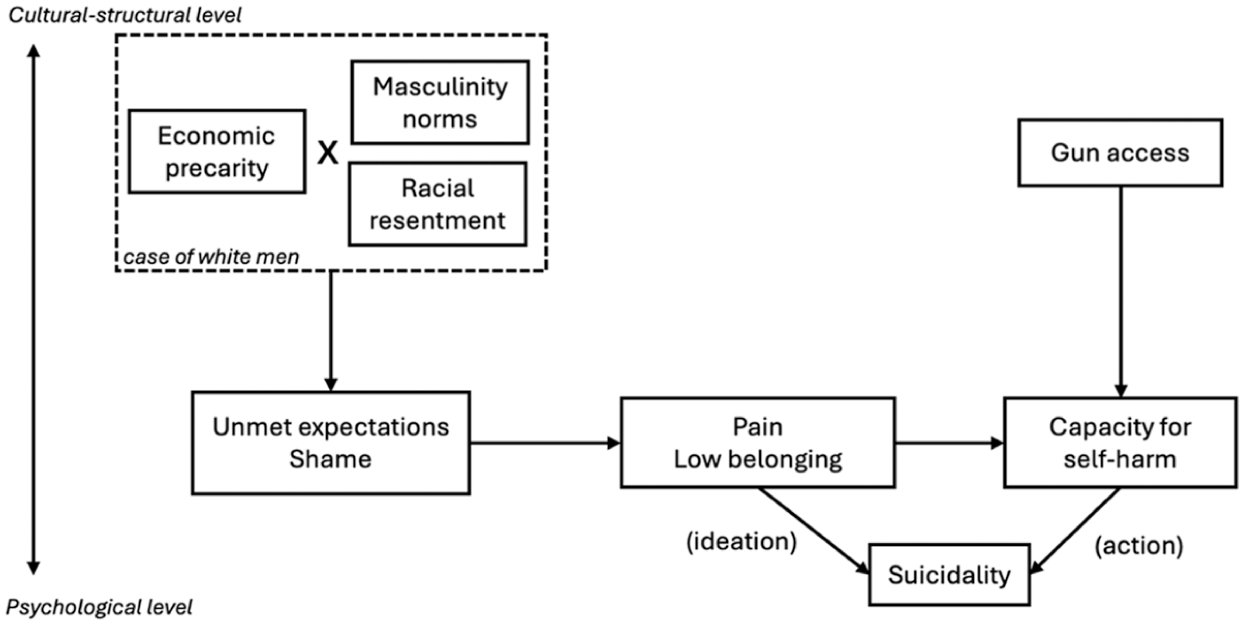
Dominant psychological and sociological theory of white men's suicide.
Psychological theories of suicide are assumed to apply across demographic groups, which is a limitation from a sociological lens. In contrast, sociological theories are more attuned to explain the suicide outcomes of specific groups by considering structural and cultural factors. In the case of white men, sociological theories center the intersection between economic precarity and white masculinity as a key contributor to suicide. Although logical, the direct linkage between economic factors and psychological distress outlined in the “deaths of despair” framework (Case and Deaton 2020) misses a crucial piece of the puzzle, namely why economic precarity may feel so acutely miserable for white men specifically.
To answer that question, sociologists have turned to cultural narratives of white masculinity as an explanatory factor in white men's suicide. Hegemonic white masculinity is an idealized, impossible achievement constantly requiring effort to maintain position at the top of the social hierarchy (Connell 1995). Economic change over the last few decades means that traditional pathways to masculine success—such as becoming a sole “breadwinner” for wife and children—are now closed (Carlson 2015b). Economic precarity is felt as distressing because it threatens men's ability to achieve the cultural ideal of what a man “should be.” White men are accustomed to high status due to their gender and race (Lewis 2004), and men, particularly those of lower socioeconomic status, may subjectively feel status threat amid changing economic conditions, even if they maintain their overall social position. In Chandler’s (2019) theorizing on men's suicide, she writes that white men who have historically expected success and status may viscerally feel a sense of “thwarted privilege” when their expectations are unmet. Changing social circumstances make traditional pathways to hegemonic masculine success, already an unattainable goal against which men will always fall short (Connell 1995), even harder to pursue. Feelings of economic precarity intersect not only with masculinity norms but also with ideas about race. As working-class white men confront both their own economic precarity and the visible success of those women and people of color who are doing better economically, status anxiety may be felt as social pain (Abrutyn 2023). White men's unmet expectations can be exacerbated by their perceived decline in relative racial status, contributing to fear and racial prejudice as white men may believe that other groups are threatening their position in the American racial status hierarchy (Blumer 1958; Siddiqi et al. 2019).
White masculinity provides a lens through which white men interpret social and economic change, culminating in the perception of status loss. Economic precarity is distressing and shameful when perceived as failure to meet the cultural expectations of masculinity among white men. Economic and social change serve as a “slow, grinding down” of white men's well-being and individual decisions to die by suicide are embedded as emotional responses to this changing context (Chandler and Wright 2024:1052). Masculinity norms often prevent men from disclosing distress or seeking help, resulting in violence and/or self-harm (Cleary 2012). Suicide may become an acceptably masculine way of enacting agency and control over a life trajectory that feels “stopped” by external circumstances (Chandler 2019).
Psychological theories of suicide highlight suicidal ideation as the result of feelings of pain. Combining these theories with sociology's cultural-structural approach paints a more detailed picture of how economic precarity interacts with masculinity norms and racial resentment to lead to unmet expectations, shame, social pain, and eventually suicide among white men, as shown in Figure 1. Yet across this existing work, firearms are limited to a deadly means of suicide, with gun access contributing only to white men's capacity for self-harm. There is evidence that firearm access increases the odds of suicide (Anglemyer, Horvath, and Rutherford 2014), and more broadly, looser gun laws correspond with higher suicide rates (Anestis et al. 2017). Yet I argue that guns matter beyond just access to a deadly means of suicide. In the next section, I introduce my novel theory of gun culture's role in suicide.
Theorizing the Role of Guns in Suicide
I offer a new theoretical contribution to the study of suicide by highlighting how gun culture positions firearms as more than just a means of dying by suicide, but as a key contributor to both suicidal ideation and action. I explain my theory using the case of white men. I first highlight, at the macro level, the relationship between a widespread form of gun culture and white men's experiences of economic precarity. Turning to the individual level, I discuss how gun culture can heighten unmet expectations into a lack of belonging and capacity for self-harm, contributing to both suicidal ideation and action.
Gun Culture and White Masculinity
For many Americans, their “identity, morality, and patriotism” are rooted in gun ownership (Mencken and Froese 2019:24), which is symbolically linked to American narratives of freedom, and independence (Cook and Goss 2014; Metzl 2019). Gun ownership is a central driver of political behavior and a meaningful social identity (Joslyn 2020). That guns have meaning is the foundation of gun culture, the shared ideologies that establish owning and wielding a firearm as a symbolic behavior. These ideologies and meanings can be specific to certain identity groups and subcultures (Yamane 2022)—for example, gun ownership was a central component of the Black Panther Party's fight for civil rights and racial equity (Bloom and Martin 2013)—and can vary geographically, such as the Southern culture of honor or the frontier gun culture of the West. Here, I focus on a specific gun culture targeted to and embraced by many white men in which guns are tools to pursue and perform masculinity amid economic and social precarity.
As promoted by the masculinity politics of the National Rifle Association (NRA) (Connell 1995), the ability to defend oneself and vulnerable others such as women and children is a way to be a “real” man, an attractive option when other pathways for achieving masculinity such as being the sole provider are constrained by socioeconomic change (Carlson 2015a). Guns thus take on particular meaning and empowerment for many white men who feel socially and economically precarious (Mencken and Froese 2019). In the face of perceived decline, guns become powerful, reactionary “symbols of belonging and of self- and community protection” (Metzl 2019:116). This symbolism was embraced by the NRA to great political effect, evident in loosening restrictions and the increasing number of Americans who own and carry guns since the 1970s (Melzer 2012). In pushing guns’ symbolic value for protection, the NRA leveraged masculinity politics to cultivate a gun culture centered around white men (Connell 1995). Guns offer the promise of return toward white male domination (Metzl 2019).
Gun culture ties together social structural changes with individual meaning-making via the pursuit of white masculinity. Gun ownership can be embraced by white men “to navigate a sense of social precariousness” (Carlson 2015a:10). Drakulich and Craig (2024) refer to some white men's “John Wayne solution” of viewing guns as a means to regain power in response to perceived status loss. Gun culture serves as a response to “a loss of American values, a loss of masculine dignity, and a loss of confidence in the state” (Carlson 2015a:11). Through this lens, performing white masculinity becomes tied up in owning and using a gun, as gun ownership is framed as a civic duty to protect one's family amid the decline of the United States into crime and chaos, especially when the state is seen as untrustworthy and unsupportive (Carlson 2015a). Buttrick (2020) digs deeper into the psychology of protective gun ownership, describing guns as a coping mechanism to inspire safety, self-efficacy, and belonging. He defines “the distinct belief structure of American protective gun owners—that the world is a dangerous place, both specifically and generally, and that government or other big institutions are essentially broken and unable to protect individuals from harm” (Buttrick 2020:836). Instead, gun ownership offers a way for a man to do “something” when the state is ineffective, asserting himself as a man who will protect and defend (Carlson 2015a; Metzl 2019), as a “warrior” who will fight (Anderson 2024). The experience of precarity viewed through the gendered and racialized lens of white masculinity paves the way for an ideology that positions owning and wielding a gun as a means to be a “good” man.
In her work on concealed carry, Stroud (2012:216) affirms gun ownership as a tool in the pursuit of masculinity: “part of the appeal of carrying a concealed firearm is that it allows men to identify with hegemonic masculinity through fantasies of violence and self-defense.” She goes on to highlight that gun ownership allows white men to feel like, and be seen as, “good guys,” rather than a disenfranchised, disempowered group in decline (Stroud, 2012). Importantly, for white men to be seen as “good guys” requires “bad guys” against which to defend, setting up the contrast between a good, moral gun owner and an “evil” attacker (Anderson 2024). This is framed broadly as fears of rising crime and the failure of policing, but given the intransigence of racial bias and stereotypes in the United States, the “bad guys” are implicitly Black or Hispanic (Metzl 2019; Stroud 2016). Fear of crime is racialized, and, in turn, gun culture and pursuant political debate about guns is implicitly racialized as well (Schutten et al. 2022). Existing survey research shows that implicit racial resentment corresponds with support for pro-gun policy (Dowd-Arrow et al. 2024). The NRA's logic that firearm ownership makes one a “real man” who can defend from danger taps into both masculinity norms and racial resentment. This form of gun culture ideologically positions the pursuit of white masculinity as an armed conflict against a racialized other. Thus, it is mutually reinforcing with the masculinity norms and racial resentment that intersect with experiences of economic precarity.
Gun Culture and Suicide
Existing work in the sociology of suicide has already theorized that the perception of precarity, felt through the lens of white masculinity, can lead to psychologically harmful feelings of unmet expectations and shame and ultimately suicide. In this section, I theorize how gun culture is likely to contribute in several places to that pathway. Most obviously, gun culture drives gun access. Gun culture and its powerful promoter the NRA ensure that guns are easily accessible. White men embedded in gun culture are likely to own a gun, if not multiple. Almost one-third of Americans own guns, and nearly half live in households where guns are present (Gallup, Inc 2020). The gun culture to gun access pathway is clear.
Beyond access, I posit that gun culture can shape psychological experiences in two additional ways. First, gun culture can alleviate or exacerbate whether and how the unmet expectations and shame experienced as a result of economic precarity lead to pain or lack of belonging. It is possible that gun culture could be protective in that guns offer a coping mechanism, “a primary means of self-defense in an increasingly unsafe world” (Metzl 2019:74). Gun culture posits gun ownership as a pathway for belonging, a way to be a “good” man and mitigate shame. Individuals may also form social ties around gun ownership (Anderson 2024; Kalesan et al. 2016). However, this imagined scenario in which gun culture is protective conflicts with the racial resentment central to this specific gun culture and the interpretation of economic precarity as a loss of relative racial status. Put differently, other gun cultures may be psychologically protective if they can offer feelings of belonging and a viable path for coping—this is worth exploring in future research—but the NRA-sponsored gun culture tied to white masculinity is more likely to threaten the sense of belonging necessary for suicide prevention due to its undercurrent of racial resentment.
The racial undercurrent of gun culture is problematic in and of itself in that it promotes racist, harmful stereotypes about men of color being criminals (Russell-Brown 2021). But racialized fear of crime and desire for protection also lead to avoidance, social disintegration, and the loss of community ties (Marx and Archer 1976). The belief that self-defense is necessary promotes mistrust and fear (Celinska 2007; Messner and Rosenfeld 2012). Racial resentment, desire for self-defense, and fear of others contributes to social isolation as people engage in community policing (Carlson 2015a). Broader feelings of belonging are threatened by and at odds with a desire for self-defense and mistrust of racialized others (Marx and Archer 1976). In short, it is likely that racialized gun culture would worsen feelings of pain and isolation among white men.
A second way in which gun culture can be psychologically harmful is that it increases the capacity for self-harm. Violent behavior—the use of firearms—is framed as not only justifiable but also a necessary component of being a “real man.” Gun culture puts forward firearm violence as a primary option to navigate heightened emotional distress, particularly when other pathways like help-seeking are viewed as unmasculine (Cleary 2012). Within narratives of gun culture, guns are not a tool but a way of life. In his ethnography of gun culture, Anderson (2024) describes a cyborg-esque intimacy between gun owner and gun, leading to deeply emotional, “embodied vigilance.” The powerful ideology and symbolism behind guns, coupled with their physicality, instills gun carriers with the power to enact harm through guns as an extension of the self. Furthermore, by explicitly legitimizing violence against others, justified as self-defense, gun culture creates a culture in which violence is normalized (Galtung 1990). The use of deadly force enters individuals’ cultural repertoire as a reasonable, justifiable option they may choose to deploy (Swidler 1986; Vaisey 2009).
Figure 2 summarizes my novel theoretical contribution. By adding gun culture to existing theories of white men's suicide, I underscore that guns are more than simply a means of acting on suicidal ideation. The salience of gun culture to many white men ties the cultural-structural factors of economic precarity, white masculinity, and racial resentment together, increasing the likelihood that white men will experience a heightened lack of belonging and develop the capacity to use violence to cope with pain and isolation. Much of the existing work on gun culture draws on qualitative evidence such as interviews and ethnography to highlight cultural ideas and their salience among subpopulations like white men (Anderson 2024; Carlson 2015a; Metzl 2019; Stroud 2016). Gun culture's relevance to many white men, and impact on their worldview, is well established. Quantitatively linking gun culture with suicide, however, requires a different approach. Here, I construct and leverage a quantitative measure of the strength of gun culture at the state level and empirically assess how it corresponds with suicide rates among white men, offering initial empirical evidence of my theory. I further show that in states with higher proportions of recent migrants of color—where racial threat is potentially made salient—gun culture becomes even more predictive of suicide, underscoring that fear of a racialized other is an important moderator.
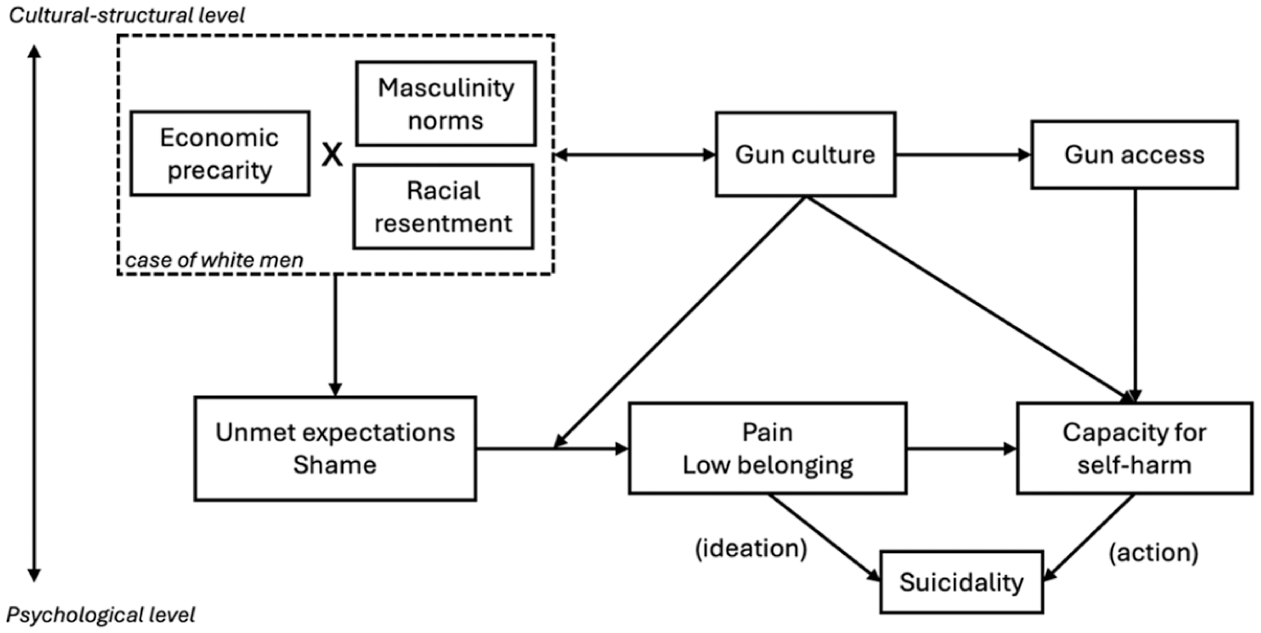
A sociological elaboration of the role of gun culture in white men's suicide.
Data and Methods
To measure the relationship between gun culture and suicide mortality, I combine multiple sources of data. Beginning with the dependent variable, I use Centers for Disease Control and Prevention (CDC) Underlying Cause of Death state-level age-adjusted mortality rates per 100,000 residents in 2021 (United States Department of Health and Human Services (US DHHS), CDC, and National Center for Health Statistics (NCHS) 2021). I focus on suicide rates among non-Hispanic white men, who experience some of the highest rates of suicide by firearm (CDC 2024). Data come from death certificates, and I limited the selection to individuals aged 15 to 84 at their time of death whose cause of death was listed as intentional self-harm by firearm. In Supplemental Table A1, I also provide analyses of intentional self-harm by other means.
The primary independent variable is a measure of state-level gun culture constructed using the American National Election Survey (ANES) 2020 Time Series Study (American National Election Studies 2021). Fielded between August 2020 and January 2021, ANES is a representative survey of U.S. eligible voters. The initial sample size was 6,448 respondents, which I collapse to the state level. State sample sizes for ANES are included in Table 1. Because some states have a very small number of respondents, in Supplemental Table A2, I include analyses limited to states with at least 30 respondents to show that my findings are robust to small state sample sizes in ANES.
Descriptive Statistics by State.
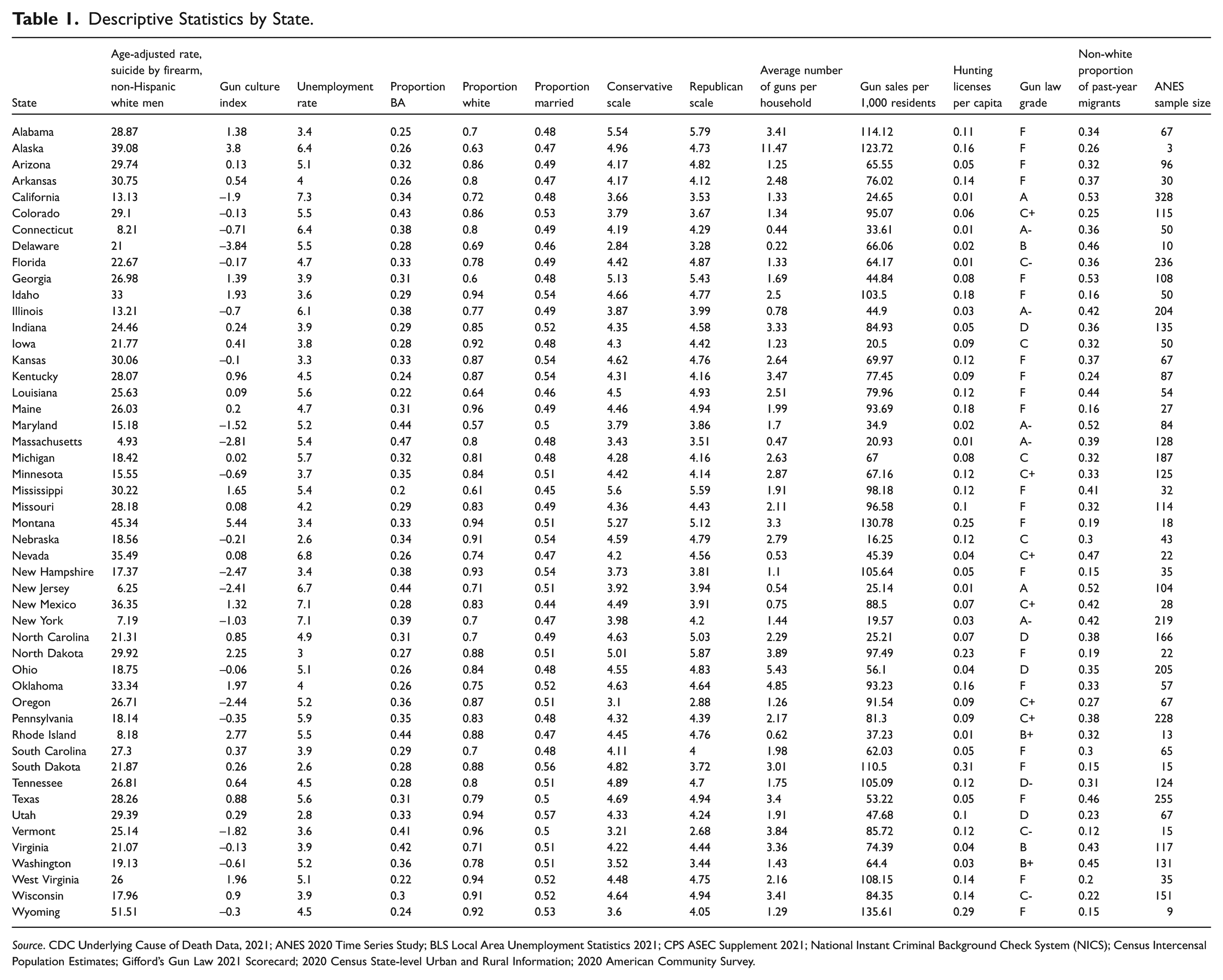
Source. CDC Underlying Cause of Death Data, 2021; ANES 2020 Time Series Study; BLS Local Area Unemployment Statistics 2021; CPS ASEC Supplement 2021; National Instant Criminal Background Check System (NICS); Census Intercensal Population Estimates; Gifford's Gun Law 2021 Scorecard; 2020 Census State-level Urban and Rural Information; 2020 American Community Survey.
Given the controversy of firearm legislation in recent years, ANES added more detailed measures of support for various means of gun control in their 2020 Time Series questionnaire, making it a thorough source of data for attitudes regarding guns. I used five variables to capture gun culture: a binary measure of whether the respondent believes the federal government should make it easier to buy a gun, or keep the rules the same (1 = should make it easier or keep it the same, 0 = should make it harder), a measure of how often respondents trust the federal government to do what's right (reverse coded, 5 = never, 1 = always), and three Likert scales measuring opposition to background checks for gun purchases, banning the sale of semi-automatic “assault-style” rifles, and mandatory government buy-backs of semi-automatic assault-style rifles (7 = oppose a great deal, 1 = favor a great deal). These five measures capture the essence of defensive gun culture: mistrust of the government and a desire for easier access to guns. The measures focus on attitudes toward restriction that are highly related to feelings of gun empowerment and gun culture (Lacombe, Howat, and Rothschild 2019; Mencken and Froese 2019). The index specifically excludes gun ownership, which I include separately in the model (see below). After averaging the data at the state level using population weights provided by ANES, the five measures were combined into an index measuring state gun culture using principal component factor analysis (Eigenvalue = 3.38).
Gun ownership and attitudes are linked to party affiliation and political views (Joslyn et al. 2017). I used ANES to construct two control variables to capture the political climate of each state. I leverage state-level weighted average responses on scales measuring conservativeness (7 = extremely conservative, 1 = extremely liberal) and party identification (7 = strong Republican, 1 = strong Democrat). As additional controls, I include state-level unemployment rates for 2021 (U.S. Bureau of Labor Statistics 2024) and state-level demographic information regarding race (proportion white), educational attainment (proportion with a bachelor's degree), and marital status (proportion married) from the 2021 Current Population Survey (CPS) Annual Social and Economic (ASEC) supplement accessed through the Integrated Public Use Microdata Series (IPUMS) (Flood et al. 2022). The CPS is a representative population survey collected at the individual level; I limited my sample to civilian noninstitutional residents aged 15 to 84. I then collapsed the data to population-weighted means at the state level to match the level of analysis of the outcome and unemployment data. I also include a measure of the proportion of state residents residing in a rural area using Urban Area data from the U.S. Census Bureau (2023).
Gun culture is intertwined with gun access, and I rely on several controls to separate the two. As there is no national registry of gun ownership, estimating the number of guns in the United States is a challenging task. Most studies rely on a well-established proxy for gun ownership: the proportion of suicides by firearm among all suicides (Kang and Rasich 2023; Siegel, Ross, and King 2014). However, this measure cannot be used to predict suicide mortality as the dependent variable (Lang 2013). I instead combined three proxy measures of firearm ownership. I first used responses to a question from ANES on how many guns the respondent or anyone else living at their residence owns to create an average measure of guns per household. Although self-reported, this measure provides one estimate of gun access. As a second and well-established measure of gun access, I rely on a measure of gun sales in 2021 calculated from the National Instant Criminal Background Check System (NICS) using a method developed by Aisch and Keller (2015) that produces estimates of the number of gun sales per 1,000 residents. 1 This measure focuses on handgun and long gun sales, the types of firearms used in suicide attempts (Wintemute et al. 1988). As a third proxy, I follow the recommendation of Siegel et al. (2014) and include a measure of hunting licenses per capita in 2021 (U.S. Fish and Wildlife Service 2025).
As a final control, I use data compiled by Gifford's Law Center, a non-profit devoted to reducing gun violence that compiles an annual Gun Law Scorecard measuring the strength of the state's gun legislation. States with stronger gun laws receive higher grades on an A to F scale. I use the 2021 Gun Law Scorecard and collapse the grade categories into a 5-point scale in which A grades are measured as 5, B grades as 4, and so on to F grades which receive a score of 1. On this scale, higher values indicate stronger gun legislation. Using a broad measure of gun control legislation controls for the extent to which tighter restrictions work as means reduction to prevent suicide mortality, allowing the model to capture gun culture apart from legislation. Descriptive statistics by state for all measures are included in Table 1. The District of Columbia and Hawaii are excluded from analyses due to suppressed suicide data. 2
To investigate perceived racial threat as a component of the relationship between gun culture and suicidality, I use a state-level measure of migration of people of color. I rely on a variable from the 2020 American Community Survey (ACS) accessed via IPUMS (Ruggles et al. 2025) measuring migration over the previous year. The variable indicates whether the respondent changed residences in the past year, which I used to identify new migrants to the state, whether coming from another U.S. state or from abroad. For each state, I calculated the population-weighted proportion of recent migrants who identify as non-white. The models also control for the proportion of white residents in a state to separate pre-existing racial diversity from the in-migration of people of color.
The model is a negative binomial regression model of suicide mortality on the gun culture index plus controls. In the final model, I interact my racial threat indicator with the gun culture index. I rely on negative binomial regression to accommodate the over-dispersion of mortality rates and use heteroskedasticity robust standard errors. I performed statistical analyses in R version 4.4.0 (R Core Team 2024), and tables were constructed using the stargazer package (Hlavac 2022). All tests indicate significance at the 95 percent level.
Results
Figure 3 plots age-adjusted firearm suicide rates for non-Hispanic white men and gun culture indices by state, with a line of best fit constructed using ordinary least squares (OLS) regression and 95 percent confidence bands. Note that some states are not named on the figure due to overlap in the point labels. There is a significant (P < .001) positive relationship such that states with stronger gun culture also generally have higher rates of suicide. For example, Alaska and Montana have both strong gun culture and high suicide rates by firearm among white men, while Delaware and Massachusetts have weak gun culture and lower rates of suicide.
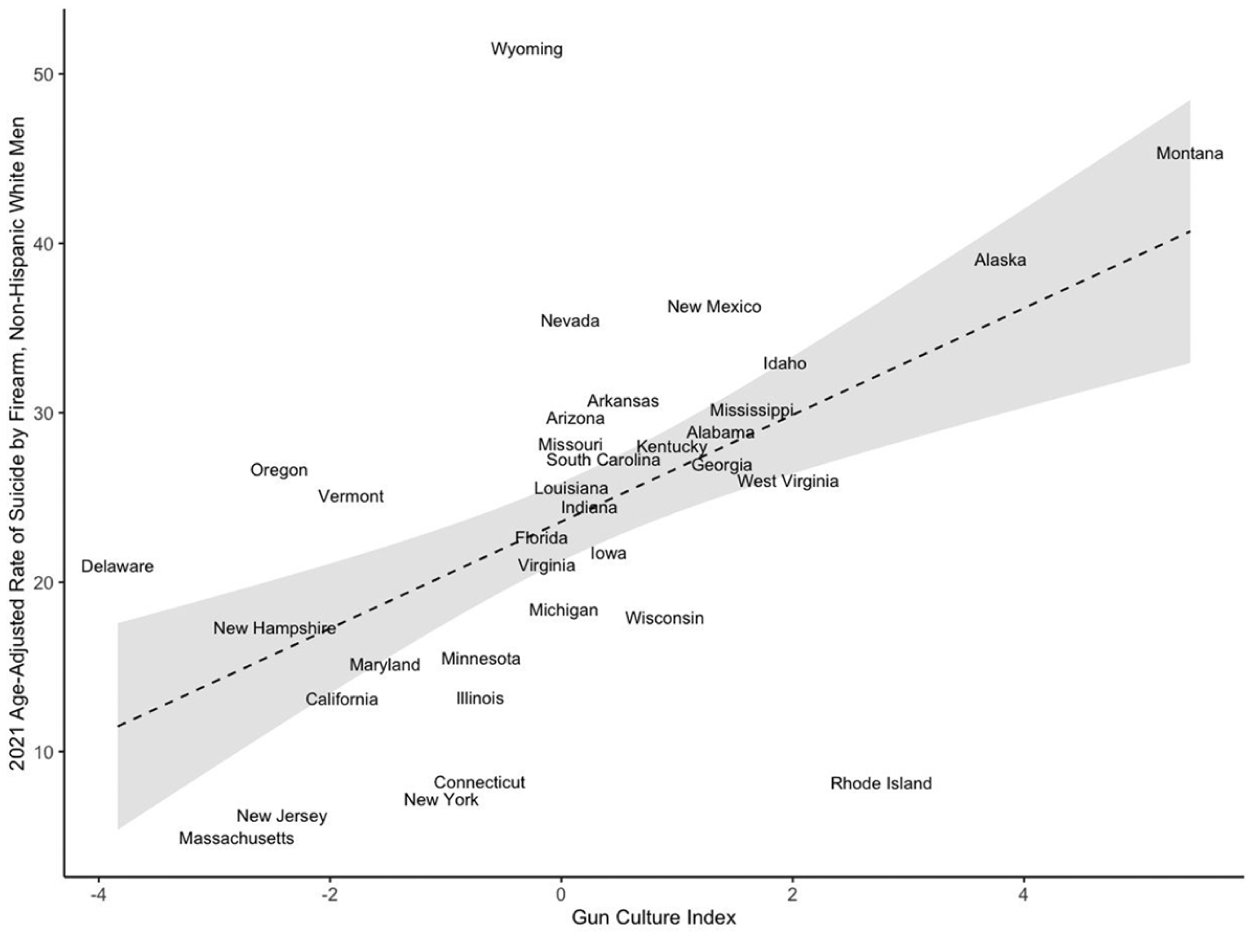
The relationship between gun culture and firearm suicide rates for non-Hispanic white men.
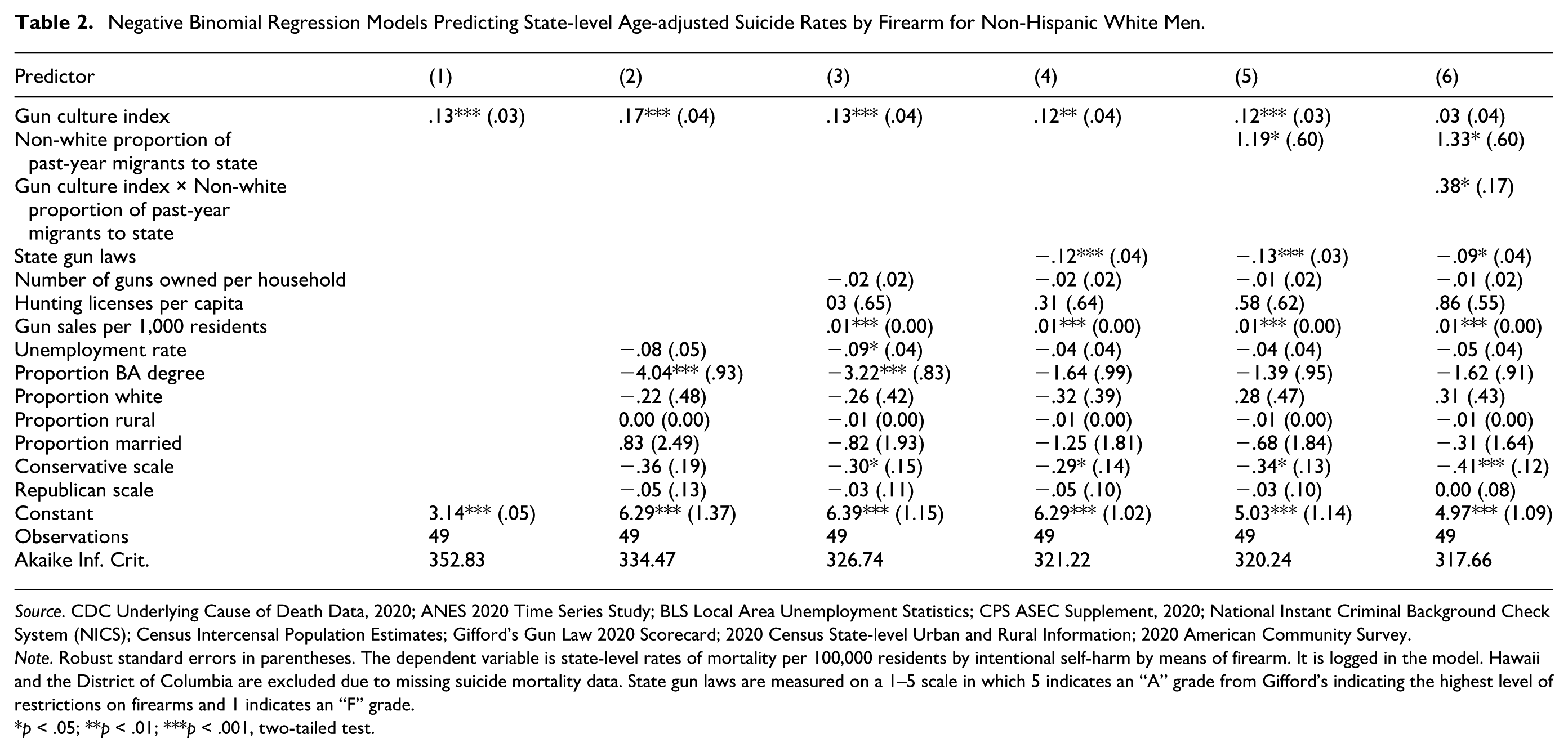
Model 1 in Table 2 confirms the significance of this relationship. An increase of one standard deviation in the gun culture index is associated with a significant 0.13 increase in logged suicide rates (P < .001). Exponentiating the negative binomial coefficient to an incidence rate ratio shows that the suicide rate is predicted to increase by a factor of 1.14 or 14 percent as gun culture increases. After controlling for state demographics including the unemployment rate, the proportion of residents with a bachelor's degree, proportion of white residents, proportion of married residents, proportion of rural residents, and the scale measures of conservative attitudes and Republican party affiliation, the significant positive relationship between gun culture and white men's suicide mortality by firearm remains (Model 2).
Negative Binomial Regression Models Predicting State-level Age-adjusted Suicide Rates by Firearm for Non-Hispanic White Men
Source. CDC Underlying Cause of Death Data, 2020; ANES 2020 Time Series Study; BLS Local Area Unemployment Statistics; CPS ASEC Supplement, 2020; National Instant Criminal Background Check System (NICS); Census Intercensal Population Estimates; Gifford's Gun Law 2020 Scorecard; 2020 Census State-level Urban and Rural Information; 2020 American Community Survey.
Note. Robust standard errors in parentheses. The dependent variable is state-level rates of mortality per 100,000 residents by intentional self-harm by means of firearm. It is logged in the model. Hawaii and the District of Columbia are excluded due to missing suicide mortality data. State gun laws are measured on a 1–5 scale in which 5 indicates an “A” grade from Gifford's indicating the highest level of restrictions on firearms and 1 indicates an “F” grade.
p < .05; **p < .01; ***p < .001, two-tailed test.
Traditionally, the relationship between firearms and suicide mortality focuses on a means pathway, in which firearms are primarily thought of as a deadly means to enact suicide. Model 3 adds the three controls for firearm access, including the average reported number of guns per household from ANES, a population-adjusted measure of gun sales captured through NICS background checks, and per capita hunting licenses. Although gun sales are predictive of suicide, the gun culture index remains significantly predictive of suicide mortality. Gun culture correlates to suicide mortality by firearm not merely through the prevalence of guns.
Model 4 adds a measure of the strength of state gun laws, measured on a scale from 1 to 5. Net of state demographics, gun culture, and other measures in the model, stronger gun laws are significantly negatively correlated with suicide mortality. This finding is consistent with a large body of literature that highlights this pattern and names firearm restrictions as key to preventing suicide (Alban et al. 2018; Kaufman et al. 2018). Net of other factors, an increase in one grade on the Gifford's Gun Law Scorecard corresponds with a 11.3 percent decrease in suicide mortality by firearm for white men. Yet even controlling for firearm legislation, gun culture remains significantly predictive of suicide mortality. The beliefs about gun legislation that make up gun culture can be measured separately from actual state legislation and are separately relevant for suicide mortality. Together, these four models highlight that states with stronger gun culture also experience higher rates of suicide by firearm among white men, net of demographic characteristics, gun access, or legislation. Gun culture itself corresponds with suicidality.
Model 5 includes a measure of the proportion of past-year migrants to a state who are non-white, proxying racial threat. The coefficient is positive and statistically significant, net of gun culture and other controls, providing initial evidence that racial threat is a contributing factor to white men's suicide. Model 6 tests whether racial threat moderates the relationship between gun culture and suicide mortality among non-Hispanic white men. The interaction term is positive and significant, suggesting that the relationship between gun culture and suicide mortality is stronger in states with more non-white recent in-migrants. Estimated marginal means from Model 5 are presented in Figure 4, highlighting this finding more clearly. White men residing in states with both an uptick in non-white migrants and a strong gun culture are more likely to die by firearm suicide. Connecting to my theory, I posit that the defensive, violent logic of gun culture is more salient given the visible presence of a racialized other, heightening negative emotions like fear, racial threat, and violence.
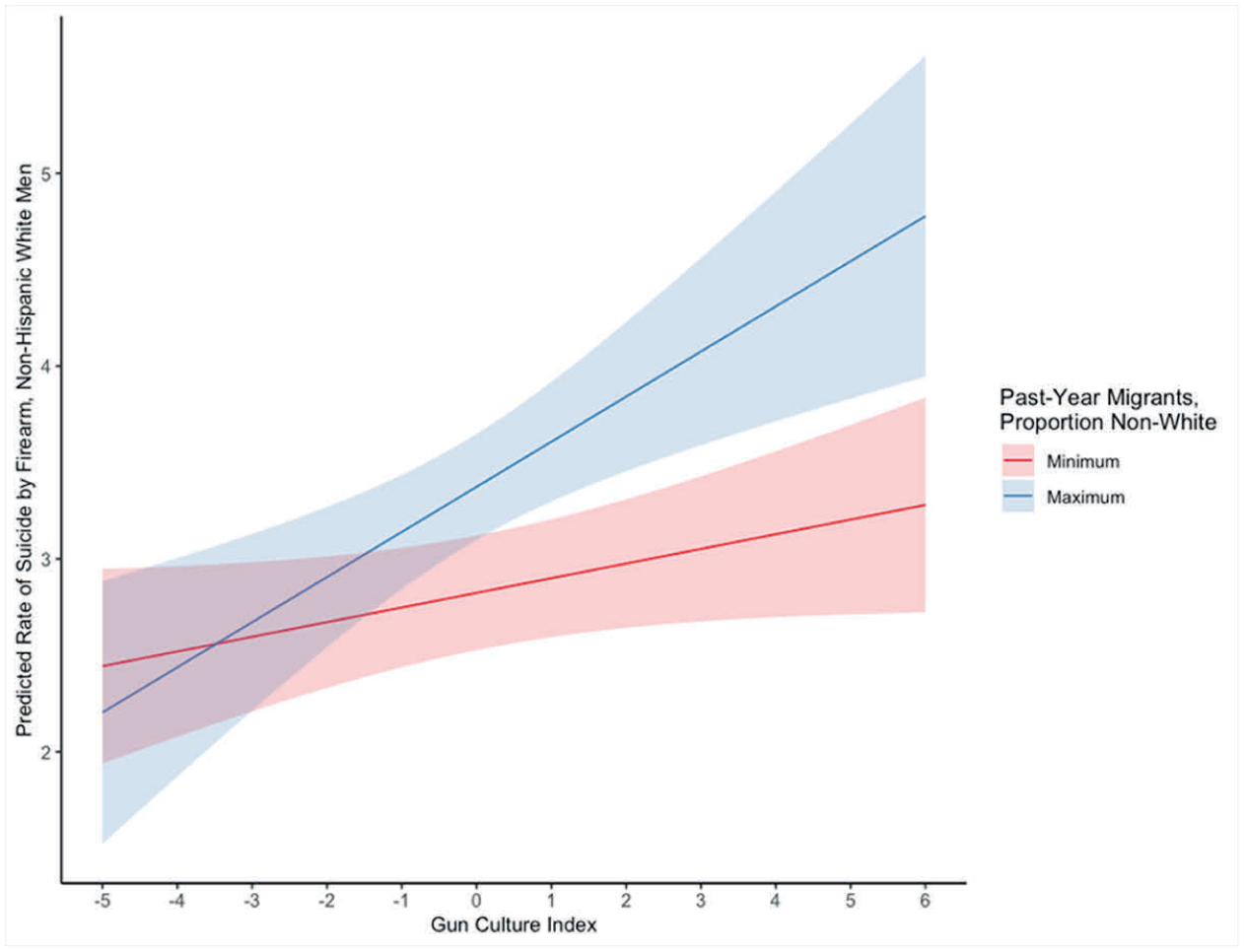
Predicted suicide by firearm from interactions of gun culture and past-year non-white migration.
Discussion and Conclusion
This article contributes a novel theory of the role of guns in suicide, leveraging the case of white men to highlight how guns are not just a deadly means of suicidal action but an epicenter for cultural forces that drive suicidal ideation. I combine existing sociological work on white men's suicide as driven by feelings of masculinity-based shame around economic precarity with work on gun culture. Gun culture is complex and multiple, consisting of the shared ideologies that establish owning and wielding a firearm as a meaningful, symbolic behavior. I focus on a particular gun culture lauded by the NRA as a pathway toward being a “good” (white) man, and highlight its intersection with perceived economic precarity, white masculinity, and racial resentment. As a key theoretical contribution of this article, I outline the multiple ways in which gun culture may exacerbate the psychological harms of cultural-structural factors. The dual lens of white masculinity and racial resentment makes visible how gun culture can lead to social pain, lack of belonging, and the capacity for self-harm.
I offer an initial empirical test of my theory by developing a measure gun culture at the state level. I show that it independently correlates with suicide mortality among white men, net of gun sales, gun ownership, politics, legislation, and state demographics. I also show that past-year non-white migration, which I use to proxy racial threat, both directly contributes to white men's suicide and strengthens the relationship between gun culture and suicide. My findings expand our understanding of the role of firearms in white men's rising suicide rates, demonstrating that their symbolic value matters above and beyond their use as a widely available means to act upon suicidal ideation. Gun culture can be understood as a cultural driver of suicide for white men in that it may heighten feelings of threat in response to social structural determinants such as economic and social change and offers firearms as a potential solution. This perspective requires an understanding of culture as a key link between macro-level social change and the micro-level decision to die by firearm. While sociologists of suicide have already considered the role of culture, this work encourages a new research agenda focusing on gun culture specifically. As I argue, in communities that embrace gun culture, social change is more likely to be interpreted as a racialized and gendered threat to white men's social dominance, and firearms to symbolize protection. The symbolic meanings of firearms as protective paradoxically contribute to isolation, fear of an imagined racial threat, and willingness to engage in violence.
To outline my theory of gun culture's role in suicide, I have focused on the case of white men, who demonstrate higher rates of suicide by firearm and are at the center of a visible gun culture. I argue that the racial resentment that characterizes some white men's embrace of a gendered and racialized gun culture exacerbates the way in which unmet economic expectations and masculine shame contribute to feelings of isolation and a lack of belonging. I also empirically show that gun culture is related to non-Hispanic white men's suicide mortality rates, and that this relationship is stronger in states with a higher proportion of non-white recent migrants, where white men may be more likely to experience racial threat. To underscore that these findings are unique to white men, I include in Supplemental Table A1 analyses of all-cause suicide among Hispanic and Black men. I find no evidence of a relationship between gun culture and suicide mortality for Hispanic or Black men. I use all-cause mortality information to increase the sample size, though the results are equivalent when using firearm suicide. The lack of relationship may be due to the small sample size, as there is more missing data among these populations due to the suppression of small cell counts by the CDC. Future work could find alternative methods to assess the impact of various gun cultures on the well-being of Black and Hispanic men. Nevertheless, that there is no evidence of a relationship between gun culture and Black and Hispanic men's suicide suggests that racial threat is a key component of gun culture's psychological harm.
Considering gender, in Supplemental Table A1, I also include analyses for white women that indicate a similar relationship between gun culture and suicide when looking at suicide by firearm or by any means. Gun culture at the state level similarly fosters suicidality among women, despite that women are less likely to embrace gun culture themselves, and generally more likely to support gun control (Celinska 2007; Filindra and Kaplan 2016). Since gun culture is linked to misogynistic beliefs (Drakulich and Craig 2024), white women's suicide rates may be driven not by their own subscription to gun culture but by fear of gender-based violence from white men. This is worth empirical consideration to gain a richer understanding of gun culture's relationship to suicide outcomes among women.
Future work on gun culture should also consider its multiplicity. Gun culture in the twenty-first century centers a perceived need for self-defense (Yamane 2022). I focus on a subculture bolstered by the NRA that cites a need for self-defense by white men from an imagined racial threat (Carlson 2015a). Notably, not all white men embrace this gun culture. And, other gun cultures have arisen in recent years, for example, a growing gun culture among transgender individuals who view guns as both a means of protection against discrimination-related threats and an empowering source of community (Anderson 2023). This and other gun cultures may increase feelings of belonging and safety. Gun owners across demographic groups may find community within gun-related political and social groups, contributing to a protective effect against suicidality. Future research should consider how other gun cultures may be alternately harmful or protective, extending the theory outlined here to other empirical cases.
The main limitation of this analysis is that it did not measure pain or belonging, or racial and masculine threat directly at the individual level. Doing so would offer more robust evidence for my theory of gun culture's role in suicide. Although I offer preliminary evidence that gun culture corresponds with higher suicide rates among white men, patterns across states cannot dive into individual psyches. Future research must explore the pathways between attitudes toward firearms and other outcomes like belonging, trust, fear, and psychological distress, among others, to show the psychological consequences of gun culture at the individual level. More and better measures of gun attitudes across demographics, geographies, and time are a key area of opportunity to further capture gun culture empirically. In particular, county-level measures of gun culture would strengthen the cultural-structural perspective offered here because culture is highly localized (Abrutyn and Mueller 2018). Although contested, improved measures of gun ownership in the United States would aid in determining to what extent suicide is driven by access to a deadly means versus a cultural pathway. Additionally, the theory would be strengthened with more specific measures of racial threat. The indicator I use here—past-year non-white migration at the state level—proxies racial threat under the assumption that white men would experience the in-migration of people of color as threatening. To more concretely measure experiences of racial threat would require an indicator of racial resentment at the individual level or more localized measures of non-white migration at the county or neighborhood level.
Despite these limitations, I offer two key contributions to the sociology of mental health. First, as a direct contribution to the sociology of suicide, I show empirically that a means-based pathway is not the whole story linking firearms and suicide. Rather, the symbolic meanings of gun ownership can foster the psychological preconditions of suicidality. In particular, the self-defense-based gun culture promoted by the NRA as a pathway toward white masculinity can be psychologically harmful to white men. Working alongside access, gun culture contributes to the pathway linking guns and suicide, requiring attention to the relationship between structural changes and cultural meaning-making. Second, my theory and findings suggest that men's mental health is affected by economic precarity in more complicated ways than a simple “despair” argument. I highlight gun culture as one key factor that may be worsening white men's psychological distress, despite being framed as a coping tool and means of regaining status. Attending to cultural drivers of psychological distress highlights how economic changes may be felt as status loss, isolation, and racial resentment, exacerbated by how gun culture can amplify feelings of threat and exalts violence. More than just a means to act on despair, guns and their symbolic implications can contribute to pain and isolation in highly racialized and gendered ways, leading to suicide and likely other mental health morbidities. To conclude, not only must research on suicide and men's mental health consider gun culture as a powerful shaper of meaning-making, but a fuller explanation of firearm violence must also extend beyond a means reduction approach to consider how the cultural meanings and symbolism of firearms can be psychologically damaging.
Supplemental Material
sj-pdf-1-smh-10.1177_21568693261453765 – Supplemental material for More than a Means: The Relationship between Gun Culture and Suicide
Supplemental material, sj-pdf-1-smh-10.1177_21568693261453765 for More than a Means: The Relationship between Gun Culture and Suicide by Amy L. Johnson in Society and Mental Health
Footnotes
Acknowledgements
The author gratefully acknowledges the helpful suggestions of the editor, anonymous reviewers, Seth Abrutyn, and attendees of the Suicide Cultures Reimagining Suicide Research Symposium.

Funding
The author received no financial support for the research, authorship, and/or publication of this article.
Declaration of Conflicting Interests
The author declared no potential conflicts of interest with respect to the research, authorship, and/or publication of this article.
Supplemental Material
Supplemental material for this article is available online.
Notes
References
Supplementary Material
Please find the following supplemental material available below.
For Open Access articles published under a Creative Commons License, all supplemental material carries the same license as the article it is associated with.
For non-Open Access articles published, all supplemental material carries a non-exclusive license, and permission requests for re-use of supplemental material or any part of supplemental material shall be sent directly to the copyright owner as specified in the copyright notice associated with the article.
