






Abstract
The current systematic study examines intercultural marriages portrayed by two YouTube vloggers through their content. A total of 25 videos were collected from each of the two selected YouTube channels, namely The Modern Singhs and Pakistani Korean. The analysis was carried out through corpus-assisted discourse analysis. Drawing on high-frequency semantic frames of nouns as quantitative data, the study employed Fillmore’s Frame Semantics theory to qualitatively analyze intercultural discourse, with particular focus on the frames of “marriage” and “culture.” The analysis reveals that both YouTube channels portray intercultural marriages in a positively, although within distinct marital contexts. The findings highlight how marriage and culture in both corpora symbolizes cultural union and personal struggle. Finding reflects marriage as different intercultural experiences and culture acting both as a barrier and a connection point. Furthermore, it indicates that the two channels present intercultural marriage in a dramatically different manner. Modern Singh focuses on tension between parents, humor and cultural integration, and it has been depicted through the scenes of exchanging their culture and handling clash of culture. The Pakistani Korean channel pays more attention to practical social pressures. They are associated with traveling, visa, immigration, and family pressure, in which the words “visa” and “hijab” denote more institutional and identity negotiations. Even though both portray marriages as emotionally satisfying, Pakistani Korean stories are more in touch with the real-life duties, whereas The Modern Singhs are more in touch with the symbolic unity and cultural accommodation.
Plain Language Summary
This study investigates how intercultural marriage is represented on two YouTube channels: The Modern Singhs and Pakistani Korean vlog using corpus-assisted discourse analysis and Frame Semantics theory. High-frequency nouns such as marriage, culture, family, and music were identified by using the corpus tool of Sketch Engine. The analysis focuses on frequently used nouns such as marriage, culture, family, and music to understand how couples describe their cross-cultural experiences. The findings show that the two channels highlight different aspects of intercultural life. The Modern Singhs often talks about family relationships, cultural traditions, and everyday challenges within a blended household. Their language presents marriage as a space where emotions, rituals, and cultural identities come together. On the contrary, Pakistani Korean channel, gives more emphasis on entertainment, national identity, food, and parental approval, with music emerging as a key way the couple connects across cultures. The comparison reveals that each channel tells a different story about intercultural marriage. While one focuses on deeper cultural tensions and family expectations, the other highlights practical challenges, shared activities, and everyday cultural negotiation. Although the study is limited by the small sample size. It offers useful insight into how couples represent their cross-cultural relationships online and how language shapes the way intercultural marriage is understood by digital audiences.
Introduction
The Digital Landscape and Cultural Exchange
The 21st century has witnessed an unprecedented acceleration in globalization, facilitated by digital technologies that dissolve geographical and cultural barriers (Castells, 2018). Social media platforms, particularly YouTube, Instagram, and TikTok, have emerged as powerful mediums for intercultural dialog, allowing individuals to share personal narratives that transcend national boundaries (Jenkins et al., 2020). It is a remarkable achievement given that 50 million users post 300 hr of videos on YouTube each minute (Statista, 2023). According to the Report of Global Media (June, 2025), Many vloggers are recording and sharing their daily lives which reflect cultural diversity. One of the most engaging aspects of this field is intercultural marriage, a phenomenon that mirrors the confusions and compromises of uniting individual cultural identities (Romano, 2021). Carey (2007) defines communication as a ritual as a way of attaching meaning to shared beliefs by communities. This is done to build to sustain and redefine shared knowledge through sharing ideas, experiences and values. Social media such as YouTube have become significant platform in the world that portray interactions facilitating multidimensional discourse in the digital era (Perloff, 1993). Garcia et al. (2022) describes that intercultural marriages were often stigmatized in the past, have become increasing due to the worldwide migration, international education, and the digitalized matchmaking. However, stereotypes, family norms, and media images are still influencing the social perception of such marriages (Matsumoto & Hwang, 2019). Vloggers provide a unique insight into intercultural relations that allows the viewers to see the reality of such unions, their successes, and obstacles. They also add to a new type of digital cultural diplomacy, where individual stories promote greater acceptability among society (Shuter, 2021). According to DeLuca (2020), vloggers are viewed as cultural intermediaries, who turn their personal experiences into easily digestible information that is informative and entertaining. As an example, Jubilee and Asian Boss are programs where intercultural couples are interviewed. Meanwhile, Elena and Ben (Russian Kenyan couple) and The Black Japan (Black American man married to a Japanese woman) are single creators giving a personal account of their mixed cultural lives (Kim & Lee, 2021).
These vlogs play various roles including the role of normalization. Vloggers make intercultural relations less mysterious by presenting banal but significant moments (e.g., holiday celebrations, language barrier, food preferences), falsifying common myths, like intercultural marriages are not inherently unstable or that one culture outshines another (Nakayama & Martin, 2019). Education is a common theme by which vloggers address the misconceptions, like the belief that intercultural marriages are not necessarily unstable or that one culture prevails over the other (Nakayama & Martin, 2019). Vloggers selectively represent their relationships by focusing on some and ignoring others (Hall, 2020). The paper explores the ways the vloggers construct intercultural marriages and their contribution to cultural fusion in the digital era.
Research Gap
Although the number of vlogs featuring intercultural marriage is on the increase, there is a major gap in research of how vloggers use language and content to semantically construct the complexities of intercultural relationships. In particular, there is a limited research regarding the usage of various nouns by different vloggers as a semantic frame to reflect intercultural marriage. In this respect, the present study is comprehensive enough to examine the high frequency nouns, comparison of various nouns on intercultural marriage, and semantic frames of various nouns using marriage and culture by each YouTuber in terms of Frame Semantics theories provided by Fillmore (1982).
Significance
The multi-layered meaning of the present study incorporates the rigorous, empirical examination of one of the most popular and least researched forms of the modern media intercultural marriage vlogging on YouTube. The research goes beyond mere media criticism and provides a tangible theoretical support on the formation and expression of multicultural identities in the digital world. This study has an important methodological impact as it has used corpus-assisted discourse to analyze the dynamic, ever-changing content of the YouTube vlogs. This study creates an empirical basis by defining and quantifying high frequency nouns and semantic frames of their understanding and therefore instead of focusing on the subjective interpretation of the intercultural discourse, the study relies on objective and data-driven findings.
The frequency counts of the noun “culture” that is repeated 33 times in The Modern Singhs and the noun “culture” that is repeated 2 times in The PakistaniKorean, can be considered as a noun tagging, which accurately identify the major themes each channel. This statistical opposition is central to their narrative emphasis. The study provides useful insights on the way in which intercultural communication is publicly mediated and enacted the fact that The Modern Singhs employs the noun of marriage 10 times in the context of the union and partnership and that the discourse also employs the word culture numerous times to elaborate on the customs of the Punjabi Sikhs and the British Scottish traditions, shows that the discourse is dedicated to the overlap of two different cultural identities.
Conversely, The PakistaniKorean has a lower frequency of “marriage” (6 times) and “culture” (2 times) nouns, which indicates a strategic or natural emphasis on relational and everyday domestic vlogging. This lexical variation tells researchers the way in which various couples decide to enable prioritization in their lives of what grand cultural discourses focus on instead of daily life to enlighten a global community.
The research is of great relevance to media researchers who investigate the influential role of platform-specific content creators
YouTubers such as Money Sighn and Faheela Muzafar, serve as cultural intermediaries, digesting the complex experiences of challenge, acceptance, and rejection into the digestible intercultural marriage experiences. The linguistic evidence demonstrates the use of nouns have an effect on millions of viewers about the idea of multicultural families.
Based on the discussion of the narration of these mainstream media, the work provides an insight into the normalization and framing of cross-cultural relations by the digital media. Findings provide a critical insight cultural aspects (e.g., tradition, identity, union) in the context of achieving engagement with an audience.
To conclude, the strength of the research is that it has a strong corpus-assisted discourse analysis approach and has presented tangible evidence of how frame semantic theory are applied in the creation of intercultural identities in YouTube vloggings, to gain deeper insights into digital discourse studies and the conception of intercultural communication in the modern and digital world.
Research Objectives
To identify and compare high-frequency nouns used by both YouTubers in their portrayal of intercultural marriage.
To investigate how the particular nouns “marriage” and “culture” are framed in YouTube videos by different content creators using Fillmore’s (1982) Frame Semantics theory.
Research Questions
What are the key high-frequency nouns used by each YouTubers?
How do these noun choices compare in representing intercultural marriage?
Furthermore, how do different YouTube channels linguistically frame the concepts of “marriage” and “culture” through their use of language, as interpreted through Fillmore’s (1982) Frame Semantics?
Literature Review
Intercultural Marriage as a Discursive and Cultural Negotiation
The term intercultural marriage which is defined as marriages between partners whose cultural group belongs to different backgrounds has become more observable in modern global mobility as unions are not only determined by demographic circumstances but also discursive practices by which partners can bargain the cultural meanings (Yurtaeva & Charura, 2024). Although the structural pressures like the endogamy rules and family expectations are still relevant to the process of evaluating and practicing marriage, sociolinguistics studies highlight that the marriage is a communicative constructed phenomenon. Instead of a rigid social contract, the constitutes is a continual contract of identity negotiation where spouses constantly define who we are by daily experience, story, and relation talk (Dewatara & Agustin, 2021). This viewpoint is consistent with the dialectical model of Martin and Nakayama, according to which intercultural communication is both cultural and individual, both static and dynamic. This perspective is a critique of essentialist approaches to culture that had been widespread in previous literature where intercultural manage was understood as a location of lack, incompatibility or foreseeable cultural incompatibility. Recent study restructure these relationships as emergent spaces of hybrid identity formation where partners actively build a negotiated or third culture specific to their union (Yurtaeva & Charura, 2024). This change marks a significant theoretical trend of shifting toward considering culture as a relative background factor rather than as a relational interactively created resource.
Mediated Intercultural Communication and Digital Identity Performance
The spread of intercultural exchange into the realm of digital technologies becomes an additional factor in the complexity of the performance and interpretation of cultural identities. In 2014, Androutsopoulos argues that digital sociolinguistics demonstrates that media like YouTube are not neutral archives of information but a discourse that language does identity work, algorithmic, given the circumstances of visibility, and the involvement of other audience members. Intercultural spouses who share their lives in vlogs engage in both intimate and performative narrative self-representation. You Tube vlogging, which is often defined as a genre of personal narratives and affective acting that is a hybrid of personal narratives and performance, allows creators to appeal to multilingual repertoires, humor, take a stance, and repetition to create a sense of authenticity and reliability (Tagg et al., 2017). These mediated narratives are semi-public texts in which cultural values, tensions and harmonies are indexed, negotiated. According to Georgakopoulou (2017), digital narratives are based on discourse strategies, which are reported speech, framing metaphor, and lexical shifts and place the self and others in culturally significant plots.
Frame Semantics as a Lens for Understanding Inter Cultural Meaning-Making
Frame Semantics offers a fruitful theoretical approach to the interrogation of such processes due to its foresight of the way lexical decisions mobilize culturally shared scenarios and ideological anticipations. Frame theory was proposed by Fillmore (1982) and it states that words stimulate conceptual structures-frames that make meaning. Lexical units, most notably nouns, give out embedded relational parts and acquainted scripts like Marriage, Family, or Tradition (Fillmore & Baker, 2001). These units act as social markers: when the vloggers mention something like a figure such as mother-in-law or something like a wedding, they do not just name they invoke culturally charged frames in which the audiences perceive the relations. In applied linguistics, frame analysis demonstrated the role of lexical framing in creating social evaluations ideological stances, and identity categories in such genres as news discourse, political rhetoric, migration discourses, and inter-group relationships (Baker et al., 2008; Musolff, 2016; Ziem, 2014). The tradition creates frame semantics that is appropriate in revealing implicit cultural meanings and relational positioning that are conveyed in discourse.
Frame Semantics in Multi-Modal and Digital Media Discourse
Recent developments of frame analysis into multi-modal media have demonstrated that making meanings in digital media entails stratified framings in linguistic, visual, prosodic and performative modalities. According to Vandelanotte (2021), online texts combine lexical indications with bodily acts like the gaze gesture, camera framing, and vocal affect that collectively trigger the evaluative frames. The strategy is especially relevant to YouTube vlogging, in which interpersonal discourse and cultural narration is made visible in the multimodal semiotic sequence. Nevertheless, the literature is still highly unbalanced toward institutional forms of communication like news and political communication with little to no discussion of the lifestyle vlogs. Since YouTube has emerged as an important locus of grassroots, intercultural narration, frame semantic study of such interpersonal, informal conversation is an obvious void.
Pakistani and Korean Digital Discourse
This study aims to fill the existing gap by exploring how intercultural marriages between Pakistanis and Koreans are represented and negotiated in digital spaces of YouTube vlogs. The study conducted by Khalid (2024) dwells upon the behavioral patterns of Pakistanis particularly residents of Islamabad and the ways they are influenced by the Korean culture. It looks at the social attitudes, practices and language patterns of the Pakistani youth who have had a continuous exposure to the Korean popular culture such as music, movies, and K-dramas. The book investigates and examines the period of the Pakistani youths who are involved in the Korean culture products in order to transform their gender identity, language and social behavior. The study performed in-depth interviews and found that the teenagers get drawn to Korean esthetic value and their creativity in terms of entertainment. It also encourages them to follow the norms of Koreans and engage them in their cultural practices. Although the study it has been explored that cultural assimilation is the result of their exposure on the Korean entertainment industry and yet, it lacks the linguistic construction and also the framing of the cultural exchange in the online discourse. The existing study addresses the gap in the literature by examining the intercultural marriages on YouTube because it demonstrates how marriages and culture are components of individual change and cultural negotiation.
Pha and Lhe (2022) examine the spread of the culture and behavioral patterns of the youth. Their research also points to the impact of Korean drama films and its influence on the people of other societies. The paper focuses on the manner in which the cultural values, language trends and ways of life are being passed to the young people across the globe through the Korean dramas. The study deals with the issues surrounding the influence of media on the society and culture. It specifically examines how the media influences the behavioral intentions, the fashion and beauty sense of the young viewers. The paper has found out that despite the fact that Korean dramas are an effective mode of conveying cultural consciousness and promoting creativity, they also lead to cultural displacement in which the youthful audience embraces the alien ideals and neglects their own standards. This research discussed the duality of cultural diffusion among the youth using the media, but does not show the intercultural impact shown using language. The present research adopts the corpus-assisted discourse analysis to demonstrate how language can form a medium of intercultural transmission wherein the culture and personality and identity are negotiated by constituting the corpus of YouTube vlogs according to the intercultural marriages.
The article by Ryoo (2009) researches on the Korean wave and its dynamism across regions. It also discusses the hybridization of cultures brought about by the Korean wave and the effects that this has on the cultural exchange across the world. It examines the effects of Korean media and entertainment specifically the Korean popular culture analyses the cultural and economic backgrounds reveal the global and local transformation. It examines the regionalization of Asia which occurred owing to Korean wave and how it has culminated into the creation of common culture with common social and historical backgrounds. The study concludes that the Korean wave functions as an in-between space that mediates culture in global culture hierarchies. The paper however makes it clear that the Korean wave is a macro-level phenomena but it fails to investigate the micro-level linguistic aspects of intercultural relationship. The present research addresses this gap by reviewing the intercultural marriage of Korean and Pakistani on You Tube vlogs and it discloses the discursive aspects of constructing individuality and cultural hybridity is made through language in digital stories.
Kim and Tahira (2022) investigate the perception of the cultural diplomacy of Korea called Korean wave by the Pakistani students in Korea. The research explored the mediation of the relationship between destination image and the Korean wave, and the behavioral intentions by the service quality. The paper has discussed how the students are exposed to K-sports, K-drama and K-Pop that make them recommend or visit the country again and the effect of this exposure. Kim and Tahira (2022) concluded that cultural involvement has positive correlation with destination image and service quality and has also been shown in prior studies to positively influence the perception of Korea, particularly in tourism and national image building. Nonetheless, this is where there is a gap on how culture is portrayed in the interpersonal contacts such as intercultural marriages. This research paper bridges that gap by applying a corpus-assisted discourse analysis methodology to discuss how YouTube vloggers discursively construct culture and marriage, which will contribute to a better understanding of how digital narratives can create and mirror intercultural relations in the digital age.
This study thus contributes to an under-explored dimension of media linguistics by applying frame semantics to intercultural lifestyle vlogging. It extends the analytical reach of lexical framing into everyday digital narratives, where cultural meanings are negotiated not by institutions but by individuals engaged in relational and performative discourse.
Research Gap and Theoretical Contribution
While the literature on intercultural communication and lexical framing is well-developed in political, institutional, and news-based genres, there remains a notable limited researches applying Frame Semantics to intercultural narratives in digital, lifestyle-oriented contexts. Most frame-based discourse studies (e.g., Baker et al., 2008; Musolff, 2016) prioritize political metaphors, refugee discourse, or crisis framing-areas where framing is overt, strategic, and ideologically explicit. In contrast, interpersonal and identity-driven vlogs especially those documenting intercultural marriages-receive far less attention despite their rich linguistic and cultural texture. Secondly, personal storytelling on platforms like You Tube is under explored in terms of how lexical framing, particularly through nouns, shapes relational roles and cultural scripts. While works such as Georgakopoulou (2017) have begun to theorize platformed narratives, there is little direct integration between Frame Semantics and vlog based discourse, especially regarding how nouns like bride, ritual tradition, or parents trigger culturally loaded frames and interpersonal evaluations. A third gap concerns the methodological rigor because this study extraction of high-frequency lexical units via Sketch Engine, few studies have linked these patterns directly with Fillmorean frame roles or cognitive discourse modeling in digital contexts. This lack of methodological integration restricts our understanding of how cultural meanings are encoded systematically across larger narrative corpora.
The researcher has justified that why Fillmore’s (1982) Frame Semantics was employed in the field of intercultural marriage discourse and digital communication. As an example, Yunia (2023) uses the example of the Kimbab Family YouTube to theorize the way multicultural families form and negotiate representations, and Li (2024) addresses the example of YouTube comments as an intercultural space of communication and identity work. Likewise, Genita (2024) applies the Anxiety/Uncertainty Management Theory to examine communication strategies in mixed-marriage vlogs, which can also be used as the methodological perspective on the current work. Also, Lubis et al. (2020) outline the trends of adaptation, empathy, and negotiation in intercultural marriages that may be applied to contextualization of communicative interactions in Pakistani-Korean vlogs. Such comparative analysis would enable the authors to include (DeLuca, 2020) as well as (Kim & Lee, 2021; Nakayama & Martin, 2019) to prove that the present study is built upon the previous ones, thus integrating further into the theoretical basis and explaining its practical implications to the intercultural discourse study.
Frame semantics by Fillmore (1982) has been used since it mediates the patterns of lexical frequency and the structure of meanings of concepts providing a cognitive linguistic tool to understand how vloggers trigger culturally shared situations using nouns. In contrast to thematic or content analysis, frame semantics picks up the hidden scripts triggered by language that show how the use of ordinary vocabulary (e.g., family, wedding, tradition) is used to encode social expectation and cultural thinking. The theoretical model therefore gives a rich conceptualism and a coherent methodology toward the study of intercultural discourse on YouTube.
Research Contribution
This paper fills the following gaps: it provides a theoretically informed, linguistically based study of intercultural discourse on YouTube. It is the novel study to use corpus-assisted discourse analysis (paying attention to the frequency of nouns) and Frame Semantics to examine how intercultural marriages are described by vloggers in their everyday language. Through analyzing the functioning of the nouns as frame-triggering element the study provides insight into the manner in which relational identities, expectations, and negotiated roles are quietly framed in the realms of the public discourse. Furthermore, it adds to the small but emerging body of linguistic research on platformed intercultural identity, where meanings are co-constructed between creators and audiences in online environments. In doing so, it not only applies Frame Semantics in an under-researched genre but also advances methodological innovation by aligning conceptual frame theory with corpus linguistic tools.
Theoretical Framework of Fillmore Semantic Frame
Fillmore’s theory (1982) argues that words activate mental “frames” structured knowledge packages based on lived experiences. So, in this study, the researcher has taken nouns as a semantic frame because central focus of this study is noun to meaning construction because they function as the primary carriers of referential and conceptual content. They represent social actors, cultural concepts, and issues central to framing such as love, family, religion, or tradition in intercultural marriage content. High-frequency nouns are prioritized for analysis because they indicate recurring thematic concerns and discursive patterns within a datasets. In the context of intercultural marriage, frequent lexical items reflect what is talked about most, pointing to the central topics, conflicts, or emotional investments of speakers or content creators. Applying the Semantic Framing Theory of Fillmore to these high-frequency nouns allows us to identify how social reality is constructed through YouTube content.
Research Design
The analysis applied the methodology of corpus assisted discourse analysis to intercultural marriage discourse framing analysis of nouns. The discussion is based on Frame Semantics Theory developed by Fillmore (1982) that enables identification of conceptual structures that are activated by nouns. Both quantitative frequency analysis using sketch engine and qualitative semantic interpretations are utilized to analyze the representation of culture and marriage concepts. The data in The Modern Singhs and The PakistaniKorean channels were not just counted in frequency to give a strong insight of the discourse of the YouTubers. First, the quantitative frequency was used to produce word lists to determine the top 20 most frequent nouns in the video transcripts of each channel, which were considered high frequency. After this, the analysis proceeded to an important quantitative step involving these chosen nouns. This entailed concordancing where contextualized illustrations to each of the high frequency nouns were derived. Concordance lines (the term with its immediate textual context) were created to see the actual usage and the immediate co-text of the terms such as culture and marriage. The concordance data were then put through Semantic Framing whereby the patterns were compared in order to ascertain the thematic areas where the nouns regularly occurred and hence the patterns were compared to determine whether the word marriage was framed as a legal status or a Union and partnership. This entire procedure makes the results, not only statistically representative, but also provides a subtle, rigorous insight into the linguistic processes in effect in the vlogs.
Data
A total of highly viewed and liked 50 YouTube videos were selected for analysis, 25 from “The Modern Singhs” channel and 25 from the “PakistaniKorean” channel. The selection of these two channels is due to their consistent focus on intercultural marriages, and their sustained production of culturally rich content. The selection of video was done via purposive sampling while ensuring that each video prominently featured themes of family, culture and marriage. Selection criteria included viewer engagement, relevance to intercultural dynamics, and presence of interpersonal interactions. The sample size was ensured via expert opinion for corpus-assisted discourse analysis, allowing for meaningful comparison. The study used the purposive sampling based on the thematic equivalence and two datasets reflected equally the main themes of intercultural marriage, family, and culture based nouns and concordance analysis. The sampling threshold is consistent with the corpus-assisted discourse analysis, which suggests that the representativeness of a group is based on thematic saturation and not on numbers (Baker et al., 2008). Therefore, the sample of 50 videos was identified to be analytically adequate and manageable. The main reason of using Fillmore Semantic Frame theory as the qualitative analysis framework as it offered an organized mechanism to juxtapose the conceptualization of intercultural relation underlying the two narrative corpora. The methodology was introduced through three different steps namely Corpus Annotation, Frame Element Extraction and Comparative Profiling.
Corpus Annotation and Lexical Unit Identification
The first step entailed preparation of the corpus and locating of Lexical Unit like nouns.
Identification of Core Frames: The analysis started with the pre-definition of two macro-level semantic frames used in the research question, including interculture (that involves the specific frames of marriage and culture).
Noun Tagging: Twenty high frequency nouns in the corpus which either explicitly or implicitly activated one of these two frames were tagged among the corpus. For example, the noun “marriage” was labeled as noun frame in the corpus.
Contextual Scrutiny: Each nouns were analyzed in context to make sure they were assigned frame appropriately with the use concordance in Sketch Engine tool. To illustrate, the noun “challenge” was affirmed as part of the marriage frame when it was used in the concordance, “Our marriage was put to many challenges” in The Modern Singhs vlogs.
Thematic Categorization and Noun Extraction
After tagging of the Nouns, the text around was then analyzed to isolate and label the Frame Elements like agents, frame roles, prototypes and slot fillings.
Extraction: Twenty high-frequency nouns that were extracted as shown in the Tables 1 and 2 were as follows in the case of the marriage frame.
Thematic Coding of High-Frequency Nouns in The Modern Singhs Corpus.

High-Frequency Nouns in the Pakistani Korean Corpus.

Thematic Categorization: The nouns extracted were subsequently grouped according to the themes like Marriage and Cultural.
Comparative Profiling
Frame Semantic framework was used to contrast the nouns between the two YouTube Channel Corpus.
Profiling Analysis: Each nouns were examined regarding the frequency and the co-occurrence of Semantic Frames. This enabled us to establish the core semantic frame in each corpus (Table 3).
Metadata Table of Pakistani Korean and Modern Singhs Channel.

These selected YouTube videos were processed by NoteGpt, and AI-assisted transcription tools. Some transcriptions of YouTube videos were not in English, so the research team has used Google translator to convert them in English. The researcher then cleaned the corpus by removing the repetitive introduction from the transcription of non-English segments, particularly in Korean and Punjabi, were translated into English using Google Translate, back translation, manual checking the subtitles followed by manual checking to ensure contextual accuracy. Repetitive introductory phrases (e.g., greetings, taglines) were removed during corpus cleaning to maintain focus on meaningful content. The cleaned transcriptions were then uploaded to Sketch Engine to generate nouns frequencies and identify concordance lines for contextual analysis. The analysis was conducted in two stages using a sketch engine tool. First, quantitative frequency data was extracted to identify the most common nouns in each corpus. Then, Frame Semantics theory was applied to the concordance lines to explore the meaning structures and thematic frames elements were found such as “marriage” and “culture.” This noun coding was achieved with sketch engine. All these measures would contribute to the credibility of the study would promote coherence. The two corpora were compared and contrasted to determine the trends in the way each vlogger approaches their intercultural experiences. These involved the analysis of frame elements like marriage and culture, and cultural connotations of high-frequency nouns.
Validity and Reliability
To enhance validity, translations were spot-checked for accuracy through the process of employing formal intercoder reliability for this purpose Korean, Urdu and Punjabi native experts were selected as to ensure familiarity with the cultural contexts of the channels further supported interpretive consistency. Analytic rigor was maintained through careful coding and comparison across data sets by them.
The collected corpus is multilingual and involved the translation of the information of Korean, Urdu, and Punjabi origins, special care measures were followed to guarantee the validity and reliability of the translation. In order to promote the accuracy of non-English segments of translation using google translate, all multilingual passages were translated into English with the help of those human coders. Afterward, the translations of the video subtitles on YouTube were cross-checked by the research team manually with the subtitles of the original video to remove all flaws, omissions, and inconsistency. Several times this process was taken and it was collectively checked by the second, third and fourth authors to make sure that it was precise and contextually. The validity of the qualitative interpretation of semantic frames was affirmed by use of peer-debriefing and co-coding. To ensure that the data were identified and interpreted in the same way.
Results and Discussions
The corpus-assisted discourse analysis methodology is used to analyze 50 videos from two YouTube channels. During qualitative analysis, this study investigate nouns, which is the major foundation in Fillmore theory, made by each vloggers to identify recurring thematic concerns and semantic patterns across both corpora. These nouns were extracted using Sketch Engine and serve as a linguistic foundation for understanding how each channel constructs their intercultural meaning. The second part of the results explores how each channel frames the concepts of “marriage” and “culture,” applying Fillmore’s (1982) Semantic Frame Theory to analyze the meanings and conceptual structures associated with these terms. By examining the extracted concordance lines in context, the analysis reveals how the same key concepts are represented differently across the two datasets.
Research on the digital identity (Nguyen, 2023; Sricahmpa, 2025) validates the fact that YouTube serves as a platform to execute cultural belonging and tell the story of cross-cultural relations. This paper relates directly to the topic of digital storytelling and intercultural marriage discourse presentation to show how globalization, religion and sociocultural norms are reflected in internet versions of narratives. Throughout the reviewed literature, intercultural relationships are depicted to be constructed discursively using linguistic options, cultural framing, and multi-modal actions. The article by Breger and Hill (2021) illustrates the idea of cross-cultural marriages as negotiations of identity and social expectations which is conceptually relevant but lacks methodological specifics. The literature devoted to YouTube and vlogs (Ho, 2022; Koh & De Fina, 2023) also testifies that intercultural experiences are constructed with the help of effective application of visual, linguistic, and multilingual resources. These results confirm the opinion that online marital discourses are based not only on the use of lexical elements but also on multi-modal meaning-making.
All these studies indicate that intercultural marriage discourse-at least on You Tube is influenced by lexical choices that are culturally loaded, identity negotiation, and multi-modal communication. This provides a solid base in the analysis of intercultural marriage stories using semantic frames and lexical patterns in the digital environment.
The media-based research (Dervin & Gao, 2012) contributes to the understanding that intercultural couples are constructed selectively as a part of television discourse with the help of linguistic constructions and the significance of studying the lexicalization and the allocation of roles is important. Tili and Barker (2015) highlights language proficiency, communication style, and identity management in intercultural marriages as part of interpersonal communication studies, which represents an additional interpersonal lens, although it is not in the scope of digital discourse.
Research Question 1
What Are the High-Frequency Nouns Used by Each YouTubers?
YouTubers have used different semantic frames of high-frequency nouns for intercultural marriage. The frequency-based lexical analysis of the two corpora was examined using Sketch Engine. Top 20 content-bearing nouns were extracted from each channel’s transcripts because by analyzing top 20 high-frequency nouns is standard and well-justified methodological approach in corpus-assisted discourse analysis. Such a method is essential as these high frequency nouns are the lexical and conceptual triggers of the vlogging discourse that directly exposes the central subject and the main topic which the YouTubers constantly including concepts of culture and marriage. This narrow range of high frequency nouns will maximize analytical efficiency. Also, the very process of qualitative analysis (semantic framing and concordance) will be feasible and rigorous by picking the top 20 nouns, and it will be possible to profoundly interpret how the nouns are used to form certain ideological positions, such as framing marriage as union and partnership. Given that nouns are the main carriers of meaning and abstract ideas. Lastly, the comparison of the 20 leading lists offers an instant and quantifiable thematic similarity and difference between the two channels that is, the dramatically different frequency of the noun “culture,” which is crucial to the comparative quality of the research. This type of approach would allow the results to be statistically representative and informative regarding the themes, and with reference to their frequency and their semantic implications within the framework of intercultural relationships. The findings are summarized in two tables, each channel, indicating the frequency and respective semantic frames. This is followed by comparative analysis to locate thematic similarities and differences, especially within how both vloggers form narratives in regard to family, identity, rituals, and social roles. The noun frequency analysis shows that there are both similar as well as different patterns of lexical features shared and exhibited by the two channels. The high-frequency nouns, including family (84), parent (34), home (25), wedding (16), and love (24) in The Modern Singhs corpus emphasize family relationships, emotional attachment, and household assimilation in the framework of intercultural marriage (Table 4). These nouns add emphasis to semantic frames of kin structure, emotional closeness and cultural rite-of-passage, indicating that the channel tends to make marriage a festivity of togetherness and cultural fusion.
High Frequency Noun in The Modern Singhs Corpus.
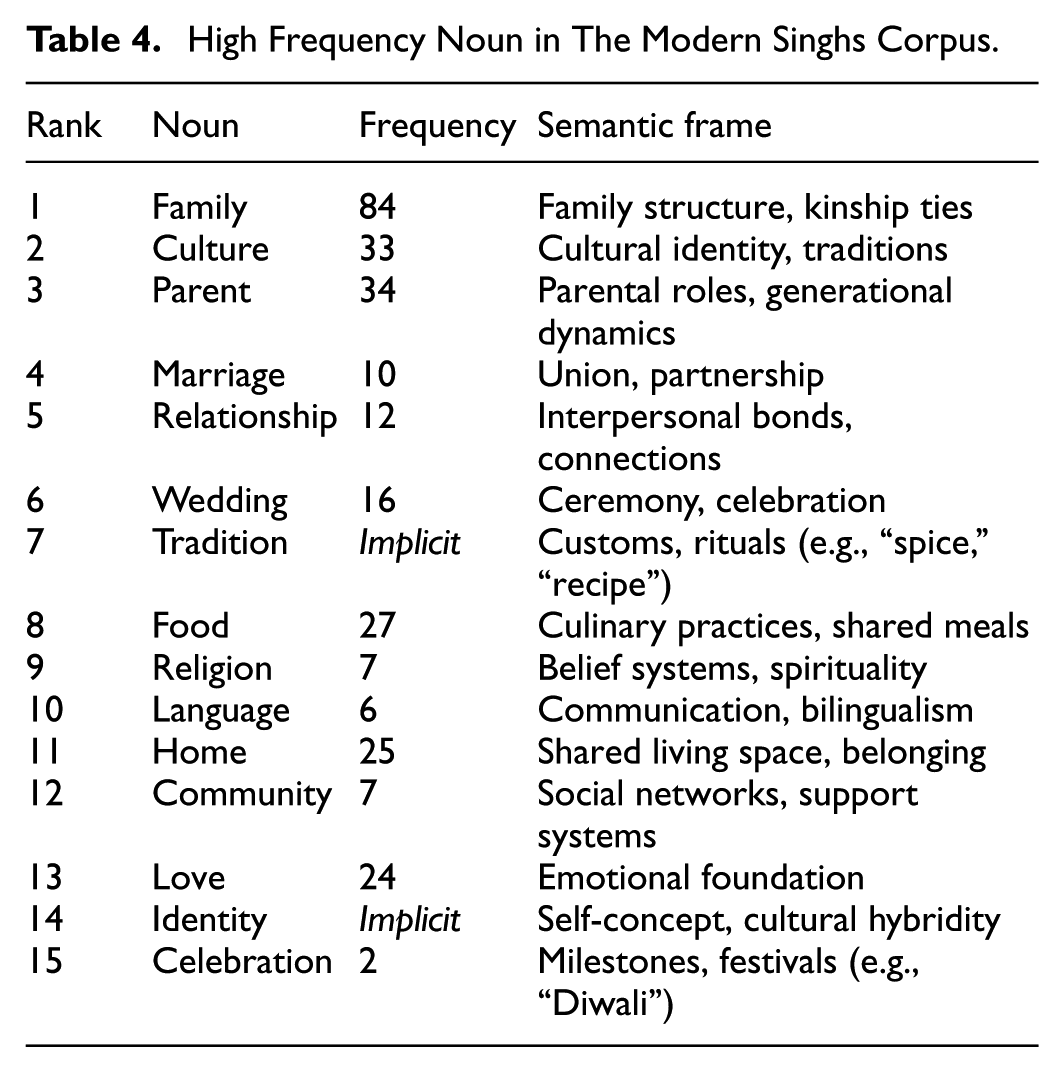
In both channels, this comparative aspect significantly differ in their thematic focus. The Modern Singhs is deeply rooted in the cultural negotiation, which is seen by the excessive presence of the noun culture (33 times) that directly puts their identity between Punjabi Sikh and British Scottish cultures into context. In contrast, the Pakistani Korean channel has a high rate of lexical divergence, with only two occurrences of culture and six occurrences of wedding. This reduced frequency indicates that their conversation deliberately pays less attention to ritual or formal cultural elaboration, probably giving priority to the familiar elements of everyday, personal, and interpersonal existence. Such a sharp contrast of the core noun use serves as a strong comparative basis to comprehend the process in which various intercultural couples can strategically share their experiences online in this way it would be helpful to explain how semantic frames were identified from the nouns (e.g., coding scheme or theoretical guidelines).
Explanation
Family and Kinship: Dominant terms like “family,”“parent,” and “mom/dad” reflect the centrality of familial bonds in intercultural marriages.
In the Modern Singhs channel, concordance line is “now we officially Mom and Dad we are just got home welcome”
In the Modern Singhs channel, the English translation of this concordance line is:
Now we are officially Mom and Dad; we have just arrived home welcome
2. Cultural Practices: Nouns like “culture,”“food,” and “tradition” highlight the negotiation of shared customs.
In the Modern Singhs channel, concordance line is “cooking pav bhaji with my Indian mother in law, an Indian street food recipe”
In the Modern Singhs channel, the English translation of this concordance line is “Cooking pav bhaji with my Indian mother-in-law which is an Indian street food recipe.”
In the Modern Singhs channel, concordance line is “Our family, you know how we usually do things, especially with Punjabi traditions”
In the Modern Singhs channel, the English translation of this concordance line is: “This is our family, you know how we usually do things, especially when it comes to Punjabi traditions.”
In the PakistaniKorean channel, concordance line is “we are going to eat food of Pakistani- Korean style chicken”
In the Pakistani Korean channel, the English translation of this concordance line is.
We are going to eat Pakistani-Korean-style chicken”
3. Challenges: Nouns such as “sorrow” (3) and “difference” (2) give meaning of conflicts or adjustments.
4. Celebration: Nouns like “marriage”, wedding” and “Diwali” (5) underscore joyous intercultural integration.
In the PakistaniKorean channel, concordance line is “My first Eid celebration with my Korean family after marriage”
In the Pakistani Korean channel, the English translation of this concordance line is:
My first Eid celebration with my Korean family after marriage.
In the Modern Singhs channel, concordance line is “Celebrating Noah’s fifth birthday, Sukhmani Sahib Path at home”
In the Modern Singhs channel, the English translation of this concordance line is:
Celebrating Noah’s fifth birthday with a Sukhmani Sahib Path at home.
Implicit Frames
Nouns like “spice” (6), “recipe” (8): Metaphors for blending cultures
“Language” (6): multilingual and barrier harmony
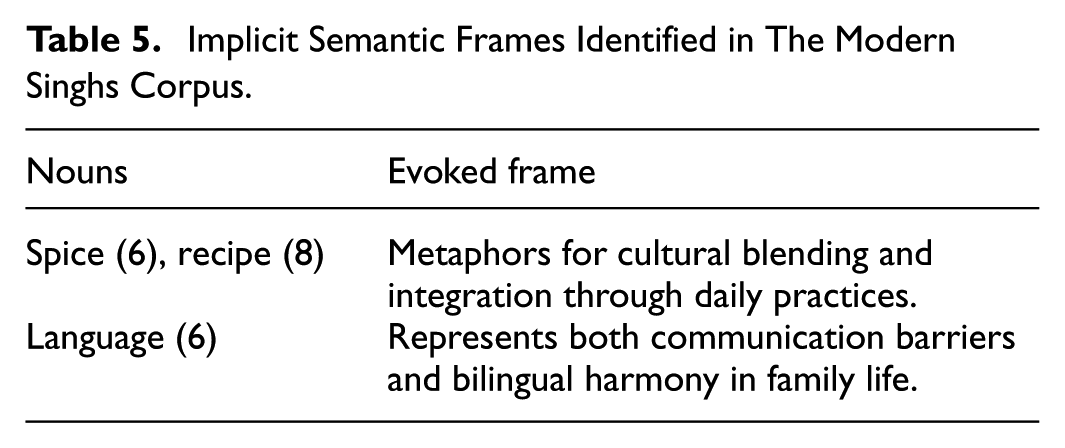
In addition to these explicit themes, many nouns activate implicit semantic frames that give metaphorical and symbolic value (Table 5). For instance, items such as spice and recipe metaphorically frame intercultural marriage as a form of blending or fusion, particularly through the lens of food. Equally, the word language is dualistic, referring both to the possible obstacles of communication and the equalizing role of bilingualism in the family. These implicit frames enhance the story as they add abstract meanings to ordinary words and indicate how intercultural identity is built silently by use of ordinary language.
Implicit Semantic Frames Identified in The Modern Singhs Corpus.
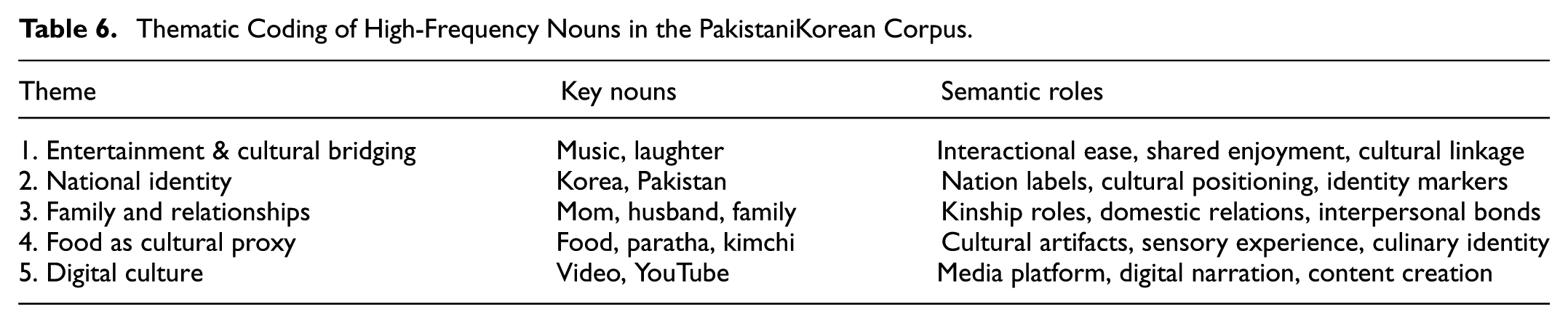
The high-frequency nouns were grouped into five prevailing thematic frames that were used to interpret the lexical patterns identified in the PakistaniKorean corpus, including Entertainment and Cultural Bridging, National Identity, Family and Relationships, Food as Cultural Proxy, and Digital Culture (Table 6). The most common noun (music, n = 482), demonstrates the significant narrative emphasis on entertainment as a cross-cultural linking factor. This was frequently represented by mutual experience with K-pop, Pakistani songs, and family gatherings. The nouns used like Korea (58) and Pakistan (38) also indicate that these countries are still rooted in the sense of their national identity and that the language is explicitly labeled in terms of culture. The evidence of the relational words such as mom, husband, and family suggests the primary role of familial relations in the intercultural context and it is usually influenced by the expectations of the generational level and domestic life. In the same way, mention of food (37), culturally particular meals like paratha and kimchi, are symbolic indicators of cultural negotiation and mutual understanding. The presence of words such as video (53) and YouTube (9) emphasize the metalinguistic layer of vlogging itself, in which the very process of creating content turns into a story of recording and enacting intercultural experience.
Thematic Coding of High-Frequency Nouns in the PakistaniKorean Corpus.
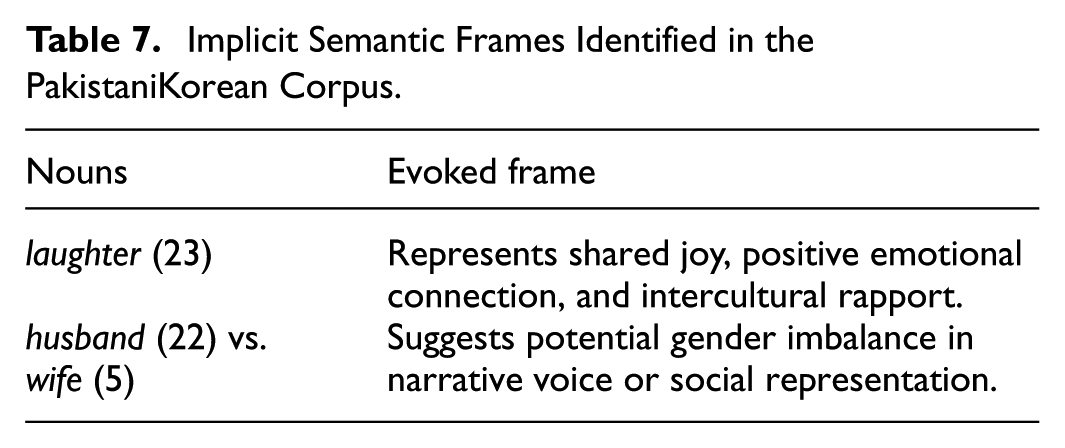
Beyond these explicit lexical themes, several lower-frequency nouns activate implicit semantic frames that reflect deeper cultural meanings and social dynamics (Table 7). As an example, laughter (23) represents emotional harmony and becomes a discursive proxy of effective cultural rapport. It is important to note, the unequal ratio of husband (22) to the wife (5) could indicate that there is a gendered discourse in the structure of the stories presented by this channel, which might be more indicative of sociocultural trends in representation. These implicit/explicit frames combine to develop a digital narrative where intercultural marriage.
Implicit Semantic Frames Identified in the PakistaniKorean Corpus.
The references to food, language, home, and family can be found in both corpora as the similarities of the cultural exchanges and everyday life are prominent. Nevertheless, priorities that are brought forth by the selection of lexicon are clearly different. The relationships of emotional attachment and ritual are anticipated in the Modern Singhs, but the performative representation, national anchoring, and relational adjustments are favored in Pakistani Korean. These words give a picture of how the different channels are selective in their emphasis on some aspects of culture and relationships in their narratives.
Explanation
Shared Entertainment (Music) (482): The overwhelming prevalence of the term “Music” indicates that shared media, such as K-pop and local Pakistani music, serves as the primary and most potent common ground and point of discussion between the cultures.
National Identification (Korea 58, Pakistan-38): The presence of “Korea” and “Pakistan” confirms that the context is explicitly framed by the respective national identities of the participants in PakistaniKorean vlogs.
Food Exchange (37) (paratha, kimchi): References to “Food” and specific national dishes suggest that cuisine is a significant medium for cultural exploration and sharing, acting as an accessible proxy for the broader culture in PakistaniKorean vlogs.
Digital Culture such as video (53), YouTube (9): The frequent use of “Video” and “YouTube” points to a trend of digital content creation, likely in the form of vlogs or documentaries, to record and disseminate these intercultural experiences like PakistaniKorean The Modern Singhs vlogs.
Research Question 2
How Do These Lexical Choices Compare in Representing Intercultural Marriage?
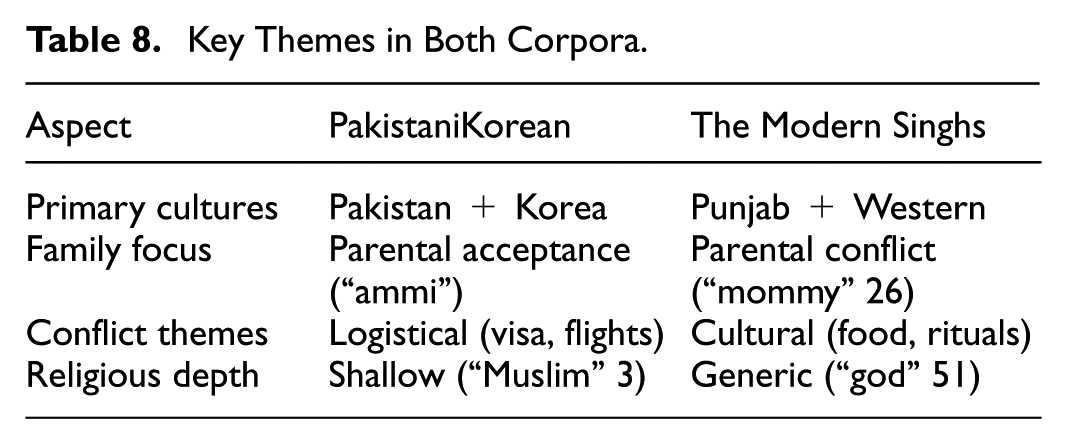
This Table 8 compares the main themes in Pakistani Korean and The Modern Singals. PakistaniKorean is a blend of Pakistani and Korean cultures, which emphasize on parental acceptance, which is represented by the term “ammi.” Meanwhile, The Modern Singhs combines Punjabi and Western cultures, with a stress on family conflict and a lot of “mommy” mentioning. The fights between PakistaniKoreans remain largely logistical such as visa and flights whereas The Modern Singhs focus on more cultural hits at the level of food and rituals. PakistaniKorean lightly refers to Islam and The Modern Singhs includes more general mentions about God. This juxtaposition indicates that narrative interests are different in the two contents.
Key Themes in Both Corpora.
This Table 9 illustrates key frame roles, prototypes and slot fillings in both corpora The Pakistani-Korean corpus presents its discourse in terms of being defined as an Agent, Participant, and culturally favorable roles as Tourist or Bride. This is in the nature of narrative style that centers on intercultural exposure and family integration. As an example of the prototype, the group Family outing is linked to the slot filling exploring Korean culture, which suggests that a significant part of the discourse is framed to present collective, exploratory practices.
Key Frame Roles, Prototypes and Slot Fillings in Both Corpora.
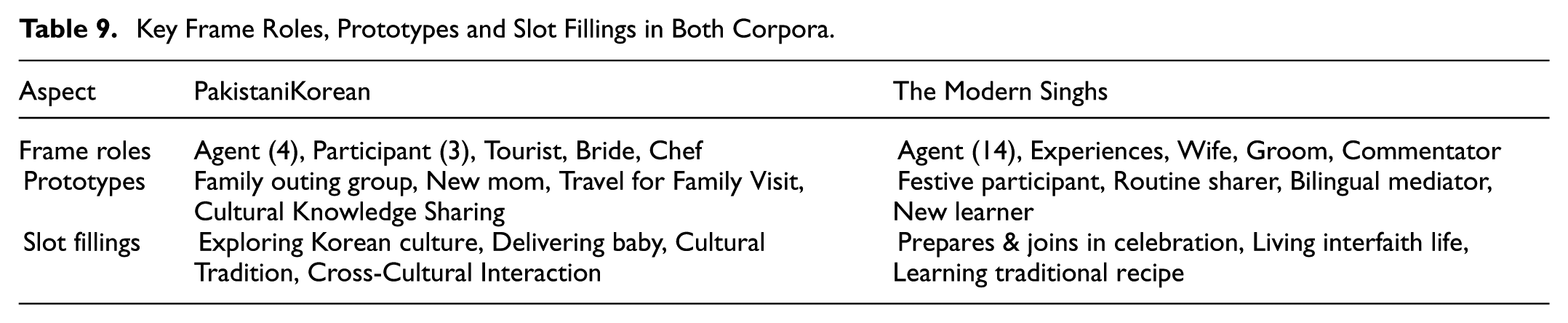
Conversely, The Modern Singhs corpus contains much more individual subjectivity, Agent prevailing (14 occurrences). It brings in various functions like Commentator and Experiencer that is more personal and reflective in narration style. Such prototypes as Bilingual mediator and new learner bring up the negotiation of identity, namely, in the context of hybrid and bilingual family environments. As an example, explaining Punjabi terms and Living interfaith life suggest the greater cultural reflection and adjustment not exposure.
Most slot fillings in the Pakistani-Korean corpus involve some external act or custom (Delivering baby, Cultural Tradition), whereas The Modern Singhs corpus involves some internal knowledge and practicing of a ritual (Learning traditional recipe, Bringing holy atmosphere). This shows that there is a change in displaying culture (PakistaniKorean corpus) to a living and understanding it (The Modern Singhs corpus).
Research Question 3
Furthermore, how different YouTube channels frame words “marriage and culture” in YouTube videos using Fillmore’s Semantic Frames?
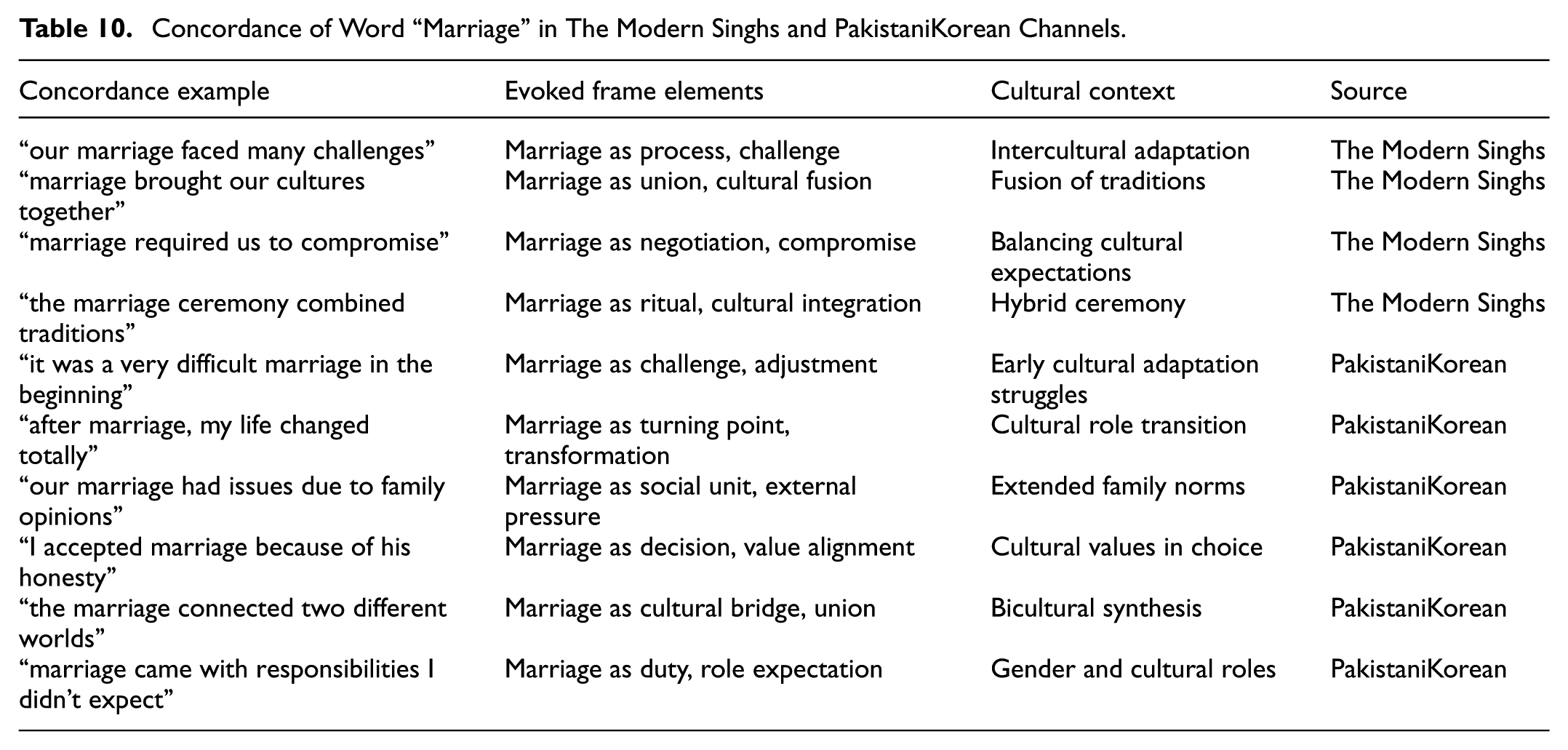
The below Tables 10 and 11 highlights the significance of word marriage in the corpora of 50 YouTube videos in The Modern Singhs and PakistaniKorean YouTube Channel.
Concordance of Word “Marriage” in The Modern Singhs and PakistaniKorean Channels.
Comparative Focused Frames in The Modern Singhs and PakistaniKorean Channels.

Across both corpora, “marriage” consistently evokes frames of cultural negotiation and union, but the focus shifts:
In The Modern Singhs, the noun frame occurs 10 times emphasizes fusion, adaptation, and ceremony, casting marriage as a hopeful site of cultural integration. In the PakistaniKorean corpus, the noun frame frequently occurs in 6 times which portrayed as a more personally and socially demanding experience, invoking responsibilities, value-driven decisions, and external familial pressures. The two analyses highlight how Frame Semantics can be flexible in identifying the ways in which a culturally charged word such as marriage can operate in different social stories.
Culture in the Modern Singhs corpus is a complex and prevailing notion, which is present in the contexts of imparting values, cultural learning, and acculturation. It is not only a source of enrichment, but it is also a place of conflict; this is what makes it a center of intercultural relationships. The term culture, although not so common in the Korean Pakistani corpus, nevertheless grounds the discourse of difference and harmony. It not only identifies borders of identities but also facilitates mutual respect which indicates a less complicated yet strong frame of coexistence.
Findings
Comparison of Cultural Word Frequencies
The two channels show some differences in the treatment of intercultural marriage. Themes that are addressed by modern Singh include parental tension, humor, and emotional resolution, and tend to uphold familiar Western cultural patterns of the Punjabi culture. On the contrary, Pakistani Korean focuses not only on the logistic and geographical issues (traveling plans and visa problems, etc.), but it also reflects Korean Pakistani marriages as happy yet deeply rooted in the realities of daily life. Both channels do not lead to the broader systemic problems, such as religious conflicts, or legislative barriers, even though a mention of the words, hijab, visa and immigration, suggest a deeper under-lay tension. These words are symbolically applied to mean the intersection of the personal self with the bigger systems of religion, state regulation and social mobility. To illustrate, the hijab denotes to the religious devotion as well as gender identity bargaining as opposed to visa reminding of institutional control and bureaucracy in inter-cultural marriage. Symbolically these words are used to denote the point of intersection of the individual self with the larger systems of religion, state regulation and social mobility. As an example, the hijab refers to both religious commitment and gender identity bargaining whereas visa reminds institutional control and bureaucracy in inter-cultural marriage. These latent frames are included to get a better picture of orientation of intercultural marriages in the systemic cultural and institutional contexts. Both creators keep their audience involved by interacting with them directly and by proposing individualized content, which allows depicting intercultural relationships as not only emotionally satisfying but also socially acceptable.
Language in Action and Cultural Practices
Using Frame Semantics (Fillmore, 1982), this study investigated the marriage term within two datasets in The Modern Singhs and a PakistaniKorean channels transcript. Although they both present marriage as the main theme, the delineation is quite different in each. In The Modern Sigh corpus, the word marriage is used and related to cultural mixing, adaptation, and ritual observance. The contextual language creates a focus on notions of compromise, union, and assimilation, portraying marriage as a constructive connection between various cultural affiliations. On the other side, the noun culture is used 33 times and gives several concepts such as identity, heritage, conflict, common values, and integration. It is a contrasting aspect (e.g., in the form of the term culture clash) and the enriching aspect (e.g., in the form of sharing of each other culture). The word marriage is repeated six times in the Korean-Pakistani corpus and is more personalized Here, the word links into family expectation, role negotiation and self-making, indicating a more complex and tense experience in relation to cultural norms. Although there are only two places where the word “culture” is used, these still arouse helpful ideas about contrast and mutual respect. In their limited use, these examples portray culture mainly as that which differentiates people but also as a basis for tolerant coexistence. The corpus was created in such a manner to balance and be representative of the two YouTube channels Pakistani Korean and The Modern Singhs. Even though the latter has more than a thousand videos, and the former 159 the same number of 25 videos of each channel were specially chosen to provide comparability based on themes and situations. Content relevance, intercultural interaction, and linguistic richness were the criteria used to select it, as opposed to channel volume. Also, to ensure sufficient linguistic density to analyze the videos, all the videos that were selected had a minimum length requirement of 5 min and a significant amount of verbal contact with millions of views. To avoid the effect of corpus size difference, the frequency scores were scaled to a thousand words, so that the effect of the varied transcript size was reduced. As such though the total incidence of the phenomena of marriage might seem low, it is showing the communicative emphasis in the sampled data as opposed to being a corpus imbalance or a shortness of transcripts.
Construction of Emotional and Sensory Imagery
This comparison points to a marked change in the way culture is presented in the two different communicative contexts. In marriage-related texts, culture is explicitly mentioned and is typically portrayed as a source of conflict, common practices or family duties (Nilasari et al., 2023). Commonly used words strengthen an image of culture as being closely related to personal identity and social values. On the other hand, in the vlog content, culture is addressed in a more laid back and informal way, by way of picturesque storytelling and amusement overtly discussing. The reduced prevalence of abstract cultural vocabulary indicates that meaning is communicated more by such action as cooking together or sharing humor—rather than explaining things directly (Nilasari et al., 2023). However, both types of media refer to such common cultural aspects as cuisine, language and weddings, but each of them puts these aspects in different contexts. Two sets of noun frequency data were analyzed from the perspective of Frame Semantics to reveal the conceptual structures associated with the frequent use of words in intercultural situations. The first set, drawn from texts about intercultural marriage, were often characterized by words such as family, culture, parent, marriage, which allude to the spheres of kinship, identity, social expectation, and emotional work. Such terms reflect the focus on real-world relationships and the dynamic negotiation of cultural roles. As opposed to it, the second set of data, which was focused on analyzing Korean Pakistani vlogs, included such terms as music, video, time, and guy indicating frames of digital media, daily experiences, and performative communication. Such words as culture and language were used less frequently suggesting that cultural representation is more subtly incorporated into activities than explicitly expressed (Du, 2025). In general, the concept of marriage is multifaceted, encompassing both personal struggles and the unification of the cultures. Although both sets of data represent marriage as flexible and changing, their presentation varies: The Modern Singhs focuses more on harmony and integration whereas the Korean Pakistani material focuses more on negotiation and external pressures (Genita, 2024). Frame Semantics demonstrates how the same concept-marriage—can embrace diverse lived realities based on context, with culture sometimes a divider and at other times a connector in cross-cultural interactions. Although the semantic structure of The Modern Singhs corpus is more complex and multi-layered, both corpora emphasize the centrality of culture for the construction of identity, for the negotiation of values, and for the adaptation to new conditions. From this perspective, Frame Semantics is a successful representation of the way in which central terms structure personal and social meaning in the discourse of intercultural marriage (Yanti, 2024).
Roles of Agents and Narrative Styles
The Pakistani-Korean corpus focuses mostly on family-centric agents. The use of terms such as Family, Mother in law, and Korean mom and sister depicts collective inclination, where connections and collective identity dictate the discussion. In one transcript, the Korean mother and sister appear to be trying on Pakistani dresses, which shows them as inquisitive parties who explored the cross-cultural interaction.
The Modern Singhs corpus, on the contrary, slants on the individualized agency with Money and Abbey being used as constant characters. This is the indication of a more personalized, dialog form of narration. An example of this can be when Money is narrating cultural expectations as Abby is learning or adjusting, which is more a personal narrative style of telling a story that has its basis on first person account.
The Pakistani-Korean corpus includes the regular action of transmitting the culture and celebrating it like Touring, Explaining hijab life, Celebrating Eid, or Hosting events. Such activities provide a wide social-cultural exhibition of festivals, traditions, and family expectations. Considering an example of the activity Explaining marriage type, the activity is directly linked to a larger story about marriage establishment in Pakistan, but the materials are served as a cultural primer to an outsider.
Conversely, The Modern Singhs corpus focuses on everyday negotiation and emotional communication such as Announces pregnancy news, ask translation, felt happy, or Comparing habits are micro-level, emotion-filled communication. To illustrate, the scene that depicts Abby referring to roti as a pancake contributes to humor and shapes the miscommunication between linguistic-cultural alignment in bicultural relationships.
In terms of the affected elements, the Pakistani-Korean corpus usually involves such symbolic or communal experience as Eid gathering, Cultural traditions, Trip to grandparents or Engagement. These emotional objects center the story in common rituals and shared history. A good example is the influence of cultural views that Fatima regards as a crucial theme that Cultures shared their experiences focusing on the cultural hybridity.
In the Modern Singhs corpus has such personal or tactile affects as Sweet rice, Dal mix, Family reaction, or Indian recipe steps. This corpus is usually based on cultural elements, emphasized on food language and emotionally evocative. Another transcript in which Husband is mixing ingredients that influence the Dal mix places inter cultural experience at the realm of physical engagement and food intimacy.
In nutshell, the Pakistani-Korean corpus highlights the macro-oriented intercultural performances based on the traditions and family arrangement, and The Modern Singhs corpus highlights the micro-level intercultural adaptation involving relationships and identity negotiation in day to day life.
There is a unification of the theme of blending of cultures in both corpora, however, one does it on controlled family story lines and official activity, whereas the other harmonizes through jokes, displays of feelings, and informal dialog. Along with displaying the variety of frame elements in intercultural discourse, this comparison provides an example of why various narrative formats may influence audience interpretation and understanding of the culture.
Conclusion
The trend of intercultural marriages became very popular in digital media, especially on YouTube. This research study focuses on two YouTubers: Money Sighns from The Modern Singhs channel and Faheela Muzafar from the PakistaniKorean. Their YouTube content is based on the portrayal of intercultural marriage challenges, acceptance, and rejection. This study sheds light on their experiences of intercultural marriages and how they convey their real-life content through language, especially what high-frequency nouns they usually use in their videos. Majorly, the comparative analysis of nouns and the major semantics frames they are using in daily vlogging. Through the corpus-assisted discourse analysis, it is revealed that they use nouns of marriage and culture in different contexts, such as in The Modern Singhs channel, where the frequency of the marriage noun is 10, which shows union and partnership, and the noun of culture occurs 33 times, which demonstrates the cultural identity and tradition of Punjabi Sikh and British Scottish culture. While in the PakistaniKorean channel, shows 6 times the frequency of the noun “wedding” and 2 times the frequency of the noun “culture.”
High noun-frequency reveals that both channels construct intercultural marriage by using different, but overlapping thematic frames. In The Modern Singhs corpus different high noun-frequency is present such as family, parent, home, wedding, and love with foreground frames of kinship, emotional attachment and cultural ritual and as such, marriage is framed as a domain of togetherness and integration. By contrast, the Korean-Pakistani corpus divides its most common nouns into bigger themes of entertainment, national identity, family role, food symbolism, and digital culture, the music becoming one of the key bridges between cultures. The patterns of the comparisons also reveal contrasting narrative priorities: the Korean-Pakistani channel is oriented toward acceptance of the parents, logistical issues, the use of such symbolic terms as ammi, but The Modern Singhs is oriented on the cultural tensions, the food-related conflicts, the nuances of mommy, influenced by the Punjab-Western culture of the 21st century. Though these results reveal the significant differences in framing intercultural relationships that are influenced by such limitations as small corpus size, interpretive subjectivity, and dependency on the frequency of nouns. These limitations indicate the usefulness of the further studies of the analysis over more extensive data and larger lexical groups to obtain a more comprehensive picture of intercultural marriage discourse in semantic terms. This research shows that both YouTubers depict intercultural marriage as a joyful but negotiated process during which family, cultural practices and symbolic objects such as food and dress are of great importance. These representations have a tendency to create simplifications of complex realities overlooking more serious issues such as gender representations, religious differences or legal limitations. This analysis can be extended further through possible future studies that can analyses verb, adjectives and adverbs among the corpus. This research also directs to exploration of perception and attitude of the audience about intercultural relations through everyday activities like food, festivals and interactions with family members of the cultures being used as a medium of cultural exchange.
Research Implications: The application of corpus-assisted discourse analysis combined with Frame Semantics theory is a viable answer to the mapping of the manner in which digital discourse produces intercultural meaning. Future studies can extend this framework to multimodal cues, verbs or audience commentaries to give the interaction richness.
Pedagogical and Applied Implications: The findings can be applied to the investigation of intercultural communication, media linguistics, and discourse studies because they can show ways of how practical cross-cultural knowledge works through daily digital narratives. It also encourage academics and educators to apply other corpus-assisted discourse analysis and corpus-assisted critical discourse analysis methodology on the analysis of identity negotiation in other digital media platforms other than YouTube.
Supplemental Material
sj-docx-1-sgo-10.1177_21582440261415780 – Supplemental material for Framing Intercultural Marriage on YouTube: A Corpus-Assisted Discourse Study Using Frame Semantics
Supplemental material, sj-docx-1-sgo-10.1177_21582440261415780 for Framing Intercultural Marriage on YouTube: A Corpus-Assisted Discourse Study Using Frame Semantics by Hamna Amir, Nada AlJamal, Urooj Alvi and Almeera Aimen in SAGE Open
Footnotes

Ethical Considerations
This paper examines YouTube vlog content that is publicly available and concentrating on intercultural marriage videos. The data include videos and transcripts that are freely available without subscription, password protection or membership control. The study adheres to the rules of the institutional and international research ethics regarding internet-mediated research which considers published content on the internet as the published material. Additionally, the ethical sensitivity was ensured during the research process. During the data analysis, channel email, content creators personal images, thumbnails and sensitive data are completely anonymized, and concordance lines have been shown only as much as was required to conduct the linguistic analysis. The research is not conducted through direct contact with the participants, intervention, and gathering of personal information. The research design follows the principles of confidentiality, responsible representation, and respect of the communicative intent of the content creators of YouTube.
Consent to Participate
Since the research is carried out solely on publicly available contents in YouTube and there is no direct human interaction, interviews, surveys, and personal correspondence of the content creators. The study adheres to the ethical requirements of using publicly available information on the internet in the study of linguistics and corpus-assisted discourse analysis. No personal or sensitive data were gathered or analyzed other than the publicly expressed data provided by the content creators.
Funding
The authors received no financial support for the research, authorship, and/or publication of this article.
Declaration of Conflicting Interests
The authors declared no potential conflicts of interest with respect to the research, authorship, and/or publication of this article.
Data Availability Statement
The data supporting to findings of the study include the publicly available YouTube vlogs and disclosed transcripts. The article does not reveal specific channel video links and URLs, because of ethical issues connected to digital traceability and privacy of participants. However, the collection of data was filtered with well-specified selection criteria (e.g., intercultural marriage vlogs), and the analysis process is outlined in enough detail that it can be reproduced methodologically.
Supplemental Material
Supplemental material for this article is available online.
References
Supplementary Material
Please find the following supplemental material available below.
For Open Access articles published under a Creative Commons License, all supplemental material carries the same license as the article it is associated with.
For non-Open Access articles published, all supplemental material carries a non-exclusive license, and permission requests for re-use of supplemental material or any part of supplemental material shall be sent directly to the copyright owner as specified in the copyright notice associated with the article.
