







Abstract
Sleep plays a crucial role in cognitive ability and electronic sports (esports) performance. Although gamers are often known for having poor sleep conditions, few studies have investigated sleep quality among electronic sports players. This study aimed to clarify the prevalence of poor subjective sleep quality among esports players, including the differences between professionals and amateurs, as well as the associated factors in esports activities. A web-based cross-sectional survey was conducted to professional and amateur esports players. The survey included attributes (age, gender, living arrangement, and esports level), subjective sleep quality, and esports activities (device, career duration, playing frequency by time of day, playing time per day on weekdays and holidays, distance between the screen and face, and food and beverage consumption during play). The analysis focused on 90 participants (35 professionals, 55 amateurs; mean age, 22.4 ± 6.6 years) who provided complete responses. The proportion of esports players with poor sleep quality was 43.3%, indicating that a relatively large proportion experienced poor subjective sleep quality. No statistical differences in poor sleep quality were observed between the professional and amateur players. However, professionals had statistically later bedtimes and wake-up times and longer sleep time than amateurs. Attribute-adjusted modified Poisson regression with robust error variance showed statistical associations between playing esports during 3:00 to 5:59 AM and 6:00 to 8:59 AM and poor subjective sleep quality. However, only a few players were active during these hours. Further investigation is needed into the factors beyond esports activities that affect sleep quality.
Plain Language Summary
Sleep is essential for cognitive function and esports performance. However, many gamers are known to have poor sleep habits, and little research has examined sleep quality in esports players. This study explored how common poor sleep quality is among esports players and whether there are differences between professional and amateur players. We surveyed 90 esports players (35 professionals and 55 amateurs, with an average age of 22.4 years). The results showed that 43.3% of participants had poor sleep quality, suggesting that many esports players struggle with sleep. Professional players tended to go to bed later, while amateur players often had shorter sleep durations. Playing esports between 3:00 AM and 8:59 AM was linked to poor sleep quality, but only a few players were active during these hours. These findings suggest the need to explore other factors affecting sleep in esports players.
Background
Electronic sports (Esports) are defined as organized and competitive video gaming confrontations (Witkowski, 2012). The global esports audience and active esports players increase annually (Newzoo, 2022). The esports market worldwide generated a revenue of USD 1.88 billion in 2022 and is expected to reach USD 12.10 billion in 2030 (Grand View Research, 2023). After the coronavirus disease 2019 (COVID-19) pandemic, large-scale esports tournaments offering substantial prize money have increased yearly (Esports Charts, 2024). To succeed in this business, esports players must demonstrate highly competitive performance.
Achieving a highly competitive performance in esports requires high cognitive abilities. Kowal et al. (2018) reported that video game players and esports players display higher cognitive abilities, including cognitive flexibility, attention, working memory, and executive functions, than non-gamers. A scoping review suggested that the main difference between professional and amateur players is their cognitive abilities (Sanz-Matesanz et al., 2023). A previous study reported a linear dose-response relationship between cognitive abilities and gaming playtime, wherein longer playtime was associated with better performance on cognitive function tests (Kowal et al., 2018). Therefore, esports players aim to improve their gaming skills and cognitive abilities through long hours of daily training.
Sleep plays a vital role in cognitive function. Sleep problems, such as poor sleep quality, sleep disturbances, and insomnia, are known risk factors for cognitive decline and dementia (Bubu et al., 2017; Xu et al., 2020). Research has previously focused on older populations; however, there is a growing body of evidence examining cognitive functions in younger individuals. A previous study demonstrated that healthy college students with poor sleep quality exhibit statistically worse executive function and working memory than those with good sleep quality (Parrilla et al., 2025). Poor sleep quality was associated with a negative cognitive bias and decreased sustained attention to non-emotional stimuli among undergraduate students (Gobin et al., 2015). Healthy adolescents also showed that poorer sleep quality correlates with weaker decision-making performance (Telzer et al., 2013). Therefore, ensuring high-quality sleep is likely to improve esports performance
However, gamers are known to have poor sleep quality. According to the neurocognitive model of sleep, persistent poor sleep quality can result from heightened cognitive arousal and maladaptive sleep-related beliefs, which interfere with the initiation and maintenance of sleep (Espie, 2002; Perlis et al., 1997). As supported by this theory, a recent meta-analysis reported a consistent negative impact of electronic media use on sleep outcomes, with problematic online gaming and smartphone use being particularly impactful (Han et al., 2024). Similarly, gaming addiction has been reported to be associated with poor sleep quality in the general population (Zaman et al., 2022). Given the cognitively demanding and emotionally stimulating nature of gaming—particularly in competitive esports—players may be at increased risk of experiencing such arousal-related sleep disturbances. In particular, individuals with severe gaming addiction (Kemp et al., 2021; Kristensen et al., 2021) and longer playing times (Kemp et al., 2021) have been shown, through systematic reviews and meta-analyses, to be at higher risk of poor sleep quality. These factors are also associated with shorter total sleep time and higher levels of daytime sleepiness (Kemp et al., 2021; Kristensen et al., 2021).
Research on esports players has increased in recent years. The average total sleep time is relatively good, which ranges from 6.8 to 8.1 hr (Bonnar et al., 2022; Goulart et al., 2023; Lee et al., 2020; Lindberg et al., 2020; Moen et al., 2022; Rudolf et al., 2020; Thomas et al., 2019). However, the average bedtime of esports players is between 2:09 AM and 4:04 AM, and the average wake-up time is between 10:10 AM and 12:13 PM (Lee et al., 2020; Moen et al., 2022), indicating a noticeable delay in the sleep phase.
Few studies have been conducted on sleep quality in esports players. Previous research has reported that the average score on the Pittsburgh Sleep Quality Index (PSQI) was 6.1 ± 2.7 points for professional, elite, and avid esports players (Goulart et al., 2023). For professional Counter-Strike: Global Offensive players, the score was 9.3 ± 0.9 points (Sanz-Milone et al., 2021). These results may indicate that sleep quality of esports players is poor; however, no further insights were available from these studies. Moreover, subjective sleep quality may differ between professional players who earn regular income from esports activities and amateur players who do not earn income from playing and are engaged in academic or work commitments. Only one study comparing professionals and amateurs reported no statistical differences in total sleep time (Rudolf et al., 2020).
The aspects of esports activities related to subjective sleep quality in esports players remain largely unclear. Previous research has reported that training time is unrelated to insomnia severity among esports players (Lee et al., 2021). In contrast, a systematic review targeting habitual adult video gamers found that longer playing times are associated with poorer sleep quality (Kemp et al., 2021). According to the neurocognitive model of sleep, prolonged and cognitively demanding activities, such as extended gaming sessions, may heighten cognitive arousal and delay the downregulation of alertness, thereby interfering with sleep initiation and reducing sleep quality (Espie, 2002; Perlis et al., 1997). In addition to play duration, sleep outcomes may also be affected by the timing of gameplay. Esports players frequently engage in gaming during late-night hours (Lee et al., 2020), which can disrupt the natural circadian rhythm by delaying sleep phase and altering melatonin secretion. Repeated exposure to delayed sleep timing may lead to a misalignment of the sleep–wake cycle, resulting in chronic sleep insufficiency or poor sleep quality (Caliandro et al., 2021; Kortesoja et al., 2023).
The type of gaming device and proximity to screens may also play a role. In particular, close-range use of high-luminance screens—a common characteristic of esports activities (Monma et al., 2024)—may substantially increase exposure to blue light, which has been shown to suppress melatonin production, delay circadian phase, and worsen subjective sleep quality (Green et al., 2017; Wahl et al., 2019; Yoshimura et al., 2017). Moreover, dietary behaviors during gameplay may contribute to sleep disturbances. The consumption of caffeinated products such as energy drinks and coffee, along with carbonated soft drinks and junk food, is widespread among gamers (Falbe et al., 2014; Kelly et al., 2021; Słyk et al., 2023; Soffner et al., 2023). Caffeinated products, as well as carbonated soft drinks and junk food, may all be associated with poor sleep quality (Gardiner et al., 2023; Min et al., 2018). Thus, to better understand the characteristics associated with subjective sleep quality in esports players, it is essential to examine a range of esports-related factors.
From a public health perspective, clarifying the prevalence of poor subjective sleep quality among esports players is an essential first step in understanding the magnitude of sleep-related problems in this emerging population. In particular, comparing prevalence between professional and amateur esports players is important, as these groups differ in daily time structure, external obligations, and the extent to which esports activities are integrated into their lives, which may influence overall sleep patterns and health risks. In addition, identifying esports–related factors associated with poor subjective sleep quality among esports players as a whole is necessary to explore behavioral characteristics that may contribute to sleep problems across this population.
The present study aimed to evaluate the prevalence of poor subjective sleep quality among esports players, compare the differences between professionals and amateurs’ players, and assess the factors associated with poor subjective sleep quality. It is hypothesized that the prevalence of poor subjective sleep quality will be high among esports players. Additionally, due to differences in lifestyle, professional and amateur esports players will exhibit distinct sleep patterns. Furthermore, various factors related to esports activities will be associated with poor subjective sleep quality.
Material and Methods
Research Design
This study employed a cross-sectional observational design to examine the prevalence of poor subjective sleep quality and its associations with esports-related activities among professional and amateur esports players in Japan. Data were collected using a self-administered, web-based questionnaire during a defined study period. The study design was chosen to allow for comparisons between professional and amateur players and to explore associations between esports activities and subjective sleep quality in a real-world setting.
Participants
This cross-sectional study obtained cooperation from one professional team and five amateur teams in Japan. The professional team was incorporated and operated by generating revenue through sponsorship, player-video streaming, media appearances, and merchandising, and its players participated in professional leagues and tournaments. In contrast, the amateur teams were formed by volunteers, were not incorporated, and operated on a smaller scale than the professional team.
A total of 175 esports players were invited to participate in the survey through their respective teams. Of these, 100 players responded to the questionnaire (response rate: 57.1%). Ten responses were excluded from the analysis due to clearly inappropriate answers to the survey items. Consequently, data from 90 respondents with complete responses were included in the final analysis (valid response rate: 51.4%).
Procedures
Representatives from each team were asked to distribute the survey to all team members. An anonymous, self-administered, web-based questionnaire was administered using Google Forms between April and May 2021. The significance and purpose of the study were explained on the first page of the survey, along with statements indicating that participation was voluntary and that there would be no penalties for choosing not to participate. Respondents were informed that there were no right or wrong answers, and they were assured that their personal information would be protected. Only individuals who provided informed consent proceeded to complete the questionnaire.
This study was approved by the Ethics Committee of the authors’ affiliated institution and was conducted in accordance with the Declaration of Helsinki (reference number withheld for peer review). The study is reported in accordance with the Strengthening the Reporting of Observational Studies in Epidemiology (STROBE) guidelines for cross-sectional studies.
Measures
The questionnaire included participant attributes, esports activities, and subjective sleep quality. Attributes included age, gender, living arrangements, and esports level. Living arrangements were assessed using the following options: “living alone,”“living with family,”“living with teammates or friends,” and “others”; these were further classified as either “alone” or “with others.” The esports level was categorized as either “professional” or “amateur,” based on the team of the participants.
Regarding esports activities, respondents answered questions based on the esports titles they primarily played. The questionnaire included questions on the primary esports title, career duration, playing frequency by time of day (per week), playing time per day on weekdays and holidays, the distance between the screen and face, and food and beverage consumption during esports play. Based on the response for the primary esports title, the device was categorized as either “PC or console” or “mobile.” The playing frequency by time of day was assessed by dividing the day into eight segments, each spanning 3 hr. For food and beverage consumption, participants were asked about their intake of junk food, carbonated soft drinks, energy drinks, and other caffeinated beverages using a dichotomized scale (yes/no). The wording of the Japanese-language questions was developed and refined in consultation with a public health expert, as well as with representatives and staff members of an esports team, to ensure content relevance and clarity.
Subjective sleep quality was measured using the Japanese version of the PSQI (Buysse et al., 1989; Doi et al., 2000), which consisted of 18 questions on sleep habits, including bedtime and wake-up time, over the previous month. The following component scores were calculated: “sleep quality,”“sleep latency,”“sleep duration,”“sleep efficiency,”“sleep disturbance,”“use of sleep medication,” and “daytime dysfunction.” Each component was rated on a scale of 0 to 3, with higher scores indicating poorer sleep conditions. The PSQI global score ranged from 0 to 21, with scores >5 indicating poor subjective sleep quality. The PSQI is the most commonly used scale for measuring subjective sleep quality (Fabbri et al., 2021). The Japanese version of the PSQI has demonstrated adequate reliability and validity in both clinical and non-clinical populations (Doi et al., 2000). When used to screen for insomnia, the PSQI had a sensitivity of 85.7% and a specificity of 86.6% (Doi et al., 2000).
Statistical Analysis
The prevalence of respondents with poor subjective sleep quality, as well as the PSQI global score, bedtime, wake-up time, and total sleep time for all respondents were described using the mean and standard deviation (continuous variables) or absolute and relative frequencies (categorical variables). Subsequently, the prevalence of respondents with poor subjective sleep quality and the PSQI global score were compared between professionals and amateurs using the Chi-square test (with phi coefficient as an effect size) and Mann–Whitney U test (with r as an effect size). In addition, each PSQI component score, bedtime, wake-up time, and total sleep time were compared as secondary outcomes using the Mann–Whitney U test (with r as an effect size).
A modified Poisson regression with robust error variance (Zou, 2004) was employed to estimate the prevalence ratios (PRs) to explore the relationships between esports activities and subjective sleep quality. Estimating PRs, rather than odds ratios, is recommended in cross-sectional studies when the outcome is common, as odds ratios may overestimate the association (Barros & Hirakata, 2003). Therefore, a modified Poisson regression with robust error variance provides a valid approach for directly estimating PRs under such conditions. In this analysis, subjective sleep quality was the dependent variable, and each esports activity factor was treated as an independent variable. Both crude and attribute-adjusted models (adjusted for age, gender, the living arrangement, and the esports level) were analyzed. Multivariate analysis was not conducted because of the small sample size; instead, each explanatory variable was entered individually. To account for multiple comparisons, an adjustment to maintain a 5% false discovery rate using the Benjamini–Hochberg method was applied to control for type I errors (Benjamini & Hochberg, 1995).
In the modified Poisson regression, esports activity factors were categorized as follows: career duration, daily playing time on weekdays and holidays, and the distance between the screen and face divided into tertiles. Due to differences in playing frequency, playing during 3:00 to 5:59 AM, 6:00 to 8:59 AM, and 9:00 to 11:59 AM was categorized as “0 days/week” and “1 to 7 days/week,” whereas playing in other time periods was categorized as “0 days/week,”“1 to 3 days/week,” and “4 to 7 days/week.” Additionally, as a sensitivity analysis, the modified Poisson regression was repeated using data from male participants only (n = 71), who represented the majority of the respondents. This analysis was conducted to examine the robustness of the findings within the dominant gender group. All data analyses were performed using IBM SPSS Statistics version 29.0 and R version 4.4.1. Statistical significance was defined as an alpha level of <.05.
Results
Table 1 presents the characteristics of the respondents. Of the respondents, 71 (78.9%) were male, 19 (21.1%) were female, and the mean age was 22.4 ± 6.6 years. For the esports level, 35 (38.9%) were professionals, and 55 (61.1%) were amateurs. Thirty-nine respondents (43.3%) reported poor subjective sleep quality; the PSQI global score was 5.6 ± 2.9. The mean bedtime, wake-up time, and total sleep time were 2:02 ± 1:56 AM, 9:07 ± 2:40 AM, and 6:32 ± 1:41 hr, respectively.
Respondents’ Characteristics.
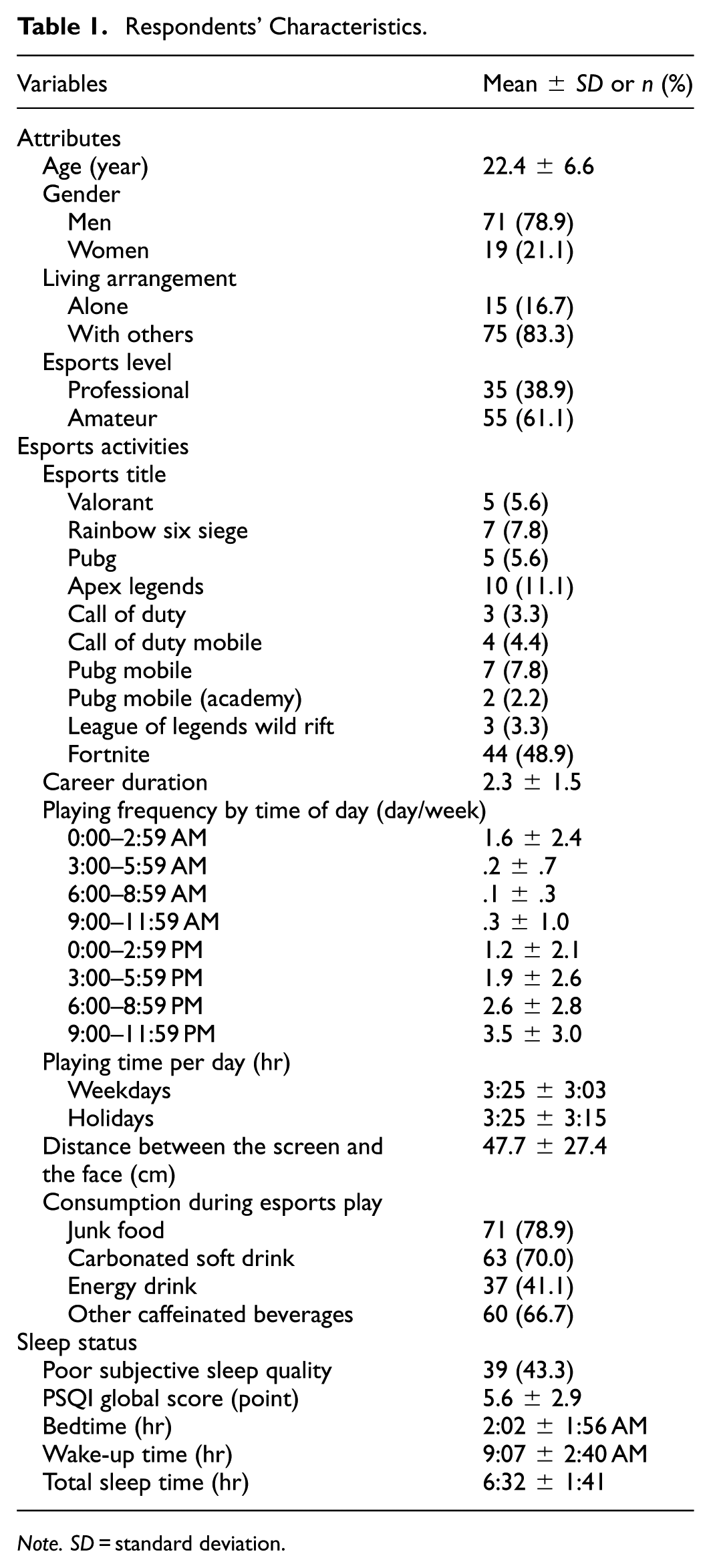
Note. SD = standard deviation.
Table 2 and Figure 1 show the sleep status by esports level. No statistical differences were found between esports levels in the proportion of respondents reporting poor subjective sleep quality, PSQI global scores, or any of the PSQI component scores. However, for professionals, bedtime and wake-up time were statistically later than for amateurs (bedtime, p < .001, r = .479; wake-up time, p < .001, r = .516). In addition, total sleep time was statistically longer for professionals than for amateurs (p = .043, r = .214).
Sleep Status by Esports Levels.
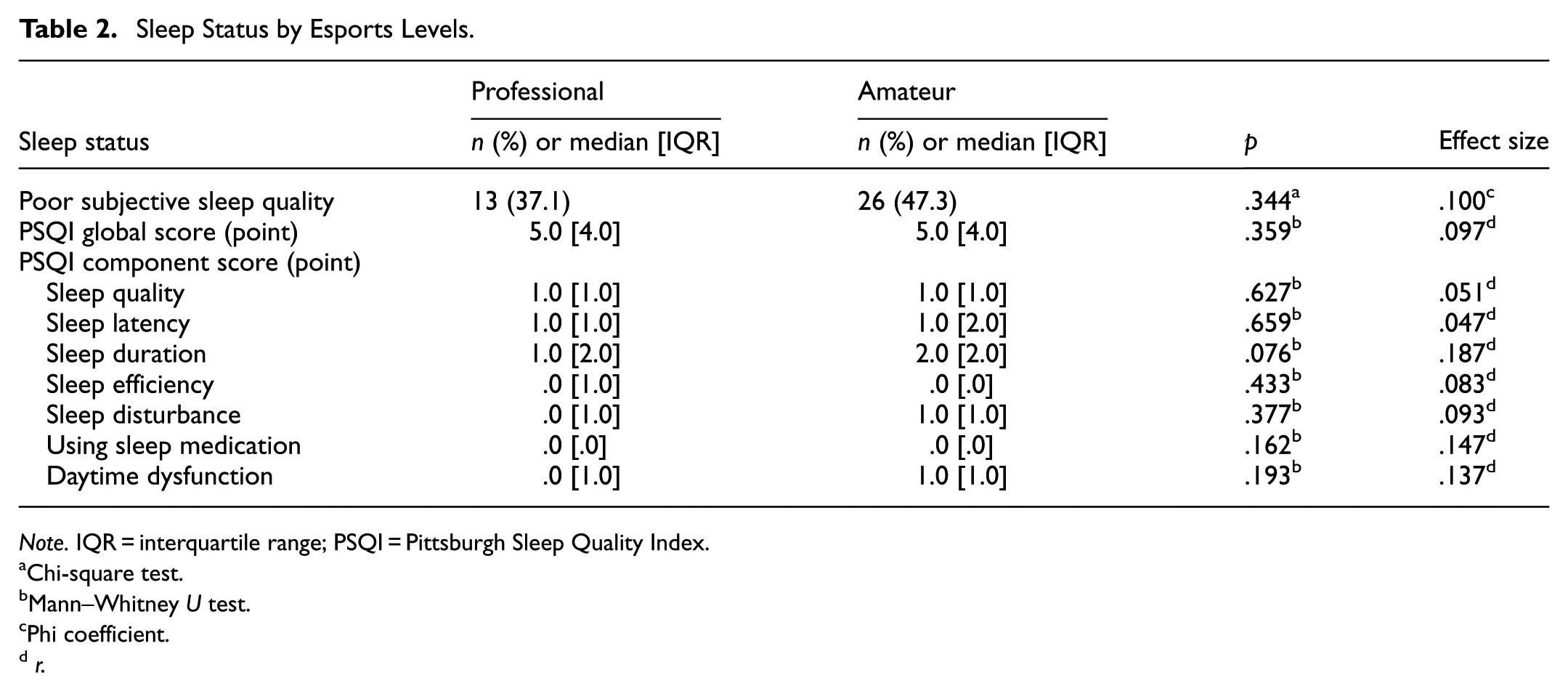
Note. IQR = interquartile range; PSQI = Pittsburgh Sleep Quality Index.
Chi-square test.
Mann–Whitney U test.
Phi coefficient.
r.

Comparison of bedtime, wake-up time, and total sleep time by esports levels.
Table 3 presents the results of the modified Poisson regression with robust error variance, with subjective sleep quality as the dependent variable and esports activities as the independent variable. In the crude model, only the playing frequency during 6:00 to 8:59 AM was statistically associated with subjective sleep quality (PR: 2.500, 95% confidence interval [CI]: [1.927, 3.244]). However, in the attribute-adjusted model, playing during 3:00 to 5:59 AM and during 6:00 to 8:59 AM was statistically associated with subjective sleep quality. For each time period, those who played on “1 to 7 days” had a higher prevalence of poor subjective sleep quality compared to those who played on “0 days” (3:00–5:59 AM, adjusted PR [aPR]: 2.160, 95% CI: [1.346, 3.467]; 6:00–8:59 AM, aPR: 2.814, 95% CI: [1.960, 4.040]). To examine the robustness of our findings, we conducted a sensitivity analysis including only male participants (n = 71). The results were generally consistent with the main findings (see Supplemental Tables 1 and 2).
Modified Poisson Regression for Poor Subjective Sleep Quality by Esports Activities.

Note. PR = prevalence ratio; CI = confidence interval.
The model is adjusted for age, gender, the living arrangement, and the esports level.
Controling for multiple comparisons using the Benjamini–Hochberg method.
Discussion
Prevalence of Poor Subjective Sleep Quality in Japanese Esports Players
The results indicated that 43.3% of the respondents reported poor subjective sleep quality, with a PSQI global score of 5.6 ± 2.9. Compared to previous studies targeting professional or avid esports players (Goulart et al., 2023; Sanz-Milone et al., 2021), participants in our study exhibited slightly better subjective sleep quality. However, relative to large-scale Japanese studies of the same age group, the proportion of poor sleepers was higher (Toyama et al., 2020), suggesting that subjective sleep quality among esports players may be poorer than that of their peers. According to the neurocognitive model of sleep (Espie, 2002; Perlis et al., 1997), cognitively demanding and emotionally stimulating activities—such as competitive gaming—can heighten arousal, inhibit the downregulation of alertness, and disrupt sleep. These mechanisms may help explain the relatively high prevalence of poor sleep quality observed in this population. Given that over 40% of players reported poor subjective sleep quality, this finding raises concerns regarding their cognitive functioning, daily alertness, and long-term health.
There were no statistical differences in the prevalence of poor subjective sleep quality or PSQI global scores between professionals and amateurs. Although their lifestyles likely differed, these findings suggest no difference in subjective sleep quality. However, as expected, differences in sleep patterns were observed between professional and amateur players; professionals had later bedtimes and wake-up times than amateurs, whereas amateurs had shorter total sleep time. In a nationwide Japanese sample, the average bedtime for individuals aged 20 to 24 years was reported to be 0:10 AM, with an average wake-up time of 8:02 AM (Statistics Bureau of Japan, 2022), indicating that professional esports players have a statistically delayed sleep phase. Furthermore, data from a large-scale Japanese survey showed that the average total sleep time for individuals in their 20s was 7:27 hr (NHK Broadcasting Culture Research Institute, 2021), suggesting that amateur esports players have shorter total sleep times than this average.
It is likely that amateurs, who have academic or work commitments that make up most of their days, reduce their sleep time to participate in esports. On the other hand, professionals whose lives revolve around esports do not face the same time constraints but tend to stay up late more frequently. Therefore, advancing the sleep phase for professionals and ensuring sufficient sleep time for amateurs are challenges that may be considered as part of the sleep improvement measures. However, these approaches should be confirmed through further research that establishes causal relationships.
Esports Activity Factors Associated with Poor Subjective Sleep Quality
When examining esports activities related to subjective sleep quality, playing during 3:00 to 8:59 AM was associated with poorer sleep. Although late-night gaming is a known characteristic of esports (Lee et al., 2020), gameplay during these hours likely overlaps with individuals’ natural sleep periods, thereby causing direct sleep disruption. However, few individuals were actively engaged in esports during these periods; thus, these findings should be interpreted with caution. Additionally, contrary to expectations, other factors related to esports activities were not found to be associated with subjective sleep quality. These results suggest that factors beyond esports behavior, including general lifestyle habits and psychosocial factors, may play a significant role in determining sleep outcomes for esports players. Future studies should adopt a multifactorial approach to understand these interactions better.
This study was conducted during the COVID-19 pandemic (April–May 2021), a period marked by social restrictions including stay-at-home orders and remote work policies (ABC News, 2021). While the impact of the pandemic on sleep was less pronounced than in 2020, evidence suggests that it persisted into 2021, continuing to influence sleep patterns (Nishijima et al., 2021; Shiratori et al., 2022). However, esports players may have experienced fewer disruptions due to the inherently remote and online nature of esports activities. The bedtimes and wake-up times reported in this study were consistent with those in pre-pandemic data from esports players (Lee et al., 2020; Moen et al., 2022). Although total sleep time in our respondents was slightly shorter than in prior studies (Bonnar et al., 2022; Goulart et al., 2023; Lee et al., 2020; Lindberg et al., 2020; Moen et al., 2022; Rudolf et al., 2020; Thomas et al., 2019), this may reflect a national trend observed in Japan (Organization for Economic Co-operation and Development, 2024), rather than pandemic-specific effects. Therefore, while the influence of the COVID-19 pandemic cannot be entirely ruled out, the findings of this study likely highlight the inherent sleep-related issues that esports players face.
Limitations
This study has several limitations. First, the number of respondents in this study was small. Although a priori power analysis indicated that a total of 90 participants was sufficient to detect a moderate effect size for group differences in the prevalence of poor subjective sleep quality, the number of respondents was inadequate for other analyses involving continuous variables or multivariable regression models. Therefore, in the modified Poisson regression, each variable was analyzed individually rather than in a single multivariable model. Given the high prevalence ratios, a larger sample size might have shown statistically significant relationships between other factors, such as playing frequency during 9:00 to 11:59 AM, consumption of carbonated soft drinks and energy drinks, and subjective sleep quality. Additionally, due to the small number of female participants, sensitivity analyses were limited to male participants only. Further research targeting a broader group of esports players is required.
Second, the study involved only one professional team and five amateur teams. Given the use of convenience sampling and the moderate response rate (57.1%), both selection and non-response biases are possible. As no data were available on non-respondents, this possibility cannot be fully evaluated. Furthermore, the geographic and genre-specific focus limits the generalizability of findings beyond the Japanese esports’ context. Third, this study used cross-sectional data, which prevented the evaluation of causal relationships between esports activities and subjective sleep quality. Therefore, a longitudinal study is required to verify this relationship.
Fourth, this study employed an exploratory analytical approach. Although the Benjamini–Hochberg correction was applied to control the false discovery rate, multiple comparisons were conducted without pre-specified hypotheses for each tested variable. As such, the observed associations should be interpreted with caution, and future hypothesis-driven studies are warranted. Fifth, the data were collected through self-reported questionnaires; therefore, reporting bias could not be excluded. Further studies should address these limitations. Finally, the factors related to esports activities that influence subjective sleep quality are limited. Several key confounding variables—such as mental health status, light exposure during gaming, physical activity, and academic or occupational stress—were not measured in this study, despite their known associations with sleep quality. The finding that broader factors should be considered offers an essential foundation for future research development in this field.
Scientific Contributions
This study is significant for highlighting poor sleep hygiene among esports players. While previous research has primarily focused on general gamers, studies specifically targeting esports players affiliated with professional or amateur teams remain limited. By focusing on this unique population, our study contributes novel insights into the sleep-related challenges they face and addresses a critical gap in the existing literature. This study contributes to the literature by identifying that professional esports players tend to experience delayed sleep phases, while amateur players are more likely to suffer from shortened total sleep times due to time constraints. In addition, gameplay during early morning hours (3:00–8:59 AM) was found to be associated with poor subjective sleep quality—a finding that has received limited attention in previous studies involving esports players.
Practical Implications
Although further research establishing causal relationships is needed, from a practical perspective, tailored interventions may be warranted. Professionals may benefit from circadian rhythm–focused sleep strategies, while amateurs may need support in achieving adequate sleep despite their daily obligations. These insights have implications for player health education and team-level sleep management within the esports field. For example, teams or organizations may consider implementing sleep hygiene education programs and promoting awareness of healthy gaming schedules—particularly discouraging gameplay during the early morning hours—as part of their preventive efforts. Such initiatives may help reduce the prevalence of poor sleep quality and support players’ recovery and performance.
Conclusion
The proportion of esports players with poor subjective sleep quality was 44.3%, indicating that their subjective sleep quality was relatively poor. Furthermore, professionals may experience delayed sleep phases, whereas amateurs may struggle with shorter total sleep time. Since this study was conducted during the COVID-19 pandemic, its impact cannot be entirely ruled out; however, these findings suggest that esports players experience these sleep-related issues. Esports activities during 3:00 to 8:59 AM were associated with poor subjective sleep quality; however, only a few players remained active during these hours. Factors other than esports activities need to be investigated in future research.
Supplemental Material
sj-doc-2-sgo-10.1177_21582440261420180 – Supplemental material for Prevalence and Factors Associated with Poor Subjective Sleep Quality Among Electronic Sports Players: A Cross-Sectional Study
Supplemental material, sj-doc-2-sgo-10.1177_21582440261420180 for Prevalence and Factors Associated with Poor Subjective Sleep Quality Among Electronic Sports Players: A Cross-Sectional Study by Takafumi Monma, Takashi Matsui, Shoya Koyama, Hiromasa Ueno, Junichi Kagesawa, Chisato Oba, Kentaro Nakamura, Hideki Takagi and Fumi Takeda in SAGE Open
Supplemental Material
sj-docx-1-sgo-10.1177_21582440261420180 – Supplemental material for Prevalence and Factors Associated with Poor Subjective Sleep Quality Among Electronic Sports Players: A Cross-Sectional Study
Supplemental material, sj-docx-1-sgo-10.1177_21582440261420180 for Prevalence and Factors Associated with Poor Subjective Sleep Quality Among Electronic Sports Players: A Cross-Sectional Study by Takafumi Monma, Takashi Matsui, Shoya Koyama, Hiromasa Ueno, Junichi Kagesawa, Chisato Oba, Kentaro Nakamura, Hideki Takagi and Fumi Takeda in SAGE Open
Footnotes
Acknowledgements
The authors would like to express their sincere gratitude to all the participants for their invaluable contributions to this study. We extend our heartfelt appreciation to the Ibaraki Esports Industry Creation Project, facilitated by Ibaraki Prefecture, Japan, for their indispensable support in fostering connections with the esports teams. We thank the staff of NTTe-Sports Ltd. and eXeField Akiba for their assistance in recruiting the participants for this study. We are especially grateful to Mr. Okada, Mr. Kawamoto, H. Ayato, and Mrs. Sawada, as well as the representatives from each esports team, for their invaluable assistance in participant recruitment, which played a vital role in the successful completion of this research.

Ethical Considerations
This study was approved by the Ethics Committee of the Institute of Health and Sport Sciences, University of Tsukuba and complied with the Declaration of Helsinki (Reference No: Tai 021-112).
Consent to Participate
Written informed consent was obtained from all individual participants included in the study.
Author Contributions
Takafumi Monma conceptualized the study design, acquired, analyzed, and interpreted the data, and wrote the manuscript. Takashi Matsui conceptualized the study design, acquired, analyzed, and interpreted the data, and reviewed the manuscript. Shoya Koyama, Hiromasa Ueno, Junichi Kagesawa, Chisato Oba, Kentaro Nakamura, Hideki Takagi, and Fumi Takeda reviewed the manuscript. All the authors have approved the final manuscript.
Funding
The authors disclosed receipt of the following financial support for the research, authorship, and/or publication of this article: This study was partially supported by joint research grants from REJECT Inc., NTT EAST Corp., and Meiji Co., Ltd. These companies provided support to the authors affiliated with each company through officers’ compensation and/or salaries. However, these companies did not have any additional roles in the decision to publish or prepare this manuscript.
Declaration of Conflicting Interests
The authors declared the following potential conflicts of interest with respect to the research, authorship, and/or publication of this article: Takafumi Monma and Takashi Matsui received grants from REJECT Inc., NTT EAST Corp., and Meiji Co., Ltd. Shoya Koyama is the chief executive officer and Hiromasa Ueno is an employee of REJECT, Inc. Junichi Kagesawa declares that he is employed by NTT EAST Corp. Chisato Oba and Kentaro Nakamura declare that they are employed by Meiji Co. Ltd. All other authors declare no competing interests.
Data Availability Statement
The datasets used and analyzed during the current study are available from the corresponding authors on reasonable request.*
Supplemental Material
Supplemental material for this article is available online.
References
Supplementary Material
Please find the following supplemental material available below.
For Open Access articles published under a Creative Commons License, all supplemental material carries the same license as the article it is associated with.
For non-Open Access articles published, all supplemental material carries a non-exclusive license, and permission requests for re-use of supplemental material or any part of supplemental material shall be sent directly to the copyright owner as specified in the copyright notice associated with the article.
