






Abstract
This study advances the theory of strategic emphasis on emerging IT in family firms by examining the multidimensional mechanisms associated with Socioemotional Wealth (SEW). Leveraging a dataset of 2,053 Chinese listed firms from 2012 to 2020, we employ computational text analysis (LIWC) and propensity score matching (PSM) to examine the associations of SEW’s five dimensions. Fixed-effects models indicate a dual pattern: ownership concentration (Control dimension) correlates with negative moderating effects on strategic emphasis on emerging IT, whereas Family Identification, Binding Social Ties, and Renewal of Family Bonds through Dynastic Succession correlate with positive moderating effects. The Emotional Attachment dimension exhibits no significant correlation. This research contributes to the literature three ways: (1) providing novel empirical evidence from the Chinese context on SEW’s paradoxical effects in disclosed strategic emphasis on emerging IT; (2) developing a text-based operationalization framework for SEW dimensions; and (3) reconceptualizing family firm emphasis theory within China’s digital transformation context.
Keywords
Introduction
Family firms constitute a vital economic pillar of the global economy. For instance, according to the 2023 Family Business Index, jointly published by the world’s top 500 family enterprises generate aggregate revenues of $8.02 trillion.
Family firms exert significant influence on China’s economic development. According to PwC’s (2021) Global Family Business Survey report, the private sector contributes over 60% of China’s GDP, with family-owned enterprises accounting for 85% of private firms. PwC’s (2021) Global Family Business Survey reveals that while mainland Chinese family firms outperform global peers financially, they underinvest in innovation. The interplay of familial control and management rights significantly influences technological emphasis decisions (Xu et al., 2020). The relationship between family firm governance and strategic emphasis is intrinsically linked to Socioemotional Wealth (SEW; Agnihotri & Bhattacharya, 2024), defined as “the non-financial aspects of firm value that address the family’s affective needs” (Gómez-Mejía et al., 2007). Strategic emphasis on emerging IT—conceptualized as an organization’s disclosed intent to adopt and diffuse emerging IT-enabled processes, products, and services (Kohli & Melville, 2019; Lyytinen & Rose, 2003)—has become increasingly critical for long-term competitiveness (Kathuria et al., 2023). Family firms’ unique emphasis on SEW may differentiate their disclosed strategic emphasis on emerging IT from non-family counterparts.
Existing research presents contradictions: some studies indicate family firms perceive emphasis on emerging IT as a threat to familial control, leading to lower propensity for strategic emphasis (Chrisman & Patel, 2012; Gómez-Mejía et al., 2007; J. Li et al., 2023; Patel & Chrisman, 2014). In contrast, others argue that family firms view emphasis on emerging IT as instrumental for building identity and achieving long-term growth, demonstrating strong capabilities for strategic emphasis (De Massis et al., 2016; Miller et al., 2008; Tsao et al., 2015; Yan et al., 2022). These tensions intensify with disruptive technologies (e.g., blockchain, Fintech) that fundamentally reshape business operations. These inconsistencies underscore the need for a deeper investigation into how family firms approach emphasis on emerging IT. Socioemotional Wealth (SEW), as a theory central to family business research, provides a robust framework to resolve these contradictions. To leverage this framework, our study employs computational text analysis (LIWC) to operationalize the multidimensional SEW construct. We then leverage a dataset of 2,053 Chinese listed firms (2012–2020) to empirically test how the 5 distinct dimensions of SEW shape a firm’s strategic emphasis on emerging IT. Based on fixed-effects models, our findings suggest an association between higher ownership concentration and reduced strategic emphasis. Whereas Family Identification, robust Binding Social Ties, and commitment to intergenerational continuity correlate with a stronger Strategic Emphasis on Emerging IT. Emotional Attachment shows no significant association.
This study contributes to the literature in three key ways: (1) Boundary condition clarification: The first empirical demonstration of how governance structures and SEW dimensions interact to shape pathways for Strategic Emphasis on Emerging IT. (2) Theoretical extension: Challenges the monolithic view of SEW by demonstrating Strategic Emphasis on Emerging IT differentially moderates its dimensions—eroding control while enhancing continuity value. Propensity for strategic emphasis hinges on strategic prioritization of specific SEW facets. (3) Cultural contextualization: Extends SEW understanding through Chinese family firm data, empirically testing its mechanisms in Asian markets and addressing Chen et al.’s (2022) call for cross-cultural theory development. Our sensitivities with a Confucian dictionary highlight how cultural ethos moderates SEW effects.
Structure of the Study. The next section reviews extant literature on family firm conceptualization, attributes, and activities for strategic emphasis. Subsequent sections present the theoretical foundation and hypotheses, followed by methodology detailing the research framework and analytical approaches. Empirical results are then elaborated. The paper concludes with implications for theory, management practice, and limitations.
Literature Review
The Contradictions of SEW Dimensions in Strategic Emphasis: The Binary Coexistence of Suppression and Facilitation
Based on existing research, family-owned enterprises exhibit significant differences from non-family firms due to their heightened emphasis on Socioemotional Wealth (SEW; Duran et al., 2016; Gómez-Mejía et al., 2007; Lasio et al., 2024; Zixu & Lou, 2022). Prevailing scholarly consensus identifies SEW as the core theoretical lens for analyzing strategic decisions in family firms (Berrone et al., 2012), acknowledging SEW as a multifaceted construct (Chen et al., 2022) whose constituent dimensions may exert conflicting influences on strategic emphasis.
The control (F) preservation imperative frequently functions as a structural constraint on strategic emphasis. To safeguard familial authority, family firms exhibit a tendency to avoid high-risk technological investments (Gómez-Mejía et al., 2007), a conservative approach particularly pronounced in rapidly evolving IT sectors (Nambisan, 2017). Empirical evidence further indicates that highly concentrated ownership exacerbates loss aversion psychology, thereby suppressing investments in long-cycle technologies like blockchain (Xu et al., 2020). Conversely, facilitative dimensions suggest positive effects. Family Identification (I) is associated with sustained commitment to strategic emphasis through strengthened member dedication (Arzubiaga et al., 2018), while Binding Social Ties (B) accelerates regulatory compliance via political-commercial networks (Su & Carney, 2021). The Renewal of Dynastic Succession (R) stimulates intergenerational investment motives, motivating younger generations to actively pursue frontier technologies like AI (Lasio et al., 2024).
The Emotional Attachment dimension (E) presents divergent cross-cultural effects. Western studies emphasize its negative impact (Gjergji et al., 2022), whereas in China’s Confucian context, reserved emotional expression and the primacy of “perpetuating family legacy” attenuate its direct influence on decisions for strategic emphasis (Ma et al., 2020), resulting in weakened observable effects in strategic emphasis on emerging IT (J. Li et al., 2023). Despite increasing scholarly attention to family firm emphasis on emerging IT, critical gaps persist. First, the evolution of digital technologies, infrastructures, and platforms has profoundly reshaped emphasis landscapes (Liu et al., 2023; Wu et al., 2024), yet existing literature overlooks family firms’ strategic emphasis on emerging IT. Limited studies suggest family firms hesitate to emphasize emerging IT due to perceived risks and SEW preservation concerns (Kathuria et al., 2023; Liu et al., 2023), but fail to clarify how differential prioritization of SEW dimensions influences emphasis.
While extant research identifies the enduring “control-emphasis” paradox in SEW studies, current literature inadequately explores its theoretical underpinnings, rooted in the complex interplay of multidimensional SEW mechanisms. This research systematically elucidates synergistic and antagonistic interactions across dimensions to resolve this paradox.
The Distinctiveness of China’s Context in the Relationship Between Socioemotional Wealth (SEW) and Emphasis on Emerging IT in Family Firms
China’s unique institutional environment, cultural traditions, and governance structures reconfigure the emphasis weightings and functional pathways across SEW dimensions. Confucian culture significantly promotes emphasis on emerging IT investment in family firms (Dou et al., 2024). Higher degrees of family involvement in Chinese enterprises correlate with intensified R&D investment intensity (Yu et al., 2020). Xu et al. (2020) discovered that Chinese family firms transform policy resources into emphasis capital through “relational contracts,” whereas in Western market-dominated environments, Binding Social Ties prioritize commercial alliances over policy arbitrage. X. C. Li et al. (2018) highlighted that the “guanxi” networks of Chinese family firms exhibit characteristics of “strong ties with high commitment,” enabling rapid integration of distributed digital technology resources—such as collaborative cloud computing service providers—while Western Binding Social Ties rely more on contractual cooperation. Empirical evidence from Xie et al. (2025) suggests that, influenced by Confucian culture, the emphasis-promoting effect of the “Renewal of Family Bonds through Dynastic Succession dimension” in Chinese family succession is more pronounced than in Western contexts, as Western inheritance emphasizes financial continuity over cultural perpetuation. Consequently, applying Western theoretical frameworks to understand Chinese family firms’ decisions for strategic emphasis on emerging IT is inappropriate.
In conclusion, while the digital technology revolution has transformed emphasis landscapes (Liu et al., 2023), the strategic emphasis on emerging IT in family firms remains largely underexplored. The limited existing research emphasizes their resistance to emphasizing emerging IT due to SEW preservation concerns (Kathuria et al., 2023) but fails to clarify how distinct SEW dimensions differentially influence decisions for strategic emphasis on emerging IT. Family firms assign varying weights to different SEW dimensions, and strategic emphasis on emerging IT may threaten certain dimensions (e.g., control rights) while enhancing others (e.g., intergenerational reputation). Further investigation into the mechanisms of SEW dimension prioritization is warranted. Current SEW research predominantly focuses on Western countries, leaving unexplored how Asian cultural contexts, such as the Confucian “
Theory and Hypotheses
Family Firm Management and Decisions for Strategic Emphasis on Emerging IT
The primary mechanism underlying the negative relationship between family firm management and firm’s strategic emphasis on emerging IT derives from the dominant role of the Control dimension within socioemotional wealth (SEW). Family firms typically prioritize the preservation of control as a core non-economic objective (Gómez-Mejía et al., 2007). Activities for strategic emphasis on emerging IT, often requiring the introduction of external capital or expertise, may dilute family ownership or weaken decision-making authority, thereby triggering avoidance behaviors due to perceived SEW loss (Xu et al., 2020). This control protection orientation predisposes family firms toward risk aversion in strategic emphasis on emerging IT, particularly when ownership is highly concentrated. Under such conditions, family members face greater risk exposure, further amplifying their loss aversion tendencies (Chen et al., 2022). For instance, emphasizing disruptive technologies like blockchain or artificial intelligence necessitates restructuring organizational processes and relying on external technical alliances, potentially threatening the family’s monopoly over strategic resources (J. Li et al., 2023). This leads family firms to favor maintaining the status quo over embracing change. Agency conflicts and resource constraints further reinforce the negative relationship. In family firm governance, the overlap between owners and managers reduces traditional agency costs but may introduce agency problems stemming from “familial altruism” (Chrisman & Patel, 2012). To preserve control, family members might exclude non-family managers with IT expertise, compromising the professionalism of decisions for strategic emphasis (Ruosen et al., 2022). Concurrently, strategic emphasis on emerging IT demands sustained investment in substantial R&D funding and specialized human capital. Family firms, seeking to avoid equity dilution, often reject external financing, exacerbating resource bottlenecks (Gómez-Mejía et al., 2007). This endogenous financing constraint, coupled with talent shortages, creates a “dual gap in innovation resources,” compelling firms to reduce strategic emphasis on emerging IT to safeguard the stability of family control (Dou et al., 2024).
Within the Chinese context, the Confucian ethos of “perpetuating the family business” intensifies this effect. Family firms frequently view control as a symbol of family honor and social status (X. C. Li et al., 2018), perceiving the uncertainty of strategic emphasis on emerging IT as a potential threat to the “family legacy.” Furthermore, policy uncertainty within a transitioning economy heightens the risk sensitivity of family firms (Xu et al., 2020), making them more inclined toward conservative strategies in an environment of accelerating technological change. In summary, family firms’ decisions for strategic emphasis are driven by concerns over the potential loss of control. Accordingly, the following hypothesis is proposed:
Moderating Effects of Family Firm Socioemotional Wealth Dimensions on Decisions for Strategic Emphasis on Emerging IT
Moderating Effects of Family Control and Influence
Ownership concentration embodies the intensity of family control. When ownership is highly concentrated, family members face a heightened risk of control dilution, evoking loss aversion psychology (Becerra et al., 2020). This risk-averse tendency inclines firms toward maintaining the status quo and avoiding activities for disclosed strategic emphasis on emerging IT (e.g., blockchain, artificial intelligence) that require introducing external resources, as these may undermine family authority (Gómez-Mejía et al., 2007). Consequently, ownership concentration strengthens the inhibitory effect of family management on disclosed strategic emphasis on emerging IT.
Moderating Effect of Family Identification With the Firm
Family members’ identification with the firm manifests as emotional belonging and loyalty (Berrone et al., 2012). High identification motivates the family to view the firm as a “symbol of identity,” making them more willing to emphasize emerging IT that enhances social recognition to preserve reputation (Chen et al., 2022). For example, emphasizing cloud computing or financial technology can bolster the firm’s technological image, aligning with the family’s identity construction goals (Magistretti et al., 2019).
Moderating Effect of Family Firm’s Binding Social Ties
Binding social ties facilitate knowledge sharing and resource integration through trust mechanisms (Amato et al., 2022), alleviating family firms’ concerns about control dilution. However, excessive embeddedness in social networks (e.g., reliance on closed government-business relationships) may restrict external technological collaboration, thereby inhibiting emphasis (Uzzi, 1997). Empirical evidence suggests that moderate Binding Social Ties (e.g., industry-university-research collaboration) can enhance efficiency in disclosed strategic emphasis on emerging IT, but high-intensity ties warrant caution against “closed emphasis traps.”
Moderating Effect of Emotional Attachment
Emotional Attachment can foster emphasis through a long-term orientation (Berrone et al., 2012), but cultural context significantly influences its mechanism. In Western studies, Emotional Attachment often inhibits emphasis due to risk aversion (Gjergji et al., 2022), whereas in Chinese family firms, driven by the Confucian value of “perpetuating the family business,” Emotional Attachment may indirectly support emphasis through implicit trust (X. C. Li et al., 2018). Therefore, its moderating effect requires interpretation embedded within the cultural background.
Moderating Effect of Renewal of Family Bonds Through Dynastic Succession
The Renewal of Family Bonds through Dynastic Succession dimension reflects the family’s emphasis on long-term continuity, and is associated with intertemporal investment motives (Miller et al., 2008). Families view disclosed strategic emphasis on emerging IT as a tool to ensure the firm’s competitiveness, especially amidst accelerating technological change (e.g., AI, big data; Tsao et al., 2015). This effect is amplified in Chinese family firms due to Confucian culture, and the technological background of second-generation successors further promotes emphasis (J. Li et al., 2023).
Research Design and Methodology
This section outlines the research design, including sample selection, data sources, variable measurements, validity assessments for the Socioemotional Wealth (SEW) constructs, empirical model specifications, and analytical procedures. We employed a combination of computational text analysis and econometric modeling to test the hypotheses. All analyses were conducted using Stata 17, with robustness checks to address potential biases.
Sample and Data Collection
This study focused on Chinese listed companies as its core research subjects. The sample comprised A-share listed firms on the Shanghai and Shenzhen Stock Exchanges from 2012 to 2020, ensuring continuous data availability for at least 5 years. Most data were sourced from the China Stock Market and Accounting Research (CSMAR) database. To enhance credibility and address potential data gaps, CSMAR data were cross-verified with the Wind database, improving dataset integrity. Annual reports were obtained directly from the official websites of the Shanghai and Shenzhen Stock Exchanges, where firms publicly disclose these reports each year. Information on Chinese family firms was extracted from the CSMAR database. Notably, technologies such as cloud computing and financial technology were not widely recognized or implemented on a large scale until after 2012. Consequently, the final sample encompassed 2,053 Chinese listed companies spanning 2012 to 2020. The sample was harmonized at N = 2,053 across all analyses.
Variable Measurement
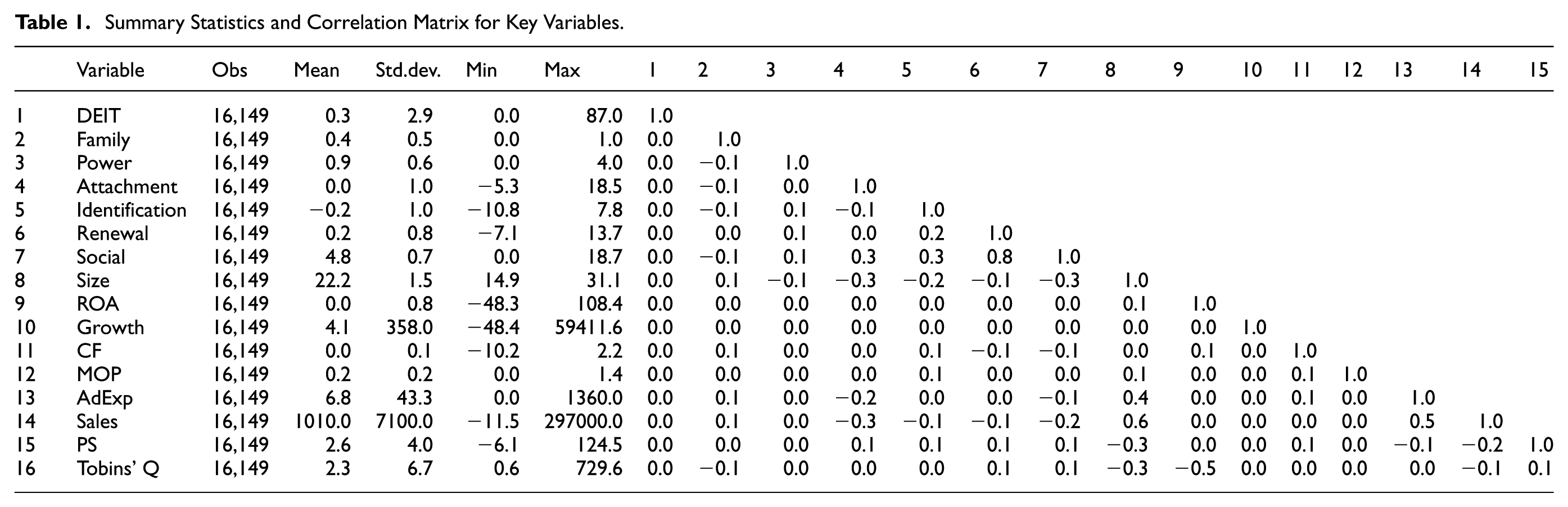
All variables were operationalized based on established literature and adapted to the Chinese context. Continuous variables were winsorized at the 1% and 99% levels to mitigate the influence of extreme values and correct for skewed distributions. Firm Size, Advertising Expenses, and Sales were transformed using the natural logarithm. Table 1 presents the summary statistics and correlation matrix for the key variables.
Summary Statistics and Correlation Matrix for Key Variables.
Dependent Variable
The dependent variable captures firm’s disclosed strategic emphasis on emerging IT (DEIT). As firms may invest in cutting-edge technologies and signal their strategic focus to investors, they typically emphasize their approach to leveraging these technologies for competitive advantage in annual reports. We employed text mining techniques on annual reports to operationalize this variable. Specifically, we initially identified firms through keywords including “blockchain,”“artificial intelligence,”“cloud computing,” and “financial technology” in their financial reports. We further examined whether these terms appeared in the business strategy section, indicating firms’ intent to leverage these technologies for competitive advantage. For firms actively seeking to utilize emerging technologies to create market advantages, we quantified their interest by counting the frequency of mentions of these technologies. The dependent variable (keyword counts) was relabeled as “disclosed emphasis,” but potential bias (impression management in reports) is discussed in limitations section.
Independent Variable
The focal independent variable was whether a company is family-owned. We defined a family firm as a company owned and managed by two or more relatives. Firms were coded as 1 if family-owned and 0 otherwise.
Moderators: Socioemotional Wealth (SEW) Dimensions
The moderators correspond to the five dimensions of socioemotional wealth (SEW). The first moderator of interest is ownership concentration. To measure ownership concentration, we calculated the shareholding proportion of the largest shareholder. The remaining four moderators operationalized the core concepts of socioemotional wealth (SEW) based on foundational research by Berrone et al. (2012) and Laffranchini et al. (2020), employing their initial seed word sets. We adapted Chen et al's (2022) methodology for constructing SEW indicators through a customized dictionary approach, utilizing Linguistic Inquiry and Word Count (LIWC) software to analyze financial reports and quantify conceptual weights. The implementation followed a four-stage sequential process.
Initial cross-cultural seed word generation commenced with Laffranchini et al.’s (2020) five-dimensional English lexicon. Specific linguistic markers were designated to capture each dimension within financial reports. Family Identification manifests through reward-related terminology, while Binding Social Ties emerge in socially oriented vocabulary. Emotional Attachment surfaces in affect-associated expressions, whereas Renewal of Family Bonds through Dynastic Succession is proxied by temporal markers. LIWC outputs provided “focusPresent” and “focusFuture” as empirical indicators for temporal orientation.
Translation protocols involved bidirectional semantic calibration. Multiple Chinese equivalents were generated using Google Translate, Youdao Dictionary, and Baidu Translate,with back-translation verification. For instance, “family honor” received the preliminary translation “
A Delphi panel comprising the original experts refined candidate terms. This optimization phase eliminated low-frequency expressions and culturally overloaded vocabulary while incorporating modern governance terminology, exemplified by replacing “
Control Variables
Drawing on prior literature, we included the following control variables: (1) Firm Size (Size): Natural logarithm of total assets. (2) ROA :Return on Assets, net profit divided by total assets. (3) Tobin’s Q: Market value divided by asset replacement cost, proxy for long-term performance. (4) Sales Growth (Growth) : Annual sales growth rate. (5) Cash Flow (CF): Operating cash flow scaled by total assets, capturing liquidity and operational efficiency. (6) Managerial Overlap Proportion (MOP): Percentage of managers holding equity in multiple companies. (7) Advertising Expenses (Adexp): Firm-level advertising expenditure. (8) Sales: Natural logarithm of total sales, controlling for revenue scale. (9) Potential Slack (PS): Unabsorbed slack resources measured as the ratio of current assets to current liabilities, reflecting financial flexibility.
Validity of SEW Measures
As each SEW dimension may involve multiple concepts, dimensionality was reduced using Principal Component Analysis (PCA), which offers advantages in producing interpretable results for subsequent analyses (detailed PCA eigenvalues, variance explained, and factor loadings are presented in Supplemental Tables A1–A3). The measurement validity of the SEW dimensions was validated through content, construct, and criterion assessments. Detailed PCA eigenvalues, variance explained, and factor loadings are provided in Supplemental Table A1, with inter-dimension correlations below .3 (Supplemental Table A3), supporting discriminant validity. Efficacy metrics confirm VIF values decreased from 12.4 to 1.7 (<10 threshold), supporting cultural adaptation.
Content Validity Test
To further verify the representativeness of the keyword sets, three family business research experts were invited to evaluate the refined keyword sets using a Likert five-point scale. The calculated Proportion of Agreement among Observers (PAO = 0.72) significantly exceeded the threshold of .7 (Holsti, 1969), confirming that the keyword sets effectively capture the core connotations of SEW.
Construct Validity Test
PCA suitability is validated by Supplemental Table A3: KMO = 0.72 exceeding the 0.6 benchmark, and Bartlett’s test significance at p < .001 (χ2 = 3852.7). The principal components collectively explain 49.85% of the total observed variance, as detailed in Supplemental Table A1. As shown in Supplemental Table A2, the variable focus present failed to meet the loading threshold and was excluded. This corroborates SEW theory’s emphasis on long-term orientation, as it aligns with the theoretical focus on future-oriented renewal rather than present-focused attachment. Although the cumulative variance explained is lower than typical values in questionnaire-based studies, it falls within the reasonable range (40%–60%) for textual analysis, reflecting the dilution effect of non-theoretically relevant narratives in annual reports. The independent formation of dimensions for Emotional Attachment and Family Identification supports the universality of Berrone’s framework. The significant loading (.7351, rounded to .74) on the Family Identification dimension (focusfuture variable) highlights Chinese family firms’ prioritization of sustainable operation. Inter-dimension correlation coefficients were all below .3, as detailed in Supplemental Table A3, satisfying the discriminant validity threshold (r < .3; Kline, 2015), confirming PCA’s effectiveness in eliminating semantic overlap. The weak correlation (r = .21**) between Binding Social Ties and Emotional Attachment is theoretically justifiable. It does not compromise dimensional independence but rather suggests the permeating effect of Chinese relational culture.
Criterion Validity Test
To assess the predictive validity of the textual measurement tool for SEW, this study designed an inter-group difference analysis based on the theoretical premise proposed by Gómez-Mejía et al. (2007)—that family firms typically exhibit higher levels of SEW due to their non-economic goal orientation. The specific grouping method involved dividing the sample of listed companies into two distinct categories, namely family firms and non-family firms. An independent samples t-test (two-tailed test, significance level α = .05) was conducted to compare the mean differences across the four text-based dimensions of SEW. Cohen’s d was calculated to quantify the effect size as detailed in Supplemental Table A4. The results showed that the inter-group differences in the dimensions of intergenerational continuity, Emotional Attachment, Family Identification, and social ties were all statistically significant, and the direction of these differences aligned with theoretical expectations, with Cohen’s d indicating small to large effect sizes.
Based on the tripartite validity testing, this study established the reliability of textual analysis for measuring Socioemotional Wealth (SEW). Content validity ensured comprehensive theoretical coverage and cultural adaptation of the lexicon, effectively resolving the localization challenges of Western constructs. Structural validity, achieved through PCA dimensionality reduction, purified dimensional constructs by mitigating cultural-contextual noise, thereby yielding distinct and well-defined dimensional structures. Criterion validity suggested the instrument’s predictive power via intergroup differences, particularly highlighting Chinese family firms’ distinctive emphasis on transgenerational continuity. Mean differences by firm type show significant associations, with Cohen’s d for intergenerational continuity at medium effect size.
Empirical Model
To estimate the impact of family firm governance on disclosed strategic emphasis on emerging IT, we accounted for the count nature and potential over-dispersion of our dependent variable. The distribution and over-dispersion tests of the dependent variable are reported in Table 2, confirming suitability for negative binomial models. Our primary specification employed fixed-effects negative binomial regression models, which are robust for handling over-dispersed count data. As robustness checks, we also estimated fixed-effects Poisson and linear models to ensure the consistency of our inferences.

where i indexes company and t indexes year. The dependent variable
Dependent Variable Distribution and Over-Dispersion Tests.

Notes. Over-dispersion confirmed (variance > mean), justifying negative binomial models.Statistical significance is indicated as follows: ***p < 0.01.
Empirical Results
Main Results
We tested our hypotheses using panel data analysis with firm- and year-fixed effects. The regression results (Table 3) provide initial support for the differential moderating roles of SEW dimensions. The baseline model indicates a significant negative association between family firm management and disclosed strategic emphasis on emerging IT (β = −.485, p < .01), consistent with
Main Regression Results – Disclosed Strategic Emphasis on Emerging IT in Annual Reports.

Notes. Robust standard errors in parentheses. The models include firm fixed effects, year fixed effects, industry × year fixed effects (
We theorize that this reversal may stem from an overembeddedness effect (Uzzi, 1997): while social ties can reduce transaction costs, the closed networks cultivated by families to reinforce control rights (F) and ensure transgenerational continuity (R) may, within the multidimensional SEW framework, lead to information homogenization and inhibit the integration of external knowledge. This mechanism is likely amplified in the context of Confucian chaxugeju (
Simple Slopes and Economic Magnitudes for SEW Interaction Effects on Disclosed Strategic Emphasis on Emerging IT.

Notes. Margins calculated at means and quantiles for substantive interpretation. Economic magnitudes reflect % change in coefficient from low to high level, with practical implication for keyword mentions in reports. Statistical significance is indicated as follows: *p < 0.10, **p < 0.05, ***p < 0.01.

Moderating effects of SEW dimensions on disclosed strategic emphasis on emerging IT.
Robustness Tests
Subsample Analysis: Strategic Emphasis on Blockchain Technology
To verify the reliability of the core findings, this study conducts a series of rigorous robustness checks. We begin by examining a subsample of firms that disclose strategic emphasis specifically on blockchain technology. This approach allows us to investigate whether the influence of socioemotional wealth dimensions persists in a distinct, high-risk technological context.
As summarized in Table 5, the subsample analysis reveals partial robustness of the main results. The direct effect of family governance is positive but statistically insignificant. Similarly, the interaction between family governance and ownership concentration shows a negative yet nonsignificant association, providing no support for
Subsample Regression Results – Disclosed Strategic Emphasis on Blockchain in Annual Reports (Negative Binomial Models).

Note. Significance levels: *p < 0.1, **p < 0.05, ***p < 0.01.
In contrast, the moderating effects of the other four SEW dimensions remain positive and significant. Family Identification exhibits a marginally significant positive effect, while Binding Social Ties, Emotional Attachment, and Renewal through Dynastic Succession all demonstrate statistically significant positive moderating roles, supporting
Control variables maintain consistent effects with the main analysis. Firm size shows a stable positive influence across all specifications, and significant overdispersion continues to justify the use of negative binomial models.
These findings indicate that family firms’ disclosed strategic emphasis on blockchain technology is particularly sensitive to social and emotional dimensions of SEW. The significant positive effect of Emotional Attachment in this high-risk context, contrasting with its non-significance in the main analysis, suggests that blockchain emphasis may activate implicit trust mechanisms within family firms, aligning with the cultural attenuation proposed in
Addressing Endogeneity Via Propensity Score Matching
To further strengthen causal inference and mitigate potential self-selection biases, we employ propensity score matching. This method creates comparable groups of family and non-family firms with similar observable characteristics, enabling more robust comparisons of disclosed strategic emphasis patterns.
We implement nearest-neighbor matching with a caliper of 0.01, estimating propensity scores through a logit model that incorporates all control variables from the main analysis. Balance diagnostics, presented in Table 6, demonstrate substantial improvement in covariate balance after matching. The standardized mean difference for firm size decreases from −15.2% to 2.1%, representing an 86.3% reduction, with corresponding improvements in other variables.
PSM Balance Diagnostics (Pre- and Post- Matching).
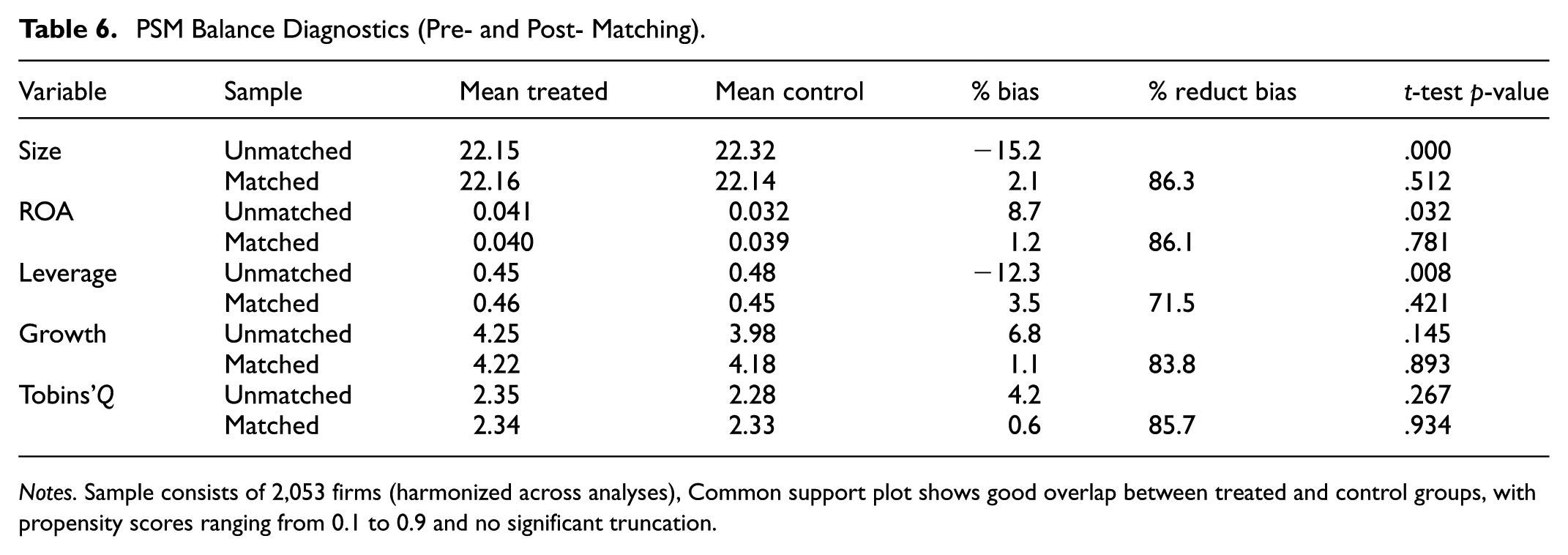
Notes. Sample consists of 2,053 firms (harmonized across analyses), Common support plot shows good overlap between treated and control groups, with propensity scores ranging from 0.1 to 0.9 and no significant truncation.
The post-matching results, based on sample sizes ranging from 5,404 to 7,050 and reported in Table 7, largely corroborate the main findings. One notable exception concerns Binding Social Ties, whose moderating effect becomes statistically insignificant in the matched sample. Other SEW dimensions maintain their expected effects, with Renewal showing particularly robust positive moderation. The persistent non-significance of Social Ties reinforces its context-dependent nature, echoing the sign reversal observed in the primary analysis. Significant overdispersion in the matched sample continues to support the use of negative binomial estimation.
PSM Regression Results – Disclosed Strategic Emphasis on Emerging IT (Negative Binomial Models).

Notes. This study employed nearest-neighbor matching (1:1) with a caliper of 0.01, where propensity scores were calculated based on a logit model incorporating all control variables. Significance levels: *p < 0.1, **p < 0.05, ***p < 0.01.
Alternative Model Specifications
To verify robustness to distributional assumptions, we re-estimated the baseline and full models using fixed-effects OLS and Poisson regressions, and compared these to our preferred negative binomial approach. Table 8 reports the results. The main effect of family firm management is negative and significant in baseline models (e.g., β = −.502, p < .01 in OLS),and becomes positive in full models (e.g., β = 4.059, p < .1 in OLS), which is consistent with primary findings. The moderating effects of SEW dimensions align with the hypotheses: negative for Control dimension (supporting
Fixed-Effects OLS and Poisson Models for Family Firm and SEW Effects on Disclosed Strategic Emphasis on Emerging IT.

Note. Significance levels: *p < 0.1, **p < 0.05, ***p < 0.01.
Model Fit Statistics Across Specifications (Poisson and Negative Binomial).
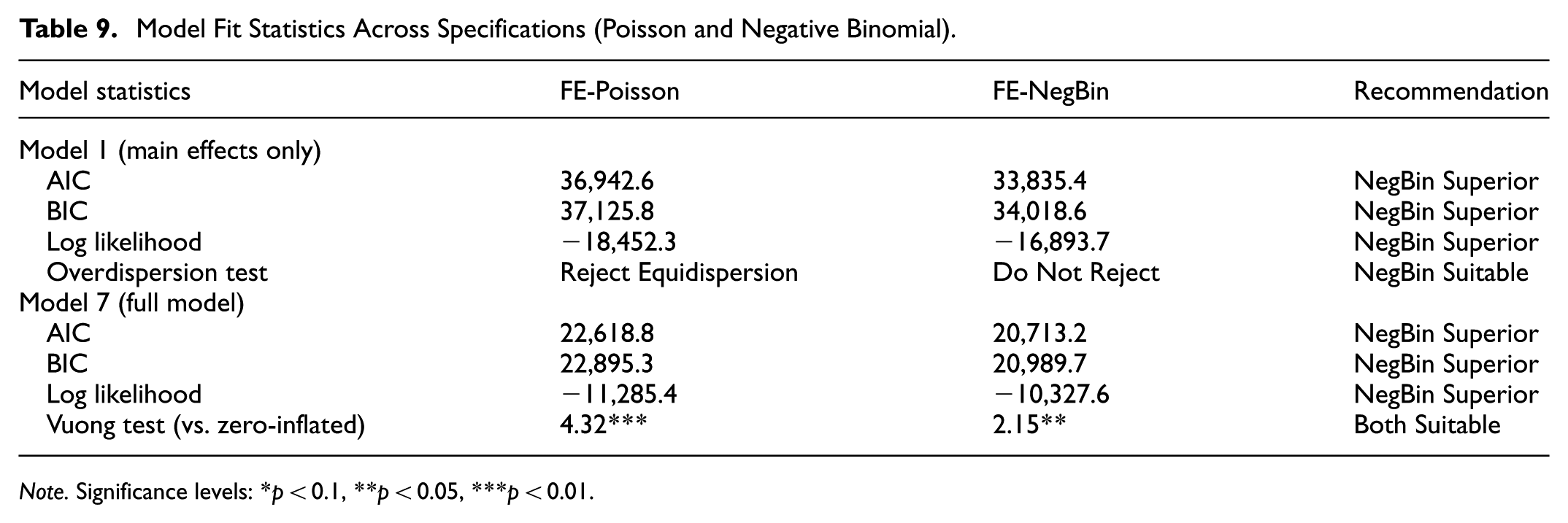
Note. Significance levels: *p < 0.1, **p < 0.05, ***p < 0.01.
Sensitivity Analysis: Confucian Cultural Lexicon for SEW Measurement
To evaluate the robustness of SEW measurement, we developed and validated a Confucian cultural lexicon specifically designed for the Chinese institutional context. The lexicon integrates multiple sources: classical Confucian texts, relevant academic literature, and contemporary corporate disclosures from A-share family firms. Methodologically, we combined TF-IDF screening with expert validation to ensure both statistical relevance and cultural appropriateness.
The measurement validation demonstrated strong psychometric properties. Intercoder reliability reaches a Cohen’s κ of .86 based on independent coding of 100 randomly selected annual reports. The construct showed excellent composite reliability at 0.91, with all dimensions exceeding the threshold for average variance extracted.
Our sensitivity analysis employs four complementary approaches. First, we benchmark against standard LIWC categories to ensure compatibility with established linguistic frameworks. Second, we test alternative frequency thresholds to verify that results are not sensitive to arbitrary cutoff choices. Third, we exclude terms with cross-dimensional loadings to ensure construct distinctness. Finally, we incorporate contemporary enterprise expressions rooted in Confucian principles to enhance cultural relevance.
As Table 10 illustrates, the results remain stable across all sensitivity checks. Coefficient magnitudes and significance levels for key SEW dimensions showed minimal variation under different model specifications. The Confucian cultural lexicon demonstrates consistent reliability across all tests, with composite reliability maintained at 0.91. These comprehensive sensitivity analyses confirmed that the observed relationships are not artifacts of measurement choices or cultural biases.
Sensitivity Tests for SEW Constructs (Raw LIWC, Thresholds, Exclusions).
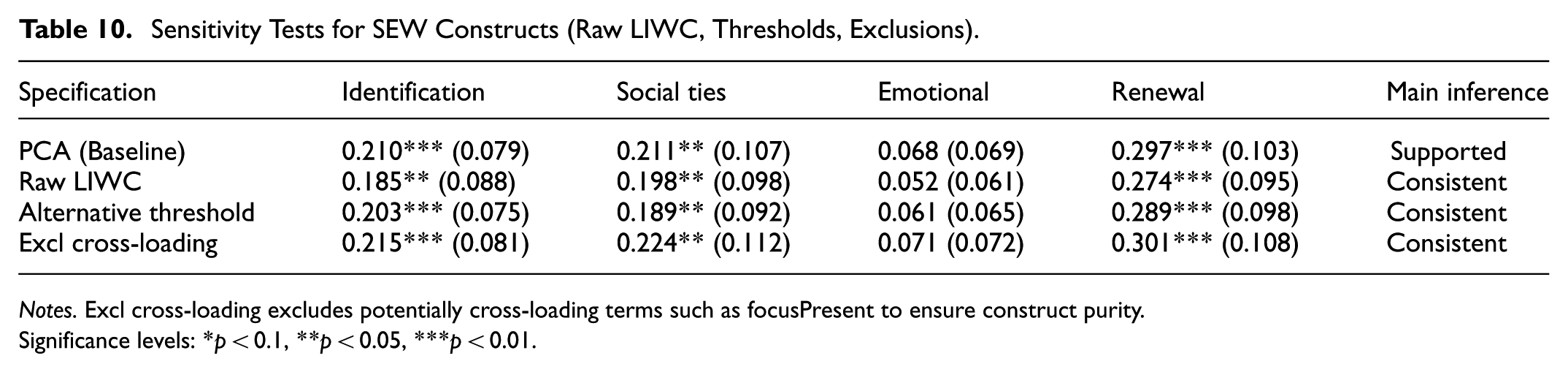
Notes. Excl cross-loading excludes potentially cross-loading terms such as focusPresent to ensure construct purity. Significance levels: *p < 0.1, **p < 0.05, ***p < 0.01.
Conclusions
The principal findings indicate that family firms’ decisions regarding disclosed strategic emphasis on emerging IT are subject to paradoxical influences from multidimensional socioemotional wealth (SEW), rather than dominance by a single dimension. The primary conclusion is that the Control dimension (F), especially under high ownership concentration, is associated with significant inhibition of disclosed strategic emphasis on emerging IT, consistent with classic theories that family firms avoid risks to protect control rights. In stark contrast, the Renewal of Family Bonds through Dynastic Succession dimension (R) shows the strongest positive association, as families view disclosed strategic emphasis on emerging IT as a core strategic tool to ensure long-term competitiveness and “perpetuate the family legacy”—an effect particularly salient in China’s Confucian context. The Family Identification dimension (I) is similarly associated with a positive moderating role, driving families to perceive emphasis as a means to enhance reputation and construct identity. The Binding Social Ties dimension (B) displays marked contextual dependency, with its effect direction contingent on network openness and interactions with other dimensions, ranging from facilitating knowledge sharing to inducing “closed emphasis traps.” The Emotional Attachment dimension (E) shows no significant direct impact in this study’s Chinese context, highlighting culture’s pivotal role in shaping SEW mechanisms.
Discussions
The Core Paradox and Its Contingencies: Dual Forces Governing Decisions for Disclosed Strategic Emphasis on Emerging IT
This study systematically reveals the complex mechanisms underlying decisions for disclosed strategic emphasis on emerging IT in annual reports among family firms by deconstructing the multidimensionality of socioemotional wealth (SEW). Empirical results suggest that SEW does not uniformly inhibit or promote emphasis; instead, its distinct dimensions exert paradoxical effects on family firms’ disclosed strategic emphasis on emerging IT (e.g., Blockchain, artificial intelligence, cloud computing, fintech). Specifically, the Control dimension (F), particularly under high ownership concentration, is associated with suppression of disclosed strategic emphasis on emerging IT in annual reports, corroborating Gómez-Mejía et al.’s (2007) classic assertion that family firms avoid risks to preserve control rights. In contrast, the Family Identification dimension (I) and Renewal of Family Bonds through Dynastic Succession dimension (R) exhibit significant positive moderating effects. This finding challenges simplified views of SEW as a monolithic inhibitory factor (e.g., Chrisman et al., 2012) and aligns with De Massis et al. (2016) and Miller et al. (2008), who posit that family firms actively emphasize to build identity and achieve long-term growth. The key theoretical extension lies in empirically revealing disclosed strategic emphasis on emerging IT’s differential impact on SEW dimensions: emphasis erodes control value while enhancing continuity value (e.g., perpetuating the family legacy). Thus, family firms’ propensity for strategic emphasis fundamentally hinges on their strategic prioritization of specific SEW dimensions. The moderating effect of the Binding Social Ties dimension (B) suggests significant contextual dependency, representing a core paradox uncovered in this study. In baseline models (considering single SEW dimensions), Binding Social Ties exhibits a positive moderating effect, consistent with Adler and Kwon’s (2002) theory that social networks facilitate emphasis by reducing transaction costs. However, when integrated into a multidimensional SEW framework (full model), this effect becomes significantly negative. This reversal underscores complex interactions among SEW dimensions. Robustness checks, including PSM, show this effect becomes insignificant in matched samples, suggesting sensitivity to selection biases, while subsample analysis on blockchain maintains a positive baseline under high-risk contexts. We infer that when Binding Social Ties interact with the Control dimension (F) and Renewal Dimension (R), closed networks constructed by families to reinforce control and ensure transgenerational continuity (e.g., tight government-business relationships) may trigger an “overembeddedness effect” (Uzzi, 1997). This leads to information homogenization, exclusion of external knowledge sources, and formation of a “closed emphasis trap.” Within China’s unique cultural context, Confucian “patterned differential order” (
Theoretical Advancement: Reconceptualizing SEW’s Multidimensional Architecture in Disclosed Strategic Emphasis on Emerging IT
The study’s results achieve three notable theoretical contributions. First, it provides empirical demonstration of how governance structures (ownership concentration) interact with distinct SEW dimensions to jointly shape pathways for disclosed strategic emphasis on emerging IT in annual reports, thereby providing critical boundary conditions for understanding family firm behavior in strategic emphasis. Specifically, empirical evidence suggesting associations between governance structures and SEW dimensions not only confirms the inhibitory effect of the Control dimension (F) on high-risk emphasis (Gómez-Mejía et al., 2007; Patel & Chrisman, 2014)—particularly pronounced in Chinese family firms with high ownership concentration (Xu et al., 2020)—but also deepens comprehension of the “control-emphasis” paradox by revealing antagonistic relationships between control and other dimensions. Second, the study challenges the monolithic view of SEW by demonstrating that disclosed strategic emphasis on emerging IT in annual reports differentially moderates its dimensions. Decisions for emphasis are inherently strategic prioritizations of specific SEW facets by families. This finding robustly refutes two simplistic assumptions: that Binding Social Ties (B) invariably promotes emphasis, though PSM results indicate context-dependent insignificance, and that Emotional Attachment (E) consistently plays a significant direct role in decisions for emphasis (some Western literature). Instead, Binding Social Ties exhibits a “closed emphasis trap” duality, while Emotional Attachment manifests non-significant direct effects in China’s Confucian context due to implicit expression and “legacy perpetuity” prioritization. Third, the study significantly extends existing theoretical frameworks through deep contextualization in China. It empirically validates the core driving role of the Renewal dimension (R) in Chinese family firms (J. Li et al., 2023; Xie et al., 2025), clarifying how Confucian “legacy perpetuity” incentivizes emphasis through reinforced intergenerational commitment. Simultaneously, it emphasizes culture (especially Confucianism) as a key reshaper of SEW dimension weights and pathways, providing Asian-market empirical grounding for cross-cultural theory development. Sensitivity analyses with a Confucian lexicon confirm stability, reinforcing cultural specificity. This contextualized examination not only deepens understanding of SEW’s cultural adaptability but also responds to scholarly calls for cross-cultural theory advancement, endowing conclusions with theoretical universality and cultural specificity.
Strategic Pathways: Navigating the SEW Paradox for Digital Transformation
In practical terms, this study provides insights that may inform managers of family firms navigating digital transformation, though these are hypothesis-generating given the associational nature of the findings and the disclosure-based outcome variable. For instance, to mitigate the Control dimension’s tendency toward risk aversion, firms could explore control rights insurance—a third-party mechanism designed to compensate for potential socioemotional wealth (SEW) losses stemming from ownership dilution (Xu et al., 2020). This approach might help preserve familial authority while enabling necessary investments in emerging IT. Succession planning also emerges as a potential lever, warranting targeted enhancements. Firms might require heirs to lead at least one major emerging IT project as a prerequisite for inheritance, thereby embedding technological expertise directly into the leadership pipeline. Complementing this, a dual-track mentorship system could bridge generational gaps: seasoned family members transmit core cultural values, while external technology experts introduce state-of-the-art skills (J. Li et al., 2023), potentially reconciling tradition with innovation. On the social capital front, governance structures could be reevaluated to foster more open networks. Participation in emerging IT ecosystems, for example, might facilitate international knowledge exchange and offset the innovation-stifling effects of overly insular ties (Uzzi, 1997). Similarly, integrating family gatherings with technology-focused summits offers a potential venue for reform—updating family charters to prioritize ongoing IT adoption, which in turn might transform emotional investments into competitive advantages. Ultimately, these strategies could be supported by implementing dynamic monitoring tools, such as five SEW dashboards. Deviations in metrics like control rights or network openness could prompt responses, including recalibrating IT strategies and upskilling the next generation. Importantly, these recommendations serve as evidence-based decision aids—drawn directly from our analyses (e.g., linking succession to the positive association for the R)—rather than prescriptive mandates, allowing flexibility in application while acknowledging the associational nature of the findings.
Limitations and Future Research
Several limitations warrant explicit acknowledgment. First, methodologically, reliance on annual report text mining to measure SEW dimensions entails inherent constraints: (1) annual reports reflect managerial perspectives, potentially subject to impression management or selective disclosure, which may introduce biases in keyword frequencies and inflate associations with strategic emphasis; (2) LIWC dictionaries and custom lexicons may inadequately capture subtle expressions and cultural specificity of SEW (especially Emotional Attachment) in Chinese contexts; (3) while PCA effectively resolved dimension overlap and verified construct validity, it may sacrifice nuances in raw information. Second, regarding sample and context: (1) focusing solely on Chinese A-share listed firms necessitates cautious generalization, as findings may not directly apply to non-listed firms, which often face distinct governance structures (e.g., less regulatory scrutiny), resource constraints (e.g., limited access to public financing), and decision-making dynamics compared to publicly listed entities. For instance, private firms may exhibit stronger SEW influences due to closer family involvement, but our results cannot be extrapolated without further validation in such contexts; (2) “contextual bias” risk exists, whereby China’s unique institutional environment (e.g., policy uncertainty), culture (Confucianism), and capital market features may shape specific SEW-emphasis relationship patterns. Third, concerning endogeneity: (1) despite fixed-effects models (including firm, year, industry × year fixed effects, and firm linear trends) and PSM (with nearest-neighbor matching, caliper = 0.01, showing improved covariate balance via standardized mean differences and good common support overlap), unobserved firm or family traits (e.g., family entrepreneurship, industry-specific technology shocks) may simultaneously influence SEW and decisions for disclosed strategic emphasis on emerging IT in annual reports (omitted variable bias); (2) success or failure of disclosed strategic emphasis on emerging IT may reciprocally affect families’ perception and valuation of SEW (reverse causality). Finally, in conceptual scope, the study concentrates on specific emerging IT technologies (blockchain, AI, etc.); SEW’s impact on other emphasis types may differ. Subsample analysis on blockchain suggests dimension effects vary by technology risk level, warranting broader IT explorations. These limitations highlight that our findings represent associations rather than causal effects, as corroborated by the fixed-effects and PSM approaches. The dependent variable is over-dispersed (variance > mean), justifying negative binomial models, with inferences robust to Poisson and OLS alternatives. Sensitivities for SEW constructs confirm stability. Governance measures were robustness-tested with alternative ownership concentration proxies and family firm definitions, yielding consistent results.
Based on these findings and limitations, future research could explore the following directions. First, refine methodologies through mixed-method approaches. Integrating text analysis with executive interviews and structured surveys could yield deeper multidimensional insights into both SEW dimensions and actual emphasis outcomes. Developing culturally sensitive NLP tools for Chinese textual data remains an actionable priority, particularly for capturing context-specific expressions like “family legacy perpetuation.” Second, broaden sample diversity and conduct cross-cultural comparisons. Research could encompass non-listed family enterprises and firms across size spectra to address generalization constraints. Rigorous cross-cultural frameworks comparing Chinese enterprises with European, American, or Southeast Asian counterparts would clarify how cultural manifestations of family values and industrial policies moderate SEW-emphasis dynamics. Third, deepen theoretical frameworks by examining dimension interactions. Investigating dynamic trade-offs between the Control dimension and Binding Social Ties across organizational life cycles warrants empirical attention, especially during ownership transition phases. Fourth, embed institutional context to analyze policy impacts. Future studies should incorporate region-specific institutional variables to quantify how policy interventions trigger heterogeneous SEW prioritization. Fifth, to effectively capture such endogenous bidirectional feedback effects between SEW and emphasis, future studies should consider employing dynamic modeling techniques, such as System Generalized Method of Moments (System GMM), or using IV for causality, building on our PSM approach. By demonstrating how SEW dimensions exert distinct effects through unique mechanisms within China’s institutional context, this research advances theoretical understanding of family firm emphasis during digital transformation. These findings yield novel theoretical propositions and actionable implications for practitioners. Cultural contextualization limitations are addressed partially in sensitivity tests, but future research may extend to Western contexts as per Berrone et al. (2012).
Footnotes
Acknowledgements
This research received no non-financial support from individuals or organizations.

Ethical Considerations
This study involved the analysis of publicly available annual reports and databases of listed companies. No human or animal participants were directly involved in any form. Therefore, ethical review and approval by an institutional review board were not required for this secondary data analysis. The research was conducted in accordance with recognized ethical standards for the use of publicly available archival data.
Informed Consent
Informed consent was not applicable to this study. The research relied exclusively on anonymized, publicly accessible secondary data (corporate annual reports and databases), with no direct interaction with or recruitment of human participants. This approach is consistent with section 8.05 of the APA Ethical Principles of Psychologists and Code of Conduct, which allows for the waiver of informed consent in research utilizing archival data that is publicly available and where the risk of identification is minimal.
Author Contributions
T.W. conceived the study, conducted formal analysis, and wrote the original draft. B.G. designed the methodology, super vised the research, and reviewed and edited the manuscript. T.W. collected data, performed investigation, and contributed to visualization. All authors reviewed and approved the final manuscript.
Funding
The authors received no financial support for the research, authorship, and/or publication of this article.
Declaration of Conflicting Interests
The authors declared no potential conflicts of interest with respect to the research, authorship, and/or publication of this article.
Data Availability Statement
The empirical data supporting this article were obtained from subscription-based commercial databases and public regulatory disclosures. Most data were sourced from the China Stock Market and Accounting Research (CSMAR) database and cross-verified with the Wind database. Annual reports were obtained directly from the official websites of the Shanghai and Shenzhen Stock Exchanges. The CSMAR and Wind datasets are subject to third-party licensing and redistribution restrictions; therefore, the authors cannot deposit or publicly release the raw proprietary datasets. Qualified researchers may obtain the same underlying financial and governance data by subscribing to or requesting access from the CSMAR and Wind providers and by retrieving annual report texts from the Shanghai and Shenzhen Stock Exchanges official websites. Non-proprietary derived data (e.g., aggregated summary tables and variable codebooks) and the full analysis scripts used for text processing (LIWC dictionary construction and preprocessing) and econometric estimation will be made available by the corresponding author upon reasonable request, subject to any contractual obligations to the data providers. Requests should specify the intended use and, where required by licensing terms, include evidence of institutional access to the proprietary sources. Any data sharing will comply with the licensing terms of CSMAR and Wind, the terms of use of the Shanghai and Shenzhen Stock Exchanges, and applicable data-protection and confidentiality obligations. Recipients of derived data or code must not attempt to redistribute proprietary raw data obtained under license. To request the analysis code, derived datasets, or further information about data preparation and variable construction, contact the corresponding author at the email address provided on the title page. The authors will respond to bona fide academic requests and, where necessary, provide a data-sharing agreement that reflects third-party licensing constraints.