







Abstract
This study explores the evolution and strategic function of sustainability discourse in the UN General Debate (UNGD) speeches from 2015 to 2024. Using structural topic modeling (STM), Shannon entropy, and correlation analysis, we uncover how international rhetoric aligns or decouples from national performance on the Sustainable Development Goals (SDGs). Twelve distinct topics were identified through STM, with eight directly linked to the SDGs. The results show a structural shift from the institutional consolidation of the 2030 Agenda to a high-entropy state of poly-crisis and fragmentation after 2020. Crucially, the correlation analysis shows an “Easier Said Than Done” phenomenon: nations with lower SDG scores exhibit higher rhetorical intensity on development themes, utilizing UN speeches as a form of symbolic policy for aspirational signaling and legitimacy. Furthermore, a stratified discursive strategy emerges, where high-performing states use discourse for validation, vulnerable nations for advocacy, and great powers—often statistically “invisible” in direct correlations—engage in strategic decoupling to redefine global norms. These findings challenge the assumption of linear diplomatic communication, demonstrating that sustainability rhetoric in the UN is a contested terrain shaped by power asymmetry, crisis response, and the discursive construction of hegemony.
Plain Language Summary
Every year, representatives from almost every nation gather at the United Nations General Debate to share their visions for the future. Since 2015, these speeches have been centered on the “Sustainable Development Goals” (SDGs)—a global “to-do list” designed to end poverty, reduce inequality, and protect the planet. But does this talk reflect real-world progress? Our study analyzed over 1,900 speeches from 196 countries using computer-assisted text analysis. We found that the way countries talk about sustainability is rarely a simple reflection of their achievements. Instead, there is often a “talk-action gap.” Interestingly, countries that struggle the most to meet sustainability targets often talk more about these goals on the UN stage. This acts as a form of “political signaling”—a way for leaders to show they support global values even when progress on the ground is slow or difficult. Through our analysis, we identified 12 major topics in these speeches. While some of them focus on urgent global issues like the COVID-19 pandemic or climate change, others are deeply tied to regional conflicts and political identity. We also found that major global powers, such as the United States, China, and Russia, use sustainability talk strategically. For these nations, these speeches are not just progress reports; they are tools used to compete for international influence and to shape global rules in their favor. Ultimately, this research shows that UN speeches are strategic performances. By distinguishing between what is said and what is actually done, we can better understand how global priorities are shaped and ensure that leaders are held accountable for the promises they make to the world.
Keywords
Introduction
A decade after the adoption of the 2030 Agenda for Sustainable Development, the global trajectory remains troubling: only 35% of its 137 targets show meaningful advancement, nearly half are lagging behind, and 18% have regressed. This alarming trend calls for urgent, coordinated global action over the next 5 years. To understand how this challenge is depicted and addressed in international discourse, attention has shifted to the United Nations General Debate (UNGD). This forum unites top world leaders to discuss critical international issues, including sustainability and the Sustainable Development Goals (SDGs). The UNGD speeches reveal a rich array of linguistic and rhetorical strategies that reflect the complexities of international politics. Analyzing the discourse has attracted researchers’ great interest as the world continues to face issues such as inequality, climate change, and geopolitical tensions (Fuoli & Beelitz, 2024; Shen & Kotze, 2025).
Recent scholars have worked to uncover the complex layers of UN diplomatic discourse, demonstrating how language shapes policy preferences, institutional identities, and collective memory within international relations. These studies generally fall into two categories: those focusing on computational and linguistic analysis of larger text corpora, and those focusing on the strategic function and framing of the discourse. In the computational and linguistic tradition, researchers have adopted computational linguistics, corpus linguistics, and discourse analysis techniques to mine large-scale corpora, like the UNGD Corpus, for patterns that shed light on how diplomatic communication is formed and changing. For instance, Shen (2023a) has investigated referential explicitation across diverse cultural contexts, identifying significant differences that affect persuasive strategies within United Nations discourse. Complementing this work, Shen and Kotze (2025), for example, distinguished between translated and original texts in their thorough diachronic analysis of diplomatic discourse, finding that translated speeches are typically more formal and conservative, demonstrating the UN translators’ cautious approach. This realization not only emphasizes the difficulties of translating in diplomatic settings but also highlights the possible ramifications for the way legitimacy and authority are viewed globally (Shen, 2023b). Furthermore, the methodological innovations employed in these studies, including topic modeling and machine learning techniques, furnish robust tools for analyzing the intricate relationships between discourse and policy outcomes (Gurciullo & Mikhaylov, 2017; Watanabe & Zhou, 2022).
Other scholars have concentrated on the function of this discourse, with studies by Fuoli and Beelitz (2024) and Sciandra et al. (2021) examining the framing of sustainability narratives within the UNGD, and the discourse surrounding sustainability has garnered increased attention. They contribute valuable insights into the efficacy of the United Nations’ sustainability agenda and its alignment with member states’ commitments by elucidating the complex relationship between political rhetoric and public perception (Litofcenko et al., 2023). Such research is vital for understanding how different nations negotiate their roles and construct their identities within the United Nations framework, particularly concerning the SDGs (Adams & Mitrani, 2024; Sciandra et al., 2021).
Despite these advancements, significant analytical disconnects remain in the current literature. While recent scholarship has enriched our understanding of specific thematic strands, such as gender, through qualitative lenses, these studies often remain fragmented or constrained by their focus on isolated variables, limiting the systemic generalizability of their findings (Alshahrani, 2023; Brun-Mercer, 2021). Moreover, much of the existing work operates primarily within the domain of linguistics and translation studies. Critics have noted that while attention to language policy and translingual dynamics is crucial for understanding UN mechanics (McEntee-Atalianis & Vessey, 2020; Shen, 2023b), there is a scarcity of research that empirically bridges the gap between these discursive patterns and material outcomes. Specifically, we lack robust quantitative evidence on whether the high-level rhetoric at the UNGD actually mirrors national commitments to the 2030 Agenda, or merely serves as symbolic decoupling.
This study addresses these gaps by conducting a comprehensive analysis of sustainability discourse in UNGD speeches from 2015 to 2024, employing structural topic modeling to identify key themes and examining their relationship to SDG Index performance. Specifically, we address two main research questions: (1) How did the prominence and diversity of sustainability-related topics evolve from 2015 to 2024 in UNGD speeches? (2) To what extent did the prevalence of sustainability-related topics in countries’ UNGD speeches correlate with their performance on the SDG Index? By bridging the gap between discourse analysis and SDG performance, we seek to provide a new understanding of how diplomatic discourse influences the implementation of the SDGs. This research not only contributes to the existing literature on UN discourse but also offers practical insights for policymakers striving to enhance the effectiveness of global sustainability initiatives.
Theoretical Framework
This research focuses on a key issue in global governance studies: how diplomatic commitments relate to actual policy results. The UNGD is the premier international political platform, providing a consistent collection of elite speeches where leaders annually express their national goals and global ambitions. To explore the connection between what countries state and what they achieve, especially regarding SDGs, the study combines two main theories of Agenda-Setting and Symbolic Policy, using Critical Discourse Analysis (CDA) to account for the statistical relations. This framework helps measure countries’ rhetorical efforts and provides tools to understand the structural factors that influence alignment with or misalignment from SDG outcomes.
Agenda-Setting Theory and Rhetorical Prioritization
The Agenda-Setting Theory provides the framework for operationalizing rhetorical commitment. Originally grounded in communication studies (McCombs & Shaw, 1972), this framework has been extensively adapted within political science and linguistics to explain how elite actors utilize discourse to structure public priorities and influence policy outcomes (Kingdon, 2011; Walgrave & Van Aelst, 2006). In the highly competitive environment of the UNGD, the frequency and salience with which a nation discusses an issue cannot be accidental, which represents a deliberate act of “issue definition” and prioritization (Entman, 1993). The theory states that the amount of attention paid to an issue determines its perceived importance, both domestically and internationally. Therefore, the recurrence and proportional emphasis a state places on topics such as climate, finance, global health, or regional conflicts are treated not merely as text, but as a measurable proxy for its rhetorical investment and its attempt to shape the global policy agenda.
Our use of STM directly operationalizes this theoretical premise. By moving beyond simple keyword counts to extract the underlying thematic architecture of the discourse, STM measures the relative “attention share” a country dedicates to specific topics (Roberts et al., 2014). This allows us to track how stated priorities shift in response to global shocks—a phenomenon described by Baumgartner and Jones (2024) as “punctuated equilibrium,” in which external events force rapid agenda realignments. The quantitative rigor enables us to understand governments’ perspectives and preferences (Baturo et al., 2017) and further test whether the magnitude of rhetorical input (agenda-setting effort) is systematically associated with tangible policy outputs.
Symbolic Policy Theory and the Decoupling Mechanism
However, interpreting high talk as necessarily equating to high performance is not advisable. The Symbolic Policy Theory offers an essential perspective, cautioning that political discourse often serves expressive or ceremonial functions rather than signaling immediate instrumental action (Edelman, 1985; Gustafsson, 2013). It suggests that political actions often serve expressive or ceremonial functions aimed at satisfying public or institutional expectations, rather than always leading to immediate, practical policy results (Edelman, 1985). In the context of the SDGs, the 2030 Agenda stands as a powerful global symbol of commitment to sustainable development. For many nations, especially those with substantial structural issues, adopting SDG language becomes a strategic choice to preserve international legitimacy and access global financial or diplomatic networks. This phenomenon is explained by decoupling in institutional sociology, where an organization’s formal rhetoric is disconnected from its actual performance, allowing the organization to appear favorable to external observers (Boxenbaum & Jonsson, 2017; Bromley & Powell, 2012).
Our central empirical finding—the “Easier said than done” phenomenon—serves as strong evidence of this symbolic mechanism. When countries with lower overall SDG performance scores show a significant tendency to emphasize SDG-related rhetoric more often, it is probably not a report of achievement but an act of aspirational signaling. By vocally supporting sustainability, they aim to manage their reputation, deflect criticism, and signal commitment, while also seeking external resources or time needed to address complex domestic issues (Lim & Tsutsui, 2012). As Gray and Baturo (2021) note, this strategy can also be seen as a way of delegating diplomacy, using the global platform to shift responsibility or demand systemic change from wealthier nations. The strategic use of symbolic output is therefore not a failure of communication but a successful political strategy to maximize legitimacy despite resource constraints.
Analytical Tools of Critical Discourse Analysis (CDA)
To fully explain the heterogeneous correlations observed across different state types, this framework integrates CDA, acknowledging that diplomatic rhetoric is inextricably linked to power asymmetry and strategic positioning. We adopt Fairclough’s (2003) dialectical-relational approach, which posits that discourse is not merely a neutral transmission of information but a form of social practice that constitutes political reality, identities, and power relations. To operationalize this macro-level theory within our text analysis, we employ the specific linguistic concept of Transitivity and Agency derived from Systemic Functional Linguistics (Fairclough, 2003; Halliday, 1985). This lens allows us to decode how states construct their relationship to sustainability through grammatical choices:
First, we examine the construction of Agency and Hegemony through the use of active voice and material processes. When actors utilize strong action verbs such as “we mobilized” or “we delivered,” they construct a semantic role of the “Active Agent.” This linguistic pattern is hypothesized to be a hallmark strategy of high-power states, such as the United States, used to legitimize leadership through demonstrated capacity. In these instances, discourse mirrors material power, offering an explanation for the positive correlations observed between rhetorical intensity and high performance indices.
Conversely, for vulnerable nations, the strategic use of passivization and externalization serves a fundamentally different political function. By employing passive constructions or victimization framings—such as describing development as being “denied” or “suffocated by barriers”—these states linguistically suppress their own agency. In doing so, they position the state as the “Goal” or receiver of external actions rather than the driver of domestic policy. This mechanism helps explain the negative correlations where high rhetorical volume reflects a political demand for structural justice and a critique of the international system, rather than a report on poor governance (Chimni, 2004).
Finally, the framework analyzes how revisionist powers employ Reframing and Normative Definition to challenge the status quo. By utilizing relational processes—for example, asserting that “development is a human right”—actors like China shift the debate from verifying factual compliance to defining fundamental norms. This suggests that for such powers, UN discourse is deployed for strategic positioning and normative contestation rather than domestic reporting (Shen, 2024). By integrating Agenda-Setting, Symbolic Policy, and these specific CDA tools, the study is equipped to systematically distinguish between Positive Policy Feedback, where rhetoric reflects leadership, and Symbolic Strategy, in which rhetoric manages reputation or demands resources. The analytical flow below (Figure 1) illustrates how our computational methodology is systematically linked to testing these high-level political theories.
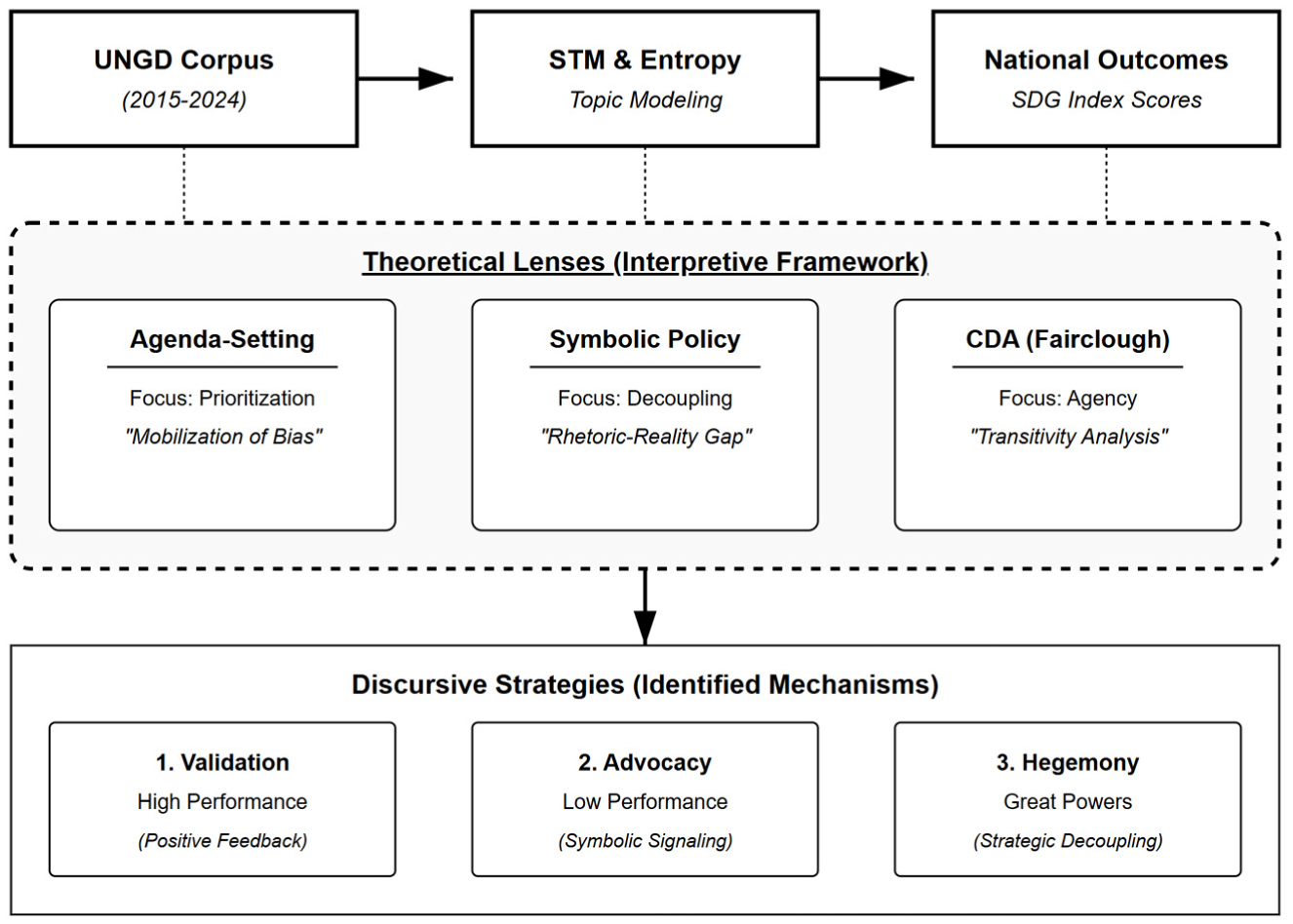
Theoretical framework: The rhetoric-performance link.
Materials and Methods
The Dataset
The study uses the entire United Nations General Debate Corpus (UNGDC), which is a comprehensive collection of more than 10,000 speeches made by representatives of 202 countries, including historical and present states, from 1946 to 2024 (Jankin et al., 2024). It is publicly accessible at the Harvard Dataverse and provides cleaned and formatted texts. While the full corpus spans nearly 8 decades, this study focuses on the period from 2015 to 2024. This has been selected for analysis to align with the worldwide adoption and implementation phase of the 2030 Agenda for Sustainable Development. This decade has seen sustainability become an increasingly prominent topic in international discourse, influencing UN policy and the communications among member states.
The final dataset comprises 1,938 speeches delivered by representatives of 196 distinct entities, including all 193 UN Member States, two observer states, and the European Union. A systematic audit of the corpus reveals a highly consistent data density, with only 22 missing country-year observations (a 1.12% missing rate) across the 10-year period (Table 1). These gaps are primarily attributed to temporary non-participation or technical absences and are considered missing completely at random, thus posing no systematic bias to the thematic extraction. To ensure semantic density for the STM, we applied a minimum length threshold of 100 words. The resulting corpus exhibits a mean length of 2,036 words (SD = 711) and a median of 1,938 words. While individual speech lengths range from 463 to 7,082 words, the STM algorithm mitigates potential “length bias” by normalizing document-topic proportions, ensuring that each speech—regardless of duration—contributes equally to the estimated topic probabilities.
Description of the Corpus.

Given that the UNGDC contains both original English speeches and official UN translations, we acknowledge the potential for translation-related linguistic shifts. As noted by Shen and Kotze (2025), translated diplomatic texts often exhibit higher formality and conservatism compared to original compositions. However, for the purpose of thematic extraction via topic modeling, the semantic consistency provided by official UN translations ensures a standardized vocabulary across the member states, facilitating a reliable cross-national comparison of policy priorities. By focusing on original and translated English speeches, the study captures the evolution and prominence of sustainability-related topics in direct response to the SDG agenda, thereby ensuring that the analysis reflects the most pertinent and policy-oriented phase of global sustainability dialogue.
Topic Modeling
To extract the latent thematic structure of the speeches, Structural Topic Modeling (STM) was employed. This method could produce robust and interpretable results for both long-term and comparative studies (Roberts et al., 2019). Unlike traditional Latent Dirichlet Allocation (LDA), STM allows the integration of document-level metadata (covariates)—such as year and country—directly into the analysis, facilitating the investigation of how topics’ prominence and content shift over time and across member states.
The corpus underwent a standard preprocessing pipeline: lowercasing, removal of punctuation and numbers, and the elimination of “stop words” (common functional words such as “the,”“is,” and “of,” as well as high-frequency diplomatic terms like “nations” and “international”). The optimal number of topics (K) for the structural topic model was identified with the search K function in the stm R package, which assesses model fit across different values of K using multiple diagnostic metrics such as held-out likelihood, residuals, and semantic coherence. As shown in the diagnostic plots (Figure 2), the held-out likelihood increases rapidly and levels off after K = 10, indicating that most model improvements occur by this point. Semantic coherence remains relatively high when K = 10–12 but decreases with more topics, suggesting reduced interpretability. Beyond K = 12, additional topics provide only slight gains in model fit, while semantic coherence declines more significantly. Besides these quantitative diagnostics, we also manually reviewed the keywords and thematic coherence of topics for K = 10, 11, and 12. Based on this qualitative review, we determined that K = 12 offers the most interpretable and meaningful set of topics for our analysis. Therefore, K = 12 was chosen as the optimal number, balancing model interpretability, coherence, and predictive performance in analyzing sustainability discourse in UN General Debate speeches.
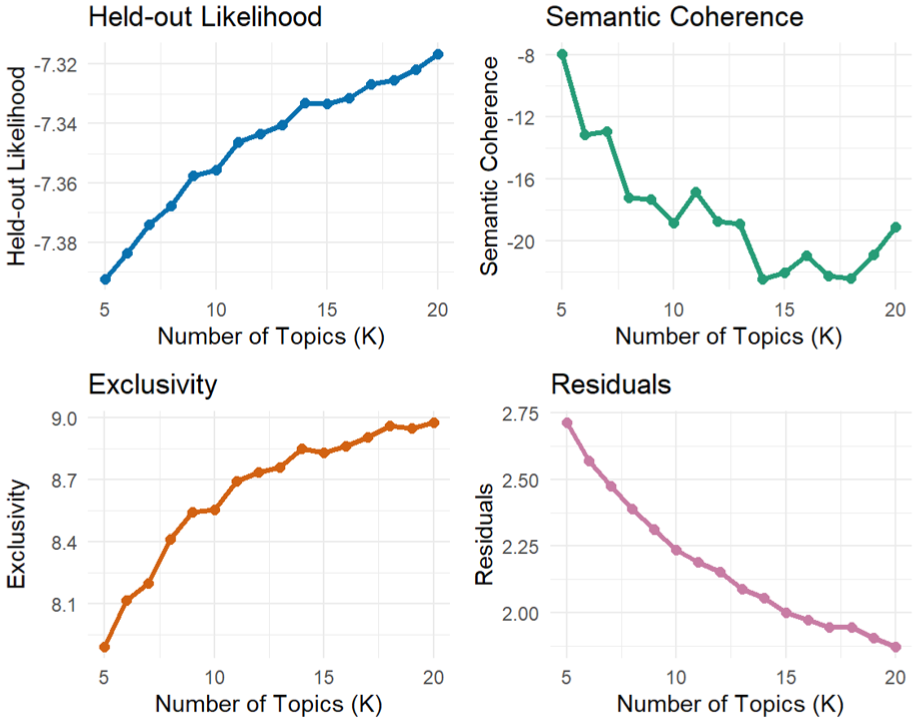
Diagnostic metrics for optimal topic number selection.
Following model selection, topic labels were rigorously validated to ensure interpretive accuracy. We employed a dual approach combining algorithmic indicators with human validation. Two independent coders were tasked with labeling the topics by examining the highest probability words alongside FREX (Frequency and Exclusivity) and Lift scores to capture distinctive terminology. To verify the consistency of these qualitative interpretations, inter-coder reliability was assessed using Krippendorff’s alpha. The process yielded a coefficient of .87, indicating strong agreement between coders. Any remaining discrepancies in topic labeling were subsequently resolved through consensus discussions to establish the final twelve thematic categories.
Topic Entropy
Beyond topic proportions, we conducted a topic entropy analysis to assess the consistency and diversity of the identified topics over the 10-year period. We calculated Shannon entropy to quantify the distributional uncertainty of topics for each year, following established practices in information theory (Shannon, 1948):

where pi represents the proportion of topic i in a given year’s collective discourse. Lower entropy indicates a highly focused debate dominated by a few key issues (e.g., a “crisis mode” focused on the pandemic), while higher entropy reflects a broad, multi-faceted discussion where multiple SDGs receive relatively equal attention. For each speech, we computed its topic entropy and averaged these values across all speeches in the same year. By examining the change in average topic entropy over the years, we can better understand whether the variety of topics in speeches is growing, shrinking, or staying steady. This sheds light on how the discussion about sustainability is shifting in complexity and scope among member states. For instance, an upward trend in entropy might show that the sustainability conversation is expanding to cover more issues. In contrast, a downward trend could mean it is focusing more narrowly on particular themes. This extra analysis of topic entropy works well with the topic modeling results, helping us understand how the complexity of themes has evolved and giving us a clearer picture of how sustainability debates are changing over time.
Correlation Analysis
We conducted a Pearson Correlation Analysis to evaluate the relationship between the annual topic proportions extracted via STM and the corresponding SDG Index Scores (retrieved from the Sustainable Development Report from the official website https://dashboards.sdgindex.org). For each topic extracted via STM, Pearson correlation coefficients are computed to assess the strength and direction of association with SDG Index scores, aggregated annually and by country. This approach allows us to determine positive association, indicating a “Positive Feedback” mechanism where higher domestic performance is reflected in increased rhetorical emphasis, and negative association, providing empirical evidence for Symbolic Policy Theory. A negative correlation suggests that states with lower performance scores may strategically increase their rhetorical salience on sustainability—an act of aspirational signaling to maintain international legitimacy. This approach, distinct from Jankin et al. (2024)’s broader descriptive analyses, focuses on quantifying the impact of sustainability discourse intensity, justified by its ability to provide causal insights into how thematic emphasis in UNGA speeches correlates with measurable sustainability outcomes, especially relevant given the post-2015 SDG adoption surge.
Results
RQ1: How Did the Prominence and Diversity of Sustainability-Related Topics Evolve from 2015 to 2024?
The STM Results of Topics
We identified 12 distinct topics via STM representing different aspects of global discussion over the past decade (Table 2). Eight topics (66%) were directly linked to the Sustainable Development Goals (SDGs) of the UN based on the top words for each topic using FREX measures.
Sustainability-Related Topics in UNGD Speeches (2015–2024).
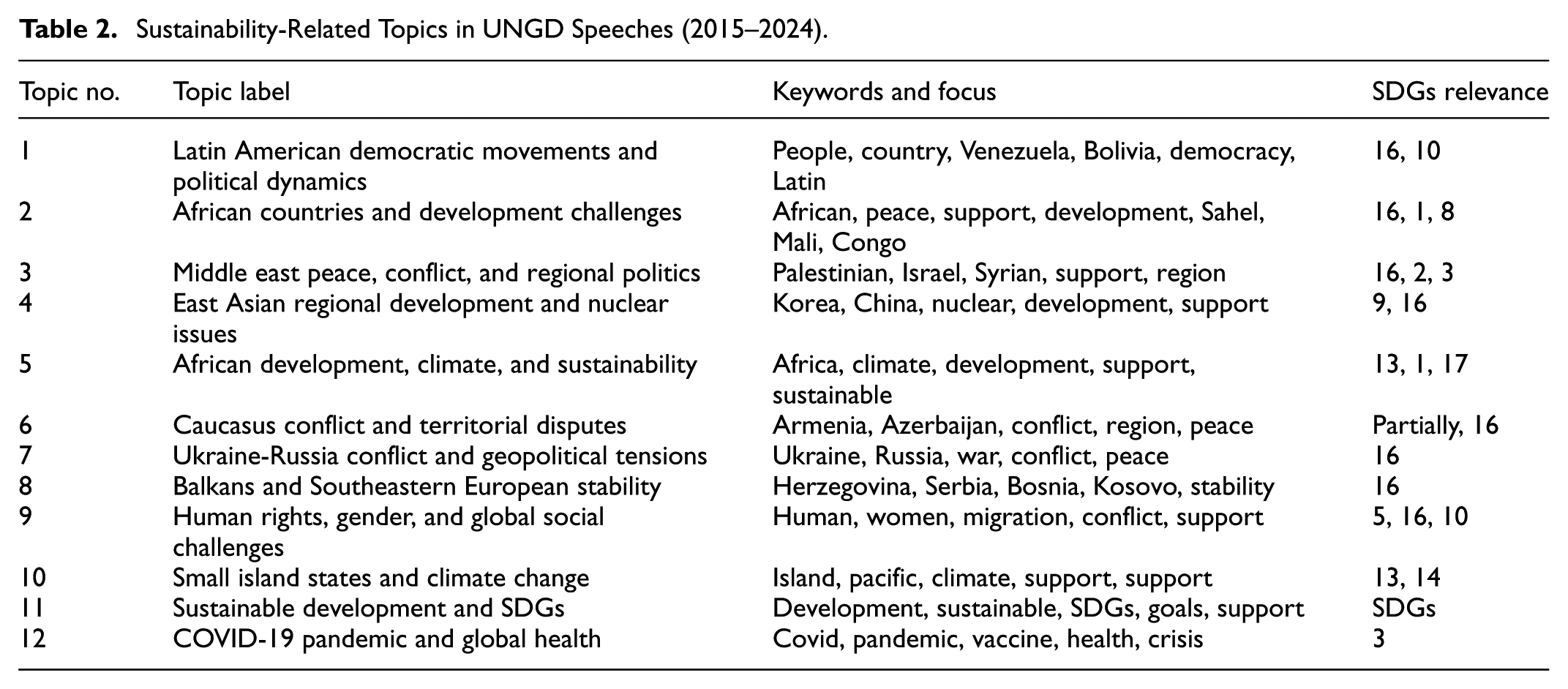
These sustainability-related topics encompass a broad range of SDGs, such as public health (Topic 9), economic development and inequality (Topics 4 and 7), peace and security (Topics 3, 6, and 10), and climate action and environmental protection (Topics 2, 5, and 9). For instance, words like “climate,”“island,”“ocean,” and “pandemic” frequently appear in discussions of climate-related topics, while terms like “terrorism,”“conflict,” and “resolution” are common in peace and security topics. Discussions of “inequality,”“growth,” and “poverty” relate to themes of economic development, whereas references to “covid,”“vaccine,” and “health” highlight health-related issues. Notably, some subjects—such as those related to geopolitical tensions and regional conflicts—do not directly align with the SDGs but still reflect persistent challenges in the global arena. The variety of topics covered in this analysis underscores the complexity of UN sustainability debates, emphasizing both the continued importance of certain global priorities and the emergence of new issues in response to changing global circumstances
Temporal Prominence of Sustainability-Related Topics
The stacked area chart (Figure 3) illustrates the temporal evolution of all identified twelve topics, with each colored band representing the mean proportion of a specific topic in a given year. The y-axis displays cumulative topic proportions, and the thickness of each band reflects the relative prominence of that topic over time. The temporal evolution reveals how the global diplomatic agenda shifts in response to both sudden shocks and long-term structural goals. Notably, Topic 11 (Sustainable Development and SDGs) serves as the thematic anchor of the decade, maintaining a consistent and substantial presence. This suggests that the SDG framework has successfully become the primary “language” of the UNGD and reflects the ongoing commitment of member states to the 2030 Agenda and the centrality of sustainable development in the UN discourse. The keywords for Topic 11—such as “development,”“sustainable,”“SDGs,” and “goals”—demonstrate its explicit alignment with the SDG framework. However, other topics exhibit more volatile trajectories. For example, Topic 12 (COVID-19 Pandemic and Global Health, SDG 3) surges in prevalence during 2020 to 2022, nearly tripling in prevalence at the height of the COVID-19 pandemic. Topic 5 (African Development, Climate, and Sustainability, SDGs 13, 1, 17) and Topic 10 (Small Island States and Climate Change, SDGs 13, 14) both increase following major climate agreements, highlighting the growing attention to climate action and resilience. This reflects an “Agenda-Setting” success where the specific vulnerabilities of island nations have moved from the periphery to a more central position in global climate discourse. Topics addressing peace, conflict, and social challenges (Topics 2, 3, 4, 6, 7, 8, and 9) are mapped to SDGs 16, 10, 5, and others, and remain persistent in the discourse, reflecting the enduring importance of these issues.
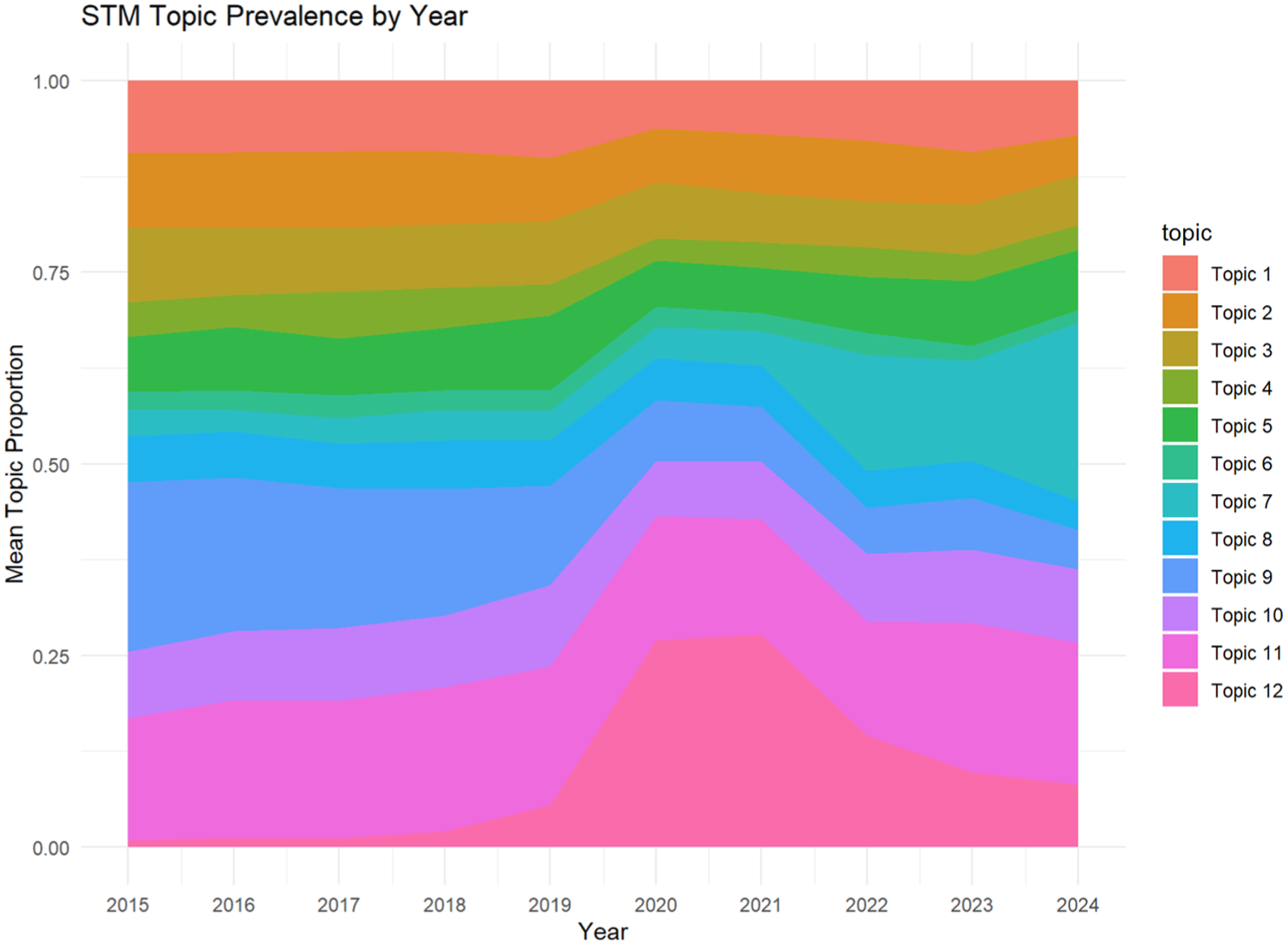
Stacked area chart of STM topic prevalence by year (2015–2024).
To better understand the structural nature of these shifts, we grouped the twelve topics into four distinct trend categories: crisis-responsive, gradually evolving, institutionally stable, and moderately fluctuating. Crisis-responsive topics, such as Topic 12 (COVID-19 Pandemic and Global Health) and Topic 7 (Ukraine-Russia Conflict), show sharp spikes in prevalence during major global events, reflecting how sudden crises can rapidly dominate international discourse. Gradually evolving topics, like Topic 10 (Small Island States and Climate Change), demonstrate a steady increase over time, indicating a growing diplomatic focus on environmental sustainability. Institutionally stable topics, including Topic 11 (Sustainable Development and SDGs) and Topic 5 (African Development, Climate, and Sustainability), maintain consistent prominence, highlighting their foundational role in multilateral diplomacy and ongoing commitment to the SDG agenda. Moderately fluctuating topics, such as Topic 1 (Latin American Democratic Movements) and Topic 3 (Middle East Peace), respond to regional developments but do not exhibit dramatic shifts. This classification reveals that sustainability discourse at the UN at the UN is not a monolith; it is a complex system that balances immediate responses to global crises with enduring priorities and gradual structural changes.
The Intensity of Sustainability Discourse by Keyword Analysis
To complement the structural topic modeling approach, we conducted a keyword-based analysis examining the temporal evolution of SDG-related terminology By identifying representative keywords for each of the 17 SDGs (e.g., “poverty” for SDG1, “health” for SDG3, “climate” for SDG13), we mapped their frequency patterns from 2015 to 2024 (Figure 4). The analysis validates and extends the STM findings, with climate-related keywords (“climate,”“emissions”) showing steady increases following the Paris Agreement implementation in 2016, while health-related terms (“health,”“disease”) exhibited dramatic spikes during 2020 to 2022 corresponding to the COVID-19 pandemic period. The keyword trend analysis demonstrates notable temporal variations that align with global sustainability priorities and crisis events. Partnership and cooperation-related terms (“partnership,”“cooperation”) maintained consistent presence throughout the decade, reflecting the ongoing emphasis on SDG17’s collaborative approach to sustainable development. Economic development keywords (“employment,”“growth”) peaked during 2020 to 2021, coinciding with pandemic-related economic recovery discussions, while environmental sustainability terms (“biodiversity,”“ocean”) showed gradual increases, particularly after 2019. This keyword-based approach provides a complementary perspective to the unsupervised topic modeling results, offering targeted insights into how specific SDG concepts have evolved in diplomatic discourse and enabling more precise correlation analysis with quantitative sustainability performance measures.
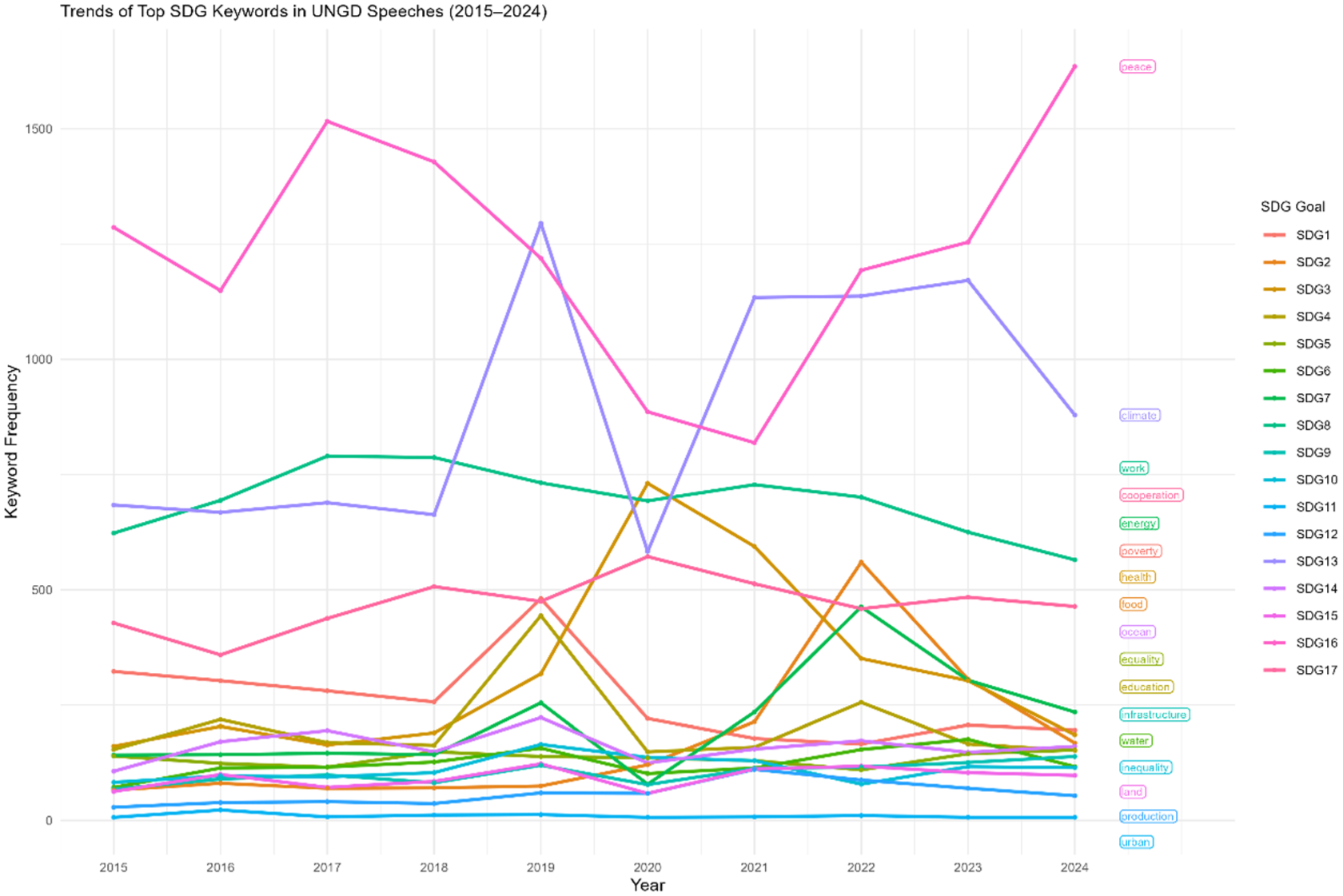
Temporal trends of top SDG keywords in UN general debate speeches.
The Diversity of Sustainability-Related Topics
While keyword counts measure intensity, Shannon Entropy measures the diversity, complexity, and unpredictability of the global debate. Figure 5 presents the temporal dynamics of topic diversity, operationalized by the mean Shannon entropy of the topic distributions. The trajectory of entropy reveals a fascinating “rhythm” that closely aligns with major global inflection points. Initially, entropy contracts immediately after the adoption of the 2030 Agenda in 2015 and the 2016 Brexit referendum, suggesting a consolidation of thematic focus and a relative narrowing, consensus-driven agenda centered on defined development goals.

Topic diversity in entropy by year.
By contrast, the advent of the COVID-19 pandemic in early 2020 corresponds with a pronounced surge in entropy, reflecting an expanded thematic repertoire and elevated uncertainty in the General Assembly’s deliberations. Following this, entropy continues to fluctuate: it climbs again in 2023 amid the intensification of the Russia–Ukraine conflict and then declines in 2024 as numerous countries undergo high-stakes national elections. This sustained high-entropy state serves as quantitative evidence of global transformations unseen in a century. It indicates that the previous order of focused consensus has dissolved into a complex, high-uncertainty environment where leaders must simultaneously grapple with compounding crises—pandemics, geopolitical conflicts (Ukraine), and economic fracturing. Together, these temporal patterns provide robust evidence that the UN’s sustainability discourse is a dynamic system. It is capable of both thematic concentration during periods of institutional alignment and rapid expansion when global shocks force a re-evaluation of interconnected goals.
RQ2: How Does the Prominence of Sustainability Discourse Correlate with Existing Sustainability Performance Across 2015 to 2024?
Global Correlation Patterns: Leadership Talk Versus Aspirational Signaling
Figure 6 illustrates the correlation coefficients between the prevalence of each topic and countries’ SDG Index scores from 2015 to 2024, with reference to the topic labels and SDG relevance summarized in Table 1. The results reveal a clear divergence in how nations use the UNGD stage based on their domestic sustainability performance. Positive correlations, shown in green, indicate that countries with higher sustainability performance tend to emphasize topics such as Topic 7 (Ukraine-Russia Conflict and Geopolitical Tensions), Topic 8 (Balkans and Southeastern European Stability), and Topic 9 (Human Rights, Gender, and Global Social Challenges) in their speeches. These topics are closely linked to SDG 16 (peace, justice, and strong institutions), SDG 5 (gender equality), and SDG 10 (reduced inequalities). This pattern suggests that high-performing countries—predominantly those with established institutional stability—tend to use their speeches to project their successes in governance and social equity, effectively asserting international leadership in these domains.
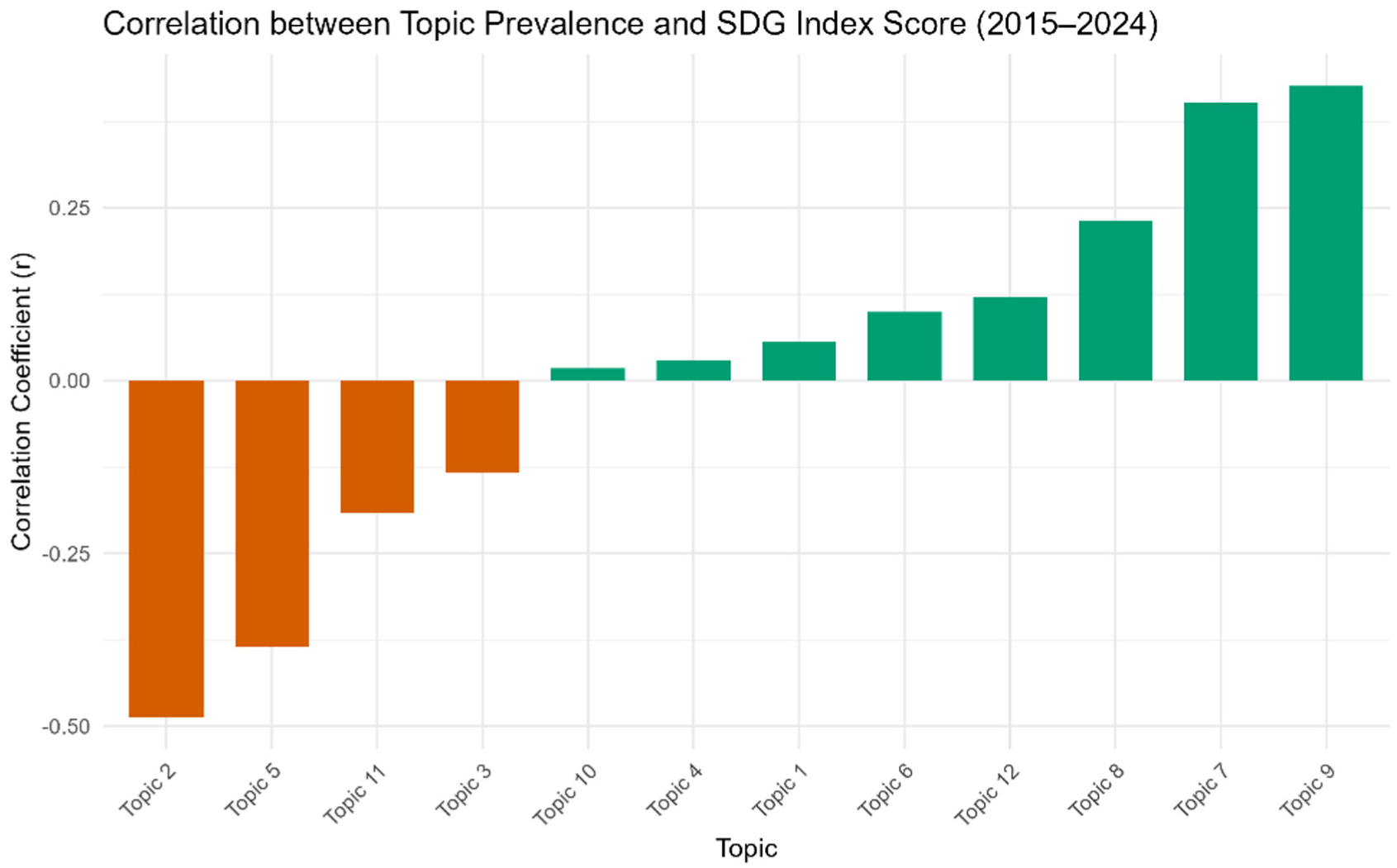
Correlation (p < .05) between topic prevalence and SDG index scores.
In contrast, negative correlations, shown in orange, are observed for topics like Topic 2 (African Countries and Development Challenges), Topic 5 (African Development, Climate, and Sustainability), Topic 11 (Sustainable Development and SDGs), and Topic 3 (Middle East Peace, Conflict, and Regional Politics). These topics share a thematic focus on regions facing systemic development challenges, where sustainability, peacebuilding, and global policy interventions are central to the discourse. Notably, the negative association for Topic 11 implies that countries with lower SDG Index scores are more likely to focus on sustainable development and SDG-related themes in their speeches, possibly as a form of advocacy or to signal their commitment to improvement. In other words, this is an “Easier said than done” pattern, which highlights a gap between discourse and action, where countries facing greater sustainability challenges may speak more about the SDGs but have yet to translate these commitments into measurable progress. Rather than reporting on progress, this rhetoric serves as a form of aspirational signaling—a strategic effort to maintain international legitimacy and advocate for support despite lagging domestic results.
Country-Specific Variations and Discursive Strategies
The data in Figure 7 shows that the relationship between what countries talk about in their UN speeches and how they perform on the SDG Index is far from uniform and varies significantly across national landscapes. For each topic, the countries with the strongest positive or negative correlations are quite different, which highlights how national priorities and contexts shape both discourse and outcomes. When analyzed through the specific thematic lenses identified in this study, distinct patterns of regional synergy, crisis response, and developmental disconnects emerge.
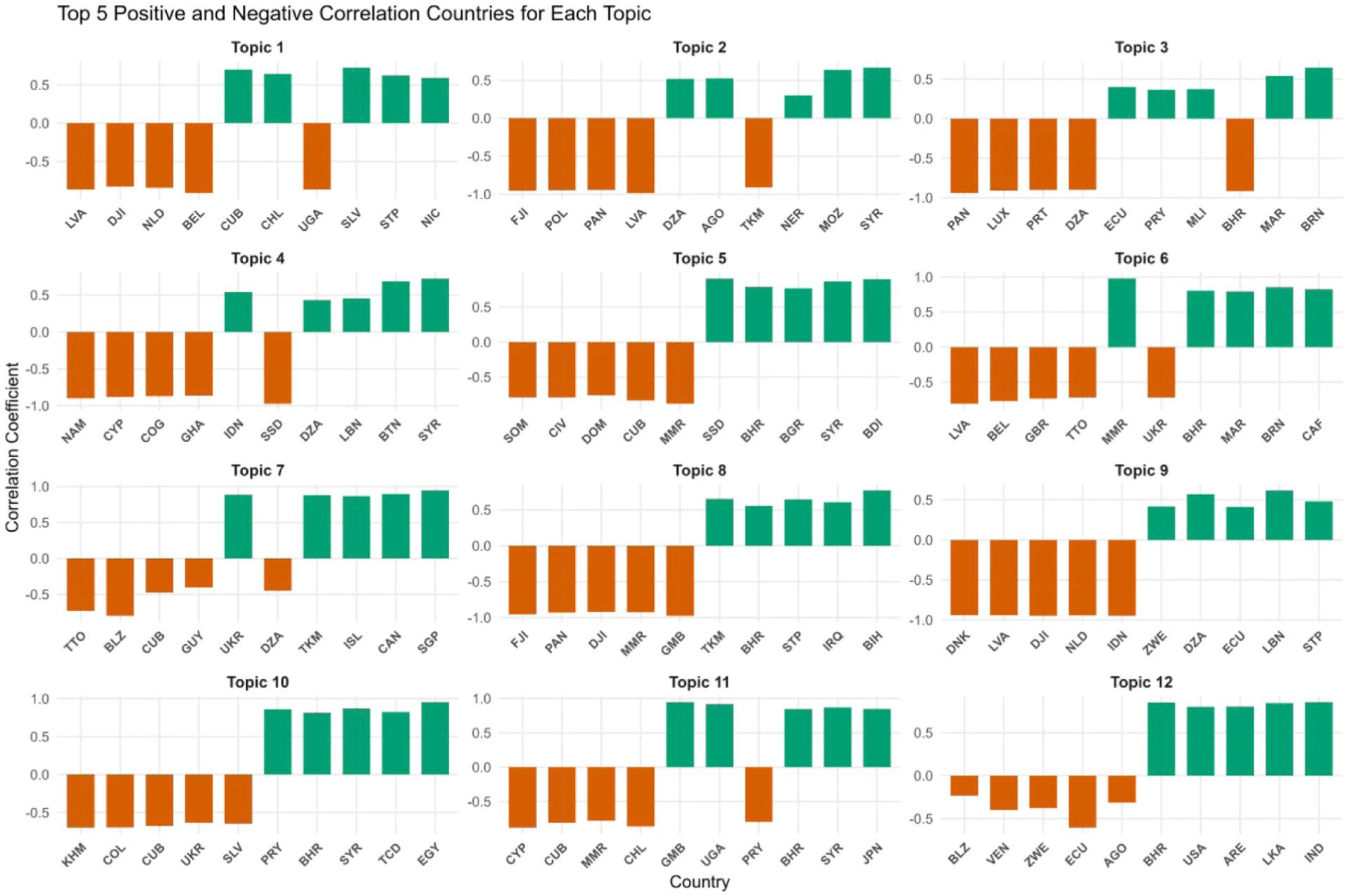
Top 5 positive and negative correlation countries for each topic.
The analysis highlights a strong regional synergy in geopolitical discourse. For Topic 1 (Latin American Democratic Movements and Political Dynamics), Latin American countries such as El Salvador (SLV), Cuba (CUB), Chile (CHL), and Nicaragua (NIC), along with the African state of São Tomé and Príncipe (STP), have the highest positive correlations. For these states, discussions regarding democratic movements and political stability are closely associated with improvements in their SDG metrics, serving to validate their achievements and assert thematic leadership. Similarly, Topic 8 (Balkans and Southeastern European Stability) shows an expected positive alignment for Bosnia and Herzegovina (BIH), confirming that rhetorical emphasis scales with direct national involvement. Conversely, geographically distant actors—such as Belgium (BEL) and The Netherlands (NLD) in Topic 1—display strong negative correlations, suggesting that their engagement with these regions is discursive and diplomatic rather than reflective of their own domestic performance baselines.
The relationship between development rhetoric and outcomes reveals a significant “rhetoric-reality gap,” particularly in the Global South. We observe a compensatory discourse in Topic 11 (SDGs) and Topic 5 (African Development), countries facing severe structural challenges—such as Cuba (CUB), Myanmar (MMR), and Somalia (SOM)—consistently appear among the strongest negative correlations. This confirms that for these states, rhetorical intensity outpaces actual progress, functioning as a signal of distress or a demand for aid rather than a report of achievement. For high-performing European nations, we observe an outward-facing discourse. Interestingly, Topic 9 (Human Rights and Gender) reveals negative correlations for leaders like Denmark (DNK) and the Netherlands (NLD). This suggests that their rhetoric on rights is often externally focused—critiquing global standards or advocating for others—rather than reflecting fluctuations in their already high domestic indices. Global crises and specialized development themes underscore the unique role of Great Powers and specific vulnerabilities. Topic 12 (COVID-19 Pandemic and Global Health) represents a rare instance of alignment for the United States (USA), which joins Bahrain (BHR) and India (IND) in showing a strong positive correlation between health-related rhetoric and pandemic response indicators. Similarly, Topic 7 (Ukraine-Russia Conflict) exhibits the clearest alignment for nations directly implicated in the conflict’s security architecture. Ukraine (UKR), alongside Canada (CAN) and Singapore (SGP), shows strong positive correlations, indicating that high rhetorical emphasis serves to reinforce their institutional positioning within the Western security alliance. Meanwhile, Topic 10 (Small Island States and Climate Change) shows unexpected positive alignment in landlocked or continental states like Paraguay (PRY) and Chad (TCD), perhaps reflecting a rhetorical solidarity with climate vulnerability rather than geographic island status.
Finally, it’s worth noting that major powers like the USA, China, and Russia are notably absent from the top five positive or negative countries for most topics, with the exception of the U.S. in the health domain (Topic 12). From a critical discourse analysis perspective, this suggests that for high-status actors, UNGD discourse is often decoupled from domestic performance and instead serves as a tool for strategic positioning. Their rhetoric is designed to negotiate global influence, shape governance architectures, or manage geopolitical competition. For instance, China’s lack of extreme correlation implies a balanced or systemic approach to discourse that avoids the “compensatory” spikes of the Global South while maintaining a broader agenda than the niche focus of smaller states. These findings make it clear that the link between what countries say about sustainability and how they actually perform on the SDGs is highly variable. In some cases, there’s a strong match between rhetoric and results; in others, there’s a noticeable disconnect. This underscores just how complex and context-dependent the relationship between international discourse and real-world sustainability outcomes can be.
Qualitative Analysis: How Countries Frame Sustainability
We qualitatively examined specific speeches from key nations identified in the correlation analysis. This qualitative evidence illuminates the linguistic mechanisms—specifically lexical choice, transitivity, and semantic framing—that underpin the statistical patterns observed in the topic modeling results.
First, the rhetoric of the United States in Topic 12 (COVID-19 and Global Health) illustrates how Great Powers utilize a discourse of mobilization through specific agent-driven constructions. Our quantitative analysis identified a strong positive correlation for the U.S. in this domain, and textual analysis confirms that American rhetoric successfully “securitized” global health. In 2021, U.S. speeches shifted from diplomatic abstraction to high-transitivity verbs that emphasize agency and material capacity, such as “shipped,”“deployed,” and “mobilized.” The explicit phrasing “We have shipped more than 160 million doses … with no strings attached” (USA_76_2021) linguistically constructs the U.S. as the primary semantic agent of global recovery. By repeatedly utilizing the phrase “We will lead” alongside material metrics (e.g., “Planes carrying vaccines … have already landed”), the discourse transforms health data into a narrative of hegemony, framing pandemic response as a projection of state power.
Second, the discourse of China on Topic 11 (SDGs) exemplifies a strategy of constructive strategic positioning through semantic reframing. Consistent with the quantitative finding that major powers often decouple rhetoric from domestic reporting, Chinese speeches utilize the UN platform to propose systemic definitions. Linguistic analysis shows a shift from “reporting” verbs to “proposing” verbs. In 2021, China introduced the Global Development Initiative (GDI), explicitly reframing development not just as an economic metric but as a moral imperative: “Development holds the key to people’s wellbeing” (CHN_76_2021). The discourse actively constructs a collective identity through inclusive phrases like “people-centered” and “benefits for all” (CHN_76_2021). By 2022, China further reinforced this stance by using metaphorical descriptors such as “pacesetter” and “provider of public goods” (CHN_77_2022). This linguistic strategy serves to legitimize China’s role not merely as a participant, but as an architect of global governance norms.
Finally, the negative correlations observed for Global South nations like Cuba on Topic 11 are explained by a “Discourse of Externalization” characterized by passive constructions and victimization tropes. For these states, high rhetorical volume on development serves as a demand for structural justice. Cuban speeches systematically rely on collocations that link “development” with “obstruction.” In 2023, the Cuban representative employed a powerful metaphor, asking, “What sustainable development can be achieved with that noose on their necks?” (CUB_78_2023). The speech linguistically transformed the economic blockade from a policy into an act of violence, describing it as “suffocating” and “economic warfare” (CUB_78_2023). By persistently pairing the subject “sustainable development” with negative predicates like “restrict” and “depress,” Cuba transforms its speech into a diplomatic tool to contest the “unjust international order,” thereby explaining why its rhetorical intensity remains high despite lagging economic indices.
Discussion
This study offers a quantitative analysis of sustainability discourse in UNGD speeches from 2015 to 2024, highlighting subtle patterns in how topics develop, their diversity, and how they align with national SDG performance. Using structural topic modeling, entropy analysis, and extensive country-level correlation analysis, we uncover a complex ecosystem where international rhetoric is not merely a reflection of domestic progress but a strategic tool used for legitimacy, agenda-setting, and geopolitical positioning. The findings suggest that the link between what countries say and what they do is mediated by power dynamics and institutional incentives, revealing three critical mechanisms: symbolic policy decoupling, adaptive agenda-setting, and stratified discursive strategies.
Symbolic Policy Decoupling and the Paradox of Commitment
One of the most striking findings is the persistent prominence of Topic 11 (Sustainable Development and SDGs) throughout the entire decade, confirming the successful institutionalization of the 2030 Agenda as the lingua franca of modern diplomacy (Litofcenko et al., 2023; Smith et al., 2021). This aligns with the observation that the SDGs have become a central reference point in global policy frameworks and media discourse (Fuoli & Beelitz, 2024; Lopez-Carrion & Marti-Sanchez, 2024). The consistent use of explicit SDG terminology—including keywords such as “development,”“sustainable,”“SDGs,” and “goals”—reflects not only ongoing commitment to the 2030 Agenda but also the centrality of sustainable development as an organizing principle in multilateral diplomacy (Baturo & Gray, 2024).
However, our correlation analysis uncovers a paradoxical “Easier said than done” phenomenon that challenges conventional assumptions about the relationship between discourse and action. Countries with lower SDG Index scores, including major powers such as China and Russia, consistently appear among those with the strongest negative correlations for Topic 11, meaning they tend to emphasize SDG-related themes more in their speeches precisely when their sustainability performance is weaker (Baturo & Dasandi, 2017; Shen, 2024). From the perspective of Symbolic Policy Theory, this suggests a mechanism of strategic decoupling: for states struggling with implementation or facing normative criticism, high-intensity rhetorical engagement serves as a compensatory signal. This pattern suggests that rhetorical commitment to the SDGs may serve as a form of aspirational signaling or diplomatic positioning rather than reflecting actual progress toward sustainable development goals (Gray & Baturo, 2021). The persistence of SDG discourse across all countries, regardless of performance, indicates that the 2030 Agenda has become a necessary diplomatic vocabulary, but one that can be deployed strategically by different actors for different purposes (Parent & MacDonald, 2024).
Adaptive Agenda-Setting: Crisis as a Driver of Discursive Change
Beyond institutionalization, the temporal dynamics of topic prevalence and diversity demonstrate that sustainability discourse at the UN is highly responsive to global crises and emergent challenges through adaptive agenda-setting, revealing the adaptive capacity of international environmental and development communication (Adhikari & Kato, 2024; Baturo & Gray, 2024). The distinct spikes in Topic 12 (COVID-19 Pandemic and Global Health), and Topic 7 (Ukraine-Russia Conflict and Geopolitical Tensions) demonstrate the UNGD’s capacity to pivot from long-term developmental goals to immediate crisis management (Hecht, 2016), which spiked following the escalation of the Ukraine war in 2022. These crisis-responsive topics reflect the UN’s role as a forum for addressing immediate global challenges while simultaneously maintaining focus on longer-term sustainability objectives. The Shannon entropy analysis provides additional evidence for this adaptive capacity, showing that thematic diversity expands significantly during periods of global uncertainty and crisis (Shen & Kotze, 2025). Entropy peaked during the COVID-19 pandemic in 2020 and again during the intensification of the Russia-Ukraine conflict in 2023, indicating that major global events trigger measurable increases in the breadth and unpredictability of sustainability-oriented discourse. Conversely, entropy contracted following major policy adoptions, such as the launch of the SDGs in 2015, suggesting that institutional milestones can temporarily focus and narrow diplomatic discourse (Smith et al., 2021).
This dynamic adaptation demonstrates that UN sustainability discourse operates across multiple temporal scales, balancing immediate crisis response with enduring institutional priorities and gradually evolving structural changes (Lopez-Carrion & Marti-Sanchez, 2024). Topics such as Topic 10 (Small Island States and Climate Change) and Topic 5 (African Development, Climate, and Sustainability) show gradual, steady increases over time, reflecting long-term shifts in diplomatic priorities driven by climate science and development experience rather than acute crises.
Stratified Discursive Strategies: From Advocacy to Geopolitics
Finally, a “rhetoric-reality gap” is not random but reflects stratified discursive strategies of different countries, uncovering distinct patterns of diplomatic communication across development levels, regional contexts, and political systems (Baturo & Dasandi, 2017; Parent & MacDonald, 2024). High-performing countries such as Sweden, Germany, and Canada consistently demonstrate direct alignment across multiple sustainability topics, using UN speeches to validate their status as model global citizens. These leading nations often focus on topics such as Topic 9 (Human Rights, Gender, and Global Social Challenges), Topic 5 (African Development, Climate, and Sustainability), and Topic 10 (Small Island States and Climate Change) when their SDG performance is high. This suggests their UN speeches are aimed at showcasing achievements and reaffirming leadership in global sustainability efforts, which aligns with Parent and MacDonald (2024), who observed that established powers frequently use status and leadership language in UN forums.
In sharp contrast, countries with lower SDG Index scores—like Nigeria, Afghanistan, Yemen, and Sudan—tend to have strong negative correlations on topics such as Topic 2 (African Countries and Development Challenges), Topic 6 (Caucasus Conflict and Territorial Disputes), and Topic 12 (COVID-19 Pandemic and Global Health). For these nations, emphasizing development issues, conflict resolution, and health crises in UN speeches is linked to lower actual SDG performance, implying their diplomatic discourse is more about advocacy and raising awareness of ongoing problems than celebrating successes.
Most significantly, the behavior of Great Powers reveals a discourse of hegemony and contestation. Our analysis highlights a “Great Power Invisibility,” where actors like China and Russia frequently do not appear in the top positive or negative correlation rankings for most topics. This statistical moderation suggests a “strategic decoupling” (Shen, 2024), where superpower discourse is detached from specific domestic indicators to serve broader geopolitical goals. As Wiener’s (2014) theory of normative contestation suggests, these powers use the UN not to report on the SDGs, but to redefine them—promoting alternative concepts such as the “Global Development Initiative” to challenge Western definitions of governance. The United States provides a notable exception only during crises, such as Topic 12 (COVID-19), where its strong positive alignment reflects an attempt to reassert leadership through material capacity. Ultimately, these findings underscore that the UN General Assembly is a fragmented arena where the same sustainability language is deployed for fundamentally different political ends: validation for the successful, survival for the struggling, and sphere-of-influence management for the powerful (Appendix).
These diverse patterns highlight how domestic politics, regional interests, and diplomatic strategies shape international sustainability communication. Countries dealing with internal challenges may use UN forums to highlight their commitment to global goals while also drawing attention to their difficulties, supporting findings by Baturo and Dasandi (2017) on domestic governance and international rhetoric. These findings underscore that the UN General Assembly serves as a fragmented arena where the same sustainability language is deployed for fundamentally different political ends: validation for the successful, advocacy for the struggling, and hegemony for the powerful.
Conclusion
This study systematically examined the evolution and alignment of sustainability discourse in UN General Debate speeches from 2015 to 2024, using mixed methods of structural topic modeling, correlation analysis, and qualitative analysis. These results show that while the SDGs have become a consistent and central theme in UN rhetoric, the prominence and variety of sustainability-related topics are highly influenced by global events, with significant shifts during crises such as the COVID-19 pandemic and the Ukraine-Russia conflict. The analysis also indicates that some topics, like sustainable development, maintain steady attention, while others fluctuate or vary in prominence over time. Our findings reveal a complex ecosystem where discourse functions as a strategic instrument for legitimacy, crisis management, and normative contestation.
Key Findings and Theoretical Implications
First, the temporal analysis demonstrates that the UNGD is an adaptive system. While the 2030 Agenda has successfully institutionalized sustainability as a consistent diplomatic vocabulary, the system exhibits high entropy during global shocks. The distinct rhetorical surges during the COVID-19 pandemic (Topic 12) and the Ukraine conflict (Topic 7) confirm that the Assembly functions as a crisis-responsive forum, where agenda-setting is continuously renegotiated in response to external instability.
Second, the correlation analysis uncovers a pervasive “Easier Said Than Done” phenomenon, highlighting significant variation in how countries’ sustainability discourse aligns with their actual SDG performance. High-performing countries tend to emphasize topics closely linked to their achievements, whereas countries facing more challenges often use sustainability rhetoric as advocacy or aspiration.
Third, the study highlights the strategic decoupling of major powers such as the USA, China, and Russia, which display distinct patterns reflecting both strategic positioning and domestic priorities in their international communication. As shown in the qualitative analysis, these powers employ specific linguistic mechanisms—such as the U.S. use of active agency or China’s semantic reframing—to reconstruct the definition of development.
Limitations and Future Research
Several limitations should frame the interpretation of these findings. First, while Structural Topic Modeling effectively identifies latent themes, it treats text as a “bag of words,” potentially overlooking subtle linguistic nuances such as sarcasm, hedging, or modality that a qualitative Critical Discourse Analysis might capture. Second, our reliance on English-language texts (official translations) may obscure rhetorical strategies unique to the original delivery language, introducing a potential Anglocentric bias in topic formation. Third, the study establishes statistical associations but cannot infer causality; we cannot claim that rhetorical shifts cause changes in SDG performance, or vice-versa, without more granular time-series modeling.
Future research should address these gaps by incorporating multilingual natural language processing to assess the impact of translation on diplomatic signaling. Additionally, scholars should investigate the causal mechanisms of the “rhetoric-reality gap” using lag-based econometric models to determine if “cheap talk” at the UN eventually compels policy changes through mechanisms of reputation or shame. Finally, expanding the analysis to include non-state actors and specialized UN committees could clarify whether the strategic decoupling observed in the General Assembly persists in more technical, binding forums.
Footnotes
Appendix: Expert Validation and SDG Mapping Rationale
This section details the methodology and substantive logic used to align the 12 topics extracted via Structural Topic Modeling (STM) with the United Nations Sustainable Development Goals (SDGs). Each mapping was subjected to a two-stage validation process: (1) topics were initially screened against the official UN SDG Indicator Metadata and the Global SDG keywords. (2) Two independent coders reviewed the top 20 keywords with the highest probability loading for each topic.

Ethical Considerations
This study did not involve human or animal subjects requiring ethical approval. No ethics committee approval was necessary.
Funding
The authors received no financial support for the research, authorship, and/or publication of this article.
Declaration of Conflicting Interests
The authors declared no potential conflicts of interest with respect to the research, authorship, and/or publication of this article.
Data Availability Statement
The datasets analyzed during the current study are available from the corresponding author on request.*
Research Interests
Ting Li: EFL pedagogy and educational technology. Fengjie Zhang: Computer assisted language testing, computational linguistics. Linwei Yang: Data mining, corpus linguistics and digital politics.