






Abstract
This research studies the relation between perceived market uncertainty and consumers’ consumption decisions in unstable markets, as the Palestinian market that witnessed multiple political conflicts and economic instability in recent decades. Market uncertainty includes three sub variables: perceived price change, perceived income change, and perceived change in currency exchange rates. Also, the study examines the moderating influence of consumers’ income and the working sector. A survey-based methodology was adopted and a convenience sample was implemented. Two hundred and twenty-six consumers from the West Bank were surveyed using structured questionnaires. Structural Equation Modeling (SEM) was conducted by using the Smart-PLS 4 program. The results show that the respondents believe that the prices in the Palestinian market are continuously increasing while their income and buying power are decreasing. Furthermore, the results indicate that the Palestinian market faces high levels of uncertainty regarding perceived changes in prices, income, and currency exchange rates. Also, the three independent factors significantly negatively affect consumer consumption decisions. The moderating effect of consumers income was found to be insignificant while the work sector mediates the only the relationship between perceived currency exchange rate and consumption decision. The results of this study are of high importance for businesses and policymakers since it provides them with valuable information about the consumers’ perceptions that can help them enhance their strategies and plans for better dealing with the unstable market situation.
Keywords
Introduction
Uncertainty in the Global Markets Context
The current global economy is witnessing intensified volatility, with many fluctuations occurring, which have adverse effects on individual expenditures, savings, and financial behaviors. Various global events, for instance, the COVID-19 pandemic, as well as political conflict situations such as the Israeli-Palestinian and Ukrainian-Russian conflicts, are resulting in high uncertainty levels.
Previous studies targeting developed countries prove that economic uncertainty has adverse effects on individual expenditures. For example, studies by Coibion et al. (2024) and Nam et al. (2021) prove that when financial and macroeconomic uncertainty indices rise, individual household expenditures decline substantially and consistently.
Objective versus Subjective Uncertainty
The traditional approach to economic analysis has mainly concerned with uncertainty using objective data, focusing on macro data such as dispersion in forecasts for GDP, inflation rates, and stock market volatility, as shown in studies by Altig et al. (2020), Fortin et al. (2023), and Nam et al. (2021). More recent studies in the field covered by Han et al. (2022), Zhao et al. (2022), and Walters et al. (2023) argue that perceived uncertainty must also be recognized.
Perceived uncertainty relates to how people read changes in their environment and how such readings influence what they anticipate about income, prices, and economic stability in general. Drawing on this perspective, Ben-David et al. (2018), Chirumbolo et al. (2021), and Zhao et al. (2022) indicated that people who are uncertain about their future earnings, work, and personal life, tend to save more and spend less. These studies in addition to other studies, indicate that perceived uncertainty, shaping consumer behavior, is a function of subjective states than of objective conditions within the external world.
Dimensions of Perceived Uncertainty
This study focuses on the way in which the perceptions of changes in prices, exchange rates, and incomes are significant elements that influence the perceptions of uncertainty. The three elements were selected because, among others, they have an obvious direct effects on consumers confidence and behaviors. Changes in prices affect incomes through ripple effects, while exchange rates may affect imports and consequently purchasing power (Fortin et al., 2023; Nam et al., 2021). Changes in incomes serve as determinants of perceived incomes; these changes show how vulnerable consumers can be to any form of economic challenges, such as reduced incomes due to reduced wages and loss of jobs (Ben-David et al., 2018; Han et al., 2022).
In extreme socio-economic fluctuations in countries such as Palestine, which falls under developing and conflict economies, consumers do not have direct experiences involving macroeconomic elements such as financial market instability and uncertainties (Chirumbolo et al., 2021). Hence, to articulate with theory, the current study emphasizes these three factors.
The Palestinian Market Context
The Palestinian market is defined by what is termed a “conflict economy.” This economy suffers from significant instability, both economic and political. The market has struggled for over 70 years with issues such as trade barriers and lack of control over borders and resources. Fluctuations in incomes, prices, and exchange rates have thus become part of life for Palestinians (AbdAlrahman, 2020; Fraihat, 2022).
The Palestinian economy operates with three interchangeable currencies which are the Israeli shekel (ILS), the U.S. dollar (USD) and the Jordanian dinar (JOD). These currencies are used for paying salaries, savings, and commercial transactions (Merrino, 2021). This multi-currency system subjects consumers to ongoing exchange rate fluctuations and making it difficult to compare prices accurately or assess true purchasing power.
The Palestinian economy is also highly dependent on imported goods and services. About 56% of imports come from Israel, while the rest come from Turkey, China, the Arab region, and Europe. This, in turn, makes the market prices highly affected by international price changes and currency rates (Palestinian Central Bureau of Statistics, 2025b).
Moreover, for more than 3 years, the public-sector employees have faced partial salary payments of about 60% of their due wages, resulting from withheld clearance revenues and fiscal restrictions by the Israeli government.
After October 7th, 2023, the unemployment rate in Gaza is about 69% by the end of 2024. The effect of war was less severe in the West Bank, where the unemployment rate was 31% in late 2024 (International Labor Organization, 2025).
All of these factors reveal a severe perceived uncertainty across three crucial fields of price levels, currency values, and income, which makes Palestine a perfect setting for studying how consumers adjust their consumption behavior in the face of underlying uncertainty.
Research Gap and Objectives
Although uncertainty has a globally significant impact, there is still limited empirical research from developing and politically unstable countries. Most studies focus on stable developed countries with reliable monetary policies and social safety nets. In Palestine, where uncertainty is complex and structural no research has yet explored how consumers perceive and react to fluctuations in prices, income, or currency values. While extensive research provides insight into the behavior of consumers in uncertain situations, yet there still a few studies that understand the behavior of consumers who adapt their buying decisions during times of continued instability.
this study fills that gap by aiming to analyze consumer reactions to changes in prices, exchange-rate, and income unpredictability in the Palestinian market. Drawing on micro-level behavioral theories, the study explores how perceived uncertainty influences buying decisions in a setting characterized by continuous conflict rather than brief shocks which offers a valuable insight into consumer behavior in a developing economy confronting ongoing uncertainty.
Theoretical and Practical Contributions
The study makes three important contributions. First of all, it will expand the field of behavioral economy theory by conceptualizing perceived uncertainty as a multiple-faceted subjective construct, rather than depending exclusively on accumulated indices. Secondly, it offers the very first empirical evidence from Palestine, an economy marked by intersecting political, monetary, and income-related uncertainties.
Lastly, the research results will provide useful information for legislators and market players about how to rebuild consumer trust and come up with flexible pricing and communication plans in times of uncertainty. the goal of these contributions is to help us better understand how people make decisions when there is a lot of uncertainty and it lasts for a long time.
Literature Review
Multiple approaches are now available for describing uncertainty and its impact on decision-making (Al-Thaqeb & Algharabali, 2019; Deng, 2020). In Deng (2020) work, the author examines various approaches for measuring uncertainty in evidence theory, analyzes the characteristics of belief entropy, and discusses the primary debates surrounding uncertainty measurement. Research conducted by Li and Teo (2021) concerning the financial market analyzed a portfolio optimization problem that takes into account both uncertainty and randomness. Megaritis et al. (2021) stated that the fluctuations that occur in the stock market are primarily driven by rising levels of unpredictability, which are a result of economic changes, despite the minimal impact of measurable uncertainty. Aljanabi (2023) presented findings confirming the direct causational linkage between Economic Policy Uncertainty (EPU) and panic mall purchasing behavior amidst the coronavirus outbreak. Liu and Luo (2023) presented diverse market-related uncertainties such as pricing variability, uncertainty, and defaults of suppliers, and emergency stock replenishment strategies significantly affecting business purchasing quantities and respective consumer business buying behavior.
Palestinian Economic Context
The Palestinian economy is deeply dependent on the Israeli government policies. hence, it suffers from structural constraints leading to instability in income, prices, and exchange rates. The Paris economic protocol in 1994 created a strong customs and monetary union between Palestine and Israel. This agreement designates Israel as responsible for issues concerning boundaries, trade, and taxation. This agreement facilitates the collection of VAT and import duties by the Israeli government, which are subsequently transferred to the Palestinian authority (PA) via the fiscal clearance revenue system (Benstead, 2023; Fraihat, 2022).
In the recent years, Israeli government has repeatedly withheld payments from the budget designated for the Palestinian Authority without any justifications, resulting in payment defaults and financial difficulties (Alazzeh & Uddin, 2025). Therefore, personnel in the public service have been receiving only 50% to 60% of their monthly salaries due to payment defaults (Reuters, 2024; World Bank, 2025).
Employment and Income Uncertainty
The West Bank’s job market faces challenges due to political constraints. Though it remained constant around 18% in 2022, unemployment in the West Bank crossed 30% in mid-2025 (World Bank, 2025). According to data from the Palestinian Central Bureau of Statistics (2025a), there has been an 86% decline in cross-border employment since October 2023 due to permit suspensions, resulting in reduced access to jobs in Israel. These sudden changes in labor access highlight the current instability of household income.
Trade Dependence and Price Uncertainty
Trade with Israel plays a central role in the Palestinian economy’s imports and exports (Ibrahim, 2024; Shikaki, 2024). By late 2024, exports from Israel were about 90% of the total exported goods, and 60% of the imported goods (Palestinian Central Bureau of Statistics, 2025c; World Bank, 2025).
Currency Instability and Financial Constraints
The Multicurrency system, which comprises the Israeli shekel, US dollar, and Jordanian dinar, adds unpredictability to everyday transactions. previous studies, such as Fares et al. (2025), Castañeda et al. (2024) and Madison (2024), show that preserving stability in economics with multicurrency systems requires high confidence in monetary regulators and competent exchange rate management. However, when consumers’ confidence is low, these systems will face instability, price inflation and a reduction of purchasing power.
The restricted monetary autonomy of the Palestinian Authority diminishes its capacity to employ policy instruments that could mitigate exchange rate fluctuations in the Palestinian market. A decline in the shekel indicates a rise in import costs in Palestine, whereas an appreciation of the shekel reflects a reduction in international competitiveness (Palestine Monetary Authority, 2025).
Recently, banks in Palestine have encountered the issue of “shekel accumulation.” This hinders banks from accepting shekel deposits. The phenomenon has been exacerbated by Israeli restrictions on exchange rates, contributing to economic uncertainty. Hence, the fluctuations in the value of the local currency have consistently influenced the consumers economic perceptions.
Integrative Perspective
In general, the presence of external trade dependency, budgetary problems, and monetary constraints creates and perpetuates an extremely volatile situation vis-à-vis prices and supplies. All these macroeconomic factors help to collectively and inclusively create an atmosphere of perpetual uncertainty for the Palestinian consumer.
The community has to deal with uncertain income sources, prices, and even exchange values for currency in general. The income sources are not only uncertain because of the high unemployment rates, but are also so even if one is employed, because one can remain employed only to face temporary employment due to political policies to either see one’s wage supplements only partly met, or to see one’s wage completely discontinued on political whims.
The prices of essential commodities can fluctuate with either the global market or local supplies, and it becomes difficult to afford them with certainty in advance. The different forms of currency being in circulation compound the situation because it makes it difficult for even the average Palestinian to deal with exchange risks on a day-to-day basis, especially in terms of earning Shekels but being charged in Dollars or Euros for imported commodities on the market.
The current political conflict in the Palestinian market has exploited these contingencies: it creates, through control of labor flows, trade arrangements, currency distributions, and tax outlays, these elements of uncertainty by design (Saad, 2025). The net effect is to create a population that must live with economically uncertain circumstances, that is, they are not sure if they will receive payment, if prices will not go haywire in the coming month, or if the funds in their pocket will retain their purchasing power.
Consumption Decision
Consumer behavior is concerned with studying every step that individuals and households undergo when making choices regarding their purchases to fulfill their wants and needs. Lejiw and Fauzi (2023) define consumer buying behavior as “the behavior consumers exhibit in seeking, purchasing, using, evaluating, and disposing of products and services they expect to satisfy their needs”; Jungang (2023) defines it as “a behavior where consumers have a desire to buy or choose a product, based on experience in choosing, using and consuming or even wanting a product.” However, according to Mehta et al. (2020), in the consumption process, a consumer represents “a person who identifies a need or desire, makes a purchase, and then disposes of the product.”
A sum of internal and external factors could affect consumer decisions and cause variations in consumer behavior and choices. These include personal demographics, the level of income, as well as other social, cultural, political, and economic factors (Mehta et al., 2020; Sharma & Sonwalkar, 2013) . In the analysis of consumer behavior during the purchasing process, there are three major methods used. These are based on psychology, sociology, and economics. The approach based on psychology focuses on the role that mental events have on the behavior of consumers, the approach based on sociology focuses on the perceptions of social groups, and the approach based on economics utilizes the micro-economic framework (Mehta et al., 2020).
Economic downturns are marked by increased uncertainty and emerging trends of new behavior among consumers (Mehta et al., 2020; Sharma & Sonwalkar, 2013). During economic downturns, risk behavior and perceptions of consumers significantly influence their purchase behavior. Risk attitude measures how averse to risk a set of consumers is to particular risks, while risk perception is what they believe about their susceptibility to possible risks (Mehta et al., 2020).
In economic crisis times, consumers experience high levels of uncertainty, and their capacity to foresee future economic conditions is exceedingly challenging. Under these circumstances, their behavior becomes more cautious, and decisions frequently become irrational since they are formed according to irrational expectations and a lack of accurate knowledge, which is a situation generated by the uncertain conditions they experience. In such settings, consumers normally choose to cut their consumption, only buy necessities, increase their savings, compromise quality, and focus more on choosing cheaper brands. Before making any decision, consumers tend to gather more information. Therefore, their routine decisions will be transformed into more complex decisions (Sharma & Sonwalkar, 2013).
Prospect theory can be applied here, which says that risk behaviors are dependent on a certain reference point or benchmark related to risk. When the outcome is better than the benchmark, it is viewed as a good situation, causing a person to resist risk by opting for a smaller but certain gain over a bigger but uncertain one. When the outcome is lower than the benchmark, it is viewed as an unfavorable situation. This causes a person to feel that they are losing something, so they opt for a bigger but uncertain loss over a smaller gain. This is the opposite of the idea of economic utility, which says that humans tend to prefer the option that is likely to provide a better gain over one that is likely to provide a smaller gain, or that they tend to prefer one that is likely to provide a small loss over one that is likely to provide a bigger loss (Aljazzazen & Balawi, 2022; Inggarsono et al., 2018).
Communicating uncertainty is important because even accurate estimates if miscommunicated, can result in poor decision-making. Erroneous and biased decisions resulting from a misunderstanding of uncertainty can erode trust and confidence in those making assessments and those acting on them (Dhami & Mandel, 2022).
Uncertainty
Modern life is more complex than ever, and everything is connected, so what happens in one part of the world affects another (Al-Thaqeb & Algharabali, 2019). Globalization and technological advancements have changed every aspect of our lives, making uncertainty more important than ever. Political division, polarization, and increased government spending in the economy have contributed to recent uncertainty. Still, relatively few studies have been conducted on uncertainty and its effect on corporations and consumers until recently.
Whether in a basic or complicated context, decisions in turbulent dynamic environments are always made at a higher uncertainty level. Decisions made in an uncertain state are difficult to determine and involve a great deal of uncertainty and ambiguity about how to arrive at a decision (Welch & Lawrence, 2019).
Uncertainty is a state of ignorance that emphasizes decision-making based on insufficient information (Aljazzazen & Balawi, 2022; Dhami & Mandel, 2022; Lu & Chen, 2021) or where the future is identifiable but not calculable, with unforeseen consequences (Aljazzazen & Balawi, 2022; King & Kay, 2020; Welch & Lawrence, 2019).
Some define uncertainty as the unpredictability of fiscal, regulatory, and monetary policies, which contribute to market volatility. More specifically, economic uncertainty may be characterized as unanticipated developments that affect the economic ecosystems, as well as how changes in fiscal or monetary policies or any other government policies affect firms. Furthermore, the issue of policy uncertainty, often known as the economic risk associated with unclear future government policies and governing structures, raises the possibility that both enterprises and people would postpone their expenditures and monetary investments owing to market uncertainty (Al-Thaqeb & Algharabali, 2019).
Feeling uncertain can be caused by other factors, such as predicted changes in consumers’ income, consumption, spending patterns, liquidity limitations, and precautionary savings, which will lead to unrealistic expectations that stimulate short-sighted consumption and make consumers select between spending and savings.
The Palestinian market is regarded as having one of the world’s most unstable economies. It has suffered dramatically over the past 30 years, and there is very little prospect of a revival anytime soon. The Palestinian economy has certain peculiar characteristics that raise the level of uncertainty, such as the usage of four foreign currencies rather than only using its Palestinian currency. When it comes to trade, the Palestinians import the majority of their imports from or through Israel and export the majority of their exports to or through Israel. This economic connection and dependence have existed since the beginning of the Israeli occupation in 1948 (AbdAlrahman, 2020; Gal & Bader, 2018).
In the Palestinian marketplace which will be the subject of this research, the uncertainty will be studied in the context of market instability caused by the unstable economic and political situations in the market that created an unstable economic environment that negatively affects household income and creates fluctuations in various product prices and currency exchange rates, and therefore, affects their consumption patterns. Following that, in this research, we will look at how Palestinian consumers perceive continual swings in product price, changes in currency exchange rates, and household income as indicators of market uncertainty that affect consumers’ consumption decisions.
Theoretical Framework
Decision Making Under Uncertainty
Decision-making under uncertainty is a central focus of behavioral economics and consumer psychology (Han et al., 2022; Walters et al., 2023). Classical economic theory asserts that customers act based on rational assessments of anticipated value about probabilistically specified outcomes (Von Neumann et al., 1944). However, research evidence suggests that decision-making is not necessarily a rational process, especially in developing or conflict-affected economies that face uncertain conditions with information asymmetry (Arthur, 2021; Chen et al., 2020; Dibb et al., 2021). In such economies, subjective uncertainty is more significant for consumer behaviors than objective uncertainty.
A special type of uncertainty is found in the Palestinian environment, more precisely in the West Bank, with income uncertainty that is exposed to more than one currency as well as politically driven price variability. Such environments are also found in other nations such as Lebanon, Sri Lanka, or Ukraine (Iqtait, 2022; Khawaldah & Alzboun, 2022), where consumer attitudes toward uncertainty contribute to economic conservatism.
In behavioral studies, consumer environmental information is conveyed by expressions of subjective risk attitudes and emotional expectations, focusing on uncertainty without using objective probability information (Aven, 2025; Omar et al., 2021; Walters et al., 2023). This approach takes into account subjective uncertainty.
Expected Utility Theory (EUT)
Expected Utility Theory (EUT) is currently the primary decision-theoretic framework employed by economists studying decision-making under uncertainty. This formalism was developed by von Neumann and Morgenstern in 1944, who assumed that maximizing expected utility represents the dominant objective of a rational decision maker using a utility function that is determined by certain probabilities. This is more true in a laboratory situation with controlled risk preferences than in real-world markets that are unpredictable.
Recent empirical research questions the relevance of Expected Utility Theory related to structural shocks between various nations (Yaman et al., 2023). Research by Immordino et al. (2024) demonstrates that income and price expectations significantly influence consumption behaviors: if people believe income growth is likely, their consumption estimates increase, while income risk can generate more expenditures for wealthy people. Research by Seo et al. (2025) integrated sentiment statistics of CPI news into models of predicting consumer price indexes, improving their predictability. This is another example of local story impacts on consumer cost-of-living beliefs. Moreover, for consumers living in the West Bank, their perceptions about incomes and prices in the foreseeable future is highly uncertain. Hence, even if EUT is the standard test for sound decision-making, it disregards decision-making predisposition biases caused by cognitive distortions, institutions, and uncertainty beliefs in less stable economies.
Prospect Theory (PT)
Prospect Theory, developed by Kahneman and Tversky in 1979, has been further developed in other mor recent studies. The prospect theory corrects the flaws in Expected Utility Theory by recognizing that individuals evaluate outcomes relative to a reference point, such as their existing income, and prioritize losses above gains. Loss aversion and reference-dependent behavior are two things that might assist explain why customers don’t respond or overreact to risk. Prospect theory posits that decision-making in uncertainty creates asymmetry, as individuals exhibit a heightened response to potential loss compared to potential gain (Beißner & Werner, 2023; Ferro et al., 2021).
Recent studies on macroeconomic uncertainty have revealed new areas of insight into consumption behavior. Han et al. (2022) state that “loss-preventive consumption” patterns will occur due to unpredictable income or price variation. Walters et al. (2023) identify two types of uncertainty - epistemic and aleatory - and describe how the two differ. The authors discuss how the lack of knowledge and randomness contained within the two types of uncertainty result; cause consumers to engage in defensive behavior, specifically in terms of increasing savings rates and cautious purchasing patterns.
Empirical research on unstable economies has confirmed the explanative power of the PT model. For instance, after the crisis in the Lebanese economy, the threat of shocks in prices caused consumers in Lebanese society to change their pattern of consumer expenditure from luxury to necessity goods (Bahn et al., 2025). Similarly, even when income remains stable, the anticipation of inflation volatility in Jordan was observed to reduce consumer spending (Aljaloudi, 2023).
In the context of Palestine, the application of the Prospect Theory indicates that relative changes in prices, exchange rates, and income influence the reference point of the consumers. This causes the volatility of the market to be viewed more as a potential loss rather than a gain. Hence, when financial crises or pay disruptions occur, West Bank consumers demonstrate risk-aversion as regards the consumption of durables.
Perceived Risk and Behavioral Economics of Uncertainty
Although the Prospect Theory explains the cognitive distortion between the gain and loss sides, the Perceived Risk Theory offers a more extensive perspective. According to the Perceived Risk Theory, risk as a factor of uncertainty affects decision-making. This approach assumes that the risk-perception process of the probable negative consequences affects the determination of the decision (Bauer, 1960; Cunningham, 1967). Recently, perceived risk has changed from a fixed reality to a fluid idea driven by emotions and faith in institutions(Chirumbolo et al., 2021; Han et al., 2022). This new approach says risk and risk management impact customer behavior; therefore, consumers will alter their behavior not just according to their perception of uncertainty but also to their ability to manage these uncertainties (Kong & Zeng, 2023; Salali et al., 2021).
The behavioral economics of uncertainty goes further to incorporate the relationship between human biases and heuristics and economic behavior. The perceptions of uncertainty are shaped by the limited capacity for information processing, biases, and the framing of the situation (Huang & Yang, 2020). In vulnerable economies, the perceptions are worsened by political instability and a lack of confidence in policies. Therefore, when developing countries face policy-induced uncertainty, less consumption happens due to negative expectations, even when the economic environment is not changing (Massil et al., 2025). For example, according to the study conducted by Aljaloudi (2023), the impact of inflation uncertainty in Jordan has been found to influence precautionary savings more than actual inflation volatility.
In the context of the West Bank’s unstable economy, consumers use cognitive structures to filter information related to the effects of currency fluctuations and income instability. This strategy reflects the view of previous studies as Pehlivanoğlu et al. (2021), Chiu and Lee (2020), and Yin et al. (2022) which suggesting that risk in developing countries appears less in the form of measurable long-term behavior and more as the observed human-dominated state of consumption that influences day-to-day consumption.
Uncertainty Reduction Theory and Adaptive Consumer Behavior
While behavioral economics targets the cognitive biases and emotional reactions related to the resolution of uncertainty, the Uncertainty Reduction Theory (URT) targets the adaptational behavior of individuals when dealing with their uncertain context. Uncertainty Reduction Theory was first conceptualized by Berger and Calabrese (1975) but was later utilized in other forms of psychology and consumer behavior studies. The goal of these consumers was to reduce uncertainty as they strove to obtain more certain information as a means of avoiding risk (Fermand et al., 2024; He & Rucker, 2022). Reducing uncertainty would become a means of survival when market uncertainty occurs rather than merely a rational effort (Campbell et al., 2020).
Evidence from fragile markets supports the significance of URT. This has been reflected in consumer behavior after income shock, where they resort to precautionary saving, involving borrowing from social ties, and show brand preference to hedge against risk and uncertainty (Dunska et al., 2024; Han et al., 2022). This adjustment pattern signifies consumers acting with URT.
In Palestine, the same attitudes toward fiscal hesitation, income cuts, and currency volatility demonstrate adjustment behavior not only in curbing economic outlay but also in changing the pattern of consumption to overcome volatility. During periods of unfavorable exchange rates, consumers tend to increase their total amount of purchases to stockpile or shift their consumption preference to imported products. These behavioral tendencies are inspired by the uncertainty-reduction mechanism suggested by URT, which provides sufficient justification to include perceived uncertainty as a multidimensional construct for this study.
Perceived Uncertainty and Consumption
Based on previous theoretical work, the correlation between perceived uncertainty and consumption behavior can be accounted for using three major approaches, each of which focuses on a different aspect of uncertainty that is relevant to the West Bank economy. Those three major approaches are:
Perceived Price Fluctuations → Consumption Decision
Frequent and unpredictable price fluctuations deliberately hinder the confidence of consumers in their purchasing power. According to the behavioral economics principles, the responses of consumers not only depend on the inflation rate but also on the anticipated volatility of the price (Wibowo et al., 2023). In less developed countries that face conflict or inflation rates, the anticipated volatility of the price affects individual consumption decisions and causes consumers to rely more on basic goods (Aljaloudi, 2023; Bahn et al., 2025).
The literature, therefore, suggests that perceived price fluctuations exert a significant influence on consumption decisions through loss-averse and precautionary mechanisms. This research assumes that the Palestinian market faces many unpredictable political and economic challenges that affect production and importing costs, which highly affect the product cost in the Palestinian market and cause price fluctuation over time, which in turn affects their expectations of future product prices. Therefore, we assumed that consumers’ perception of future price change would affect their consumption trends. Thus, we supposed the following sup-hypotheses:
Perceived Income Changes → Consumption Decision
Income expectations strongly shape consumption behavior, especially during periods of unstable labor markets. Evidence from previous research suggests that income uncertainty is positively related to savings decisions and coexistent consumption decreases, as suggested by Expected Utility Theory and Prospect Theory (Hirvonen et al., 2021). This is especially true for the Palestinian situation, where public servants often receive reduced or delayed wages. Therefore, the following research hypotheses are formulated:
Perceived Exchange-Rate Fluctuations → Consumption Decision
Currency fluctuations make cross-currency transactions complicated. Emerging markets’ studies show that consumer perception of currency instability decreases their intentions for long-term commitments, pushing them to opt for products that are priced in more stable currencies (Dalgic, 2024). In the West Bank, consumers encounter stability issues in the Israeli Shekel (ILS), United States Dollar (USD), or Jordan Dinar (JOD). Therefore, a slight change in the exchange rates could significantly increases the price of imported products or directly affect the consumers purchasing power.
In this research, we suppose that the Palestinian consumer perception of their income and product prices will be affected by currency fluctuations, which in turn will affect the consumption patterns, and we assume the following hypotheses:
Moderating Effect
The behavioral effects of perceived uncertainty vary and depend on socioeconomic stability and employment structure. Two key factors of income level and work sector account for this variation.
The income level determines the effect of uncertainty, as it affects the ability of consumers to withstand shocks. Individuals from higher income levels have more liquidity and savings to fall back on and can afford any expenditure behavior fluctuations. This view has been confirmed among the emerging economies as individuals from wealthy backgrounds remain less susceptible to price or income-related perceptions of uncertainty, whereas other income classes remain highly susceptible as their effects get aggravated due to behavior triggered due to uncertainty (Carroll & Samwick, 1997; Han et al., 2022).
Therefore, we proposed the following sup-hypotheses:
The work sector (public vs. private) has a great influence on the level of perceptions of uncertainty related to employment. In Palestine, for example, the salaries of the people working in the public sector tend to be more stable, although sometimes the payment can be delayed. On the other hand, people working in the private sector tend to encounter instability related to job loss due to the fluctuations of the market.
Together, these pathways constitute the main framework of the current model: perceived uncertainty—regarding price, income, and exchange rates—directly influences consumption decisions. This relationship is moderated by income level and work sector.
Therefore, we proposed the following sup-hypotheses:
Figure 1 shows the research model that displays the main relationships among the research variables and the supposed hypotheses.
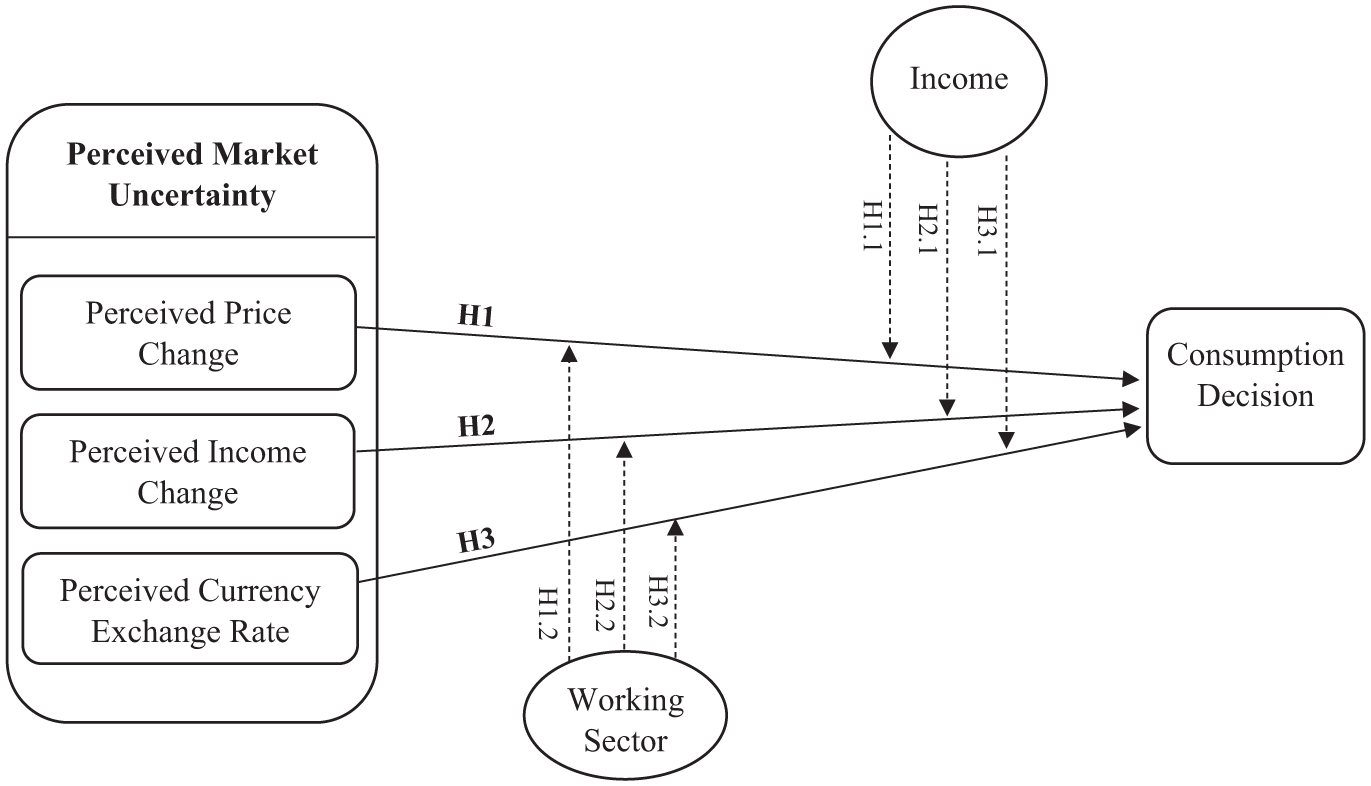
Research model.
Materials and Methods
Sample
The study was designed as a quantitative, analytical (theoretical) inference that aims to study the relationship between uncertainty and consumers’ behavior, and for theoretical testing, and not aiming to generalize the data to the whole Palestinian population, a convenience sample technique was chosen and applied to gather data from Palestinian consumers. Three screening criteria were applied to make sure that respondents are within the scope of the study: each respondent should be 18 years old or older, live in the West Bank Region, and be responsible for buying their own or their family’s requirements.
Consumers were invited to voluntarily participate in the survey. A total of 226 respondents participated in the survey. F. Hair et al. (2018) suggested that the sample-to-variable ratio necessitates a minimum observation-to-variable ratio of 5:1. Nonetheless, ratios of 15:1 or 20:1 are preferred. Thus, the 226 participants constituted a sufficient sample size for data analysis with a ratio of 56:1, given that the study has four main constructs. The profiles of the respondents are presented in Table 1.
The Demographic Profile of the Respondents. (N = 226).

The majority of the sample was male (52.7%), and almost half of the respondents were under the age of 40. 68.1% of respondents are married. The respondents are well educated, where 52.2% holding a bachelor’s degree and 33.6% having a postgraduate degree. The income levels of the sample ranged from less than $1,000 (49.1%) to more than $2,000 (19.9%). Respondents who worked in the private sector represent 46.5% of the sample, while those in the public sector represent 36.3%. Most of the respondents are paid by Shekeel (69.5%), while others are paid in other foreign currencies. The sample structure is fairly similar to the actual composition of the West Bank market.
Data Collection Method
Data collected between June and August of 2024. A five-point Likert scale was employed in the investigation, which had constructs such as Perception of Price Fluctuation (PPF), Perceived Income Change (PEC), Perceived Currency Exchange Rate (PCE), and Consumption Decision (CD) that were employed from the works of Anderloni et al. (2012), Claveria et al. (2020), and Hampson et al. (2021). The items were adapted to serve the study purpose without changing the main scope of the items.
The first part of the survey captures demographic variables. This step is followed by six questions that consider consumer perception of price changes and five questions that evaluate consumer perception of income changes. Then, there are six questions that examine consumer perception of exchange rate changes, followed by five questions on consumption decisions.
The questionnaire was initially framed in English, and then the Arabic version of the study was employed, which matches the language of the respondents. An interview was then conducted with three academicians to check the relevance of the questions, and the questionnaire was modified on the basis of the views obtained.
The questionnaire was disseminated in person, electronically using Google Forms, as well as through social media platforms and emails.
Ethical Considerations
The study adopted a non-experimental, survey-based research design in which respondents were asked to report their perceptions regarding the study constructs related to uncertainty and consumer consumption decisions in the Palestinian market. Participants were not exposed to any experimental manipulation, pre-testing procedures, or behavioral interventions. The research design minimized potential risks by avoiding sensitive questions, ensuring anonymity, and analyzing and reporting data exclusively in aggregated form.
The anticipated benefits of the study, including its contribution to understanding consumer behavior under conditions of market uncertainty in a fragile and under-researched context, outweigh the minimal risks associated with participation.
Participation was voluntary, and informed consent was obtained through clear information provided on the questionnaire’s introductory page prior to data collection.
Measurement Method
In analyzing the findings, we utilized the technique of Structural Equation Modeling (SEM) for testing our hypotheses. The analysis was conducted using Smart PLS-4, employing the Partial Least Squares (PLS) technique. The technique is most appropriate for our research due to the small sample size and the nature of our findings, which follow a non-normal distribution, and its ability to test complex study models such as our model (Barghouthi et al., 2024; F. Hair et al., 2019; Henseler, Ringle, & Sarstedt, 2016).
Nonresponse Bias and Common Method Bias
To examine nonresponse bias, a t-test was done to compare the responses of customers who participated early in the survey with those who responded later (Armstrong & Overton, 1977). There were no statistically significant differences between early and late answers.
The one-factor test was suggested by Podsakoff and Organ (1986) as a way to assess the potential threat of common method variance bias. The relevant factor analysis revealed that neither a single factor nor a general factor was developed in the unrotated factor structure.
Furthermore, this study studied the correlation links between the components to analyze common technique bias. Tehseen et al. (2017) stated that common method bias would not be a concern when the correlation between constructs is lower than .900. The correlations between the constructs in this study are less than .900. These findings removed the likelihood of any common method variance bias.
Frequency Analysis of Respondents’ Perception
According to the frequency analysis results (Table 2), respondents perceived the prices of necessary and luxury products to be higher than before. They feel that the prices are continuously increasing and believe they will not go down shortly.
Respondents’ Perception.
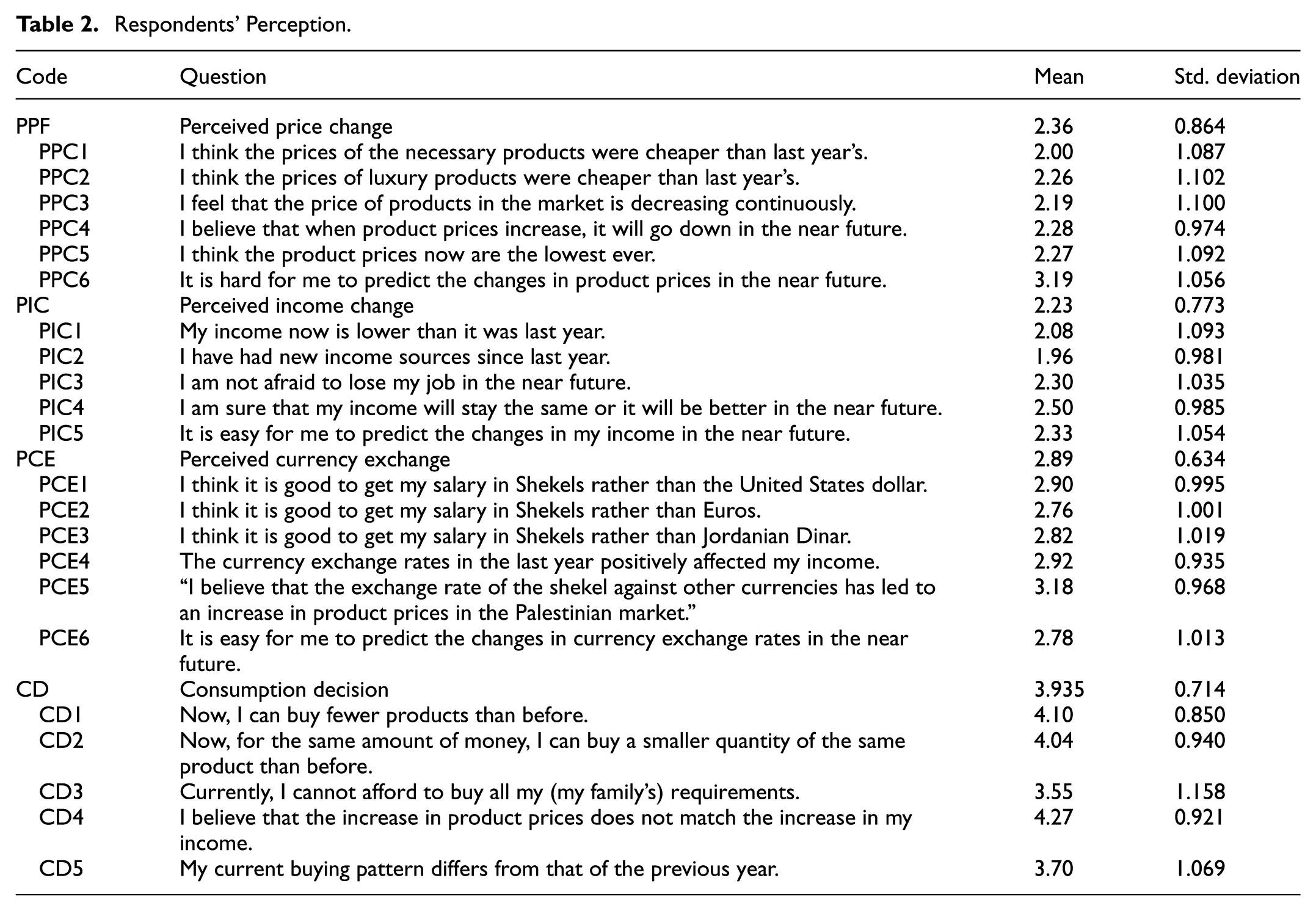
Respondents stated that their income has decreased compared to the previous year, with greater chances of losing their jobs in the near future. Additionally, the respondents found that they prefer to get their salaries in foreign currencies such as the US dollar, Jordanian Dinar, or Euro rather than the Shekel.
The responses also show that their buying power had decreased as they could not afford to buy all their basic requirements. Therefore, their current consumption pattern is different from what it was before.
Results
Measurement Model Assessment
The evaluation of the measurement model is the initial stage of PLS-SEM analysis. Consequently, our study paradigm incorporated reflectively evaluated constructs, “composite reliability,”“indicator reliability,”“convergent validity,” and “discriminant validity” (F. Hair et al., 2020).
Indicator outer loadings should be 0.700 or higher (Wong, 2013), and any indicator score value lower than 0.500 should be eliminated from the model. While evaluating the reflective measurement model, the indicators for PCE1, PCE2, PCE3, PPC6, and CD5 were deleted for the reason of low standardized loadings. The loadings were found to be less than the suggested cut-off value of 0.500, which meant that these indicators did not contribute much to the respective constructs (F. Hair et al., 2020). Following the deletion, the internal and convergent consistency of the remaining indicators improved.
Reliability is evaluated using Cronbach’s α (Cronbach, 1951) and composite reliability (CR) statistics. As seen in Table 3, both exceeded the required threshold of .7, suggesting high reliability (Henseler, Hubona, & Ray, 2016). Similarly, Convergent validity was satisfactory because the AVEs were above 0.500 for all constructs (Fornell & Larcker, 1981).
Measurement Model Output.
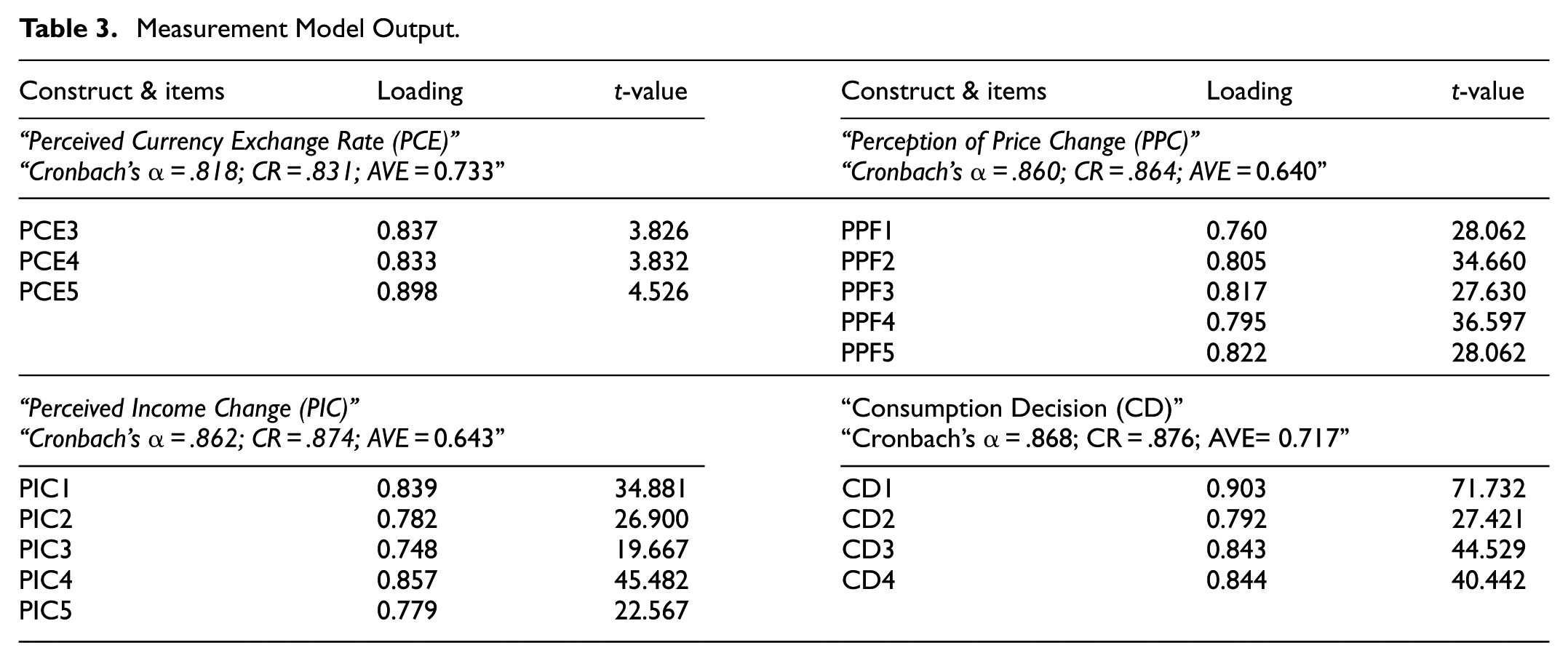
According to the recommendations made by Fornell and Larcker (1981), the square root of AVE for each construct should be greater than any correlation estimate to assess the discriminant validity. According to Table 4, each construct’s square root of AVE (shown on the diagonal) was higher than the construct’s correlation with every other construct. Furthermore, according to F. Hair et al. (2020), discriminant validity is ensured if the shared variance between a pair of constructs exceeds their AVE. The results in Table 4 indicate that all shared variance is greater than the individual AVE. Thus, the analysis reveals that each latent variable was separate and measured its own properties.
Fornell- Larcker and the Square Root of AVE.

Multicollinearity was detected using the variance inflation factor (VIF) test. All variables recorded values range from 1.73 to 2.880, which are below the recommended cut-off of 3.0 mentioned by F. Hair et al. (2020). Thus, the investigation passed the multicollinearity assumption.
Structural Model
The structural model assessment in PLS-SEM comprises testing hypotheses and examining the independent variables’ predictive relevance (Q2), effect size (f2), and variance explained (R2) with respect to the dependent constructs. The model explained 47% of the variance in the consumption decision (CD) variable (R2 = 0.47), which reflects a moderate level of explanatory power (F. Hair et al., 2020), see Figure 2.
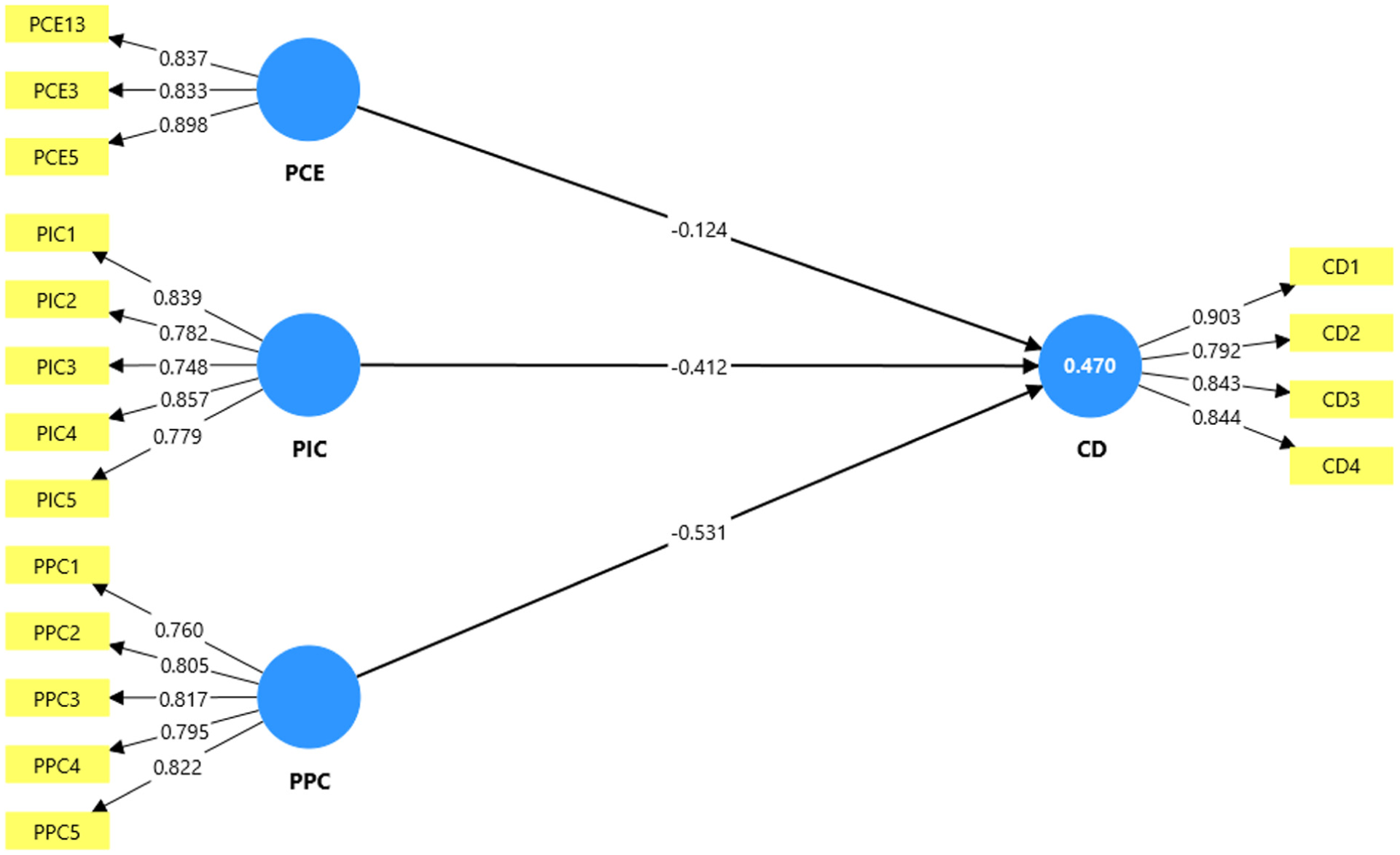
The structural model.
Predictive relevance (Q2) was assessed using the blindfolding procedure (Henseler et al., 2009). The results showed that the Q2 for the dependent variable CD was above zero (Q2 = 0.443), confirming that the model has good predictive relevance.
Cohen (2013) categorized f2 values of 0.02, 0.15, and 0.35 as small, medium, and large, respectively. The f2 values of the independent variables on the dependent variable are low and large (Table 6).
Finally, F. Hair et al. (2020) recommended key model fit indices for PLS-SEM. Table 5 demonstrates that all fit indices within the research model satisfied the established thresholds, indicating that the data appropriately conform to the proposed model.
Indices of Model Fit.

Hypothesis Testing
Figure 2 and Table 6 present the standardized path coefficients (β), SD, t-values, p-values, and hypothesis support. The results show that Perceived Currency Exchange Rate (β = −.124, p < .05), Perceived Income Change (β = −.412, p < .01), and Perception of Price Change (β = −.531, p < .01) have a significant negative effect on the consumption decision. As a result, H1, H2, and H3 hypotheses are supported.
Hypothesis Testing and Path Coefficients - Direct Effect.

Moderating Effect
To analyze the moderating role of work sector and income, Multi-Group Analysis (MGA) was used since they are qualitative moderators with two categorical levels (public and private) and three categorical levels (low, middle, and high). The sample was split into two non-overlapping groups for the work sector variable. Three non-overlapping groups were created from the sample for the income variable. As suggested by F. Hair et al. (2020), Henseler’s MGA and permutation tests were used to compare the path coefficients between groups. This is a non-parametric significance. When the difference in path coefficients between groups was statistically significant (p < .05), moderation was deemed significant.
Before conducting the Multi-Group Analysis (MGA), we tested measurement invariance through MICOM method. The findings revealed partial measurement invariance, thereby ascertaining that comparisons across income categories were valid. The number of respondents within each group was adequate for conducting MGA for different income levels (Low: 83, Middle: 77, High: 54), as well as sectors of work (Private: 118, Public: 96), meeting the requirements put forth by F. Hair et al. (2020). While conducting MGA, 5,000 bootstrap samples were used to increase its stability and robustness regarding differences across various groups. Results of the Multi-Group Analysis (MGA) Across Income Levels
To establish whether income moderated the structural relationships, the sample was divided into three non-overlapping categories, including low, middle, and high. The Multi-Group Analysis (MGA) was conducted through the permutation tests in a manner outlined in by F. Hair et al. (2020). Table 7 shows the outcome of the parameter estimations, including the contrasts among the three categories. Each p-value is higher than .050. There are no statistically significant differences in the low, middle, or high categories. More specifically:
(1) PPC → CD: There were no significant differences across the three income groups: Low versus Middle: Diff = –0.057, p = .771, Low versus High: Diff = 0.023, p = .834, and Middle versus High: Diff = 0.080, p = .609. Thus, income does not moderate the relationship between perceived price change (PPC) and consumption decision (CD).
(2) PIC → CD: All group comparisons were non-significant: Low versus Middle: Diff = –0.030, p = .616, Low versus High: Diff = –0.017, p = .556, and Middle versus High: Diff = –0.013, p = .438. Consequently, income does not moderate the relationship between perceived income change (PIC) and consumption decision (CD).
(3) PCE → CD: All pairwise comparisons were also non-significant: Low versus Middle: Diff = 0.101, p = .178, Low versus High: Diff = –0.061, p = .066 (borderline but still >0.05), and Middle versus High: Diff = –0.162, p = .287. Therefore, income does not moderate the relationship between perceived currency exchange rate (PCE) and consumption decision (CD)
Group Analysis Due to Income.

“MGA based on Henseler’s MGA procedure with 5,000 bootstrap samples; significance at p < .05.” (Henseler et al., 2016).
Results of the Multi-Group Analysis (MGA) Across Work Sector Levels
As shown in Table 8, only one relationship is significantly moderated by work sector. Specifically, the effect of PPC on CD was significantly stronger in the private sector (β = .658) than in the public sector group (β = .578), and the difference between the two path coefficients was statistically significant (Diff = 0.080, p = .003). This result supports the corresponding moderation hypothesis, indicating that work sector meaningfully influences the strength of the perceived price change (PPC) and consumption decision (CD) relationship. In contrast, no significant sector-based differences were found for the paths PIC to CD (Diff = 0.012, p = .911) or from PCE to CD (Diff = –0.162, p = .153); therefore, these results indicate that work sector does not moderate the relationship between each of perceived income change (PIC) and perceived currency exchange rate (PCE) and consumption decision (CD).
Group Analysis Due to Work Sector.

“MGA based on Henseler’s MGA procedure with 5,000 bootstrap samples; significance at p < .05.”
Discussion
The study focused on consumer behavior in an uncertain environment. We dealt with three factors of uncertainty: changes in product prices, changes in currency exchange rates, and changes in consumer income. The study aimed to measure the consumer’s perception of these three factors rather than the actual changes, and tried to understand consumer responses and how their perception of uncertainty could affect their consumption decision.
The first hypothesis was supposed to measure the effect of perceived price change (PPC) on consumers’ consumption decisions (CD), and the effect was found to be significant without any significant effect for the moderating factors (income, working sector). Thus, Palestinian consumers believe that the prices of the products in the Palestinian market are continuing to rise, and they think that they will not go down shortly; instead, they believe that they will continue rising, but they cannot be assured whether this trend will continue or will end soon. Thus, they start adjusting their consumption behavior, especially when they notice that their buying power has decreased as prices increase and they cannot buy the same kind or amount of products they used to purchase.
Analysis shows that work sector and income level do not modify how perceived price changes affect consumption. This finding aligns with expectations in a market characterized by prolonged uncertainty over decades, where people respond to uncertainties such as price fluctuations in the same way, regardless of their work sector or income level. They tend to react similarly, focusing more on affordability and becoming more cautious with their spending. In such situations, price changes are viewed as a broader economic issue rather than a typical market signal, thereby reducing consumers’ price sensitivity across different socio-economic groups.
These findings are supported by previous studies, such as the study of Grunert et al. (2023), which indicated that after the Ukraine war, consumers from different income levels are similarly affected by the price rises. Similarly, El Bilali and Ben Hassen (2024) find that consumer purchasing behavior in the Near East and North Africa region is negatively affected by price shocks related to conflict and supply disruption. Also, the study of Rahbarinejad et al. (2025) indicates that inflation in prices causes consumers to tend to minimize costs and therefore buy less expensive products.
The second hypothesis supposed that perceived income change (PIC) affects consumption decisions (CD), the direct effect was found to be significant without any moderator effect for income level and working sector. Therefore, consumers who feel their income has significantly decreased or believe that it will be decreased in the near future or even lose their jobs due to market instability will tend to focus their purchases on necessities and will search for cheaper choices regardless of their income level or work sector.
The public sector is expected to have a more stable income than the private one, however, in the Palestinian context this is not the case, especially in the last few years where the Palestinian government due to the Israeli actions, was not able to pay salaries at the beginning of each month and it was delayed for several weeks each time and when its paid, it don’t pay the full compensation. On the other hand, workers in the private sector are highly dependent on the buyers who are regularly working in the public sectors, and if their buying power decreased, the privet sector ability to sell and gain profits will decrease and hence it will not be able to pay salaries for its employees or even it will be forced to fire some of them to cut costs. Therefore, there were no differences between the consumption behaviors of individuals from the private and the public sectors since both of them are facing the same market circumstances and both of them are not feeling secure in their jobs and are expecting not to be paid or even to be fired at any time in the near future. Thereafter, consumers are found to be tending to make more cautious consumption decisions regardless of their working sector or income level.
These findings go hand in hand with other studies, such as the study of Hua and Mi (2025), which studied the effect of declining income due to COVID-19 on consumption behavior in China and found that when consumers’ income declines, they experience higher levels of anxiety and therefore tend to be more cognitively involved in their consumption decisions. Similarly, the study of Han et al. (2022) indicated that income stability induces cautious consumption regardless of income growth expectations.
The third hypothesis was supposed to test the effect of perceived currency exchange rates (PCE) on consumers’ consumption decisions (CD). Since workers in the private sector may be paid in other currencies than the local currency (Shekeel), the currency exchange rate could have a direct effect on their buying power. The study results found that currency exchange rate instability negatively affected consumption decisions. This matches the reality that consumers who get their salaries in US Dollars or Euros will face income changes when they convert their income into shekels to buy their necessities in the local market. In addition, currency exchange rate fluctuations could substantially affect the prices of imported products in the market, which may create higher levels of uncertainty. These results cause consumers to be more cautious in their purchases, focusing more on satisfying their basic needs and searching for cheaper choices. These findings align with previous studies such as Dalgic (2024) and Iorember et al. (2024) that indicate a strong effect on household consumption by exchange rate.
In this relationship, the moderating effect of income was insignificant, while the working sector’s moderating impact was significant. In this study context, the currency exchange rate is highly related to the work sector, where workers in the private sector are taking their salaries in foreign currencies such as the US dollar and Euro and that’s why they are found to be more affected by exchange rates in comparison to the public sector workers, who are paid only by the local currency (Sheekels) and therefore their income is not affected by the exchange rates.
Conclusion
The main aim of the study was to create a more comprehensive understanding of consumer behavior in uncertain environments. The focus was on subjective uncertainty rather than on objective uncertainty. We intend to understand the effect of uncertainty from the consumer’s perspective, rather than focusing on major economic indicators, and test how their consumption behavior could change under such uncertainty.
The Palestinian market was chosen for this study due to its special characteristics of prolonged political and economic instability that has continued for several decades, in addition to its challenging nature, where it is relatively impossible to predict the future for regular consumers due to its complicated political and economic structure, which created high levels of uncertainty within the market.
The study focused on three main dimensions of uncertainty: price changes, currency exchange rate fluctuations, and income changes. The three dimensions were studied as perceived variables rather than economic indicators, and consumers’ perception of the current and future changes in these three dimensions was examined with their effect on their consumption decision.
The study results indicate that price changes, currency exchange rate fluctuations, and income changes have a significant negative effect on consumers’ decisions. Therefore, we can conclude that Palestinian consumers are feeling insecure regarding their income, and they predict that their income will be lower in the near future than their current income. Also, they perceive current prices as higher than usual, and they think that it will be higher in the future. These beliefs make them more cautious in their purchasing and searching for cheap choices regardless of their income level or working sector.
These results indicate that consumers’ perceptions of income and price changes are a national phenomenon rather than an economic or social indicator that could affect one group more or less than another.
On the other hand, the effect of the third dimension of currency exchange rate was higher for individuals who work in the private sector in comparison to those who work in the public sector. But the consumption decision of both of them was negatively influenced. Therefore, we can conclude that consumers who are paid in foreign currencies but pay for their purchases in local currency are facing higher levels of uncertainty regarding their purchasing power, and they will tend to be more cautious in their consumption decisions.
In the end, the Palestinian market is considered one of the most troubled markets in the world, where consumers are facing unprecedented risks caused by the prolonged political conflict and economic instability. These market realities make the local consumers more cautious in their decisions since their ability to predict future changes in the market is very limited, which makes the tendency toward buying low-price products and focusing on satisfying their basic needs, rather than buying luxury products, a national tendency rather than a phenomenon that is related to one social sector and not associated with another.
Theoretical Implications
This research introduces a novel theoretical mechanism: uncertainty-induced behavioral homogenization. While existing consumer theory assumes that socioeconomic variables, such as income level and employment sector, systematically differentiate consumption responses, our results indicate that under prolonged and multi-dimensional uncertainty, these distinctions lose their explanatory relevance. We theorize that when instability is sustained—characterized by the triple threat of price escalation, income change, and currency volatility—it acts as a “behavioral leveler.” This forces consumers across disparate socioeconomic strata to converge toward a singular, defensive consumption strategy. This finding challenges the “homogenous consumer” assumption in standard models by showing that systemic risk can override micro-economic status, positioning perceived uncertainty as a higher-order driver that dominates traditional demographic predictors.
Furthermore, the research presents a new theoretical approach to behavioral homogeneity, grounded in the lack of clarity due to Indeterminate Probabilities. Existing consumer theory suggests that social/economic factors, such as income and employment sector, create clear distinctions between different consumer groups. However, in circumstances where multiple factors create long-term uncertainty (Price Increases, Income Losses, Exchange Rate Fluctuations), these classifications lose their value. We propose that continued uncertainty leads to mandatory “behavioral leveling” across socioeconomic groups, resulting in their adoption of a common defensive consumption strategy. Our findings contradict the standard consumer behavior models’ portrayal of the “homogeneous consumer.” By demonstrating that systemic risk will dominate microeconomic position, perceived uncertainties will drive behavior more strongly than demographic characteristics do.
Finally, by viewing the Palestinian market as an analytically significant case rather than a mere backdrop, this research’s context has now repositioned a theoretical boundary condition. This study shows that applying consumer behavior theories developed in stable or intermittently volatile economies to structurally uncertain markets greatly overestimate consumers’ income and occupational status. Therefore, by identifying “perceived uncertainty” as the main construct of this study, it provides a transferable theoretical framework for studying other conflict-affected or high-volatility economies. As a result, it changes how the academic literature views consumer behavior during crises and how the constant uncertainty restructures their cognitive frameworks.
Managerial Implications
This research is very important for companies, as well as for policymakers, in markets where there is a substantial degree of uncertainty. This research offers five key conclusions for managers:
➢ Firstly, managers could consider implementing dynamic pricing, which would have the capacity to change from time to time depending on the changes in price perceptions and exchange rates, as these factors have a huge influence on consumer behavior.
➢ Second, since changes in perceived income affect consumer spending, marketing and advertising must be differentiated based on the perception of customer income. It could be that customer loyalty schemes, packages, or different discounts could enhance customer satisfaction based on their respective perceived incomes.
➢ Thirdly, given that the perception of price fluctuation influences decision-making, a clear communication of prices is necessary. Price guarantees or easy understanding of the impact of exchange rates and inflation on prices can help reduce client worries.
➢ Fourth, businesses should invest in market research to map customer perceptions of price, currency, and income changes. The information enables businesses to predict future trends and align their products and operations based on this information.
➢ Finally, companies must pursue product differentiation strategies in order to offset price variability perceptions. Through product differentiation, organizations will be able to focus attention from price toward other areas such as quality and uniqueness as opposed to price.
On the other hand, based on the result that perceived income change impacts consumption decisions, governments can lay out income-help policies to stabilize customer purchasing power. this could include:
➢ Presenting centered financial help or tax relief for families that understand a reduced income, specifically at some stage in economic downturns or inflationary periods.
➢ Since the perception of price fluctuations is a key in consumption decisions, policymakers can implement rules that manipulate inflation and manage risky price actions, mainly for essential goods and services. This may include price monitoring, putting price ceilings on primary goods and services, or implementing subsidies to reduce the effect of price volatility on inclined populations.
➢ To help purchasers make informed choices, governments can initiate campaigns to teach the general public about currency exchange rates, income changes, and price fluctuations. Providing apparent data about financial situations and how they affect prices may reduce uncertainty and help clients navigate economically demanding situations.
➢ Governments can also lay out policies by selling domestic companies to lessen dependency on external factors, which incorporate exchange and price fluctuations. This can include incentives for local companies to source substances regionally or invest in local manufacturing, which lowers price sensitivity and reliance on unstable external markets.
Limitations and Future Research
There are a few limitations to this research:
➢ The findings won’t be applicable to customers in different regions with exclusive financial conditions, cultural attitudes, or exchange rate studies. This limits the generalizability of the conclusions to different markets.
➢ While the study tests certain perceptions, other external variables such as political instability, market competition, global economic trends, and supply chain disruptions would also affect consumption decisions. These factors may not have been absolutely captured in this research, doubtlessly affecting the robustness of the effects.
➢ The consequences can be time-sensitive as perceptions of price changes and income fluctuations are subject to change over time. Therefore, Longitudinal research is needed to affirm whether the identified consequences are substantial or if they range with broader economic trends.
Future research could explore how exclusive demographic factors (e.g., age, gender, and education) could moderate the relationships discussed in this study. This would offer a knowledge of how perceptions impact intake choices across numerous patron segments and enhance the generalizability of the findings. Future studies could also extend the scope of this study by considering additional external factors that affect consumer behavior, such as political instability, international economic conditions, or changes in marketplace opposition. Lastly, in order to gain a deeper understanding of customers’ perspectives and decision-making processes, future research has proposed merging quantitative and qualitative methods, such as focus groups or interviews.
Footnotes
Acknowledgements
This is to confirm that at this time, this article has not been submitted to any other journal except the Journal of Sage Oben.

Ethical Considerations
This study was conducted in accordance with recognized ethical standards for research involving human participants. Data were collected through an anonymous online questionnaire distributed via Google Forms. No personal, sensitive, or identifying information was collected, and participation was entirely voluntary. The questionnaire’s cover page clearly explained the purpose of the study and informed participants of their right to withdraw at any time without any consequences.
Consent to Participate
Informed consent was obtained implicitly through participants’ voluntary completion of the questionnaire. Given the non-interventional and non-experimental nature of the study, the anonymous data collection process, and the absence of foreseeable risk to participants, formal approval from an institutional ethics committee was not required.
Consent for Publication
Not applicable. The study did not include any individual-level identifiable data, images, or personal information. All data were collected and reported in an aggregated and anonymous form.
Author Contributions
Conceptualization, Mohammed Abdalrahman, Mohammad Barghouthi and Ahmad Zarir; Methodology, Mohammed Abdalrahman and Mohammad Barghouthi; Software, Mohammed Abdalrahman; Validation, Mohammed Abdalrahman, Qasim Awad and Muhammad Sharia; Formal analysis, Mohammed Abdalrahman and Mohammad Barghouthi; Investigation, Mohammed Abdalrahman and Muhammad Sharia; Resources, Ahmad Zarir, Qasim Awad and Muhammad Sharia; Data curation, Mohammad Barghouthi and Ahmad Zarir; Writing – original draft, Mohammed Abdalrahman and Mohammad Barghouthi; Writing – review & editing, Mohammed Abdalrahman, Mohammad Barghouthi, Ahmad Zarir, Qasim Awad and Muhammad Sharia; Visualization, Ahmad Zarir; Supervision, Mohammed Abdalrahman; Project administration, Mohammed Abdalrahman.
Funding
The authors received no financial support for the research, authorship, and/or publication of this article.
Declaration of Conflicting Interests
The authors declared no potential conflicts of interest with respect to the research, authorship, and/or publication of this article.
Data Availability Statement
The data used to support this study’s findings are available from the author upon reasonable request.