






Abstract
As one of the fastest-growing marketing channels, live streaming uses grassroots influencers and established celebrities to drive user engagement and sales. However, the effectiveness of these two types of streamers and the reasons behind their performance difference have not been fully examined. Based on a dual-study design using 15-month panel data (N = 1,350) and survey data (N = 530), this research reveals that influencer streamers can achieve higher sales than celebrities. This result is mediated by higher user engagement, perceived similarity, and perceived credibility. Meanwhile, a high product variety can decrease the performance gap between the two types of streamers. This study extends Trans-Parasocial Relationship theory to TPSR-LSC framework for the first time to explore the underlying mechanism through which streamer type influences consumer behavior in the context of live streaming commerce and makes further contributions by identifying the contextual boundary of product diversity. This study contributes to both theory and practice implications in the continuously evolving field of live commerce.
Keywords
Introduction
Powered by mobile internet and digital live streaming technologies, live commerce has gradually evolved into a new influencer marketing channel (D. Wu et al., 2023). Taobao, the giant of social retail in China, has successfully conducted live streaming shopping since 2016 (Applegate, 2021). During the live session, live streamers show and introduce products, and viewers interact with both live streamers and other viewers in real-time via likes, questions and comments. Moreover, competitive and time-limited price discounts are also available for viewers to purchase products promptly. Since the sudden outbreak of the COVID-19 pandemic, the sales of live commerce have experienced an explosive growth (Ho et al., 2022), and live streaming has become a marketing channel for promoting sales across all industries (K. Wang et al., 2024).
The rapid growth of live commerce has led to the emergence of extremely influential live streamers, such as the famous influencer Li Jiaqi, whose digital fans number exceeds 140 million and who has achieved an impressive sales performance. Inspired by the enormous commercial success of influencers, celebrities have also followed them to join in the live commerce trend, especially during the pandemic when all kinds of offline entertainment events and sports activities have been prohibited. Influencers and celebrities are two important types of streamers who promote their products for sales via live streaming (Xue & Liu, 2023). According to the classification of Xue and Liu (2023), live streamers can be divided into influencer-type and non-influencer-type. The personal influence of influencer-type streamers lies in the social influence they have, which includes both social media influencers and celebrities. Previous studies commonly refer to social media influencers simply as “influencers” (Gu et al., 2024; Schouten et al., 2021). This study follows the same convention. In contrast, non-influencer-type streamers, such as store owners or employees hired by brands, possess limited personal influence and mainly depend on product or brand reputation to attract consumers. Although celebrities can be viewed as a subgroup of influencer-type streamers, their influence typically stems from professional achievements and public recognition rather than long-term social media engagement. Therefore, this study differentiates influencers and celebrities to compare their distinct influence mechanisms and sales performance in live streaming commerce.
Streamers typically promote multiple products during live sessions that can last for several hours. Although some argue that live commerce resembles offline promotions, the surge in sales from live streaming is mainly contingent on the streamer’s influence, reputation, and persuasive power to drive purchases, much like celebrity endorsements. Live streamers serve as both content creators and conveyors of product information. While delivering product details clearly to consumers, they simultaneously gather real-time feedback during interactions.
Influencer marketing has attracted increasing academic attention in recent years (Reinikainen et al., 2020), and numerous studies have confirmed its effectiveness (Hudders et al., 2021; Taylor, 2020). As a crucial branch of influencer marketing, live commerce has also attracted increasing academic attention (Luo et al., 2022; Mai et al., 2023; Nuraisah et al., 2024; Y. Wu & Thoo, 2021). A considerable portion of prior studies on live commerce has concentrated on how live streaming affects consumers ‘purchase intentions (Dua, 2024; Hou et al., 2019; J. Kim et al., 2022; Lim et al., 2022; Luo et al., 2022; Qin et al., 2023), impulsive buying behavior (Huo et al., 2023; Lee & Chen, 2021; Ming et al., 2021), or purchase decisions (Clement et al., 2020; Wongsunopparat & Deng, 2021), as well as other intentions and behaviors (J. V. Chen et al., 2025; J. Chen & Liao, 2022; Lv et al., 2022). Recently, scholars have begun emphasizing the significance of live streamers. However, such studies remain limited, and there is insufficient exploration of how streamer characteristics and types of impact live commerce performance or consumer behavior. Comparative studies on different types of streamers are especially scarce (K. Wang et al., 2024; Wei & Xi, 2024). Schouten et al. (2021) assessed the differing effects of influencer and celebrity endorsements on consumer purchase intentions. But up to now, no studies have examined whether the differences in influencers and celebrities exist and further lead to differences in live sales performance.
Moreover, the mechanisms underlying the performance differences between influencers and celebrities in live commerce are still unknown. To bridge this gap, this study constructs the Trans-Parasocial Relationship in Live Streaming Commerce (TPSR-LSC) framework and positions the relationship between streamers and followers as a dynamic process including synchronous interactivity, community identification, and dynamic trust co-construction. The three dimensions are associated with three core variables: user engagement, perceived similarity, and perceived credibility to reflect the multidimensional characteristics of the streamer and live streaming performance. According to the TPSR-LSC framework, this study raises the following research questions: Do the influencer and celebrity streamers differ significantly in these three dimensions and how do these differences affect consumers’ purchase behavior and live streaming performance? Addressing these questions is of great significance for exploring the mechanisms underlying the performance differences between influencers and celebrities, which provide rich theoretical insights and practical guidance for livestreaming commerce.
Finally, most studies in live commerce rely on cross-sectional survey data (N. Chen & Yang, 2023; Nguyen-Viet & Nguyen, 2024; Y. Zhou & Huang, 2023). Only a few studies use secondary data from live streaming practices (Gu et al., 2024; Zheng et al., 2022). With the development of live commerce practices, it has become increasingly feasible to use panel data from live streaming sales. After all, panel data can provide empirical evidence for research in the emerging area.
Therefore, based on TPSR-LSC framework, this study finds that influencers outperform celebrities because they can achieve higher user engagement, perceived similarity, and perceived credibility, and the advantage is weakened by higher product variety.
Literature Review
In the past decades, scholars have applied the concept of Parasocial Relationship (PSR) to explain one-sided, illusory, and non-reciprocal social relations between audiences and media figures in traditional media contexts, such as television and radio (Horton & Richard Wohl, 1956). Following this line of research, some scholars have applied PSR to social media contexts characterized by interactivity. These schloars argue that, since the emergence of social media, the one-sided relationships between media figures and audiences have been enhanced by their interactivity (C.-P. Chen, 2016; C. A. Hoffner & Bond, 2022).
However, the scholarly definition of interactivity suggests that media figures and audiences can communicate directly without temporal or spatial restrictions, and users can participate in real-time and even modify the form and content of the media environment (Blattberg & Deighton, 1991; Steuer, 1992). Driven by mobile internet technologies, social media interactivity has intensified, and audiences are no longer passive observers but active participants who can interact with media figures and even create content (Su et al., 2021).
To explain the evolution of influencer–follower relationships across platforms and through interactive, reciprocal, and co-creative processes, we have introduced the notion of Trans-Parasocial Relationship.
Theorization of Trans-Parasocial Relation(TPSR)
To further explain the evolution of parasocial relationships across platforms in the social media era, Wellman (2021) extended the concept of PSR and proposed the notion of “trans-mediated parasocial relationships”. The new relationships explain how influencers maintain follower relationships established on one platform across other platforms, reflecting more reciprocal and co-creative interactions between media figures and audiences. This theoretical extension focuses on two aspects: (1) how influencer–follower relationships across platforms are established and maintained; (2) how affordances provided by each platform facilitate or hinder the development of influencer–follower relationships.
In contrast, Lou (2022) proposed the concept of Trans-Parasocial Relationship (TPSR) to characterize a new type of influencer–follower relationship that is more interactive, reciprocal, and co-creative. Lou (2022) defines TPSR as a “(a)synchronous interactive, collectively reciprocal and co-creative” relationship. Specifically, “(a)synchronous interactive” indicates that interactions can happen synchronously via live streaming or interactive in an asynchronous way via comments, polls, or short videos; “collectively reciprocal” means that influencers reply to representative comments or frequently asked questions to meet the overall expectations of follower communities; “co-creative” reflects the dynamic and value-building nature of influencer–follower relationship. Followers are no longer passive consumers but active co-creators in building influencers’ values, goals, and content. Overall, this new type of relationship breaks the traditional unidirectional and one-sided media relationship pattern and is characterized by higher levels of interactivity, bidirectionality, and co-creation.
At the theoretical level, De Jans et al. (2022) used the TPSR theory to study how social media influencers promote healthy eating among adolescents. Their findings show that TPSR is not only about image matching. Adolescents may make social comparisons, either upward or downward, or become more aware of health through interactions. These results offer new insights into how influencers shape attitudes and behaviors. Hu (2022) compared the influence of influencer-led live streaming and brand-led live streaming on consumers’ behavior using the 5A framework, while TPSR was only briefly mentioned. Influencer live streamers are more effective at building emotional bonds and interactive experiences, while followers’ affective attitudes toward streamers influence both short-term purchases and long-term brand loyalty (Hu, 2022). J. Kim et al. (2022) investigated TPSR as an independent variable in live streaming contexts and found significant direct and indirect effects of TPSR on audience stickiness and purchase intentions.
In summary, most of the previous TPSR studies focused on the changes of influencer-follower relationships in social media era. However, these studies did not consider the distinctive features of live streaming commerce, including the real-time interaction between streamers and audiences, transactional orientation, and dynamic community formation. Therefore, current research is limited in both theoretical breadth and practical application and is largely descriptive in nature. In particular, little research has systematically explored how TPSR can be translated into tangible commercial outcomes in live streaming commerce, especially in real-time, transaction-oriented and highly interactive live streaming contexts.
Based on the above research gaps, the next section extends and reconceptualizes the TPSR framework to capture its application in live streaming commerce.
Trans-Parasocial Relationships in Live Streaming Commerce (TPSR-LSC) Framework
Building on Lou (2022) theorization of TPSR, this study extends TPSR to live streaming commerce. TPSR-LSC frameworks the relationship between live streamers and their followers as synchronously interactive, community identification, and dynamic trust co-construction.
Synchronously interactive reflects the real-time and bidirectional interactive exchanges that could enhance viewers’ emotional and behavioral engagement. Community Identification means the shared interests, values, and perceived similarities among the dynamic livestream community, which can strengthen social belonging and social influence. Dynamic Trust Co-construction refers to the co-created, evolving sense of credibility and reliability between the streamer and audience during live sessions. The main differences between TPSR and TPSR-LSC are shown in Figure 1.

The different characteristics of TPSR and TPSR-LSC.
The TPSR-LSC framework includes three main dimensions:
Synchronously Interactive
This dimension reflects the real-time bidirectional communication between streamers and viewers, including commenting, Q &A, voting and instant feedback. According to previous research, such synchronous interaction can enhance viewers’ sense of closeness and social presence and further stimulate their cognitive, affective and behavioral engagement (Su et al., 2021). In terms of empirical measurement, this study reflects synchronously interactive as the variable of user engagement, which not only captures the interactive features offered by the live streaming platform, but also represents the dynamic communicative process between streamers and viewers to explore product attributes, reduce uncertainties and facilitate purchase decisions (Huang & Mohamad, 2025; S. Zhang et al., 2024).
Community Identification
Community Identification is defined as the extent to which viewers identify with shared interests, values and cognitive similarities in the live streaming community. A live streaming room can be regarded as a dynamic social space where followers aggregate around common consumption preferences, similar appearances or esthetics, as well as shared brand values, and further build affective bonds and social resonance by identifying with both the streamer and other viewers in the community (Lou, 2022; Yin et al., 2025). This kind of community-based resonance makes consumers feel more socially connected and part of a group, which further stimulates their purchase behavior (Kwon & Ha, 2023). For empirical analysis, this study operationalizes community identification as the perceived similarity variable. Perceived similarity refers to viewers’ perceived similarities with the streamer in terms of interests, appearances, esthetics, or values, and this similarity triggers psychological resonance and emotional closeness, which further leads to attitudinal and behavioral alignment and purchase decisions (Hughes et al., 2021; Lou & Yuan, 2019).
Dynamic Trust Co-Construction
This dimension refers to the dynamically developed trust between streamers and viewers based on their continuous interaction, including the perceived credibility of streamers’ information, recommendations and their personal attributes (Hu, 2022; J. Kim et al., 2022). In live streaming commerce, the formation of trust between streamers and viewers is inherently a co-constructive process. Trust is formed through ongoing interaction of information and emotion, and feedback from viewers. Streamers continuously show their trustworthiness and credibility in terms of information release, recommendations and personal attributes through their authentic self-presentation, feedback responses and live demonstrations of product usage (Hyan Yoo & Gretzel, 2008). Drawing on the continuous process of trust co-construction, viewers develop their perception of the streamer’s credibility and personal attributes, as well as their credibility perception of the information released by the streamer and their product recommendations (Hu, 2022). Therefore, this study treats Dynamic Trust Co-construction as equivalent to the perceived credibility, which includes two sub-dimensions of trustworthiness and expertise. The higher credibility perceived by viewers in streamers, the more willing they would be to accept the information released by them, and the psychological basis for purchase intention and behavior would be established (N. Chen & Yang, 2023; Y. Liu & Sun, 2024).
Overall, synchronous interactivity, community identification, and dynamic trust co-construction jointly constitute the TPSR-LSC Framework. In this study, the above three dimensions respectively correspond to user engagement, perceived similarity, and perceived credibility that jointly reflect the real-time interaction, community-based, and trust-worthy characteristics of transactions in live streaming commerce.
Based on the TPSR-LSC framework, this study aims to investigate the comparative influence of influencer and celebrity streamers on consumers’ purchase behavior. We aim to explore how user engagement, perceived similarity, and perceived credibility as mediating variables can transform trans-parasocial relationships into actual purchase behavior in live streaming context. In addition, product variety is expected to moderate the promotional effectiveness of different types of streamers. Guided by this theoretical logic, the following section develops the research hypotheses.
Hypotheses Development Based on the TPSR-LSC Framework
Wei and Xi (2024) compared the effects of CEO and celebrity streamers in terms of consumer behavior in live streaming, whereas Yan et al. (2025) compared the effects of virtual and human streamers. Furthermore, Tang et al. (2025) investigated the collaborative effects between virtual and real celebrities, while S. Zhang et al. (2024) compared the effects of celebrity, KOL, and brand streamers. Existing evidence also indicated that celebrity and influencer streamers significantly affect consumers’ purchase behavior (Gu et al., 2024; Maharani et al., 2025). However, there is limited empirical research exploring influencer streamers or celebrity streamers, who perform better in sales performance in live streaming commerce.
Influencers become famous on social media by sharing their personal views and gaining support from their followers (J. V. Chen et al., 2025). Influencer streamers were the first to perform well in live streaming sales as they possessed digital marketing skills and interacted efficiently with their followers. In contrast, celebrities monetize their fame through endorsements. They become live streamers by leveraging their established reputations and achievements. On the other hand, influencers gained popularity by sharing their personal opinions and engaging with their followers. They build trust and emotional connections with consumers through real-time interaction and co-creation of content. Both factors are highly aligned with the interactive and participatory nature of live streaming commerce. Therefore, influencer streamers are more likely to trigger consumers’ purchase behavior and have better sales performance than celebrity streamers.
Schouten et al. (2021) found that influencers as endorsers are more effective than celebrities in improving consumers’ purchase intentions and attitudes toward advertisements. This study builds on this finding and extends the discussion to the live streaming commerce context. The following hypothesis is proposed.
Product variety is not a new topic. Product variety refers to the breadth of product categories the degree to which retailers offer different items in each product category offered by retailers (Agrawal & S, 2019; Simonson, 1999; Triantafillidou et al., 2017). It affects consumers’ purchase intention and purchase behavior (Alanadoly & Salem, 2022; Chang, 2011; Heitmann et al., 2007; Ramdas, 2003).
Live streamers typically present a large number of products within a limited time to stimulate immediate purchase (H. Chen et al., 2023). Increasing product variety can meet more consumer needs and improve competitiveness (Bech et al., 2019; Sorkun, 2019). However, higher product variety may lead to cognitive overload, affecting consumers’ perceived prices and qualities (Santos et al., 2020). Furthermore, Park et al. (2023) found that a greater variety of products negatively affects the performance of live streaming, especially for small and medium-sized sellers. The negative influence may stem from that small and medium sellers do not have enough time to interact with consumers, and streamers lack in-depth knowledge across various product categories. Influencers are successful because consumers have strong parasocial relationships with them, whereas celebrities are successful due to their high visibility and large fan bases. Therefore, we propose that increasing product variety weakens the advantages of influencers and reduces the performance gap between influencers and celebrity streamers.
The emergence of social media gives rise to a new type of technology-mediated interaction (D. Boyd, 2015), and this also applies to live streaming commerce, which is characterized by three features: synchronous interactive, community identification and dynamic trust co-construction. Based on TPSR-LSC framework, this study compared the live streaming performance of influencer and celebrity streamers, and further explored the mediating effects of user engagement, perceived similarity and perceived credibility, which represent three dimensions of TPSR-LSC framework.
User engagement is a core mechanism in social media and plays a crucial role in live streaming marketing (D. M. Boyd & Ellison, 2007; Oestreicher-Singer & Zalmanson, 2013). Referring to X. Wang and Wu (2019), we identify two mechanisms of user engagement: (1) Product interactivity, in which streamers disclose product information and users can know how to use the product; (2) Real-time communication, in which bidirectional real-time communication can clarify uncertainties and enhance engagement. Therefore, user engagement is mainly characterized by real-time bidirectional interaction, which matches the “synchronously interactive” dimension of the TPSR-LSC framework. In addition, User engagement extends across multiple platforms to enhance the connection between streamers and followers, shorten consumers’ decision-making path and enhance purchase behavior. However, due to their limited time and expertise to interact with audience, celebrity streamers have less user engagement. In contrast, influencer streamers leverage their professional knowlege to promote products through real-time explanations and interactive responses, thereby enhancing user engagement and purchase intention.
Many scholars have verified the mediating effect of user engagement between social relational factors and consumers’ purchasing behavior across different contexts. Husnain and Toor (2017) found that consumer engagement significantly mediates the relationship between social media marketing activities and consumers’ purchase intention in the context of social network marketing. Rahman et al. (2018) confirmed that fan-page engagement mediates the effect of social connectedness on purchase intention, as social interaction can enhance purchasing behavior through psychological engagement. From an identity-driven perspective, Prentice et al. (2019) also found that customer engagement significantly mediates the relationship between customer identity and purchase intention. In addition, H. Kim et al. (2025) revealed that in the context of metaverse consumption, user engagement mediates the relationship between social identity and consumers’ intention to purchase virtual products. In summary, user engagement serve as a key mediator linking social interaction and purchase behavior in both social media and virtual consumption contexts. Based on the above analysis, we propose the following hypothesis.
Perceived similarity is the “community identification” dimension of the TPSR-LSC framework, reflecting an individual’s perception of likeness with others (Hughes et al., 2021). This dimension is triggered by factors such as age, gender, race, and life experiences. Stokburger-Sauer et al. (2012) define perceived similarity as the degree of alignment between the follower’s self-view and that of a digital influencer. Due to influencers’ online public disclosures, followers can gain what target influencers think and feel, which decreases the psychosocial distance between them and leads to a higher level of perceived similarity (De Veirman et al., 2017; J. Kim & Song, 2016). Some studies have shown that similarity leads to interpersonal attraction and influences purchasing behavior on social commerce platforms (H. Liu et al., 2016; Xiang et al., 2016). Perceived similarity reduces misunderstandings and psychological distance.
Within the TPSR-LSC framework, community identification is operationalized through perceived similarity between followers and streamers. This identification enables followers to develop psychological connection with streamers and increases their likelihood of being influenced by the streamer. Celebrity streamers are typically perceived as “distant”, whereas influencers are seen as more approachable and similar to followers, which reduces psychological distance and may further influence purchase behavior (Yang, 2021). Based on the above theoretical and empirical considerations, the following hypothesis is proposed.
Perceived credibility is the “Dynamic Trust Co-construction” dimension of the TPSR-LSC framework and comprises trustworthiness and expertise (Hyan Yoo & Gretzel, 2008). Trustworthiness refers to the degree to which one is perceived as honest and sincere in delivering accurate information (Priester & Petty, 2003). Influencers benefit from followers’ perceptions of authenticity in their posts and interactions, which affects trust (Audrezet et al., 2020). Expertise is related to knowledge and skills (Erdogan, 1999). Live influencers often claim expertise, which improves consumers’ understanding of products, thereby positively influencing trust and brand attitudes (Erz & Heeris Christensen, 2018; Yang, 2021).
By engaging in real-time interaction with followers, influencers signal honesty and competence, thereby increasing followers’ trust in their product evaluations and purchase behavior. This trust formation mechanism explains why influencers can perform better than celebrity streamers in live commerce. Previous studies have also found that the perceived credibility of social media influencers significantly affects consumers’ purchase intention (Chapple & Cownie, 2017; Lou & Yuan, 2019). Based on the above theoretical and empirical studies, the following hypothesis is proposed.
The proposed research model is presented in Figure 2. This study will test above hypotheses through two studies using secondary data and survey data.
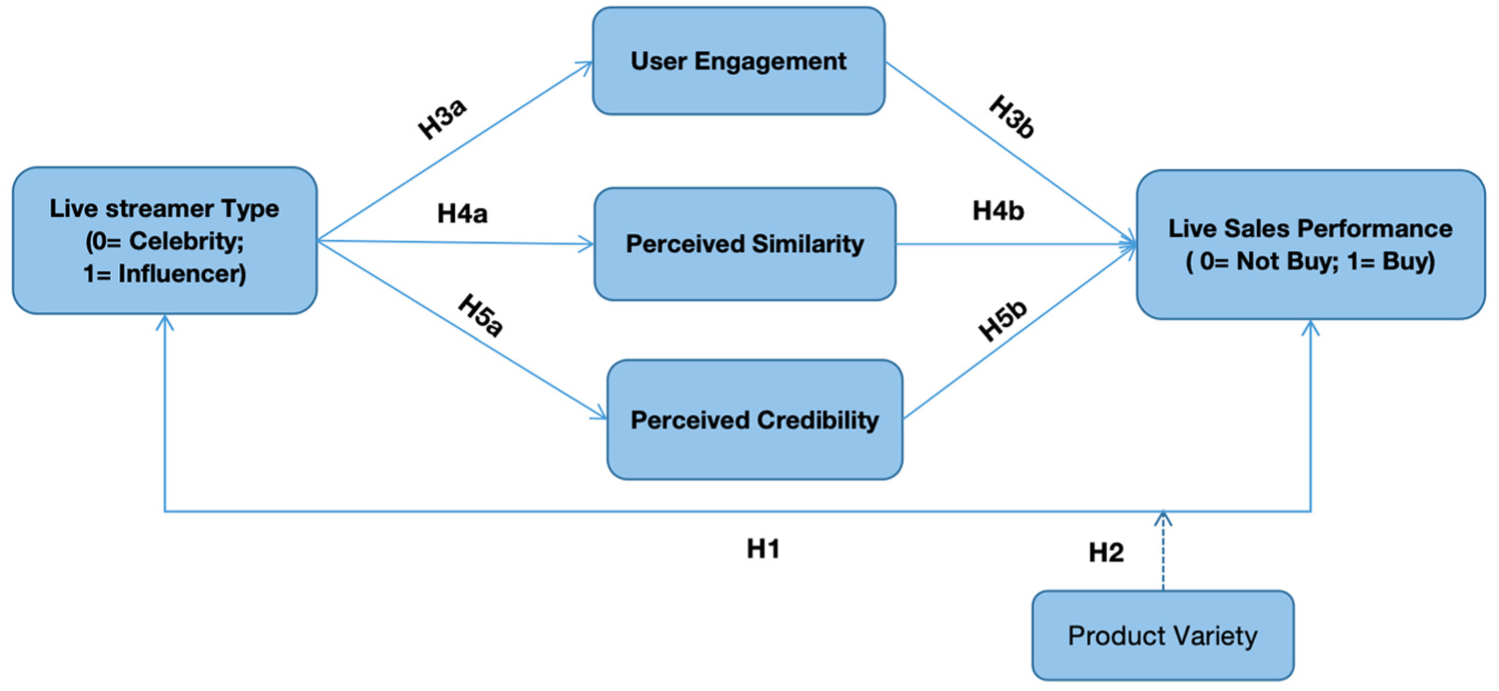
The proposed research model.
Study 1
Study 1 tests Hypotheses H1 and H2 using transaction data from live streaming sessions on the Chanmama platform (www.Chanmama.com) over a 15- month period, from July 2023 to July 2024. This study relied on secondary data and did not involve direct interaction with human participants. Chanmama is a dedicated live streaming commerce platform that provides influencer marketing services, with a membership system priced at around $100 per month and offering detailed, accurate, and reliable data.
Celebrity and influencer streamers were selected through a multi-stage procedure to ensure comparability and minimize potential bias. First, celebrity streamers with stable live streaming activity were selected as the reference group. Given that celebrities usually have multiple professional obligattions, their live streaming frequency might be lower than that of full-time influencers. Therefore, “stable live streaming” was defined as conducting live streaming activities in at least 12 of the 15 months, with an average of no fewer than 10 live sessions per month. There were 42 celebrities with stable live sessions. Second, influencers were matched to the celebrity group with similar monthly live streaming frequency (±5 sessions/month), follower count (±20%), and monthly GMV (±20%) to ensure comparability in basic operational characteristics. Since existing literature does not offer an unified standard of allowable deviations in streamer sample matching, this study determined the matching criteria for streamer groups by considering comparability, sample availability, research resources and the characteristics of the live streaming commerce industry. Observations with deviations, such as unmatched product categories or monthly live session frequencies falling outside the predefined range, were excluded. A total of 48 influencers were included in the sample. Missing monthly data were treated as zeros. The final panel data set comprised 1,350 observations across 15 months and was analyzed using Stata 18 to compare performance and test the moderating effect of variety.
The dependent variable (live streaming performance) was measured using GMV, a widely used metric in e-commerce research and practice (Y. Chen et al., 2022). GMV represented the total amount of money earned from the sale of all goods on live streams and was positively related to sales performance and purchase conversion, and GMV was also an important performance indicator for platforms and brands to evaluate the effectiveness of live streaming campaigns (Gu et al., 2024; Wongkitrungrueng et al., 2020). The description of all measured variables is shown in Table 1.
Variables Measures.
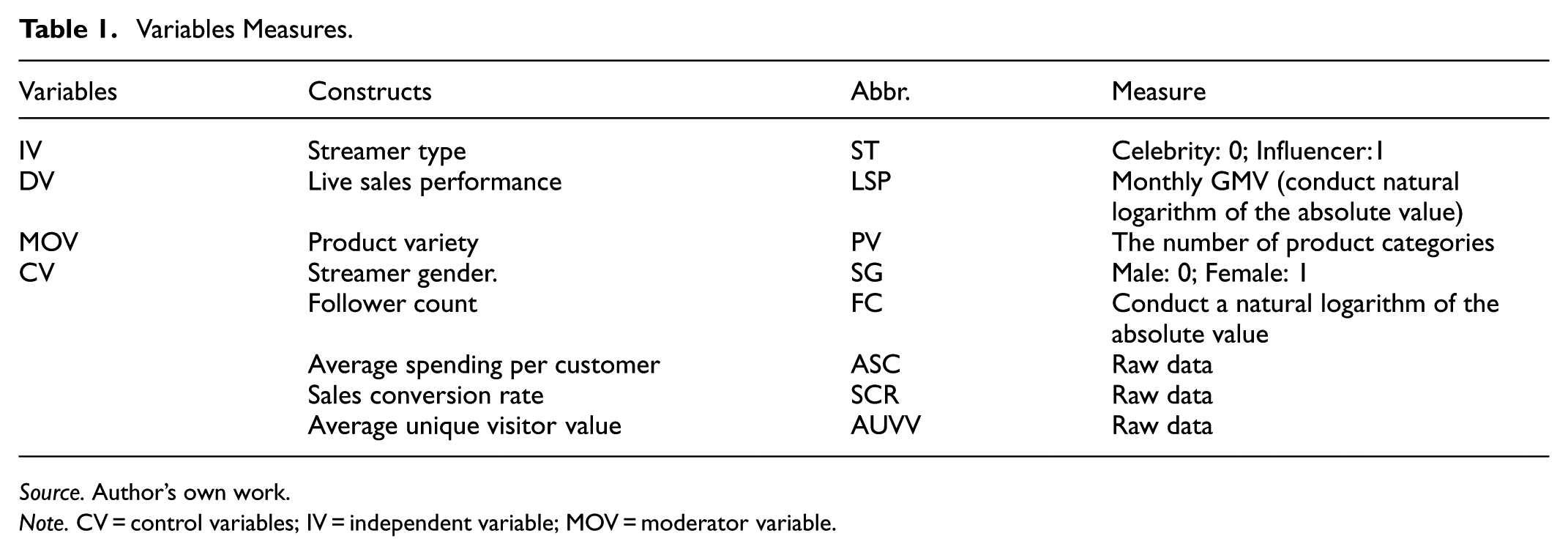
Source. Author’s own work.
Note. CV = control variables; IV = independent variable; MOV = moderator variable.
Table 2 presents the correlation matrix and multicollinearity analysis for the key variables, revealing the following insights. ST is positively correlated with LSP, with a Pearson correlation coefficient of .21 (p < .01). PV, measured by the number of promoted product categories, has a mean value of 12.88, indicating a relatively high level of diversification. SCR and AUVV have mean values of 4.11 and 3.78 respectively, and are positively with LSP, with Pearson correlation coefficients of .21 (p < .01) and .24 (p < .01). These findings indicate relatively favorable live streaming sales performance. Significant correlations were also found among other key variables. VIF values ranged from 1.16 to 2.06, indicating that multicollinearity is not a serious concern.
Descriptive Statistics and Multicollinearity Analysis of Variables.

Note. N = 1,350.
p < .05. **p < .01.
Since the independent variables are binary indicators distinguishing celebrities from influencers and are time- invariant, fixed effects model is not feasible due to perfect multicollinearity. Hence, we adopted a random effects approach. All models were estimated using feasible generalized least squares (FGLS) with heteroskedasticity-robust standard errors and a common AR (1) autocorrelation structure. The estimated AR (1) coefficient was .51, which represents moderate positive autocorrelation and was appropriately corrected in the FGLS estimation. Accordingly, the regression coefficients, standard errors, and significance levels in the following regression analyses were robust to both heteroskedasticity and serial correlation. The regression results are displayed in Table 3.
Results of Main and Moderating Effects.

Note. N = 1,350; Robust standard errors in parentheses.
p < .05. **p < .01.
Table 3 presents the FGLS regression results of the three models. Model 1 only includes five control variables. Model 2 adds the main independent variable ST, while Model 3 further incorporates the moderator PV and the interaction term. The Wald χ2 statistics for all three models are significant at the 1% level, indicating good model fit. The key findings are as follows.
Model 1: The regression results show that, among the control variables, FC, SCR, and AUVV are positively and significantly correlated with LSP (p < .01), suggesting that these three factors consistently contribute to higher LSP, whereas SG and ASC are not significantly related to LSP.
Model 2: ST has a strong positive effect on LSP (b = 0.45, 95% CI [0.21, 0.70], p < .01), providing support for H1. The significance and direction of the five control variables are consistent with Model 1.
Model 3: The main effect of PV is significant, and the interaction between PV and ST is negative and highly significant (b = −0.21, 95% CI [−0.26, −0.16], p < .01). The results indicate that the positive effect of ST on LSP weakens as PV increases. In other words, the sales performance gap between influencer streamers and celebrity streamers narrows as the product variety increases. The findings provide strong support for H2. The effects of the control variables are consistent with those in Model 2, except for SCR, which becomes insignificant in Model 3, further confirming the robustness of the findings.
Study 2
In study 2, we test hypotheses H3a-H5b and conduct a robustness check for H1 using a survey-based randomized online experiment on the Credamo platform (www.Credamo.com), a widely used academic platform for data collection and experimental research. Credamo provides access to a participant pool of over 3 million users and implements quality control procedures to ensure high-quality data that meet international academic standards.
This study involved minimal risk to participants. They were asked to watch a real live streaming clip and report their perceptions and purchase intentions, with no personally identifiable or sensitive information collected; all responses were recorded anonymously. Prior to participation, participants were presented with an online informed consent statement outlining the study’s purpose, the voluntary nature of participation, data confidentiality, and the right to withdraw at any time. Only participants who read and agreed to this statement proceeded with the study. The study offers valuable insights into consumer decision-making in live streaming commerce, with potential academic and practical implications.
In line with established practices in live streaming commerce research, streamer stimuli were selected to represent influencer and celebrity types. They were selected based on the total number of followers across all major live streaming platforms, to ensure that both had similar online influence among influencers and celebrities. Under this criterion, Influencer 1 and Celebrity 1 were selected from Taobao, while Influencer 2 and Celebrity 2 were selected from Douyin to represent their respective streamer types. Under this selection approach, potential differences in participants’ responses could be primarily attributed to streamer type rather than to disparities in popularity or platform exposure. To ensure anonymity during the peer review process, the real names of the streamers used in the stimulus materials are anonymized in the text. Detailed information regarding the selected streamers can be provided upon request.
In live clips shown in the online random experiment, Taobao streamers promoted wet toilet paper, whereas Douyin streamers promoted NuoFan truffle chocolate. First, both types of streamers had prior experience promoting these two products. Second, these two products were relatively inexpensive and generally acceptable to most consumers. Third, as the products were not strongly seasonal or gender-specific, buyers were less likely to be substantially influenced by their own preferences. In addition, wet toilet paper is not yet widely used by consumers, indicating considerable market potential. Truffle chocolate can be consumed as a snack or used as a gift, contributing to its broad consumer appeal and growing demand. These products were selected to make the experiment comparable and consistent with typical consumer goods in live streaming commerce.
A summary of all measurement items for study 2 variables is presented in Table 4.
Variables Measures.
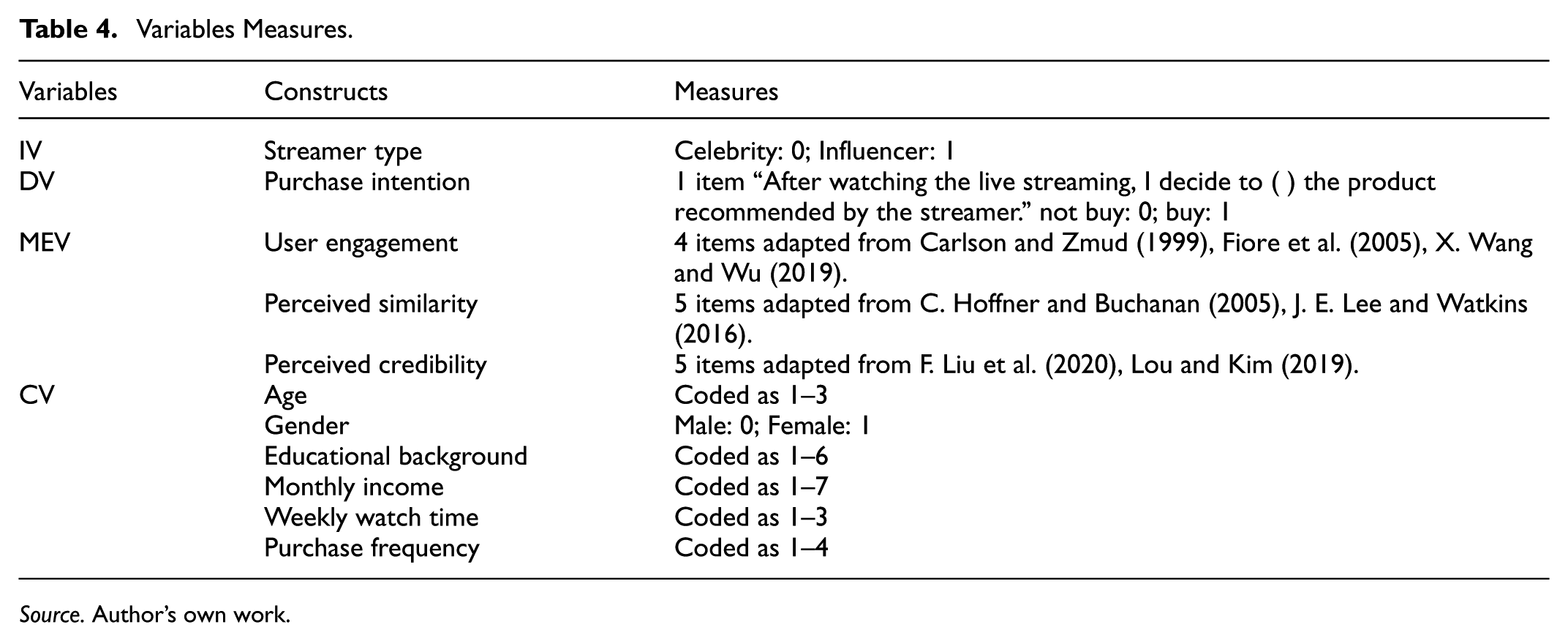
Source. Author’s own work.
Due to the limitations of the survey design, the dependent variable was participants’ purchase intention rather than actual sales. Although behavioral intention may not perfectly predict actual purchasing behavior, previous studies have consistently shown that purchase intention is a strong and reliable predictor of consumer behavior (N. Cao et al., 2025; Peña-García et al., 2020).
A pre-test (n = 60) was conducted to validate the research design and survey questionnaire. SPSS 27 software was used to assess the reliability and validity of the data. The factor analysis results showed good convergent validity and satisfactory reliability for subsequent surveys.
The survey adopted a randomized online experimental design with four blocks, each containing four texts and videos featuring two celebrities and two influencers. A total of 600 questionnaires were collected through the Credamo platform from 24th December 2023 to 20th January 2024. Quality control questions were included in the questionnaires. In addition, screening questions were used to select the targeted participants at the beginning of the questionnaires.
To reduce potential common method bias (CMB), the following procedural remedies were implemented during questionnaire design (Podsakoff et al., 2003). First, it was emphasized that all respondents were anonymous and confidential and there were no right or wrong answers to reduce evaluation apprehension and social desirability bias. Second, all measurement items were carefully reviewed and revised to ensure clarity, conciseness, and context relevance to live streaming commerce, thereby reducing ambiguity and improving response accuracy.
Furthermore, Harman’s single-factor test was used to statistically assess the extent of CMB. The results of the unrotated principal component analysis revealed that the first factor explained 53.3% of the total variance, slightly exceeding the conventional 50% threshold. However, since both the independent and dependent variables were binary and the target constructs were conceptually distinct, the results did not indicate a serious common method bias issue.
Therefore, the combined procedural and statistical controls suggest that CMB was unlikely to pose a serious threat to the validity of the findings.
A tatol of 530 valid questionnaires were retained for the data processing and analysis. Each valid questionnaire was compensated at ¥ 3. Among the participants, 295 were female (55.66%) and 235 were male (44.34%). Most participants were aged between 18 to 42 (86.98%) and had a bachelor’s degree or higher (74.34%). Most respondents spent no more than 5 hours per week watching live sessions (87.55%), and 92.26% had previously purchased products promoted by influencers or celebrities.
Table 5 presents the factor analysis results for user engagement, perceived similarity, and perceived credibility. The factor analysis method is maximum likelihood factor extraction, supplemented with maximum variance rotation. The results demonstrate that the questionnaire possesses satisfactory reliability and validity.
Factor Analysis Result.
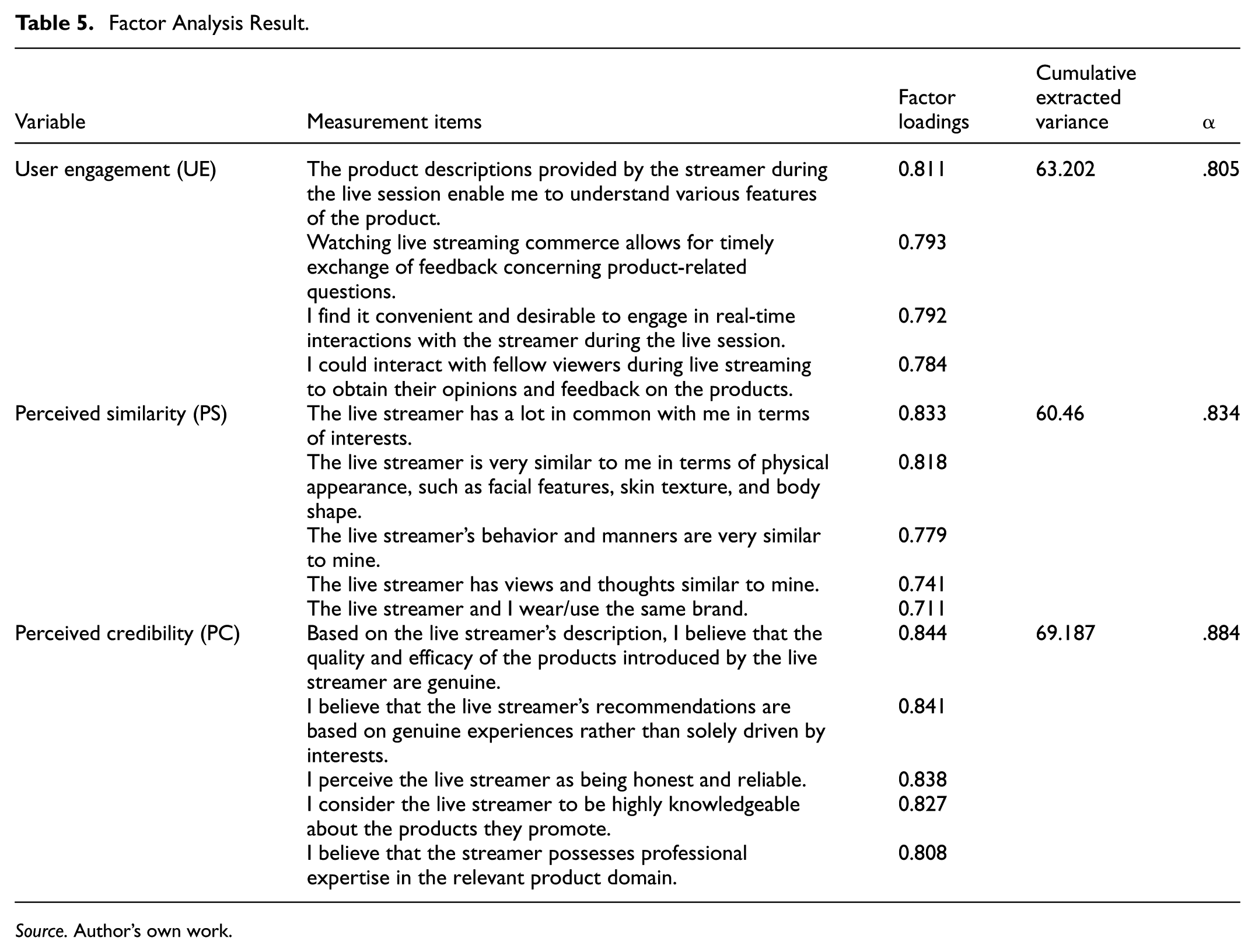
Source. Author’s own work.
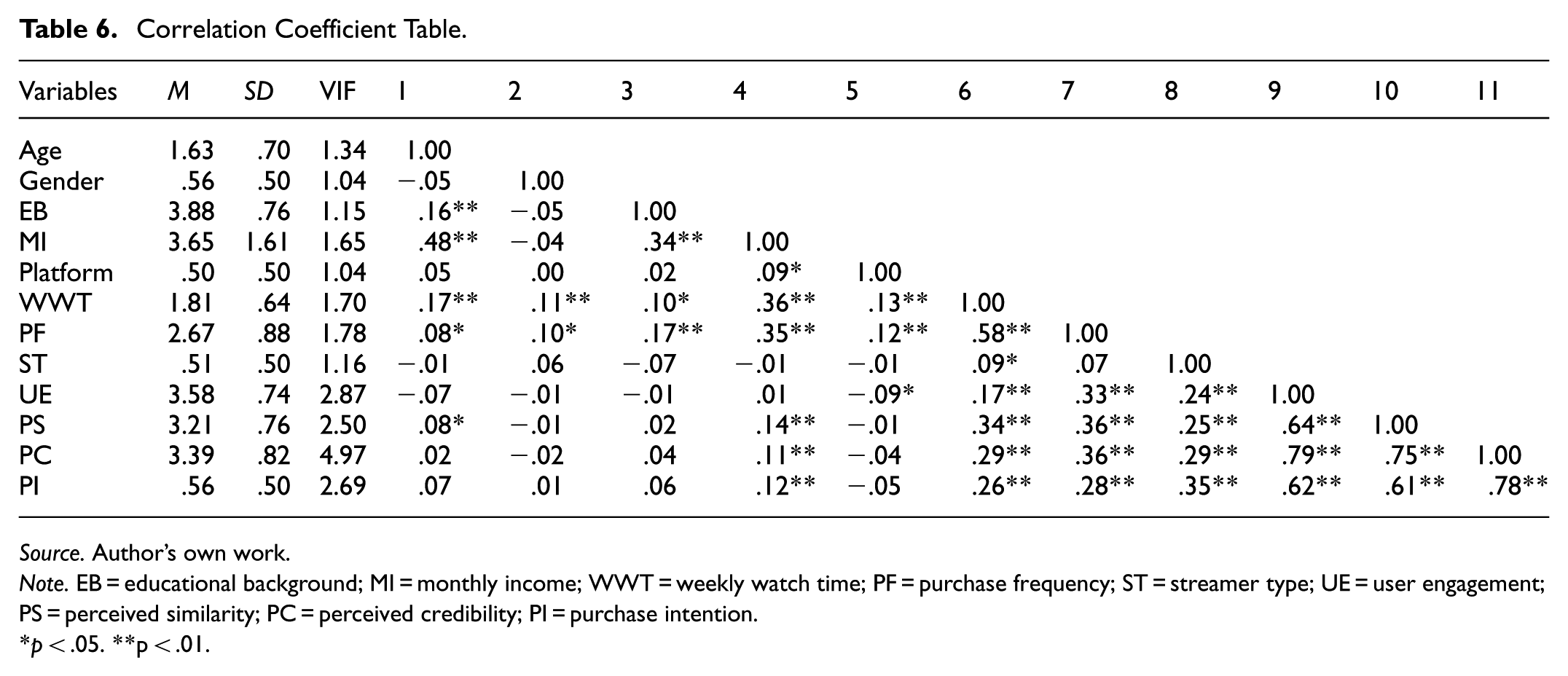
Table 6 presents the descriptive statistics, including means, standard deviations, variance inflation factors (VIF), and inter-variable correlation coefficients. The VIF results are satisfactory, with values ranging from 1.04 to 4.97, indicating no serious multicollinearity issues.
Correlation Coefficient Table.
Source. Author’s own work.
Note. EB = educational background; MI = monthly income; WWT = weekly watch time; PF = purchase frequency; ST = streamer type; UE = user engagement; PS = perceived similarity; PC = perceived credibility; PI = purchase intention.
p < .05. **p < .01.
To examine the mediating roles of user engagement, perceived similarity, and perceived credibility in the relationship between streamer type and consumer purchase intention, we employed the bootstrap approach proposed by Preacher and Hayes (2008) using PROCESS macro (v4.2) Model 4 for SPSS 29 (Hayes, 2017). Since the dependent variable is binary, all models involving purchase intention were estimated using binary logistic regression. Indirect effects were assessed using bias-corrected confidence intervals (BCa CI) based on 5,000 bootstrap samples. Table 7 presents the analysis results.
Regression Analysis Results.
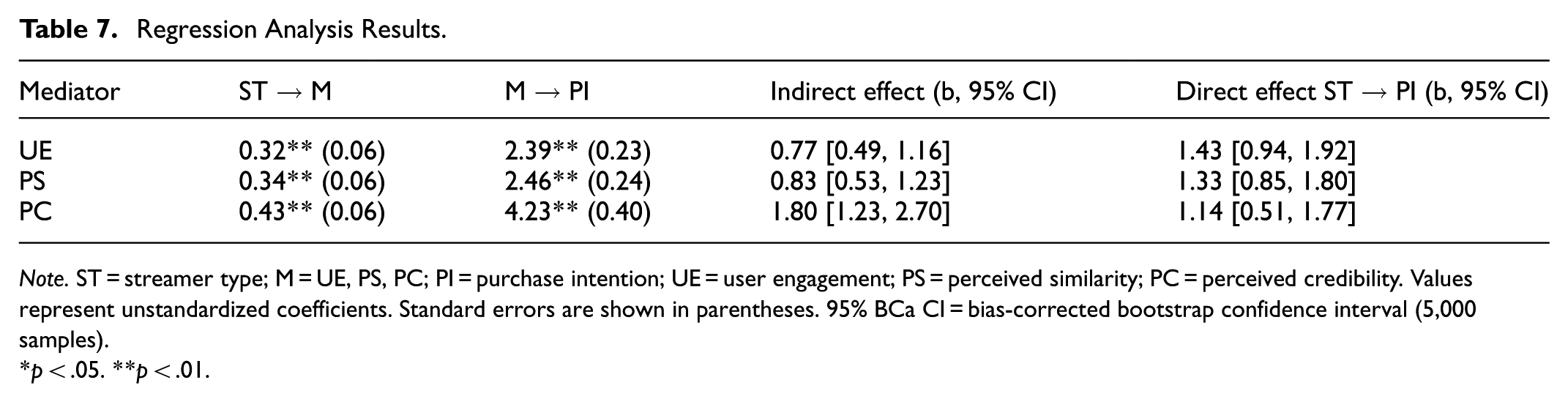
Note. ST = streamer type; M = UE, PS, PC; PI = purchase intention; UE = user engagement; PS = perceived similarity; PC = perceived credibility. Values represent unstandardized coefficients. Standard errors are shown in parentheses. 95% BCa CI = bias-corrected bootstrap confidence interval (5,000 samples).
p < .05. **p < .01.
Table 7 presents the direct effects of streamer type (ST) on the mediators and Purchase Intention (PI). ST significantly predicted user engagement (UE), perceived similarity (PS), and perceived credibility (PC): ST → UE, b = 0.32, p < .01; ST → PS, b = 0.34, p < .01; ST → PC, b = 0.43, p < .01, supporting H3a, H4a, and H5a.
The indirect effects of ST on PI via the mediators were also significant, indicating partial mediation effects: via UE, b = 0.77, 95% CI [0.49, 1.16]; via PS, b = 0.83, 95% CI [0.53, 1.23]; via PC, b = 1.80, 95% CI [1.23, 2.70]. These findings support H3b, H4b, and H5b.
Controlling for each mediator, ST also showed a significant direct effect on PI: ST → PI | UE, b = 1.43, 95% CI [0.94, 1.92]; ST → PI | PS, b = 1.33, 95% CI [0.85, 1.80]; ST → PI | PC, b = 1.14, 95% CI [0.51, 1.77]. These results indicate that influencer streamers outperform celebrity streamers in LSP even after accounting for the mediators.
Overall, all hypothesized relationships were supported. ST positively influenced UE, PS, and PC, which in turn mediated the effect of ST on PI.
Discussion and Implications
Discussion
This study verifies all eight proposed hypotheses (H1–H5b) using two complementary approches: panel data analysis and an online experimental survey, thereby demonstrating the robustness of the findings across behavioral and perceptual evidence. Study 1 finds that influencers generally achieve higher live streaming sales than celebrities. However, the performance gap narrows as product variety increases. When selling across multiple product categories, which requires broader product knowledge and presentation skills, influencers’ performance advantage diminishes. These results indicate that, compared with celebrities, influencers rely more on authentic interaction and emotional closeness with audiences, whereas celebrities emphasize broader appeal and media exposure.
Study 2 further examines the underlying mechanisms. Compared with cultivated celebrities in mainstream media, influencers are perceived as more approachable and trustworthy. They select products more frequently based on personal interests while engaging in more interactive and expressive communication with audiences. These findings are consistent with Schouten et al. (2021), who pointed out that consumers tend to perceive influencers as sharing similar backgrounds and lifestyles, which enhances identification and purchase intention. In contrast, cultivated celebrities, who are generally regarded as privileged, are more image-driven and less emotionally connected to products.
The findings of the two studies provide a coherent link from behavioral outcomes (Study 1) to underlying psychological mechanisms (Study 2). Specifically, based on actual GMV data, Study 1 shows significant differences in live streaming sales performance between influencers and celebrities, while Study 2 further clarifies the mechanisms underlying these differences. That is, compared with celebrities, influencers stimulate stronger purchase intentions through enhanced user engagement, perceived similarity and perceived credibility. This behavioral–perceptual dual validation not only strengthens the robustness of the findings but also clarifies the mediating role of trans-parasocial relationship (TPSR) in shaping consumer purchase behavior. In addition, the integration of behavioral and perceptual data enables multi-level evidence triangulation, consistent with the call in contemporary marketing and consumer behavior research for “triangulation across behavioral and perceptual evidence” (C. C. Cao & Reimann, 2020).
Theoretical Implications
Theoretically, this study extends and reconceptualizes TPSR theory in the context of live streaming commerce and proposes the TPSR-LSC framework. We further validate the applicability of three dimensions of TPSR-LSC in this context. Unlike previous studies on TPSR, which mainly describe influencers’ social interactions with followers in terms of collectively reciprocal and co-created content within social-oriented interactions (Hu, 2022; Lou, 2022; Su et al., 2021), the TPSR-LSC framework emphasizes real-time interaction, community identification, and dynamic trust co-construction, which are transaction-oriented and extend TPSR from a social to a commercial context.
Furthermore, we discover that the underlying mechanisms correspond to the three dimensions of the TPSR-LSC framework (User Engagement, Perceived Similarity, and Perceived Credibility) and further demonstrate their mediating effects in the relationship between streamer type (influencer vs. celebrity) and live streaming outcome. Our study clarifies the mechanism of the TPSR-LSC framework and provides evidence supporting the pathway from streamer type to purchase behavior (Huang & Mohamad, 2025; Hughes et al., 2021; X. Zhang et al., 2023).
Additionally, we find that product variety plays a critical boundary condition, dramatically reducing influencers’ sales advantage. When product variety is high, it limits the level of interaction between the influencers and audiences, thereby weaking the relative advantage of influencers over celebrities. Theoretically, our findings extend the understanding of boundary conditions in live streaming commerce and indicate that the effectiveness of streamer type is context dependent. Under high product variety conditions, the advantages of influencers in terms of interaction and emotional resonance may be diminished. Our findings provide theoretical support for exploring how contextual or environmental variables moderate the relationship between interaction mechanisms and sales outcomes. That is, how different streaming strategies are effective in product-diverse contexts (Feng et al., 2021).
Practical Implications
From a practical standpoint, Brands with limited marketing budgets should preferentially choose influencers with strong domain expertise and interactive skills. Influencers with such expertise and interactive skills can appear knowledgeable, credible, qualified, and experienced in specific product categories. They can maintain high level of audience interaction by responding to viewers’ questions in real time, recommending products based on individual needs, and displaying products in an engaging manner to enhance cost-effectiveness (Feng et al., 2021). When resources are sufficient, brands should combine both influencers and celebrities to balance deep audience engagement with mass exposure (Leung et al., 2022).
Moreover, due to the diverse product categories in live streaming promotion trends in China, streamers should aviod promoting unrelated products within a single live session (e.g., beauty products and home electronics in the same session). Selling irrelevant products may distract audiences and reduce interaction effectiveness. Instead, streamers should focus on products within a professional domain to enhance interaction and credibility (Bargoni et al., 2024). Practical suggestions include focused product presentation, user-generated content (UGC), product recommendations, and honest disclosure of personal product experience.
In addition, streamers should further engage audiences in social media communities (e.g., fan groups and private chat channels) beyond live streaming to maintain dynamic relationships and extend trust beyond individual interaction moments. By combining public and private interaction spaces, streamers can also expand and solidify their fan base, strengthen relational bonds, and further enhance purchase intention (Djafarova & Rushworth, 2017; Jin et al., 2019; Kapitan et al., 2022).
Conclusion
This study investigated performance differences between influencer and celebrity streamers in live commerce using a robust dual-study design integrating panel and cross-sectional data. The findings indicated that influencers consistently performed better than celebrities, and user engagement, perceived similarity, and credibility partially mediated this advantage. Furthermore, product variety reduced the performance gap between influencers and celebrities. Theoretically, this study extends Trans-Parasocial Relationship (TPSR) theory by proposing the TPSR-LSC framework, advancing its scope from a social to a transactional live streaming context and clarifying the mechanisms by which streamer type affects consumer behavior effectively. Practically, the findings suggested that prioritizing domain-specific influencers and combining them with celebrities to maximize both engagement and reach. They also indicated maintaining coherent product themes and encouraging cross-platform community interactions to enhance trust, similarity, and consumer engagement, thereby drive sales.
Despite its theoretical and practical contributions, this study also has several limitations. First, the three mediators are highly correlated (r > .64), suggesting potential multicollinearity. Futhre studies could employ serial mediation models or more refined measures to separate their influences. Second, the sample used in this study is limited to the Chinese live streaming commerce context, which may restrict generalizability. Future studies may consider replication in other cultures. Third, all variables are self-reported and may be subject to common method bias. Future studies could draw on multi-source or experimental data to reduce this risk. In addition, product variety is measured by the number of categories and therefore reflects breadth but not the depth or complexity of products (e.g., SKU-level variation). Future studies may benefit from integrating both breadth and depth measures or incorporating actual behavioral or sales data. Finally, purchase intention rather than actual behavior is used as the dependent variable. Future studies could further examine predictive validity using longitudinal data or datasets linking survey responses with actual sales
Beyond these limitations, future research may also explore dynamic live streaming interaction, such as streamer language, real-time consumer feedback, and emotional responses, or other newly emerged elements such as AI recommendation systems or virtual streamers, to further understand consumer psychology and behavior in transactional commerce.
Footnotes

Ethical Considerations
This study involved an online experimental survey and posed minimal risk to participants. In accordance with institutional and national guidelines, formal ethical approval was not required for this type of anonymous survey research.
Consent to Participate
Informed consent was obtained from all participants prior to their participation. Participants were informed about the purpose of the study, the voluntary nature of participation, their right to withdraw at any time, and the anonymity of their responses.
Author Contributions
Yuanyuan Zhang : Conceptualization, Literature Review, Methodology, Data Collection and Formal Analysis, Validation, Results and Discussion, Writing Original draft preparation, Writing- Reviewing.
Siti Hasnah Hassan: Conceptualization, Methodology, Validation, Results and Discussion, Conclusion, Reviewing and Editing.
Funding
The authors received no financial support for the research, authorship, and/or publication of this article.
Declaration of Conflicting Interests
The authors declared no potential conflicts of interest with respect to the research, authorship, and/or publication of this article.
Data Availability Statement
Data used in the study will be provided by the corresponding authors upon a reasonable request.