






Abstract
This study aimed to examine the mediating role of values in the relationship between personality factors and political orientation. While previous research has established correlations among personality factors, values, and political views, the mechanisms underlying these connections remain unclear. We investigated whether personality directly influences political orientation or whether values operate as mediators, transmitting the effects of personality onto political orientation. This study examined the relationships between personality factors (HEXACO model), Schwartz value dimensions, and political orientation (left-right, liberal-conservative). The data were collected via an anonymous, internet-based survey. The sample consisted of 431 Swedish respondents. The data were analysed using correlations, hierarchical regression, and path analysis. The findings suggest differences between right-wing orientation and conservatism, indicating that they should not be used interchangeably. Personality traits accounted for a small portion of the variance in political orientation and conservatism, while values exerted a more significant influence. Values were found to mediate the effects of personality on political orientation and conservatism, suggesting that personality traits are distal factors and values are proximal factors in shaping political attitudes. Age and gender were also related to political orientation, with individuals becoming more conservative, particularly regarding social conservatism, with age and men tending to be more conservative than women. Hence, the impact of personality on political orientation is predominantly channelled through values, suggesting that personality shapes our values, which subsequently mould our political views.
Plain Language Summary
This study looks at how our personality traits and personal values influence our political beliefs. We wanted to understand if personality directly affects political views, or if values act as a bridge between the two. We found that values play a crucial role in this process. Here’s a breakdown of the main findings: Personality and Values: Our personality traits, like being outgoing or cautious, form our values. These values are things we consider important in life, such as fairness, tradition, or security. Values and Political Views: Once our values are shaped, they influence our political orientation. This means that the things we care about can guide whether we lean more towards liberal or conservative views. Age and Gender Influence: The study also found that as people get older, they tend to become more conservative, especially in social matters. Additionally, men are generally more conservative than women. Cultural Context: The research was conducted with Swedish participants, so the findings might differ in other cultural settings. Future studies in different countries could provide more insights. Research Method: The study used an anonymous online survey with 431 participants from Sweden. The researchers analysed the data using various statistical methods to understand the relationships between personality, values, and political orientation. In summary, the study suggests that our personality indirectly shapes our political views by first influencing our values. Understanding this connection can help explain why people hold different political beliefs and how these beliefs might change over time.
Keywords
Introduction
Engagement in political discourse and participation are fundamental expectations in a democratic society. Individuals hold varying political views, which contribute to the equilibrium of our society (Carney et al., 2008). When categorising these diverse political perspectives, the most common framework is the spectrum ranging from left to right or liberal to conservative (Lee & Eshleman Latimer, 2024). While this framework may simplify complexities, it is generally observed that individuals aligned with the left side of the spectrum tend to advocate for equality, whereas those on the right often uphold hierarchical structures (Claessens et. al., 2023; Joshi, 2021; Kteily & Brandt, 2025; Satherley et al., 2021; Thorisdottir et al., 2007). Some studies show, however, that liberals do not always display more “state empathy” than conservatives, and may even empathise less with suffering political opponents because they judge conservatives as more harmful and morally blameworthy, which dampens empathy despite liberals’ general concern about harm (Casey et al., 2025; Catena-Fernández & Fernández, 2025; Zebarjadi et al., 2023). On the liberal-conservative axis, liberals are usually inclined to embrace social change, whereas conservatives tend to resist it (Carney et al., 2008; Moise et al., 2021). Hence, the political spectrum encompasses both economic and social dimensions. Right-wing individuals typically advocate for a free-market economy with minimal government interference, while left-wing individuals support a more regulated economy with redistributive policies (Malka & Soto, 2015). Conversely, the conservative-liberal spectrum focuses more on social issues, with conservatives leaning toward maintaining traditional social norms and values, while liberals advocate progressive change and increased social freedoms (Lane et al., 2023; Malka & Soto, 2015). Understanding these distinctions is crucial for comprehending the complex nature of political ideologies, as they capture different dimensions of political beliefs and attitudes (Greenberg & Jonas, 2003). Despite this, the left-right paradigm remains a prevalent and effective method for analysing political orientation. It is important to note that political orientation is not merely a reflection of personal opinions; it can also be influenced by factors such as social status (Furnham & Fenton-O’Creevy, 2018; Jost, 2009). Furthermore, previous research has highlighted a correlation between personality, values, and political stances (Caprara et al., 2009; Lönnqvist & Ilmarinen, 2025; Stahlmann et al., 2025).
Personality and Political Orientation
Our personality defines who we are and can, therefore, be expected to influence our political preferences (McAdams & Olson, 2010). The Five-Factor Model of Personality (FFM; McCrae & Costa, 1987) and the Big Five model (Goldberg, 1981) are the most widely used frameworks in personality research. These models categorise personality into five traits: Openness to Experience, characterised by intellectual curiosity and interest in new experiences; Conscientiousness, involving organisation and goal-oriented behaviour; Extraversion, associated with sociability and a preference for lively social settings; Agreeableness, reflecting traits of being likeable, warm, and trusting; and Neuroticism, involving emotional instability and mood fluctuations. Later, Ashton et al. expanded the Big Five model by introducing an additional factor, Honesty-Humility, which led to the HEXACO personality scale (Ashton et al., 2004). While both models share similarities in some dimensions, such as Extraversion and Conscientiousness, they also exhibit significant differences. One key distinction lies in the number of factors each model comprises. The Big Five model consists of five primary dimensions: Neuroticism, Extraversion, Openness to Experience, Agreeableness, and Conscientiousness (Mieda & Oshio, 2020).
On the other hand, the HEXACO model includes six domains: Honesty-Humility, Emotionality, Extraversion, Agreeableness, Conscientiousness, and Openness to Experience (Zhao et al., 2018). This additional factor in the HEXACO model, Honesty-Humility, captures trait variances beyond those covered by the Big Five, including sincerity, fairness, and modesty (Zhao et al., 2018). Moreover, the HEXACO model offers a different conceptualisation of certain traits compared to the Big Five. For instance, the Emotionality dimension in HEXACO is akin to Neuroticism but excludes anger and includes sentimentality, traits that are typically associated with Big Five Agreeableness (Sibley et al., 2010). HEXACO’s Emotionality focuses on sensitivity to threats and emotional dependence, whereas FFM’s Neuroticism encompasses a broader range of negative emotions, including anxiety, depression, and vulnerability. Additionally, HEXACO Agreeableness differs from its Big Five counterpart by excluding sentimentality and emphasising qualities such as forgiveness, gentleness, and patience. In contrast, in the FFM, Agreeableness encompasses a broader range of interpersonal traits, including warmth and trust (Zhao & Smillie, 2014).
Research indicates significant correlations between personality traits and political orientation (Garner & Revelle, 2025). Across various samples and contexts, Openness to Experience is positively related to liberal and left-wing ideology, while Conscientiousness is positively correlated with conservative and right-wing ideology (Furnham & Fenton-O’Creevy, 2018; Gerber et al., 2010; Huddy et al., 2023; Leone, Chirumbolo, & Desimoni, 2012; Sibley et al., 2012; Vasilopoulos & Jost, 2020; Xu et al., 2021). A meta-analysis by Sibley et al. (2012, p. 664) found that Openness to Experience (r = −.18) and Conscientiousness (r = .10) were significantly but weakly correlated with political conservatism. Carney et al. (2008, p. 825) explained these associations, stating that left-wing individuals are more driven by creativity, curiosity, and diverse experiences, whereas right-wing individuals are more motivated by self-control, adherence to norms, and rule-following.
Agreeableness and Neuroticism also exhibit consistent positive correlations with support for left-wing political parties. In other words, individuals who are more agreeable and/or more emotionally unstable tend to be more supportive of left-wing parties (Caprara et al., 2006; Furnham & Fenton-O’Creevy, 2018; Huddy et al., 2023; Mondak & Halperin, 2008; Osborne & Sibley, 2012). Research indicates mixed results regarding Extraversion and political orientation. Some studies have suggested that higher Extraversion is associated with a conservative or right-wing orientation (Caprara et al., 2006; Schoen & Schumann, 2007), whereas others have not found a significant association (Gerber et al., 2011; Leone, Chirumbolo, & Desimoni, 2012). The HEXACO trait of Honesty-Humility negatively correlates with various measures of conservatism (Chirumbolo & Leone, 2010; De Vries et al., 2022; Leone, Chirumbolo, & Desimoni, 2012). Hence, individuals with higher levels of Honesty-Humility tend to have more liberal or left-wing political orientations.
Values and Political Orientation
Personal values are general principles that help prioritise goals and identify what is significant or valuable in life (Bilsky & Schwartz, 1994). Research has consistently shown a significant relationship between values and political orientation, surpassing the influence of the five-factor model of personality traits. Caprara et al. (2006) and Roets et al. (2014) found that values can explain up to 30% more variance in political orientation than personality. While personality delineates our inherent characteristics, values form the bedrock of our attitudes and judgements, influencing but not necessarily dictating our actions (Schwartz, 1992, 2012). Schwartz (1992) categorises values into four dimensions, each with specific facets. The “Openness to Change” dimension includes Hedonism (enjoyment), Stimulation (variation), and Self-Direction (freedom). The “Conservatism” dimension encompasses Tradition, Security, and Conformity (obedience). The “Self-transcendence” dimension is defined by Universalism (tolerance) and Benevolence (helpfulness), while “Self-enhancement” includes power (control) and Achievement (success). Schwartz (2012) notes that while everyone possesses these values, their importance varies among individuals. Empirical studies indicate that individuals with a high emphasis on Self-Transcendence and Openness to change tend to align with left-wing political ideologies, whereas those prioritising Conservatism lean right (Caprara et al., 2006; Roets et al., 2014; Wu & Molden, 2023). This pattern is consistent across the liberal-conservative spectrum. Furthermore, research by Caprara et al. (2009) has explored the interplay between personality, values, and political orientation. They discovered that values mediate between personality and political orientation, suggesting that personality traits influence our values, which, in turn, shape our political leanings.
Previous studies have predominantly focused on the five-factor model of personality and its relationship with a single political dimension, typically the left-right or liberal-conservative spectrum. Often, these two spectrums are treated synonymously when both are mentioned. However, this study diverges from that approach by incorporating a six-factor model that includes an additional component of Honesty-Humility and examines the interplay of personality traits and values across both left-right and liberal-conservative dimensions. This expanded framework aims to enhance our understanding of the intricate interactions between personality, values, and political orientation.
Personal Values as a Mediator Between Personality Factors and Political Orientation
Several earlier studies have shown that personality factors are related to personal values. In one of the first studies about personality factors and values, Bilsky and Schwartz (1994) analysed the relationship between the Rokeach Value Survey (RVS) and the Freiburg Personality Inventory (FPI) by using Similarity Structure Analyses. They concluded that the findings showed “both meaningful and systematic associations of value priorities with personality variables” (Bilsky & Schwartz, 1994, p. 163; Sagiv & Schwartz, 2022). More recently, Fischer and Boer (2015) conducted a meta-analysis of correlations between Big Five traits and Schwartz’s value dimensions involving 9,935 participants from 14 countries. The results showed that Openness to Experience negatively correlated with conservation values and slightly positively with transcendence values; Extraversion and conservation values were negatively aligned; Agreeableness positively correlated with self-transcendence and negatively with self-enhancement; Conscientiousness was positively associated with conservation and negatively with openness to change; and Neuroticism showed weak and inconsistent value associations. Findings strongly supported the systematic connections between personality traits and broad value dimensions while also highlighting that those relationships are influenced by contextual factors (Fischer & Boer, 2015). The results of Fischer and Boer (2015) are in line with those of Parks-Leduc et al. (2015), who conducted a meta-analysis of 60 studies on the Five-Factor Model (FFM) of personality traits and Schwartz values. The findings indicated that Openness to Experience was positively correlated with Self-Direction, Stimulation, and Universalism, but negatively with Tradition, Conformity, and Security; Agreeableness was positively correlated with Benevolence, Universalism, Conformity, and Tradition, but negatively with Power; Extraversion was positively correlated with Stimulation, Power, Achievement, and Hedonism; Conscientiousness was positively correlated with Security, Conformity, and Achievement; Emotional Stability showed no significant relationships with values. The results highlighted systematic relationships between personality traits and basic human values while showing that traits and values are distinct constructs.
In addition to studies on the relationships between the FFM and personal values, the HEXACO personality model appears to be related to Schwartz’s value dimensions. In a study involving 1,244 participants, regression models predicting each of the 10 basic values from personality showed mean-adjusted multiple correlations of .39 for HEXACO factors excluding Honesty-Humility, .45 for all HEXACO factors, and .53 for HEXACO facets (Anglim et al., 2017). The facet-level multiple correlations were even larger (>.60) for Power, Universalism, and Cooperation (Anglim et al., 2017).
The theoretical mediation model for path analysis is presented in Figure 1. Based on earlier research about political orientation, personal values and personality factors, we can assume that both personality factors and values are related to political orientation. It can also be assumed that political orientation is more likely to depend on personality factors and values since political opinions are more likely to change than personality or personal values. In addition to these direct paths from HEXACO personality factors and Schwartz value dimensions to political orientation, the theoretical model also includes mediation effects from personality to political orientation via personal values. Based on earlier studies, it can be assumed that personal values reflect personality factors to some degree and, in turn, shape a person’s political choices and opinion formation (Caprara et al., 2009). As Bardi et al.’s (2009) longitudinal studies have shown, intraindividual changes in values can occur, and value change depends on the significance of possible life-changing events. On the other hand, the FFM personality traits exhibit high levels of stability over time, as shown in a longitudinal study by McCrae and Costa (1994). In the mediation model, therefore, the values are considered mediators between HEXACO personality factors and political orientation, while direct effects are also tested empirically.

Theoretical mediation model for the path analysis.
The present study measures political orientation separately on a left-to-right and liberal-to-conservative spectrum with two questions. The definitions of “left,”“right,”“liberal,” and “conservative” are left to the respondents. In addition to this traditional measure of political orientation, we also measured social and economic conservatism using a scale of specific statements. Social conservatism encompasses beliefs and values related to traditional social norms, moral values, and cultural practices. In contrast, economic conservatism refers to attitudes and principles concerning economic policies, fiscal responsibility, and free-market ideologies.
This study extends existing research by examining the interplay among the six-factor personality model, values, and political orientation along both left-right and liberal-conservative dimensions. The objectives include exploring how personality, values, and political orientation interact, whether values mediate the relationship between personality and political orientation, and whether personality influences political orientation through values rather than directly. This multifaceted approach provides a more comprehensive understanding of the intricate relationships between personality, values, and political orientation.
Method
Participants and Procedure
The survey was distributed via social media and among Swedish-speaking psychology students taking introductory courses in Spring 2022. The survey was in Swedish, and all respondents needed to be fluent in Swedish. The survey was conducted entirely online and anonymously. Participants were informed of their rights to voluntary participation and the option to stop answering at any time.
The required sample size was estimated with G*Power (linear multiple regression, effect size Cohen’s f2 = 0.15, p < .05, power = 0.95, number of predictors = 18) to be 213.
The sample consisted of 431 participants (mean age = 43.45 years, SD = 19.01 years), of whom 69.7% were women. Regarding marital status, 28.9% were single, 34.5% were married, 24.3% were cohabiting, and 12.3% were in a romantic relationship but living separately. Most participants (74.1%) had further education degrees (university, vocational university, community college), 21.1% had upper secondary school, and 4.2% had primary and lower secondary education.
The use of psychology students was primarily because of accessibility and feasibility within the research context, which is common in exploratory studies of this type. Although these participants may have some familiarity with psychological constructs, such exposure is unlikely to bias self-reported responses on personality, values, or political orientation. In contrast, it could facilitate better item comprehension and reduce careless responses, thereby improving data quality. Given the study’s focus on testing mediation mechanisms rather than generating population-representative estimates, a student sample was deemed appropriate.
The data was analysed using SPSS 28 and STATA 17.
Measures
Political Orientations
Political orientations were assessed using two 11-point scales (from 0 to 10) for left-right and liberal-conservative orientations, known for their high validity, with higher scores indicating a right/conservative orientation (Kroh, 2007). Hence, the respondents had to indicate their standing on left-right and liberal-conservative continuums by choosing a number between 0 and 10. The Social and Economic Conservatism Scale, comprising 12 questions, was also employed to further evaluate the liberal-conservative dimension. The Social Conservatism scale includes seven items measuring opinions on topics such as patriotism, traditional marriage, and religion, whereas the Economic Conservatism scale consists of five items measuring attitudes toward limited government, fiscal responsibility, and welfare benefits. The participants stated how positive they are towards it on a scale (from 1 to 100) from “very positive” to “very negative.” High values indicate social and Economic Conservatism (Everett, 2013). The social and Economic Conservatism scales had Cronbach’s alphas of .80 and .73, respectively.
Personality Traits
Personality traits were measured using the HEXACO-60 scale (Ashton & Lee, 2009), which includes statements such as “I would be bored by a visit to an art gallery.” The HEXACO scale measures Honesty-Humility (H), Emotionality (E), Extraversion, Agreeableness (A), Conscientiousness (C), and Openness to Experience (O). The participants indicated their level of agreement (1–5), from “do not agree” to “agree completely.” High values indicate that the participants score high in the personality trait concerned. Cronbach’s alphas of the six scales varied from .70 to .81.
The Short Schwartz Value Scale (SSVS)
Values were assessed using the Short Schwartz Value Scale, which comprises 10 questions (Lindeman & Verkasalo, 2005). The questions included the 10 facets of the values, that is, Power, Achievement, Hedonism, Stimulation, Self-Direction, Universalism, Benevolence, Tradition, Conformity, and Security. Participants then rated (1–8) how important the presented facets were, from “against my principles” to “very important.” High values indicate that the participants have the presented values. Since each value was measured with one item, no reliability coefficient can be reported.
Background Information
Participants provided demographic information, including gender, marital status, educational level, and birth year.
Ethical Declaration
The study protocol was reviewed and approved by the Social Sciences Ethics Review Board of University of Nicosia (decision no. SSERB 00400; 20 July 2024). The study was conducted in accordance with the principles of the Declaration of Helsinki and the ethical principles of the Belmont Report—respect for persons, beneficence, and justice (Pritchard, 2021). The study design minimised potential risk of harm because the survey was anonymous, did not include sensitive topics, and did not target vulnerable participant groups as defined by relevant national regulations. Given this minimal-risk, anonymous design, the anticipated benefits of the research outweighed any potential risks to participants. Informed consent was obtained electronically via the online survey platform; participants first viewed an information and consent form and could proceed to the questionnaire only after providing consent. Data were collected and stored securely, and only aggregated results are reported.
Results
Correlates of Political Orientation
Left-Right Political Orientation and Liberal-Conservative Dimensions
Descriptive statistics (mean, standard deviation, skewness, kurtosis) of the study variables are presented in Table 1. Given the rule-of-thumb that skewness and kurtosis values between −0.5 and 0.5 indicate normality, some of the study variables appeared to deviate somewhat from normality. Personal values such as Self-Direction and Benevolence, and personality dimensions Honesty-Humility and Social Conservatism, showed the most notable deviations from normality. This deviation might be due to the sample being mainly composed of young students.
Means (M) and Standard Deviations (SD) of the Variables and Pearson Correlation Coefficients Between Four Dependent Variables and Independent Variables (1–4).

Man = 1; Woman = 2.
p ≤ .05. **p ≤ .01. ***p ≤ .001.
In addition to descriptive statistics for the variables measured in the study, Table 1 presents intercorrelations and correlates for four political orientation scores (left-right, liberal-conservative, Social Conservatism, and Economic Conservatism). Table 1 shows that right-wing orientation measured with one item had a positive correlation with a one-item measure of conservatism (r = .37) as well as Social (r = .33) and Economic (r = .57) Conservatism measured with the 12-item SECS. Interestingly, political conservatism in Sweden had the strongest relationship with Social Conservatism (r = .49). At the same time, the correlation to Economic Conservatism was much weaker (r = .20). Being a conservative or liberal seems more related to values than economic preferences.
The distribution of people across the liberal-conservative and left-right dimensions is shown in Figure 2. The mean and median of left-right orientation were 4.27 and 4.00, respectively, on a scale from 0 (left) to 10 (right), indicating that the respondents were predominantly left-oriented. The mean of the liberal-conservative orientation was 3.50, and the median was 3.00, suggesting that the respondents were more inclined toward liberal than conservative values.
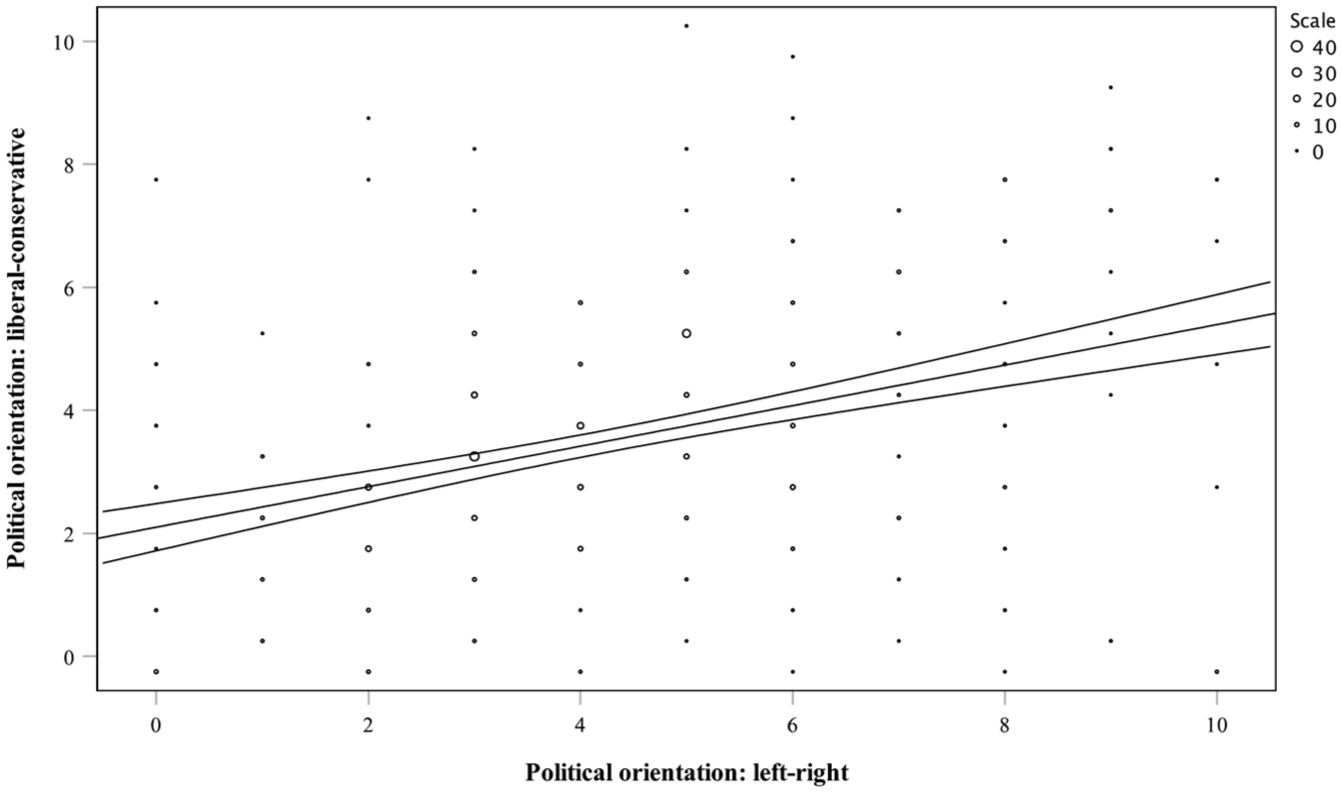
Scatterplot between liberal-conservative and left-right orientation.
The distribution of people by Social and Economic Conservatism is shown in Figure 3. The mean of Social Conservatism was 42.57, and the median was 42.85 on a scale from 0 (left) to 10 (right; scale 0–100), indicating the respondents were slightly more oriented to social liberalism. The mean of Economic Conservatism was 36.50, and the median was 35.50 (scale 0–100), indicating that the respondents were more inclined toward economic liberalism. In this study, “Economic Conservatism” meant the opinion that the state’s role in controlling economic activities must be limited. A paired-samples t-test showed that the Swedish respondents scored higher on social than on Economic Conservatism, t(431) = 5.92, p < .001.

Scatterplot between social conservatism and economic conservatism.
Correlations between right-wing political orientation, general conservatism, economic and Social Conservatism, gender, and age are shown in Table 1. While political orientation and conservatism had statistically non-significant relationships with gender, Social and Economic Conservatism had weak but significant positive relationships with the male gender. Age correlated positively with all measures of conservatism, so the older the respondent was, the higher their score on conservatism. The strongest relationship (r = .50) was found between Social Conservatism and age. Political conservatism did not have any statistically significant relationship with age.
Correlations Between Political Orientation, Conservatism, and Schwartz’s Value Dimensions
Correlations between left-right political orientation, three measures of conservatism, and Schwartz values are shown in Table 1. Correlations between right-wing political orientation and values were as expected: right-wing orientation correlated positively with Power, Achievement, Tradition, Conformity, and Security, and negatively with Universalism and Benevolence. General conservatism correlated positively with Tradition, Conformity, and Security and negatively with Hedonism, Stimulation, Self-Direction, and Universalism. Social conservatism correlated positively with Power, Tradition, Conformity, and Security and negatively with Hedonism, Stimulation, Self-Deception, and Universalism. Economic conservatism correlated positively with Power, Achievement, Tradition, Conformity, and Security. Negative correlations were found between Economic Conservatism and Universality and Benevolence.
In general, correlations between political orientation and different measures of conservatism show that politically right-wing and conservative respondents emphasised values related to Tradition, Conformity, and national Security, as well as power defined as social influence, authority, and wealth. However, right-wing orientation and conservatism were negatively related to values emphasising individualism, enjoyment, and creativity.
Correlations Between Political Orientation, Conservatism, and HEXACO Personality Measures
Table 1 displays correlations between political orientation, measures of conservatism, and HEXACO personality dimensions. Right-wing orientation had the strongest (negative) correlation with Openness to Experience. The general measure of conservatism correlated statistically significantly with Emotionality, Agreeableness, and Openness to Experience. Social conservatism was positively associated with Honesty-Humility and Extraversion, whereas Economic Conservatism was negatively associated with Honesty-Humility, Emotionality, and Openness to Experience. In general, correlations between political orientation, conservatism, and personality factors were relatively weak.
Regression Models for Predicting Political Orientation and Conservatism
Four regression models were constructed to investigate predictors of political right-wing orientation, general conservatism, Social Conservatism, and Economic Conservatism. Variables were entered into the model in three steps: (a) two background variables (age, gender), (b) six HEXACO personality factors, and (c) 10 Schwartz value dimensions. The level of significance was set to p < .05. The collinearity diagnostics (criteria: tolerance values < 0.1 or VIF > 10 as indicators of multicollinearity and condition index > 15 indicating moderate multicollinearity) indicated that multicollinearity was not a problem in this dataset.
Predictors of Right-Wing Political Orientation
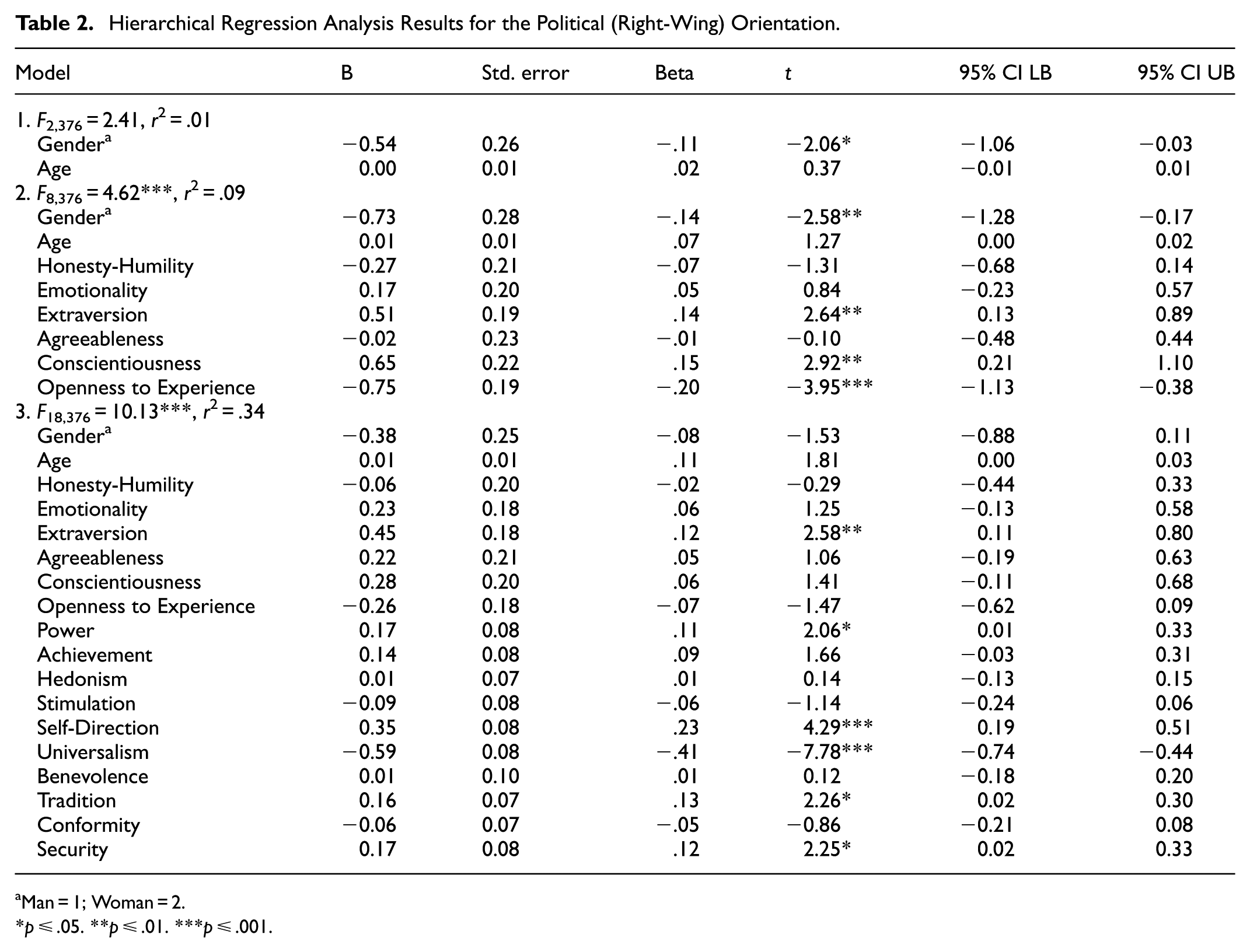
Table 2 presents the results of the hierarchical regression analysis for predicting right-wing political orientation. The HEXACO scales and background factors accounted for 9% of the variance in political orientation. Extraversion and Conscientiousness were positively related to right-wing orientation, whereas Openness to Experience had a negative relationship to right-wing orientation. In the third step, Schwartz values were added to the model. Schwartz values, personality and background variables accounted for 34% of the variance. In the final model, the statistically significant relationship to political orientation remained only for Extraversion. Values of Power, Self-Direction, Tradition, and Security were positively related, and Universalism was negatively associated with right-wing orientation.
Hierarchical Regression Analysis Results for the Political (Right-Wing) Orientation.
Man = 1; Woman = 2.
p ≤ .05. **p ≤ .01. ***p ≤ .001.
The results show that some level of Extraversion characterised a right-wing-oriented person, especially respect for tradition, national Security, independence, and the right to choose one’s path.
Predictors of General Conservatism
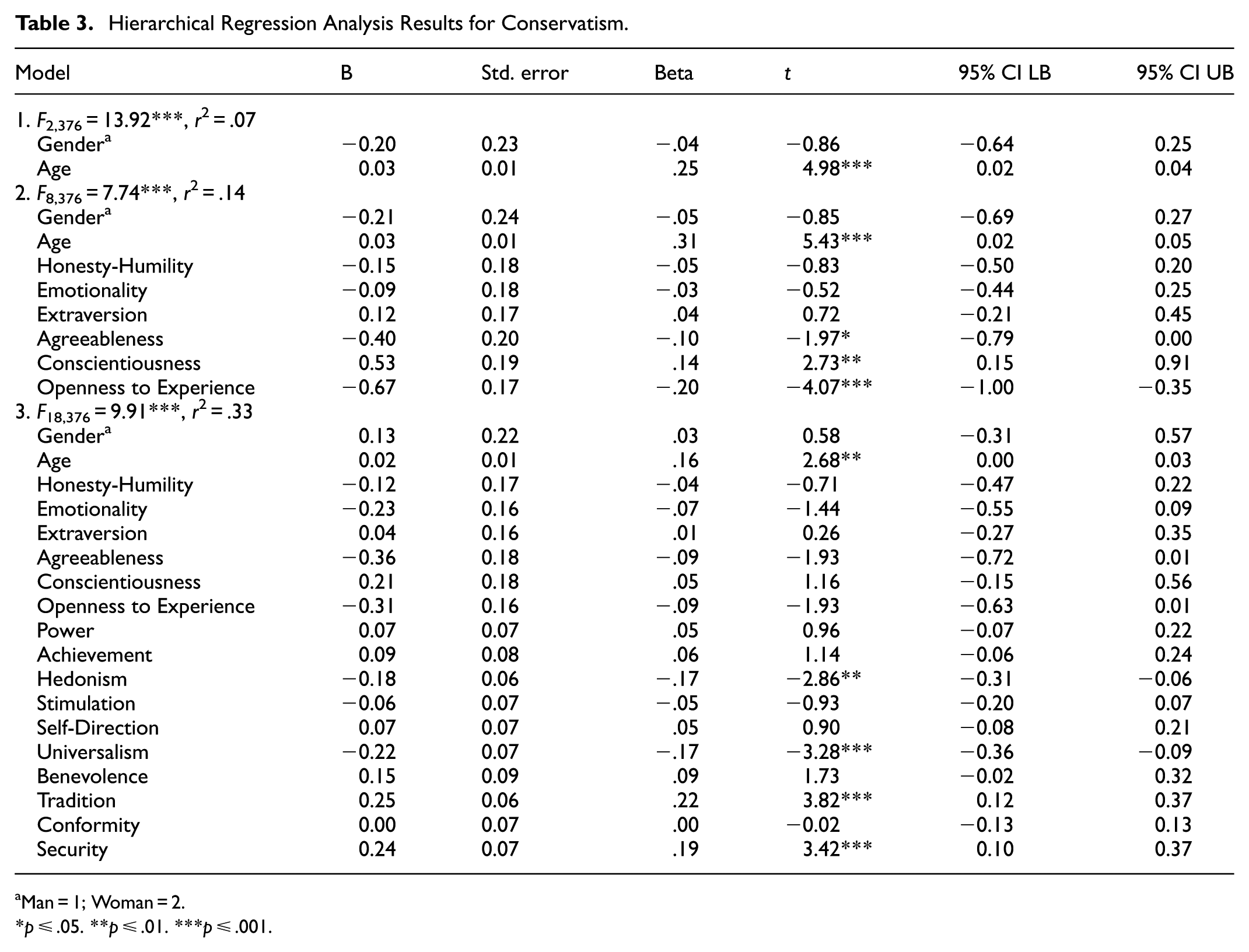
Table 3 presents the results of hierarchical regression analysis related to general conservatism. In the first model, age was positively and significantly associated with conservatism. Background factors explained 7% of the variance in conservatism. The variance accounted for increased to 14% when personality variables were added to the model. Age and Conscientiousness were positively related to conservatism, while Agreeableness and Openness to Experience were negatively related. The third model, including background, personality, and values factors, explained 33% of the variance in the conservatism score. Age, Tradition, and Security were positively related, and Hedonism and Universalism were negatively associated with conservatism. Personality factors lost statistical significance in the final model due to intercorrelations between independent (predictor) variables.
Hierarchical Regression Analysis Results for Conservatism.
Man = 1; Woman = 2.
p ≤ .05. **p ≤ .01. ***p ≤ .001.
People scoring high in general conservatism seem older, object to a hedonistic, enjoyment-oriented life, value traditions, accept one’s place in society, and especially value national and personal safety.
Predictors of Social Conservatism
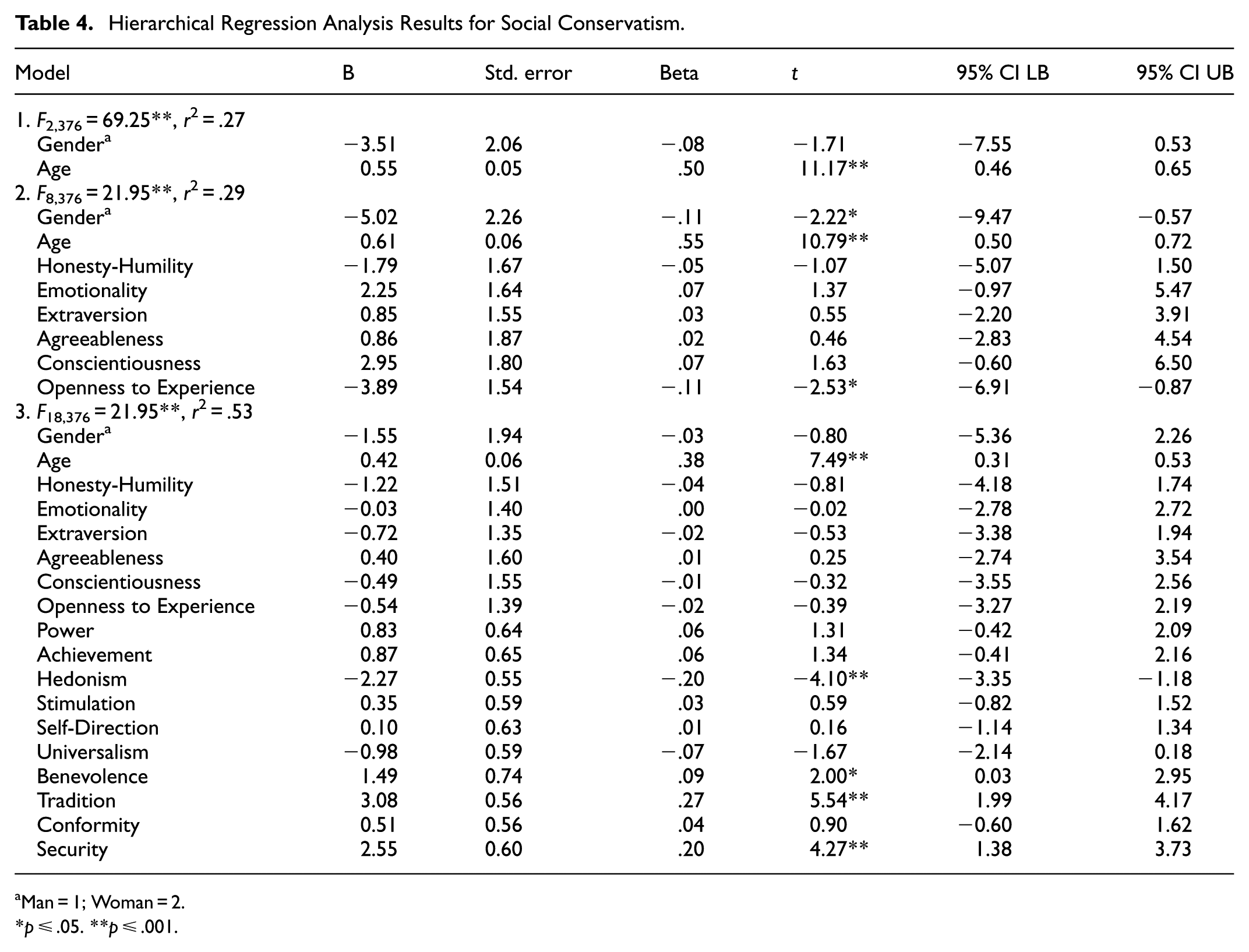
Social conservatism refers to conservative attitudes towards such social issues as religion, abortion, and marriage. In model one, age was strongly related to Social Conservatism and gender accounted for 27% of the variance in Social Conservatism. When personality factors were added to the model, the increase in variance explained was only 2% (Model 2, Table 4). Only Openness to Experience was statistically significantly related to Social Conservatism. In the final model (53% variance accounted for), age was the strongest predictor of Social Conservatism. The other significant predictors were Hedonism, which had a negative relationship with Social Conservatism and Benevolence; Tradition and Security, which had positive relationships with Social Conservatism.
Hierarchical Regression Analysis Results for Social Conservatism.
Man = 1; Woman = 2.
p ≤ .05. **p ≤ .001.
Similarly, as with general conservatism, respondents scoring high in Social Conservatism found a hedonistic lifestyle negative but valued tradition and Security. Also, Benevolence, that is, being helpful and responsible, was valued.
Predictors of Economic Conservatism
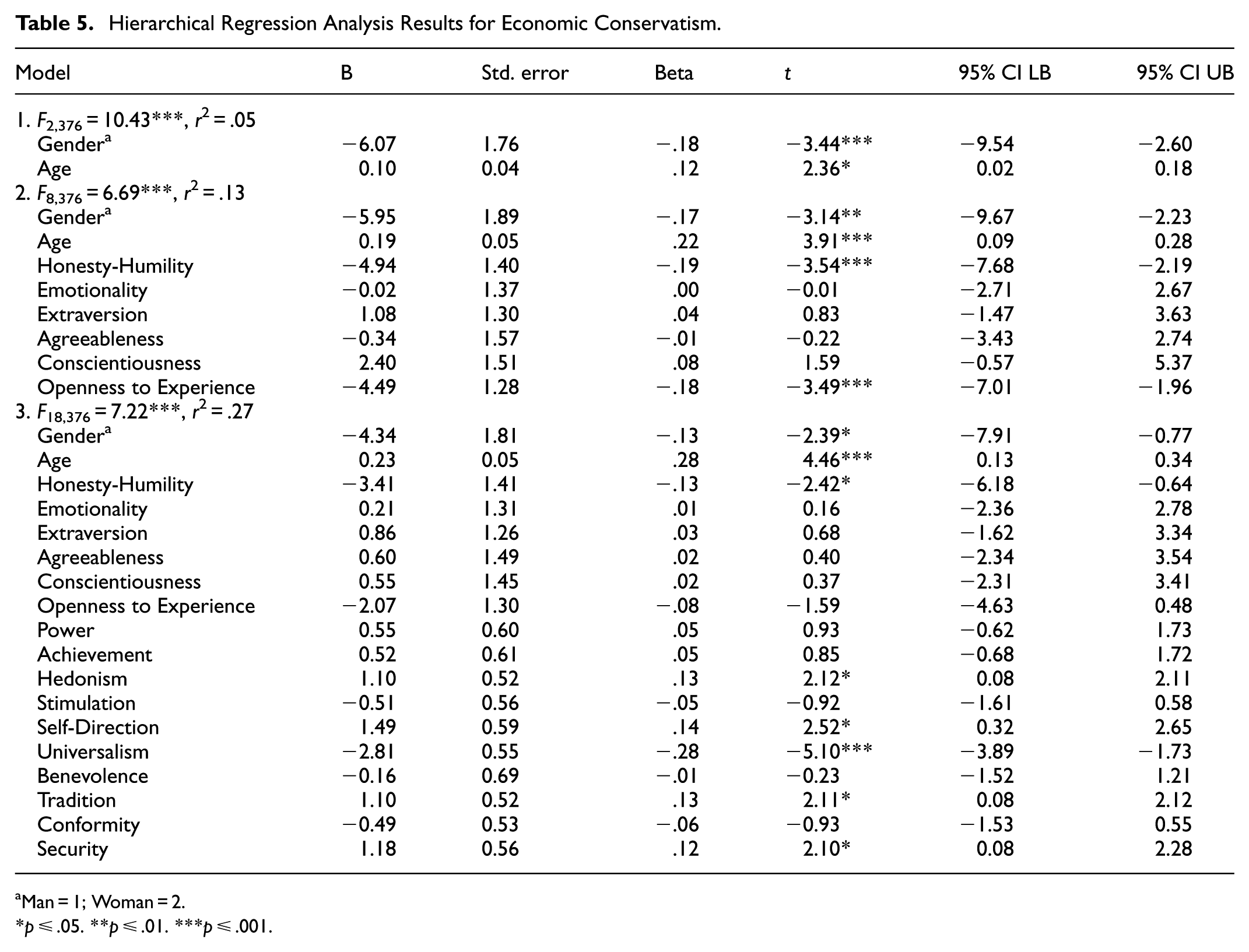
In this study, Economic Conservatism refers to the preference for low state involvement in all economic activities, that is, opposition to high taxes, limitations on the welfare state, and state control in general. Table 5 shows that gender and age were related to Economic Conservatism and explained 5% of the variance. When personality factors were entered into the model, the explanatory power rose to 13%. Age was positively related, and gender, Honesty-Humility, and Openness to Experience were negatively associated with Economic Conservatism. The third model, including background factors, personality variables and values, explained 27% of the variance. Gender, Honesty-Humility, and Universalism were negatively associated with Economic Conservatism, while age, Hedonism, Self-Direction, Tradition, and Security were positively associated with it.
Hierarchical Regression Analysis Results for Economic Conservatism.
Man = 1; Woman = 2.
p ≤ .05. **p ≤ .01. ***p ≤ .001.
People scoring high in Economic Conservatism tend to be older, more often men, and score lower in Honesty-Humility. They value hedonistic pleasures and the possibility of making independent choices. Values such as the preservation of nature, social justice, or world peace have less importance in their lives.
Path Models Predicting Political Orientation and Liberalism-Conservatism
The regression results indicated that some, but not all, of the effects of personality on political orientation and conservatism disappeared when values were included in the model. This might suggest that values mediate the impact of personality factors on political orientation and conservatism. In this way, personality factors could be considered “distal” and values as “proximal” factors influencing political orientation and conservatism. To model the mechanisms by which personality factors relate to political orientation and conservatism, directly or via values, we constructed two path models using structural equation modelling (Figures 4 and 5).
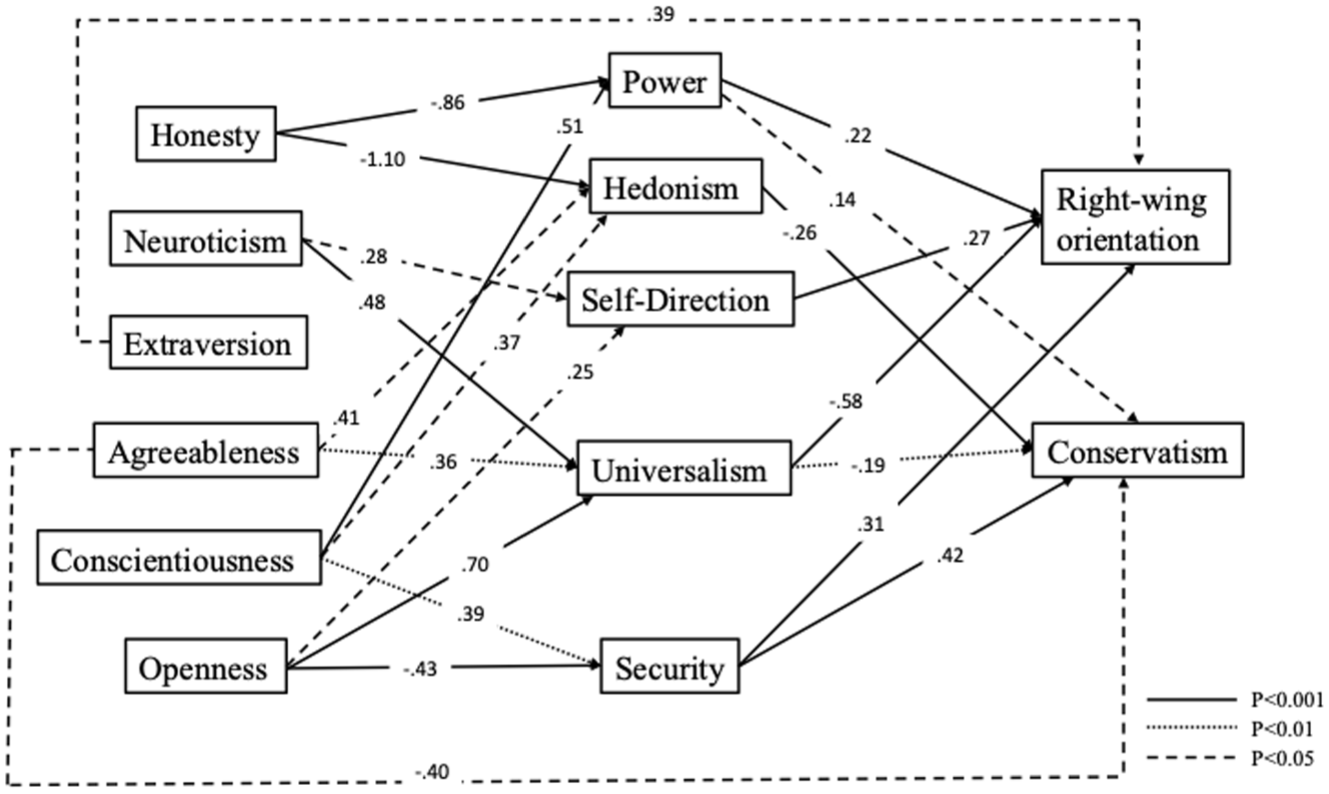
Path model showing the relationships between HEXACO variables, values, right-wing orientation, and general conservatism.
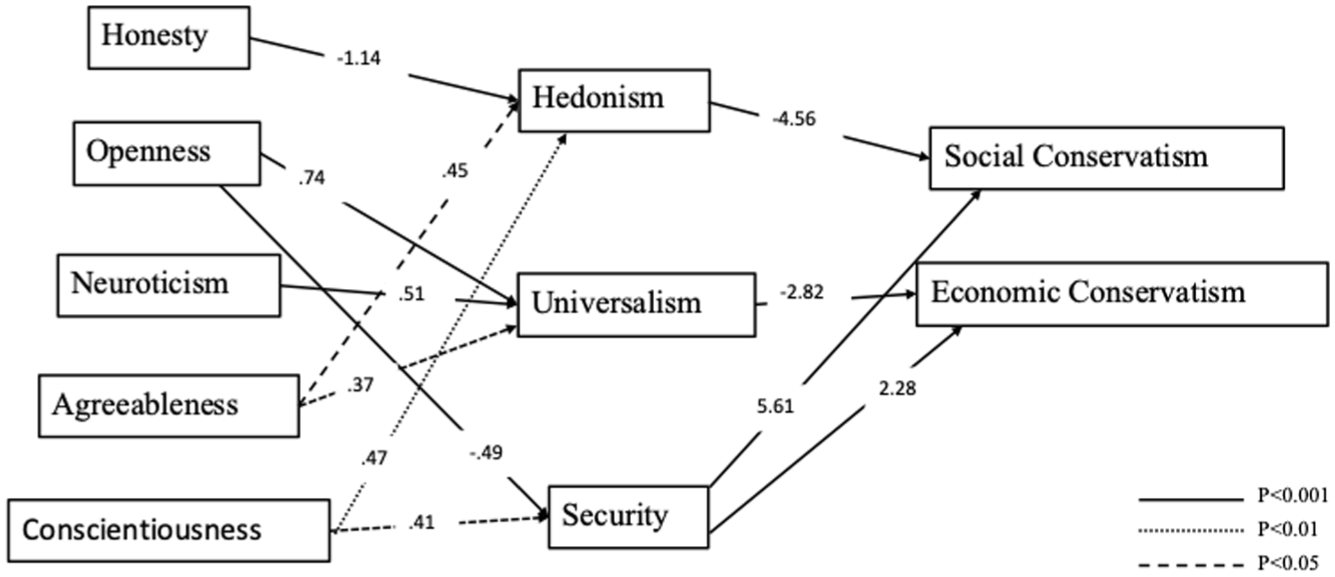
Path model showing the relationships between HEXACO variables, values, social conservatism, and economic conservatism.
Right-Wing Orientation and General Conservatism
Results of the path analysis of the relationships between personality, values, and single-item measures of left/right-wing orientation and liberalism/conservatism are shown in Figure 4 (simplified model omitting covariances) and in Table A1 (path coefficients, variances, and covariances). The fit of the model presented in Figure 4 can be considered good (χ2 = 91.21; RMSEA = 0.06; CFI = 0.91).
Figure 4 shows that Extraversion was the only HEXACO factor directly related to political orientation, which was negatively associated with right-wing orientation. Honesty-Humility had a negative relationship with both Power and Hedonism. Power was positively associated with right-wing orientation and conservatism, whereas Hedonism was negatively related to conservatism. Emotionality was positively associated with Self-Direction and Universalism. Self-Direction positively relates to right-wing orientation, and Universalism is negatively associated with right-wing orientation and conservatism. Agreeableness had a direct negative relationship with conservatism and positive relationships with Hedonism and Universalism. Conscientiousness was positively related to three values: Power, Hedonism, and Security. Security had positive relationships with both right-wing orientation and conservatism. The last HEXACO factor presented in Figure 4, that is, Openness to Experience, showed a strong positive relationship with Universalism and a negative relationship with Security.
Table A1 shows that covariances between right-wing orientation and conservatism, Power and Hedonism, and Hedonism and Self-Direction were positive and statistically significant. For clarity, these covariances are not displayed in Figure 4.
Social and Economic Conservatism
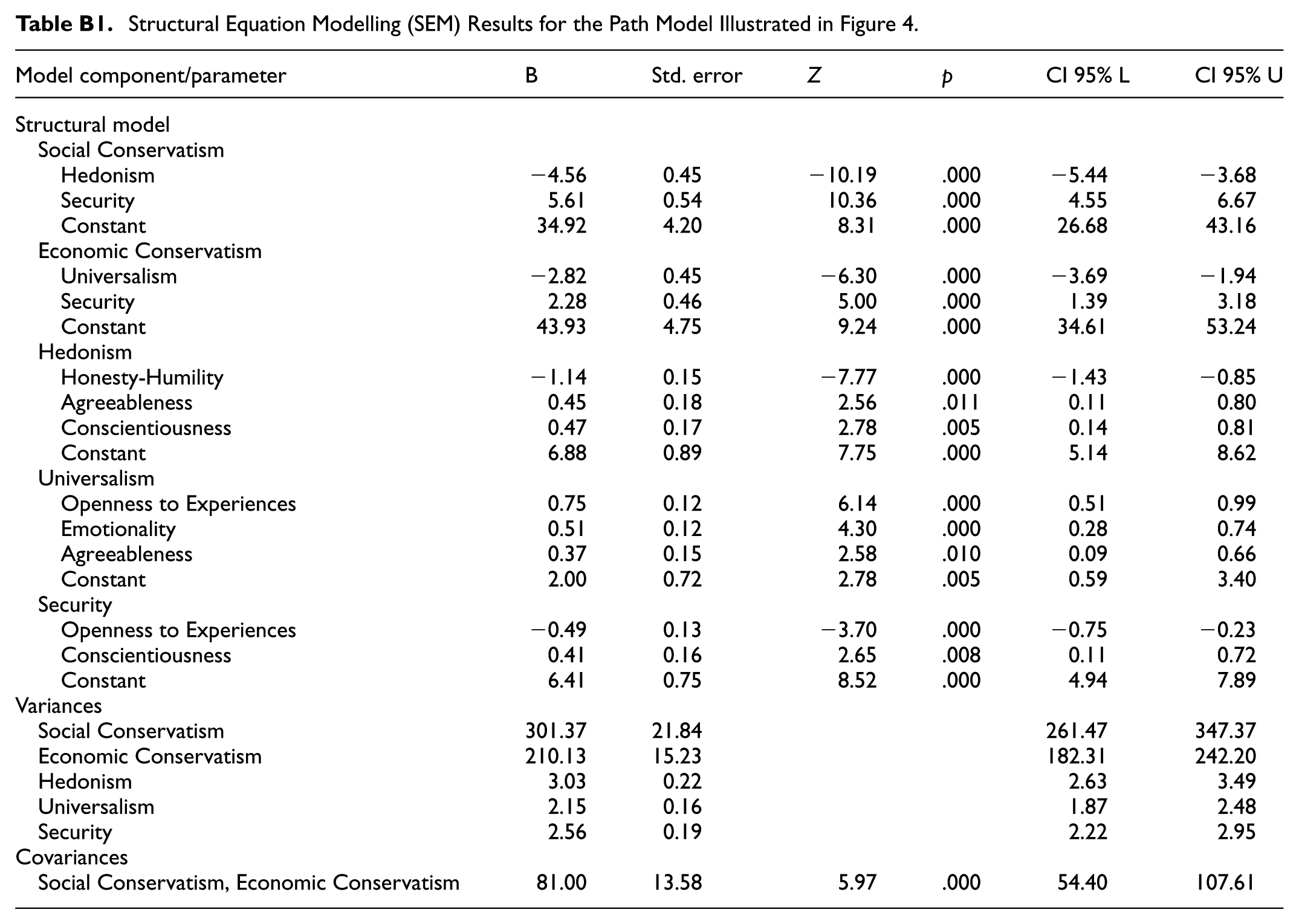
The second path model was constructed to investigate further the mechanisms by which HEXACO personality factors and values are related to Social and Economic Conservatism. The results of the SEM path analysis are presented in Figure 5 (simplified model omitting covariances), and the corresponding structural equation coeffects, variances, and covariances are in Table B1. The model’s fit in Figure 5 can be considered excellent (χ2 = 30.02; RMSEA = 0.03; CFI = 0.98).
Before evaluating the results, it should be noted that, in this measure of conservatism, “Economic Conservatism” refers to a preference for economic liberalism and low government interference in economic activities. Only three value dimensions had significant relationships with social or economic conservatism: Hedonism was negatively related to Social Conservatism, Universalism was negatively associated with economic conservatism, and Security was positively related to Social and economic conservatism. Those three values fully mediated the effects of personality. The Honesty-Humility scale of HEXACO was negatively associated with Hedonism, Openness to Experience was positively related to Universalism and negatively to Security, and Emotionality was positively related to Universalism. Agreeableness is positively related to Hedonism and Universalism, whereas Conscientiousness is positively associated with both Hedonism and Security.
Discussion
Political debates in many societies have become increasingly polarised, with individuals’ political identities playing a central role in how they view themselves and others. Given the strong correlation between political orientation and self-identity, it is essential to understand the connection between underlying personality traits, value systems, and ideological positions. The present study contributes to this discussion by examining the associations between personality factors, values, and political orientation (left–right, liberal–conservative) in a Swedish sample.
Personal Values and Personality Factors as Correlates of Right-Wing Orientation and Conservatism
Regression analysis results showed that right-wing orientation correlated positively with Power, Self-Direction, and Security, and negatively with Universalism. In terms of personality traits, right-wing orientation was positively associated with Extraversion. In contrast, in the present sample, conservatism correlated positively with Tradition and Security but negatively with Hedonism and Universalism, in line with Dimdins et al. (2023). Unlike right-wing orientation, conservatism did not maintain a significant relationship with any personality factors in this model. These results underscore that while there are overlaps, significant differences exist between conservatism and right-wing orientation in Sweden, implying that they should not be used interchangeably, as suggested by previous studies (Demel et al., 2024; Leone, Chirumbolo, & Desimoni, 2012; Leone, Desimoni, & Chirumbolo, 2012; Zettler & Hilbig, 2010).
Regarding the distinction between Social and Economic Conservatism, both positively correlate with Tradition, Security, and age. However, Social Conservatism also shows a positive correlation with Benevolence and a negative correlation with Hedonism. Economic conservatism, in contrast, correlates positively with Hedonism and Self-Direction while showing negative correlations with Honesty-Humility, Universalism, and gender. These findings highlight distinct value differences between Social and Economic Conservatism. However, it is essential to note that the individual relationships between personality factors, values, and political orientation/conservatism were relatively weak.
Our results indicate significant differences between the right-left and conservative-liberal dimensions, underscoring the importance of treating them as distinct constructs. The intercorrelations observed in our study demonstrate that while related, these dimensions are influenced by different sets of values and personality traits. For instance, Social Conservatism, which relates to attitudes towards tradition and social order, is more strongly predicted by personality and values than Economic Conservatism, which pertains to preferences for government involvement in the economy. This suggests that Economic Conservatism may be shaped by additional factors beyond personality and values alone, such as personal economic experiences and educational background.
Age and gender were related to political orientation. The results indicate that in Sweden, conservatism is more closely linked to values rather than economic preferences, a trend that intensifies with age. Consequently, as individuals age, they tend to become more conservative, suggesting a value shift over time. Additionally, the findings reveal that men tend to be more conservative than women, aligning with previous research in this field (Schlesinger & Heldman, 2001).
Personality, Values, and Their Impact on Right-Wing Orientation and Conservatism
When examining values and personality together, it becomes evident that values influence political orientation and conservatism more than personality traits. With the inclusion of values in the model, most personality effects on political orientation and conservatism diminished. While personality accounted for 8% of the variance in right-wing orientation, 7% in conservatism, 2% in Social Conservatism, and 8% in Economic Conservatism, the exact figures for value dimensions were 25%, 19%, 24%, and 14%, respectively. These findings are consistent with prior research, which typically finds that personality explains 5% to 10% of the variance and values about 16% (Caprara et al., 2006; Costello et al., 2022). The variance explained by personality traits and values was significantly higher for Social Conservatism (53%) than for Economic Conservatism (27%). This discrepancy suggests that social attitudes are more deeply rooted in individual personality traits and values. In contrast, economic attitudes may be influenced by a broader range of factors, including personal economic experiences, education, and exposure to different economic ideas. Social conservatism deals with moral values, traditions, and social order, which are closely tied to personal values and personality. In contrast, economic conservatism involves beliefs about economic policies and government intervention, which may be shaped by pragmatic, context-specific factors.
The results suggest that values might mediate the influence of personality on political orientation. This hypothesis has been previously tested with similar outcomes, though not simultaneously with right-wing, general, social, and Economic Conservatism (Caprara et al., 2009). Thus, personality factors could be considered “distal” influences, with values acting as “proximal” influences in shaping political orientation and conservatism. It should be noted, however, that mediation models based on cross-sectional data are always speculative, although they are very often used in psychological research employing a cross-sectional design (Lee & Eshleman Latimer, 2024).
While values fully or partly mediated the effects of most personality variables, Extraversion directly affected right-wing orientation. This finding can be attributed to the nature of Extraversion, which includes traits such as assertiveness, social dominance, and a preference for social engagement. Earlier studies show that Extraversion influences political participation through political efficacy (Dawes et al., 2014). In addition, Huber et al. (2021) reported a positive and direct relationship between Extraversion and collective political activities in different countries (Huber et al., 2021). Right-wing ideologies often emphasise social order, leadership, and assertiveness, making them appealing to extroverts. Extraverted individuals may be drawn to these ideologies because they align with their inherent social and assertive tendencies.
Agreeableness was found to have a direct negative effect on conservatism. The direct negative relationship between agreeableness and conservatism can be understood in terms of social harmony, openness to diversity, conflict avoidance, empathy, and moral values. Agreeable individuals prioritise social cohesion, inclusivity, and compassionate policies, which align more closely with liberal than with conservative ideologies. The relationship between agreeableness and conservatism, however, seems complex. Hirsh et al. (2010) suggested that individuals who lean towards right-wing ideologies, characterised by competition and self-interest, are less likely to exhibit agreeableness. This negative correlation between agreeableness and conservatism was further supported by Bakker (2016), who found that one aspect of agreeableness, compassion, was linked to liberalism, while another, politeness, was associated with conservatism. Two studies by Hirsh et al. (2010) reported that one aspect of agreeableness (compassion) was linked to liberalism and egalitarianism, while the other aspect (politeness) was connected to conservatism and traditionalism. This suggests that different aspects of agreeableness might have opposing relationships with conservatism.
Values as a Mediator Between Personality and Right-Wing Orientation/Conservatism
The impact of personality traits on right-wing orientation and conservatism was mediated through five values: Hedonism, Self-Direction, Universalism, Conservatism, and Security. Honesty-Humility was mediated through Power and Hedonism; Emotionality through Self-Direction and Universalism; Agreeableness through Hedonism and Security; and Openness to Experience through Universalism and Security. In essence, whether one possesses sincerity, fairness, and modesty affects how much a person values pleasure and prestige. Similarly, emotional sensitivity influences views on freedom and tolerance; gentleness and patience affect attitudes towards pleasure and Security; and creativity and innovation as traits impact views on tolerance and safety. These patterns, in turn, influence one’s right-wing or conservative orientation.
For economic and Social Conservatism, personality was mediated through three values: Hedonism, Universalism, and Security. Honesty-Humility was related to Hedonism, Openness to Experience, Universalism and Security, Emotionality to Universalism, Agreeableness to Hedonism and Universalism, and Conscientiousness to Hedonism and Security. Hence, sincerity, fairness, and modesty influence attitudes towards pleasure, thereby influencing one’s leaning towards social versus economic conservatism. This supports the theory that personality traits are distal factors and values are proximal factors, a pattern consistent across four political dimensions: right-wing orientation, conservatism in general, and Social and Economic Conservatism. However, Extraversion stands out as a direct influence on right-wing orientation, reinforcing the mediating role of values even when tested with different personality traits and political orientations (Amsalem & Sheffer, 2023; Caprara et al., 2009).
Finally, although our data did not directly address current world events, the observed associations between values, personality, and political orientation offer one lens on how individuals interpret and respond to contemporary crises. Values such as Universalism and Benevolence—typically associated with empathy and openness—are often linked to support for humanitarian aid and international cooperation, whereas Security and Tradition tend to align with preferences for stability, national interest, and more cautious policy responses. At the same time, these dispositional influences operate within social contexts: media exposure and framing, group identity and social norms, and prevailing societal narratives can amplify, attenuate, or redirect these patterns. Accordingly, divergent public attitudes toward pressing global issues (e.g., conflicts or humanitarian crises) likely reflect an interplay between psychological dispositions and these social–cultural forces. Future research should explicitly model this interplay—for example, by measuring media diets and identity salience alongside values and personality, and by testing mediation/moderation in cross-cultural settings.
Limitations
A key limitation of this study is the use of cross-sectional data, which prevents us from making causal inferences. While mediation analyses suggest pathways, they imply causality best examined through longitudinal studies. Conducting longitudinal studies, however, poses significant challenges and might not fit well with sensitive studies about political orientation. Longitudinal studies require tracking participants, meaning that the answers would not be anonymous, which is likely to cause bias. Additionally, it is unclear why measuring personality factors, values, and political orientation at different time points would yield more accurate results, as political opinions can change in response to contemporary events (e.g., election results and political scandals) that may temporarily influence a person’s viewpoint (Dias & Lelkes, 2022). Nevertheless, our cross-sectional data necessitate a cautious interpretation of the mediation results, acknowledging potential limitations in capturing causal dynamics.
The participant pool, sourced from social media, the University of Gothenburg, and personal contacts, may not be ideally representative but likely reflects the University of Gothenburg student population (and their acquaintances). For instance, a higher proportion of female participants were highly educated, and the group included more individuals with left-wing or liberal orientations than right-wing or conservative ones. This characteristic of the sample is evident in some of the score distributions: those of Self-Direction and Benevolence, as well as the personality dimensions Honesty-Humility and Social Conservatism, deviated from normality. This deviation is likely due to the young student sample, which tends to be more liberal and left leaning in Sweden. The use of psychology students was also primarily driven by accessibility and feasibility, which is common in exploratory research, and was considered appropriate given that the aim was to examine mediation mechanisms rather than provide population-level estimates. Nevertheless, the reliance on a student sample limits the generalizability of the findings, and more representative samples are needed in future studies.
Additionally, when handling sensitive personal information, it is prudent to consider the possibility of untruthful responses, whether intentional or due to bias. The use of self-reported, internet-based survey data may also introduce social desirability effects and misrepresentation. However, the survey was conducted entirely anonymously, which likely reduced pressures to conform to perceived norms or to present oneself in a favourable light. While self-report remains a limitation, it is a standard and widely used method in personality and values research. Future studies could complement self-reports with behavioural or longitudinal data to strengthen validity. The sample was also Sweden-centric, suggesting that these findings should be tested in different cultural contexts, which might yield different results. Future studies with nationally representative samples from various countries are needed.
While personality factors and personal values offer some insight into political orientation, relying solely on them provides a limited understanding of this complex issue. It is essential to consider a multifaceted approach to fully grasp how political orientations are formed (Xu et al., 2016). This could include examining the influence of social factors like socialisation, group identity, and life experiences. Additionally, understanding the role of cognitive processes such as information processing, moral reasoning (Campbell et al., 2015), and motivated reasoning is crucial. Furthermore, the impact of the political context itself, including political systems, current events, and media influence, cannot be ignored. By integrating these broader perspectives and employing diverse methodologies, researchers can develop a more comprehensive and nuanced understanding of the formation of political orientation.
Conclusions
This study shows that right-wing orientation and conservatism are related but distinct dimensions in Sweden and should not be used interchangeably. Considering them individually provides a more defined description of how traits and values influence ideology. In all the path models, values were the main, direct correlates of political positions, and personality played a less significant, indirect role, predominantly mediated by values. Right-wing orientation was associated with higher Security, Power and Hedonism, and with lower Universalism and Self-Direction; Conservatism, in turn, was associated with higher Security and lower Universalism. Extraversion maintained a small direct association with right-wing orientation and Agreeableness with Conservatism.
Path analysis indicated that Social Conservatism correlated with increased Security and decreased Hedonism, while Economic Conservatism correlated with increased Security and decreased Universalism. The impact of personality was mediated by values, with no significant direct pathways from traits to outcomes after accounting for values.
Demographic factors played significant roles: age was positively correlated with conservatism—particularly its social dimension—and men tended to be more conservative than women. These trends suggest a value shift with age rather than a purely economic reorientation.
These findings have implications for future research. Foremost, measurement is critical: researchers must not aggregate left–right and liberal–conservative viewpoints into a single scale and should distinguish between social and economic conservatism when theorising and modelling predictors. Second, theorising should focus on values as mediating mechanisms that convert general predispositions into concrete political positions. Third, when explaining economic ideology, it is necessary to incorporate context-specific variables (e.g., financial strain, class, education, policy knowledge), given their weaker association with traits and values compared to social ideology. Taken together, these results not only clarify the psychological pathways underlying political orientations in Sweden but also provide a basis for understanding how enduring traits and values may translate into divergent public attitudes toward contemporary global issues such as conflicts and humanitarian crises.
Footnotes
Appendix A
Structural Equation Modelling (SEM) Results for the Path Model Illustrated in Figure 3.

| Model component/parameter | B | Std. error | Z | p | CI 95% L | CI 95% U |
|---|---|---|---|---|---|---|
| Structural model | ||||||
| Right-wing orientation | ||||||
| Power | 0.22 | 0.07 | 3.28 | .001 | 0.09 | 0.36 |
| Self-Direction | 0.27 | 0.07 | 4.02 | .000 | 0.14 | 0.40 |
| Universalism | −0.58 | 0.07 | −8.68 | .000 | −0.71 | −0.45 |
| Security | 0.31 | 0.06 | 5.00 | .000 | 0.19 | 0.44 |
| Extraversion | 0.39 | 0.16 | 2.52 | .012 | 0.09 | 0.70 |
| Constant | 3.45 | 0.94 | 3.68 | .000 | 1.61 | 5.29 |
| Conservatism | ||||||
| Power | 0.14 | 0.06 | 2.21 | .027 | 0.02 | 0.27 |
| Hedonism | −0.26 | 0.05 | −5.30 | .000 | −0.36 | −0.17 |
| Universalism | −0.19 | 0.06 | −3.11 | .002 | −0.31 | −0.07 |
| Security | 0.42 | 0.06 | 7.36 | .000 | 0.31 | 0.53 |
| Agreeableness | −0.40 | 0.17 | −2.29 | .022 | −0.74 | −0.06 |
| Constant | 5.54 | 0.84 | 6.59 | .000 | 3.89 | 7.19 |
| Power | ||||||
| Honesty-Humility | −0.86 | 0.12 | −7.34 | .000 | −1.08 | −0.63 |
| Conscientiousness | 0.54 | 0.14 | 3.90 | .000 | 0.27 | 0.81 |
| Constant | 5.47 | 0.65 | 8.43 | .000 | 4.20 | 6.74 |
| Hedonism | ||||||
| Honesty-Humility | −1.08 | 0.14 | −7.89 | .000 | −1.35 | −0.81 |
| Agreeableness | 0.42 | 0.16 | 2.56 | .011 | 0.10 | 0.74 |
| Conscientiousness | 0.36 | 0.16 | 2.24 | .025 | 0.04 | 0.67 |
| Constant | 7.19 | 0.83 | 8.70 | .000 | 5.57 | 8.81 |
| Self-Direction | ||||||
| Emotionality | 0.28 | 0.11 | 2.55 | .011 | 0.07 | 0.50 |
| Openness to Experience | 0.25 | 0.11 | 2.20 | .028 | 0.03 | 0.47 |
| Constant | 5.65 | 0.54 | 10.40 | .000 | 4.59 | 6.72 |
| Universalism | ||||||
| Emotionality | 0.51 | 0.12 | 4.30 | .000 | 0.28 | 0.74 |
| Agreeableness | 0.37 | 0.15 | 2.58 | .010 | 0.09 | 0.66 |
| Openness to Experience | 0.75 | 0.12 | 6.14 | .000 | 0.51 | 0.99 |
| Constant | 2.00 | 0.72 | 2.78 | .005 | 0.59 | 3.40 |
| Security | ||||||
| Conscientiousness | 0.41 | 0.16 | 2.65 | .008 | 0.11 | 0.72 |
| Openness to Experience | −0.49 | 0.13 | −3.70 | .000 | −0.75 | −0.23 |
| Constant | 6.41 | 0.75 | 8.52 | .000 | 4.94 | 7.89 |
| Variances | ||||||
| Power | 2.01 | 0.15 | 1.75 | 2.32 | ||
| Right-wing orientation | 3.74 | 0.27 | 3.25 | 4.31 | ||
| Conservatism | 3.15 | 0.23 | 2.73 | 3.63 | ||
| Hedonism | 3.05 | 0.22 | 2.65 | 3.52 | ||
| Self-Direction | 2.21 | 0.16 | 1.92 | 2.55 | ||
| Universalism | 2.15 | 0.16 | 1.87 | 2.48 | ||
| Security | 2.56 | 0.19 | 2.22 | 2.95 | ||
| Covariances | ||||||
| Power, Hedonism | 0.34 | 0.12 | 2.85 | .004 | 0.11 | 0.57 |
| Right-wing orientation, Conservatism | 0.75 | 0.18 | 4.16 | .000 | 0.40 | 1.11 |
| Hedonism, Self-Direction | 0.98 | 0.14 | 6.88 | .000 | 0.70 | 1.26 |
Appendix B
Structural Equation Modelling (SEM) Results for the Path Model Illustrated in Figure 4.
| Model component/parameter | B | Std. error | Z | p | CI 95% L | CI 95% U |
|---|---|---|---|---|---|---|
| Structural model | ||||||
| Social Conservatism | ||||||
| Hedonism | −4.56 | 0.45 | −10.19 | .000 | −5.44 | −3.68 |
| Security | 5.61 | 0.54 | 10.36 | .000 | 4.55 | 6.67 |
| Constant | 34.92 | 4.20 | 8.31 | .000 | 26.68 | 43.16 |
| Economic Conservatism | ||||||
| Universalism | −2.82 | 0.45 | −6.30 | .000 | −3.69 | −1.94 |
| Security | 2.28 | 0.46 | 5.00 | .000 | 1.39 | 3.18 |
| Constant | 43.93 | 4.75 | 9.24 | .000 | 34.61 | 53.24 |
| Hedonism | ||||||
| Honesty-Humility | −1.14 | 0.15 | −7.77 | .000 | −1.43 | −0.85 |
| Agreeableness | 0.45 | 0.18 | 2.56 | .011 | 0.11 | 0.80 |
| Conscientiousness | 0.47 | 0.17 | 2.78 | .005 | 0.14 | 0.81 |
| Constant | 6.88 | 0.89 | 7.75 | .000 | 5.14 | 8.62 |
| Universalism | ||||||
| Openness to Experiences | 0.75 | 0.12 | 6.14 | .000 | 0.51 | 0.99 |
| Emotionality | 0.51 | 0.12 | 4.30 | .000 | 0.28 | 0.74 |
| Agreeableness | 0.37 | 0.15 | 2.58 | .010 | 0.09 | 0.66 |
| Constant | 2.00 | 0.72 | 2.78 | .005 | 0.59 | 3.40 |
| Security | ||||||
| Openness to Experiences | −0.49 | 0.13 | −3.70 | .000 | −0.75 | −0.23 |
| Conscientiousness | 0.41 | 0.16 | 2.65 | .008 | 0.11 | 0.72 |
| Constant | 6.41 | 0.75 | 8.52 | .000 | 4.94 | 7.89 |
| Variances | ||||||
| Social Conservatism | 301.37 | 21.84 | 261.47 | 347.37 | ||
| Economic Conservatism | 210.13 | 15.23 | 182.31 | 242.20 | ||
| Hedonism | 3.03 | 0.22 | 2.63 | 3.49 | ||
| Universalism | 2.15 | 0.16 | 1.87 | 2.48 | ||
| Security | 2.56 | 0.19 | 2.22 | 2.95 | ||
| Covariances | ||||||
| Social Conservatism, Economic Conservatism | 81.00 | 13.58 | 5.97 | .000 | 54.40 | 107.61 |

Ethical Considerations
This study was reviewed and approved by the Social Sciences Ethics Review Board (SSERB) of the University of Nicosia, Cyprus (decision no. SSERB 00400; 20 July 2024) and was conducted in accordance with the principles of the Declaration of Helsinki and the ethical principles of the Belmont Report.
Consent to Participate
Informed consent was obtained from all participants prior to participation.
Funding
The authors received no financial support for the research, authorship, and/or publication of this article.
Declaration of Conflicting Interests
The authors declared no potential conflicts of interest with respect to the research, authorship, and/or publication of this article.
Data Availability Statement
The datasets used and analysed during the current study are available from the corresponding author on reasonable request.*