






Abstract
Vietnam’s One Commune One Product (OCOP) program is pivotal for rural socio-economic development, yet traditional production, such as Dong vermicelli, poses environmental challenges regarding water use and waste. While the circular economy (CE) presents a viable solution, its adoption is hindered by unquantified market-based incentives. This study addresses this gap by empirically evaluating consumer willingness-to-pay (WTP) for OCOP Dong vermicelli featuring specific CE attributes. A discrete choice experiment (DCE) integrated with a latent class model (LCM) was administered to 606 Vietnamese consumers to quantify preferences for five attributes: OCOP star rating, traceability, wastewater treatment, residue management, and price. The analysis revealed significant preference heterogeneity, identifying a key segment of “OCOP Advocates” characterized by younger demographics, higher income, and greater CE awareness. This group demonstrated a significant WTP premium: 9.3% for verified wastewater treatment, 4.4% for residue repurposing, and 6.5% for a 5-star OCOP rating, relative to baseline products. These results provide robust empirical evidence for a market-based pathway to integrating CE principles within a developing country’s traditional food sector. They highlight a viable market for sustainable OCOP products, incentivizing producers to adopt water-saving and circular practices. The findings suggest that policymakers can foster sustainable mountainous agriculture by strengthening OCOP certification standards and enhancing consumer awareness, thereby aligning market demand with environmental stewardship.
Keywords
Introduction
The agricultural sector in Vietnam remains central to the national economy, sustaining rural and mountainous livelihoods, ensuring food security, reducing poverty, and contributing significantly to export revenue (Dung et al., 2022; Newman et al., 2020; H. Q. Nguyen et al., 2019; Phi & Bui, 2022; Tran et al., 2021). To foster rural development, the government has introduced the One Commune One Product (OCOP) program, which mobilizes local resources and cultural assets to create high-quality, value-added products (Knight, 1994; Kurokawa, 2009). Among these, OCOP Dong vermicelli, produced from edible canna (Canna edulis), serves as both an important source of income and a marker of cultural identity for ethnic minority groups in the northern mountainous regions of Vietnam.
Despite these socio-economic benefits, OCOP Dong vermicelli production generates large volumes of wastewater and residue that threaten water quality and local ecosystems (P. B. N. Nguyen et al., 2024; Pham, 2020). Circular economy (CE) principles offer a promising framework for mitigating the impact of reuse, recycling, and resource regeneration (Alhawari et al., 2021; Awan et al., 2020; Geisendorf & Pietrulla, 2018; Murray et al., 2017). Circular practices such as repurposing residues into organic fertilizers, treating and reusing wastewater for irrigation, enhancing soil fertility, managing waste, and promoting water conservation, potentially add value to OCOP Dong vermicelli production depletion and foster more sustainable production systems (Haque et al., 2023; Mannina et al., 2022; Morseletto et al., 2022; Rodias et al., 2021; Rodríguez-Espinosa et al., 2023). Although these CE practices are essential, OCOP-certified Dong vermicelli production only elevates a product’s market status and quality perception, but does not explicitly mandate or certify advanced CE practices. Growing consumer demand for sustainably produced goods presents an opportunity to accelerate the implementation of CE principles. While the OCOP label provides a baseline for quality, it is unclear whether a market exists for OCOP Dong vermicelli products that integrate supplementary, verifiable sustainability attributes. Therefore, this study addresses the core question: Are consumers willing to pay an additional premium for OCOP-certified Dong vermicelli products that feature verified CE attributes?
Prior studies have shown that environmentally conscious consumers are often willing to pay a premium for products incorporating sustainability attributes, such as eco-labels, traceability, and certification (Sama et al., 2018; Sánchez-Bravo et al., 2021; Trang et al., 2025; Villanueva et al., 2025). This literature underscores the influence of sustainability and certification on consumer behavior in global food and agricultural markets. For example, eco-labeling in coffee and organic certification in fruits have been shown to affect purchasing decisions significantly (Aminravan et al., 2025; Gatti et al., 2022, 2024; Liu et al., 2019; Maaya et al., 2018), such studies typically emphasize international commodities rather than localized, culturally embedded products. However, most existing studies focus on broad agricultural products or international contexts, offering limited insights into localized programs such as Vietnam’s OCOP. Moreover, whether these global findings translate into consumer behavior towards specific OCOP products, such as Dong vermicelli, remains an open question.
Despite this progress, several gaps remain in the literature. First, little is known about how consumers respond to sustainability attributes in the context of OCOP products, particularly Dong vermicelli. Second, few studies explicitly link willingness-to-pay (WTP) for attributes such as wastewater treatment, residue management, traceability, and certification with resource-efficient practices in localized supply chains. Without this link, it is challenging to determine whether consumer demand can effectively motivate producers to adopt CE practices. Third, evidence on consumer heterogeneity in developing countries is scarce. In particular, limited knowledge exists on how preferences vary across socio-demographic groups in Vietnam’s mountainous regions, leaving unanswered questions about how such heterogeneity can inform effective policies for sustainable rural development.
To address these gaps, this study aims to (1) analyze consumer preferences for OCOP Dong vermicelli attributes related to water conservation and CE practices (wastewater treatment and residue management), as well as product-specific features (star rating, traceability), and (2) identify distinct consumer segments based on their preferences and socio-demographic characteristics. To achieve these aims, we employ a discrete choice experiment (DCE) and a latent class model (LCM), which enable us to quantify WTP and identify heterogeneous consumer profiles. By linking consumer demand with sustainable production practices, this study contributes to advancing the adoption of CE in rural food systems, safeguarding water resources, and supporting the livelihoods of ethnic minority communities in the mountainous agricultural sector of Vietnam.
Following this introduction, we review the literature on consumer preferences for sustainable products, as well as the agricultural application of water conservation and the CE principles in Section “Background.” This theoretical foundation informs our research methodology, which is detailed in Section “Methodology.” Section “Results and Discussions” presents the results and discussions of our analysis. Section “Limitations and Future Research” concludes the paper with a discussion of its limitations and suggestions for future research.
Background
OCOP Dong Vermicelli and Its Pivotal Role in the Quality and Origin Assurance Framework and Rural Development
The One Village One Product (OVOP) movement, initiated in Oita prefecture, Japan, in 1979, exemplified how rural communities could mobilize endogenous resources and cultural capital to produce distinctive, high-value commodities. By fostering specialization, the OVOP revitalized declining rural economies, doubling household incomes within two decades (Haraguchi, 2008), from $13,000 in 1979 to $26,000 in 2003 (Perdue et al., 2013). Its success has facilitated its widespread adoption across Asia, where it is now regarded as a paradigm of rural economic transformation (Knight, 1994).
Vietnam’s One Commune One Product (OCOP) program, which was adapted from the OVOP, constitutes a state-administered certification framework aimed at enhancing the market competitiveness of indigenous and specialty products from rural localities. OCOP products are categorized into six groups (foods, beverages, medicinal herbs, handicrafts, ornamental plants, and community-based tourism services). They were evaluated for star-based ranking (from one to five). This evaluation is based on stringent criteria related to quality, safety, packaging, and marketability (Food and Agriculture Organization of the United Nations [FAO], 2022; Hoang Thanh et al., 2018). Consequently, products certified as OCOP serve as a powerful signal to consumers, primarily assuring them of the product’s origin and quality. Additionally, OCOP products play an important role in economic development, cultural preservation, livelihood diversification, and market expansion, thereby positioning them as a cornerstone of Vietnam’s rural development strategy (Trang et al., 2025).
Dong vermicelli, a traditional specialty in Vietnam’s northern mountainous provinces, exemplifies how OCOP certification can catalyze local product transformation. Produced from edible canna through artisanal processing techniques, Dong vermicelli is renowned for its clarity, elasticity, and purity, which can be achieved without chemical additives. The acquisition of OCOP certification has enabled Dong vermicelli producers to standardize production processes, enhance packaging quality, and achieve three- to five-star ratings, thereby expanding their market access. As a result, this product not only strengthens the economic resilience of ethnic minority households but also reinforces regional cultural identity, elevating a local staple into a nationally recognized symbol of community-based rural development.
However, this seemingly successful trajectory also reveals a deeper conceptual tension within the OCOP framework. While certification mechanisms prioritize product quality, branding, and market competitiveness, they do not explicitly assess or incentivize the environmental sustainability of production practices. This limitation reflects a broader contradiction between market rationality, emphasizing commercialization and value upgrading, and ecological rationality, which centers on resource conservation and environmental stewardship. As such, the OCOP-driven advancement of Dong vermicelli illustrates not only the potential for rural industrialization but also the risks of decoupling economic progress from ecological integrity. Addressing this disjunction forms the core analytical concern of this study, which seeks to examine how product standardization and certification systems can reconcile market imperatives with sustainability objectives in rural development contexts.
Environmental Externalities in OCOP Dong Vermicelli Production and the CE Pathway
While OCOP certification has successfully elevated the market status of Dong vermicelli, it does not inherently address the significant environmental externalities of its production. Specifically, starch extraction generates substantial volumes of untreated wastewater and fibrous residues, thereby creating localized ecological degradation and resource inefficiencies (P. B. N. Nguyen et al., 2024; Pham, 2020). Although OCOP certification enhances competitiveness and visibility, it fails to adequately mitigate these environmental externalities and does not explicitly mandate or certify advanced CE practices. Such omission risks undermine the long-term sustainability of the Dong vermicelli sector.
The CE framework provides a promising pathway to address these shortcomings. Core CE practices include wastewater treatment to minimize aquatic pollution and reuse arrowroot residues in animal feed or as biofertilizers (Bhandari et al., 2023; Kurniawan et al., 2021; López-Sánchez et al., 2022; Priyadharshini et al., 2021; Shahid et al., 2020; Su, 2021). Integrating these measures into the OCOP program would not only extend certification beyond quality assurance but also align rural development with global sustainability imperatives, thereby positioning Dong vermicelli as an exemplar of environmentally responsible rural enterprise. However, practical incorporation of such CE measures into local certification schemes remains underexplored.
Although CE principles have been widely applied in organic farming, horticulture, and agro-industrial systems to reduce ecological footprints and generate alternative revenue streams (Arruda et al., 2021; Barros et al., 2020; Haque et al., 2023; Prieto-Sandoval et al., 2018; Velasco-Muñoz et al., 2022), empirical evidence remains scarce for smallholder-based food systems. In Vietnam’s mountainous regions, where artisanal production predominates, little is known about the extent to which CE practices can complement OCOP certification to address unresolved environmental challenges. In practice, however, the adoption of CE measures depends not only on technical feasibility but also on consumer demand and the market’s willingness to reward environmentally responsible producers.
Despite a growing policy interest in sustainable rural development, several research gaps remain. First, little is known about how OCOP-certified enterprises operationalize environmental responsibility beyond compliance-based certification. Second, empirical studies have yet to explore how CE practices can be effectively integrated into small-scale, resource-constrained production contexts such as Dong vermicelli. Third, the behavioral and market conditions that influence producers’ willingness to adopt CE measures are poorly understood. Addressing these gaps is essential for advancing the theoretical and practical understanding of how product certification schemes can evolve toward environmentally sustainable rural governance.
Consumer Preferences for Verified Sustainability Attributes
Consumer demand is increasingly shaping the adoption of sustainability-oriented practices in food systems. Purchasing behavior is often influenced by verified sustainability attributes, such as traceability, eco-labels, and certifications, which connect food choices with environmental and social outcomes. A sustainable product is commonly defined as one that minimizes ecological harm, promotes social well-being, and ensures economic viability (Cook et al., 2023; Garcia-Garcia et al., 2021; Qu et al., 2024; Sánchez-Bravo et al., 2021). Increasing awareness of climate change, biodiversity loss, and natural resource depletion has heightened consumer sensitivity to such attributes (Hong et al., 2025; Li & Kallas, 2021), whereas product features such as health, chemical safety, and certification consistently influence preferences and WTP (Guo et al., 2020; Yin et al., 2017; Zhu et al., 2022). However, how these evolving consumer expectations translate into purchasing behavior toward regionally certified products remains unclear.
Although sustainability considerations increasingly shape consumer decision-making, preferences for specific sustainability credentials remain highly heterogeneous and context-dependent. Two important research gaps have emerged from this observation. First, limited empirical attention has been paid to how consumers perceive supplementary CE attributes, such as wastewater treatment or residue reuse, when incorporated into products that already carry established certifications, such as OCOP. Second, quantitative evidence of consumers’ WTP for such CE-enhanced attributes is largely absent, particularly within smallholder-based food systems in Vietnam’s mountainous regions. To address these gaps, this study examines consumer preferences and WTP for CE-integrated OCOP Dong vermicelli. In doing so, it extends the literature on CE integration into certified local products. It offers policy-relevant insights into how consumer demand drives sustainable and inclusive rural development.
Synthesized Research Gaps
To summarize, while prior research has examined the concepts of OCOP certification, CE practices, and consumer WTP individually, empirical inquiry remains limited at their intersection. Specifically, few studies have investigated how consumers distinguish between established OCOP quality assurances and supplementary CE-related process attributes, such as wastewater treatment and residue repurposing. Moreover, evidence on consumers’ WTP for such enhanced sustainability features in already-certified products is particularly scarce in the Vietnamese context. Addressing these gaps, the present study employs DCE to assess whether integrating advanced CE practices into OCOP-certified production can generate both environmental and economic value, thereby establishing a viable business case for sustainable traditional products.
Methodology
Theoretical Framework and Methodological Justification
Theoretical Framework
This study is grounded in Lancaster’s theory of consumer choice and random utility theory, which together provide a rigorous framework for analyzing preferences and WTP for OCOP Dong vermicelli. Lancaster’s theory emphasizes that consumers derive utility not from the product itself but from its attributes, making it especially well-suited for examining multi-attribute goods (Gracia & De Magistris, 2008; Kuenne, 1998; Sohrabi et al., 2020; Wierenga, 1984), such as vermicelli, where quality, certification, and emerging CE features all matter. This attribute-based perspective enables the explicit analysis of trade-offs, as consumers may balance traditional product qualities with sustainability-related attributes, such as wastewater treatment and residue management. Random utility theory complements this framework by providing an econometric foundation for modeling choice behavior, conceptualizing utility as the sum of an observable component associated with product attributes and an unobservable component capturing individual heterogeneity (Boxall, 1999; Boxall & Adamowicz, 2002; Hess et al., 2018; Louviere et al., 2002; McFadden & Train, 2000). By framing choices probabilistically, random utility theory directly underpins discrete choice models, allowing for the estimation of both choice approaches on food and environmental economics to examine how consumer demand can incentivize the integration of sustainability into OCOP certification and, more broadly, rural development policy.
Justification for Methodological Approach
This study employs a Discrete Choice Experiment (DCE) as the primary methodological approach to quantify consumer preferences and WTP for the non-market attributes of OCOP Dong vermicelli. Grounded in Lancaster’s theory of consumer choice and random utility theory, DCE models utility as a function of product attributes rather than the product itself, making it particularly suited to credence attributes (Dahlhausen et al., 2018; Lizin et al., 2022), such as certification, wastewater treatment, and residue treatment. Unlike revealed preference methods, which are constrained by existing market conditions, DCE enables the valuation of novel or emerging attributes, including CE practices that are not yet widely implemented in OCOP vermicelli production (Louviere, 1992; Louviere et al., 2000).
Compared with alternative stated-preference methods, DCE offers distinct analytical advantages. While contingent valuation typically elicits WTP for a single attribute or product bundle, DCE requires respondents to make explicit trade-offs across multiple attributes, thereby revealing their relative importance and marginal WTP (Hanley et al., 2001). This capability is essential for understanding how consumers balance traditional quality cues (OCOP star rating and traceability) against sustainability features (wastewater and residue treatment) and associated price premiums. As a result, DCE provides richer behavioral insights than single-attribute valuation approaches. Furthermore, by presenting respondents with realistic choice scenarios that mirror actual purchasing decisions, DCE mitigates hypothetical bias more effectively than direct elicitation methods (Lusk & Schroeder, 2004). A core assumption is that individuals select the option yielding the highest utility, including the “opt-out” alternative, when none of the offered profiles is preferred (Mas-Colell et al., 1995). Including this opt-out alternative enhances realism and enables the estimation of demand elasticity.
With a strong methodological track record in food, agriculture, and environmental economics (Hong et al., 2025; Khai & Yabe, 2015; Trang & Tu, 2024; Tu et al., 2021; Wu et al., 2015), DCE ensures both analytical rigor and policy relevance, making it the most robust tool for assessing whether consumer demand can support the integration of CE practices into OCOP certification.
Specifically, the utility derived by consumer k when selecting alternative n from a set of M options within choice set C can be denoted as

Hence, consumer k will choose alternative n if

Research Design and Data Collection
Research Design
This study adopts a cross-sectional survey design incorporating a DCE to examine consumer preferences and willingness to pay for attributes of OCOP Dong vermicelli. A cross-sectional approach is appropriate for capturing consumer trade-offs at a specific point in time, while the DCE enables the systematic evaluation of multiple product attributes - including credence-based CE practices - within realistic purchase scenarios. Data were collected in Hanoi, Vietnam, between October 2024 and January 2025, a period covering both regular consumption and the Lunar New Year preparation season, when vermicelli consumption typically increases.
Hanoi was selected as the study site for three reasons. First, as Vietnam’s capital and largest urban center, it offers a heterogeneous consumer population with diverse socioeconomic backgrounds and food consumption behaviors, thereby supporting the external validity of the findings. Second, consumers in Hanoi have relatively high exposure to OCOP-certified products through government promotion campaigns and established retail channels, enhancing familiarity with OCOP labeling and quality signals. Third, the city’s population includes a substantial number of migrants from northern mountainous provinces where Dong vermicelli is traditionally produced, ensuring familiarity with the product among a meaningful share of respondents.
The research design integrates stated-preference data derived from the DCE with socio-demographic information collected via the survey questionnaire, enabling the analysis of preference heterogeneity and consumer segmentation. This integrated design supports the identification of distinct consumer groups with differing valuations of CE attributes and price sensitivity.
To strengthen internal validity, the research protocol incorporated several bias-mitigation measures commonly recommended for stated preference studies. Strategic bias was reduced by informing respondents that their choices would not directly influence prices or policy outcomes. Information bias was addressed through standardized attribute descriptions and visual aids, while hypothetical bias was mitigated by employing realistic price levels and including an opt-out alternative in each choice set to reflect real-world purchasing conditions.
Data Collection
Consistent with Orme’s (2010) guidelines for robust estimation in discrete choice experiments, a target sample size of approximately 600 respondents was established. To achieve this, a convenience sampling strategy was employed to recruit participants via face-to-face interviews in Hanoi, Vietnam. The final dataset comprised 606 valid respondents, yielding 2,424 choice observations. This sample size exceeds the benchmark of 500 commonly cited in recent empirical studies (Kušar et al., 2023; Mesidis et al., 2023; Torma & Thøgersen, 2024; Trang et al., 2025), ensuring adequate statistical power for both aggregate and complex model specifications. Ten trained research assistants approached potential respondents outside markets and supermarkets, ensuring access to a broad range of consumers. Before data collection, the assistants received specialized training on the survey structure, attribute descriptions, and choice experiment procedure, enabling them to clearly communicate the study objectives and accurately administer the DCE. When respondents were unfamiliar with OCOP Dong vermicelli, the assistants provided a brief explanation (approximately 3–4 min) of the product and the structure of the choice sets to ensure informed participation. Prior to the choice experiment, all respondents received a standardized introduction to the four attributes and their corresponding levels, supported by visual aids. Additionally, real examples of OCOP Dong vermicelli products were shown to enhance contextual understanding and facilitate thoughtful decision-making. After the survey, each participant received 50,000 VND in compensation for completing the questionnaire.
Design of the Discrete Choice Experiment for OCOP Dong Vermicelli
Attribute and Level Selection
To ensure the validity of the experimental design, a rigorous two-phase protocol was implemented to elicit and refine the relevant attributes prior to the main survey. Initially, a comprehensive review of extant literature on food quality cues, sustainability labeling, and circular economy (CE) practices—contextualized within the production of Dong vermicelli—yielded a preliminary pool of potential attributes. Subsequently, this list was validated and narrowed down through qualitative consultation, comprising focus group discussions with 20 consumers and in-depth interviews with three OCOP experts. Based on criteria of relevance and comprehensibility, five final attributes were established: OCOP star rating, traceability, wastewater treatment, residue treatment, and price.
OCOP Star Rating
As previously mentioned, the OCOP star rating was officially certified by the Vietnamese government. It serves as a government-endorsed quality cue that reduces information asymmetry and signals credibility. Prior studies have shown that consumers are willing to pay premiums for higher ratings (Ballco & Gracia, 2022; Trang et al., 2025; Wu et al., 2021).
In this study, OCOP Dong vermicelli were differentiated into three quality classifications: three-, four-, and five-star. These classifications are operationally defined and coded as “Three-star,”“Four-star,” and “Five-star.” The “Three-star” rating functions as the baseline, indicating the minimum quality standard for certified OCOP Dong vermicelli. Furthermore, this study posits that consumers demonstrate WTP for products associated with higher star ratings.
Traceability
Traceability refers to the extent to which a product provides sufficient information on its origin and production process, allowing the verification of its quality, safety, and authenticity (Benatia et al., 2022; Ruiz-Pastor & Mesa, 2023). This has become increasingly important in food markets, with evidence that consumers are willing to pay for reliable traceability information (X. Chen et al., 2021; Yin et al., 2017).
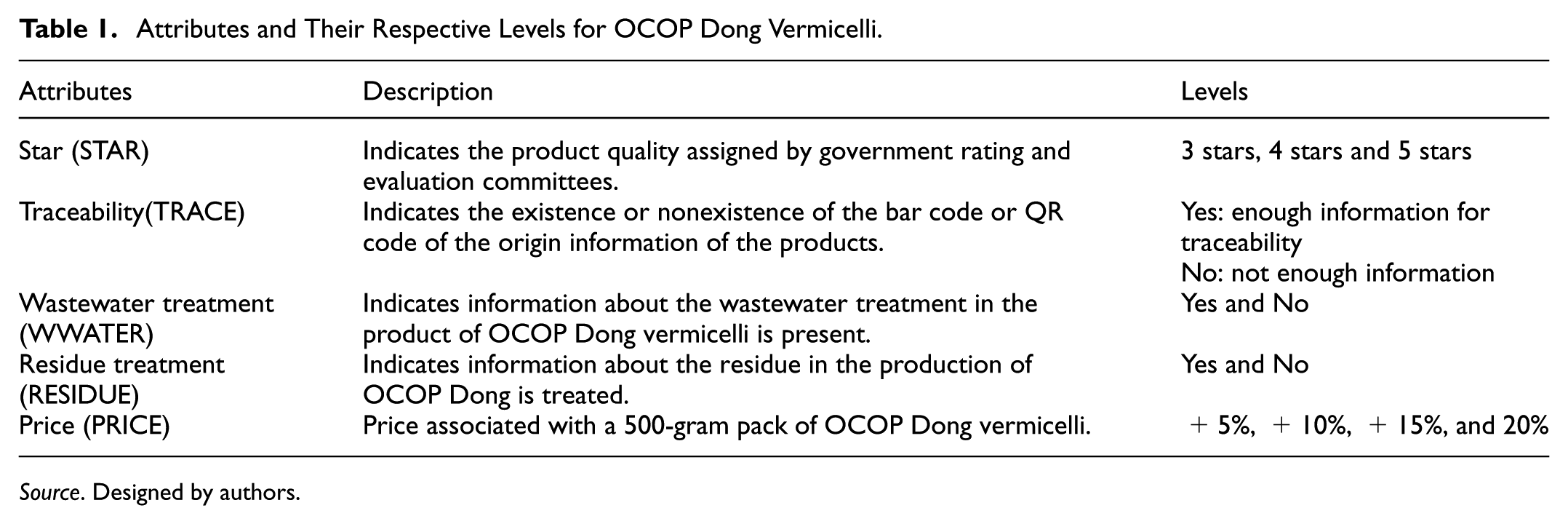
In this study, producers of OCOP Dong vermicelli provided the required traceability information as mandated by local and national authorities. However, from the consumer perspective, this information may or may not be perceived as sufficient. Therefore, the variable TRACE captures consumer perceptions of the sufficiency of traceability information (enough vs. not enough information) (see Table 1 for details).
Attributes and Their Respective Levels for OCOP Dong Vermicelli.
Source. Designed by authors.
Wastewater Treatment
Vermicelli production is highly water-intensive and generates substantial wastewater from the washing, grinding, and starch extraction processes. If left untreated, this water poses environmental risks; however, treatment enables its reuse for irrigation and aligns with CE practices (Fito & Van Hulle, 2021; Silva, 2023). To capture consumer valuation of sustainable practices, wastewater treatment was coded as a binary attribute (yes/no). We expected positive preferences and a higher WTP for products linked to wastewater treatment.
In this study, we posited that consumers are willing to pay a premium for OCOP Dong vermicelli, contingent upon receiving information about wastewater treatment practices. Consequently, the attribute of information about the wastewater treatment of OCOP Dong vermicelli is categorized into two levels: Yes and No. This attribute was coded as WWATER.
Residue Treatment
Arrowroot processing generates fibrous residues, which, if unmanaged, contribute to local pollution. However, residues can be repurposed as compost, livestock feed, or biochar, enhancing resource efficiency and farmer income, while reducing environmental harm (Campos et al., 2020; Kamboj et al., 2024). Despite its potential, the consumer demand for residue treatment remains underexplored. This study includes residue treatment as a binary attribute (yes/no) and hypothesizes that consumers prefer vermicelli associated with residue recycling.
In this study, we posit that consumers are willing to pay a premium for OCOP Dong vermicelli when the residue is treated. The attribute of the information about the residue treatment of OCOP Dong vermicelli has two levels: Yes and No. This attribute was coded as RESIDUE.
Choice Sets Design
We randomly assigned participants to one of the four distinct survey versions. These versions were differentiated according to specific attributes and their corresponding levels, as shown in Table 1.
The attributes from Table 1 are explained as follows:
STAR: government-assigned product quality rating (3, 4, or 5 stars), coded with dummy variables; TRACE: availability of a barcode or QR code providing traceability information; coded 1 = Yes, 0 = No; WWATER: information on wastewater treatment practices; coded 1 = Yes, 0 = No; RESIDUE: information on residue treatment in production; coded 1 = Yes, 0 = No (see Table 1). PRICE: quantifies the premium, expressed as a percentage, that consumers are WTP for a 500 g package of OCOP Dong vermicelli. This variable encompasses four distinct levels: 5%, 10%, 15%, and 20%. The determination of these specific percentage increments was guided by preliminary research indicating a consumer propensity to accept price premiums within the 5% to 20% range above the extant market price for OCOP Dong vermicelli. Moreover, the adoption of percentage-based price levels is predicated on the established theoretical understanding that consumers typically perceive price differentials in relative terms (i.e., percentages) rather than as absolute monetary values (Tait et al., 2019; Tienhaara et al., 2015). This approach is further supported by findings suggesting that percentage-based expressions of price changes hold greater cognitive salience for respondents than absolute figures (Snowball & Willis, 2006; Sy et al., 1997).
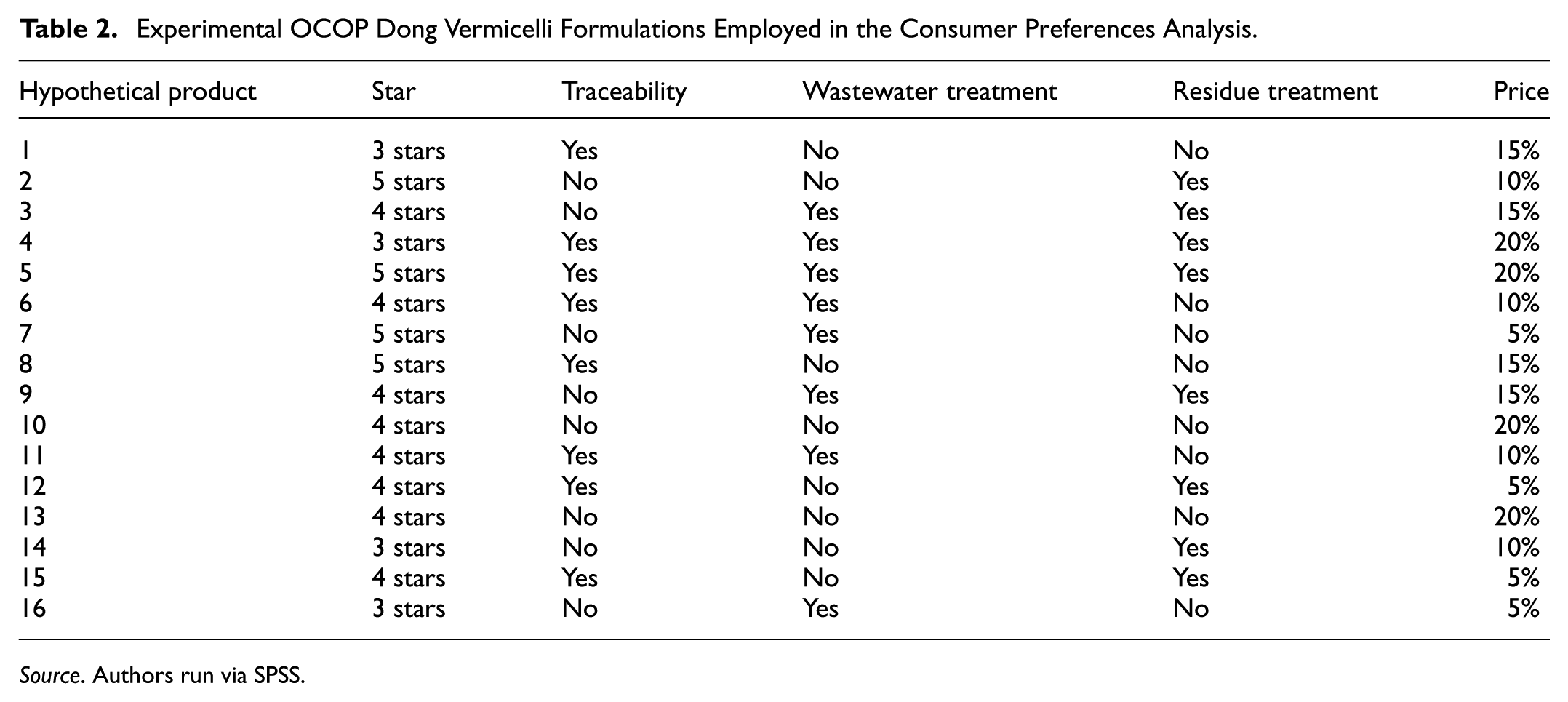
The primary objective of this investigation is to identify the specific product attributes of OCOP Dong vermicelli that hypothetical consumers consider most significant. This study focused on quantifying a utility function using the aforementioned attributes as independent variables. By doing this, the research integrated two attributes, each possessing two levels; two additional attributes, one with two levels and the other with three levels; and a final attribute with four levels. This configuration culminated in a comprehensive factorial design comprising 96 potential combinations (2 × 2 × 2 × 3 × 4). To navigate the intricacies associated with this design, the statistical software SPSS 22 was utilized to execute an orthogonal design methodology, leading to the creation of 16 unique attribute profiles (Addelman, 1972).
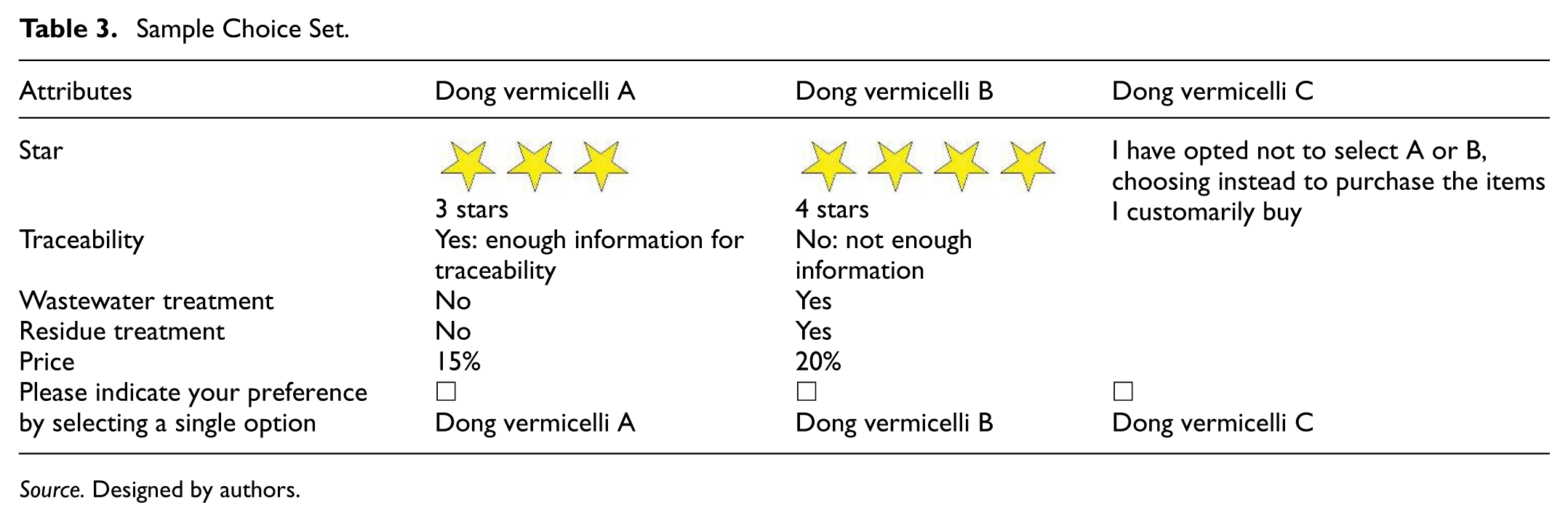
The OCOP Dong vermicelli products, designated explicitly as Products A and B, alongside a benchmark comparator (Product C), were treated as unbranded alternatives in this study. Consequently, to ensure a balanced and orthogonal presentation of attribute levels within the choice experiments, a cyclical or fold-over design methodology was employed. Following this established approach, the level of a designated attribute was systematically incremented by one unit for each subsequent alternative presented within the same choice set (Louviere et al., 2000). The resulting 16 unique choice sets were randomly allocated across four distinct versions of the questionnaire, with each participant tasked with evaluating the four choice sets. In total, 16 hypothetical product profiles were constructed to facilitate the assessment of consumer WTP for the various attributes characterizing the Dong vermicelli product, as detailed in Table 2. Table 3 presents the sample choice set.
Experimental OCOP Dong Vermicelli Formulations Employed in the Consumer Preferences Analysis.
Source. Authors run via SPSS.
Sample Choice Set.
Source. Designed by authors.
Analytical Framework: The Latent Class Model
To analyze consumer preferences and WTP, this study employed the Latent Class Model (LCM), which explicitly accounts for unobserved heterogeneity by assuming that the population consists of a finite number of discrete segments with distinct preference structures (Boxall & Adamowicz, 2002; Greene & Hensher, 2003).
The LCM was selected over alternative discrete choice models for several reasons. In contrast, the Multinomial Logit (MNL) assumes homogeneous preferences across all customers, an unrealistic assumption given the diversity of consumer attitudes toward sustainability and price sensitivity. While the Mixed Logit (MXL) relaxes the homogeneity assumption, it does not explicitly identify discrete consumer segments. The LCM, by contrast, yields clearly interpretable and actionable segments, making it particularly valuable for policy design and marketing strategy (Swait, 1994). These features enable targeted interventions to promote CE-integrated OCOP products, aligning consumer demand with sustainability-oriented certification and rural development objectives.
The LCM is particularly suitable when the research objective is to uncover latent groups (e.g., consumers oriented towards the CE vs. those who are price-sensitive). By jointly estimating class membership probabilities and class-specific utility parameters, the LCM provides a robust statistical framework for preference heterogeneity and actionable insights for targeting consumer segments (Greene & Hensher, 2003). This segmentation capability is especially relevant in the context of CE attributes, where consumers may differ sharply in environmental awareness, trust in certification, and WTP for sustainability practices. By jointly estimating class membership probabilities and class-specific utility parameters, the LCM provides a robust statistical framework for capturing preference heterogeneity while simultaneously linking segment membership to socio-demographic characteristics.
Following Swait (1994), the composite utility function within the latent class model is represented as:

Here,
The probability of a specific consumer (n) belonging to a particular class (k) while choosing alternative (j) can be formulated as follows:

In this equation,
The utility function (3) within this investigation is collectively defined as:

Where: STAR = product quality rating (3, 4, or 5 stars)
TRACE = traceability code (1 = Yes, 0 = No).
WWATER = wastewater treatment information (1 = Yes, 0 = No).
RESIDUE = residue treatment information (1 = Yes, 0 = No).
PRICE signifies the level of financial expenditure that consumers are willing to pay for a 500 g pack of the Dong vermicelli.
To evaluate consumer preference heterogeneity by extending the basic latent class model, this study modeled prior class membership probabilities as a function of respondents’ socio-demographic characteristics.

In this context,
To determine the optimal number of segments, the minimization of the Akaike Information Criterion Version 3 (AIC3) is typically employed following the approach recommended by Louviere et al. (2002) for latent class choice models. The AIC3 is formulated as:

In Equation 7: LL is log-likelihood value of the estimated model, representing the goodness-of-fit; S is number of latent classes (segments) in the model;
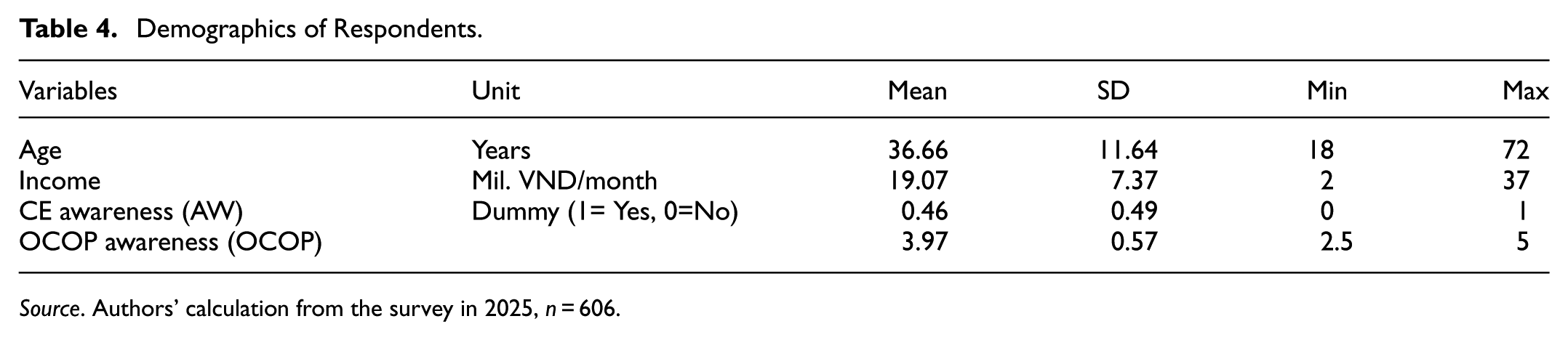
The study was conducted with a final sample of 606 participants, with a mean age of 36.66 years (SD = 11.64) and an average monthly income of 19.07 million VND (SD = 7.37 million). The participants were highly aware of the OCOP products (M = 3.97, SD = 0.57). As indicated in Table 4, 45.7% of the participants in this sample demonstrated awareness of the CE concept.
Demographics of Respondents.
Source. Authors’ calculation from the survey in 2025, n = 606.
The assessment of scale reliability of OCOP awareness, as indicated by Cronbach’s alpha coefficient, obtained a value of 0.762, surpassing the threshold of 0.7, thereby signifying that the scales exhibit a high degree of reliability (George & Mallery, 2019; Hair et al., 2013).
WTP Estimation
Following the estimation of the LCM, the class-specific WTP for each attribute was calculated as the negative ratio of the attribute coefficient to the price coefficient (Hanemann, 1984). This allows for a direct monetary valuation of how much consumers in each identified segment are willing to pay for implementing CE practices and other quality enhancements. The formula used is as follows:

where
Data collected were analyzed using SPSS Version 22.0 and NLOGIT Version 5.0.
Results and Discussions
Results
Latent Class Model Results
To determine the optimal number of latent classes, models ranging from one to five classes were systematically evaluated. Although higher-order structures (comprising three to five classes) were explored, these models failed to converge after multiple iterations with different starting values, or produced solutions with one or more classes containing fewer than 5% of respondents -a threshold commonly regarded as indicative of spurious segmentation rather than substantive heterogeneity (Nylund et al., 2007).
The results presented in Table 5 indicate that the two-class specification provides a superior fit compared to the single-class baseline. Specifically, the two-class model yielded the lowest AIC3 value (4,933.5), thereby optimizing the trade-off between model fit and parsimony. Beyond statistical metrics, the two-class solution offers high interpretability, aligning with established theoretical frameworks of consumer segmentation in credence goods markets. The derived segments, comprising a cohort prioritizing sustainability attributes (wastewater treatment, residue treatment, traceability) and a distinct group driven by price and traditional quality signals (star rating), mirror well-documented typologies in food sustainability literature (i.e., “green” versus “conventional” consumers). Furthermore, the cognitive complexity associated with circular economy attributes likely generates a dichotomy in response patterns, which is more accurately captured by two distinct preference structures than by higher-order class solutions. Consequently, the two-class LCM was selected as the most appropriate framework to characterize preference heterogeneity regarding OCOP Dong vermicelli.
Selection Criteria for the Optimal Latent Class Model.
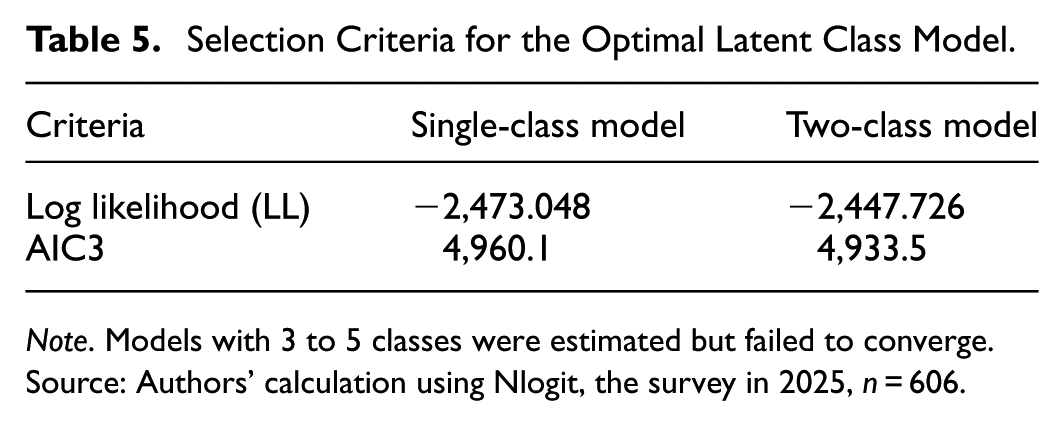
Note. Models with 3 to 5 classes were estimated but failed to converge.
Source: Authors’ calculation using Nlogit, the survey in 2025, n = 606.
The likelihood of consumer segmentation is presented in Table 6. The estimated coefficients suggest that Segment 1 is predominantly comprised of individuals with markedly elevated income levels, heightened awareness of the circular economy, and younger demographics. These individuals favor the products’ water conservation and CE practices, including wastewater treatment and residue management, earning them five stars. We classify these individuals as “OCOP Dong vermicelli Advocates.” Conversely, Segment 2, characterized by antithetical perspectives and heightened price sensitivity, is designated as “OCOP Dong vermicelli Skeptics.” These findings highlight the heterogeneity in consumer preferences regarding income, age, and CE awareness. The probability of consumer segmentation was utilized to ascertain the “market share” attributable to each segment (Boxall, 1999; Khai & Yabe, 2015).
Latent Class Model of OCOP Dong Vermicelli.
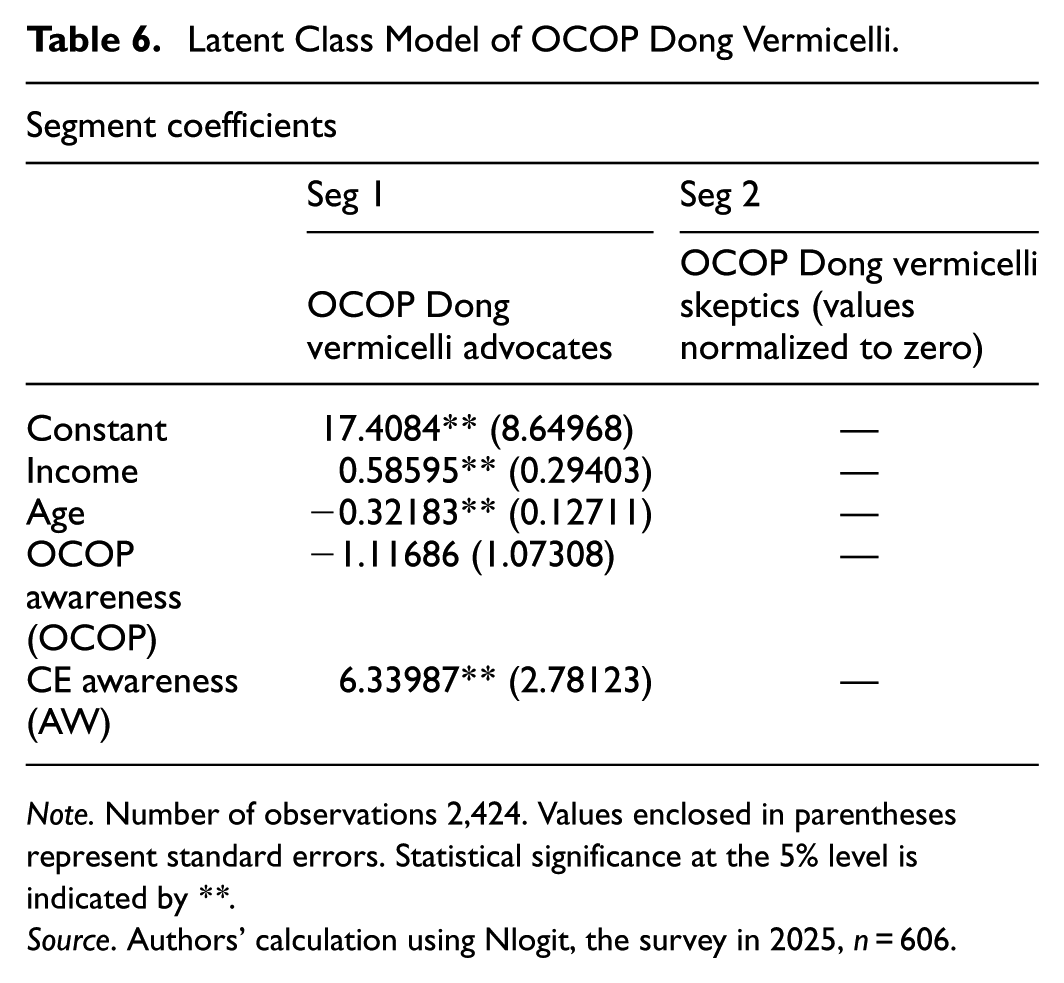
Note. Number of observations 2,424. Values enclosed in parentheses represent standard errors. Statistical significance at the 5% level is indicated by **.
Source. Authors’ calculation using Nlogit, the survey in 2025, n = 606.
Table 7 confirms that price exerts a negative and significant effect on consumer utility in both segments, aligning with the law of demand, whereby higher prices reduce utility and the WTP. This suggests that Dong vermicelli serves as a typical example of a good for Vietnamese consumers. Within this context, “OCOP Dong vermicelli Advocates” exhibit higher WTP for non-price attributes such as sustainability and product quality, whereas “OCOP Dong vermicelli Skeptics” exhibit a lower WTP for these features, reflecting greater price sensitivity.
Utility Functions Coefficients.
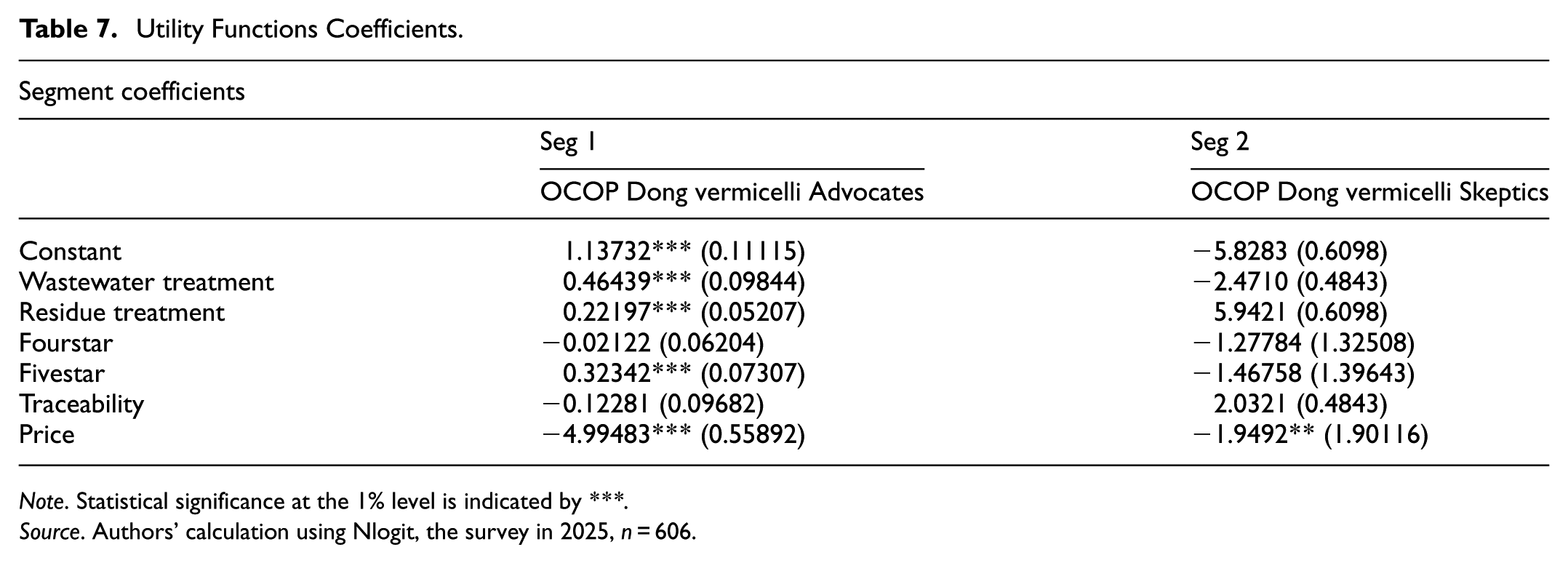
Note. Statistical significance at the 1% level is indicated by ***.
Source. Authors’ calculation using Nlogit, the survey in 2025, n = 606.
Consumers’ WTP Results
The data presented in Table 8 reveal that consumers identified as “Advocates” are willing to pay a 9.3% premium for OCOP Dong vermicelli when it incorporates wastewater treatment processes. This finding suggests increased awareness among consumers of environmental concerns, encompassing practices aligned with the principles of the circular economy. Furthermore, these consumers demonstrated a higher WTP for residue treatment, valued at an additional 4.4%, signifying a preference for products with environmentally sustainable characteristics. An additional WTP of 6.48% was also evident for products with a five-star rating, suggesting a preference for attributes indicative of quality or recognized standards.
Marginal WTP for OCOP Dong Vermicelli’s Segments.
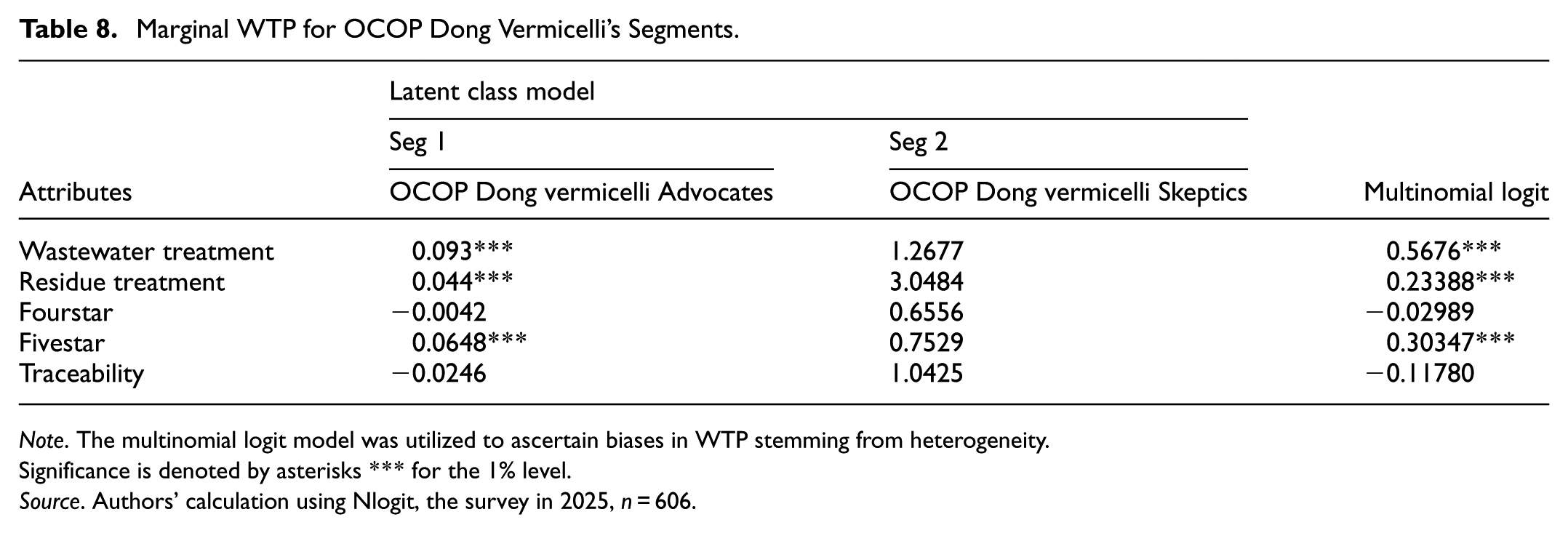
Note. The multinomial logit model was utilized to ascertain biases in WTP stemming from heterogeneity.
Significance is denoted by asterisks *** for the 1% level.
Source. Authors’ calculation using Nlogit, the survey in 2025, n = 606.
Discussions
Preference Heterogeneity and Segmentation
This study explores consumer preferences and WTP for the OCOP Dong vermicelli with CE attributes. The results highlight substantial heterogeneity among Vietnamese consumers, suggesting that demand for OCOP products is far from uniform. Demographic and socio-economic differences, consistent with previous evidence (Hong et al., 2025; Trang et al., 2025; Trang & Tu, 2024), play a significant role in shaping choices. For policy and marketing, this means that “one-size-fits-all” strategies are unlikely to succeed. Instead, more tailored approaches are needed to target distinct consumer groups. By demonstrating how heterogeneity interacts with CE attributes, this study provides evidence for designing inclusive and segmented strategies for rural development.
Wastewater Treatment Attribute
Among the CE attributes, wastewater treatment has emerged as particularly valued, with consumers willing to pay a premium of 9.3%. This finding supports prior studies linking wastewater treatment to positive environmental perceptions (Jiao et al., 2024; Munusami et al., 2017; Paola et al., 2018), but contrasts with research showing aversion to the use of recycled water in food (B. Chen et al., 2023; Menegaki et al., 2009). The difference lies in framing: consumers appear more receptive when wastewater treatment is presented as part of responsible production rather than as direct input into consumption. Importantly, income and CE awareness were found to moderate WTP, indicating that outreach campaigns could emphasize environmental stewardship to build support. For policymakers, this suggests that subsidies or certifications tied to wastewater treatment could enhance environmental outcomes and strengthen consumer trust.
Residue Treatment Attribute
Consumers also expressed a WTP a 4.4% premium for residue treatment, reinforcing findings from prior work on recycling and waste treatment (Boyer et al., 2021; Hellali et al., 2023; Pretner et al., 2021; Villanueva et al., 2025). In addition to its environmental benefits, residue management is perceived as a farmer-friendly practice that converts waste into value. This tangibility may explain why consumers reward it as it connects abstract CE principles with visible production improvements. This finding suggests that residue treatment could serve as a focal point for communication, demonstrating both producer responsibility and resource efficiency. Integrating residue treatment into OCOP training programs can support farmers in adopting circular practices that resonate with consumers.
OCOP Star Rating
Consumers were willing to pay 6.48% more for products rated five stars than for those rated four stars, echoing earlier research linking certification to trust and premium pricing (Enneking, 2004; Maesano et al., 2020; Morone et al., 2021; Sriwaranun et al., 2015). Unlike CE attributes, star rating is an immediately visible and government-backed signal, giving consumers confidence in product quality. This highlights the strategic importance of strengthening the credibility of OCOP star systems. More transparent communication of what each star level represents, coupled with strict enforcement of standards, could enhance the value of certification and reinforce the OCOP’s branding in both domestic and export markets.
Traceability Attribute
By contrast, traceability did not generate significant additional WTP. This finding diverges from studies that have identified consumer demand for traceability in food systems (Trang et al., 2025). A possible explanation is that Vietnamese consumers may already assume that OCOP products are trustworthy because of government endorsement, making traceability redundant. Alternatively, visible attributes such as star ratings may crowd out the informational value of the traceability. For marketing purposes, this suggests that investments in traceability technologies may yield limited consumer returns unless they are bundled with other signals. From a policy perspective, the result highlights the contextual nature of consumer trust, while traceability may be critical in export markets or for high-risk products. In local OCOP contexts, more salient attributes, such as certification and environmental practices, should take priority.
Policy Implications
This study shows that Vietnamese consumers are willing to pay premiums for OCOP Dong vermicelli when they incorporate CE attributes such as wastewater treatment and residue management, and achieve a five-star rating under the OCOP program. These findings have several implications for producers, policymakers, and stakeholders.
First, for producers and farmers, the findings suggest that sustainability attributes are not abstract ideals, but marketable qualities that consumers actively recognize and reward. Small investments in low-cost wastewater treatment systems (e.g., settling tanks for water recycling) and the valorization of arrowroot residues into compost, biochar, or livestock feed could simultaneously reduce environmental harm, improve resource efficiency, and create supplementary income streams. However, many small-scale producers face financial and technical constraints, which limit their adoption. Cooperative investment models, shared processing facilities, and access to concessional credit schemes could help to lower these barriers. More broadly, these practices may be transferable to other OCOP and traditional products that face similar environmental pressures. Embedding CE principles into such production systems would contribute to the sustainable development goals related to clean water, responsible consumption, and decent work, aligning local innovation with global sustainability agendas.
Second, for policymakers, the results highlight the importance of enabling frameworks that reward sustainable practices. Fiscal incentives, such as targeted subsidies, concessional loans, and tax reductions, could facilitate the adoption of wastewater treatment and residue management technologies among smallholders. Policymakers might also consider establishing a national standard for sustainable OCOP products and introducing a voluntary “OCOP-Green” or “OCOP-Circular” supplementary label, awarded to producers meeting verifiable criteria for water conservation and waste valorization. Developing clear science-based standards for what constitutes “treated wastewater” or “repurposed residue” would help prevent greenwashing and strengthen consumer confidence. Complementary public awareness campaigns could further educate consumers about the meaning and benefits of sustainability labels, stimulate demand, and reinforce market incentives for certified products. Embedding such measures into rural development programs would not only support Dong vermicelli producers but also create a replicable model for other regions, aligning Vietnam’s rural development strategies with global sustainability commitments.
Third, for marketing and market positioning, the findings indicate that quality assurance and environmental stewardship can be emphasized jointly. Combining five-star OCOP certification with demonstrable CE practices may enable producers to access higher-value domestic and export segments. Producer associations and cooperatives may enhance visibility through certification logos, eco-labels, or QR code traceability systems that connect consumers to authentic production narratives. Digital storytelling, social media engagement, and e-commerce platforms offer particularly promising avenues to reach younger, urban, and higher-income consumers, who often exhibit stronger preferences for sustainability-oriented products.
Finally, beyond Dong vermicelli, these insights point to broader opportunities for scaling. The integration of traditional products with certified CE practices could be extended to other OCOP sectors that face environmental challenges, such as specialty tea (water use), fruit processing (residues), or aquaculture (wastewater). This approach provides a replicable model for developing countries seeking to leverage cultural heritage to create high-value, sustainable products. By co-branding products based on both cultural authenticity and verified environmental stewardship, regions may establish a distinctive market niche that links rural livelihoods with sustainable production and responsible consumption.
Taken together, these policy directions suggest that advancing sustainability within the OCOP framework requires coordinated action among producers, policymakers, and markets. Strengthening synergies among certification, circular-economy practices, and consumer demand could transform traditional local products into drivers of inclusive and environmentally responsible rural development. By aligning incentives, information, and institutional support, Vietnam and similar developing economies may foster a new generation of heritage-based industries in which cultural preservation, environmental stewardship, and market competitiveness reinforce one another.
Limitations and Future Research
Although this study yields valuable insights into consumer preferences and WTP for the OCOP Dong vermicelli, it is crucial to acknowledge certain inherent limitations. First, the dataset was conveniently collected from specific marketplaces in Hanoi. Consequently, the findings may not fully capture the spectrum of consumer preferences across diverse geographical regions or socioeconomic segments in Vietnam. This constraint inherently diminishes the applicability of the findings on the national scale. Additionally, the possibility of social desirability bias cannot be ruled out, as some respondents may have provided answers that they perceived as more socially or environmentally appropriate rather than expressing their valid preferences. Second, the environmental ramifications and implications of the CE were evaluated predominantly through qualitative insights and secondary data, rather than through direct quantification of the environmental impacts or resource utilization efficiencies associated with vermicelli production. Subsequent research endeavors should integrate life cycle assessments and empirical analyses of water consumption and waste management practices to fortify the environmental dimensions of the inquiry. Lastly, the analysis focused on a single OCOP product, which may limit the broader applicability of the findings to other OCOP-certified or traditional food commodities. Extensive comparative investigations encompassing multiple OCOP products and diverse regions would significantly contribute to validating and enhancing these findings.
Footnotes

Ethical Considerations
This study was conducted in strict adherence to the ethical guidelines established by the Vietnam National Foundation for Science and Technology Development (NAFOSTED) and Thai Nguyen University of Economics and Business Administration. The research protocol was formally reviewed and approved by the Ethics Review Board (ERB) of Thai Nguyen University of Economics and Business Administration.
Consent to Participate
Informed consent was obtained from all participants prior to their inclusion in the study. Each participant was provided with a comprehensive consent form that detailed the following: an introduction to the study and its objectives, a guarantee of confidentiality, confirmation of the voluntary nature of their participation, and their right to withdraw at any time without consequence. The form also included contact information for the research team and a statement of consent.
Funding
The authors disclosed receipt of the following financial support for the research, authorship, and/or publication of this article: This research is funded by the Vietnam National Foundation for Science and Technology Development (NAFOSTED) under grant number 502.01-2021.24.
Declaration of Conflicting Interests
The authors declared no potential conflicts of interest with respect to the research, authorship, and/or publication of this article.
Data Availability Statement
The data and materials supporting this study’s findings are available from the corresponding author, Tran Thi Tuyet, upon reasonable request.