






Abstract
Despite the presence of several national and international strategic plans, the world continues to face the severe consequences of climate change. A major barrier to effective environmental policy performance is the lack of pro-environmental behavior and the presence of organizational silence within institutions. This study, in alignment with Sustainable Development Goal (SDG) 13 (climate action), examines the role of institutional pressure in fostering pro-environmental behavior and, consequently, improving environmental performance. Furthermore, the study examines how organizational silence impacts the development of pro-environmental behavior and its subsequent impact on environmental policy performance. An established questionnaire was utilized to collect data from 324 public managers at the National Energy Efficiency and Conservation Authority and the Ministry of Climate Change of Pakistan. This closely aligns with SDG 7 (affordable and clean energy). The analysis was conducted using Structural Equation Modeling (SEM). The results show that institutional pressure has a positive impact on pro-environmental behavior (β = .45, p < .001), which also enhances environmental performance (β = .38, p < .001). It has a positive influence on pro-environmental behavior, which mediates between institutional pressure and environmental performance (β = .298, p = 0). Furthermore, organizational silence has adverse moderation effects on institutional pressure and pro-environmental behavior (β = −.042, p = .041). These findings provide practical insights for policymakers and institutions working to bolster climate resilience, strengthen policy execution, and support global sustainability initiatives by aligning with important SDGs.
Plain Language Summary
This study looks at how the actions and influence of board members affect the way public organizations care for the environment. We found that when board members actively support environmental issues, employees are more likely to adopt eco-friendly behaviors. These behaviors, in turn, help improve the organization’s overall environmental performance. However, when employees remain silent about problems or new ideas, the positive influence of board members is weakened. Our analysis of survey responses from 324 public managers, using advanced statistical techniques, shows a clear link between governance and environmental behavior. The findings provide useful insights for building sustainable governance strategies that support climate resilience and align with the United Nations’ Sustainable Development Goals (SDGs).
Keywords
Introduction
Climate change and the effectiveness of environmental policies have become pressing global concerns for both organizations and institutions. (Mechler et al., 2020). The World Meteorological Organization reports that the last decade has been the warmest on record, and global temperatures continue to rise at an alarming rate. (Xu, 2024). The United Nations has consistently identified Pakistan as one of the most vulnerable countries to climate change and environmental degradation. In light of these challenges, scholars have devoted increasing attention to the organizational and behavioral factors that shape sustainability practices (Hurlimann et al., 2021). This emphasis is paramount in developing countries, where acute climate change pressures exist, while environmental policies are playing catch-up with stated commitments (Wright et al., 2023). Despite the availability of multiple national and international frameworks, the adoption of such frameworks has been lethargic, leading to gaps between policy design and policy outcomes (Hurlimann et al., 2021). Resultantly, the performance of environmental policies has often fallen short of expectations.
Studies on public organizations indicate that elected officials and institutional frameworks significantly affect both employee and organizational performance (Schwarz et al., 2020). Institutional pressures, whether rooted in political mandates, professional standards, or community expectations, often act as drivers that steer organizations toward more sustainable practices (Colwell & Joshi, 2013). The pressures from regulatory bodies (elected members) often lead to more effective environmental initiatives (Marrucci et al., 2023). Stakeholder pressure is an influence that can affect the activities of an organization in all its processes of value creation and vice versa (Singh et al., 2022). Some of the stakeholders that exert pressures on an organization include customers, media, community members, shareholders, business partners, social groups, and NGOs (Blay et al., 2025). The pressure that is generated by the elected board members has formal authority to control, to appraise, and give directions. In contrast to the general stakeholder pressure (e.g., NGOs, citizens, or market actors), elected board members are internal governance actors whose authority is statutory. Despite the extensive research conducted on stakeholder expectations, the precise function of elected boards and regulatory bodies, particularly in developing nations, has received less attention. The attainment of international climate change objectives is ultimately dependent on the activities of public institutions and the behaviors of those operating inside them. Among these dynamics, two factors stand out, which are: pro-environmental behavior and organizational silence (Gencer et al., 2023; Zhang et al., 2023). This study, therefore, explores how these elements interact with institutional pressures to shape environmental policy performance in public organizations.
Pro-environmental behavior (PEB) is central to sustainability and includes practices such as reducing energy consumption, recycling, and embedding sustainability in daily work routines (Kollmuss & Agyeman, 2002; Shah et al., 2023). Leadership is critical in promoting such behavior, particularly through the encouragement of innovative practices and organizational citizenship behaviors aligned with environmental responsibility (Kyeong, 2025). Yet, fostering a culture of environmental responsibility remains a persistent challenge in many public institutions, especially in developing countries (Wang et al., 2021). The problem of organizational silence, in which workers decide not to voice their opinions, concerns, or creative ideas, is equally significant. Silence hinders environmental innovation and the institutions’ ability to act (Sahabuddin et al., 2023). In rigid hierarchical structures or punitive systems, employees may be reluctant to voice sustainable solutions, thereby weakening the impact of institutional actions on outcomes (Razmjooei et al., 2018). In such contexts, even strong institutional pressures may fail to translate into meaningful environmental performance.
These dynamics point to the importance of examining how institutional pressures, pro-environmental behavior, and organizational silence collectively shape the performance of environmental policies. Although institutional pressure and pro-environmental behavior have been studied in various contexts. However, there exists a population gap, where the examination of these relationships is limited in the context of Pakistan’s public sector, particularly when moderated by organizational silence. Accordingly, this study seeks to answer the following research questions. How does institutional pressure shape pro-environmental behavior among public sector managers? How pro-environmental behavior enhances environmental performance within public organizations? How organizational silence conditions or moderates the relationship between institutional pressure and pro-environmental behavior? Does pro-environmental behavior function as a mediating mechanism between institutional pressure and environmental performance?
In line with these questions, this study’s primary focus is on the effects of institutional pressures and behavior patterns on environmental policy output in public sector institutions. By addressing this gap, the study contributes to theory and practice by clarifying how institutional and behavioral dynamics shape environmental policy outcomes in the public sector, while advancing the United Nations’ Sustainable Development Goal 13 (Climate Action). This research study was organized in the following ways. Section two describes the literature review, theoretical foundation, and hypothesis development. In section three, the data gathering procedure and the methodology are elucidated. In section four, the empirical analysis, findings, results, and discussion are presented. The conclusion is made in the last section.
Literature Review and Theoretical Framework
Problems of accountability in public management are often studied under the lens of Principal-Agent (Agency) theory and the stewardship theory (Rajala & Jalonen, 2025). The agency theory is one of the earliest and widely tested theories in management, economics, and administration studies, mapping challenges that arise when political leaders and managers differ in terms of authority and accountability. The governance frameworks are usually created to minimize the institutional losses in the wake of such differences while ensuring consistency in the behaviors of both managers and elected officials (Panda & Leepsa, 2017). Applying this perspective to environmental and climate policy, it suggests that political leaders and oversight organizations may apply institutional pressure on managers, especially following policy failures. Such pressure influences managers to change their behavior, thereby enhancing the likelihood of effective performance of the policies.
The agency theory alone provides an incomplete perspective in this context; it is more likely to define managerial decision-making through the prism of adhering to hierarchical control and oversight. Institutional theory completes the analytical prism as it includes factors that impact managers’ reasoning and responses to environmental demands. Institutional theory highlights the fact that organizational behavior is not merely a product of formal relations of accountability but also of normative, cognitive, and cultural pressure in organizations (David et al., 2019). Organizations pursue legitimacy by conforming to socially accepted standards and practices, which helps explain why managers may adopt pro-environmental behaviors even in the absence of direct monitoring or enforcement (Phan & Baird, 2015). However, institutional pressures are heterogeneous, differing across organizational contexts, assessment practices, and cultural environments, which in turn affect how pro-environmental behaviors are internalized and enacted (Macris et al., 2025). In order to enhance the theoretical basis of the pro-environmental behavior (PEB), Stern’s (2000) Theory of Environmentally Significant Behavior (ESB) is included in the research, and it is considered to be one of the most comprehensive theories explaining the reasons why people adopt behaviors that lead to environmental protection. According to ESB, the framework of individual norms, values, consciousness of actions, and moral obligations results in environmentally responsible actions. The psychological reasons are then translated into behaviors that have significant effect on the environmental outcomes (Stern, 2000).
In Pakistan’s governance context, institutional pressure in the domain of climate and energy policy is transmitted through different mechanisms. The Ministry of Climate Change (MoCC), operating under the federal government, issues top–down ministerial directives, regulatory frameworks, and policy guidelines that cascade to subordinate agencies such as the National Energy Efficiency and Conservation Authority (NEECA). NEECA, established under the National Energy Efficiency and Conservation Act of 2016, functions as a federal regulatory authority tasked with designing, implementing, and monitoring energy efficiency and conservation measures, while remaining under the oversight of MoCC and relevant parliamentary committees. In turn, the pressure of institutions on the public managers is put in the form of the hearings of parliamentary oversight, ministerial directives, the enforcement of regulations, and performance monitoring systems. The institutional pressures are of various types. Some are coercive, where strict adherence to legal requirements and reporting standards is mandatory, and some are normative, which is the necessity to comply with more global commitments stipulated in the National Climate Change Policy 2021 and the international environmental agreements of Pakistan. The institutional pressure in this study is a mixture of ministerial, parliamentary, and regulatory control, which, when put together, can encourage managers to perform pro-environmental actions and enhance the environmental performance of the organization.
A difference between these two views reveals that agency theory focuses on accountability-based solutions where political actors aim to chastise managers, whereas institutional theory focuses on the socially embedded norms that regulate organizational practices. Combined, the two frameworks imply that institutional pressure, particularly when instigated by failures of environmental policy performance, can be a strong impetus to encouraging pro-environmental actions by public managers. These behaviors, as they are integrated into the organizational environments, are likely to lead to better environmental performance. Even though the Stakeholder Theory and the Resource Dependence Theory are applicable to the research of governance, they would not be the most appropriate in this context. The approaches of Stakeholder Theory and Resource Dependence Theory are based on the exterior power and the power of resource dependency, respectively, whereas the current study is concerned with the internal governance pressure among the elected board members. The Agency Theory describes the influence of board oversight on the compliance of managers to environmental policies, and the Institutional Theory describes the influence of governance norms and expectations on the pro-environmental behavior and environmental performance. The combination of these theories makes them coherent and contextually suitable as the background of the model of the study.
The Association of Institutional Pressure and Pro-Environmental Behavior
Pro-environmental behavior (PEB) includes behaviors that seek to reduce the adverse effects of an individual or an organization on the environment through enhancing sustainability (Kollmuss & Agyeman, 2002). These include minimizing waste, composting, energy saving, use of transit patterns, and adopting eco-friendly products (Liu et al., 2017; Lu et al., 2019). Since the 1970s, the concept has been studied extensively in the field of environmental psychology; however, the PEB in the public sector, including its interplay with organizational citizenship behavior, is limited and not well developed (Ingrams, 2020). Recent research points to the contribution of organizational results of PEB of employees, when incorporated into larger pledges of organizational social responsibility (Hongxin et al., 2022; Yue et al., 2022). Since managerial actions and behaviors can encourage employee behavioral participation that motivates people to work in a performance-oriented manner, leadership is also an essential component. Nonetheless, regardless of such a growing body of work, there is still no consensus on the most important antecedents that are always effective in PEB (Kollmuss & Agyeman, 2002). This emphasizes how crucial it is to investigate how institutional factors shape PEB in public sector organizations. In this study, the various forms of PEB measured were applied such as PEB Conservation and PEB Food and Transportation, to achieve conceptual consistency between the literature review and the measurement part (Markle, 2013).
Institutional pressure is the external pressure created by regulatory bodies, political powers, professional bodies, and other societal stakeholders that help push the organizations to practice or behave in a certain manner (Colwell & Joshi, 2013). The institutional pressure is defined as the externalities that organizations feel due to their institutional environment, which forces them to live up to set norms, rules, and expectations (P. J. DiMaggio & Powell, 1983; Scott, 1995). These pressures influence the structures and behaviors in an organization by forcing entities to embrace practices that are deemed to be legitimate, acceptable or even necessary within the operating environment. Such pressures are acting as a strong force in organizations, and they influence the decision-making process and create conformity in various sectors. (Beckert, 2010). They may arise out of legal and political regulations, professional standards, or the more general expectations of the community, and in many cases, they propel organizations toward even more environmentally responsible practices (Bansal & Roth, 2017; Colwell & Joshi, 2013). Although most researchers consider institutional pressure as a driver to proactive environmental action (M. Delmas & Toffel, 2004; Schaefer, 2007), others warn that it can also result in only symbolic responses with superficial compliance instead of changes (M. A. Delmas, 2002). This highlights that the effects of institutional pressure are determined by how organizations understand and internalize the expectations given to them.
Stakeholder pressure is pressure from stakeholders, or parties who may influence or be impacted by a firm’s operations, is regarded as an important motivator for enterprises to safeguard the natural environment from the detrimental effects of their activities (Nguyen & Adomako, 2022). Besides the generic regulatory and stakeholder pressure that is usually debated in institutional theory, this research is based on a narrower element of internal governance pressure, which is the institutional pressure by the board. In contrast to external regulatory pressure, which arises because of national legislature or policy requirements, or stakeholder pressure, which arises because of the expectation on one side or the other of the society, market, or community, board-driven pressure is caused by elected board members who have formal oversight authority in the organization. These board members in the case of the National Energy Efficiency and Conservation Authority (NEECA) and the Ministry of Climate Change have a direct role in ensuring that organizations adhere to environmental and climate policy requirements, strategic performance, and alignment to national climate priorities.
Recent researches have also pointed out that there are also larger dynamics of social perception that inform environmental and climate-related behaviors that are external to formal institutions. To illustrate, Song (2023) established that perception gaps between the experts and the population play a significant role in climate-technology acceptance, and that policy trust, perception of the climate-risks, and perceived social influence are critical predictors of climate-technology adoption (Song et al., 2024). Despite the fact that the institutional pressure is the subject of our study in the context of the public organizations, the consideration of this wider literature of societal acceptance makes the theoretical connection stronger, as it demonstrates how individual perceptions and trust also drive the pro-environmental behavior. This offers further grounds on the analysis of the behavioral reactions to institutional pressures in the context of the public-sector.
Academically, agency theory views Institutional Pressure (IP) as a form of examination and sentence, whereby principals monitor agents for adherence and performance. In that sense, agency theory views institutional pressure as a form of checking and punishment (David et al., 2019; Panda & Leepsa, 2017). On the other hand, institutional theory argues that organizations react to coercive and normative expectations to attain legitimacy within their institutional surroundings. Together, these two viewpoints provide a more comprehensive understanding of the practice of IP. In Pakistan, such pressures materialize through parliamentary oversight, ministerial directives, and regulatory enforcement mechanisms administered by the Ministry of Climate Change (MoCC) and the National Energy Efficiency and Conservation Authority (NEECA), particularly under the NEECA Act (2016) and the National Climate Change Policy (2021).
Building on institutional theory, this study argues that institutional influences are central to shaping PEB among public managers. Unlike much prior research focused on private-sector compliance, the present study examines how public institutions respond to external pressures in contexts where environmental policy performance is weak. In this sense, institutional pressure is viewed not only as a constraint but also as a potential catalyst for authentic behavioral change that advances environmental performance. Consistent with the United Nations’ Sustainable Development Goals (SDGs), particularly SDG 13 (Climate Action) and SDG 7 (Affordable and Clean Energy), institutional accountability is expected to stimulate organizational adoption of PEB.
The Association of Pro-Environmental Behavior and Environmental Performance
Environmental performance refers to how organizational activities affect the natural environment, encompassing human, ecological, terrestrial, and aquatic systems (Phan & Baird, 2015). Measuring and monitoring performance requires indicators that capture environmental impacts, which are increasingly important to diverse stakeholders, including regulators, investors, employees, and the wider public (Barbera et al., 2025; Ilinitch et al., 1998). Governments, professional bodies, and private enterprises have developed various metrics to evaluate performance (Phan & Baird, 2015). At the organizational level, environmental performance depends not only on governance structures and executive commitment but also on the ecological awareness and competencies of employees to effectively implement the policies (Dubey et al., 2017; Guerci et al., 2016). Organizational practices for developing sustainability skills, the motivation of employees is thus a driver to leverage environmental performance and enhance competitiveness (Famiyeh et al., 2018; Nejati et al., 2017).
In this context, pro-environmental behavior (PEB) emerges as a determinant behind organizational environmental performance. From an agency theory point of view, ensuring that the behavior not only of managerial but also of subordinate employees is in keeping with institutional goals is important if the intended outcomes are to be achieved. The argument that PEB both improves sustainability performance and positively affects management quality and employees’ satisfaction is supported by empirical studies (Mouro & Duarte, 2021). Actions such as energy conservation, recycling, and incorporating environmentally friendly practices in day-to-day activities aid in transitioning sustainability statements into results. Nevertheless, the association between these two variables varies in different studies of the literature. While some research shows that PEB can actually help sustain organizational sustainability, others have cautioned that individual-level efforts can be fragmented or not effective when institutional accountability mechanisms are embedded in the organization. In the public sector, these tensions are especially striking because environmental performance is much more directly linked to policy implementation than market incentives. Public organizations’ political and environmental goals depend heavily on institutional pressures, governance processes, and behavior alignment.
This study highlights its dual significance: both as an individual commitment and as a driver of systemic policy performance by positioning PEB as the behavioral channel through which institutional pressures influence environmental outcomes, Furthermore, situating this relationship within the framework of the Sustainable Development Goals, specifically SDG 13 (Climate Action) and SDG 7 (Affordable and Clean Energy), underscores the global relevance of fostering PEB in public organizations. PEB is the behavioral channel through which institutional demands are converted into outcomes. Agency theory highlights alignment of agent behavior with principal goals, while institutional theory stresses conformity to sustainability norms. Together, they suggest that managers’ eco-friendly practices, such as resource efficiency and green innovation, translate institutional directives into improved environmental performance (EP).
The Association of Institutional Pressure and Environmental Performance
Institutional theory explains how organizational practices are shaped by psychological, cultural, and regulatory constraints, leading organizations to converge toward particular behaviors (Teo et al., 2003). Within this framework, institutional pressures, whether coercive, normative, or mimetic, play a pivotal role in driving organizations to adopt sustainability-oriented practices. Prior studies consistently demonstrate that external expectations can enhance environmental performance. For instance, studies in the manufacturing sector indicate that regulatory and normative pressures encourage the adoption of greener production processes, thereby enhancing organizational sustainability outcomes (Habib et al., 2022). Evidence from supply chain management further shows that institutional demands reinforce the effectiveness of sustainability initiatives (Shahzad et al., 2022). Within the public sector, regulatory oversight and external scrutiny have been associated with improved transparency and more rigorous reporting of environmental performance (Tang et al., 2022).
However, the magnitude and nature of institutional influence vary considerably across sectors. In the private sector, organizations often respond to institutional pressures by pursuing market-oriented innovations that align with profit motives. By contrast, public institutions face more complex dynamics shaped by accountability requirements, legitimacy concerns, and compliance with policy mandates. This divergence suggests that institutional pressure does not exert a uniform effect on environmental outcomes; rather, its impact depends on how sector-specific governance structures and organizational behaviors mediate and interpret these pressures. Building on this perspective, the present study conceptualizes institutional pressure not merely as an external constraint but also as a potential catalyst for fostering pro-environmental behavior within public organizations. By shaping managerial priorities and organizational routines, institutional demands can encourage the integration of sustainability considerations into decision-making and everyday practices, thereby indirectly enhancing environmental performance. This view adds value to understanding institutional influence, linking it to behavioral practices that translate policy-induced pressures into tangible environmental outcomes. Institutional pressure can directly compel compliance with environmental standards, but its impact is most effective when mediated by PEB. Agency theory predicts performance gains from oversight, while institutional theory warns against symbolic compliance without behavioral change. Thus, IP is expected to influence EP both directly and through its effect on PEB.
Pro-Environmental Behavior Mediates Between Institutional Pressure and Environmental Performance
Agency theory suggests that institutional actors shape employee behavior to achieve organizational performance outcomes (Naz et al., 2022). Prior studies have documented the direct effects of institutional pressure on organizational practices (M. A. Delmas, 2002; Mitnick, 2015). Therefore, little is understood about how this kind of pressure results in better environmental performance, especially in government departments. This weakness highlights the need to examine pro-environmental behavior as a mediation process. In public-sector work, this is often a motivational intervention that motivates employees to perform environmentally friendly practices that not only ensure legitimacy but also reduce penalties. This, pro-environmental behavior, which is in fact the behavioral channel through which institutional demands are enforced at the organizational level, is viewed as a type of pro-environmental behavior.
As evidence suggests, PEB is not simply compliance that carries organizational learning, innovation, or performance improvement (Mouro & Duarte, 2021). With an analysis of PEB as the mechanism linking institutional pressure to environmental outcomes, this study aims to bring together agency and institutional theories. It positions employees’ environmentally responsible behavior as a behavioral bridge that makes external demands into measured improvements in environmental performance. Agency theory explains how rules incentivize compliance, and institutional theory shows how norms promote legitimacy; both converge on PEB as the mechanism that enacts external demands. PEB therefore mediates the IP and EP link, translating pressure into tangible environmental gains.
Even though the institutional pressure may provoke a pro-environmental behavior, recent research points out that the pressure cannot necessarily be reflected in the actual behavior because of mental and social limitations. Lee and Song (2024) highlight the importance of the fact that weak behavioral responses to climate initiatives can be supported by low perceived trust, fairness, or procedural legitimacy among employees. These observations substantiate our thesis that institutional pressure on its own might not be enough unless a work environment where voice and participation is allowed or facilitated. Based on this, pro-environmental behavior plays a mediating role in which institutional expectations are internalized. Finally, this perspective also advances the broader sustainability discourse by illustrating how public institutions can operationalize in alignment with the United Nations Sustainable Development Goals, with particular emphasis on Goal 13, which focuses on Climate Action. The argument here is clear: institutional pressure alone is insufficient unless it is complemented by the active behavioral engagement of managers and employees.
Organization Silence Moderate Between Institutional Pressure and Pro-Environmental Behavior
Organizational silence is defined as the collective phenomenon in which employees deliberately withhold opinions, concerns, or suggestions regarding organizational practices (Pinder & Harlos, 2001). Silence is sometimes thought of as a passive lack of speech, but it can also mean protective withdrawal, implicit agreement, or subtly opposing something (Tangirala & Ramanujam, 2008). In public organizations, where employee input plays a critical role in policy implementation and service delivery, silence can be especially consequential. Empirical research highlights that a culture of silence undermines organizational learning, innovation, and adaptability, thereby constraining the achievement of institutional goals (Brinsfield & Edwards, 2020; Nikaeen & Bagheri, 2012). Despite this recognition, little attention has been given to how silence may condition the effectiveness of institutional pressures. Institutional theory emphasizes the role of external forces in shaping organizational practices, yet it does not sufficiently address how internal communication climates can obstruct or amplify these forces (Kim & Cho, 2024). A high level of organizational silence may weaken the ability of institutional mandates to influence pro-environmental behavior, as managers and employees may be reluctant to share ideas or take initiative in sustainability practices. Conversely, an open communication climate allows external pressures to translate more effectively into behavioral change.
This study positions organizational silence as a negative moderator in the relationship between institutional pressure and pro-environmental behavior by building on these insights. By integrating this perspective, the analysis extends institutional theory to highlight how internal dynamics, specifically the suppression of voice, can hinder the behavioral mechanisms through which external demands foster environmental performance. Beyond theoretical contribution, this framework emphasizes the practical importance of cultivating transparent communication cultures within public institutions to advance climate action (SDG 13) and energy transition goals (SDG 7). Organizational silence (OS), the withholding of voice or feedback, weakens the translation of external pressure into behavior (Pinder & Harlos, 2001; Tangirala & Ramanujam, 2008). In high-silence climates, managers may comply superficially but fail to adopt meaningful PEB. In open climates, mandates more effectively foster authentic behavioral change. OS thus moderates the IP and PEB relationship.
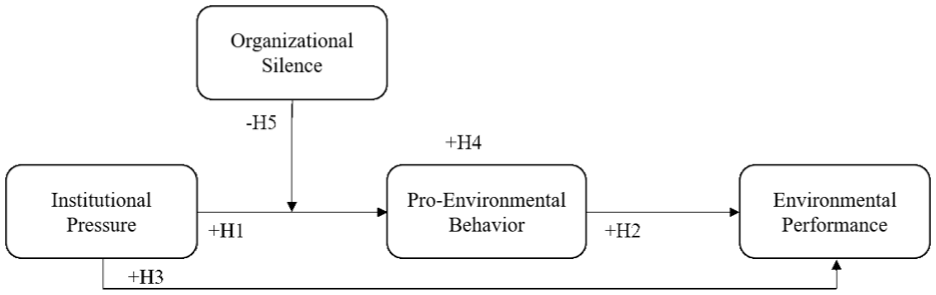
Theoretical model of the study.
Methodology
Data Collection
This research aims to strengthen the environmental and climate change policy performance. Therefore, data were collected from public managers who directly implement environmental policy on behalf of public officials, with purposive sampling. The purposive sampling allowed us to select content-rich participants who could provide meaningful insights (Creswell, 2014). This sampling approach is designed to focus on specific research needs, rather than the general population, which can respond to questions about the study (Rai & Thapa, 2015). The criteria for selection were public managers with at least 3 years of experience with policy formulation, monitoring, or implementation. This ensured the respondents could understand institutional pressures and behavioral dynamics in their organizations. The data sources included the MoCC of Pakistan and its affiliate departments, and NEECA. In this research, the institutional pressure is operationalized as the board-driven institutional pressure, which represents the impact made by the elected board members in the National Energy Efficiency and Conservation Authority (NEECA) and the Ministry of Climate Change. This operationalization is in line with the governance framework of these state institutions in the public sector, in which the board members have the formal powers to monitor policy implementation, departmental performance, and enforce adherence to national environmental and climatic requirements.
A structured questionnaire was used, building on well-established and validated measures from prior research. The first section gathered institutional and demographic information, while the second measured institutional pressure, pro-environmental behavior, environmental performance, and organizational silence. More than 400 questionnaires were distributed among staff of the MoCC and the NEECA, from which 324 valid responses were obtained, yielding a response rate of approximately 81%. This is considered robust for explanatory studies in organizational contexts (Baruch & Holtom, 2008). Nonresponse bias was assessed by comparing early and late respondents on demographic factors such as age, tenure, and organizational role. The absence of statistically significant differences (p > .05) suggests that the representativeness of the sample was not compromised. Although purposive sampling restricts the extent to which findings can be generalized to the broader public sector, it was necessary to target officials most directly engaged with environmental policy. Potential risks of selection bias were mitigated by drawing respondents from more than one institution and ensuring an adequate sample size for Structural Equation Modeling (SEM). Thus, although external validity may be constrained, the approach strengthens internal validity and provides theoretically robust evidence from information-rich cases central to the study’s objectives.
Assessment and Measurement
In quantitative studies, the number of variables selected, the theoretical relationships proposed, and the instruments used to evaluate these relationships are critical to ensuring methodological rigor (Creswell, 2014). This study employs four main constructs: institutional pressure, pro-environmental behavior, environmental performance, and organizational silence, as described in the literature review and theoretical framework. To measure these constructs, we relied on established and validated scales from prior research. The use of previously tested instruments enhances both reliability and comparability of results (Saunders et al., 2019). Minor wording modifications were made, in consultation with two university professors and two public sector experts, to ensure clarity and contextual appropriateness. These measurements are effective in several settings, including public institutions and associated industries. Institutional pressures were adapted using 16 items from the measurement scale introduced by (Phan & Baird, 2015). The scale captures coercive, normative, and mimetic pressures that influence organizational behavior. Employees’ pro-environmental behavior was assessed using (Markle, 2013) scale using 18 items, which measures behaviors such as resource conservation, recycling, and sustainable workplace practices. Environmental performance was measured using 15 items adapted from (Phan & Baird, 2015), focusing on the extent to which organizations achieve sustainability goals, reduce environmental impacts, and comply with environmental standards. Organizational silence was measured using 15 items (Van Dyne et al., 2003) scale, which captures employees’ tendency to withhold opinions, feedback, or concerns in organizational contexts. The study employed a 5-point Likert scale to capture responses for all measurement items.
Data Analysis Technique
Structural Equation Modeling (SEM) was used to test and confirm the proposed hypotheses. SEM has received recognition in social science studies because it is able to provide a broad methodology for measuring and describing theoretical systems. It may be especially useful when one dependent variable in one relationship also constitutes an independent variable in another (Hair et al., 2019). Following this two-step procedure, the analysis estimates the measurement model and refines the measurement model for all constructs, and then assesses the structural model (Sarstedt, 2020). This method also ensures that the measurement model is reliable prior to testing structural relationships, avoiding the potential for confounding the two. As discussed above, an exploratory control path from organizational silence to pro-environmental behavior was also included in this study to encapsulate the structural relationships. We have used the construct of Institutional Pressure as IP, Pro-Environmental Behavior as PEB, higher order construct Pro-Environmental Behavior Conservation PEBc, Pro-Environmental Behavior Environmental Citizenship PEBec, Pro-Environmental Behavior Food & Transportation PEBft, Environmental Performance as EP, and Organizational Silence as OS as constructs.
Estimation Results
Measurement Model Analysis
The measuring model explains how a hidden factor and the indicators associated with it are interrelated. The link that exists between measurable constructions and the structure that underlies them is specified by the measurement model. In this context, identifying suitable indicators for investigation constitutes a critical step in implementing the conceptual framework. The measurement approach further examines how well individual items load onto their respective conceptually defined constructs. Assessing the measurement model ensures that the questionnaire accurately captures the intended constructs. The conceptual framework for the measurement model is illustrated in Figure 2.
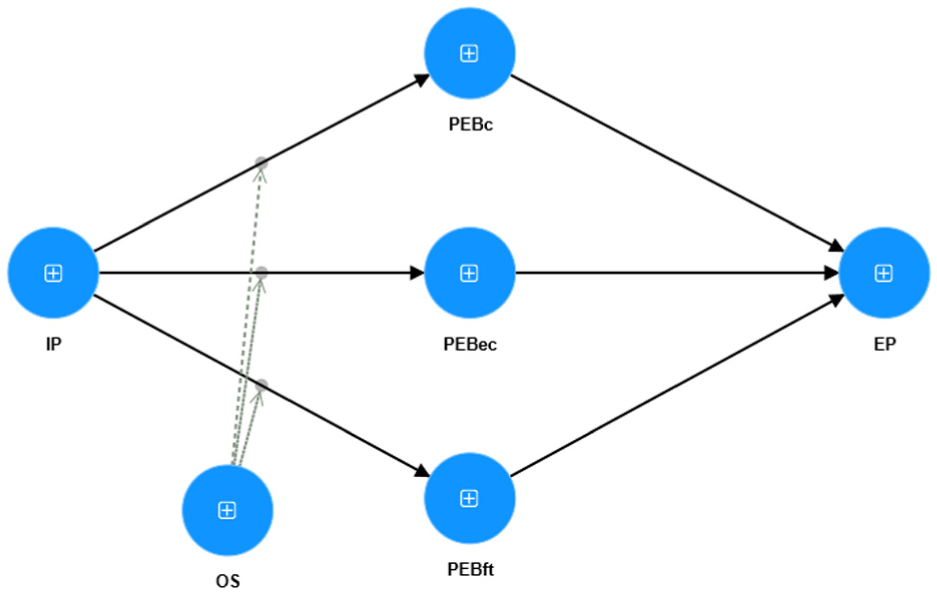
Measurement model.
To evaluate the measurement model, this study focuses on three key components: internal consistency reliability, convergent validity, and discriminant validity (Aburumman, 2023). Reliability measures Cronbach’s alpha and composite, are the two fundamental assessments that make up the reliability of internal consistency. The composite reliability measures the extent to which the collection of items consistently signals the latent construct, whereas Cronbach’s alpha offers an estimate of reliability depending on the inter-item correlation of the observable indicator variables. Cronbach’s alpha and composite reliability ratings are generally between .70 and .95 and are regarded as acceptable ranges (Hair et al., 2019). Table 1 shows internal consistency reliability.
Cronbach’s Alpha and Composite Reliability.
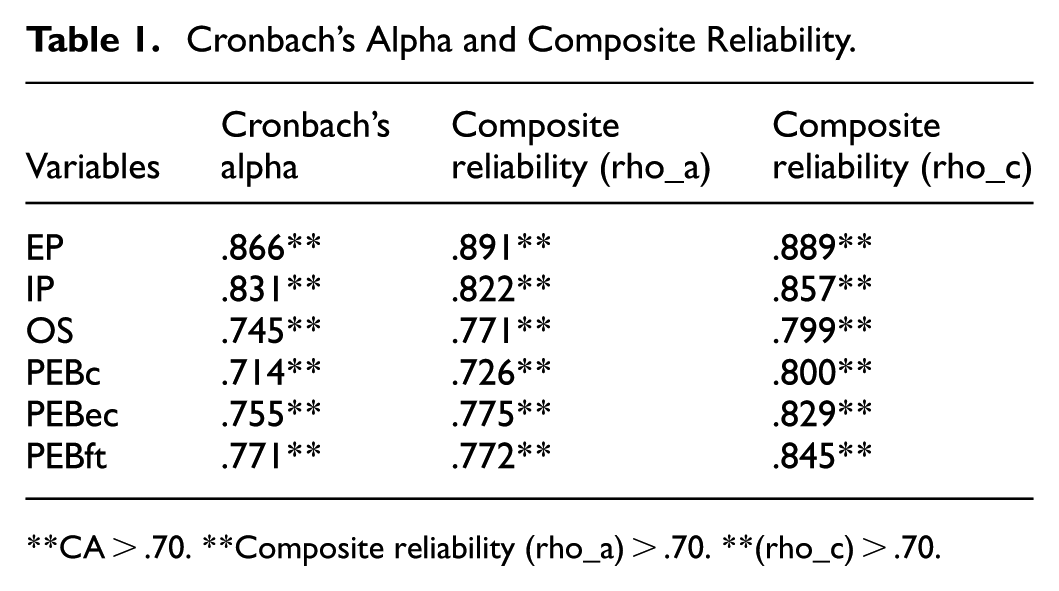
CA > .70. **Composite reliability (rho_a) > .70. **(rho_c) > .70.
The findings show in Table 1 a very significant internal consistency reliability for our study. All the values above .7 indicate the model’s reliability and fitness.
The indicators that were created to assess a certain concept are said to have convergent validity when they do so. According to convergent validity, assessments with the same or comparable constructs ought to demonstrate a high degree of correlation. Convergent validity is primarily assessed using factor loadings and the average variance extracted (AVE). Generally, items with factor loadings of 0.70 or higher are retained, while those below 0.40 are typically removed. Items with loadings between 0.40 and 0.70 may be retained if the construct’s Cronbach’s alpha, composite reliability (Nunnally, 1978), and AVE values exceed the recommended thresholds. An item should only be eliminated if its removal results in an improvement of the AVE, composite reliability, and Cronbach’s alpha values above the established criteria. Average Variance Extracted (AVE) values greater than 0.5 are accepted. While the AVE value must be more than 0.5, the study is still valid and will move forward with further calculations if the AVE value is close to 0.5. Although the average extracted variance is bigger than 0.5, we may still proceed with our empirical study using 0.4. The convergent validity of the model is considered adequate, as Fornell and Larcker (1981) suggest that an AVE below 0.50 can be acceptable if the composite reliability exceeds 0.60 (Fornell & Larcker, 1981; Lam, 2012). The results for composite reliability and AVE are summarized in Table 2.
Composite Reliability and Average Variance Extracted.
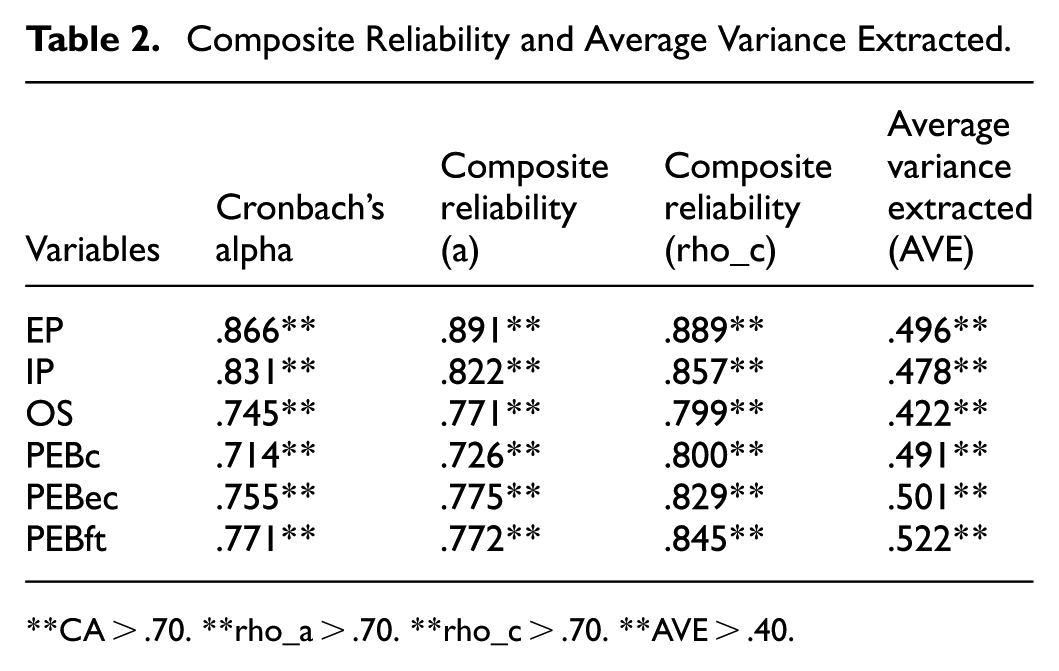
CA > .70. **rho_a > .70. **rho_c > .70. **AVE > .40.
All constructs demonstrated Cronbach’s alpha values greater than .70, with composite reliability values similarly surpassing the .70 threshold, and the significance of the average variance extracted demonstrates our measurement model’s convergent validity.
To determine if a concept is discriminatively valid, it must be highly correlated with its indicators in comparison to other structures. The Fornell-Larcker criterion has faced criticism for its limited ability to detect discriminant validity issues, which led to the development of the Heterotrait-Monotrait (HTMT) ratio. Unlike the Fornell-Larcker approach, the HTMT method provides a more rigorous and reliable assessment of discriminant validity, effectively addressing the limitations of its predecessor. The highly sensitive ratios of the updated HTMT standards, founded on an assessment of the heterotrait associations and the monotrait associations, show that they successfully detect an absence of discriminant validity. The distinctiveness of the HTMT parameters is what distinguishes them from one another. Given that it delivers the lowest accuracy rates across all simulated circumstances, HTMT 0.85 is among the most restrictive criteria of the three techniques. This suggests that, in research settings, an HTMT value below 0.90 with supporting inferences indicates that discriminant validity has been successfully established, whereas an HTMT value around 0.85 may signal potential concerns regarding discriminant validity (Henseler et al., 2015). In general, results for the HTMT criteria that are below 0.85 are considered to be acceptable.
Table 3 presents the HTMT results, indicating that all constructs have HTMT ratio values below 0.85. This confirms that discriminant validity is satisfied across the model. The table demonstrates that there are no discriminant validity issues among the constructs or their corresponding variables.
Discriminant Validity Heterotrait-Monotrait Ratio (HTMT) Matrix.

HTMT Values < 0.85.
Structural Model Analysis and Results
The subsequent phase in SEM analysis is the structural model examination. The internal model is another name for the structural model. The structural model takes care of the connection across latent and anticipated parameters. The purpose of the structural model evaluation is to look at the links across elements and the model’s capacity for prediction. Evaluating the common method variance and collinearity are the initial steps in the structural model analysis process. When the dependent as well as independent variables are determined in a single questionnaire employing the same answer and methodology, common method bias, also known as variance, may arise. Since this is frequently the situation, there have been in-depth discussions on how to identify, prevent, and act for common method bias (variance) in a variety of study areas (F. Kock et al., 2021). There are two approaches that have been used to avoid the common method bias in this research. The first approach comes under the EX-Ante research design that contrasts the sequence of surveys of the independent and dependent variable remedies that have been used to negate some of the common method biases associated with items’ integration or inquiry contextual (Tehseen et al., 2017). The second approach used to calculate and evaluate the common method bias is the EX-Post statistical assessment. It is suggested that the presence of a VIF larger than 3.3 indicates both pathologic collinearity and the possibility of common method bias contamination in an experiment. Hence, the framework can be regarded as having no common method bias if each of the VIFs in the internal model that comes from the complete collinearity analysis is equal to or less than 3.3 (N. Kock, 2015). All the VIF values in Table 4 are less than 3.3, which shows no common bias detected in the model.
Collinearity Analysis (VIF) Inner Model List.

Collinearity Analysis (VIF) Inner Model List > 0.2 & < 5.0.
The degree of collinearity describes how strongly the two separate model indicators correlate. The structural model parameters for the links within constructs are derived by evaluating several regression equations. This procedure is identical to assessing constructive methods of measurement, with the difference that in this case, the construct values of the predicting constructs are utilized to compute the Variable Inflation Factor (VIF) values for every assessment in the structural model. Collinearity is possible at VIF values as low as 0.2, although it is more likely to occur at VIF values higher than 5, which may indicate problems with collinearity between different predictive constructs. Table 4 shows that the results of the collinearity test suggest that each of the parameters has satisfied the requirements for eligibility, namely that the tolerance range was more than 0.20 and that the value for VIF 5 showed that the model did not include multicollinearity. The acceptable level lies within the 0.2 to 5 range of the VIF value.
The list of variables associated with the inner model collinearity study is presented in Table 4. The hypothesis’s postulated relationships are all fully associated with one another.
In the second stage of structural modeling, four key criteria are typically considered when evaluating the structural model: the coefficient of determination (R2), cross-validated redundancy, effect size (f2), and the significance of path coefficients as indicated by t-values and p-values for hypothesis testing. R2 values of .75, .50, and .25 are generally interpreted as substantial, moderate, and weak levels of explanatory power, respectively. The magnitude of the effect f2 with values such as 0.35, 0.15, and 0.02 is categorized as major, medium, and tiny, respectively (Gignac & Szodorai, 2016). Research ought to execute two phases to investigate the route coefficients hypothesis testing. Making certain the p-value of any effect that is either direct or indirect is under the threshold of .05 is the initial phase. The next phase is to make certain that zero doesn’t cross the higher or lower limits of the interval of confidence. Any route coefficient (whether direct or indirect) that satisfies the aforementioned criteria is therefore regarded as empirically justified and valid. The statistic t is used to determine the p-value (the probability value), depending on the t distribution. When the value of the t statistic is more than 1.96, the path coefficients will be significant when doing a two-tailed t analysis with a level of significance of 5%. The critical value of the t-test is 1.65 for an acceptable level of significance of 10%, whereas it is 2.58 when adopting a significant threshold of 1%. Table 5 shows the structural model assessment for hypotheses 1, 2, and 3.
Structural Model Assessment.

p < .05. **R-Square > .0. **F-Square > .0.
The analysis indicates that all path coefficients in the model are statistically significant, with detailed values presented in Table 5. The table shows the direct relationship of hypotheses 1, 2, and 3, which is positive and significant after the analysis. These positive and significant results prove our proposed theory. Hypothesis 1 is validated because values show that institutional pressure has a considerable and favorable impact on all the constructs of pro-environmental behavior. The findings also support hypothesis number two. Environmental performance is positively and significantly impacted by each component of pro-environmental behavior. Following the outcomes, our third hypothesis is likewise shown to be correct. Environmental performance is significantly and favorably impacted by institutional pressure. The bootstrap results were used to produce the accompanying graphs, which show the importance and normally distributed path coefficients of our hypothesis. In Figures 3 to 5, the path coefficients are displayed.

Path coefficient of hypothesis 1.

Path coefficient of hypothesis 2.

Path coefficient of hypothesis 3.
Association of Pro-Environmental Behavior as a Mediator
According to hypothesis 4, institutional pressure and environmental performance are associated with the mediation of pro-environmental behavior. In Figure 6, the mediation connection is depicted. This model was created using the Smart PLS 4 program. First, this model illustrates how institutional pressure and environmental performance are directly related. Then, pro-environmental activity serves as a mediator in this interaction. Finally, there is a connection between environmental performance and pro-environmental behaviors.
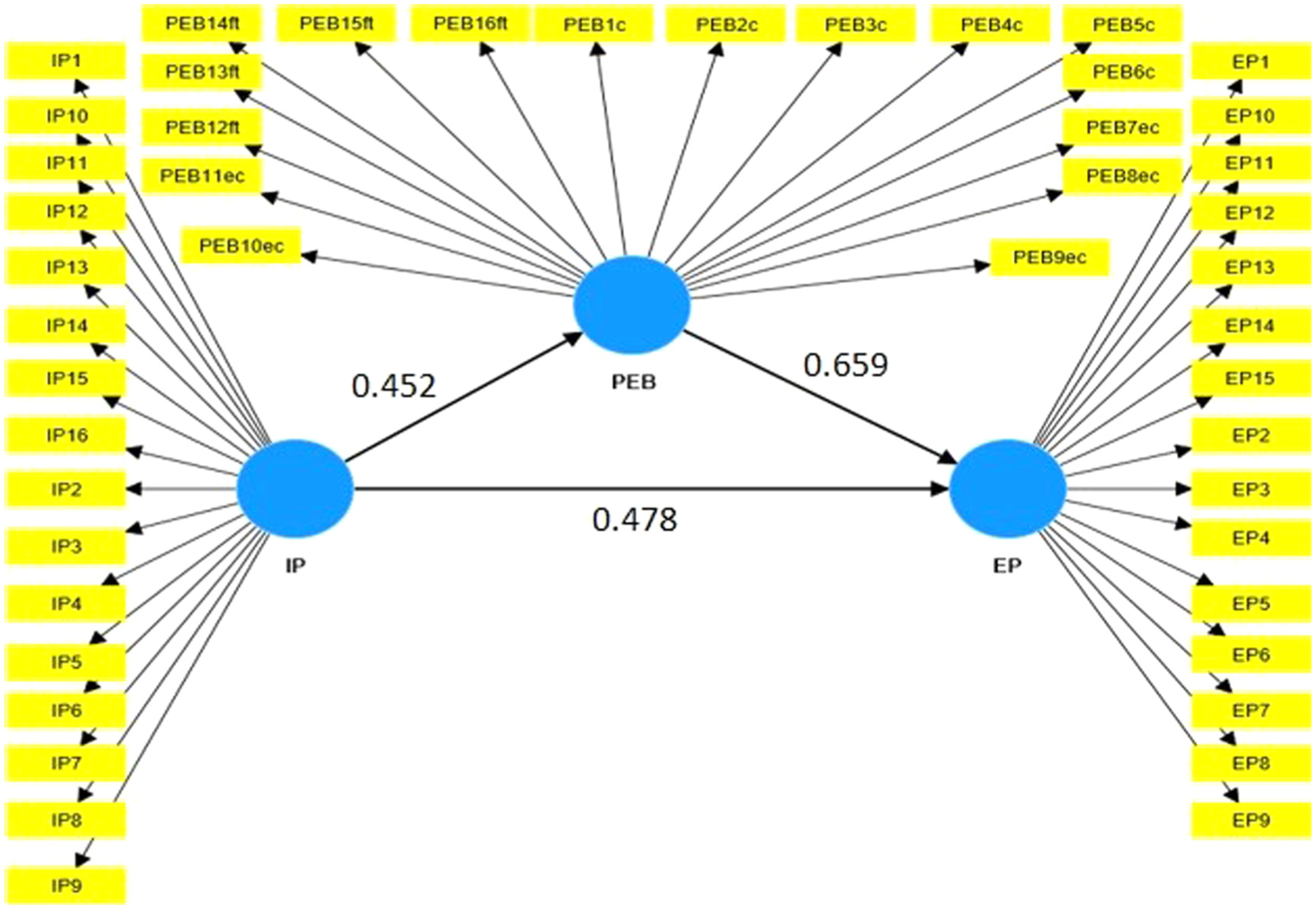
Mediation of pro-environmental behavior.
A mediation analysis was conducted using SmartPLS software to examine the role of pro-environmental behavior in linking institutional pressure and environmental performance. The findings from this analysis are presented in Tables 6 and 7.
Mediation Total Effect.
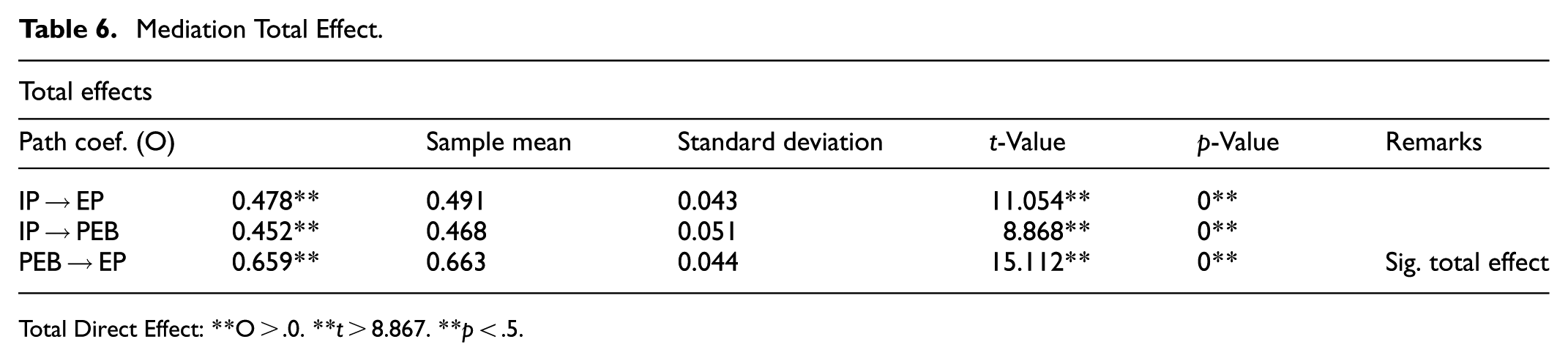
Total Direct Effect: **O > .0. **t > 8.867. **p < .5.
Mediation Total Indirect Effect.

Total Indirect Effect: **O > .0. **t > 7.855. **p < .5.
The results indicate that institutional pressure exerts a significant indirect effect on environmental performance through pro-environmental behavior (H4: β = .298, t = 7.856, p = 0). When accounting for the mediator, both the total effect of institutional pressure on environmental performance and the effect of pro-environmental behavior remain significant (β = .659, t = 15.112, p = 0).
Association of Organizational Silence as a Moderator
According to hypothesis 5, institutional pressure and pro-environmental behavior are negatively moderated by organizational silence. Figure 7 depicts the basic moderation relationship. The fundamental approach of moderation is thus appropriate since it is anticipated that the moderating factor will affect one or more specific structural paths with the aid of suitable conceptual words.

Moderation of organizational silence.
Moderation is the process whereby one construct affects the strength or even the direction of a relationship between two other constructs. As a consequence, moderation takes data variability into account. After conceptually establishing a moderation framework, its hypothesized connections, and the relationship factor, the model assessment follows. To evaluate the moderating influence, we utilize smart PLS to verify the bootstrapping routes component. The results of the moderation are shown in Table 8.
Moderation Analysis Results.
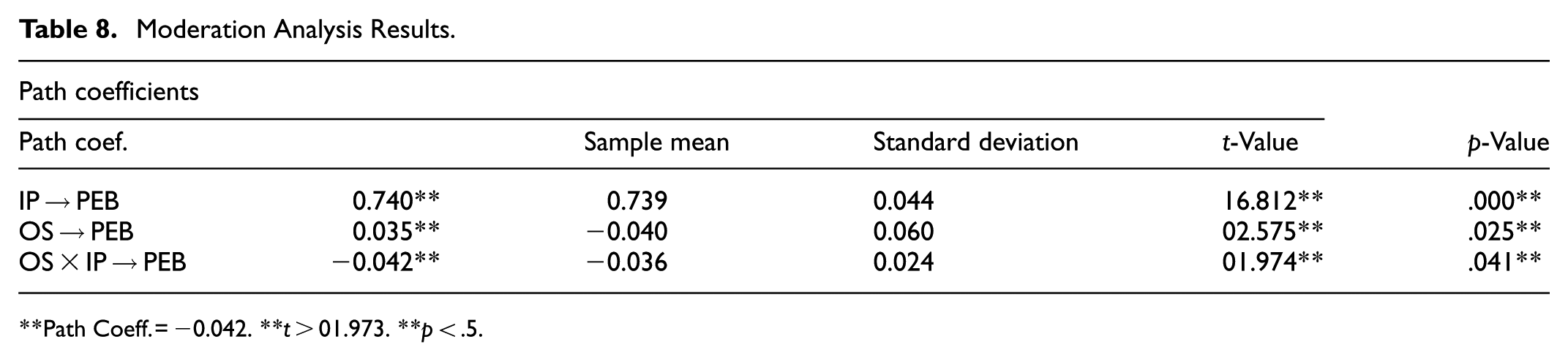
Path Coeff. = −0.042. **t > 01.973. **p < .5.
By incorporating a variable for organizational silence in hypothesis 5, one may predict whether institutional pressure will cause public managers to behave more or less sustainably when organizational silence moderates the course. The findings score regression coefficient for this hypothesis phrase in nature is = −0.042, t = 1.974, and p = .041. The OS → PEB path was not hypothesized but was included as an exploratory control path to assess robustness. The results suggest OS → PEB has a positive association with a path coefficient of 0.035.
Discussion
This study aimed to enhance environmental policy performance by examining how institutional pressure influences public managers’ pro-environmental behavior and, in turn, affects environmental outcomes. These findings provide compelling empirical evidence for the theoretical framework, illustrating the interplay between external institutional pressures and internal organizational factors in determining environmental performance within public sector organizations. The analysis confirmed that institutional pressure significantly and positively influences the various dimensions of pro-environmental behavior, specifically conservation, environmental citizenship, and sustainable food and transportation practices. The results support earlier research that emphasizes the importance of hierarchical institutional structures to guide organizational behavior. For example, Phan and Baird (2015) showed that regulatory mandates and policy frameworks can motivate employees to adopt sustainability-oriented practices. Similarly, Zhang et al. (2023) argue that formal rules, reporting requirements, and policy expectations create normative and coercive pressures that guide environmental actions in public organizations. Our findings extend this literature by demonstrating that institutional forces are effective not only in shaping corporate-level sustainability outcomes, as widely studied in private firms, but also in influencing individual-level behaviors within the public sector. This highlights the embeddedness of environmental behaviors in institutional contexts, reinforcing institutional theory’s assertion that actors internalize external pressures through organizational norms and practices.
The results also demonstrate that pro-environmental behavior significantly enhances environmental performance, supporting hypothesis 2. These findings resonate with earlier research that links employee-level behaviors to broader sustainability outcomes. For instance, Norton et al. (2015) emphasized that workplace environmentally responsible behaviors, ranging from conservation to citizenship, collectively contribute to organizational sustainability. The present research extends prior work by providing evidence that in resource-constrained public institutions, individual behaviors are particularly important in bridging the gap between policy design and policy implementation. By evidencing a strong explanatory power (R2 = .561), this study underscores that fostering environmentally conscious behaviors at the micro level is essential to achieving institutional-level environmental goals, especially in developing-country contexts where enforcement capacity may be limited.
Consistent with hypothesis 3, institutional pressure directly improves environmental performance. This is aligned with the broader institutional literature (Phan & Baird, 2015), which emphasizes the effectiveness of coercive and normative pressures in enhancing organizational compliance and performance outcomes. However, our findings also suggest that institutional pressure is not sufficient on its own, as a significant portion of its impact is mediated by individual behavior. This nuance extends previous work by highlighting the dual pathway through which external regulations influence outcomes, directly through compliance and indirectly through behavioral mechanisms. The mediating analysis confirmed hypothesis 4 that pro-environmental behavior partially mediates the effect of institutional pressure on environmental performance. This result supports the argument that external pressures are translated into meaningful organizational outcomes only when internalized and enacted by employees (Ones & Dilchert, 2012). By empirically validating this pathway, our study enriches the theoretical perspective on how institutional forces shape organizational behavior in public organizations and illustrates the behavioral mechanisms that underpin policy implementation effectiveness. The results also emphasize the theoretical importance of the distinction between board-based institutional pressure and the wider regulation pressure or stakeholder pressure. In the case of elected members on the board of the public sector, the role of this board is internal governance with the decrees of the environment and performance reviews of departments. Their influence thus, is a performance-focused and narrow kind of institutional pressure that directly influences the behavior of managers.
The fifth finding, hypothesis 5, predicted that organizational silence would negatively moderate the relationship between institutional pressure and pro-environmental behavior. The results support this expectation, with the interaction effect showing that silence indeed weakens the influence of institutional pressure on pro-environmental behavior (β = −.042, t = 1.974, p = .041). This suggests that when employees refrain from voicing concerns or innovative ideas, the effectiveness of institutional mandates in fostering sustainable practices is diminished. Beyond the hypothesized relationships, we also examined an exploratory control path from OS to PEB. Interestingly, however, organizational silence also demonstrated a direct positive association with pro-environmental behavior (β = .035, t = 2.575, p = .025). While this was not hypothesized, it reveals complex behavioral mechanisms within bureaucratic organizations. Silence may reflect compliance-driven behavior: employees in hierarchical bureaucracies, particularly in developing countries like Pakistan, adhere strictly to sustainability directives without questioning or debating them. In such contexts, silence can function as a form of fear-based conformity or avoidance of conflict, where employees comply with rules to avoid penalties or reputational risks rather than out of intrinsic environmental commitment.
This dynamic is consistent with the literature on bureaucratic behavior in developing countries, which highlights how strong hierarchical structures and risk-averse cultures often encourage employees to follow orders rather than exercise discretion (Christensen, 2012; P. DiMaggio & Powell, 2010). In environmental governance, such patterns may lead to the outward performance of pro-environmental tasks even when genuine engagement is lacking. Thus, silence-driven compliance can paradoxically result in visible pro-environmental behaviors, though these may be fragile and unsustainable in the absence of authentic motivation. The results emphasize a dual role of organizational silence: as a barrier that weakens institutional influence on environmental performance, but also as a compliance mechanism that drives superficial or enforced forms of pro-environmental behavior. This finding advances the theoretical understanding of environmental governance in developing country bureaucracies, where silence may not always equate to passivity but can reflect complex dynamics of compliance, conformity, and survival within institutional hierarchies. Future research should explore whether such silence-induced pro-environmental behaviors are sustainable in the long term or if they erode once external pressure subsides.
In light of these findings, a key implication concerns how public organizations might directly address organizational silence. While our results demonstrate that silence weakens the influence of institutional pressure on pro-environmental behavior, even modest reductions in silence can preserve and strengthen this relationship. One promising direction is the institutionalization of “safe-voice” mechanisms, such as anonymous reporting systems, climate surveys with structured feedback loops, and learning reviews where employees can raise concerns without fear of reprisal. These practices align with calls in the public management literature to create psychologically safe environments that reduce fear-driven compliance and foster authentic engagement. Embedding such mechanisms could transform silence from a barrier into an opportunity for constructive dialogue, thereby reinforcing the effectiveness of institutional mandates and enhancing the sustainability of pro-environmental behaviors over the long term. Although theoretically we could have silence as a mediator- as institutional pressure correlatively and directly rose or fell because of silence- there is no empirical or contextual force behind this in our public-sector context to suggest that there is such a cause-effect relationship between silence and institutional pressure. Further studies may focus on organizational silence as the mediator in various organizational settings or a less formalized one.
Conclusion
The complexity of environmental and climate change policy implementation continues to pose significant challenges, largely due to insufficient pro-environmental behavior and the persistence of organizational silence within public institutions. This study advances the understanding of how institutional pressure shapes pro-environmental behavior and environmental performance, contributing to SDG 13 (Climate Action). Public institutions face multiple challenges in implementing environmental policies because various behavioral and structural obstacles create obstacles to progress. Research examined institutional pressures on pro-environmental behavior and environmental performance by investigating pro-environmental behavior mediation and organizational silence moderation. This study demonstrates that institutional pressure leads to significant enhancement of pro-environmental behaviors regarding conservation and environmental citizenship and food & transportation, which subsequently leads to a substantial improvement of environmental performance. Institutional pressure delivers immediate environmental performance results, which confirms its dual effects on performance. The connection between institutional pressure that leads to environmental results gets strengthened by pro-environmental behavior, which works as a partial mediator between these two variables. Organizational silence exerted a negative effect on this connection, thus blocking external pressures from leading to meaningful environmental initiatives. The study revealed an unanticipated positive link between organizational silence and pro-environmental behavior, even while researching different relationships within the dataset. Public organizations’ environmental actions receive improved understanding through this research about institutional factors affecting them, along with methods for advancing climate policy success within bureaucratic systems.
Theoretical and Practical Implications
Theoretically, this study integrates institutional theory with the literature on pro-environmental behavior and organizational silence, offering a holistic framework to explain how environmental performance is shaped by external pressures, behavioral mechanisms, and organizational culture. Practically, the results suggest that policymakers and public managers should recognize that regulatory frameworks are necessary but insufficient; they must also cultivate employee engagement and foster open communicative environments to translate policies into practice. Particularly in developing-country contexts, where top-down enforcement alone often fails, the combination of institutional support, behavioral empowerment, and cultural openness becomes critical for achieving environmental goals. The present research emphasizes the contribution of institutional pressure and internal behavioral mechanisms to the enhancement of environmental performance, yet the research outcomes coincide with other processes in the society and international arena in general. Recently, as found by Song (2025), institutional pressure does not guarantee effective climate-technology adoption without other factors, including such as policy trust and social legitimacy and climate-tech diplomacy. Based on this, as much as the pro-environmental actions of the officials offer an internal basis, their transfer into broader environmental consequences relies on the process of building trust and cross-national cooperation in the society. Therefore, the implications of the study are not confined to organizations but to the necessity of combined strategies to interrelate internal behavioral motivators to the external mechanisms in the society and internationally in order to improve climate governance. These lessons connect directly to the Sustainable Development Goals, in particular SDG 7 (Affordable and Clean Energy) and SDG 13 (Climate Action) in making internal behavioral mechanisms consistent with policy goals. Strategies such as structured environmental training programs, rewarding of voluntary green programs, and board-level interventions might be implemented to strengthen the pro-environmental norms in the context of the public institutions.
Future Research
Future research should further examine how institutional pressures influence environmental performance across industries and jurisdictions, as well as how institutional strategies operate across borders. The observed inverse association between organizational silence and pro-environmental performance also warrants deeper investigation to identify the factors shaping this relationship in constrained institutional contexts. In addition, studies should explore how racial, ethnic, and socio-cultural factors influence the environmental attitudes of elected officials and bureaucrats, thereby informing more context-sensitive policy frameworks. Further research is also needed to determine whether improvements in environmental policy effectiveness reflect substantive change or result from institutional pressure and metric manipulation. Examining how politicians and public managers shape environmental outcomes will clarify policy effectiveness. Additionally, studies should investigate efficient policy implementation strategies and mechanisms to strengthen struggling institutions. Learning from successful international initiatives could inspire reforms that advance climate governance goals (SDG 13 as primary, and SDG 7 as secondary). Finally, expanding research beyond the Ministry of Climate Change and NEECA to include other public agencies would offer a more comprehensive understanding of institutional impacts on sustainability.
The two organizations, which are the subjects of the study, are the National Energy Efficiency and Conservation Authority (NEECA) and the Ministry of Climate Change (MOCC), both located in Pakistan. They are chosen since these are the organizations which are directly involved with the implementation of national policies on the environment and climate, and their elected members of the board possess the official powers of control over compliance, evaluation of performance and leading the pro-environmental initiatives. This renders them quite applicable to the study of institutional pressure that is initiated by the board and its effects on pro-environmental behavior and environmental performance. Although the results can best be applied to other institutions that have similar governance and environmental mandates, care should be taken when generalizing to the rest of the ministries or sectors. Further studies can apply this framework to a wider group of communities working in the public sector to challenge the strength of these connections. Another promising direction is to move beyond reliance on self-reported measures of environmental performance, which may be biased. Future studies could combine survey data with objective indicators, such as energy intensity, compliance rates, environmental audits, or efficiency data, to strengthen validity and assess alignment between reported behaviors and actual outcomes. Although the present research concentrated on bureaucratic organizations of the public sector, the institutional processes that were identified, including the impact of institutional pressure on acting pro-environmentally, can also be relevant in other organizations in the private sector (firms or NGOs) with institutionalized environmental policies. Nevertheless, the extent and the importance of the organizational silence as a moderator variable might vary in less hierarchical or more participatory environments. Further studies may be conducted to investigate these mechanisms in various organizational settings to determine their generality.
Footnotes
Acknowledgements
I’d like to offer my heartfelt appreciation to Ms. Xueyan Yang and Mr. Shafei Moiz Hali for their invaluable advice and help while writing this research article. I also like to thank Xi’an Jiaotong University, School of Public Policy and Administration, China, for providing the necessary resources and a favorable atmosphere for my study. Finally, I would like to thank Foundation University, Islamabad, and National Defence University, Islamabad, for providing support in data collection.

Ethical Considerations
This article does not contain any studies on human and animal participants performed by any authors. It was not required as it was a non-contrived field survey, and no intervention was made on the participants.
Consent to Participate
Informed consent was obtained in distributed questionnaires, assuring anonymity, voluntary participation, and presentation of results at the aggregate level rather than the individual level.
Author Contributions
Mr. Usman wrote and compiled the whole article, Mr. Shafei contributed to the analysis part, and Ms. Yang contributed to supervision and proofreading.
Funding
The authors received no financial support for the research, authorship, and/or publication of this article.
Declaration of Conflicting Interests
The authors declared no potential conflicts of interest with respect to the research, authorship, and/or publication of this article.
Data Availability Statement
Data is available in an Excel sheet and can be accessed with the author’s permission.