






Abstract
This study aims to provide a holistic perspective by examining the effects of GeoGebra software in mathematics instruction at both theoretical and practical levels. The research was designed in two phases using a mixed-methods approach. In the first phase, qualitative studies published between 2015 and 2025 were examined through a systematic meta-thematic analysis, resulting in the identification of five main themes: conceptual understanding, learning process, student attitudes, skill development, and limitations. In the second phase, a GeoGebra-supported instructional intervention was implemented with 30 ninth-grade students enrolled in a high school in southeastern Türkiye over a 3 week period (a total of 18 hr), and students’ post-intervention views were collected through semi-structured interviews. The findings indicate a high level of alignment between the themes derived from the meta-thematic analysis and the students’ lived experiences. In particular, GeoGebra was found to make significant contributions to concretizing mathematical concepts, enhancing conceptual understanding and motivation, structuring the learning process, and fostering positive attitudes toward mathematics. However, limitations related to insufficient digital competencies and technical infrastructure were observed to partially hinder pedagogical implementation. Overall, these findings suggest that GeoGebra functions as a dynamic instructional component that supports cognitive and affective processes while fostering meaningful student engagement and agentic learning experiences.
Plain Language Summary
This study looks at how GeoGebra, a free and interactive math software, can help students understand math more easily and enjoy learning it. First, the researchers looked at many past studies to find out how teachers and students have used GeoGebra. They found that GeoGebra helps students by showing math in a visual way, making hard ideas easier to understand, increasing interest, and helping with problem-solving. Then, the researchers tested these ideas in real classrooms with secondary school students during an 18-hour math lesson using GeoGebra. Students said they understood math better, felt more motivated, and took more control of their learning. They also did better on math tests and remembered what they learned for longer. The study shows that GeoGebra is more than just a digital tool—it can support deep thinking and help students become more confident learners. But not all schools have the resources, like technology and teacher training, to use GeoGebra well. The researchers suggest better support for teachers and fairer access to technology in schools. They also recommend using artificial intelligence to make learning even more personalized. This research offers useful ideas for improving math education in a fair and lasting way.
Keywords
Introduction
The innovations brought about by the digital age have led to profound transformations in education systems, with mathematics instruction being one of the fields most affected by this shift (Hoyles & Noss, 2015). The integration of Information and Communication Technologies (ICT) into education has not only supported students’ learning processes but has also transformed teachers’ pedagogical approaches, enabling the development of more interactive and dynamic learning environments (Drijvers, 2019). In this context, mathematical digital competence (MDC) has emerged as a key concept that fosters students’ mathematical thinking processes and their ability to use digital tools effectively (Geraniou & Jankvist, 2019). Mathematical digital competence requires not only the acquisition of fundamental mathematical concepts but also a deep understanding of these concepts and their application in problem-solving processes through digital tools (Niss & Højgaard, 2011). Consequently, the role of dynamic mathematics software in education has become increasingly critical. Interactive mathematics software such as GeoGebra enables students to explore mathematical relationships, understand abstract concepts through visualization, and actively engage in problem-solving processes (Arzarello et al., 2012).
Developed in 2001 by Markus Hohenwarter (Hohenwarter & Jones, 2007) the dynamic mathematics software GeoGebra is now used by millions of students and teachers worldwide. Recent studies have demonstrated that GeoGebra enhances students’ problem-solving skills, supports deeper understanding of mathematical concepts, and allows teachers to present instructional content in a more interactive manner (Clements & Sarama, 2011; Leung & Bolite-Frant, 2015). However, a substantial proportion of the research in this field is based either on single case studies or on experimental designs with limited scope. This situation makes it difficult to examine the pedagogical role of GeoGebra in a multidimensional and integrative manner.
For this reason, there is a need for integrative research that is not confined to a single methodological approach but instead combines thematic structures derived from systematic literature syntheses with field-based qualitative data collection processes. Such an approach allows for an in-depth examination of how thematically identified patterns in literature gain meaning across different educational contexts and facilitates a more comprehensive understanding of the pedagogical role of GeoGebra in mathematics instruction. In line with this need, the present study adopts a two-phase, sequential exploratory qualitative design. In the first phase, qualitative studies published after 2015 were systematically examined through a meta-thematic analysis to identify the core thematic structures related to the use of GeoGebra in mathematics education. In the second phase, in order to explore how these thematic structures are reflected in classroom practice, students’ perspectives on their learning experiences were collected through semi-structured interviews following an 18 hr GeoGebra-supported instructional intervention conducted in a high school in southeastern Türkiye.
This integrative approach enables the themes derived from the literature and the student experiences emerging from instructional implementation to be interpreted jointly and relationally, thereby offering a contextualized and in-depth understanding of how GeoGebra is experienced in mathematics instruction and how it is pedagogically positioned. Accordingly, the main research question of the study is formulated as follows:
When the themes identified through meta-thematic analysis and the student experiences obtained from classroom implementation are considered together, how can the pedagogical role of GeoGebra in mathematics instruction be understood?
In addition to this overarching question, the following sub-questions are addressed:
According to qualitative studies in literature, what are the main themes that reflect how GeoGebra is conceptualized in mathematics instruction?
What strengths and limitations regarding the pedagogical use of GeoGebra are revealed by the themes identified in the meta-thematic analysis?
What are students’ experiences of the GeoGebra-supported instructional process, and in what ways do these experiences align with or diverge from the thematic structures identified in the meta-thematic analysis?
Within this framework, the study aims to contribute to the understanding of GeoGebra not merely as a technical tool, but as a pedagogical component closely related to students’ conceptual meaning-making, engagement in the learning process, and the ways in which learning experiences are structured.
Theoretical Background
Digital transformation in education is fundamentally redefining teaching and learning processes, particularly in mathematics instruction. Traditional instructional environments are increasingly being replaced by digital, interactive, and student-centered structures, necessitating the reconfiguration of teacher roles, learning experiences, and pedagogical decision-making (Drijvers, 2019; Hoyles & Noss, 2015). This transformation represents not merely the integration of technology, but a pedagogical paradigm shift that requires the redesign of access to knowledge, learner autonomy, and assessment practices (Morgan-Thomas et al., 2020). The theoretical framework of the present study is constructed around two core dimensions of this transformation: (i) the digitalization of mathematics learning environments, and (ii) the pedagogical role of GeoGebra software as a prominent tool within this digitalization process.
The Digitalization of Mathematics Learning Environments
Over the past decade (2015–2025), the digitalization of mathematics learning environments has accelerated, leading to radical changes in the nature of instructional materials, classroom interaction, and the design of learning processes (Clark-Wilson et al., 2015; Morgan-Thomas et al., 2020). Digitalization has necessitated not only the enhancement of existing instructional strategies but also the adoption of new pedagogical paradigms. Within the framework of constructivist learning theory, students have increasingly been positioned as active producers of knowledge and engaged in processes of relating and reconstructing concepts in environments supported by multiple representations (Perry et al., 2019). Classrooms enriched with digital technologies offer simulations, animations, dynamic visualizations, and interactive exploration opportunities that enable students to explore the entire learning process rather than focusing solely on reaching a final answer (Jankvist & Misfeldt, 2015). In this way, conceptual understanding, problem-solving skills, and cognitive flexibility are fostered.
The theory of instrumental genesis (Drijvers, 2019) posits that students transform digital tools into extensions of their cognitive development, thereby constructing new mathematical meanings. Accordingly, the integration of digital tools represents not merely technical support, but a process that fundamentally reshapes students’ interactions with mathematical objects.
In this context, teachers’ competencies in integrating technology in pedagogically meaningful ways are of critical importance. The TPACK model (Mishra & Koehler, 2006) emphasizes the need for teachers to integrate technological, pedagogical, and content knowledge. The widespread adoption of remote and hybrid learning practices in the post-pandemic period has further intensified the need for teachers to develop these competencies (Olivares-Funes et al., 2024). Moreover, digitalization has transformed pedagogical practices such as collaborative learning, real-time feedback, and data-informed assessment. More recently, the integration of artificial intelligence–supported systems into educational environments has enabled the analysis of student performance and the design of personalized learning pathways (Botana et al., 2024).
GeoGebra in Mathematics Education
With the increasing role of digital tools in mathematics instruction, GeoGebra software has gained a prominent position in both national and international curricula over the past decade (2015–2025). By integrating different mathematical domains such as dynamic geometry, algebra, statistics, and calculus, GeoGebra enables students to deepen their conceptual understanding through transitions among multiple representations (Hariri et al., 2025; Leung & Bolite-Frant, 2015). Owing to its interactive features, students are provided with opportunities to visualize, manipulate, and explore abstract mathematical relationships, thereby making the learning process more meaningful and enduring (Pebrianti & Handayani, 2022). Research on the instructional impact of GeoGebra indicates that the software particularly enhances students’ mathematical thinking, problem-solving, and modeling skills (Febrianti & Dasari, 2024; Hariri et al., 2025). The dynamic graphs and parametric structures offered by the software contribute to the development of functional thinking and support a more flexible understanding of mathematical structures (Zengin, 2023). At the same time, GeoGebra has been reported to increase students’ interest and motivation toward mathematics and to foster more positive attitudes toward the subject (Hariri et al., 2025).
From the perspective of pre-service and in-service teachers, GeoGebra represents a powerful tool for restructuring instructional content, developing interactive teaching materials, and enhancing student engagement (Pebrianti & Handayani, 2022). However, effective integration requires teachers to possess well-developed digital pedagogical competencies. Accordingly, the systematic integration of GeoGebra into teacher education programs has been strongly emphasized (Perry et al., 2019). In recent years, the use of GeoGebra versions integrated with artificial intelligence has also gained attention. Botana et al. (2024) demonstrated how the integration of GeoGebra Discovery with ChatGPT contributes to automated feedback provision, proof generation, and geometric exploration. Similarly, Olivares-Funes et al. (2024) showed that the use of AI-supported GeoGebra in the teaching of differential equations strengthens students’ conceptual understanding and renders the learning process more interactive.
The flexible structure of GeoGebra, which addresses different learning styles, is another noteworthy feature. The study by Hariri et al. (2025) revealed that students with visual–spatial and experiential learning styles particularly benefit from graphical modeling and dynamic simulations. This finding indicates that GeoGebra has the potential not only to enhance individual achievement but also to create inclusive learning environments that are sensitive to learning differences. Nevertheless, several limitations related to the pedagogical use of GeoGebra have also been reported. Insufficient levels of students’ digital literacy, difficulties in accessing the advanced features of the software, and some teachers’ inability to use technology holistically as a pedagogical tool constitute notable constraints (Hariri et al., 2025; Zengin, 2023). For this reason, it is emphasized that not only software training, but also comprehensive teacher education programs focusing on how such software can be meaningfully integrated into curricula, are required.
Overall, the findings in the literature suggest that GeoGebra is not merely a technical software application, but rather offers a pedagogical ecosystem that supports cognitive processes, conceptual learning, and motivation. However, deficiencies in digital literacy, teachers’ limited integration competencies, and technical infrastructure constraints may hinder the full realization of this potential (Zengin, 2023). This situation indicates that training programs focusing solely on software use are insufficient, and that there is a need for holistic teacher education programs that enable pre-service teachers to integrate technology effectively for pedagogical purposes. Addressing this gap in the literature, the present study triangulates theoretical themes derived from the literature with field-based student experiences, thereby generating more comprehensive, contextualized, and interpretable findings regarding the role of GeoGebra in mathematics education.
Method
This study was designed as an exploratory qualitative investigation aimed at examining how GeoGebra, as a dynamic mathematics software, is used within teaching and learning processes in an authentic educational context and how it gains meaning within these processes. Exploratory research seeks not to test the effectiveness of a phenomenon, but rather to reveal how that phenomenon is constructed within a given context, how it is experienced, and how it operates in practice (Babbie, 2020).
In this respect, the study focuses on understanding the processes related to the pedagogical use of GeoGebra and the experiences of participants from a qualitative perspective. The research process consists of two complementary phases: the first phase involves a literature-based meta-thematic analysis, while the second phase entails an exploratory qualitative case study that examines how the thematic structure derived from this analysis is reflected within a real educational setting.
Research Design
This study was conducted within the framework of a two-phase exploratory qualitative research design aimed at examining how GeoGebra is positioned in the context of mathematics instruction and how it gains meaning within teaching and learning processes. Rather than focusing on quantitative effectiveness testing, the research design emphasizes an in-depth understanding of how the phenomenon operates within its context, the ways in which it is pedagogically employed, and the experiences of participants. Exploratory qualitative research does not seek to test predetermined hypotheses; instead, it aims to reveal how a phenomenon is constructed, how it is experienced, and how it acquires meaning across different contexts (Babbie, 2020). In this respect, the study investigates the role of GeoGebra as an instructional tool in mathematics education by jointly considering a literature-based conceptual structure and implementation data derived from an authentic educational setting.
The research design consists of two complementary phases. In the first phase, qualitative studies on the use of GeoGebra were synthesized through a meta-thematic analysis to develop a conceptual framework. In the second phase, the reflections of this conceptual framework within a real educational environment were examined through an exploratory qualitative case study conducted within the broader exploratory qualitative research design. This second phase did not aim to evaluate effectiveness or conduct comparative assessments.
An integrative perspective was adopted in the interpretation of findings derived from both the literature synthesis and the field implementation, emphasizing their joint and relational analysis. Such an integrative approach is considered a strategy that enhances depth in qualitative research by enabling the convergence of findings from multiple data sources and contributing to a multidimensional understanding of the phenomenon under investigation (Batdı, 2021).
Data Collection Process
The research process was conducted in three interrelated stages in accordance with an exploratory qualitative research design. In the first stage, qualitative studies in the literature were examined through a meta-thematic analysis to identify thematic structures that reveal how GeoGebra is conceptualized in mathematics instruction, the pedagogical purposes for which it is used, and the ways in which it is linked to teaching and learning processes.
In the second stage, a GeoGebra-supported instructional process was implemented with secondary school students in order to examine how the thematic structures emerging from the meta-thematic analysis are reflected in an authentic educational context. This process was carried out over a 3 week period (a total of 18 hr), during which students’ perspectives on their learning experiences were collected through semi-structured interviews. The aim of this stage was to explore, from a qualitative perspective, how the themes identified in the literature acquire meaning in classroom practice and how they are experienced by students.
Meta-Thematic Analysis Process
Meta-thematic analysis is a qualitative synthesis process grounded in document analysis, in which findings derived from qualitative studies are integrated through themes and codes (Batdı, 2024). This approach aims to systematically examine qualitative research focusing on a particular topic and to identify shared thematic patterns across studies. In the present study, meta-thematic analysis was employed to reveal how GeoGebra is addressed in the literature within the context of mathematics education, the pedagogical purposes for which it is used, and the ways in which it is associated with teaching and learning processes. Accordingly, studies that examined the use of GeoGebra from a qualitative perspective were searched and analyzed in academic databases based on predefined criteria. Topic-specific keywords were used to identify relevant studies, and the research included in the analysis was selected in accordance with criteria related to methodological rigor and content relevance. The databases searched and the inclusion criteria applied in the study are presented in Table 1.
Databases Searched in the Study and the Criteria Established for the Inclusion of Studies in the Research.
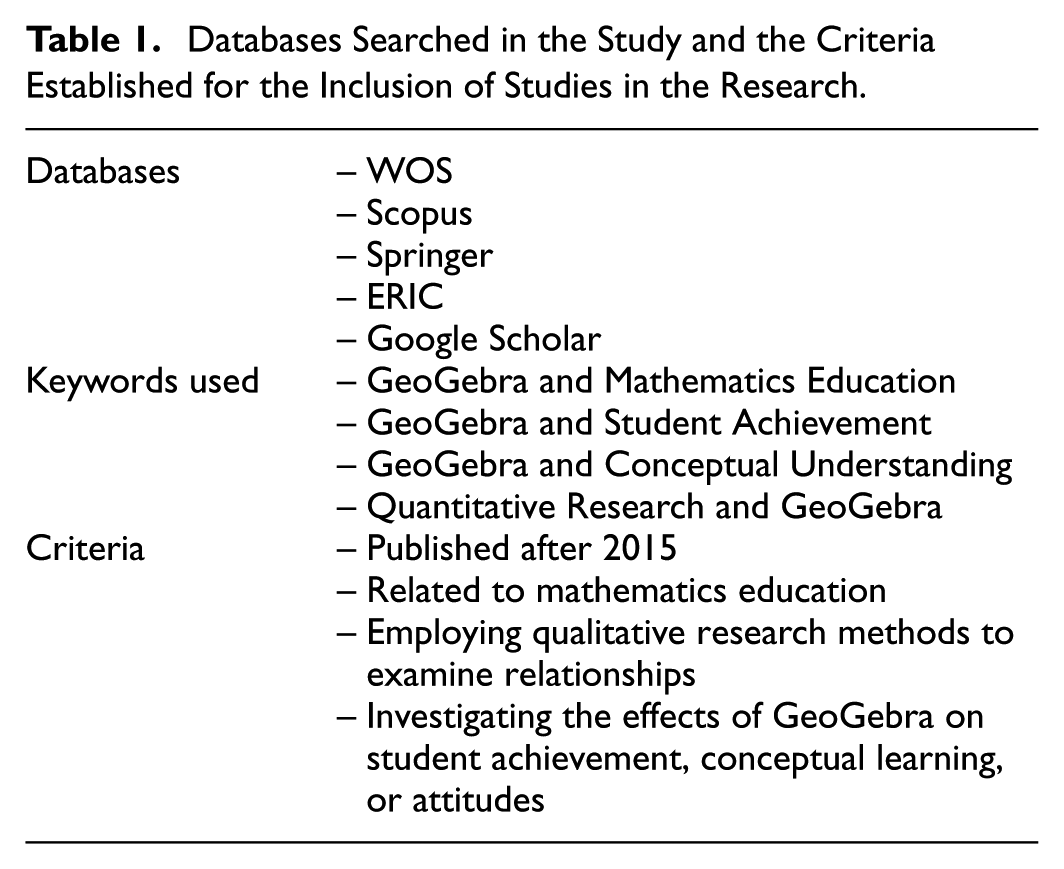
In line with the identified databases and inclusion criteria, the studies retrieved were systematically reviewed and subjected to an inclusion or exclusion process based on their eligibility. To ensure transparency in this process, the stages of study inclusion and exclusion were visualized using a PRISMA flow diagram (Figure 1).

PRISMA flow diagram.
Implementation Process
The implementation process was conducted during the first semester of the 2024 to 2025 academic year. In line with the aims and scope of the study, the study group consisted of 30 ninth-grade students enrolled in a high school located in southeastern Türkiye. Participants were selected based on existing classroom structures, and no random assignment was employed. In this respect, the implementation was structured as an exploratory qualitative application process carried out in an authentic classroom setting. Within the scope of the implementation, learning outcomes related to the theme “Quantities and Change” in the secondary school mathematics curriculum were addressed, and GeoGebra-supported lessons were implemented to facilitate the concretization of abstract mathematical concepts. The implementation lasted for a total of 3 weeks, during which students participated in a structured instructional program totaling 18 hr.
The lesson plan was designed to include activities focused on concept exploration, dynamic visualization, and problem solving, and relevant digital materials were prepared prior to each lesson. The instructional process was monitored by the researcher to ensure that the implementation progressed in accordance with the planned structure. At the end of the implementation, semi-structured interviews were conducted in order to examine students’ experiences with GeoGebra-supported instruction in depth. The interview protocol was designed to elicit students’ experiences with using GeoGebra, their perceptions of the learning process, their experiences related to conceptual understanding, and their evaluations of the instructional process. As emphasized by Merriam and Tisdell (2016), semi-structured interviews enhance the depth of qualitative data by allowing participants to express their experiences in a flexible and meaningful manner.
In this study, no quantitative measurement instruments (such as pre-tests, post-tests, or achievement tests) were used; instead, the data collection process was based on students’ post-implementation perspectives. This approach made it possible to examine how GeoGebra-supported instruction was experienced and interpreted by students from a qualitative perspective, and provided a basis for the integrative interpretation of the themes derived from the meta-thematic analysis and the student experiences emerging from the field implementation. The implementation process was carefully planned, and each stage was monitored by the researcher to ensure the integrity of the application. The weekly implementation plan, the topics covered, and the distribution of the related learning outcomes are presented in Table 2.
Implementation Process.

Teacher Profile and Classroom Context
The teacher who conducted the instructional implementation in this study is a high school mathematics teacher with 10 years of professional experience. The teacher holds a master’s degree in Curriculum and Instruction and possesses in-depth knowledge of curriculum development, instructional design, and assessment and evaluation. This academic background contributed to the teacher’s ability to make theoretically grounded decisions when structuring lesson plans and to ensure pedagogical alignment throughout the implementation process. In addition, the teacher has participated in various in-service training programs on the use of dynamic mathematics software, particularly GeoGebra, and has developed experience in integrating these tools into instructional practices. This professional expertise enabled the GeoGebra-supported instructional process implemented in the study to be carried out in a planned, systematic, and pedagogically coherent manner.
The lessons were conducted in a classroom equipped with an interactive whiteboard and internet access. Under the teacher’s guidance, students engaged in both individual and group work. This setting provided a conducive environment for observing the effects of the implementation and for analyzing students’ conceptual learning processes within dynamic mathematics environments.
Data Coding and Analysis
The excerpts included in the reviewed studies were coded by taking into account the type of study (thesis or article), the source of the excerpt (teacher, student, or pre-service teacher), and the page number on which the excerpt appeared. These codes were used in the presentation of the findings. In cases where the original study did not assign sequential identifiers to participant code was marked with “**” to indicate that no participant number was avaiable in the source. This notation is also reflected in the presentation of the findings. Table 3 presents examples of the codes assigned to the studies examined in the meta-thematic analysis process, along with the corresponding descriptive information for each code.
Coding Framework of the Studies Examined in the Meta-Thematic Analysis Process.
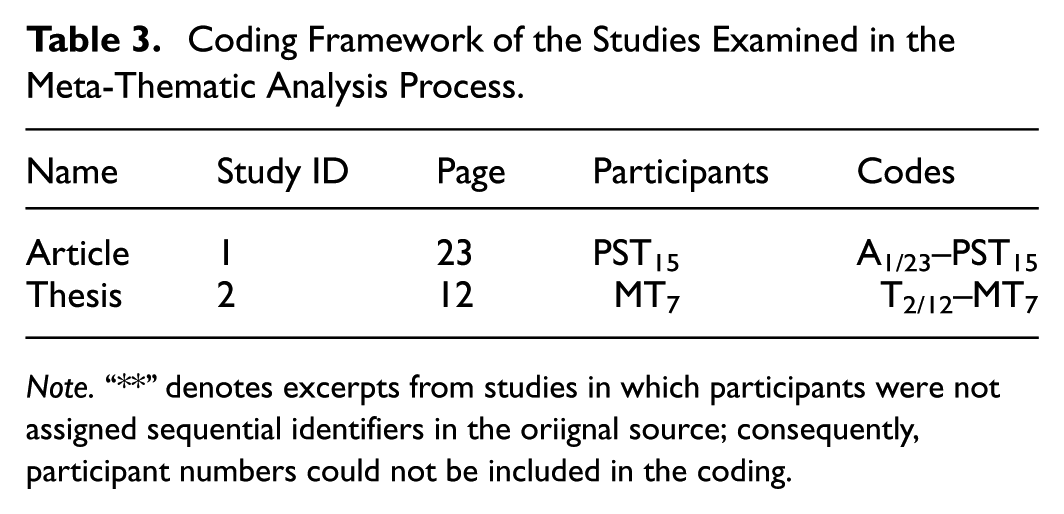
Note.“**” denotes excerpts from studies in which participants were not assigned sequential identifiers in the oriignal source; consequently, participant numbers could not be included in the coding.
In this study, the collected research was examined in detail using document analysis, and the coding process was conducted with the support of MAXQDA software. The coding procedure followed the stages of open coding, axial coding, and selective coding (Strauss & Corbin, 1998). These stages enabled the systematic categorization and analysis of the data. Participant perspectives (raw data) extracted from the reviewed studies were examined repeatedly, and new themes and codes were generated accordingly. Throughout this process, the consistency and reliability of the coding were considered critical factors in enhancing the rigor of the analysis (Mayring, 2000). The themes and codes identified during the meta-thematic analysis were examined and interpreted in depth within the context of the participant perspectives analyzed in the studies (Batdı, 2021, p. 92).
Analyzes conducted independently by two researchers were compared, and Cohen’s Kappa reliability coefficient was calculated to determine inter-coder agreement (Cohen, 1960). The inter-coder agreement value was calculated as 0.92, indicating a high level of agreement. This result was recorded as an important finding supporting the reliability of the study. The coding process was carried out collaboratively by the researcher and an academic expert in the field. The studies were analyzed independently, the resulting themes and codes were compared, and any discrepancies that emerged were resolved through academic discussion. Following the resolution of these differences, the coding process was finalized, thereby strengthening the reliability of the research.
Ethical Procedures and Informed Consent
This study was approved by the Gaziantep University Social and Human Sciences Research and Publication Ethics Committee (Approval No: 730103), and participants’ rights were meticulously protected throughout the research process. Prior to the implementation, comprehensive written information regarding the purpose of the study, the research procedures, and the use of data was provided to all students and, in the case of participants under the age of 18, to their parents or legal guardians. Informed consent forms based on voluntary participation were obtained accordingly. The parental informed consent form used in the study is provided in the Appendix 2.
As the study was designed as an instructional intervention integrated into the regular curriculum, it posed no physical or psychological risk to the students. During the data collection process, participants’ personal identities were kept confidential, and anonymity was ensured through the use of coded identifiers (e.g., S1, S2) in all analyses. The potential benefits of the study—namely, supporting students’ meaning-making processes related to mathematical concepts through GeoGebra and enriching their learning experiences—were deemed to outweigh the minimal level of risk associated with an instructional practice conducted within routine class hours and involving no non-standard or harmful procedures.
In addition, explicit written informed consent for the publication of anonymized visual materials (including classroom images presented in Table 2) was obtained from all participants and, where applicable, from their parents or legal guardians prior to data collection. Identifiable facial features in the images have been obscured to ensure full anonymity. Documentation of these consent forms is securely retained by the corresponding author and can be provided upon request.
Results
In this study, a meta-thematic analysis was conducted on the research studies identified in the literature. Through this type of analysis, it was aimed to analyze data obtained from qualitative studies in order to generate detailed and comprehensive findings. The themes and codes derived from the analyses were presented in the form of models. These models address four dimensions of GeoGebra: its effects on academic achievement, its impact on the learning process, its influence on attitudes toward the course, and its limitations.
Figure 2 presents the codes expressed with respect to the contributions of GeoGebra applications to achievement in mathematics courses. The codes grouped under this theme represent aspects of GeoGebra that directly contribute to academic achievement. Some participant statements referencing the codes within this theme are as follows:
“At first, I couldn’t understand what the teacher explained. But I immediately understood what was on the computer. I understood the computer part the most. I drew it myself, which made it easier to understand. The computer makes learning easier.” T3/65– S** “Previously, what I knew was based on memorization. But with these kinds of applications, I draw, see, and try by myself. That’s why it’s better.” A3/9– S**

The effect of GeoGebra on math course success.
In conclusion, students indicated that GeoGebra accelerates the learning process, facilitates learning, helps them better understand of concepts, and positively affects exam performance. These findings indicate that GeoGebra makes significant contributions to enhancing students’ academic achievement.
Figure 3 presents the codes related to the aspects of GeoGebra applications that enhance learning processes. The codes grouped under this theme demonstrate that GeoGebra supports the learning process by facilitating the understanding of mathematical concepts. Some participant statements referring to the codes within this theme are as follows: “It became easier to visualize mathematical concepts in my mind.” A3/8– S** “I think that using GeoGebra software in mathematics instruction would be beneficial for teachers. When I reach a level where I can teach using this software, I believe I will not struggle to explain many topics that students find difficult.” A2/16– PST8 “…For example, when I saw the limit theoretically, I couldn’t understand what it was. But when I built it with GeoGebra, I easily saw the relationship between them.” A2/18– PST25 “Sometimes I worry that I won’t be able to explain a topic or meet students’ expectations in mathematics teaching. When mathematical expressions are very abstract, hard to understand, or meaningless, I believe I can express them better with GeoGebra. GeoGebra can be more effective in mathematics teaching because it visualizes and concretizes the concepts.” A2/15– PST18 “The best aspect is that it is dynamic. This is a great advantage because you can see movement there. You can move the point, move the graph. You can move everything you draw. You don’t have that opportunity on the board. Sometimes you can’t even draw properly. You can’t fully show what you want to show. I think this can be helpful.” T4/71– TE1
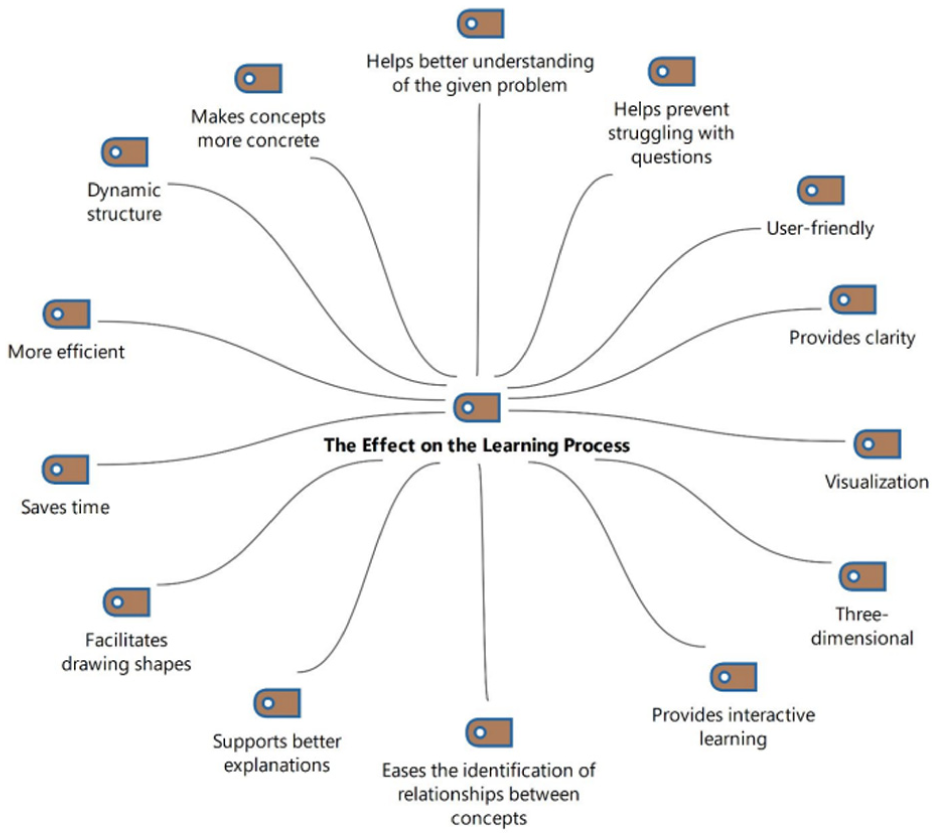
The effect of GeoGebra on learning process.
In conclusion, the statements under this theme reveal that GeoGebra applications are a powerful learning and teaching tool for both students and teachers, particularly by facilitating the concretization, visualization, and understanding of mathematical concepts through its dynamic features.
Figure 4 presents the codes related to the aspects of GeoGebra that influence student motivation and attitudes toward mathematics lessons. The codes under this theme indicate positive changes in students’ attitudes toward mathematics and increases in their motivation. Increased interest in the lesson, reduced mathematics anxiety, and the encouragement of active participation were observed. It was also reported that GeoGebra enhances not only students’ interest but also pre-service teachers’ engagement with the subject and contributes to the development of teaching-related self-confidence.

The effect of GeoGebra on attitudes toward the course.
Participants emphasized that GeoGebra offers greater opportunities for interaction and practice during lessons, thereby making the learning process more meaningful. In addition, the ability to conduct individual explorations and examine concepts independently made learning more appealing for students.
Both students and pre-service teachers stated that mathematics lessons became more engaging, meaningful, and aligned with their interests through the use of GeoGebra. They noted that the use of digital tools made mathematics learning more enjoyable and helped them follow lessons more attentively. Some participant statements referring to the codes within this theme are as follows:
“After learning to use GeoGebra in mathematics teaching, my confidence increased. As I develop myself in this software, I believe I will become a more effective teacher and succeed in teaching mathematics.” A2/14– PST1 “Instead of lessons constantly taught on the board with a pen, being able to do it practically ourselves helped my development.” A3/9– S** “GeoGebra impressed me a lot because I saw theorems I didn’t know before, and now I want to teach them using GeoGebra… because my confidence increased, I overcame my fear, and now nothing can stop me.” A2/15– PST6
In conclusion, the statements under this theme indicate that GeoGebra positively affects students’ and pre-service teachers’ attitudes toward lessons, enhances their motivation, supports confidence development, and provides a more interactive, meaningful, and enjoyable learning environment for mathematics teaching.
Figure 5 presents the limitations of GeoGebra applications as expressed by the participants. Although GeoGebra has many strengths that support the learning process, several limitations were also reported by students, pre-service teachers, and teacher educators. These limitations were categorized into technical, pedagogical, and individual dimensions.

Limitations of GeoGebra.
From a technical perspective, the main limitations include the software’s inability to support certain mathematical formulas and symbols, the complexity of its structure making it difficult learn and users lack of full mastery of its features. A teacher educator emphasized that effective use of the software requires understanding both the tool itself and the underlying mathematical concepts, and that a deficiency in either can hinder learning:
“Students need to be taught this program well. They need to understand both the tool and the software and make an effort to learn. If they don’t know the concepts, they also need to learn those. When two things that are hard to understand overlap, it leads to a deadlock.” T4/78– Te1
In the pedagogical context, some students reported reluctance toward using computers during lessons and stated that they preferred traditional instructional methods. This finding highlights the importance of teacher guidance when transitioning to technology-supported learning environments. One student expressed this view as follows:
“There is no need to use a computer in class. I prefer the teacher to explain the lesson. I would rather listen to the teacher than learn from the computer.” T3/67– S**
Among individual limitations, some students struggled to use the program effectively due to a lack of digital literacy. Additionally, some students were cautious about computer-based learning, citing potential health concerns associated with prolonged computer use. One student expressed this concern:
“I don’t find lessons taught with a computer as useful as lessons taught with a book because computers emit radiation, but books do not.” T3/66– S**
In conclusion, the statements under this theme indicate that, despite these limitations, GeoGebra remains an effective learning tool that encourages students’ active participation in problem solving and supports the development of higher-order skills such as analytical thinking, error analysis, and collaborative evaluation.
Findings Obtained at the End of the Implementation Process
In the first stage of this study, qualitative research studies in the literature were examined using the meta-thematic analysis method, and a thematic structure was developed regarding how GeoGebra has been addressed in the context of mathematics education. This structure was organized under five main themes: academic achievement, learning process, attitude toward the lesson, skill development, and limitations.
Within the framework of this thematic structure, student views regarding the experiences of ninth-grade students who participated in GeoGebra-supported instruction were collected during the implementation process. The qualitative data obtained from semi-structured interviews revealed patterns that closely overlapped with the themes identified through the meta-thematic analysis. In particular, students’ statements demonstrated significant parallels with many of the codes under the Learning Process theme.
Students frequently emphasized aspects of GeoGebra such as its ability to visualize abstract mathematical concepts, facilitate graph drawing, and contribute to making topics more comprehensible. For example, the statements “I modeled functions using GeoGebra; it helped me a lot with questions I did not understand” (S21) and “Being able to see functions that I could not visualize in my mind helped me understand the topic” (S13) are associated with the codes of visualization, conceptual understanding, and concretization. Similarly, the statements “It becomes easier for me to show graphs” (S16) and “Supporting lessons with visuals and seeing them dynamically provided a real advantage” (S20) correspond to the codes of ease of drawing, clarity, and interactive learning.
In addition, statements such as “It both reinforced what I had learned and taught me new things” (S16) and “Observing things that we cannot see in real life through GeoGebra helps with reinforcement” (S17) point to the codes of reinforcement, retention, and connection to daily life. These findings indicate that students experienced the GeoGebra-supported learning process not merely as a means of acquiring information, but as a process of constructing and making sense of knowledge.
The concentration of student views predominantly around the Learning Process theme is noteworthy. This finding suggests that students perceived GeoGebra not only as a visual support tool but also as a dynamic pedagogical tool that structures the learning process, increases interaction, and allows for individual differences in learning. The thematic overlap between the themes obtained from the meta-thematic analysis and the student experiences that emerged during the implementation process indicates consistency among the findings obtained from different stages of the study.
Discussion
The findings of this study indicate that the dynamic mathematics software GeoGebra can play a pedagogically meaningful role within the context of mathematics teaching and learning. While the findings provide valuable insights into GeoGebra’s role, it is important to note that the study was conducted in a single classroom with a limited number of participants, which may affect the generalizability of the results. GeoGebra is considered not merely a technological tool providing visual support, but as a learning environment that enhances interaction with abstract mathematical concepts and enriches students’ learning experiences. Within the two-stage exploratory qualitative design employed in this study, the thematic structure developed through meta-thematic analysis was interpreted alongside student perspectives obtained from a real classroom setting. This approach enabled the discussion of thematic overlaps and divergences between the prominent themes emerging in the literature and the students’ experiences in the implementation context. Given the substantial body of research on GeoGebra in mathematics education, this study does not aim to develop a new theory but rather seeks to provide an integrative contribution to existing knowledge by synthesizing qualitative literature from 2015 to 2025 and supporting it with classroom-based empirical data.
One of the notable findings of the study concerns how students experience GeoGebra in their processes of understanding mathematical concepts. In particular, the dynamic and visual representation of abstract concepts such as functions, graphs, and algebraic relationships through GeoGebra appears to provide students with a learning experience that allows them to recognize relationships among these concepts. This aligns with Yerushalmy and Shternberg’s (2001) notion of multiple representation fluency, suggesting that students’ transitions between algebraic and graphical representations are experienced as a learning process that supports mathematical thinking. In this context, GeoGebra is perceived not merely as a tool for presenting mathematical knowledge but as a learning environment in which students can reorganize mathematical objects and establish connections across different representations. Statements such as “I understood better when I drew it myself” highlight the importance of learners constructing their own representations from a constructivist perspective (DiSessa, 2018). Such experiences suggest that mathematical thinking is not simply a process of reaching a solution, but rather involves making connections between representations and generating meaning through these relationships.
The interactive nature of GeoGebra demonstrates that students can engage directly with mathematical objects in a dynamic learning environment. Student feedback indicates that observing the immediate effects of changes in mathematical parameters on graphs supports a more exploratory and experiential approach to learning. These experiences, when considered within the framework of instrumental genesis theory (Drijvers, 2019), provide insights into how digital tools are appropriated as part of the learning process. Statements such as “I could better see the change in the function as I moved the graph” illustrate that students understand mathematical relationships through dynamic processes rather than static representations. In this sense, GeoGebra functions as a learning environment that enables students to experiment, explore different possibilities, and generate meaning based on their observations. The continuous interaction with dynamic representations can be interpreted as a structure that allows students to engage in the learning process more actively and inquisitively (Zhou, 2025).
The study also provides important insights into how GeoGebra-supported instruction affects students’ motivation and attitudes toward mathematics. Students’ perspectives indicate that lessons conducted with GeoGebra are perceived as more engaging and participatory. This suggests that students are more willing to engage in mathematical activities and find the learning process more meaningful. From the perspective of self-determination theory (Deci & Ryan, 2013), GeoGebra-supported learning environments appear to satisfy students’ needs for autonomy, competence, and relatedness. Students’ reports of developing a sense of control over their learning through exploratory activities relate to autonomy; their ability to experiment with mathematical representations relates to competence; and classroom interactions and shared activities relate to relatedness. In this way, GeoGebra is experienced as a learning environment that allows students to develop meaningful relationships not only with content but also with their own learning processes (Goldin, 2014).
Furthermore, the findings indicate that GeoGebra-supported learning environments can accommodate individual learning preferences. Student perspectives suggest that the combined use of visual representations, interactive activities, and algebraic expressions provides meaningful learning opportunities for students with diverse learning preferences. This can be interpreted as a learning experience that makes student heterogeneity, often overlooked in mathematics instruction, more visible (Hariri et al., 2025). Students’ ability to construct their own representations, regulate their learning pace, and structure problem-solving processes individually can be associated with learner agency as described in the literature. As Biesta and Tedder (2007) note, learner agency reflects the individual’s capacity to interpret the learning process based on their own experiences rather than external direction. In this study, students’ statements—such as “I drew it myself and understood it better” or “I solved the problem by moving the graph”—indicate that learners actively participated in their learning process and assumed agentic roles in constructing mathematical meaning.
In this context, GeoGebra is experienced as a learning environment in which students do not merely consume provided knowledge but actively engage with mathematical objects to create their own learning pathways. Similarly, research by Kumpulainen and Gillen (2019) on digital learning environments, which focuses on multimodal expression and learner agency, suggests that the interactivity and representational variety offered by GeoGebra may provide a context that supports the development of learner agency.
Conclusion and Recommendations
The findings of this study provide significant insights into how GeoGebra can be positioned as a pedagogically meaningful tool in mathematics education. Qualitative evidence based on student perspectives suggests that GeoGebra is experienced not merely as a supportive technological tool but as a learning component that enriches conceptual understanding, allows students to navigate between multiple representations, and supports mathematical meaning-making. Accordingly, it is recommended that GeoGebra be pedagogically integrated into curricula, particularly in areas such as functions, geometry, mathematical modeling, and multiple-representation skills. Such integration should move beyond a narrow focus on tool usage and be designed to foster students’ conceptual thinking, relational reasoning, and representational fluency.
From the perspective of teacher education, the findings indicate that training programs focusing solely on the technical aspects of the software are insufficient for effective and meaningful use. Teachers need comprehensive professional development programs, structured within the Technological Pedagogical Content Knowledge (TPACK) framework, that enable them to integrate GeoGebra into mathematics teaching pedagogically. These programs should encourage teachers to design, implement, and reflect on lesson plans by combining technology, pedagogical strategies, and mathematical content knowledge. In this way, teachers can become not only competent users of GeoGebra but also practitioners who leverage the software to enhance students’ cognitive and affective learning experiences.
Moreover, the sustainable and inclusive implementation of GeoGebra’s pedagogical potential depends on specific contextual factors. Differences in students’ digital literacy, teachers’ experience with pedagogical integration of GeoGebra, and schools’ technical infrastructure are important variables that influence how digital tools are experienced in learning environments (Perry et al., 2019; Zengin, 2023). The present study was conducted in a single high school in southeastern Turkey with 30 ninth-grade students within a specific instructional context, which limits the direct generalizability of the qualitative findings. Therefore, the results should be interpreted as contextualized examples of how GeoGebra-supported instruction is experienced and interpreted by students in a particular setting. Future research is expected to examine similar or contrasting patterns of GeoGebra’s pedagogical use across diverse socio-cultural contexts, school types, and teacher profiles, employing qualitative or mixed-methods designs. In particular, design-based research approaches offer significant potential for investigating the long-term integration of GeoGebra into instructional practices, evaluating the sustainability of such integration, and developing context-sensitive instructional designs.
Finally, recent developments in artificial intelligence present new avenues for research in mathematics education when integrated with GeoGebra. The use of large language models, such as ChatGPT, in GeoGebra-supported learning environments to provide real-time hints, feedback, and personalized learning experiences can contribute to the development of innovative instructional approaches. However, for such integrations to be pedagogically meaningful, research is needed to support teachers’ and students’ critical and informed use of these systems. In this context, addressing digital inequalities, strengthening technical infrastructure, and designing technological tools in a culturally responsive manner are crucial to ensuring equitable and sustainable use of GeoGebra and similar digital tools in education.
Footnotes
Appendix 1
Appendix 2

Ethical Considerations
The study was conducted in accordance with the ethical standards of the Higher Education Institutions Scientific Research and Publication Ethics Directive and approved by the Gaziantep University Social and Human Sciences Ethics Committee. (Protocol code: 730103).
Consent to Participate
Written informed consent was obtained from all individual participants included in the study as well as their legal guardians for participants under the age of 18.
Funding
The authors received no financial support for the research, authorship, and/or publication of this article.
Declaration of Conflicting Interests
The authors declared no potential conflicts of interest with respect to the research, authorship, and/or publication of this article.
Data Availability Statement
The qualitative data analyzed during the current study are available from the corresponding author on reasonable request, subject to ethical approval and participant privacy*.