







Abstract
Recent research on counterproductive work behaviors (CWB) has clearly distinguished between organizational-directed and individual-directed forms of CWB. Organizational-directed counterproductive work behaviors (CWB-O) pose a significant threat to organizational effectiveness and employee well-being. However, there remains a gap in research regarding the psychological mechanisms by which perpetrators subsequently engage in positive behaviors. Drawing on moral cleansing theory, this study, based on two-wave survey data from 489 Chinese employees, explores the relationship between CWB-O and organizational citizenship behaviors (OCB-O). The results reveal that employees who engage in CWB-O experience higher levels of guilt and stronger perceptions of moral impurity, both of which independently and positively mediate the impact of CWB-O on OCB-O. Furthermore, we find that employees’ traditionalism orientation positively moderates the indirect effects of CWB-O on OCB-O through guilt experience and moral impurity perception, with the mediation effect being more pronounced for employees with higher traditionalism orientation. This study extends moral cleansing theory and highlights the role of cultural values in shaping workplace moral self-regulation.
Plain Language Summary
Lately, studies on counterproductive workplace behavior (CWB) have shown that CWB can be aimed at either the organization or individuals, and there are differences between the two. In this research, we used the moral cleansing theory to figure out how organization - targeted CWB (CWB - O), like stealing from the company or being deliberately late, is related to organization - targeted citizenship behaviors (OCB - O), such as volunteering to help the company or promoting its good image.We found that when employees do CWB - O, they often feel guilty and think they’ve done something morally wrong. These feelings seem to be a link between CWB - O and OCB - O. That is, these negative feelings might make employees more likely to do OCB - O as a way to make up for their bad behaviors. Also, an employee’s sense of tradition plays a role. Employees with a stronger sense of tradition are more likely to feel bad and think they’re morally impure after doing CWB - O. This makes the connection between CWB - O and OCB - O, through these negative feelings, stronger for them. On the other hand, employees with a weaker sense of tradition don’t have this as strongly. We surveyed 489 Chinese employees twice to test these ideas, and the results of the survey supported what we thought.
Keywords
Introduction
Counterproductive work behavior (CWB) refers to intentional actions that harm the legitimate interests of organizations and their members (Koopman et al., 2021). Among its two primary forms—organization-targeted CWB (CWB-O) and individual-targeted CWB (CWB-I)—CWB-O directly undermines organizational effectiveness through behaviors such as theft, sabotage, and deliberate absenteeism (Yang & Diefendorff, 2009). With the rapid digitalization of workplaces, CWB-O has become increasingly prevalent and sophisticated, manifesting in acts like cyber-slacking and online fraud, which impose substantial costs on organizations (Malik et al., 2021). Despite its prevalence, the psychological aftermath for perpetrators themselves has received scant attention.
Existing research has predominantly adopted a victim-centric perspective, focusing on how organizational factors mitigate CWB, while neglecting the moral and emotional experiences of those who engage in such behaviors (Marcus & Schuler, 2004). Moreover, most studies treat CWB as a unitary construct, obscuring critical differences between CWB-O and CWB-I in terms of antecedents, consequences, and psychological mechanisms (Berry et al., 2007). This oversight is problematic because CWB-O, by targeting the organization rather than individuals, may elicit distinct moral self-regulatory responses from perpetrators. Specifically, employees who commit CWB-O may subsequently experience guilt and perceive their moral self as tainted, prompting them to engage in compensatory behaviors to restore their moral equilibrium (Tetlock et al., 2000). Thus, current researches remain unclear whether and how CWB-O triggers subsequent prosocial behaviors toward the organization after its occurrence. And they fail to explain the psychological mechanisms by which actors transition from harming the organization to actively promoting its interests. The limitations of existing studies may overlook an important self-correcting process in employee behaviors and provide no guidance for organizations to avoid counterproductive practices or determine how to facilitate moral repair following workplace deviance. Furthermore, compared to interpersonally directed CWB-I, CWB-O may elicit distinct moral self-regulatory responses in actors. Unlike deviant acts targeted at individuals, CWB-O—such as intentional work slowdowns, excessive breaks, or misuse of organizational resources—harms an abstract collective entity rather than an identifiable individual. Theoretically, this characteristic may either alleviate the actor’s moral discomfort (due to diffused harm and less salient victims) or exacerbate it (because the organization embodies shared values and collective well-being). Prior researches have not examined which outcome prevails, nor can they guide organizations in facilitating natural moral repair among employees who engage in organization-directed deviant behavior.
CWB-O is conceptually linked to OCB-O through the moral cleansing theory. This theory posits that individuals who engage in unethical behavior experience psychological distress and restore their moral self-image through compensatory moral actions (Tetlock et al., 2000; West & Zhong, 2015). First, research on moral emotions indicates that transgressions against valued entities elicit guilt—a self-conscious emotion characterized by remorse and tension—thereby prompting individuals to take remedial actions (Tangney et al., 2007). In the workplace, meta-analytic findings confirm that employees who feel guilty for harming the organization are more likely to engage in prosocial extra-role behaviors (Ilies et al., 2013). Second, studies on cognitive self-evaluation suggest that unethical behavior undermines individuals perceived moral self-worth, creating a sense of moral impurity, and individuals seek purification through subsequent moral actions (Sachdeva et al., 2009; Zhong et al., 2010). Third, research on the CWB-OCB relationship provides preliminary evidence that perpetrators of transgressions sometimes exhibit higher levels of citizenship behavior, implying the presence of compensatory dynamics (Klotz & Bolino, 2013; Zhu & Xu, 2022).
Traditionality is defined as the extent to which individuals accept values rooted in Confucian culture, such as prioritizing collective interests and norm compliance (Farh et al., 1997; Yang, 2003), and it enhances the moral sensitivity of CWB-O perpetrators. First, employees with high traditionality hold stricter moral self-standards and are more likely to internalize violations of organizational rules as personal moral failures, thereby exacerbating guilt (Liao et al., 2018; Xie et al., 2008). Second, the self-concept of such employees is more strongly derived from role obligations and collective welfare; thus, actions that harm organizational interests threaten their core identity, leading to stronger perceptions of moral impurity (Hui et al., 2004; Lu et al., 2017). Third, empirical studies demonstrate that traditionality amplifies negative emotional and cognitive responses to transgressions related to oneself, making individuals with high traditionality more inclined to engage in compensatory moral behaviors (Hu et al., 2022).
Drawing on moral cleansing theory, the present study addresses this gap by adopting a perpetrator-centric lens to examine how CWB-O triggers subsequent organization-targeted citizenship behavior (OCB-O) through two parallel pathways: guilt experience (a self-conscious moral emotion) and perceived moral impurity (a moral cognition). Furthermore, we investigate whether employee traditionality—a cultural value emphasizing collective interests and role obligations—moderates these mediated relationships. By doing so, we aim to answer the following questions:
This research may offer three contributions. First, by advancing the understanding of CWB-O by illuminating its positive downstream consequences through moral cleansing, challenging the prevailing view that CWB only yields negative outcomes. Second, by integrating affective and cognitive mechanisms within moral cleansing theory, providing a more comprehensive account of how unethical behavior can be transformed into pro-organizational action. Third, by examining the moderating role of traditionality in a collectivist cultural context, it reveals how individual differences in cultural values shape moral self-regulation, thereby extending the boundary conditions of moral cleansing theory.
Literature Review and Development of Hypotheses
Moral Cleansing Theory
Moral cleansing theory originates from the moral balance model, which explains how individuals transition between moral and immoral behaviors. The moral balance model posits that individuals’ moral standing and prior behaviors shape their subsequent moral decisions (Nisan & Horenczyk, 1990). In general, individuals maintain a relatively stable moral balance point and an idealized moral self-image. Previous moral behavior affects one’s self-moral perception and actual moral self-evaluation through moral regulation, and individuals tend to adjust their behaviors (to be more positive or more negative) to maintain their moral balance within a given period (Liao et al., 2018). For instance, when actual moral self-evaluations deviate from one’s ideal moral self-image, individuals engage in moral or immoral behaviors to restore moral balance (Miller & Effron, 2010). Specifically, prior moral behavior can elevate moral self-perceptions, which may activate the moral licensing mechanism and increase the likelihood of engaging in immoral behavior—a shift “from good to bad” (Griep et al., 2021). Conversely, prior immoral behavior—such as abusive supervision or CWB—can activate the moral cleansing mechanism, prompting individuals to engage in subsequent moral behaviors, representing a “from bad to good” transition (Liao et al., 2018). Furthermore, prior immoral behavior can diminish perpetrators’ moral self-perceptions and undermine their established moral self-images. It may also motivate compensatory moral behavior through self-conscious moral emotions or moral cognition mechanisms (Burmeister et al., 2019; Liao et al., 2018). Therefore, moral cleansing theory is particularly relevant to our investigation, as it offers an overarching framework for understanding how CWB-O elicits self-conscious moral emotion or moral cognition, ultimately triggering OCB-O as a compensatory response.
Moral Emotional and Cognitive Responses to CWB-O
As a prevalent form of unethical workplace behavior (Cohen et al., 2014), CWB refers to actions that harm or have the potential to harm the interests of the organization or its members (Fox et al., 2001). CWB may be spontaneous or deliberate and often involves harmful or deviant actions (Fox et al., 2012). Building on these characteristics, CWB has evolved into an overarching construct encompassing a wide range of harmful organizational behaviors (Marcus & Schuler, 2004), from serious violations such as theft, vandalism, and disclosure of organizational secrets to more ambiguous or minor behaviors such as tardiness, early departure, rumor spreading, and reprimanding colleagues. CWB is typically conceptualized as two distinct dimensions based on its target: organization-directed CWB (CWB-O) and individual-directed CWB (CWB-I; Berry et al., 2007). This two-dimensional structure demonstrates strong discriminant validity in the Chinese context (Rotundo & Xie, 2008).
While earlier research has typically treated CWB as a holistic construct and examined its consequences (Carpenter et al., 2021; Ilies et al., 2013), recent studies have identified substantial differences between its two dimensions (Ciampa et al., 2021). Compared with CWB-I, CWB-O appears less influenced by interpersonal conflict or risk-taking tendencies. Employees may perceive self-serving CWB-O as non-detrimental to the interests of other organizational members. However, individuals generally value morality and incorporate collective interests into their self-concept (Wang et al., 2022). The overtly harmful and norm-violating nature of CWB-O undermines employees’ long-held moral values and is likely to evoke moral dissonance in perpetrators. Therefore, this study incorporates two moral cleansing mechanisms that may be activated by CWB-O: self-conscious moral emotion and moral cognition.
First, we predict that CWB-O would elicit feelings of guilt among the perpetrators themselves. When individuals engage in behaviors that violate moral standards or harm others, they tend to engage in conscientious reflection, which in turn stimulates negative moral self-evaluations (Liao et al., 2018). This negative evaluation not only lowers perpetrators’ moral self-perception below their moral balance point, but also leads them to experience an anxious emotion accompanied by pain, remorse, and self-blame and guilt (Tangney et al., 1996). We argue that the harmful nature of CWB-O can result in direct financial damage to the organization and drive perpetrators to evaluate themselves negatively (Bolino & Klotz, 2015). Unable to justify actions that deviate from their moral values, individuals may attribute the negative consequences of these actions to their own moral failings and believe that they must pay for their unethical behavior, resulting in strong feelings of unease and tension and ultimately guilt (Tangney et al., 2007). Organizations typically advocate adherence to company codes of conduct, encourage members to contribute to organizational success, and work toward achieving collective goals (Kim & Ployhart, 2014). However, CWB-O, such as tardiness, absenteeism, and leaving early, is often explicitly prohibited because such behavior is viewed as unethical and detrimental to a company’s image and efficiency. Employees who spontaneously engage in CWB-O violate organizational norms and thus perceive themselves as immoral, a perception inconsistent with their ideal moral image and one that elicits feelings of guilt (Miller & Effron, 2010).
Second, this study predicts that CWB-O can lead perpetrators to experience perceived moral impurity. Specifically, individuals care greatly about their self-worth, which is defined to a large extent by how morally they perceive themselves (Dunning, 2007). When individuals commit immoral acts, they feel moral impurity and perceive their moral self-worth as threatened (Sachdeva et al., 2009). In addition to undermining employees’ long-established moral self-consciousness, CWB-O can also lead to feelings of moral impurity, as employees may receive negative comments from coworkers and become associated with “immoral” labels that damage their prior public moral image (Cohen et al., 2014). In addition, employees are often aware that their actions are harmful to the organization and violate its rules when they engage in CWB-O. This also diverts perpetrators from the goal of being the ethical individuals they strive to be and undermines their long-held sense of moral purity (Wang et al., 2022), thereby triggering perceived moral impurity. Consequently, we propose the following hypotheses:
CWB-O and OCB-O: The Mediating Role of Guilt Experience and Perceived Moral Impurity
According to moral cleansing theory, perpetrators of unethical behavior engage in compensatory behavior to restore the balance of their moral self-perception and cleanse themselves (West & Zhong, 2015). Furthermore, employees who have committed CWB show stronger prosocial tendencies and often take the initiative to engage in remedial actions that compensate victims and repair their moral image, such as organizational citizenship behaviors (OCB; Ilies et al., 2013). Regarded as widely esteemed and actively advocated moral conduct (Turnipseed, 2002), OCB refers to a series of extra-role behaviors performed voluntarily by employees. Such behaviors contribute to organizational development and performance yet remain unacknowledged by formal rules and regulations, nor are they incentivized by the remuneration system (Lee & Allen, 2002). In recent years, scholars have increasingly examined the antecedents of OCB and its complex relationship with negative work behaviors, such as counterproductive work behavior (CWB). Like CWB, OCB also includes organization-targeted (OCB-O) and individual-targeted (OCB-I) behaviors (Organ, 1997). The former directly serves organizational goals, such as actively maintaining the organizational image, whereas the latter focuses on supporting colleagues or teams (Lee & Allen, 2002). OCB-O is a set of behaviors that directly benefit an organization in line with its code of conduct (Tagliabue et al., 2020). It is influenced by individual emotional and cognitive factors (Lee & Allen, 2002). Given the altruistic, voluntary, and moral nature of the behavior, this study hypothesizes that when an employee commits CWB-O and recognizes its harmful impact on the organization, they will experience negative emotions and cognitions, which may drive them to subsequently engage in compensatory behaviors toward the organization. In other words, individuals may adopt OCB-O to alleviate guilt and cleanse their damaged moral image.
The guilt experience stemming from CWB-O consequences drives perpetrators to comply with organizational regulations and engage in compensatory behaviors beyond their formal duties (Turnipseed, 2002). This extra-role attribute is consistent with the characteristics of OCB-O (Organ, 1997), which typically manifests as conscientiousness, sportsmanship, compliance, and civic virtue (Ilies et al., 2013). Such OCB-O engagement can not only compensate for organizational losses and improve overall performance, but also alleviate employees’ guilt.
Second, the cognitive view of moral cleansing theory suggests that individuals monitor their feelings of moral self-worth and maintain their moral standards through moral cleansing (O’Connor et al., 2020). Immoral behavior negatively influences individuals’ perceptions of self-worth. Therefore, individuals can regain some of their lost moral worth through subsequent moral behaviors (Sachdeva et al., 2009). As mentioned earlier, OCB-O is a moral behavior that employees may adopt after acting against the organization’s interests, which can reduce the loss of moral image caused by their prior CWB-O (Organ, 1997) and help restore moral character in terms of compliance, loyalty, and conscientiousness. Additionally, OCB-O is spontaneous rather than motivated by a remuneration system, which makes it unexpectedly positive and not influenced by interpersonal relationships (Poon, 2019). OCB-O is more likely to allow perpetrators to receive appreciation and praise in the workplace. Therefore, it can be considered an effective way for employees to repair their immoral image and restore moral purity. Considering the self-conscious moral emotions and cognitive processes involved in moral cleansing, we propose the following hypotheses:
The Moderating Role of Employee Traditionality
Traditionality is defined as a systematic set of personal traits that individuals embrace under the influence of traditional Chinese culture, including attitudes, morals, values, and behavioral intentions (Yang, 2003), and reflects the degree to which they accept traditional values, concepts, and norms. It is rooted in the core ideas of “self-restraint and ritual restoration” and “group priority” in Confucian culture, and reflects individuals’ emphasis on collective interests, role obligations, and organizational norms (Yang, 2003). In addition, traditionality is a continuum, and individuals may hold different levels of it. Traditionality reflects individuals’ cultural values. Its application requires considering different cultural backgrounds and systematically examining its differentiated impact on moral cognition, emotion, and behavior, thereby providing a theoretical basis for cross-cultural moral management (Xie et al., 2008). In an organizational context, individual traditionality emphasizes the extent to which employees identify with traditional values on two dimensions: normative compliance and collective interests (Xie et al., 2008). Employees with varying levels of traditionality show significant differences in perceptions, emotions, and behaviors (Lu et al., 2017). Those who score high on traditionality are more likely to comply with various codes of conduct and regulations established by the organization and attach greater importance to their roles and obligations within the company (Hu et al., 2022). In addition, such individuals believe that they should not focus solely on personal interests; instead, they should be dedicated to protecting the interests of the organization (Farh et al., 1997) by exhibiting more prosocial extra-role behaviors (Hui et al., 2004). When such employees engage in CWB-O, their actions directly conflict with their internal ethical standards, resulting in serious moral disharmony. According to the moral balance model (Nisan & Horenczyk, 1990), employees with higher traditionality tend to form stronger negative evaluations of CWB-O due to their stricter moral self-requirements. This, in turn, leads to more intense feelings of guilt and moral impurity (Sachdeva et al., 2009). By contrast, those with lower traditionality tend to adhere to looser moral standards and justify CWB-O through cost–benefit analysis. Such employees experience lower levels of moral disharmony and thus exhibit weaker emotional and cognitive responses. Therefore, this study argues that when an individual engages in CWB-O, the level of employee traditionality may influence the individual’s assessment of the immorality of their behavior, which in turn influences the degree of guilt experience and the perception of moral impurity.
Specifically, we propose that employees with high levels of traditionality experience stronger feelings of guilt and perceive greater moral impurity when engaging in CWB-O than those with low traditionality. First, employees with high traditionality strictly abide by moral standards, place great importance on their role-based obligations, and show greater concern for collective interests. Therefore, they maintain higher internal moral self-requirements and oppose selfish behaviors that violate rules and regulations; thus, they are more likely to view CWB-O as profoundly unethical conduct. Highly traditional employees have a strong sense of identity with the social norm of “collective supremacy” and perceive CWB-O as a betrayal of the entire organization (Xie et al., 2008). Such employees are more likely to attribute CWB-O to their own moral flaws rather than to external circumstances, creating a stronger sense of responsibility (Liao et al., 2018), which exacerbates feelings of guilt and moral impurity. Low-traditional employees often suppress negative emotional and cognitive reactions through external attributions.
Once individuals commit CWB-O that conflicts with their traditional values, the prominent violation and harm to the organization are likely to create a strong sense of deprivation of their moral self-concept. This, in turn, may provoke extremely negative self-evaluations or even self-condemnation. Hence, perpetrators are inclined to consider taking full responsibility for the consequences (Burmeister et al., 2019) and subsequently feel a heightened level of guilt and a loss of self-moral purity.
By contrast, employees with low traditionality rely on cost–benefit assessments to determine whether to perform a behavior, prioritizing potential gains over moral implications (Poon, 2019). Therefore, such individuals are more likely to accept and adopt unethical behaviors that benefit themselves. Although the immoral nature of CWB-O may cause perpetrators to feel regretful or receive negative comments from colleagues, they tend to ignore the fact that such behavior violates rules and harms the organization. Therefore, the following hypotheses are proposed:
Considering the relationships outlined in the previous hypotheses, we further propose that the indirect effect of CWB-O on OCB-O through guilt experience and perceived moral impurity will differ depending on employees’ levels of traditionality. Specifically, while perpetrators’ guilt experience and perceived moral impurity tend to trigger direct compensatory behavior (Liao et al., 2018), employees with low traditionality may ignore such guilt or even reframe their perceptions to justify their past immoral behavior (West & Zhong, 2015). By contrast, because of their higher standards of moral self-importance, employees with high traditionality may experience higher levels of guilt and a stronger sense of perceived moral impurity. This leads them to feel regretful for their past misconduct, clearly recognize its immoral nature, and accept the resulting consequences (Yang, 2003). Furthermore, they are more willing to adopt compensatory behaviors, such as OCB-O (Lu et al., 2017). They attach great importance to the moral value of their actions and to organizational interests (Xie et al., 2008). They believe that OCB-O, a positive moral behavior with spontaneous and altruistic characteristics, aligns with their traditional values, can greatly alleviate their psychological guilt, and help recreate a pure moral image (Tetlock et al., 2000). Therefore, they are willing to undertake the costs of performing the act and are more likely to engage in “moral self-cleansing” through OCB-O. In summary, the following hypotheses are proposed:
The hypothesized model is presented in Figure 1.

Theoretical model.
Methods
Sample and Procedure
We collected data at two time points from enterprises in Guangdong, Fujian, and Hainan provinces in China. These regions were chosen for their diverse economic structures and cultural backgrounds, providing a broader context for the research. The research samples consisted of frontline employees from diverse sectors, such as finance, tourism, hospitality, and smart bathroom products. We first explained our research aims to the HR managers of the target companies and guaranteed the confidentiality of participants’ information. Once we obtained approval from the companies, we sent the questionnaire link via WeChat and asked the HR departments to assist in forwarding it to employees. The survey was administered using Wenjuanxing (www.sojump.com), a widely adopted Chinese online survey platform. We recruited full-time employees through this platform, which has been extensively used in recently published empirical studies for data distribution and collection (Liang et al., 2025; Wang et al., 2025; Zhang et al., 2025), thereby supporting the reliability of this data acquisition method.To mitigate potential common method bias, we employed a two-wave research design with a 1-week interval and incorporated multiple procedural remedies. These included embedding attention-check items (e.g., selecting identical responses for designated items and reentering age information in the second wave), temporally separating data collection, minimizing wording that might imply morally sensitive connotations, and informing participants in advance that the study did not involve any value judgments (Podsakoff et al., 2003; Tangney et al., 1996). We adopted a two-wave design with a 1-week time lag to reduce the impact of common method biases (Podsakoff et al., 2003; Tangney et al., 1996). Based on efficacy analysis and reference to the sample size requirements of similar mediation-adjustment model studies in the past (Hu et al., 2022), we ensured adequate statistical power, taking into account practical constraints such as time and resources. Power analysis was performed using G * Power 3.1 (Power = 0.80, α = .05, effect size f2 = 0.15), and the minimum sample size was calculated to be 391. To account for potential churn and ineffective responses, we aimed to collect data from approximately 500 participants in total. At Time 1, we collected demographic information from 530 participants and conducted surveys on CWB-O, guilt experience, perceived moral impurity, and traditional employee loyalty. The last four digits of participants’ cell phone numbers were requested and used for further matching. At Time 2, after excluding invalid samples (incomplete or inattentive information), the OCB-O questionnaires were distributed. A total of 489 employees completed the survey, yielding a response rate of 92.26%. Among the 489 valid paired samples, 44.2% were male and 55.8% were female. Their average age was 32.40 years (SD = 8.660), with 86.1% having a bachelor’s degree or above, and the average tenure was 10.27 years (SD = 8.713), with 41.5% of them working for more than 10 years. The industry distribution is finance (28.2%), tourism (24.6%), hotel (21.3%), smart bathroom products (18.9%), and other industries (7.0%). They are all frontline employees with no management participation to ensure the homogeneity of the research objects.
Measures
All measurement instruments employed in this study were drawn from well-established scales frequently used in prior research. Considering that our respondents were employees of Chinese domestic organizations, we followed Brislin’s (1980) rigorous translation-back translation procedure to translate all items into Chinese. We additionally sought input from language specialists and management experts to refine item wording, thereby enhancing accuracy and readability. These scales have demonstrated widespread applicability in studies conducted within the Chinese context. For instance, they have been used in the effect of perceived HRM system strength on employees’ counterproductive work behavior(Jiao et al., 2025), paradoxical consequences of unethical pro-organizational behavior (Chen et al., 2023), and a moral disengagement of exploitative leadership and employee expediency (Cheng et al., 2023). Collectively, this evidence supports the contextual appropriateness of the scales for research in China.
Data Analytical Strategy
AMOS 21.0, SPSS 24.0 and its PROCESS 3.3 macros were used for the statistical analysis of the sample data in this study. Specifically, SPSS was used for descriptive statistical analysis, reliability, correlation analysis, and multiple linear regression analysis; AMOS was used for confirmatory factor analysis (CFA), path analysis test, and mediation effect test; PROCESS macros were used to test moderating and moderated mediation effects.
Results
Reliability and Validity Assessment
We conducted a series of confirmatory factor analyses (CFAs) to rigorously evaluate the measurement model in terms of indicator reliability, internal consistency, convergent validity, and discriminant validity. First, model reliability was assessed based on established criteria, including factor loadings greater than 0.60 for satisfactory indicator reliability, Cronbach’ s α coefficients exceeding 0.70 for adequate internal consistency, and composite reliability (CR) values above 0.70 (Hair et al., 2019). As shown in Table 1, all standardized factor loadings ranged from 0.690 to 0.818, providing evidence of strong indicator reliability. Cronbach’ s α coefficients ranged from 0.816 to 0.928, and CR values ranged from 0.823 to 0.929, further confirming the robustness of the model’s internal consistency. Overall, these results indicate that the measurement model demonstrates satisfactory reliability and meets the recommended thresholds for psychometric soundness (Salloum et al., 2019).
Assessment of the Measurement Model.

The subsequent step involved assessing the construct validity of the model. Convergent validity was examined by assessing whether each construct’s average variance extracted (AVE) exceeded the benchmark value of 0.50, as recommended by Fornell and Larcker (1981). All constructs reported AVE values above 0.534 (p < 0.001), providing strong support for convergent validity. As shown in Table 2, the five-factor model had the best data fit (χ2/df = 1.044, CFI = 0.998, TLI = 0.997, RMSEA = 0.010, SRMR = 0.027). The Satorra-Bentler chi-square test also revealed that the five-factor model was superior to other four alternative factor models, such as a four-factor model in which CWB-O and guilt experience were set to load on a single factor (S-BΔχ2(4) = 442.786, p < 0.001), and a three-factor model in which CWB-O, guilt experience, and perceived moral impurity were loaded together (S-BΔχ2(7) = 981.671, p < 0.001). These results suggested that the five-factor model was significantly better than the other four alternative models, and our five constructs had good discriminant validity.
Comparison of Measurement Models.

Note. CWB-O = counterproductive work behavior toward organization; Gu = guilt experience; Im = perceived moral impurity; OCB-O = organizational citizenship behavior toward organization; Tra = employee traditionality. “+” refers to combination of variables.
Descriptive Statistical Analysis
Table 3 demonstrates the means, standard deviations, and coefficients of the variables. The results showed that CWB-O had a significant positive correlation with guilt experience (r = 0.430, p < .01), perceived moral impurity (r = .267, p < .01), and OCB-O (r = 0.359, p < 0.01); guilt experience (r = 0.367, p < 0.01) and perceived moral impurity (r = 0.414, p < 0.01) were also both positively correlated with OCB-O. Thus, Hypotheses 1a and 1b and Hypotheses 2a and 2b were preliminarily verified.
Means, Standard Deviation, and Correlation Coefficient.

Note. N = 489.
Refers to p < 0.01, *refers to p < 0.05.
Hypothesis Testing
We used path analyses with AMOS 21.0 to test the direct and mediating effects. Hypotheses 1a and 1b proposed that employee CWB-O was positively associated with guilt experience and perceived moral impurity. As shown in Table 4, the relationship between CWB-O and guilt experience was positive and significant (β = 0.514, SE = 0.057, p <0.001). Similarly, the relationship between CWB-O and perceived moral impurity was positive and significant (β = 0.332, SE = 0.054, p < 0.001). Therefore, both Hypotheses 1a and 1b were supported. Hypotheses 2a and 2b proposed that employees’ guilt experience and perceived moral impurity were positively related to OCB-O. The results revealed that guilt experience (β = 0.281, SE = 0.045, p <0.001) and perceived moral impurity (β = 0.379, SE = 0.048, p < 0.001) had positive and significant effects on OCB-O, therefore Hypotheses 2a and 2b were supported.
Test Results of Path Analyses and the Bootstrap Analysis of Mediation Effects.

Note. N = 489, LL = lower limit; UL = upper limit.
refers to p < 0.001.
To test the mediating effects of guilt experience and perceived moral impurity between CWB-O and OCB-O. We conducted the Bootstrap method with 2000 samplings to construct a 95% unbiased correction confidence interval (CI). The test results in Table 3 showed support for the mediating effect between CWB-O and OCB-O through guilt experience (indirect effect = 0.145, SD = 0.036, p < 0.001; 95% confidence interval (CI) [0.078, 0.220]) and perceived moral impurity (indirect effect = 0.126, SD = 0.031, p < .001; 95% CI [0.071, 0.195]). CIs did not include zero, hence Hypotheses 3a and 3b as were supported.
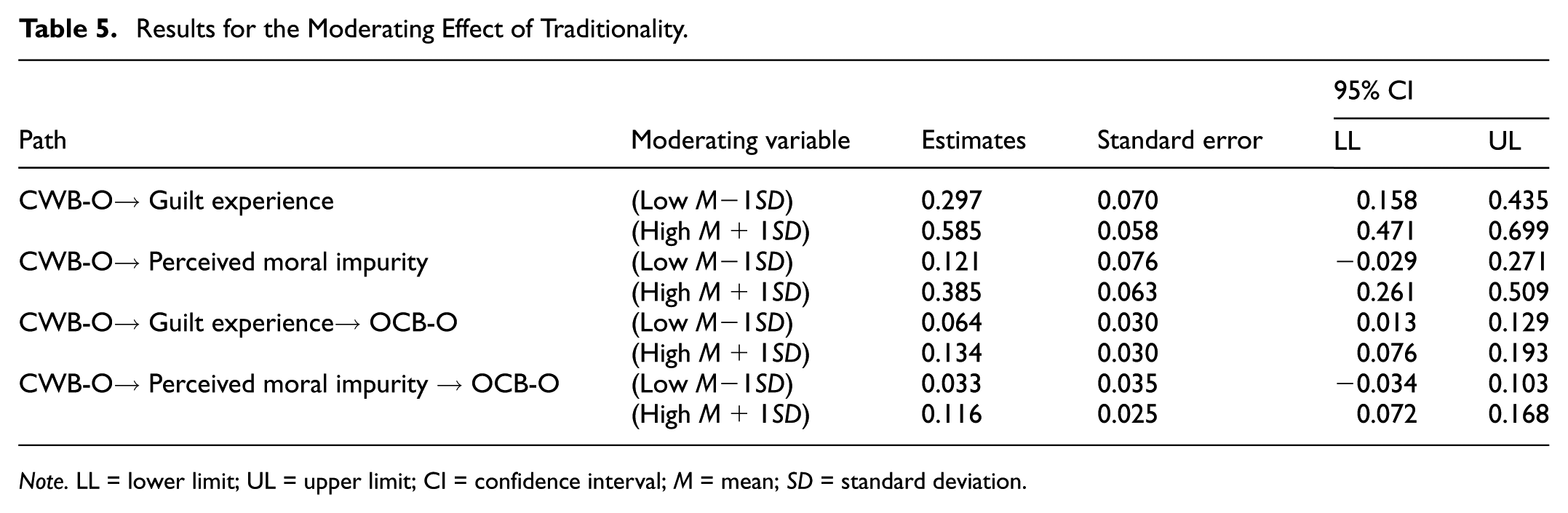
To test Hypotheses 4a and 4b, which stated that employee traditionality was a first-stage moderator, we used the SPSS PROCESS 3.3 macros. We controlled for gender, age, education and years of employment, and performed the Bootstrap method with 2000 samplings to construct a 95% CI. As shown in Table 5, the effect of CWB-O on guilt experience was more significant and stronger for high employee traditionality (M+1SD) (β = 0.585, SE = 0.058; 95% CI [0.471, 0.699]) than for low employee traditionality (M-1SD) (β = 0.297, SE = 0.070; 95% CI [0.158, 0.435]). The relationship between CWB-O and perceived moral impurity was also more significant when employee traditionality was at a higher level (M+1SD) (β = 0.385, SE = 0.063; 95% CI [0.261, 0.509]) but became non-significant (M−1SD) (β = 0.121, SE = 0.076; 95% CI [−0.029, 0.271]) when employee traditionality was at a lower level. Therefore, Hypotheses 4a and 4b were supported.
Results for the Moderating Effect of Traditionality.
Note. LL = lower limit; UL = upper limit; CI = confidence interval; M = mean; SD = standard deviation.
To reflect more directly on the moderating effect of employee traditionality, this study followed (Toothaker, 1994) suggestion and plotted simple slopes for a higher and lower level of employee traditionality. The results in Figures 2 and 3 indicated that when employee traditionality was high, the positive relationship between CWB-O and guilt experience as well as the positive relationship between CWB-O and perceived moral impurity were stronger. Hypotheses 4a and 4b were therefore further supported.
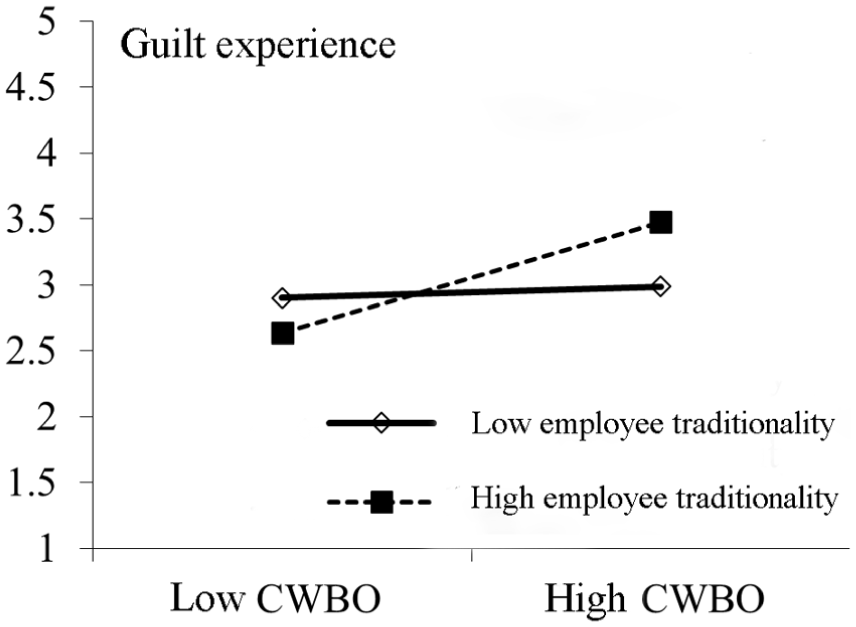
The moderating effect of employee traditionality on CWB-O and guilt experience.
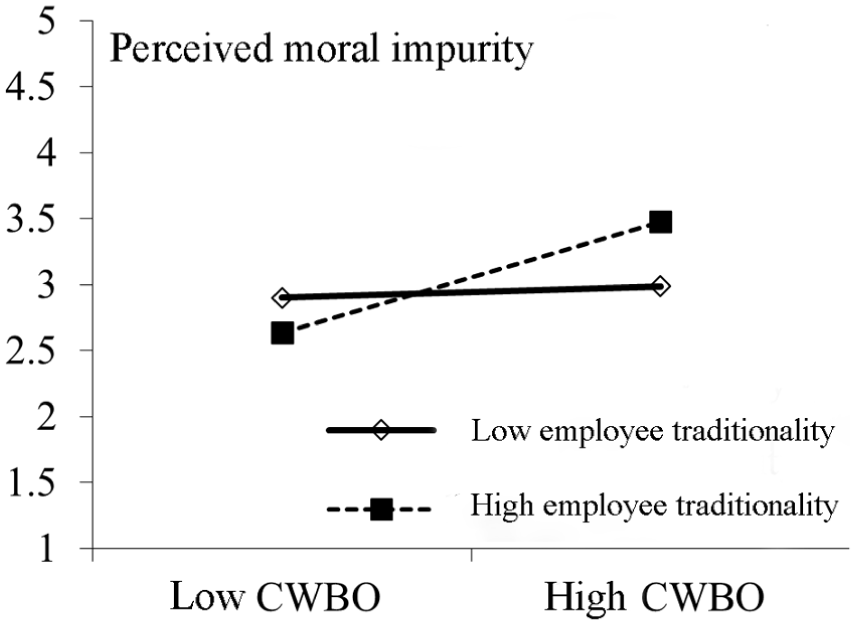
The moderating effect of employee traditionality on CWB-O and perceived moral impurity.
To test Hypotheses 5a and 5b for the moderated mediation effect, we continued to use the PROCESS 3.3 macros (Hayes, 2017). We still constructed 95% CIs by using the Bootstrap method to repeat sampling 2,000 times. As shown in Table 5, the indirect effect of CWB-O on employee OCB-O via guilt experience was stronger and positive when employee traditionality was taken at a higher level (M+1SD) (β = 0.134, SE = 0.030, 95% CI [0.076, 0.193]), but weaker when employee traditionality was low (M−1SD) (β = 0.064, SE = 0.030, 95% CI [0.013, 0.129]). In addition, Table 5 also revealed that when employees held a higher level of traditionality, the indirect effect of CWB-O on employee OCB-O via perceived moral impurity was significant (M+1SD) (β = 0.116, SE = 0.025, 95% CI [0.072, 0.168]) while it was non-significant when followers held a lower level of employee traditionality (M−1SD) (β = 0.033, SE = 0.035, 95% CI [−0.034, 0.103]). Therefore, Hypotheses 5a and 5b were supported.
Discussion
Discussion of Findings
First, our results demonstrate that CWB-O positively influences both guilt experience and perceived moral impurity (Hypotheses 1a and 1b). This finding aligns with moral cleansing theory, which posits that unethical behavior triggers negative self-evaluations and moral emotions (Tetlock et al., 2000). It extends prior work by showing that even organization-directed deviance, which may be perceived as less interpersonally harmful than individual-directed CWB evokes significant moral distress in perpetrators. This contrasts with earlier assumptions that CWB-O might be morally neutralized through organizational anonymity or diffusion of responsibility (Berry et al., 2007). The significant positive relationship suggests that employees internalize organizational harm as a personal moral transgression, regardless of the target. Theoretically, this can be explained by the inherent conflict between CWB-O and employees’ moral self-concept: even when behavior is directed at an abstract entity (the organization), individuals recognize that their actions damage collective interests, which are valued in any workplace but particularly salient in collectivist cultures (Yang, 2003). This recognition activates self-conscious emotions (guilt) and cognitive self-evaluations (moral impurity) as mechanisms of moral self-regulation (Sachdeva et al., 2009).
Second, both guilt experience and perceived moral impurity were found to positively predict OCB-O (Hypotheses 2a and 2b), and they mediated the CWB-O→OCB-O relationship (Hypotheses 3a and 3b). These findings corroborate and extend the work of Ilies et al. (2013) and Liao et al. (2018), who found that guilt motivates reparative behaviors. However, our study adds a novel cognitive pathway perceived moral impurity as an independent mechanism. Notably, the effect sizes for the two mediators were comparable, suggesting that both affective and cognitive routes are equally important in explaining moral cleansing following CWB-O. This dual-pathway finding advances moral cleansing theory by integrating emotional and cognitive perspectives that have previously been examined in isolation (West & Zhong, 2015). The mediating roles of guilt and moral impurity can be understood through the lens of moral balance theory (Nisan & Horenczyk, 1990). Employees who deviate from their moral baseline experience psychological discomfort, motivating them to restore equilibrium through compensatory behaviors. OCB-O, as a visible and valued form of prosocial behavior, provides an ideal avenue for moral restoration because it directly benefits the organization that was harmed. Importantly, both affective and cognitive pathways appear to operate simultaneously, suggesting that moral cleansing is not merely an emotional impulse but also involves deliberate cognitive reappraisal.
Third, employee traditionality positively moderated the relationships between CWB-O and both guilt experience and perceived moral impurity (Hypotheses 4a and 4b), as well as the indirect effects of CWB-O on OCB-O through these mediators (Hypotheses 5a and 5b). These moderation effects were particularly pronounced: for high-traditionality employees, the CWB-O→moral impurity path was significant, whereas for low-traditionality employees, it became non-significant. This pattern suggests that cultural values fundamentally shape how employees interpret and respond to their own unethical behavior. Employees with high traditionality, who internalize collectivist norms and role obligations (Farh et al., 1997) are more likely to experience moral dissonance when violating organizational rules, leading to stronger emotional and cognitive reactions. This finding extends research on traditionality by demonstrating its role not only in shaping prosocial behavior (Hui et al., 2004) but also in moderating responses to deviance. The stronger effects for high-traditionality employees can be attributed to their heightened moral sensitivity and sense of collective responsibility. For these individuals, CWB-O represents not just a rule violation but a betrayal of deeply held values. Their moral self-standards are more stringent, and they are less likely to justify or rationalize their deviance. Consequently, they experience more intense guilt and perceive greater moral contamination, which in turn motivates stronger compensatory efforts. In contrast, low-traditionality employees may employ cognitive strategies, such as external attribution or cost-benefit reasoning to minimize moral discomfort, dampening their emotional and cognitive responses.
Theoretical Contributions
First, CWB-O and CWB-I are not only different in terms of the intensity and object of the behavior, but they are significantly distinct in the harm, violation, and behavioral consequences (Ciampa et al., 2021). Therefore, we argue that it is necessary to study CWB-O and CWB-I separately. By centering on organizationally directed counterproductive work behavior (CWB-O), this study offers a nuanced account of the conditions under which perpetrators subsequently engage in organizational citizenship behavior directed toward the organization (OCB-O), as well as the mechanisms that facilitate this behavioral shift. In doing so, it broadens the current understanding of CWB-O and its downstream consequences. Drawing on a perpetrator-centered perspective, we delineate the negative moral emotions and self-evaluative cognitions that perpetrators are likely to experience and theorizes how moral self-cleansing triggers reflective processes regarding the immorality of their prior actions, ultimately motivating subsequent ethical behavior. We advance the literature—traditionally centered on team or organizational-level consequences of CWB—by addressing the overlooked psychological and behavioral ramifications for perpetrators themselves. The findings further indicate that organizations may formulate more holistic governance strategies for CWB by shifting from solely targeting antecedents to facilitating the transformation of its consequences, thereby offering a novel theoretical lens for understanding how “bad behaviors” embedded in CWB-O may evolve into “good behaviors.”
Second, although scholarship on moral cleansing has grown rapidly in organizational behavior, prior work has largely relied on either an emotional or a cognitive lens, leaving the full psychological sequence that connects immoral actions to subsequent compensatory behavior following CWB-O insufficiently theorized and empirically demonstrated. This study advances moral cleansing theory by empirically unpacking two theoretically distinct pathways, thereby offering a more fine-grained account of the mechanisms through which moral cleansing unfolds. Drawing on Kipfelsberger et al.’s (2016) theoretical framework, we empirically test the effects of two key mechanisms—self-conscious moral emotional responses and moral cognitive processing—and demonstrate the mediating roles of guilt experience and perceived moral impurity in linking CWB-O to subsequent OCB-O. The results indicate that guilt experience and perceived moral impurity constitute affective and cognitive pathways, respectively, each significantly predicting individuals’ subsequent OCB-O. These findings offer more systematic and structurally coherent evidence for moral cleansing theory. Moreover, the study illuminates the relative explanatory power and complementarity of these two pathways in accounting for the transition from immoral to compensatory behavior, while identifying the situational contingencies that amplify or attenuate their effects. Taken together, by empirically delineating the core psychological mechanisms and their boundary conditions, this research sheds light on why and how individuals may shift toward OCB-O after engaging in CWB-O, thereby strengthening both the explanatory power and the broader applicability of moral cleansing theory.
Third, this study enriches the empirical understanding of the CWB–OCB relationship. Although prior research has theorized that CWB may engender subsequent OCB via a moral cleansing effect (Klotz & Bolino, 2013), empirical evidence substantiating the underlying mechanisms has remained sparse. Third, this study enriches the empirical understanding of the CWB–OCB relationship. Although prior research has theorized that CWB may engender subsequent OCB via a moral cleansing effect (Klotz & Bolino, 2013), empirical evidence substantiating the underlying mechanisms has remained sparse. Building on these findings, we propose and validate a dual-path mediation model that integrates self-conscious moral emotions and moral cognitive processing, elucidating how CWB-O is transformed into OCB-O through the affective route of guilt and the cognitive route of moral impurity. This model demonstrates not only the distinct effects of these psychological mechanisms but also their complementary contributions in explaining the transformation from CWB-O to OCB-O. In doing so, it offers a more structured and theoretically coherent framework for interpreting the complex interplay between these behaviors.
Fourth, this study deepens understanding of the boundary conditions of moral cleansing and the dynamic mechanisms underlying CWB-O. We systematically examines the relationships among CWB-O, moral-emotional and moral-cognitive reactions, and moral compensatory behaviors, and identifies the moderating role of employee traditionality. The findings indicate that high-traditionality employees hold stricter moral self-standards, making it harder for them to accept past unethical acts and leading to stronger guilt experience and perceived moral impurity. Consequently, these employees are more likely to engage in OCB-O as a form of moral compensation. This finding clarifies which employees are more prone to negative moral emotions and cognitions after unethical behavior—and thus more likely to take compensatory actions—and offers clearer evidence of individual differences in moral cleansing. By showing how traditionality differently moderates emotional and cognitive pathways, this study extends evidence on how moral traits and situational factors jointly shape moral cleansing.
Fifth, this study analyzes the performance differences of moral cleansing theory among different traditional employees. The study found that high-traditional employees are more likely to undergo moral purification through OCB-O after CWB-O, while low-traditional employees show weaker salary motivations. Moreover, our findings challenge static cultural determinism by revealing that traditionality—a cultural value internalized at the individual level—moderates moral cleansing processes. This suggests that cultural influences are not monolithic but interact with personal agency (Farh et al., 1997). Crucially, we propose a cultural-individual reversibility mechanism: If high-traditionality employees in collectivist cultures can attenuate cultural constraints through moral self-regulation, individuals in individualistic societies may similarly cultivate “quasi-collectivist” traits through value internalization (Zhang et al., 2023). We believe that this has the following value for studying the collectivism-individualism debate in culture: First, the individual heterogeneity of cultural values. Even in highly collectivist cultures, there are still significant differences in employee identification of traditional values, which independently influence their moral decisions (Farh et al., 1997). This shows that cultural values are not a rigid and mandatory framework, and that individuals can achieve a certain degree of “cultural disconnect” through moral self-regulation. Second, the theoretical potential of cross-cultural reversibility: If individuals in a collectivist culture can weaken cultural constraints by reducing tradition, can individuals in an individualist culture cultivate similar highly traditional behavioral patterns by strengthening collective-oriented values? This opens up a new direction for cross-cultural comparative research. Future research can explore the formation mechanism of “quasi-collectivist” values in individualistic culture to test the boundary conditions of cultural dynamics (Zhang et al., 2023).
Managerial Implications
First, although this study shows that employees who engage in CWB-O may experience negative moral emotions and cognitions and subsequently engage in positive behaviors such as OCB-O, its purpose is not to justify or normalize CWB-O. Instead, the findings demonstrate that CWB-O intensifies employees’ guilt experience and perceived moral impurity, which in turn directly motivate compensatory responses. Accordingly, managers should recognize that employee behavior is dynamic and that employees may develop self-initiated repair motives after engaging in undesirable actions. Organizations can implement structured reflection mechanisms (e.g., reflection logs, consequence feedback) to help employees acknowledge the harm caused by CWB-O and reinforce the psychological pathway from negative moral experiences to compensatory behavior. This intervention directly aligns with the two mediating mechanisms identified in this study—guilt experience and perceived moral impurity. In addition, managers should utilize institutional and communication mechanisms to clarify organizational ethical standards, thereby enabling employees to recognize the harmful and unethical nature of CWB-O and motivating them to engage in moral repair through OCB-O.
Second, although guilt experience and perceived moral impurity are typically regarded as negative moral emotions and cognitions (Poon, 2019), this study demonstrates that both exert significant positive effects by motivating employees to engage in compensatory behaviors such as OCB-O. This finding suggests that such negative experiences are malleable and can function as resources in organizational ethics management. Accordingly, managers should frame these psychological experiences in a positive light and foster an ethical climate that supports self-repair. Specifically, ethics-focused meetings and moral dilemma discussions can help employees understand that, following deviant behavior, the priority is not concealment or punishment but self-reflection and self-repair. Organizations may also establish formal “compensation channels” that provide employees who have engaged in CWB-O with opportunities to restore their moral self-image through positive behaviors such as OCB-O. In doing so, organizations can more effectively translate the mechanism identified in this study—where negative experiences motivate compensatory behavior—into a usable managerial tool.
Third, this study shows that employee traditionality positively moderates the “CWB-O—guilt experience and perceived moral impurity—OCB-O” pathway, such that employees high in traditionality experience stronger guilt and moral impurity following CWB-O and, in turn, are more likely to engage in compensatory behaviors. Managers should be committed to strengthening the organization’s moral climate and improving employees’ traditionality and moral self-regulation ability. To achieve this, organizations can use personality screening tests (such as honest interviews and tests) or simulation games to identify employees with a relatively high level of traditionality. It is also necessary to add the ethical standards into the job descriptions and performance assessments. In addition, organizations can provide regular ethics training to the employees and managers. Specifically, organizations should leverage tradition to provide actionable strategies: during the personnel selection process, incorporate traditionality assessment into hiring. Use scenario-based tests, such as “How would you respond if you witnessed resource misuse?” or validated scales (Farh et al., 1997) to identify candidates with high traditionality for ethics-sensitive roles. In the design of moral training, tailor interventions to traditionality levels. For high-traditionality employees, emphasize moral self-accountability and collective duty such as “Your actions impact organizational integrity”; for low-traditionality groups, organizations should highlight the concrete costs of CWB-O. In performance management, embed moral cleansing mechanisms. Establish “ethical remediation channels”—allow employees who report past CWB-O to redeem themselves via verified OCB-O. Track such compensation in performance reviews as evidence of moral growth. Through such training, the organizational members can get familiar with ethical codes of conduct, and develop the habits of assessing and reflecting on their behaviors from a moral perspective regularly. Organizations can also use anonymous ethics surveys to encourage employees to reflect on their CWB-O.
Limitations and Future Research Directions
This study has these main limitations. First, all measurement scales employed in this study were rendered into Chinese using a rigorous translation-back translation procedure and were further refined through consultations with linguistic and management experts. Nevertheless, the study did not conduct a pilot test. Future research should consider implementing pilot testing to strengthen the psychometric soundness and contextual appropriateness of the measurement instruments. The second research limitation is linked to our data, which may suffer from their “incompleteness” (Cole & Maxwell, 2003). We don’t have a full panel of data, which means everything is not measured repeatedly at all three-time points. It prevents us from measuring changes. Therefore, future research should consider adopting daily investigation such as the experience sampling method of “multiple days, multiple time points per day” to observe organizational members’ emotional, cognitive and behavioral changes (Connelly et al., 2012). Although our two-wave design mitigates common method variance (Podsakoff et al., 2003), we acknowledge fundamental constraints of self-reported CWB-O and OCB-O. Participants may underreport deviant behaviors due to social desirability bias (Stewart et al., 2009), potentially attenuating effect sizes. Similarly, self-rated guilt and moral impurity could reflect retrospective justification rather than authentic states. While we controlled for demographics and used temporal separation, future research must employ multi-source designs to triangulate constructs. Additionally, the single-context sample (Eastern China) limits generalizability. Replication in individualistic cultures is needed to test the proposed cultural reversibility mechanism. In addition, although the self-reported data supported our hypotheses, it should be known that the participants may be reluctant to admit their CWB-O or tend to behave in a self-favorable manner when reporting their negative work behaviors (Stewart et al., 2009). Considering that CWB is stigmatized, future research should consider collecting data from multiple sources. For example, the colleagues of the perpetrators of CWB-O can be invited to evaluate the perpetrators’ CWB-O by using employee–peer dyads to reduce the common method bias. We also note that same-source data for mediators and moderators may inflate path coefficients (Podsakoff et al., 2003). Although the two-wave design partially addresses this, future studies should collect the data of traditionality and moral emotion from multiple sources.
Second, the moral cleansing model proposed in this research still has room for improvement. For instance, future research can introduce “shame” and “perceived loss of moral credentials” to further examine and enrich the pathways of “self-conscious moral emotion” and “moral cognition.” Moreover, the implementation of OCB-O is often accompanied by costs (Fox et al., 2001), and perpetrators of CWB-O are likely to choose the less costly behaviors to compensate for their deviant behaviors. They may even change the object of compensation to make up for the loss of morality. For example, perpetrators of CWB-O may not conduct OCB-O but OCB-I subsequently. Afterward, this research does not focus on CWB-I and OCB-I, thus future research can explore whether there is still a moral cleansing effect between the two constructs. Besides, our research cannot provide answers to the questions such as whether CWB-O will trigger both OCB-O and OCB-I at the same time or at different time points. We encourage further research to explore these unknown areas.
Third, the study has limitations on the cultural and situational particularities of the samples. The research sample is only from specific provinces in China (such as Guangdong, Fujian), and emphasizes the traditional cultural characteristics of employees. However, the moderating effect of traditionality in Western individualistic culture may be different, and the lack of cross-cultural comparison weakens the external effectiveness of the theory. In addition, the industry distribution (such as finance, tourism) does not cover diversified areas such as high knowledge-intensive or manufacturing industries, which may affect the generalization ability of the results. Therefore, the universality of the conclusions of this study may need to be further verified. Future research can be extended to multi-country samples or different industries to verify the cross-background stability of the model. Meantime, despite controlling for demographics, our sample’s generalizability is constrained by two interrelated factors: firstly, Cultural specificity—all participants were frontline employees from Eastern China, where collectivist norms are pronounced. This limits extrapolation to individualistic cultures or managerial roles; Moreover, social desirability bias—self-reported CWB-O likely suffered from underreporting due to stigma (Stewart et al., 2009). Future studies should combine multi-source assessment with cross-cultural sampling.
Future research should further explore the boundary conditions that affect the moral cleansing process of CWB-O. In addition to differences in personal moral traits, formal/informal relationships and environmental factors can also have an impact on the negative emotional and cognitive experiences caused by employees’ unethical behavior (Burmeister et al., 2019). Employees who have a better relationship with leaders may have a higher sense of identity with the organization, and situational factors such as moral climate and corporate ethics will affect how organizational members interpret their behavior, which may lead to reduced CWB and strengthen moral emotion or identity. Conversely, if employees perceive the organizational climate as injustice or mistrust, they may entitle themselves to engage in negative work behaviors (Ilies et al., 2013). Therefore, future research can add variables such as “moral courage” to explore the boundary condition in the transition from moral emotion/cognition to OCB-O.
Our research has adopted a “perpetrator-centric” perspective to examine the behavioral change from bad deeds to good deeds. It is worth noting that scholars can use an observer’s perspective, to explore whether the transition of a colleague from “bad” to “good” can motivate other employees to compensate for their own past unethical behaviors. In addition, when scholars are interested in the CWB-I, we encourage them to examine the psychological and behavioral responses of victims to the compensated behavior conducted by the perpetrator of CWB-I. We are not clear whether the relationship between the victim and the perpetrator will be improved or stagnated or even worse. This could be an important avenue for future research.
Conclusion
This study reveals that organization-targeted counterproductive work behavior can trigger a moral cleansing process, leading perpetrators to subsequently engage in organization-targeted citizenship behavior through the dual pathways of guilt experience and perceived moral impurity. Employee traditionality strengthens these indirect effects, highlighting the role of cultural values in shaping moral self-regulation. By integrating affective and cognitive mechanisms within moral cleansing theory, this research advances understanding of how unethical behavior can be transformed into constructive organizational contributions, offering both theoretical insights and practical guidance for ethical management in culturally diverse workplaces.
Footnotes
Appendix
Summary of Abbreviations in the Text.

| Fully spelled terms | Abbreviation |
|---|---|
| Counterproductive workplace behavior | CWB |
| Organization-targeted CWB | CWB-O |
| Organization-targeted citizenship-behaviors | OCB-O |
| Individual-targeted CWB | CWB-I |
| Confidence interval | CI |

Ethical Considerations
This study involving human participants was in accordance with the ethical standards of the institutional and national research committee and with the Declaration of Helsinki and its later amendments or comparable ethical standards. The studies were scrutinized and approved by Huaqiao University. Prior to participation, all respondents were fully informed of the study’s purpose, their voluntary participation, and the confidentiality of their responses.
Consent to Participate
Informed consent was explicitly obtained from all participants.
Author Contributions
Peixu He: Project administration, Funding acquisition, Conceptualization, Writing—original draft. Xinru Wu and Leheng Jiang: Writing—review & editing. Xiaofeng Su: Methodology, Data analysis, Writing—original draft, review. Qiongyao Zhou: Investigation, Formal analysis. Cuiling Jiang: Writing—review & editing. All authors have read and agreed to the published version of the manuscript.
Funding
The authors disclosed receipt of the following financial support for the research, authorship, and/or publication of this article: Funding was provided by Huaqiao University’s Academic Project Supported by the Fundamental Research Funds for the Central Universities (23SKGC-QT05), National Natural Science Foundation of China (72172048).
Declaration of Conflicting Interests
The authors declared no potential conflicts of interest with respect to the research, authorship, and/or publication of this article.
Data Availability Statement
The raw data supporting the conclusions of this article will be made available by the authors, without undue reservation.*