







Abstract
This study examined the effects of task-based instruction (TBI) on Grade 9 EFL students’ reading attitudes in a public secondary school in Ethiopia, focusing on cognitive, affective, conative, and overall dimensions. A quasi-experimental design was employed with 96 participants divided into experimental and control groups. The experimental group received a ten-week task-based reading instruction intervention, using adapted reading texts, while the control group followed conventional instruction. Data were collected via a reading attitude questionnaire and semi-structured interviews, and analyzed using ANCOVA, paired-samples t-tests, and thematic analysis. Results indicated significant improvements in the cognitive and conative components of reading attitude for the experimental group, while changes in the affective component and total reading attitude were not statistically significant. Qualitative findings revealed enhanced comprehension, critical engagement, enjoyment, and sustained participation in reading tasks among experimental group students. The study demonstrates that TBI can support cognitive engagement and proactive reading behaviors, though affective responses and overall attitude may develop more gradually as students become more familiar with task-based approaches. Limitations include the short intervention period and single-site sampling, suggesting that future research should examine longer-term effects across diverse educational contexts.
Plain Language Summary
This study looked at whether task-based reading instruction can improve how Grade 9 students feel about reading in English as a foreign language. The study took place in a secondary school, where 96 students participated. The students were divided into two groups. One group learned reading through task-based instruction, which uses meaningful activities such as group tasks, problem-solving, and real-life reading situations. The other group was taught using more traditional reading lessons. The task-based instruction lasted for ten weeks and used adapted reading texts. To understand students’ reading attitudes, the researchers collected information through questionnaires and interviews before and after the lessons. The results showed that students who learned through task-based instruction improved in how they understood reading tasks and how actively they chose to read and participate in reading activities. These students were more engaged, showed better understanding of texts, and were more willing to take part in reading tasks. However, changes in students’ feelings toward reading, such as enjoyment or emotional response, were limited, and overall reading attitude did not change significantly during the short study period. The interviews supported these findings, showing that students enjoyed working with tasks, felt more confident, and stayed involved in reading activities. The study suggests that task-based instruction can help students think more deeply about reading and become more active readers. However, improving students’ feelings about reading may require longer teaching periods.
Keywords
Introduction
Reading in a foreign language is a fundamental academic skill, yet many learners of English as a Foreign Language (EFL) experience persistent difficulties with comprehension, often due to limited linguistic resources such as vocabulary knowledge, and may consequently show reduced engagement with reading tasks (Grabe & Stoller, 2019; Nation, 2008). Research across diverse EFL contexts indicates that restricted exposure to authentic texts, exam-driven instruction, and excessive reliance on word-by-word translation often result in reading lessons that are perceived as monotonous and anxiety-provoking rather than meaningful or engaging (Ismail et al., 2023; T. T. N. Nguyen, 2022). Such instructional conditions may hinder both reading comprehension development and students’ willingness to engage with reading activities. Conventional teacher-centered instruction has also been associated with weaker motivation and affective engagement compared with student-centered approaches in EFL classrooms (Kassem, 2018; Liu et al., 2025). In contrast, programs integrating meaningful reading tasks have been shown to enhance learners’ confidence and reading habits, thereby supporting stronger engagement with reading activities (Samutkao & Chaturongakul, 2025). The available evidence therefore suggests that improving EFL reading outcomes requires attention not only to instructional techniques but also to learners’ underlying attitudes toward reading.
In the Ethiopian secondary school EFL context, reading plays a central role in English instruction, with English often used as the medium of instruction in secondary education (MoE, 2020). However, classroom reading instruction has been shown to rely heavily on textbook-driven practices and traditional teacher-centered approaches that limit meaningful engagement and strategy use (Gashaye & Dibekulu, 2020). Studies in Ethiopian secondary schools also report challenges such as low reading motivation and varied student engagement with reading tasks, suggesting difficulties in reading comprehension and affective dimensions of reading (Luele, 2023; Wordofa et al., 2025b). Despite policy recommendations promoting learner-centered and communicative approaches, empirical evidence examining the application of Task-Based Instruction (TBI) in Ethiopian secondary school reading classes remains limited, particularly regarding its potential influence on students’ reading attitudes across cognitive, affective, and conative dimensions (Mekonnen & Wakuma, 2025; Wordofa et al., 2025a).
Task-based instruction, grounded in the principles of task-based language teaching, has emerged as a promising alternative to traditional teacher-fronted reading instruction(Ellis, 2003; Long, 2015). TBI organizes instruction around purposeful tasks that require learners to use language to achieve communicative or problem-solving goals, often through interaction and engagement with authentic or semi-authentic texts (Ellis, 2003). Empirical studies conducted in secondary and tertiary EFL contexts generally indicate that task-based reading instruction leads to improved reading comprehension outcomes compared with conventional approaches, although the magnitude and consistency of these effects vary across contexts and study designs(Ismail et al., 2023; L. T. T. Nguyen et al., 2025; Wordofa et al., 2025a). Such improvements are commonly attributed to deeper cognitive engagement with texts, collaborative meaning-making, and the integration of meaning-focused and form-focused language use within communicative tasks (Nastiti et al., 2023; T. T. N. Nguyen, 2022; Zangana, 2023).
Beyond achievement gains, a growing body of research suggests that TBI also influences affective and motivational dimensions of reading. Motivation theory in second-language learning emphasizes that learners’ emotions, attitudes, and sustained engagement play a central role in learning outcomes beyond cognitive achievement (Dörnyei & Ryan, 2015). Empirical studies indicate that task-based reading instruction can enhance learners’ motivation for L2 reading and reduce reading-related anxiety, although affective gains are not consistently statistically significant across all measures and contexts (Ismail et al., 2023; Marlinton et al., 2023). Qualitative and mixed-methods research further shows that learners often perceive task-based reading lessons as more meaningful and engaging than traditional instruction, suggesting positive learner perceptions even when quantitative affective gains are modest (T. T. N. Nguyen, 2022; Samutkao & Chaturongakul, 2025). Overall, these findings suggest that TBI has the potential to foster more positive learner dispositions toward reading. Reading attitude is widely conceptualized as a multidimensional construct comprising cognitive, affective, and conative components, with each dimension influencing how learners think about, feel toward, and engage in reading activities (Mathewson, 1994; Yamashita, 2013). The cognitive component refers to learners’ beliefs and evaluations about reading, including perceptions of its usefulness, importance, and relevance to academic and real-life goals(L. H. Nguyen & Nguyen, 2023). When instructional approaches support comprehension and knowledge construction, learners are more likely to develop positive cognitive evaluations of reading activities. In task-based reading contexts, students often report that tasks help them understand texts more effectively and develop strategies for locating and using information, reflecting favorable cognitive evaluations of reading through tasks (Ismail et al., 2023; Wordofa et al., 2025a).
The affective component of reading attitude concerns learners’ emotional responses during reading activities, such as enjoyment, interest, boredom, and anxiety (Mathewson, 1994; Yamashita, 2013). Research suggests that TBI-based reading instruction may increase interest and enjoyment and help reduce anxiety and pressure associated with reading in a foreign language, particularly in collaborative task-based environments that emphasize meaning and interaction (Ismail et al., 2023; Wordofa et al., 2025b). Such environments have been found to foster a more supportive classroom climate, which in turn promotes positive emotional engagement with reading(Marlinton et al., 2023). Positive emotional experiences are important because enjoyment and reduced anxiety are closely related to sustained attention and continued engagement with reading activities (Dörnyei & Ryan, 2015; Guthrie & Wigfield, 2000).
The conative component of reading attitude relates to learners’ behavioral intentions and observable engagement, including willingness to participate in reading tasks, persistence when facing difficulty, and frequency of reading-related behaviors (Mathewson, 1994; Yamashita, 2013). Evidence from task-based reading studies suggests that learners exposed to TBI tend to become more actively involved in classroom activities and more willing to discuss texts, with some studies reporting increased persistence in completing reading tasks (L. T. T. Nguyen et al., 2025; Samutkao & Chaturongakul, 2025). These behavioral patterns suggest that positive beliefs and emotions fostered through task-based instruction may translate into stronger engagement with reading activities.
Taken together, existing research indicates that TBI can enhance reading comprehension while showing promising, though not yet comprehensive, effects on learners’ motivation, anxiety levels, engagement, and confidence in EFL reading, as many studies examine these variables in isolation rather than within an integrated attitude framework (Ismail et al., 2023; L. T. T. Nguyen et al., 2025; Yousif, 2025). Moreover, much of the literature tends to conceptualize reading attitude broadly or focuses on isolated affective variables, rather than systematically examining its cognitive, affective, and conative components within a unified theoretical framework (Sur & Ates, 2022).
In the Ethiopian secondary school context, these limitations are particularly salient, as traditional, teacher-centered instructional practices and summative assessment remain widespread, with classroom assessment and instruction often dominated by conventional tests and teacher-led methods rather than formative, student-centered approaches(Gurmesa et al., 2022; Tegegne et al., 2025). Moreover, empirical evidence on the effects of TBI on students’ multidimensional reading attitudes in this context remains limited, as most local research has focused on general reading instruction practices, strategy use, and perceptions of TBI implementation rather than integrated studies of cognitive, affective, and conative reading attitude outcomes (Wordofa et al., 2025b).
In response to these gaps, the present study investigates the effects of TBI on EFL students’ reading attitudes by examining its cognitive, affective, and conative dimensions simultaneously. By linking task-based pedagogy with a multidimensional model of reading attitude, the study seeks to provide a more comprehensive understanding of how TBI shapes learners’ beliefs about reading, their emotional experiences during reading tasks, and their reading-related behaviors. The findings are expected to contribute both theoretically and pedagogically by providing evidence that may inform more engaging and learner-centered approaches to EFL reading instruction.
Literature Review
Conceptual Foundations of Task-Based Instruction
Task-Based Language Teaching (TBLT) also referred to as Task-Based Instruction (TBI) or Task-Based Language Instruction (TBLI) has been a prominent pedagogical approach in language education since the 1980s. Its early systematic implementation is commonly traced to the Bangalore Project, which emphasized meaning-focused communication through task completion rather than explicit grammar instruction (Prabhu,1987).
TBLT is generally defined as an instructional approach that places tasks at the core of syllabus design, classroom practice, and assessment (Richards & Rodgers, 2014). Skehan (1998) characterizes TBLT as an approach in which learners engage in tasks that mirror real-world language use, thereby creating conditions for meaningful communication and natural language development. Instead of teaching isolated linguistic items, tasks integrate multiple language forms and skills within a single communicative activity (Nunan, 2004).
Similarly, Van den Branden (2006) argues that task-based instruction involves engaging learners in a range of tasks that require pragmatic language use in authentic or quasi-authentic contexts. During task performance, learners’ primary focus is on meaning and task completion, while attention to language form emerges naturally from communicative need (Ellis, 2003; Van den Branden, 2006). This meaning-oriented orientation distinguishes TBI from traditional form-focused approaches that prioritize explicit instruction of linguistic structures (Richards & Rodgers, 2014).
Nunan (2004) identifies several pedagogical strengths of task-based instruction, including its responsiveness to learners’ communicative needs, its emphasis on learning through language use, and its capacity to bridge classroom learning with real-world language use. Consequently, tasks allow learners to experience language as a functional tool rather than as an abstract set of rules (Nunan, 1989, 2004).
Advocates of task-based instruction maintain that language development is best facilitated through meaningful interaction and communication, rather than through rote memorization of grammatical structures (Ellis, 2003; Willis, & Willis, 2007). TBI is also widely regarded as a learner-centered approach, as it prioritizes learners’ communicative purposes and needs in syllabus (Nunan, 1989; Richards & Rodgers, 2014). Because tasks require learners to process multiple language forms simultaneously, they reflect the complexity of authentic language use and support integrated language development (Nunan, 1989, 2004).
Based on these perspectives, task-based instruction can be understood as an approach that treats tasks as the central unit for planning, implementing, and evaluating classroom activities (Ellis, 2003; Nunan, 2004; Van den Branden, 2006). Tasks are typically designed to be meaningful, goal-oriented, and relevant to learners’ interests, with an emphasis on achieving communicative outcomes. In EFL contexts, such task-oriented learning environments provide structured opportunities for learners to actively use English for meaningful purposes and increase classroom engagement (Carless, 2007; Littlewood, 2007)
Task-Based Instruction and Reading Attitude
A substantial body of research demonstrates that positive reading attitudes are associated with increased engagement, higher reading frequency, and improved reading comprehension (Day & Bamford, 1998; Guthrie et al., 2012; Schiefele et al., 2012). In EFL contexts, reading attitudes are particularly important because learners often perceive reading in a foreign language as cognitively demanding or discouraging (Alderson, 2000; Grabe, 2009; Mori, 2002). Instructional practices that emphasize relevance, enjoyment, and active learner involvement have been shown to foster more positive attitudes toward reading (Day & Bamford, 1998; Guthrie et al., 2012; Ismail et al., 2023).
Recent research in positive psychology and learner engagement highlights the importance of affective and motivational factors in language learning. Positive achievement emotions such as enjoyment are linked to stronger behavioral engagement and higher academic achievement, whereas negative emotions and disengagement are associated with avoidance behaviors and lower performance (Dewaele & MacIntyre, 2014; Jin & Zhang, 2021; Pekrun, 2024; Skinner et al., 2009; Yu & Zhou, 2022). These findings indicate that reading attitude understood as the interaction of beliefs, emotions, and behavioral tendencies can mediate the relationship between instructional practices and reading outcomes (McKenna et al., 1995).
Despite its importance, much of the existing EFL research has examined reading attitude independently of instructional approaches or has treated motivation and attitude as broad constructs (Mori, 2002; Yamashita, 2004; Yildiz, 2021). As a result, limited attention has been given to how specific pedagogical approaches, including task-based instruction, influence the multidimensional nature of reading attitude.
Emerging research suggests that task-based instruction can positively shape learners’ perceptions of reading activities. T. T. N. Nguyen (2022) found that learners exposed to task-based reading instruction reported more favorable perceptions of reading activities than those in traditional classrooms, describing tasks as meaningful and engaging and indicating greater motivation to read.
Studies focusing on emotional responses also report similar patterns. Asma (2018) found that secondary school EFL learners developed more positive emotional responses toward English reading after participating in task-based lessons, attributing these changes to task relevance and learner involvement. Sukma et al. (2022) likewise observed higher motivation and engagement among learners in task-based reading classrooms compared with conventional instruction.
With regard to behavioral engagement, task-based instruction has been shown to promote active participation and persistence in reading tasks. Baharun et al. (2023) documented increased learner initiative, peer interaction, and on-task behavior during task-based activities. Similarly, L. T. T. Nguyen et al. (2025) reported that high school students receiving TBLT-based reading instruction demonstrated greater willingness to engage in reading tasks and stronger persistence over time. These findings suggest that meaningful task-based activities can transform positive emotional responses into sustained behavioral engagement with reading.
Empirical research also indicates that task-based instruction supports deeper interaction with texts. Task-based reading activities require learners to interpret, analyze, and respond to textual information in order to complete tasks, thereby encouraging deeper cognitive processing (Ellis et al., 2019; Rahimpour & Mehrang, 2010).
For example, ÖKCÜ (2015) reported that task-based reading activities reduced learner passivity and increased active participation in secondary school EFL classrooms. T. T. N. Nguyen (2022) further found that learners exposed to task-based reading instruction demonstrated higher levels of inferential and interpretive comprehension than those taught through teacher-centered approaches.
Evidence from related task-oriented approaches such as problem-based learning supports similar conclusions. When reading is embedded within meaningful tasks requiring information gathering, synthesis, and problem solving, learners tend to demonstrate higher engagement, more effective strategy use, and improved comprehension outcomes (Strobel & Barneveld, 2009; Walker & Leary, 2009). Such engagement is closely connected to learners’ beliefs, emotions, and willingness to read key elements of reading attitude (Mckenna et al., 2012; Schiefele et al., 2012).
Despite these promising findings, several gaps remain in the existing literature. First, many studies examine only one aspect of reading attitude most commonly motivation or enjoyment without addressing cognitive, affective, and conative dimensions simultaneously. This limits a comprehensive understanding of reading attitude as a multidimensional construct. Second, empirical evidence from diverse EFL contexts, particularly secondary school settings in underrepresented regions, remains limited. Classroom-based studies in contexts such as Ethiopia indicate that learner-centered approaches, including task-based instruction, are rarely implemented, with lecture-based and question–answer methods continuing to dominate reading instruction (Gashaye & Dibekulu, 2020; Luele, 2023; Wordofa et al., 2025b).
Therefore, there is a need for classroom-based research examining how task-based instruction influences the cognitive, affective, and conative dimensions of reading attitude simultaneously. The present study addresses this gap by examining the effects of task-based instruction on all three dimensions of reading attitude cognitive, affective, and conative within a single instructional intervention. By integrating task-based pedagogy with a multidimensional model of reading attitude, the study aims to determine whether task-based learning environments promote more positive beliefs about reading, more favorable emotional experiences during reading activities, and stronger behavioral engagement with reading tasks. To achieve this purpose, the following research hypotheses are formulated:
Research Design
This study employed a quasi-experimental design to examine the effects of task-based instruction on students’ reading attitudes. Two intact Grade 9 classes served as the experimental and control groups in order to preserve the natural learning environment while examining cause-and-effect relationships. Pretests and posttests, together with questionnaires and interviews, were administered to measure changes in students’ reading attitudes. This design enabled the investigation of the instructional intervention in a real-world school context where random assignment was not feasible, thereby enhancing the applicability of the findings to similar educational settings.
Participants
The study was conducted at Derartu Tulu Secondary School in Addis Ababa, during the first semester of the 2024/25 academic year. Two intact Grade 9 classes were selected through a lottery method, with 49 students in the experimental group and 47 in the control group, representing a total sample of 96 students. Participants were aged 14 to 21 and had studied English as a subject from primary school, using English as the medium of instruction for core subjects. EFL teachers were purposefully selected based on their qualifications and experience, with one teacher assigned to the experimental group and another to the control group.
Instruments
Reading Attitude Questionnaire
Both the experimental and control groups completed the reading attitude questionnaire before and after the intervention. This instrument was adapted from Lee and Schallert (2014), which was designed to investigate the relationships between L1 and L2 reading attitudes, the contribution of reading attitude and language proficiency to reading achievement, and factors influencing L2 reading.
The questionnaire measures the three components of attitude: cognition (personal and evaluative beliefs), affect (feelings and emotions), and conation (behavioral intent). It consists of 26 statements rated on a 5-point Likert scale, ranging from strongly agree to strongly disagree. For accessibility, the questionnaire was translated into Amharic.
To ensure validity, the items were reviewed and refined based on a pilot study with a sample similar to the target population. The internal consistency of the adapted Amharic version was confirmed using Cronbach’s alpha, yielding α = .81 for the pre-test and α = .80 for the post-test, demonstrating strong and stable reliability across both administrations. These values are slightly different from the original English version, which reported α = .58 to .89, reflecting normal variation due to translation and contextual adaptation rather than instability of the instrument.
Semi-Structured Interview
In order to investigate student perspectives of task-based instruction and its influence on reading attitude, semi-structured interviews were employed in this research. This approach allowed for an in-depth examination of the student experience in an open-ended fashion that correlated to key areas and response questions of interest (Wordofa et al., 2025b). Semi-structured interviews were employed to complement the quantitative analysis and provide deeper insight into the mechanisms underlying the observed changes in reading attitude. While the hypotheses were tested statistically using the reading attitude questionnaire (paired t-tests and ANCOVA), interviews were included to help explain how and why task-based instruction influenced students’ cognitive, affective, and conative responses to reading. This mixed-method approach allows the study to capture not only whether changes occurred (quantitative) but also how students experienced and interpreted those changes (qualitative).
For the experimental group, seven students were purposively sampled to represent different viewpoints. Sampling was based on observed engagement, rate of learning progression during the period of the intervention, and readiness to share the experience. The interview schedule was designed to utilize open-ended questioning to assess the impact of task-based instruction on the attitudes of students toward reading, considering the cognitive, affective, and conative perspectives. The cognitive domain explored perceptions and beliefs concerning reading. The affective domain was centered on the feelings and emotional reactions toward the activity of reading. The conative domain considered the intentions and readiness to participate in reading tasks.
The questions were translated to Amharic and checked for clarity to ensure that respondents gave clear and comfortable answers. The questions took between 15 and 20 min to answer. The interviews were tape-recorded and thematically analyzed. The themes were developed through repeated reading, coding, and coding consolidation within the domains of attitude. The themes included cognitive, affective, and conative domains, which had subthemes of engagement in significant tasks, collaborative learning experiences, and reading motivation, respectively.
Importantly, the qualitative data were used to contextualize and enrich the quantitative findings by providing evidence of students’ experiences and perceptions that underlie the statistical results. For example, interviews helped explain patterns observed in the experimental group, including subtle changes in engagement or motivation that may not have reached statistical significance in between-group comparisons. This integration of qualitative and quantitative data strengthens the interpretation of the hypotheses by illustrating the processes through which task-based instruction affects reading attitudes.
Intervention Procedure
Prior to the intervention, formal approval was obtained from the school administration and teaching staff, and the teacher assigned to the experimental class received 3 days of training on TBI principles and their application in reading instruction. A pre-test was administered to assess baseline reading comprehension and reading attitudes for both groups.
The TBI intervention followed Willis’s (1996) three-phase framework: pre-task, task cycle, and post-task (language focus). In the pre-task stage, students engaged in activities designed to activate prior knowledge and prepare them for reading. For example, in the lesson titled “Understanding Social Norms and Gender Roles,” students discussed traditional gender roles in their community, identifying advantages and challenges and predicting the content of the reading passage. Groups then presented a short summary of their main ideas to the class. Vocabulary exploration was conducted collaboratively, with students inferring the meanings of key words such as conform, disproportionate, perpetuate, discriminatory, and affirmative action using contextual clues and sharing strategies with other groups. These activities encouraged critical thinking, prediction, and engagement with key concepts prior to reading.
During the task cycle, students worked collaboratively in pairs or groups to complete reading-based tasks, linking textual information with personal experiences. In one activity, groups were divided into teams to identify challenges and strategies related to social norms and gender roles presented in the text. Students completed structured discussion sheets recording textual evidence alongside their own interpretations and presented their findings to the class, highlighting three main points. This stage incorporated information-gap, opinion-gap, and reasoning-gap exercises, promoting active participation, problem-solving, and the practical application of comprehension strategies.
In the post-task phase, students consolidated their understanding and engaged in reflective and analytical activities. They practiced vocabulary by identifying word meanings from context and synonyms within the text, summarized paragraphs in their own words, and completed true/false/not-given tasks based on textual evidence. Students also engaged in personal reflection, writing short paragraphs about their thoughts on gender roles and social norms, connecting the content to their own knowledge and values. Throughout all phases, the teacher monitored progress, provided feedback, and facilitated group presentations to ensure active engagement and comprehension.
Following the ten-week intervention, post-test questionnaires measuring reading attitudes were administered to all participants. In addition, seven students from the experimental group were purposively selected for semi-structured interviews to explore their perceptions of TBI and its effects on reading attitudes. Interviews were transcribed verbatim, translated into English, and analyzed thematically to triangulate qualitative and quantitative findings. This procedure demonstrates how TBI integrates cognitively demanding, collaborative, and meaningful reading tasks, fostering positive reading attitudes and enhancing students’ comprehension skills.
Data Analysis
The study employed a mixed methods approach, combining both quantitative and qualitative methods to extensively examine the after effects of the intervention procedure on students’ reading attitudes. To assess changes in reading attitude, all participants completed the reading attitude questionnaire before and after the intervention procedure. The quantitative results were subjected to statistical analysis for descriptive purposes, including the calculation of mean and standard deviation values, and inferential statistical procedures, such as a paired sample t-test and univariate analysis of covariance (ANCOVA), to determine the effects of the intervention. Specifically, paired-samples t-tests were used to examine within-group changes in reading attitudes over time, while ANCOVA was employed to test between-group differences at posttest after controlling for pretest scores, in line with the study’s hypotheses concerning both improvement and comparative effectiveness of the intervention. The choice of ANCOVA was based on its ability to adjust for pretest differences and provide higher sensitivity to treatment effects in pretest and posttest designs (Schwarz, 2025). Prior to conducting ANCOVA, its underlying assumptions were examined, and the results confirmed that the assumptions of homogeneity of regression slopes and normality of residuals were satisfactorily met. Data analysis was conducted using SPSS version 23.
Further, the use of a qualitative research method, through semi-structured interviews, allowed the data to be analyzed thematically in order to identify emerging trends and ideas related to learners’ experiences with TBI and its impact on their reading attitudes. It is important to note that qualitative findings were used to complement and help interpret the quantitative results, particularly in instances where affective outcomes showed strong within-group improvement but did not reach statistical significance in between-group ANCOVA comparisons. The research methodology enabled the researcher to conduct a comprehensive exploration of participants’ perspectives. Therefore, the study achieved a comprehensive understanding of the impact of TBI on learners’ reading attitudes.
Results
Descriptive and Inferential Findings
The experiment was conducted to explore the effect of TBI on the reading attitudes of EFL learners. Using univariate analysis of covariance (ANCOVA), the study examined how the treatment affected the post test scores of the experimental group on reading attitudes. In line with previous studies, before conducting the ANCOVA, statistical checks were performed to ensure normality, linearity, equality of variances, and homogeneity of regression slopes, as well as the appropriateness of the covariates. In addition, the assumption of equal regression slopes was examined, as non-significant results were required for this condition. In this respect, it was verified whether the interaction effects were significant in relation to the outcome variables (F(1, 96) = .562, p = .455; F(1, 96) = .039, p = .844; F(1, 96) = 3.462, p = .066; F(1, 96) = 1.599, p = .209) for cognitive, affective, conative, and total reading attitudes, respectively.
Moreover, it was examined whether the standardized residuals followed a normal distribution by applying the Shapiro Wilk test for the overall model and each individual scale. In this context, the assumption of equal variances was examined using scatter plots and Levene’s test (p = .158, .355, .044, .120) for cognitive, affective, conative, and total reading attitudes, respectively. The analysis showed that there were no outliers in the data. In accordance with the requirements of the study, before conducting the ANCOVA, mean descriptive statistics were calculated to compare the pretest and posttest mean scores of the two groups. The results are summarized in Table 1.
Descriptive Statistics of the Two Groups’ in Pre and Posttests.
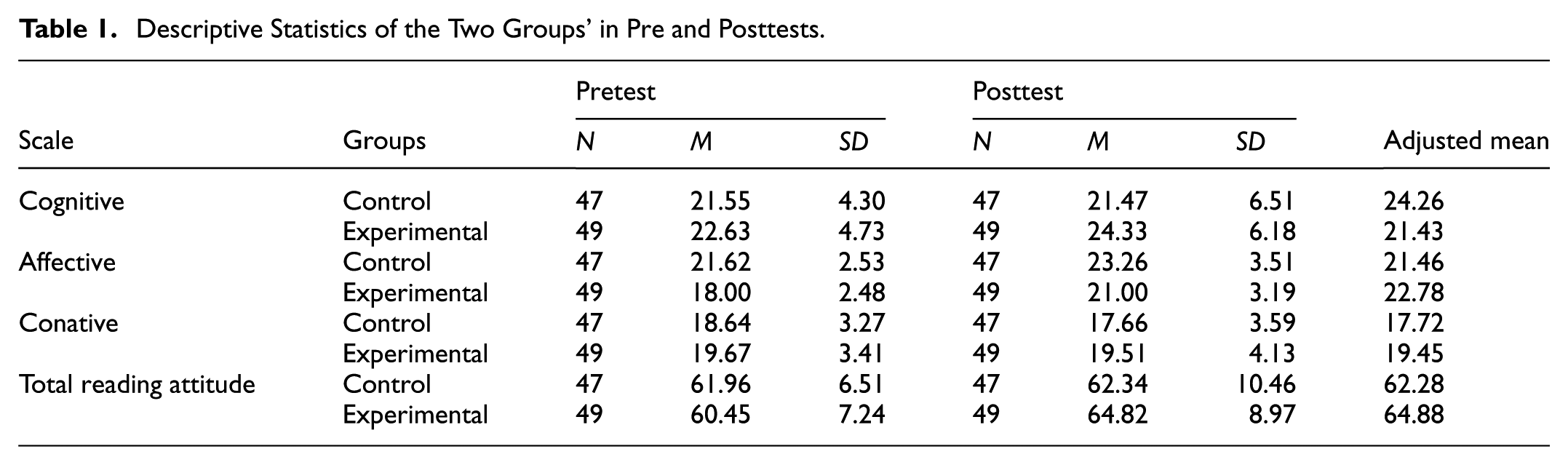
For the Cognitive scale, the control group recorded a pretest mean of 21.55 with a standard deviation of 4.30. The posttest mean remained almost unchanged at 21.47 with a standard deviation of 6.51. The adjusted mean for the control group was 24.26. The experimental group began with a pretest mean of 22.63 and a standard deviation of 4.73. The posttest mean increased to 24.33 with a standard deviation of 6.18. The adjusted mean for the experimental group was 21.43.
For the Affective scale, the control group showed a pretest mean of 21.62 with a standard deviation of 2.53. The posttest mean increased to 23.26 with a standard deviation of 3.51. The adjusted mean was 21.46. The experimental group started with a lower pretest mean of 18.00 and a standard deviation of 2.48. The posttest mean rose to 21.00 with a standard deviation of 3.19. The adjusted mean for the experimental group was 22.78.
For the Conative scale, the control group had a pretest mean of 18.64 and a standard deviation of 3.27. The posttest mean slightly decreased to 17.66 with a standard deviation of 3.59. The adjusted mean was 17.72. The experimental group recorded a pretest mean of 19.67 with a standard deviation of 3.41. The posttest mean remained stable at 19.51 with a standard deviation of 4.13. The adjusted mean for the experimental group was 19.45.
For Total attitude, the control group obtained a pretest mean of 61.96 with a standard deviation of 6.51. The posttest mean showed minimal change at 62.34 with a standard deviation of 10.46. The adjusted mean was 62.28. The experimental group began with a pretest mean of 60.45 and a standard deviation of 7.24. The posttest mean increased markedly to 64.82 with a standard deviation of 8.97. The adjusted mean for the experimental group was 64.88.
Overall, the experimental group demonstrated greater improvement than the control group in cognitive, affective, and total reading attitude scores. Changes in the conative component remained limited in both groups. As the adjusted mean scores of the experimental group were higher than those of the control group, an inferential statistical technique, ANCOVA, was used to examine whether the differences between the adjusted mean scores of the control and experimental groups were statistically significant, as presented in Table 2.
Results of ANCOVA on Post-Test Using Pre-Test as a Covariate.
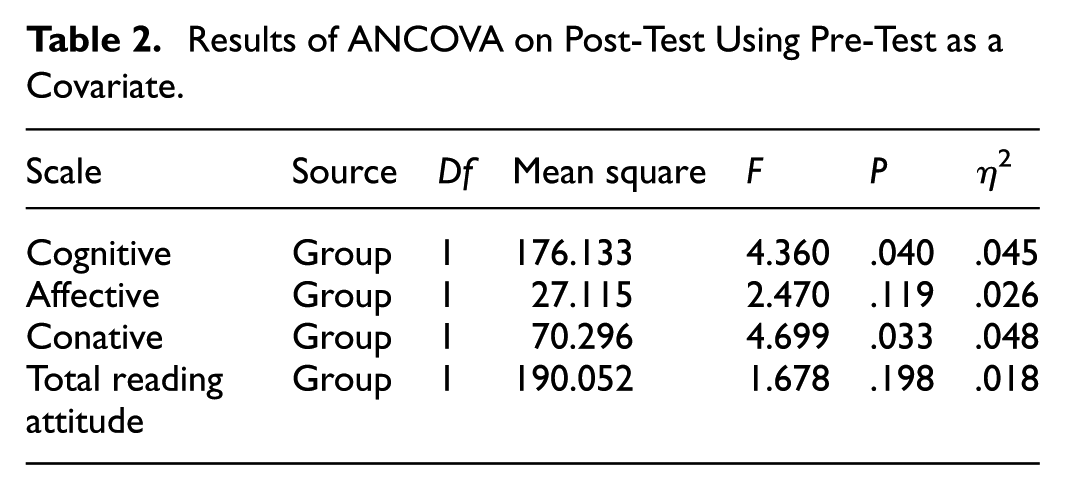
For the Cognitive scale, the analysis revealed a statistically significant group effect, F(1) = 4.360, p = .040. This value represents a small effect, indicating a significant difference in adjusted posttest means between the control and experimental groups after controlling for pretest scores. The finding suggests the intervention had a measurable effect on students’ cognitive reading attitudes, although the magnitude of the effect remained limited.
For the Affective scale, the group effect was not statistically significant, F(1) = 2.470, p = .119, with a small effect size, η2 = .026. This value also falls within the small effect range, indicating no meaningful difference between the groups on affective reading attitudes when pretest differences were controlled. The intervention did not produce a statistically reliable impact on this component.
For the Conative scale, a significant group effect was found, F(1) = 4.699, p = .033, with a small effect size, η2 = .048. Although statistically significant, this partial eta squared value reflects a small effect, showing a significant difference in adjusted posttest scores between the groups, favoring the experimental group. The result suggests the intervention contributed to changes in students’ behavioral intentions toward reading, although the practical impact remained modest.
For Total Attitude, the group effect was not statistically significant, F(1) = 1.678, p = .198, with a small effect size, η2 = .018. This value indicates a small effect size, suggesting no significant overall difference between the control and experimental groups on total reading attitude after accounting for pretest scores.
Overall, the ANCOVA results indicate the intervention produced statistically significant effects on the cognitive and conative components of reading attitude, while no significant effects were observed for the affective component or total reading attitude. The effect sizes across all scales were small, suggesting limited practical impact despite some statistically significant findings. Importantly, all partial eta squared values fell within the small effect size range, indicating that although some effects were statistically significant, their practical magnitude was limited.
Paired Sample t-Test
In Table 3, the results of the paired sample t- test of the experimental group are presented. The primary purpose of conducting paired-samples t tests is to investigate the four dimensions of reading attitude: Cognitive, Affective, Conative and Total Reading Attitude before and after receiving treatment.
Paired-Samples t -Test Results for Students in the Experimental Groups.
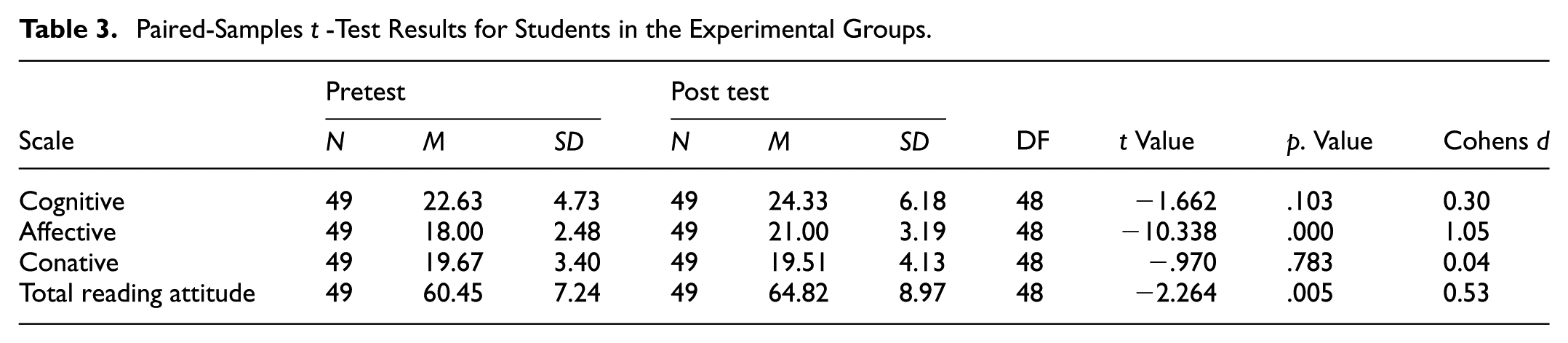
For the cognitive scale, the mean score increased from 22.63 (SD = 4.73) at pretest to 24.33 (SD = 6.18) at posttest. This difference was not statistically significant, t(48) = −1.662, p = .103. The effect size was small, Cohen’s d = 0.30, which corresponds to a small effect according to conventional benchmarks, indicating a weak practical impact of the intervention on students’ cognitive reading attitudes.
For the affective scale, the mean score increased markedly from 18.00 (SD = 2.48) at pretest to 21.00 (SD = 3.19) at posttest. This change was statistically significant, t(48) = −10.338, p < .001, with a large effect size, Cohen’s d = 1.05. This value represents a large effect, suggesting that the intervention had a substantial and practically meaningful influence on students’ affective responses to reading.
For the conative scale, the mean score slightly decreased from 19.67 (SD = 3.40) at pretest to 19.51 (SD = 4.13) at posttest. The difference was not statistically significant, t(48) = −0.970, p = .783. The effect size was negligible, Cohen’s d = 0.04, which is indicative of a trivial effect and confirms the absence of a meaningful intervention impact on students’ reading-related behavioral intentions.
For total reading attitude, the mean score increased from 60.45 (SD = 7.24) at pretest to 64.82 (SD = 8.97) at posttest. This improvement was statistically significant, t(48) = −2.264, p = .005, with a medium effect size, Cohen’s d = 0.53. This value reflects a medium effect, indicating a moderate but practically meaningful overall improvement in students’ reading attitudes following the intervention.
In summary, the paired samples analysis shows that Task Based Instruction had its strongest effect on the affective component of reading attitude, produced a moderate overall improvement in total reading attitude, and resulted in limited or no change in the cognitive and conative components within the experimental group. Overall, the magnitude of the effect sizes suggests that the intervention was particularly effective in enhancing affective engagement with reading rather than cognitive beliefs or behavioral intentions.
Interview Results
This section presents the qualitative analysis of interview data collected from students in the experimental group. The purpose of the interviews was to explore students’ perceptions of task based instruction and to examine its effects on their reading attitude. The analysis focused on how students experienced TBI during reading lessons and how it influenced their attitudes toward reading. Interview data were analyzed thematically and organized according to the three established components of reading attitude, cognitive, affective, and conative or behavioral. This structure ensures direct alignment with the study title and the quantitative findings.
Cognitive Effects of TBI on Students’ Reading Attitude
The interview findings indicate a positive influence of task-based instruction on the cognitive dimension of students’ reading attitude. Five out of the seven participants reported improved understanding of reading texts, particularly in their ability to identify main ideas and locate specific information. Four participants explained that task-based activities required them to focus on meaning construction rather than merely reading to answer questions. One participant stated, “Before, I read only to answer the questions, but the tasks made me think about what the text really means.”
Group discussion was identified by five participants as helpful for clarifying ideas and examining texts from multiple perspectives. As one student noted, “When we discussed the text in groups, I understood ideas that I missed when reading alone.” In addition, four participants reported improvements in critical thinking and higher-order reading skills, such as interpreting implied meanings and evaluating information. One participant explained, “The tasks pushed me to explain my ideas and think more deeply, not just repeat the text.”
Two participants expressed concern about limited time for completing longer tasks, noting that time pressure sometimes affected comprehension. As one student remarked, “Sometimes the task was long, and I rushed, so I could not fully understand the text.” Despite this concern, six of the seven participants indicated that task-based instruction enhanced their overall cognitive engagement with reading, suggesting a largely positive cognitive impact.
Affective Effects of TBI on Students’ Reading Attitude
The affective dimension showed clear improvement following the intervention. Six of the seven participants expressed satisfaction with task-based instruction and reported more positive emotional responses toward reading. Participants commonly described reading as less intimidating and more enjoyable. One student stated, “Reading English was scary before, but now I enjoy it because the activities are interesting.”
Five participants reported increased confidence and motivation, indicating greater willingness to engage with reading tasks. As one participant explained, “I feel more confident to read because I know I can understand the text with my group.” Interactive tasks and collaborative work were identified by six participants as creating a supportive classroom environment, which helped reduce anxiety and increase interest in reading activities.
Four participants reported greater enthusiasm when encountering new reading texts, while one participant expressed limited enjoyment, particularly when tasks were perceived as lengthy or demanding. This participant commented, “I like the tasks, but when they are too long, I feel tired and lose interest.” Overall, six of the seven participants demonstrated clear affective gains, indicating that task-based instruction positively influenced students’ emotional responses to reading.
Conative or Behavioral Effects of TBI on Students’ Reading Attitude
Interview data also revealed changes in students’ reading-related behaviors. Five out of the seven participants reported greater willingness to participate actively in reading activities and group discussions. One participant noted, “I participate more now because everyone has a role in the task.” These students described increased effort, active involvement, and stronger commitment to completing reading tasks.
Three participants reported that they began reading English texts outside the classroom, suggesting the development of self-initiated reading habits. One student explained, “I started reading short English texts at home because I want to understand better.” Additionally, four participants reported greater persistence when dealing with difficult texts, as illustrated by one participant’s comment: “Even if the text is difficult, I try again instead of giving up.”
Two participants expressed a preference for individual reading and discomfort with extended group work, which limited their engagement during some activities. As one of these participants stated, “I understand better when I read alone, not in a big group.” These findings suggest that while task-based instruction promoted positive reading behaviors for most participants, individual learning preferences continued to shape engagement patterns.
Overall Interpretation of the Interview Findings
The thematic analysis shows that task based instruction positively affected students’ reading attitudes across cognitive, affective, and conative dimensions. Across the three dimensions, six of the seven participants reported improvement in at least two aspects of reading attitude, including enhanced comprehension and critical reading skills, more positive emotional responses toward reading, and increased engagement in reading-related behaviors.
The interview results highlight variation in students’ experiences, showing both strong positive responses and more cautious perspectives. Although the degree of impact varied among learners, the interview findings provide credible qualitative evidence supporting the effectiveness of task-based instruction in enhancing reading attitudes. The results further underscore the importance of accommodating learner differences, particularly regarding task length, time allocation, and preferred modes of participation, when designing task-based reading instruction.
Discussion
This study examined the effects of task-based instruction on EFL students’ reading attitudes across cognitive, affective, and conative components, as well as on overall reading attitude, within an Ethiopian secondary school context. The discussion integrates quantitative and qualitative findings and situates the results within existing empirical literature.
The findings indicate that task-based instruction produced a statistically significant effect on the cognitive component of reading attitude, although the effect size was small. Thus, Hypothesis 1 is accepted, confirming that students exposed to task-based instruction demonstrated higher cognitive reading attitude scores than those taught through conventional methods. This result suggests that students exposed to task-based reading activities developed more positive beliefs about reading and demonstrated enhanced engagement with text meaning compared with those taught through conventional methods. This aligns with previous empirical findings, as T. T. N. Nguyen (2022) reported that learners taught through task-based instruction perceived reading as more meaningful and demonstrated improved comprehension-related beliefs. Similarly, Ökcü (2015) found that replacing teacher-centered reading with task-based activities enhanced learners’ engagement and perceptions of reading lessons. Interview findings from the current study further support this interpretation, providing qualitative confirmation of the cognitive benefits predicted by task-based learning, as students reported focusing more on understanding ideas and discussing meanings rather than merely answering comprehension questions.
Quantitative ANCOVA results did not show a statistically significant group effect for the affective component, although paired-sample t-test results revealed a significant pretest–posttest improvement within the experimental group. Accordingly, Hypothesis 2 is rejected at the between-group level, but partial support is observed through within-group gains and qualitative evidence. This pattern suggests that while task-based instruction positively influenced students’ emotional responses toward reading, the difference between groups was not strong enough to reach statistical significance after controlling for pretest differences. A primary reason for this lack of significant between-group difference is the relatively short ten-week duration of the intervention. Reading attitude is widely recognized as a stable, multifaceted psychological construct that is resistant to rapid change. According to Ajzen (2005), attitudes are formed over years of experience and carry a high degree of “evaluative consistency,” making them difficult to alter in the short term. In the Ethiopian context, where students have spent nearly a decade in teacher-centered, traditional reading environments, their affective predispositions are deeply entrenched. Consequently, while the experimental group showed internal progress, ten weeks was likely insufficient to overcome the longitudinal stability of their prior attitudes compared to the control group. This aligns with the findings of Petscher (2010), who noted that affective changes in reading often require multi-year longitudinal support rather than short-term instructional shifts.
At the same time, qualitative interview data revealed clear affective gains, with students reporting increased enjoyment, reduced anxiety, and greater confidence in reading. These qualitative perceptions reflect situational and emerging affective responses rather than statistically confirmed between-group effects, which explains the apparent discrepancy between the quantitative and qualitative findings. One plausible explanation is that the interviews captured students’ immediate, task-specific emotional experiences, such as enjoyment and reduced tension during collaborative activities, whereas the affective attitude questionnaire measured more generalized and enduring emotional orientations toward reading. In this sense, students’ reported enjoyment may reflect situational or emerging affective responses rather than fully consolidated affective attitudes.
A further explanation relates to measurement sensitivity. Questionnaire-based affective attitude measures may not be sufficiently sensitive to detect subtle or early-stage emotional changes during a relatively short intervention, while qualitative interviews allow learners to articulate nuanced and context-specific affective experiences. Similar patterns have been reported in previous task-based reading studies, where learners expressed enjoyment and increased motivation in interviews despite limited or non-significant quantitative gains in affective attitude measures (Asma, 2018; Sukma et al., 2022). Consistent with McKenna et al. (1995), the qualitative improvements observed in this study may therefore represent the initial phase of affective attitude development, which requires repeated positive reading experiences over time to stabilize and become measurable through standardized attitude scales.
The study found a statistically significant effect of task-based instruction on the conative component of reading attitude. Thus, Hypothesis 3 is accepted, confirming that students exposed to task-based instruction demonstrated stronger reading-related behavioral intentions than those taught through conventional methods. This finding suggests that task-based instruction enhanced students’ willingness to participate, persist in reading tasks, and engage more actively during lessons. Interview data further corroborates this statistically significant effect, providing convergent qualitative evidence of increased behavioral engagement, as students reported greater participation, effort, and voluntary reading beyond classroom requirements. The results are consistent with Baharun et al. (2023), who reported higher levels of participation and on-task behavior among learners engaged in task-based activities, and Rahimpour and Mehrang (2010), who observed greater persistence and involvement during task-based reading tasks.
Despite significant gains in specific components, the intervention did not produce a statistically significant effect on total reading attitude in the ANCOVA analysis. Therefore, Hypothesis 4 is rejected at the between-group level, although paired-sample t-test results showed a significant improvement in total reading attitude within the experimental group, suggesting developmental progress over time. This modest overall effect aligns with the multidimensional nature of reading attitude, where cognitive, affective, and conative components may develop at different rates (Claes et al., 2024) and with prior findings indicating that entrenched prior reading experiences may require longer interventions to produce strong overall effects (Aynalem & Tesmand, 2023).
In sum, the findings provide differentiated evidence that task-based instruction positively affects EFL students’ reading attitudes. Hypotheses 1 and 3 are accepted, while Hypotheses 2 and 4 are rejected at the between-group level, though partial support for affective and overall attitudes is observed through within-group gains and qualitative evidence. Statistically significant between-group effects were observed for cognitive and conative components, while affective improvements were evidenced primarily through within-group change and qualitative perceptions. The findings highlight the potential of task-based instruction to enhance engagement, motivation, and behavioral involvement in reading activities, consistent with previous empirical studies (Asma, 2018; Baharun et al., 2023; T. T. N. Nguyen, 2022; Sukma et al., 2022). The study extends existing literature by demonstrating context-specific effects in Ethiopian secondary schools and by examining all three components of reading attitude within a single research design.
Conclusion
This study investigated the effects of task-based instruction on Grade 9 EFL students’ reading attitudes, focusing on cognitive, affective, and conative components in an Ethiopian secondary school context. Consistent with the study’s hypotheses, statistically significant between-group effects were found for cognitive and conative attitudes, while affective outcomes were supported by within-group improvement and qualitative evidence rather than ANCOVA results. Task-based activities promoted active meaning construction, deeper engagement with texts, and more positive beliefs about reading.
The results also indicate that task-based instruction enhanced students’ behavioral engagement with reading by increasing participation, effort, and persistence during reading tasks. Although the overall reading attitude did not show a significant between-group effect, improvements within the experimental group suggest that attitude development is gradual and requires sustained instructional support. This distinction between statistical effects, developmental trends, and learners’ perceived experiences ensures that conclusions remain proportionate to the evidence. The study contributes context-specific empirical evidence to Ethiopian EFL research and demonstrates the value of addressing cognitive, affective, and behavioral dimensions of reading together.
Limitation and Implication for Future Research
This study has several limitations that inform directions for future research. The use of a single school and a relatively small sample limits generalizability to other EFL contexts. The quasi experimental design with intact classes reduced control over preexisting group differences. The ten week intervention period may not have been sufficient to produce stronger or lasting changes in all reading attitude components, especially affective and overall attitude. Reliance on self-report measures may have introduced response bias, and the study did not directly examine the relationship between reading attitude and reading comprehension achievement. Future research should involve larger and more diverse samples, adopt longitudinal designs, and examine how changes in cognitive, affective, and conative attitudes relate to reading performance. Studies should also compare different task types and levels of task complexity and include classroom observation data to provide deeper insight into how task based instruction influences reading attitudes over time.
Footnotes
Acknowledgements
We would like to express our gratitude to the Hawassa University for supporting this research. We also extend our heartfelt thanks to the participating students from Derartu Tulu secondary school for their willingness to engage in this study and for providing the necessary data.

Ethical Considerations
Data collection for this study adhered to the ethical principles specified in the Hawassa University Ethical Guidelines for Human Subjects. Therefore, approval for the study protocol was granted by the Hawassa University’s College Ethics Review Committee (CRERC) under reference number [CSSH/52/2023]. Informed consent was obtained from all participants, and they were provided with clear information regarding the nature, purpose, and potential implications of the study. Confidentiality and anonymity of participants have been strictly maintained throughout the research process, and any identifying information has been appropriately safeguarded. Finally, the participants were informed that they had the freedom to decide whether or not to participate in the study, and they had the option to withdraw from the intervention at any point if they wished.
Consent to Participate
Informed consent was a fundamental component of our research conducted in the Derartu Tulu Secondary School in Ethiopia, ensuring that participants were fully aware of their rights and the study’s objectives. Prior to participation, we provided comprehensive information about the study’s aims, procedures, and potential impacts, ensuring clarity for participants from diverse backgrounds. Emphasizing that participation was entirely voluntary, we reassured participants that they could withdraw at any time without any repercussions, fostering a sense of security. To protect confidentiality, all collected data were anonymized, and personal identifiers were removed. We encouraged open communication, inviting participants to ask questions and providing contact information for further inquiries. Written consent forms, available in both English and Amharic, were signed by participants to document their agreement. This thorough approach to informed consent helped build trust and ensured ethical compliance, as detailed in the methodology section of the manuscript.
Author Contributions
All authors participated in the conception and design of this study. Yohannes Joressa, the first researcher, was responsible for material preparation, data collection, and analysis. He also took the lead in writing the initial draft of the manuscript. Dr. Mulu Geta and Dr. Aregay Meressa were involved in commenting, revising, and enhancing the final manuscript for submission.
Funding
The authors received no financial support for the research, authorship, and/or publication of this article.
Declaration of Conflicting Interests
The authors declared no potential conflicts of interest with respect to the research, authorship, and/or publication of this article.
Data Availability Statement
The supporting the current study are available from the corresponding authors upon reasonable request*