






Abstract
This study focuses on Turkish citizens’ opinions on and attitudes toward refugees and migrants on X (formerly Twitter) between June and July 2022, a period of increased immigration-related news coverage in Türkiye. Specifically, we ask which sustainable-cohesion-related themes and attitudes prevail on the platform and how these discourses vary across distinct refugee and migrant populations. To address this, qualitative content analysis was conducted on the most popular posts (N = 89) to capture views on the sustainable cohesion of refugees and migrants, specifically granting citizenship, allowing permanent residency, employment, development, and future projections. Our findings show that (a) only a small portion of tweets include references to sustainable-cohesion-related themes, containing mostly negative attitudes, and (b) opinions and attitudes differ by refugee and migrant group (Syrians, Afghans, Ukrainians). We reveal that sustainable-cohesion-related themes used by the government feature on X-sphere, yet they are contested to push counter-arguments and promote strong anti-refugee opinions and attitudes. This further reflects negative public sentiment on, skepticism of, and discontent with outsiders, echoing realistic-group-conflict theory, which views immigrant and refugee influxes as instigators of perceptions of economic and social threats. The research contributes to the literature on the influence of political actors on social media, highlighting their potential to shape public opinion and sentiment regarding political issues.
Plain Language Summary
This study looks at how people in Türkiye used the social media platform X (formerly Twitter) to share their opinions about refugees and migrants during June and July 2022, a time of intense news coverage about immigration. We examined the most popular posts to see what they said about “sustainable social cohesion,” which means different groups in society living together peacefully and contributing to shared goals over the long term. This includes granting citizenship, allowing permanent residency, supporting employment, encouraging development, and thinking about the future of these communities. Our analysis found that only a small number of posts discussed these topics, and most expressed negative views. Attitudes also varied by group: Syrians and Afghans were often described as unwanted or as threats to the economy and society, while Ukrainians were more likely to be mentioned in neutral or positive ways. We also found that politicians, particularly from anti-refugee parties, were highly active in shaping the online conversation, often challenging government messages about integration and using their platforms to spread strong opposition to refugees. These results show how social media can both reflect and shape public opinion on migration issues in Türkiye.
Introduction
Despite being the largest refugee-hosting country in the world (UNHCR, 2025), Türkiye’s refugee and migrant populations struggle with a lack of legal status. As a signatory to the 1951 Refugee Convention, the country officially considers only the citizens of European countries as “refugees”; thus, those from other nations may merely stay in the country “temporarily” as “guests” while waiting for asylum in a third country. Migrants and refugees from Syria have been granted “temporary protection” under a special status allowing them to reside in Türkiye under the first-ever asylum law passed in 2014, bestowing certain rights in line with international law (Dimitrova & Ozdora-Aksak, 2022). During our data collection period in 2022, Türkiye was hosting other migrant groups as well—mainly 133,000 Afghans and 145,000 Ukrainians (UNHCR, 2022).
This study investigates opinions about and attitudes toward a sustainable future for refugees and migrants—sustainable social cohesion—in an often-unwelcoming host-country context (Erdogan, 2022). Our use of these two terms, refugees and (im)migrants, comes from the common usage by the Turkish population and the extant literature to refer to these groups as migrants or refugees, and using these terms interchangeably. Social cohesion refers to the degree of unity, trust, and connection within a society, encompassing relationships among individuals, communities, and governing institutions. It is a fundamental aspect of social stability, ensuring that diverse groups coexist harmoniously while fostering a shared sense of belonging, where individuals feel represented and supported (Adetunji et al., 2023; Cox et al., 2023).
Previous studies have measured host communities’ public attitudes toward and social-distance perceptions of refugee and migrant populations (De Coninck & Matthijs, 2020; De Coninck et al., 2020; Van Oorschot, 2000, 2006; Willnat et al., 2023). Native hostility toward immigrants and national-identity-threat perceptions are driven by negative stereotypes regarding their ethnic and cultural traits (Choi et al., 2022). Citizens often rely on social media to receive information and push their opinions on and attitudes toward social crises by showcasing public discourse online (Liu, 2010; Nerghes & Lee, 2019), making it essential for researchers to uncover how social-media conversations reflect the public’s attitude toward different migrant groups in Türkiye. There is abundant research on the representations of refugee and migrant populations in mainstream-media and social-media discussions (Elmas et al., 2025; Nerghes & Lee, 2019). These studies have mainly focused on a large corpus of social-media posts to capture overall attitudes and patterns (Kelling & Monroe, 2023; Lee & Nerghes, 2018; Nerghes & Lee, 2019).
While existing social-media studies examining the public perception of refugees in Türkiye have largely relied on generic keyword searches or hashtags with negative connotations (Bagci et al., 2023; Uluğ et al., 2023), our study adopts a more specific lens focused on the specific components of sustainable cohesion. Rather than general perceptions, we ask which sustainable-cohesion-related themes and attitudes prevail on the Turkish X-sphere, and how these discourses differ across distinct refugee and migrant populations. Furthermore, we identify the key users driving the highest engagement on these issues. Since X is an essential outlet for portraying political views and forming public attitudes in Türkiye (Bozdağ, 2020), characterizing these opinion leaders provides critical insights into the discourse of a politically and socially polarized country (Koçer & Bozdağ, 2020).
Based on the conceptualization used in previous public-opinion surveys (Erdogan, 2022; SODEV, 2021), we operationalized sustainable-cohesion-related themes as: granting long-term residency or citizenship, employment, and contribution to Türkiye’s development and future (see Figure 1). Our findings reveal that posts constituting the discussions about the attitudes toward the future and sustainable cohesion of migrant populations were mainly negative, with differences between different migrant groups. The June–July 2022 period provides a crucial baseline for understanding how refugee-related narratives in Türkiye were shaped before the December 2024 Syrian regime change, capturing the intense, multi-crisis context that revealed deep structures of public attitudes toward different migrant groups, including Syrians, Afghans, and Ukrainians. Analyzing this crucial moment in 2022 remains essential in 2025 because many of the social-cohesion challenges and comparative refugee hierarchies that have surfaced in 2022 continue to influence public discourse and policy, even after Syria’s political transition and repatriation efforts.

Visual representation of the coding instrument used in capturing sustainable-cohesion-related themes.
Literature Review
Sustainable Cohesion of Refugee and Migrant Populations in Türkiye
Although Türkiye is a signatory to the 1951 Refugee Convention, the Convention’s geographic limitation means that only individuals arriving from European states are formally recognized as refugees. Migrants from other regions are instead granted only a temporary stay while awaiting potential resettlement in a third country. As a result, the vast majority of Syrians living in Türkiye continue to fall under the legal designation of “temporary protection” rather than being recognized as refugees (Dimitrova & Ozdora-Aksak, 2022). Consequently, even after more than fourteen years in the country—or in some cases, having been born there—only a limited number of Syrians have obtained Turkish citizenship. In addition, public controversy over policies that allow foreigners to acquire citizenship through property purchases has further intensified debates surrounding migrants’ access to citizenship.
We argue that refugees and migrants should be commonly analyzed through the concept of social cohesion, which is considered a prerequisite for the sustainable development of both displaced populations and host societies. Social cohesion is defined by shared values, mutual challenges, and equal opportunities, and it correlates strongly with social capital. This concept refers to a society’s capacity to foster trust and promote peaceful coexistence despite demographic and ethnic diversity (Jayakody et al., 2022). However, countries often encounter obstacles in sustainably managing a rising number of refugees (Al-Husban & Adams, 2016). While social-cohesion strategies provide a forward-looking structure for integration or eventual repatriation (Ozcurumez & Hoxha, 2020), achieving equal access to essential services, including healthcare, education, civic engagement, and gender equity, remains a significant challenge (Harris, 2000). Such challenges are particularly acute in highly polarized and legally challenging environments such as Türkiye.
In Türkiye, resistance to the presence of over 3 million refugees often arises from doubts about the sustainability of social cohesion, reflecting World Bank warnings that widening social divides increase the risk of global conflict (World Bank Group, 2022). Therefore, social cohesion is essential for promoting social justice and economic stability. United Nations (2022) research supports this, highlighting cohesion as a key driver of political stability and well-being. As sustainability increasingly shapes how institutions evaluate their impact on social and environmental systems (Finkbeiner et al., 2010), achieving their goals requires frameworks that support vulnerable populations and build resilient host communities (Missimer et al., 2017).
Pak et al. (2018) argue that achieving sustainability requires the inclusion of ecologically disadvantaged regions and economically marginalized groups in public policy. Finkbeiner et al. (2010) expand this approach using indicators that address health, gender, and political concerns. From a social-cohesion perspective, OECD (2012, p. 57) notes that societies capable of integrating minorities and cultivating a shared sense of belonging are better positioned to implement effective policies. These principles translate into practical initiatives such as protecting public health, ensuring balanced settlement, and promoting equal educational opportunities, often supported by corporate-social-responsibility efforts. When applying this framework to refugee contexts, Al-Husban and Adams (2016) highlight that the central challenge is developing resilient mechanisms to manage increased migration and adapt to changing conditions (p. 450).
More broadly, the major challenge for countries hosting refugees lies in finding long-term solutions. Their legal status as “temporary visitors” in Türkiye and the current vision of social cohesion lacks a clear, standardized framework to define refugee-integration policies and their expected outcomes across different countries. The difficulty is in evaluating the impact of social-cohesion programs, which are implemented amidst political uncertainty, economic struggles like unemployment, and social hostility toward displaced populations (Ozcurumez & Hoxha, 2020, p. 3). Türkiye’s large refugee and migrant populations necessitate the development of services and policies that ensure these groups’ social inclusion and prevent their marginalization by the local communities (Pak et al., 2018). Emergency support for their safety and security is also needed, alongside programs for sustainable growth and education of their children as part of community building (Hossain, 2021).
The potential for sustainable social cohesion is heavily influenced by the attitudes host countries have toward refugees and migrants. Research typically analyzes the variance in these attitudes through the lenses of contact theory (Pettigrew et al., 2011) and intergroup-threat theory (Blalock, 1967; Stolle et al., 2008). Contact theory posits that interaction between locals and newcomers, especially under favorable circumstances, can build understanding and reduce fear (De Coninck et al., 2020; Knappert et al., 2021; Pettigrew et al., 2011). Conversely, intergroup-threat theory suggests that growing migrant populations may trigger fears regarding competition for limited resources, leading to negative sentiment. Similarly, realistic-group-conflict theory posits that immigration often intensifies perceived economic and symbolic threats (Pettigrew, 1998; Pettigrew & Tropp, 2008). These dynamics are magnified by social media, which serve as a space where public opinion is both voiced and constructed. Research indicates that online discourse regarding refugees and immigrants on X reflects the polarization of Türkiye’s political and social landscape (Bulut & Yörük, 2017). Grounded in social media’s capacity for public debate, this study investigates dominant narratives on Twitter/X concerning Turkish citizens’ views on the sustainable cohesion of diverse migrant groups.
Public Discourse on X and Refugees and Migrants
Turkish host-society discontent with migrants and refugees has grown steadily since the 2011 Syrian influx, caused by a mix of economic anxieties, perceived competition over low-wage work and public services, fears about crime and security, and cultural or symbolic threats. Their prolonged large-scale presence, rising unemployment and inflation, and uneven integration outcomes have led to increased skepticism and hostility in the host community, resulting in incidents of discrimination and calls for repatriation or stricter controls (Kirişçi, 2014). Public-opinion research in Türkiye suggests that economic worries (e.g. job-market competition, pressure on housing and services) and symbolic threats (e.g. cultural differences, social-cohesion challenges) foster negative attitudes, and fears about crime prevail in public perception (Akbulut-Yüksel et al., 2024; Uluğ et al., 2023).
Extant literature reveals that immigration has become one of the most salient and divisive issues in Türkiye’s political-communication terrain. As media and political actors continually foreground immigration in public discourse, migrant populations—particularly Syrians, Afghans, and more recently Ukrainians—have become central to polarized debates about national security, the economy, and national identity (Alakoç et al., 2022; Gülmez, 2019). Research shows that communication about migrants in Türkiye is shaped by a convergence of electoral incentives, foreign-policy concerns, and public-opinion dynamics, with political elites, news outlets, and advocacy groups strategically utilizing frames and agenda-setting techniques to influence attitudes (Balch & Balabanova, 2020; Erisen & Uysal, 2025; Manap, 2025; Mendelsohn & Budak, 2021; Sert & Danış, 2021).
Digital platforms have further intensified these dynamics. Studies reveal that social media such as Twitter/X, YouTube, and Facebook have become critical spheres where competing narratives about immigrants circulate, often amplifying security, cultural-threat, and economic frames (Akçapar & Şimşek, 2018; Doğanay & Keneş, 2016; Ozduzen et al., 2021). Research consistently stresses that anti-migrant rhetoric peaks during politically charged moments, specifically elections, and reinforces enduring “us vs. them” distinctions, with humanitarian frames receiving limited visibility (Yılmaz et al., 2023). Algorithmic amplification exacerbates this effect, as recommendation systems on platforms like YouTube and Facebook tend to push users toward increasingly extreme (e.g. anti-refugee) content, reducing exposure to alternative (e.g. humanitarian) perspectives (Çoban & İnceoğlu, 2025). Together, these studies underscore how Türkiye’s refugee debates are not merely reflections of demographic or economic realities, but are deeply mediated and politically constructed through framing, algorithmic dynamics, and discourse formation across digital and traditional platforms.
Even though public-opinion polls do generate an overview of public attitudes, issue positions, and public sentiment regarding refugees and migrant populations in Türkiye, social-media discussions can reflect stances more sincerely, as has been found in a comparative study by O’Connor et al. (2010). When assessing the role of social-media conversations in shaping public attitudes toward a highly contentious political issue in an authoritarian political context such as Türkiye (Esen & Gumuscu, 2016), it is essential to examine the social-media discourse about the cohesion and sustainability of refugees and migrant populations. Furthermore, a systematic analysis of conversations is essential given the vibrant social-media environment with diverse types of accounts sharing “news,” opinions, and affect (Meraz & Papacharissi, 2013).
The media play a critical role in shaping opinions on migration. Contact with mass-mediated content shapes attitudes toward refugees and impacts willingness to support them (Bagci et al., 2023). Although mainstream media frame audiences’ understanding of issues and their perception of the degree of deservingness of refugees (Willnat et al., 2023), social media have emerged to become complementary as well as competing venues on which the public can become informed as well as engage in building narratives, specifically through the participatory affordances of social media and other online platforms (Van der Meer & Verhoeven, 2013). However, online and social media news sources frequently fail to report accurate information regarding the settlement of refugees and migrants in a country, leading to negative perceptions of their work status, economic advantages, and criminality (Tahiroğlu, 2022). Indeed, extant literature suggests that negativity, hatred, racism, and xenophobia toward refugees and migrants do circulate on social-media platforms, contributing to negative public opinion and sentiments among host-community members (Yılmaz et al., 2023).
Beyond the debate over the relative influence of traditional and digital media sources on representations of refugees and migrant groups, there is a lack of a specific focus on what online public conversations convey about the future projections of refugee and migrant populations in Türkiye. It is timely to concentrate on uncovering how social-media conversations represent the sustainable-cohesion-related attitudes of Turkish citizens toward refugee and migrant groups in Türkiye and portray public views. To that end, we pose our first research question:
A significant disparity between the representations of two distinct groups of refugees—one white and European, the other one non-Western, non-European—suggesting a hierarchy of “worthy” versus “unworthy” refugees, fueled by apparent racism in conventional and social media, is observed in the literature (Elmas et al., 2025). For instance, Bolzoni et al. (2023) discuss the double standard in solidarity with different categories of refugees in the context of Italy after the 2022 Russian invasion of Ukraine. Focusing on mainstream US newspapers, El-Nawawy and Elmasry (2024) compare the framing of Syrian and Ukrainian refugees to reveal that those outlets humanized the latter while the former were portrayed as threats and aggressors.
In a similar vein, in recent years, Türkiye has become home to Syrian, Afghan, and Ukrainian refugees, among others. An analysis of X posts on Afghan refugees in Türkiye found a predominance of negative attitudes that include dehumanization of the group and a range of perceived threats stemming from their presence (Uluğ et al., 2023). Thus, the migrant group’s origin might be a factor shaping the attitude of the host community. Indeed, recent studies have shown that specific refugee groups are represented and discussed variously on social-media platforms in Türkiye and found that Ukrainians are portrayed more positively than others (Elmas et al., 2025). Therefore, Turkish citizens’ perceptions of the cohesion of different migrant groups should be studied in online social conversations. To investigate the differences in public discourse across different migrant populations, we ask:
Methods
Qualitative content analysis (QCA) was used to analyze the tweets sampled, allowing researchers to analyze textual discussions systematically and draw reliable conclusions regarding their context. QCA is particularly effective in reducing and abstracting data to focus on meaningful aspects directly related to the research questions, thus counteracting the danger of interpreting the material solely through the lens of one’s assumptions and expectations and ensuring a precise emphasis on the relevant themes (Schreier, 2014). It is a commonly used technique to investigate meaning and patterns in social-media texts, including those focusing on migrant and refugee representations and discourses (Uluğ et al., 2023). To address the research questions, we analyzed the most popular tweets to identify themes and attitudes regarding the sustainable cohesion of refugee and migrant groups in Türkiye. Comparing and contrasting, essential for developing coding frames (Boyatzis, 1998), informed our examination of differences across these groups, which we will illustrate with tweet examples.
Data Collection and Sample Selection
DiscoverText, a tool developed by Dr. Stuart Shulman at the University of Massachusetts Amherst, was utilized to collect and manage the data. DiscoverText was selected as it relies on the official application programming interface (API) to retrieve historical data while preserving the metadata, essential for analyzing user engagement and identifying opinion leaders. Employing this tool to isolate influential actors and characterize polarized discourse aligns with established practices in recent sociological research regarding political influencers and online debates (e.g., Rohlinger et al., 2023; Rose & Rohlinger, 2024). Posts containing the words “refugees, migrants, Syrian(s), Afghan(s), Ukrainian(s)” [mülteciler, göçmenler, Suriyeli(ler), Afgan(lar), Ukraynalı(lar)] and/or “temporary protection, stay, work, employment, vocation, economic contribution, support, development, future” [GKK/Geçici koruma, kalma, çalışma, ekonomi, destek, iş, katkı, kalkınma, gelecek] linked with Boolean terms were collected separately via DiscoverText.
We analyzed the sustainable-cohesion-related themes emerging from X conversations between June 23 and July 8, 2022. These 2 weeks were selected because of intensive media coverage of refugees and migrants at the time, including but not limited to (a) forced and voluntary returns of Syrians to their home country (Mepa News, 2022), (b) Greece taking more aggressive measures against refugee influx, effectively coercing migrants back into Türkiye (The Guardian, 2022), (c) Ukrainian refugees surpassing the five-million threshold worldwide (BBC, 2022) and reaching almost 150,000 in Türkiye (UNHCR, 2022), and (d) Afghan refugees’ reported involvement in sexual-violence incidents in Türkiye (Cossé, 2022; Fakih, 2022; Warsi, 2022). The sample of posts is grouped under refugees as a general category and the three different subpopulations (Syrians, Afghans, and Ukrainians).
To provide some additional detail for context, most Syrian refugees, for example, had become established all over the country by then and were having children and opening businesses, with no plans for returning home, where a civil war was still being waged. However, many news stories were about conflicts with refugees in the neighborhoods where they concentrated. The emergence of Arabic as the prevalent language of business in such areas and the perception of advantages being selectively provided to immigrants led to local dissatisfaction with and resentment against the newcomers, as the Stockholm Center for Freedom (2023, p. 35) described: “In 2022 anti-immigrant sentiment reached a boiling point, fueled by Turkey’s economic woes. Xenophobia, hate speech and hate crimes against Syrian refugees continued increasing as the country prepared for upcoming elections.” Concurrently, such sentiments were being pushed by the leader of the nationalist Victory Party, Ümit Özdağ, in his presidential-campaign rallies across the country. Adding to the refugee influx, Türkiye received more than 85,000 Ukrainian immigrants fleeing from the Russian invasion by the end of February 2022. Many settled in resort towns along the Mediterranean coast where they had previously vacationed, contributing to rising inflation and housing shortage (Akgündoğdu & Trissel, 2023). Simultaneously, Greece was taking aggressive steps to push migrants back to Türkiye—as many as 150,000 in 2022 were “averted” (Human Rights Watch, 2023).
After cleaning for non-Turkish-language content, the initial dataset consisted of 500,100 tweets. Of these, 378,290 were reposted, and 493,645 were favorited at least once. When we examine the engagement level within the dataset, 72,655 tweets were @mentioned and replied to at least once. A total of 24,804 hashtags were used. Once all reposts were excluded, the “unique tweet” count reached 38,157 (by keyword: 10,608 for “refugee(s)/immigrant(s),” 11,921 for “Afghan(s),” 11,978 for “Syrian(s),” and 3,650 for “Ukrainian(s)).”
In line with our goal to conduct a focused QCA to develop an in-depth understanding of the messages that attracted the highest attention within the period investigated, we sampled the most popular tweets, rather than running an exhaustive big-data analysis, which other studies in migrant and refugee social media representations have done. We prioritized high-engagement (“popular”) posts to capture content with genuine agenda-setting power, distinguishing our approach from random sampling, which often overrepresents isolated content. Methodological work in computational network analysis supports this choice; for instance, Choi et al. (2020) demonstrate that the top 10% of ‘hub’ communities drive over 36% of retweets, whereas nearly 92% of cascades outside these structures fail to propagate entirely.
Furthermore, our decision to sample popular rather than random posts is grounded in recent empirical research on rumor amplification, which identifies echo chambers as primary drivers of viral spread. For instance, Vosoughi et al. (2018) analyzed Twitter data and found that top 1% of shared content reached between 1,000 and 100,000 people, whereas the vast majority of information rarely exceeded 1,000 users. This indicates that a random sample would likely capture isolated content with minimal public impact. Crucially, Del Vicario et al. (2016) demonstrate that such high levels of engagement are structurally linked to the formation of homogeneous echo chambers, where selective exposure amplifies specific narratives and determines the size of diffusion cascades. Consequently, focusing on high-engagement posts is essential for analyzing the polarized discourses that successfully permeate the public agenda, distinguishing them from what might be considered low-impact noise. By doing that, we can observe the dominant discourse produced by the highest-impact X accounts. This can further provide insight into online public-opinion leaders on the sustainable cohesion of refugees and migrants in Türkiye.
Tweets with more than 100 exact duplicates as individual items in the dataset were identified, totaling 93 tweets. After discarding suspended accounts and deleted tweets (n = 4), 89 top retweeted posts constituted our final sample. The accounts from which these tweets were shared were also identified and operationalized as “most popular users”—those whose posts were retweeted at least 100 times.
Coding Instrument
The tweets were content-analyzed using a coding instrument designed to capture references to the sustainable-cohesion-related themes about migrant populations in online discussions (see Table 1 for the coding instrument). The operationalization of sustainable-cohesion-related themes was derived from extant research (Erdogan, 2022; SODEV, 2021): Turkish-citizenship-related issues, residency and residency permits in Türkiye, being guests, employment and work life of refugees, the economic contribution of refugees to the host country, national development, long-term impact, and their future projections. Beyond finding references to these themes in online conversations, we were also interested in understanding the attitudes embodied in those references. Therefore, we coded whether the tweets contained positive, negative, or neutral attitudes toward refugees and migrant groups investigated, that is, the “attitude” variable. Lastly, the account owners of the sample were coded in terms of their role, (a) activist, (b) journalist, (c) news agency, (d) citizen (regular user), and (e) politician, to determine how different user types engage with the topic, specifically in terms of the attitudes and themes previously identified.
Coding Instrument.

A spreadsheet with the metadata was prepared and each tweet was coded based on our coding instrument. Two graduate students coded the sample. Intercoder reliability tests for all the variables were run using Recal2 (Freelon, 2013). The lowest agreement level was at Krippendorff’s alpha of .84 and the highest at 1.00. Quantitative description of the data (sustainable-cohesion themes and attitudes) was calculated using the Statistical Package for the Social Sciences (SPSS) after the raw data were coded in the spreadsheet. In addition, as a commonly utilized qualitative approach to the content analysis of media texts, the themes and attitudes were contextualized by elaborating on exemplary tweets drawn from the sample.
Ethical Considerations
Selected tweets were translated from the original language, Turkish, into English and quoted verbatim. The tweets were accessed publicly and stored in a password-protected cloud-drive folder accessible only to the authors. As is generally done with publicly available social-media data, tweets were not anonymized. However, personal and identifying information of the individuals mentioned in the sampled tweets as victims of violence has been removed from the manuscript in an effort to avoid re-traumatizing them.
Findings and Discussion
To answer the first research question (RQ1), we conducted a content analysis of the most popular tweets to detect the occurrences of sustainable-cohesion-related themes related to migrants and refugees and examine the attitudes emerging from those posts. For RQ2, we examined the differences by country of origin. Table 2 summarizes the frequencies of references to sustainable-cohesion themes overall and by migrant group.
Frequency Table of Sustainable-Cohesion-Related Themes Mentioned in the Sample.
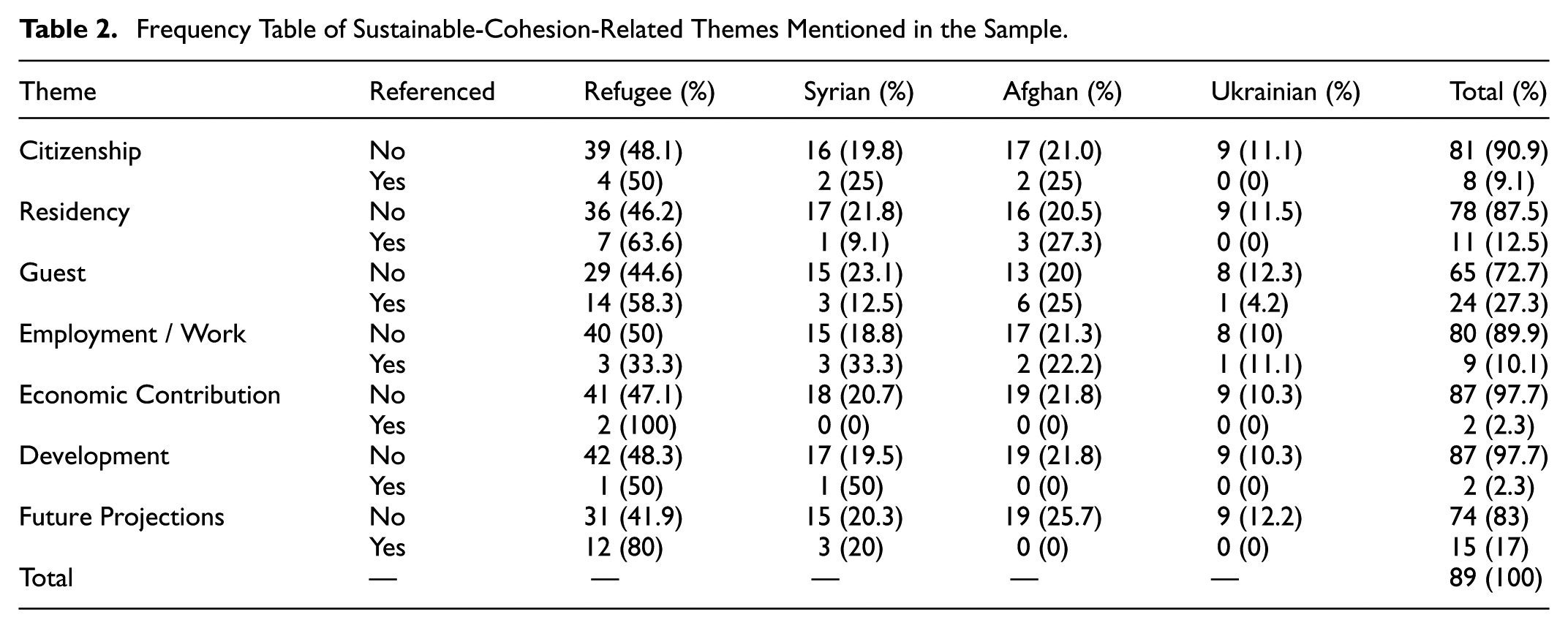
Overall, sustainable-refugee-cohesion themes were mentioned at relatively low-frequency levels in the sample. The most frequently observed themes are guest status, future projections of refugees and migrant groups, and their residency in Türkiye. The theme of migrant groups being “guests” is mentioned 24 times (27.3%). At 17% of the total (n = 15), the second prominent theme is speculations regarding the future projections of refugees’ status in the country. Notably, the top two themes reflect concern over the presence of refugees and migrant populations in general, highlighting fears of a perceived outsider-invasion threat. Thirdly, 12.5% of the sample (n = 11) includes comments about the residency permits given to these various groups.
Table 3 summarizes the distribution of attitudes toward migrants emerging from tweets categorized by their origin. An overwhelming majority of the tweets (78.4%; n = 70) embrace a negative attitude, while only 6 (6.8%) are positive. Thus, it is observed that refugee-sustainability themes have entered social-media discussions in Türkiye; however, as opposed to the government’s positive-framing efforts, our findings suggest that the opinion in the Turkish X-sphere tended to be primarily negative about these guest communities. All in all, the X users we observed are critical about granting refugees residency permits, viewing them as overstaying guests and opposing their temporary-protection status.
Frequency Table of Attitudes Toward Refugees and Migrant Groups Mentioned in the Sample.
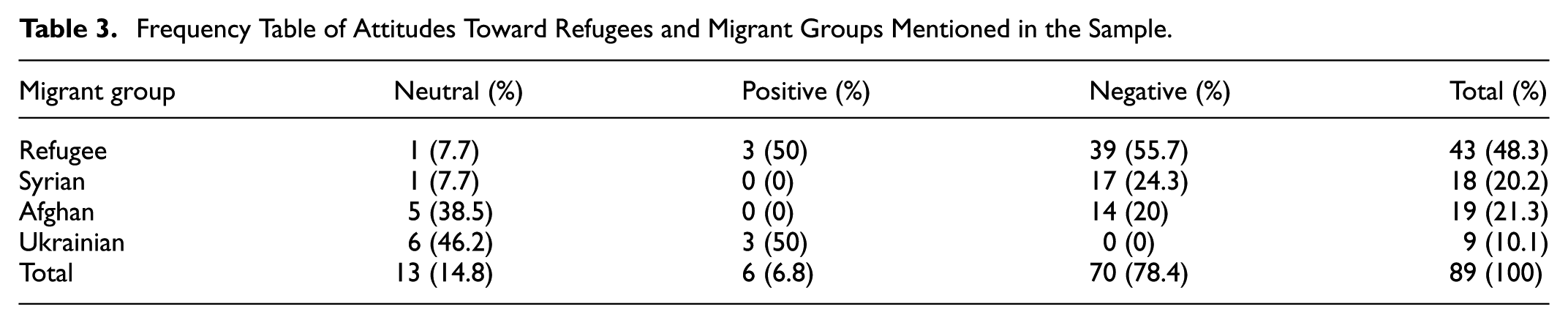
To answer RQ2, we examined how the references to sustainable-cohesion-related themes and attitudes toward refugees and migrant groups varied across refugee subpopulations. Table 2 shows the distribution of references to specific cohesion-related themes. The results reveal that the most frequent themes (guest status, future projections, and residency) were focused on the umbrella category “refugees.” Specifically, tweets commenting on the guest status of these groups focused on the refugee category the most (n = 14; 58.3%), followed by Afghans (n = 6; 25%), and Syrians (n = 3; 12.5%). As for the references to future projections of migrant groups, 12 (80%) centered on “refugees,” 3 (20%) on Syrians, and no mention was found of Afghans or Ukrainians. Thirdly, the residency theme was most frequently observed in the “refugee” category (n = 7; 63.6%), followed by Afghans (n = 3; 27.3%) and Syrians (n = 1; 9.1%).
Further, Table 3 summarizes the frequencies of attitudes coded in popular online discussions by migrant group. With 39 observations (55.7%), the majority of all negative-attitude references focused on the umbrella category of “refugees,” followed by Syrians (n = 17; 24.3%) and Afghans (n = 14; 20%), while no tweets including negative attitudes toward Ukrainians were found (n = 0) in the sample. Conversely, 46.2% (n = 6) of the neutral and 50% (n = 3) of the positive attitudes were related to Ukrainians.
Contrary to the AKP government’s positive narratives focusing on the issues of residency, long-term stay, cohesion, and the economic and workforce contributions of refugee populations in Türkiye, our findings suggest that popular online public discussions about refugees, Syrian and Afghan groups in particular, reflect negative attitudes toward the guest community. In the next section, we contextualize our findings by discussing tweet examples. We also compare and contrast themes and attitudes across different refugee and migrant groups.
Comparing Sustainable-Cohesion Themes About Different Refugee Groups in Türkiye
Residency
As outlined above, a prevalent thematic emphasis for the umbrella refugee category is on residency. Users opposed refugees’ residency in Türkiye with posts like “We do not want refugees in our country.” There was even a specific hashtag #ülkemdesuriyeliistemiyorum [“I do not want any Syrians in my country”], which reflects the general tendency toward referring to refugees as “Syrians” and as guests that overstayed, creating a financial burden on Türkiye’s already weakened economy and a threat against social order and cohesion. At the same time, posters questioned Syrians’ cultural similarity to the host community and commitment to religious values. Here is a sample tweet: “Go to the hospital, refugees; go to the bank, refugees; go to the post office, refugees; go to the beach, refugees; go see the mosque, are there any refugees? And they say we are brothers of the same religion!” (ATAKIZ, 2022a).
Citizenship
Another contested issue is granting citizenship to refugees in exchange for payment. There are fears that refugees and migrants will gain civil and political rights as citizens in the future, which might, in turn, lead to soil or land claims. As a remedy, the following tweet by the ultra-right anti-refugee Victory Party’s leader promises to deny citizenship and send refugees back (if elected): “The outcome will be demand for cultural and political rights first and demand for land later. What do you think, should we wait to see those happen? Or should we authorize the Victory Party to send back asylum seekers and illegals in 2023?” (Özdağ, 2022a).
Another post exemplifies increased public skepticism of the AKP government’s pro-refugee settlement and employment support policies (A Haber, 2022) and high uncertainty caused by mistrust of official immigration figures: “The official number of Syrians in Türkiye has been announced. Minister of the Interior Çataklı announced the number of registered Syrians in Türkiye as 3,648,983. Lies, lies, lies—does that figure include the 122,000 people you cannot track? How about the number of undocumented migrants?” (Özdağ, 2022)
Employment and Contribution to the Economy and Long-Term National Development
Refugee employment and contribution to Türkiye’s economy are other contentious sustainability topics in the X-sphere. Giving Syrians jobs and work permits was criticized in many tweets. The relevant online conversations tend to be especially critical of Syrians and highlight competition over jobs in the dire economic situation of the country. Furthermore, there is fear of “outsiders” replacing the highly educated and skilled Turkish workforce, as illustrated by the following post: “Do you know that, while nearly 800,000 of our health-care workers are waiting to be appointed, 4,000 Syrian health-care workers were made civil servants?” (ATAKIZ, 2022b).
These findings align with the realistic-competition theory (Pettigrew, 1998; Pettigrew & Tropp, 2008), which posits that competition over scarce resources and jobs, especially in times of national and economic turmoil, negatively shapes public attitudes toward and opinions about refugees and migrants. While losing jobs to outsiders might be a threat, outsiders not working and not contributing to the Turkish economy, being lazy and disturbing social order, displaying voyeurism, and having too many children by local standards are other concerns, as showcased in the tweet below that received a high level of responses.
The so-called ‘asylum-seeking men’ lay rugs in the playgrounds and watch Turkish mothers playing with their babies and children. No Turkish man comes to the park in my neighborhood. On the other hand, there are excessive births. When you encounter a Syrian woman, there are 4 or 5 babies with her. (Çolak, 2022)
Another variable was related to the (lack of) contribution to national development and the long-term impact of refugees in Türkiye. Although the Justice and Development Party (AKP) government portrays the “successful” integration and cohesion of refugees and migrant populations as part of national development and as a source of labor force (Cumhuriyet, 2021), X conversations indicate otherwise. Our content-analysis results suggest that X users see “outsiders” as an economic burden and hindrance to national development due to their lack of education, the need for financial support, and high reproduction rates (thus, fast population growth).
Having let 10 million refugees stay means that we have spent 100 billion dollars, and we will spend 100 billion more. This means that we will take on the health and education expenses of a population growing three times faster than we do, and find them jobs. For 10 years, we have been working for the benefit of asylum seekers. The economic crisis will not end until they leave. (Özdağ, 2022)
Security Threats
Afghans are mostly mentioned in the context of sexual perversion and overall delinquency due to perceived threats of sexual violence and crime directed at women and children. They are referred to as a population of men without jobs or any economic or social contribution to the country, who come and disrupt local peace and order. This group is unwanted in the country and needs to be sent back. Here is a sample tweet that underlines this perspective:
Life sentence without parole has been demanded for the Afghan who came here after leaving his wife, daughter, and parents, filmed the wives and daughters of our people and shared it on TikTok, and also sexually abused and killed the 16-year-old girl A… A…. in Gebze by hitting her on the head with a stone. (Mühendisyen, 2022)
Another tweet exemplifies public concerns over security threats and the risk of violence by uncontrolled Afghan groups, framing them as potential criminals. Anti-refugee, ultra-right party leader Özdağ reiterates his commitment to fighting this invasion of Türkiye by outsiders. The following tweet highlights the strength of the public support for the anti-refugee attitude.
Yesterday, 10 Afghans attacked and stabbed two Turks in Denizli. Y…. B…. needed 32 stitches. M… M…Ö… was lightly wounded. Local news does not mention Y…. The lawyers of the Denizli provincial presidency of the Zafer Party are closely following the incident. To our citizens who were attacked: Zafer Party is with you. (Özdağ, 2022)
The presence of refugees from Ukraine was also approached with skepticism, as Ukrainian men in Türkiye were regarded as not fighting for their country and enjoying peace and rest on Türkiye’s beaches. For instance: “I’m asking those who keep harping on the Syrians. Antalya’s beaches are full of Ukrainians. Have you ever heard a guy say, ‘Why are you sunbathing here? Go fight for your country, which is at war?” (Konuşmaz, 2022).
On the whole, though, compared with other refugee and migrant groups, Ukrainians were perceived as less invasive and less of a security threat. Indeed, the conflict in Ukraine was seen as contributing to Turkish economic development through military-technology innovations. The war was frequently mentioned as a testing ground for Turkish military products such as unmanned aerial vehicles.
Speaking to The Times of London, Ukrainian Bayraktar TB2 Siha Pilot: “Bayraktar TB2 Siha was hit by the Russian S-300 air defense system, we saw that it was full of holes, but it survived the attack, it came back.” #localandnationalIndustry #nationaltechnologymove. (Eurodolar1980x, 2022)
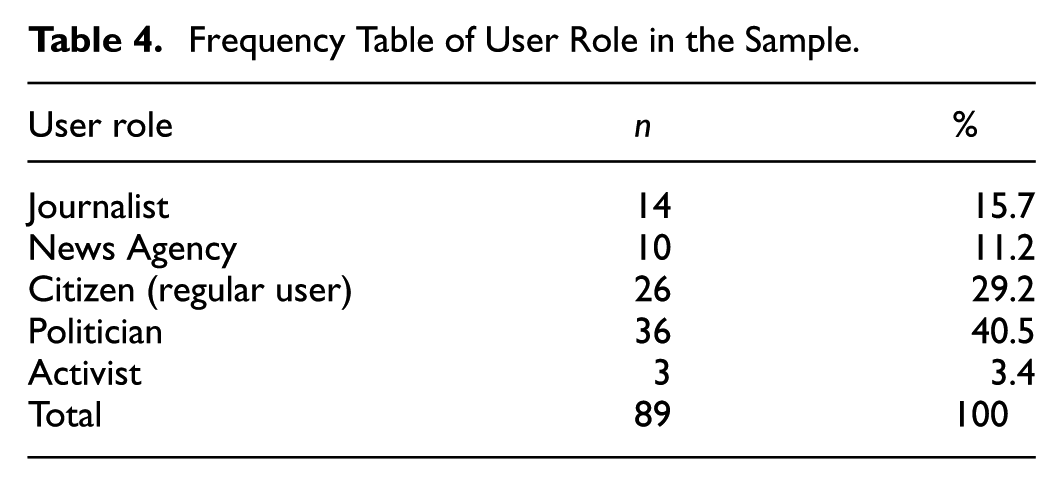
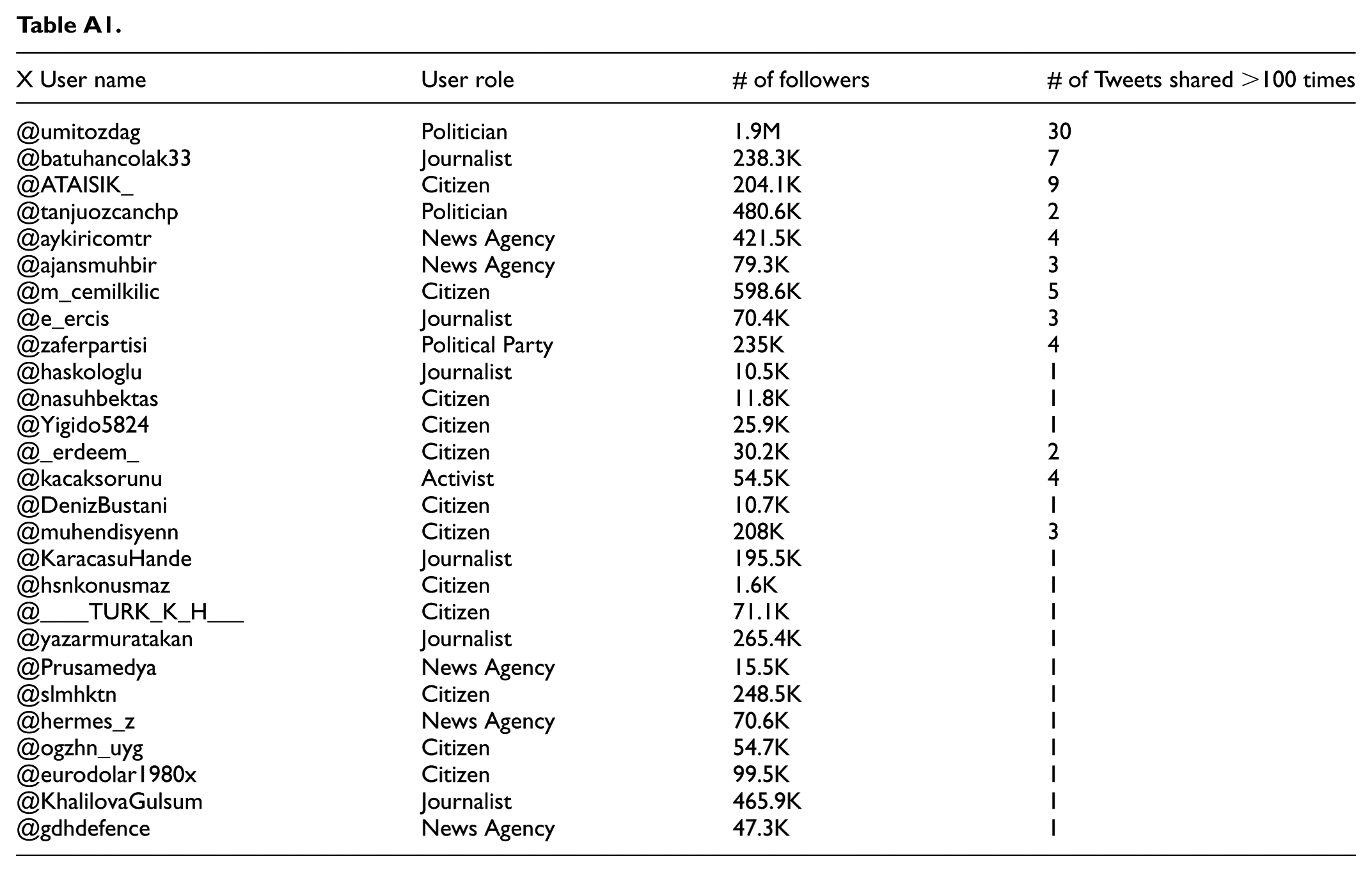
We also coded for user type in the sample. Table 4 displays the distribution of X accounts by user type. The results show that 40.5% (n = 36) of the sample (composed of popular tweets of most retweeted users that fall within the sampling period) were shared by politicians or political parties, followed by regular citizens (n = 26; 29.2%). Even though the number of unique politician or political party accounts in the sample is not high (n = 3, please see Table A1), their tweets were retweeted at much higher rates than posts by other types of accounts. This suggests that the sustainable-cohesion-related discourses about refugees and migrant populations in Türkiye during the sampling period were mainly shaped by politicians, and specifically the Victory Party and its leader, Ümit Özdağ. Özdağ’s tweets play a key role in amplifying public concerns about refugees; his discourse influences the perceptions of intergroup competition, reinforcing fears associated with realistic-group-conflict theory. In this setting, X affords the reflection and promotion of such powerful narratives, increasing Özdağ’s influence as a political actor over public attitudes and opinion.
Frequency Table of User Role in the Sample.
Conclusions
One of the essential challenges many countries face is the need to handle refugee and migrant communities sustainably (Al-Husban & Adams, 2016). In this sense, social sustainability is a multi-faceted concept that comprises adequate social services (including distributional equity, health, and education), gender equality, and political responsibility and participation (Harris, 2000, p. 17). It is difficult for governments to develop and implement such sustainable-cohesion policies without public support. Thus, we aimed to understand, in the context of Türkiye, the host community’s opinions regarding the sustainability of migrant and refugee groups, as expressed on X about refugees’ citizenship, residency, employment, economic contributions, and their future.
Our findings reveal that, despite the utmost social importance of the topic, X conversations regard refugees and their future mainly negatively from an anti-refugee perspective, in alignment with public opinion polls. Overall, our study supplements extant survey results by detecting negative public views on a controversial political issue in a conflict-ridden, politically and socially polarized national context. In accordance with the study’s research objectives, our analysis does not encompass a large timespan in reflecting Turkish public opinion toward migrant and refugee groups. However, the period from June to July 2022 serves as a critical juncture for understanding refugee discourse in Türkiye prior to the Syrian regime change in December 2024. It illustrates how intersecting crises influenced public perception of Syrian, Afghan, and Ukrainian populations. This timeframe remains analytically significant in 2025, despite Syria’s recent political transition and ongoing repatriation efforts. The social stratification and cohesion challenges observed in 2022 continue to underpin policy and public debates in Türkiye.
Although previous studies reveal a pro-refugee and humanitarian perspective where refugees are framed as providers of cheap(er) labor and are employed in the least desirable jobs, such as seasonal agricultural work (Dimitrova & Ozdora-Aksak, 2022), the tweets in our sample do not cover this pro-refugee dimension. Our study echoes realistic-group-conflict theory, which views immigrant and refugee influxes as economic and social threat perceptions, and refutes intergroup-contact theory, which argues that increased contact with refugee groups will help reduce prejudice and negative attitudes (Pettigrew, 1998; Pettigrew & Tropp, 2008).
Our research reflects an anti-refugee stance where negative attitudes and opinions toward outsiders are exacerbated when the host community views the problem as an issue of limited resources and a cause for intergroup threat and conflict. Thus, ensuring adequate services, mechanisms, and facilities for outsiders (Mykhailenko et al., 2024), without disadvantaging host communities, is essential for sustainable social cohesion. However, when national resources are limited, a lack of equity in their distribution hinders social cohesion (Jayakody et al., 2022).
Our findings further show that sustainable-cohesion-related themes used by the AKP government indeed feature on X-sphere (albeit at low frequencies). However, these themes are contested to push counter-arguments and promote strong anti-refugee opinions and attitudes. Our study’s analyses of most retweeted posts reflect the public’s negative sentiments on, skepticism of, and discontent with outsiders. Furthermore, we show that politicians and political parties mainly fuel these negative conversations as online public-opinion leaders (Wasike, 2023). Our social-media analysis notably suggests the dominance of the far-right ultra-nationalist Victory Party’s leader, Ümit Özdağ. This may have negatively shaped public discourse and views on the sustainable cohesion of refugees and migrants during a time when immigration issues were highly salient on the public and media agenda. Thus, our research contributes to the literature on political actors on social media, highlighting their potential to shape public opinion and sentiment about political issues.
A methodological contribution of this study is the coding instrument designed to capture references to sustainable-cohesion-related themes and sentiments online. We believe it could be adapted to contexts in other countries with migrant or refugee populations to conduct a comparative analysis. Further, this study could provide a framework for analyzing public opinion on sustainable cohesion through surveys of or experimental research in host and refugee communities. Government entities or civil-society organizations working for refugees may use these themes and design messages in line with them to promote sustainable cohesion, engage in policy advocacy, and trigger positive public sentiments.
We address the digital contestation of sustainable cohesion through the lens of Türkiye’s polarized context, which is a critical issue that might remain a persistent global concern. Our analysis of how opinion leaders utilize social media to influence public attitudes provides a transferable framework for research in diverse cultural contexts. As migration continues to reshape societies worldwide, this study’s findings provide crucial information for fields such as sociology, communication studies, media studies, psychology, and political science in understanding intergroup conflict and social integration issues in digital environments.
Future studies could investigate the dynamics and spatial distribution of the identified users’ networks to examine their long-term effects on public opinion and attitudes. The evolving political landscape in Türkiye indeed warrants further exploration, given the dominant figures playing influential roles derived from their high engagement in social media and the powerful impact of their networks. The arrest of the anti-refugee opposition leader Ümit Özdağ on January 21, 2025 on charges of “inciting public hatred through social media” (Reuters, 2025, para. 1) attests to the need to understand the political impact of political opinion leaders. Moreover, the study can be extended to other social-media platforms for cross-platform analysis of themes, attitudes, and influencers. Finally, future research could scrutinize the effectiveness of policymakers’ and civil-society organizations’ messages to promote cohesion and trigger positive public sentiments toward refugee and migrant populations.
Footnotes
Appendix A
| X User name | User role | # of followers | # of Tweets shared >100 times |
|---|---|---|---|
| @umitozdag | Politician | 1.9M | 30 |
| @batuhancolak33 | Journalist | 238.3K | 7 |
| @ATAISIK_ | Citizen | 204.1K | 9 |
| @tanjuozcanchp | Politician | 480.6K | 2 |
| @aykiricomtr | News Agency | 421.5K | 4 |
| @ajansmuhbir | News Agency | 79.3K | 3 |
| @m_cemilkilic | Citizen | 598.6K | 5 |
| @e_ercis | Journalist | 70.4K | 3 |
| @zaferpartisi | Political Party | 235K | 4 |
| @haskologlu | Journalist | 10.5K | 1 |
| @nasuhbektas | Citizen | 11.8K | 1 |
| @Yigido5824 | Citizen | 25.9K | 1 |
| @_erdeem_ | Citizen | 30.2K | 2 |
| @kacaksorunu | Activist | 54.5K | 4 |
| @DenizBustani | Citizen | 10.7K | 1 |
| @muhendisyenn | Citizen | 208K | 3 |
| @KaracasuHande | Journalist | 195.5K | 1 |
| @hsnkonusmaz | Citizen | 1.6K | 1 |
| @____TURK_K_H___ | Citizen | 71.1K | 1 |
| @yazarmuratakan | Journalist | 265.4K | 1 |
| @Prusamedya | News Agency | 15.5K | 1 |
| @slmhktn | Citizen | 248.5K | 1 |
| @hermes_z | News Agency | 70.6K | 1 |
| @ogzhn_uyg | Citizen | 54.7K | 1 |
| @eurodolar1980x | Citizen | 99.5K | 1 |
| @KhalilovaGulsum | Journalist | 465.9K | 1 |
| @gdhdefence | News Agency | 47.3K | 1 |
Acknowledgements
We thank Dr. Stu Shulman and DiscoverText for awarding us the X used in this study.
Authors Note
The research was carried out while the corresponding author, Ozen Bas, was working at Kadir Has University, Istanbul, Turkey.

Ethical Considerations
This article does not contain any studies with human or animal participants.
Author Contributions
Ozen Bas contributed to the research design, literature review, data collection, data analysis, and the writing of the results. Emel Ozdora was involved in the research design, literature review, data collection, data analysis, and the writing of the results. Christine L. Ogan contributed to the research design, literature review, data analysis, and the writing of the results. Sena Elif Ozkan contributed to the literature review, data analysis, and the writing of the results.
Funding
The authors received no financial support for the research, authorship, and/or publication of this article.
Declaration of Conflicting Interests
The authors declared no potential conflicts of interest with respect to the research, authorship, and/or publication of this article.
Data Availability Statement
The dataset comprising publicly available X (formerly Twitter) posts analyzed in this study is openly accessible in a public data repository here.