






Abstract
This study examines the relationship between workplace spirituality, teacher well-being, and job satisfaction, and introduces the Contemplative-Spiritual School Model (CSSM) as a conceptual and exploratory framework for understanding how meaning, values, and inner awareness may shape teachers’ work experiences. Using a mixed-methods design, quantitative data were collected from 100 in-service teachers through standardized Likert-scale instruments, complemented by qualitative responses to open-ended questions addressing perceptions of meaning, purpose, and spiritual climate in schools. Contrary to dominant assumptions in the literature, quantitative analyses revealed no statistically significant associations between workplace spirituality and either teacher well-being or job satisfaction. These findings suggest that the influence of spirituality in educational settings may be indirect, context-dependent, or mediated by psychological and organizational processes not captured by direct correlational measures. Qualitative analysis, however, revealed nuanced understandings of spirituality as linked to moral commitment, relational meaning, emotional labor, and tensions in professional identity, pointing to potential explanatory pathways beyond linear models. Drawing on this integrative interpretation, the CSSM is positioned explicitly as a theoretically grounded, exploratory framework rather than an empirically validated model. The study contributes by problematizing simplistic causal claims and advancing a multidimensional perspective on spirituality and teacher well-being, with implications for leadership practice, school climate development, and future longitudinal and culturally responsive research designs.
Plain Language Summary
Teachers today face heavy workloads, emotional demands, and growing pressure, which can affect their happiness and well-being. Many people believe that having a sense of meaning, purpose, and connection—what we often call spirituality—might help teachers feel more satisfied and supported at work. This study explored whether spirituality at school is linked to teachers’ well-being and job satisfaction. We surveyed 100 teachers from different areas and school types. They completed questionnaires about workplace spirituality, well-being, and job satisfaction, and they also answered open-ended questions about what gives meaning to their work. The results showed something surprising: spirituality did not have a direct statistical link to well-being or job satisfaction. This means that simply feeling spiritual at work does not automatically make teachers happier or more satisfied. However, teachers’ written responses helped us understand why. Many teachers said spirituality mattered to them through their relationships with students, their moral purpose, and feeling aligned with their values. These deeper experiences may influence well-being in indirect or complex ways that our survey did not measure. Based on these findings, we developed an exploratory framework called the Contemplative-Spiritual School Model (CSSM). It proposes that spirituality might shape teachers’ experiences through psychological and organizational factors—such as supportive leadership, fairness, and meaningful work—rather than through simple cause-and-effect relationships. This study highlights the need for schools to consider teachers’ inner lives, but also shows that spirituality’s impact is not straightforward. Future research should use long-term and more detailed methods to better understand how meaning, purpose, and connection support teachers in their work.
Keywords
Introduction
Contemporary educational systems are undergoing rapid and sustained transformation. Teachers across contexts face increasing workloads, heightened accountability pressures, emotional labor, and expanding administrative demands, often alongside ongoing technological and curricular change (Ingersoll et al., 2022; OECD, 2024). These conditions have intensified concerns about teacher well-being, job satisfaction, and retention, with international evidence indicating rising levels of stress, burnout, and professional disengagement (Skaalvik & Skaalvik, 2016; Kutsyuruba et al., 2023; Education Support, 2024). As schools struggle to sustain stable and motivated teaching workforces, attention has increasingly turned to the less tangible dimensions of work life, including meaning, purpose, and value alignment.
While material and structural reforms—such as salary adjustments or performance incentives—remain important, they have shown limited success in addressing deeper sources of professional fulfillment (Guarino et al., 2021). This has prompted scholars to explore more holistic perspectives on teacher motivation that recognize the inner, psychological, and moral dimensions of professional life.
Workplace Spirituality as an Emerging Perspective
Within this broader shift, workplace spirituality has emerged as a framework for understanding how individuals seek meaning, connectedness, and authenticity in their work (Ashmos & Duchon, 2000; Giacalone & Jurkiewicz, 2003). In organizational research, workplace spirituality is typically conceptualized not as religiosity, but as a human orientation toward purposeful work, ethical alignment, and a sense of belonging within a community (Fry, 2003; Milliman et al., 2003). Studies in business, healthcare, and higher education contexts have linked workplace spirituality to outcomes such as engagement, organizational commitment, and psychological well-being, though findings are not always consistent (Petchsawang & Duchon, 2012; Raj et al., 2023).
In educational settings, interest in spirituality has been more limited and uneven. Schools differ fundamentally from other organizations in their moral purpose, relational intensity, and emotional demands, suggesting that insights from non-educational contexts may not transfer straightforwardly. Moreover, existing educational studies often focus on leadership styles (e.g., spiritual leadership) rather than teachers’ lived experiences of meaning and purpose in daily work (Li et al., 2023).
Need for Focused Empirical and Conceptual Clarification
Despite growing interest, the relationship between workplace spirituality, teacher well-being, and job satisfaction remains under-theorized and empirically questionable. Much of the existing literature assumes a direct and positive association among these constructs, often drawing on cross-sectional correlations or generalized theoretical claims. However, fewer studies critically examine whether such relationships hold across contexts or whether spirituality operates indirectly through psychological or organizational mechanisms such as professional identity, relational trust, or school climate.
In addition, qualitative perspectives on how teachers themselves interpret spirituality in their professional lives remain relatively scarce. Without such insight, there is a risk of treating spirituality as a generic organizational resource rather than as a complex, contextually grounded experience shaped by cultural, institutional, and relational factors.
Purpose of the Study and Research Questions
Against this background, the present study seeks to examine the role of workplace spirituality in relation to teacher well-being and job satisfaction using a mixed-methods approach. Rather than presuming positive associations, the study adopts an exploratory stance, combining quantitative analysis with qualitative inquiry to better understand how spirituality is experienced and articulated by teachers. Drawing on the findings, the study also introduces the Contemplative-Spiritual School Model (CSSM) as a
The study is guided by the following research questions:
By addressing these questions, the study aims to contribute to a more nuanced and context-sensitive understanding of spirituality in education, highlighting both its potential and its limits as a lens for examining teacher well-being and organizational life.
Literature Review
Conceptualizing Spirituality in Contemporary Work Contexts
Spirituality has increasingly been examined in organizational research as a response to growing concerns about alienation, instrumentalism, and loss of meaning in modern work environments. Rather than being defined in religious or doctrinal terms, contemporary scholarship generally conceptualizes spirituality as an individual and collective orientation toward meaning, purpose, connectedness, and value alignment (Ashmos & Duchon, 2000; Giacalone & Jurkiewicz, 2003). This perspective emphasizes inner experience and ethical coherence while remaining inclusive of diverse belief systems.
Early philosophical and cultural traditions—ranging from Aristotelian and Confucian notions of purposeful activity to Islamic and humanistic views of moral work—have long acknowledged the relationship between inner life and meaningful action. These philosophical origins are acknowledged only briefly here, serving as a conceptual background rather than the focus of this empirical study. Contemporary organizational research instead prioritizes operationalizable constructs that allow spirituality to be examined empirically within secular institutions (Fry, 2003; Milliman et al., 2003).
Within this framework, spirituality is commonly understood as multidimensional, encompassing meaningful work, a sense of community, and alignment between personal and organizational values. Importantly, these dimensions are not assumed to produce uniform outcomes across contexts, but rather interact with institutional cultures, leadership practices, and individual interpretations.
Workplace Spirituality and Employee Well-Being: Empirical Evidence
A substantial body of research has explored the relationship between workplace spirituality and employee outcomes, particularly well-being, job satisfaction, and organizational commitment. Studies conducted in business and healthcare settings frequently report positive associations, suggesting that spiritually supportive environments may enhance psychological resilience, engagement, and perceived purpose at work (Petchsawang & Duchon, 2012). Similarly, spiritual leadership models have been linked to increased motivation and organizational citizenship behaviors.
However, these findings are not universally consistent. Several studies note that the effects of workplace spirituality are often modest, context-dependent, or mediated by other organizational variables such as trust, fairness, and leadership climate (Benefiel et al., 2014; Lips-Wiersma et al., 2009). Moreover, much of the existing evidence relies on cross-sectional designs and self-report measures, limiting causal inference and raising concerns about overgeneralization. These limitations suggest the need for more cautious interpretation of assumed direct relationships between spirituality and work-related outcomes.
Spirituality in Educational Settings: Teachers and Schools
Compared to corporate and healthcare contexts, empirical research on workplace spirituality in education remains relatively limited. Existing studies have primarily focused on higher education or leadership perspectives, examining constructs such as spiritual leadership and its relationship to faculty satisfaction or institutional commitment (Li et al., 2023; Raj et al., 2023). While these studies provide valuable insights, they often privilege managerial viewpoints and may not fully capture teachers’ lived experiences in everyday school contexts (Yang et al., 2019).
Schools differ from many other organizations in that they are explicitly value-driven institutions, characterized by sustained interpersonal interaction, emotional labor, and moral responsibility toward students. Teaching is frequently described as meaningful work, yet it is also marked by tension, role overload, and emotional exhaustion (Skaalvik & Skaalvik, 2016). This duality complicates simplistic assumptions that spirituality naturally translates into well-being or satisfaction. As such, there is a need for empirical inquiry that examines how teachers themselves interpret spirituality and whether it functions as a source of support, tension, or ambivalence in their professional lives.
Teacher Job Satisfaction, Meaning, and Organizational Climate
Teacher job satisfaction has traditionally been examined through motivational and organizational lenses, including Self-Determination Theory, Herzberg’s two-factor theory, and research on school climate and leadership (Ryan & Deci, 2017; Thapa et al., 2013). These approaches highlight the importance of autonomy, competence, relational support, and fair organizational practices. While meaning and purpose are often acknowledged implicitly within these models, they are rarely examined explicitly as spiritual or existential constructs (Palmer, 1998).
Research on school climate suggests that relational trust, leadership support, and perceived justice play critical roles in shaping teacher satisfaction and retention (Hoy & Tarter, 2011). These findings align with organizational spirituality literature, which emphasizes alignment, community, and ethical coherence. However, the intersection between these bodies of work remains underdeveloped, particularly with respect to how spirituality might operate indirectly through organizational and psychological processes rather than as a direct predictor of satisfaction or well-being.
Synthesis and Direction for the Present Study
Taken together, the literature suggests both potential and uncertainty regarding the role of spirituality in educational work contexts. While theoretical models and empirical findings point to meaningful connections between spirituality, well-being, and job satisfaction, existing research often assumes linear relationships and underestimates contextual complexity. Moreover, the voices of teachers themselves remain insufficiently represented, particularly in studies that integrate quantitative and qualitative perspectives.
The present study responds to these gaps by adopting an exploratory mixed-methods approach that does not presume positive associations but instead examines whether and how workplace spirituality relates to teacher well-being and job satisfaction in practice. By integrating empirical findings with theoretical reflection, the study introduces the Contemplative-Spiritual School Model (CSSM) as a
Methodology
Research Design
This study adopted a
Participants and Sampling
The sample consisted of
The sample included
Descriptive Statistics for Main Variables (N = 100).

Instruments
Quantitative data were collected using a structured online questionnaire consisting of three standardized Likert-scale instruments. Workplace spirituality was measured using an adapted version of established scales focusing on meaningful work, sense of community, and alignment with organizational values (Ashmos & Duchon, 2000; Milliman et al., 2003). Teacher well-being was assessed using items addressing emotional exhaustion, psychological balance, and professional vitality, while job satisfaction was measured through items capturing overall satisfaction with teaching work and school environment. All items were rated on a five-point Likert scale ranging from strongly disagree (1) to strongly agree (5). Internal consistency reliability coefficients for the scales were acceptable for exploratory research (Cronbach’s α ranging from .72 to .81).
The qualitative component consisted of
Data Collection Procedure
Data were collected online over a 6-week period. Participation was voluntary and anonymous. Prior to accessing the questionnaire, participants were provided with an information page explaining the purpose of the study, the nature of participation, and their right to withdraw at any time. No identifying information was collected. Completion of the survey indicated informed consent. The online format facilitated access to teachers across geographically diverse locations while minimizing disruption to participants’ professional responsibilities.
Data Analysis
Quantitative data were analyzed using descriptive statistics and Pearson correlation analysis to examine relationships among workplace spirituality, teacher well-being, and job satisfaction. Prior to analysis, data were screened for missing values and normality assumptions. Given the exploratory nature of the study and the sample size, analyses focused on identifying patterns rather than making causal claims.
Qualitative data were analyzed using
Ethical Considerations
The study involved minimal risk and collected no identifying personal data. In accordance with institutional and national guidelines, the study was considered
Results and Discussion
Results
Quantitative Results
Descriptive statistics for workplace spirituality, teacher well-being, and job satisfaction are presented in Table 1. Mean scores indicated moderate levels across all three constructs, with no evidence of ceiling or floor effects. Internal consistency reliability was acceptable for all scales, with Cronbach’s alpha coefficients ranging from .78 to .84, supporting their suitability for exploratory analysis.
To address
Intercorrelations Among Workplace Spirituality, Well-Being, and Job Satisfaction.
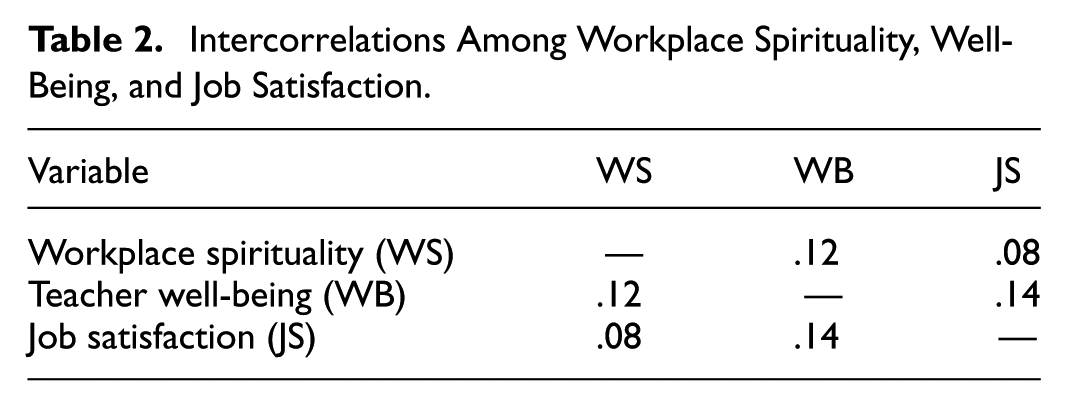
Given the absence of significant bivariate relationships, regression analysis was not conducted, consistent with methodological guidance discouraging regression modeling when predictor–outcome associations are non-existent. Assumption checks nevertheless indicated approximate normality, absence of influential outliers, and acceptable linearity and homoscedasticity, supporting the robustness of the correlation results.
Qualitative Results
To address
The first theme concerned
The second theme captured the
The third theme highlighted the role of
Integration of Quantitative and Qualitative Findings
Addressing
Discussion
Interpretation of Quantitative Findings
The quantitative analyses revealed no statistically significant associations among workplace spirituality, teacher well-being, and job satisfaction. While this finding contrasts with studies reporting positive relationships in other organizational contexts (Milliman et al., 2003; Petchsawang & Duchon, 2012), it warrants careful interpretation rather than dismissal. The absence of significance suggests that spirituality may not function as a direct or uniform predictor of well-being and satisfaction within school settings.
One plausible explanation lies in the complexity of spiritual experience, which may not be fully captured through cross-sectional Likert-scale measures. Spirituality involves subjective meaning-making, ethical orientation, and relational depth, all of which may vary considerably across institutional contexts. In addition, the heterogeneity of the sample—including variation in school setting, professional experience, and organizational climate—may have attenuated associations that could emerge more clearly under specific conditions (Skaalvik & Skaalvik, 2016).
More importantly, these findings align with research suggesting that spirituality exerts influence indirectly, through psychological and organizational mechanisms such as meaning-making, value congruence, psychological capital, and relational trust (Avey et al., 2011; Bryk & Schneider, 2002). As these mediating processes were not measured in the present study, the quantitative results highlight the limitations of assuming linear relationships and underscore the need for more nuanced analytical models.
Insights from the Qualitative Data
The qualitative findings provide important contextual depth to the quantitative results. Teachers consistently described spirituality not in religious terms, but as an inner orientation toward meaning, ethical commitment, and relational connectedness. Teaching was frequently portrayed as a morally grounded and socially significant vocation, with fulfillment derived primarily from student relationships and contributing to broader societal good.
At the same time, many participants emphasized that this sense of meaning was fragile and easily undermined by excessive administrative demands, emotional exhaustion, and lack of institutional support. These accounts illuminate a central tension: teachers may experience strong internal purpose while simultaneously reporting diminished well-being or satisfaction due to unsupportive organizational conditions. This tension helps explain why spirituality did not emerge as a direct quantitative predictor of well-being or job satisfaction.
Leadership and school climate emerged as particularly salient contextual factors. Teachers who described trusting relationships, fair leadership practices, and a sense of community reported greater emotional resilience, whereas those in fragmented or distrustful environments expressed disengagement and spiritual depletion. These findings reinforce existing research emphasizing the centrality of organizational climate in shaping teacher experiences (Hoy & Tarter, 2011).
Integrating Findings and the Conceptual Framework (CSSM)
Taken together, the quantitative and qualitative findings suggest that workplace spirituality operates as a conditional and context-sensitive resource rather than a direct determinant of teacher well-being or job satisfaction. To integrate these insights, the Contemplative-Spiritual School Model (CSSM) is proposed as an exploratory conceptual framework that synthesizes existing theory with patterns emerging from the data.
Figure 1 illustrates how workplace spirituality—understood as meaning, purpose, alignment, and connectedness—may influence teacher outcomes indirectly through psychological mechanisms such as meaning-making, intrinsic motivation, and psychological capital. These processes are, in turn, shaped by contextual moderators including leadership practices, relational trust, workload fairness, and school climate. Within this framework, outcomes such as well-being, job satisfaction, and retention intentions are viewed as emergent and conditional rather than automatic consequences of spiritual orientation.

Conceptual school spirituality model (CSSM).
Importantly, the CSSM is not presented as an empirically validated model, but as a theoretically grounded heuristic designed to guide future inquiry. Its value lies in challenging linear assumptions and providing a structured way to investigate how spirituality interacts with organizational conditions in educational settings.
Conclusion
This study explored the relationships among workplace spirituality, teacher well-being, and job satisfaction through an integrated mixed-methods design. Although the quantitative findings did not reveal statistically significant associations among the main variables, the qualitative data offered important insight into how teachers understand and experience spirituality in their professional lives. Teachers consistently framed spirituality in terms of meaning, ethical alignment, and relational connectedness, highlighting its relevance to educational work even when it does not translate into measurable outcomes such as well-being or job satisfaction.
The absence of significant quantitative effects suggests that workplace spirituality may not function as a direct predictor of teacher well-being or job satisfaction. Rather, its influence appears to be indirect and contingent upon psychological processes and organizational conditions. Qualitative responses pointed to the importance of meaning-making, intrinsic motivation, leadership support, trust, and school climate in shaping whether spiritual orientations contribute positively to teachers’ professional experiences. These findings indicate that spirituality operates within a broader contextual and relational ecology rather than as an isolated individual resource.
On this basis, the Conceptual School Spirituality Model (CSSM) is proposed as a theoretically grounded, exploratory framework that integrates existing scholarship with the empirical patterns observed in this study. While the model is not empirically tested, it offers a coherent lens for understanding the conditional pathways through which spirituality may influence teacher outcomes. Overall, this study contributes to ongoing discussions about the inner life of teachers by demonstrating that spirituality remains a meaningful, though complex, dimension of educational work and by providing a conceptual foundation for future research that examines its psychological and organizational dynamics more rigorously.
Footnotes
Acknowledgements
The author wishes to thank all participating teachers who voluntarily shared their experiences and insights for this study. Special thanks are extended to colleagues and peer reviewers who provided valuable feedback on earlier drafts of this manuscript.

Ethical Considerations
This study did not involve interventions with human or animal subjects that would require formal institutional review board (IRB) approval. Data were collected anonymously through voluntary teacher participation in online questionnaires. Participants were informed about the purpose of the study, assured of confidentiality, and provided informed consent before responding. Therefore, this study was exempt from IRB review, and no committee approval number is applicable.
Funding
The author received no financial support for the research, authorship, and/or publication of this article.
Declaration of Conflicting Interests
The author declared no potential conflicts of interest with respect to the research, authorship, and/or publication of this article.
Data Availability Statement
The data supporting the findings of this study are available from the corresponding author upon reasonable request. The data are not publicly available due to privacy and ethical restrictions related to participant confidentiality.