







Abstract
Virtual influencers have emerged as experts in specific domains, attracting followers by creating content on platforms such as Douyin, the Chinese version of TikTok. However, their rise also challenges the traditional impact of human influencers on tourist well-being. As influencers increasingly adopt certain linguistic styles, a critical question remains underexplored: when and why might specific language features be effective? To address this gap, this study adopts cognitive and affective perspectives to examine how different linguistic characteristics of social media influencers (human vs. virtual) influence tourists’ sharing intentions. In Study 1, we investigated how the combination of influencer type (human vs. virtual) and language style (warmth- vs. competence-oriented) differentially affects willingness to share. In Study 2, we employed different scenarios and controlled for gender effects to test the robustness of our findings. In Study 3, we introduced the moderating role of temporal perception. The results reveal that the speaking style of influencers boosts tourists’ sharing intention through the mediation of processing fluency and psychological richness. Specifically, for human influencers, using a warm (as opposed to competent) language style leads to stronger willingness to share, as it triggers higher levels of processing fluency and psychological richness. In contrast, for virtual influencers, a competence-oriented (rather than warm) language style is more effective. Furthermore, we found that a lower level of temporal perception enhances the effect of influencer language style on sharing intention, whereas a higher level of temporal perception weakens this effect. By unraveling the matching mechanism between influencer type and language features, this study offers novel theoretical and practical insights for social media promotional strategies.
Plain Language Summary
Have you ever wondered why you feel like sharing some travel videos online but not others? Our research looked at how the type of person in the video (a real human or a computer-generated AI influencer) and the way they talk (in a friendly “warm” way or a smart “competent” way) affect your decision to share. We conducted three online experiments with travelers. We found a simple but powerful rule: People prefer to share videos where real humans use warm, friendly language, but they prefer videos where AI influencers use smart, competent language. This is because friendly humans feel more genuine, and smart AIs feel more capable, both making the video easier to understand and more enjoyable. For tourism marketers, this means they should carefully match the type of influencer with the right speaking style to get more people sharing their content. For everyone else, it helps explain how we react to the growing number of AI personalities online.
Keywords
Introduction
Social media, with over 4 billion users, is indispensable for destination branding in tourism marketing. Internet and mobile technology convergence have made these platforms primary channels for travel information exchange, significantly influencing destination choice, experience co-creation, and image.
Users widely adopt social platforms to share experiences, maintain connections, and express emotions (Shamayleh & Arsel, 2026). Digital content’s shareability substantially amplifies its reach (Tellis et al., 2019). Brands establish direct consumer interactions through these platforms, where users engage through liking, sharing, and commenting (Martínez-López et al., 2017).
Inducing audience sharing is crucial due to its cost-effective mass reach, raising a key question: What fundamentally drives marketers to create shareable content?
Language, a core medium for emotion and information (Packard et al., 2024), enables cognitive organization and collaboration. Social media discourse typically exhibits emotional intensity, informality, and low complexity (Muresan et al., 2016; Walther, 2012), with emotional content demonstrating superior shareability (Alhabash et al., 2013). Strategic linguistic approaches enhance brand relationships (Gretry et al., 2017), optimize digital experiences (Barcelos et al., 2018), and amplify purchase intentions.
Linguistic style is a strategic determinant in influencer persuasion (Byun & Ahn, 2023). Both human and virtual influencers use resonant language to boost message receptivity and drive behavior (M. T. Lee & Theokary, 2021; Wang et al., 2025), though audience reactions vary significantly by influencer authenticity (Wang et al., 2025).
This study aims to investigate how linguistic cues influence the motivation behind social media sharing. First, it demonstrates that linguistic styles play a crucial role in digital persuasion. They not only shape information comprehension by enhancing processing fluency but also strengthen persuasive effects by regulating psychological richness. These two psychological dimensions collectively constitute the core mechanism of digital persuasion. Furthermore, our research explores how temporal perception influences sharing intention, thereby identifying a key boundary condition for social media sharing behavior. Additionally, to the best of our knowledge, this study represents the first application of the psychological richness theory in the context of social media. This contribution is significant for advancing the understanding of language effects in social media research and provides new strategic insights for destination marketers.
Literature Review and Hypotheses Development
The Impact of Linguistic Styles and Influencer Types on Social Media Willingness to Share
Information Theory indicates perceived positive valences increase sharing propensity (Su et al., 2025). Research confirms robust technological infrastructure enhances trust, while reduced privacy concerns facilitate data sharing (Kim et al., 2017). Fulfilling consumer expectations through perceived enjoyment constitutes a primary sharing motivator. In eco-friendly, non-competitive contexts, diminished social proximity strengthens interpersonal connections and sharing willingness (Oliveira et al., 2020; Schreiner et al., 2018; Wiewiora et al., 2013). Interactive experiences exert beneficial psychological impacts (Lin et al., 2024), reducing defensive barriers and enhancing cognitive receptivity during information exchange. Informal environments—especially face-to-face communication—serve as optimal knowledge-sharing conduits by fostering trust (Fawcett et al., 2007; Hon et al., 2022; Wiewiora et al., 2013).
Sharing intention reflects individuals’ openness to disseminate information (H. Li et al., 2023), acting as a behavioral antecedent linked to sharing outcomes (Fawcett et al., 2007). Elevated willingness to share often correlate with higher information quality in shared content (Zaheer & Trkman, 2017). In social media, linguistic execution critically shapes engagement, with empirical evidence confirming specific linguistic features stimulate interaction behaviors (liking, commenting, sharing; Pezzuti et al., 2021), highlighting the nexus between lexical choice and user-brand dynamics.
Language is pivotal across human existence (Berger & Packard, 2023). As communication’s indispensable component, consumer psychology research focuses on words, punctuation, letters, and paralinguistic cues (Luangrath et al., 2016). Subtle linguistic variations yield significant effects: pronoun/preposition usage influences purchases (Ludwig et al., 2013), concrete language affects satisfaction (Packard & Berger, 2023), and high-arousal language stimulates online purchase intentions (Wang et al., 2025). During service interactions, emotional language outperforms cognitive language. Agents initiate conversations with either competence-oriented cognitive language (e.g., “How may I assist?”) or warm affective language (e.g., “How are you?”). Social norms suggest warm behaviors—relationship-building, empathy, apologies—benefit interactions before transitioning to objectives (Kaski et al., 2018). Warmth transmission aligns with leisure’s relaxation/comfort goals (Su et al., 2020), fostering belongingness and social fulfillment essential for well-being (Mattila & Enz, 2002). Conversely, cognitive language conveys instrumentality, intelligence, and agency (Deci & Ryan, 2000), with terms like “diagnose” or “think” signaling cognitive efforts (Packard & Berger, 2024). Both linguistic styles are critical, yet their importance varies across interaction phases: client satisfaction increases significantly when agents use warm language initially/conclusively and competence-oriented language intermediately (Packard & Berger, 2023).
As potent advertising vehicles, influencers particularly resonate in fashion/beauty sectors among youth (Tian et al., 2025). They strategically craft psychologically attuned, emotionally resonant personas to expand followings (Jin et al., 2019). Notably, influential accounts include non-human entities (Lou & Yuan, 2019). Virtual influencers (animated/hyper-realistic digital personas) increasingly rival humans in market impact (Barari, 2023). Comparative studies show human influencers outperform virtual counterparts in brand attitude/purchase intention via perceived competence/credibility (H. Li et al., 2023), receiving superior evaluations in trustworthiness, social presence, and anthropomorphism (Barari, 2023). Conversely, virtual influencers uniquely stimulate word-of-mouth diffusion for human influencers (Sands et al., 2022). Divergent effects occur in language arousal: high-arousal language boosts purchase intentions for virtual influencers but reduces them for humans (Wang et al., 2025). Thus, we propose the hypothesis as follows:
The Mediating Effects of Processing Fluency and Psychological Richness
Processing fluency reflects the subjective ease of information processing, encompassing individuals’ perceived effort in acquiring and interpreting stimuli (C.-J. Chang, 2013). In consumer contexts, it serves as a critical predictor of advertising attitudes, brand perceptions, and purchasing decisions through its influence on perceived processing difficulty (Storme et al., 2015). Within virtual influencer research, processing fluency mediates relationships between visual/auditory characteristics, linguistic styles, brand alignment, and purchase intentions (Chan & Northey, 2021; Huang et al., 2024).
Attribution Theory (Janiszewski & Meyvis, 2001) posits that fluency perceptions derive from contextual factors like time constraints and preference judgments (C. Chang, 2013; Graf et al., 2018; X. S. Liu et al., 2022), with attribution sources contingent on stimulus-judgment congruence. Multimodal consistency enhances mental imagery, motivation, and attitudinal outcomes (X. Liu et al., 2023). High fluency emerges when task information aligns with cognitive judgment levels (A. Y. Lee & Aaker, 2004), such as when prior knowledge matches expectations, eliciting positive responses (Lau, 2025; Reber et al., 1998). Psychophysiologically, processing fluency operates as a hedonic marker (Reber et al., 2004), modulating truth judgments, risk perceptions, and aesthetic evaluations (C.-J. Chang, 2013; Lau, 2025).
Psychological richness—a third dimension transcending traditional hedonic-eudaimonic dichotomies (Oishi et al., 2021)—correlates with but remains distinct from happiness (Zacher, 2024). Characterized by diverse, novel, and emotionally intense experiences (Oishi et al., 2020), it is strongly predicted by openness and extraversion (Oishi & Westgate, 2022), with self-compassionate individuals exhibiting heightened psychological richness (Y. Liu et al., 2025). This construct encompasses both positive and negative emotional extremes, as evidenced by COVID-19-related distress studies (Dahlen & Thorbjørnsen, 2022).
Cognitive Load Theory suggests tourism ads matching tourists’ cognitive frameworks enhance processing fluency (A. Y. Lee & Aaker, 2004). Functioning as a hedonic cue (Dragojevic & Giles, 2016), fluency correlates with happiness and psychological richness, often eliciting positive affect (Reber & Greifeneder, 2017). Its interplay with psychological richness warrants systematic investigation. Thus, we propose the hypothesis as follows:
Moderating Role of Temporal Perception
Temporal perception denotes individuals’ cognitive evaluation of chronological sequences, encompassing judgments about event simultaneity, non-simultaneity, and sequentiality (Yin & Huang, 2009). Psychological research shows identical physical durations may be subjectively perceived differently across contexts due to neurocognitive mechanisms involving attention and affect (Y. Li et al., 2026). The “internal clock” hypothesis posits humans gauge time through an endogenous chronometric mechanism (Allman et al., 2014).
Conversely, overestimated time perception creates time pressure, prompting quicker decisions that attenuate Linguistic Feature-Influencer Type interactive effects on Sharing Willingness. Individuals tend to skim information rather than deeply contemplate content, reducing Psychological Richness experiences and diminishing willingness to share. Simultaneously, overestimation may increase cognitive load, causing resistance to complex linguistic/influencer combinations and inhibiting Sharing Willingness. Thus, we propose:
Overview of Studies
We conducted three experimental studies to test the hypotheses. Study 1 employed a 2 × 2 between-subjects factorial design to examine willingness to share toward tourism short videos presented by human or virtual influencers (H1a, H1b). It assessed audience responses to warm versus competence-oriented language across influencer types while investigating the mediation of processing fluency and psychological richness (H2, H2a, H2b). Study 2 replicated the design, procedure, and measures of Study 1 with two modifications: (a) altering the experimental scenario to validate effect robustness and enhance generalizability, and (b) varying the digital avatar’s gender. This study retested H1a, H1b, H2, H2a, and H2b. Study 3 introduced a queuing scenario to evaluate temporal perception’s moderating role in the influencer type–linguistic style interaction on willingness to share (H3, H3a, H3b), while concurrently re-examining H1a, H1b, H2, H2a, and H2b. As shown in Figure 1.
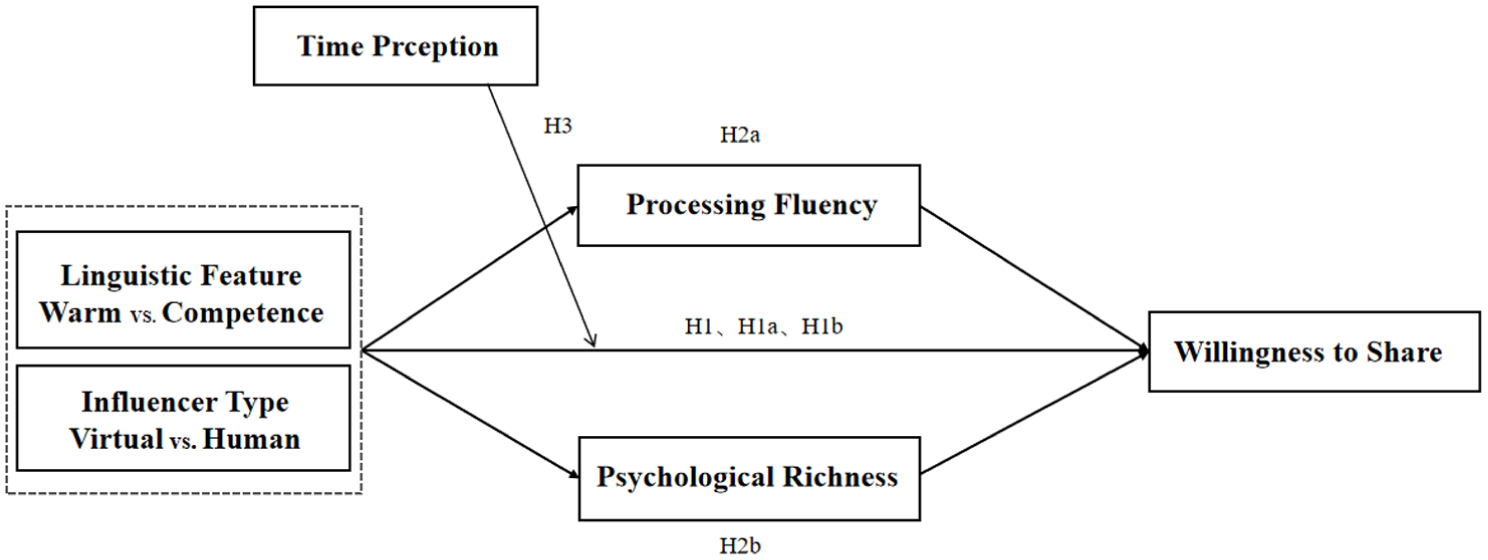
Theoretical model of this research.
Methods and Data Analysis
Coding
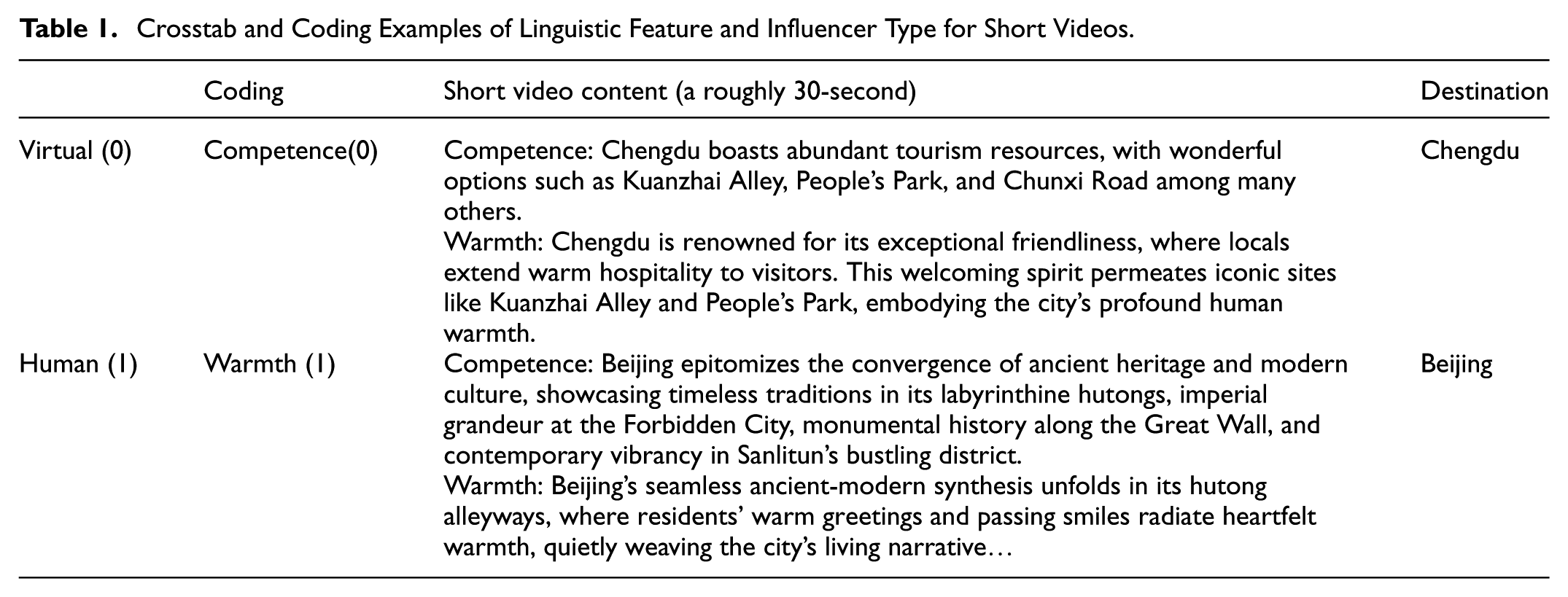
The independent variable—influencer type and linguistic style—were operationalized as categorical variables: virtual influencers were coded as 0, human influencers as 1; competence-oriented language as 0, and warm language as 1 (Table 1).
Crosstab and Coding Examples of Linguistic Feature and Influencer Type for Short Videos.
Study 1
Pretest
A pretest on Credamo employed a within-subjects design with 40 participants, excluding psychology/linguistics/arts majors to control individual differences. Chengdu was selected as the destination based on its inclusion in China Tourism Academy’s (2025) “Top 10 Tourist Satisfaction Cities.” Linguistic stimuli—warm versus competence-oriented language—were designed with marketing experts using Douyin tour guide scripts. Participants randomly reviewed Chengdu tourism videos:
Warm language: “Chengdu radiates heartfelt hospitality, warming visitors with sincerity. In Kuanzhai Alley and People’s Park, kind locals share hidden charms.”
Competence language: “Chengdu features high-quality resources: traditional architecture/cuisine in Kuanzhai Alley, teahouse clusters in People’s Park, and diverse options in Chunxi Road.”
Warmth perceptions were measured via Chang C.’s (2013) 7-point Likert scale (e.g., “This language feels warm”). Paired-sample t-tests confirmed significant differences (Mwarmth = 5.53, SD = 1.04; Mcompetence = 3.24, SD = 1.16; t(df = 39) = 3.79, p < .001), validating stimuli for formal experimentation..
Procedure and Stimuli
This study employed a 2 (linguistic style: warmth vs. competence) × 2 (influencer type: virtual vs. human) between-subjects design. Based on G*Power 3.1 calculations (f = 0.25, α = .05, 95% power), N = 210 minimum sample was determined. We recruited 420 Credamo participants, excluding psychology/linguistics/arts majors, Chengdu visitors, or pretest participants. Participants received nominal compensation (66.9% female; age 21–30: 38%, 31–40: 49%).
Participants were randomized to four conditions viewing tourism videos:
Virtual influencer (woman) with warmth/competence language Human influencer (woman) with warmth/competence language
Scenarios simulated social media browsing: “Imagine you’re on holiday encountering this video…” Scripts alternated between:
Warmth: “Chengdu radiates heartfelt hospitality… locals share hidden charms” Competence: “Chengdu features high-quality resources… diverse dining/shopping options”
After reviewing the videos, participants identified the influencer type (human/virtual) and completed 7-point Likert scales measuring processing fluency (A. Y. Lee & Aaker, 2004; Cronbach’s α = .798), psychological richness (adapted from Oishi et al., 2021; α = .856), willingness to share (adapted from Kang & Schuett, 2013; α = .815), and emotional states (valence/arousal; Russell, 2003; α = .911) as control variables. Demographic data (gender, age, etc.) were collected subsequently.
Main Effect Analyses
The two-way ANOVA results revealed significant main effects of influencer type on participants’ willingness to share (F(1,416) = 4.758, p < .05) and linguistic style on willingness to share (F(1,416) = 6.246, p < .05), with a significant interaction effect between the two factors (F(1,416) = 159.987, p < .001). Follow-up contrast analyses demonstrated that for human influencers, participants exhibited stronger willingness to share with warmth-oriented language (Mwarmth = 5.84, SDwarmth = 0.67; Mcompetence = 4.23, SDcompetence = 1.23: F(1,208) = 141.11, p < .001). Conversely, for virtual influencers, participants showed higher willingness to share with competence-oriented language (Mwarmth = 4.26, SDwarmth = 1.17; Mcompetence = 5.34, SDcompetence = 1.21: F(1,208) = 43.40, p < .001). As shown in Figure 2, these findings support H1a and H1b.
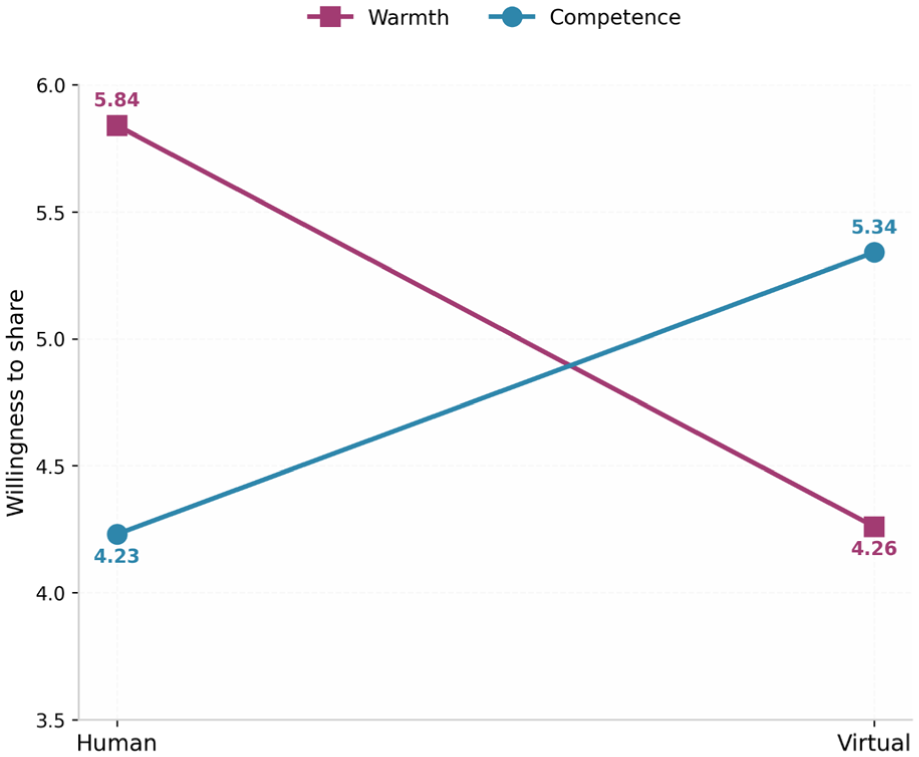
Study 1: Interaction effect of linguistic style and influencer type on participants’ willingness to share.
Mediation Effect Analysis
Subsequent mediation analyses were conducted using Model 6 of the Process macro (Hayes, 2017), with Linguistic Feature as the independent variable (1 = warmth, 0 = competence). Under conditions of a 5,000 bootstrap sample size and 95% confidence interval, the mediating effects of Processing Fluency and Psychological Richness were further examined. Results from the human influencers experimental group (Table 2) indicated a significant mediation effect (95% CI = [0.09, 0.44], β = .24, SE = 0.09, excluding 0), thereby supporting H2. Specifically, the mediation effect along the path “Linguistic Feature → Processing Fluency → Psychological Richness → Willingness to Share” was significant ([0.03, 0.18], β = .09, SE = 0.04, excluding 0). However, the mediation effect along the path “Linguistic Feature → Processing Fluency → Willingness to Share” was non-significant ([−0.01, 0.19], β = .07, SE = 0.05, including 0), and the mediation effect along the path “Linguistic Feature → Psychological Richness → Willingness to Share” was also non-significant ([−0.01, 0.22], β = .08, SE = 0.06, including 0). Thus, as the above results demonstrate, since the mediation effect coefficient was more than 0, H2a was also supported.
The Mediation Analysis Results of Human Influencer Experimental Group (Study 1).

Note. LF = Linguistic Feature; PR = Psychological richness; PF = Processing fluency; WS = Willingness to share.
On the other hand, the mediation analysis results from the virtual influencers experimental group (Table 3) demonstrated that, with Linguistic Feature as the independent variable (1 = warmth, 0 = competence), a significant mediation effect was observed (95% CI = [−0.54, −0.45], β = −.30, SE = 0.13, excluding 0), thereby supporting H2. Specifically, the mediation effect along the path “Linguistic Feature → Processing Fluency → Psychological Richness → Willingness to Share” was significant ([−0.27, −0.04], β = −.15, SE = 0.06, excluding 0). However, the mediation effect along the path “Linguistic Feature → Processing Fluency → Willingness to Share” was non-significant ([−0.08, 0.03], β = −.02, SE = 0.03, including 0), and the mediation effect along the path “Linguistic Feature → Psychological Richness → Willingness to Share” was also non-significant ([−0.35, 0.10], β = −.13, SE = 0.11, including 0). Thus, as the above results indicate, since the mediation effect coefficient was less than 0, H2b was also supported.
The Mediation Analysis Results of Virtual Influencer Experimental Group (Study 1).
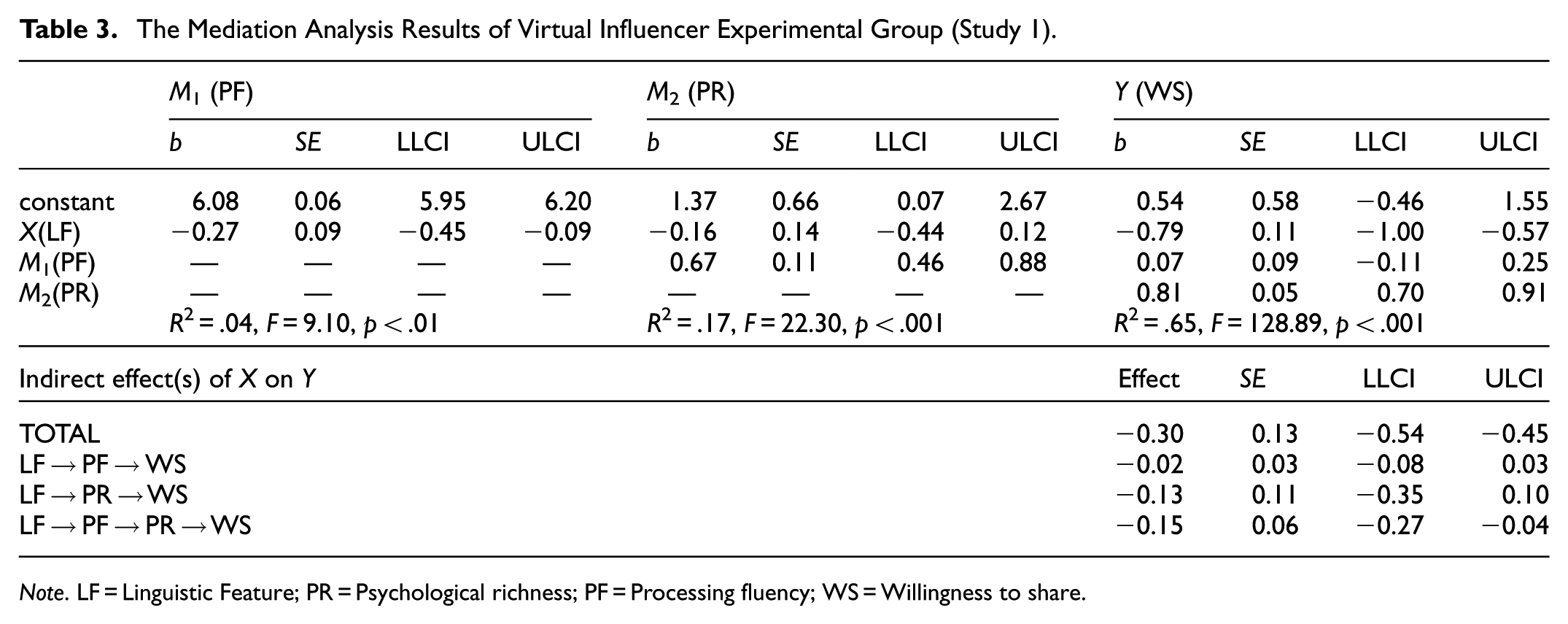
Note. LF = Linguistic Feature; PR = Psychological richness; PF = Processing fluency; WS = Willingness to share.
Examining Emotional Arousal and Valence as Alternative Mechanisms
Do emotional arousal and valence exhibit equivalent mediating roles? Bootstrap mediation effect tests were conducted with arousal and valence as separate mediating variables. The results revealed that the mediation effect of arousal was non-significant (95% CI = [−0.52, 0.008], including 0), and the mediation effect of valence was also non-significant ([−0.449, 0.013], including 0). Thus, neither emotional arousal nor valence mediated the impact of linguistic type and influencer type on participants’ willingness to share, thereby ruling out their roles as mediators.
Study 2
Pretest
Study 2 revalidated H1–H2 by altering scenarios and using a male digital human. Design, procedures, and measures mirrored Study 1.
A Credamo pilot employed a within-subjects design (N = 40), excluding psychology/linguistics/arts specialists and prior participants. Beijing was selected per China Tourism Academy’s (2025) “Top 10 Tourist Satisfaction Cities.” Linguistic stimuli (warm vs. competence language) were developed with marketing experts using Douyin vlogger scripts.
Participants reviewed Beijing tourism descriptions:
Warm language:
Beijing embraces visitors with distinctive warmth – from hutong elders’ greetings to strangers’ smiles. Beyond history, helpful residents share stories, fostering belonging.
Competence language:
Beijing offers abundant resources: Forbidden City (imperial architecture/culture), Great Wall (majestic landscapes), hutongs (folk experiences), 798 Art District (contemporary culture), Sanlitun (nightlife/dining).
Perceived warmth was measured via C. Chang’s (2013) 7-point Likert scale (e.g., “This language is warm”). Paired-sample t-tests confirmed significant differences (Mwarmth = 5.44, SD = 0.97; Mcompetence = 3.94, SD = 1.01; t(df = 39) = 2.79, p < .01), validating manipulations for formal experimentation.
Formal Experiment
A 2 (Linguistic Feature: Warmth vs. Competence) × 2 (Influencer Type: Virtual vs. Human) between-subjects design was implemented. Participants (N = 426), recruited via Credamo, excluded individuals from psychology, linguistics, or art-related fields, those who had visited Beijing, and prior experiment participants. Demographics: 63.4% female, 40.4% aged 21 to 30, 46.7% aged 31 to 40. The stimuli mirrored the pilot study, presented as travel short videos. After viewing, participants answered whether the recommender was human or virtual, followed by 7-point Likert scale assessments: processing fluency (adapted from A. Y. Lee & Aaker, 2004; Cronbach’s α = .828), psychological richness (adapted from Oishi et al., 2021; α = .804), willingness to share (adapted from Kang & Schuett, 2013; α = .875), and emotional arousal/valence (Russell, 2003; α = .891) as controls. Finally, demographic data (gender, age, etc.) were collected.
Procedure and Stimuli
A two-way ANOVA revealed a significant interaction effect between Linguistic Feature and Influencer Type on willingness to share (F(1,426) = 343.67, p < .001). Contrast analyses showed: for human influencers, warmth language elicited higher willingness to share (Mwarmth = 5.73, Mcompetence = 4.45, F(1,211) = 261.36, p < .001); for virtual influencers, competence language yielded higher willingness to share (Mwarmth = 4.38, Mcompetence = 5.59, F(1,211) = 124.42, p < .001). These results (Figure 3) reconfirmed H1a and H1b.
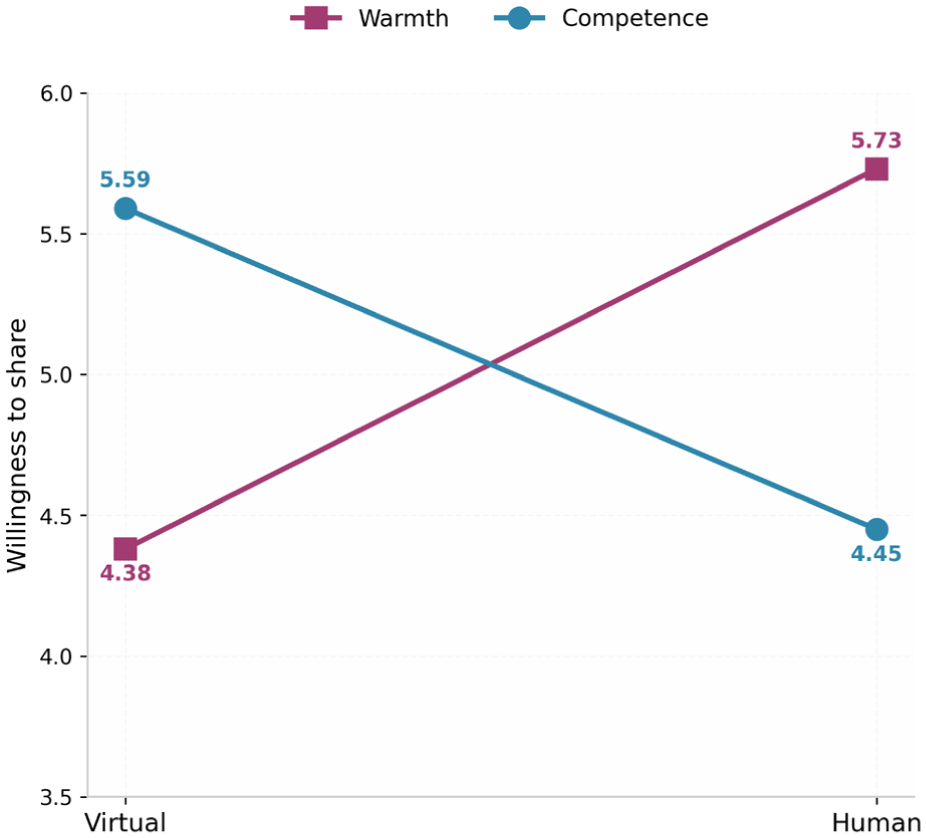
Study 2: Interaction effect of linguistic feature and influencer type on participants’ sharing intention.
The Mediation Effect Analysis
A mediation analysis was conducted using Model 6 of the PROCESS macro (Hayes, 2017). With Linguistic Feature as the independent variable (1 = Warmth-oriented, 0 = Competence-oriented), the analysis tested the mediating roles of processing fluency and psychological richness under a bootstrap sample size of 5,000 and 95% confidence intervals. Results for the human influencer experimental group are presented in Table 4. The serial mediation effect was statistically significant (β = .20, SE = 0.13, 95% CI = [0.09, 0.15], excluding 0), thereby supporting H2. Specifically, the path “Linguistic Feature → Processing Fluency → Psychological Richness → Sharing Intention” exhibited significant mediation (β = .10, SE = 0.05, [0.03, 0.11], excluding 0). By contrast, neither the direct path “Linguistic Feature → Processing Fluency → Sharing Intention” (β = .12, SE = 0.08, [−0.06, 0.15], including zero) nor “Linguistic Feature → Psychological Richness → Sharing Intention” (β = .07, SE = 0.08, [−0.05, 0.14], including 0) reached significance. Thus, as demonstrated by the positive mediation coefficient (>0), H2a was supported.
The Mediation Analysis Results of Human Influencer Experimental Group (Study 2).
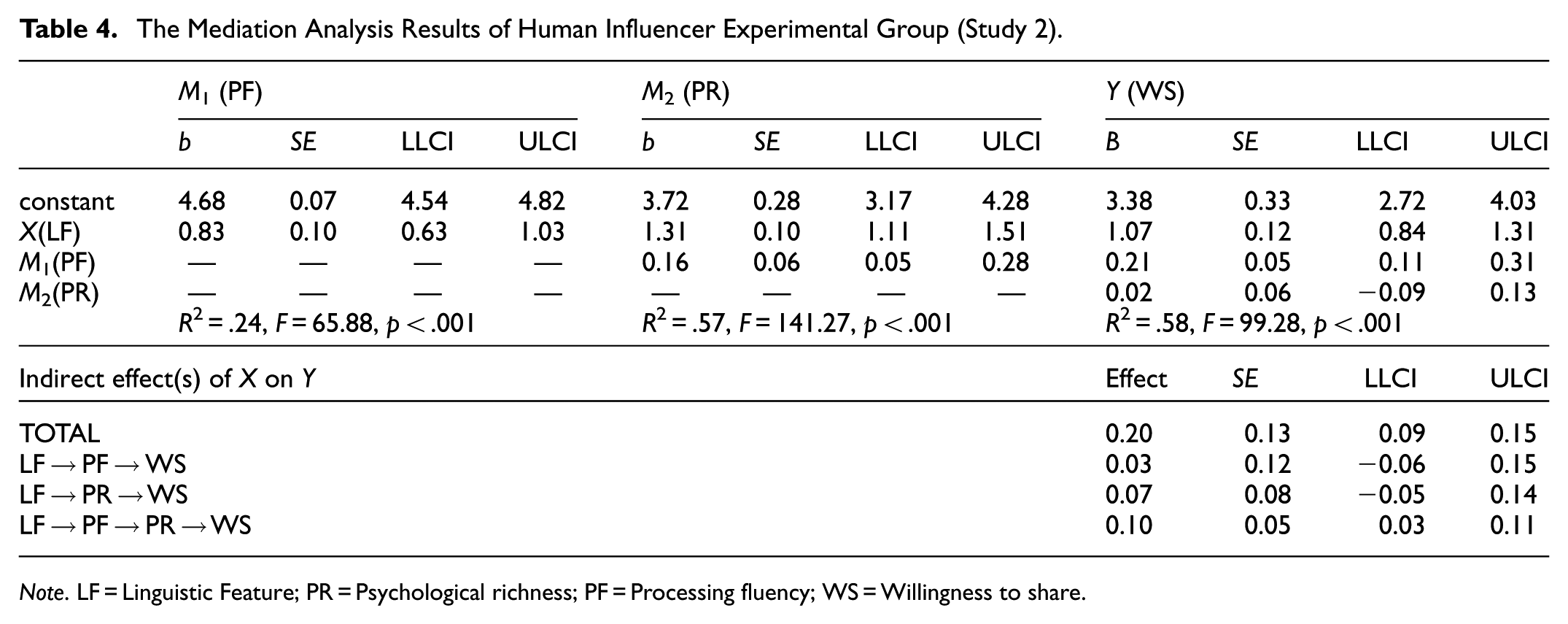
Note. LF = Linguistic Feature; PR = Psychological richness; PF = Processing fluency; WS = Willingness to share.
On the other hand, for the virtual influencer experimental group (Table 5), a mediation analysis was performed with Linguistic Feature as the independent variable (1 = Warmth-oriented, 0 = Competence-oriented). The serial mediation effect was statistically significant (β = −.35, SE = 0.18, 95% CI = [−0.77, −0.10], excluding zero), supporting H2. Specifically, the path “Linguistic Feature → Processing Fluency → Psychological Richness → Sharing Intention” exhibited significant mediation (β = −.16, SE = 0.06, [−0.29, −0.046], excluding 0). However, neither the direct path “Linguistic Feature → Psychological Richness → Sharing Intention” (β = −.17, SE = 0.05, [−0.44, −0.04], excluding 0) nor “Linguistic Feature → Processing Fluency → Sharing Intention” (β = −.02, SE = 0.12, [−0.28, 0.17], including 0) reached significance. Thus, as demonstrated by the negative mediation coefficient (<0), H2b was also supported again.
The Mediation Analysis Results of Virtual Influencer Experimental Group (Study 2).

Note. LF = Linguistic Feature; PR = Psychological richness; PF = Processing fluency; WS = Willingness to share.
Examining Emotional Arousal and Valence as Alternative Mechanisms
Do emotional arousal and valence exhibit similar mediating roles? To test this, bootstrap mediation analyses were conducted with arousal and valence as separate mediators. Results revealed that the mediation effect of arousal was nonsignificant (95% CI = [−0.746, 0.018], including 0), and the mediation effect of valence was also nonsignificant ([−0.006, 0.063], including 0). Thus, neither arousal nor valence mediated the impact of linguistic type or influencer type on sharing intention, ruling out their potential roles as mediators.
Study 3
Preliminary Experiment
A Time Perception manipulation check employed a within-subject design (N = 46), excluding psychology/linguistics/art majors, prior participants, and Chengdu residents. During material development, interviews with 10 students revealed queuing experiences influence Time Perception. Accordingly, scenarios manipulated this variable:
Scenario 1: Imagined 30-minute outdoor queue for “Night Cruise on Jinjiang River” ticket collection (no performances) while viewing Chengdu promotional video (Study 1 stimulus; participants Study 1-naïve).
Scenario 2: Identical queue with role-players (e.g., Li Bai, boatmen) interacting with audience alongside video.
In our experiment, temporal perception was operationalized as participants’ subjective perception of time passage. Participants subsequently completed Dong et al.’s (2023) 3-item Time Perception scale:
Time passed slowly during the wait Queuing time felt longer than expected Frequently checked watch/phone while waiting
Paired-samples t-test confirmed significant differences (Mlow = 3.21, SD = 0.23; Mhigh = 5.94, SD = 0.17; t(df = 45) = 8.9, p < .001), validating experimental manipulations.
Formal Experiment
Experiment 3 examined H3 (Time Perception’s moderating role among Linguistic Feature, Influencer Type, and sharing intention). We recruited 415 Credamo participants with no background in psychology/linguistics/arts and no prior visitation to Chengdu with nominal compensation (63.9% female; 21–30y:40.7%, 31–40y:45.1%).
A 2 (Linguistic Feature: Warmth vs. Competence) × 2 (Influencer Type: Human vs. Virtual) × 2 (Time Perception: High vs. Low) between-subjects design was employed. The protocol mirrored Experiment 1 for participants with no prior exposure to Chengdu tourism or related experiments. At the formal experiment stage, participants first underwent procedures identical to the pre-experimental phase before being randomly assigned to either the high or low time perception condition. Following the operational protocol of Experiment 1, participants were then randomly assigned to view one of four video stimuli representing orthogonal combinations of linguistic features (warmth vs. competence) and influencer types (human vs. virtual). Post-stimulus exposure, participants completed standardized measurement instruments that retained core measures from Experiments 1 and 2, with additional temporal perception metrics adapted from Dong et al.’s (2023) validated scale. The temporal perception construct was operationalized through three items: “Time seemed to pass slowly during the waiting period”“The actual waiting duration exceeded my initial expectations” and “I frequently checked my watch or phone while waiting.”
The Moderated Effect Analysis
Based on the mean time perception score (Mmean = 4.56), participants scoring below the mean were categorized as the underestimated time perception group (coded as 0), while those scoring above the mean were categorized as the overestimated time perception group (coded as 1); the independent variables were coded as Linguistic Feature (1 = warmth, 0 = competence) and Influencer Type (1 = human, 0 = virtual), with Time Perception (1 = high, 0 = low) serving as the moderator variable.
The Cronbach’s α coefficients for Processing Fluency, Psychological Richness, and Willingness to Share were .790, .769, and .862 respectively, all exceeding the threshold of .70, indicating acceptable internal consistency reliability.
In the case of virtual influencer, the mediation effect was significant (indirect effect = −0.27, SE = 0.11, 95% CI = [−0.49, −0.07] ), the mediation effects of processing fluency and psychological richness were found to be significant (index = −0.19, SE = 0.06, [−0.32, −0.08]). Similarly, for human influencer, the mediation effect was significant (indirect effect = 0.92, SE = 0.12, [0.70, 1.16]), the mediation effects of processing fluency and psychological richness were found to be significant (index = 0.46, SE = 0.08, [0.32, 0.62]). Therefore, H2a and H2b were supported again.
First, the three-way interaction effect of Time Perception, Linguistic Feature, and Influencer Type on participants’ Willingness to Share was significant [F(1, 407) = 21.615, p < .01], indicating that the influence of Linguistic Feature and Influencer Type on Willingness to Share was moderated by Time Perception, thereby supporting Hypothesis 3 (H3).
Specifically, as presented in Table 6 and Figure 4a and 4b, under conditions of underestimated time perception, the interaction effect of Linguistic Feature and Influencer Type on Willingness to Share was enhanced, supporting Hypothesis H3a; conversely, under conditions of overestimated time perception, this interaction effect was attenuated, supporting Hypothesis H3b.
Results of the Moderation Test for Time Perception.
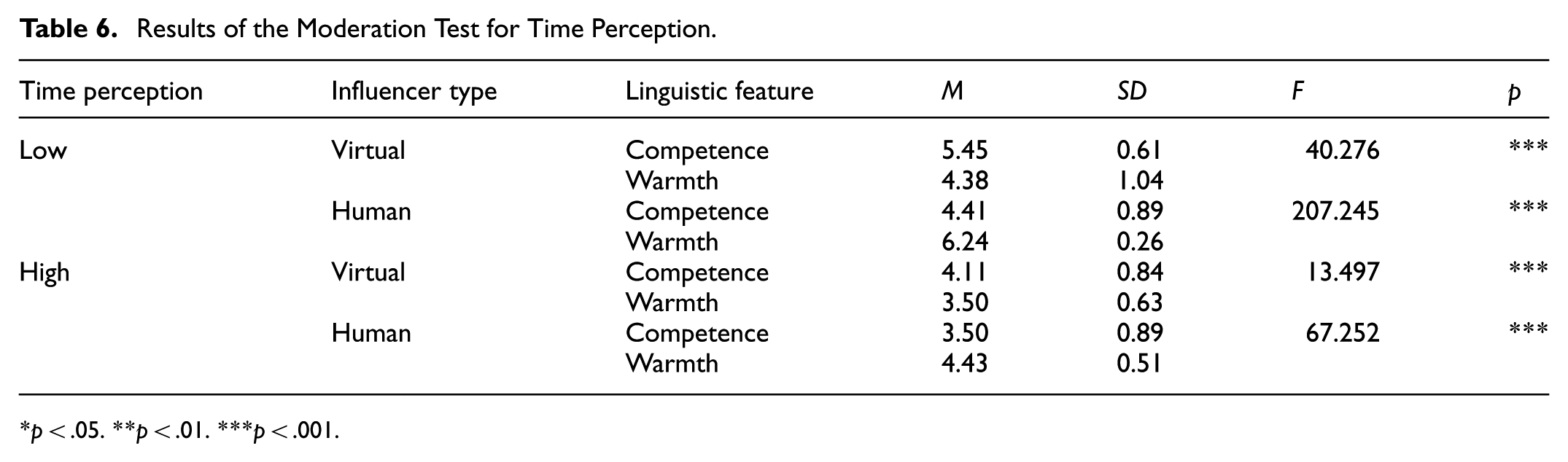
p < .05. **p < .01. ***p < .001.

(a, b) Interaction effect.
Discussion
This study makes theoretical contributions from three key aspects. First, it reveals a nuanced phenomenon: the effectiveness of social media influencers in driving sharing intention varies significantly depending on their use of distinct linguistic features. Specifically, warmth-oriented language (as opposed to competence-oriented language) significantly enhances sharing intention when used by human influencers. Conversely, competence-oriented language (rather than warmth-oriented language) is more effective in stimulating sharing intention when employed by virtual influencers. The warmth-oriented language used by human influencers helps narrow the psychological distance with their audience and enhances perceived affinity. This can be attributed to the unique way emotional content allocates cognitive resources, thereby strengthening attention and facilitating memory encoding (Tellis et al., 2019). In contrast, the competence-oriented language used by virtual influencers conveys professionalism and logical rigor, reflecting the audience’s high expectations regarding the expertise of virtual influencers. Demonstrating such competence further enhances their credibility. Our findings enrich the theoretical understanding of social media sharing behavior by moving beyond a singular focus on technical features or anthropomorphism—a limitation in prior research that often overlooked the role of conversational quality as a core interactive element (Hao & Li, 2025). This study underscores that language and influencer type function as an interactive whole, shaping individuals’ information processing through the dual dimensions of warmth and competence, thereby ultimately influencing their sharing intention.
Second, this study introduces processing fluency and psychological richness as mechanisms through which the linguistic styles of social media influencers affect tourists’ sharing intention. While prior research has established that psychological processes shape individuals’ memory, preferences, and sharing behavior (Berger & Milkman, 2012), their role in the context of social media remains underexplored. Our findings confirm that high processing fluency enhances psychological richness, which in turn increases sharing intention. Specifically, highly fluent content improves the likelihood of sustained information reception (Kool et al., 2010). By reducing information loss and fostering a positive processing experience, processing fluency positively influences attention dwell time. In contrast, text features that require high cognitive engagement exhibit a dual inhibitory effect: they prolong comprehension time, increase cognitive resource expenditure, weaken attention persistence, and inhibit deep consumption (Berger et al., 2023). In contexts requiring sustained attention, overemphasizing cognitive challenges often proves counterproductive. Simplified language and emotional resonance are key to maintaining engagement: the former reduces cognitive load, while the latter elicits empathetic responses (Berger et al., 2023). We extend a positive psychology theory to an information processing model, offering a tool to predict how individuals enhance their social sharing intention. Furthermore, the warmth-oriented language used by human influencers creates distinctive emotional experiences that align with the interesting experiences and perspective shifts emphasized by psychological richness (Oishi et al., 2020). For example, personal stories conveyed in a warm tone or expressions of care for the audience can evoke unique emotions, enrich psychological states, and influence sharing intention. This form of psychological richness breaks the monotony of daily life, resonates emotionally, and reflects its inherent rejection of routine in favor of diversity. In comparison, the competence-oriented language used by virtual influencers demonstrates professionalism and logical rigor, satisfying the pursuit of novelty and knowledge. Exposure to such content immerses the audience in new domains of understanding, increasing life diversity and thereby enhancing both psychological richness and sharing intention. Psychological richness emphasizes diverse experiences and shifts in life perspective, valuing variety, novelty, and interest (Oishi et al., 2020).
Finally, this study integrates the perspective of temporal perception into the theoretical framework of social media sharing intention, revealing its moderating role in the interaction between linguistic features and influencer types on sharing intention. Specifically, when temporal perception is underestimated, the enhancing effect of this interaction is significantly amplified; when it is overestimated, the effect is significantly weakened. Temporal perception is influenced by affective states, accelerating during pleasant experiences and decelerating during states of anxiety (Droit-Volet et al., 2013). A happy state makes time feel faster (Danckert & Allman, 2005), and deviations in time estimation reflect the quality of experience (Boltz, 1993). Previous tourism research has confirmed that temporal perception during activity planning determines the duration of stays (Y. Li et al., 2023), highlighting its critical role in tourism behavior (K. S. Lee & Tao, 2022; Y. Q. Li & Jiang, 2023). When perceived time exceeds actual time, tourists tend to extend their stays and increase spending (Pearce, 2020). However, how individual temporal perception influences behavioral intentions—such as social media sharing intention—had not been established. This study confirms that underestimating temporal perception creates a sense of time abundance, increasing willingness to process information and allowing the combination of linguistic features and influencer types to exert their full effect. This aligns with the accelerated temporal perception associated with positive affect (Danckert & Allman, 2005), suggesting that positive emotions and time underestimation jointly enhance sharing intention. Conversely, overestimating time generates pressure, prompting quicker decisions and reducing depth of processing, thereby weakening the interactive effect—a pattern consistent with how overestimation of activity time influences tourism decisions (Y. Li et al., 2023).
On the other hand, emotional arousal and valence cannot substitute for the mediating roles of processing fluency and psychological richness, as their effects are context-dependent. High-intensity emotional activation may inhibit sharing intention, particularly for low-relevance content (Weingarten & Berger, 2017). Non-resonant high-arousal messages can diminish sharing willingness, while overly commercialized content may raise authenticity concerns, thereby suppressing dissemination (Haan & Berkey, 2002). This negative effect is more pronounced in influencer marketing contexts: excessive emotional arousal may trigger defensive mechanisms, leading audiences to perceive emotional stimuli as manipulative, thus reducing trust and engagement (Eisend & Tarrahi, 2022). The absence of significant alternative effects confirms that emotional factors alone are insufficient to drive sharing intention, highlighting the complexity of communication effectiveness. A nonlinear dynamic balance exists between emotional arousal and credibility; overemphasizing either aspect may induce cognitive dissonance. Therefore, communication strategies require a multidimensional evaluation framework that aligns emotional intensity with information credibility to prevent cognitive conflict.
Conclusions, Limitations, and Implications of the Study
Conclusions
This study explores how the linguistic features of human versus virtual influencers influence tourists’ sharing intention through distinct cognitive and affective pathways. Experimental results confirmed that warm language elicits stronger willingness to share among audiences compared to competent language in the presence of human influencers. Conversely, competent language elicits stronger willingness to share than warm language in the presence of virtual influencers. Specifically, for human influencers, using a warm (as opposed to competent) language style leads to stronger willingness to share, as it triggers higher levels of processing fluency and psychological richness. In contrast, for virtual influencers, a competence-oriented (rather than warm) language style is more effective.
Furthermore, Time Perception moderated this relationship: when individuals underestimated time perception, the enhancing effect of the Linguistic Feature × Influencer Type interaction on Willingness to Share was significantly amplified; conversely, when individuals overestimated time perception, this interaction effect was relatively attenuated.
Limitations
This study has limitations. First, the experimental setting diverged from real-world tourism scenarios, potentially affecting external validity. Future research could conduct experiments in more ecologically valid contexts to enhance generalizability. Second, the focus on specific linguistic features and influencer types limited scope. Subsequent studies could broaden investigation to encompass other linguistic elements and emerging influencer categories (e.g., cross-cultural linguistic differences, virtual influencers, UGC creators) to comprehensively examine sharing willingness factors.
Additionally, Time Perception measurement was relatively simplified, potentially omitting complex dimensions. Future research could employ refined scales and multidimensional assessments, combined with longitudinal designs, to precisely track its dynamic changes and long-term impacts.
Further studies should explore interaction effects of other variables (cultural backgrounds, personality traits, platform characteristics) with linguistic style and influencer type. Amidst technological advancement, emerging technologies like VR/AI are reshaping tourism information sharing; how they alter dissemination pathways merits thorough investigation. This study offers valuable perspectives, and addressing these limitations will advance understanding of tourism communication dynamics.
Implications
Our research makes a pioneering contribution by empirically establishing the dual mediation of processing fluency and psychological richness in tourism communication, thereby offering a novel framework that integrates linguistic style with influencer typology. Furthermore, the successful application of Time Perception theory to tourism information sharing highlights the critical role of temporal factors in information processing and sharing decisions.
For tourism marketers, marketing strategies can be tailored according to influencer type and linguistic style. When collaborating with human influencers, employing warm language can strengthen emotional connections with audiences, thereby encouraging information sharing. For virtual influencers, emphasizing competent language helps establish trust and enhance willingness to share. Additionally, Time Perception is a significant factor. Pre-trip, tourists’ perception of time is more abstract; thus, marketing messages containing rich details and engaging narratives can capture attention and stimulate sharing. Conversely, during and post-trip, when time perception is more concrete, concise information aligned with travel plans is more likely to be shared. Tourism practitioners can design campaigns creating a perception of time affluence (e.g., offering exclusive discounts or early-bird special offers) to encourage tourists to spend more time exploring and sharing experiences.
This study holds significant implications for the sustainable development of the tourism industry. By elucidating how tourism information propagates among tourists, destinations can attract more visitors, boost local economies, and foster cultural exchange. Simultaneously, it enables tourism organizations to better understand tourists’ information needs and preferences, delivering more personalized and valuable information services, thereby effectively enhancing overall tourist satisfaction and travel experiences.
Footnotes

Ethical Considerations
All experiments involving human participants and/or human tissue samples were conducted in accordance with the ethical standards of Sichuan Tourism University Institutional Review Board (IRB) or Ethics Committee (EC) and with the Declaration of Helsinki (or other relevant national/international guidelines). Formal approval for this study was granted by the School of Tourism and Culture Industry, Sichuan Tourism University on December 2024.
Consent to Participate
Written informed consent was obtained from all participants prior to inclusion in the study.
Author Contributions
Yuanhong Zhong: Data curation, Conceptualization. Weiwei Deng: Writing—original draft, Formal analysis. Lijun Chen: Methodology, Visualization. Jinna Shi: Project administration, Funding acquisition. Writing—review & editing.
Funding
The authors disclosed receipt of the following financial support for the research, authorship, and/or publication of this article: This work was supported by Annual Institutional Research Project of Sichuan Tourism University (Project number: 2024SCTUDSK12); Sichuan Tourism Development Research Center (Project number: LY24-11); National Social Science Foundation of China, by National Office for Philosophy and Social Sciences [grant number 24BSH131].
Declaration of Conflicting Interests
The authors declared no potential conflicts of interest with respect to the research, authorship, and/or publication of this article.
Data Availability Statement
Data sharing not applicable to this article as no datasets were generated or analyzed during the current study.