






Abstract
Small- and medium-sized enterprises (SMEs) play a vital role in today’s economy and are one of the most dynamic and creative frameworks. Social entrepreneurship is increasingly being acknowledged as a key driver of economic and societal progress. In line with this, the present study seeks to examine how sustainable innovation acts as a bridge between social entrepreneurship orientation (SEO) and sustainable entrepreneurship (SE) in Saudi Arabia, with a focus on environmental preservation. A survey was conducted with 103 SME managers in Saudi Arabia. The research followed a positivist philosophy, adopted a deductive approach, and used quantitative methodology with convenience sampling. The results revealed a partial link between SEO and SE and a partially significant connection between SEO and sustainable innovation. Additionally, the findings reveal a significant relationship between sustainable innovation and SE (p = .000). The results also indicate that sustainable innovation plays a partially mediating role. Based on the outcomes, the discussion explores the potential theoretical and practical implications, acknowledges the limitations, and provides recommendations for future research.
Keywords
Introduction
Social entrepreneurship has emerged as a significant and distinct domain in the broader field of entrepreneurship. Unlike traditional commercial ventures, social enterprises are characterized by their unique mission-driven approach and the specific demands of their target markets (Premadasa et al., 2023). Concurrently, entrepreneurial orientation (EO) has become a pivotal concept in entrepreneurship research (Lurtz & Kreutzer, 2017). Scholarly consensus defines EO as a firm-level strategic construct rooted in the strategy-making process that encapsulates an organization’s entrepreneurial tendencies (Premadasa et al., 2023). SEO have emerged as a transformative response to conventional business paradigms. Research indicates that SEO are fundamentally driven by the pursuit of social value creation, with entrepreneurial behaviors specifically directed toward addressing complex societal challenges (Austin et al., 2006; Lumpkin et al., 2018). In this context, social enterprises must employ innovative approaches to develop effective solutions to social problems (Premadasa et al., 2023). Additionally, scholars emphasize that social enterprises encounter two primary strategic challenges: (a) effectively leveraging existing resources and capabilities and (b) continuously developing novel solutions to meet evolving social needs. While the foundations of social entrepreneurship are traced back to Bowen’s (1953) early work, scholarly interest has surged dramatically over the last 10 years (Saebi et al., 2019; Sassmannshausen & Volkmann, 2018). This shift in academic emphasis is a direct result of evidence showing many ways in which social entrepreneurship may help achieve sustainability (Sutter et al., 2019), agent of systemic social transformation (Alvord et al., 2004), driver of institutional reform (Cajaiba-Santana, 2014), and significant contributor to economic development in underserved markets (Azmat et al., 2015).
Academic inquiry into sustainable entrepreneurship (SE) has witnessed sustained growth in recent scholarship (Chaves-Vargas et al., 2024; Moya-Clemente et al., 2021). The extant literature has primarily examined three distinct, yet interrelated domains: (a) social entrepreneurship (Dacin et al., 2011; Sarango-Lalangui et al., 2018), (b) environmental and ecological entrepreneurship, including its green variants (Gast et al., 2017; York et al., 2016), and (c) conventional business entrepreneurship (Belz & Binder, 2017; Dean & McMullen, 2007). The conceptualization of sustainable entrepreneurship (SE) has evolved from multiple scholarly perspectives. Schaltegger and Wagner (2011) adopt a market-oriented lens, defining SE as “the implementation of sustainability innovations targeting mass markets to generate broad societal benefits.” In contrast, Shepherd and Patzelt (2011) propose a more comprehensive ecological and social framework that characterizes SE as “oriented toward conserving natural ecosystems, supporting life systems, and maintaining community welfare through the development of future-oriented products, processes, and services.” Their definition expanded the notion of profit to encompass both economic returns and broader socioecological value creation for multiple stakeholders. Pinkse and Groot (2015) conceptualize sustainable entrepreneurship as “the identification, development, and capitalization of business opportunities that advance sustainability objectives by delivering simultaneous social and environmental value to society.” These collective definitions reveal two fundamental dimensions of SE: (a) its intrinsic connection to sustainable development principles, and (b) its intergenerational responsibility toward future stakeholders. This dual focus necessitates examining SE through the theoretical lens of sustainability science, which emphasizes long-term ecological balance alongside socioeconomic progress. Recent scholarly discourse has increasingly focused on enterprise innovation, particularly on its role in sustainable development. Sustainable innovation has emerged as a critical mechanism for mitigating environmental degradation, optimizing energy utilization, and fostering eco-friendly economic growth that harmonizes ecological preservation with corporate performance. The growing imperative to integrate sustainability into innovation ecosystems has prompted significant academic and practical interest in developing frameworks that align environmental objectives with business strategies. The convergence of ecological and commercial priorities has stimulated substantial empirical research in this field (Wei et al., 2022).
Prior studies have mostly focused on Western and Asian countries (Alnoor et al., 2024; Avelar et al., 2024; P. Cheng et al., 2025; Idrees et al., 2025; Thelken & de Jong, 2020), lacking the context of emerging markets, and very few studies have been conducted in the Saudi context (Al Halbusi et al., 2025; Al-Mamary, 2025). Most studies treat entrepreneurial orientation (EO) as unidimensional construct (Asad et al., 2024; Baquero, 2024), and rarely has been investigated as multiple dimensions variable sustainability issues.
The mediating role of sustainable innovation in the relationship between SEO and SE has not been empirically studied. Only a few studies have connected SEO and SE through the SI. The mediation perspective of SI is missing (Alzahrani & Bhunia, 2024; Yi et al., 2024). Prior literature suggests that firms with strong SEO have a greater intention to create social value to behave sustainably (H. Peng et al., 2021; Yasir et al., 2021). Entrepreneurs who intend to develop SE practices are increasingly motivated by the emergence of SEO and SI in various forms. Kokko (2019) argues that his interest in Social Entrepreneurship Orientation (SEO), Sustainable Innovation (SI), and Sustainable Entrepreneurship (SE) has risen sharply, yet their interrelationships remain relatively unexplored. In prior research, most studies examined green innovation as a mediator with variables such as CSR and competitive advantages (Awashreh & Hamid, 2025; Seman et al., 2019; Yuan & Cao, 2022). This study investigated sustainable innovation because of its comprehensiveness, whereas green innovation was narrower. Green innovation focuses on making product production less polluting, while sustainable innovation is broader and includes green innovation within it as well as encompassing socio-environmental and economic dimensions (Kneipp et al., 2019).
In summary, this study examines a critical gap in the literature by investigating (a) the relationship between SEO and SE and (b) the mediating role of Sustainable Innovation in this relationship, with a specific focus on SMEs in KSA. SMEs serve as critical engines for economic growth and development (Gherghina et al., 2020). SMEs constitute a vital component of national economic structures, particularly in emerging and developing economies (Ndiaye et al., 2018). In the Saudi context, official estimates from the Ministry of Labor and Social Development indicate that SMEs contribute substantially to the national economy, accounting for approximately 22% of the country’s gross domestic product. Empirical data reveals that SMEs constitute a substantial employment sector in Saudi Arabia, accounting for approximately 34% of the national workforce in 2019 (Baeshen et al., 2021). This significance is further amplified by Saudi Vision 2030, the Kingdom’s strategic development framework, which explicitly prioritizes SME growth and technological advancement across all economic sectors (Awashreh, & Hamid, 2024; Badghish & Soomro, 2024). Chung (2024) mentioned that using technology, particularly AI, enhances design and adaptability. Vision implementation has encouraged SMEs to embrace innovative technologies and adopt sustainable production methodologies aligned with both economic diversification and environmental sustainability objectives. The findings of this study contribute to the literature on SMEs performance and provide valuable insights for entrepreneurs in SMEs. This study investigated whether sustainable innovation mediates the relationship between social entrepreneurship orientation and sustainable entrepreneurship.
Theoretical Foundations and Hypotheses Development
Social cognitive theory proposes that human actions are shaped by the dynamic interplay of three key elements: the individual’s environment, cognitive processes, and behavior, all of which interact and influence one another (Bandura, 1977). In essence, This theory suggests that human behavior emerges from the dynamic interplay between personal factors, lived experiences, and environmental influences, with particular emphasis on how cognition and motivation shape thought and action (Allinson & Hayes, 1996). The term “social cognition” refers to how individuals interpret the actions of others or external occurrences, forming their understanding of social contexts. The theory posits that individuals do not react passively to external stimuli. Instead, their perceptions, thought processes, and belief systems form an internal cognitive framework that actively shapes their interpretation of the world) Emami & Hunt, 2025; Scheffer& Heckhausen, 2025). Applying social cognition theory to entrepreneurship research provides a valuable lens for understanding how entrepreneurs make decisions, particularly in the dynamic contexts in which their actions and situational factors interact (Boudreaux et al., 2019; Oo et al., 2018; Wang et al., 2019). This perspective underscores the importance of cognitive processes in entrepreneurial decision making, emphasizing how individuals assess and respond to their environment rather than simply adapting to it. Cognitive research has increasingly emphasized entrepreneurial cognition within the domain of social entrepreneurship, revealing its pivotal role in shaping decision-making processes. This body of work underscores the importance of developing cognition-driven mechanisms to guide entrepreneurial choices (Chien-Chi et al., 2020; Del Sarto et al., 2025; Nsereko et al., 2021; To et al., 2020). By focusing on cognitive frameworks, scholars aim to uncover the underlying principles influencing how social entrepreneurs evaluate opportunities, assess risks, and formulate strategic actions.
Social Entrepreneurship Orientation
SEO describes the mindset, actions, and decision-making processes that guide social entrepreneurs in shaping their organizations’ strategy, competitive stance, and leadership approaches. This reflects their inclination to generate both societal and financial benefits as outlined by X. Peng et al. (2023). Building on Kraus et al. (2017), SEO is a framework adapted from entrepreneurial orientation (EO), integrating a social mission perspective due to EO’s established role in explaining business performance. Essentially, SEO represent the behavioral tendencies of social entrepreneurs that influence both social and economic outcomes. In this study, SEO were assessed through three key dimensions: social proactiveness, social risk-taking, and social innovation. Social proactiveness reflects an entrepreneur’s ability to identify and pursue opportunities using a forward-thinking approach, staying ahead of competitors in the field (Alriyami et al., 2025; X. Peng et al., 2023). It involves actively seeking, evaluating, and capitalizing on social enterprise opportunities. Proactive behavior is essential for pioneering new products and services or securing unique resources, leading to a first-mover advantage and competitive differentiation. This in turn enhances economic outcomes such as financial performance (Halberstadt et al., 2021). In essence, social proactiveness involves actively seeking opportunities, anticipating market needs, and being the first to take initiative, distinguishing it from innovation, which focuses on implementing novel solutions, such as inventions (Corsini et al., 2018; Turpin & Shier, 2020). Research on proactiveness has examined how organizations pursue opportunities, suggesting that this forward-looking approach can greatly improve the success of social entrepreneurship projects (Halberstadt et al., 2021). Social risk taking reflects an individual’s willingness to engage in ventures with uncertain outcomes, where the potential for high rewards justifies inherent hazards. This propensity involves accepting calculated risks when pursuing entrepreneurial initiatives. Research indicates that individuals with greater risk tolerance are more likely to pursue entrepreneurial opportunities (Hmieleski & Corbett, 2006). Social innovativeness represents the entrepreneurial capacity to identify and capitalize on novel opportunities through creative problem-solving. This orientation manifests itself in the development and implementation of original products, services, or approaches that address social needs (Rauch et al., 2009). This study examines the impact of SEO on SE via SI, and the resource-based perspective serves as the theoretical basis. According to the RBV, companies want to outperform their competitors by making up most of their physical, human, and organizational resources. This strategy works if these resources are valuable to customers, rare, and difficult to replicate. Thus, resources boost the efficacy of businesses and the creation of new services, which is a fundamental assumption (C. C. J. Cheng & Sheu, 2017).
Sustainable Entrepreneurship
Entrepreneurial orientation (EO) reflects an individual’s predisposition toward innovation, proactiveness, and risk-taking when pursuing market opportunities, which collectively influences new product development initiatives (Covin & Miller, 2014). Traditionally conceptualized as a firm-level characteristic, EO serves as a critical framework for assessing entrepreneurial potential at both the organizational and individual levels. Notably, when applied to individuals, EO primarily measures entrepreneurial intentions rather than organizational outcomes. SE refers to opportunity-driven initiatives that create future goods, services, or processes, while actively maintaining ecological balance, supporting communities, and protecting life-sustaining systems. This entrepreneurial approach generates multidimensional values encompassing (a) economic returns, (b) individual well-being, (c) societal benefits, and (d) environmental preservation (Shehryar Shahid et al., 2023). SE represents an emerging paradigm that bridges sustainable development principles with those of commercial enterprises (Schaltegger & Wagner, 2008). This transformative approach fundamentally reshapes conventional perspectives on business operations and their environmental consequences (Graham, 2010). Contemporary entrepreneurs now face the critical challenge of maintaining an equilibrium between profitability and ecological/social responsibility. Scholarly consensus emphasizes the necessity of incorporating sustainability management into core business strategies, recognizing its vital role in advancing sustainable development goals (Parrish, 2010; Tilley & Young, 2009). The adoption of SE fundamentally depends on business owners’ strategic decisions to implement them. However, research indicates that this remains a novel concept for many operators, particularly SMEs (Moorthy et al., 2012). Empirical evidence reveals significantly lower adoption rates among SMEs than larger corporations, suggesting distinct challenges in implementing sustainable practices at smaller organizational scales.
Recent research has recognized entrepreneurship and sustainable development as fundamentally interrelated. This paradigm shift has led to growing expectations from entrepreneurs to actively mitigate the ecological and social externalities of their business operations (Markman et al., 2019; Shehryar Shahid et al., 2023; Muñoz et al., 2018; Rawan et al., 2025). Numerous terms have been used in discussions on sustainability in entrepreneurship. For instance, phrases like “ecopreneurship” (Dixon & Clifford, 2007; Isaak, 2002), “sustainable development entrepreneurship” (Muñoz & Cohen, 2018), “sustainable entrepreneurs” (Choi & Gray, 2008; Tilley & Young, 2009), “environmental entrepreneurship” (Linnanen, 2005), and “green entrepreneurship” (Schaltegger, 2002) are often used synonymously to describe SE. SE has frequently been associated with ecopreneurship and social entrepreneurship as it emphasizes environmental conservation and societal benefits. The distinctiveness of SE lies in the fact that it places a premium on the well-being of subsequent generations, while simultaneously fostering economic, social, and environmental value (Belz & Binder, 2017; Terán-Yépez et al., 2020).
Sustainable Innovation
Numerous perspectives suggest that conventional economic theories of innovation remain relevant and applicable when examining sustainable corporate innovation practices (Foster & Green, 2000). In the current dynamic market, it is imperative for organizations to comprehend the process of promoting innovation at multiple levels in order to establish a competitive advantage (Abker & Musa, 2024). However, alternative viewpoints argue that unlike conventional innovation, sustainable innovation generates not only standard spillover effects but also an additional externality by diminishing production-related environmental impacts or lowering the ecological costs of products – a phenomenon termed the “dual externality effect” (Wei et al., 2022).
Consequently, there is a need to broaden the scope of innovation economics to better analyze corporate behavior. Several scholars have explored the relationship between innovation and entrepreneurial activity (Autio et al., 2014; Brem, 2011; Vettik-Leemet & Mets, 2024) The scholars suggests that entrepreneurs act as selective mechanisms, identify particular strategic (and innovative) opportunities, and convert them into marketable products and services. This perspective establishes the direct connection between entrepreneurship and innovation management. The sequence typically begins with ideation, followed by opportunity identification and assessment, concept refinement, market implementation, and dissemination, thereby forming an integrated progression that bridges innovation and entrepreneurial activity. These entrepreneurial and innovation processes unfold simultaneously and interdependently (Mets, 2021).
Brem (2011) identified a gradual transition from innovation to entrepreneurship across different stages of the process. In the initial phases, emphasis lies predominantly on idea generation and management, with entrepreneurial aspects gaining prominence as activities progress toward commercialization and market diffusion. However, the study revealed no distinct boundary separating innovation from entrepreneurship, as these elements intertwine in a complex and partially overlapping manner (Vettik-Leemet & Mets, 2024). Alfalih (2022) Argue that SMEs are the drivers of change and innovation. Regional studies have addressed SEO, SE, and SI, all of which vary in methodology and population. Building on the above discussion and Figure 1, we formulated the following hypothesis:

Conceptual framework.
Methodology
Aligned with the study objectives, this study adopted a positivist philosophical stance by employing a deductive approach to theory development. The methodology followed a mono-method quantitative design, utilizing a survey strategy with a cross-sectional time horizon. The survey items were adopted form (Kraus et al., 2017) four items for social innovativeness, three items for social risk-taking, and three items for social proactiveness.
Population and Sample
The study population consists of all small and medium-sized entrepreneurial enterprises in the Kingdom of Saudi Arabia. According to the latest report for the first quarter of 2025, their total active commercial registrations by the end of Q1 2025 amounted to 1.68 million (Monsha’at, 2025). The study relied on a non-probability convenience sample owing to the large scale of the population, difficulties in accessing the population addresses, and confidentiality of information (Acharya et al., 2013).
Primary data were gathered through structured questionnaires distributed to (SMEs) operating in the Kingdom of KSA. The study received 103 valid surveys from SMEs owners, entrepreneurs, and managers because the unit of analysis was the company and not the individual. As the unit of analysis in this study is the firm, obtaining a large response volume is difficult, especially in contexts that do not have strong links to scientific research and research institutions. Roscoe (1975) recommended that the majority of behavioral studies would be most appropriate, with a sample size of 30 to 500. The authors administered the survey to ensure high response quality and reliability. A cross-sectional descriptive survey design was selected for this study because it was a cost-effective and time-efficient method for data collection. This approach allows researchers to capture responses in a single timeframe, whether over days, weeks, or months, to effectively address research questions (Sekaran, 2003).
Ethical Consideration and Information Consent
The research design was developed with participant protection as one of its design principles, and a series of considered methodological choices were made as each stage of the research progressed in order to systemically minimize the risk of physical, psychological, social, professional and reputational harm to participants. Voluntary Participation and Freedom of Withdrawal Participation in the study was totally voluntary. No inducement, incentive or coercion of any kind was resorted to in order to recruit participants, and no participant was put under any obligation, by his or her employer, his or her professional association, or the research staff, to participate. Every participant was expressly told, both in the participant information sheet and in the preamble to the survey instrument, that the participant had the right to withdraw from the study at any time and without penalty, without having to provide a reason and without any consequence for his or her professional position or relationship with any organization. Anonymity & data de-identification. The survey was to be completely anonymous. No personally identifiable information, such as peoples full names, specific job titles, company names, national identification numbers or contact details, were collected as part of the survey response. Design of non-sensitive instruments The survey instrument was thoroughly reviewed to ensure that no questions would require participants to disclose commercially sensitive business information, to reveal their own financial information, their illegal or non-compliant business practices, to express political views that may put them at risk of having their reputations tarnished or jeopardize them in the KSA context. Confidentiality of data the participants have been informed that the data will be used only for research purpose and confedntial protected.
Consents: Informed consent was obtained through an active opt-in mechanism. After reading the Participant Information Sheet, prospective participants were presented with a clearly formatted consent statement on a dedicated page before the survey questions began. This statement gives the participants the choice to participate voluntarily or to withdraw. Online administration gives the respondents an opportunity to answer the instrument in the privacy of their own home and in the absence of the researcher, who may generate social desirability pressure or create discomfort.
The risks of harm to be experienced with participation in this study are minimal, well-controlled, and greatly outweighed by the potential benefits for society, for the field of entrepreneurship research, and for participants themselves. Following the implementation of the protective design features described above–full anonymity, voluntary participation, non-sensitive instrument design, de-identified data storage, online self-administration–the residual risk of harm to participants is assessed as low.
Results
Respondents Profile
Table 1 shows the respondents’ characteristics: 62.1% were local companies, 10.7% were international companies, and 27.2% had partnerships between local international companies. In terms of company age, 30% had more than 20 years of experience, 26.2% had 11 to 15 years of experience, 16.5% had 5 to 10 year, 14.6% had 15 to 20 years of experience, and 12.5% had less than 5 years. Regarding Company Size (by number of staff), 28.2% had more than 200 employees, 26.2% had between 150 to 200 employee, 21.4% employed 101 to 150 employees, 14.6% employed 50 to 100 employees, and 9.7% employed fewer than 50 employees.
Respondent’s Profile.

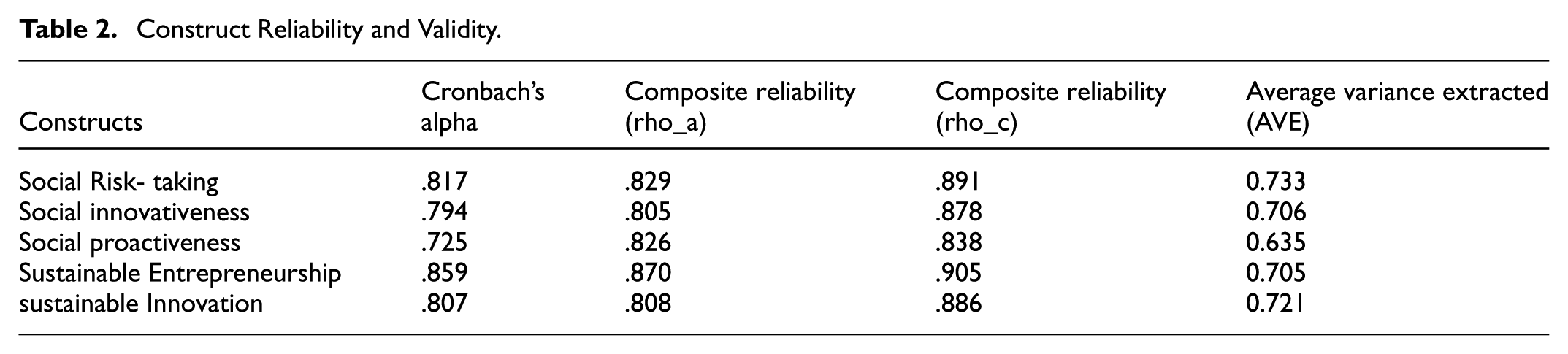
The reliability of the instrument was verified by calculating Cronbach’s alpha and CR, and its validity was verified using the mean variance (AVE) for convergent validity, and the Fornell and Larcker criterion and cross-loading matrix for discriminant validity. The extracted mean variance (AVE) was used as a primary indicator of convergent validity, which indicates how well the items of each latent variable can explain the total variance of the concept they measure.
These indicators are based on the criteria established by Hair et al. (2014), which stipulate that alpha Cronbach and composite reliability must be greater than 0.70 to indicate acceptable reliability, and that the AVE must be greater than 0.50 to consider that the items explain a sufficient amount of the variance in the underlying variable Table 2 and Figure 3 show the construct reliability.
Construct Reliability and Validity.
The HTMT ratio relies on the assumption that different construct metrics are not strongly correlated. If they are, it indicates a lack of discriminatory validity, meaning that the constructs may not be as distinct as assumed. An HTMT value of less than 0.85 usually indicates sufficient discriminatory validity, although some researchers suggest a more conservative threshold of 0.90. From a statistical point of view, the HTMT ratio is based on a comparison of correlations (Hair et al., 2021; Rasoolimanesh, 2022). Table 3 presents the HTMT values and all values in the acceptable range, as recommended by (Hair et al., 2021). A recommended threshold of 0.90.
Heterotrait-Monotrait Ratio (HTMT).
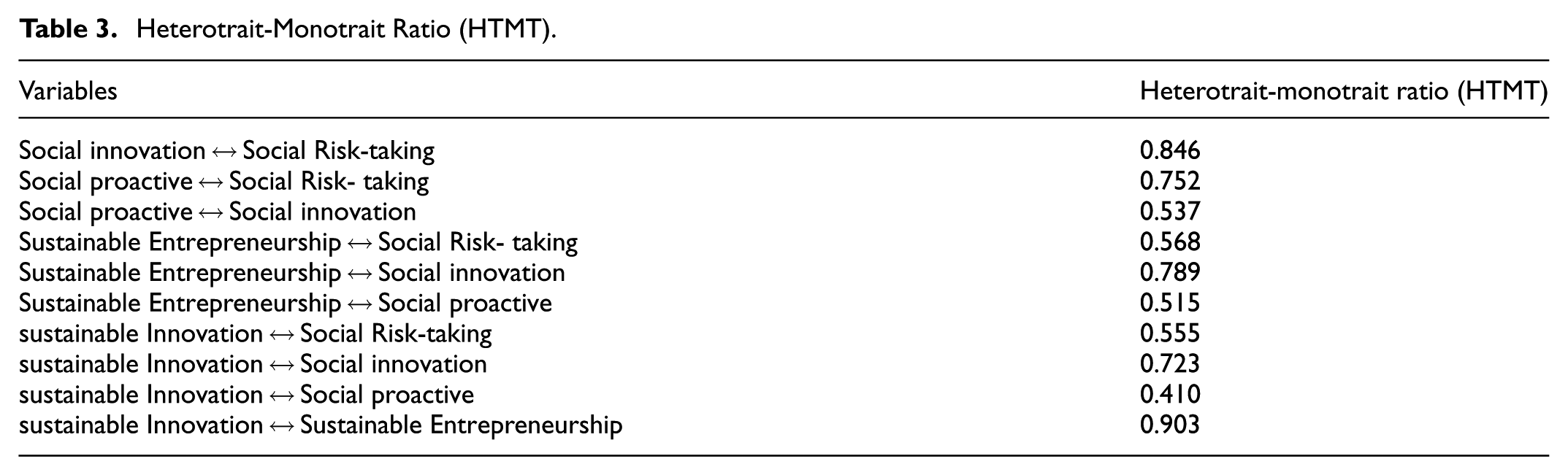
Table 4 reflects the quality of the explanatory and predictive relationships between variables. The coefficient of determination (R2), predictive validity (Q2), and effect size (f2) were among the most important indicators used in (PLS-SEM) to assess the effectiveness of the model in explaining the phenomenon under study (see Figure 2).
Overview of the R-Square.


Model assessment.
The results indicate that the value of the coefficient of determination (R2) for the Sustainable Entrepreneurship variable (.715) has strong explanatory power. R2 for Sustainable Innovation (.361), which represents moderate explanatory power. Chin (1998) determined that if R2 is above .67, it is considered strong.
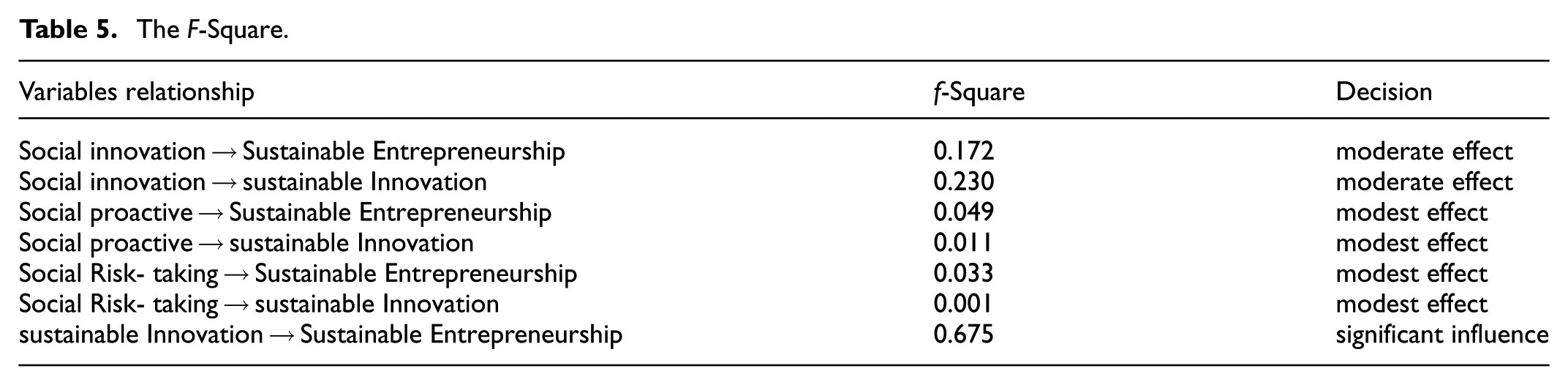
The f2 index, used to measure the effect size of each independent variable on its dependent variables, revealed a variation in the intensity of the effect between the different paths. The effect size reached (0.172) for the effect of social innovation and SE, and (0.230) for the effect of social innovation on SI, F2 for the effect of social proactive on Sustainable Entrepreneurship (0.049), F2 for the effect of social proactive on sustainable Innovation (0.011), while F2 for the effect of social risk-taking on Sustainable Entrepreneurship (0.033), and the F2 (0.675) for the effect of SI on SE. A F-square value greater than 0.35 suggests a substantial influence, while a value between 0.15 and 0.35 indicates a moderate effect. While a value less than 0.02 indicates no impact, a number between 0.02 and 0.15 indicates the modest are listed in Table 5 present the F2 values.
The F-Square.
Direct hypotheses linking the independent, dependent, and mediating variables in the structural model were tested using bootstrapping techniques across 5,000 subsamples. The significance of the relationships was analyzed using the impact factor (beta), standard deviation (STDEV), t-value, and statistical significance (p-value). The analysis results in Table 6 and Figure 3 show that all direct relationships in the model are statistically significant, except for the relationship between socially proactive and sustainable innovation (B = 0.104, p = .320), and the relationship between Social Risk and sustainable innovation (B = 0.039, p = .736).
Direct Relationship–Path Coefficients.

Source. Compiled by the researcher based on data (2025).

Hypotheses testing.
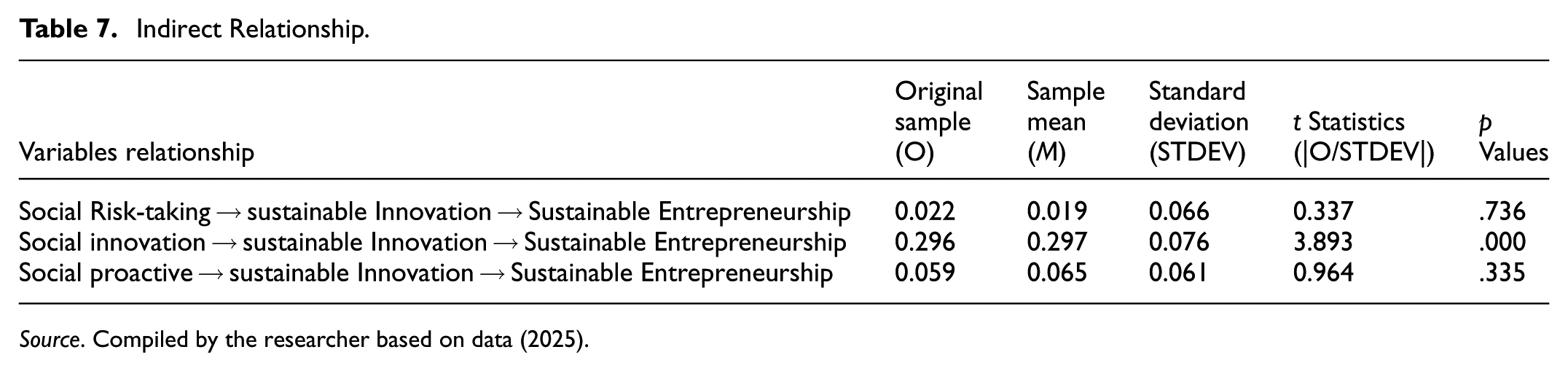
The analysis results in Table 7 show that the indirect relationships in the model are partially statistically significant, except for the relationship between the mediation of sustainable Innovation between Social Risk-taking and Sustainable Entrepreneurship (B = 0.022, p = .736), and the mediation of sustainable innovation on the relationship between socially proactive and Sustainable Entrepreneurship (B = 0.059, p = .335).
Indirect Relationship.
Source. Compiled by the researcher based on data (2025).
Discussions
The rise of businesses that integrate social and environmental solutions into their core operations has led to two distinct research areas: social and sustainable entrepreneurship. Although these fields are closely related, each has evolved independently, sparking debates that have been systematically examined in the literature. In this study, we conducted a detailed analysis of the impacts of SEO and SI on SE in the Saudi context. We conducted an inclusive analysis of the collected data. Our results showed that SEO and SI significantly and positively affected SE. Furthermore, the study outcomes revealed that SI partially mediated the relationship between SEO and SE. A comparison with the existing literature reveals several noteworthy insights. This expanded the context of entrepreneurship orientation by enriching the Arab perspective through the three key dimensions of SEO social proactiveness (SP), social risk-taking (SR), and social innovativeness (SI) within the SME sector. The findings show that both SP and SR have a strong impact on SE, whereas SI is not significant for SE. These findings are consistent with (Corsini et al., 2018; Halberstadt et al., 2021; X. Peng et al., 2023; Turpin & Shier, 2020), who found that social proactiveness significantly fosters SE. underscored that SEO is crucial for improving SE.
However, this study found that social risk-taking and proactivity did not exhibit a statistically significant influence on sustainable innovation (p = .736; p = .320). This contradicts prior work (e.g., Hmieleski & Corbett, 2006; Rauch et al., 2009), suggesting that cultural or contextual variations may explain this divergence. Furthermore, social innovativeness has a positive impact on sustainable innovation (p = .000). These results align with established literature, confirming the robust association between SEO and sustainable innovation across diverse industry contexts (Corsini et al., 2018; X. Peng et al., 2023; Turpin & Shier, 2020). This study confirms that the relationship between social pro-activeness and sustainable entrepreneurship notably improves in the presence of sustainable innovation.
Innovation is the “process of translating an idea or invention into a product or service that creates value or for which customers will pay” (Arogyaswamy, 2019). This implies that an innovation must be replicable at an economic cost and must satisfy a specific need. Innovation encompasses design activities, technological development, production and product engineering. Sustainable innovation is considered to be a key determinant of performance (Lin et al., 2022). Therefore, the findings of this study reveal a strong, statistically significant link between sustainable Innovation and SE (p = .000). This finding provides a new context for testing SEO in Arab world culture and extends existing theories through the variables studied. Finally, our findings show that sustainable innovation has SI partially mediates the relationship between SEO and SE. Social innovativeness had a mediating relationship with SI and SE (p = .000), while social proactiveness (SP) and social risk-taking (SR) did not (p = .335; p = .736). Despite the understanding that sustainable innovation acts as a mediator between social risk-taking and sustainable entrepreneurship, recent findings indicate that it does not mediate this relationship (Sarango-Lalangui et al., 2023; Youssef et al., 2018). A few large companies dominate the competitive landscape, while MSMEs rely on traditional and informal business practices, leading to a high mortality rate during the start-up phase. Saudi SMEs are characterized by their family ownership. Most small family businesses perform traditional tasks that do not involve much risk or innovation. These establishments also have a lower level of awareness and interest in sustainability (Rice et al., 2024). Saudi SMEs face numerous constraints on sustainable innovation. Among these barriers, organizational culture, lack of access to finance, limited connections to knowledge networks, and the rigidity of the regulatory framework are particularly prominent. The complexity of sustainable entrepreneurship makes it difficult to identify a single variable that can explain its relationship to social innovation. Therefore, SI must be embedded in other variables to influence the relationship between social innovation and entrepreneurship sustainability. Furthermore, many startups have not been established to solve societal issues or social enterprises, reflecting the low level of social orientation in the sample.
Conclusion and Implications
Conclusion
This study tested the relationship between SEO and SE and assessed the mediating role of SI among SMEs in Saudi Arabia, specifically from an environmental conservation perspective. This study aims to construct a theoretical model to examine the connections between SEO, SE, and SI in SMEs operating in Saudi Arabia. The study outcomes demonstrate that an SEO consists of three primary elements: proactive social engagement, willingness to take social risks, and a focus on social innovation. Research shows that SMEs in Saudi Arabia have adopted these practices to a certain extent. These findings suggest that, although an SEO moderately enhances both sustainable and incremental innovation, SI partially mediates the relationship between SEO and SE. A social entrepreneurship mindset and commitment to SI enable entrepreneurs to build an ecosystem that supports long-term business sustainability by deepening their understanding of market dynamics. From a management standpoint, the research findings can guide entrepreneurs in developing cohesive strategies to enhance SMEs’ capacity to respond efficiently to business environment shifts.
Theoretical Contribution
This study contributes to the existing understanding of SE among Saudi Arabian SMEs. While this study focuses on the KSA context, its findings offer broader theoretical insights that extend beyond this specific setting and enrich the general literature on this subject. From a theoretical standpoint, this study elucidates how SMEs can achieve enhanced performance through the interplay between the SEO (with its key components) and SI, ultimately contributing to SE. This study offers empirical support for a framework that outlines the three key dimensions of SEO in relation to SE among SMEs in Saudi Arabia. While prior studies have acknowledged the significance of SEO and their connection to sustainable business practices, this study makes a notable theoretical contribution by proposing a three-dimensional SEO model derived from an integrated perspective. Using survey data from 103 SMEs, the findings hold greater relevance for broader applicability given the scarcity of quantitative research in this field. Overall, SEO significantly influenced SE. A second key theoretical contribution of this study is its expansion of the existing literature by exploring the relationships between SEO, SI, and SE. These findings, supported by theoretical reasoning, demonstrate that SEO have a substantial impact on fostering sustainable entrepreneurial practices.
Practical Implications
This study provides valuable insights for both business leaders and managers. First, it highlights the significance of SEO and its impact on the SE of Saudi Arabian SMEs. By understanding this relationship, decision makers can prioritize strengthening their entrepreneurial orientation to foster long-term sustainability. Second, the findings demonstrate that fostering an innovation-friendly business climate and supporting creative initiatives can enhance SME competitiveness. Through SEO dimensions, sustainable innovation enables entrepreneurs to better understand and respond to market needs, empowering SMEs to develop effective solutions to operational challenges. Third, the findings provide valuable managerial insight by validating the conceptual framework. This enhanced understanding enables SME decision makers to better anticipate and adapt to evolving market conditions, thereby improving organizational responsiveness and resilience.
Limitations and Future Research
This study has several limitations that suggest directions for further investigation. First, we examine the influence of SEO on SMEs. Further studies should explore this concept in different contexts to broaden our understanding of its applicability. Second, this study is limited to SMEs in Saudi Arabia. Expanding future studies to include businesses from different sectors or geographical locations could enhance the generalizability of the results. This extension offers useful insights for managers to align SEO with their sustainable business practices. Third, the study relied primarily on perceptual measures for both the independent and dependent variables. Despite careful data collection, such as gathering responses from diverse SMEs, the cross-sectional design may not fully capture the evolving relationship between SEO and SI in fostering SE. Future studies could strengthen these findings by incorporating detailed secondary data or by adopting longitudinal approaches to yield more robust and dynamic insights. Finally, this study examined the relationship between SEO and SE through SI. Future research could extend this line of inquiry by exploring indirect effects through moderating variables, which may further clarify the dynamics of this relationship.
Footnotes

Ethical Considerations
This study was performed according to the institutional and international ethical guidelines for research on humans. The study was conducted in accordance with the principles set out in the Declaration of Helsinki and the rights, privacy and well-being of all study subjects were taken into account and protected.
Consent to Participate
Participation in the survey was completely voluntary. Participants were advised that they could skip any question if they did not feel comfortable answering it and that they could also withdraw from the survey anytime till submission without having to provide a reason for such withdrawal.
Funding
The authors disclosed receipt of the following financial support for the research, authorship, and/or publication of this article: The Researchers would like to thank the Deanship of Graduate Studies and Scientific Research at Qassim University for financial support (QU-APC-2026).
Declaration of Conflicting Interests
The authors declared no potential conflicts of interest with respect to the research, authorship, and/or publication of this article.
Data Availability Statement
The data will be available upon request.