






Abstract
Understanding learner attitudes toward Metaverse-based language learning is necessary for conducive learning environments. The study focused on how learners formed attitudes toward Metaverse-based language learning, especially through self-efficacy and curiosity. Activity theory was used to frame the analysis, while structural equation modeling and one open-ended qualitative question were combined to examine both the hypothesized relationships and learners’ explanatory accounts. The quantitative results showed that hedonic motivation, interactive learning environments, and self-efficacy for language learning positively predicted both performance expectancy and perceived satisfaction. Perceived satisfaction positively predicted learning effectiveness. Performance expectancy and self-efficacy for language learning positively influenced curiosity, which in turn influenced learning effectiveness. Curiosity also mediated the relationship between performance expectancy and the effectiveness of Metaverse-based language learning. Diverging from some prior e-learning findings, performance expectancy did not show significant direct effects on learning effectiveness in the present Metaverse-based language learning context. Despite the formative stage of Metaverse-based language learning, this study offers preliminary implications for future research and educational practice. Educational stakeholders and developers may need to pay closer attention to learners’ hedonic experiences, self-efficacy, curiosity, and the quality of interactive learning design in Metaverse-based language learning.
Plain Language Summary
Metaverse has attracted growing attention from language education stakeholders. It is necessary to comprehend learner attitudes towards Metaverse-based language learning for a conducive learning environment. The current mixed-method research aims to investigate factors influencing learner attitudes toward Metaverse-based language learning based on the activity theory, considering the role of self-efficacy and curiosity for language learning. As a result, hedonic motivation, interactive learning environments, and self-efficacy for language learning positively predicted both performance expectancy and perceived satisfaction. Perceived satisfaction positively predicted learning effectiveness. Performance expectancy and self-efficacy for language learning positively influenced curiosity, and curiosity in turn influenced learning effectiveness. Curiosity also mediated the relationship between performance expectancy and the effectiveness of Metaverse-based language learning. Diverging from some prior e-learning findings, performance expectancy did not show significant direct effects on learning effectiveness in the present Metaverse-based language learning context. Moreover, the detailed thematic analysis showed that Metaverse-based language learning approaches promoted language communication skills, enhanced learning interactivity, and offered convenience for learning. Nevertheless, the learning effect varied from person to person, subject to technical and cost constraints, ethical issues, and learning resources’ quality. Despite the formative stage of Metaverse-based language learning, this study offers preliminary implications for future research and educational practice. Educational stakeholders and developers may need to pay closer attention to learners’ hedonic experiences, self-efficacy, curiosity, and the quality of interactive learning design in Metaverse-based language learning.
Introduction
Metaverse has been increasingly discussed as a learning environment that can support interaction, knowledge exchange, and access to learning activities beyond physical classrooms (İbili et al., 2024). In language education, existing studies have examined its use in areas such as English vocabulary learning and learners’ English learning experiences (S. M. Lee & Ahn, 2025b; Wang et al., 2025). However, these studies do not fully explain how learners judge Metaverse-based language learning as a learning experience. This issue is important because the value of Metaverse in education cannot be assessed only by its technical functions. Its use in higher education is also shaped by access conditions, institutional infrastructure, and students’ well-being (Singh, 2024). Therefore, before Metaverse-based language learning is promoted more widely, it is necessary to examine how learners perceive and evaluate this learning mode. More importantly, learner attitudes need to be placed within a clear theoretical framework, rather than being treated as simple positive or negative reactions to a new technology (J. G. Wu et al., 2024).
In this study, learner attitudes are understood as learners’ affective and perceptual responses to using Metaverse for language learning. Such attitudes are important because they are closely related to how learners engage with learning activities and evaluate their learning experiences. In technology-enhanced learning research, learner attitudes have been associated with factors such as self-efficacy, interactive learning environments, perceived usefulness, perceived satisfaction, behavioral intention, and learning effectiveness. For example, Liaw and Huang (2014) showed that performance expectancy and perceived satisfaction played important mediating roles in explaining learning effectiveness in e-book-based learning. Although Metaverse-based language learning differs from e-book learning in its immersive and interactive features, these prior findings suggest that learners’ attitudes may also be shaped by the joint effects of learner characteristics, environmental conditions, usefulness-related beliefs, satisfaction, and perceived learning outcomes. Therefore, a focused model is needed to examine how these elements operate together in Metaverse-based language learning.
However, research has rarely examined learner attitudes toward Metaverse-based language learning through structural equation modeling. The gap becomes more evident when self-efficacy and curiosity are considered together. In technology-enhanced learning, self-efficacy has been discussed in several related forms, such as online learning self-efficacy, internet self-efficacy, and computer self-efficacy (Kuo et al., 2014). Online learning self-efficacy is close to online academic self-efficacy because both concern learners’ confidence in completing learning tasks in technology-mediated environments (Kuo et al., 2014). The present study focuses specifically on self-efficacy for language learning, which refers to learners’ confidence in carrying out language-learning tasks in Metaverse-based environments. This distinction is necessary because previous studies on technology-enhanced learning have often focused on learners’ confidence in using technologies, the internet, or computers, rather than their confidence in completing language-learning activities within immersive environments (Esiyok et al., 2025).
Studies on technology or computer self-efficacy have mainly explained learners’ acceptance and use of digital tools (Pan, 2020). However, confidence in using technology is different from confidence in completing language-learning tasks. In language learning, self-efficacy concerns learners’ beliefs about whether they can perform language-related tasks successfully, which may shape engagement, motivation, and learning outcomes (An et al., 2021). Although self-efficacy has been examined in technology-supported language learning (Yu & Duan, 2024), recent Metaverse-related studies have focused more on technology- or computer-related self-efficacy when explaining learner responses, such as trusting intention, engagement, and satisfaction (Al-kfairy et al., 2026; Lo et al., 2024). Therefore, it remains necessary to examine how self-efficacy for language learning shapes learners’ experiences and behavioral responses in Metaverse-based language learning.
Curiosity for Metaverse-based language learning refers to learners’ psychological interest in bridging knowledge gaps, engaging with novel language stimuli, or participating in Metaverse learning activities (Pizzolante et al., 2023). This study pays attention to curiosity because language learning in Metaverse tends to expose learners to unfamiliar scenes, tasks, and interactional situations. These conditions may encourage learners to search for missing information, try new forms of expression, and continue exploring the learning environment. Lowry et al. (2013) showed that curiosity can shape users’ actions and experiences when they engage with technology. Gao et al. (2024) also discussed curiosity in technology-rich learning contexts, where novelty is part of the learning process. Curiosity can support engagement and exploration in language learning (Paradowski & Jelińska, 2023). Yet in Metaverse-based language learning, curiosity has seldom been examined together with self-efficacy for language learning. The two constructs capture different aspects of learner experience: curiosity may draw learners into unfamiliar tasks, whereas self-efficacy may help them persist when those tasks become challenging.
A systematic search was conducted to identify Metaverse studies that used structural equation modeling. On 8 April 2024, the Web of Science Core Collection was searched based on the Topic field. The Topic field was searched using “metaverse OR Metaverse” and “structural equation model*.” This search covered keywords, titles, and abstracts, and it yielded 64 studies. The author then visualized keywords in VOSviewer to map the literature, following Van Eck and Waltman (2010). The analysis identified five research topics and 53 items that occurred more than three times (see Figure 1). The topics included PLS-SEM work on tourism continuance intention and studies on commerce sustainability. They also included adoption in services and education, unified theory of acceptance and use of technology (UTAUT) applications, and TAM-based acceptance and flow studies.
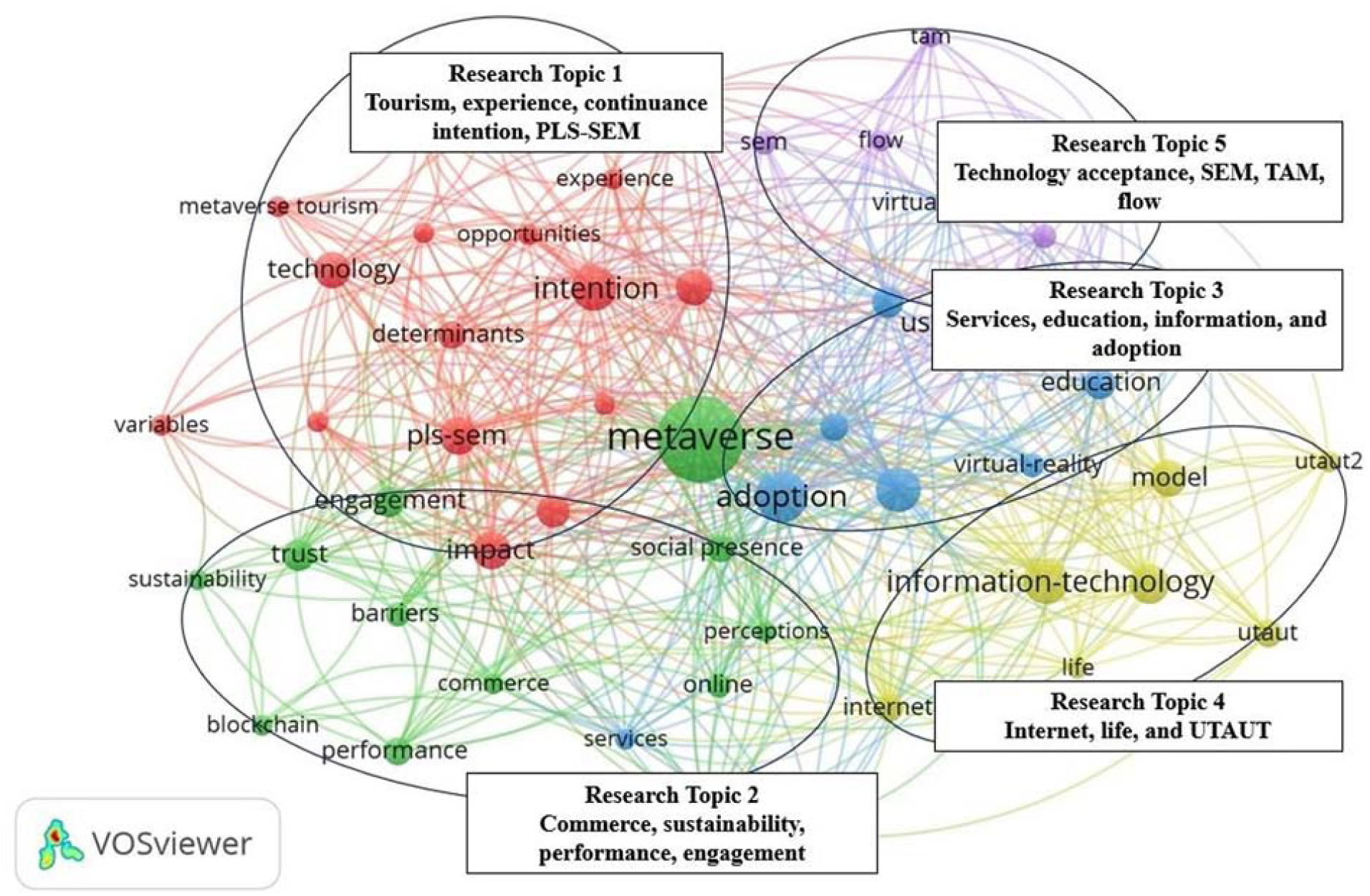
The visualized keywords regarding research on Metaverse using structural equation modeling methods.
Language learning attitudes were not a central focus of the 64 identified studies. Twenty-six studies focused on banking, commerce, and marketing, while nine addressed cross-disciplinary topics. Another 15 studies examined educational issues that were not specific to language learning, and 14 focused on tourism, social life, or entertainment contexts (Pal & Arpnikanondt, 2024). These studies show that user perceptions of Metaverse have been examined across several domains, including education. However, they provide limited evidence on what shapes learner attitudes toward Metaverse-based language learning when structural equation modeling is used. It also remains unclear whether self-efficacy for language learning and curiosity, rather than computer or internet self-efficacy, help explain learners’ responses in Metaverse-based language learning contexts (Kuo et al., 2014).
Metaverse may enrich language education by making learning more immersive, but its educational value still depends on learners’ acceptance and responses (Valizadeh & Morady Moghaddam, 2025). Existing studies have not yet explained in sufficient detail how language learners perceive Metaverse-based language learning. This gap matters because learner attitudes are closely related to engagement and learning success in computer-assisted second language acquisition and technology adoption (Bessadok & Hersi, 2025). Activity theory is used because Metaverse-based language learning brings together learners, technological tools, learning tasks, interaction, and outcomes. The study, therefore, examines how learners form attitudes toward this learning mode. Structural equation modeling is used to test a model including self-efficacy for language learning, interactive learning environments, perceived satisfaction, hedonic motivation, performance expectancy, curiosity, and learning effectiveness. An open-ended question is also included so that learners can report the benefits, problems, and possible improvements they perceive in Metaverse-based language learning.
Literature Review
Metaverse and Language Education
The term Metaverse combines “meta” (i.e., “beyond” in Greek) and “universe.” It describes a virtual world that seamlessly transitions from virtual activities to users’ real lives through virtual reality technologies (Pal & Arpnikanondt, 2024). Common platforms include Roblox, Horizon Worlds, Sandbox, Decentraland, Zepeto, and VRChat. Metaverse is supported by artificial intelligence (AI), extended reality (XR), and three-dimensional (3D) technologies. It shares decentralization and interactivity with related technologies, yet it emphasizes “shared” and “seamless” experiences. Authenticity and collaboration are often treated as two central features of Metaverse-based learning (Pal & Arpnikanondt, 2024). In education, immersive tools have already been used to make learning experiences more engaging, and this trend is also visible in language education (S. Lu, 2025; Qiu et al., 2023). Metaverse, however, should not be reduced to virtual reality alone. It brings together simulation, interaction, identity, communication, and learning activities within a broader socio-technical environment (Q. Chen, 2025).
Metaverse also differs from other immersive technologies by linking virtual activities more closely with learners’ social and educational contexts (Pal & Arpnikanondt, 2024). Although prior studies on immersive language learning offer useful insights, they have not fully explained how Metaverse-based environments relate to self-efficacy for language learning and curiosity. Recent language education studies have reported encouraging results. İbili et al. (2024) found improvements in listening and reading skills in Metaverse-based medical English education. H. J. Chen (2023) indicated that Gather increased engagement and lesson plan outcomes among pre-service English teachers. Shu and Gu (2023) reported that Edu-Metaverse supported resource sharing and deep learning through interaction. However, the links among self-efficacy, curiosity, learner attitudes, and perceived learning effectiveness remain underexamined. Therefore, this study examines these relationships in Metaverse-based language learning. Figure 2 presents a typical interaction scene in common Metaverse platforms.
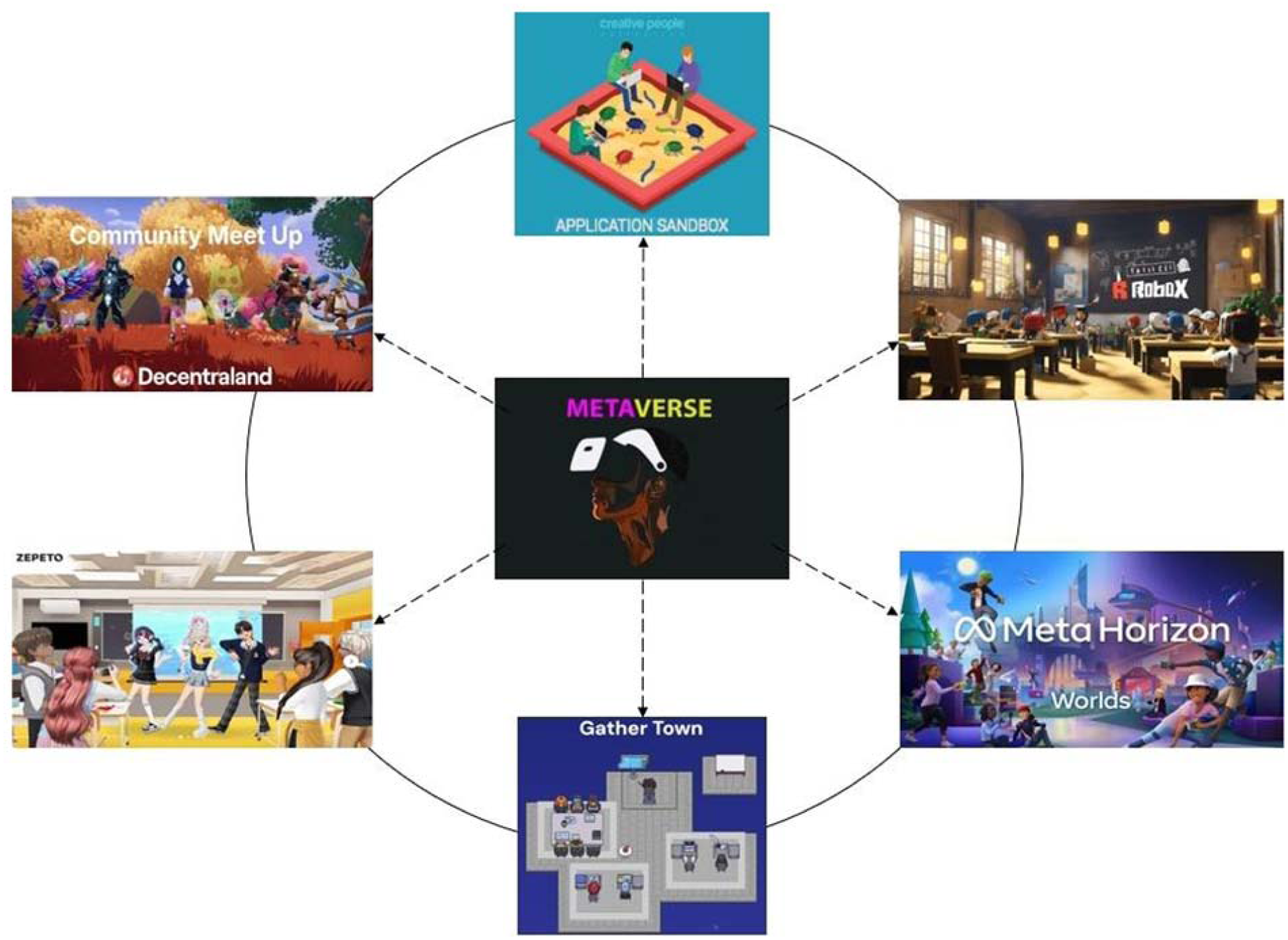
Scenes of learners learning and communicating on Metaverse platforms.
Theoretical Framework
Learner Attitudes Toward Metaverse-Based Language Learning Based on the Activity Theory
Liaw and Huang (2014) examined learner attitudes using the activity theory framework developed by Sharples et al. (2005). They found that attitudes relate to personal features, contextual elements, satisfaction, performance expectancy, behavioral intention, and learning effectiveness. Activity theory is widely applied in research on technology-enhanced learning. Recent examples include AI-assisted language learning (Li et al., 2025) and telecollaboration in English as a foreign language (EFL) contexts (G. Z. Liu et al., 2025). Following Liaw and Huang (2014), this study uses activity theory to explain learner attitudes toward Metaverse-based language learning from a technological perspective. This approach supports a coherent linkage between tool use, interaction patterns, and learning outcomes. It also clarifies how the selected constructs are positioned within the learning activity system.
Activity theory originally focused on human activity as tool-mediated interaction within social-historical and socio-cultural contexts (Kuuti, 1996). Engeström (1999) expanded the model by adding the rules, community, and divisions of labor. Sharples et al. (2005) reframed these elements as the communication of learning, the context of learning, and the control of learning. The framework thus depicts six interacting elements: subjects, learning tools, the context of learning, the communication of learning, the control of learning, and the learning object or outcome (Sharples et al., 2005). From a technological perspective, language learning is a dynamic process that is facilitated by knowledge and technology, and tools mediate activities and shape interactions in learning systems (Liaw & Huang, 2014). In this study, Metaverse serves as a mediating tool for language learning.
As a mediating learning tool, Metaverse should not be treated as neutral. In data-intensive learning spaces, surveillance, privacy, and informed consent may become part of learners’ experience (Molka-Danielsen et al., 2025). These issues may affect whether learners feel safe and whether they are willing to participate. AI-supported Metaverse tools add further concerns, especially around algorithmic bias, transparency, trust, and learner autonomy (Zhuk, 2025). These issues are part of the context within which learner attitudes are formed. This study acknowledges these issues, but is concerned with learner attitudes and outcomes in Metaverse-based language education.
In language learning, when learners use Metaverse, control may transfer between learners and the system. Control of learning indicates that learners are autonomous, motivated, and competent. Consequently, hedonic motivation, self-efficacy, and curiosity about language learning in Metaverse correspond to the regulation of learning. Hedonic motivation and curiosity can drive communication and exploration in learning activities (Poli et al., 2024). Liaw and Huang (2014) emphasized self-efficacy in learner attitudes toward e-book learning from Bandura’s (1986) socio-cognitive viewpoint. This facilitates the investigation of self-efficacy in language learning inside Metaverse as a crucial learner variable.
The context of learning concerned communities in which learners interacted toward a specific goal, influenced by the functionalities of tools and available resources (Liaw & Huang, 2014). Hence, it might involve learners’ perceived satisfaction and usefulness of the functions and content of Metaverse-based language learning. Liaw and Huang (2014) revealed the mediating roles of performance expectancy and perceived satisfaction in factors influencing learner attitudes toward the ebook as a learning tool. Communication of learning illustrates how learners collaboratively develop interaction modes in a learning activity (Liaw & Huang, 2014). This corresponds with interactive learning environments in this research. Learning effectiveness is regarded as the learning object within the identical activity system.
The Theoretical Model of Learner Attitudes Toward Metaverse-Based Language Learning Based on the Activity Theory from the Technological Perspective
Self-efficacy for language learning describes learners’ belief that they can plan and carry out the actions needed to achieve language-learning goals within Metaverse. The construct is based on Bandura’s (1986) social cognitive theory. This construct also corresponds to the “expectancy” element in Eccles and Wigfield’s (2002) expectancy-value theory, which concerns confidence in one’s ability to succeed. Performance expectancy describes learners’ belief that Metaverse can support their development of language skills (Venkatesh et al., 2012). Although both concepts are related to expectancy, they differ in focus. Self-efficacy for language learning concerns learners’ belief in their own ability, while performance expectancy concerns whether they see Metaverse as useful for language learning.
Hedonic motivation reflects the enjoyment, fun, or pleasure derived from using Metaverse for language learning (Venkatesh et al., 2012). It differs from self-efficacy and performance expectancy in that it emphasizes intrinsic enjoyment rather than competence or utility beliefs. Curiosity encompasses learners’ psychological interest and desire to investigate and acquire language knowledge in Metaverse (Pizzolante et al., 2023). Perceived satisfaction refers to the learning experiences derived from the learning process and its outcomes (Shee & Wang, 2008). It can be influenced by intrinsic enjoyment (Z. Liu et al., 2023) and interactive learning environments (Uriarte-Portillo et al., 2023). Interactive learning environments denote Metaverse’s social and interactive learning design (Liaw & Huang, 2014).
Expectancy-value theory distinguishes expectancy beliefs from value beliefs, yet it also explains their interplay in engagement (Eccles & Wigfield, 2002). Self-efficacy can be related to perceived usefulness, as reflected in performance expectancy (i.e., utility value). Hedonic motivation and curiosity represent intrinsic values and may correlate with both expectancy and utility beliefs. Satisfaction is an outcome shaped by expectations and perceived values. These links are consistent with activity theory (Sharples et al., 2005) that depicts the interaction among tools (i.e., Metaverse), subjects (i.e., language learners), and communities (i.e., interactive learning environments) to facilitate the object (i.e., learning effectiveness). Learners seek learning effectiveness (i.e., object/outcome) facilitated by Metaverse (i.e., tools). Motivational and competency beliefs (e.g., hedonic motivation, self-efficacy, and curiosity) are key psychological conditions for learning. Interactive learning environments embody contextual and communal assistance. Performance expectancy and perceived satisfaction capture evaluations of the tool’s utility and the learning experience. Based on these relationships, this study forms a theoretical model for hypothesis development (see Figure 3).

The theoretical model of learner attitudes toward Metaverse-based language learning based on activity theory from a technological perspective.
Hedonic Motivation
Hedonic motivation affects learners’ experiences and their use of technology. This study characterizes hedonic motivation as the enjoyment, fun, or pleasure derived from using Metaverse for language learning. This corresponds with research characterizing hedonic motivation as an inherent impetus to pursue pleasure and evade discomfort (Venkatesh et al., 2012). In UTAUT2, hedonic motivation elucidates the reasons consumers embrace technologies beyond just functional requirements (Venkatesh et al., 2012). Davis et al. (1992) similarly describe it as enjoyment from using technology for its own sake. Nguyen et al. (2024) conceptualize hedonic motivation as pleasurable and interesting experiences of knowledge acquisition in Metaverse. In the context of Metaverse-based language learning, hedonic motivation is evidenced as positive affective reactions, such as enjoyment during immersive interactions. Such an effect can facilitate long-term participation in learning activities.
Pal and Arpnikanondt (2024) found that Metaverse can provide innovative and fun learning experiences. They described situations where students interact with virtual creatures and participate in immersive experiences (Pal & Arpnikanondt, 2024). Additionally, prior studies have found hedonic benefits, such as pleasure and entertainment, in Metaverse environments (Arpaci et al., 2022). In Metaverse-based medical English instruction, learners derived enjoyment, which enhanced their willingness to adopt the platform (İbili et al., 2024). These findings suggest that hedonic motivation needs attention from developers and educational stakeholders. From a technical perspective in activity theory, hedonic motivation is a personal experiencing factor that affects participation and assessment patterns. It can connect early experiences with later judgments about tool utility and learning satisfaction. Therefore, hedonic motivation is positioned as a key antecedent in the learning attitude framework.
Interactive Learning Environments
Interactive learning environments in this study refer to the social and interactive learning design within Metaverse that supports language learning. Di Natale et al. (2024) reported that interactive Metaverse features can strengthen engagement and social presence. Metaverse can support learner-system, teacher-system, teacher-learner, and learner-learner interactions. These interaction channels can support informal, workplace, and academic learning in situational settings. Metaverse applications also allow multiple natural interaction modes and experiential learning opportunities (G. J. Hwang et al., 2023). H. J. Chen (2023) emphasized the central role of social interaction in learning processes. Accordingly, collaborative and interactive environments are important for effective learning in Metaverse. Research interest in interactivity has therefore increased in Metaverse-based learning contexts.
Within activity theory, interactive learning environments represent the context of learning and community support. These factors influence how learners engage with and judge learning experiences. They also influence how learners interpret the tool’s value during task completion. This framing supports examining interactivity as a contextual driver of attitudes and outcomes. Interactive learning environments may strengthen communication of learning by enabling new interaction patterns (Liaw & Huang, 2014). They may also improve perceived satisfaction and perceived usefulness through richer social support. In the present study, interactive learning environments are treated as a key independent construct that predicts process evaluations and outcomes of Metaverse-based language learning.
Self-Efficacy for Language Learning
This study defines self-efficacy for language learning in Metaverse as learners’ confidence in performing language tasks supported by Metaverse (Kuo et al., 2014). This construct differs from computer or internet self-efficacy and deserves distinct attention in technology-enhanced learning (Kuo et al., 2014). Learners’ academic confidence in a specific subject can have unique effects on learning outcomes (Yu & Duan, 2024). Prior studies indicate that academic self-efficacy supports learning outcomes in virtual learning environments (H. P. Lu et al., 2024; Yu & Duan, 2024). In a 3D virtual learning world, learners reported higher self-efficacy in advanced English use and communication (D. Zheng et al., 2009). Web-based virtual spaces also showed increases in self-efficacy for language skills (Peterson et al., 2023). These findings justify including self-efficacy as a core learner factor in Metaverse-based language learning.
H. P. Lu et al. (2024) additionally discovered that Metaverse applications facilitated vocabulary learning, improved self-efficacy, and promoted interactive and collaborative interactions. The results indicate that self-efficacy can be enhanced through Metaverse-supported learning activities. From a technical perspective in activity theory, self-efficacy can explain why learners develop different participation and evaluation patterns in tool-involved language-learning activities. Self-efficacy can be associated with subsequent evaluations, such as performance expectancy, curiosity, and perceived pleasure. Consequently, self-efficacy in language learning inside Metaverse is identified as a crucial factor in the learning attitude framework. Its inclusion supports a more complete account of learner differences in Metaverse-based language learning settings.
Performance Expectancy
Performance expectancy is central to learning attitudes toward Metaverse-based language learning. In this study, performance expectancy is learners’ belief that Metaverse helps them achieve language learning goals. Prior work found that perceived enjoyment can increase perceived usefulness of Web 2.0 (Fan & Wang, 2023). Continuous interaction and collaboration in intelligent learning systems can also raise perceived usefulness (Gómez-Carmona et al., 2024). Social interaction enables cooperative and group learning that may influence gains in participation and performance. An et al. (2021) reported that English self-efficacy influences technology selection and use for performance gains. Namely, perceived usefulness in technology-enhanced language learning is associated with self-efficacy beliefs. In summary, these findings suggest that enjoyment, interactive learning environments, and self-efficacy are plausible predictors of performance expectancy in Metaverse contexts.
However, the working mechanisms among these constructs remain unclear in Metaverse-based language learning. Existing evidence mainly comes from Web 2.0 tools, intelligent learning systems, and broad technology-enhanced contexts. Grounded in activity theory, this study positions key predictors within one activity system (Liaw & Huang, 2014). Hedonic motivation and self-efficacy for language learning align with the control of learning and rules in activity theory. Interactive learning environments are embedded in the community and the learning context. Performance expectancy reflects learners’ evaluation of the tool’s usefulness during learning activities. Accordingly, the following hypotheses are advanced:
Curiosity
Curiosity is an intrinsic motivator that supports exploration and active learning. This study defines curiosity as psychological interest triggered by language knowledge gaps or by novel, surprising, and moderately complex stimuli supported by Metaverse (Pizzolante et al., 2023). Curiosity is linked to deeper exploration and stronger learning outcomes (Poli et al., 2024). Pizzolante et al. (2023) also highlighted Metaverse-supported experiences that elicit exploration. Learners with self-efficacy may face challenges more confidently and explore unfamiliar contexts during long-term learning. Workshop-based language learning could enhance curiosity, academic enjoyment, and achievement (Ahmed Abdel-Al Ibrahim & Hashemifardnia, 2024). Dubey et al. (2022) linked perceived usefulness to curiosity in learning, while Peng et al. (2023) reported that perceived usefulness in English m-learning was associated with both curiosity and self-efficacy.
Previous work indicates that self-efficacy and performance expectancy may influence learners’ curiosity in technology-enhanced and exploratory learning. Nevertheless, their interconnections in Metaverse-based language learning remain little investigated. Within the framework of activity theory, self-efficacy (i.e., control over learning/rules) reflects a learner’s confidence in competence. Performance expectancy (i.e., division of labor/communication of learning) represents the expected outcomes of the activity system and is theorized to energize curiosity (i.e., an object-oriented motivator driving exploration). By placing learners’ beliefs about competence and their evaluation of tool utility within the same learning activity system, as viewed through the lens of activity theory, the following hypotheses are proposed.
Perceived Satisfaction
Perceived satisfaction refers to learners’ subjective assessment and emotional responses during Metaverse-supported language learning. Technologies with hedonic value can strengthen satisfied experiences, including in learning contexts. Z. Liu et al. (2023) reported a positive relationship between enjoyment and learning satisfaction in desktop-assisted virtual reality learning. Interactive learning conditions have been closely linked to learner satisfaction. G. Y. Lin et al. (2023) showed that information system interaction mediated the effects of quality dimensions on satisfaction with learning experiences in flipped classes. Uriarte-Portillo et al. (2023) reported improved learning satisfaction in an AR-assisted interactive learning environment, which echoed findings from interactive e-book learning (Liaw & Huang, 2014). Efficacy beliefs may also matter for satisfaction, as shown in studies of web-based learners (M. Lee et al., 2024) and informal digital English learning (Y. Zheng & Xiao, 2024). These studies motivate the examination of satisfaction mechanisms in Metaverse-based language learning.
Nevertheless, the predictive effects of these variables remain unclear in Metaverse-based language learning environments. Existing evidence often comes from flipped classes, AR-assisted interactive learning, and e-book learning. Using activity theory from a technological perspective, this study integrates experience factors and contextual conditions within a single activity system. Hedonic motivation and self-efficacy correspond to the control of learning and rules. Interactive learning environments belong to the community and the learning context. Perceived satisfaction falls within the division of labor/communication of learning and reflects learners’ evaluation of the learning experience in tool-mediated activities. This positioning supports testing how motivational, contextual, and competency beliefs shape satisfaction in Metaverse-based language learning settings. Accordingly, the following hypotheses are proposed:
Learning Effectiveness
Learning effectiveness is the degree to which an educational intervention achieves the desired learning outcomes. It is essential for evaluating the affordances of educational tools during learning processes (Al-Adwan et al., 2023). Proficient Metaverse users may perceive greater usefulness for performance, effectiveness, and productivity (Alhawary, 2023). In other immersive contexts, perceived usefulness supported biology learning assisted by virtual reality (Ferdinand et al., 2024). Engagement in VR-assisted industrial operations learning also mediated the positive link between usefulness and learning effectiveness (Wong et al., 2023). Curiosity is also relevant for learning success. S. W. Y. Lee et al. (2022) linked epistemic curiosity to learning of agency. Curiosity can motivate exploration and relate to academic success, including achievement (Feraco et al., 2023). Satisfaction is similarly tied to perceived effectiveness in e-learning and e-book learning (Poon et al., 2024; Liaw & Huang, 2014).
Prior research thus highlights the roles of perceived usefulness, curiosity-driven learning, and satisfaction in the effectiveness of technology-assisted learning. However, their interrelationships remain insufficiently examined in Metaverse-based language learning. Grounded in activity theory from a technological perspective, this study treats learning effectiveness as the object/outcome of the activity system. Performance expectancy and perceived satisfaction pertain to the division of labor/communication of learning and reflect process evaluations of tool utility and learning experience. Curiosity belongs to the control of learning/rules and reflects an object-oriented motivator that can sustain exploration during learning activities. Examining these constructs together enables a unified account of learner evaluation, motivation, and outcomes in Metaverse contexts. Accordingly, the following hypotheses are proposed, and a research model is constructed (see Figure 4):
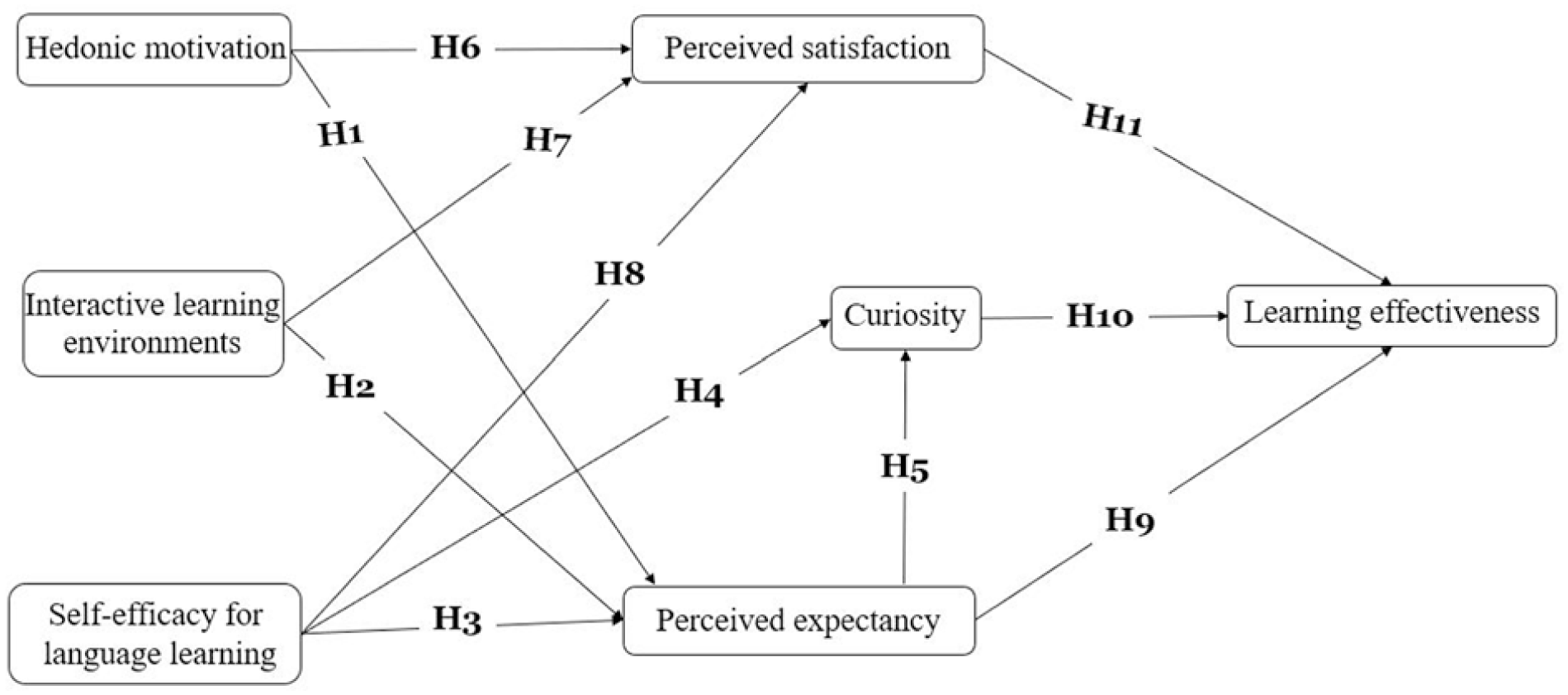
The hypothesized research model of learner attitudes toward Metaverse-based language learning.
Methods
Scale Design
The questionnaire was adapted through item deletion, selection, and addition, following Stewart et al.’s (2012) scale adaptation procedures. To fit the Metaverse-based language learning context, items from earlier scales were revised in wording and contextual focus where necessary. Items were selected based on the theoretical framework and prior literature to reflect the main constructs examined in this study. Two professors specializing in educational psychology and questionnaire design reviewed the initial item pool for content relevance, redundancy, and cultural appropriateness, following content validity guidance by Almanasreh et al. (2019). Items adapted from existing scales were revised carefully to preserve conceptual equivalence, following Beaton et al. (2000), measurement quality standards proposed by Mokkink et al. (2010), and translation and cultural adaptation guidance by Wild et al. (2005).
The measurement comprised hedonic motivation, performance expectancy (Tseng et al., 2019), interactive learning environments, perceived satisfaction, and learning effectiveness (Liaw & Huang, 2014), curiosity (Lowry et al., 2013), and self-efficacy for language learning (Su et al., 2018). The survey included 3 parts with 30 questions, using a 5-point Likert scale (see Supplemental Appendix). The author obtained the data on informed consent and demographics in the first part. The second part demonstrated the items of the variables. The last open-ended item elicited learners’ insights on the benefits, drawbacks, and suggestions for Metaverse-based language instruction.
Sampling Procedure
Given the need to reach learners with an actual experience of Metaverse-based language learning, this study adopted convenience sampling. This approach belongs to non-probability sampling and allows researchers to recruit participants who are accessible and available for the study (Etikan et al., 2016). This sampling strategy was adopted because Metaverse-based language learning is still an emerging educational practice, and the study required learners who had actually used or experienced such learning environments. Therefore, participants were recruited from accessible learner groups and were invited to complete the questionnaire only if they had prior experience with Metaverse-based language learning. This approach enabled the study to collect data from respondents who could provide relevant evaluations of the constructs examined in the model.
To improve the diversity and relevance of the convenience sample, several steps were taken during recruitment. First, the questionnaire was distributed to learners with different educational backgrounds and language-learning experiences rather than from a single class or institution. Second, prior experience with Metaverse-based language learning was used as an inclusion criterion, so that participants could provide informed evaluations of the learning environment. Third, responses were screened to exclude invalid or careless responses. These procedures helped increase the relevance and diversity of the sample, although they did not remove the limitations associated with non-probability sampling.
However, convenience sampling also has clear limitations. The sample was drawn from learners who were reachable during data collection, not from a randomly selected population. For this reason, the results describe this group of respondents and should be applied to broader language-learner populations with caution (Andrade, 2021). Learners who were more interested in digital technologies, immersive learning, or Metaverse-based language learning may have been more likely to complete the questionnaire. This concern is consistent with web survey methodology, which shows that participation may depend on respondents’ access, interest, and willingness to respond (Bethlehem, 2010). Therefore, the findings should be interpreted as evidence based on the present sample rather than as statistically generalizable conclusions about all language learners. This limitation was considered when interpreting the results and proposing directions for future research.
Data Collection
Using the Chinese scale design website of Questionnaire Star (i.e., https://www.wjx.cn/), the author designed the questionnaire and generated its hyperlinks and QR codes (i.e., quick response codes) for the measurement distribution via social media. The rule of N:q proposed by Kline (2023) guided us to evaluate the research’s minimal sample size, which depicts the recommended ratio of sample size to the number of constructs in the hypothesized research model, that is, 20:1. Therefore, the author yielded 140 for the study’s minimal sample size. The author used rapid convenience sampling aided by social networks to gather data. The method concerns recruiting easily accessible participants, distinct from random sampling. The author distributed the scale’s QR codes and hyperlinks to users in the chatting group and channels (e.g., the VRChat English map learning group, the Roblox channel, and the VRChat channel) on Tencent QQ. The author also recruited the channel administrators of two channels and invited friends from school who were using Metaverse-based learning to help us collect data.
Ethical Considerations
Before data collection, the author ensured participants’ rights to confidentiality, anonymity, and the right to withdraw from the study before the deadline of February 18th, 2024. Participation involved minimal risk, as the study collected only questionnaire and open-ended response data and did not involve any intervention or sensitive personal identification in the reported dataset. The potential benefits of the study were thought to outweigh the minimal risks involved. The findings may contribute to a better understanding of learner attitudes toward Metaverse-based language learning and inform the design of more effective, learner-centered digital language learning environments. The author also obtained written informed consent from all participants at the outset of data collection. The study received approval from the author’s school’s institutional review board.
Data Analysis
For the data analysis, the author accessed the data from the Questionnaire Star website to conduct in-depth quantitative and qualitative analyses. Before conducting the quantitative analysis, the author discarded invalid responses to ensure data reliability. The invalid comments included responses that were completed casually, within a short timeframe, with identical answers to every question, that refused informed consent, and that seldom participated in Metaverse-based language learning. Subsequently, the author stored the valid dataset for exploratory and confirmatory factor analysis. The author also assessed the reliability and validity using IBM SPSS 23.0 and a CR and AVE calculator. Next, the author implemented structural and measurement model assessments to examine the interrelationships among the latent variables. Ultimately, two proficient researchers meticulously analyzed the comments on the open-ended qualitative question prior to coding and synthesizing the qualitative data via thematic analysis, as directed by Ando et al. (2014). The author chose thematic analysis because it identified and made sense of important “themes” in the qualitative data.
The author examined the normality of the data distribution using skewness and kurtosis. A normally distributed dataset would be identified if its absolute skewness and kurtosis values were below 2.000 and 3.000, respectively (Kline, 2023). Using IBM SPSS 23.0, the author assessed the data distribution using the “Analyze-Descriptive Statistics-Descriptives” analytical path. The author examined and ensured the measurement’s reliability and validity using IBM SPSS 23.0 and a CR-and-AVE calculator, and tested the factor loadings of each scale item using IBM AMOS 24.0. Afterward, the author evaluated explanatory power (R2) and used effect sizes to test the research hypotheses. Further, the author used path coefficients (β) to assess the relationships among variables and calculated them in IBM SPSS AMOS 24.0. Zhang and Liu (2022) classified effect sizes as small (0 < |β| < 0.100), modest (0.100 < |β| < 0.300), moderate (0.300 < |β| < 0.500), and high (0.500 < |β| < 1000). The explanatory power of the structural model (R2) was analyzed using the “Squared Multiple Correlations” function of IBM AMOS 24.0. Moore et al. (2013) found that above 70% of the explanatory power was significant.
The qualitative responses to the open-ended question were analyzed using a codebook-based thematic analysis. The analysis comprised two phases to improve transparency and reproducibility: codebook development and theme identification. During Phase 1, two researchers independently reviewed all responses to familiarize themselves with the dataset and developed preliminary codes by annotating meaningful text units (e.g., “real-time communication”). The two researchers subsequently reviewed and integrated the initial codes, creating a unified codebook that included code names and definitions to minimize ambiguity. Using the refined codebook, they re-coded the entire dataset and organized the codes into preliminary categories (e.g., advantages, downsides, and recommendations).
In Phase 2, similar codes were brought together to form themes and sub-themes. For instance, “high interactivity” was placed under the theme of strengths. The researchers then compared these categories with the original responses and revised them when necessary to keep the coding close to participants’ meanings. Unclear coding cases were discussed before final decisions were made. Intercoder reliability for the final coding scheme was assessed (Cohen’s Kappa = 0.83), which indicates near-perfect agreement (Landis & Koch, 1977). To ensure the representativeness of reported quotations, excerpts were selected primarily from high-frequency sub-themes and, secondarily, for typicality and clarity, so that the quotations reflected common views rather than isolated opinions. The qualitative results are reported by organizing themes under overarching categories (e.g., advantages, downsides, and recommendations), with representative quotations used to illustrate each theme.
Results
The Outcomes of the Normal Distribution Test and Descriptive Statistics
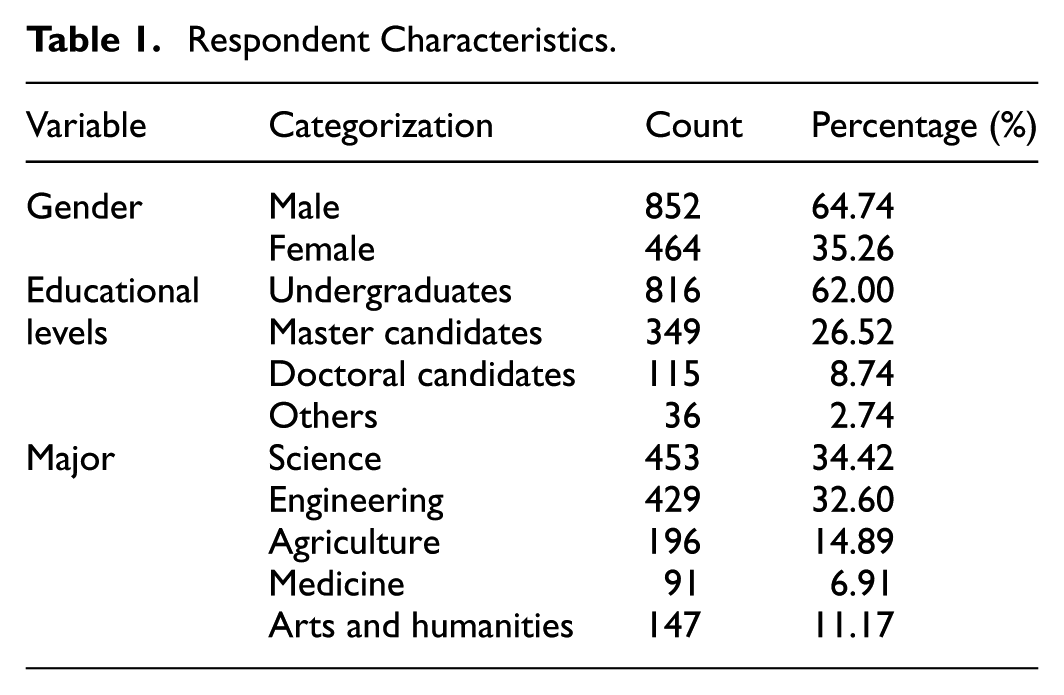
The survey remained open from December 11, 2023, to January 29, 2024. A total of 1,426 language learners participated in the survey, and 1,316 responses were left after data screening. A total of 1426 participants exceeded the minimum sample size of 140 in this study, which Kline (2023) considered an almost ideal sample size for structural equation modeling. Table 1 shows the demographic information provided by participants. Most participants were science and engineering majors, followed by those in agriculture, the arts, and the humanities. Technological innovations related to Metaverse might strongly attract science and engineering users within the author’s social network. Further, the predominantly male sample might be attributable to differences in interests and awareness of Metaverse between men and women. Rapid convenience sampling may have yielded fewer data from doctoral learners and postgraduates than from undergraduates. Moreover, data distribution tests revealed skewness values of [−1.307, −0.586] and kurtosis values of [−0.255, 1.959], both within the acceptable range. Therefore, this study could proceed with further analysis.
Respondent Characteristics.
The Assessment of the Measurement and Structural Model
Exploratory Factor Analysis
To improve the interpretability of the hypothesized model, the author conducted an exploratory factor analysis in accordance with Kline’s (2023) guidelines. The Kaiser-Meyer-Okin (KMO) and Bartlett’s sphericity tests, analyzed in IBM SPSS 23.0, were used to assess the appropriateness of the data for structural equation modeling. The author then analyzed the principal components after selecting a fixed number of factors of 7 and a display coefficient of 0.4 (Shrestha, 2021). Shrestha (2021) suggested that factor loadings greater than 0.40 could indicate sufficient measurement power of the items. According to Zhang and Liu’s (2022) categorization, the KMO value (0.963 > 0.700) and substantial sphericity (p < 0.001) indicated adequate data appropriateness for modeling. Notably, the total variance of 67.709% indicates a good representation of the measurement model.
Confirmatory Factor Analysis
The author tested the reliability and validity in IBM SPSS 23.0 and a CR and AVE calculator. The study analyzed the reliability (i.e., Cronbach’s α) and convergent validity (i.e., average variance extracted (AVE), composite reliability (CR), and factor loadings) for each variable. The convergent validity can be regarded as strong when AVE > 0.500, CR > 0.500, and factor loadings > 0.500 (Fornell & Larcker, 1981). Fornell and Larcker proposed that researchers accept AVE > 0.400 when CR > 0.600 (Fornell & Larcker, 1981) for established measurement items of variables frequently examined. Hutcheson and Sofroniou (1999) defined excellent, good, and acceptable internal consistency as α ≥ 0.900, 0.800 ≤ α < 0.900, and 0.700 ≤ α < 0.800, respectively. Table 2 verifies the measurement model’s validity and reliability. The author then used the Fornell-Larcker method to determine the discriminant validity of the measurement model. The results in Table 3 demonstrate that the square root of the average variance extracted for each construct was greater than the correlation coefficients between that construct and the other constructs. Hence, the discriminant validity of the measurement model could be deemed as good (Fornell & Larcker, 1981).
Reliability and Convergent Validity Results.
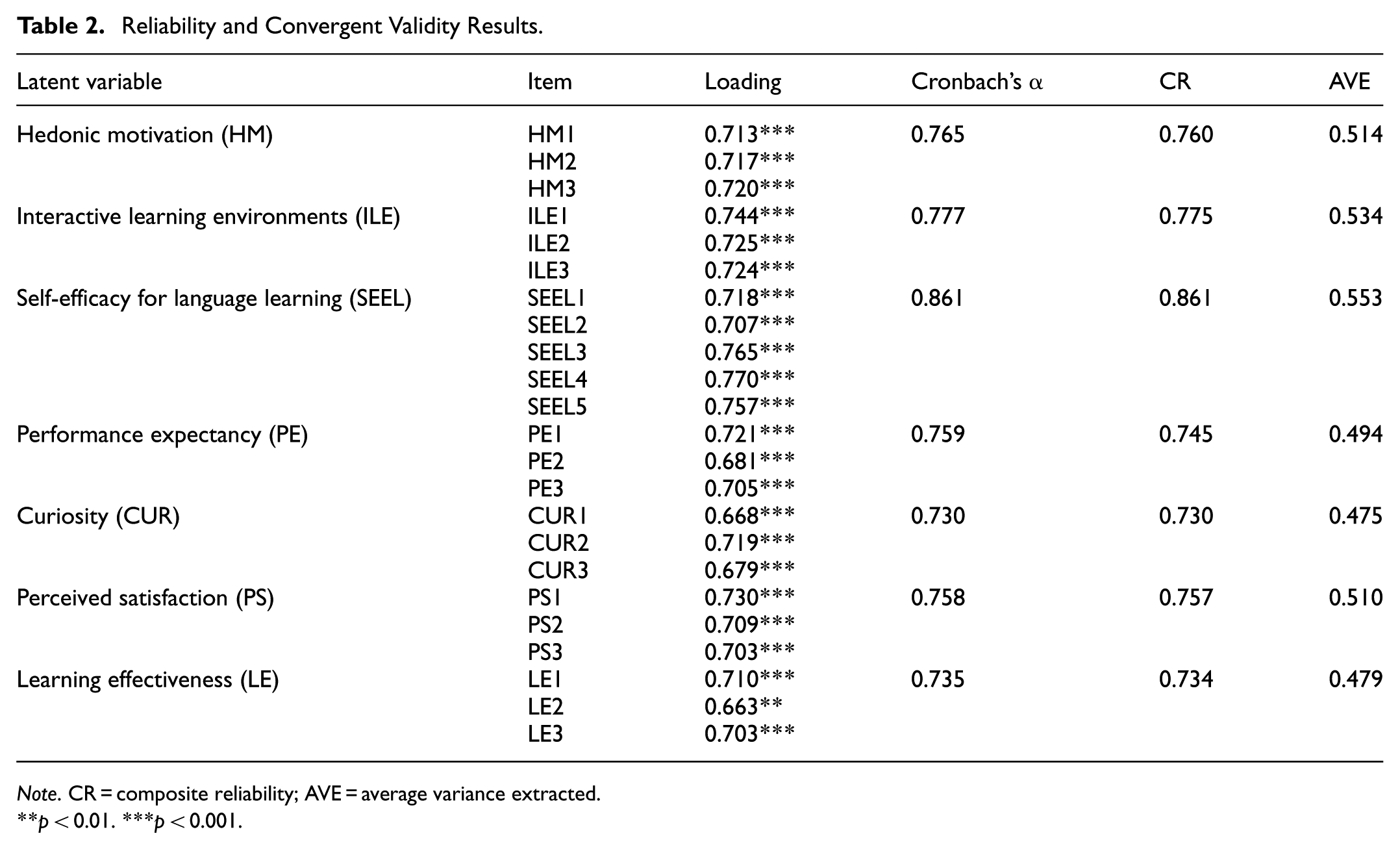
Note. CR = composite reliability; AVE = average variance extracted.
p < 0.01. ***p < 0.001.
The Fornell-Larcker Test Results.
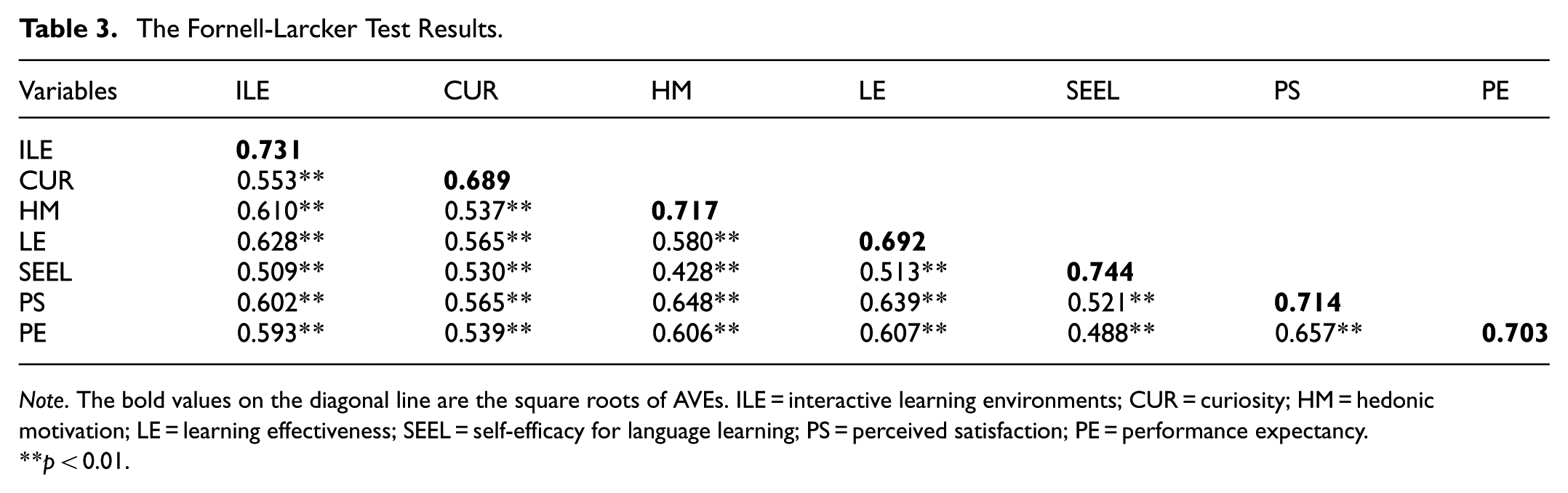
Note. The bold values on the diagonal line are the square roots of AVEs. ILE = interactive learning environments; CUR = curiosity; HM = hedonic motivation; LE = learning effectiveness; SEEL = self-efficacy for language learning; PS = perceived satisfaction; PE = performance expectancy.
p < 0.01.
Model Fit Indices
Using IBM AMOS 24.0, the author calculated model fit indices to evaluate the structural model’s fit. This study adopted nine metrics of the model fit proposed by Hair et al. (2006), such as χ2 divided by degrees of freedom (CMIN/DF), SRMR, comparative fit index (CFI), adjusted goodness-of-fit index (AGFI), Tucker Lewis Index (TLI), root mean square residual (RMSEA), RMR, normed fit index (NFI), and goodness-of-fit index (GFI). According to the metrics of Hair et al. (2006), the model fit indices presented in Table 4 were acceptable. As a result, hypothesis testing might begin after the structural equation model has been evaluated.
Metrics for Model Fit and Guideline Values.

Hypothesis Testing and the Mediating Effect
Table 5 presents the results of hypothesis testing and the mediating effects. The three largest effect sizes were found in the predictive effects of PE on CUR, HM on PS, and PS on LE. However, one insignificant effect size was located in the predictive effect of PE on LE. Table 5 also identifies three predictors of performance expectancy: hedonic motivation, interactive learning environments, and self-efficacy for language learning. Another two antecedents of perceived satisfaction were interactive learning and self-efficacy for language learning. Further, performance expectancy significantly predicted curiosity, which in turn significantly affected learning effectiveness.
Hypothesis Testing.
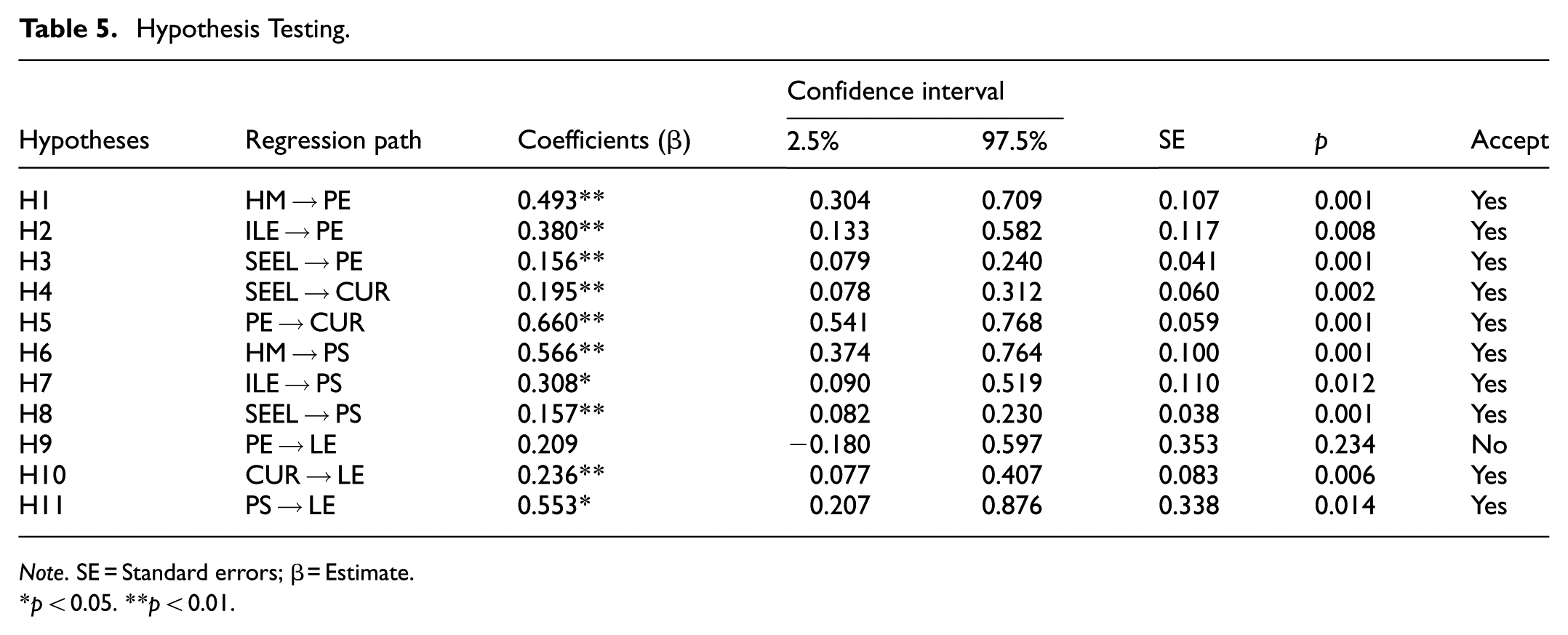
Note. SE = Standard errors; β = Estimate.
p < 0.05. **p < 0.01.
Curiosity also mediated the relationship between performance expectancy and learning effectiveness. This study adopted r1 to display the direct effect of PE on CUR, r2 the direct effect of CUR on LE, and r3 the mediating effect of CUR on the relationship between PE and LE (β = 0.153, CI = [0.057, 0.285], p = 0.005 < 0.01). The model effectively explained variances in PE, PS, CUR, and LE, with R2 values ranging from 64.0% to 88.0% (see Figure 5). Moreover, the study sample might not be representative of the population due to the lack of randomness in rapid convenience sampling, which increased systematic errors and led to sampling bias.
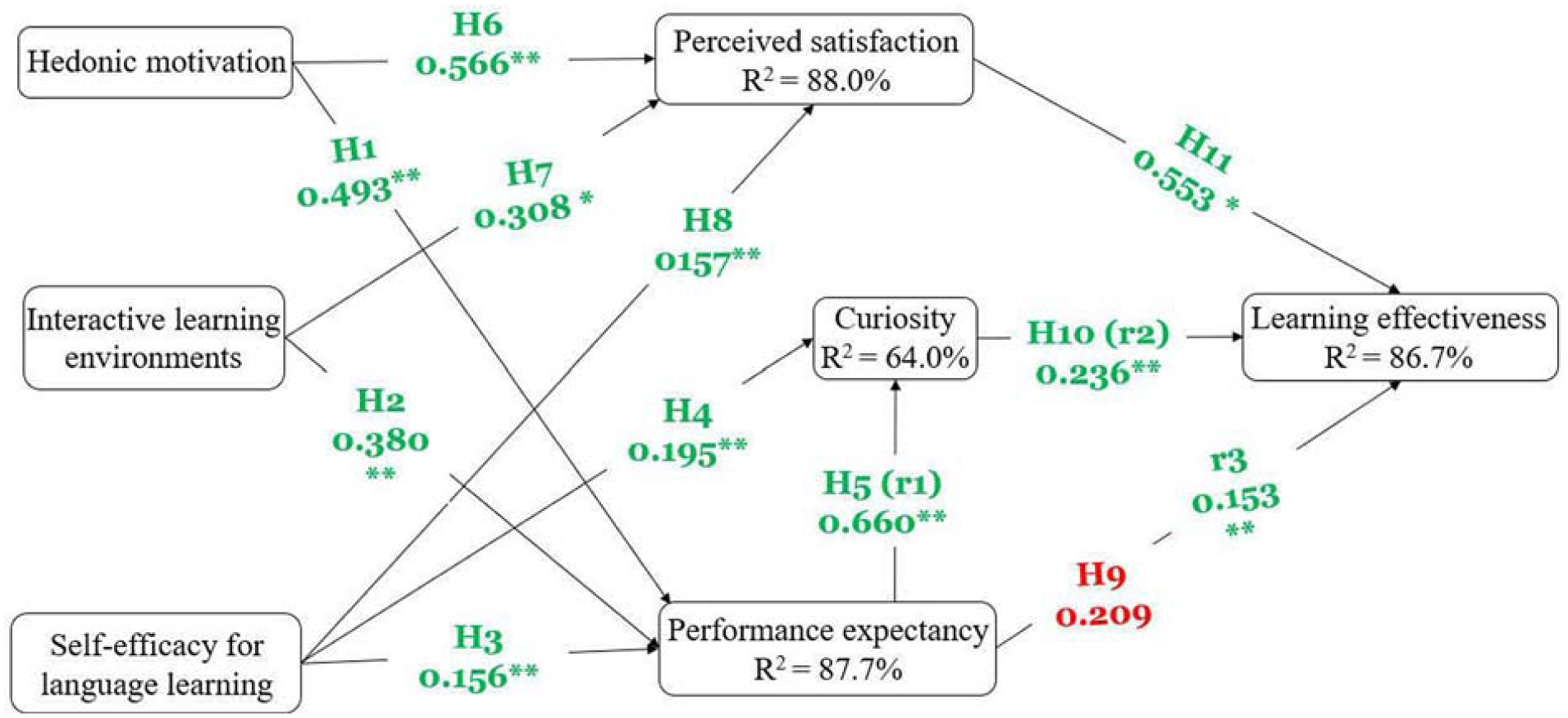
The established model of influencing factors of learner attitudes toward Metaverse-based language learning.
Qualitative Phase
The author obtained 673 valid responses from participants regarding their opinions on Metaverse-based language education. The current qualitative data provided meaningful and sufficient insights that complemented the quantitative results despite a lower response rate to the open-ended qualitative question than the quantitative section. The intercoder reliability (Kappa = 0.83) indicated near-perfect agreement between the two raters (Landis & Koch, 1977). Positively, Metaverse enabled language learners to communicate in real time through “diverse interaction modes,” thereby improving interactivity and enhancing language skills. This finding aligned with the quantitative results, indicating the positive impact of interactive environments on learners’ performance. As a recurring theme from “The Metaverse platform can provide learners with immersive, situational and experiential learning scenarios, making learning more vivid and real,” Metaverse afforded immersive and engaging language learning experiences. Further, Metaverse facilitated “convenient and efficient social interaction without geographical barriers.” The convenience and accessibility of Metaverse afforded cultural exchange, as noted in “On the Metaverse platform, learners can communicate with people from different cultural backgrounds. Such exchanges help to understand other cultures’ language usage, social habits, and values, thereby improving cross-cultural communication.”
Conversely, as mentioned in “For ordinary users, the technical threshold and cost are relatively high,” the technical threshold and cost limited language learners’ effective use of learning resources in Metaverse. “Lack of correct guidance and language correction” raises concerns about the accuracy and security of learning resources, such as “translation with limited accuracy and information leakage,” which might affect the quality of learning content in Metaverse and possibly undermine learners’ satisfaction with their learning experience. This was consistent with the quantitative finding that interactive learning environments had a negligible effect on learner satisfaction. This qualitative finding also aligned with the insignificant direct roles of performance expectancy and perceived satisfaction in the effectiveness of Metaverse-based language learning. Further, “Complex operation and few users” highlighted usability and popularity issues that affected the learning experience.
Participants also offered suggestions for improving Metaverse-based language learning. One suggestion concerned learning support. For example, some participants mentioned adding “translation functions and other auxiliary functions” so that learners could stay interested while improving their foreign language skills. Technical usability was also raised. Participants suggested that platforms should “lower the technical threshold, improve interface friendliness, and optimize operating procedures.” Some responses focused on learning resources, including “updating tutorials” and “providing diverse and accurate learning materials.” These comments show that learners cared not only about available functions but also about whether the tools were reliable and useful, a point related to learner trust in AI-supported environments (Zhuk, 2025) and the mediating role of tools in activity theory (Sharples et al., 2005). Security and privacy also appeared in participants’ suggestions, especially the need to “strengthen data protection measures to ensure user information security.” Some participants further linked wider use of the platform to stronger promotion, such as “expanding user base and increasing platform visibility and popularity.”
The detailed analysis showed that Metaverse-based language learning approaches improved language communication skills, enhanced learning interactivity, and offered greater convenience for learning. Nevertheless, the learning effect varied across learners and was subject to ethical issues, technical thresholds, and cost constraints. Therefore, it was necessary to continuously improve and optimize the platform, technological innovation, and popularization to lower the learning threshold. Importantly, ethical concerns (i.e., privacy and information security) merit further attention from developers and education stakeholders to foster a conducive and effective language learning environment in Metaverse. The word cloud in Figure 6 illustrates users’ insights on Metaverse-based language learning, with the font’s color and size indicating each entry’s variety and frequency. Specifically, the advantages of Metaverse-based language learning were represented in brown, the disadvantages in green, and the suggestions in red. Regarding font size, the larger the font, the higher the frequency for each category.
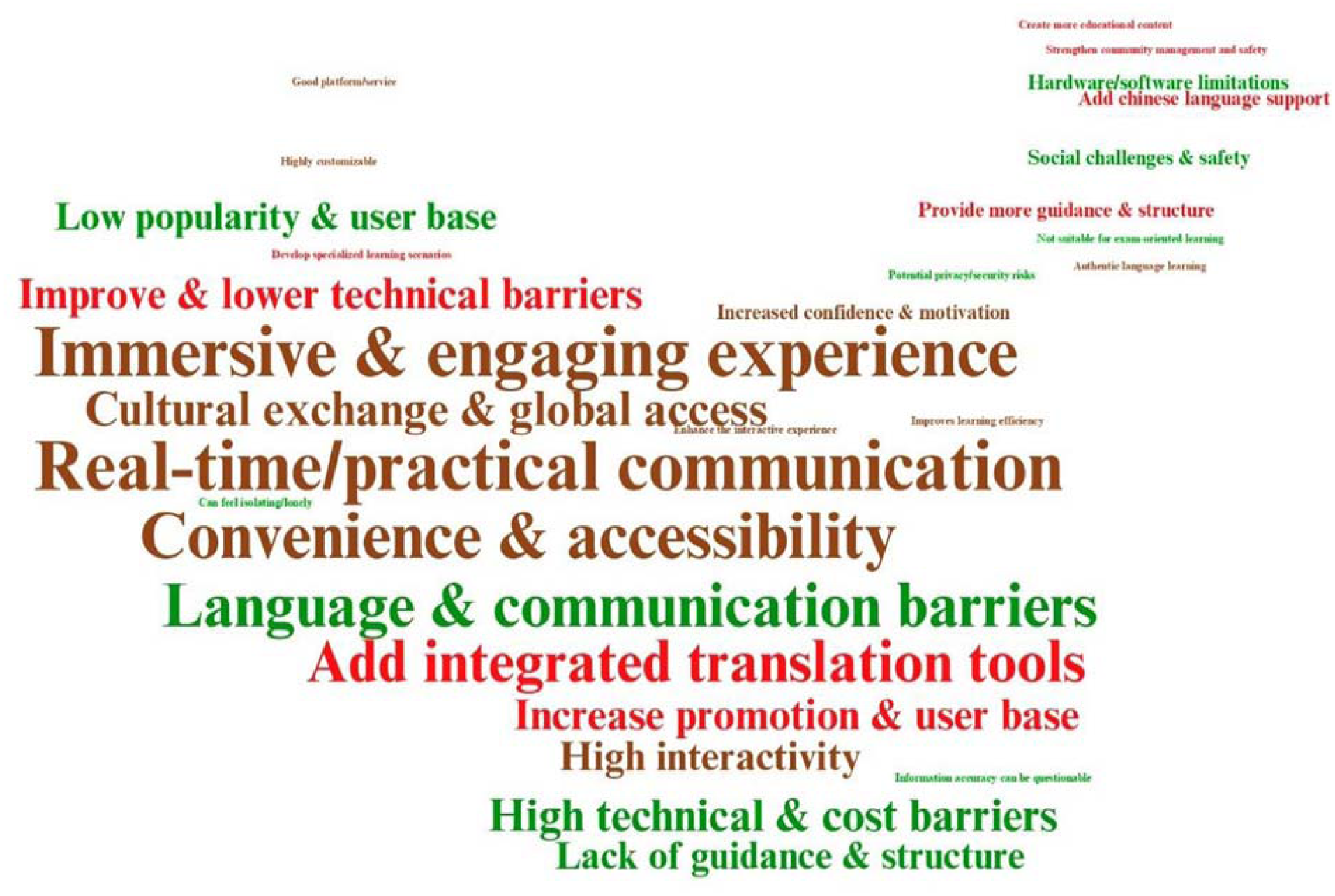
The word cloud of participants’ comments on the Metaverse-based language learning.
Discussion
The positive effects of hedonic motivation (H1), interactive learning environments (H2), and self-efficacy for language learning (H3) show that learners’ performance expectancy was not based only on the technical features of Metaverse. For hedonic motivation, the logic is relatively straightforward. An enjoyable learning experience can reduce the perceived burden of technology-mediated learning and make the environment seem more useful for performance improvement. Relevant support was provided by Chao (2019), who showed that perceived enjoyment positively influenced performance expectancy in mobile learning. This interpretation is also consistent with Abdullah and Ward’s (2016) meta-analysis of e-learning acceptance, which identified enjoyment as a strong predictor of students’ perceived usefulness of e-learning systems.
Interactive learning environments may also have strengthened performance expectancy by making Metaverse-based learning activities more socially and cognitively engaging. This explanation is consistent with activity-theory-based research showing that technology-supported learning is shaped by the interaction among learners, tools, learning activities, and social conditions (Liaw & Huang, 2014). More specifically, Liaw and Huang (2014) found that interactive learning environments positively influenced learners’ perceived usefulness of e-books as learning tools. Di Natale et al. (2024) further noted that immersive virtual reality and Metaverse-based learning environments involve social, cognitive, and affective dimensions.
Self-efficacy for language learning may have strengthened performance expectancy because learners who felt more capable of completing English-learning tasks were more likely to expect useful learning outcomes from Metaverse-based activities. This interpretation can be anchored in social cognitive theory. Bandura (1997) defined self-efficacy as learners’ belief in their capability to organize and carry out the actions needed to achieve desired outcomes. In the present context, learners who believed they could manage English-learning tasks were therefore more likely to expect Metaverse-based activities to produce useful learning outcomes. Evidence from online English learning points in a similar direction, as M. F. Teng and Wu (2023) found that self-efficacy beliefs were related to learners’ perceived progress.
The positive effects of self-efficacy for language learning and performance expectancy on curiosity supported H4 and H5. Curiosity in this setting did not appear to arise from novelty alone. Learners who felt able to manage English-learning tasks may have been less likely to avoid unfamiliar Metaverse-based activities. Instead, new tools, scenarios, and problems were therefore more likely to be seen as opportunities for exploration than as sources of difficulty. This interpretation is grounded in Bandura’s (1997) view of self-efficacy as learners’ belief in their capability to organize and carry out actions required to achieve desired outcomes. It also fits Loewenstein’s (1994) information-gap account, in which curiosity arises from the perceived gap between what one knows and what one wants to know. In EFL writing, L. S. Teng (2024) showed that self-efficacy was related to learners’ use of cognitive, metacognitive, and motivational regulation strategies. This finding suggests that confident language learners may be better able to sustain exploration when tasks become demanding.
Performance expectancy may have contributed to curiosity by giving exploration a practical purpose. Learners who regarded Metaverse-based learning as useful were not only attracted by the novelty of the environment. They also had a clearer reason to examine how its tools, activities, and resources could support their language learning. This explanation is compatible with Dubey et al. (2022), who reported that perceived usefulness could trigger curiosity. Related evidence from English M-learning also shows that curiosity and self-efficacy contributed to learners’ intention to use mobile English learning (Peng et al., 2023). Curiosity may further persist when learners perceive progress while still seeing possibilities for further exploration, as suggested by the learning progress framework (Poli et al., 2024).
Perceived satisfaction was positively predicted by hedonic motivation, interactive learning environments, and self-efficacy for language learning, in line with H6, H7, and H8, respectively. The effect of hedonic motivation indicates that learners’ satisfaction was not only influenced by what Metaverse could offer technically, but also by the fun of the learning experience. Enjoyable Metaverse-based language learning may have made the learning process more interesting and less tedious, therefore producing more positive appraisals of the experience. This interpretation is supported by recent EFL e-learning evidence showing that perceived enjoyment is associated with satisfaction and continuance intention (Xu & Yang, 2026). It is also broadly consistent with EFL blended learning research in which perceived enjoyment was significantly related to students’ satisfaction (J. Wu & Liu, 2013).
Self-efficacy for language learning may also have contributed to perceived satisfaction. From the perspective of self-efficacy theory, learners’ beliefs in their capability to organize and carry out actions required to achieve desired outcomes can shape how they approach learning challenges (Bandura, 1997). In the present context, learners who believed that they could complete English-learning tasks were more likely to regulate their learning, persist when difficulties occurred, and experience the learning process as manageable. This explanation is consistent with EFL writing research showing that self-efficacy strongly predicts learners’ cognitive, metacognitive, and motivational regulation strategies (L. S. Teng, 2024). More closely, Y. Zheng and Xiao (2024) found that online learning self-efficacy had a positive direct effect on online course satisfaction among EFL learners and also influenced satisfaction indirectly through online self-regulated learning.
There was a positive association between interactive learning environments and perceived satisfaction. This result suggests that learners’ satisfaction with Metaverse-based language learning may not mainly derive from technological novelty, but is more likely related to whether the virtual environment supports situated participation, peer collaboration, and authentic interaction. Chang and Hsiao (2025) incorporated interactive learning environment features into their explanatory framework of student satisfaction in the learning Metaverse. This framework indicates that interactive environmental features are an important dimension for understanding satisfaction in Metaverse-based learning. S. M. Lee and Ahn’s (2025a) study of L2 learners’ experiences in a Metaverse space further showed that virtual spaces designed around situated, active, and collaborative learning principles can support more participatory language learning experiences. Therefore, the present finding suggests that learners are more likely to report higher perceived satisfaction when the Metaverse-based language learning environment provides stronger interaction and participation.
Regarding learning effectiveness, curiosity (H10) was a significant positive predictor, whereas performance expectancy (H9) did not directly predict learning effectiveness. This pattern suggests that performance expectancy may matter for learning effectiveness mainly through curiosity rather than through a direct path. Learners’ belief that Metaverse-based language learning is useful may therefore need to stimulate curiosity before it is translated into perceived learning gains. Dubey et al. (2022) showed that perceived usefulness can stimulate curiosity, which provides support for this interpretation. Curiosity was not merely a peripheral affective factor in this model. Alan and Mumcu’s (2024) intervention study is relevant here because curiosity-oriented pedagogy was associated with knowledge retention, learning achievement, and information sharing. A complementary cognitive account is provided by Poli et al. (2024), who describe curiosity as part of exploration, information seeking, and learning progress.
The non-significant effect of performance expectancy on learning effectiveness suggests that learners’ belief in the usefulness of Metaverse-based language learning was not directly associated with stronger perceived learning outcomes in this study. This result does not mean that performance expectancy is unimportant. Rather, it suggests that performance expectancy may function as a more distal evaluative belief in this context. In the UTAUT framework, performance expectancy refers to users’ belief that using a system will help them attain performance gains, and the model was developed to explain technology acceptance and use (Venkatesh et al., 2003). Recent language-learning technology research supports this distinction. H. B. Hwang’s (2025) study of app-based EFL learning offers a useful comparison. In that study, perceived usefulness was associated with app acceptance, whereas actual use was explained by acceptance and facilitating conditions. This helps explain why performance expectancy in the present study may have remained a general acceptance-related belief rather than a direct predictor of learning effectiveness.
This interpretation is particularly relevant to Metaverse-based language learning, where learning effectiveness may depend not only on learners’ positive expectations of the technology but also on how the immersive environment is pedagogically structured. Metaverse may appear useful to learners, but its learning value is realized only when the environment is organized around concrete tasks, interaction, feedback, and repeated language practice. Tong et al. (2025) made this point at the design level by linking Metaverse affordances to pedagogy. Çelik and Baturay (2024) reached a similar conclusion empirically: their Metaverse-based language teaching intervention improved vocabulary learning, retention, engagement, presence, and classroom community. Therefore, the present result may reflect a gap between learners’ general expectations of the technology and the learning value they actually experienced. Given the cross-sectional design and sample characteristics of the present study, this finding should be interpreted as context-bound rather than as evidence that performance expectancy is unrelated to learning effectiveness in all Metaverse-based language learning contexts.
Learners who were more satisfied with the Metaverse-based language learning experience also reported higher learning effectiveness (H11). In this context, satisfaction may reflect learners’ belief that the virtual tasks, interactive activities, and opportunities for language practice were useful for their learning, rather than only their enjoyment of the environment. J. Lin and Wang (2024) found that student satisfaction predicted perceived online learning among Chinese university EFL learners, which indicates that satisfaction is an important factor in understanding learners’ perceived language learning outcomes. Çelik and Baturay’s (2024) quasi-experimental study further showed that Metaverse-Based Language Teaching had positive effects on L2 vocabulary learning and retention, learning engagement, presence, and sense of classroom community. Therefore, the present finding may be understood as suggesting that, in Metaverse-based language learning contexts, higher perceived satisfaction tends to be associated with more positive evaluations of learning effectiveness.
Collectively, in line with activity theory from a technological perspective, the findings support the roles of hedonic benefits, curiosity, self-efficacy beliefs (i.e., control of learning/rules), interactive learning environments (i.e., community/context of learning), performance expectancy, and perceived satisfaction (i.e., division of labor/communication of learning) in shaping learner attitudes and learning-related outcomes (i.e., learning object) within Metaverse (i.e., learning tools). The study also offers a model-based account of mechanisms shaping learner attitudes toward Metaverse-based language learning (Sharples et al., 2005). This paradigm emphasizes the role of curiosity and self-efficacy as basic motivators in the language learning framework.
From a practical perspective, the findings suggest that educational stakeholders and developers may need to pay closer attention not only to immersive interactivity itself, but also to the quality, usability, ethical safeguards, and resource support that make such interaction educationally meaningful. From a research perspective, future studies could test the present model across more diverse learner groups and educational stages. Future research could examine whether the structural relationships identified in this study change under different technological and learner-related conditions, such as system quality, privacy concerns, trust, and learning strategies. The use of convenience sampling also limits the representativeness of the sample. Thus, the findings should be generalized to other higher education contexts with caution and be further tested with more diverse learner groups and educational settings.
Conclusion
Major Findings
This study found that learners’ attitudes toward Metaverse-based language learning were related to both individual learning beliefs and environmental features. The quantitative results further showed that self-efficacy for language learning, curiosity, and perceived satisfaction were among the most important factors in explaining learners’ attitudes and perceived learning effectiveness. Hedonic motivation, interactive learning environments, and self-efficacy for language learning positively predicted performance expectancy and perceived satisfaction. Meanwhile, performance expectancy and self-efficacy for language learning positively predicted curiosity, which further predicted learning effectiveness in Metaverse-based language learning. Perceived satisfaction also significantly predicted learning effectiveness. These results indicate that learners’ evaluations of Metaverse-based language learning were not only related to their judgments of technological usefulness but also closely connected with enjoyment, interaction quality, self-efficacy, and curiosity during the learning process.
One noteworthy result was that performance expectancy did not directly predict learning effectiveness in Metaverse-based language learning. In other words, learners’ belief that Metaverse was useful did not necessarily correspond to stronger perceived learning effectiveness. By comparison, learning effectiveness appeared to be more closely related to whether learners became curious, felt satisfied, and became meaningfully involved in language practice. The qualitative analysis further enriched this explanation. Participants perceived Metaverse-based language learning as useful for language communication, learning interaction, and access to learning opportunities. Nevertheless, participants also noted that its actual effectiveness could be constrained by learner readiness, technical problems, ethical concerns, and the quality of learning resources. Therefore, although Metaverse-based language learning has educational potential, whether this potential can be translated into effective learning experiences depends on the interaction among the technological environment, instructional design, and learner characteristics.
These findings partly align with Social Cognitive Theory, especially its view that self-efficacy beliefs play an important role in learning and behavior (Bandura, 1986). They are also connected to technology acceptance research, which highlights usefulness-related beliefs in explaining learners’ evaluations of technology (Davis, 1989). However, the non-significant direct path from performance expectancy to learning effectiveness was not fully consistent with some prior online learning research, in which usefulness- or performance-related beliefs were found to predict learning outcomes (Liaw & Huang, 2014). Therefore, the present findings are better understood as context-specific evidence from the emerging field of Metaverse-based language learning, rather than as a simple contradiction of previous online learning research.
Theoretical and Practical Contributions
The contribution of this study lies first in its use of activity theory to explain learner attitudes toward Metaverse-based language learning. Rather than viewing Metaverse only as a technological platform, the study conceptualizes learning as an activity system in which learners, digital tools, interactive environments, motivational beliefs, and perceived learning outcomes are closely connected. The findings show that hedonic motivation, interactive learning environments, self-efficacy for language learning, curiosity, and perceived satisfaction all play important roles in this system. This helps explain why learners’ attitudes toward Metaverse-based language learning cannot be understood only through technological usefulness. The non-significant direct path from performance expectancy to learning effectiveness is also theoretically meaningful. It suggests that usefulness-related beliefs may not directly become perceived learning gains unless they are accompanied by curiosity. In this sense, the study clarifies a possible boundary of performance expectancy in Metaverse-based language learning contexts.
The study also makes a practical contribution by identifying the conditions under which Metaverse-based language learning is more likely to be perceived as valuable by learners. The findings indicate that practical value does not come from technological novelty alone, but from the combined role of learner confidence, curiosity, perceived satisfaction, and meaningful interaction. This provides an empirical basis for understanding why some immersive learning experiences may be attractive but not necessarily effective, and why learners’ perceived gains depend on both the quality of the environment and their psychological engagement with learning. Metaverse-based language learning becomes educationally valuable when immersion is connected with learners’ confidence, curiosity, satisfaction, and meaningful language use.
Limitations of the Study
The present findings should be interpreted with several limitations in mind. Because the sample was recruited through convenience sampling and was limited to higher education learners, it may not fully represent Chinese learners in broader Metaverse-based language learning contexts. Since the participants were not randomly selected, the examined relationships should be interpreted cautiously beyond the sampled tertiary education context. The cross-sectional self-report design also limits causal inference and captures learners’ perceptions at only one point in time. Later studies may follow learners over time, introduce experimental comparisons, or draw on behavioral or performance-based evidence to examine whether these relationships remain stable. In addition, Metaverse-based learning environments may differ in interaction design, task structure, technical support, and pedagogical guidance. Accordingly, the findings of the present study should be understood within these methodological boundaries, especially when compared with evidence from Metaverse-based and other technology-enhanced language learning contexts. Despite these limitations, this study offers an initial model for understanding how learners form attitudes toward Metaverse-based language learning, a field that remains at an early stage of development.
Implications
For educators, Metaverse should first be treated as a language-learning space, not as a display technology. The present results showed that self-efficacy for language learning was linked to performance expectancy, perceived satisfaction, and curiosity, and that curiosity and satisfaction were closely related to learning effectiveness. This means that teachers need to create conditions in which learners feel able to participate, have reasons to explore, and can use the target language repeatedly. Virtual tasks can therefore be built around role-play, problem solving, peer dialogue, oral or written responses, feedback, and revision. These activities matter because they turn visual immersion into actual language practice. Online learning research has also found learner–content interaction to be an important predictor of student satisfaction, which supports the need to treat interaction as part of the lesson design rather than as an optional platform feature (Kuo et al., 2014).
For developers, the central issue is whether the platform makes language learning easier to carry out. A useful Metaverse tool should not only look immersive; it should also show learners what to do next, how to respond to feedback, how their progress is changing, and how they can communicate with others in the target language. The quantitative results point in the same direction: hedonic motivation and interactive learning environments predicted both performance expectancy and perceived satisfaction. Thus, enjoyment matters, but it should be embedded in communicative tasks, feedback use, and repeated target-language practice rather than treated as entertainment alone. Game elements such as rewards, badges, and collaborative challenges are more defensible when they lead learners toward communicative tasks, feedback use, and repeated target-language practice. Dichev and Dicheva (2017) cautioned that gamification does not automatically improve learning, because its educational value depends on how game elements are integrated into instructional design.
For institutions, the study points to a more basic implementation issue. A platform that appears useful is not necessarily ready for classroom and learning use. The non-significant direct path from performance expectancy to learning effectiveness suggests that learners’ belief in the usefulness of Metaverse is not enough on its own. Relevant institutions need to make sure that the learning environment is technically stable, ethically safe, and usable in real teaching conditions. Before a Metaverse activity is used in learning, the data issue should be made visible to learners. They should know what the platform records, who can access the records, and how the information is protected, because privacy, security, and user safety remain important risks in Metaverse adoption (Benjamins et al., 2023). Access problems are equally concrete. If a learner’s device, network, or technical support is unreliable, the lesson can quickly shift from language interaction to troubleshooting. For this reason, decisions about hardware, connectivity, learning support, and risk management should be made together with the design of the language tasks themselves (Jagatheesaperumal et al., 2024).
For future research, the main issue is not only whether Metaverse-based language learning works, but under what conditions it works better. The present study suggests that self-efficacy, curiosity, satisfaction, interaction quality, and performance expectancy play different roles in explaining learning effectiveness. Future studies could test whether these relationships remain stable across educational levels, disciplines, language proficiency groups, and learning contexts. Because this study focused on higher education learners and used rapid convenience sampling, broader and more balanced samples would improve the generalizability of the findings. Future research could also examine system quality, information quality, service quality, instructional design quality, and resource quality. Longitudinal, experimental, and comparative designs would be useful for tracing how learners’ expectations, curiosity, satisfaction, interaction experiences, and perceived learning effectiveness change over time. This would help clarify when Metaverse-based language learning becomes a genuinely pedagogical environment rather than only a novel technological setting.
Supplemental Material
sj-docx-1-sgo-10.1177_21582440261461862 – Supplemental material for The Role of Self-Efficacy and Curiosity in Factors Influencing Learner Attitudes Toward Metaverse-Based Language Learning: A Structural Equation Model
Supplemental material, sj-docx-1-sgo-10.1177_21582440261461862 for The Role of Self-Efficacy and Curiosity in Factors Influencing Learner Attitudes Toward Metaverse-Based Language Learning: A Structural Equation Model by Qianqian Cai in SAGE Open
Footnotes
Acknowledgements
I would like to express my heartfelt gratitude to all of the instructors and staff at the School of English and Advanced Translation Studies who have greatly helped and guided me.
Author Note
Qianqian Cai, the independent author,  , ranked first in the entrance examination, is presently a doctoral student majoring in Foreign Linguistics and Applied Linguistics at the School of English and Advanced Translation Studies at the Beijing Language and Culture University. She has also worked as a teaching assistant for “Academic Writing” and “Frontiers in Foreign Language Education” and has been awarded the First-Class Academic Scholarship. She has written several academic articles and published articles in distinguished international journals related to her research interests. One of her articles (First author, SSCI Q1) titled “Factors Influencing Learner Attitudes Towards ChatGPT-Assisted Language Learning in Higher Education” has been an ESI (Essential Science Indicators) top paper since May and June 2024, which is a highly cited and hot paper. She is also in charge of several municipal and school-level scientific research projects. Further, she has received more than 2 years of systematic and rigorous statistical training. She has proficient and solid statistical knowledge and scientific research skills, including structural equation modeling, systematic literature review, meta-analysis, and citation network analysis. Her research interests encompass intelligent language education, technology (artificial intelligence)-assisted (language) education, pragmatics, second language acquisition, and English as a foreign language education. Additionally, she has been invited to review several manuscripts for the following journals: Education and Information Technologies (SSCI, Q1) and The Asia-Pacific Education Researcher (SSCI, Q1).
Ethical Considerations
The methodology of this study, such as questionnaire design, data collection procedures, and sampling method, was approved by the Human Research Ethics Committee of Beijing Language and Culture University. The current study involved anonymous data and non-sensitive information, which adhered to the ethical standards outlined in the Beijing Language and Culture University Research Ethics Guidelines. The formal ethics approval was deemed exempt from full review by the Beijing Language and Culture University Institutional Review Board (IRB) on March 1, 2024 (Ref: EX-2024-BYLL).
Consent to Participate
All 1426 participants were willing to participate in this study and contribute their answers to the researchers exclusively for academic research purposes. The author also guaranteed that the answers would be confidential and used solely for this academic study. Before accessing the online survey, participants were mandated to affirmatively select a consent box indicating that they:
- Comprehended the research aims outlined on the introductory page.
- Willingly consented to furnish anonymized responses.
- Recognized that aggregated data may be disseminated via academic publications.
This opt-in consent procedure was deemed exempt from full review by the Beijing Language and Culture University Institutional Review Board (IRB) on March 1, 2024 (Ref: EX-2024-BYLL).
Author Contribution
Funding
The author disclosed receipt of the following financial support for the research, authorship, and/or publication of this article: This work was supported by the Key Research and Application Project of the Key Laboratory of Key Technologies for Localization Language Services of the State Administration of Press and Publication, “Research on Localization and Intelligent Language Education Technology for the “Belt and Road Initiative” under Grant (number CSLS 20230012); the research project of Graduate Students of Beijing Language and Culture University “Xi Jinping: The Governance of China” under Grant (number SJTS202108); and the Fundamental Research Funds for the Central Universities, and the Research Funds of Beijing Language and Culture University under Grant (number 23YCX006).
Declaration of Conflicting Interests
The author declared no potential conflicts of interest with respect to the research, authorship, and/or publication of this article.
Data Availability Statement
Supplemental Material
Supplemental material for this article is available online.
References
Supplementary Material
Please find the following supplemental material available below.
For Open Access articles published under a Creative Commons License, all supplemental material carries the same license as the article it is associated with.
For non-Open Access articles published, all supplemental material carries a non-exclusive license, and permission requests for re-use of supplemental material or any part of supplemental material shall be sent directly to the copyright owner as specified in the copyright notice associated with the article.
