






Abstract
With the emergence of positive psychology (PP), resilience has gained increasing attention as a positive quality. Additionally, motivation serves as a crucial driving factor in second language (L2) learning. While prior research has primarily focused on their influence within the specific domain, at the macro level, limited attention has been paid to how these variables interact with learners’ behavioral intentions in technology-enhanced environments. Addressing this gap, the present study examines the relationships among motivation, resilience, and behavioral intention to use generative artificial intelligence (GenAI) tools in language learning among Chinese English as a Foreign Language (EFL) learners (N = 502). Data were collected via three validated closed-ended questionnaires. Structural equation modeling revealed that both motivation and resilience significantly predict learners’ intention to adopt GenAI, with resilience serving as a significant mediator in the motivation-intention relationship. These findings suggest that fostering resilience-oriented motivation strategies could be a valuable component of EFL instruction to support positive engagement in GenAI-assisted language learning contexts; however, such integration should be explored with consideration of the cross-sectional design, which precludes claims about causality or actual learning outcomes.
Plain Language Summary
This study explores why Chinese students learning English are willing to use Artificial Intelligence (AI) tools to help them learn. The researchers looked at two key factors: motivation (how much students want to learn) and resilience (how well they deal with challenges and bounce back from setbacks). Both of these qualities are important for learning success and come from a field of psychology that focuses on positive human strengths. A total of 502 university students took part in the study by completing questionnaires about their motivation, resilience, and how likely they are to use AI in their language learning. The results showed that students who are more motivated and more emotionally strong (resilient) are more likely to want to use AI tools in their learning. Even more interestingly, resilience helped explain how motivation leads to this willingness to use AI—meaning that motivated students are more likely to use AI tools if they also have emotional strength. These findings are important for teachers and schools. If educators want students to use AI tools successfully, it is not enough to just provide the technology. They also need to help students build motivation and emotional strength. For example, offering supportive learning environments, encouraging positive thinking, and helping students develop confidence could make them more open to using new learning technologies.
Introduction
Motivation and resilience are pivotal in foreign language learning, as they are closely associated with learners’ behavioral intentions and reported learning behaviors, particularly in generative artificial intelligence (GenAI)-mediated environments. Resilience is one of the vital variables in positive psychology (PP), which encompasses diverse definitions. Wu et al. (2024a) define it as one’s ability to cope with stressful and challenging situations positively. These situations may include high-demand assignments, high expectations from teachers and parents, and some challenging tasks. Connor and Davidson (2003) regard resilience as a psychological and personality quality that can be used to measure successful stress-coping ability, which can assist individuals to adapt to challenges within disruptive conditions. Moreover, resilience can also be viewed as the capacity to withstand and bounce back from hardship, which may enable learners to cope with difficulties and is often linked to academic performance, underlying future academic success (Chu et al., 2024). Therefore, resilience is considered a crucial quality for students, as it has been found to correlate with motivation, self-regulation, problem-solving skills, and psychological well-being (Wu et al., 2024a; J. Yang & Yang, 2025). Motivation is also a crucial variable in PP, which can serve as a director of learners’ behavior, driving academic success. It is the main reason why learners choose to engage in an activity, how long they intend to continue the activity, and how hard they are determined to pursue it (Danesh & Shahnazari, 2020). Given the established role of motivation and resilience in shaping learning behaviors, it becomes essential to examine how these psychological constructs interact with and are influenced by emerging educational technologies such as GenAI.
In recent years, with the development of GenAI, more and more pedagogical practices have used GenAI as an auxiliary tool. Consequently, many studies have investigated its association with learners’ psychological variables (Shin & Lee, 2024; L. Yang & Derakhshan, 2026; L. Yang & Wang, 2024) and the features of its feedback compared with teachers’ feedback (Lin & Crosthwaite, 2024). As for its roles, numerous studies suggest that it has a profound relationship with both teachers and students. For students, the automated writing feedback software can provide an accessible and supplementary tool to L2 teachers’ ratings (Shin & Lee, 2024), is associated with improved writing performance (Athanassopoulos et al., 2023; Kurt & Kurt, 2024), especially in grammatical range and accuracy (Rahimi et al., 2025), and is linked to enhanced motivation (Huang & Mizumoto, 2025), while also offering an effective tutor and source of language input (Barrot, 2023). For teachers, while GenAI can assist them in providing written corrective feedback (Lin & Crosthwaite, 2024), it also calls for teachers’ positive emotions and advanced digital literacy (Y. Liu & Chang, 2024). In order to prevent the use of GenAI from overwhelming students, it is advisable that teachers consider an iterative design process for instructional activities and materials, and provide scaffolding in due course (Woo et al., 2024). Thus, from this theoretical perspective, motivation and resilience, as key internal resources that language learners need to mobilize and maintain when engaging with GenAI technology, can have their dynamic interplay systematically explained through the Conservation of Resources Theory (COR).
According to COR (Hobfoll et al., 2018), individuals will strive to obtain, retain, foster, and protect those things they value, which encompasses external resources (such as money and support) and internal resources (such as resilience and self-efficacy). Based on this framework, motivation can be regarded as an internal driving force that prompts individuals to invest resources and stimulates their willingness to actively engage in learning with GenAI technologies. Through such investment, individuals gradually enhance their resilience, which in turn promotes their persistence and adaptability when facing GenAI-related tasks, thereby strengthening their behavioral intention to use GenAI. This study is the first to apply COR theory to explain the transformation mechanism of positive psychological resources, thereby expanding the theoretical boundaries of COR theory in the domains of language learning and teaching. Therefore, this study anticipates that EFL learners can not only directly enhance their behavioral intention to use GenAI through motivation, but also indirectly promote this intention through the mediating role of resilience. Although COR provides a robust theoretical framework for understanding the dynamic transformation of individual psychological resources, existing research has not yet sufficiently applied this perspective to systematically reveal how motivation and resilience, within this framework, jointly shape foreign language learners’ intention to use technology in GenAI-empowered macro-level learning environments.
Although several studies have explored the role of GenAI-generated writing assessments (Rahimi et al., 2025), there are few studies that have explored its association with psychological variables at the macro level. To bridge this gap, the current study attempts to explore the roles of two positive traits, namely motivation and resilience, in Chinese EFL learners’ behavioral intention to use GenAI. By unveiling the predictive roles of motivation and resilience, the present study aims to probe how these positive traits interact with each other within the GenAI-empowered environment, providing an interpretation of the potential relationships through which positive psychological traits may relate to learners’ behavioral intention at the macro level. To achieve this goal, this study aims to answer the following three questions:
Literature Review
Motivation
Motivation is a vital variable in PP, which may interact with foreign language enjoyment, well-being, resilience, learning engagement, grit, and loving pedagogy (Wang et al., 2021). In a language learning context, Dörnyei (2009) believes language learning motivation encompasses both individual factors (such as perceived usefulness toward the target language and learning experience) and social factors (such as social status), which may influence one’s attitudes and behaviors toward language learning. In addition, he also proposed the second language (L2) motivational self-system, which contains three factors: the Ideal L2 Self, the Ought-to L2 Self, and the L2 Learning Experience (Huang & Mizumoto, 2025). Among these three factors, the Ideal L2 Self is the most powerful motivational force, which can represent one’s expectation of a future image as a proficient language user. The Ought-to L2 Self represents one’s belief that they should possess the attributes due to external expectations and stress. The L2 learning experience refers to one’s attitude toward the L2 learning process, which includes the actual encounters and interactions. As motivation is a driving force behind learners’ behavior, L2 learners will manifest motivated learning behavior to bridge the gap between their current status and intended future selves (Danesh & Shahnazari, 2020). Furthermore, according to Deci and Ryan (1995), motivation can be divided into two categories: external motivation and internal motivation. Learners motivated by internal factors will feel that the learning process is enjoyable and hold a positive attitude toward the learning process. This positive experience will, in turn, increase their autonomy (L. Yang, 2026). On the contrary, learners who rely on external factors may have difficulty sustaining motivation.
With the emergence of the positive turn in psychology, motivation has become a crucial variable to be investigated in L2 teaching and learning. Recent studies cluster into three strands that mirror our research questions. First (RQ1), studies indicate that learners’ motivation relates to technology acceptance and behavioral intention to use GenAI in L2 learning. Although some studies do not measure intention directly, gains in motivation observed under GenAI-assisted assessment and writing point to a plausible pathway from heightened motivation to stronger intentions to adopt GenAI for learning (Huang & Mizumoto, 2025). Second (RQ2), as a key PP resource, resilience appears relevant to intention formation because it helps learners manage uncertainty, errors, and feedback in GenAI-supported tasks. Empirical studies show that resilience strengthens persistence and self-regulation (Chu et al., 2024; Wu et al., 2024a), which are antecedents of behavioral intention. Third (RQ3), resilience may mediate the link between motivation and behavioral intention. Motivated learners who are also resilient are better able to convert motivational impetus into an intention to use GenAI despite cognitive load or setbacks. Consistent with this view, Woo et al. (2024) reported that while ChatGPT can motivate participation, the accompanying cognitive load may require personal resources such as resilience to sustain intended use. This three-part synthesis directly motivates our empirical tests of RQ1 to RQ3.
Motivation serves as the foundation for L2 learners to form usage intentions and sustain engagement. However, in technology-enhanced environments, translating motivation into lasting behavioral intention relies particularly on a learners’ key ability to cope with challenges and setbacks, which refers to resilience.
Resilience
Resilience refers to individuals’ ability to deal with stressful and challenging situations (Wu et al., 2024a). It was found that resilience is composed of several important factors, including perceived happiness, empathy, sociability, persistence, self-regulation, and so on (G. L. Liu et al., 2024). Resilience is a precious quality for learners, which can enhance self-regulation, motivation, problem solving skills, and facilitate psychological well-being (Wu et al., 2024a). In the teaching environment, academic resilience refers to the ability to effectively handle problems, stress, or pressure in the academic environment (G. L. Liu et al., 2024). In the foreign language teaching and learning process, it can help teachers and learners to cope with difficulties and stressors effectively, so that teachers can find meanings in their profession (Wang et al., 2021).
According to the available literature, the study of resilience mainly focuses on the following three topics. The first one is the concept and structure. Duan et al. (2024) conducted a survey in 1,653 EFL learners. They identified a four-factorial structure of student academic resilience, including positive individual characteristics, family support, teacher support, and peer support. Chu et al. (2024) synthesized 27 high-quality empirical studies to reveal the complex and diverse features of resilience. The second topic is its relationship with other variables, such as burnout, learning engagement, well-being, grit, and so on. To give an example, Kim and Kim (2017) conducted a questionnaire survey among 1,620 secondary school learners to explore the constituent factors of resilience and its relationship with motivated behavior and L2 proficiency. They identified a five-factor model of resilience, involving perceived happiness, empathy, sociability, persistence, and self-regulation. Among those five factors, persistence can play the most significant role in L2 learning. The last theme is the comparison of resilience in a cross-cultural environment. Wang et al. (2022) explored the challenges of maintaining resilience among 18 Chinese teachers and 15 Iranian teachers. The findings indicated that both Chinese and Iranian teachers perceived person-focused factors as the major challenges in sustaining resilience.
Although existing research has reached a certain consensus on the conceptual structure of resilience and its mechanisms in traditional learning environments, how resilience interacts with learners’ intention to use GenAI within the new intelligent learning environment constructed by GenAI remains underexplored. This offers a critical entry point for the current study: by situating resilience within GenAI-empowered language learning contexts, this study aims to examine how it interacts with motivation to jointly influence learners’ behavioral intention toward GenAI.
Generative Artificial Intelligence (GenAI)
With the development of science and technology, GenAI has become an important auxiliary tool in foreign language learning and teaching. GenAI refers to the science of developing systems that are enabled to perform tasks as humans do (Derakhshan & Ghiasvand, 2024). Integrating GenAI into foreign language teaching can be termed ‘Technology-Based Language Education’ (TBLE), which pertains to the use of electronic technologies in the language education process (Derakhshan & Zhang, 2024). The effectiveness of TBLE may be influenced by students’ perceptions or attitudes toward GenAI. This phenomenon can be explained by the Technology Acceptance Model (Wu et al., 2024b). This model, originally proposed by Davis (1989), who studied users’ acceptance of information systems, is influenced by intentions, behaviors, attitudes, perceived usefulness, and perceived ease of use. Perceived usefulness can represent one’s perception of the degree of improvement of their work performance when using a specific system, while perceived ease of use refers to the extent to which users believe that the specific system is easy to use. Both of them will influence users’ attitudes and intentions toward GenAI (Wu et al., 2024b). Based on the above, this study defines the behavioral intention to use GenAI as an individual’s subjective probability and willingness to exert effort to plan or engage in using GenAI tools (e.g., systems for text generation, code writing, image creation) under specific contexts and within a given timeframe.
As for foreign language teaching and learning, the application of GenAI and its role has been investigated in L2 writing, which mainly focuses on its function of giving corrective feedback. To give a few examples, Athanassopoulos et al. (2023) conducted their research in a junior high school in Patras. As for the results, it was found that the total number of words, the unique words, and the average word number per sentence were improved. This suggests that ChatGPT can be used as an auxiliary tool in L2 writing to improve students’ writing skills. As for the comparison between teachers’ assessment and GenAI assessment, Shin and Lee (2024) used ChatGPT’s new feature, which is called ‘My GPTs’ to evaluate 50 essays written by Korean secondary-level EFL students. They found a strong similarity between human raters and ChatGPT scores. Lin and Crosthwaite (2024) compared the written corrective feedback from ChatGPT and teachers to identify the differences between them. The results indicate that teachers’ written corrective feedback involves direct correction and indirect correction to address local and global issues in students’ composition, while GPT tends to employ metalinguistic information with excessive attention to local issues. Despite its pedagogical potential, GenAI use may also generate negative learning outcomes, such as inaccurate and unintelligible responses, reliance, decreased creativity, and reduced critical thinking (Barrot, 2023). According to Woo et al. (2024), students may experience high cognitive load during the writing task, especially during prompt engineering. Nevertheless, this study adopts a positive stance toward the crucial role of GenAI, emphasizing its potential to form a virtuous cycle with motivation and resilience.
Reviewing existing literature, the studies focusing on resilience and motivation in the environment empowered by GenAI are scant. To give some examples, Woo et al. (2024) explored students’ motivation to learn, cognitive load, and satisfaction with the learning process in the writing task with ChatGPT. After completing the experiment, their motivation did not have a significant change. However, they reported high cognitive load and high satisfaction with the writing task. It can be concluded that ChatGPT can serve as a tool to engage students in the writing classroom, which may impose heavy cognitive demands. Derakhshan and Zhang (2024) explored the application of psycho-emotional traits in TBLE. They provided deeper insight into the influence of technology-based education on L2 learners’ psychological attributes. As for the review of GenAI, Ibrahim and Kirkpatrick (2024) synthesized available research to conduct a systematic review of ChatGPT’s implications and potential in writing instruction. They found that ChatGPT can enhance L2 writing instruction by boosting learners’ motivation and offering instantaneous, personalized feedback.
However, while most studies have examined GenAI as an independent or mediating variable affecting other psychological traits, only a few have investigated it as a dependent variable tied to concrete behaviors and identified its antecedents. Therefore, this study seeks to fill this gap by examining the interplay between motivation and resilience in shaping learners’ behavioral intention to adopt GenAI in L2 learning. While existing research has extensively examined the relationships among learners’ motivation, resilience, and their behavioral intention to use GenAI, most of these studies have focused predominantly on the technology itself, overlooking the psychological capital inherent in learners. Therefore, this study seeks to integrate positive psychology, COR, and the Technology Acceptance Model (TAM) to investigate the acquisition, investment, and transformation mechanisms of motivation and resilience as key psychological resources, as well as the complex psychological processes underlying the formation of learners’ behavioral intention.
Theoretical Basis and Present Study
This study adopts the Technology Acceptance Model (TAM; Davis, 1989) as the primary theoretical framework for explaining EFL learners’ intention to use GenAI. TAM argues that technology acceptance is mainly shaped by two core cognitive beliefs: perceived usefulness and perceived ease of use. Perceived usefulness refers to the extent to which individuals believe that using a technology can enhance their learning or work performance, whereas perceived ease of use refers to the extent to which they believe that using the technology requires minimal effort. In GenAI-assisted English learning, learners’ continued intention to use GenAI depends not only on the functional affordances of the technology itself, but also on their subjective evaluations of its learning value and usability (Wu et al., 2024b). Thus, TAM provides the central theoretical basis for explaining EFL learners’ GenAI use intention.
However, TAM offers limited insight into how learners’ internal psychological resources shape their cognitive evaluations of technology. To address this limitation, this study introduces Conservation of Resources Theory (COR; Hobfoll, 2010) as a supplementary explanatory lens. COR posits that individuals strive to obtain, conserve, and develop valued resources, and that they invest these resources to cope with external pressures and challenges. In GenAI-assisted English learning, difficulties such as unfamiliar technical operations, unstable quality of generated content, and challenges in understanding feedback may consume learners’ cognitive, emotional, and time resources. From a COR perspective, learners mobilize existing resources and continue resource investment to manage such pressures and prevent further resource loss. Accordingly, motivation and resilience, as internal psychological resources, may influence how learners respond to GenAI-related challenges and further shape their perceptions of GenAI’s usefulness and ease of use (G. L. Liu et al., 2024).
In this study, motivation and resilience are regarded as two key internal psychological resources. Motivation encourages learners to invest time and cognitive effort in exploring GenAI’s learning functions, thereby strengthening perceived usefulness. Resilience enables learners to maintain engagement, regulate emotions, and persist when encountering technical difficulties or learning setbacks, thereby enhancing perceived ease of use. Based on the integrated logic of TAM and COR, this study argues that motivation and resilience do not influence GenAI use intention in isolation. Instead, they affect learners’ attitudes and behavioral intentions by shaping perceived usefulness and perceived ease of use.
Methodology
Research Context and Participants
The convenience sampling was conducted in the Chinese university EFL context, with participants recruited from seven public universities. We provided participants with a QR code generated by Wenjuanxing, which is a professional platform with the functions of online questionnaire surveys, examinations, and voting. Subsequently, questionnaires with excessively short response times were excluded as invalid. Upon inspection, 502 of the 531 questionnaires collected were considered valid. Given the varied educational backgrounds and learning environment, the recruitment criteria were established to make the data collected more accurate. Firstly, they must currently be undergraduates enrolled in a Chinese university. Secondly, they must be learning English as a foreign language. Finally, they must have experience using GenAI to assist their language learning.
This survey collected 502 valid questionnaires from undergraduates by convenience sampling. The sample comprised 202 males (40.24%) and 300 females (59.76%). The majority were aged between 19 and 21 years (n = 429, 85.46%). To make the data more representative, we distributed the questionnaire to participants from different majors, including humanities and social sciences (n = 97, 19.32%), science and engineering (n = 108, 21.51%), and other majors (n = 297, 59.16%). The sample also included participants from different years of study. The second-year students formed the largest subgroup (n = 324, 64.54%), followed by first-year students (n = 164, 32.67%), third-year students (n = 9, 1.79%), and fourth-year students (n = 5, 0.9%). Furthermore, in the first optional question of the questionnaire, the participants were asked whether they voluntarily participated in this study and allowed researchers to use their responses as data. Finally, all participants provided informed consent.
Quantitative Data Collection and Analysis
As for the quantitative data collection, three validated closed-ended scales were employed, consisting of 58 items. The questionnaire had two parts. The first section was demographic information, primarily designed to collect the participants’ background information (e.g., gender, age, major, level of education). The second part was scale-type questions, which included three closed-ended scales. Participants were asked to select the most appropriate description. Further details about the three scales are described in the following section.
Motivation Scale
The Motivation Scale, developed by Glynn et al. (2011), was employed to measure the differences in the predictive roles of learning motivation on engagement in different types of Technology Enhanced Learning (TEL; Dunn & Kennedy, 2019). The original questionnaire consists of three subscales: learning motivation, academic engagement, and the frequency of TEL resources usage. Given that the research background of this scale is similar to the present study, we selected the learning motivation subscale to explore the motivation of EFL learners, with a Cronbach’s α of .899. The Motivation Scale has 23 items, which are divided into four dimensions, including intrinsic motivation (Cronbach’s α = .923), extrinsic motivation (Cronbach’s α = .930), self-efficacy (Cronbach’s α = .945), and effort regulation (Cronbach’s α = .919). An example item is ‘The course content I learn is relevant to my life’. Participants were required to select the most appropriate option from ‘1’ (strongly disagree) to ‘5’ (strongly agree).
Connor-Davidson Resilience Scale
This scale is used to measure an individual’s ability to recover and adapt after facing negative experiences, with a Cronbach’s α of .923. At first, Connor and Davidson (2003) proposed the original Resilience Scale, which consisted of 25 items and covered five main dimensions, involving competence, tolerance of negative emotions, acceptance of change, control, and spiritual influence. Later, Campbell-Sills and Stein (2007) simplified this scale, resulting in the commonly used version with 10 items (CD-RISC-10), to enhance its simplicity and practicality. An example item is ‘I am capable of handling unpleasant feelings, such as anger’. Participants were required to select from 1 (completely inconsistent), 2 (not very consistent), 3 (relatively consistent), to 4 (completely consistent).
General Attitudes Toward Artificial Intelligence Scale
The General Attitudes toward Artificial Intelligence Scale (GAAIS), developed by Schepman and Rodway (2020), is a well-established scale to assess people’s overall attitudes toward GenAI. It has two dimensions: positive and negative attitudes. This scale mainly consists of four dimensions: innovativeness (Cronbach’s α = .916), optimism (Cronbach’s α = .964), discomfort (Cronbach’s α = .907), and insecurity (Cronbach’s α = .907). An example item is ‘I am interested in using artificial intelligence systems in my daily life’. This scale adopts a 5-point Likert scale, ranging from 1 (strongly disagree) to 5 (strongly agree). In this study, the adopted GAAIS showed high internal consistency, with a Cronbach’s α of .890.
Data Analysis
It is widely accepted that the scale has an acceptable internal consistency when the coefficient of Cronbach’s α falls between .8 and .9. If the coefficient exceeds 0.9, it demonstrates the scale has excellent reliability (Cong et al., 2024; Taber, 2018). The scales employed in this study had undergone reliability testing for each individual dimension as well as for the overall scale. Moreover, a Corrected Item-Total Correlation (CITC) value greater than 0.40 suggests that the item has a strong correlation with the other items in the same scale, while lower values indicate weaker correlations. The items in the three scales all met the CITC > 0.40 criterion. In addition, the ‘Cronbach’s α if Item Deleted’ statistic was also examined. If deleting an item does not increase the overall reliability, then the item can be considered reliable within its dimension (Raykov, 2008). As a result, the Cronbach’s α values did not increase upon the removal of any individual items, suggesting that all items are well-constructed and internally consistent.
The data was analyzed using SPSS 27.0 and AMOS 24.0, including structural equation modeling, Pearson’s correlation analysis, path analysis, and a mediating effect test. The procedures were conducted in four steps. First, data screening and cleaning were conducted by checking for invalid questionnaires, missing values, and outlier values based on Mahalanobis distance (p < .001). Skewness (absolute value < 2) and kurtosis values (absolute value < 7) were calculated to confirm that the data met the assumption of normality (Curran et al., 1996; Gao et al., 2025). Subsequently, multicollinearity was examined by calculating the variance inflation factor (VIF) and tolerance values for all factors. All VIF values were below 5, and tolerance values were above 0.2, indicating no serious multicollinearity issues (Mu et al., 2024). The tests indicated that the data met the assumption of normality and showed no evidence of multicollinearity. Second, reliability for each dimension and the overall questionnaire was assessed using Cronbach’s α and McDonald’s ω. Third, confirmatory factor analysis was performed to test the validity of each latent variable. Finally, the structural equation model was constructed. To simplify the model, the mean scores of each dimension were used to replace individual items, and all models were estimated based on the maximum likelihood estimation method. To enhance the robustness of this study, the bootstrap method was adopted, with 1,000 iterations and 95% confidence intervals. An indirect effect was considered statistically significant if the confidence interval did not include zero (Milojevich et al., 2019). Meanwhile, the results of path analysis and Pearson’s correlation analysis were also displayed simultaneously in the output interface.
Results
Confirmatory Factor Analysis
Figure 1 illustrates the CFA model of the Motivation Scale, which was constructed using AMOS 24.0. To verify its validity, this study used goodness-of-fit indices to evaluate the CFA model. As shown in Figure 1, the standardized factor loadings of all dimensions in the Motivation Scale all exceed 0.70, which demonstrates that each indicator provides meaningful value in explaining the unobserved construct.
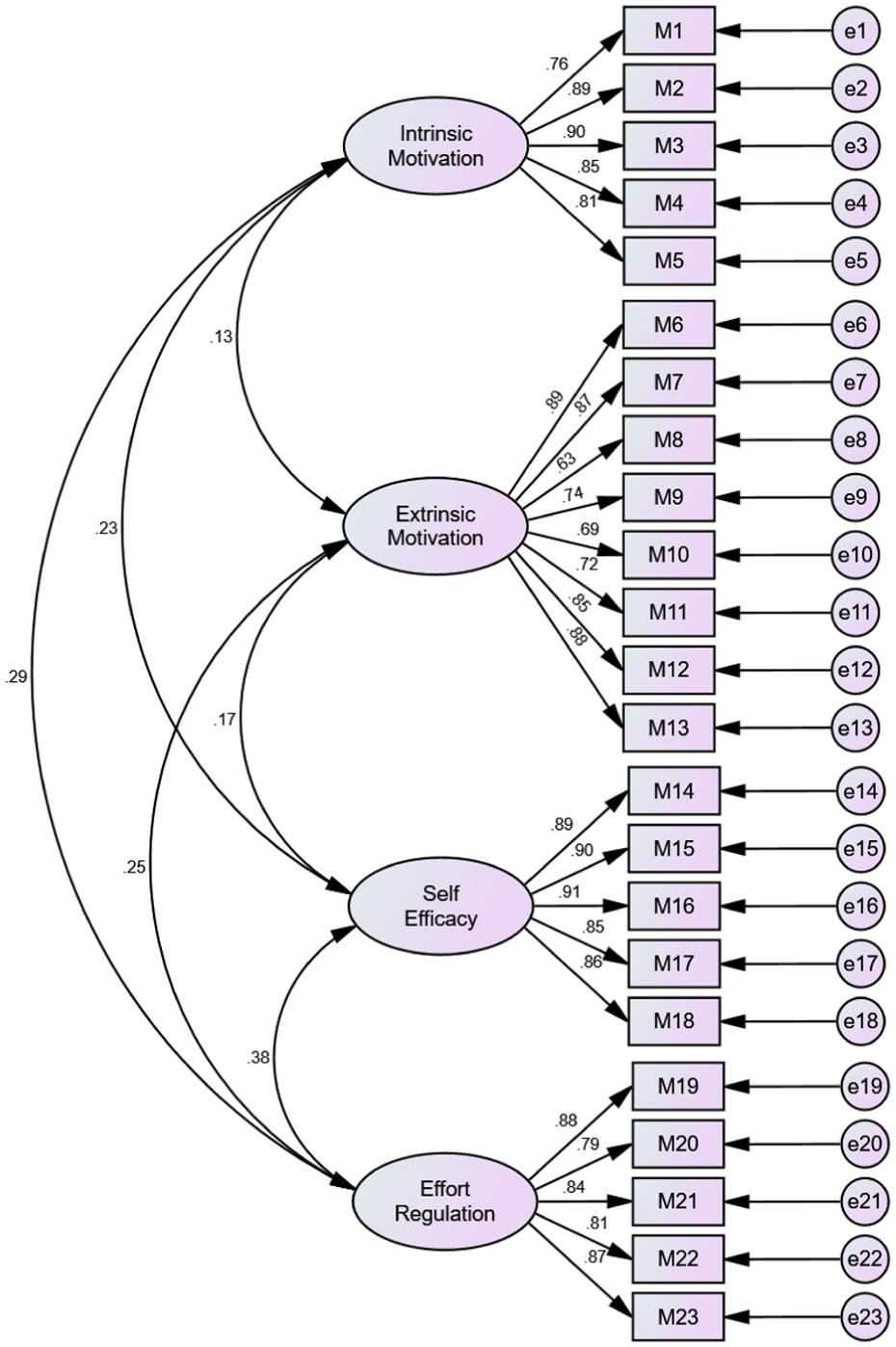
CFA model of motivation.
Collier (2020) emphasized that researchers should report chi-square and degrees of freedom, along with CFI, IFI, NFI, TLI, and RMSEA when presenting model fit statistics. Comprehensively considering these recommendations, this study reported CMIN/DF, CFI, IFI, TLI, NFI, and RMSEA. According to Kline (2023), a CMIN/DF value less than 3 indicates good model fit. Collier (2020) suggested that adequate model fit is achieved if RMSEA < 0.10 and SRMR < 0.08. Moreover, for the other indices mentioned above, a cut-off point of 0.90 or higher is considered acceptable. As a result, all the goodness-of-fit indices for the motivation model met the recommended threshold values. To be specific, CMIN/DF = 2.810, CFI = 0.957, IFI = 0.957, TLI = 0.951, NFI = 0.935, RMSEA = 0.060, and SRMR = 0.038. These results indicate a high degree of consistency between the observed data and the theoretical model, reflecting that the model fits the variance-covariance structure of the observed data well. In addition, these results indicate that the observed variables are adequately represented by the latent constructs, and that the latent variables are related as specified in the model.
Similarly, in order to verify the validity of the behavioral intention to use GenAI scale, the researchers conducted CFA using AMOS 24.0 and displayed the results in Figure 2. The standardized factor loadings of each dimension indicate high correlations between the observed variables and their corresponding latent variables. These results further indicate that the model adequately represents the relationships between the observed and latent variables and exhibits good fit. Specifically, the factor loading of the items in Innovativeness ranges from 0.78 to 0.93, those in Optimism range from 0.85 to 0.93, those in Discomfort range from 0.83 to 0.87, and those in Insecurity range from 0.71 to 0.87.
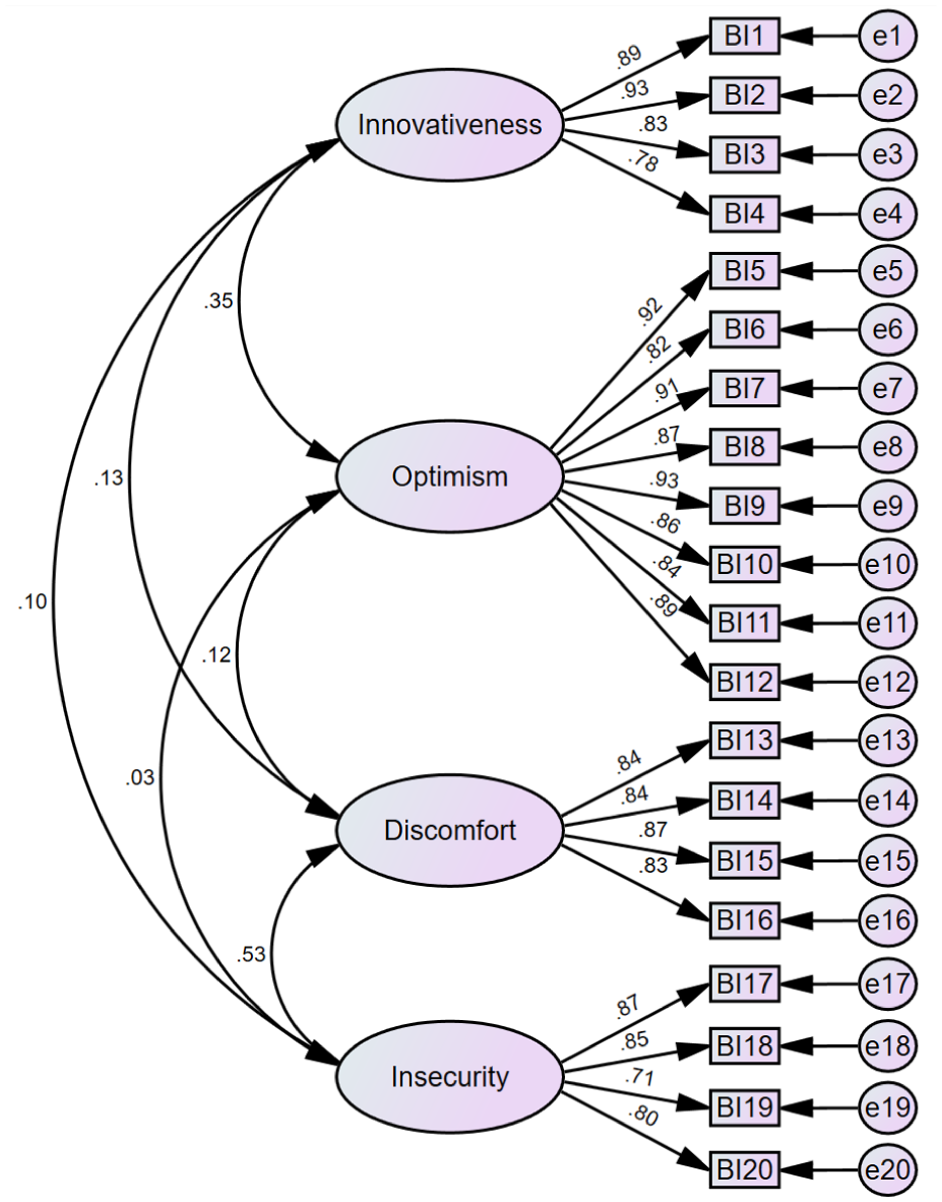
CFA model of behavioral intention to use GenAI.
The goodness-of-fit of behavioral intention to use GenAI can be evaluated using the same boundary values. To be specific, CMIN/DF = 2.896, CFI = 0.965, IFI = 0.965, TLI = 0.959, NFI = 0.948, RMSEA = 0.062, and SRMR = 0.036. The model fit indices for this CFA model illustrate that the overall structure of the model is reasonable, fits well, and has a high degree of interpretability.
Reliability and Validity Testing
As for the reliability of the three latent variables in this study, Cronbach’s α was evaluated according to the cut-off value of .80, as suggested by Hobart and Cano (2009). Specifically, the α values for resilience, motivation, and behavioral intention to use GenAI were .923, .899, and .890, respectively, indicating that all of the scales had high internal consistency.
The average variance extracted (AVE) should exceed 0.50 to demonstrate an acceptable level of convergent validity, which means that the latent construct can explain no less than 50% of the indicator variance (Cheung et al., 2024). According to Table 1, the AVE scores in the present study demonstrate strong convergent validity, since all AVE values exceed the threshold of 0.50. In addition, composite reliability (CR) is used to evaluate the measurement consistency of a set of observed variables with respect to their corresponding latent variables. In structural equation modeling, composite reliability values above 0.70 indicate adequate reliability for each construct (Fornell & Larcker, 1981). As shown in Table 1, all measurement variables demonstrate high consistency with their corresponding latent variables.
Reliability of All the Factors.
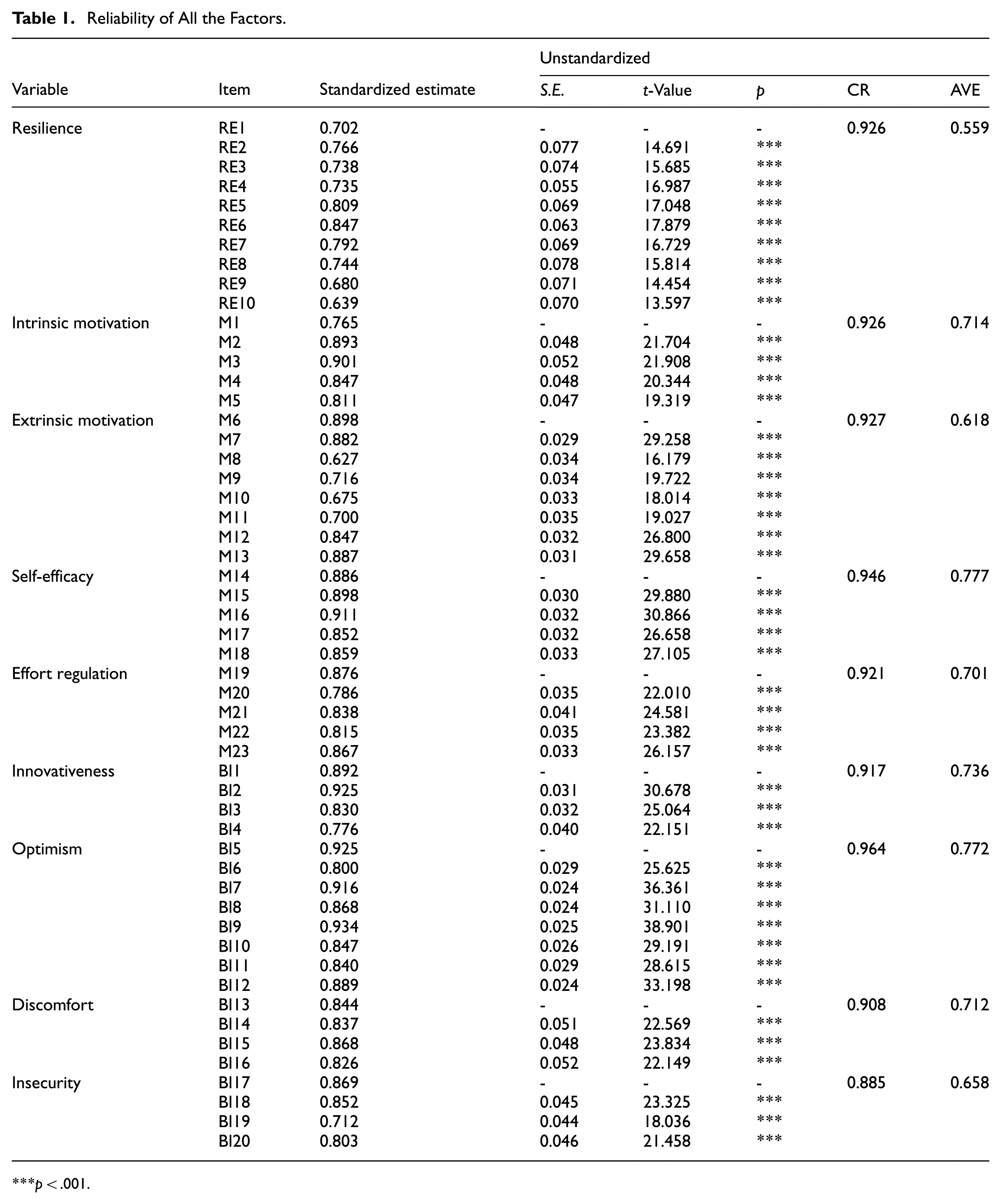
p < .001.
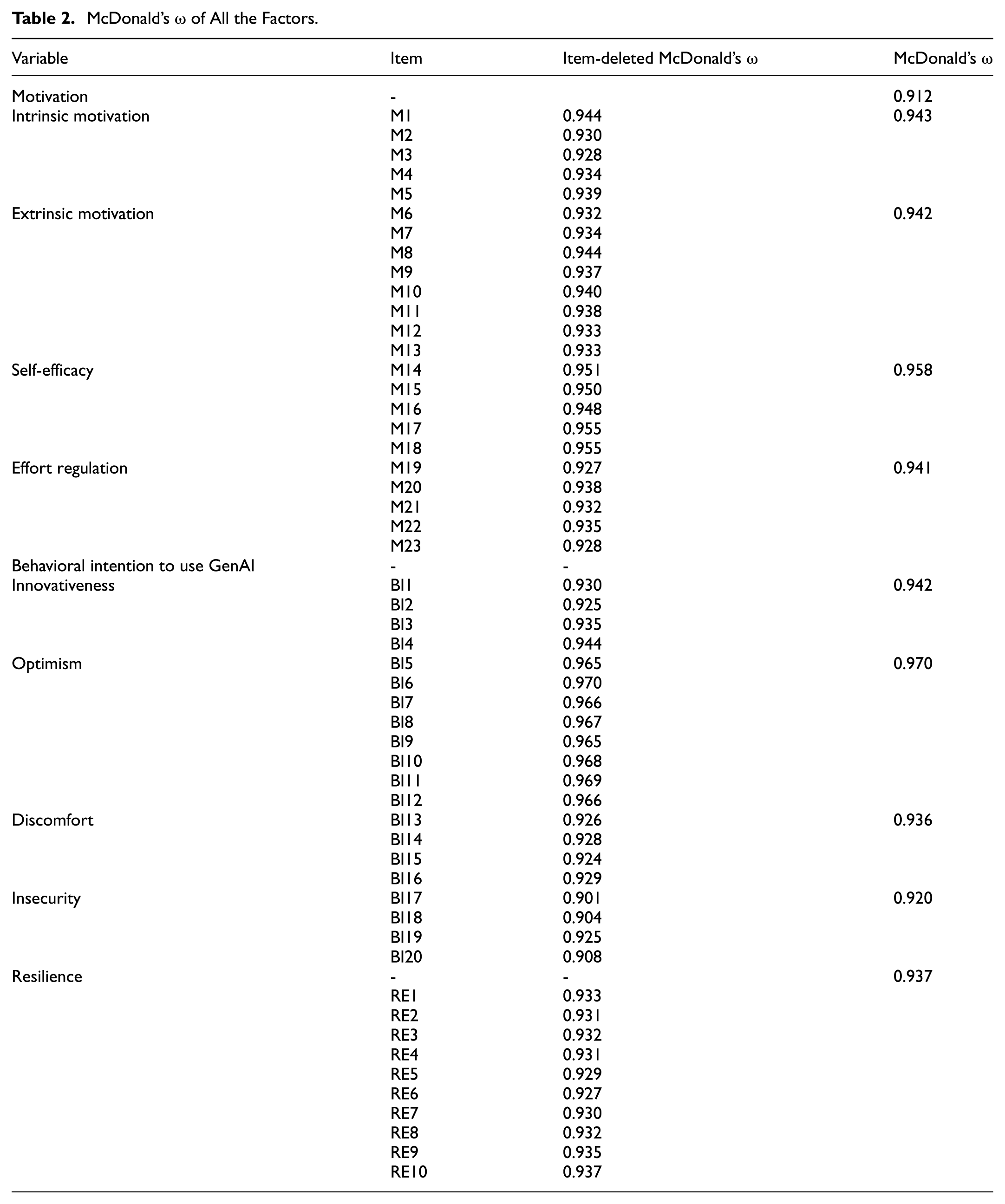
In order to provide a more accurate estimate of internal consistency under potentially unequal factor loadings, McDonald’s ω values were also calculated and presented in Table 2. According to Cho and Choi (2024), McDonald’s ω values above 0.70 are generally considered acceptable, with values above 0.80 indicating good reliability and values above 0.90 reflecting excellent reliability. According to Table 2, all the factors demonstrate excellent internal consistency.
McDonald’s ω of All the Factors.
SEM Analysis
After conducting the CFA for the three latent variables, the researchers constructed the SEM model as proposed, which is illustrated in Figure 3. When constructing the finalized SEM model, the researchers used the mean values to replace each dimension within the corresponding latent variables—especially for the latent variables motivation and behavioral intention to use GenAI—so that the SEM model could be simplified. In addition, to assess the validity of the proposed model, the same seven model fit indices were employed and are displayed in Table 3. The CMIN/DF was 2.621, which is below the recommended cut-off value of 3. The RMSEA is 0.057 and SRMR is 0.046, both of which are below the boundary values of 0.10 and 0.08, respectively. CFI = 0.942, IFI = 0.942, TLI = 0.931, and NFI = 0.910. As shown in Figure 3 and Table 3, all seven goodness-of-fit indices meet the threshold values, indicating that the proposed model adequately fits the dataset.
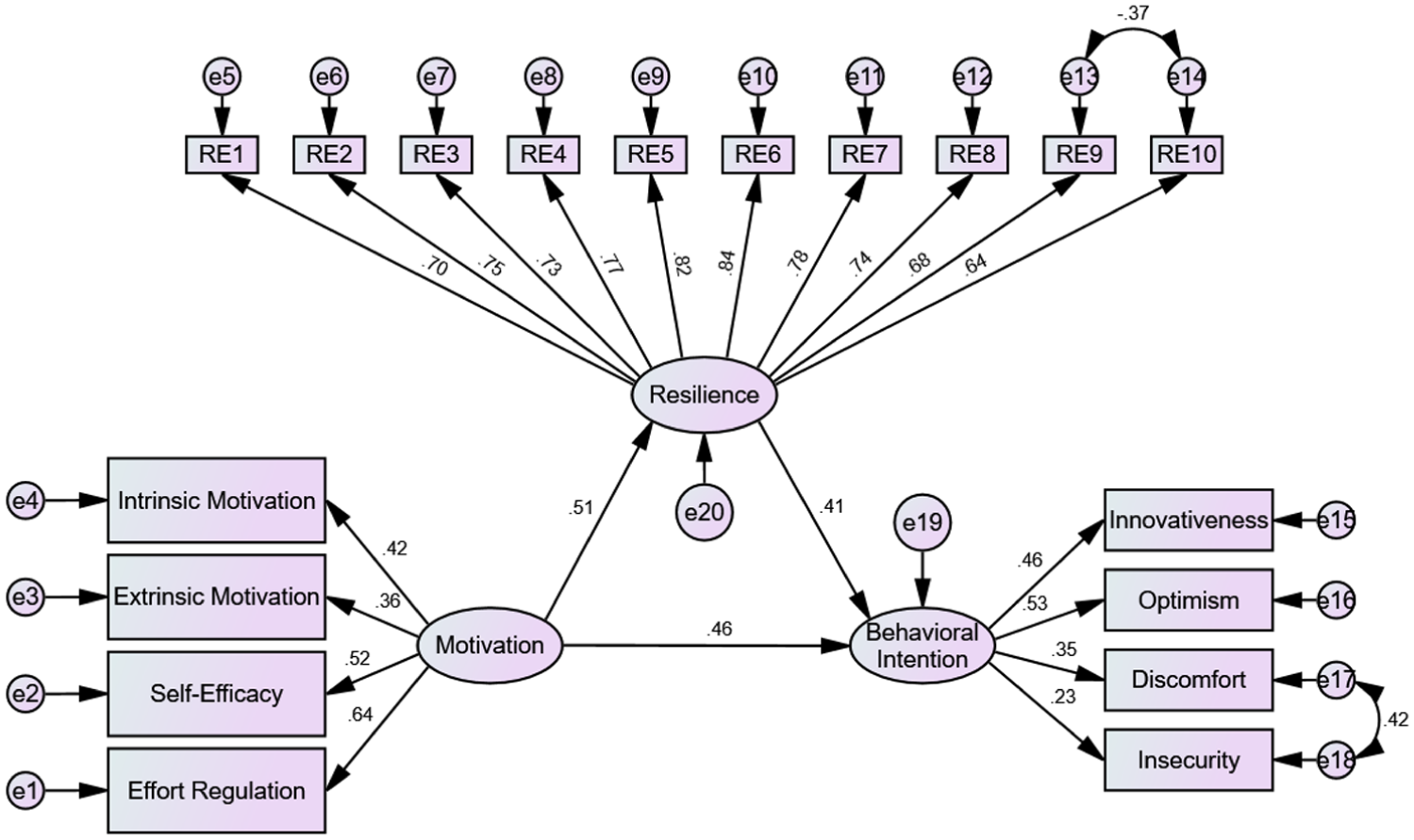
The finalized SEM model.
Model Fit Indices for the Proposed Model.

Correlation Among Motivation, Resilience and Behavioral Intention
To verify the relationships among the three latent variables, a path analysis was conducted, and the standardized path coefficients are presented in Table 4. As for the first path, motivation was positively associated with resilience (β = .511, t = 6.737, p < .001). Regarding the second path, the standardized path coefficient of resilience on behavioral intention to use GenAI achieved an ideal level (β = .407, t = 4.352, p < .001), accounting for 26.1% of the variance. The standardized path coefficient between motivation and behavioral intention to use GenAI indicated a positive association (β = .460, t = 3.929, p < .001), accounting for 56.8% of the variance, suggesting that motivation has a significant positive impact on behavioral intention to use GenAI. Hence, the results of the three path analysis confirm that there is a significant causal relationship among the three latent variables and that the proposed model is valid, demonstrating that motivation and resilience can both enhance behavioral intention to use GenAI.
Results of Multiple Linear Regression with SEM.

p < .001.
Mediating Effect Test
To test the mediating effect and strengthen the robustness of the study, a bootstrap analysis was performed using 1,000 bootstrap resamples and 95% confidence intervals, applying both percentile and bias-corrected approaches. The results of the mediating effect test are presented in Table 5.
Mediating effect test.

As for the total effect, as shown in Table 5, the impact of motivation on behavioral intention to use GenAI was 0.668, and the 95% confidence interval was [0.302, 0.838], which did not include 0. The p-value was .001 (p < .01), indicating that motivation was significantly associated with behavioral intention to use GenAI.
Regarding the direct effect, the influence of motivation on behavioral intention to use GenAI was 0.460, and the 95% confidence interval was [0.116, 0.722], which also did not include 0. Motivation was significantly associated with behavioral intention to use GenAI, reflecting a direct relationship (p = .003). Moreover, the direct effect accounted for 68.86% of the total effect, further suggesting that the direct effect plays a substantial role in the relationship.
As for the indirect effect, the estimated value was 0.208, and the 95% confidence interval was [0.075, 0.296], which also did not include 0. The p-value was .003 (p < .01), indicating a significant indirect effect among the three latent variables. Furthermore, resilience was associated with both motivation and behavioral intention to use GenAI, suggesting a potential mediating role, with the indirect effect contributing 31.14% to the total effect.
From the perspective of the contributions of the direct and indirect effects to the total effect, the contribution of the indirect effect is smaller than that of the direct effect. That is to say, the direct association between motivation and behavioral intention to use GenAI is stronger than the indirect association, while the indirect association plays a supplementary role. Taken together, the hypothesized associations proposed in this study are supported by the data.
Discussion
In GenAI-assisted EFL learning, learners’ technology adoption may be shaped not only by technological affordances but also by their internal psychological resources. In this regard, the present study examined the predictive effects of motivation and resilience on learners’ behavioral intention to use GenAI, as well as the mediating role of resilience between motivation and behavioral intention. The results showed that both motivation and resilience were positively associated with behavioral intention, with motivation exerting a significant direct effect and resilience serving as a partial mediator. The explanatory power of the validated structural model further supports the roles of these psychological resources in GenAI acceptance (G. L. Liu et al., 2024). These findings are consistent with previous studies showing the positive roles of resilience and motivation in technology-mediated or informal language learning contexts. For example, Wu et al. (2024a) reported a strong positive association between resilience and engagement, while G. L. Liu et al. (2024) found that promotion-focused motivation significantly influenced informal digital learning of languages other than English. From the perspective of COR, individuals tend to obtain, retain, foster, and protect valued resources when coping with challenges (Hobfoll et al., 2018). Accordingly, these results provide a basis for further interpreting how motivation and resilience operate as psychological resources in the GenAI acceptance process.
Another important finding concerns the direct effect of motivation on behavioral intention to use GenAI. This study found that motivation significantly predicted learners’ intention to use GenAI, a finding consistent with El-Sisi’s (2025) finding that learning motivation partially mediated the relationship between TAM-related factors and behavioral intention to adopt a GenAI chatbot. It is also supported by Zheng et al. (2024), who identified motivation as a significant predictor of EFL learners’ behavioral intention to use GenAI tools. From the perspective of the integrated TAM-COR framework, motivated learners are more likely to recognize the learning value of GenAI and perceive it as useful for improving English learning. Meanwhile, according to the resource investment principle of COR (Hobfoll et al., 2018), individuals need to invest resources to prevent loss, recover from loss, and gain additional resources. Thus, motivation can be understood as an internal psychological resource that encourages learners to invest time, effort, and attention in exploring GenAI, thereby strengthening their behavioral intention to use it.
In addition to this direct relationship, this study also found that resilience partially mediated the relationship between motivation and behavioral intention to use GenAI. This finding is consistent with Derakhshan and Zhang’s (2024) emphasis on the role of psycho-emotional traits in technology-based language education. According to the first corollary of COR (Hobfoll et al., 2018), individuals with greater resources are less vulnerable to resource loss and more capable of regaining resources. In this sense, motivated learners may be more willing to view GenAI as a tool for acquiring valuable resources, such as learning efficiency, academic improvement, and language support. Resilience further helps them cope with possible resource loss caused by technical difficulties, unstable generated content, or learning setbacks. Therefore, learners with higher resilience may be better able to transform their motivation into behavioral intention to use GenAI. However, as this study measured intention rather than actual behavior, future research is needed to examine whether such intentions can translate into sustained GenAI use.
This study also contributes to the existing literature by extending the discussion of motivation and resilience to the context of GenAI-assisted EFL learning. Previous studies have examined these psychological factors in specific language learning domains, such as L2 writing. For example, Solhi et al. (2024) found that L2 writing motivation positively predicted the use of cognitive approach strategies and negatively predicted cognitive avoidance strategies in coping with boredom. Shafiee Rad and Jafarpour (2023) also showed that interventions involving well-being, grit, emotion regulation, and resilience could improve L2 learners’ writing performance. Building on these studies, the present research suggests that motivation and resilience are also relevant to learners’ acceptance of GenAI in EFL learning. Moreover, the results showed that the direct effect of motivation on behavioral intention was greater than its indirect effect through resilience. This may be explained by the resource caravans principle of COR, which suggests that resources do not exist in isolation but tend to travel together (Hobfoll et al., 2018). In a GenAI-assisted learning environment, motivation may directly encourage learners to recognize the potential of GenAI for preserving and acquiring learning resources, such as learning efficiency, language support, and academic improvement. By contrast, the indirect effect through resilience may involve a more complex process of coping with challenges and recovering from possible resource loss. Therefore, motivation appears to play a more immediate role in shaping learners’ intention to use GenAI, while resilience provides an additional protective pathway.
Taken together, these findings suggest that motivation and resilience play important roles in shaping learners’ technology acceptance in GenAI-mediated EFL learning contexts.
Conclusion and Implications
This quantitative study unpacked the relationships among motivation, resilience, and behavioral intention to use GenAI in a Chinese university. Our findings highlight that: (1) Motivation, resilience, and behavioral intention to use GenAI are positively correlated with one another; (2) Motivation can directly and positively influence GenAI adoption intention in a significant manner; (3) Resilience can serve as a mediator between motivation and behavioral intention to use GenAI; (4) The contribution of the direct effect to the total effect is greater than that of the indirect effect. Regarding the contributions of this study, they lie not only in extending the investigation of key affective variables into GenAI-empowered learning environments, but also in examining the associations among these variables from a macro perspective.
The findings suggest that in GenAI-empowered EFL classrooms, teachers can support students’ motivation and behavioral intention through affective and strategic scaffolding. By fostering a supportive, mistake-tolerant environment and guiding students to view GenAI as a learning tool, teachers can help learners sustain motivation, regulate frustration, and enhance classroom engagement (Zhao & Yang, 2026).
Regarding the direct predictive effect of motivation on GenAI adoption intention, teachers may enhance students’ sense of support and motivation in GenAI-assisted learning through immediacy behaviors. In GenAI-assisted EFL learning contexts, such teacher support helps establish positive and caring teacher-student relationships (Yao et al., 2026), enabling students to better recognize the learning value of GenAI, understand how to use it appropriately, and maintain their willingness to engage with it. When students possess strong motivation to use GenAI, this motivation is more likely to translate into behavioral intention and manifest as active participation in GenAI-supported learning tasks. Simultaneously, this process may foster more supportive teacher-student interactions within technology-mediated learning environments (Fan & Wang, 2022).
Regarding the mediating role of resilience, teachers should help students develop the capacity to cope with difficulties in GenAI-assisted learning, for example, by encouraging trial and error, refining prompts, and reflecting on feedback. Teachers’ own resilience can also support more stable guidance when students encounter challenges (Wang et al., 2022). Such practices may help sustain motivation, strengthen behavioral intention to use GenAI, and foster positive emotional experiences and adaptive engagement (Li, 2020).
Limitations
Some limitations of this research should be acknowledged. First, this research relied exclusively on self-reported questionnaires to examine the relationships among motivation, resilience, and behavioral intention to use GenAI, measuring intention rather than actual usage behavior, which may introduce discrepancies between the findings and real-world practices. Moreover, the cross-sectional design precluded the capture of dynamic processes among these variables over time. This method may also induce the Hawthorne effect, potentially compromising the authenticity of the results. To mitigate bias and enhance data richness, future research is encouraged to adopt longitudinal designs or mixed-methods approaches that integrate qualitative and quantitative techniques, thereby constructing a more comprehensive and nuanced understanding of the three latent variables.
Second, the study sample consisted exclusively of Chinese foreign language learners, which may limit the generalizability of the findings. As generative artificial intelligence is still an emerging tool in language learning, Chinese foreign language learners may exhibit unique patterns of perception and acceptance due to their specific learning contexts, varying degrees of technological exposure, and cultural backgrounds. Therefore, caution is warranted when extrapolating the conclusions to other learning settings (e.g., first language acquisition, other academic disciplines) or to learners from different cultural backgrounds. Future research should aim to include more diverse samples, encompassing learners from various disciplinary backgrounds, cultural contexts, and educational stages to examine the consistency and robustness of the findings across different populations.
Finally, although the bootstrap method was used to test the mediation pathway, the cross-sectional research design cannot establish the causal sequence from motivation and resilience to behavioral intention, and the causal ordering of the model’s conclusions cannot be robustly inferred. Additionally, the study sample primarily focused on a specific group, whose technological familiarity and perceptions of challenge were relatively homogeneous, limiting the generalizability of the findings across different levels of technological complexity or user experience. Therefore, future research could increase the number of iterations in robustness tests and employ longitudinal designs to systematically examine whether the mediating role of resilience remains consistent across different task types, levels of technological complexity, and learner groups.
Footnotes
Acknowledgements
We would like to thank all the participants who took part in the study and all the faculty members who helped make that possible. We are also grateful to the insightful comments suggested by the editor and the anonymous reviewers.

Consent to Participate
Informed consent was obtained from all the individual participants included in this study.
Author Contributions
The authors have materially participated in the research and article preparation. Additionally, the authors have approved the final article.
Funding
The authors disclosed receipt of the following financial support for the research, authorship, and/or publication of this article: The current study is sponsored by the 14th Five-Year Plan of Educational Scientific Research in Inner Mongolia Autonomous Region (Grant No.: NGJGH2024463) and the Reform Project of Postgraduate Education and Teaching in Inner Mongolia Autonomous Region (Grant No.: JG2025002C).
Declaration of Conflicting Interests
The authors declared no potential conflicts of interest with respect to the research, authorship, and/or publication of this article.
Data Availability Statement
The datasets analyzed during the current study are available from the corresponding author upon reasonable request.