






Abstract
This study investigates the relationships among artificial intelligence anxiety (AIA), fixed teaching mindset (FTM), and professional burnout (BO) among English language teachers in Türkiye, specifically examining the mediating role of FTM in the AIA-BO relationship. Based on the Job Demands-Resources (JD-R) Model and Mindset Theory, the study employed a quantitative, cross-sectional survey design with 238 EFL teachers. Data were collected using the Teacher Artificial Intelligence Anxiety Scale, an adaptation of the Maslach Burnout Inventory-Educators Survey, and the Teacher Mindset Scale. Results confirmed that AIA acts as a significant job demand, showing positive direct effects on emotional exhaustion (EE) and depersonalization (DP) as core burnout dimensions. Moreover, AIA was found to positively predict FTM. The central hypothesis of mediation was partially supported. FTM significantly and partially mediated the relationship between AIA and both EE and DP. This indicates that FTM functions as a key psychological mechanism through which AI-related anxiety is associated with these core burnout symptoms. However, the indirect effect on the personal accomplishment was not significant. These findings extend the JD-R model by integrating FTM as a depleted psychological resource that amplifies teachers’ vulnerability to technological demands, offering a novel theoretical lens for understanding burnout in AI-integrated educational contexts. The persistence of significant direct effects suggests that while FTM is an important pathway, other mechanisms also contribute to burnout. Practically, the study highlights the need for extensive professional development that includes both AI literacy training and mindset cultivation strategies to enhance teacher well-being and resilience against technological stress.
Plain Language Summary
Artificial intelligence (AI) tools are becoming common in education, including in English language teaching. While they offer opportunities, they can also create stress and uncertainty for teachers who feel unprepared, threatened, or overwhelmed. This study explores how feelings of anxiety about AI is linked to teacher burnout and examines whether teachers’ beliefs about teaching play a role in this process. The study surveyed 238 English language teachers working in Türkiye. Teachers completed questionnaires measuring their level of anxiety about AI, their teaching mindsets, and different aspects of burnout, including emotional exhaustion, depersonalization, and personal accomplishment. The study used statistical analyses to examine how these factors are connected. The findings showed that teachers who reported higher levels of anxiety about AI also experienced higher levels of emotional exhaustion and depersonalization, two core components of burnout. In addition, teachers with higher AI anxiety were more likely to hold a fixed mindset, a belief that teaching ability is relatively unchangeable. This fixed mindset partially explained why AI anxiety led to greater emotional exhaustion and depersonalization. In other words, teachers who felt anxious about AI and believed their teaching abilities could not improve were more vulnerable to burnout. However, the study did not find evidence that fixed mindset explained the relationship between AI anxiety and teachers’ sense of personal accomplishment. This suggests that feelings of achievement at work may be influenced by other factors, such as institutional support, rather than anxiety or mindset alone. In short, the findings suggest that teachers’ psychological beliefs shape how they respond to technological stress. Supporting teachers’ well-being in the age of AI requires not only technical training but also efforts to promote more flexible, growth-oriented beliefs about teaching and professional development.
Keywords
Introduction
The teaching profession is inherently demanding, characterized by persistent emotional labor, high expectations from stakeholders, and significant workload demands (Alharbi, 2025; D. Liu & Du, 2024; Onan & Aydın, 2024; Sadoughi et al., 2024). These chronic stressors contribute substantially to the distress and vulnerability of teachers to professional burnout (D. Liu & Du, 2024). As many swift and challenging changes do, the rapid and widespread incorporation of artificial intelligence (AI) technologies into educational practices is exacerbating existing issues and radically transforming the field of language teaching (Y. Liu & Chang, 2024). The advent of generative AI and its rapid expansion in education has introduced a distinct and potent occupational demand: AI anxiety (AIA; Wang & Wang, 2022; Zhou & Hou, 2024). AIA is a psychological reaction characterized by uneasiness, stress, worry, and fear regarding the increasing prominence of AI in educational settings (Kaya et al., 2024; Y. Shen & Guo, 2024). This anxiety profoundly stems from pragmatic concerns, including fears of job displacement, lack of necessary technical proficiency, and insufficient institutional support (Gao et al., 2024; X. Liu & Liu, 2025). Teachers often grapple with existential questions about their professional survival in an AI-dominated educational landscape, intensifying anxiety and pressure within the EFL community (Y. Liu & Chang, 2024; Y. Shen & Guo, 2024). These AI-induced emotional demands function as powerful stressors that contribute directly to burnout, a syndrome defined by emotional exhaustion, depersonalization, and reduced personal accomplishment (Demerouti et al., 2001; Maslach et al., 2001), especially when job demands consistently overwhelm a teacher’s available resources (Alharbi, 2025). However, the impact of such demands is not uniform across all teachers. Individual responses to AI-related stressors are significantly shaped by internal psychological belief systems, particularly teacher mindsets (Y. Liu & Chang, 2024; Zarrinabadi et al., 2026). Grounded in Dweck’s (2006) implicit theories of intelligence, Mindset Theory distinguishes between two fundamental belief systems about the malleability of abilities. While growth mindset represents the belief that competence can be developed through effort and learning, fixed mindset—or Entity Theory—reflects the belief that teaching abilities are stable, innate, and unchangeable (Dweck, 2006, 2017; Yeager & Dweck, 2012). Teachers holding a fixed teaching mindset (FTM) believe that one is either “born to teach” or will not become an effective educator regardless of effort invested (Gero, 2013), viewing teaching as an innate ability that cannot be substantially enhanced (Dweck, 2013). This cognitive orientation has profound implications for how teachers respond to professional challenges, particularly technological demands. Teachers with FTM typically prioritize performance goals over learning goals, seek validation of existing competence rather than development opportunities, and exhibit a “helpless pattern” when confronted with setbacks, which are characterized by self-denigration, reduced persistence, and challenge avoidance (Dweck, 2013; Zarrinabadi et al., 2026). Empirical evidence links FTM to heightened negative emotions such as worry and anger (Frondozo et al., 2022) and to burnout components, specifically emotional exhaustion and depersonalization (Zarrinabadi et al., 2026). Within the JD-R framework, FTM is conceptualized as a personal vulnerability that functions as a “hindrance demand” within the JD-R framework, as it prevents teachers from effectively utilizing available resources to cope with technological stress. Rather than viewing AI literacy acquisition as a manageable learning curve, teachers with FTM perceive it as an insurmountable threat to their limited abilities (Sadoughi et al., 2024), thereby intensifying anxiety and accelerating avoidance behaviors and burnout (Gregoire, 2003; Parviz & Arthur, 2025; Seyri & Ghiasvand, 2025).
Despite growing recognition of AI anxiety and teacher burnout as critical concerns, and the compelling theoretical link between a fixed teaching mindset and maladaptive stress responses, several gaps necessitate the present investigation. First, while individual relationships, such as mindset effects on burnout (Sadoughi et al., 2024; Zarrinabadi et al., 2026) and dimensions of AI anxiety (X. Liu & Liu, 2025) have been examined, no research has empirically tested a comprehensive structural model wherein fixed teaching mindset mediates the relationship between AI anxiety and professional burnout among EFL teachers. Second, existing studies have concentrated predominantly on Chinese and Iranian EFL contexts (D. Liu & Du, 2024; Parviz & Arthur, 2025; Zarrinabadi et al., 2026). While research in Türkiye has documented teaching anxiety, burnout, and technology-related stress (Ayduğ & Altınpulluk, 2023; Onan & Aydın, 2024; Tütüniş et al., 2025; Yeşilçınar & Erdemir, 2023), there is a clear lack of comprehensive quantitative research investigating how a fixed mindset specifically functions as a mechanism through which AI anxiety is associated with burnout in this context. Given that teachers’ reactions to AI are heavily influenced by cultural and implementation contexts (Ekoç, 2022; Martinez et al., 2025), context-specific findings from Türkiye are also valuable for the growing literature.
This study addresses these gaps by employing a quantitative, cross-sectional survey design to test a comprehensive structural model in which fixed teaching mindset mediates the relationship between AI anxiety and professional burnout. Beyond addressing the gaps, the study offers the first empirical test of a structural model linking AI anxiety to burnout through fixed teaching mindset, extends the JD-R model to incorporate emerging technological demands, and generates context-specific evidence from the Turkish EFL setting, a context underrepresented in the existing literature. Grounded in the identified gaps and theoretical context, this study is guided by the following research questions:
Is there a statistically significant relationship between AI anxiety and professional burnout among EFL teachers in Türkiye?
Is there a statistically significant relationship between fixed teaching mindset and professional burnout among EFL teachers in Türkiye?
Is there a statistically significant relationship between AI anxiety and fixed teaching mindset among EFL teachers in Türkiye?
Does fixed teaching mindset significantly mediate the relationship between AI anxiety and professional burnout among EFL teachers in Türkiye?
Literature Review
Teaching as a Demanding Profession in the Age of AI
Education is commonly accepted to be a demanding and complex occupation due to its dynamic and multidimensional nature (Kyriacou, 2001). Besides, the responsibilities attributed to the teacher within the educational setting both make them crucial determiners of achievement (Brandt et al., 2019; Murphy et al., 2004) and the most likely victims of tension, worry, exhaustion, and anxiety (Montgomery & Rupp, 2005). Such tendencies toward experiencing negative feelings related to the profession stem from the multitude of responsibilities and classroom demands such as instruction, classroom management, material preparation, and lesson planning (Derakhshan et al., 2024; McCarthy et al., 2016). As in many cases, these high job demands accompanied by insufficient resources to cope with them can eventually lead to burnout (Schaufeli & Bakker, 2004). The rapidly changing scope of education along with the social, economic, and technological advancements, can turn the teaching profession into an even more challenging job. The recent introduction to generative artificial intelligence (AI) technologies and their practical applications in almost all the spheres of education have brought about a range of feelings among teachers. As Y. Liu and Chang (2024) suggest, the emotional landscape experienced by EFL teachers is multifaceted, encompassing both affective and negative emotional responses during their adaptation to AI-integrated pedagogical practices. The dynamic interplay between these emotional dimensions is mediated by teachers’ social networks and their professional backgrounds (Y. Liu & Chang, 2024). The extent to which teachers’ feelings of anxiety toward AI use in education is determined by a number of factors, including their mindsets. While teachers with a growth mindset are more likely to enjoy novel practices such as the use of AI in teaching, those with a fixed mindset tend to develop negative and undesirable feelings toward them and suffer from high levels of anxiety (Zhang & Cao, 2025).
AI Anxiety Among EFL Teachers
AI anxiety (AIA) is a psychological response that includes a variety of negative emotions, including dread, discomfort, resistance, worry, stress, and fear concerning the application of AI techniques and products in education (Seyri & Ghiasvand, 2025; Y. Shen & Guo, 2024). AIA is a distinct form of anxiety that should be interpreted differently from computer or robot anxiety as it focuses on AI’s unique capabilities and challenges within the educational context (Parviz & Arthur, 2025). AIA among teachers can stem from the increasing expectations to master traditional methodologies while simultaneously learning to understand and integrate AI tools into their teaching practices (Y. Liu & Chang, 2024; Omidvar & Meihami, 2025). This expected transition reveals existing knowledge gaps and technological challenges, eliciting negative emotional responses (Y. Liu & Chang, 2024; Moorhouse, 2024). Similarly, recent research in blended learning contexts has shown that the integration of digital tools along with instructional demands can increase both cognitive and emotional strain among teachers, particularly when institutional and technological support is limited (Cheng et al., 2026).
For EFL teachers, AIA sources often relate to threats to professional identity, competence, and workload (X. Liu & Liu, 2025; Parviz & Arthur, 2025). Their concerns are further triggered by their insufficient technical competence (Sumakul et al., 2022), which brings about the need for training on the use of AI in language teaching (Omidvar & Meihami, 2025; Xie et al., 2025). In a recent study, a substantial proportion of teachers express pronounced anxiety about being unable to keep up with the rapid advances associated with AI technologies and getting failure or error messages when operating AI tools, proving that technical challenges increase their reluctance (Parviz & Arthur, 2025). This failure to keep up with the quickly changing AI technologies makes people even more afraid of losing their jobs or at least having their teaching duties change (Ilhan, 2025; Jazbec et al., 2025; X. Liu & Liu, 2025). There is also research reporting that EFL teachers employ various coping strategies to manage AI-related anxiety, including seeking help from colleagues, cognitive reframing, and maintaining a positive outlook (Xin & Derakhshan, 2025). These strategies can enhance resilience and promote mental well-being. On the other hand, the emotional demands of teaching, combined with the stress of adapting to new technologies, can exacerbate feelings of strain and potentially contribute to burnout (Cheng et al., 2026; Pishghadam et al., 2022).
EFL Teacher Burnout as an Affective Barrier
Burnout is commonly conceptualized as a psychological syndrome that arises when individuals recognize a profound disparity between their professional potential and the challenging realities of their workplace (Schaufeli & Taris, 2005). This syndrome is common in many jobs that need a lot of face-to-face interaction and care (Maslach, 2003), but studies that compare different types of jobs show that teachers are more likely to burn out than people who work in other human service fields (Skaalvik & Skaalvik, 2014). In the educational context, this syndrome is multifaceted, marked by emotional weariness, depersonalization, and a reduced perception of personal achievement (Kim et al., 2019; Maslach, 2003; Maslach & Jackson, 1981).
Within this broader conceptualization, burnout has been identified as a particularly salient challenge in EFL teaching contexts. The multiple antecedents of burnout frequently include excessive workloads, insufficient administrative backing, reduced self-efficacy, and challenges related to student (mis)behavior, all of which contribute to profound job dissatisfaction (Alavinia & Ahmadzadeh, 2012; Chen et al., 2024; Güneş & Uysal, 2019; Pines, 2002). Furthermore, teacher burnout significantly degrades the affective climate of the classroom and negatively impacts the quality of the educational experience provided to students (Braun et al., 2020; Vesely et al., 2013).
In the contemporary educational sphere, the integration of technology, particularly artificial intelligence (AI), plays a complex, dual role in this dynamic. On one hand, emerging research suggests that AI can alleviate burnout by lowering administrative burdens, offering personalized support, and reducing teaching workloads (Alharbi, 2025; Derakhshan & Ghiasvand, 2024; Tang & Liao, 2025). On the other hand, technology can act as a source of stress; the pressure to master new tools and anxieties regarding potential job displacement by AI can induce technostress and job disinterest, which can exacerbate burnout levels (Alharbi, 2025; Dehghan, 2023).
To understand these conflicting dynamics, this study draws upon the Job Demands-Resources (JD-R) model (Bakker & Demerouti, 2007). This theoretical framework, which has also been echoed in the field of education (Dicke et al., 2018), posits that employee well-being is contingent upon the interplay between two primary work characteristics: job demands and job resources (Lesener et al., 2019). Job demands encompass elements of the profession, including substantial teaching responsibilities, research obligations, and emotional labor, that necessitate continuous effort and entail physiological and psychological outcomes (Bakker & Demerouti, 2017). On the contrary, job resources, encompassing organizational autonomy, social support, and skill variety, trigger a motivational process. These resources not only ease the attainment of professional goals but also buffer against the negative effects of job demands, fostering engagement and positive psychological states (Bakker & Demerouti, 2007, 2017; Taris & Schaufeli, 2015). According to the model, excessive demands initiate a health deficiency process that drains energy and leads to exhaustion and burnout (Schaufeli & Bakker, 2004).
Fixed Teaching Mindset as a Mediator of Affective States
In the present study, one of the central theoretical premises is rooted in Mindset Theory, specifically the concept of Entity Theory (Dweck, 2006). This perspective asserts that fundamental human attributes such as intelligence, aptitude, and skills are innate, unchanging, and largely resistant to change, regardless of the effort invested (Dweck & Leggett, 1988; Lou et al., 2022; Ortiz Alvarado et al., 2024). Within the pedagogical domain, this cognitive framework manifests as a fixed teaching mindset (FTM). Teachers possessing an FTM perceive their instructional capabilities as unalterable traits that cannot be meaningfully improved through professional development or consistent effort (Nalipay et al., 2022; Zarrinabadi et al., 2026; Zeng et al., 2019).
This belief system significantly influences educators’ interpretations and responses to professional expectations. Teachers with a fixed mentality usually put performance goals ahead of learning goals that stress growth and effort because they want to prove that they are already good at what they do (Dweck, 2013). Consequently, when confronted with setbacks, these individuals often exhibit a “helpless pattern,” characterized by self-denigration, reduced persistence, and the avoidance of challenges, viewing failure as a confirmation of their inherent inadequacy (Dweck, 2013; Lou et al., 2022). This cognitive orientation eventually discourages engagement in developmental activities or the seeking of constructive feedback.
Within technology-mediated educational contexts, these maladaptive response patterns become particularly consequential. When situated within the JD-R framework, AIA constitutes a formidable technological job demand, driven by fears of displacement and the pressure to master complex tools (Y. Liu & Chang, 2024; X. Liu & Liu, 2025; Parviz & Arthur, 2025). An FTM makes this need harder to meet by taking away the psychological resource of perceived ability. Teachers with an FTM do not see mastering AI literacy as a reasonable challenge; instead, they see it as an impossible danger to their limited skills (Sadoughi et al., 2024). This impression triggers resistance and anxiety over AI integration, exacerbating fears of job displacement due to a perceived inability to adapt (Parviz & Arthur, 2025; Seyri & Ghiasvand, 2025; Zarrinabadi et al., 2026). This connection has direct effects on the main aspects of burnout. FTM amplifies emotional exhaustion by causing teachers to internalize technological challenges as personal failures, leading to intense stress and frustration (Ortiz Alvarado et al., 2024; Y. Shen & Guo, 2024; Zarrinabadi et al., 2026). Furthermore, FTM predicts withdrawal mechanisms such as depersonalization and cynicism (Maslach et al., 2001). Finally, by fostering the avoidance of challenging tasks, FTM prevents the accumulation of mastery experiences, which are essential for self-efficacy (Bandura, 1997). Since self-efficacy is a vital protective factor against burnout (An & Tao, 2024), its erosion through FTM directly diminishes the sense of personal accomplishment (Sadoughi et al., 2024).
Taken together, these mechanisms suggest a mediating role for fixed teaching mindsets in technology-related affective outcomes. Although empirical investigation, particularly examining the mediation effect of teacher mindsets between AI anxiety and burnout, is still scarce, the extant evidence corroborates this proposed approach. Besides, research consistently associates anxiety and stress from shifting demands with increased burnout (G. Shen, 2022) while identifying emotion regulation and self-efficacy, the constructs closely linked to mindset, as critical mediators (Chen et al., 2024). Thus, it is posited that FTM acts as a mechanism that converts the external demand of AI anxiety into the psychological syndrome of burnout.
As visualized in Figure 1, based on the theoretical arguments and empirical evidence reviewed, the study proposes the following directional hypotheses:
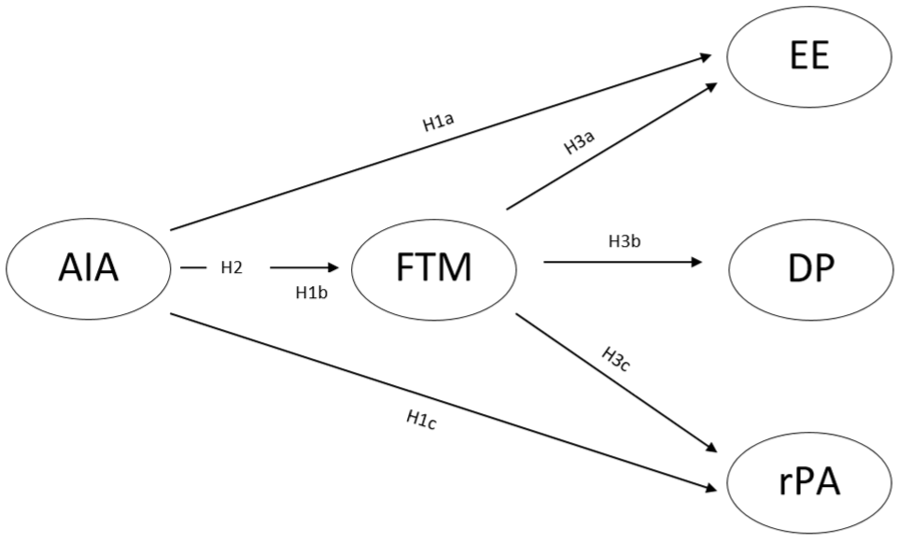
Hypothesized model path plot.
Methods
Research Design
This study employed a quantitative, cross-sectional survey design to investigate the relationships among artificial intelligence anxiety (AIA), fixed mindset (FTM), and professional burnout (BO) dimensions among English as a Foreign Language (EFL) teachers in Türkiye. Specifically, the study examined the mediating role of FTM on the relationship between AIA and BO across three burnout dimensions (EE, DP, and rPA).The quantitative approach, utilizing standardized scales, was selected to assess these constructs systematically and establish the hypothesized predictive and mediating pathways through Structural Equation Modeling (SEM; Kline, 2023).
Participants and Context
The initial research sample for the present study comprised 250 EFL teachers who were reached through criterion-based purposive sampling. The primary inclusion criteria were determined as teaching English in an institutional context for at least a year, working in Türkiye in face-to-face classrooms, and not having an administrative role within the institution. On the other hand, having a non-Turkish citizenship was listed among the exclusion criteria for the sample. Efforts were made to ensure diversity, recruiting participants from different provinces and educational settings ranging from elementary schools through high schools and universities across Türkiye to enhance the representativeness of the findings across the specified teaching levels. After excluding those who did not meet the criteria for inclusion, a substantial sample size of 238 EFL teachers to test complex mediation models using SEM was obtained (Kline, 2023).
The final sample consisted of 238 EFL teachers (166 females, 72 males) working in institutional, face-to-face teaching contexts across Türkiye (Table 1). Participants represented a range of educational levels, including elementary, secondary, and higher education. Regarding educational qualifications, slightly more than half of the participants held a Bachelor’s degree while the rest held a Master’s or a doctoral degree, indicating a well-educated sample with nearly half possessing graduate-level degrees. The sample was predominantly experienced, with most teachers reporting more than 10 years of professional teaching experience. The researchers’ professional networks, through which they distributed the survey, likely contributed to the predominance of experienced teachers in the sample. Besides, it reflects the demographic reality of EFL teaching in the Turkish institutional context, where experienced teachers constitute the majority of the workforce. Teachers were employed across both public and private institutions, reflecting diverse instructional environments. Notably, fewer than half of the participants reported having received formal training related to artificial intelligence, a contextual factor directly relevant to the study’s focus on AI anxiety and technology-related stress.
Demographic Characteristics of Participants (N = 238).
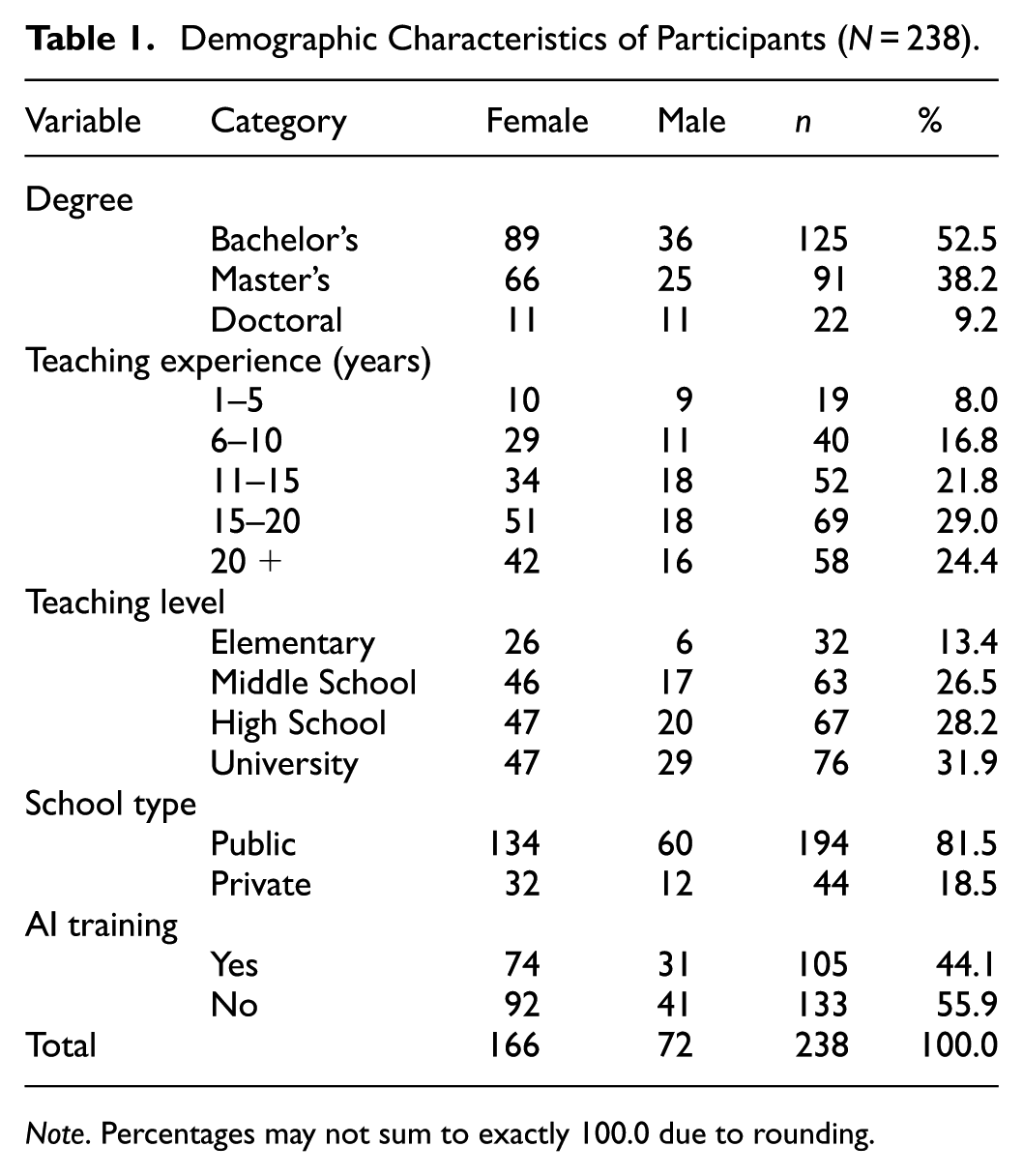
Note. Percentages may not sum to exactly 100.0 due to rounding.
Instruments
Data were collected using a comprehensive online survey consisting of three established and validated psychological scales adapted for the EFL context and preceded by a demographic section.
AI Anxiety Scale
The Teacher Artificial Intelligence Anxiety (TAIA) Scale was specifically developed and validated by X. Liu and Liu (2025) among Chinese EFL teachers. The final scale comprises 21 items across five distinct dimensions: technical proficiency (TP), job displacement (JD), technological support (TS), student experience (SE), and research development (RD). These latter three dimensions are highlighted as newly introduced based on the unique professional characteristics of university EFL teachers. The questionnaire uses a 7-point Likert scale ranging from 1 (strongly disagree) to 7 (strongly agree) and there are no reverse-coded items. The original development study demonstrated robust psychometric properties for the scale with satisfactory model fit indices (χ2/df = 3.204, CFI = 0.945, TLI = 0.936, RMSEA = 0.073). Regarding reliability, the original study reported high internal consistency with an overall Cronbach’s alpha of .95 and Composite Reliability (CR) values for the sub-dimensions ranging from .854 to .929. For the present study, the five-factor CFA model was tested (TP, JD, TS, SE, RD), and the model showed acceptable fit (χ2/df = 526.487/179 = 2.94; CFI = 0.952; TLI = 0.944; RMSEA = 0.082; SRMR = 0.062).
Professional Burnout Inventory
Professional burnout of the EFL teachers was assessed using an adapted version of Maslach Burnout Inventory-Educators Survey (MBI-ES; Maslach et al., 1997). It measures burnout as a symptom of emotional exhaustion, depersonalization, and reduced personal accomplishment. Emotional exhaustion (EE, eight items) refers to the depletion of emotional resources, depersonalization (DP, seven items) describes indifferent and negative attitudes toward others, and personal accomplishment (PA, seven items) involves a negative evaluation of one’s effectiveness on the job. The adapted version employs a 7-point Likert-type frequency scale ranging from 0 (never) to 6 (every day/always). Following the procedure established by Horn and Schaufeli (1998) in the Dutch validation study, mean scores rather than sum scores were calculated for each subscale to facilitate interpretation and enable direct comparison across dimensions. Additionally, personal accomplishment scores were reverse-coded to create a reduced personal accomplishment (rPA) dimension, where higher scores indicate greater feelings of ineffectiveness, consistent with the directional interpretation of EE and DP.
The MBI-ES has demonstrated robust psychometric properties in multiple educational contexts. Horn and Schaufeli (1998) reported strong factorial validity (NNFI = 0.87, GFI = 0.89, AGFI = 0.86, RMSR = 0.102) and high internal consistency (Cronbach’s α ranging from .72 to .90) across teacher samples. A three-factor model representing EE, DP, and rPA in the present study also demonstrated acceptable model fit to the data, χ2/df = 2.76, CFI = 0.955, TLI = 0.950, RMSEA = 0.086, and SRMR = 0.072. The standardized factor loadings were generally strong, with the majority of items loading above 0.67, indicating adequate convergence of the observed indicators on their respective latent constructs. Internal consistency reliability estimates for the current sample were acceptable for all three subscales (EE (α = .946), DP (α = .832), and rPA (α = .835)).
Teacher Mindset Scale
The Teacher Mindset Scale is a seven-item scale developed by Gero (2013) based on Dweck’s self-theories. It assesses convictions regarding the essence of teaching ability and comprises two dimensions as fixed teaching mindset (four items, teaching ability is innate and unchangeable) and growth teaching mindset (three items, teaching ability can be improved). The instrument is rated on a 6-point scale from 1 (strongly disagree) to 6 (strongly agree), and no reserve coding is required. Internal consistency (Cronbach’s α) was acceptable for both dimensions of the scale (αFTM = 0.65, αGTM = 0.71). CFA suggested the two-factor structure was between “acceptable” and “adequate” fit, with key indices calculated as RMSEA = 0.063, CFI = 0.96, and SRMR = 0.048. In the present study, the CFA results indicated a good model fit for the two-factor structure (Growth and Fixed Mindset), χ2/df = 2.37, CFI = 0.991, TLI = 0.986, RMSEA = 0.076, and SRMR = 0.063 suggesting that the proposed measurement model adequately fit the data. Due to the scope of the present study, only the fixed teaching mindset dimension of the instrument was utilized.
Data Collection and Analysis
Following the ethical approval from the institutional review board, data collection was carried out over a 6-week period during the fall term of the 2025 to 2026 academic year. Before accessing the survey items, all participants were presented with a digital informed consent form outlining the study’s objectives, voluntary participation, and data confidentiality protocols. The study posed minimal risk to participants, as it involved only anonymous self-report questionnaires with no sensitive or personally identifiable information collected. The potential benefits of advancing understanding of teacher well-being in AI-integrated educational contexts were deemed to outweigh this minimal risk. The data were collected via an anonymous online survey created on Microsoft Forms in order to facilitate broad access to EFL teachers across diverse educational contexts within Türkiye. The survey links were disseminated through online professional communities and university communication channels across Türkiye to reach the target population. In this investigation, the scales utilized were administered in their original English language format without translation into Turkish, given that the participants were professionally proficient in English.
The preliminary analyses were carried out through SPSS v.27, and the central hypotheses were tested within a SEM framework using JASP (lavaan package). After screening and removing invalid surveys (e.g., those with excessively short completion times or incomplete responses), descriptive statistics and preliminary assumption checks were performed. As preliminary analyses, the normality and multicollinearity of the data were assessed to evaluate distributional assumptions. Confirmatory factor analyses (CFA) were conducted to evaluate the measurement model, including factor loadings and model fit indices. Mediation analyses were subsequently performed within the same SEM framework using maximum likelihood (ML) estimation to test the significance of indirect effects. Model adequacy was evaluated based on established fit index thresholds (CFI ≥ 0.90, TLI ≥ 0.90, RMSEA ≤ 0.08, SRMR ≤ 0.08), standardized factor loadings (≥0.50), and statistical significance levels (p < .05; Hu & Bentler, 1999). As part of preliminary analyses, independent samples t-tests and one-way ANOVA were conducted to examine potential differences across gender and teaching experience groups.
Results
The present study addressed four research questions through a series of analyses. Regarding RQ1, which examined the relationship between AI anxiety and professional burnout, correlation and SEM analyses confirmed significant positive associations between AI anxiety and all three burnout dimensions, supporting H1a, H1b, and H1c in full. Concerning RQ2, which investigated the relationship between fixed teaching mindset and professional burnout, fixed teaching mindset showed significant positive correlations with emotional exhaustion and depersonalization, whereas its association with reduced personal accomplishment was non-significant, yielding partial support for H3. With respect to RQ3, which examined the relationship between AI anxiety and fixed teaching mindset, the structural model confirmed a significant positive path from AI anxiety to fixed teaching mindset, providing full support for H2. Finally, RQ4 addressed whether fixed teaching mindset mediates the relationship between AI anxiety and professional burnout. The mediation analyses revealed partial support for the mediation hypothesis. Fixed teaching mindset significantly mediated the associations between AI anxiety and both emotional exhaustion (H3a supported) and depersonalization (H3b supported), but not reduced personal accomplishment (H3c not supported), yielding a pattern of partial mediation.
Descriptive and Preliminary Analyses
In the present study, univariate normality of the data distribution was confirmed, with the skewness values falling between ±1.5 (Tabachnick & Fidell, 2013). Although these indices assess univariate rather than multivariate normality, maximum likelihood (ML) estimation, which is employed in the present SEM analyses, has been demonstrated to be relatively robust to moderate violations of multivariate normality, particularly when skewness and kurtosis values are within acceptable thresholds and sample size is adequate (Finney & DiStefano, 2006; West et al., 1995). As a preliminary analysis of the data collected, internal reliability coefficients tests were run, and Cronbach’s alpha values of .789, .874, and .888 were yielded for the AI Anxiety Scale, Burnout Scale, and Teacher Mindset Scale, respectively. Further details regarding the descriptive statistics, skewness, kurtosis values, and reliability scores of each factor are presented in Table 2.
Descriptive Statistics, Univariate Normality Measurements, and Reliability Analysis of the Instruments.
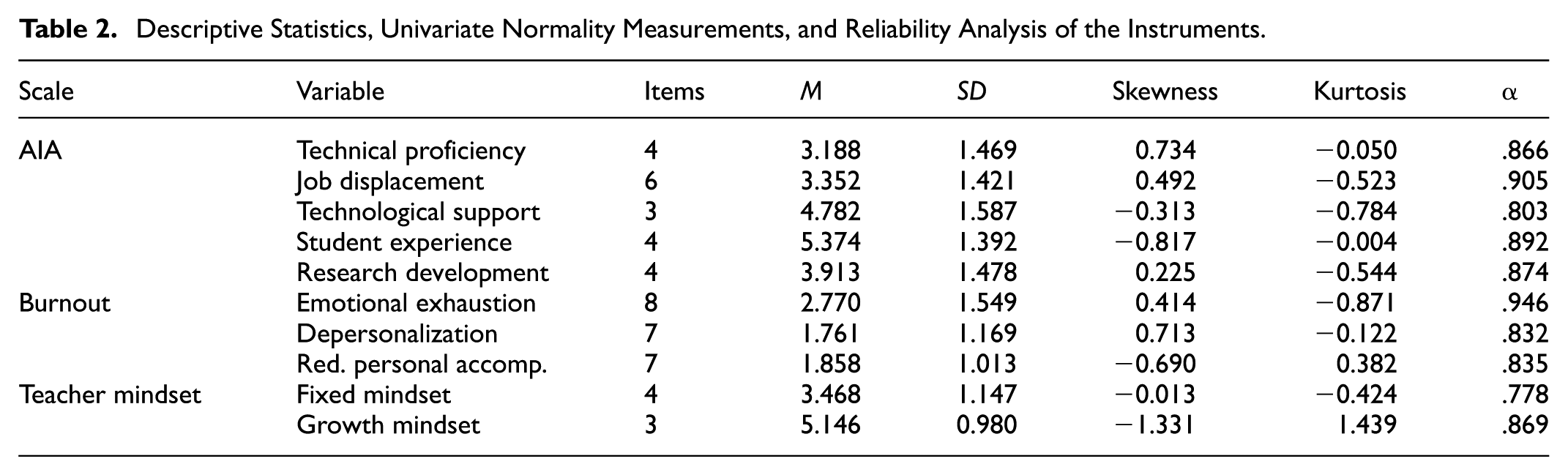
Additional analyses were conducted to examine potential differences across demographic groups. Independent samples t-tests indicated no statistically significant differences across gender for AI anxiety, fixed teaching mindset, or burnout dimensions (p > .05). Similarly, one-way ANOVA results revealed no significant differences across teaching experience groups for any of the study variables (p > .05). These findings suggest that the observed relationships in the mediation model are consistent across demographic subgroups within the present sample.
Correlation Analysis
Prior to testing the mediation model, the correlations among study variables were examined to assess the appropriateness of the proposed mediation paths. Pearson correlation coefficients are presented in Table 3.
Correlation Coefficients Between the Variables Included in the Model.
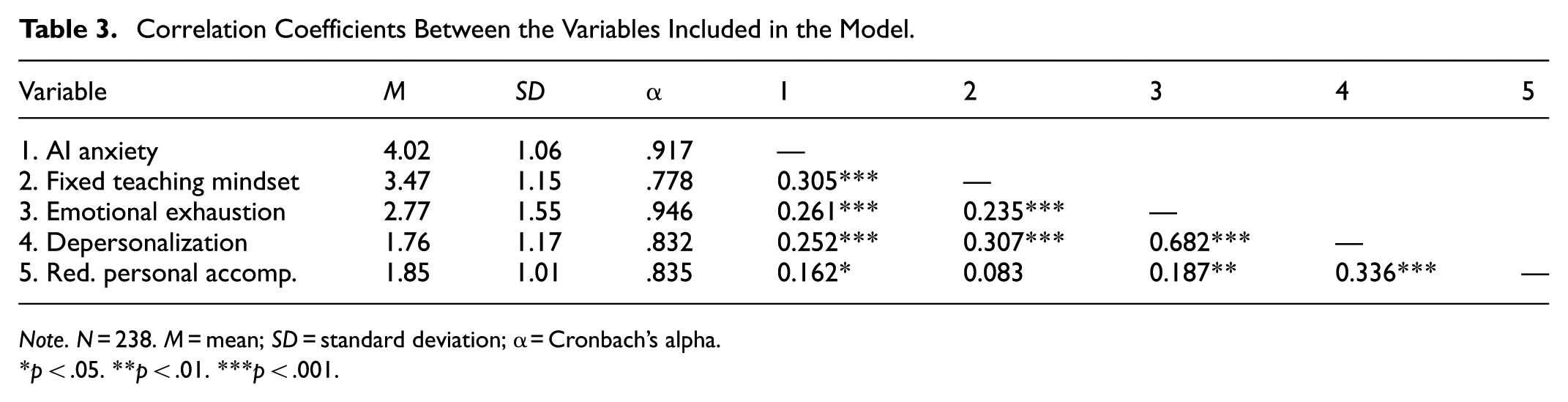
Note. N = 238. M = mean; SD = standard deviation; α = Cronbach’s alpha.
p < .05. **p < .01. ***p < .001.
As reported in Table 3, all scales and factors employed in the hypothesized model demonstrated strong internal consistency, with Cronbach’s alpha (α) coefficients ranging from .778 for FTM to .946 for EE, indicating acceptable to excellent reliability across measures.
Correlation analyses revealed several theoretically meaningful associations. Consistent with hypotheses, AIA demonstrated significant positive correlations with FTM (r = .305, p < .001), EE (r = .261, p < .001), DP (r = .252, p < .001), and rPA (r = .162, p < .05), suggesting that teachers experiencing greater AI-related anxiety reported both more rigid pedagogical beliefs and higher levels of burnout across all three dimensions. FTM showed significant positive associations with EE (r = .235, p < .001) and DP (r = .307, p < .001), indicating that teachers endorsing more fixed beliefs about teaching ability experienced greater emotional depletion and interpersonal detachment. Notably, the correlation between FTM and rPA was not statistically significant (r = .083, p > .05), foreshadowing the subsequent mediation results.
The analyses revealed that the patterns of correlations among burnout dimensions aligned with established research on the MBI factor structure (Maslach et al., 1997). EE and DP exhibited a strong positive correlation (r = .682, p < .001), consistent with theoretical conceptualizations of these dimensions as the “core” of burnout (Green et al., 1991). rPA showed moderate correlation with DP (r = .336, p < .001) and weaker correlation with EE (r = .187, p < .01), supporting the relative independence of this dimension (Green et al., 1991; Horn & Schaufeli, 1998). These preliminary findings provided empirical justification for examining fixed teaching mindset as a potential mediator linking AIA to burnout outcomes.
Measurement Model Analysis
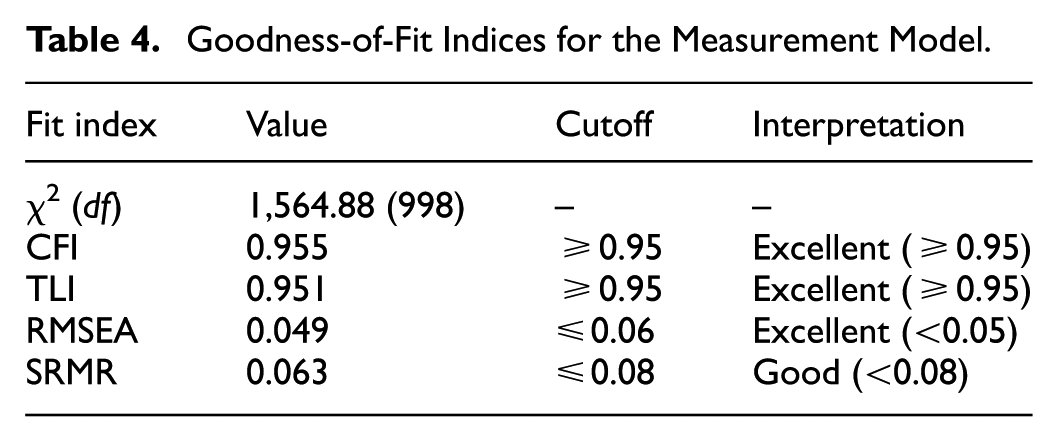
A confirmatory factor analysis was conducted using the ML estimator, and the structural model demonstrated good overall fit, χ2(998) = 1564.88, p < .001. Additional fit indices indicated good to excellent model fit with a Comparative Fit Index value (CFI) of 0.955, Tucker-Lewis Index value (TLI) of 0.951, a Root Mean Square Error of Approximation (RMSEA) of 0.049 [90% CI: 0.044, 0.054], and a Standardized Root Mean Square Residual (SRMR) of 0.063 (Table 4). These results support the adequacy of the measurement model (Hair et al., 2010; Hu & Bentler, 1999; Kline, 2023).
Goodness-of-Fit Indices for the Measurement Model.
Mediating Effect Analysis
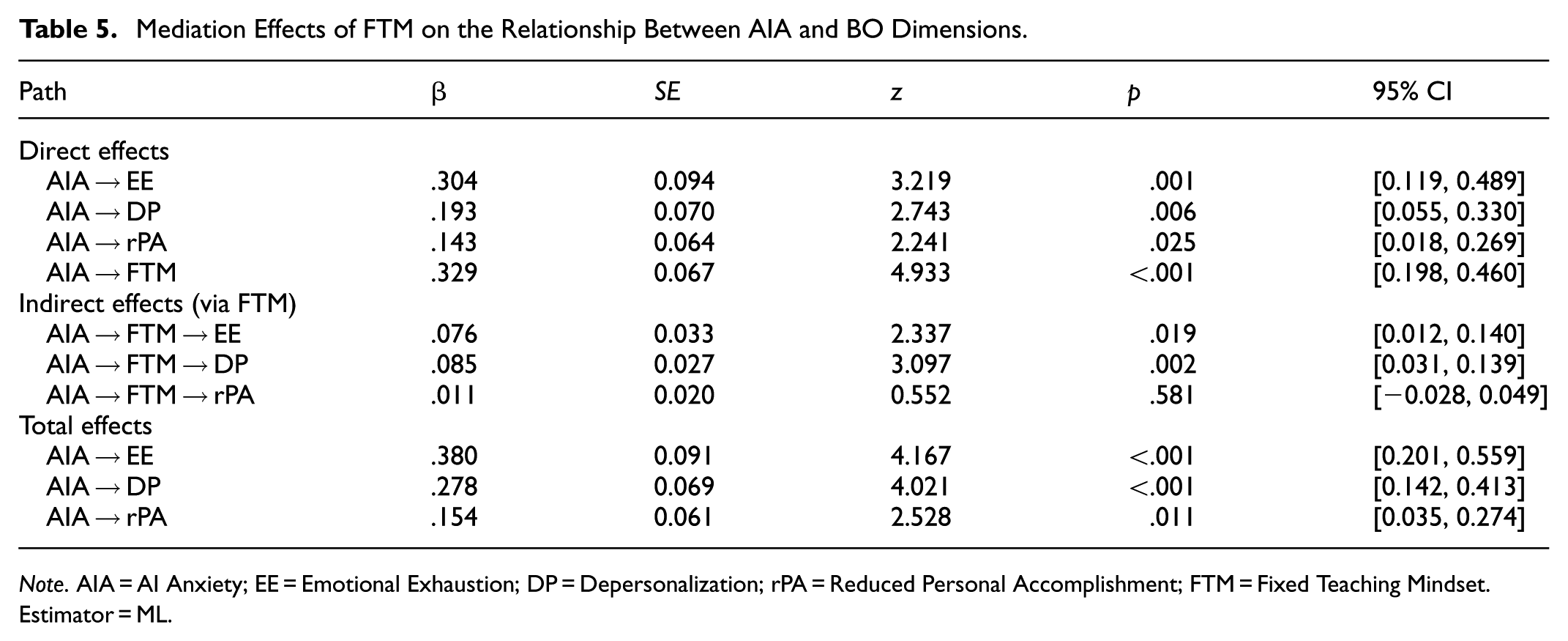
The core research hypothesis that teacher mindset mediates the relationship between AIA and burnout dimensions was tested using Path Analysis (a form of SEM) on the three key composite scores. FTM was entered as the mediating variable, AIA as the predictor, and sub-dimensions of burnout (EE, DP, and rPA) as the outcomes (Table 5).
Mediation Effects of FTM on the Relationship Between AIA and BO Dimensions.
Note. AIA = AI Anxiety; EE = Emotional Exhaustion; DP = Depersonalization; rPA = Reduced Personal Accomplishment; FTM = Fixed Teaching Mindset. Estimator = ML.
SEM with ML estimation was conducted to test the hypothesized mediation model. The direct effects indicated that AIA significantly predicted all three dimensions of burnout. Specifically, AIA was a positive predictor of EE (β = .304, SE = 0.094, z = 3.219, p = .001, 95% CI [0.119, 0.489]) and DP (β = .193, SE = 0.070, z = 2.743, p = .006, 95% CI [0.055, 0.330]), and it also positively predicted rPA (β = .143, SE = 0.064, z = 2.241, p = .025, 95% CI [0.018, 0.269]). Furthermore, the indirect effects revealed significant mediation through FTM for two burnout dimensions. The indirect path from AIA to EE via FTM was significant (β = .076, SE = 0.033, z = 2.337, p = .019, 95% CI [0.012, 0.140]), as was the indirect path to DP (β = .085, SE = 0.027, z = 3.097, p = .002, 95% CI [0.031, 0.139]). In contrast, the indirect effect on rPA was not significant (β = .011, SE = 0.020, z = 0.552, p = .581, 95% CI [−0.028, 0.049]).
Total effect estimates indicated that AIA had a significant overall impact on EE (β = .380, SE = 0.091, z = 4.167, p < .001, 95% CI [0.201, 0.559]), DP (β = .278, SE = 0.069, z = 4.021, p < .001, 95% CI [0.142, 0.413]), and rPA (β = .154, SE = 0.061, z = 2.528, p = .011, 95% CI [0.035, 0.274]). Analysis of path coefficients further showed that FTM significantly predicted EE (β = .232, SE = 0.087, z = 2.653, p = .008) and DP (β = .259, SE = 0.065, z = 3.978, p < .001), but not rPA (β = .033, SE = 0.059, z = 0.555, p = .579). AIA also significantly predicted FTM (β = .329, SE = 0.067, z = 4.933, p < .001), confirming the viability of the mediational pathways.
Overall, these findings support a partial mediation model, in which FTM partially explains the effects of AIA on EE and DP, but not on rPA.
In short, as seen in Figure 2, the results provide partial support for the mediation hypothesis. FTM significantly mediated the relationship between AIA and two dimensions of teacher burnout (EE and DP), indicating that teachers’ fixed mindset beliefs about their abilities serve as a psychological mechanism through which AI anxiety contributes to these burnout symptoms. However, FTM did not mediate the relationship between AIA and rPA. The direct effects of AIA on all burnout dimensions remained significant even after accounting for the mediating role of FTM, suggesting partial rather than full mediation. These findings indicate that while fixed mindset beliefs represent one important pathway through which AI anxiety affects teacher burnout, other mechanisms may also be at play.
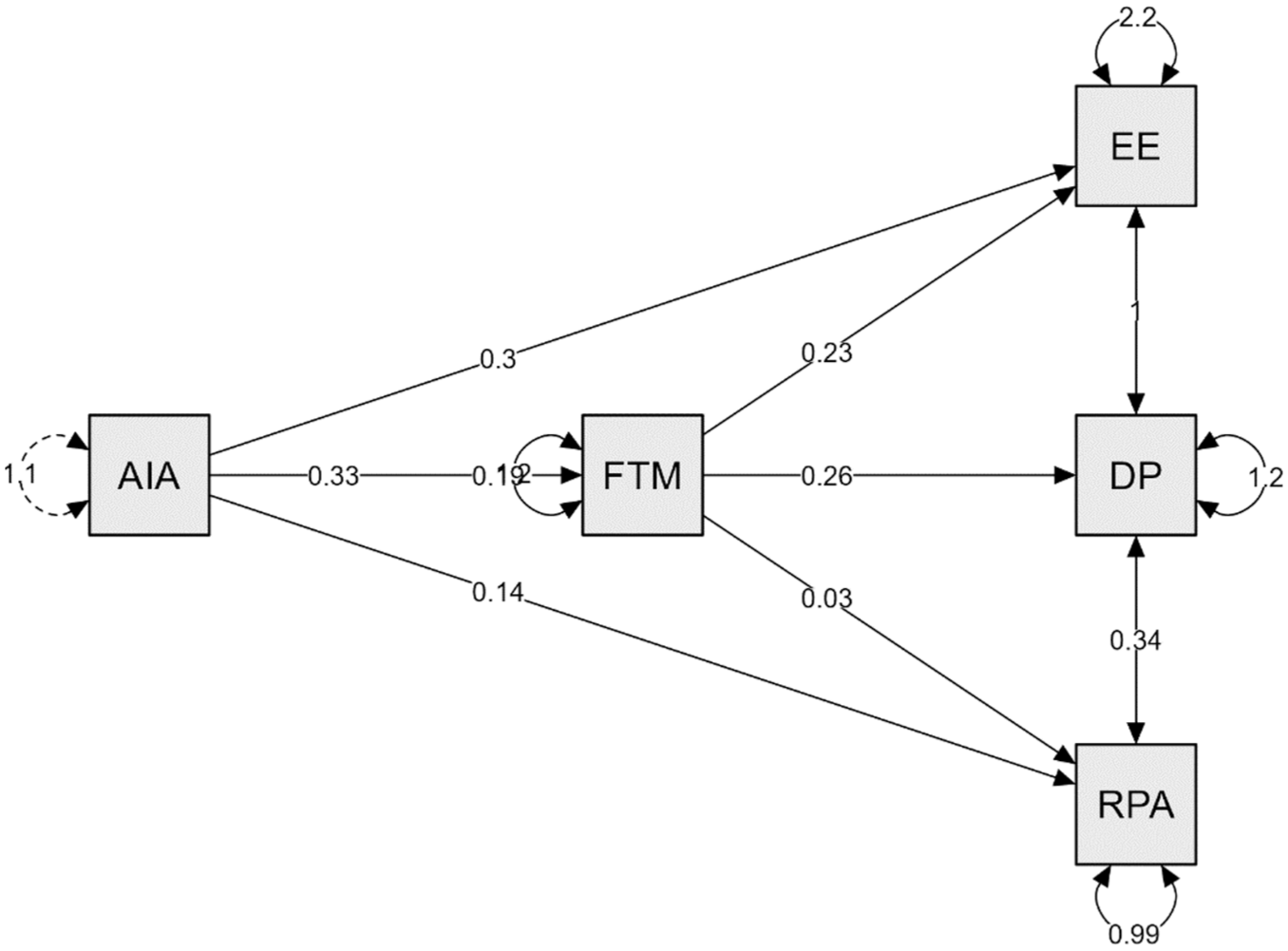
Model path plot.
Discussion
The present study examined the interrelations of AI anxiety (AIA), teacher mindsets, and professional burnout among EFL teachers in Türkiye, particularly investigating whether a fixed teaching mindset serves as a mediator between AI anxiety and burnout dimensions. The findings provide empirical evidence for the hypothesized relationships and reveal important mechanisms through which AI-related technological demands are associated with burnout symptoms. Given the cross-sectional nature of the data, the mediation analysis findings should be interpreted as indicative of statistical associations rather than causal mechanisms.
Regarding the first research question, the associations between AI anxiety and burnout dimensions are consistent with the health impairment pathway of the JD-R model (Schaufeli & Bakker, 2004). When technological demands chronically outpace available resources, cognitive and emotional overload accumulates across multiple functioning domains. What distinguishes AI-related demands from conventional job stressors, however, is their existential dimension. The pressure to master rapidly evolving tools is compounded by fears of professional obsolescence and identity threat, which are the concerns that teachers carry beyond the immediate task and into their broader sense of professional self (Y. Liu & Chang, 2024; X. Liu & Liu, 2025; Parviz & Arthur, 2025). This compounded demand structure helps explain why emotional exhaustion emerged as the most responsive burnout dimension in the present model, a pattern consistent with findings from other technology-integration contexts (Alharbi, 2025; Dehghan, 2023). The support for H1b is theoretically meaningful in terms of what depersonalization actually represents in the burnout process. Rather than a passive symptom, depersonalization has long been understood as an active regulatory response: when the emotional cost of sustained engagement becomes too high, psychological distancing from students and work serves as a way of managing that cost (Maslach et al., 2001; Maslach & Jackson, 1981). In the context of AI anxiety, this dynamic takes on an additional quality. Teachers who feel inadequate in the face of technological demands are not only managing everyday classroom stress; they are also managing a sense of threat to their professional competence. Withdrawal, in this sense, becomes a way of reducing exposure to situations in which that inadequacy might become visible, which over time deepens the detachment that characterizes burnout (Zarrinabadi et al., 2026). The finding for H1c extends this picture in a different direction. Reduced personal accomplishment is less about how teachers feel in the moment and more about how they evaluate themselves over time. As AI anxiety intensifies, teachers appear to increasingly question whether their efforts translate into meaningful outcomes, a process that gradually undermines their sense of professional efficacy and impact (Sadoughi et al., 2024). This erosion of perceived effectiveness is qualitatively different from exhaustion or depersonalization and likely unfolds through a slower, more cumulative appraisal process rather than through acute emotional responses to daily demands (Maslach, 2003).
The second research question investigated the relationship between AI anxiety and teacher mindsets, specifically examining whether AI anxiety predicts fixed teaching mindset. The support for H2 is theoretically notable. The fear and perceived threat associated with AI integration can trigger defensive cognitive patterns characteristic of entity theory (Dweck, 2006). When teachers experience anxiety regarding their ability to master AI technologies or concerns about professional displacement, they may retreat to fixed beliefs about their capabilities, viewing their teaching competence as static and unchangeable (Sadoughi et al., 2024). This cognitive response aligns with Dweck’s (2006) characterization of the “helpless pattern,” wherein individuals confronted with challenges interpret difficulties as confirmations of their inherent limitations rather than as opportunities for growth (Ortiz Alvarado et al., 2024; Zarrinabadi et al., 2026). This finding further extends previous research by establishing that contemporary technological stressors can shape or reinforce maladaptive cognitive frameworks, thereby amplifying their detrimental effects on teacher well-being (Gregoire, 2003).
As for the third research question, H3 was partially supported, with fixed teaching mindset associated with emotional exhaustion and depersonalization but not with reduced personal accomplishment. This pattern is interpretively meaningful. This lack of predictive power regarding personal accomplishment suggests that while a fixed mindset contributes to the “core” interpersonal and emotional symptoms of burnout, the feeling of reduced accomplishment is driven more directly by AI anxiety itself rather than the teacher’s mindset.
The significant relationship between fixed mindset and emotional exhaustion supports theoretical propositions that fixed mindset depletes critical psychological resources, particularly perceived competence and self-efficacy (Sadoughi et al., 2024; Zarrinabadi et al., 2026). Teachers holding fixed beliefs about their teaching abilities are more likely to interpret professional challenges as personal failures reflecting immutable inadequacy, thereby experiencing intense frustration and emotional strain (Ortiz Alvarado et al., 2024; Y. Shen & Guo, 2024). This cognitive appraisal pattern intensifies the emotional costs of job demands, accelerating the exhaustion process central to burnout (Maslach et al., 2001). Similarly, the significant positive relationship between fixed mindset and depersonalization aligns with theoretical expectations. When teachers believe their competence is fixed and unchangeable, they are more likely to adopt maladaptive coping mechanisms, including emotional withdrawal and cynical detachment from their work and students (Maslach et al., 2001; Sadoughi et al., 2024). This withdrawal serves a self-protective function, shielding the individual from further perceived threats to their professional identity (Zarrinabadi et al., 2026). On the other hand, the absence of a significant relationship between fixed mindset and reduced personal accomplishment is theoretically informative, given the predictions linking fixed mindset to avoidance of challenging learning activities and consequent failure to accumulate mastery experiences necessary for self-efficacy (Bandura, 1997). However, this finding may reflect the complexity of the personal accomplishment dimension, which has been shown to exhibit distinct patterns compared to emotional exhaustion and depersonalization in various cultural contexts (Maslach, 2003). Additionally, personal accomplishment appears to be more contingent on external evaluative feedback than on internal belief systems alone. Institutional recognition, student responsiveness, and observable instructional outcomes are referents that largely operate outside the scope of what mindset beliefs can directly shape (Maslach, 2003).
The last and central research question examined whether teacher mindset significantly mediates the relationship between AI anxiety and professional burnout. H3a was supported as the indirect effect of AI anxiety on emotional exhaustion through fixed mindset was found to be significant. This finding suggests that AI anxiety is associated with emotional exhaustion partially via fixed mindset beliefs (Dweck, 2013; Zarrinabadi et al., 2026). However, the persistence of a significant direct effect indicates partial rather than full mediation, suggesting that AI anxiety also affects emotional exhaustion through additional pathways not captured by fixed mindset alone. The finding aligns with the JD-R framework, which posits that job demands such as AI anxiety can initiate a health impairment process through multiple mechanisms (Bakker & Demerouti, 2007; Schaufeli & Bakker, 2004). H3b was also supported. Among all tested indirect pathways, the mediation through fixed mindset was strongest for depersonalization –theoretically coherent, given that interpersonal withdrawal is precisely the coping strategy most available to teachers who perceive their competence as fixed and under threat (Dweck, 2013; Lou et al., 2022; Maslach et al., 2001). The significant direct effect again indicates partial mediation, implying that while fixed mindset is an important mechanism, other processes also contribute to depersonalization in the context of AI anxiety. Lastly, H3c, predicting mediation of the relationship between AI anxiety and reduced personal accomplishment, was not supported. This finding warrants careful theoretical consideration rather than being treated as a simple null result. Notably, the zero-order correlation between fixed mindset and reduced personal accomplishment was already non-significant at the bivariate level, indicating that the absence of mediation reflects a genuine lack of association between these constructs rather than a suppressed indirect effect. The fact that AI anxiety impacts reduced personal accomplishment directly suggests that the perceived threat of AI to one’s professional “worth” or “accomplishment” is an immediate reaction that bypasses the teacher’s general mindset about teaching ability. This direct pathway may reflect the existential nature of AI-related concerns, particularly fears of job displacement and professional obsolescence that directly challenge teachers’ sense of competence and relevance (Y. Liu & Chang, 2024; X. Liu & Liu, 2025; Parviz & Arthur, 2025).
To conclude, the pattern of partial mediation observed for emotional exhaustion and depersonalization, combined with the absence of mediation for reduced personal accomplishment, reveals important insights. Fixed mindset represents a significant but not exclusive psychological mechanism through which AI anxiety contributes to burnout. The persistence of significant direct effects indicates that AI anxiety operates through multiple pathways, including those not mediated by mindset beliefs. These additional pathways may involve other psychological processes such as emotion regulation strategies, coping mechanisms, social support networks, or institutional factors that were not measured in the present study (Chen et al., 2024; Cheng et al., 2026; Xin & Derakhshan, 2025). Finally, the varying mediation patterns across burnout characteristics indicate that a fixed teaching mindset serves as a depleted internal resource, amplifying specific strains more than others within the JD-R framework (Bakker & Demerouti, 2017). While a fixed mindset intensifies the emotional and social consequences of AI anxiety, resulting in exhaustion and cynicism, the threat to professional accomplishment seems to function through more immediate cognitive evaluations of competence within an AI-integrated educational environment (X. Liu & Liu, 2025; Seyri & Ghiasvand, 2025).
Theoretical and Pedagogical Implications
The findings of this study make important theoretical contributions to the understanding of teacher burnout in the context of technological change. First, the study successfully integrates Mindset Theory (Dweck, 2006) into the JD-R model (Bakker & Demerouti, 2007), demonstrating that internal psychological beliefs operate as critical mechanisms linking external job demands to burnout outcomes. The study also establishes AI anxiety as a significant contemporary job demand that directly contributes to teacher burnout extending the JD-R model by incorporating emerging technological stressors that are increasingly relevant in modern educational contexts (Alharbi, 2025; Y. Liu & Chang, 2024). Lastly, the differential mediation patterns across burnout dimensions highlight the multidimensional nature of burnout and suggest that different dimensions may be influenced by distinct psychological mechanisms. Notably, this study offers the first empirical test of a comprehensive structural model in which fixed teaching mindset mediates the relationship between AI anxiety and professional burnout among EFL teachers. Additionally, by documenting these dynamics in the Turkish EFL context, the study contributes to a literature that has been predominantly shaped by Chinese and Iranian samples (e.g., D. Liu & Du, 2024; Parviz & Arthur, 2025).
The findings also yield several pedagogical implications for educational administrators, professional development designers, and policymakers. The significant direct and indirect effects of AI anxiety on burnout underscore the urgency of providing systematic support for teachers navigating AI integration. Institutions should prioritize comprehensive AI literacy training that develops technical skills while addressing the psychological dimensions of technological change (Omidvar & Meihami, 2025; Xie et al., 2025). Critically, the mediating role of fixed mindset suggests that mindset-focused interventions could be particularly effective in buffering the negative effects of AI anxiety on burnout. Professional development programs should incorporate growth mindset cultivation strategies, helping teachers reframe AI integration as an opportunity for professional development rather than a threat to their existing competence (Sadoughi et al., 2024). Evidence-based mindset interventions, such as those emphasizing incremental progress and the value of effort (Yeager & Dweck, 2012), could be adapted for the context of technological change.
Finally, the findings suggest that interventions targeting burnout prevention in the context of AI integration should adopt a multifaceted approach. While addressing fixed mindset beliefs is important, the persistence of significant direct effects indicates that additional strategies, such as enhancing social support networks, improving institutional communication about AI implementation, and providing adequate technical resources, are also necessary (Bakker & Demerouti, 2017). Such comprehensive approaches should be implemented as early as possible and sustained throughout the AI integration process (Tütüniş et al., 2025; Yeager & Dweck, 2012).
Limitations and Future Directions
Several limitations should be acknowledged when interpreting the findings of this study. First of all, the cross-sectional design limits causal interpretation of the observed relationships. Although the proposed mediation model is theoretically grounded, the reported relationships should be interpreted as statistical associations rather than temporal cause-and-effect. Thus, longitudinal research is needed to establish temporal ordering among AI anxiety, mindset beliefs, and burnout. Future studies could also allow researchers track changes in these constructs over time, particularly as teachers gain experience with AI technologies.
In addition, the study focused on fixed teaching mindset as the primary mediating mechanism but did not examine other potential mediators such as emotion regulation strategies, coping mechanisms, or self-efficacy beliefs, despite theoretical suggestions that these factors play important roles (An & Tao, 2024; Chen et al., 2024). The persistence of significant direct effects from AI anxiety to burnout suggests these unmeasured constructs necessitate investigation. Future research should test more comprehensive models incorporating multiple mediating pathways to provide a fuller understanding of how AI anxiety is related to burnout. Likewise, by focusing exclusively on fixed teaching mindset as the mediating mechanism, the present study did not examine the potential protective role of growth mindset against AI anxiety and burnout. Given that growth mindset is theoretically associated with adaptive responses to challenges, including technological change (Dweck, 2006; Nalipay et al., 2022), future research should examine whether growth mindset functions as a compensatory resource that buffers the burnout-inducing effects of AI anxiety.
Furthermore, study variables were measured through self-report instruments, which introduces the possibility of common method variance. The anonymous survey format and use of psychometrically validated instruments partially mitigate this concern; however, future research would benefit from incorporating multiple data sources to triangulate findings.
Finally, as a mediation study in scope, the study did not examine potential moderating factors that might strengthen or weaken the observed relationships. Variables such as prior technology experience, institutional support, teaching experience, or demographic characteristics may moderate the effects of AI anxiety on mindset and burnout. Identifying such moderators could inform more targeted and effective interventions. Moreover, the findings of this study are primarily applicable to EFL teachers working in institutional, face-to-face settings in Türkiye, and caution should be exercised when generalizing the results to other educational contexts or cultural settings.
Conclusion
This study examined the mediating role of fixed teaching mindset in the relationship between AI anxiety and professional burnout among EFL teachers in Türkiye. The findings provide empirical evidence that AI anxiety represents a significant occupational demand that directly contributes to EFL teacher burnout in the Turkish educational context. More importantly, the findings demonstrate that fixed teaching mindset serves as a critical psychological mechanism partially mediating the relationship between AI anxiety and two core burnout dimensions, namely, emotional exhaustion and depersonalization. These findings underscore the importance of addressing both the external demands imposed by AI integration and the internal psychological resources, particularly the depletion of adaptive mindset beliefs, that shape teachers’ responses to these demands.
The partial mediation pattern observed carries both theoretical and practical importance. Theoretically, it extends the JD-R model by positioning fixed teaching mindset as a depleted psychological resource that amplifies the health-impairing effects of technological demands. Besides, it establishes AI anxiety as a contemporary occupational stressor with measurable consequences for teacher well-being in the Turkish EFL context. Practically, the findings suggest that effective burnout prevention in AI-integrated educational settings requires a dual focus: building teachers’ technical competence through AI literacy programs while simultaneously cultivating the adaptive mindset beliefs that enable them to approach technological change as a professional opportunity rather than an existential threat. As AI continues to reshape educational landscapes, understanding the psychological mechanisms that connect technological demands to teacher well-being is not only a research priority but an institutional one.
Footnotes

Ethical Considerations
The Social Sciences and Humanities Scientific Research and Publication Ethics Review Committee at Manisa Celal Bayar University approved the study (approval number: E--050.01-1122296) on October 16, 2025.
Consent to Participate
Respondents gave online informed consent before starting the surveys.
Author Contributions
Hüsem Korkmaz: Conceptualization (lead); Methodology (lead); Data curation (lead); Formal analysis (lead); Investigation (lead); Writing – original draft (lead); Writing (review & editing) (lead).
Funding
The author received no financial support for the research, authorship, and/or publication of this article.
Declaration of Conflicting Interests
The author declared no potential conflicts of interest with respect to the research, authorship, and/or publication of this article.
Data Availability Statement
The datasets collected and analyzed during the current study are available from the corresponding author on reasonable request.*