






Abstract
Generative language models are increasingly used in academic writing, yet research on AI-assisted writing often reduces them to instructional tools or feedback providers and relies mainly on outcomes or self-reports. This study instead examines human–AI coordination as the analytic focus and conceptualizes composing as a distributed activity involving writers, prompts, system outputs, and evolving drafts. Drawing on human–computer interaction and distributed cognition, it reports a 12-week longitudinal qualitative study of 25 multilingual L2 academic writers. Data include AI interaction logs, time-stamped draft histories, screen recordings, and stimulated recall interviews anchored in observable interactional moments. Analysis of episodes linking prompts, AI output, writer uptake, and draft change shows that agency emerges through cycles of proposal, evaluation, constraint tightening, and consolidation, while identity is negotiated through selective alignment with AI-generated academic voice and disciplinary norms.
Plain Language Summary
Artificial intelligence tools such as ChatGPT are becoming common in academic writing. Many studies look at whether these tools improve students’ writing or ask students how useful they think the tools are. This study takes a different approach. It looks closely at what actually happens when students write with AI over time. The study followed 25 multilingual university students for 12 weeks while they used AI during academic writing tasks. It collected several kinds of evidence, including records of their conversations with AI, changes made across draft versions, screen recordings, and follow-up interviews about specific moments during writing. The study shows that writing with AI is not a simple process in which students just accept suggestions from a tool. Instead, students and AI work together in a step-by-step way. Students ask questions, review the AI’s responses, decide what is useful, revise the wording, narrow or reshape ideas, and then build these choices into later drafts. In this process, students remain active decision-makers. The findings also show that students think carefully about voice and identity. They do not simply copy an “academic” style from AI. Rather, they choose when to follow AI suggestions and when to reject them so that the text still sounds like their own work and fits the expectations of their academic field. Overall, the study argues that AI should be understood as part of a writing process that students actively manage, not as a tool that writes for them.
Introduction
Generative language models are now embedded in writing environments where text emerges through interaction between writers and computational systems. In such settings, writing unfolds through coordinated action among writers, prompts, model-generated proposals, and successive revisions. It is therefore better understood as an interactive process than as an individual activity merely supported by neutral tools. Research on interactive text production shows that writing assistants shape composing by offering suggestions that writers inspect, adapt, sequence, or disregard as texts develop (Arnold et al., 2016, 2018, 2020; Buschek et al., 2021; Chen et al., 2019). Within human–computer interaction research, language models are increasingly treated as participants in writing, with machine-in-the-loop studies documenting cycles of proposal and evaluation and negotiation of control across composing phases (Bhat et al., 2021, 2023; Buschek et al., 2018; Clark et al., 2018). Nguyen et al. (2024) further show that human–AI collaboration in academic writing follows recurrent interactional patterns over time.
AI-mediated communication research shows that digital systems shape what writers can say and how they can respond within particular interfaces. In this sense, rhetorical work is organized across both human writers and nonhuman systems (Hancock et al., 2020). From this perspective, writing with AI is distributed cognitive activity spanning people, algorithms, interfaces, and evolving drafts rather than an individual process supplemented by external aids (Cope et al., 2020). This interactional view also reshapes how identity and agency are theorized. Posthumanist and sociomaterial approaches treat identity as situationally enacted within sociotechnical assemblages (Haraway, 1991; Pennycook, 2017), and Darvin (2025) argues that identity and agency in the age of generative AI are distributed and negotiated. Writers perform identity through alignment with or distancing from model output and through managing tensions between standardized academic discourse and locally grounded expression, with agency observable in how control is negotiated across interactional moments. This concern is particularly important for L2 academic writers, for whom composing often involves negotiating language accuracy, academic voice, stance, and ownership at the same time.
Despite rapid growth in AI writing research, much work still frames AI as instruction or feedback and relies on outcomes or self-reports, shifting attention away from real-time composing. Even studies that recognize AI as a writing partner often prioritize post-task evaluations over interactional processes. Wang and Wang (2025) note that such approaches obscure how L2 writers’ engagement with AI unfolds across composing stages and how critical decision-making is enacted in interaction, leaving limited process-level understanding of how multilingual writers negotiate identity and agency in AI-mediated academic writing.
The present study addresses this gap by examining human–AI coordination in L2 academic writing. Rather than evaluating learning outcomes, effectiveness, or attitudes, it focuses on observable practices through which multilingual writers negotiate identity and agency while composing with generative AI. Specifically, it asks the following research questions:
How do multilingual L2 writers negotiate identity during real-time interaction with generative AI while composing academic texts?
What interactional patterns signal shifts in writer agency across stages of AI-mediated composing?
How do writers manage tensions between academic English norms and locally grounded identity expression in AI-mediated writing?
This study makes three main contributions. First, it shifts the analysis of AI-assisted L2 writing from outcomes, perceptions, or tool effectiveness to the interactional processes through which writing is produced. Second, it shows how agency and identity become visible in observable prompt–output–uptake–revision sequences, thereby offering a process-level account of human–AI mediation in academic writing. Third, it contributes to L2 writing research by showing that multilingual writers’ voice, stance, and authorship are negotiated not only in final texts but also through real-time engagement with AI-generated academic language. In doing so, the study links human–AI interaction research with L2 writing scholarship and provides an empirically grounded framework for examining authorship in AI-mediated composing.
To make the interactional basis of these claims directly reviewable, the Results section presents worked episode displays that reproduce (i) writer prompts, (ii) AI outputs, (iii) writer uptake moves, and (iv) corresponding draft changes. A concise interactional codebook is provided in the Methodology section, and supplementary episode materials (episode inventory) are included in Appendix A.
Literature Review
Research on writing with computational systems has long documented that writing technologies do more than accelerate text production. They shape how writers attend to language, evaluate alternatives, and distribute labor across composing processes (Haas, 1990). Early work on predictive and assistive text systems demonstrated that suggestions at the word or phrase level reorganize writing behavior by foregrounding some linguistic possibilities while rendering others less accessible (Arnold et al., 2016; Chen et al., 2019). As such systems evolved, interaction shifted from isolated prediction toward sustained co-writing, in which writers engage with longer, semantically consequential proposals that enter the composing process as candidate contributions rather than neutral aids (Yang & Li, 2024).
Human–AI Interaction in Writing as Situated Action
Within human–computer interaction research, writing with language models has increasingly been examined as a form of situated interaction. Empirical studies show that writers do not simply accept or reject AI-generated text, but engage in patterned sequences of evaluation, partial uptake, chaining, and revision that unfold over time (Arnold et al., 2018, 2020; Buschek et al., 2021). These patterns suggest that AI-generated text functions as a turn to which writers respond. Writers respond to it by accepting, revising, resisting, or redirecting it, rather than treating it as a static output. The timing, granularity, and persistence of suggestions shape when writers pause, reconsider direction, or reframe emerging arguments (Nguyen et al., 2024).
Work examining writers’ engagement with biased or opinionated suggestions further underscores that interaction with AI is not passive. Writers actively negotiate alignment with model output, sometimes resisting suggestions that conflict with their intended stance and at other times reworking AI-generated phrasing to fit local rhetorical goals (Bhat et al., 2021, 2023). Such findings suggest that agency in AI-mediated writing is enacted through observable interactional moves, including resistance, override, and reformulation, rather than through abstract control or intention (Koltovskaia et al., 2024; Yan & Zhang, 2024).
Distributed Cognition and Machine-in-the-Loop Writing
This section uses distributed cognition to explain why AI-mediated writing is treated here as a coordinated activity rather than as individual writing assisted by an external tool.
The interactional nature of AI-mediated writing aligns with theoretical accounts of writing as distributed or extended cognition (Hayes, 2012). From this perspective, cognitive activity is not confined to the individual writer but emerges across systems of people, tools, representations, and environments. Lillis et al. (2020) conceptualize writing as a situated, temporally distributed professional practice, showing that texts emerge through coordination across tools, institutional demands, and evolving written records rather than as isolated products. Studies of machine-in-the-loop writing illustrate how planning, formulation, and revision are distributed across human judgment and algorithmic generation, with responsibility for meaning negotiated dynamically across interactional moments (Clark et al., 2018).
AI-mediated writing does not externalize cognition in a simple linear way. Instead, writers repeatedly offload tentative formulations to the system, evaluate returned proposals, and reintegrate selected elements into the evolving text. These cycles make visible how thinking is reorganized through interaction, with AI output functioning as a provisional resource that invites further judgment rather than as a determinate solution. Writing, in this sense, is constituted through coordination between human and nonhuman actors whose contributions are asymmetrical but interdependent (Nguyen et al., 2024).
Agency as Interactional Accomplishment
This section clarifies how agency is identified in the study: not as a stable personal trait, but as something observable in writers’ decisions to accept, revise, resist, or redirect AI-generated text.
Across this literature, agency is increasingly conceptualized as an interactional accomplishment rather than an individual capacity (Hayes, 2012). Studies documenting how writers manage AI suggestions show that agency is enacted locally through decisions about uptake, sequencing, and modification (Arnold et al., 2016; Buschek et al., 2018). These decisions are observable in interaction logs, keystroke data, and revision histories, making agency analytically accessible as behavior rather than as self-reported disposition (Koltovskaia et al., 2024). Radtke and Rummel (2025) further demonstrate that writers’ revision behavior and uptake of AI-generated text are shaped by how authorship and AI involvement are framed, highlighting how agency is exercised under specific interactional conditions rather than assumed as a stable capacity.
In this study, agency refers to the writer’s observable management of control within human–AI composing. It is identified in actions such as accepting, rejecting, revising, constraining, redirecting, or consolidating AI-generated text. Agency therefore concerns how writers organize and regulate the composing process in interaction with the system.
Recent CALL and GenAI-supported L2 writing research further suggests that agency is shaped not only by local interactional choices but also by writers’ digital literacy, institutional policy environments, and capacity to evaluate AI-generated output critically (Li, 2025; Moorhouse & Wong, 2025; Moorhouse et al., 2025). In this sense, agency in AI-mediated L2 writing involves the writer’s ability to use AI strategically, assess its limitations, remain accountable for textual decisions, and negotiate the constraints imposed by classroom or institutional rules.
AI-mediated communication research further emphasizes that computational systems mediate action by structuring affordances and constraints rather than by determining outcomes (Hancock et al., 2020). In writing contexts, this mediation operates through interface design, prompt persistence, and suggestion framing, all of which shape what kinds of agency moves are made available to writers. Agency therefore changes across composing stages. It appears in moments of delegation, resistance, and consolidation as writers respond to AI participation (Yan & Zhang, 2024).
Identity, Authorship, and Norm Negotiation in AI-Mediated Writing
This section explains how identity is traced through writers’ alignment with, modification of, or distancing from AI-generated academic language.
Questions of identity and authorship become particularly salient when writing is distributed across human and algorithmic contributors. Posthumanist and sociomaterial approaches challenge the assumption that authorship resides solely in the individual writer, instead framing identity as enacted through practice within assemblages of human and nonhuman actors (Haraway, 1991; Pennycook, 2017). From this perspective, identity in writing is not simply expressed. It is performed through the writer’s alignment with, or distancing from, available discursive resources.
Identity, by contrast, refers to how writers position themselves as academic authors through voice, stance, style, and ownership. In AI-mediated writing, identity is visible when writers decide whether AI-generated language sounds too generic, too polished, too distant from their intended meaning, or compatible with their preferred authorial presence. Thus, while agency concerns control over the composing process, identity concerns the kind of authorial self that is projected through the emerging text.
In CALL and GenAI-mediated language learning contexts, identity is also shaped by how learners position themselves in relation to digital tools, institutional expectations, and emerging norms of acceptable AI use (Li, 2025; Moorhouse & Wong, 2025; Moorhouse et al., 2025). For multilingual L2 writers, this means that authorial identity is negotiated not only through voice, stance, and textual ownership, but also through decisions about when to rely on AI-generated academic language, when to resist it, and how to remain recognizable as the responsible author of the text.
In AI-mediated writing, identity work is observable in how writers negotiate stylistic fit, register, and stance when engaging with model output. Hu et al. (2025) show that AI-assisted academic writing involves ongoing identity negotiation, as writers balance ethical concerns, authorship legitimacy, and the maintenance of scholarly voice while interacting with generative systems. Writers may suppress AI-generated language that appears overly standardized, reassert voice through reformulation, or selectively appropriate phrasing that aligns with their intended positioning. Ou et al. (2026) demonstrate that multilingual academic writers engage in translanguaging and transpositioning practices when composing with AI, using model output selectively to negotiate disciplinary norms, linguistic identity, and authorial positioning across drafts. These practices are especially consequential in academic writing, where normative pressures are strong and deviations from expected discourse forms carry interactional consequences. These issues are also central to L2 writing research, where voice, stance, authorial presence, and textual ownership have long been treated as key dimensions of academic writing development. For multilingual writers, academic voice is not simply a matter of correctness or fluency; it involves negotiating how far to align with disciplinary expectations while maintaining a recognizable authorial position (Hyland, 2002; Matsuda & Tardy, 2007; Tardy, 2012, 2016). AI-mediated writing intensifies this negotiation because model-generated text often offers fluent academic phrasing that may be rhetorically useful but potentially distant from the writer’s intended voice.
Limitations of Existing Research and the Present Gap
Despite growing recognition of AI as an active participant in writing, much existing research still prioritizes outcomes, attitudes, or persuasive effects rather than process-level interaction. Even when co-writing is acknowledged, analyses often move away from real-time composing toward post-task evaluations or aggregate measures. What remains limited are interactional accounts that treat human–AI mediation itself as the analytic object and trace how agency moves, identity positioning, and norm negotiation become observable in interaction across composing stages.
Methodology
Research Design
This study employed an interpretive qualitative research design to investigate how multilingual L2 writers enact authorship, agency, and identity during human–AI mediated academic writing. The study was grounded in distributed cognition and situated action. It therefore treated writing as an emergent activity shaped by coordination among writers, generative AI systems, prompts, system outputs, and evolving drafts. From this perspective, AI is not treated as an instructional aid or feedback provider but as a mediating system whose affordances and constraints actively shape the moment-to-moment organization of writing activity. Accordingly, analysis focused on observable prompt–response–revision sequences rather than outcomes or attitudes.
Qualitative Tradition and Analytic Orientation
Methodologically, the study is situated within interaction-oriented qualitative analysis of writing activity, drawing on traditions of interaction analysis and discourse-oriented studies of composing. The term interactional refers to writing as a sequence of coordinated actions distributed across writers, AI-generated proposals, prompts, drafts, revisions, and deletions.
Rather than treating writing as an individual cognitive process or a static textual artifact, the analysis examined recurrent interactional episodes in which writers proposed prompts, evaluated system output, aligned with or resisted AI-generated language, and consolidated text into evolving drafts. Analytic claims were grounded in these observable sequences and their material traces (prompts, drafts, revisions, deletions).
Participants
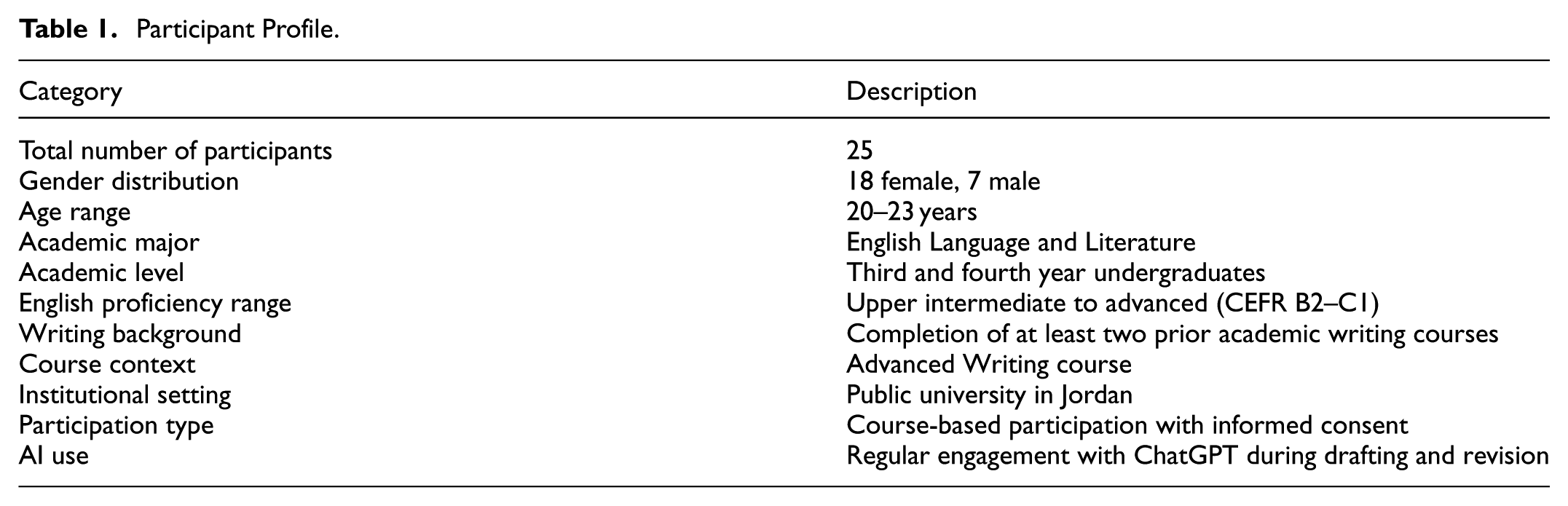
Participants were 25 undergraduate students enrolled in a single section of an Advanced Writing course in the English Language and Literature program at a public university in Jordan. A criterion-based purposeful sampling strategy was used to identify information-rich participants whose writing activity was analytically relevant to the study’s focus on human–AI mediation. This approach is consistent with qualitative standards in applied linguistics and writing research, where depth of interactional evidence and analytic relevance are prioritized over representativeness (Duff, 2008).
Eligibility criteria required that participants were in their third or fourth year of study, demonstrated upper-intermediate to advanced English proficiency equivalent to CEFR B2–C1 based on institutional placement, and had completed at least two prior academic writing courses. All students in the course engaged with ChatGPT as part of their natural writing practices. Informed consent was obtained for the use of writing data for research purposes, and participation or non-participation had no effect on grades or course standing.
All data were anonymized using participant codes (e.g., P01, P02) across logs, transcripts, and reporting. Participant demographics and contextual characteristics are summarized in Table 1.
Participant Profile.
Instruments and Data Collection
Data were collected over a 12-week period using multiple complementary sources designed to capture AI-mediated writing as interactional activity.
Primary data consisted of complete ChatGPT interaction logs, including prompts, AI-generated outputs, and follow-up queries, alongside time-stamped draft version histories documenting how AI-generated text was incorporated, modified, or rejected across composing stages.
Screen recordings were collected from a purposively selected subset of eight participants to capture real-time interactional sequences. Each focal participant contributed one recorded session per writing task, resulting in a total of 24 recorded sessions. These recordings documented prompt formulation, response evaluation, deletion, revision, and consolidation, providing fine-grained evidence of interactional decision-making that is not recoverable from drafts alone.
Participants used the free version of ChatGPT (GPT-4o-mini). Access conditions remained stable throughout the study period, and no instructional constraints or interface modifications were introduced.
Secondary data consisted of brief stimulated recall interviews conducted shortly after the 24 recorded sessions. These interviews were anchored exclusively to specific, time-stamped interactional moments visible in the screen recordings and logs. Their function was to contextualize observable actions, such as why a particular AI-generated sentence was deleted or reformulated. Interviews were not treated as experiential or attitudinal data and were not coded as independent analytic evidence.
Corpus Overview and Episode Sampling
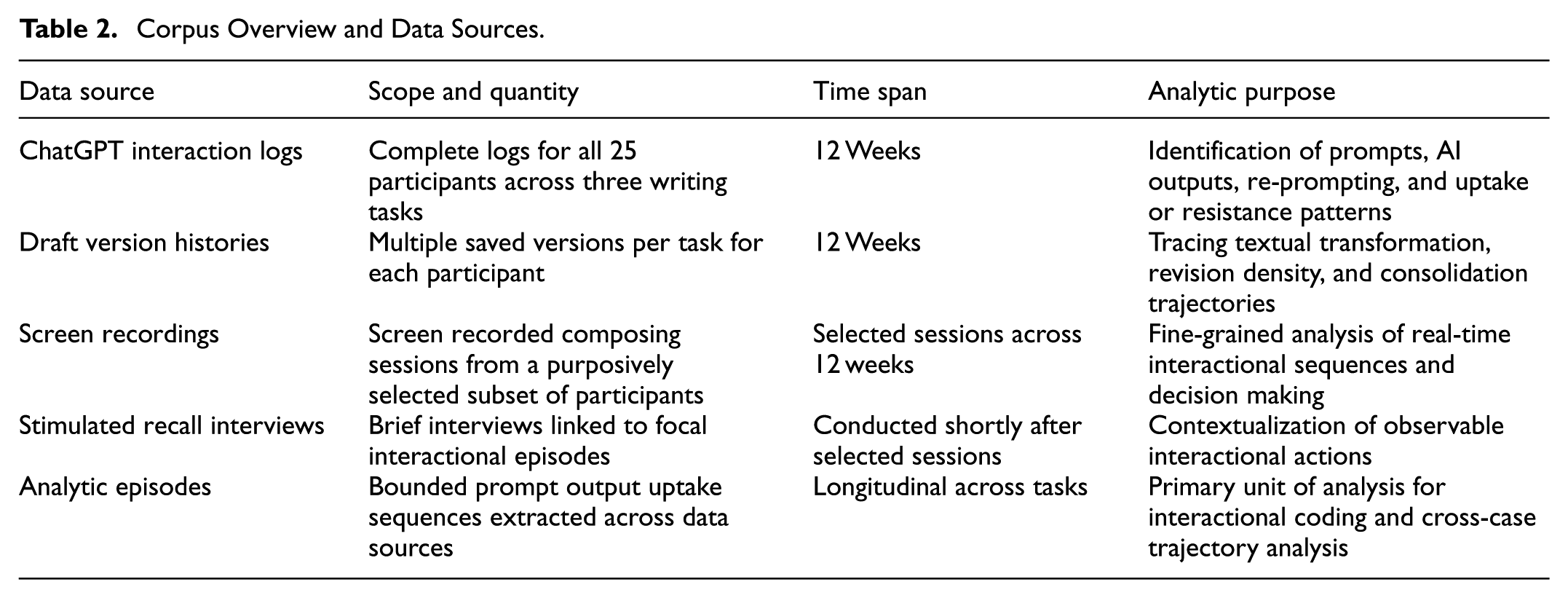
Across the 12-week period, the analytic corpus comprised complete AI interaction logs for all 25 participants, multiple time-stamped draft versions for each of three writing tasks, 24 screen-recorded composing sessions, and stimulated recall interviews linked to selected interactional moments. These sources were assembled to document writing as it unfolded through successive human–AI interactions rather than as finalized textual products.
Screen-recorded sessions and associated recall interviews were sampled using maximum variation principles to ensure representation across writing task types, composing stages, and observable patterns of AI engagement. Focal sessions included episodes characterized by high AI uptake, sustained resistance or constraint tightening, and extensive revision of AI-generated text, enabling analytic comparison across contrasting interactional practices.
The primary analytic unit was the interactional episode. An episode was defined as a bounded sequence consisting of (a) a writer-initiated prompt, (b) the corresponding AI-generated output, (c) an observable writer uptake action such as insertion, deletion, or reformulation, and (d) the resulting textual change in the evolving draft. In schematic terms, each episode followed the sequence: writer prompt → AI output → writer uptake or resistance → draft change. This sequence provided a consistent unit for comparing how participants accepted, modified, rejected, or consolidated AI-generated material across tasks. Episodes were identified through synchronized timestamps across AI logs, screen recordings, and draft version histories. Episodes were analytically nested within composing sessions, writing tasks, and participants, enabling longitudinal and cross-case analysis of interactional trajectories over time. An overview of the analytic corpus is provided in Table 2.
Corpus Overview and Data Sources.
Procedure
Over the 12-week period, participants completed three academic writing tasks: an argumentative essay, a reflective narrative, and a short research paper. AI use was unrestricted and unscripted but fully logged. Participants engaged with ChatGPT during drafting and revision according to their own writing practices, without prescribed prompts or mandated stages.
All composing sessions selected for analysis were screen recorded, and all ChatGPT interactions were archived. Drafts were saved at multiple points to create version histories documenting textual transformation over time. Stimulated recall interviews were conducted shortly after selected sessions and focused narrowly on specific interactional decisions visible in the recordings.
No instructional intervention, training, or evaluative feedback related to AI use was introduced as part of the research design. The study documented naturally occurring human–AI interaction during academic writing.
Data Analysis
Data were analyzed through a theory-informed qualitative framework. The analysis prioritized observable practices, such as prompting, deleting, revising, and incorporating AI output, rather than general beliefs or attitudes. Concepts from distributed cognition, human–computer interaction, and interactional theories of agency and identity informed the analytic lens without predetermining categories or outcomes.
Analytic Pipeline and Reliability
Analysis proceeded through four iterative stages.
First, interactional episodes were segmented. Screen recordings, AI logs, and draft histories were synchronized using timestamps, and composing activity was segmented into episodes based on observable transitions such as new prompt formulation, deletion of AI output, or initiation of revision.
To support direct inspection of the analytic basis, key episodes are presented in the Results as worked episode displays that align prompt turns, AI proposals, writer uptake actions, and resulting draft deltas. Episode identifiers remain traceable across synchronized logs, recordings, and versioned drafts.
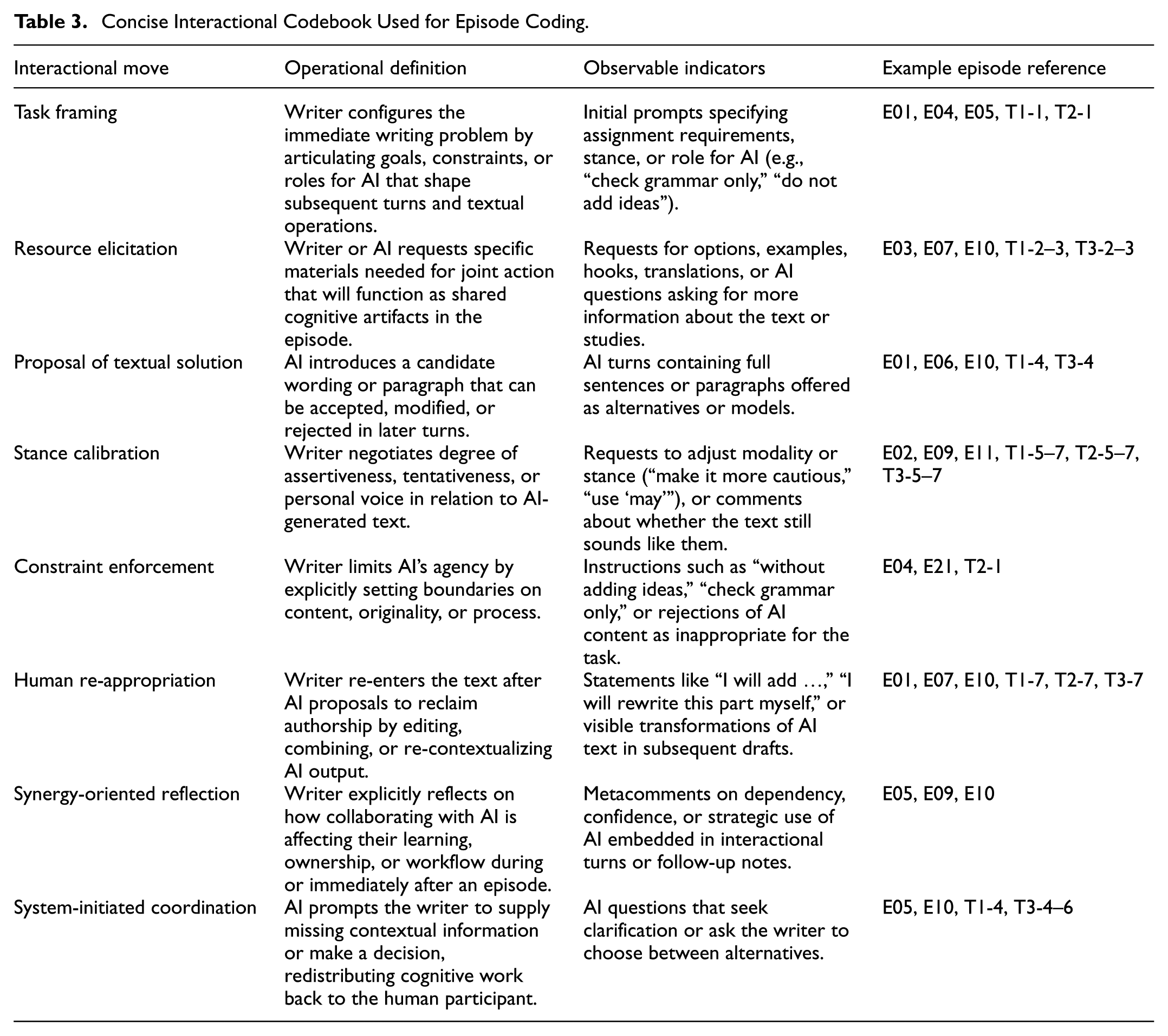
Second, interactional moves were coded. Episodes were coded for agency moves (e.g., provisional acceptance, resistance, override, reformulation), identity positioning (e.g., alignment, distancing, reassertion), and norm negotiation (e.g., academic conformity versus localized rhetorical expression). Codes were operationally defined and refined through iterative comparison across episodes and cases (Table 3).
Concise Interactional Codebook Used for Episode Coding.
Additional episode materials (episode inventory) are provided in Table A1.
Third, cross-episode and cross-case trajectory analysis was conducted. Coded episodes were examined longitudinally to identify recurring patterns and shifts in interactional strategies across writing tasks and composing stages. Analysis focused on changes in prompting density, revision activity, and consolidation behavior over time.
Fourth, negative case and boundary analysis was undertaken. Episodes that deviated from dominant patterns, such as near-wholesale uptake of AI output or minimal revision, were examined to refine analytic claims and delineate the limits of observed regularities.
To support analytic consistency, a delayed recoding procedure was employed. The primary researcher recoded a randomly selected 15% of the interactional episodes 3 weeks after the initial analysis. This procedure yielded a 94% agreement rate, with discrepancies resolved through reflexive memoing and refinement of code definitions to ensure they remained grounded in observable behavior.
Stimulated recall interviews were used selectively to contextualize specific interactional moments identified in the primary data and were not treated as standalone analytic evidence.
Credibility, Positionality, and Ethical Considerations
Credibility was supported through analytic triangulation across AI logs, screen recordings, draft version histories, and recall commentary. Interactional episodes were traceable across data sources using synchronized timestamps and episode identifiers. Dependability was strengthened through a documented audit trail of analytic decisions, code refinements, and reflexive memoing. Confirmability was supported through sustained reflexive practice focused on interrogating interpretive assumptions and analytic boundaries.
Researcher Positionality
The researcher was affiliated with the study context, providing relevant cultural and linguistic insight; potential power asymmetries were mitigated through voluntary participation, consent procedures emphasizing non-impact on grades, and anonymization after course completion. Reflexive journaling and memoing across the 12-week period supported analytic rigor by grounding interpretations in observable interactional behavior rather than pedagogical assumptions. Transferability was supported through detailed description of the context, participants, tasks, and analytic procedures (Lincoln & Guba, 1985). Ethical approval for this study was obtained from the relevant institutional review board prior to data collection. The study was approved under Decision No. 438/2025, dated 15 May 2025. The study design limited the risk of harm by focusing on routine academic writing practices and by not requiring participants to complete tasks beyond normal course activities. Participation was voluntary, and non-participation had no effect on grades, course standing, or access to instruction. The potential benefits outweighed the minimal risks because the study offers insights into how multilingual L2 writers negotiate agency, authorship, and identity when using generative AI, a topic of growing relevance to higher education, writing instruction, and ethical AI use. Before data collection, participants received clear information about the purpose of the study, the types of data to be collected, including AI interaction logs, draft histories, screen recordings, and stimulated recall interviews, and their right to withdraw without penalty. Informed consent was obtained from all participants before data collection. All data were anonymized and stored securely on password-protected devices.
Results
The analysis revealed recurring patterns in how multilingual L2 writers enacted agency and negotiated identity during AI-mediated academic writing. Across tasks and participants, these patterns appeared in how writers sequenced their interactions with AI, how they treated AI-generated text, and how they gradually consolidated authorship across drafts. Rather than appearing as isolated decisions, agency and identity emerged through sequences of coordinated actions distributed across prompts, AI outputs, revisions, and evolving drafts. The results are organized around the three research questions. “RQ1: Identity Negotiation During Real-Time Human–AI Interaction” section addresses RQ1 by examining how writers negotiated identity through alignment with, modification of, or distancing from AI-generated academic language. “RQ2: Interactional Patterns Signaling Shifts in Writer Agency” section addresses RQ2 by tracing interactional patterns that signaled shifts in writer agency across composing stages. “RQ3: Managing Tensions Between Academic English Norms and Local Identity Expression” section addresses RQ3 by examining how writers managed tensions between academic English norms and locally grounded identity expression during authorial consolidation. “Cross-Case Trajectories of Human-AI Mediation” section synthesizes cross-case trajectories across participants and tasks.
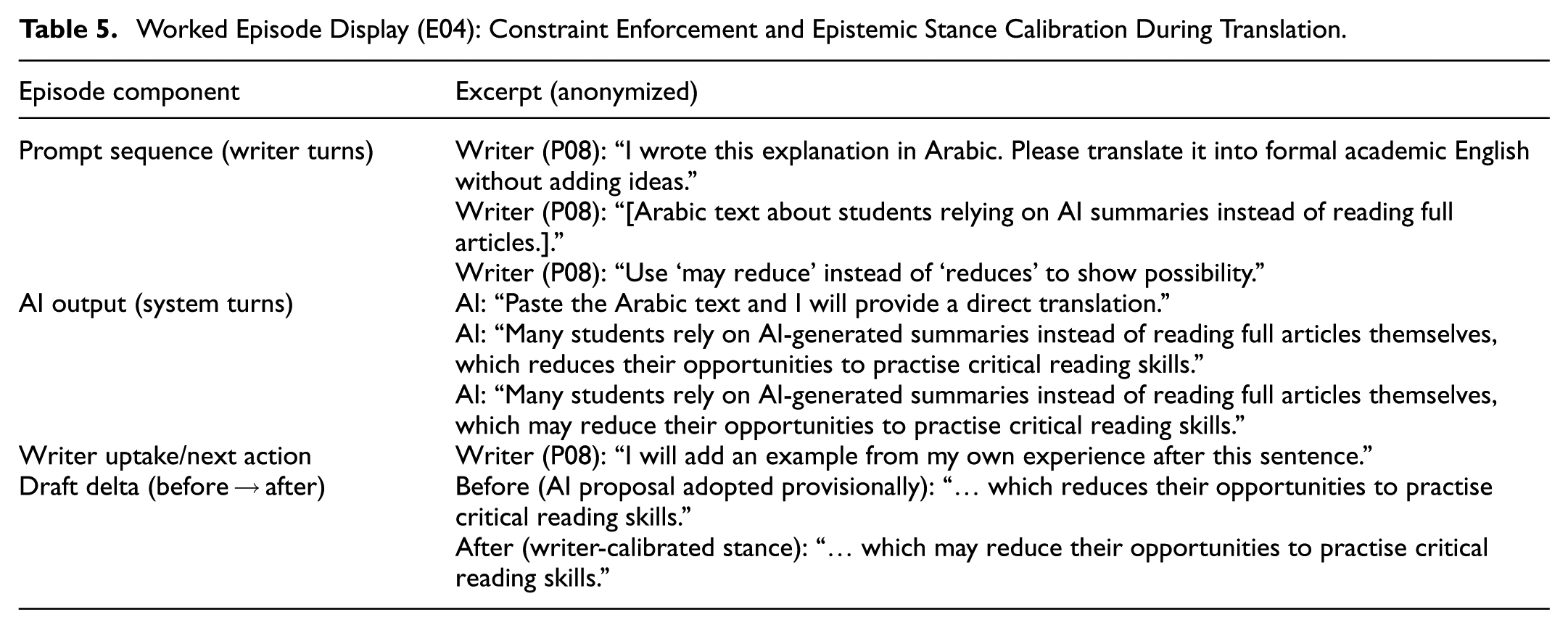
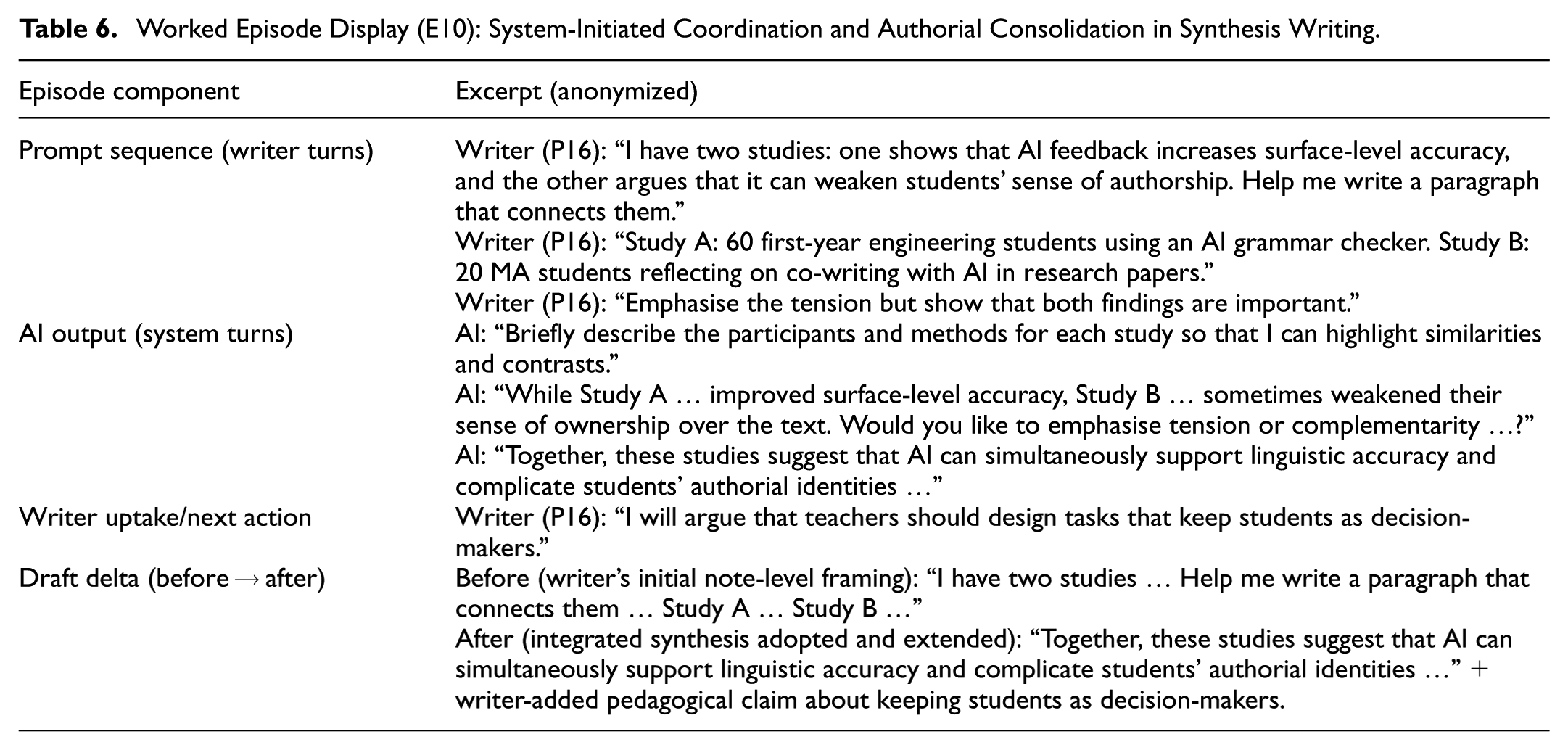
To foreground the interactional evidence, each results subsection includes a worked episode display (Tables 4–6) that reproduces prompt turns, AI proposals, writer uptake, and the associated draft delta. Remaining episodes are summarized across cases and indexed in Appendix A.
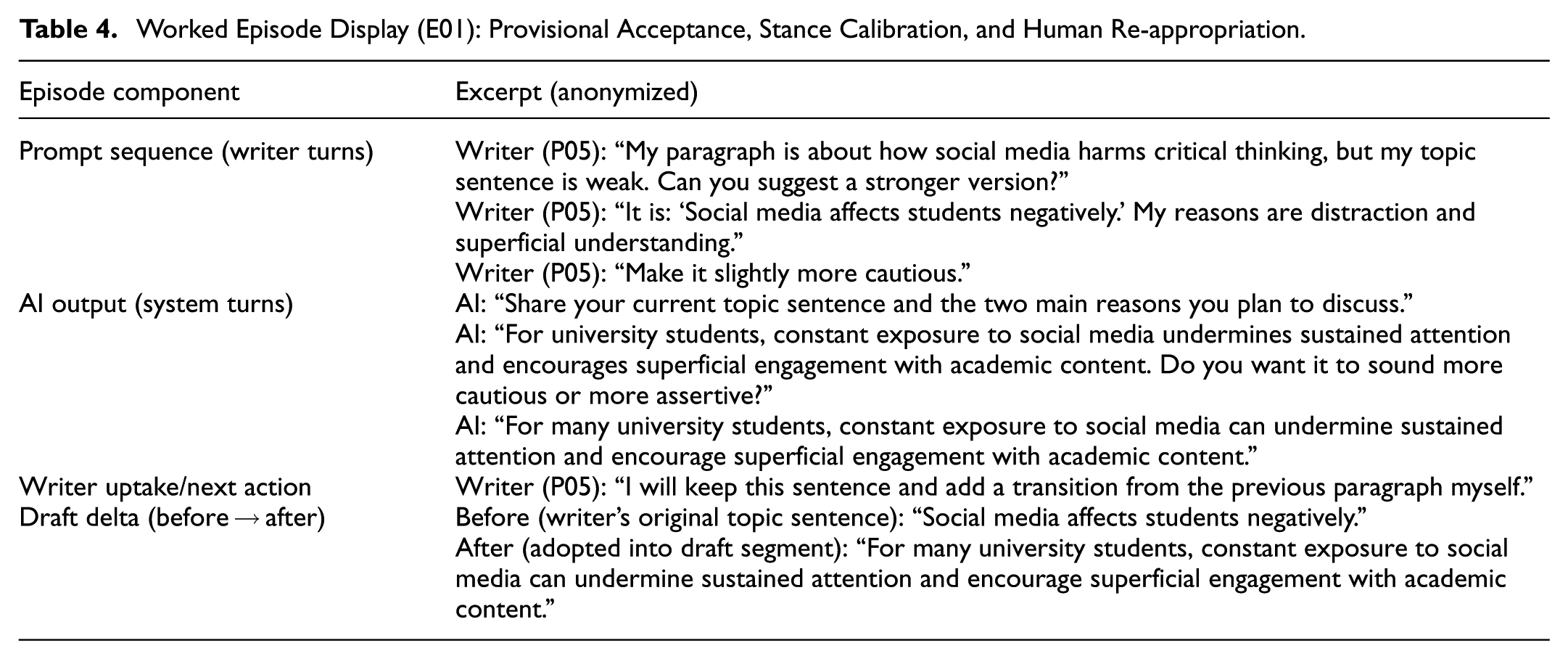
Worked Episode Display (E01): Provisional Acceptance, Stance Calibration, and Human Re-appropriation.
Worked Episode Display (E04): Constraint Enforcement and Epistemic Stance Calibration During Translation.
Worked Episode Display (E10): System-Initiated Coordination and Authorial Consolidation in Synthesis Writing.
RQ1: Identity Negotiation During Real-Time Human–AI Interaction
Across the dataset, agency was enacted not as a stable personal attribute but as a sequence of interactional moves unfolding across composing stages. Screen recordings and interaction logs consistently showed that writers rarely accepted AI output wholesale. Instead, composing was organized around cycles of proposal, evaluation, uptake, modification, and in some cases rejection, with these cycles often repeating within a single paragraph or drafting session.
A recurrent pattern involved provisional acceptance followed by immediate revision. Episode E01 (Table 4) illustrates this sequence: P05 requests a stronger topic sentence, the system proposes candidate formulations, and the writer calibrates stance (“slightly more cautious”) before adopting the sentence and reclaiming authorial control by adding a human-authored transition.
In stimulated recall, participants often described using AI output as a provisional base that required re-authoring to preserve authorial distinctiveness (e.g., P07: “I used it as a base, but I could not leave it like that. It sounded like it could belong to anyone. I needed to make it argue my point”).
In other cases, agency was enacted through explicit resistance. In a thesis formulation episode, P14 rejected multiple AI-generated reformulations by repeatedly re-prompting the system. Interaction logs show three successive prompts within a two-minute span, each narrowing constraints by specifying what the thesis should not do. Each AI output was read briefly and deleted without insertion. Screen recordings confirm that no revision of the AI text occurred prior to deletion.
Reflecting on this episode, P14 stated, “It kept pushing it toward something safer. I did not want safe. I wanted it to sound more direct, even if it was less polished” (Stimulated recall, P14, argumentative essay, Week 2, 00:08:44). Here, resistance was enacted through repeated deletion and constraint tightening, demonstrating agency as an iterative interactional practice rather than a binary choice.
RQ2: Interactional Patterns Signaling Shifts in Writer Agency
Identity was enacted through writers’ moment-to-moment alignment with or distancing from AI-generated language. Across tasks, participants oriented to AI output as carrying an implicit and standardized academic voice that could be selectively appropriated, reshaped, or rejected. This orientation was visible in revision timing, lexical choice, and decisions about whether to reuse AI-generated material.
Episode E04 (Table 5) illustrates identity positioning through stance calibration and constraint enforcement. P08 frames the AI’s role as a direct translator (“without adding ideas”), then modifies the AI’s categorical claim to a modalized formulation (“may reduce”) to align the sentence with the writer’s epistemic stance and planned personal elaboration.
In this episode, identity is visible in the writer’s stance calibration and ownership management. P08 does not simply accept the AI translation as a correct academic version; rather, the writer modifies the categorical claim “reduces” into the more tentative “may reduce” and then plans to add a personal example. These moves show identity as authorial positioning: the writer aligns with AI-supported academic English while also preserving epistemic caution, experiential grounding, and control over the emerging argument.
During the research paper task, P03 accepted an AI-generated transition sentence connecting two theoretical claims, then replaced abstract nominalizations with more concrete verbs and substituted generalized academic vocabulary with expressions used elsewhere in the draft, retaining the syntactic frame while shifting lexical choices. As P03 noted, “The structure was useful, but the words felt too textbook. I kept the shape but changed the sound” (Stimulated recall, P03, research paper, Week 7, 00:21:05), illustrating identity positioning through selective uptake in which organizational affordances were preserved while stylistic control was reasserted.
In contrast, P19 deleted a polished AI-generated paragraph in a reflective narrative without revision, and no elements appeared in later drafts. As P19 explained, “It was correct, but it was not how I would argue it. If I kept it, the paper would not feel like mine anymore” (Stimulated recall, P19, reflective narrative, Week 5, 00:15:12), showing that identity was enacted through rejection rather than modification, and that authorship was negotiated through exclusion as well as incorporation. Across these examples, identity is therefore traced through concrete textual decisions: stance adjustment signals authorial caution, lexical revision signals control over voice, and deletion of fluent but generic AI prose marks a boundary of textual ownership.
RQ3: Managing Tensions Between Academic English Norms and Local Identity Expression
Negotiation between academic English norms and locally grounded identity expression was most visible during later stages of drafting, when writers consolidated AI-mediated revisions into a coherent authorial text. Version histories across tasks showed that early drafts often contained a higher proportion of AI-generated phrasing, while later drafts reflected increased synthesis, compression, and normalization under writer control.
Episode E10 (Table 6) shows norm negotiation during synthesis and consolidation in a literature review segment. The AI redistributes coordination by requesting missing contextual details, proposes an integrated synthesis, and the writer directs the rhetorical relation (“emphasise the tension”) before adding an explicit pedagogical claim that positions writers as decision-makers rather than passive adopters.
P11’s draft trajectory shows early reliance on extended AI-generated explanations that were later shortened, paraphrased, and integrated with writer-added citations; screen recordings captured P11 rereading a paragraph aloud, deleting several sentences, and rewriting the remainder to better align with the argument. As P11 noted, “At first, I let it explain things broadly. Later, I had to make it fit academic expectations and also fit how I usually write” (Stimulated recall, P11, research paper, Week 9, 00:33:48), a shift observable across cases as decreased prompting and increased revision during consolidation.
Norm negotiation did not entail uniform conformity. P22 repeatedly rejected or revised AI suggestions that neutralized evaluative markers, retaining longer sentences and explicit stance in the final draft. As P22 explained, “The AI kept smoothing it out. I wanted it to stay a bit more forceful, even if it sounds less neutral” (Stimulated recall, P22, argumentative essay, Week 4, 00:19:02), showing academic norms treated as constraints to be negotiated rather than imposed through AI-mediation.
Cross-Case Trajectories of Human-AI Mediation
Across participants and tasks, writers developed recurring strategies for engaging with AI (e.g., structural scaffolding, lexical exploration, initial elaboration) while retaining final decision-making; these strategies stabilized over time but varied by task and composing stage. Longitudinally, early interactions showed higher prompting density and greater tolerance for provisional AI uptake, whereas later stages emphasized revision, consolidation, and selective suppression, with no participant relinquishing control over authorial consolidation. This pattern was consistent across screen recordings, interaction logs, and draft histories, indicating that agency and identity were maintained through ongoing interactional practices distributed across time, tasks, and composing stages rather than through a single decisive act.
Discussion
This study examined human–AI mediation in L2 academic writing by treating interaction itself as the analytic object. The findings indicate that agency and identity are not properties that writers possess prior to composing, nor effects attributable to AI use alone. Rather, they are enacted through sequential and observable practices as writers coordinate with a generative system across drafting stages. When read alongside research on human–AI interaction, distributed cognition, and sociomaterial authorship, the results demonstrate how agency and identity become visible in writing activity. They also suggest that these patterns can be traced through observable interactional moves rather than inferred only from final texts or self-reports.
The discussion develops this argument in four steps. First, it explains human–AI mediation as sequential coordination. Second, it shows how writing activity is distributed across writers, systems, and drafts. Third, it clarifies agency as observable uptake, resistance, and reformulation. Fourth, it explains identity as positioning through alignment with, or distancing from, AI-generated academic language.
The worked episode displays in Tables 4 to 6 make visible the sequential organization of mediation: writers configure tasks and constraints, AI proposes candidate text, and writers accept, resist, or reformulate while consolidating drafts. These episodes provide the direct empirical basis for the cross-case patterns discussed in the subsections that follow.
Human-AI Mediation as Sequential Coordination
Across cases, writers engaged AI through patterned sequences of proposal, evaluation, and consolidation. These sequences align with prior findings in human-computer interaction research showing that writing assistants function as interactional turns that invite response rather than as static aids (Arnold et al., 2016; Buschek et al., 2021). The present analysis extends this work by demonstrating how such sequences unfold longitudinally in academic writing and how their organization shifts across composing stages. Early provisional acceptance followed by immediate modification, repeated re-prompting to constrain system output, and later consolidation under writer control emerged as recurrent interactional patterns.
These findings support a view of mediation in which AI shapes the timing and form of action without determining outcomes. Consistent with accounts of AI-mediated communication, the system structures possibilities for expression through affordances such as fluency, generality, and stylistic smoothing, while writers enact control through interactional moves that accept, resist, or reframe those possibilities (Hancock et al., 2020). From this perspective, mediation is neither neutral nor deterministic but enacted through sequential coordination, making agency analytically observable in situated interaction.
Distributed Cognition and the Reorganization of Writing Activity
The findings provide process-level evidence for treating AI-mediated writing as distributed cognitive activity. Writers routinely offloaded tentative formulations to the system, evaluated returned text as provisional material, and reintegrated selected elements into evolving drafts. These recursive loops resemble prior descriptions of machine-in-the-loop writing as sensemaking through interaction rather than execution of predefined plans (Clark et al., 2018). What the present study adds is a detailed account of how such loops reorganize responsibility for meaning across composing stages.
Early in drafting, AI output functioned as an expansive resource that enabled exploration of phrasing, structure, and argumentation. Later, the same output became material to be disciplined, compressed, or rejected during consolidation. This shift suggests a trajectory in which the role of AI changes across phases of activity rather than remaining constant. Such trajectories are consistent with distributed cognition accounts emphasizing that tools participate differently across stages of practice and that writing should be understood as temporally extended activity rather than as a single act (Cope et al., 2020; Hayes, 2012).
Agency as Enacted Through Acceptance, Resistance, and Reformulation
The analysis demonstrates that agency in AI-mediated writing is enacted through interactional moves rather than through global control or stated intention. Acceptance, resistance, override, and reformulation were not isolated decisions but components of extended sequences unfolding across prompts, revisions, and draft versions. These patterns mirror prior findings on predictive and generative text systems, where writers negotiate influence by modulating uptake rather than by choosing between use and nonuse (Bhat et al., 2021; Buschek et al., 2018).
Importantly, acceptance did not signal surrender of authorship. Instead, it often functioned as a temporary alignment that enabled subsequent modification and consolidation. Resistance was enacted through repeated deletion, constraint tightening, and selective suppression rather than explicit refusal. These observations support interactional accounts of agency that conceptualize it as a dynamic accomplishment distributed across time and activity rather than as a stable individual capacity (Hayes, 2012; Koltovskaia et al., 2024).
Identity as Performative Positioning in AI-Mediated Writing
Identity emerged in this study as a performative accomplishment enacted through alignment with or distancing from AI-generated language. Writers oriented to AI output as carrying an implicit and standardized academic voice, which they selectively appropriated or suppressed depending on local rhetorical goals. These practices align with posthumanist and sociomaterial accounts that locate identity in situated action within assemblages of human and nonhuman actors rather than in stable personal traits (Haraway, 1991; Pennycook, 2017).
Identity work was embedded in micro-level revision decisions such as preserving syntactic structure while altering lexical choices or rejecting fluent but generic passages to maintain a sense of authorship. This finding connects directly to L2 writing scholarship on voice and authorial identity, which has shown that multilingual writers’ academic texts are shaped not only by linguistic proficiency but also by how writers project authority, stance, and ownership in institutionally valued forms of discourse (Hyland, 2002; Matsuda & Tardy, 2007; Tardy, 2012, 2016). In this literature, voice is not treated as a purely personal or stylistic feature; rather, it is understood as a socially situated rhetorical accomplishment through which writers position themselves in relation to disciplinary expectations, audience assumptions, and available linguistic resources. The present findings extend this line of work by showing that, in AI-mediated writing, such positioning is negotiated interactionally: writers may borrow AI-generated structures, reject overly generic formulations, recalibrate stance, or revise lexical choices in order to maintain a recognizable authorial presence. For L2 writers, therefore, AI-generated academic fluency becomes both a resource and a pressure, supporting access to valued academic forms while also requiring active work to preserve voice, ownership, and rhetorical responsibility. These practices were particularly salient during consolidation, when writers negotiated the fit between academic norms and locally grounded ways of arguing. Rather than treating norms as fixed standards imposed by the system, writers engaged them as constraints to be managed through interaction, reinforcing views of academic discourse as negotiated and historically situated (Darvin, 2025; Lillis et al., 2020).
Implications for Theorizing Human-AI Writing Interaction
Taken together, the findings reframe AI-assisted writing as identity work distributed across writers, systems, prompts, outputs, and drafts. The study shows what human–AI mediation looks like in practice by tracing observable patterns of acceptance, resistance, reformulation, and consolidation. When generative systems participate in writing, agency and identity are most productively examined in the sequential organization of interaction and the transformation of AI output across drafts rather than in attitudes, perceptions, or final text quality alone.
This interactional framing complements and extends existing human-computer interaction research by foregrounding authorship and norm negotiation as central analytic concerns. It also underscores the value of methods that capture writing in motion, including screen recordings, interaction logs, and version histories, for understanding how human and nonhuman contributions are coordinated over time. For writing studies, these findings suggest that authorship and agency should be theorized as emergent properties of distributed composing activity rather than as individual capacities preceding writing.
Scope, Delimitations, and Directions for Future Research
The discussion should be interpreted in light of the study’s delimitations. The analysis does not evaluate learning outcomes, improvement, or instructional effectiveness, nor does it advance pedagogical prescriptions. The study contributes by theorizing human–AI mediation in L2 academic writing as situated and distributed interaction through which agency and identity are enacted moment by moment. Because the study was conducted in a single Advanced Writing course at one public university in Jordan, the findings should be understood in terms of analytical transferability rather than statistical generalizability. The specific patterns observed here may differ in other L2 settings, disciplinary contexts, proficiency levels, genres, or AI platforms. However, the study’s focus on prompt–output–uptake–revision sequences provides a transferable analytic framework for examining how multilingual writers negotiate agency, identity, and authorship when composing with generative AI. Future research could therefore apply this framework in other institutional, disciplinary, and technological contexts to examine how different writing norms and AI tools shape human–AI mediation. The findings should also be interpreted in relation to the specific AI system used in the study. Participants used GPT-4o-mini, and interactional patterns may have been shaped by model-specific features such as output variability, sensitivity to prompt wording, and the possibility of producing overly generic, inaccurate, or unsupported suggestions. These limitations are relevant because writers’ resistance, constraint tightening, deletion, and reformulation may partly reflect their responses to the system’s instability or limitations. Future studies could compare different AI models and interface designs to examine how model reliability, output style, and prompt sensitivity shape agency and identity negotiation in AI-mediated writing.
Future research could extend this interactional framework to other writing contexts, including professional, disciplinary, and multilingual settings beyond undergraduate coursework, as well as to different AI interfaces and design configurations. Comparative studies examining how interactional patterns vary across institutional norms, genres, or levels of writer expertise would further refine understanding of how agency and identity are negotiated in AI-mediated writing environments.
Conclusion
This study treated human–AI interaction in L2 academic writing as the analytic object. It showed that writing with AI is not merely tool use or instructional support, but a coordinated activity in which agency and identity are enacted across writers, systems, prompts, outputs, and drafts. Across tasks, writers engaged AI through recurring cycles of proposal, evaluation, modification, and consolidation, demonstrating that agency is accomplished over time rather than in single acceptance or rejection decisions: acceptance functioned provisionally, resistance took the form of deletion and constraint tightening, and reformulation enabled reclamation of authorial control.
The findings also show how identity is performed through selective alignment with and distancing from AI’s standardized academic voice, embedded in micro-level revisions such as lexical substitution, syntactic reshaping, and suppression of fluent but generic passages. Rather than reproducing academic norms wholesale, writers negotiated these norms as constraints during authorial consolidation. Methodologically, the study contributes a process-level account of AI-mediated writing based on screen recordings, interaction logs, and draft histories, demonstrating the value of capturing writing in motion and making visible the distributed nature of cognitive and rhetorical labor. The study does not address learning outcomes or pedagogy; its contribution lies in specifying interactional patterns through which agency and identity are enacted in AI-mediated composing. As generative systems become embedded in writing environments, an interactional approach provides a foundation for theorizing authorship and composing as distributed activity within evolving sociotechnical assemblages.
Footnotes
Appendix A
Acknowledgements
The authors thank the editor and the three anonymous reviewers for their careful reading of the manuscript and their constructive comments. The authors also thank the participating students for their time and openness during data collection and the course instructors for facilitating access to the research context.
Ethical Considerations
Ethical approval for this study was obtained from the relevant institutional review board prior to data collection. The study was approved under Decision No. 438/2025, dated 15 May 2025. Participation was voluntary, and all participants provided informed consent prior to data collection. Data were anonymized prior to analysis and reporting, and participants were informed of their right to withdraw without penalty. All procedures complied with institutional and international ethical guidelines for research involving human participants.
Consent to Participate
Informed consent was obtained from all participants before data collection. Participants were informed of the purpose of the study, the nature of their involvement, the types of data to be collected, their right to withdraw at any time without penalty, and the measures taken to protect confidentiality and anonymity.
Author Contributions
Hesham Aldamen: Conceptualization, Methodology, Investigation, Data curation, Formal analysis, Writing – original draft, Writing – review and editing. Mohamad Almashour: Investigation, Data curation, Formal analysis, Writing – original draft, Writing – review and editing. Marwan Jarrah: Conceptualization, Methodology, Supervision, Writing – review and editing, Project administration.
Funding
The authors received no financial support for the research, authorship, and/or publication of this article.
Declaration of Conflicting Interests
The authors declared no potential conflicts of interest with respect to the research, authorship, and/or publication of this article.
Data Availability Statement
The interaction logs, screen recordings, draft version histories, and interview materials that support the findings of this study contain sensitive personal data and cannot be made publicly available. An anonymized subset of materials and the interactional codebook are available from the corresponding author upon reasonable request.*
GenAI Use Disclosure Statement
Generative AI tools were not used to generate research data or to conduct data analysis. Generative AI was used in a limited manner to support language editing and clarity during manuscript preparation. Specifically, ChatGPT (OpenAI; GPT-4o-mini), accessed via  , was used intermittently for surface-level language editing between January and February 2026. No proprietary data were uploaded to the system, and no AI-generated content was used without critical review and human authorship. The authors take full responsibility for the content of the manuscript.
Figshare Statement
No Figshare repository was used for this submission.