






Abstract
Generative AI (GenAI) is reshaping the teaching of English as a foreign language (EFL), but research on how teachers’ cognition affects their teaching integration is still limited. This qualitative study, based on Borg’s teacher cognition model, explores Chinese university EFL teachers’ cognition on GenAI, aiming to address a gap in understanding how teachers’ beliefs and concerns, the conceptualization and enactment of TPACK and the interpretation and construction of professional roles shape technology adoption. The data were collected through semi-structured interviews with six EFL teachers and analyzed through thematic analysis. The results reveal three interrelated dimensions: teachers’ beliefs and concerns form a dynamic balance that plays a regulatory role between technological automation and human agency; the ethical awareness reconstructs TPACK into an ethical-centered system; the role of teachers has changed from knowledge transmitters to learning facilitators and ethical mentors. Based on the findings, this study proposes a techno-ethical teaching framework that combines cognitive pillars, practical mechanisms, and support systems. These findings also indicate that professional training and institutional policies should not only stay at the level of simple technical operations, teachers need to be supported to form technical-ethical judgment, and truly play a central role in the sustainable and responsible GenAI integration.
Plain Language Summary
This qualitative study explored how six Chinese university teachers think about and use generative AI (GenAI) in teaching English as a Foreign Language (EFL). The aim was to understand what shapes their decisions to adopt or avoid AI tools in teaching. The researchers found three key insights. First, teachers struggle to balance the convenience of AI with their own role in guiding students' learning. Second, knowing how to use AI ethically such as avoiding plagiarism and protecting privacy has become just as important as knowing the technology itself. Lastly, teachers see their roles less as mere deliverers of knowledge and more as guides and moral mentors. Based on these findings, the study suggests a new teaching framework that combines technology with ethical considerations. It also argues that training programs and school policies should help teachers develop sound judgment in the use of AI, not just teach them how to use the technology.
Keywords
Introduction
The rapid expansion of generative artificial intelligence (GenAI) in the field of education has led to a transformative shift in teaching theory and practice (Kohnke et al., 2023). This is especially noticeable in language education (Tan & Zhao, 2025), where GenAI tools such as ChatGPT have greatly facilitated intelligent, immediate and personalized learning support (Baidoo-Anu & Ansah, 2023; Wu et al., 2025). In English as a Foreign Language (EFL) context, a growing body of research (e.g., Ghafouri et al., 2024; Orhan et al., 2024; Teng, 2024) has highlighted GenAI’s potential, namely, to reduce teachers’ workload (Law, 2024), support professional development (Brandão et al., 2024; Tafazoli, 2024), and enhance learners’ motivation, engagement, and language proficiency (Pan et al., 2025; Zhai, 2025). However, potential benefits that GenAI tools bring come along with increasing tensions in real classroom settings. According to Allen and Mizumoto (2024), empirical evidence on the impact of GenAI on language teaching in daily educational practice is still limited. At the same time, there are still many concerns about its sustainable, ethical and equitable integration (Kim & Danilina, 2025; Mahmoudi-Dehaki & Nasr-Esfahani, 2025). Luo et al. (2024) compared the introduction of GenAI to “opening Pandora’s box,” pointing out that it may lead to a series of problems, including academic integrity crisis, excessive technical dependence and the emergence of dehumanized education paradigm (Barrot, 2023; Nguyen & Hoang, 2025; Rudolph et al., 2023).
Teachers play a key intermediary role in promoting or limiting the classroom application of GenAI (Chan & Tsi, 2024; Kumar & Sharma, 2025). In this context, understanding the teacher’s perspective is critical to bridging the gap between GenAI’s technological potential and classroom reality, as argued by Prilop et al. (2024). Lan and Chen (2024) pointed out that success in technological change is based on teachers’ cognition, which may affect decision-making, the use of tools and the development of professional competence. Borg (2006) pointed out that teacher cognition is formed by beliefs, knowledge, attitudes and assumptions. With the revolutionary growth of GenAI, teachers’ concerns have become a key cognitive-affective factor affecting technology integration (Dele-Ajayi et al., 2021). When applying GenAI, each teacher’s perception affects their understanding of the benefits and risks, their technical capabilities, and their possible technological impact (Zhai, 2025). However, current research tends to treat teacher cognition as a broad concept, without fully distinguishing how individual aspects such as beliefs, professional knowledge, and understanding of roles interact to form a way to integrate GenAI into classroom practice. In particular, how teachers use technological, pedagogical, and content knowledge (TPACK) to deal with GenAI has not been fully explored.
In addition, as the latest research shows, teachers’ engagement with GenAI is closely related to their cognitive orientation and interpretation strategies (Bae et al., 2024; Hutauruk & Daulay, 2024; Zhai, 2025). Considering the important cognitive role of teachers in the formation of technology integration, it is worrying when teachers’ continuous and significant use of GenAI in daily classrooms is still limited (Whalen et al., 2025). Niepes (2025) pointed out that current research usually discusses technology, teaching methods and human factors separately.
Taken together, there is still a lack of an accurate understanding of how teachers’ cognitive processes, especially their beliefs, knowledge and cognition of their own roles, form the integration of GenAI, especially among EFL teachers in China. This gap is consistent with the criticism put forward by Kizilcec et al. (2024) and Zhai (2025), who believe that human factors, that is, teachers themselves, their teaching choices and life experience, are widely ignored in the literature. To address this gap, the present study examines Chinese university EFL teachers’ cognition of GenAI integration, focusing on their beliefs and concerns, their conceptualization and enactment of TPACK, and their interpretation and construction of professional roles.
Literature Review
Teachers’ Beliefs and Evaluative Concerns in GenAI Integration
Today, the research on language teachers’ cognition has shifted from simply observing teachers’ teaching behavior to deeply analyzing their complex cognitive world (Burns et al., 2015). Borg (2006) proposed the teacher’s cognitive model, believing that teachers’ behavior in the classroom is influenced by the system of beliefs, knowledge and learning experience. Teachers’ cognitive structure largely affects their teaching decisions (Martínez et al., 2025) and the way they achieve development through reflection and professional practice (Levin, 2014). However, previous studies (e.g., Chen & Abdullah, 2023; Wei & Zhang, 2025) always reported that there is an inconsistency between teachers’ cognition and practice, which highlights the influence of contextual factors, such as limited resources, insufficient professional development and organizational constraints on teachers’ cognitive decision-making. This is also pointed out by Flint et al. (2024), Gao et al. (2020), and Luo et al. (2020), suggesting the need to go beyond isolated perspectives and study teacher cognition in a multi-level ecosystem, including classrooms, schools and broader social and cultural norms.
Teachers’ internal cognitive tension, especially beliefs, concerns and external environmental factors, has become more complicated due to the emergence of GenAI. Although Borg (2006)’ s framework does not explicitly mention concern, it can be understood as a cognitive assessment of the uncertainty of the potential risks of using technology and the ethical consequences. Research shows that teachers’ concerns affect the way they actually interact with GenAI. Teachers who prefer constructivism and student-centered teaching methods often regard GenAI as an educational tool that can support personalized teaching, student autonomy and differentiated teaching as Martinez et al. (2025) reported. Based on this perspective, GenAI is often seen as a potential way to improve education equity (Mah & Groß, 2024). In contrast, practitioners with traditional educational beliefs hold concerns that these tools will weaken the quality of teaching, creativity, critical thinking and teachers’ autonomous decision-making ability. As Moorhouse and Kohnke (2024) claimed, the role of teachers may be reduced to a passive one. In such cases, teachers’ concerns shape the way they integrate GenAI, prompting them to use it more cautiously or selectively, and to carefully balance technical capabilities with ethical and teaching considerations.
Conceptualizing and Enacting TPACK in GenAI-Integrated Teaching
To understand how teachers respond to this pressure, we need to study the overall structure of their ability and willingness to integrate technology. Research on technology cognition shows a consistent result: teachers’ previous experiences with educational technology influence how they interact with new tools (Krushinskaia et al., 2024). Teachers’ successful use of digital tools can significantly increase their acceptance of new technologies, such as GenAI, as reported in the study by Cabellos et al. (2024) on 321 university teachers across Spain’s public and private institutions. Another study conducted by Luo and Day (2026) surveyed 651 university lecturers in mainland China and found that their psychological needs for autonomy, competence, and relatedness were the strongest drivers of their intention to use GenAI.
The Technological Pedagogical Content Knowledge (TPACK) framework (Mishra & Koehler, 2006) suggests that teachers should possess technical knowledge (TK), pedagogical knowledge (PK), and content knowledge (CK) for effective teaching. Empirical studies have found that teachers who have a good grasp of TPACK are more motivated and willing to try new technologies as Bardakcı and Alkan (2019) reported. A case study done by Lai Wah and Hashim (2021) in Malaysia has also reached similar conclusions. Yang et al. (2021) also found that the richer the teacher’s experience in TPACK, the more new technologies can be used in teaching. As Mishra et al. (2023) further argue, if teachers want to make good use of GenAI in education, they need to work hard on several aspects of TPACK, especially to understand the social background and human changes behind it.
However, the unique attributes of GenAI like its generative ability, autonomy and internal bias, expose the limitations of the traditional TPACK model and lead to a deeper contradiction: the conflict between technical ability and ethical-pedagogical constraint. Scholars believe that responsible integration requires a clear framework for dealing with ethical knowledge. Celik (2023) argued that “intelligent TPACK” should include an ethical dimension beyond technical skills, which was also supported by Lan et al. (2025). Ning et al. (2024) proposed an AI-TPACK framework that integrated AI-specific capabilities. This development marks a paradigm shift that the successful integration of GenAI is a practice of critical judgment, not a simple application of technology.
The current literature indicates that teachers feel this pressure strongly. According to Akanzire et al. (2025), although they acknowledge the potential of GenAI to transform teaching practices, they explicitly expressed concerns that academic integrity, data privacy, algorithmic fairness, and the value of human-centered teaching may be undermined as reported in numerous studies (e.g., Kumar & Vavekanand, 2025; Safi, 2025; Tlili et al., 2025). In addition, as Quaicoe and Pata (2018) contend, practical obstacles such as insufficient preparation, lack of technical support and institutional obstacles still exist. Therefore, teachers continuously weigh the benefits and risks of GenAI in ways that integrate their TPACK knowledge with ethical and contextual considerations.
Teacher Cognition and Role Interpretation in GenAI-Supported Contexts
Teachers’ cognition forms the way they interpret, negotiate and construct their professional roles in a classroom supported by GenAI. As discussed by Lan and Chen (2024), the success of technological change depends on teachers’ way of thinking. In GenAI-supported teaching context, the way teachers understand their roles is largely influenced by their cognition. Isma'il and Ibrahim (2025) argue teachers’ role is not fixed, but evolves along with technological challenges as Ayanwale et al. (2024) and Tan et al (2025) both identified. Therefore, studying the development of this role helps to explain how teachers mediate GenAI use in practice.
The introduction of GenAI created ethical and professional expectations that teachers need to adjust to meet their teaching responsibilities. Iqbal et al. (2025) and Zhang et al. (2026) reported that teachers now face challenges, such as academic integrity, data privacy, and fairness in AI-supported learning. These challenges require teachers to integrate institutional policies, teaching objectives and ethical considerations in daily teaching. As Shao and Sun (2025) pointed out, these pressures are reshaping teachers’ professional identity, shifting them from traditional knowledge transmitters to ethically responsible learning facilitators.
In addition, the formation of teacher roles depends on external contextual factors, including political trends, professional training and institutional support. A study by Wang et al. (2026) shows how EFL teachers in China experienced identity tensions when integrating GenAI in language teaching with factors such as students’ expectations and interaction with GenAI developers may affect their roles. However, these external factors do not directly determine the role of teachers, but change through teachers’ cognitive mediation. As Bae et al. (2024) argue, teachers’ cognition plays a key role in interpreting and applying technology. Teachers who actively reflect on these challenges are more likely to form roles that can balance student autonomy, instructional design, and ethical supervision.
Research Gap and Purpose
Although research on teachers and GenAI has increased, there are still three gaps. First of all, as Kizilcec et al. (2024) and Zhai (2025) mentioned, there is still little interest in the impact of teachers’ cognitive processes on technology integration. In particular, beliefs and concerns regarding GenAI, knowledge (including knowledge related to TPACK), role cognition, and how to interact with contextual factors to guide classroom practice have not been fully explored.
Secondly, although there are a large number of studies on teacher cognition and the use of GenAI, there are still few studies on EFL teachers in China where cultural, institutional and ethical backgrounds pose unique challenges. Chinese teachers need to deal with issues such as the responsible use of GenAI, fairness in assessment, and institutional expectations, while existing professional development usually emphasizes technical competence rather than ethical reflection and critical application. Existing research on teaching practice and professional competence (e.g., Iqbal et al., 2025; Zhang et al., 2026) highlight this gap, indicating the need for a framework to understand how teachers balance pedagogical, ethical, and institutional needs when using GenAI.
Thirdly, Borg’ s (2006) teacher cognition model and Mishra and Koehler’s (2006) TPACK framework are often cited, but the possibility of synergy between the two in understanding GenAI integration has not been fully explored. Borg provides a macro perspective on how beliefs, knowledge and practices are formed through institutional and sociocultural dynamics, while TPACK provides a micro perspective to analyze the specific knowledge areas used by teachers in decision-making. By combining such a framework, we can understand why educational experts actually adopt or reject the use of GenAI in practice. This is particularly important in the context of China due to the need to carefully balance ethical, cultural and technical factors.
In this study, we contextualize three constructs: teachers’ beliefs and concerns, the conceptualization and enactment of TPACK (i.e., their understanding and classroom application of technological, pedagogical, and content knowledge), and the interpretation and construction of professional roles (i.e., how they cognitively negotiate their professional identity and responsibilities in GenAI-supported classrooms). We explore how EFL teachers at Chinese universities integrate GenAI in the classroom through the following research questions:
What beliefs and concerns shape EFL teachers’ cognition of GenAI integration?
How do EFL teachers conceptualize and enact TPACK in GenAI-integrated teaching?
How does EFL teachers’ cognition shape their interpretations and constructions of professional roles in GenAI-supported contexts?
Methodology
Research Design
The researchers used Merriam’s (2002) interpretive qualitative approach to explore EFL teachers’ cognition regarding GenAI integration. This approach allows in-depth examination of teachers’ experiences and cognitive processes in specific social and institutional contexts. Researchers adopted a non-participatory observer’s position and follow the qualitative research principles proposed by Yin (2016), and always maintain research consistency when identifying core themes.
The design clearly revolves around three research questions: to deal with beliefs and concerns through questions about teachers’ views on the benefits, risks and ethical considerations of GenAI (RQ1); to examine the understanding of TPACK (RQ2) through questions about professional knowledge and technology use; evaluate role interpretation and construction (RQ3) through questions about professional identity, changing responsibilities, and teaching methods in GenAI-supported teaching contexts.
Context and Participants
This research was carried out in HT University (a pseudonym), which is located in eastern China and attaches great importance to the application of AI in various disciplines. It is committed to using GenAI in language teaching. HT University encourages EFL teachers to participate in GenAI-related training programs to deepen their understanding of advanced technologies and improve teaching methods. Teachers are usually willing to use GenAI, but they face difficulties in translating theoretical knowledge into practice, which highlights the importance of understanding teachers’ cognitive processes. In order to capture diverse cognitive perspectives, this study adopted the maximum variation sampling strategy, a type of purposive sampling. Participants were selected based on two main dimensions related to the research questions: teaching experience (two to 25 years) and frequency of GenAI use (monthly to almost daily). This diversity makes it possible to explore how different levels of contact shape teachers’ cognitive framework and pedagogical rationality. Gender balance was also taken into account to capture potential variations in perspectives.
The participant recruitment process is as follows. The researcher first contacted the EFL teachers of HT University to provide detailed information about the research and invited interested teachers to express their willingness to participate. Interested teachers were asked to fill out a questionnaire about their demographic background and the use of GenAI. Based on this information, the researchers conducted preliminary interviews to assess teachers’ understanding of GenAI, teaching practice and willingness to participate. Through this process, the researchers intentionally selected six teachers, taking into account the diversity of gender, teaching experience and the proficiency to use GenAI (see Table 1 for the demographics of participants). All participants met the following criteria for participation: (1) currently teaching EFL; (2) aged between 25 and 60; (3) having practical experience with GenAI tools; and (4) willing to participate in the entire research process.
Participant Demographics.

Data Collection and Analysis
According to Borg’s (2006) cognitive framework, the researchers designed an interview protocol to explore teachers’ beliefs and concerns, TPACK knowledge, and role interpretation and construction regarding GenAI. The protocol was originally written in Chinese and translated into English and evaluated by three EFL experts to ensure the validity of the content and structure. The questions are divided into five parts: background information, beliefs and concerns regarding GenAI, teachers’ knowledge base, practice, reflection, and professional development and conclusions.
The first section collects the background information of participants’ teaching experience and their understanding of GenAI. The second part explores teachers’ beliefs and concerns about integrating GenAI, including their views on language learning, teaching, technology acceptance, and ethical considerations. This part directly responds to RQ 1. The third part investigates teachers’ understanding of GenAI-related CK, PK and TPACK, which directly responds to RQ 2. The fourth part focuses on teachers’ actual practices, reflection and professional development related to GenAI, and provides data related to RQ 2 and RQ 3. The last part invites participants to comprehensively reflect on the topics discussed and grasp the relationship between beliefs and knowledge.
Six EFL teachers participated in a 60-minute semi-structured interview. In the interview, they reached theoretical saturation as there was no new theme, and codes that appeared in the interview were repeated. The research focuses on the depth of the theme in order to obtain a comprehensive and detailed understanding of teachers’ GenAI-related cognition. The interview recordings were transcribed verbatim into Chinese and translated into English by the researchers for analysis. The accuracy of the translation was confirmed by reverse translation and checking with the original recording.
Researchers always reflected on the research process, studied the possible assumptions of GenAI, and attempted to reduce the bias by exchanging explanations. Data analysis and coding were based on the thematic analysis proposed by Braun and Clarke (2006), using a combination of deductive coding and inductive coding (Braun & Clarke, 2021). Deductive coding focused on Borg’s teacher cognition framework and inductive coding was used to discover new themes.
The coding process went through six stages (see Figure 1). After being familiar with the data, the researchers used inductive and deductive methods to create preliminary codes. Subsequently, these codes were grouped into possible subthemes. Through repeated reviews, three main themes were obtained based on the research questions: theme 1 (beliefs and concerns about GenAI), theme 2 (TPACK conceptualization and enactment), and theme 3 (role interpretation and construction). In order to ensure the accuracy of the analysis, researchers conducted iterative reviews and validation. Three experts evaluated 40 randomly selected coding samples, and the inter-rater reliability reached 92 %, which was within the acceptable range proposed by Miles and Huberman (1994).
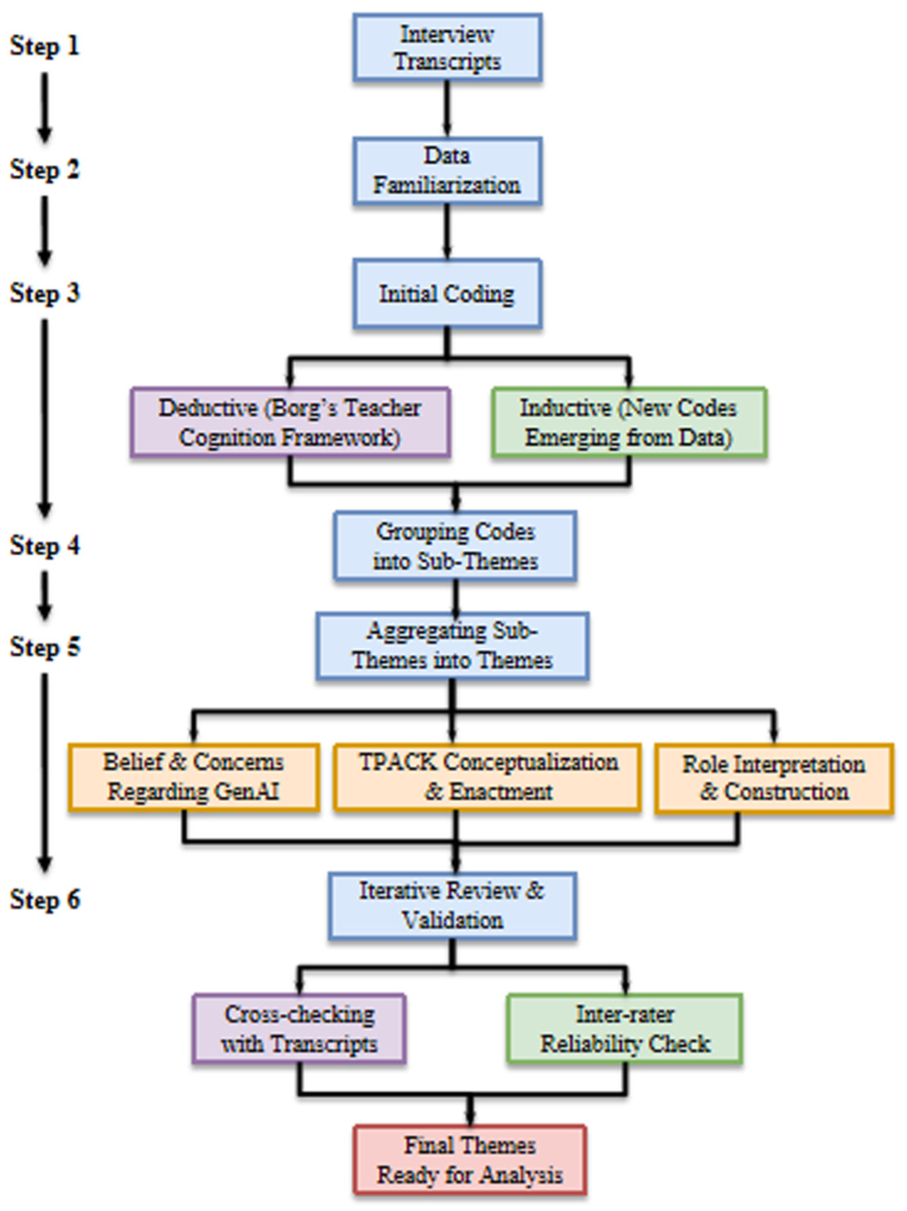
Process of coding analysis.
Ethical Considerations
This study was approved by the Ethics Committee of Zhaoqing University (Approval No. 2025064) in accordance with the Declaration of Helsinki.
The study’s design aims to reduce any potential risks. Six adult EFL teachers agreed to take part in semi-structured interviews for this study to talk about their professional backgrounds and knowledge of how GenAI is being used in language instruction. This study does not involve vulnerable populations, delicate subjects, identifiable personal information, or health-related data. Participants have the right to choose not to answer any questions or to withdraw from the study at any time without any adverse effects.
Due to the design features of this study, the risks are minimized, and the potential benefits are achieved through an in-depth understanding of teachers’ cognition of GenAI integration, which helps to achieve more ethical and effective teaching practices. Informed consent was obtained before data collection. Research participants have received clear instructions on the purpose, procedures and data use of the study, and are guaranteed data confidentiality and security. Ethical approval, informed consent, and concern for participants’ comfort ensure that research on their beliefs, knowledge, and role awareness can be conducted in a responsible and ethical manner.
Findings
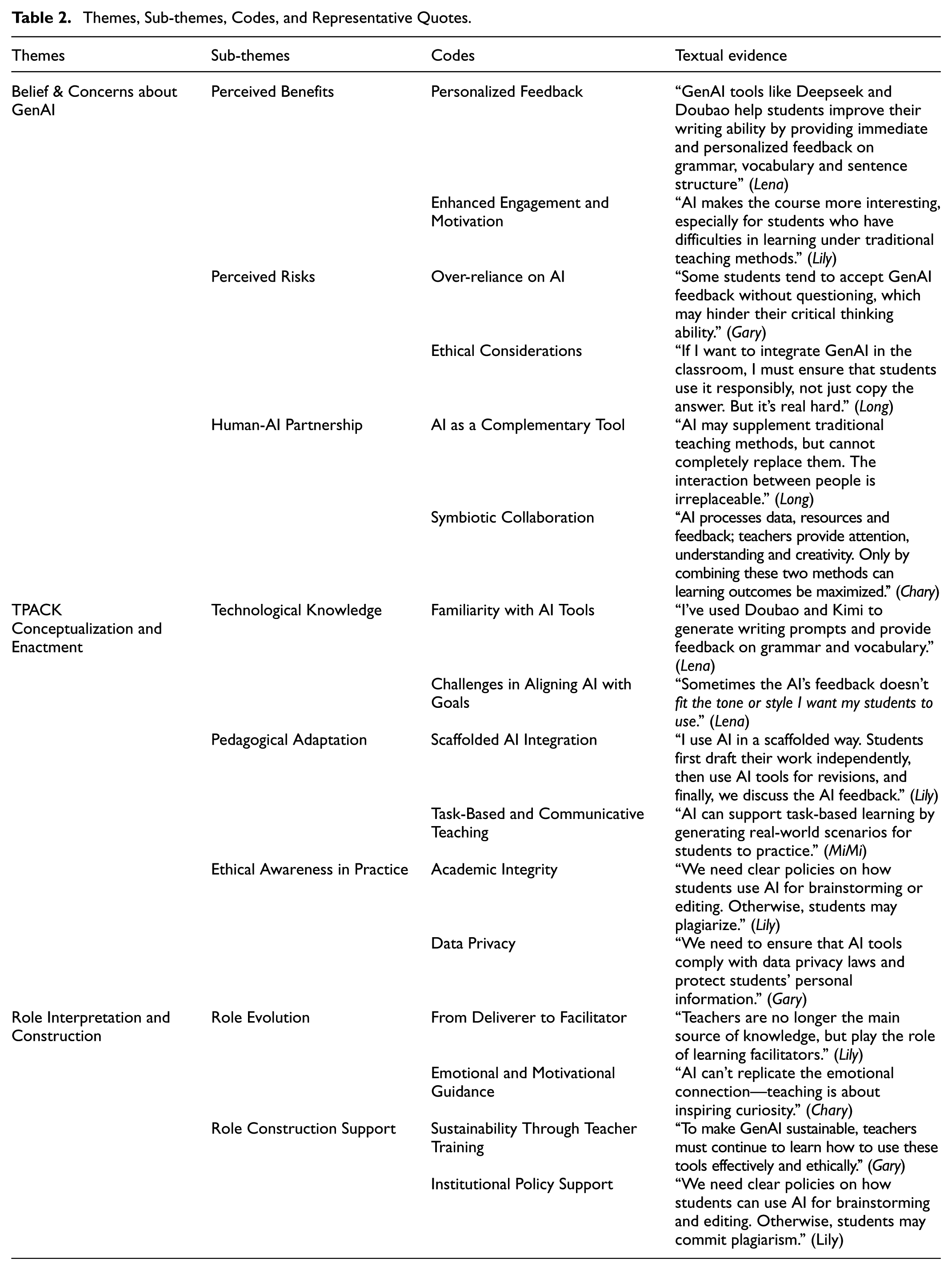
The data analysis revealed three main themes consistent with the research questions (see Table 2): 1) Beliefs and concerns about GenAI; 2) TPACK Conceptualization and Enactment; 3) Role interpretation and construction. Each theme includes sub-themes obtained by encoding teacher interview records, which reflects their cognition related to GenAI integration.
Themes, Sub-themes, Codes, and Representative Quotes.
Theme 1: Beliefs and Concerns Regarding GenAI
In this section, we have examined how EFL teachers’ beliefs and concerns influence their cognition of GenAI integration, which addresses the first research question.
Sub-theme 4.1.1: Perceived Benefits
All participants believed that GenAI could provide personalized support and enhance students’ engagement and autonomy. According to Lena, the GenAI tool helped students improve their writing skills by “providing immediate and personalized feedback on grammar, vocabulary and sentence structure.” Mimi added that it could also cultivate important autonomy in learning by letting students correct themselves. Lily also observed that “AI makes the course more interesting, especially for students who have difficulties in learning under traditional teaching methods.” These opinions indicate that teachers regard GenAI as a tool that can improve learning outcomes and students’ enthusiasm, and give a positive evaluation of its educational potential.
Sub-theme 4. 1.2: Perceived Risks
Teachers also expressed some concerns related to over-reliance, ethical use, and academic integrity. They showed concerns that over-reliance may weaken students’ critical thinking ability. Gary said: “Some students tend to accept GenAI feedback without questioning, which may hinder their critical thinking ability.” Chary similarly raised the risk of using this technology as a ‘shortcut’. Academic integrity was another major issue. Participants stressed the need for responsible use. Chary pointed out if students submited works generated by GenAI as their own, there would be a risk of plagiarism. Long also noted: “If I want to integrate GenAI in the classroom, I must ensure that students use it responsibly, not just copy the answer.” These reflections suggest that teachers are actively assessing the pedagogical and ethical implications of GenAI and its potential risks, which shows their nuanced cognition of GenAI.
Sub-theme 4.1.3: AI and Human Partnership
Participants continue to believe that GenAI is not a tool to replace human teaching, but a tool for improving human teaching. Long explained: “AI may supplement traditional teaching methods, but cannot completely replace them. The interaction between people is irreplaceable.” Some teachers envisioned a collaborative human-AI scenario in EFL teaching. Gary, for example, stated how AI could be used to generate useful content and help students engage in critical discussions. Chary further emphasized the symbiotic collaboration by saying: “AI processes data, resources and feedback; teachers provide attention, understanding and creativity. Only by combining these two methods can learning outcomes be maximized.” These observations show that teachers’ cognition goes beyond belief and encompasses a reflective assessment of the appropriate balance between automation and human education.
In general, the first theme shows that teachers’ beliefs and concerns about GenAI are at the core of their cognitive framework, affecting their interpretation of the relevant opportunities and limitations of GenAI in practice.
Theme 2: TPACK Conceptualization and Enactment
This theme discusses the second research question, focusing on how teachers conceptualize and enact TPACK in GenAI-supported teaching.
Sub-theme 4.2.1: Technological Knowledge
When using GenAI tools, participants showed different levels of familiarity and self-confidence. Lena and Gary reported that they often used platforms such as Doubao or ChatGPT to provide feedback or tips to improve teaching. In contrast, Long, the older participant, acknowledged he encountered difficulties in using GenAI and mentioned that “I’m worried that teachers of the same age will also find it difficult to learn these new tools.” Obviously, there is a digital divide between younger and older teachers. In addition, teachers were also aware that it’s challenging to align GenAI recommendations with pedagogical goals. Lena mentioned that sometimes GenAI’s suggestions were inconsistent with her desired tone or specific style, while Mimi described the generated content as “too general.” These examples show that teachers will evaluate GenAI generated content before integrating it, which reflects their practical application of knowledge.
Sub-theme 4.2.2: Pedagogical Adaptation
Participants reported they were using a scaffolded strategy to integrate GenAI into teaching while maintaining critical thinking. Lily described a three-step process: independent drafting, AI-assisted revision, and subsequent discussion, allowing students to engage with AI outputs critically. Gary emphasized that discussions after working with AI could enhance students’ deep understanding. In addition, other participants found that GenAI technology helps to improve task-based learning and communication-centered teaching methods. Mimi believed that AI could generate real-world scenarios for students to practice. Chary further mentioned that teachers needed to guide students to use language in the real context. These practices show that teachers’ TPACK knowledge plays a role as cognitive resources, making it possible to integrate GenAI with situational sensitivity and pedagogical significance.
Sub-theme 4.2.3: Ethical Awareness in Practice
Ethical considerations were prominent among participants. Lily emphasized the clear guidelines to prevent plagiarism. Long also mentioned the importance of raising students’ awareness, adding: “Students must understand that AI-generated content should be a reference to develop ideas, not the final product.” Data privacy protection was also an important concern. Gary and Chary emphasized data protection, arguing that teachers should ensure that AI tools comply with data protection regulations and protect student data. They believed that it is equally important to protect students’ personal information and enhance the learning experience. These examples show that ethical consideration is an important part of professional knowledge, and also imply that responsible integration should be based on the responsibility mechanism.
In all, theme 2 demonstrates that teachers’ conceptual understanding of TPACK and its classroom enactment are influenced by both technical ability and pedagogical and ethical evaluation, and cognition plays a role as an important intermediary mechanism for the integration of GenAI.
Theme 3: Role Interpretation and Construction
This theme discusses research question 3 and explores how teachers’ cognition affects their interpretation and construction of their professional roles.
Sub-theme 4.3.1: Role Evolution
Participants expect to change from knowledge transmitters to learning facilitators and ethical mentors. As Lily mentioned: “Teachers are no longer the main source of knowledge, but play the role of learning facilitators.” Lena added that “if teachers give repetitive tasks to GenAI, teachers can focus on cultivating critical thinking and creativity.” However, participants like Chary and Gary still emphasized unique values that could not be replaced, such as emotional support and motivational guidance. These observations show a basic fact: technology can improve the efficiency of education, but interpersonal interaction in education is irreplaceable. This cognition reflects how teachers understand their professional identity in a changing environment.
Sub-theme 4.3.2: Role Construction Support
Participants emphasized that in order to maintain the integrity of GenAI, it is necessary to develop professional skills and institutional policies. They mentioned that sustainable development of professional skills is fundamental for long-term success. Gary insisted: “To make GenAI sustainable, teachers must continue to learn how to use these tools effectively and ethically.” Chary also expressed support and stressed the importance of training for middle-aged teachers. Lily stressed clear policies to prevent abuse: “We need clear policies on how students use AI for brainstorming or editing. Otherwise, students may plagiarize.” This shows that teachers’ cognition plays an intermediary role in role formation, and combines reflection, ethics and practice, emphasizing the interdependence between personal ability and contextual support.
Theme 3 shows that teachers’ cognitive engagement affects the interpretation and construction of professional roles, regulates emotional support, ethical responsibility and organizational constraints.
Discussion
This study explores the cognition of Chinese university EFL teachers on integrating GenAI. Three key findings are derived. 1) Teachers’ beliefs and concerns create a dynamic balance between technological automation and human agency. 2) Ethical awareness transforms TPACK into an ethically-centered system. 3) Teachers’ roles are shifted to learning facilitators and ethical mentors. All these findings provide an empirical theoretical framework for dealing with the complexity in GenAI era.
Extending Teacher Cognition: Beliefs and Concerns Mediate Technological automation and Human Agency
Consistent with Martínez et al. (2025), participants were aware of the potential of GenAI in improving personalized learning and engagement. However, similar to the concerns raised by Akanzire et al. (2025), Kumar and Sharma (2025), and Whalen et al. (2025), they also expressed concerns regarding ethical and pedagogical issues. The simultaneous understanding of the benefits of GenAI and its ethical and pedagogical risks shows that there is a deep-rooted tension in teachers’ cognition, which indicates that it is inherently shaped by ongoing negotiation rather than a fixed supportive or resistant orientation.
This finding is consistent with the framework of Borg (2006) and extends it. Although Borg conceptualizes beliefs as a central lens for interpreting teaching practice, this study shows that concerns understood as assessments of risks and constraints also play an equally important role in shaping technology integration. In the GenAI age characterized by low transparency and ethical uncertainty, teachers not only draw upon existing beliefs, but also actively weigh the concerns. For example, Gary’s concern that learners may passively get feedback from GenAI and lack critical thinking, and Long’s emphasis on avoiding plagiarism, suggest that concern plays a regulatory role in guiding teaching decisions. Instead of rejecting using GenAI, teachers are more inclined to carefully weigh the advantages and disadvantages of new technologies as they become more integrated into learning environments—a pattern consistent with the research by Mogavi et al. (2023). As described by Mishra et al. (2023), understanding the operating mechanism of GenAI and its integration in a specific educational environment enables teachers to implement significant improvements in student learning.
Importantly, the dynamic interaction between beliefs and concerns operates as an important mechanism used by teachers to promote GenAI-facilitated learning. In this process, beliefs facilitates an open attitude towards innovation, while concerns provide the necessary caution, together forming an appropriate educational response to specific contexts. This reveals a stable cognitive balance-a process by which teachers can use GenAI with maximum efficiency while reducing its risks, as pointed out by Barrot (2023) and Moorhouse and Kohnke (2024). As advocated by Chan and Tsi (2024) and Kumar and Sharma (2025), teachers play a decisive role in ensuring the ethical use of AI while this core role is directly derived from the stable cognitive balance provided. In addition, although GenAI provides scalable solutions for personalized feedback (Anderson et al., 2025), its long-term sustainability depends not only on technology. As Nyaaba (2024) points out, teachers must be prepared to critically evaluate digital technologies and consciously integrate them into use.
Therefore, this study extends Borg’s (2006) model and proposes that teachers’ cognition during the GenAI era is shaped by this dynamic interaction between beliefs and concerns, through which teachers actively regulate the terms of human–AI collaboration. Rather than barriers, concerns function as productive constraints that support responsible and pedagogically meaningful integration.
Reshaping TPACK: From Knowledge Integration to Adaptive and Ethical Practice
The findings from Theme 2 show that teachers’ conceptualization and enactment of TPACK in GenAI-based teaching transcends technical skills, including ethical considerations and teaching adjustments. This view is supported by three relevant aspects.
First of all, technical knowledge in the context of GenAI goes beyond simple operational skills. Even experienced teachers emphasize the importance of critical assessment of the results of GenAI when pedagogical goals are inconsistent, which reinforces the TPACK concept proposed by Mishra and Koehler (2006), that is, context-based integration of knowledge, which is also the basis for Elmaadaway and Abouelenein (2023) to explore how to make digital classroom teaching more diverse.
More importantly, ethical awareness affects decision-making in GenAI-based teaching. Teachers expressed their concerns about academic plagiarism, data privacy and responsible use, and regarded GenAI as a technology that requires ethical scrutiny. This is consistent with the concept of “intelligent TPACK” proposed by Celik (2023), which regards ethics as the core of the integration of technological and pedagogical knowledge. At the same time, Laine et al. (2025) and Silva-Atencio (2025) emphasized the mechanism of ethical constraints. This study points out in detail how these mechanisms are applied to classroom decision-making, especially in judging when and how to trust the results of GenAI. Ethical awareness plays a role in micro-level decision-making: the choice of tools, the evaluation of AI-generated content, and the identification of pedagogical interventions. When Mimi questioned the content generated by GenAI and believed that it is “too general,” or when Long pointed out that the generated content should be used as a creative reference source rather than a final product, they integrated content knowledge, pedagogical reasoning and ethical judgement. These practices describe the two major challenges faced by teachers identified in the literature: Luo et al. (2024) emphasized the “black box” characteristics of GenAI, in which the lack of transparency makes the evaluation difficult; Nyaaba et al. (2026) pointed out the risk of bias in AI systems which is trained on culturally influenced datasets. Addressing these challenges requires what Cooper et al. (2025) call “critical GenAI literacy.”
The implications for the professional development of teachers are of great importance. Lan et al. (2025) proposed to integrate ethical knowledge into teacher training, and Zlotnikova et al. (2025) called for ethical standards. Integrating ethical knowledge into teacher training affects the ways teachers mobilize technological and pedagogical knowledge in context. This is consistent with the AI-TPACK framework of Ning et al. (2024) and extends it further, in which ethical judgement is regarded as a mechanism to coordinate different knowledge fields.
Together, these findings indicate that TPACK in the GenAI era is in a state of actual transition between technology and ethics. Ethical consciousness is a dynamic system, which guides technological and pedagogical knowledge. This study provides evidence that ethical awareness is not peripheral but constitutive of TPACK, which fundamentally reshapes it from a knowledge-integration framework into an ethically guided, context-sensitive system.
Role Reconstruction in AI Contexts
Theme 3 shows how EFL teachers interpret and construct their professional roles in classroom supported by GenAI. The results reveal that the teachers’ role is dynamic, moderated by context, and influenced by both pedagogical and ethical considerations.
To start, participants predicted that the role of teachers will change from a traditional knowledge transmitter to a learning facilitator, indicating that the AI automation is reassigning teaching responsibilities. As Chapwanya (2025) argues, this is an important role change. Lily, Lena and other participants have embraced these changes. According to Shao and Sun (2025), teachers envisioned a more diversified and comprehensive role, with particular attention to maintain human-machine collaboration. This is consistent with the view of Lan and Chen (2024) that the success of technological change depends on the transformation of teachers’ way of thinking, which in turn shapes their professional competence and identity.
Secondly, teachers emphasize the importance of emotional and motivational leadership, and confirm that GenAI cannot replace the relational and emotional aspects of the classroom. The irreplaceable humanistic dimension of the classroom expressed by participants such as Chary and Gary reflects the concerns raised by Whalen et al. (2025) and Iqbal et al. (2025). Precisely because GenAI lacks this human touch, teachers need to balance ethics, education and social responsibility when using GenAI tools.
Thirdly, the professional role of teachers depends on the support of specific situations, including continuous training and institutional support. Participants presented training needs for the responsible use of GenAI and clear guidelines for ensuring academic integrity. Gary stressed continuous learning, while Lily called for institutional support to prevent abuse. This is consistent with the research of Bae et al. (2024), who found that technology-oriented professional development can reduce doubts and promote the integration of GenAI. Similarly, Harrington et al. (2025) pointed out that context-specific institutional guidelines are particularly important in dealing with ethical risks, especially in different cultural backgrounds. Cordero et al. (2024) also advocated clear ethical guidelines for effectively integrating GenAI. Without the supportive ecosystem, the integration of GenAI will remain on the surface or fail to meet ethical standards.
In short, these findings indicate that role reconstruction is a reflective and cognitively mediated process. Teachers actively negotiate between the opportunities for the use of emerging technologies, ethical boundaries, and teaching goals, and redefine their professional identities from knowledge transmitters to promoters, mentors, and ethical guardians of GenAI-supported learning. This is consistent with Chan and Tsi (2024)’s view that teachers are the key intermediary for ethical integration of GenAI, and also resonates with Bannister and Carver (2025)’s research which highlights the evolving teacher identity in technology-enhanced classrooms.
Conceptual Framework Grounded in Empirical Findings
Based on the empirical findings, this study proposes a techno-ethical teaching framework rooted in teachers’ authentic cognition (see Figure 2). The framework consists of three components-cognitive pillars, practical mechanism and support system, and is oriented toward three core goals.
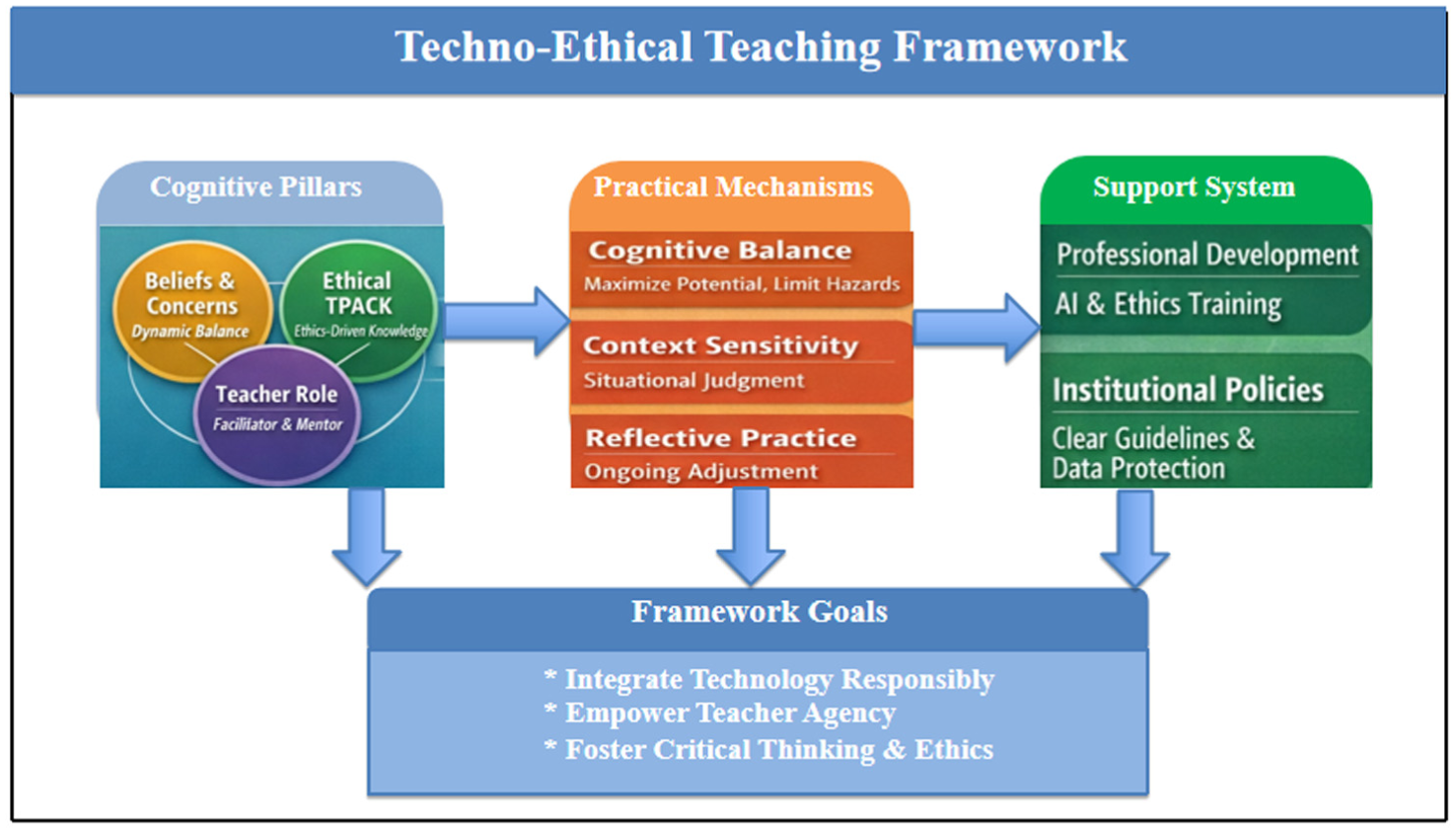
Techno-ethical teaching framework for GenAI integration in EFL education.
The cognitive pillars come from Themes 1 and 2. First, teachers’ beliefs and concerns create a dynamic balance: they recognize the potential of GenAI while being cautious about ethical risks, which together shape teaching decisions. Secondly, ethical awareness evolves from a peripheral element of TPACK to a core dimension that integrates technological, pedagogical and content knowledge, thus transforming TPACK into a system centered on ethics. Third, teacher role perception reflects a fundamental change: teachers redefine themselves from knowledge transmitters to learning facilitators and ethical mentors, a change that shapes their professional identity in a GenAI-assisted classroom.
The practical mechanisms developed from Themes 2 and 3 include three interrelated pathways. The cognitive balance mechanism enables teachers to assess the benefits and risks associated with GenAI, making them an active intermediary role in human-GenAI cooperation. The context-sensitivity mechanism reflects the flexibility of teachers to adjust the use of GenAI according to specific teaching situations. The reflective practice mechanism integrates thinking into the whole teaching decision-making process and encourages continuous improvement and integration strategies.
The support system developed from Theme 3 focuses on the external environment. Clear institutional policies are regarded as the basic condition for the responsible use of GenAI. The sustained professional development that integrates ethical elements helps teachers improve their technical knowledge and ability to conduct ethical assessment.
Based on these three layers, the framework aims to achieve three goals: responsible technology integration, taking advantage of the benefits of GenAI, while maintaining the boundaries of education; teacher agency, teachers as active participants rather than passive recipients of technology; and the cultivation of critical thinking and ethical awareness, guiding students to interact critically with GenAI content.
To conclude, this framework which puts teachers’ cognition in the core mediation mechanism and reveals three basic principles: cognition-oriented integration, where teachers’ beliefs, ethical TPACK and role perception guide the GenAI use; ethical awareness at all levels; combining contextual practice to ensure that technology serves the core goals of education.
Conclusion and Recommendations
In this study, Borg (2006)’ s teacher cognition framework is used to study Chinese EFL teachers’ cognition of the integration of GenAI. The results show that teachers’ cognition is dynamic and multidimensional, and these diverse beliefs and concerns play an important role in the critical evaluation of GenAI and its effective integration in teaching practice.
The research also shows that teachers use technological, pedagogical and content knowledge in a context-adapted way. As shown, TPACK not only exists in practice, but also serves as a cognitive knowledge to help teachers carry out continuous assessment, implement GenAI and adjust according to the situation. Notably, ethical awareness is a crucial part of this knowledge base, which affects how teachers interpret GenAI-generated content and how to teach students to participate responsibly.
When it comes to the professional roles, all teachers agree that with the use of GenAI, their responsibilities will also change. Teaching is no longer just to impart knowledge, they must assume more roles as learning facilitators and ethical mentors. This is consistent with Chan and Tsi (2024)’ s view that this shift does not diminish the function of teachers, but rather enables them to be more irreplaceable in giving emotional support and stimulating learning motivation. In short, this change does not reduce teachers’ autonomy, but drives them to take greater responsibility for promoting students’ thinking ability and ethical awareness in a GenAI-supported learning environment.
These findings suggest that teachers’ beliefs and concerns, TPACK knowledge, and evolving roles contribute to the formation of an integrated cognitive system for interpreting and applying GenAI in practice. This study proposes a techno-ethical teaching framework, aiming to achieve a balance among technological, pedagogical and ethical factors in GenAI-assisted teaching. This model extends the teaching cognition framework of Borg (2006) and TPACK (Mishra & Koehler, 2006) to the GenAI era, and provides both theoretical and practical guidance for EFL teaching.
As participant Chary emphasizes, “AI can’t replicate the emotional connection—teaching is about inspiring curiosity.” In the ever-changing digital age, technological advances will not diminish the role of teachers; on the contrary, they make teachers the core force in supporting complex and sustainable language education.
Limitations and Future Research
This study has the limitations of a small number of participants and focusing on a single cultural background. Nevertheless, the insights on educational resources, institutional support and practical methods can still provide reference for similar higher education environments and lay the foundation for subsequent large-scale research. Future research could include cross-cultural comparisons to explore how teachers perceive and adopt new technologies in different contexts. In addition, longitudinal research to explore how teachers’ beliefs, TPACK knowledge, and interpretation and construction of teachers’ roles develop over time will also be useful.
Footnotes
Acknowledgements
We would like to express sincere gratitude to the EFL teachers who generously participated in this study. Their time, openness, and thoughtful insights made this research possible.

Ethical Considerations
Regarding ethical considerations, this study followed the principles of the Declaration of Helsinki. The study received the approval from the official Ethics Committee of Zhaoqing University (Ethical code: 2025064). The researchers ensured that all ethical guidelines were rigorously followed.
Author Contributions
Feifei Chen was the primary author of this manuscript. She designed the study, conducted the research, and drafted the original manuscript. Miaoqing Wang contributed to data visualization and provided proofreading and language revision. Lei Zhang supervised the research process, contributed to the conceptual design of the study, and reviewed and revised the manuscript. All authors read and approved the final manuscript.
Funding
The authors received no financial support for the research, authorship, and/or publication of this article.
Declaration of Conflicting Interests
The authors declared no potential conflicts of interest with respect to the research, authorship, and/or publication of this article.
Data Availability Statement
The data supporting this study are originally derived from interview transcripts. Due to the sensitive and confidential nature of the interviews, raw data are not publicly available to protect participant privacy. However, anonymized or partial data could be shared upon reasonable request, subject to academic needs. Researchers interested in accessing the data should contact the corresponding author at [
Consent Details
All participants were informed of the purpose and procedures of the study, and informed consent was obtained prior to data collection.