






Abstract
Corpus-based translation studies (CTS) on translation universals that distinguish translated language as a distinct variety have been criticized for their monofactorial design and auto-isolation. Adopting a multifactorial design, this study conducts a multidimensional analysis of nontranslated English versus English translated from multiple source languages, used in work reports or state addresses issued by governments of nine countries. The study finds that the purpose of non-translated and translated state addresses seems to be a factor greater than the translation status that affects the text type and communicative dimensions of the political discourse. Also, such investigations into translations from multiple source languages of political discourse offer evidence for differences in the frequency patterns of linguistic features as compared to studies on translations from a single source language, revealing disaccord with proofs of translation universals. The findings have important implications for the line of CTS comparing non-translated and translated languages and for using statistics for CTS.
Plain Language Summary
This study compares original English government addresses with those translated into English from other source languages. It finds that the purpose of the address (e.g., to inform or persuade) has a stronger influence on the text type and communicative style than whether the text was translated or not. Essentially, context and intent matter more in original or translated political discourse than previously assumed. Additionally, analyzing translations from multiple source languages provides different insights compared to studying translations from just one language, challenging some common theories about how translation works.
Keywords
Introduction
Corpus-based translation studies (CTS) have started to grow and flourish since the 1990s as pioneered by Baker (1993). The past three decades have witnessed a surge in studies aimed at distinguishing translated language as a distinct variety. Major findings include hypothesized translation universals identified based on comparing the distribution pattern of a linguistic phenomenon in translated and nontranslated texts of the same register. Studies in this field have been criticized for their monofactorial research design, which investigates the distribution of a linguistic feature with respect to a single explanatory factor (e.g., translation status/ontology), thereby neglecting a more complex, multivariate explanatory framework. Therefore, a new research agenda calls for multifactorial, multi-methodological, interdisciplinary empirical research (De Sutter & Lefer, 2019; Han et al., 2023; Pérez et al., 2021). In a multifactorial analysis, does translation status hold up as the most critical variable, or do other forces like communicative purpose prove more influential? To answer this call, this study demonstrates empirically how a multifactorial approach can reframe our understanding of the forces that shape translated language. Such a multifactorial approach as multidimensional analysis (MDA) (Biber, 1988) has attracted increasing attention from CTS scholars. This study is thus motivated to conduct an MDA comparing nontranslated English texts versus English texts translated from multiple source languages, in relation to nine native and non-native countries.
Literature Review
Translation Universals in Translated Language
Translation universals are hypotheses on universal features of translation. Research in this field contrasts translations either with their source or nontranslated languages (Baker, 1993). Translation universals, including simplification (Ferraresi et al., 2018; Z. Liu & Dou, 2023; Vanderauwera, 1985), explicitation (Blum-Kulka, 1986; Kruger, 2019; Olohan & Baker, 2000), normalization (Kenny, 1998, 2001), leveling out (that is, translations tend to be more homogenous) (Baker, 1996; Laviosa, 1998), and shining through (i.e., source language interference) (Teich, 2003) have been proposed. Yet they are relied on excessively to explain differences between translated and nontranslated languages, potentially “overlooking the influence of other factors like communicative contexts, which dynamically shape language use” (Yao et al., 2024). Meanwhile, features chosen to justify translation universals are limited and isolated across studies (Sheng & Li, 2024), such as the optional complementizer that (Kruger, 2019; Olohan & Baker, 2000), type-token ratio (Baker, 2000; Ferraresi et al., 2018), and average word length (L. Huang & Chu, 2014; Volansky et al., 2015). Consequently, the cherry-picking of features in the univariate analysis raises concerns about achieving a holistic understanding of the nature of translated language. Since there is no way of capturing translations from all times and all languages (Tymoczko, 1998), “laws” and “tendencies” characterized as probabilistic propositions or conditioned regularities have appeared more acceptable (Mauranen, 2008). Besides, it is challenging to distinguish between translations, adaptations, and texts that are otherwise heavily influenced by foreign sources, so it is not feasible to make such comparisons that are assumed in parallel or comparable corpus studies (Mauranen, 2008).
In addition to doubts on translation universals since their proposal (e.g., Kajzer-Wietrzny, 2018), De Sutter and Lefer (2019) and Pérez et al. (2021) have pinpointed four major issues. First, the overemphasis on difference can be understood since early CTS needed a raison d’être as an emerging discipline. As CTS grows mature, quantitative differences are likely to be found between translated and nontranslated texts alongside a massive number of commonalities. Second, the robust advancement of a theoretical framework in this domain necessitates more meticulously designed empirical research. Third, the monofactorial nature of research design overlooks the interplay of language-internal and -external factors, because such design considers only one explanatory factor—translation status (i.e., translated vs. nontranslated). It remains to be seen whether translation status remains an important factor when integrated into a multifactorial design. Finally, CTS can hardly be considered interdisciplinary nowadays, without heeding theoretical and methodological developments in related fields such as variational linguistics, sociolinguistics, etc. All these interrelated issues have led to a reductionist approach that compromises the framework’s dependability and calls for multifactorial, multi-methodological, interdisciplinary empirical research. Some scholars have started implementing this research agenda and increasingly used a multifactorial design (e.g., MDA) to investigate factors such as editorial intervention (De Sutter & Lefer, 2019), register (Kruger & van Rooy, 2016), source language (Kruger et al., 2019), and translation method (human vs. computer-aided) (Luo & Li, 2022). The common finding drawn from these studies is that translated language is not solely determined by a single factor but the result of multiple interacting factors, thus suggesting the need for further refinement of the research approach by integrating additional factors into the statistical models.
MDA in Translated Language
Biber’s MDA
Biber (1988) revolutionized research on register variation by introducing MDA, a multivariant method of extracting latent dimensions of variation from patterns of co-occurrence of linguistic features. By transcending the limitations of analyzing isolated linguistic features, MDA condenses constellations of features into factors, or dimensions, that demonstrate high shared variance through factor analysis. MDA is “based on the assumption that linguistic co-occurrence patterns reflect underlying communicative functions” (Biber et al., 2006). Biber (1988) proposed six dimensions that “represent patterns of covariation of linguistic features and were functionally interpreted according to their constituting features and the registers that they characterized” (Nini, 2019). The six dimensions are labeled as (1) involved versus informational production; (2) narrative versus non-narrative concerns; (3) explicit versus situation-dependent reference; (4) overt expression of persuasion; (5) abstract versus non-abstract information; and (6) on-line information elaboration (Biber, 1988, p. 115). Each dimension consists of features with positive and negative loadings (Biber, 1988, p. 89) that tend to occur in a complementary distribution (see Appendix Table A1), that is, if the positive features co-occur frequently in a text, the negative features appear relatively infrequent in the same text, and vice versa. Biber (1989) developed a typology of texts in English with respect to his multidimensional model of variation. Eight text types are identified with respect to those dimensions; each type represents a grouping of texts that are markedly similar to one another with respect to their dimension characterizations. Those types are intimate interpersonal interaction, informational interaction, scientific exposition, learned exposition, general narrative exposition, imaginative narrative, situated reportage, and involved persuasion.
MDA has become a widely used approach for investigating various registers, including academic discourse (e.g., Jin, 2021; J. Liu & Xiao, 2022), media discourse (e.g., Y. Huang & Ren, 2019), political discourse (e.g., Kruger et al., 2019), business discourse (e.g., Bu et al., 2020; Ren & Lu, 2020; Wang & Liu, 2024), legal discourse (e.g., Sun & Cheng, 2017), and conversational texts (e.g., Biber, 2006). These studies have proved MDA’s effectiveness in identifying register variation and linguistic features attributable to variation.
MDA in Translated Language and Political Discourse
MDA is considered a valuable tool for new CTS agendas. Translation has been approached “as an inherently multidimensional linguistic activity and product” (De Sutter & Lefer, 2019). As similarities and differences between the sub-corpora of translated and nontranslated texts are identified and functional interpretations are then made on communicative dimensions, results of exploratory MDA research may build a global account of the translated language under study (Pérez et al., 2021). For example, Hu et al. (2016) found, by comparing translated and nontranslated Chinese writings, that translation universals are not to be taken for granted. Kruger and van Rooy (2016) argued that explicitation may not be a translation-specific feature but shared by translated English and non-native indigenized varieties of English as constrained languages. Ji (2017) argued that the traditional practice of aligning translation genres with target language genres seems problematic. These studies reflect the highly dynamic nature of translation juxtaposed with non-translation.
MDA has been increasingly applied to contrastive studies of translated and nontranslated political discourse. Such studies involve translated or interpreted language in government work reports or state addresses (Zou & Wang, 2021), parliamentary speeches (Pérez et al., 2021; Xu, 2021), and press conference speeches (Sheng & Li, 2024; Yao et al., 2024; Zhang et al., 2023). Although the purpose of all political communication is persuasion (Fairclough, 1989; McNair, 2011, p. 10), these studies attempted to disclose the difference in text types or communicative dimensions between translated and non-translated political discourses. They either replicate Biber’s (1988) analysis or adopt a full MDA. Utilizing Biber’s (1988) MDA facilitates comparison with Biber’s (1988) results or among studies on differentiating between registers or register variation. In this line, Pérez et al. (2021) compared their findings about three dimensions between translated and nontranslated parliamentary speeches with those of Biber’s registers, and argued that the difference in one dimension cannot be explained by the translational process but is affected by the context of communicative exchange. By adopting Biber’s (1988) MDA, Sheng and Li (2024) found that interpreted and noninterpreted press conference speeches differ in text types and all dimensions but one. Zhang et al. (2023) also followed Biber’s (1988) MDA and discovered that the factor of country (China or America) impacts more dimensions than that of mode (written or spoken) in diplomatic discourse. On the other hand, a full MDA is also applied to explore communicative dimensions specific to translation (e.g., Xiao, 2015; Xu, 2021; Yao et al., 2024; Zou & Wang, 2021). However, with no consensus on the chosen number of linguistic features or communicative dimensions, these studies are commonly challenged by decreasing replicability and reporting unoriginal or over-generalized dimensions (e.g., involved vs. informational production, oral vs. literate discourse, and interpreted vs. non-interpreted discourse).
In retrospect, most studies in this area compared nontranslated American or British English with translated English sampled from one source language. Their results can scarcely be replicable in studies on translation between other language pairs. It is also rarely seen that English translations from different source languages of the same political register are examined. Hence, honoring the new research agenda, this study follows Biber’s (1988) MDA to compare nontranslated and translated English state addresses of different source languages, from communicative and functional perspectives.
Method
The Corpus
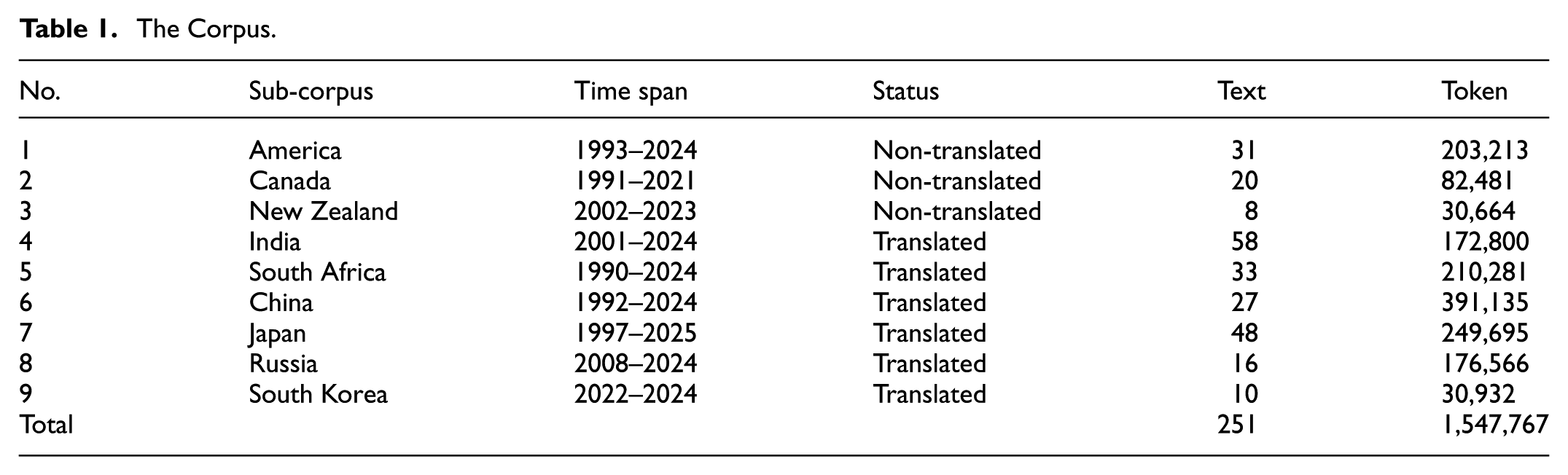
This study compares translated and nontranslated state addresses from nine countries (see Table 1). Different countries tend to name their translated or nontranslated state addresses differently, for instance, America’s State of the Union addresses, China’s Government Work Reports, Japan’s Policy Speeches, and India’s Addresses to the Nation (hereinafter state addresses). Usually, these state addresses are delivered regularly by the President, Prime Minister, or Premier at significant governmental gatherings and made accessible through official transcription or translation published on governmental websites. These addresses serve to outline and articulate the government’s plans, achievements, and goals to the citizens and the international community. Due to the exploratory nature of this study, the corpus consists of nine sub-corpora of state addresses in relation to nine countries. The primary reason for such collection is that these countries’ state addresses are publicly accessible to be considered for examination. Additionally, the country’s national power (e.g., GDP ranking, global influence) is taken into account.
The Corpus.
Research Questions
The three research questions explored in this study are as follows:
Do translated and nontranslated state addresses differ in text types?
Do translated and nontranslated state addresses of different text types appear distinct on communicative dimensions?
What linguistic features on each dimension serve to distinguish between translated and nontranslated state addresses of different text types?
To answer the first question, the nine sub-corpora of state addresses were all used. Considering space constraints for answering the second question, it was infeasible to conduct pairwise comparisons among nine sub-corpora for differences on all six dimensions of analysis. So, the second question was approached based on the result of the first question. The result found that the nine sub-corpora of addresses fell into three text types: involved persuasion, learned exposition, and general narrative exposition. The second question thus only investigated the three sub-corpora that had the highest proportions of texts for each text type identified for the sub-corpora, that is, America, China, and Russia (hereafter as NA, TC, and TR). For instance, the sub-corpora of Russia and India were both identified as the text type of general narrative exposition, and the proportion of texts in the sub-corpus of Russia identified as general narrative exposition was higher than that of texts identified as such in the sub-corpus of India; then the sub-corpus of Russia was selected for scrutiny as representing that text type, for the sake of answering the second question. Consequently, linguistic features scrutinized for the third question were derived from the three sub-corpora investigated for the previous question.
Data Analysis
The multidimensional analysis of the nine sub-corpora was conducted successively through a Multidimensional Analysis Tool (MAT) (Nini, 2019). MAT is a Windows program that replicates Biber’s (1988) MDA of English texts via the Stanford Tagger (the accuracy rate of tagging was approximately 95%). The program generates a grammatically annotated version of the input corpus as well as the statistics (including standardized feature frequency, z-score, and dimension score) needed to perform a text-type analysis. The program plots the corpus on Biber’s (1988) dimensions and determines the closest text type for the corpus and its individual texts (Biber, 1989).
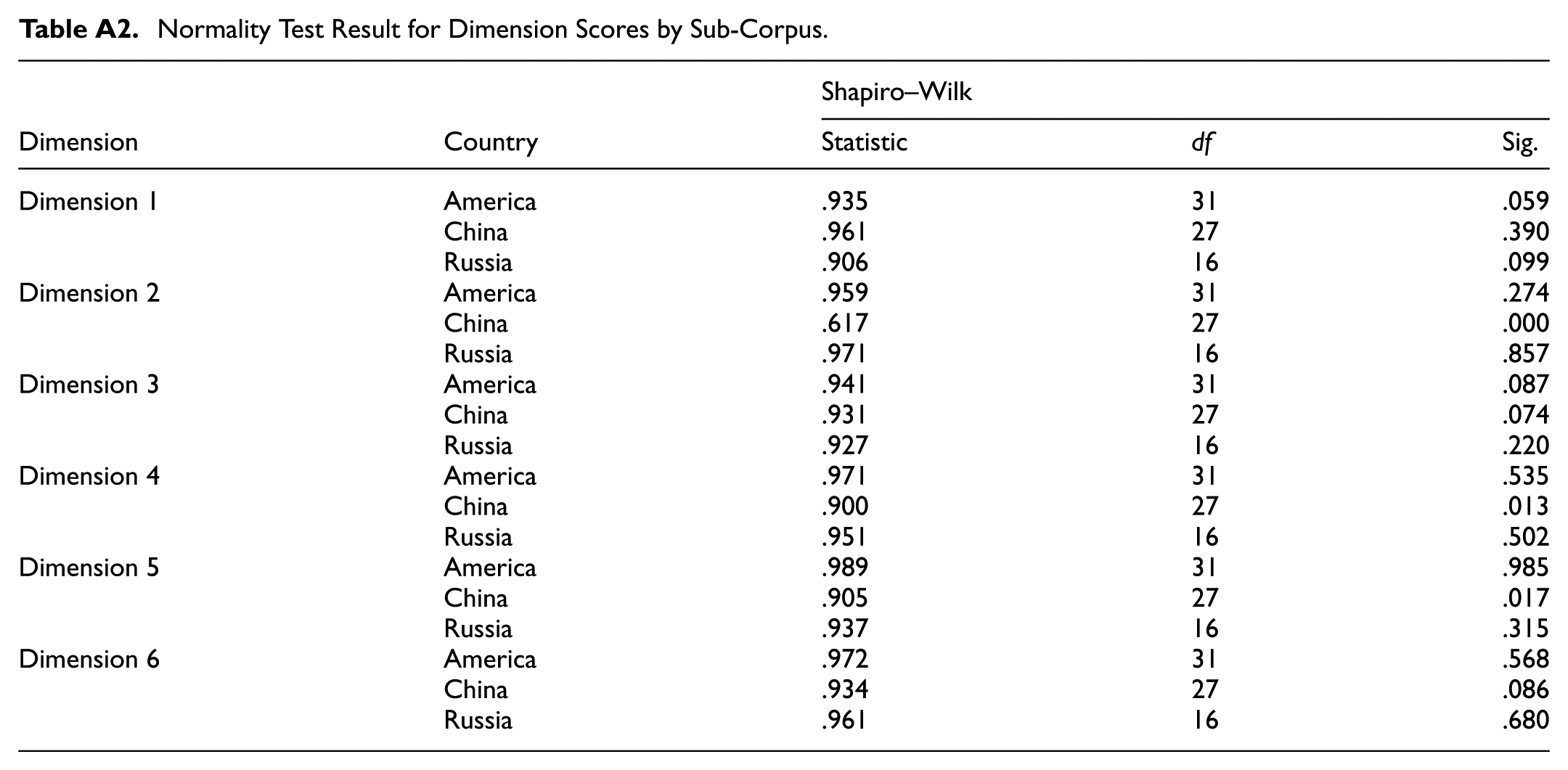
Considering the Shapiro–Wilk test result (see Appendix Table A2) and the small samples of texts in each sub-corpus, the assumption of normality for the distribution of dimension scores and z-scores of linguistic features was not supported. Therefore, the non-parametric Kruskal–Wallis H test was used to test for significant effects for the sub-corpus with a level of significance at .05. Where a significant effect was found, post hoc pairwise comparisons were carried out through the Mann–Whitney U-test, with Bonferroni correction to minimize the risk of Type 1 error associated with multiple comparisons. All statistical processing was done in SPSS 26.
Results and Analysis
Difference in Text Types
According to the MAT results of text type (see Table 2), the text type of the nine sub-corpora of state addresses, be it translated or nontranslated, appears to vary by country, or is country-specific; so, it is not primarily affected by the translation status of such addresses. Specifically, learned exposition is the most frequent text type, found in seven out of nine sub-corpora, involving two native and five non-native countries. This suggests that these groups of native and translated state addresses as official documents are similar to registers such as “press reviews and academic prose” (Nini, 2019). Additionally, general narrative exposition is the text type for two sub-corpora of non-native countries, that is, Russia and India, which resemble “press reportage, press editorials, biographies, non-sports broadcasts, and science fiction” (Nini, 2019). Moreover, involved persuasion is the text type found merely for the sub-corpus of America’s native addresses, which are analogous to “spontaneous speeches, professional letters, and interviews” (Nini, 2019).
Text Types of Nine Sub-Corpora of State Addresses.
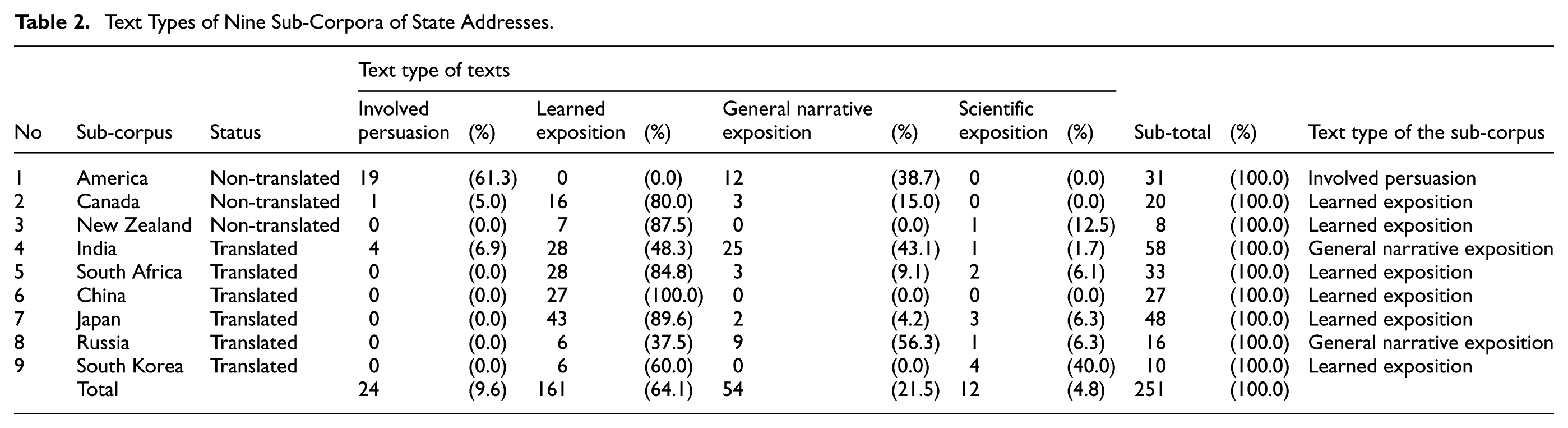
As regards text-type variation within each sub-corpus, only the sub-corpus of China shows no variation, comprising exclusively texts of learned exposition. Other sub-corpora display considerable diversity in the combination of text types among their respective texts. Two of the only three sub-corpora of nontranslated state addresses contain both texts of involved persuasion and generic exposition. All sub-corpora of translated state addresses (but the sub-corpus of India) contain only texts of generic exposition (i.e., learned exposition, general narrative exposition, and/or scientific exposition). Such results corroborate the abovementioned finding that the text type of the sub-corpus of a country’s state addresses is not determined by the translation status.
Difference in Communicative Dimensions
As each of the three sub-corpora of America, China, and Russia has the highest proportion of texts belonging to the text type identified for the sub-corpora, respectively, that is, involved persuasion, learned exposition, and general narrative exposition, the three sub-corpora (i.e., NA, TC, and TR) are further scrutinized to discover the difference in communicative dimensions. According to the Kruskal–Wallis H test results shown in Table 3, a significant difference exists in terms of dimension scores on each of the six dimensions across the three sub-corpora. The varying difference in dimension scores on each dimension ranges from big to small in the following order: 1, 3, 6, 5, 2, and 4.
Kruskal–Wallis H Test Results for Scores on Six Dimensions Across the Three Sub-Corpora of NA, TC, and TR.
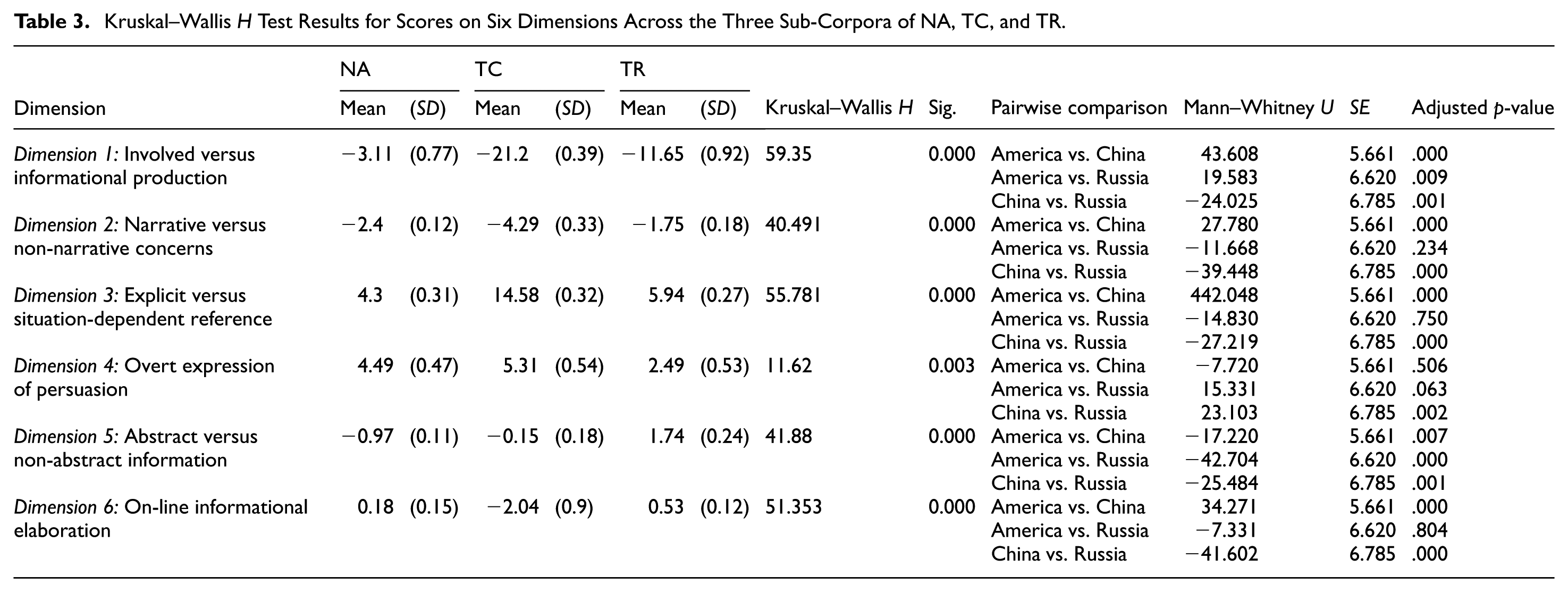
Moreover, the post hoc pairwise comparisons of dimension scores show that, though closer in text type, TC and TR differ on each dimension, whereas NA and TR differ on only two, and NA and TC on five (see Figure 1). This indicates that no significant difference is found between the non-translated sub-corpus and both translated sub-corpora, while no such difference exists between the translated sub-corpora, on any dimension. Only Dimension 4 reveals a significant difference existing merely between the two translated sub-corpora.
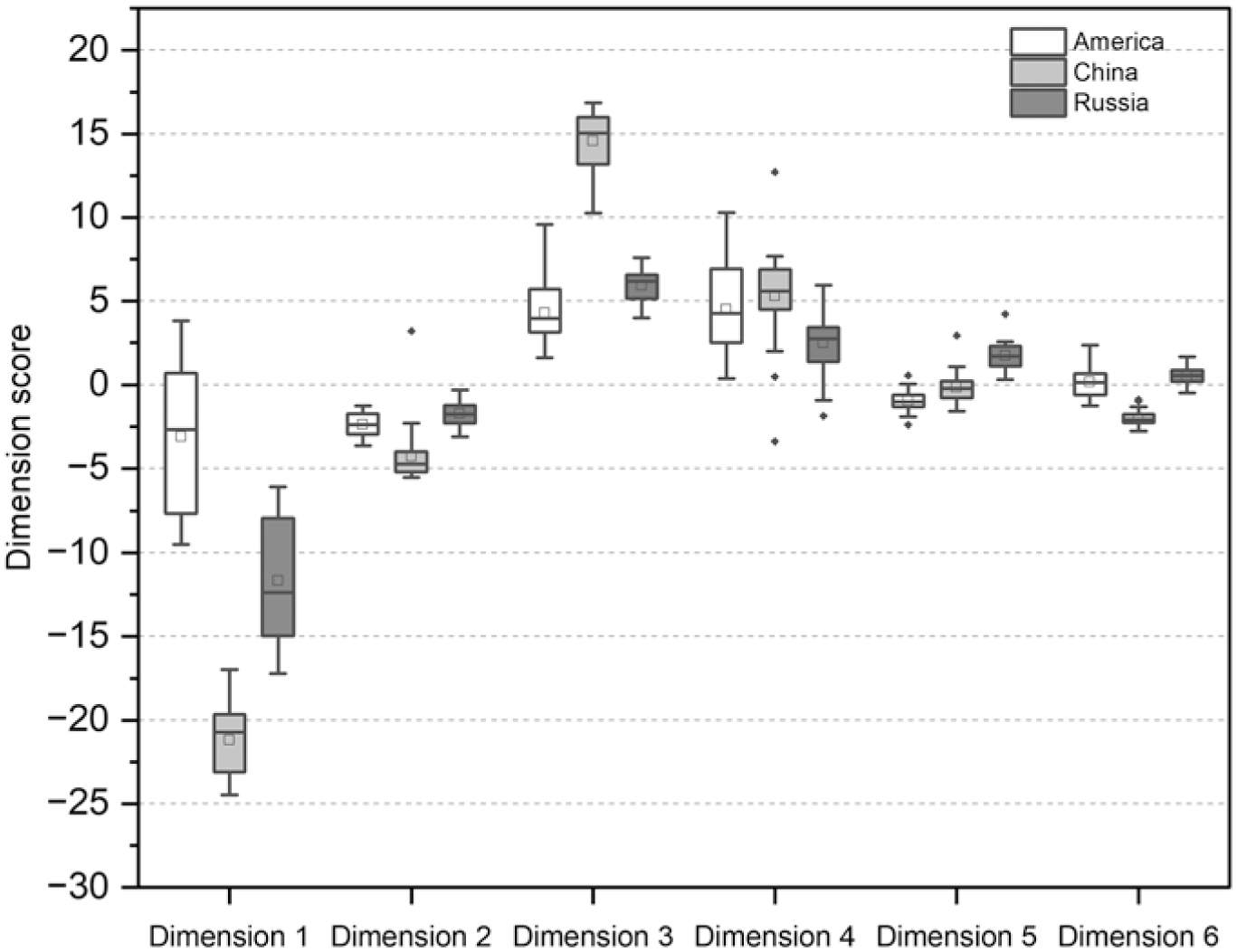
Distribution of dimension scores of the three sub-corpora on six dimensions.
Difference in Choices of Linguistic Features for Communicative Dimensions
The following tables show the Kruskal–Wallis H test results for comparing z-scores of individual linguistic features loaded on each dimension. Each table is sorted in the following order: The primary sorting is based on positive or negative features; the secondary sorting is according to the country in focus; the tertiary sorting is by the Kruskal–Wallis H value (from high to low). The secondary sorting is thus arranged to facilitate the comparison among the three countries of interest. Overall, the analysis focuses on those linguistic features that can best differentiate between the sub-corpora according to their significant differences in z-scores. It somehow involves the normalized frequency of certain features (to a frequency per 1,000 words of the running text, abbreviated as ptw and placed in parentheses).
Dimension 1: Involved Versus Informational Production
Dimension 1 involves the most linguistic features and strongly represents a fundamental parameter of variation among texts in English. High scores on dimension 1 represent discourse with interactional, affective, and involved purposes, associated with strict real-time production and comprehension constraints. Low scores mark discourses with highly informational purposes, which are carefully crafted and highly edited (Biber, 1988, p. 115). The former discourse results in generalized lexical choice and a generally fragmented presentation of information, and the latter enables precision in lexical choice and an integrated textual structure (Biber, 1988, p. 170).
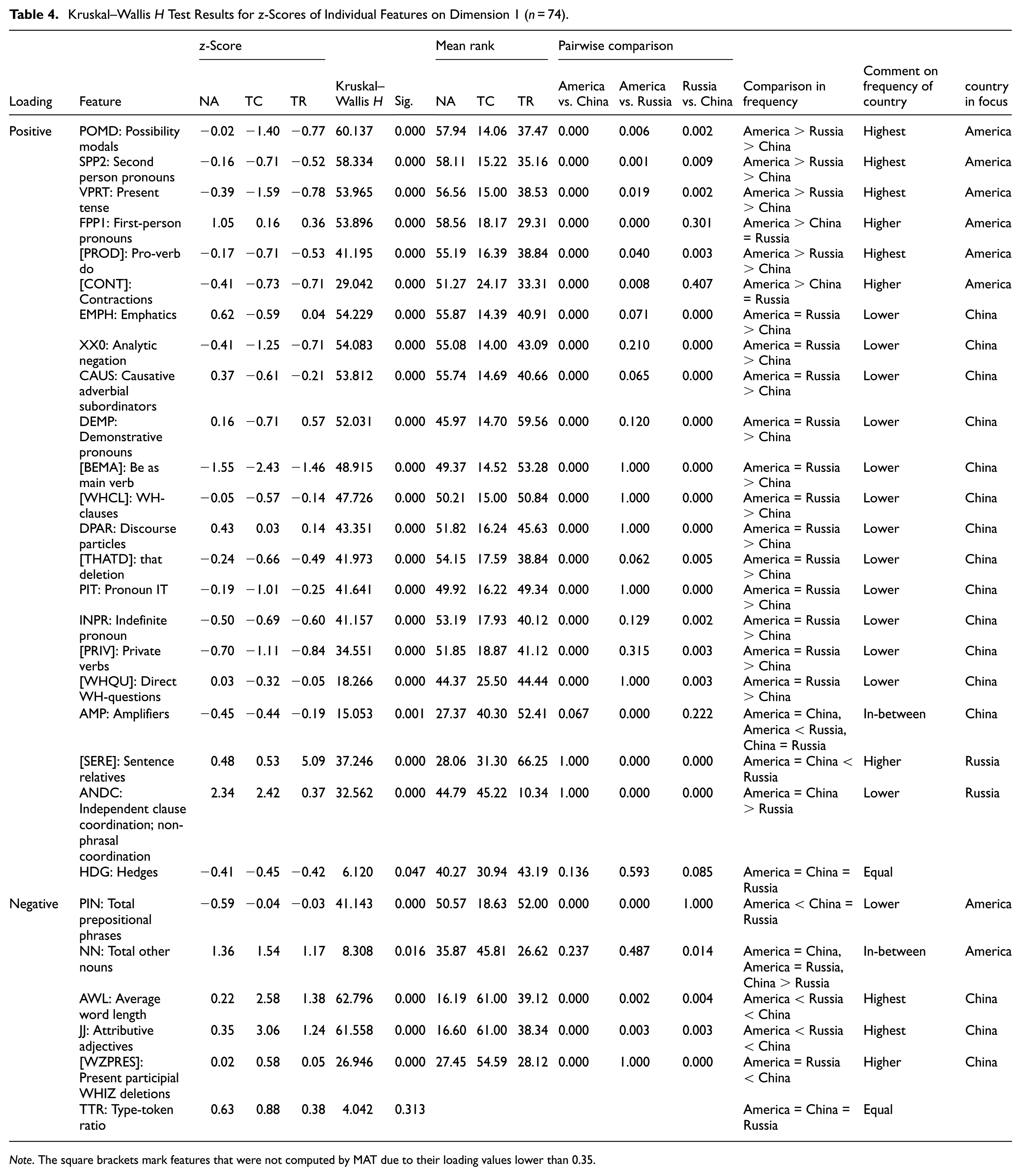
According to Table 3, all negative dimension scores of the three sub-corpora show that both non-translated and translated state addresses belong to informational discourse. In comparison, NA has the most involved addresses; TC contains the most informational addresses (see Figure 1). Dimension 1 also sees the largest variation among the three sub-corpora. Out of 22 positive features marking involved production, 21 display significant differences in frequency. Among them, such features as possibility modals (POMD), second person pronouns (SPP2), present tense (VPRT), and pro-verb do (PROD) can best differentiate the three sub-corpora on this dimension, as a significant difference exists between their frequencies in either two of the three sub-corpora (see Table 4).
Kruskal–Wallis H Test Results for z-Scores of Individual Features on Dimension 1 (n = 74).
Note. The square brackets mark features that were not computed by MAT due to their loading values lower than 0.35.
As in example (1), NA uses second-person pronouns (SPP2) (7.6 ptw) more frequently to refer directly to the American addressees, adding a colloquial, informal flavor. This frequent choice in oral addresses permits rapid language production (Biber, 1988, p. 19) in interactive situations. NA also uses more possibility modals (POMD) (5.7 ptw) to show uncertainty or lack of possibility of certain events occurring, which may enable the American president to sound more objective and less imposing. Present tense (VPRT) is used to signal actions occurring in the immediate context of interaction, occurring more frequently in NA (64.2 ptw) than TC (23.2 ptw) and TR (51.1 ptw), rendering the native address more likely to involve and engage addressees.
1. So, my fellow Americans, whatever
Featuring the most informational discourse, TC has the longest average word length (AWL) (5.53) and the most attributive adjectives (JJ) (118.3 ptw), two features that can best differentiate among the three sub-corpora towards the positive pole. In example (2), TC uses more attributive adjectives and longer word length with other positive features, such as nouns and prepositional phrases, to elaborate and classify concepts through a compressed sentence, making the Chinese premier’s translated address sound highly informational and densely structured.
2. … comprehensively deepen reform; constantly expand opening up; drive development through innovation; keep to the
Dimension 2: Narrative Versus Non-Narrative Concerns
Dimension 2 distinguishes between “an active, event-oriented discourse and a more static, descriptive or expository type of discourse” (Biber, 1988, p. 109). In Table 3, all three sub-corpora are found concentrating on non-narrative content. In comparison, TC has significantly more non-narrative content than the other two. Table 5 shows that out of six positive features marking narrative content, public verbs (PUBV) can best distinguish NA (4.1 ptw) and TR (3.6 ptw) from TC (1.6 ptw) in terms of frequency.
Kruskal–Wallis H Test Results for z-Scores of Individual Features on Dimension 2 (n = 74).
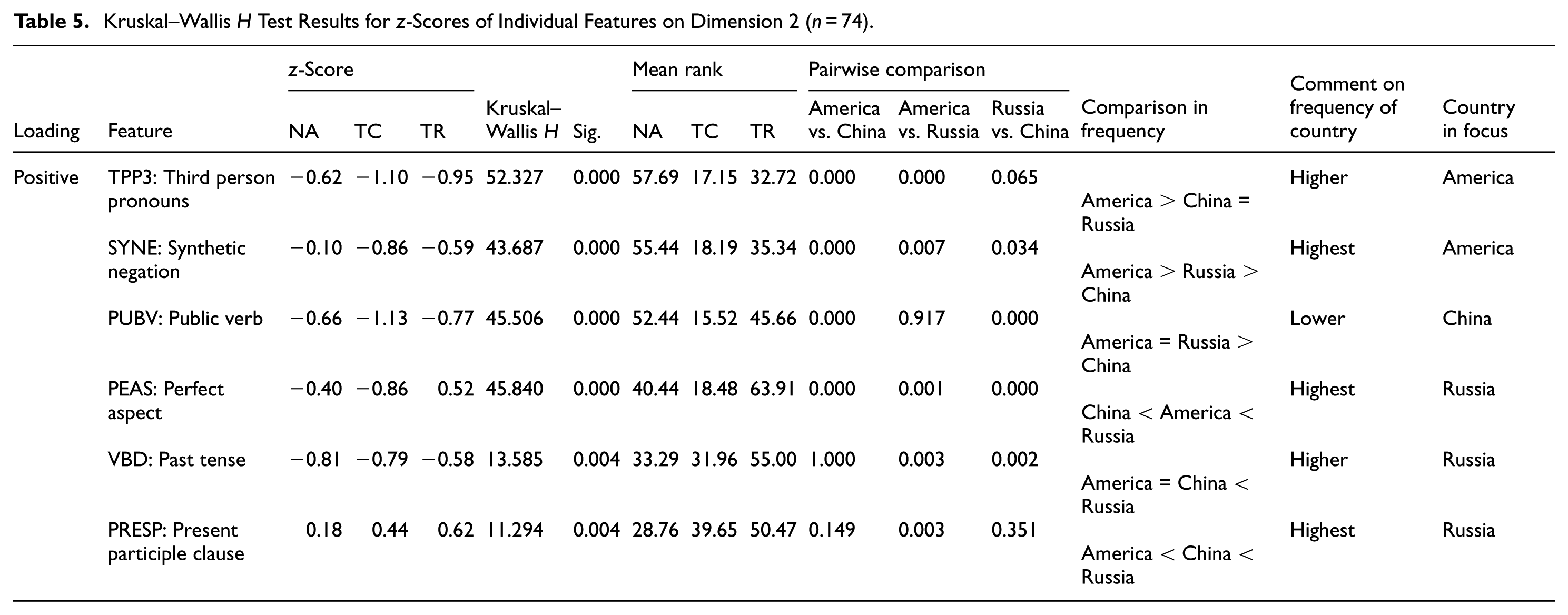
Among public verbs, the most frequent one in NA is say (1.1 ptw); the most frequent two subjects of say are I and he. That in TR is say (1.2 ptw); the most frequent two subjects of say are I and president. The most frequent public verb in TC is maintain (1.0 ptw); the most frequent two subjects of maintain are we and economy. Apparently, public verbs follow singular first-person pronouns more frequently in NA and TR as they function “as markers of indirect, reported speech” (Biber, 1988, p. 109), or activity verbs (He, 2017) to explicate attribution; whereas TC prefers collective we to emphasize “collective endeavors or beliefs” (Biber, 1995) of the government or to make “explicit reference to themselves” (Jin, 2021) in the presentation of claims.
3.
Dimension 3: Explicit Versus Situation-Dependent Reference.
Dimension 3 distinguishes between discourse that identifies referents fully and explicitly through relativization and discourse that relies on nonspecific deictics and references to an external situation for identification purposes (Biber, 1988, p. 115). According to Table 3, all three sub-corpora belong to context-independent discourse according to their positive scores; yet TC is characterized by remarkably more explicit reference than NA and TR.
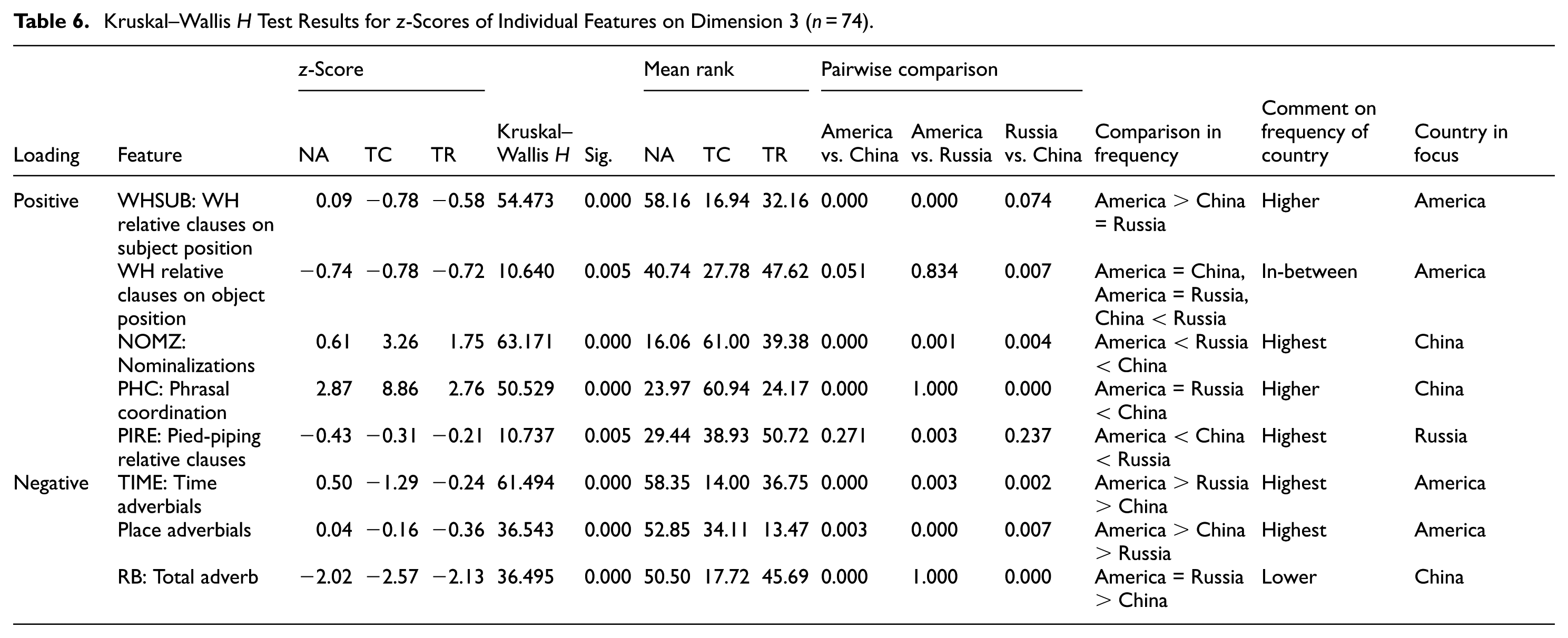
Among the five positive features associated with explicit reference, phrasal coordination (PHC) can best differentiate TC from the other two (see Table 6). The most frequent of such phrases in TC include economic and social development, science and technology (as seen in example 4), urban and rural residents, etc. The heavier use of phrasal coordination helps to specify two entities involved or concepts that frequent the Chinese government’s agenda. Such use results in low information elaboration yet well-planned information integration, “easing the burden of shared context and prior knowledge” (Sheng & Li, 2024) for the foreign readers of China’s translated addresses.
Kruskal–Wallis H Test Results for z-Scores of Individual Features on Dimension 3 (n = 74).
4. We will carry out a number of projects of major importance for overall economic
Among the three negative features, adverbs (RB) can best distinguish NA (30.0 ptw) and TR (28.1 ptw) from TC (20.3 ptw). This result indicates that NA and TR rely more heavily on adverbs to be situation-dependent. Adverbs over 1 ptw in NA include when, so, also, here, together, and where; those of the same frequency in TR are also, as well (collocate appears more frequently), and already. In contrast, no adverbs in TC are as frequent; the most frequent one is also (1.0 ptw).
Dimension 4: Overt Expression of Persuasion
Dimension 4, as marked with positive features, distinguishes between “overt expression of persuasion” (Biber, 1988, p. 111) and covert expression of persuasion (Ali & Ahmad, 2016; Wang & Liu, 2024). The result shown in Table 3 points out that only the dimension scores of TC and TR are significantly different, and the former is found to contain significantly more overt expressions of persuasion than TR. However, no linguistic feature of this dimension has a significantly higher frequency in TC than in TR (see Table 7). Considering their normalized frequencies, predictive modals (PRMD) and necessity modals (NEMD) are used more in TC than TR, which may weakly distinguish the two translated sub-corpora on this dimension.
Kruskal–Wallis H Test Results for z-Scores of Individual Features on Dimension 4 (n = 74).
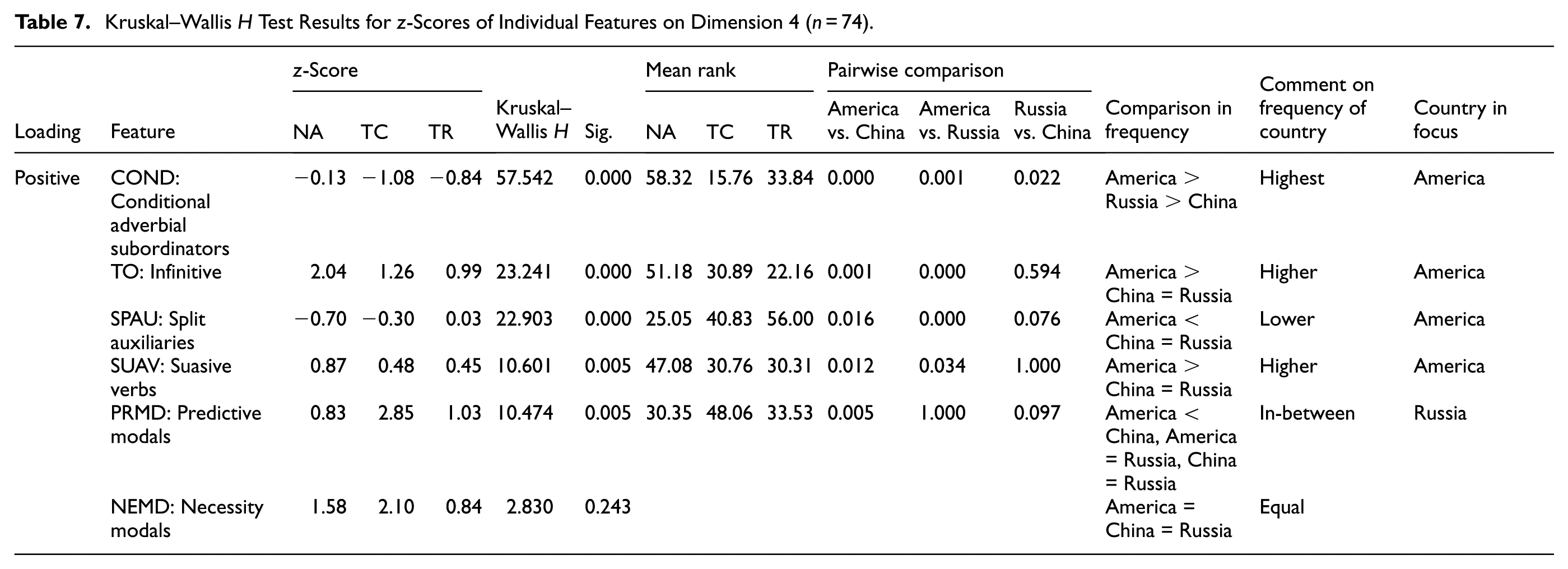
As in example (5), TC uses predictive modal will to express the certainty of future activities that the government is committed to, and chooses the necessity modal should to make “direct persuasion” (Biber, 1988, p. 151; Bu et al., 2020) by giving instructions for relevant entities to assume roles or take actions.
5. We
Dimension 5: Abstract Versus Non-Abstract Information.
Dimension 5 serves as a discriminator of abstract versus non-abstract texts (Conrad & Biber, 2014, p. 180). Abstract style approximates passivized style since passive constructions are the main underlying linguistic feature (He, 2017). Based on Table 3, the three sub-corpora differ from each other, with TR being slightly abstract discourse and NA and TC featuring non-abstract one. However, Table 8 shows that no feature whose frequency significantly differs among the three can thus best distinguish them. Similar to Dimension 4, the normalized frequency of such features as agentless passives ([PASS]) and conjuncts (CONJ) may weakly serve to distinguish them.
Kruskal–Wallis H Test Results for z-Scores of Individual Features on Dimension 5 (n = 74).
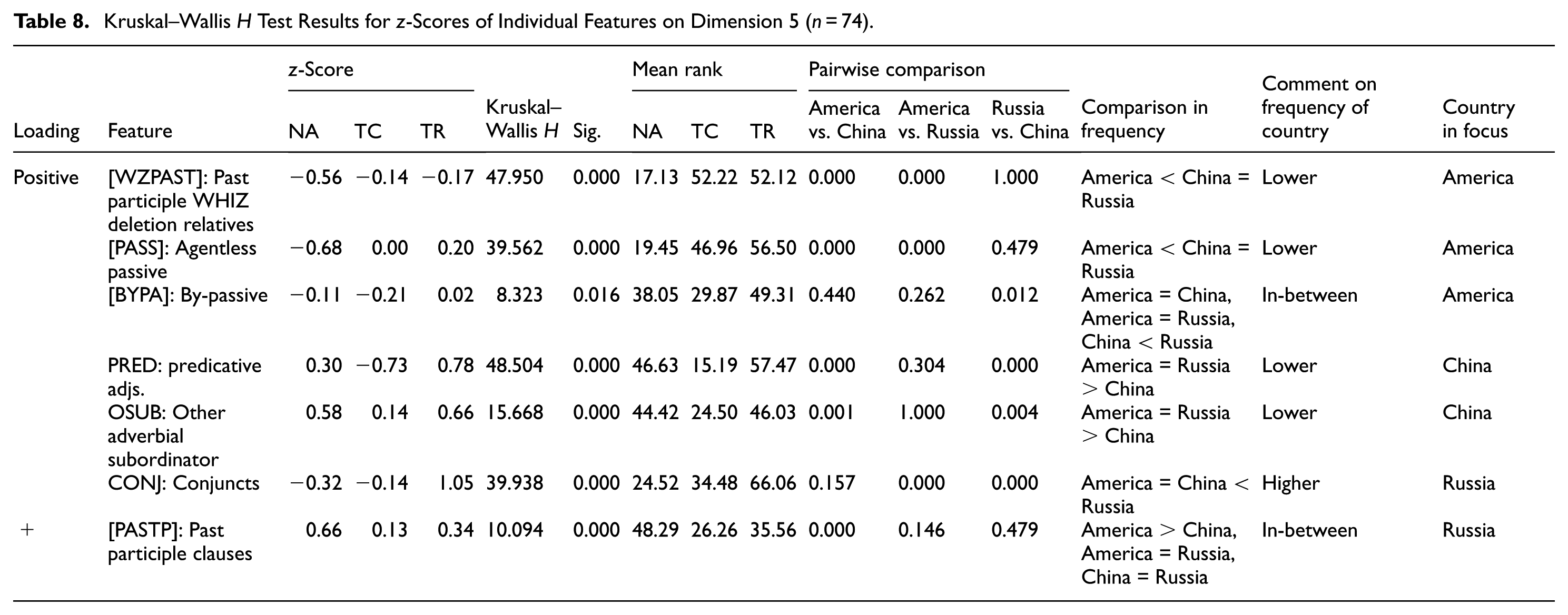
TR uses the most agentless passives (10.9 ptw), including built, allocated, and launched; TC uses fewer ones (9.5 ptw), including made, improved, and strengthened. The two translated sub-corpora use more of this construction than the native one (5.1 ptw), to emphasize the patient when the agent can be easily inferred to be the government (Sheng & Li, 2024). Additionally, conjuncts are used more in TR (2.9 ptw) than in NA (0.7 ptw) and TC (1.0 ptw). Those in TR include in (addition, particular), however, as, for, and therefore. Example (6) illustrates that TR’s preference for conjuncts contributes to its abstract style by building complex logical relationships between sentences, rendering explicitness in grammatical cohesion, and presenting information, explanation, or stances in the planned discourse (Zou & Wang, 2021).
6. Esteemed colleagues, according to our estimates, Russia will become one of the world’s five largest economies in terms of purchasing power parity within two or three years.
Dimension 6: On-Line Informational Elaboration
Dimension 6 indexes informational elaboration under strict real-time conditions (Biber, 1988, p. 156). High scores on this dimension mark informational discourse produced under highly constrained conditions, in which information is presented in a relatively loose, fragmented manner (Biber, 1988, p. 115), typical of spoken conversation (Biber et al., 1999, p. 1068; Kruger & van Rooy, 2016). Low scores characterize texts heavily informative and minimally subject to contextual, spontaneous pressures (Pérez et al., 2021). Based on Table 3, NA and TR loaded with positive scores are slightly analogous to spoken conversation; while TC loaded with a negative score is produced as “well-planned” (Sheng & Li, 2024), “prepared speeches” (Wang & Liu, 2024), as they are “minimally subject to contextual, spontaneous pressures” (Pérez et al., 2021). According to Table 9, four out of five positive features serve to distinguish NA and TR from TC.
Kruskal–Wallis H Test Results for z-Scores of Individual Features on Dimension 6 (n = 74).
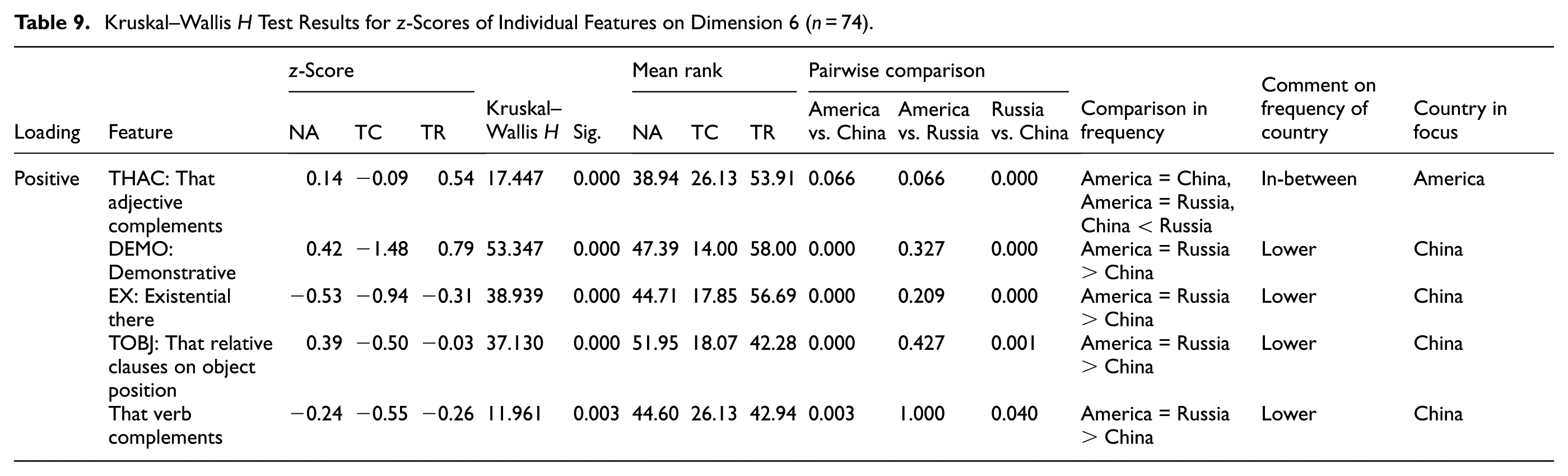
The four features are demonstrative (DEMO), existential there (EX), that relative clauses on object position (TOBJ), and that verb complements (THVC). Specifically, their normalized frequencies are significantly higher in NA (11.7, 1.3, 1.2, 2.6) and TR (13.2, 1.7, 0.8, 2.5) than in TC (3.7, 0.5, 0.2, 1.7). Example (7) shows that, rather than giving a detailed specification, demonstrative this is used in TR as pointers, requiring the foreign readers to find the exact meaning usually in the surrounding context (Biber et al., 1999, p. 70). By using existential there rather than the ordinary subject-verb pattern, TR finds it possible to postpone (and thus prepare the foreign addressees for) new information (Biber et al., 2021, p. 158). The uses of that-clauses, as in example (8), aim to unpack information that could otherwise be presented more densely with phrasal features, or to elaborate information relative to the addresser’s opinions, attitudes, or stances, while assuming less background knowledge (Ren & Lu, 2020) from the receivers of America’s native addresses.
7. We have finally reached
8. I have to say
Discussion and Conclusion
Rethinking Translated Versus Nontranslated Languages
Concerning text types, our findings that translated and nontranslated state addresses belong to different types seem to echo studies of Zou and Wang (2021), Zhang et al. (2023), and Sheng and Li (2024), which differentiated America’s native English and translated English from Chinese in spoken or written political discourse. However, we also found that the text type of the groups of translated and nontranslated state addresses from nine countries is country-specific, and a different degree of variation exists within texts of every group, regardless of the translation status of those state addresses. Besides, the groups of state addresses of two native countries, that is, Canada and New Zealand, exhibit the type of learned exposition different from that rare type of involved persuasion of America’s addresses. Given these, we differ from those studies by arguing that translation status does not primarily affect the text type of the political discourse, which may be determined mainly by the purpose of discourse. To fulfill the purpose of persuasion, America’s native addresses aim not only for information dissemination and diffusion but also, more importantly, for demonstrating the government’s keen attempts to engage its own and/or foreign public in certain activities or to accept certain viewpoints. Convincing or not, these addresses are a symbol of discourse power vested in the world’s most powerful country (Sheng & Li, 2024) derived from its leadership in economic, political, cultural, and military strength.
Though political discourse is inherently persuasive, the primary function of the translated state addresses is perhaps not persuasion through engagement, but the unambiguous presentation of the official record for a global audience. Such a function can be explained by the intention of the government to provide translation services for such high-profile political documents, which focuses on facilitating reliable and effective dissemination of information about the government’s performance and positions by the foreign media through the lingua franca. By weighing up information exposition, the English translation of the political discourse seems to give priority to winning trust before winning hearts (Sheng & Li, 2024). This divergence in purpose between translated and non-translated political discourses of governments may reflect their different underlying political communication strategies and philosophies of governance built based on national power.
Regarding communicative dimensions, America’s nontranslated and Russia’s translated addresses are found to resemble each other more than China’s and Russia’s translated addresses do. And there is no dimension with a mere difference between non-translated and translated addresses. These seem to contradict most previous MDA-aided corpus-based translation studies, for example, Xu (2021), Zou and Wang (2021), Zhang et al. (2023), Kruger and van Rooy (2016), Pérez et al. (2021), and Sheng and Li (2024). Those studies commonly compare American or British English overrepresented as native English with translated English from one overrepresented source language to riskily conclude that native and translated discourses differ in text types and communicative dimensions. An addition of translated English from any other source languages (for instance, this study) could probably produce dissimilar results to disaccord with those studies. Again, this may reconfirm the decisive factor of the purpose of discourse, which is conferred by each government and leads to specific communicative settings that exert “a greater impact on variation than the translational process” (Pérez et al., 2021).
Rethinking Translation Universals
Our findings about the dissimilarity between China’s and Russia’s translated addresses on every communicative dimension and the proximity of Russia’s translated addresses to America’s native addresses also seem to conflict with previous studies arguing that the translated language may align with the target language (i.e., normalization) (Kenny, 2001) or not (Ji, 2017). Meanwhile, such findings contradict the leveling-out hypothesis that translations are more alike as compared with native texts (e.g., Baker, 1996; Grabowski, 2013). This surprising linguistic and communicative alignment of Russia’s translated and America’s native addresses seems to call for future interdisciplinary research connecting linguistic findings with international relations theory. Research in question may uncover a legacy of shared Cold War-era rhetorical frameworks or a similar strategic positioning towards an imagined global audience today.
This study also shows that on Dimension 6 Russia’s translated addresses use the complementizer that as frequently as America’s native addresses but more frequently than China’s translated addresses. This finding seems at odds with studies in favor of explicitation (e.g., Kruger, 2019; Olohan & Baker, 2000), as reflected in the more frequent use of that in translated texts from one source language compared to nontranslated texts.
The findings about type-token ratio (TTR) and average word length (AWL) from Dimension 1 also offer mixed results about simplification, as the two features are commonly used as indicators to justify simplification (e.g., Ferraresi et al., 2018; Z. Liu & Dou, 2023). We found no significant difference in TTR, which indicates lexical diversity among the three countries’ addresses. This result may contradict findings of studies proving simplification but supports Ferraresi et al.’s (2018) findings about translations and interpretations of plenary speeches at the European Parliament. As an indicator of lexical sophistication, AWL is significantly higher for China’s than for Russia’s translated addresses, and they are significantly higher than for America’s native addresses. This result about AWL echoes Z. Liu and Dou’s (2023) findings about simultaneous interpreting of United Nations Security Council speeches. These combined findings render simplification ambiguous in translation of political discourse.
Possible explanations for and implications of these disagreements are as follows. On the one hand, translation universals appear contingent on the communicative setting dictated by the culture of the source language. There seems to be a greater factor at play when translated and nontranslated languages of political registers are compared. Therefore, the misleading concept of translation universals seems costly, since CTS are already past the phase of “needing a raison d’être” (De Sutter & Lefer, 2019; Pérez et al., 2021), and research of this kind is past its infancy. Several universal claims have “proved to have been falsified at a universal level” (Jia et al., 2022) and softened to “tendencies” or “conditioned regularities” (Mauranen, 2008; Tymoczko, 1998). Our findings suggest that even this more nuanced view is insufficient without accounting for the primary driver of communicative purpose, which can evidently override such tendencies. Besides, “no claims can be made about how widespread and how linguistically, culturally, and historically independent any features identified may be” (Olohan, 2004). Therefore, with multifactorial empirical research, we come to realize early that attempts to justify or falsify them with so many arrays of parameters available may generate endless lists of similar or dissimilar results, with nearly empty hope of finding any features or tendencies that can identify a translation of every register. Instead, we may boldly assume that the nature of translation is a priori rather than a posteriori. As a text is established as a translation, we may anticipate within it translation tendencies. But the text does not cease to be a translation if a tendency is not certified. In this sense, our findings could contribute to, rather than definitively resolve, ongoing theoretical debates.
On the other hand, statistics for CTS are a double-edged sword. All statistical results about linguistic features are subject to choices of sub-corpora, corpus sizes, statistical methods, levels of significance, etc., as applied differently. Even in this study, we find divergent results. For one, Dimension 1 shows that America’s and Russia’s addresses delete that (THATD) more frequently than China’s addresses, but Dimension 6 shows that America’s and Russia’s addresses use that-clauses more frequently than China’s. For another, the differences in type-token ratio (TTR) across the three sub-corpora do not reach statistical significance, but similar patterns can be found for other features whose differences do reach. Ferraresi et al. (2018) attributed this to the large amount of variation in large data. Besides, high-stakes political texts such as state addresses are characterized by a highly formal and formulaic register. This register imposes strong constraints on lexical choice, which may lead to a convergence in lexical diversity, regardless of the source language, culture, or translation status. This reminds us that statistics may work convincingly with large-sized corpora of translations, but the individuality and creativity of each translation need not be overlooked.
The main limitations of this study are listed below. First, the replication of Biber’s framework may potentially uncover nuanced differences specific to translated language. Second, the focus on a single political genre, the uneven distribution of texts across countries, the selection of countries with publicly available governmental materials, potential temporal variation across the corpus, and challenges associated with cross-country comparability, each could affect generalizability. Third, the lack of comparison between source and target texts fails to capture the effect of shining-through and the role of speakers. Fourth, lack of control for translation processes and translator-related variables. Future studies may consider other registers and genres, or more native English languages and English translated from more diverse source languages, or use other methods (e.g., cluster analysis), to investigate variation between translated and nontranslated languages.
Footnotes
Appendix
Normality Test Result for Dimension Scores by Sub-Corpus.
| Shapiro–Wilk | ||||
|---|---|---|---|---|
| Dimension | Country | Statistic | df | Sig. |
| Dimension 1 | America | .935 | 31 | .059 |
| China | .961 | 27 | .390 | |
| Russia | .906 | 16 | .099 | |
| Dimension 2 | America | .959 | 31 | .274 |
| China | .617 | 27 | .000 | |
| Russia | .971 | 16 | .857 | |
| Dimension 3 | America | .941 | 31 | .087 |
| China | .931 | 27 | .074 | |
| Russia | .927 | 16 | .220 | |
| Dimension 4 | America | .971 | 31 | .535 |
| China | .900 | 27 | .013 | |
| Russia | .951 | 16 | .502 | |
| Dimension 5 | America | .989 | 31 | .985 |
| China | .905 | 27 | .017 | |
| Russia | .937 | 16 | .315 | |
| Dimension 6 | America | .972 | 31 | .568 |
| China | .934 | 27 | .086 | |
| Russia | .961 | 16 | .680 | |
Acknowledgements
We would like to express our deepest gratitude to the editors and anonymous reviewers for their thorough reviews and valuable advice.

Ethical Considerations
This research does not involve animal or human studies, and as such, no ethics committee approval was required.
Consent to Participate
This article does not contain any studies with human participants performed by any of the authors.
Author Contributions
Contributing author: conceptualization, methodology, and writing. Corresponding author: review, editing, and funding acquisition.
Funding
The authors disclosed receipt of the following financial support for the research, authorship, and/or publication of this article: This work was funded by China’s National Office for Philosophy and Social Sciences, Grant Number 25BYY096.
Declaration of Conflicting Interests
The authors declared no potential conflicts of interest with respect to the research, authorship, and/or publication of this article.
Data Availability Statement
Data would be made available upon reasonable request from the corresponding author.*