






Abstract
This study develops and empirically validates a structural model of co-creation for tourism product design, integrating perspectives from both tourists and destination stakeholders. Using exploratory factor analysis and structural equation modeling (SEM) with data from Holguin, Cuba, an emerging destination, the research identifies five interrelated dimensions of the co-creation process: (a) personalization and participation, (b) technology and innovation, (c) value and satisfaction, (d) collaboration and sustainability, and (e) experience and context. The model showed acceptable fit for a complex, theory-driven SEM framework (CFI = 0.910; TLI = 0.900), supporting the theoretical coherence and empirical adequacy of the proposed model. Results highlight the central role of active participation and digital technologies in shaping perceived value, satisfaction, and willingness to consume the co-created product. In contexts with limited institutional coordination, technology serves as a compensatory mechanism, fostering collaboration, and adaptability among actors. The study provides a scalable framework for designing participatory, sustainable, and high-value tourism products. Limitations relate to the single-destination scope, non-probabilistic sampling, and the absence of longitudinal validation. Future research should replicate the model across diverse contexts and explore mediating variables such as satisfaction, loyalty, and emotional engagement.
Plain Language Summary
This study examines how tourists and local stakeholders, including businesses, public institutions, and community members, can collaborate to design better tourism experiences. This process, known as co-creation, turns tourists from passive consumers into active participants who help shape the products they enjoy. To understand how co-creation works, the researchers developed and tested a model combining personalization, technology, sustainability, collaboration, and satisfaction. The study was conducted in Holguin, Cuba, an emerging destination with limited digital infrastructure and weak institutional coordination. Surveys with tourists and tourism stakeholders identified five key factors: personalization and participation, technology and innovation, value and satisfaction, collaboration and sustainability, and experience and context. Results suggest that active participation increases perceived value, satisfaction, and willingness to engage with co-created products. Digital tools, such as mobile apps and online platforms, also improve communication and connection. Overall, the study shows that co-creation can make tourism more innovative, engaging, and sustainable, benefiting both visitors and local communities.
Keywords
Introduction
Tourism destinations increasingly compete on their ability to design innovative, authentic, and sustainable products that meet evolving traveler expectations while supporting local development. However, many emerging destinations still rely on standardized and externally conceived packages that limit local innovation, reduce stakeholder participation, narrow the diversity of experiences, and undermine competitiveness (Hernández-Mogollón et al., 2020). These limitations reveal the need for more collaborative approaches to tourism product design.
Value co-creation has become a central concept in tourism research because it reframes tourists, providers, communities, and institutions as active contributors to the creation of meaningful experiences. Rather than viewing tourists as passive consumers, co-creation emphasizes interaction, personalization, knowledge exchange, and shared value generation throughout the design and delivery of tourism products (Custódio Santos et al., 2020; Font et al., 2021; Ribeiro et al., 2023; Xie et al., 2020). In practice, co-creation enables tourists to participate directly in developing and customizing their experiences, producing more collaborative, immersive, and differentiated outcomes.
Research increasingly emphasizes that collaborative experience design and consumer-to-consumer co-creation enhance the perceived value of tourism experiences. As Bolzán and Mendes-Filho (2021) observe, value emerges from consumers’ social practices and transcends transactional exchanges. This view challenges provider-centric models and positions tourist participation as a core driver of innovation and value creation. Similarly, prior studies show that personalized and interactive experiences can strengthen satisfaction, loyalty, authenticity, and engagement (Font et al., 2021; Yu et al., 2021).
Several authors have examined the intersection of experience design, customer participation, technological mediation, sustainability, and stakeholder collaboration in tourism (Custódio Santos et al., 2020; Carvalho et al., 2023; Dai & Zhang, 2024; Haid & Albrecht, 2021; John & Supramaniam, 2024; Nan et al., 2024; Pine & Gilmore, 1998; Sabiote-Ortiz et al., 2025; Zhou & Chen, 2022). However, the literature remains fragmented. Most studies address co-creation from behavioral, technological, or experiential perspectives, without integrating these dimensions into an operational model specifically focused on tourism product design. Likewise, although recent research recognizes the importance of customer participation, ICT-enabled interaction, sustainability, and stakeholder engagement, few studies empirically link these elements to design-stage processes and outcomes such as willingness to consume the co-created product.
This gap is especially relevant for emerging destinations, where limited digital infrastructure, weak institutional coordination, scarce training, and dependence on standardized tourism models can hinder innovation and competitiveness. Holguín, Cuba, illustrates these tensions. Despite its tourism potential, most tourism offerings follow centralized resort-oriented models that constrain local entrepreneurship and collaborative design, reducing the diversity and authenticity of visitor experiences. Weak institutional coordination, limited digital infrastructure, and insufficient training further hinder the integration of technology and sustainability into tourism development. These conditions make Holguín a suitable context for examining how co-creation can support more participatory, adaptive, and competitive tourism product design.
To address these gaps, the present study develops and empirically tests a structural model of co-creation for tourism product design in an emerging destination. Co-creation in tourism is defined here as the collaborative process through which tourists, providers, and local stakeholders jointly design and enhance tourism products by contributing knowledge, creativity, and resources to generate shared value. This definition combines the relational, participatory, and value-creation aspects emphasized in Service-Dominant Logic and Sociotechnical Systems Theory, ensuring consistency across the theoretical model, hypotheses, and discussion.
The proposed model integrates five interrelated dimensions: Personalization and Participation, Technology and Innovation, Value and Satisfaction, Collaboration and Sustainability, and Experience and Context. These dimensions capture how tourist involvement, digital mediation, perceived value, stakeholder collaboration, sustainability, and contextual experience interact within a unified framework for tourism product design. In doing so, the model bridges the gap between co-creation as a theoretical idea and its practical application in the design and development of tourism products.
The study contributes to the literature in three ways. First, it translates the concept of co-creation into an operational model for tourism product design, connecting theoretical constructs with measurable dimensions. Second, it integrates perspectives from tourists and destination stakeholders to capture aggregated design-stage perceptions rather than post-consumption behavior or intergroup differences. Third, it evaluates how the five co-creation dimensions are associated with perceived value, satisfaction, and willingness to consume the co-created product, thereby offering empirical evidence for a design-oriented framework applicable to resource-constrained destinations.
By focusing on Holguín, Cuba, the study provides context-specific evidence on how emerging destinations can use co-creation to align tourist expectations, local capabilities, technological innovation, and sustainability principles. The resulting model offers theoretical and practical guidance for designing tourism products that are more participatory, authentic, adaptive, and competitive.
Literature Review
Evolution of Tourism Product Design
The concept of the tourism product has been widely examined over the past four decades, evolving alongside the tourism industry. In general, a tourism product enables people to travel beyond their usual environment and engage in structured experiences that combine services, attractions, and infrastructure.
Tourism products are commonly classified as primary or secondary. Primary products, such as natural landscapes, cultural heritage sites, or significant events, motivate travel and strongly influence destination image. Secondary products, including accommodation, food services, and transport, support the trip by enhancing comfort and convenience. According to Hassan (2021), a tourism product is “an object or experience that attracts visitors and consists of specific components, including tours, accommodation, attractions, entertainment, transportation, and dining.” Thus, tourism products are not isolated services but composite systems of tangible and intangible resources designed to meet visitor needs and expectations.
Tourism products have distinctive characteristics that shape their development and management. They are intangible, heterogeneous, perishable, seasonal, easy to imitate, and inseparable from consumption, since the tourist participates in the experience as it is produced. These traits create both challenges and opportunities: while they complicate quality assurance and capacity management, they also allow tourists to participate in co-producing meaningful experiences. Understanding these characteristics is essential for designing and marketing products that meet visitor expectations and ensure satisfaction.
In recent years, tourism has been transformed by global competition, post-COVID recovery, and accelerated digitalization. These forces have strengthened specialization, differentiation, and diversification in product development. A key shift is the growing relevance of experience co-creation, supported by technologies that deepen interaction between providers and travelers. Experiences are increasingly built collaboratively rather than designed unilaterally, allowing tourists to personalize trips, provide feedback, and co-shape more meaningful outcomes.
Digital platforms and online communities now play a central role in this process. Through social media, review sites, and mobile applications, tourists and providers co-create value by exchanging feedback and recommendations, enabling destinations to refine offerings with real-time data and build engaged customer communities. At the same time, local stakeholder participation and sustainability have become integral to tourism design, enhancing authenticity, supporting fair benefit distribution, and aligning development with the Sustainable Development Goals. Overall, technology, co-creation, and sustainability converge to create tourism products that are increasingly personalized, interactive, and responsible.
Technology, Creativity, and Sustainability in Tourism Product Innovation
Tourism product design is evolving through advanced technologies and creative methodologies. Tools such as virtual reality (VR), augmented reality (AR), and computer-aided design (CAD) allow designers to conceptualize, prototype, and test experiences before launch. These technologies can simulate tours, accommodations, heritage sites, or adventure activities, enabling stakeholders and visitors to provide early feedback, improve quality, and shorten production cycles (Zhou & Chen, 2022). Digital design, 3D modeling, and visualization also expand innovation and customization by improving precision, efficiency, and communication among designers.
Beyond technology, tourism increasingly incorporates creative approaches such as design thinking, storytelling, and experiential theming to develop distinctive offerings. Tourists have become active co-designers rather than passive consumers, as providers use participatory practices that allow travelers to personalize experiences and enhance value. Real-time co-creation, such as guides adapting tours to visitor interests, produces richer and more memorable experiences. In this sense, the fusion of digital tools and creative collaboration is generating tourism products that are more innovative, engaging, and adaptive.
Sustainability has also become a central principle in tourism product design. Rather than focusing only on eco-friendly materials or energy-efficient facilities, contemporary approaches consider the entire product lifecycle and its environmental and social context. Modern frameworks adopt a triple-bottom-line perspective, balancing people, profit, and planet to promote social well-being, economic viability, and environmental responsibility.
Designers therefore evaluate not only financial returns but also community effects, such as employment, cultural preservation, equity, and impacts on natural systems, including resource use, waste, and biodiversity. As Haid and Albrecht (2021) note, contemporary sustainable design frameworks assess social and environmental criteria alongside economic outcomes. This broader perspective supports circular-economy practices, community-based models, and stakeholder participation involving communities, governments, NGOs, and tourists. Sustainable tourism design now aims not only to reduce harm but to create regenerative, inclusive, and mutually beneficial experiences.
Co-creation in Tourism: Concepts, Stakeholders, and Empirical Gaps
Alongside the sustainability paradigm, the literature highlights co-creation as a transformative approach to developing tourism products. Consistent with the working definition adopted in this study, co-creation is the collaborative process through which tourists, providers, and local stakeholders jointly design and enhance tourism products and experiences by contributing knowledge, creativity, and resources to generate shared value (Custódio Santos et al., 2020; Font et al., 2021; Ribeiro et al., 2023).
This definition integrates the relational, participatory, and value-in-use dimensions highlighted by Service-Dominant Logic and Sociotechnical Systems Theory. Rather than passive consumers, tourists are active contributors whose feedback and participation shape the authenticity and quality of the final product. The process unfolds through continuous interaction and knowledge exchange among tourists, firms, communities, and public institutions, fostering innovation and mutual benefit throughout the product lifecycle.
A key advantage of co-creation is its capacity to enhance satisfaction and perceived value. When tourists, providers, and communities collaborate, products better align with traveler expectations and contextual authenticity, creating more meaningful and memorable experiences. Research in tourism and hospitality confirms that interaction, engagement, and personalization, core to co-creation, drive perceived value and loyalty (Custódio Santos et al., 2020; Font et al., 2021; Vaz Serra et al., 2022). By engaging tourists as co-authors rather than consumers, destinations strengthen emotional bonds and competitiveness through authentic, sustainable offerings.
In sum, co-creation in tourism product design is a continuous, collaborative process that integrates social, technological, and cultural dimensions. It enables tourists and stakeholders to create innovative and authentic products, fostering relationships and shared learning that transcend transactions. Thus, co-creation bridges creativity, sustainability, and stakeholder engagement, linking individual experiences with collective destination development.
To clarify the conceptual landscape of tourism product design and co-creation, the authors conducted a targeted review of 43 Scopus-indexed publications. Of these, 40% were published between 2010–2019 and 60% between 2020–2024, confirming growing academic interest in the topic. From this corpus, 55 key variables, including market demand, resources, innovation, stakeholder participation, design, and development, were identified and analyzed through network analysis using NetDraw and UCINET. Degree centrality was used to identify the most interconnected and influential concepts.
The network showed moderate decentralization, with a centralization value of 0.357, indicating that no single concept dominated the system. The most central variables were Tourism market and demand (degree = 14.079), Tourism resources (12.857), Development and implementation (12.832), and Design (12.750). These results confirm that tourism product development depends on the interaction between demand, available resources, design activities, and implementation capacity.
Design emerged as a key node linking development and implementation, product concept testing, market demand, tourism resources, innovation, and services. This suggests that tourism design is shaped by both creative and practical considerations. Similarly, Development and implementation occupied a central position, reflecting the importance of transforming ideas into viable products through execution, coordination, and management. In co-creation contexts, this stage is especially relevant because it integrates, tests, and refines tourist feedback and stakeholder contributions.
The joint centrality of Design and Development confirms that tourism product creation is an iterative process rooted in understanding customer needs and translating them into feasible offerings. The network also included Willingness to Consume the Co-created Product as an outcome-oriented variable. Its lower degree centrality (6.039; normalized = 0.151) is consistent with its role as an outcome rather than an input. Although peripheral in the design network, this variable remains theoretically relevant because successful tourism products ultimately depend on tourists’ evaluative readiness to engage with and choose the co-created offering.
In summary, the literature on tourism product design and development identifies several interrelated themes essential for creating innovative and competitive offerings. There is a clear shift toward experiential, co-creative design, in which tourists increasingly seek experiences they can actively shape rather than passively consume. Technological innovation has also become a major driver, as digital design tools enhance creativity and efficiency while interactive technologies enable real-time co-creation. At the same time, changing consumer behavior, social media influence, community participation, and sustainability compel destinations to differentiate and innovate continuously. Collectively, these trends show that successful tourism products integrate design thinking, stakeholder collaboration, and sustainability to generate shared value for tourists and host communities.
Despite advances in tourism product design, several research gaps persist. A key need is to identify the design elements and techniques that most effectively enhance co-created experiences, including which forms of tourist participation, such as storytelling, choice-making, or hands-on involvement, generate the strongest gains in satisfaction and loyalty. Methodologically, scholars also call for improved models and tools to measure the impact of co-design on experience quality and value creation.
As consumer expectations evolve, especially in the post-pandemic era, future research should explore how emerging trends such as virtual tourism, AI-driven personalization, and new notions of wellness and safety can be incorporated into design practices. Another critical direction is assessing the long-term effects of local community engagement, particularly the conditions under which involving residents and indigenous knowledge fosters more sustainable tourism.
Overall, the literature recognizes co-creation as a powerful mechanism for developing distinctive, high-value tourism products that enhance satisfaction, strengthen destination appeal, and support community well-being. However, more research is required to clarify how co-creation influences each stage of design and delivery and to identify effective strategies for implementing it across diverse contexts. Continued inquiry in these areas will help tourism product development evolve with changing markets and societal priorities, benefiting tourists, businesses, and host communities alike.
Integrative Theoretical Foundations and Hypotheses Development
Recent studies show that living labs, real-life experimental settings where tourists, residents, firms, and public institutions co-design solutions, have become key engines of innovation in smart destinations. Three Q1 to Q2 papers published between 2023 and 2025 illustrate their relevance for tourism product design. Dickinger and Kolomoyets (2024), analyzing six living labs, identified clearly defined roles, lab manager mediation, and participant capacity building as success factors for value co-creation. Smit et al. (2024), through a multi-site experiment across five Dutch destinations, proposed iterative prototyping, stakeholder rotation, and collective sense-making to reduce participation fatigue and manage multi-actor complexity. Yin et al. (2024), using a mixed-methods model across four Chinese smart-tourism destinations, validated five dimensions that strengthen co-creation—innovative environment, interactivity, personalized service, cognitive engagement, and social interaction—and showed that digitally mediated personalization and real-time interaction increase perceived value and willingness to consume the co-created product.
These findings reinforce the Technology and Innovation, Collaboration, and Sustainability dimensions of the proposed model. Living-lab governance, through defined roles, mediation, reflexive evaluation, and capacity-building, strengthens stakeholder collaboration and aligns with the Collaboration and Sustainability factor. Similarly, smart-destination research emphasizes ICT-enabled personalization and real-time interactivity, supporting the Technology and Innovation pathway and its relationship with perceived value and willingness to consume the co-created product. Incorporating these insights links co-creation to open-innovation ecosystems and provides practical guidance for implementing co-designed tourism products, especially in emerging destinations developing smart-tourism initiatives.
Tourism product design has evolved from viewing tourists as passive consumers to recognizing them as active co-designers of personalized and meaningful experiences. Recent studies highlight three converging pillars: technology-enabled personalization through VR/AR prototyping, CAD, and smart-destination platforms; living-lab and stakeholder co-creation environments that generate new products, social capital, and shared learning; and holistic sustainability, which balances economic viability with social equity and environmental stewardship. In parallel, the network analysis of 55 variables confirms that Design and Development serve as structural hubs linking resources, innovation, and market demand, while willingness to consume the co-created product operates as a downstream outcome shaped by perceived value, satisfaction, and loyalty.
However, empirical evidence remains limited in three areas. First, the mechanisms through which specific co-design techniques, such as iterative prototyping in living labs, translate into measurable gains in perceived value and willingness to consume the co-created product remain unclear. Second, standardized metrics are still needed to assess the long-term effects of co-created products on community sustainability and destination competitiveness. Third, co-creation models remain insufficiently validated in emerging destinations with distinctive resource constraints and stakeholder dynamics.
To address these gaps, this study develops and empirically tests a structural model of co-creation for tourism product design in an emerging destination. Integrating dimensions from prior research—personalization, technology, value, collaboration, and contextual experience—the model provides a comprehensive framework that advances theory and guides the development of co-creative, sustainable, and competitive tourism products.
In summary, the reviewed literature shows that value co-creation in tourism emerges from the interaction of personalization, technology, collaboration, and contextual experience. However, these dimensions have rarely been operationalized within a single empirical framework. To address this gap, the present study develops and validates a structural model integrating five dimensions that explain how co-creation drives perceived value, satisfaction, and willingness to consume the co-created product.
The model advances prior approaches by explicitly linking five theoretical perspectives, Service-Dominant Logic, Experience Economy, Sociotechnical Systems, Stakeholder, and Experiential Learning theories, to measurable constructs. This integration underpins the study’s hypotheses and empirical testing. Each dimension reflects the adopted definition of co-creation, showing how collaboration, participation, and shared value manifest in tourism product design, ensuring conceptual consistency.
Service-Dominant Logic (SDL). SDL redefines marketing by viewing service, not goods, as the core of exchange. In tourism, value arises from interactions and relationships rather than tangible transfers (Blázquez-Resino et al., 2013). Tourists act as co-producers, contributing knowledge, skills, and experiences, while providers facilitate experience design instead of creating value alone. In this model, Personalization and Participation are grounded in SDL, positioning tourists as active co-creators whose engagement generates value.
Experience Economy Theory. Pine and Gilmore’s framework differentiates experiences from goods and services, proposing four stages: commodity, goods, services, and experiences. Tourism was among the first sectors to adopt this model, emphasizing unforgettable events across four dimensions: education, esthetics, entertainment, and escapism (Chai et al., 2022). Unlike traditional services, the experience economy depends on emotional engagement and active participation, producing deeper, lasting interactions. Accordingly, the Experience and Context dimension in our model draws on this theory by highlighting immersive, multisensory experiences that promote learning, enjoyment, and emotional connection.
Sociotechnical Systems Theory (STS). STS explores the interdependence between social and technical subsystems. Stylos et al. (2025) argue that performance improves when human and technological systems are optimized together, noting that innovation often fails when technology is prioritized over human and cultural adoption factors. Building on this, the model’s Technology and Innovation dimension emphasizes human-centered digital tools designed to support collaboration and participation rather than replace human judgment. STS thus frames technology as a complement to, not a substitute for, human creativity and decision-making.
Stakeholder Collaboration and Sustainability. Stakeholder theory holds that organizations must consider the interests of all affected parties. In tourism, Wondirad et al. (2020) show that sustainable ecotourism relies on collaboration among authorities, businesses, communities, and tourists to ensure fair distribution of benefits and resource conservation. Nevertheless, such collaboration is often limited by power imbalances and a lack of trust. These insights ground the Collaboration and Sustainability dimension of our model, which stresses inclusive planning and equitable outcomes as prerequisites for authenticity, environmental care, and socio-economic resilience. Integrating stakeholder collaboration into co-creation aligns economic goals with social and ecological sustainability.
Experiential Learning Theory (ELT). ELT describes learning as a cycle of experience, reflection, conceptualization, and application. Lo (2022) notes that it promotes project-based, learner-centered engagement that transforms experience into knowledge. In tourism, ELT suggests that visitors gain greater value when they actively engage with cultural and environmental contexts and reflect on them. Accordingly, the Value and Satisfaction dimension draws on ELT, proposing that reflective, participatory experiences enhance perceived value and satisfaction, which, in turn, foster loyalty and revisit intentions.
Integration of Theories and Model Relationships. The proposed co-creation model integrates these theoretical perspectives to explain how its dimensions interact. Service-Dominant Logic and the Experience Economy jointly suggest that value emerges when tourists co-produce personalized, emotionally engaging experiences with providers (Blázquez-Resino et al., 2013; Chai et al., 2022). Sociotechnical Systems Theory posits that technology should complement, not replace, human engagement, enabling personalization and collaboration (Stylos et al., 2025). Stakeholder Theory highlights the need to involve all relevant actors for equitable and sustainable outcomes (Wondirad et al., 2020), while Experiential Learning Theory explains how participatory, reflective experiences lead to lasting satisfaction and loyalty (Lo, 2022).
Together, these frameworks justify the model’s relationships: personalization and innovation enhance perceived value; collaboration fosters sustainability and authenticity; immersive experiences evoke emotional engagement; and experiential learning transforms engagement into lasting satisfaction and behavioral intention. Based on this theoretical integration and the conceptual links among the five co-creation dimensions, the following hypotheses were formulated and tested through Structural Equation Modeling (SEM):
A schematic summary of these hypotheses and their expected directions is presented in Table 8 (below), which is incorporated into the Results section to report standardized path coefficients and significance values.
Materials and Methods
Conceptual Model and Measurement Structure
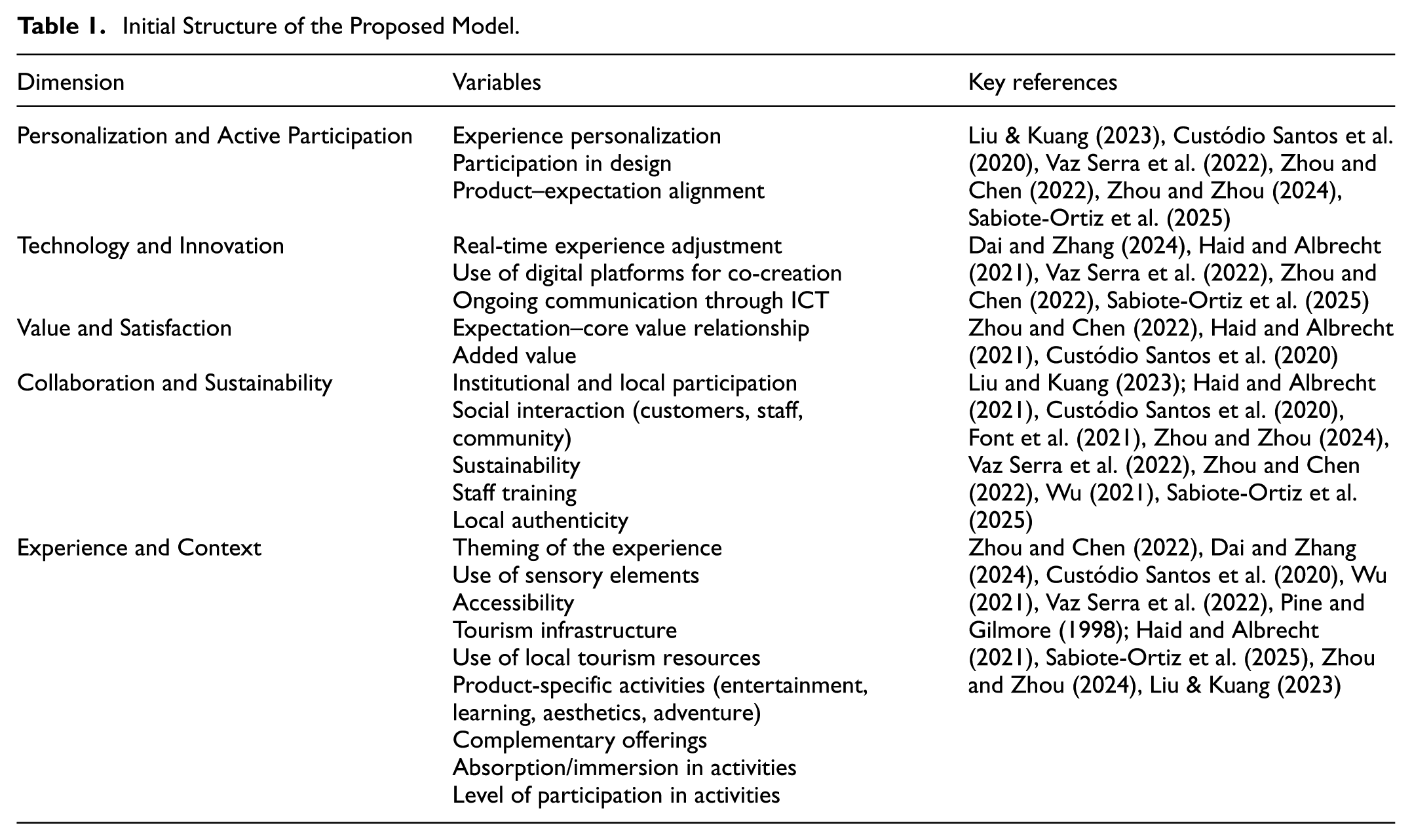
Building on the previous framework, this study presents a structural model that empirically operationalizes the co-creation process in tourism product design. The five dimensions, personalization and participation, technology and innovation, value and satisfaction, collaboration and sustainability, and experience and context, represent distinct expressions of co-creation, capturing how collaboration, participation, and shared value emerge throughout product design and development. These dimensions stem from the integration of Service-Dominant Logic, Experience Economy, Sociotechnical Systems, Stakeholder, and Experiential Learning theories, ensuring both conceptual consistency and empirical measurability. The dependent variable, willingness to consume the co-created product, reflects the behavioral outcome derived from perceived value and satisfaction generated through the co-creative process.
Table 1 presents the initial model structure, specifying the dimensions, the associated variables, and the primary literature sources supporting their inclusion. To empirically validate the theoretically assumed model, a structured instrument was developed. Respondents were asked to evaluate each of the independent variables and the dependent variable using a 1 to 10 importance scale, indicating the degree to which they considered each element relevant to the co-creation of tourism products.
Initial Structure of the Proposed Model.
Sampling Design and Data Collection
Given that this research focuses on the design process itself rather than on evaluating a final tourism product, a non-probability quota sampling strategy was employed. The aim was to include the main actor groups involved in tourism product co-creation, integrating both demand-side participants (tourists) and supply-side or institutional actors (destination stakeholders).
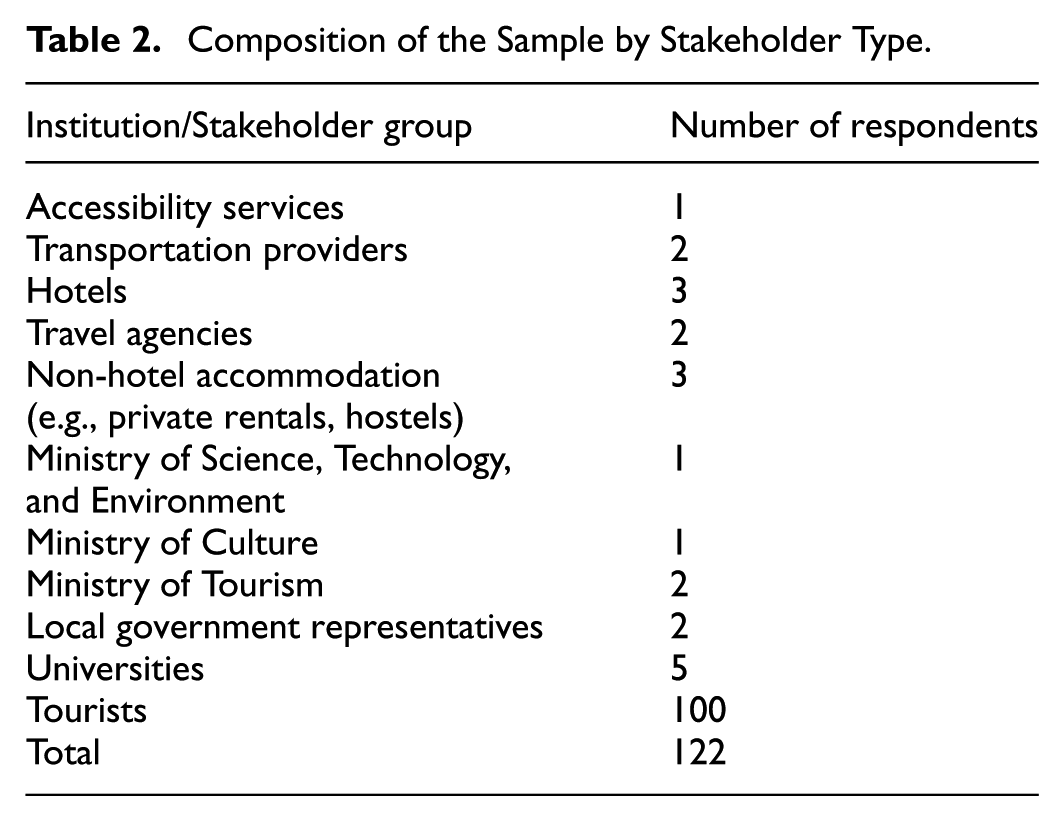
Table 2 provides a general characterization of the sample composition. As shown, the sample reflects the participation of key actor groups commonly engaged in tourism product development and co-creation. The final sample comprised 122 respondents, including 100 tourists and 22 destination stakeholders. The tourist subgroup included 90 Canadian visitors, 7 German visitors, and 3 Italian visitors. These quotas were defined to reflect the dominant international source markets visiting Holguin during the study period, while recognizing that the sample was not intended to provide statistical representativeness of the full tourist population. The stakeholder subgroup included representatives from accessibility services (n = 1), transportation providers (n = 2), hotels (n = 3), travel agencies (n = 2), non-hotel accommodation providers (n = 3), the Ministry of Science, Technology, and Environment (n = 1), the Ministry of Culture (n = 1), the Ministry of Tourism (n = 2), local government representatives (n = 2), and universities (n = 5). This quota-based strategy was used to include the main demand-side and supply-side actors involved in tourism product co-creation and design.
Composition of the Sample by Stakeholder Type.
Tourists were recruited on-site during their stay at the destination through tourism facilities and public spaces commonly used by international visitors. Destination stakeholders were selected according to their involvement in tourism planning, service provision, institutional coordination, local development, or knowledge generation related to tourism product design. The total sample size met established methodological standards for exploratory factor analysis, which recommend collecting 5 to 10 observations per variable (Nicolaou & Masoner, 2013).
The study does not aim to compare tourists and destination stakeholders as distinct populations, nor to estimate group-specific parameters or differences. Instead, both groups were intentionally integrated to reflect their complementary roles in the co-creation and design of tourism products. Accordingly, results are interpreted at the aggregate level, and no intergroup comparisons or group-based inferences are made.
This analytical choice is grounded in the study’s design-oriented focus. The constructs were measured using a 1 to 10 importance-based scale that captures evaluative judgments relevant to the product design stage rather than latent psychological traits intended for cross-group comparison. In this context, tourists contribute experiential and expectation-based inputs, while destination stakeholders provide technical, institutional, and sustainability-related perspectives. These perspectives are non-comparable but complementary for modeling co-creation as a design-stage process.
Under this analytical scope, formal measurement invariance testing is not a prerequisite, as invariance assessment is required when latent constructs or structural relationships are explicitly compared across groups. Nevertheless, this limitation is acknowledged, and future research aimed at intergroup comparisons should apply formal tests of configural, metric, and scalar invariance or multi-group SEM (Hair et al., 2019; Kline, 2023).
Measurement Instrument and Scale Design
The use of a 1 to 10 importance scale was deliberate: respondents assessed the relevance of specific design attributes that enable co-creation rather than reporting personal behavioral intentions. This approach aligns with prior tourism design and service innovation studies that use expert and user judgments to estimate the perceived importance of co-creative factors (Custódio Santos et al., 2020; Font et al., 2021; Vaz Serra et al., 2022). Although prior tourism studies commonly refer to similar outcomes as “purchase intention,” the present study uses the term “willingness to consume the co-created product” because the dependent outcome was measured as an importance-based evaluation at the design stage, rather than as a conventional post-consumption behavioral intention. This wording better reflects respondents’ evaluative propensity toward consuming the co-created product within the design process.
Focusing on the design process rather than post-consumption behavior, both tourists and destination stakeholders evaluated the criticality of each attribute in facilitating co-creation. This method provides a valid proxy for design significance rather than for attitudinal or behavioral intention constructs. The resulting data allowed integrated analysis across respondent groups, and internal consistency and factor analyses confirmed coherent, reliable dimensions suitable for structural modeling.
Assessment of Common-Method Bias and Robustness Checks
To ensure robust results and mitigate potential common-method variance, both procedural and statistical controls were implemented. During data collection, anonymity and voluntary participation were guaranteed to minimize evaluation apprehension. Questionnaire items were presented in randomized order, employed varied scale anchors, and used concise, non-overlapping wording to prevent response patterns and halo effects. In addition, the inclusion of heterogeneous respondent groups, tourists and tourism stakeholders, helped reduce single-source bias by capturing multiple perspectives on co-creation processes.
As a post hoc statistical assessment, Harman’s single-factor test was conducted by loading all items into an unrotated exploratory factor analysis. The results indicated that the first factor explained 31.8% of the total variance, which is well below the 50% threshold commonly used to indicate problematic common-method bias (Podsakoff et al., 2003). This confirms that no single latent factor accounts for the majority of covariance among the measures. Consequently, common-method variance is unlikely to have significantly affected the findings, supporting the reliability and internal validity of the estimated model.
In addition, a common latent factor (CLF) approach was implemented within the confirmatory factor analysis to further assess potential common method variance. A latent method factor was specified to load on all observed indicators, and changes in the standardized structural coefficients were examined relative to the baseline model. The inclusion of the common latent factor did not produce substantive changes in the magnitude, direction, or significance of the estimated structural paths. This stability suggests that common method variance does not materially affect the relationships tested in the model.
Data Analysis and Statistical Procedures
After data collection, the dataset was analyzed using exploratory factor analysis (EFA) with the principal components method and Varimax rotation to enhance interpretability. Model adequacy was verified with standard indicators, the Kaiser-Meyer-Olkin (KMO) measure, Bartlett’s test of sphericity, and discriminant validity. All analyses were performed in IBM SPSS Statistics 25.
In the second phase, Structural Equation Modeling (SEM) was applied to test and validate the proposed theoretical model. This quantitative analysis was conducted in R using the lavaan package for latent variable modeling. The estimation produced standardized regression coefficients and key model fit indices: the Comparative Fit Index (CFI), the Tucker–Lewis Index (TLI), the Root Mean Square Error of Approximation (RMSEA), and the Standardized Root Mean Square Residual (SRMR).
Given the study’s design-oriented focus and the integration of tourists and destination stakeholders to capture complementary perspectives, the analysis does not aim to perform formal intergroup comparisons or predictive cross-validation. Accordingly, robustness assessment focuses on multicollinearity diagnostics and alternative model specifications to evaluate the stability of the estimated relationships rather than on multi-group SEM or split-sample validation.
Model fit quality was evaluated using the indicators summarized in Table 3. To enhance clarity and reproducibility, data were processed and visualized using additional R packages, including semPlot (for model diagrams) and psych (for descriptive and internal consistency statistics). This combination of tools enabled a robust, transparent, and replicable evaluation of the structural model.
Recommended Thresholds for Structural Model Fit Indices.

As part of the exploratory analysis, principal axis factoring was used for common-factor extraction, and communalities were examined to ensure that the retained factors adequately captured shared variance among the indicators.
Ethical Considerations
This study did not involve clinical procedures, biomedical experimentation, or the collection of sensitive personal data. Data were collected through an anonymous, non-interventional survey administered to adult participants, including tourists and destination stakeholders, who participated voluntarily. In accordance with commonly accepted ethical standards for social science research, formal Institutional Review Board (IRB) approval was not required for this type of minimal-risk, observational study.
Informed consent was obtained from all participants prior to data collection. Respondents were informed about the purpose of the study, the voluntary nature of their participation, the anonymity and confidentiality of their responses, and their right to withdraw at any time without consequence. No personal or identifiable information was recorded. All procedures complied with internationally recognized ethical principles for research involving human participants, as outlined in the Declaration of Helsinki (2013 revision).
Results
This section presents the empirical findings derived from the methodological procedures described earlier. The analysis was conducted in two main phases: (a) descriptive statistics and exploratory factor analysis (EFA), and (b) structural equation modeling (SEM) to test the relationships between latent constructs and assess the overall model fit.
Table 4 presents the descriptive statistics for all variables included in the initial model. Most variables show low dispersion, with observed values ranging mainly between 6.5 and 10. The dependent variable, willingness to consume the co-created product, shows a wider range, from 5.0 to 9.96, reflecting its role as an outcome variable that integrates the effects of multiple co-creation dimensions.
Descriptive Statistics of the Study Variables.
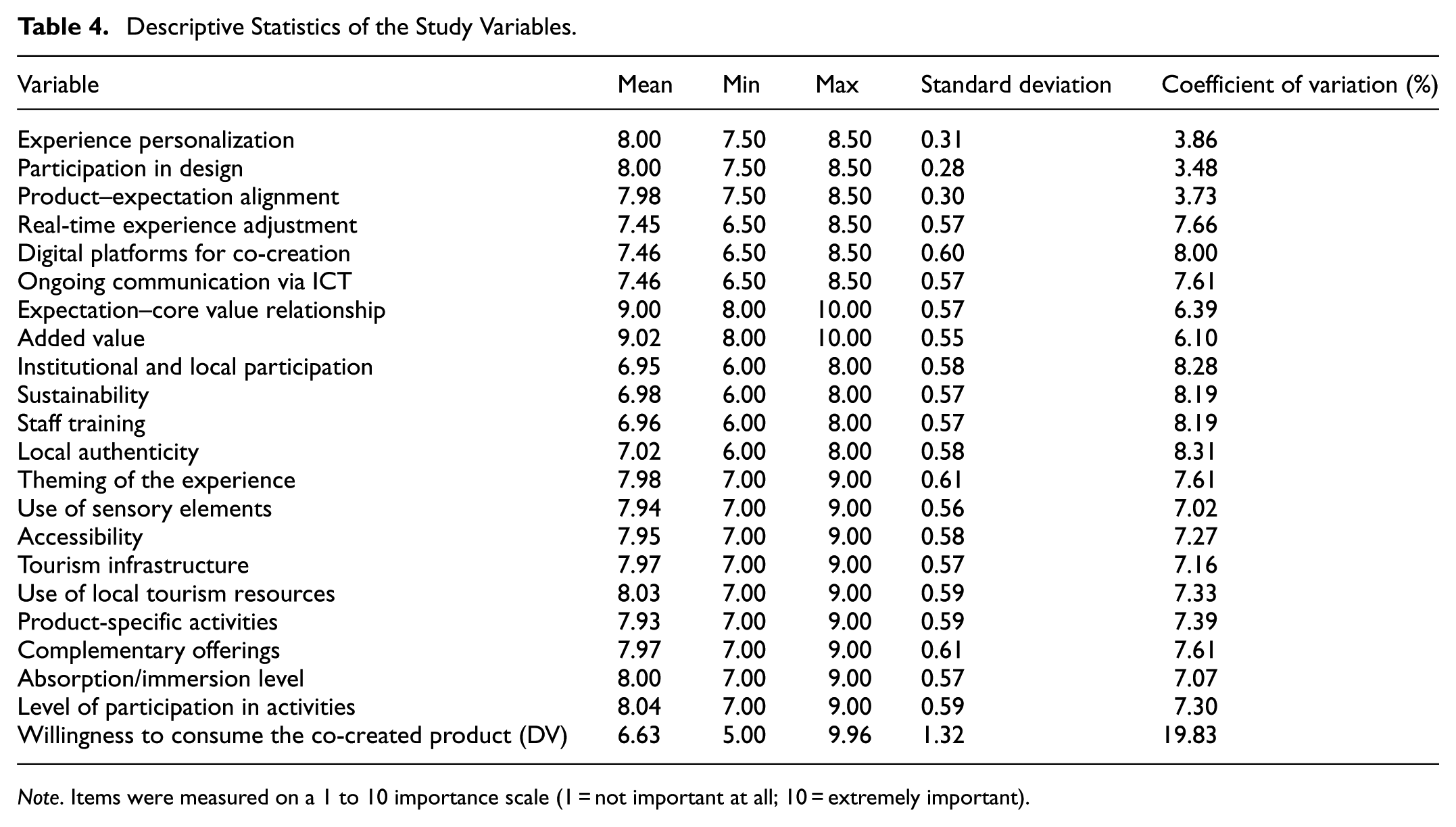
Note. Items were measured on a 1 to 10 importance scale (1 = not important at all; 10 = extremely important).
The coefficient of variation remains below 10% for all independent variables, indicating relatively homogeneous evaluations of the design-stage co-creation attributes. The dependent variable presents a higher coefficient of variation (19.83%), suggesting greater dispersion in respondents’ evaluations of willingness to consume the co-created product. Among the independent variables, the highest mean values are observed for expectation–core value relationship and added value, indicating the perceived relevance of value alignment in the co-creation process.
The exploratory factor analysis identified five underlying factors, accounting for 89.79% of the total variance. The Kaiser-Meyer-Olkin (KMO) measure was 0.908, indicating strong sampling adequacy, while Bartlett’s Test of Sphericity was statistically significant (p < .001), supporting the suitability of the correlation matrix for factor analysis.
Table 5 presents the rotated factor matrix, showing the standardized factor loadings for each variable and the variance explained by each factor. To improve readability, only loadings equal to or greater than 0.50 are displayed; lower loadings and non-substantive cross-loadings were suppressed. Cross-loadings were inspected during the analysis, and each retained item loaded more strongly on its assigned factor than on any alternative factor.
Rotated Component Matrix and variance Explained by Factor.
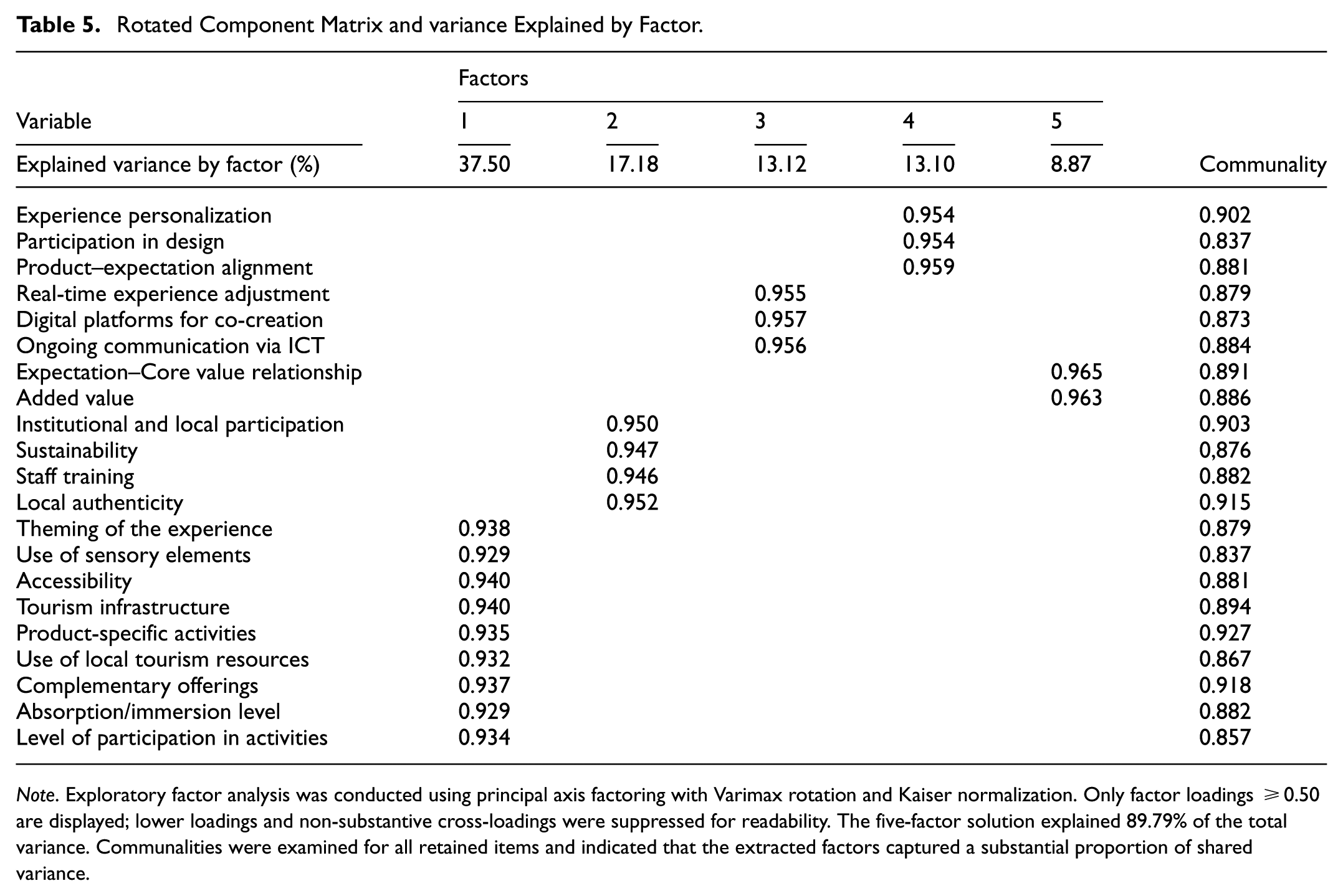
Note. Exploratory factor analysis was conducted using principal axis factoring with Varimax rotation and Kaiser normalization. Only factor loadings ≥0.50 are displayed; lower loadings and non-substantive cross-loadings were suppressed for readability. The five-factor solution explained 89.79% of the total variance. Communalities were examined for all retained items and indicated that the extracted factors captured a substantial proportion of shared variance.
A Varimax rotation was applied to enhance interpretability. As a robustness check, the exploratory factor analysis was also estimated using a common-factor extraction method, principal axis factoring, which yielded an equivalent factor solution and supported the stability of the retained dimensions. The five-factor solution explained 89.79% of the total variance, with Factor 1 accounting for 37.50%, Factor 2 for 17.18%, Factor 3 for 13.12%, Factor 4 for 13.10%, and Factor 5 for 8.87%. Communalities for all retained items were consistently high, ranging from 0.837 to 0.927. This indicates that the extracted factors captured a substantial proportion of shared variance and that all retained indicators were well represented by the factor solution. This indicates that the extracted factors captured a substantial proportion of shared variance and that all retained indicators were well represented by the factor solution.
Although several indicators showed high standardized loadings, item trimming was not applied because the items represent distinct, design-relevant attributes rather than redundant psychometric indicators. Given the study’s focus on tourism product design and co-creation components, retaining conceptually specific items helped preserve content validity and interpretability.
The factor structure was interpreted as follows. Factor 1 includes nine variables associated with the structural and experiential conditions under which the tourism product is delivered, such as theming of the experience, sensory elements, accessibility, infrastructure, use of local tourism resources, complementary offerings, immersion, and participation in activities. This factor was labeled Experience and Context.
Factor 2 groups variables related to institutional and local participation, sustainability, staff training, and local authenticity. This factor was labeled Collaboration and Sustainability, as it captures the relational, institutional, and contextual foundations of co-created tourism product design.
Factor 3 comprises variables related to real-time experience adjustment, digital platforms for co-creation, and ongoing communication via ICT. This factor was labeled Technology and Innovation, reflecting the role of digital tools and technological mediation in supporting co-creation.
Factor 4 includes experience personalization, participation in design, and product–expectation alignment. This factor was labeled Personalization and Participation, as it reflects the active involvement of tourists in shaping tourism products according to preferences and expectations.
Factor 5 consists of expectation–core value relationship and added value. This factor was labeled Value and Satisfaction, as it captures the perceived relevance of value alignment and added benefits in the co-created tourism product.
Measurement model properties are reported in an integrated manner to enhance reproducibility before interpreting the structural paths. Item-level descriptive statistics are presented in Table 4, standardized factor loadings are reported in Table 5, reliability and convergent validity indicators are summarized in Table 6, and discriminant validity evidence is presented in Table 7.
Reliability and Convergent Validity of the Model by Dimension.
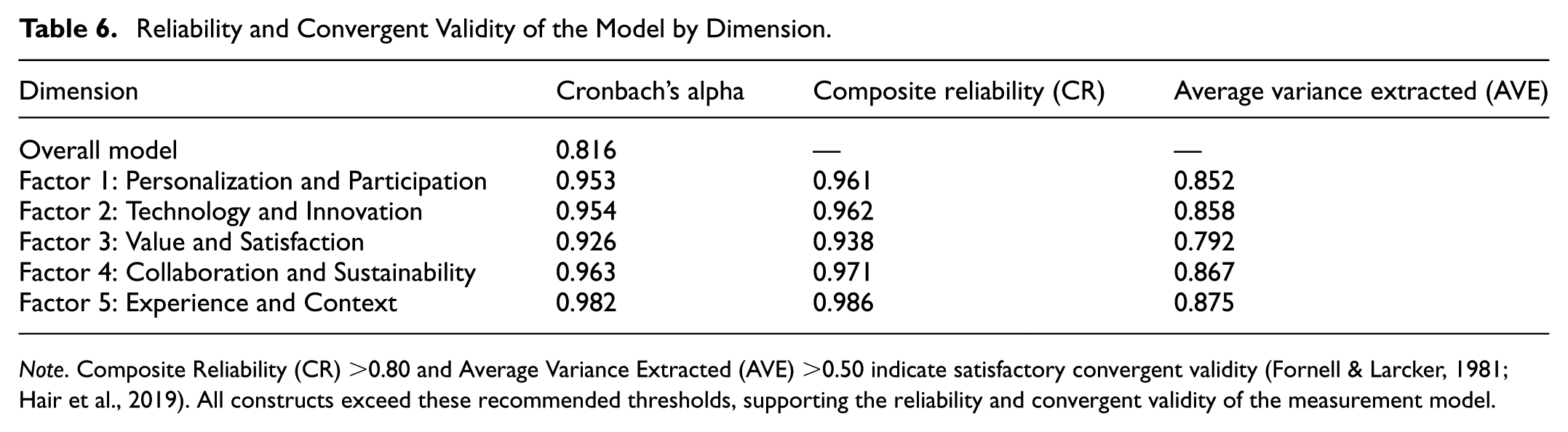
Note. Composite Reliability (CR) >0.80 and Average Variance Extracted (AVE) >0.50 indicate satisfactory convergent validity (Fornell & Larcker, 1981; Hair et al., 2019). All constructs exceed these recommended thresholds, supporting the reliability and convergent validity of the measurement model.
Convergent and Discriminant Validity Based on Fornell–Larcker Criterion and HTMT Ratios.
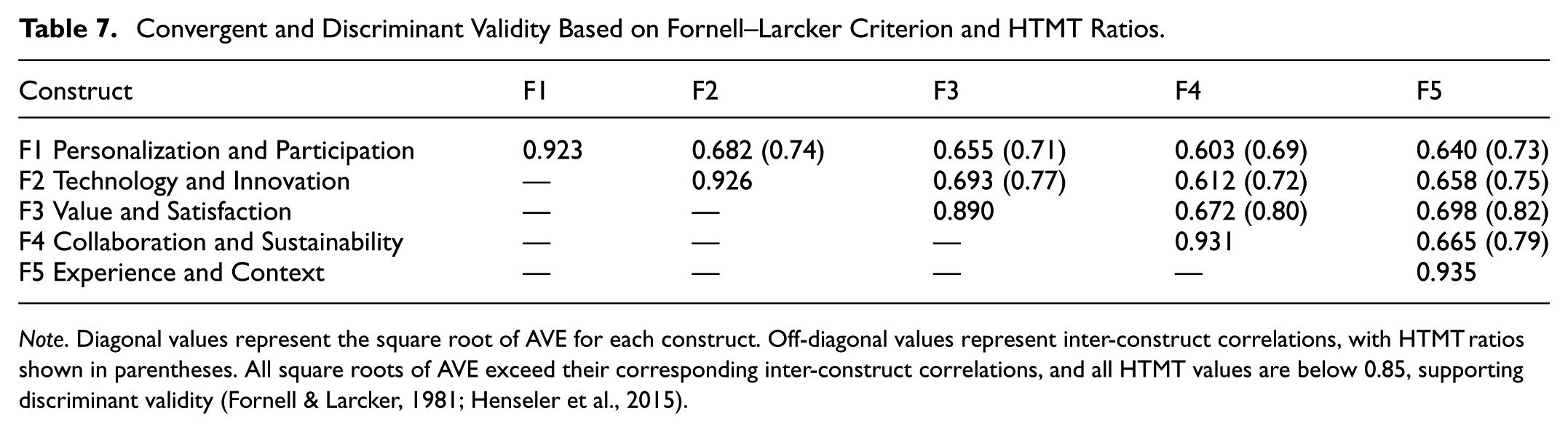
Note. Diagonal values represent the square root of AVE for each construct. Off-diagonal values represent inter-construct correlations, with HTMT ratios shown in parentheses. All square roots of AVE exceed their corresponding inter-construct correlations, and all HTMT values are below 0.85, supporting discriminant validity (Fornell & Larcker, 1981; Henseler et al., 2015).
Cronbach’s alpha, Composite Reliability (CR), and Average Variance Extracted (AVE) were calculated for each latent dimension. In addition, discriminant validity was assessed using both the Fornell–Larcker criterion and the HTMT ratio. The reliability coefficients for all dimensions were above the recommended threshold of 0.70, indicating adequate internal consistency. Composite Reliability values ranged from 0.938 to 0.986, while AVE values ranged from 0.792 to 0.875, supporting convergent validity across all constructs. Additionally, no substantial changes in Cronbach’s alpha values were observed when individual variables were removed from each factor, further supporting the stability of the measurement structure.
Table 7 presents the inter-construct correlation matrix following the Fornell–Larcker criterion and includes the corresponding HTMT ratios.
The diagonal values, representing the square roots of AVE, are higher than the corresponding inter-construct correlations, satisfying the Fornell–Larcker criterion. In addition, all HTMT ratios remain below the conservative threshold of 0.85, further supporting discriminant validity across the five constructs. Cross-loading inspection also indicated that each item loaded more strongly on its intended factor than on any other factor. Taken together, these results support the empirical distinctiveness of the five dimensions: Personalization and Participation, Technology and Innovation, Value and Satisfaction, Collaboration and Sustainability, and Experience and Context.
Following the confirmation of the five-factor structure, the structural equation model (SEM) was constructed and estimated. The results are presented in Figure 1, which displays the standardized path coefficients between the observed variables and their corresponding latent constructs, as well as the relationships among the latent factors themselves. Notably, the model reveals significant correlations between each observed variable and its associated factor, meaningful inter-factor relationships, and statistically substantial paths connecting the independent factors to the dependent variable, willingness to consume the co-created product.
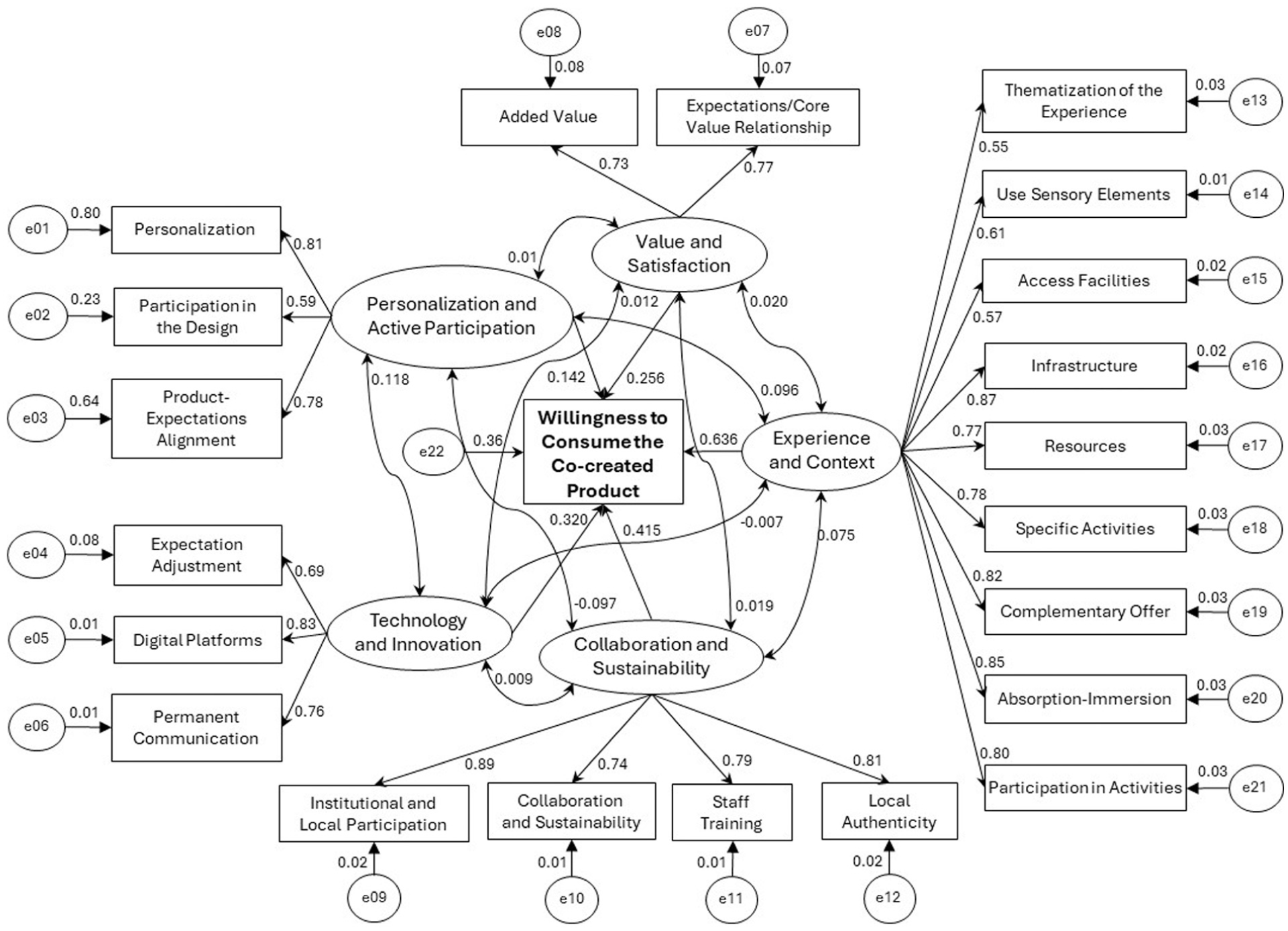
Structural model of the co-creation process in tourism product design.
Table 8 summarizes the results of structural equation modeling and hypothesis testing. All six hypothesized paths (H1–H6) were positive and statistically significant (p < .05), confirming the model’s theoretical expectations. The most substantial standardized effects occurred for the relationship between Technology and Innovation and Value and Satisfaction (H2), followed by the relationship between Personalization and Participation and Value and Satisfaction (H1), underscoring the key role of personalization and digital mediation in shaping perceived value. The remaining paths, including the relationship between Collaboration and Sustainability and Experience and Context (H3), as well as the relationship between Value and Satisfaction and Willingness to Consume the Co-created Product (H5), were also significant, demonstrating a coherent structural configuration consistent with model assumptions.
Structural Path Estimates and Hypothesis Testing Results.
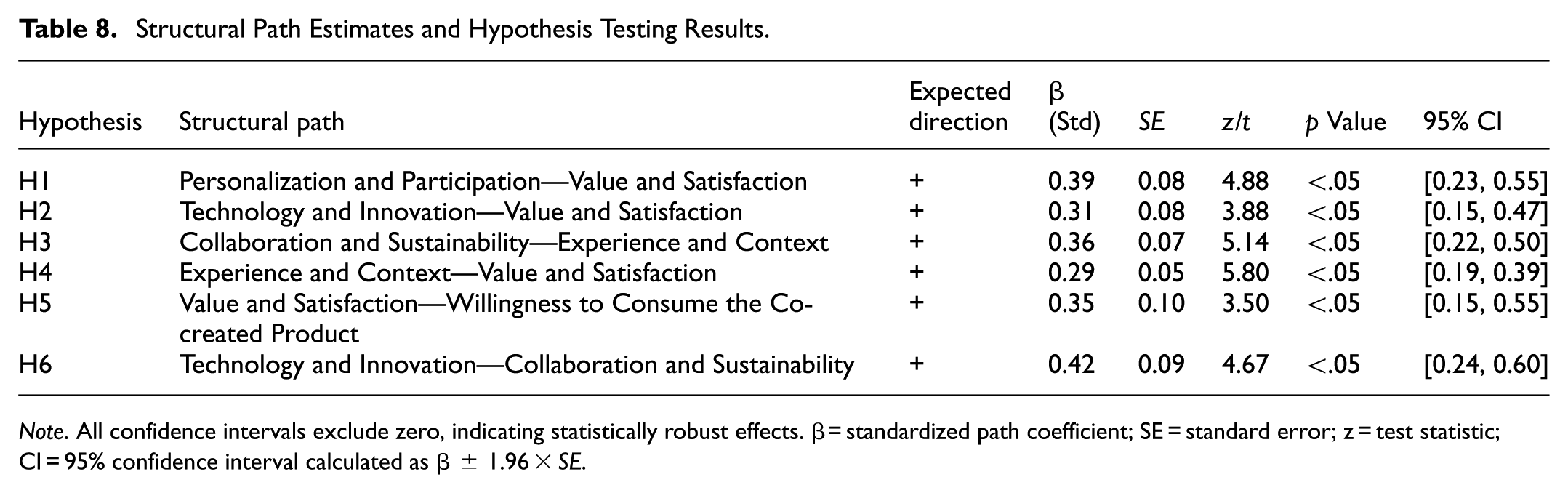
Note. All confidence intervals exclude zero, indicating statistically robust effects. β = standardized path coefficient; SE = standard error; z = test statistic; CI = 95% confidence interval calculated as β ± 1.96 × SE.
The model demonstrated strong explanatory power, accounting for 82% of the variance in Value and Satisfaction, 76% in Experience and Context, and 69% in Willingness to Consume the Co-created Product. These R2 coefficients indicate that the framework explains a substantial share of variability in the key endogenous constructs, providing empirical support for the hypothesized structural relationships.
The model fit indices are reported in Table 9, including the Comparative Fit Index (CFI), Tucker–Lewis Index (TLI), Root Mean Square Error of Approximation (RMSEA), and Standardized Root Mean Square Residual (SRMR).
Structural Model Fit Indices.
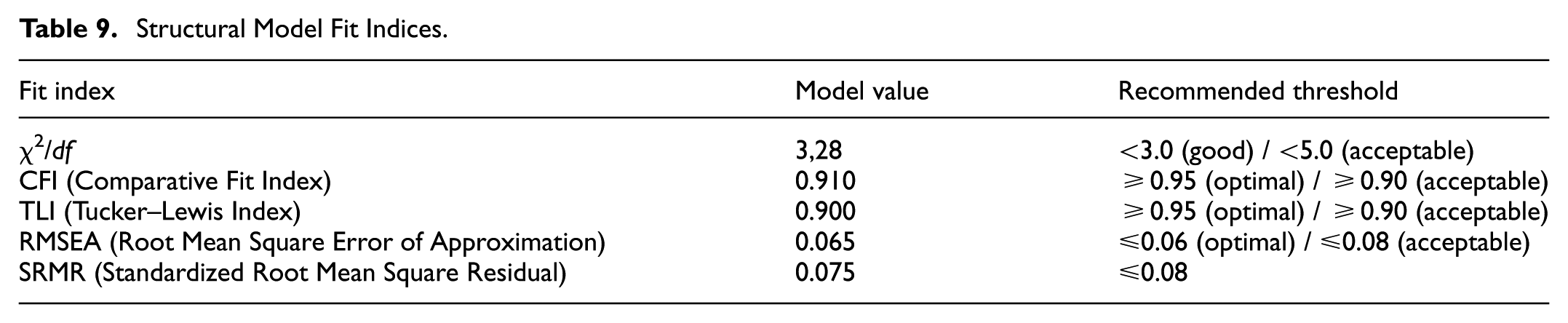
As shown, the model achieves values close to the recommended thresholds, providing an overall adequate fit in terms of goodness-of-fit and confirming that the empirical data adequately represent the theoretical model. Overall model fit was interpreted using a holistic evaluation of multiple fit indices rather than relying on a single strict cutoff. The normed chi-square (χ2/df = 3.28) falls within the range commonly considered acceptable for complex SEMs in applied social science research. The incremental fit indices (CFI = 0.910; TLI = 0.900) do not reach the more stringent optimal threshold of 0.95; therefore, they are interpreted as indicating acceptable, but not excellent, fit. In addition, RMSEA = 0.065 and SRMR = 0.075 fall within commonly accepted limits, supporting an adequate approximation of the data by the proposed model. Taken together, these results indicate an acceptable overall fit for a theory-driven structural equation model applied to a heterogeneous sample.
Following established SEM guidelines, model fit is therefore interpreted holistically rather than based on a single cutoff. Given the multidimensional structure of the model and the integration of heterogeneous respondent groups, the overall pattern of fit indices indicates an acceptable, theoretically coherent model, with no evidence of misspecification that would warrant post hoc modifications.
Multicollinearity among the predictor constructs was assessed using variance inflation factors (VIF). All VIF values were well below conservative thresholds (VIF < 3.3), indicating that multicollinearity is not a concern and does not bias the estimation of the structural relationships. An alternative model specification was estimated as a robustness check by introducing minor structural restrictions. The main structural relationships remained stable in terms of direction and statistical significance, supporting the robustness of the proposed model.
While the global fit indicators show overall adequacy, the model does not reach a perfect fit under the strictest benchmarks. The CFI (0.910) and TLI (0.900) values are slightly below the ideal 0.95 threshold but remain acceptable for complex, multidimensional models with heterogeneous samples. Because the dataset combines perceptions from tourists and destination stakeholders, some variation and residual correlation are expected. These deviations reflect the empirical complexity of modeling co-creation as an inherently interactive, cross-actor process rather than model weakness, enhancing transparency and contextual accuracy.
Although CFI and TLI are marginally below ideal values, both RMSEA and SRMR fall within recommended limits, supporting an acceptable overall fit for the proposed co-creation framework.
While the global fit indices indicate overall adequate model fit, additional robustness checks were conducted to assess potential common method variance. The inclusion of a common latent factor did not produce substantive changes in the magnitude, direction, or significance of the estimated structural paths. This stability suggests that common method variance does not materially affect the relationships tested in the model.
Overall, the results provide empirical support for the structural model as a conceptually coherent and acceptable representation of the co-creation process in tourism product design. The evidence supports the interdependence of the five latent dimensions: Personalization and Participation, Technology and Innovation, Value and Satisfaction, Collaboration and Sustainability, and Experience and Context, and shows that their joint configuration is positively associated with willingness to consume the co-created product, providing a strong basis for the theoretical and managerial implications discussed next.
Discussion
The findings reinforce theoretical understanding of co-creation in tourism by empirically supporting a structured model of five interrelated dimensions. Consistent with the adopted definition, co-creation is understood as a collaborative process in which tourists, providers, and local stakeholders jointly design and enhance tourism products by contributing knowledge, creativity, and resources to generate shared value. The high centrality of “design” and “development” within the relational network aligns with Custódio Santos et al. (2020), who argue that transforming tourists into co-producers requires reconfiguring product design as a collaborative and adaptive practice. This confirms that co-creation in tourism design is a systemic and iterative process rather than a one-way exchange.
The confirmation of all hypothesized relationships (H1–H6) provides empirical support for the framework. The positive effects of personalization, participation, technology, and innovation on value and satisfaction (H1–H2) validate principles of Service-Dominant Logic and Sociotechnical Systems Theory, emphasizing that tourists create shared value through active involvement and technology-enabled interaction. Similarly, the influence of Collaboration and Sustainability on Experience and Context (H3) highlights the role of inclusive stakeholder participation in fostering authenticity and environmental coherence. The significant effect of Value and Satisfaction on willingness to consume the co-created product (H5) further indicates that co-created experiences are associated with stronger evaluative engagement and greater disposition to engage with the designed product.
Personalization and Active Participation, identified as key dimensions in both the factor analysis and SEM, support Liu and Kuang’s (2023) argument that intensive personalization enhances authenticity and enriches the overall experience. This also aligns with Font et al. (2021), who show that deeper tourist involvement increases satisfaction, loyalty, and renewed willingness to consume the co-created product. These findings confirm the relational value generated through co-creation and its role in producing shared benefits for tourists and destination stakeholders.
Unlike studies that treat technology as a secondary enabler (Fan et al., 2020), this research identifies Technology and Innovation as a structural driver of co-creation. Its strong loadings on digital communication and real-time experience adjustment are consistent with Vaz Serra et al. (2022), who note that strategic digital platform use in smart destinations amplifies co-creation and strengthens customer–provider relationships. In emerging destinations such as Holguín, this stronger influence can be explained by limited coordination, infrastructure, and resources. Digital platforms, real-time communication tools, and co-design applications can compensate for weak formal structures by enabling information exchange, collaboration, and adaptive design among otherwise disconnected actors. From a Sociotechnical Systems perspective (Stylos et al., 2025), technological subsystems can offset organizational and social deficiencies, while Stakeholder Theory suggests that digital tools also operate as hybrid governance mechanisms linking tourists, firms, and institutions.
The findings also show that sociocultural factors shape co-creation in emerging destinations. In Holguín, institutional and infrastructural constraints produce a context-specific logic of collaboration in which technology functions not only as a tool but also as a social integrator that reduces asymmetries among actors. Drawing on Stakeholder Theory (Wondirad et al., 2020), the prominence of Collaboration and Sustainability reflects adaptive responses to collectivism, reciprocity, informal trust networks, and shared community values commonly observed in Latin America and the Caribbean. This interplay between sociotechnical mediation and cultural collectivism helps explain why Technology and Innovation, together with Collaboration and Sustainability, emerged as dominant drivers of shared value in constrained tourism systems.
Although willingness to consume the co-created product exhibits relatively low centrality within the network, this does not diminish its theoretical relevance. Consistent with Ribeiro et al. (2023), it can be interpreted as an outcome mediated by perceived experience quality, symbolic meaning, and emotional engagement. Thus, willingness to consume the co-created product reflects an evaluative orientation toward the offering, showing how shared value derived from personalization and participation is translated into favorable consumption-related evaluations.
The distinct Collaboration and Sustainability dimension supports Haid and Albrecht’s (2021) view that local stakeholder integration, environmental commitment, and staff training constitute structural pillars of modern tourism products. These elements act as strategic levers for differentiation, legitimacy, and competitiveness, confirming that sustainable collaboration is intrinsic to co-creation rather than a secondary outcome.
Finally, the robustness of the proposed model is supported by acceptable fit indices (CFI = 0.910; TLI = 0.900). Although these values are slightly below the 0.95 threshold suggested by Hu and Bentler (1999), both RMSEA (0.065) and SRMR (0.075) meet recommended standards. These deviations reflect the model’s multidimensional nature and the heterogeneous sample of tourists and institutional stakeholders rather than model deficiencies. As noted by Hair et al. (2019) and Kline (2023), such results are common in complex, field-based SEM applications.
Overall, the empirical validation shows that co-creation in tourism product design operates as a multidimensional and context-sensitive process that generates shared value among tourists, firms, and institutions. The integration of technological innovation, stakeholder collaboration, and experiential personalization demonstrates that co-creation is both conceptually consistent and practically applicable, offering a foundation for destination management, marketing, and policy design.
Implications
The findings offer relevant implications for policymakers, destination managers, and tourism practitioners seeking to improve the competitiveness, sustainability, and authenticity of emerging destinations through co-creation.
Policy Implications
From a policy perspective, the results highlight the need to create institutional conditions that enable co-creation among public authorities, private firms, communities, and tourists. Policymakers should strengthen destination governance through multi-level coordination mechanisms aligned with cultural, social, and environmental objectives. They should also support capacity-building programs in digital literacy, innovation management, and sustainable design for local entrepreneurs and tourism professionals. In addition, incentive systems, such as grants, tax benefits, or recognition schemes, can encourage projects that integrate tourists and residents into co-design activities or adopt environmentally responsible practices. Open-innovation ecosystems, including tourism living labs, may further allow public and private stakeholders to test new products and technologies in real-life contexts. Finally, data-sharing and interoperability standards across tourism institutions can improve the monitoring of co-created experiences and support evidence-based decision-making.
Marketing and Managerial Implications
For tourism operators and marketers, the results show how co-creation can be translated into business practice. Firms should integrate customers into the design process through participatory channels such as digital platforms, surveys, and co-design workshops, enabling tourists to personalize experiences and contribute design-relevant feedback. Digital technologies should be used as co-creative infrastructures rather than merely informational tools, since real-time communication, mobile applications, and virtual previews can enhance engagement and continuous customization. Marketing strategies should emphasize experiential and emotional value propositions based on authenticity, sustainability, and collaboration with local communities. Managers should also incorporate sensory and thematic design elements, use storytelling and user-generated content to strengthen destination identity, and train front-line staff to adopt a facilitative role that encourages dialogue, creativity, and adaptability.
Together, these policies and managerial actions can transform emerging destinations into more innovative, sustainable, and participatory tourism ecosystems.
Limitations and Future Research Directions
Despite its contributions, this study has several limitations that should be considered when interpreting the findings. First, the empirical validation was conducted in a single emerging destination, Holguin, Cuba, which limits external validity and the direct transferability of the results to destinations with different institutional, sociocultural, or market conditions. Second, the use of non-probability quota sampling, although suitable for capturing key actors involved in tourism product design, restricts statistical representativeness and prevents population-level generalization beyond the studied context.
Third, although the sample size met established adequacy criteria for exploratory factor analysis (Nicolaou & Masoner, 2013), it was insufficient for detailed subgroup analyses by nationality, age, travel motivation, or actor type. The integration of tourists and destination stakeholders is conceptually consistent with the study’s design-stage focus on co-creation; however, the aggregated analytical approach does not allow systematic intergroup comparisons. Therefore, the findings should be interpreted as context-specific and exploratory, offering analytical rather than statistical generalization. Because the constructs were operationalized through importance-based design evaluations rather than psychological trait measures, the study also does not assume cross-group metric equivalence.
Future studies with larger and more balanced subgroup samples should employ measurement invariance testing and multi-group SEM to compare actor-specific perceptions of co-creation mechanisms. Further research should also replicate the model across diverse tourism contexts, including urban, rural, coastal, cultural, and nature-based destinations, to test its robustness and adaptability across different tourism ecosystems. Longitudinal case studies of implemented co-creation projects would also help assess perceived versus actual outcomes and strengthen the model’s predictive and practical relevance.
Future research could further examine mediating and moderating variables, such as customer satisfaction, loyalty, emotional engagement, digital competence, and contextual or technological conditions, to clarify when and how co-creation influences willingness to consume the co-created product. In addition, cognitive and behavioral mechanisms deserve further attention. For instance, tourists’ construal levels could explain differences in engagement and personalization during co-design, while emotional versus rational advertising appeals may clarify how communication strategies influence decision-making and participation in co-creative experiences. Researchers should also examine the tension between imitation and innovation in the development of new tourism services, particularly under resource constraints in emerging destinations. Although multiple procedural and statistical diagnostics were applied, future studies could incorporate marker variables or longitudinal designs to further address potential method-related biases.
Together, these lines of inquiry would refine the model, expand its empirical reach, and deepen understanding of how cognitive framing, persuasive communication, and innovation strategies shape tourists’ value perceptions and behavioral intentions within co-created experiences (Azhdary Moghadam et al., 2024; Hussain et al., 2020).
Conclusions
This study provided empirical support for a structural model of co-creation in tourism product design, showing that value co-creation operates through five interrelated dimensions: Personalization and Participation, Technology and Innovation, Value and Satisfaction, Collaboration and Sustainability, and Experience and Context. Together, these dimensions explain how participation, technological mediation, stakeholder collaboration, and contextual authenticity converge to generate perceived value and willingness to consume the co-created product in emerging destinations.
The findings confirm that tourists can act as co-producers of value when actively involved in the design process, enhancing satisfaction and evaluative engagement with the resulting offering. Technology enables real-time adaptation and information exchange, while collaboration among institutions, communities, and firms supports sustainability and cultural authenticity. Thus, co-creation emerges not merely as a marketing approach but as a systemic capability that strengthens the competitiveness and resilience of resource-constrained destinations.
Theoretically, the study advances prior research by integrating Service-Dominant Logic, Experience Economy, Sociotechnical Systems, Stakeholder, and Experiential Learning theories into a unified explanatory framework. Methodologically, it offers a replicable approach for applying factor analysis and structural equation modeling to examine interdependencies among co-creation variables in tourism research.
The study also has limitations. Its validation in Holguín, Cuba, restricts generalizability, while the non-probabilistic sample and the use of importance-based scales limit population-level inference and conclusions about post-consumption behavior. Future research should test the model across diverse geographic and cultural settings, apply measurement invariance testing and multi-group SEM with larger and balanced samples, and use longitudinal or mixed-method designs to evaluate real-world co-creation outcomes. Further studies could also examine mediating and moderating mechanisms, including satisfaction, loyalty, emotional engagement, digital competence, construal levels, advertising appeals, and the balance between imitation and innovation in resource-constrained contexts.
Overall, the proposed framework offers theoretical depth and practical guidance for policymakers, destination managers, and tourism entrepreneurs. By aligning technological, social, and experiential factors, it supports the development of tourism ecosystems that are more competitive, personalized, sustainable, and inclusive.
Footnotes
Acknowledgements
The authors thank the anonymous reviewers of the journal for their extremely helpful suggestions to improve the quality of the article. The usual disclaimers apply.

Consent to Participate
Written informed consent was obtained from all participants involved in the study. Prior to participation, respondents were informed about the purpose of the research, the voluntary nature of their participation, and the confidentiality of their responses. The study involved no sensitive personal data and was conducted in full compliance with the ethical principles outlined in the Declaration of Helsinki (2013 revision).
Author Contributions
Conceptualization: Y.G.S.; methodology: Y.G.S., O.O.P., and R.P.C.; validation: G.G.V., R.P.C., O.O.P.; formal analysis: A.S.R., Y.G.S.; investigation: G.G.V., A.S.R., R.P.C., O.O.P., R.M.V.; data curation: Y.G.S.; R.P.C.; writing—original draft preparation: Y.G.S.; writing—review and editing: R.P.C. and A.S.R.; visualization: O.O.P., A.S.R., and G.G.V.; supervision: R.M.V.; project administration: G.G.V. All authors have read and agreed to the published version of the manuscript.
Funding
The authors received no financial support for the research, authorship, and/or publication of this article.
Declaration of Conflicting Interests
The authors declared no potential conflicts of interest with respect to the research, authorship, and/or publication of this article.
Data Availability Statement
The original contributions presented in this study are included in the article. Further inquiries can be directed to the corresponding author.
Institutional Review Board Statement
The study did not involve any clinical procedures, biomedical experimentation, or collection of sensitive personal data. Instead, the data were collected through anonymous surveys and interviews voluntarily completed by adult SME owner-managers, addressing only their business perceptions and general demographic characteristics. In Ecuador, according to Acuerdo Ministerial 4883 del Ministerio de Salud Pública (Registro Oficial Suplemento 173, del 12 de diciembre de 2013), ethical review by an Institutional Review Board (IRB) or Comité de Ética de Investigación en Seres Humanos (CEISH) is required only for biomedical or clinical research that may pose physical or psychological risks to participants. Our study, being observational, non-interventional, and of minimal risk, is exempt under this regulation. Nevertheless, we affirm that all procedures complied with the ethical standards of the 2013 revision of the Declaration of Helsinki, including respect for informed consent, privacy, and voluntary participation. Participants were informed of the purpose of the study and their right to withdraw at any point without consequence. No personal or identifiable information was recorded. The above is assumed to be an exemption from the ethical compliance requirement.