






Abstract
This study investigates how personal traits, shopping motivations, and marketing stimuli influence impulse buying (IB) in Portuguese fashion retail, with self-control (SC) as a mediator. Data from 411 consumers were analyzed using PLS-SEM. Results show that fashion involvement, hedonic motives, and price sensitivity directly increase IB, while utilitarian motives reduce it. SC is a strong negative predictor of IB and fully mediates the effects of sales promotions and store ambiance on IB. The findings advance impulse buying theory by integrating trait-based, motivational, and situational factors into a unified S-O-R model, highlighting SC’s critical regulatory role. Practically, retailers can leverage hedonic appeals and promotions to stimulate sales, but should avoid overstimulation to preserve consumer trust and self-regulation.
Plain Language Summary
Impulse buying is something most of us have experienced—walking into a store with no plans to shop and walking out with a bag full of clothes. This study looks closely at what drives that kind of spontaneous behavior, focusing specifically on fashion physical retail in Portugal. The researchers surveyed 411 consumers and used a structural model to analyze how different traits and marketing stimuli influence impulse buying. They looked at factors like sensation seeking, self-identity, shopping motivations (both for pleasure and practicality), how involved people are with fashion, how sensitive they are to price, and how much they’re influenced by store promotions and ambiance. A key part of the study is the role of self-control. The findings show that self-control acts as a kind of filter—helping people resist external triggers like sales promotions or appealing store environments. While fashion involvement, hedonic motives, and price sensitivity directly encourage impulse buying, self-control weakens the impact of other factors. In fact, it completely mediates the effects of store ambiance and promotions. This means that those elements only influence buying behavior when someone’s self-control is low. The study offers valuable insights for fashion retailers. Retailers who want to increase sales should focus on creating enjoyable shopping environments and running sales promotions because these strategies work best with customers who have low self-control. The study deepens our comprehension of impulse buying by showing how motivations interact with environments and internal self-regulation.
Introduction
People now make purchases not only of essential goods to satisfy their basic needs but also to achieve psychological fulfillment (Duarte et al., 2025) and wellbeing (Huerta de Soto et al., 2021; Magano et al., 2024; Sánchez-Bayón et al., 2021). Rook (1987) defined Impulse Buying (IB) as a spontaneous, unreflective, and immediate form of consumer behavior that often results from emotional arousal. Rook and Fisher (1995) extended this IB definition as “a consumer’s tendency to buy spontaneously, unreflectively, immediately, and kinetically” (p. 306). Impulsive seek immediate gratification (Ahmadova & Nabiyeva, 2024; Yoon, 2013). However, highly impulsive consumers do not always act on impulses; normative concerns can override trait impulsiveness, leading to restraint (Rook & Fisher, 1995).
Research on the IB antecedents has three main streams (Sánchez-Bayón, 2020). First, personal traits: Verplanken and Herabadi (2001) and Rook and Hoch (1985) found dispositional impulsivity predicts unplanned purchases. Second, motives and cognitive resources: Hoch and Loewenstein (1991) argue impulsivity alone is insufficient; the hedonic or utilitarian motivations and the consumer’s cognitive and material resources matter (Baumeister, 2002; Vohs & Faber, 2007). Third, marketing-driven triggers: store layouts, shelf placements, and limited-time promotions (Mattila & Wirtz, 2001). IB is a process-oriented behavior that connects antecedents and triggers to purchase outcomes (Cook & Yurchisin, 2017; Xiao & Nicholson, 2013), and can occur at any stage (Lo et al., 2016).
Prior research has addressed separate effects of personal traits, shopping motivations, and marketing stimuli, but limited attention has been given to how these operate together (Dholakia et al., 2006; Iyer et al., 2020), particularly in fashion retail. The mediating role of self-control remains underexplored. As Iyer et al. (2020) highlight, advancing a unified understanding of impulse buying requires bridging these strands. This perspective aligns with the call by Rook and Fisher (1995, p. 312) for deeper exploration into the contextual moderators that influence the link between antecedents and impulse buying behavior. Recent scholarship emphasizes a comprehensive model accounting for internal traits and external stimuli through shared mechanisms like self-control (Duan, 2025; Redine et al., 2023). Thus, we propose a unified S-O-R framework integrating trait-based, motivational, and situational antecedents with self-control as the central mediator.
However, a clear research gap persists: prior studies have not sufficiently examined how self-control simultaneously mediates internal and external antecedents within an integrated fashion retail model. Recent research underscores SC’s mediating function in compulsive buying (Duan, 2025) and personality-driven impulsivity (Xie et al., 2025), but a comprehensive framework is lacking.
Fashion is a domain where IB thrives, evoking excitement, pleasure, and self-expression (Coley & Burgess, 2003; Haq et al., 2014; Magano et al., 2025). High fashion heightens sensitivity to trends, peer validation, and a strong desire for self-presentation, leading to experiencing unplanned purchasing episodes triggered by aesthetic stimuli, promotional cues, or social media exposure (Cengiz & Barin, 2025).
Our research question is: “How do internal and contextual factors influence impulse buying in the fashion retail context, and to what extent does self-control mediate these relationships?” We integrate these variables into a comprehensive model, exploring internal antecedents (sensation-seeking, self-identity, hedonic/utilitarian motives, fashion involvement) and external antecedents (price, sales promotions, store ambiance), with self-control as a cognitive regulator. In doing so, we investigate the mediating role of self-control, which acts as a cognitive regulator of impulsive urges (Baumeister, 2002; Vohs & Faber, 2007).
We operationalize these within the Stimulus-Organism-Response (S-O-R) framework (Mehrabian & Russell, 1974a), commonly used for IB research (Chang et al., 2014; Lee & Johnson, 2010; Zhang et al., 2022), Portugal represents a relevant setting: a mature Southern European market where fashion intertwines with social identity and leisure culture, with a mix of international chains, domestic brands, and recent economic fluctuations.
Literature Review
Impulse Buying
IB refers to purchases made immediately without any specific buying objectives (Beatty & Ferrell, 1998). Rook’s (1987) definition of IB as spontaneous and unreflective still underpins much research, though recent literature reframes IB as affectively intense, emotionally ambivalent behavior (e.g., Cao et al., 2024; Redine et al., 2023), situating external stimuli like store layout as key triggers. Xu et al. (2020) introduce a dual-systems model of impulse buying, proposing that buying behavior online results from the interplay between an impulsive system (fast, emotional, automatic) and a reflective system (deliberate, self-regulatory). Miao (2011) proposes that the emotional trajectory evolves from immediate sensory-driven pleasure to cognitive appraisal-based guilt, moderated by normative evaluation.
Deshpande et al. (2022) expand the conceptual understanding by introducing how advertising appeals, particularly humor and scarcity, directly influence IB. Humor appeals stimulate buying by enhancing enjoyment anticipation, whereas scarcity appeals evoke urgency and exclusivity. Perceived scarcity, while perceived perishability, triggers fear of missing out, driving IB, particularly in fast fashion contexts (Cengiz & Şenel, 2024; Cook & Yurchisin, 2017; Juanim et al., 2024).
Stilley et al. (2010) add the concept of “in-store slack,” a deliberate mental budgeting strategy where consumers intentionally allocate IB is purely irrational, suggesting some consumers anticipate spontaneous purchases as part of their shopping experience (Stilley et al., 2010).
Recently, literature has explored IB within digital purchasing (e.g., Chauhan et al., 2023; Chen et al., 2022; Cueva-Estrada & Sánchez-Bayón, 2024; Deokule & Katole, 2021; Hewei, 2022; Huang & Cai, 2021; D. Liu & Huang, 2024; M. Liu, 2022; Lo et al., 2016; Madhu et al., 2023; Moghddam et al., 2024; Styvén et al., 2017; Sundström et al., 2019; Um et al., 2023). In this study, however, we focus on traditional fashion retail, for which we disregard online purchasing behaviors.
Determinants of Impulse Buying
Traits
Stable traits determine how individuals process external stimuli such as marketing efforts (Saran et al., 2016). Through their influence on emotional regulation, decision-making, and self-control, traits drive consumers toward impulse buying. Self-identity (SI) and sensation-seeking (SS) are essential personality traits that motivate responses to internal desires and external stimuli (Sharma et al., 2010; Xiao & Nicholson, 2013). Sensation-seeking individuals seek new and unusual experiences, aligning with spontaneous buying. Traits function as risk factors for impulsive buying, but their effect depends on environmental circumstances. Positive emotions from traits lead to hedonic consumption and fashion involvement, resulting in impulsive buying (Saran et al., 2016).
SI defines how people view their personal identities and social position. People base purchasing decisions on self-expression when products convey their values, aspirations, and affiliations (Iyer et al., 2020). According to Redine et al. (2023), people make impulse fashion purchases when items match or enhance their self-image; acquiring these products provides immediate identity validation, disrupting logical thinking and weakening personal control systems. This is particularly evident in hedonic consumption, where shopping environments encourage emotional satisfaction and symbolic validation of self-image (Saran et al., 2016).
Sensation-seeking leads people to seek exciting, new, and intense experiences; such individuals engage in impulsive activities with lower adherence to cautious decision-making (Lucas & Koff, 2014). These consumers view impulse buying as enjoyable, fulfilling their need for excitement and instant pleasure. The desire for novelty dominates inhibitory processes, weakening self-control, especially in stimulus-rich retail spaces (Iyer et al., 2020).
Impulse buying creates psychological conflict, satisfying immediate desires yet often leading to remorse. Miao (2011) describes consumer affective ambivalence through impulse buying, generating both positive enjoyment and guilt from the conflict between hedonic cravings and self-control.
The traits of self-identity and sensation-seeking enhance consumer experiences while creating obstacles for controlling impulsive behavior. According to Xu et al. (2020), self-control affects how affective states relate to impulse buying but fails to provide sufficient protection during emotionally intense or identity-linked situation. Accordingly, we hypothesize:
Hedonic and Utilitarian Motives
Consumers’ purchasing decisions are influenced by internal motives, which the IB literature categorizes into two types: hedonic and utilitarian. Hedonic Motives (HM) are associated with pleasure, excitement, and novelty, while utilitarian motives are driven by practical needs, such as convenience and functionality (Beatty & Ferrell, 1998). The fashion industry relies on hedonic motives to drive impulse buying due to emotional gratification strategies used in shopping environments; people become more likely to make spontaneous buys when they experience positive emotional responses to experiential or symbolic triggers.
Fashion consumers rely on hedonic drivers such as relaxation, shopping, social interaction, novelty, and perceived value (Mashilo et al., 2025). Dey and Srivastava (2017) fun, emotional arousal, and escapism as essential hedonic factors influencing young adult shoppers. Emotional triggers such as aesthetic appeal, novelty, and social praise suppress self-control; individuals with weak regulatory strength give in to impulsive behaviors more easily when encountering persuasive promotional materials or sensory-rich settings (Palma et al., 2018; Sultan et al., 2012).
Utilitarian motives (UM) involve purchases based on functional needs and efficiency, like saving time or obtaining essential items. The literature shows that UM influence impulsive buying even though this behavior is usually linked to hedonic motivations in modern retail settings that combine functional elements with emotional triggers (e.g., Dam, 2023; Parsad et al., 2021).
Yoon (2013) suggests consumers pursuing utilitarian objectives engage in rational decision-making, yet this does not exclude spontaneous decisions. Shoppers may justify spontaneous purchases if the product satisfies a functional need or offers significant value (Parsad et al., 2021; Redine et al., 2023). UM can reduce psychological barriers to impulse purchases by providing a logical rationale for action (Dam, 2023). Ahmadova and Nabiyeva (2024) observe that perceived functional benefits lead to bypassing self-control, as the purchase no longer causes internal conflicts. According to Eren et al., 2012, materialism and hedonic shopping value strongly predict impulse buying. Therefore, we formulate the following hypotheses:
Fashion Involvement
Fashion involvement (FI) refers to the degree of personal connection that someone has with fashion products and related activities; it describes the level of fashion awareness people have, showing their commitment to fashion trends, along with their emotional and cognitive bond with clothing as a means of expressing identity (Cengiz & Barin, 2025). Individuals deeply invested in fashion tend to seek pleasure through hedonic values and use fashion as a tool for self-enhancement (Saran et al., 2016).
High fashion involvement creates increased attention to trends and promotional stimuli that drive consumers to buy impulsively in apparel, accessories, and lifestyle goods (Cengiz & Barin, 2025; Saran et al., 2016; Silva et al., 2022; Sundström et al., 2019). Fashion-involved consumers make more frequent spontaneous purchases, often skipping rational decision processes, as fashion consumption provides emotional fulfillment while confirming their sense of identity (Cengiz & Şenel, 2024). Research demonstrates that fashion involvement creates direct links with symbolic consumption, hedonic motivation, and social identity (Haq et al., 2014; O’Cass, 2001).
Identity display purchases and emotional regulation through acquiring fashion items diminish self-regulation abilities, making consumers more likely to experience regretful spending and succumb to temptation (Gawior et al., 2022). The relationship between fashion involvement and shopping satisfaction remains positive despite its association with impulse buying (Saran et al., 2016). Nonetheless, such involvement without planned moderation tends to diminish consumers’ self-control abilities, creating a conflicting effect where aesthetic and identity benefits coexist with increased impulsive actions that harm financial prudence (Mashilo et al., 2025). As such, we hypothesize:
While hedonic motives (HM), fashion involvement (FI), and self-identity (SI) are interrelated, they represent distinct theoretical constructs. HM capture transient motivational states for immediate emotional gratification from shopping. FI reflects enduring personal relevance to fashion, functioning as a stable amplifier of sensitivity to fashion-related stimuli. SI involves using consumption for self-expression, where purchases affirm or enact personal identity. Thus, HM provide the immediate emotional "fuel" for impulse buying, FI determines baseline susceptibility within fashion, and SI supplies symbolic justification that overrides deliberation. All three are necessary: HM explain situational affective triggers, FI explains why some consumers are pervasively more attuned to such triggers, and SI explains the deep-seated symbolic pathway connecting products to the core self (Haq et al., 2014; O’Cass, 2001; Saran et al., 2016).
Marketing Stimuli
Marketing stimuli refer to external cues that activate consumer attention and arousal, including advertising, product placement, price promotions, sensory elements, and scarcity messaging (Babin et al., 1994; Parreño-Selva et al., 2014). In physical retail, these stimuli are embedded in store design and merchandising, amplifying impulse buying behaviors (Ramanathan & Menon, 2006). Advertising activates hedonic motives, leading to impulse buying responses that bypass rational processes (Huang & Cai, 2021; Juanim et al., 2024). Sales Promotions (SP) provide a rational excuse for indulgence (Parreño-Selva et al., 2014), while hedonic motives moderate the pathway from impulse purchase decision to customer satisfaction (Madhu et al., 2023). This dual-channel influence (promotional cues lowering cognitive barriers and hedonic arousal accelerating impulsive action) is documented in fashion and digital shopping contexts (D. Liu & Huang, 2024; Redine et al., 2023).
Unlike sales promotions, price influences decision-making through perceptions of value and affordability. Lower price points serve as mental justifications for purchases, especially for non-essential or hedonic items. Ahmadova and Nabiyeva (2024) noted that impulse buyers are swayed by available budget, as lower prices reduce the psychological cost of purchasing and increase spontaneous consumption.
In addition to encouraging unplanned purchases, attractive prices (PR) can erode self-control by shifting the internal cost-benefit analysis. Parreño-Selva et al. (2014) discuss how consumers ration purchases of vice products when high prices act as natural barriers. Conversely, when prices are low, these self-imposed constraints weaken, resulting in impulsive actions. This aligns with the “licensing effect,” where consumers justify indulgence through saving money, loosening regulatory restraint (Parreño-Selva et al., 2014).
Retail store ambiance (SA) plays a crucial role in shaping impulse buying and self-control. The atmosphere (lighting, music, layout, visual merchandising) acts as a powerful external trigger (Sharma et al., 2014). Yoon (2013) demonstrates that sensory and affective experiences driven by store atmospherics significantly enhance impulse buying in fashion retail, evoking joy and excitement that override rational evaluations. Conversely, environments promoting rational engagement (e.g., orderly displays) encourage self-control. Chi and Chen (2020) highlight that aesthetic and emotional values in lifestyle fashion stores positively influence impulse buying by enhancing emotional arousal and gratification. Hedonic shopping motives amplify this pathway by strengthening emotional responses to environmental stimuli (Hashmi et al., 2020). Hygiene factors contribute to user satisfaction, while motivation factors directly influence emotional arousal, leading to impulse purchases (Sharma et al., 2014). In contrast, Upadhye et al. (2021) emphasize that interventions such as planning prompts mitigate impulses, arguing that without deliberate planning, consumers in stimulating environments are prone to self-control failure. Nghia et al. (2022) suggest self-control diminishes impulse buying, especially in offline settings where ambiance is more physically immersive. Overall, a compelling retail atmosphere increases impulse buying by intensifying hedonic appeal and undermining self-control mechanism (Chi & Chen, 2020; Nghia et al., 2022; Yoon, 2013). We hypothesize:
Self-Control
Self-Control (SC) refers to the individual’s ability to regulate thoughts, emotions, and behaviors to achieve long-term goals, often at the expense of short-term temptations (Iyer, 2016). Low self-control is frequently associated with increased impulsivity and decreased resistance to purchase cravings (Baumeister, 2002; Nyrhinen et al., 2024; Sultan et al., 2012). While Impulse buying behavior often feels uncontrollable, cognitive awareness together with self-control resources help regulate it (Palma et al., 2018; Vohs & Faber, 2007; Xu et al., 2020).
People focused in achieving positive outcomes may feel tempted by promotions but are also capable of resisting IB through self-regulation (Dholakia et al., 2006) According to Sultan et al. (2012), specific training and exercise approaches help people develop better abilities to resist impulse buying desires.
Ramanathan and Menon’s (2006) show that impulsive behavior resulting from continuous exposure to hedonic desires surpass control mechanisms until consumers find satisfaction.
The traditional view that impulsive urges defeat cognitive SC is challenged by Stilley et al. (2010) who show consumers often take proactive steps to plan for budget deviations before they occur. This perspective combines hedonic flexibility with financial planning to reveal a more advanced decision-making that lets consumers deliberately balance control with indulgence. According to Chauhan et al. (2023) materialistic and hedonic motivations predict IB more effectively than SC does. Self-control actually increases emotional attachment to retailers according to Ramadan et al. (Ramadan et al., 2021) which results in increased impulse purchases. Thus, we hypothesize:
Additionally, taking into consideration the previous sections, we hypothesize that SC mediates the relationships between IB antecedents and IB; therefore:
Within the S-O-R framework, self-control (SC) is conceptualized as an internal regulatory state (organism) that is influenced by external stimuli (e.g., sales promotions, store ambiance) and personal factors (e.g., fashion involvement, personality traits). Positioning SC as a mediator, rather than a moderator, aligns with models treating SC as a finite cognitive resource susceptible to depletion (Baumeister, 2002; Vohs & Faber, 2007). A moderator would imply SC alters the strength or direction of relationships across different SC levels. In contrast, a mediator explains the underlying mechanism: external and internal drivers deplete self-regulatory resources, which then facilitates impulsive behavior (Duan, 2025). This mediating role is strongly supported by recent empirical work. A comprehensive meta-analysis by Nyrhinen et al. (2024) confirms self-regulation as a central and robust mediating mechanism in the formation of impulsive buying behaviors. Furthermore, Xie et al. (2025) provide direct empirical validation by successfully modeling self-control as both a direct mediator and a sequential mediator in the pathway from personality traits to impulse buying. In their study, self-control not only directly transmitted the influence of traits like neuroticism and conscientiousness but also served as the critical proximal mechanism through which more distal factors like family dynamics ultimately exerted their effect on impulsive behavior. These findings collectively establish self-control not as a mere boundary condition, but as a critical psychological conduit and transmission mechanism. Therefore, modeling self-control as a mediator is theoretically coherent, empirically well-founded, and aligns with the latest research on complex antecedent pathways to impulse buying.
The literature review has outlined three well-established yet often isolated streams of antecedents to impulse buying: (a) trait-based factors (sensation-seeking, self-identity), (b) motivational drivers (hedonic and utilitarian motives, fashion involvement), and (c) situational marketing stimuli (price, sales promotions, store ambiance). While each stream has robust empirical support, research has seldom examined how these internal and external factors operate together within a single comprehensive model (Iyer et al., 2020). This fragmentation is evident in physical fashion retail, where all three streams are simultaneously at play. Moreover, although SC is increasingly recognized as a critical mediator (Duan, 2025; Xie et al., 2025), its role in transmitting effects from such a broad set of integrated antecedents remains untested. Therefore, a clear research gap exists: the lack of an integrative model incorporating trait, motivational, and situational antecedents through SC. This study aims to fill this gap within the S-O-R framework.
Structural Model
The prediction of impulse buying requires integration between situational and social signals together with personal characteristics and self-regulation abilities (Đukić & Stanković, 2021). The S-O-R model gained popularity (Iyer et al., 2020; Mehrabian & Russell, 1974b) for explaining how environmental stimuli (e.g., advertising, store layout and ambiance) affect the consumer’s internal state (organism), which then produces a behavioral response (e.g., impulse purchase). Iyer et al. (2020) expanded the model utility by incorporating key antecedent categories (traits, motives, resources, and marketing stimuli) into the S-O-R structure, offering a more comprehensive view of impulse buying drivers.
The present study operationalizes these relationships within the S-O-R paradigm. In this framework, personal factors (traits, motives, fashion involvement) and marketing stimuli (price, sales promotions, store ambiance) serve as Stimuli (S). These stimuli influence the internal Organism (O) state, which subsequently drives the behavioral Response (R) of impulse buying. Critically, we position self-control as the central regulatory component of the “Organism” state. Drawing on self-control theory (Baumeister, 2002), we conceptualize self-control as a finite cognitive resource that can be depleted. Therefore, the proposed model specifies that various stimuli and internal predispositions impact impulse buying primarily by depleting or overwhelming this self-regulatory resource within the organism. This integration provides a coherent mechanism for the S-O-R sequence: Antecedents (Stimuli) → [Depletion of Self-Control Resource within the Organism] → Increased Impulsive Buying (Response).
This theoretical positioning is supported by prior research. Studies by Lee and Johnson (2010) and Chang et al. (2014) successfully used the S-O-R model to demonstrate how store environment (stimulus) influences emotional and cognitive states (organism) to drive impulse buying (response). Furthermore, a growing body of evidence confirms that internal states, particularly self-control, act as key mediators between external stimuli and impulsive behavioral outcomes (Duan, 2025; Xie et al., 2025). By embedding self-control as the core mediating “organism” variable, our model not only aligns with the S-O-R logic but also grounds it in the established resource-depletion principle of self-regulation. Consequently, we developed the structural model presented in Figure 1 based on our literature review and the previously formulated hypotheses, offering an integrated view of how trait-based, motivational, and situational factors converge to influence impulse buying through the mediating pathway of self-control.
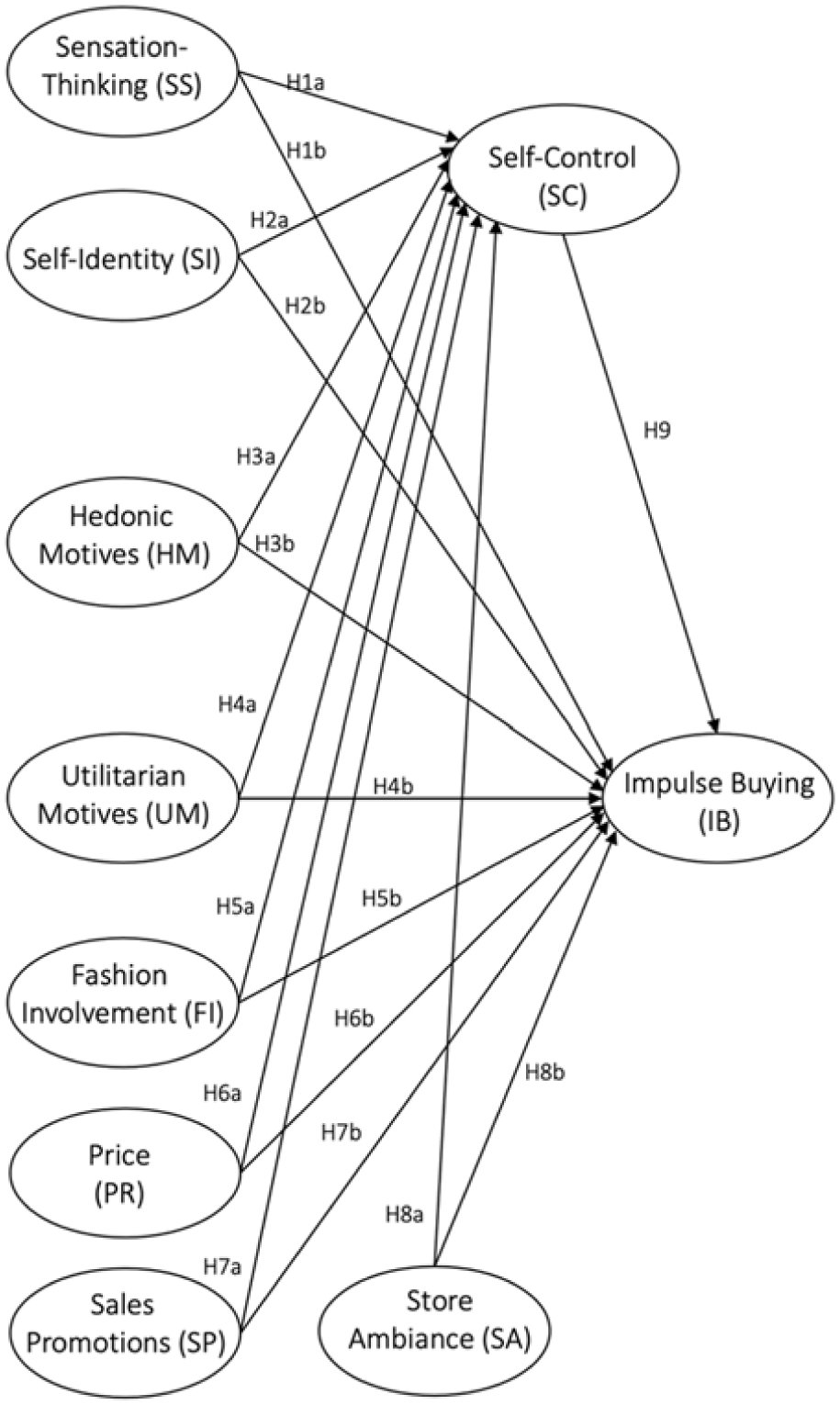
Structural model.
Methods
Procedures and Instruments
A survey was conducted based on a questionnaire with two primary sections. The first section included a total of 55 items covering the constructs identified in our structural model: Sensation-Seeking (SS)—three items adapted from Olsen et al. (2016), measured by a seven-point Likert scale; Self-Identity (SI)—five items adapted from Strizhakova et al. (2008), measured by a seven-point Likert scale; Hedonic Motives (HM)—seven items adapted from Babin et al. (1994), measured by a five-point Likert scale; Utilitarian Motives (UM)—four items adapted from Park et al. (2012), measured by a five-point Likert scale; Fashion Involvement (FI)—four items adapted from O’Cass (2004), measured by a six-point Likert scale; Price (PR)—three items adapted from Park et al. (2012), measured by a seven-point Likert scale; Store Ambiance (SA)—six items adapted from Mohan et al. (2013), measured by a seven-point Likert scale; Sales promotion (SP)—four items adapted from Kukar-Kinney et al. (2012), measured by a seven-point Likert scale; and Impulse Buying Behavior (IB)—nine items adapted from Lin and Chen (2013), measured by a five-point Likert scale. The second section of the questionnaire included demographic questions: gender, age, and education level. After setting the questionnaire in English, two experienced management researchers were informed about the study goals and scope, the constructs, and the planned procedures. Accordingly, minor wording modifications were applied to several items. A back-translation process was undertaken (Behr, 2017), first conducting a translation into Portuguese by a bilingual author and then back-translating into English by a Portuguese native with translation experience. The resulting versions were compared and considered equivalent. Then, a pilot survey involving 28 students was conducted over a week, providing the authors with further feedback concerning the required time to complete the questionnaire.
Since the study is cross-sectional and relies on self-reported data, specific procedural strategies were implemented to overcome concerns about common method variance bias. First, the items were reviewed by an expert panel, and the questionnaire was piloted before the main study (Cooper et al., 2020; Jakobsen & Jensen, 2015; Kock et al., 2021). Additionally, the items were randomized, with dependent and independent variables separated into different sections of the questionnaire (Polas, 2025). Also, independent and dependent variables were separated within the questionnaire to help minimize the potential for common method bias (Jakobsen & Jensen, 2015). The questionnaire was distributed using a snowball sampling approach between March and April 2025. Initial invitations were sent to university students, who were asked to complete the survey and share it with their social networks (including family, friends, and acquaintances) without age restrictions. To further diversify the sample, the survey was also posted on social media platforms (Facebook) targeting Portuguese consumers interested in fashion retail. This combined approach allowed us to gather responses from a broad age range (16–76 years) and various educational backgrounds, reflecting a more representative segment of Portuguese fashion consumers rather than a strictly student-based sample. A total of 555 answers were collected and screened, resulting in the removal of 144 incomplete cases. As such, our convenience sample reached a total of 411 cases.
Data Analysis
Jamovi 2.5.2.0 was used to assess the psychometric properties of the items and characterize the sociodemographic profiles, by determining frequencies and percentages for all variables, as well as the mean, standard deviation, minimum, and maximum values for age. The study constructs were characterized by their mean and standard deviation, as well as asymmetry (–3 to +3) and kurtosis (–7 to +7) values to assess the normality of their distributions (Kline, 2015).
A confirmatory factor analysis (CFA) was conducted using SmartPLS 4 to assess the validity and reliability of the measurement model (Ringle et al., 2025). This assessment used Covariance-Based Structural Equation Modeling (CB-SEM), a confirmatory approach that aims to reproduce the covariance matrix of the observed data by estimating parameters that minimize the difference between the theoretical model and the observed data (J. F. Hair et al., 2017). The CB-SEM procedure was chosen for its robustness in evaluating reflective measurement models and its ability to provide comprehensive fit indices.
Reliability was assessed using Cronbach’s alpha and composite reliability (CR), applying the recommended threshold of 0.70, which indicates good internal consistency (J. Hair et al., 2021; Nunnally & Bernstein, 1994). Discriminant validity was assessed using the Fornell-Larcker criterion, which requires that the square root of the average variance extracted (AVE) for each construct is greater than its correlations with other constructs; this approach ensures that constructs are more strongly related to their own indicators than to those of other constructs (Fornell & Larcker, 1981). Furthermore, the Heterotrait-Monotrait (HTMT) ratio was evaluated, with values below the threshold of 0.85 confirming satisfactory discriminant validity (Henseler et al., 2015). Both techniques are widely regarded as robust methods for establishing discriminant validity in structural equation modelling (J. Hair et al., 2021). In the process, specific items were considered for elimination due to poor factor loadings. J. F. Hair et al. (2017) recommend that loadings below 0.50 be excluded from the model to maintain construct validity and reliability. Moreover, Fornell and Larcker (1981) emphasize that low-loading items can adversely affect the AVE, compromising the model’s convergent validity. Therefore, items with loadings below 0.50 were removed to improve the overall measurement model’s reliability and validity (Henseler et al., 2015). Model fit was assessed using Chi-square statistic (χ2), comparative fit index (CFI), Tucker-Lewis index (TLI), root mean square error of approximation (RMSEA), and standardized root mean square residual (SRMR). According to J. Hair et al. (2021), CFI and TLI values greater than 0.90 indicate an acceptable fit, while RMSEA values below 0.08 and SRMR values below 0.08 suggest a good fit (J. Hair et al., 2021; Hu & Bentler, 1999).
The structural model was assessed using Partial Least Squares Structural Equation Modeling (PLS-SEM) via SmartPLS 4. PLS-SEM is a variance-based technique particularly suited for exploratory research and models involving latent constructs (J. Hair et al., 2021). Path coefficients and their significance were evaluated using the bootstrapping technique with 10,000 resamples in SmartPLS 4 to confirm the hypothesized relationships. Significant relationships were identified by examining the p-values (J. Hair et al., 2021). The R2 values for the endogenous constructs were examined to assess the explanatory power of the model. Values of 0.75, 0.50, and 0.25 are considered substantial, moderate, and weak, respectively (J. Hair et al., 2021).
Results
Sample Characteristics
The sample (Table 1) consisted of 411 participants, with 59.4% identifying as females (n = 244) and 40.6% as males (n = 167). Regarding educational background, a majority held higher education qualifications, representing 67.2% of the sample (n = 276), while the remaining 38.2% (n = 135) had basic or secondary education. Participants ranged in age from 16 to 76 years, with a mean age of 34.2 years and a standard deviation of 16.3, indicating a diverse age distribution across the sample. Overall, the sample skewed younger and more educated, with a strong representation of female participants.
Sample Characteristics.
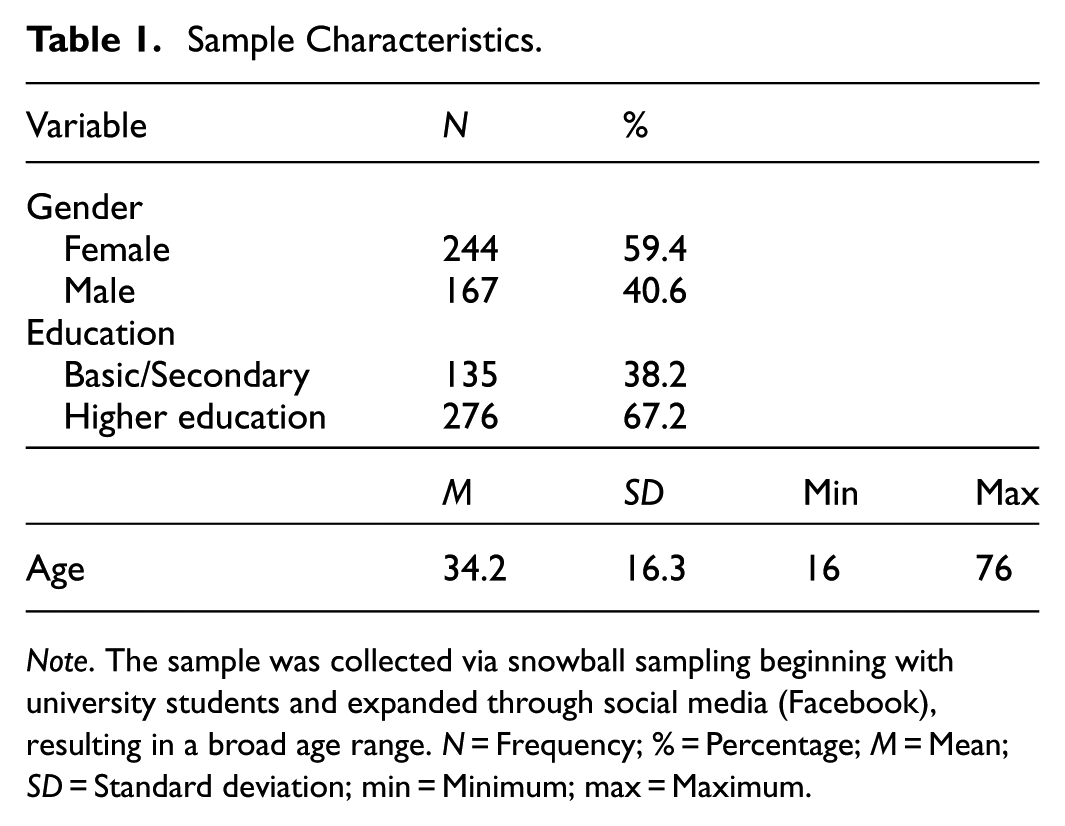
Note. The sample was collected via snowball sampling beginning with university students and expanded through social media (Facebook), resulting in a broad age range. N = Frequency; % = Percentage; M = Mean; SD = Standard deviation; min = Minimum; max = Maximum.
Measurement Model
A Principal component analysis (PCA) using Varimax rotation was conducted, aiming at exploring the underlying structure of the multi-construct measurement model related to IB and its antecedents. Several items from the initial set of 55 items were removed from the measurement model due to low loadings and reliability issues; specifically, items HM1, HM7, UM2, SA1, SA2, SA3, SC1, SC2, SC3, IB1, and IB5 to IB9 were excluded. Bartlett’s Test of Sphericity was highly significant (χ2 = 10,636, df = 703, p < .001), indicating that the correlation matrix is not an identity matrix and therefore suitable for PCA. The Kaiser-Meyer-Olkin (KMO) Measure of Sampling Adequacy showed an excellent overall value of 0.895, well above the recommended threshold of 0.60 (Kaiser, 1974). All individual items also had high KMO values, mostly exceeding 0.85, further confirming sampling adequacy. Table 2 documents the descriptive statistics for the remaining 38 items used in this study grouped by constructs (as resulted from the PCA). The extracted components align well with theoretical expectations. As can be seen in Table S1 in Supplemental Materials, there are no issues concerning skewness or kurtosis values, which are within the ranges suggested by Kline (2015). Cronbach’s alpha coefficients for the constructs are above 0.70, ranging from 0.830 to 0.936, thus indicating good internal consistency (Nunnally & Bernstein, 1994).
Discriminant Validity: CR, AVE, and HTMT.
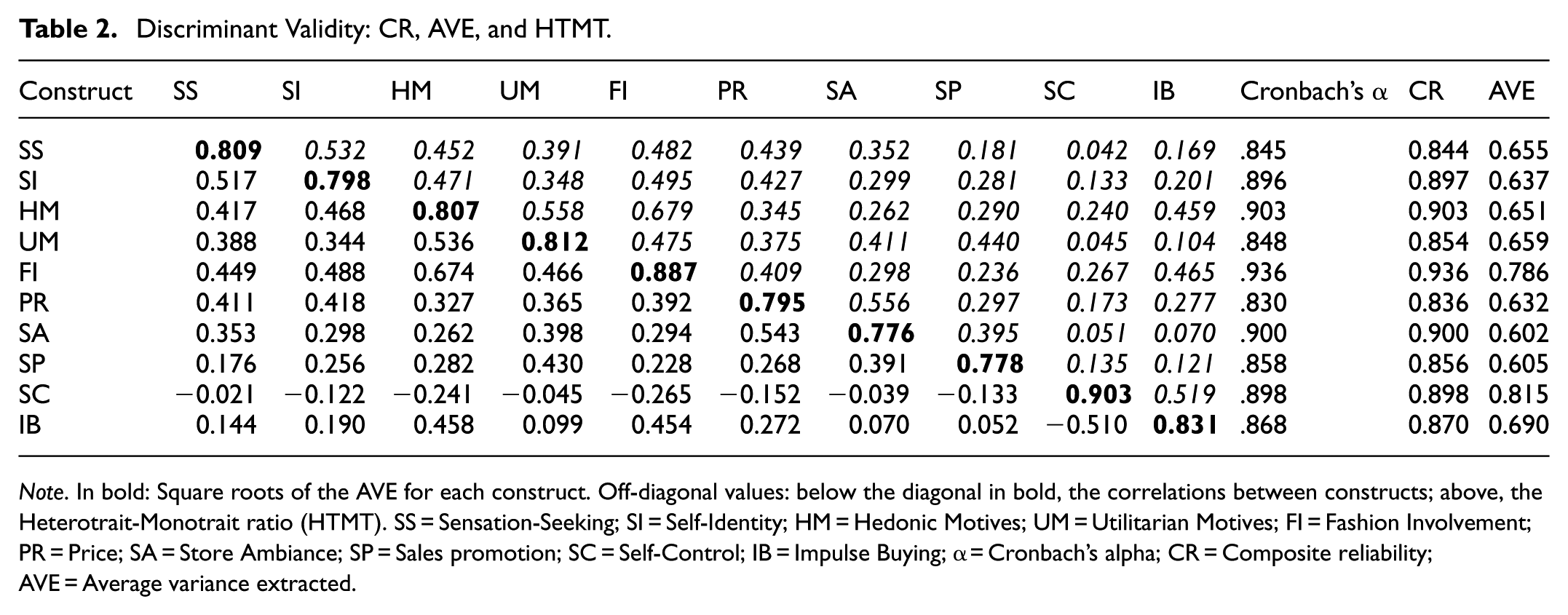
Note. In bold: Square roots of the AVE for each construct. Off-diagonal values: below the diagonal in bold, the correlations between constructs; above, the Heterotrait-Monotrait ratio (HTMT). SS = Sensation-Seeking; SI = Self-Identity; HM = Hedonic Motives; UM = Utilitarian Motives; FI = Fashion Involvement; PR = Price; SA = Store Ambiance; SP = Sales promotion; SC = Self-Control; IB = Impulse Buying; α = Cronbach’s alpha; CR = Composite reliability; AVE = Average variance extracted.
Confirmatory Factorial Analysis
The results of CFA, conducted using Smart-PLS, indicate that the measurement model’s overall fit is satisfactory. Although the chi-square value is statistically significant, as is typical with larger samples (χ2 = 1,399.421, df = 620, p < .001), the relative chi-square (χ2/df = 2.257) falls within the commonly accepted threshold, suggesting a reasonable model-to-data fit. Other global fit indicators also reinforce this conclusion: RMSEA is 0.055, comfortably below the 0.06 benchmark for good fit, with its confidence interval tightly bounded between 0.051 and 0.059; further, SRMR is 0.049, well under the 0.08 cutoff, indicating that the model’s residuals are acceptably small. Incremental fit indices such as the CFI = 0.924, TLI = 0.914, and NFI = 0.873 all exceed 0.90 or approach it closely, reinforcing the conclusion that the model is statistically robust.
From the perspective of construct reliability and validity, the findings are also strong, as all constructs in the model exhibit excellent internal consistency. Cronbach’s alpha values range from .830 to .936, with CR scores mirroring this robustness. AVE also exceeds the standard threshold of 0.50 for all constructs. Particularly notable are the high AVE values for FI (0.786) and SC (0.815), suggesting that these constructs are well represented by their respective indicators.
Discriminant validity is clearly established through the Fornell-Larcker criterion (Table 2). Each construct’s AVE square root is greater than its correlations with other constructs, demonstrating that the latent variables are empirically distinct. The pattern of correlations also aligns with theoretical expectations. For instance, SC is negatively related to IB (r = −.510), which supports prior literature on the inhibitory role of self-regulation in impulsive behavior. Furthermore, HTMT values remain below the 0.90 threshold, confirming that each construct captures a distinct conceptual domain. For example, the HTMT between HM and FI is 0.679, which, although relatively high, is still below the critical value, reflecting the expected conceptual overlap between emotional drivers and fashion orientation without implying redundancy.
Similarly, the HTMT between SI and SS is 0.517, suggesting they are moderately correlated yet remain distinct personality traits. The low HTMT value between SC and IB (−0.510) reinforces the discriminant validity and the hypothesized inverse relationship between these constructs. This negative and relatively strong association not only confirms their conceptual independence but also supports the theoretical assumption that lower self-control facilitates impulsive behavior.
In short, the HTMT analysis provides further confirmation of discriminant validity in the model. Alongside the AVE-based Fornell-Larcker criterion and cross-construct correlations, the HTMT values confirm that the measurement model is both statistically sound and conceptually well-differentiated, justifying the subsequent structural model testing. Taken together, these CFA results offer strong support for the reliability and validity of the measurement model: the constructs are internally consistent, conceptually coherent, and statistically distinguishable. This lays a solid foundation for proceeding to the structural phase of the model, where the relationships among traits, motivations, marketing stimuli, self-control, and impulse buying can be examined more comprehensively.
Structural Model: Path Analysis and Hypotheses Evaluation
The results of the path analysis carried out through SmartPLS reveal a rich and coherent understanding of the psychological and marketing-driven mechanisms that influence impulse buying in fashion retail contexts. The model presents a good overall fit, with an SRMR of 0.056, comfortably below the accepted threshold of 0.08, and d_ULS = 2.303 and d_G = 0.934, indicating acceptable residuals and model approximation. This indicates that the model’s estimated relationships align well with the empirical data. Table 3 reports the Path Analysis and identifies the supported hypotheses. Looking at the variance explained, the model accounts for 36.6% of the variation in Impulse Buying (IB), suggesting a substantial predictive capacity. In contrast, SC, which is conceptualized as a mediating factor, has a lower explanatory power, with an R2 of .114. This more modest figure reflects the complexity of self-control as a cognitive and emotional construct, influenced by both internal dispositions and external stimuli.
Path Analysis and Hypotheses Evaluation.

Note. SS = Sensation-Seeking; SI = Self-Identity; HM = Hedonic Motives; UM = Utilitarian Motives; FI = Fashion Involvement; PR = Price; SA = Store Ambiance; SP = Sales promotion; SC = Self-Control; IB = Impulse Buying. β = Standardized path coefficient; p = p-value; f 2 – Effect size; VIF = Variance inflation factor.
For enhanced clarity, the final structural model, depicting only the statistically significant paths, is presented visually in Figure 2.
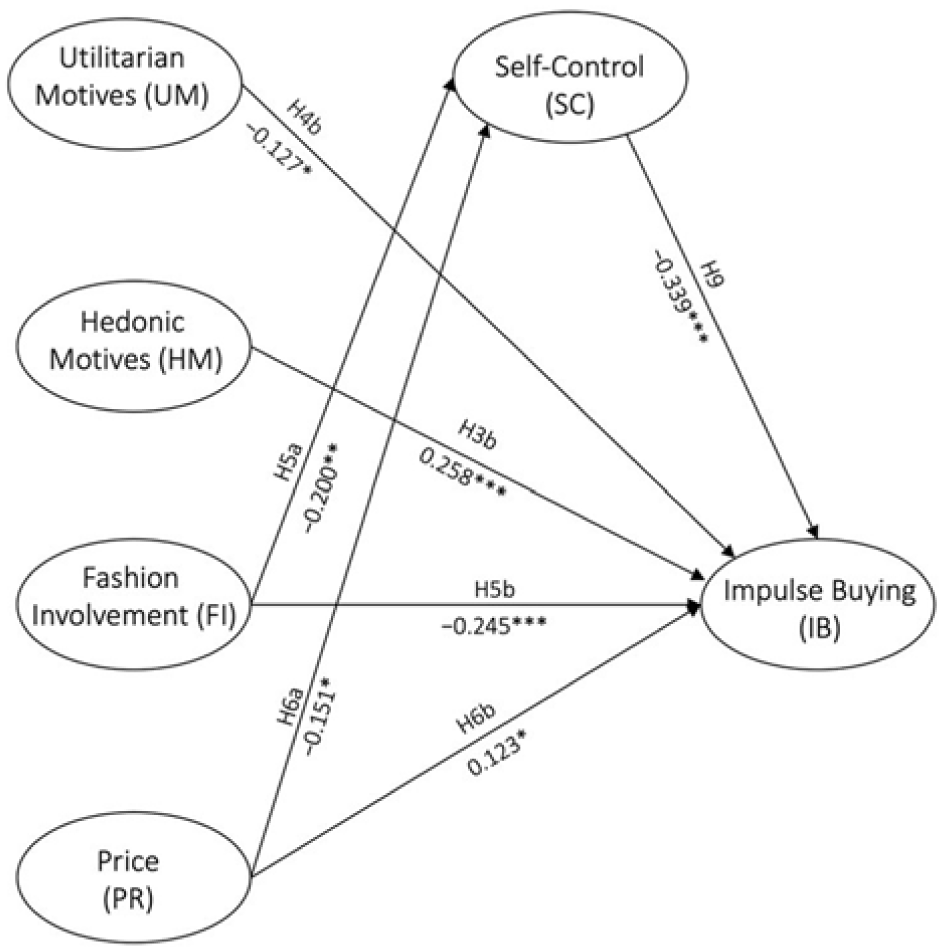
Final structural model with significant paths.
The strongest direct effects were observed between FI and IB (β = .245, p < .001), and HM and IB (β = .258, p < .001). Price (β = .123, p = .015) and Utilitarian Motives (β = –.127, p = .019) also showed significant but smaller direct effects on IB. Interestingly, Self-Control had a significant negative effect on IB (β = –.339, p < .001), supporting its role as a behavioral inhibitor. However, only a few predictors significantly influenced SC itself. FI (β = –.200, p = .003) and PR (β = –.151, p = .012) negatively affected SC, suggesting that higher engagement with fashion or price sensitivity reduces consumers’ self-control.
The mediation analyses further refined these insights. Notably, Sales Promotion exerted a significant indirect positive effect on IB through decreased self-control (β = .068, p = .006), suggesting that promotional stimuli weaken SC and thereby increase impulse purchases. Moreover, Store Ambiance also showed a significant indirect path via SC (β = .051, p = .020), indicating a similar mechanism. This suggests full mediation—SP and SA affect IB only through its impact on SC. Other indirect paths, such as Fashion Involvement → SC → IB and Utilitarian Motives → SC → IB, did not reach significance, though some approached marginal significance (e.g., H4c, p = .077). These results emphasize that while emotional and cognitive triggers are central to impulse buying, marketing variables, particularly those that influence consumers’ perception of value, cannot be overlooked.
Multi-Group Analysis by Gender
Given the gender distribution of the sample (59.4% female, 40.6% male), a multi-group analysis (MGA) was conducted to examine potential differences in path coefficients between female and male respondents. Using bootstrapping with 10,000 resamples in SmartPLS, we compared all structural paths across genders. The results we obtained indicated no statistically significant differences for any path (all two-tailed p > .05), suggesting that the proposed model holds equally for both genders.
This finding of invariance is noteworthy given the gender imbalance in the sample, as it provides empirical evidence that the structural relationships are robust and hold consistently across both female and male consumers, thereby mitigating concerns that the disproportionate representation might have biased the core findings.
Discussion
The analysis shows SS and SI had no effect on either SC or IB thus failing to validate H1a/b and H2a/b. The studies of Rook and Hoch (1985) and Sharma et al. (2010) have proposed that SS stands as a key trait driving hedonic consumption and impulsivity. However, our study finds that SS is a factor that does not influence Portuguese consumers. The consumer experience in the Portuguese cultural environment may prioritize social and aesthetic pleasures and identity expression, which aligns with the findings of Elhajjar (2023) and Saran et al. (2016). The strong influence of hedonic motives and fashion involvement on impulse buying may be partly explained by the Portuguese cultural context, where shopping, particularly for fashion, is often a social and leisure-oriented activity. The significance of price sensitivity could reflect a broader consumer cautiousness and value-seeking behavior prevalent in the market. Conversely, the non-significant findings for some stimuli (e.g., sales promotions) might indicate a localized promotional fatigue or a cultural preference for sustained value over aggressive discounts. These nuances highlight how local shopping habits and economic perceptions can shape the pathways to impulse consumption.
The lack of significance from SI indicates that fashion does not represent a core aspect of identity among participants, or that identity signaling is achieved through more controlled and planned consumption (Dholakia, 2006; Strizhakova et al., 2008).
The literature supports the idea that hedonic motives correlate positively with higher IB (β = .258, p < .001), while not affecting SC (H3a) significantly. This reinforces previous research that emphasizes the importance of pleasure-seeking in fashion impulse buying (Beatty & Ferrell, 1998; Dey & Srivastava, 2017) and aligns with recent empirical work identifying hedonic drivers as primary triggers of impulsive purchases in both online and physical fashion retail contexts (Mashilo et al., 2025). Interestingly, the disconnect between HM and SC may indicate that emotional gratification functions in parallel, rather than directly weakening self-regulatory resources, a view supported by Xu et al. (2020) and consistent with findings that hedonic arousal can bypass reflective self-control systems, leading directly to impulsive action (Redine et al., 2023).
The results indicate that UM decrease IB (β = –.127, p = .019) which confirms H4b while SC (H4a) was not confirmed. This result supports the idea that utilitarian shopping involves deliberate decision-making as well as goal-oriented conduct (Parsad et al., 2021). Our findings indicate that UM directly blocks impulsive actions while using cognitive framing instead of enhancing SC directly.
FI demonstrated its strongest influence on IB (β = .245, p < .001), while reducing SC (β = –.200, p = .003), supporting H5a/b—results aligned with the literature that shows that higher FI strengthens both marketing influence and emotional responses to hedonic stimuli in consumers (Mashilo et al., 2025; O’Cass, 2001). The negative relationship with SC reveals how intense FI makes consumers more prone to buying impulsively because it intensifies their focus on fashion cues and emotional involvement with them.
Price acted as a significant predictor of IB, confirming both H6a (β = –.151, p = .012) and H6b (β = .123, p = .015). Consumers tend to use the “licensing effect” (Parreño-Selva et al., 2014) to validate their purchase of indulgences through price savings, thus diminishing their self-control. This mechanism is further supported by recent research highlighting how promotional pricing and perceived affordability directly lower psychological barriers to impulsive spending (Ahmadova & Nabiyeva, 2024; Dam, 2023). Conversely, price sensitivity can diminish SC as consumers prioritize value-based justifications and overlook control mechanisms in order to take advantage of perceived discounts (Ahmadova & Nabiyeva, 2024). Therefore, price acts not only as a motivator for IB but also as an underlying disruptor of cognitive self-control, a dual role increasingly documented in contemporary retail behavior studies (Redine et al., 2023).
A key finding of this study is the full mediation of sales promotions and store ambiance through self-control. The non-significant direct effects of SP and SA on IB, contrasted with their significant indirect effects via SC, provide compelling evidence for a resource-depletion mechanism. These marketing stimuli do not merely ’push’ a consumer to buy; rather, they appear to function as subtle depleting agents. Promotional cues may create a cognitive load by inducing value calculations and urgency, while an engaging store ambiance demands attentional and emotional resources. This depletion of the finite self-control resource, as theorized by Baumeister (2002), lowers the consumer’s regulatory defenses, creating a pathway for impulsive urges to manifest as behavior. This underscores that the most powerful influence of the marketing environment may be its capacity to weaken internal control, rather than to directly elicit a purchase. This finding refines our understanding of external triggers, positioning them as antecedents to a change in the consumer’s internal regulatory state.
The results show no significant link between SP and IB or SC, resulting in the rejection of H7a/b, in contrast to the literature, which indicates that promotional urgency is a primary cause of impulse actions (Madhu et al., 2023; Parreño-Selva et al., 2014).
The non-significant effect of sales promotions on both SC and IB was unexpected and contrasts with some prior research (e.g., Madhu et al., 2023). Several post-hoc explanations are plausible. It may reflect a degree of consumer desensitization to common promotional tactics, or it could indicate that for this sample, perceived value and product quality are more influential purchase drivers than promotional urgency. This finding underscores the need for further research to understand the specific conditions under which promotions effectively trigger impulse buying, particularly across different cultural and retail contexts.
SA failed to influence either SC or IB (H8a/b not supported), in contrast with the findings of Yoon (2013) and Chi and Chen (2020), who demonstrate that sensory-rich environments boost impulse buying through emotional arousal. However, the present study failed to confirm this relationship. A possible explanation could be a higher threshold for sensory arousal or greater resistance to sensory stimuli in retail stores.
The results support H9 through a negative relationship between SC and IB (β = –.339, p < .001). As such, this study validates previous studies on SC as an essential inhibitor of unplanned buying behavior (Baumeister, 2002; Sultan et al., 2012) and is consistent with recent meta-analytic and empirical evidence confirming self-regulation as a central and robust mechanism in curbing impulsive consumption (Duan, 2025; Nyrhinen et al., 2024). The model shows a significant and strong buffering effect of SC against emotional and situational triggers. The discriminant validity is also shown in the model (HTMT between SC and IB = –0.510).
However, the relatively low R2 for self-control (11.4%) highlights that this construct is far from fully explained by the trait, motivational, and marketing variables in our model. This is theoretically consistent, as state self-control is known to be influenced by a host of additional transient factors, such as ego depletion from prior tasks, cognitive load, time pressure, mood fluctuations, and even physical fatigue (Palma et al., 2018; Vohs & Faber, 2007. The modest explained variance suggests that while our model successfully identifies several key antecedents that deplete self-control in the fashion retail context, a more comprehensive understanding requires the integration of these broader situational and internal states in future research.
The two strongest direct effects on IB came from HM and FI, which demonstrate the dominant influence of emotional gratification and fashion engagement on consumer responses. These findings support the S-O-R model (Iyer et al., 2020; Mehrabian & Russell, 1974b), which posits that stimuli (HM, FI, PR) influence internal states (SC) and lead to behavioral outcomes (IB). However, SC’s mediating role was not entirely evident since only a few predictors had a significant effect on it.
This research provides theoretical insights into impulse buying behavior by demonstrating that SC partially mediates the relationships between HM, FI, PR, and IB, and, most importantly, SC fully mediates the relationships between SP and SA with IB, thereby contradicting traditional models that overlook this mediating role. In fact, both H6c and H8c reveal indirect-only mediation, a classic example of suppressed or masked effects. Although SP and SA don’t directly appear to drive impulse buying, they operate through self-control, underscoring SC’s critical mediating role in shielding consumers from external marketing stimuli. This reinforces that marketing environments and promotions can affect buying decisions not by directly pushing purchases, but by eroding the internal control mechanisms that would otherwise prevent them.
Nevertheless, the results suggest the need for incorporating other antecedents and internal control processes (Sultan et al., 2012; Vohs & Faber, 2007). Interventions that enhance SC (e.g., reflective prompts and friction-inducing elements like digital timers) may be effective in reducing IB, particularly among fashion-involved consumers. Retailers should strike a balance between hedonic and utilitarian stimuli to reach different motivational segments while maintaining ethical standards and re-evaluate or customize SA and SP tools because of their weak influence on consumers.
Conclusions
This study investigated both personal and contextual factors that influence fashion retail impulse buying in Portugal, specifically through self-control mechanisms. The study used established consumer behavior and self-regulation theories to define a structural model, which examined direct and indirect relationships between multiple antecedents and impulse buying (IB). The study validates various existing research findings on hedonic and contextual factors and provides insight into how these elements interact with regulatory processes. The selected predictors successfully explained a significant portion of the variance in impulse buying behavior (R2 = .366). Fashion involvement, together with hedonic motives, proved to be the most powerful drivers of IB, aligning with prior studies that suggest that emotional gratification and self-identification function as key drivers for impulsive purchasing behavior. Price sensitivity and utilitarian motives also exerted significant, though comparatively weaker, effects. Most notably, SC acts as a psychological filter that mediates the effects of external cues. Even when SP and SA don’t directly affect IB, their real influence is revealed through SC, justifying the importance of including mediating variables in the model.
This study makes its primary theoretical contribution through its examination of self-control as a mediating factor. The expected negative correlation between self-control and impulse buying behavior confirmed that self-control functions as a fundamental constraint mechanism. The findings demonstrate how marketing stimuli reduce self-control because of their indirect effects on sales promotion and store ambiance. The study’s results align with previous experimental and meta-analytic research which shows that marketing stimuli influence consumer behavior through self-control depletion mechanisms.
The model indicated that some antecedents of impulse buying did not produce a significant effect on self-control. The self-control paths from fashion involvement and price sensitivity were negative but the model showed no significant effects from utilitarian motives and hedonic motives. The results indicate that certain consumption goals reduce self-regulation (e.g., style and cost concerns) yet others use direct hedonic methods to bypass it.
Theoretical Contributions
This study expands existing knowledge about impulse buying in three distinct ways. First, it directly addresses Iyer et al.’s (2020) call for a comprehensive framework by combining multiple consumer-level and contextual predictors into one model, integrating trait-based, motivational, and situational perspectives into a single explanatory framework. This integration not only validates the S–O–R framework but also clarifies the relative importance of these antecedents in a fashion retail context. Second, it offers novel empirical support for regulatory resource depletion theory (Baumeister, 2002) by demonstrating self-control’s role as a central mediator. Importantly, the study reveals that self-control fully mediates the effects of sales promotions and store ambiance on impulse buying—a finding that refines our understanding of how external stimuli operate by showing they primarily reduce behavioral control rather than directly triggering purchases. Third, the study provides a new understanding of how hedonic and utilitarian motives operate independently: while both influence impulse buying, hedonic motives exert a stronger direct effect, and neither operates through self-control, suggesting that motivational drivers can bypass regulatory resistance. These contributions collectively advance theoretical models of impulse buying by offering a more integrated, nuanced, and contextually grounded perspective.
Practical Implications
The findings offer actionable insights for fashion retail managers, extending beyond tactical optimization to encompass strategic considerations of consumer well-being and ethical brand stewardship. Primarily, practitioners should maintain their investment in sensory and symbolic appeals, as these elements significantly influence fashion involvement and hedonic motives, which are potent drivers of impulse buying. Integrating visual merchandising with compelling product storytelling and authentic influencer collaborations can effectively boost the hedonic value of fashion offerings, thereby stimulating spontaneous purchases (Magano et al., 2022). Furthermore, the results confirm that the strategic combination of sales promotions with immersive atmospheric cues can deplete self-control resources, creating a powerful pathway to increased impulse buying. Retailers can apply this knowledge by optimizing in-store stimuli—particularly in high-traffic zones and near checkout points—to serve as deliberate, yet measured, impulse triggers.
However, the study also reveals a critical tension: while promotional pricing and stimulating environments can boost short-term sales, they simultaneously weaken consumers’ self-regulatory mechanisms. This duality necessitates a more nuanced and responsible approach to marketing strategy. An over-reliance on aggressive impulse triggers risks consumer overstimulation, post-purchase regret, and the erosion of long-term brand trust. Therefore, managers are encouraged to balance these potent tactical tools with initiatives that support consumer self-regulation and well-being. For instance, incorporating reflective prompts at key decision points, offering transparent budgeting aids, or introducing short “cooling-off” options in digital carts can empower consumers without diminishing the shopping experience. Such practices align commercial objectives with consumer welfare, fostering a relationship based on respect rather than exploitation.
Ethically, building sustainable brand trust may require moving beyond exploiting self-control depletion. Transparent communication about pricing and promotions, avoiding manipulative scarcity messaging, and ensuring authentic value propositions are essential. By segmenting consumers based on their fashion involvement and underlying motives (hedonic vs. utilitarian), retailers can tailor communications that resonate more deeply while also promoting mindful consumption. For the highly involved, hedonic-seeking segment, this might involve enriching the experiential value while subtly guiding towards more considered choices. Ultimately, the most forward-thinking implication is to reframe the retailer’s role from a mere architect of temptation to a trusted partner in the consumer’s lifestyle, cultivating loyalty through a balanced approach that drives healthy sales while safeguarding consumer autonomy and trust.
Limitations
Despite its contributions, this study contains various limitations. The sample exhibits a higher proportion of female respondents (59.4%), which may reflect the demographic reality of fashion retail shoppers in Portugal. However, a multi-group analysis confirmed that the structural relationships did not differ significantly between genders, supporting the robustness of the findings despite the imbalance. Future studies should nonetheless aim for a more balanced sample to enhance generalizability. In addition, the sample consists only of Portuguese consumers. While this provides depth to a specific context, it limits the generalizability of the findings. Cultural values (e.g., individualism vs. collectivism, hedonic orientation), retail infrastructure, and economic conditions vary across nations and likely influence the antecedents of impulse buying. Different regions exhibit distinct cultural elements and market conditions and retail practices which could affect the observed relationships. Therefore, the proposed model should be tested in other cultural settings. Also, as highlighted in prior meta-analyses (Iyer et al., 2020), consumer resources and moods could lead to a more sophisticated model with higher explanatory power; the exclusion of these variables reduces the model’s explanatory power and creates potential biases. In particular, mood states could act as mediators, as emotional states of excitement, guilt, and regret commonly occur during impulsive buying and create intricate interactions with self-control mechanisms. Moreover, the study design as a cross-sectional approach prevents us from establishing cause-and-effect relationships. The proposed structural model requires stronger evidence which can be obtained through longitudinal or experimental research methods. The assumption that external stimuli affect behavior through self-control needs verification using real-time or time-sensitive data to establish its validity.
Furthermore, the sample’s over-representation of highly educated individuals (67.2%) should be considered when interpreting the findings. Higher education may correlate with greater cognitive resources, which could theoretically bolster self-control (a potential conservative bias), yet it may also be linked to a higher valuation of experiential and hedonic consumption. The strong effect of hedonic motives observed in our study, therefore, is particularly noteworthy, as it persists even in a sample that might possess enhanced cognitive capacity for restraint. Future research with a more educationally representative sample would be valuable to validate these findings.
A further methodological consideration pertains to the measurement of impulse buying. Following scale purification, the retained items for IB predominantly capture the spontaneous and unreflective mindset associated with impulse buying (e.g., “Just do it,”“I see it, I buy it”), rather than a comprehensive range of self-reported impulsive purchase behaviors. This conceptual narrowing means our findings are most directly applicable to the psychological predisposition toward impulse buying. While this aligns with core definitions of the construct (Rook, 1987), future studies should aim to employ or develop scales that more fully capture the behavioral dimensions of impulse purchases to enhance the generalizability of the conclusions. A related measurement limitation concerns the self-control construct, which serves as the central mediating variable in our model. Following scale purification, only two items (SC4 and SC5) were retained for this construct. Although the two items achieved acceptable reliability and convergent validity within the PLS-SEM framework, a two-item scale inherently restricts the breadth of content coverage and may underrepresent the full dimensionality of self-control as theorized by Tangney et al. (2004). Given SC’s pivotal role as the organism-level mediator linking all antecedents to impulse buying in our S-O-R model, this restriction warrants particular caution when interpreting the mediation findings. Future studies should employ a broader, validated self-control measure to ensure more robust operationalization of this construct and to strengthen confidence in the mediation pathways identified here.
Directions for Future Research
Future research can build upon our findings in several promising directions. One avenue involves testing the model in diverse cultural contexts to examine how cultural norms, retail environments, and consumer values moderate impulse buying behavior. Comparative studies across different countries or among different regions would help validate the model’s cross-cultural applicability. Another valuable extension would be to explore the moderating effects of demographic variables, including gender, age, and generational cohorts. Prior research suggests that impulse buying behavior may vary substantially across these groups. For instance, younger consumers may exhibit higher impulsivity due to underdeveloped self-control mechanisms, while older consumers may be more price-conscious or utility-driven. Exploring these moderating effects could yield insights into segmentation strategies and tailored marketing interventions. Additionally, mood states should be incorporated as either mediators or moderators in future models. Some literature emphasizes the importance of positive and negative emotional states in impulse buying, suggesting that mood regulation may operate alongside or in tandem with self-control. Including measures of consumer affect could refine our understanding of the interplay between emotion, cognition, and behavior in retail contexts.
Methodologically, one should also consider adopting experimental and longitudinal designs to better capture the dynamic nature of impulse buying. For example, experience sampling methods or real-time behavioral tracking could be used to monitor fluctuations in self-control and mood throughout a shopping episode. Finally, future studies should investigate the serial or parallel mediation between multiple psychological constructs, such as self-control and mood. Such models would allow for a more sophisticated understanding of how internal states interact to shape external behavior, offering deeper insights for both theory and practice.
The low explained variance in self-control points to a critical avenue for future inquiry. Subsequent models should integrate additional predictors known to deplete regulatory resources, such as ego depletion from prior tasks, cognitive load, time pressure (Vohs & Faber, 2007), emotional states (Miao, 2011), and even physical factors like fatigue. Incorporating these variables would not only increase the explanatory power of the model but also provide a more dynamic and realistic picture of how self-control fluctuates in a shopping environment.
Overall, this study offers a comprehensive analysis of impulse buying in the Portuguese fashion retail sector, highlighting the interplay between psychological motives, contextual triggers, and self-regulation. By confirming self-control as a critical mediating mechanism and identifying the potent influence of fashion involvement and sales-related stimuli, the research advances both theoretical understanding and managerial practice. At the same time, the study’s limitations offer fertile ground for future inquiry. As the boundaries between physical and digital retail continue to blur, and consumer attention spans contract, understanding the psychological levers of impulsivity will become increasingly vital for creating ethical, engaging, and effective shopping environments.
Supplemental Material
sj-docx-1-sgo-10.1177_21582440261464251 – Supplemental material for Impulse Buying in Physical Fashion Retail and the Mediating Role of Self-Control
Supplemental material, sj-docx-1-sgo-10.1177_21582440261464251 for Impulse Buying in Physical Fashion Retail and the Mediating Role of Self-Control by José Magano, Ignácio do Valle Lopes and Luís Durães Ferreira in SAGE Open
Footnotes

Ethical Considerations
The Ethics Committee at CICEE—Universidade Autónoma de Lisboa University approved our survey study (approval: CE07202502) on March 5, 2025.
Consent to Participate
Participation in this study was voluntary, and participants retained the right to refuse participation or to withdraw at any time without prejudice. All information provided and data collected were used solely for scientific research purposes, and in compliance with the GDPR (EU 2016/679) and Law 58/2019 (LPDP), the security, anonymity, and confidentiality of participants were guaranteed throughout all stages of the process. Data were processed, analysed, and disclosed only in aggregated form, never on an individual basis. Informed consent is thereby requested for participation and for the necessary data processing required to achieve the study’s objectives under the terms described. By proceeding, participants confirmed that they were 18 years of age or older and that they have read and understood the study procedures.
Funding
The authors received no financial support for the research, authorship, and/or publication of this article.
Declaration of Conflicting Interests
The authors declared no potential conflicts of interest with respect to the research, authorship, and/or publication of this article.
Data Availability Statement
Supplemental Material
Supplemental material for this article is available online.
References
Supplementary Material
Please find the following supplemental material available below.
For Open Access articles published under a Creative Commons License, all supplemental material carries the same license as the article it is associated with.
For non-Open Access articles published, all supplemental material carries a non-exclusive license, and permission requests for re-use of supplemental material or any part of supplemental material shall be sent directly to the copyright owner as specified in the copyright notice associated with the article.
