






Abstract
As a pivotal element of China’s strategy to expand global openness, the Belt and Road Initiative (BRI) has raised an important yet underexplored question: Does it enhance the public attitudes toward China? Leveraging international news coverage (2005–2023) and Pew Research Center’s Global Attitudes Survey data, this study employs a difference-in-differences (DID) design across national and temporal dimensions to assess the BRI’s impact on China’s global perception and its underlying mechanisms. The results demonstrate that the BRI has positively contributed to foreign public attitudes toward China. In countries where media sentiment toward the BRI improved, public perceptions of China rose significantly. Conversely, in nations with deteriorating media sentiment, the BRI did not substantially worsen negative attitudes toward China. Civilizational differences further shaped outcomes—perception to China deteriorated in Nordic-Eastern Europe, Latin America, South Asia, and West Asia but improved markedly in Confucian, Afro-Islamic, and Southern-Eastern European societies. Mechanistically, cultural and economic distance attenuated the positive effect of media sentiment on foreign public attitudes toward China, whereas institutional distance had no significant moderating role. Importantly, the findings extend Media framing theory by showing that valence framing effects are context-dependent rather than universal. Positive media sentiment toward the BRI enhances public attitudes toward China, yet negative sentiment does not consistently lead to deteriorating perceptions. This asymmetric effect underscores the conditional nature of emotional framing across countries, shaped by factors such as cultural or economic distance. These findings provide critical insights for balancing economic development and image-building in the BRI’s ongoing implementation.
Plain Language Summary
The Belt and Road Initiative (BRI) is a central component of China’s strategy to deepen its engagement with the global economy. While the initiative is often discussed in economic and geopolitical terms, its influence on how China is perceived by the public in participating countries remains insufficiently understood. This study examines whether and how the BRI has shaped foreign public attitudes toward China. Using international news coverage from 2005 to 2023 together with public opinion data from the Pew Research Center’s Global Attitudes Survey, we apply a difference-in-differences research design to compare changes in perceptions of China across countries and over time. The findings show that, overall, the BRI has made a positive contribution to foreign public attitudes toward China. In countries where media reporting on the BRI became more favorable, public attitudes toward China improved significantly. In contrast, in countries where media sentiment toward the BRI worsened, the initiative did not lead to a substantial further decline in already negative views of China. The effects of the BRI are not uniform across regions and cultural contexts. Public perceptions of China declined in many Global North countries, while Global South countries did not experience a similarly strong positive shift. Differences were also evident across civilizational groupings: China’s image deteriorated in Nordic-Eastern Europe, Latin America, South Asia, and West Asia, but improved notably in Confucian, Afro-Islamic, and Southern-Eastern European societies. Further analysis indicates that cultural and economic distance weakens the positive influence of favorable media coverage on China’s image, whereas institutional differences do not play a significant role. Overall, the findings highlight the importance of aligning economic cooperation with effective image-building strategies as the Belt and Road Initiative continues to evolve.
Keywords
Introduction
Since it was first proposed by President Xi Jinping in 2013, the Belt and Road Initiative (BRI) has become a key vehicle for conveying China’s policy positions and core values on the global stage. As such, the BRI is not merely a framework for international development cooperation—it also represents China’s strategic endeavor to expand its global discourse power and construct a favorable image as a rising major power (C. Zhang, 2024). In the new era, as the BRI continues to deepen and expand, it offers fresh opportunities for reshaping foreign public attitudes toward China. On the one hand, the initiative enables partner countries to ride the wave of China’s economic growth and achieve mutual prosperity (Z. Chen, 2023), thereby potentially enhancing positive attitudes toward China (J. Li et al., 2020; Y. Xie & Jin, 2022). On the other hand, however, the absence of political trust in some countries—coupled with negative portrayals by certain political forces and media outlets—has led to misinterpretations of China’s development and foreign aid as hegemonic ambitions (H. Yu, 2017), which could diminish the BRI’s positive influence on public attitudes toward China (Han & Jiang, 2017; J. Wang, 2022).
How, then, does the BRI actually influence foreign public attitudes toward China? Scholars have approached this question from various perspectives. For instance, J. Wang (2023) confirmed that countries that signed cooperation agreements under the BRI generally held more favorable views of China than non-participant countries. Through economic engagement (i.e., direct investment, project contracting, and debt relief) in Belt and Road countries, China has significantly heightened its favorability among local publics (An & Wang, 2024; Han & Jiang, 2017; Z. Liu & Ding, 2024). However, most existing studies adopt either economic or international relations frameworks, with limited attention paid from the perspective of communication studies. Yet the relationship between the BRI and communication studies is evident: the initiative is constructed through specific media texts and disseminated through public cognition and evaluation; news discourse and social structures mutually interact and reinforce one another (Fu & Yuan, 2017; Reveilhac, 2025), thereby shaping audiences’ interpretive frameworks and influencing perceptions of China (Fairclough, 2010). Therefore, it is essential to examine the relationship between the BRI and public attitudes toward China from a communication perspective—particularly international communication—by analyzing the media texts that construct and transmit BRI narratives. A crucial question thus emerges: has the global diffusion of the BRI led to a substantive improvement in global public attitudes toward China?
To answer this question, this study adopts a longitudinal perspective and employs a difference-in-differences (DID) methodology that operates at both the national and temporal levels. Specifically, the study draws on international news reports from 2005 to 2023, along with survey data from the Pew Research Center’s Global Attitudes and Trends project, to investigate the relationship between BRI-related media coverage and public attitudes toward China. The study addresses the following key questions:
Do media reports on the BRI influence public attitudes toward China in different countries? If so, in what ways? Do differences in political systems, economic development, or cultural backgrounds affect this relationship? How?
By systematically exploring these questions, the study aims to provide constructive insights into how the BRI can better facilitate both China’s external openness and the enhancement of its global image in the new era.
Literature Review
Media Framing as a Theoretical Perspective: Media Representations of the BRI and Public Attitudes Toward China
National image is a constructed form of cognition, wherein the representation of the “other” often implies a projection of the “self” (Yang, 2008). A nation’s image can be divided into two dimensions: the idealized image (how a country wishes to be seen) and the perceived image (how it is actually viewed by others). Recent theoretical work conceptualizes national image as a multidimensional evaluative orientation among foreign publics, combining cognitive judgments (e.g., competence, trustworthiness), affective reactions (e.g., warmth, hostility), and generalized impressions of political and economic behavior (Buhmann & Ingenhoff, 2015; Q. Xie, 2024). This aligns with multidimensional approaches that treat country image as a structured network of beliefs and feelings rather than as a set of isolated evaluative items (Roth & Diamantopoulos, 2009). From this perspective, a country’s national image is reflected through public attitudes toward that nation.
A growing body of literature has affirmed the critical role of discourse in shaping national image and attitudes toward that nation. Discourse constructivism and poststructuralist theory argue that discourse creates social realities and identities (Mattern, 2005); political psychology further suggests that discourse can reshape perceptions of political actors and thereby influence political outcomes (Castano et al., 2016). Media discourse plays a central role in constructing meaning and social relationships, helping individuals form notions of common sense and perceived legitimacy (Merrill, 1962; Z. Li, 2006). Beyond shaping the availability of information, media influence public perceptions and attitudes through the frames they employ.
Media Framing Theory, as proposed by Entman (1993), emphasizes that news coverage not only directs audiences’ attention to specific issues but also shapes their interpretation and evaluation of these issues by highlighting particular causal explanations, attributing moral responsibility, and providing affective cues. By selectively emphasizing certain aspects of reality while downplaying others, framing influences cognition and perception, effectively constructing a lens through which audiences understand events and actors. In the context of the Belt and Road Initiative, Media Framing Theory provides a robust analytical framework for examining how positive or negative media sentiments (valence framing) across different countries emphasize cooperation, risks, or geopolitical competition. Furthermore, the theory aligns with psycholinguistic approaches that conceptualize national image as a structured network of beliefs and emotions rather than as discrete checklist evaluations (Lopez & Balabanis, 2020). Accordingly, applying Media Framing Theory in this study offers a coherent and integrative pathway for understanding how media sentiment regarding the Belt and Road Initiative translates into public attitudes toward China.
Valence Framing: Media Sentiment Orientation Toward the BRI and Its Effects on Public Attitudes
News is never entirely objective; all reporting inevitably carries a certain emotional or evaluative tone (Entman, 1993; Wahl-Jorgensen, 2019; Q. Xia & Wang, 2016). Traditional journalistic discourse often emphasizes objectivity by excluding emotional expression. In this framework, objectivity is typically understood as the exclusion of values from news narratives, thus placing it in opposition to sentiment (Maras, 2013). However, numerous studies on emotion and news production suggest that journalism is inherently emotional in nature (Beckett, 2015). From both theoretical and practical perspectives, integrating emotional expression into digital-era journalism has become a necessary evolution of the field (Seigworth & Gregg, 2010). With regard to BRI coverage, substantial research indicates that media narratives from different countries exhibit clear emotional tendencies, shaped by national interests and geopolitical stances. For example, U.S. media coverage of the BRI evolved through three stages—“arrogance,”“aggressiveness,” and “caution”—reflecting increasing uncertainty and anxiety in American foreign policy (J. Li et al., 2024). X. Liu et al.’s (2024) research on Philippine media found that sentiment toward the BRI fluctuated from positive to negative and back to positive, highlighting the complex and shifting perceptions within Filipino society. Economic narratives were generally portrayed more objectively, while geopolitical frames conveyed more negative sentiment (Callahan, 2016).
These findings demonstrate that national media tend to embed their political ideologies in their emotional representations of the BRI. Through these affect-laden discourses, media not only inform the public but also shape, guide, and even alter perceptions, attitudes, and behaviors toward China in the international arena (Lyu & Takikawa, 2022; Ryffel et al., 2014).
Notably, framing also can operate through emotionally valenced presentation, whereby the media convey a positive or negative evaluation of an event or actor to shape audience interpretation (Chong & Druckman, 2007; Geise & Xu, 2025). In the context of the BRI, the emotional tone embedded in media coverage—emphasizing cooperation and mutual benefit or highlighting risk and geopolitical rivalry—constitutes a form of valence framing, a “lightweight” type of frame that primarily communicates sentiment rather than complex issue-specific arguments. de Vreese (2005) further notes that the tone of news coverage can be understood as an integral component of framing, reinforcing the affective cues presented to audiences. Scheufele (1999) emphasizes that the operationalization of framing in empirical research can rely on valence-based cues, such as positive or negative sentiment indicators, making it a suitable approach for studying how shifts in media sentiment translate into changes in public perceptions of China’s national image. Thus, valence framing provides a more detailed theoretically grounded lens for interpreting the observed relationship between media sentiment on the BRI and the public’s evaluative impressions of China.
In the context of the BRI, media coverage has had a multifaceted impact on China’s national image across political, economic, and cultural domains. The media agenda is highly correlated with public attitudes toward BRI projects (Oo & Dai, 2024), and the sentiment in media coverage is closely linked to bilateral economic and political ties, which in turn shapes the overall perception and discursive landscape regarding China in the target regions (García-Herrero, 2025). Research by Q. Yu and Guo (2024) found that the more positive the U.S. media’s coverage of the BRI, the more favorable ASEAN countries’ perceptions of China’s political credibility. Similarly, studies by J. Chen and Xu (2015) and K. Zhang and Xu (2023) revealed that media in countries such as Pakistan and various Arab nations presented the BRI in a generally positive light, reinforcing a favorable public image of China. Conversely, misinterpretations and geopolitical concerns have generated negative portrayals of the BRI in some countries. For instance, Indian media have often portrayed China as a strategic threat and ally of Pakistan (Y. Zhao & Guo, 2020), while South Korean media have depicted China as politically responsible but economically aggressive—resulting in a complex, ambivalent national image (Z. Li et al., 2021; Song, 2023). Therefore, media outlets across different countries shape international perceptions of China by presenting issues through distinct framing strategies. These divergent framing practices are particularly evident in global media discourses surrounding the Belt and Road Initiative.
While existing research has largely relied on media content analysis to infer public perceptions of China, many studies conflate “media perspectives on China” with the actual public image held by foreign audiences. Moreover, most analyses are limited to particular countries, regions, or time points, lacking comprehensive temporal depth or global scope. Given these limitations, this study revisits national image not only as a discursive construct but also as an attitudinal outcome measurable through globally comparable survey data, enabling a more direct assessment of how public perceptions of China evolve in relation to the BRI. More importantly, given that the BRI has been in operation for over a decade, it is now both timely and necessary to undertake a systematic, longitudinal study of how the initiative has influenced public perceptions of China across a wide range of countries.
Based on this discussion, we propose the following research question and hypothesis:
Structural Moderators: Institutional, Economic, and Cultural Distances in Shaping Public Perceptions of the BRI
As a comprehensive national strategy integrating political, economic, and diplomatic dimensions, the BRI is inevitably shaped by inter-country differences. These differences—referred to as “distances”—manifest in areas such as geography, political systems, economic structures, and value orientations (M. Zhang & Zhang, 2017). Since the BRI is fundamentally an initiative centered on cross-regional economic interaction, exploring how these distances affect the relationship between media sentiment and perceptions of China is critical.
Multiple studies have highlighted the influence of such distances on trade and investment. Xu et al. (2017), for example, found that differences in macro- and micro-economic systems between China and BRI countries significantly impeded bilateral trade. Fan and Huang (2017) reported that cultural distance plays a key role in determining the efficiency of cultural product trade among BRI nations—smaller cultural distances enhance trade, while larger distances inhibit it. In the realm of foreign direct investment, Qi et al. (2021) discovered that political distance between China and recipient countries negatively affects BRI-related investment flows. Other researchers have directly examined how these distances influence media sentiment toward the BRI. Xuan and Lin (2021), for instance, found that cultural distance positively correlated with favorable sentiment in BRI-partner countries, but had a negative effect in non-partner countries.
These structural differences also shape international perceptions of China. Studies have shown that institutional, economic, and cultural distances significantly influence national images of China (Zhou & Fan, 2023). Specifically, Countries with greater institutional divergence from China tend to hold more negative views (M. Xia & Hao, 2022); those with wider economic gaps also exhibit more critical attitudes (X. Huang et al., 2024); and the smaller the cultural and ideological differences, the more likely a country is to hold a favorable image of China (Bao & Jiang, 2012).
Notably, prior research shows that national image is highly stable and shaped predominantly by long-standing historical narratives, cultural value systems, and geopolitical alignments (Anholt, 2007). Media coverage of specific issues may has limited capacity to alter these entrenched perceptions, particularly when pre-existing cognitive schemas dominate evaluations of foreign nations (Scheufele, 2000; Wanta et al., 2004). Therefore, incorporating structural country-level characteristics—such as cultural value orientations, geopolitical blocs, or civilizational membership—is theoretically essential for explaining cross-national heterogeneity.
Accordingly, this study poses a second research question and several additional hypotheses:
Data Sources, Research Methodology, and Variable Measurement
Data Sources
Public Attitudes Toward China
Following established practice in Chinese scholarship on international public opinion, this study uses data from the Pew Research Center’s Global Attitudes and Trends survey to measure public attitudes toward China (B. J. Wang & Gao, 2023). Pew Research Center’s Global Attitudes and Trends survey is an internationally recognized dataset that annually investigates public opinion on key global issues and national development perceptions across a wide range of countries. Each year, the survey samples approximately 1,000 respondents per country, all aged 18 and above, using stratified sampling techniques. The survey is conducted annually across multiple countries over a period of 3 to 6 weeks to reduce the impact of major events. With an error margin below 5%, interviews are conducted via phone and in person. To ensure accuracy, the questionnaire is translated into over 80 languages. The survey includes the question, “Please tell me if you have a very favorable, somewhat favorable, somewhat unfavorable or very unfavorable opinion of China” for which data collection began in 2005. After aligning these data with national-level media reporting data, 41 countries were retained for this study.
News Coverage of the Belt and Road Initiative
To assess the international media coverage of the Belt and Road Initiative (BRI), this study draws on news reports collected from both English and non-English sources through ProQuest and a multilingual news database developed by a leading university’s media research lab. ProQuest provides a comprehensive database of English-language newspaper articles (Bao & Jiang, 2012). As one of the most widely used and authoritative databases in academic research, ProQuest (2025) offers the most extensive news archive, encompassing over 3,000 renowned international media outlets with a historical completeness rate of 95%. It is frequently used for content and framing analysis in communication studies (M’Bareck, 2019). The university-developed database supplements the content from English-language sources in non-English speaking countries.
In this study, the selection of leading news publications is based on the following criteria: (1) inclusion in internationally recognized media directories (e.g., ProQuest source list); (2) nationwide circulation or equivalent digital influence within the country; (3) significant influence and citation frequency in cross-national media studies. For non-English-speaking countries, additional verification procedures were implemented to ensure the representativeness and credibility of the selected media, based on local media ratings and audience coverage data: First, for countries where English is not the native language but is an official language (e.g., India, Pakistan, Bangladesh), the selected English newspapers are authoritative; second, in countries where English is not the native language but is widely spoken (e.g., Thailand, Israel, and some Arab countries), the selected English newspapers are the most recognized and influential in the country; third, in developed countries with authoritative English-language newspapers (e.g., France’s Le Figaro), these sources were also included. These standards ensure that the 41-country sample selected meets the minimum requirement for national representativeness. Specifically, the leading media outlets covered in this study include: The New York Times and The Guardian in the English-speaking domain; Le Monde, Der Spiegel, and El País in Europe; The Times of India, The Straits Times, The Nation in Kenya, and The Jakarta Post in Asia and Africa. In non-English-speaking regions, to maintain an international reporting perspective, Chinese media outlets, such as Xinhua News Agency, were excluded from the final analysis.
News articles were retrieved in two stages. The first period is between January 2005 and September 2013 (prior to the BRI’s official launch), the starting point of January 2005 aligns with the launch of the Pew Research Center’s survey on perceptions of China, while the endpoint of September 2013 corresponds to the initial proposal of the Belt and Road Initiative. The articles of this period were identified using the Boolean search “China AND Economy.” For non-English-speaking countries, keyword searches were adapted using context-specific translations verified by native-language consultants and cross-language keyword validation to ensure semantic consistency. A unified multilingual preprocessing pipeline was applied using language-specific tokenizers to minimize variation arising from linguistic differences. The emphasis on “Economy” reflects the BRI’s foundational focus on economic development and cooperation.
For the period from October 2013 to October 2023 (marking the end of the third Belt and Road Forum for International Cooperation), the keywords “One Belt, One Road,”“Belt,” and “Road” were used. In both stages, searches were restricted to article titles. The final dataset includes publication details such as headline, source, date, country, and full text. After removing reports from Chinese media outlets to focus solely on foreign coverage, a total of 6,026 articles were obtained from 451 leading news publications across 41 countries in 15 languages.
Research Methodology
Difference-in-Differences (DID) Approach
This study employs the difference-in-differences (DID) method, a quasi-experimental econometric technique widely used to identify causal effects of policy interventions or external shocks. Unlike traditional OLS regression, DID helps to address endogeneity concerns by comparing the change in outcomes before and after an intervention between a treatment group and a control group. In this context, it compares changes in perceptions of China’s national image between countries where media sentiment toward the BRI significantly shifted after 2014 (treatment group) and those where sentiment remained stable (control group). The approach helps isolate the net effect of changes in BRI-related media sentiment on China’s image, net of broader temporal and national fixed effects.
Sentiment Analysis
Sentiment analysis refers to the computational processing, classification, and interpretation of emotion-laden text. This study employs the LIWC (Linguistic Inquiry and Word Count) dictionary to analyze the emotional valence of news reports. Developed by Pennebaker and colleagues, LIWC—particularly the LIWC2015 version—provides fine-grained sentiment indicators and has been validated in multilingual contexts (Dudău & Sava, 2021).
Since LIWC was originally developed for English texts, non-English articles in our sample were first translated into English before analysis. To further validate the method’s applicability, we drew on psychometric studies conducted in non-English contexts: the Simplified Chinese LIWC (SCLIWC) has been empirically validated, with N. Zhao et al. (2016) finding that LIWC frequency scores were significantly correlated with human-coded psychological expressions in short social media texts (Weibo). Additionally, cross-linguistic studies have demonstrated consistent psycholinguistic components between Chinese and English texts, and the Chinese LIWC dictionary itself has shown acceptable reliability and validity (J. L. Huang et al., 2012).
To mitigate potential distortions arising from implicit metaphors or irony, which are often present in journalistic reporting on the BRI, we implemented text preprocessing steps to remove noise and cross-validated LIWC-generated sentiment scores with human-coded ratings for a subset of articles. While these measures do not entirely eliminate the risk of misinterpretation, they support the reliability of LIWC for longitudinal and cross-national comparative analyses.
Variable Measurement
Dependent Variable
Public Attitudes Toward China
Attitudes toward China was operationalized based on Pew survey responses to the question about national impressions. Respondents chose from four options: “very favorable,”“somewhat favorable,”“somewhat unfavorable,” and “very unfavorable.” Responses were reverse-coded and standardized for analysis: “very favorable” = 4, “somewhat favorable” = 3, “somewhat unfavorable” = 2, “very unfavorable” = 1. The scores were then normalized to have a mean of 0 and a standard deviation of 1 for comparability across countries and years.
Key Independent Variable
Media Sentiment Toward the BRI: The sentiment index was calculated using the LIWC-generated counts of positive and negative words as follows:

A higher score reflects a more positive emotional tone in news coverage; a lower score indicates a more negative tone.
It is important to clarify that the Pew Global Attitudes Survey and the media sentiment measure capture fundamentally different dimensions of opinion and rely on different units of analysis. The Pew Global Attitudes Survey focuses on public attitudes toward China, whereas media sentiment refers to the emotional orientation expressed in national media coverage toward the Belt and Road Initiative (BRI) itself.
Moderating Variables
To examine how national differences in systems, economies, and cultures moderate the relationship between media sentiment and perceptions of China, three types of distance variables were included:
1. Cultural Distance: Measured using Hofstede’s six cultural dimensions—power distance, individualism versus collectivism, masculinity versus femininity, uncertainty avoidance, long-term versus short-term orientation, and indulgence versus restraint. We used the national-level scores compiled by Hofstede Insights, which incorporate the original Hofstede survey data (2015) as well as subsequent scholarly updates. As of 2023 these represent the most comprehensive and publicly available cultural indices.
Cultural distance between China and each country was computed using the Kogut and Singh (1988) index.
The specific calculation formula is as follows:

Among them, CDj represents the cultural distance between China and country j; Iij denotes the score of country j on the i-th cultural dimension; IiN is China’s score on the i-th cultural dimension; and Vi refers to the variance of scores for each cultural dimension. The data for each country across the six dimensions are sourced from the publicly available Hofstede Insights database.
2. Institutional Distance: Calculated using the Worldwide Governance Indicators (WGI), which include six components: voice and accountability, political stability, government effectiveness, regulatory quality, rule of law, and control of corruption. Following Y. Wang et al.’s (2014) method, the average of these six dimensions for each country was compared with China’s, and the absolute difference was taken as the institutional distance.
3. Economic Distance: Drawing on the methodology of Z. Liu and Huang (2019), this study uses the annual Index of Economic Freedom published by the Heritage Foundation to measure the economic institutional quality of different countries. This index is calculated by evaluating each country on 12 economic freedom indicators—including government integrity, judicial effectiveness, and financial freedom—on a scale of 0 to 100, with each indicator assigned equal weight. The economic distance is defined as the absolute difference between a country’s total economic freedom score and that of China.
Control Variables
GDP: To account for economic development levels that may affect national attitudes toward China and the BRI, GDP was included as a control variable (log-transformed). Data were obtained from the United Nations Conference on Trade and Development (UNCTAD).
BRI Agreement Status: A dummy variable was introduced to indicate whether a country had signed a formal BRI cooperation agreement with China (1 = yes; 0 = no). As of November 2023, China had signed BRI agreements with 153 countries, covering 77% of the world’s nations and 65% of the global population (China Belt and Road Portal, 2023). After benefiting from the BRI, partner countries experience a reduced perception of differences and an enhanced perception of commonalities. This emotional resonance is profoundly reflected in the sentiment orientation of their domestic news coverage, ultimately contributing to the formation of an in-group identity among BRI participants—distinct from non-participating countries as the out-group.
It is important to note that all variables involved in this study were treated as time-varying measures across the 2005 to 2023 period. This dynamic approach ensures that analyses, including heterogeneity tests and moderating effect assessments, reflect temporal changes rather than assuming static conditions throughout the study period.
Empirical Analysis
Identifying Treatment and Control Groups
The core of the Difference-in-Differences (DID) method lies in comparing the outcome variable before and after an intervention across treatment and control groups. Therefore, defining these groups accurately is a critical step in applying the model. In this study, countries in which the emotional tone of BRI-related news coverage experienced a statistically significant change following the initiative’s launch were assigned to the treatment group; those without significant change were assigned to the control group.
The year 2014 was used as the cutoff point, given that the BRI was officially proposed in late 2013 and policy effects would require some time to materialize. Paired-sample t-tests were conducted to compare the average sentiment scores before and after 2014 for each country.
As shown in Table 1, the results show that out of the total sample, 28 countries (68%) experienced statistically significant changes in sentiment and were classified as the treatment group. Among them, 18 countries exhibited a shift toward more positive sentiment (e.g., Pakistan, Malaysia, Singapore), while 10 countries showed a shift toward more negative sentiment (e.g., the United States, the United Kingdom, India). The remaining 13 countries (32%) exhibited no significant change and were designated as the control group (e.g., South Africa, Turkey, South Korea, New Zealand, Vietnam). These findings suggest that a majority of countries responded positively to the BRI in their news media coverage, providing a foundation for examining the initiative’s influence on public attitudes toward China.
Sentiment Means of News Coverage by Country, t-Values and Grouping Information.
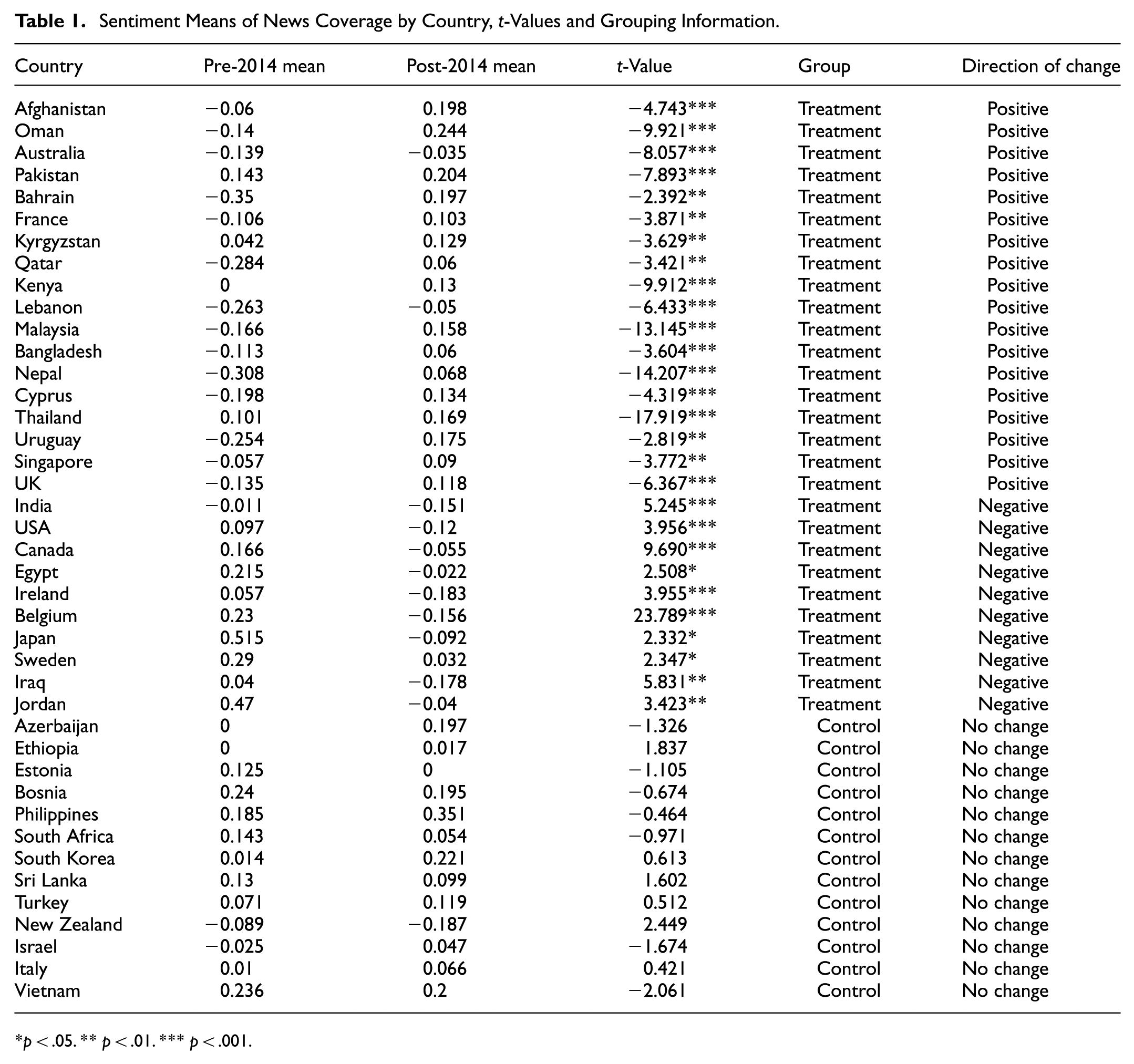
p < .05. **p < .01. ***p < .001.
Descriptive Statistics
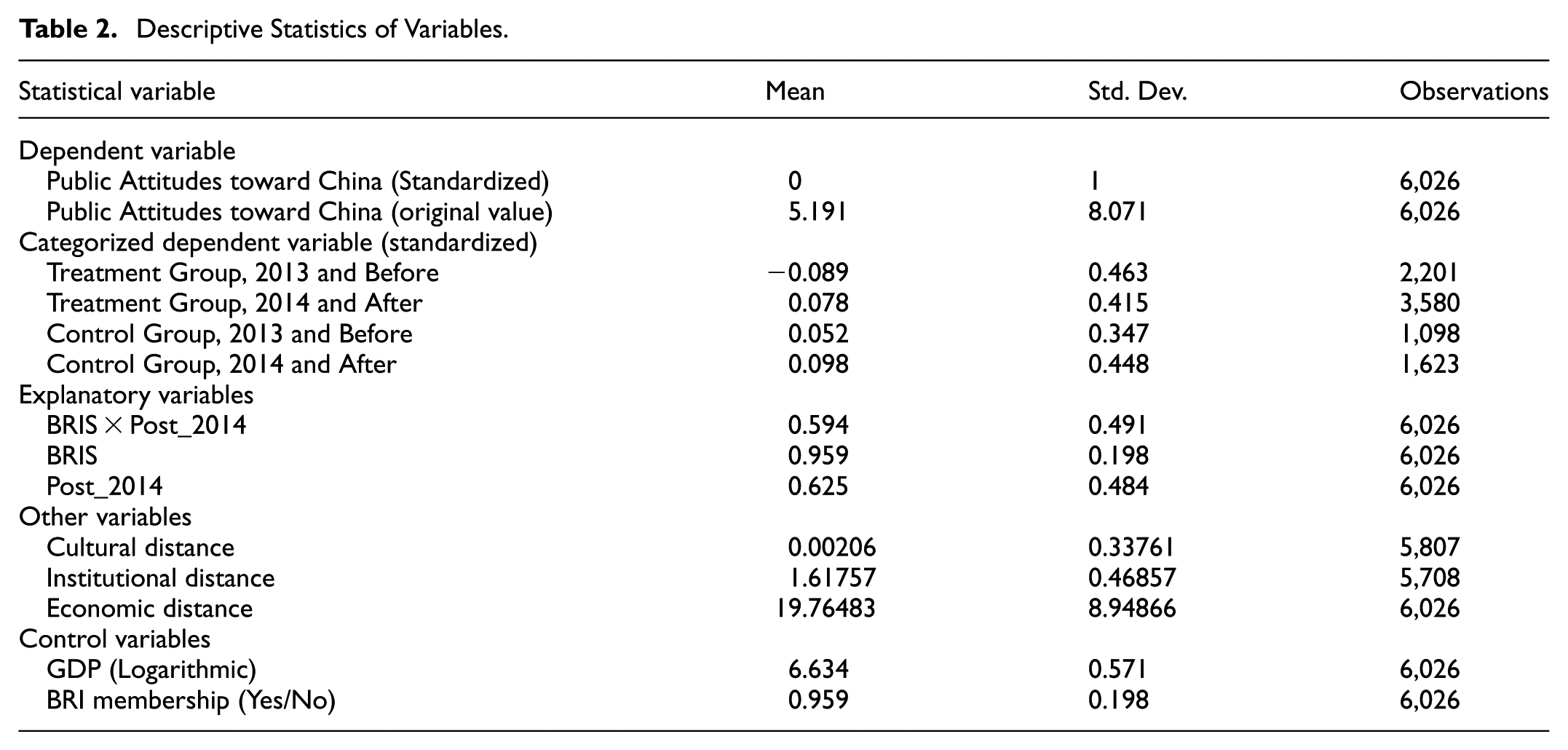
Table 2 summarizes key descriptive statistics for the dependent, independent, and control variables, as well as subgroup data for the treatment and control groups, both before and after the BRI was launched. These statistics provide essential context for interpreting the DID regression results.
Descriptive Statistics of Variables.
DID Regression Results
To assess the causal effect of changes in media sentiment toward the BRI on public attitudes toward China, the following DID model was estimated:

Where:
Yit represents country i’s attitudes toward China in year t; α is the intercept term;
BRISi is a dummy variable that equals 1 if country i exhibits a statistically significant shift in media sentiment toward China before and after 2014, and 0 otherwise; Post_2014i is a time dummy variable, where Post_2014i = 1 for years 2014 onward (since the BRI was announced in late 2013), and Post_2014i = 0 for years 2013 and prior;
BRIi is a country-level control variable, coded as 1 if country i has signed a BRI cooperation document with China, and 0 otherwise;
GDPit serves as an economic control variable, representing the GDP of country i in year t(logarithmic).
The model also includes:
Time fixed effects (δt) to control for aggregate temporal variations;
Country fixed effects (ηi) to account for time-invariant, country-specific confounding factors;
The error term (εit) capturing unobserved stochastic influences.
The focal coefficient β quantifies the causal effect of BRI-related media sentiment shifts on attitudes toward China. A statistically significant estimate of β indicates that directional changes (positive/negative) in a country’s BRI media sentiment significantly alter its public perceptions and attitudes toward China.
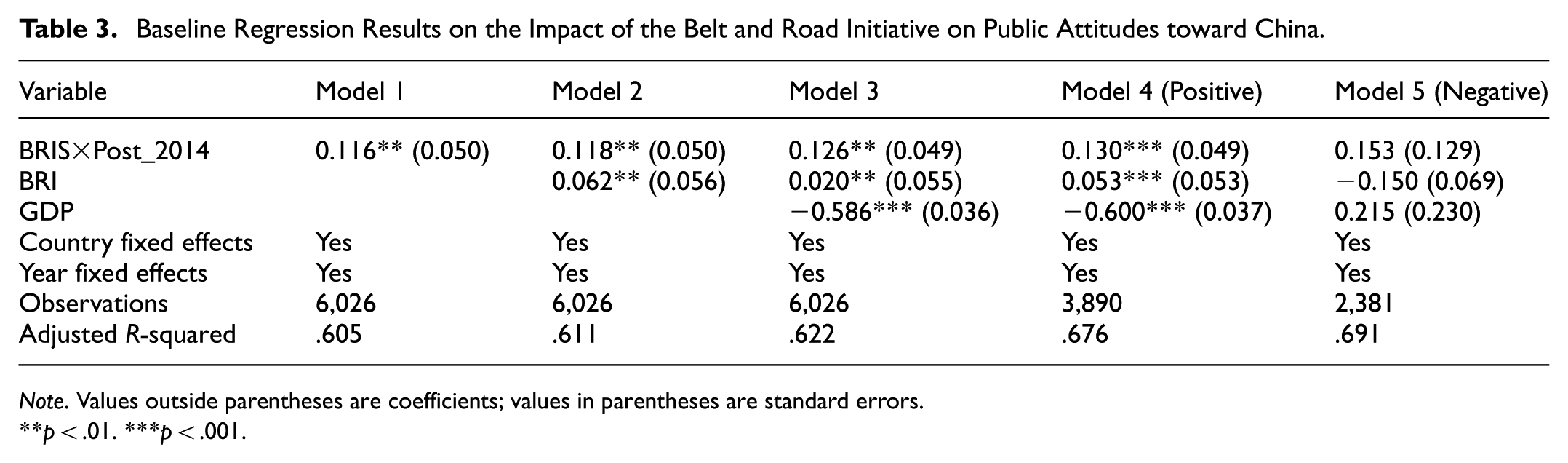
Table 3 reports the difference-in-differences estimation results for the impact of BRI-related media sentiment on attitudes toward China, treating sentiment change as the core explanatory variable. The validity of the DID model relies on the parallel trends assumption. Pre-treatment tests confirm that sentiment trends between treatment and control groups were similar before 2014, and placebo tests suggest that the observed effects are unlikely driven by omitted variables.
Baseline Regression Results on the Impact of the Belt and Road Initiative on Public Attitudes toward China.
Note. Values outside parentheses are coefficients; values in parentheses are standard errors.
p < .01. ***p < .001.
Model 1 includes only the core explanatory variable (BRIS×Post_2014), while Models 2 and 3 progressively introduce BRI agreement status and GDP as control variables. All regressions control for country and year fixed effects.
The results show that the coefficient of the key interaction term (BRIS×Post_2014) is consistently positive and statistically significant across Model 1 (β = .116, p < .01), Model 2 (β = .118, p < .01), and Model 3 (β = .126, p < .01). This indicates that after the launch of the BRI, countries with significant shifts in media sentiment exhibited overall improvements in attitudes toward China. Even with the inclusion of control variables (BRI and GDP), the positive effect of the interaction term remains significant, demonstrating the robustness of the result and its resistance to interference from other major factors affecting China’s image perception.
To further examine the specific effects of positive versus negative sentiment changes in BRI news coverage, the treatment group was subdivided into countries with positive and negative sentiment shifts. Countries with a positive shift were coded as 1 and combined with the control group (coded 0) in the DID model (Model 4); countries with a negative shift were likewise coded as 1 and compared with the same control group in Model 5.
The results show that in Model 4, the coefficient of the interaction term (BRIS × Post_2014) is significantly positive (β = .13, p < .001), indicating that in countries where sentiment shifted positively, the BRI significantly enhanced public attitudes toward China. This suggests that in such countries, the media were more receptive to the positive messages conveyed by the BRI—such as economic cooperation, infrastructure development, and shared growth—which in turn improved public perceptions of China.
In countries with negative sentiment shifts, however, the interaction term in Model 5 is not statistically significant (p > .05). This finding can be interpreted in two ways: from a negative perspective, these countries may have held long-standing unfavorable views of China, which the BRI failed to reverse; from a more positive angle, even though media coverage in these countries focused on issues such as debt, financial risk, or political implications, the resulting negative sentiment did not significantly worsen public attitudes.
The divergence between the effects of positive and negative sentiment shifts highlights the presence of cross-national heterogeneity. Future research should explore the specific causes of sentiment decline in certain countries and develop more targeted policy responses. Thus, Hypothesis 1 (H1) receives partial support.
Moreover, in Models 3 and 4, the coefficient for GDP is significantly negative (β = −.586, p < .001; β = −.60, p < .001), suggesting that more developed countries tend to view China more negatively, while less developed countries hold relatively more favorable views. This may reflect the defensive stance of high-income countries in economic competition and the more welcoming attitude of low-income countries toward economic opportunities from China.
In Model 5, the effect of GDP is not significant, indicating that in countries with negative sentiment shifts, changes in perceptions of China are more influenced by non-economic factors, such as political relations or cultural differences. This underscores the complex role of economic development levels in shaping attitudes toward China.
As for the BRI agreement variable, it is significantly positive in Model 3 (β = .02, p < .01) and Model 4 (β = .053, p < .01), but not significant in Model 5. This suggests that, in general, countries that signed BRI cooperation agreements tend to have more favorable views of China—likely due to tangible benefits in economic development, infrastructure, or diplomatic cooperation. However, in countries with negative sentiment shifts, whether or not a BRI agreement was signed appears to have little effect on perceptions of China. This may be because media narratives and public opinion in these countries are influenced more strongly by factors such as political conflict, trade friction, or cultural divergence, thereby diluting the perceptual impact of BRI cooperation.
The above findings collectively answer RQ1.
Heterogeneity Analysis and Robustness Checks
To further validate the applicability of the hypotheses and the stability of the findings under different model specifications and sample conditions, this study conducted heterogeneity analysis and robustness checks.
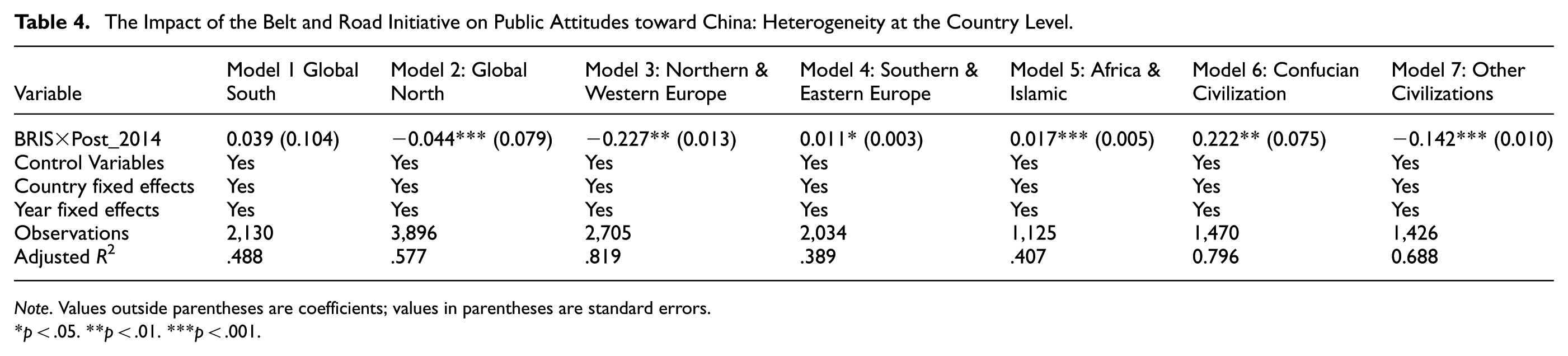
Table 4 presents the regression results of how national-level heterogeneity affects the relationship between BRI news coverage and attitudes toward China. From the perspective of economic, political, and social development, countries in the Global North and Global South show markedly different responses to the BRI.
The Impact of the Belt and Road Initiative on Public Attitudes toward China: Heterogeneity at the Country Level.
Note. Values outside parentheses are coefficients; values in parentheses are standard errors.
p < .05. **p < .01. ***p < .001.
In Global North countries, the coefficient for the interaction term (BRIS × Post_2014) is significantly negative (β = −.844, p < .001), suggesting that after the launch of the BRI, these countries experienced a notable decline in public perception of China. This may be due to mainstream media in the Global North adopting a relatively negative stance toward the BRI—emphasizing potential geopolitical threats or motives of economic expansion—while downplaying or omitting coverage of economic cooperation and development achievements. As a result, public sentiment toward China deteriorated in these countries.
In contrast, the coefficient for the same interaction term is not significant in Global South countries, indicating that despite the BRI’s presence, public perception of China did not show significant improvement. This result is unexpected but not entirely inexplicable. One possibility is that while the BRI has generated real economic benefits in some Global South countries, these outcomes were not effectively communicated through the media, thereby failing to translate into more favorable public attitudes toward China.
This study further employs Inglehart’s World Values Map to categorize countries based on civilizational types and dominant social values, in order to assess variation in BRI effects across different cultural contexts. Specifically, we used data from the World Values Survey Wave 7 (2017–2022), which provide comprehensive coverage for most countries in our sample during the study period. To more accurately capture cross-national heterogeneity, this study adopts the civilizational and value classification derived from Inglehart’s World Values Survey cultural map. Unlike simple geographic or economic groupings, civilizational clusters reflect deep-rooted value systems, historical traditions, and normative orientations that influence how publics interpret international actors (Inglehart & Welzel, 2005). This approach aligns with comparative politics and political communication scholarship, which demonstrates that civilizational membership shapes political attitudes and cross-national perceptions (Berg-Schlosser & De Meur, 2009). Moreover, empirical work on global communication networks shows that sentiment flows and public reactions frequently follow civilizational boundaries (Garcia & Schweitzer, 2015). Accordingly, classifying countries into types such as Northern–Western Europe, Southern–Eastern Europe, African–Islamic societies, the Global South, and Confucian societies yields a theoretically grounded and empirically informed operationalization for country-level heterogeneity in our analysis.
The results show clear heterogeneity across civilizations.
As shown in Table 4, countries belonging to Nordic-Western Europe (β = −.277, p < .001) and Other Civilizations—including Latin America, South Asia, and West Asia (β = −.142, p < .001)—exhibited significantly negative coefficients. This suggests that the BRI has contributed to a decline in attitudes toward China within these regions. Factors such as geopolitical rivalry, historical differences, or conflicts of interest may explain this trend.
By contrast, countries aligned with Confucian, Southern-Eastern European, and Afro-Islamic civilizations demonstrate significantly positive effects. Specifically, the coefficients for Confucian (β = .222, p < .01), Southern-Eastern European (β = .011, p < .01), and Afro-Islamic (β = .117, p < .001) countries are all statistically significant and positive. This may be attributed to stronger cultural affinity, shared traditional values, or tangible benefits from economic cooperation under the BRI.
It is also noteworthy that the coefficients for Nordic-Western Europe and Confucian civilizations have the largest absolute values among all groups—whether positive or negative. This suggests that these two civilizations exhibit the strongest emotional responses to the BRI. On the one hand, the significantly negative coefficient for Nordic-Western Europe may indicate heightened skepticism or competition toward China’s global rise; on the other hand, the strongly positive response in Confucian countries may reflect geographic proximity, cultural compatibility, and economic alignment with China.
Overall, the baseline regression results and heterogeneity analysis are largely consistent, which reinforces the robustness of the core explanatory variable (BRIS × Post_2014) across different groupings and contextual conditions. Specifically, these results suggest that the BRI’s impact on China’s national image follows a broadly generalizable pattern, albeit with notable regional and civilizational differences.
Mechanisms Through Which Belt and Road News Coverage Shapes Foreign Public Attitudes Toward China
Table 5 presents empirical results examining the mechanisms through which BRI-related media sentiment influences public attitudes toward China. Specifically, this section employs a triple difference-in-differences (DDD) model to test whether cultural, institutional, and economic distance moderate the relationship between media sentiment and public attitudes of China.
The Interactive Effects of Belt and Road Initiative News Coverage on Public Attitudes toward China.
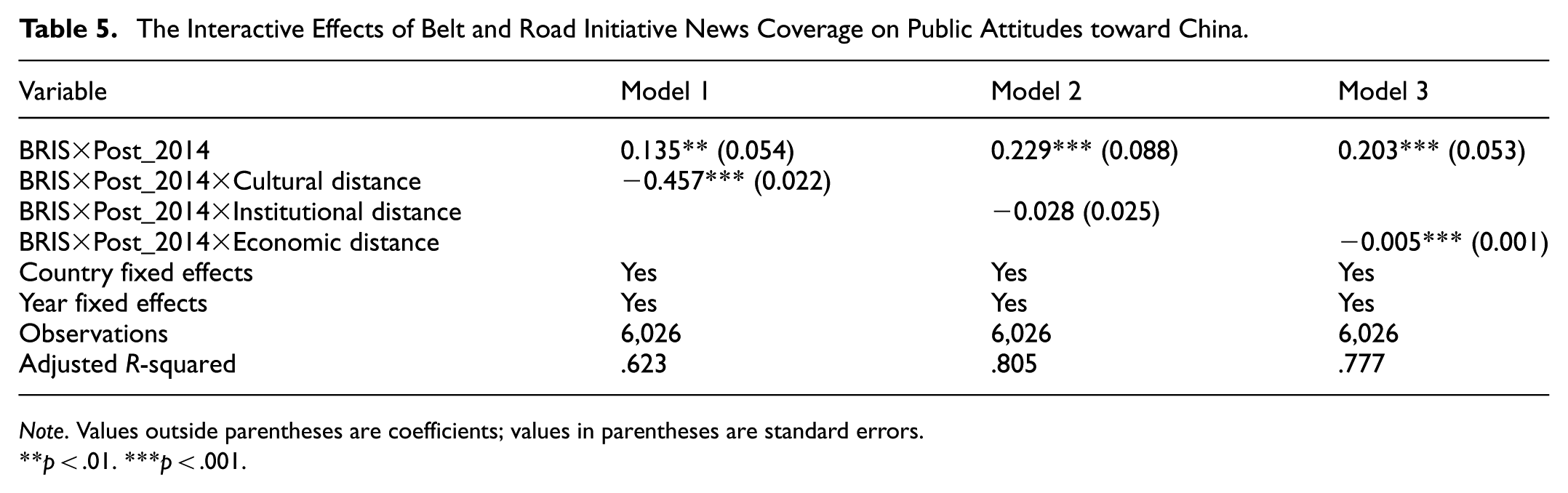
Note. Values outside parentheses are coefficients; values in parentheses are standard errors.
p < .01. ***p < .001.
The regression results show that the interaction terms between BRI media sentiment and cultural distance (β = −.457, p < .001) and between sentiment and economic distance (β = −.005, p < .001) are both significantly negative. However, the interaction between sentiment and institutional distance does not reach statistical significance (p > .05).
These findings lend support to Hypotheses H2 and H4, but do not support H3. Specifically, the negative moderating effect of cultural distance suggests that in countries with greater cultural dissimilarity to China, the positive impact of BRI-related media sentiment on perceptions of China is significantly weakened. One plausible explanation is that cultural distance increases the difficulty or distrust in interpreting information presented in media reports, thereby diminishing the persuasive power of positive narratives about the BRI.
Similarly, greater economic distance is shown to reduce the effectiveness of positive media sentiment in improving China’s image. This may be because economic asymmetry weakens the sense of shared interest, making it harder for the public in distant economies to resonate with messages of economic cooperation or mutual benefit conveyed in BRI news stories.
In contrast, the lack of a significant moderating effect for institutional distance may imply that political or governance differences between China and other countries are not a decisive factor in shaping public perceptions—at least not in the context of BRI media coverage. It is possible that audiences focus more on economic and tangible outcomes of the initiative than on abstract political system differences, especially in the short term.
Taken together, these results provide a complete answer to RQ2.
Discussion
As a critical component of China’s comprehensive strategy to deepen opening-up, the Belt and Road Initiative (BRI) carries the dual mission of promoting economic development and enhancing the national image. This study employed a difference-in-differences approach to analyze 6,026 overseas media news reports and public perception data on China’s national image from 2005 to 2023, exploring the impact of the BRI on China’s national image and its underlying mechanisms. The DID design allows for rigorous causal inference by comparing changes in perceptions before and after the BRI across countries with varying exposure, controlling for unobserved time-invariant factors and confounding trends.
The study finds that the BRI has had an overall positive effect on enhancing China’s national image. In countries where news coverage exhibited a positive sentiment shift, the BRI significantly improved public perceptions of China’s national image. According to the Affect Heuristic Model, audiences tend to rely on affect as a heuristic shortcut in processing complex information (Slovic et al., 2007). When BRI-related news conveys positive emotions—such as cooperation, mutual benefit, and shared development—these affective cues strengthen the public’s favorable attitudes toward China, making them more inclined to interpret China’s international actions and national image positively. However, in countries where media sentiment shifted negatively, the BRI did not significantly deepen negative perceptions of China’s image. This may be attributed to declining trust in domestic media in the post-truth era. As noted, Western media elites and grassroots society have shifted from a traditional “representative trust relationship” to one of “contempt and antagonism” (W. Wang, 2017). Consequently, publics may be skeptical of negative affective information related to the BRI, weakening the negative impact of such coverage on perceptions of China’s image. Alternatively, according to the Situational Theory of Publics (Grunig, 1997), public reactions are influenced not only by the content of the information itself but also by situational factors such as personal involvement and the relevance of the issue. Therefore, in countries where the benefits of the Belt and Road Initiative are substantial or where the public’s attention to the BRI is relatively low and its relation to national interests is minimal, the public’s response to negative coverage may be weaker, and it may not significantly deepen negative perceptions of China. Even negative news may be buffered by the tangible achievements of the BRI in economic cooperation and infrastructure, preventing significant adverse impressions. This suggests that in countries exhibiting positive affective changes, continuous promotion of successful BRI cases should be reinforced to consolidate and amplify favorable trends, while in countries experiencing negative sentiment shifts, China need not adjust its strategic direction due to short-term adverse reporting but should focus on long-term trust-building and sustained communication.
Significant differences also emerge across civilizational types. China’s national image has shown negative shifts in Nordic-Western Europe and other civilizational countries (including Latin America, South Asia, and West Asia), while it has significantly improved in Confucian, Afro-Islamic, and Southern and Eastern European countries. This highlights the importance of cultural proximity in the dissemination of national image, while cultural differences may exacerbate negative perceptions or communication frictions. This aligns with the “matching effect” hypothesis in cognitive consistency theory (Kruglanski et al., 2018). Notably, although Latin American countries belong to the Global South, the greater cultural distance has led to a decline in the perception of China’s national image as a result of the BRI. This could also be attributed to the profound influence of postcolonial thought in Latin America. Postcolonial theory emphasizes that colonial history and cultural ties deeply influence a nation’s political identity and attitudes toward external powers (Said, 1978). Latin American countries, historically subjected to European and American colonialism, may harbor a certain level of strategic skepticism toward China, despite increasing economic cooperation. Due to significant cultural and political system differences, the public in these countries may find it challenging to fully embrace China’s narrative. Postcolonial theory also reminds us that, although China advocates a “win-win cooperation” framework, this approach often fails to deeply align with the historical experiences and cultural identities of nations like those in Latin America, leaving rooted suspicions that make the public’s perception of China complex and contradictory. Therefore, communication strategies should be tailored according to civilizational characteristics, adopting “one region, one policy” or “one country, one policy” approaches. In countries with significant cultural gaps, attention should be paid to historical factors and unfamiliarity with China’s institutions and development models, which may be influenced by Western-dominated global discourse. In such contexts, China should strengthen cultural exchanges and people-to-people interactions, using communication content with emotional appeal and shared interests to alleviate strategic skepticism toward the BRI. In culturally proximate countries, economic cooperation should be further deepened, alongside strengthening emotional bonds, building trust and shared socio-cultural understanding, and consolidating positive recognition.
Examination of the mechanisms through which BRI news coverage influences China’s national image reveals that cultural and economic distance significantly weaken the positive effect of media sentiment, whereas the interactive effect of institutional distance is not significant. Cultural distance may cause some countries to perceive Chinese culture as incompatible with their own traditions and values, weakening the translation of positive media sentiment into favorable public perceptions (Scheufele, 1999). Economic distance reflects concerns about dependency or competition that may override positive media sentiment, consistent with motivated reasoning theory (Lodge & Taber, 2013). The insignificance of institutional distance may be due to audiences focusing on economic cooperation and development opportunities rather than political system differences regarding the BRI.
Importantly, existing research on “media sentiment” mainly focuses on the emotional expression in news discourse, such as the use of affective vocabulary and the analysis of tonal color (Brett & Pinna, 2013; Wirth & Schramm, 2005). However, fewer studies treat media sentiment as a comparable, quantifiable structural variable. This study conceptualizes media sentiment as a relatively stable and directional attribute of news discourse, specifically referring to the emotional orientation or tendency (positive, negative, or neutral) reflected in news coverage. This emotional orientation may exhibit continuity within specific socio-cultural and political contexts. By quantifying the emotional characteristics of news texts across multiple countries, this study operationalizes media sentiment into a cross-nationally comparable analytical indicator, thus offering a new perspective for analyzing the influence of media coverage on public attitudes. Theoretically, this approach helps transition the study of “media sentiment” from discourse analysis traditions to an empirical research framework capable of macro-level comparisons and causal analysis.
Also, these findings offer theoretical implications for Media Framing Theory, particularly valence framing. Traditional framing research emphasizes how media guides audiences by selectively presenting issues, causal explanations, and moral evaluations (Entman, 1993). Valence framing, by contrast, focuses on the emotional orientation of news (positive vs. negative) as a direct signal influencing audience judgment, especially in environments with complex information and limited attention. This study demonstrates that valence framing is an important trigger for national image perceptions in the context of the BRI, but also reveals its cross-national boundary conditions: positive sentiment does not universally translate into favorable perceptions, and negative valence does not automatically produce significant adverse impressions. The effects of valence framing are thus moderated by media trust, cultural distance, and economic distance, resulting in a conditional valence framing effect. In other words, the influence of emotional news cues is embedded within specific political-cultural contexts and should be understood as an interactive social-cognitive process rather than a uniform stimulus-response relationship (Entman, 1993; Lopez & Balabanis, 2020).
Structural factors such as cultural value systems, geopolitical alignment, and civilizational identity exert deeper and more persistent influences on how audiences internalize BRI-related information. These structural predispositions often have stronger explanatory power than media sentiment itself (Anholt, 2007; Lodge & Taber, 2013; Scheufele, 1999), reinforcing the idea that national reputation is primarily filtered through pre-existing cultural and geopolitical frames rather than momentary media positivity.
Conclusion
This study provides robust evidence that the BRI has positively influenced China’s national image across diverse countries, though the effects vary depending on media sentiment, cultural proximity, and economic context. Positive valence in news coverage strengthens favorable perceptions, while negative valence does not uniformly generate adverse effects. Civilizational and structural distances shape the reach and strength of these effects, highlighting the importance of contextualized communication strategies.
Theoretically, the findings advance the study of “media sentiment” from a discourse analysis tradition to an empirical research framework capable of macro-level comparisons and causal analysis. On the other hand, it extends Media Framing Theory by demonstrating that the effects of emotional framing are conditional in cross-national contexts. The study shows that emotional cues in news interact with media trust and structural distances, leading to complex public perception outcomes. Practically, these results imply that China’s communication strategies should be long-term, multilayered, and culturally sensitive, emphasizing successful cooperation, mutual benefits, and trust-building rather than relying solely on positive media narratives. Future research should continue to explore the interactive dynamics among emotional framing, media credibility, and structural distances in global political communication.
Limitations and Future Directions
This study offers valuable insights into how BRI-related media coverage shapes global public attitudes toward China, but several limitations should be noted. First, the measurement of China’s national image relies on a single survey item, capturing mainly affective evaluations and potentially overlooking cognitive or behavioral dimensions. Future research could use multidimensional or composite measures for a more comprehensive assessment. Moreover, in this study, our sample selection and analysis primarily focus on the economic dimension of BRI-related news coverage. This emphasis does not imply that other dimensions are unimportant; rather, it reflects the fact that economic cooperation constitutes the most stable, quantifiable, and cross-nationally comparable aspect of BRI reporting. Nonetheless, we acknowledge that future research would benefit from incorporating non-economic dimensions into quantitative models to provide a more comprehensive understanding of how different facets of the BRI shape foreign public attitudes toward China.
Second, while LIWC provides a systematic method for analyzing media sentiment, its dictionary-based approach may miss context-dependent features such as irony, sarcasm, or metaphor. Advanced natural language processing techniques could better capture these subtle semantic patterns.
Finally, the country/civilizational classifications used as moderators have limitations. The Global North–Global South distinction, though statistically informative, may be overly broad and theoretically tenuous. Future studies should consider more refined, multidimensional operationalizations of country characteristics—including cultural, historical, economic, and geopolitical factors—to more accurately capture cross-national media effects.
Footnotes

Funding
The authors disclosed receipt of the following financial support for the research, authorship, and/or publication of this article: This work was supported by the National Social Science Fund under Grant 23BXW050.
Declaration of Conflicting Interests
The authors declared no potential conflicts of interest with respect to the research, authorship, and/or publication of this article.
Data Availability Statement
The datasets supporting this study are available from multiple sources. Public opinion data can be accessed through the Pew Research Center’s Global Attitudes and Trends survey. The BRI global media coverage dataset was collected from ProQuest Global Newsstream and a multilingual news database developed by a university media research laboratory. Additional processed data are available from the corresponding author upon reasonable request.
Generative Artificial Intelligence (AI)
I confirm that I used ChatGPT (March 2025 version) to check grammar and improve sentence structure during the preparation of this manuscript. This use has been transparently disclosed in the manuscript.