






Abstract
This study examines the direct and indirect relationships between learning-centered leadership and perceived school effectiveness within Türkiye’s centralized education system, with a particular focus on the mediating role of teacher self-efficacy. Data were collected from 299 teachers working in 38 high schools during the 2024 to 2025 academic year using stratified random sampling and were analyzed using structural equation modeling. The findings suggest that learning-centered leadership is positively associated with perceived school effectiveness both directly and indirectly through teacher self-efficacy. Supportive leadership behaviors—such as prioritizing learning, monitoring instructional practices, and modeling learning-oriented professionalism—are associated with teachers’ professional growth and with more positive school-level outcomes. The study highlights teacher self-efficacy as a key mechanism through which leadership may influence perceived organizational outcomes and provides evidence that collaboration-oriented routines may help strengthen leadership processes in centralized policy environments.
Keywords
Introduction
School effectiveness (SEFF) has long been a central focus of both education policy and academic research, reflecting ongoing efforts to understand how schools may support improvements in student learning outcomes. Studies in educational management and leadership have consistently emphasized the critical role of high-quality teaching and learning environments in supporting student achievement (Darling-Hammond, 2010; Shaked, 2024). In this context, the importance of school leaders in enhancing these environments by promoting teachers’ professional development and shaping classroom practices is widely recognized (Hallinger et al., 2017; Özdemir et al., 2025). Developing effective learning environments is therefore closely associated with sustained improvement in student achievement (OECD. 2020a).
School effectiveness is often conceptualized as an output-oriented construct, defined by factors such as quality, efficiency, adaptability, and flexibility (Akyurek et al., 2024; Hoy, 2009). However, despite the extensive body of research on effective schools, studies indicate that the relationship between leadership and classroom teaching has not been sufficiently explored, and there remains a critical lack of understanding regarding how principals can directly influence teaching effectiveness (Hallinger et al., 2020; Muijs & Harris, 2007; Özdemir et al., 2025). Furthermore, the impact of cultural context on this relationship—and its interaction with mediating variables such as teacher self-efficacy (TSE)—is still poorly understood (Hallinger & Hosseingholizadeh, 2020). While studies of school effectiveness in Türkiye generally focus on teacher qualifications and resource adequacy, the interaction between school leaders and teachers has been relatively neglected (Bellibaş et al., 2020; Gumus et al., 2018). Nevertheless, it has been suggested that the positive impact of learning-centered leadership (LCL) on teacher self-efficacy may be more pronounced in centralized education systems than in decentralized ones (Shaked, 2024). In research on school leadership and organizational functioning, school effectiveness is sometimes examined using teachers’ perceptions, particularly when effectiveness is conceptualized as an organizational construct. Although perceptual indicators do not directly capture objective outcomes, they provide meaningful insight into how schools function in practice (Akyurek et al., 2024; Alanoğlu & Karabatak, 2025).
In Türkiye’s centralized policy framework, decisions regarding staffing, budgeting, and curriculum are predominantly made at the national level, which constrains the autonomy of individual schools. In highly centralized education systems, leadership influence is often limited at the structural decision-making level and instead tends to operate through relational, psychological, and sense-making processes within schools. Consequently, school principals rely on collaborative routines—including professional learning communities and observation-feedback cycles—to enact changes in classroom practices through mastery experiences, vicarious modeling, and verbal persuasion. Unlike in decentralized educational systems, these mechanisms are enabled by internal sense-making processes within schools rather than structural autonomy. This contextual configuration suggests that leadership effects may be more likely to operate through culturally shaped organizational routines and professional interactions rather than through structural autonomy.
The concept of LCL has emerged as a prominent approach within the field of educational leadership, owing to its capacity to enhance pedagogical practices and student learning (Liu et al., 2016). This leadership model underscores the importance of fostering teacher development and optimizing learning experiences across the school. Although it shares some common foundations with instructional and transformational leadership (Hallinger & Murphy, 1985), the LCL model places particular emphasis on building a school’s collective capacity by supporting teacher learning (Hallinger et al., 2017). In this regard, it can be posited that the model is theoretically expected to be associated with stronger teacher self-efficacy and improve the quality of school outcomes. Teacher self-efficacy has been shown to influence teaching effectiveness (Klassen & Tze, 2014), student outcomes (Ross et al., 2001), academic achievement (Caprara et al., 2006), the learning process (Darling-Hammond, 2000), and overall teaching quality (Holzberger et al., 2013). It is therefore a key variable that directly affects the quality of school outcomes (Fraser, 2014). The implementation of learning-centered leadership practices has been associated with improvements in teaching quality, particularly when teacher self-efficacy is effectively supported. Principals who actively promote teacher learning create more favorable environments for effective instruction and ultimately enhance academic achievement at multiple levels (Farnsworth, 2015; Gumus et al., 2018).
Despite the growing international attention to learning-centered leadership, empirical research examining its dynamics in centralized education systems remains scarce. Against this backdrop, the purpose of this study is to examine the effect of school principals’ learning-centered leadership practices on school effectiveness within the context of the Turkish education system, and to determine the mediating role of teacher self-efficacy in this relationship. Rather than proposing a new theoretical mechanism, this study aims to extend existing leadership research by examining how established leadership pathways operate under highly centralized governance conditions. Türkiye’s centralized education system and hierarchical management structure are among the key structural factors shaping school leaders’ pedagogical leadership practices. Within this framework, the relationships between leadership, self-efficacy, and school effectiveness develop in ways that differ from those observed in Western contexts. In particular, cultural characteristics such as a strong tendency to avoid uncertainty and a robust hierarchical culture have been shown to create distinctive interaction mechanisms in the development of teachers’ self-efficacy through leadership. These mechanisms play a decisive role in the functioning of the education system and in teachers’ professional growth.
This study is among the limited number of empirical investigations that explore how learning-centered leadership operates within a highly centralized and policy-driven education system. The findings are expected to contribute to the literature by providing context-specific evidence on how leadership influences teachers’ perceptions of school effectiveness under strong bureaucratic and hierarchical conditions. By highlighting the contextual boundaries of leadership theories, this research provides contextual evidence regarding how learning-centered leadership functions in non-Western education systems. These findings may provide a useful reference point for policymakers, education administrators, and educational leadership researchers by offering context-informed insights that may help inform leadership development and policy discussions. Moreover, the present study contributes to the growing international literature examining the joint effects of learning-centered leadership and teacher self-efficacy on school outcomes. The study, therefore, contributes to the literature primarily by clarifying contextual boundary conditions rather than by proposing new theoretical pathways.
Türkiye’s Centralized Education System
Türkiye’s education system is characterized by its intricate structure, which is a consequence of both its centralized nature and the dynamics of its culture. The Ministry of National Education (MoNE) wields extensive authority, encompassing school principal appointments and curriculum oversight. However, this centralized structure impedes the efficacy of instructional leadership (Kılıçoğlu et al., 2020). Despite the MoNE’s recent efforts to enhance the selection and training criteria for school administrators, it has been observed that leadership skills receive inadequate support in practice (Cansoy et al., 2025; Gumus & Akcaoglu, 2013). In particular, the fact that school principals are compelled to engage with bureaucratic procedures rather than prioritizing pedagogical leadership skills to contribute to teachers’ professional development hinders educational innovation (Bellibaş et al., 2022). The hierarchical structure and cultural tendencies to avoid uncertainty in Türkiye have been shown to result in school leaders adopting a more traditional and risk-averse approach (Özdemir et al., 2025). This predicament presents a significant challenge to educators seeking to cultivate innovative practices and exercise autonomy within the classroom environment (Zayim & Kondakci, 2015).
Despite advancements observed in certain domains, the education system of Türkiye continues to confront substantial challenges, as evidenced by data from the OECD. The PISA 2018 results reveal that students have a low sense of belonging to school (OECD. 2020b), while TALIS 2018 data indicate that teachers are inadequate in motivating students and using technology (OECD. 2019). This finding suggests that school leadership should play a more active role in teaching processes. In recent years, the Turkish education system has been subjected to considerable pressure as a result of demographic changes, including the integration of Syrian refugee students (Arar et al., 2019). In this context, the ability of school leaders to create inclusive educational environments has become critically important. However, the discordance between central policies and school-level requirements engenders a complex process (Arar & Örücü, 2024). The necessity for transformation in Türkiye’s education system necessitates not only a review of existing policies but also a restructuring of the understanding of school leadership in favor of pedagogical leadership. Current research emphasizes that the establishment of a trust-based culture within educational institutions and the enhancement of teacher autonomy are pivotal to the efficacy of the system (Bellibaş et al., 2022; Zayim & Kondakci, 2015). These structural and cultural characteristics have the potential to shape the effects of learning-centered leadership.
Conceptual Framework and Hypotheses
The concept of learning-centered leadership is predicated on the premise that educators’ professional development should be accorded a high level of priority, with the overarching aim of enhancing the school’s learning culture (Liu et al., 2016). This approach has been shown to assist educators in refining their pedagogical competencies, prompting introspection regarding their practices, and augmenting the organizational capacity of the educational institution (DuFour, 2004; Hallinger & Murphy, 1985). Research indicates that learning-centered leadership supports school effectiveness by improving the quality of school outcomes, with this effect typically being indirect (Hallinger & Heck, 1996; Leithwood & Jantzi, 2006; Murphy et al., 2011). It is emphasized that continuous support for teachers’ professional development is associated with academic achievement, and that this support is provided by leaders who prioritize teaching quality (Muijs & Harris, 2007).
Teacher self-efficacy is a fundamental concept based on Bandura’s (1977) social cognitive theory, which refers to a teacher’s belief in their ability to successfully perform a specific task. Teachers with high self-efficacy have been shown to encourage student participation, apply data-driven teaching methods, develop positive attitudes, and set high academic expectations (Lentz, 2019; Thien et al., 2024; Tschannen-Moran et al., 1998). It has been demonstrated by preceding studies that learning-centered leadership exerts an indirect influence on school effectiveness, which is manifested through the enhancement of teacher self-efficacy (Ross & Gray, 2006).
School effectiveness is a multidimensional concept that is evaluated based on students’ cognitive, emotional, and social development, as well as the outputs produced by the school (Brookover, 1985; Hallinger & Murphy, 1986). The prevailing academic consensus identifies three characteristics as being fundamental to effective educational institutions: firstly, the presence of robust leadership, secondly, the establishment of elevated academic expectations, and thirdly, the cultivation of a culture oriented toward perpetual enhancement (Edmonds, 1982; Lezotte, 1993). The extant literature indicates that teacher self-efficacy is an important determinant of school effectiveness, and that this effect can be enhanced through learning-centered leadership (Caprara et al., 2006; Heck, 1992). In accordance with the principles of social cognitive theory, the implementation of leadership practices has been demonstrated to enhance teachers’ perceptions of self-efficacy by means of environmental factor shaping. This, in turn, has been shown to result in improvements in teaching quality and school effectiveness (Klassen & Tze, 2014; Tschannen-Moran & Hoy, 2001). In this context, teacher self-efficacy may serve as a potential mediating variable in the relationship between learning-centered leadership and school effectiveness.
The conceptual framework of this study is based on theoretical approaches (Southworth, 2002; Spillane, 2015) that suggest leadership practices aimed at improving learning and teaching processes are the key factors that distinguish successful schools from others, as well as Bandura’s Social Cognitive Theory (Bandura, 1977, 1997). The first approach emphasizes the direct and indirect effects of effective leadership on teaching and learning, while the second approach reveals that individuals’ self-efficacy beliefs are shaped through mutual interaction with environmental factors and behavioral outcomes. Integrating these perspectives, learning-centered leadership can be viewed as an environmental and social mechanism that activates teachers’ self-efficacy beliefs through modeling, verbal persuasion, and mastery experiences—the three key sources identified by Bandura. In this sense, principals’ behaviors that promote teacher learning, provide feedback, and model effective instructional practices function as contextual stimuli that bolster teachers’ confidence in their instructional abilities.
The integration of these two theories substantiates the hypothesis that school leadership can enhance school effectiveness by fortifying teacher self-efficacy. Empirical studies supporting the theoretical framework reveal the effects of learning-centered leadership on teacher competence and school effectiveness (Alanoğlu, 2025; Bellibas & Liu, 2017; Darling-Hammond, 2000; Dilekçi & Limon, 2022; Kılınç et al., 2025; Lentz, 2019; Ross & Gray, 2006) and emphasize that the fundamental difference between successful schools and less effective schools lies in leadership practices (Boyce & Bowers, 2018). In this context, there is an increasing interest in understanding the critical role leadership plays in teacher performance and student achievement, and the mechanisms through which it exerts this influence (Leithwood et al., 2020).
Effective leadership involves the active involvement of teachers and other relevant stakeholders in decision-making processes through democratic participation and dialogue (Kiltz et al., 2004). This pedagogical approach has been demonstrated to facilitate teachers’ professional development by engendering a robust school culture (Liu et al., 2016) and can enhance teachers’ self-efficacy by fostering professional collaboration (Mitchell & Sackney, 2016; Stosich et al., 2018). Such a culture has been demonstrated to contribute to the process of creating a harmonious school community that meets the needs of teachers and students (Watson & Scribner, 2007) and can make schools more effective.
In conclusion, this conceptual framework provides both theoretical and empirical grounds for how learning-centered leadership can increase school effectiveness through teacher self-efficacy. Social cognitive theory elucidates the self-efficacy mechanism, while leadership theories underscore the significance of strategies aimed at enhancing learning and teaching processes. The integration of these two approaches serves to provide a robust theoretical foundation for the study. From a sense-making perspective, learner-centered leadership significantly influences how teachers interpret policy demands and school objectives. This promotes cognitive reframing and the development of a shared understanding of teaching and learning. By providing modeling, feedback, and structured interactions, principals can effectively facilitate teachers’ local meaning-making processes, constituting a vital pathway through which leadership enhances teacher self-efficacy. The model presented in Figure 1 illustrates the theoretical relationships predicted regarding the impact of learning-centered leadership on school effectiveness and the mediating role of teacher self-efficacy in this relationship.
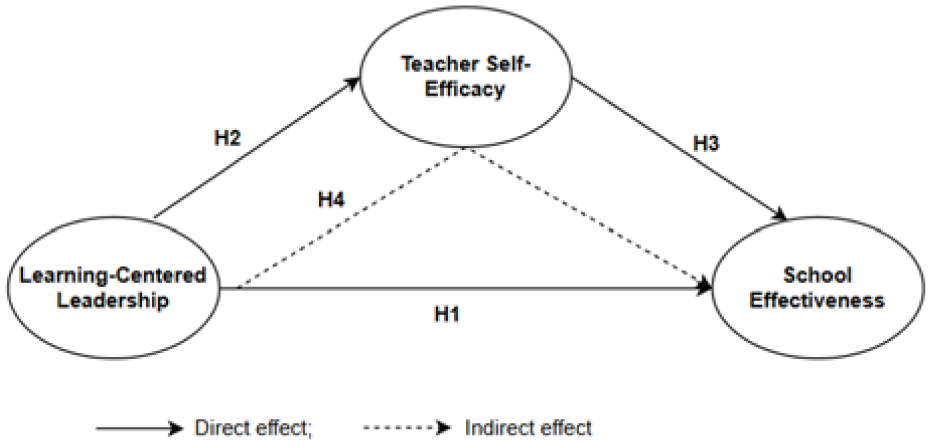
Hypothetical model.
The following hypotheses were developed within the model context:
Method
In this section, we detail the research model, sample, variables, and measures, and data collection and data analysis procedures.
Research Model
The present study was conducted for the purpose of examining the direct effect of learning-centered leadership on school effectiveness and its indirect effect through teacher self-efficacy. The research was structured within a cross-sectional quantitative design. Cross-sectional studies are observational survey studies in which researchers collect data from a sample representing the target population at a specific point in time. This methodological approach facilitates the evaluation of relationships between various variables at a specific point in time (L. Cohen et al., 2013).
Sampling
This study was conducted in public high schools in the city center of Elazığ Province in eastern Türkiye during the 2024–2025 academic year. The study population consisted of 3,150 teachers from 45 high schools in the city center. The minimum sample size required was calculated using the known population formula via the Raosoft sample size calculator. This calculation indicated that a sample of 343 teachers was needed to achieve a margin of error of 5% and a confidence level of 95%. To ensure representativeness, a stratified random sampling method was employed within a multistage sampling design. In the first stage, schools were treated as strata; those with accessible teacher lists were included. Seven schools could not provide teacher lists, so the final sample frame comprised 38 high schools. In the second stage, approximately 10% of teachers from each school were randomly selected. Teacher lists were divided into 10 groups, and at least one teacher from each group was randomly chosen to ensure proportional representation. A total of 500 teachers were invited to participate, and 317 (63.4%) returned completed questionnaires. After excluding 18 incomplete or careless responses, the final dataset included 299 teachers, corresponding to a 95% confidence level and a margin of error of 5.26%. Among these participants, 55.2% (n = 165) were female, and 44.8% (n = 134) were male. On average, they had 16.36 years of teaching experience.
Variables and Measures
In this study, all the scales utilized were conceptualized as individual-level constructs. The conceptualization at the individual level is predicated on the premise that the measurement of variables is based on individual teacher perceptions (Wang & Howell, 2010). In accordance with the objective of the study, learning-centered leadership was designated as the independent variable, school effectiveness was designated as the dependent variable, and teacher self-efficacy was designated as the mediating variable. The following section provides a detailed description of the data collection tools that were utilized in order to respond to the research questions posed in this study.
The Learning-Centered Leadership Scale, developed by Liu et al. (2016), was adapted into Turkish by Kılınç et al. (2017). The original five-point Likert-type scale, which has four dimensions, was found to consist of three dimensions in the adaptation study: developing a vision for learning, providing learning support, and managing and modeling the learning program. Some of the sample items are: “Your principal sets a clear vision for teacher learning in the school,”“Rewards teachers who engage in ongoing teacher Professional learning,” and “Emphasizes the purpose of professional learning for teaching improvement.” In this study, the Cronbach’s alpha reliability coefficient was .98, and the model fit values obtained from the confirmatory factor analysis (CFA) indicate that the scale’s three-factor structure achieved a strong fit with the data (χ2 = 3.36; RMSEA = .08; CFI = .96; TLI = .95; SRMR = .02).
The short version of the teacher self-efficacy scale, as devised by Tschannen-Moran and Hoy (2001), was adapted into Turkish by Karaoğlu (2019). The 12-item 9-point Likert-type scale is comprised of three dimensions: self-efficacy related to student participation, self-efficacy related to the use of teaching strategies, and self-efficacy related to classroom management. Some of the sample items are: “To what extent can you use a variety of assessment strategies?”“How much can you do to motivate students who show low interest in schoolwork?”, and “To what extent can you craft good questions for your students?” In the present study, Cronbach’s alpha reliability coefficient was determined to be .98. The model fit values obtained from the CFA indicate that the scale’s three-factor structure achieved a strong fit with the data (χ2 = 3.69; RMSEA = 0.09; CFI = 0.95; TLI = 0.94; SRMR = 0.03).
The School Effectiveness Scale was originally developed by Hoy (2009)and subsequently adapted into Turkish by the Alanoglu (2014). The scale is unidimensional and comprises eight items. The purpose of this scale is to measure the quality, quantity, efficiency, compatibility, and flexibility of the outputs produced in a school (Hoy, 2009). One of the sample items is: “The quality of products and services produced in this school is outstanding.” In the present study, the Cronbach’s alpha reliability coefficient was .94. The model fit values obtained from the CFA indicate that the scale’s one-factor structure achieved a strong fit with the data (χ2 = 3.27; RMSEA = 0.08; CFI = 0.99; TLI = 0.97; SRMR = 0.02).
Ethical approval was obtained from the Social and Humanities Research Ethics Committee of Firat University (Decision Date: 07 November 2024; Document No: 08.11.2024-28733; Session No: 2024/22). The study was designed to minimize any potential risks to participants, and participation was entirely voluntary. Informed consent was obtained from all participants before data collection. The potential benefits of the study for educational practice and teacher well-being were deemed to outweigh any minimal risks. All procedures adhered to COPE guidelines and the 1964 Helsinki Declaration, along with its subsequent amendments.
Data Analysis
The organization of the research data was conducted utilizing the SPSS 22 software, while the analysis of relationships between variables and hypotheses was facilitated by employing structural equation modeling (SEM) through the utilization of the Mplus 8.11 program. SEM is an analytical method that is utilized to evaluate a theoretical framework by identifying the relationships between potential structures that represent the predictions of the relevant theory. These relationships are measured using appropriate observed variables (Hayduk et al., 2007). The capacity of SEM to accommodate both observed and latent variables as both causes and effects enhances the diversity of testable hypotheses (Kline, 2015).
Frequency and percentage distributions were calculated in the analysis of participants’ demographic characteristics. The Harman one-factor test was employed to evaluate the probability of variation in the data set attributable to the measurement instrument (Podsakoff & Organ, 1986). In addition, several procedural steps were taken to reduce the risk of common method bias, including ensuring voluntary and anonymous participation and informing participants that there were no right or wrong answers. In the free factor analysis, three factors explained 62.688% of the total variance, while in the analysis forced to a single factor, this ratio was found to be 41.21%. To further examine the potential influence of common method bias, a single-factor CFA model was tested and compared with the proposed measurement model. The measurement model demonstrated acceptable fit to the data (χ2/df = 1.96, RMSEA = 0.05, CFI = 0.93, TLI = 0.93, SRMR = 0.07, see Table 1). In contrast, the single-factor model showed very poor fit (χ2 = 5520.85, df = 702, RMSEA = 0.152, CFI = 0.651, TLI = 0.631, SRMR = 0.161), indicating that a single latent factor could not adequately account for the covariance among the study variables. These results suggest that common method variance is unlikely to fully explain the observed relationships.
Results of Descriptive Statistics.
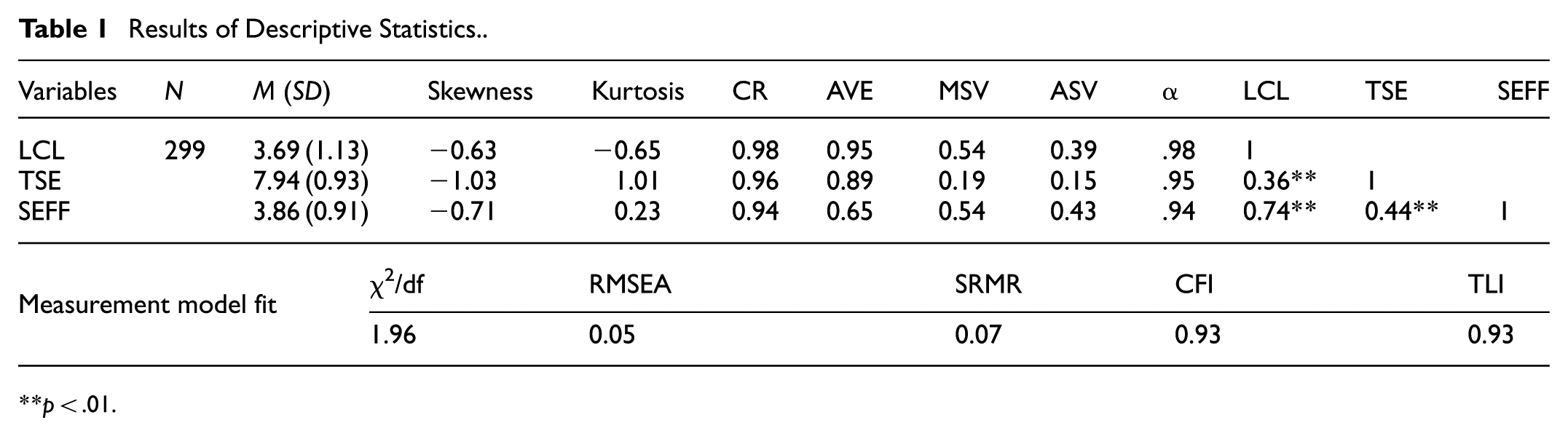
p < .01.
Before the analysis of the data, an examination was conducted of the means and standard deviations of the scale dimensions, as well as the kurtosis and skewness coefficients. The kurtosis and skewness values are found to fall within the ±1.5 range (see Table 1), indicating that univariate normality is satisfied (Tabachnick & Fidell, 2019). However, Mardia’s multivariate skewness (b = 475.84, p < .001) and kurtosis (b = 2,017.74, p < .001) values demonstrate that the multivariate normality assumption has been violated (Mardia, 1970). Pearson correlation analysis was performed to ascertain the relationships between the research variables. Given that the data did not meet the multivariate normality assumption, a robust maximum likelihood (MLR) estimation method was employed to construct a model appropriate for the research objective. This model is resistant to parametric deviations and adapts the chi-square statistic with standard errors (Muthén & Muthén, 2017; Tabachnick & Fidell, 2019).
To guarantee the structural validity of the proposed model variables, the CFA was initially conducted. Consequently, the CFA, CR (Composite Reliability), and AVE (Average Variance Extracted) values were calculated for convergent validity, while maximum shared variance (MSV) and average shared variance (ASV) values were calculated for divergent validity. The conditions CR > AVE and AVE > 0.50 indicate convergent validity, while the conditions MSV < AVE and ASV < AVE indicate divergent validity (Hair et al., 2016). Convergent validity is indicative of a strong relationship between the items in the variables and their own factors, while divergent validity indicates that the items have a weaker relationship with other factors. Furthermore, factor loadings exceeding 0.50 were regarded as an additional indicator of validity.
After the completion of the CFA, a SEM analysis was conducted. A variety of fit indices are utilized to assess model fit in SEM. Of these, the chi-squared (χ2) value is of the greatest importance. The chi-square/degrees of freedom (χ2/df) ratio is a measure of the model’s fit. A ratio below 2 indicates a good fit, while a ratio between 2 ≤ χ2/df ≤ 3 is considered acceptable (Kline, 2015). The values of Standardized Root Mean Square Residual (SRMR) and Root Mean Square Error of Approximation (RMSEA) that are less than 0.05 are indicative of excellent fit, those that fall between 0.06 and 0.08 are indicative of acceptable fit, and those that are greater than 0.08 are indicative of poor fit (Hu & Bentler, 1999). As demonstrated by Hair et al. (1998), values of the Comparative Fit Index (CFI) and the Tucker-Lewis Index (TLI) that exceed 0.90 and approximate 1.00 are indicative of a satisfactory model fit.
It is recommended that a bootstrap analysis be performed in order to ascertain the significance of indirect effects in the model (Preacher & Hayes, 2008). In this context, a Bootstrap analysis was performed with 5,000 bootstraps, and the confidence interval was calculated as a 95% CI. In the event that the entire observed relationship between the dependent and independent variables is attributable to the mediator variable, this is referred to as full mediation. Conversely, if it reflects only part of the observed relationship, it is referred to as partial mediation (Hayes & Preacher, 2014). Finally, the f2 analysis results obtained by Cohen were examined to provide a more accurate interpretation of the explanation percentages obtained for R2. When interpreting the Cohen’s f2 value, the terms small, medium, and large are used for f2 ≥ 0.02, f2 ≥ 0.15, and f2 ≥ 0.35, respectively (J. Cohen, 1988).
Results
Before examining the relationships between the variables, descriptive statistics and reliability analyses were conducted for the scales used in the study. The results of these analyses and the measurement model fit indices are presented in Table 1.
As demonstrated in Table 1, when evaluated in the context of 5-point Likert scales, the mean values of school effectiveness (M = 3.69) and LCL (M = 3.86) scales are relatively above average. Conversely, the mean value of teacher self-efficacy, measured on a 9-point Likert-type scale, was comparatively elevated (M = 7.94). Upon examination of the correlation coefficients, it was ascertained that the relationship between the variables was significant (p < .01). The findings of this study indicate a strong positive correlation between LCL and SEFF (r = .74; p < .01), as well as a moderate positive correlation between TSE (r = .36; p < .01). Furthermore, a moderate positive relationship was identified between TSE and SEFF (r = .44; p < .01). Furthermore, the CR, AVE, MSV, and ASV values demonstrate that the convergent and divergent validity conditions have been met.
In general, it is considered desirable for the Cronbach’s alpha reliability coefficient to be equal to or above .70. As demonstrated in Table 1, the reliability scores of the scales employed for the model variables exceeded .90, signifying that the scales exhibited high reliability. Furthermore, it was observed that the CR values exceeded the .70 threshold, and the AVE values were above .50. Furthermore, the fit values in the measurement model were found to be at a satisfactory level of fit (χ2/df = 1.96; p = .00, RMSEA = 0.05, SRMR = 0.07, CFI = 0.93, and TLI = 0.93), indicating that the structures in the measurement model can be used in second-order CFA and SEM analyzes. The measurement model fit values provide the optimal value for achieving a satisfactory fit in YEM (Simsek, 2007) (Figure 2).
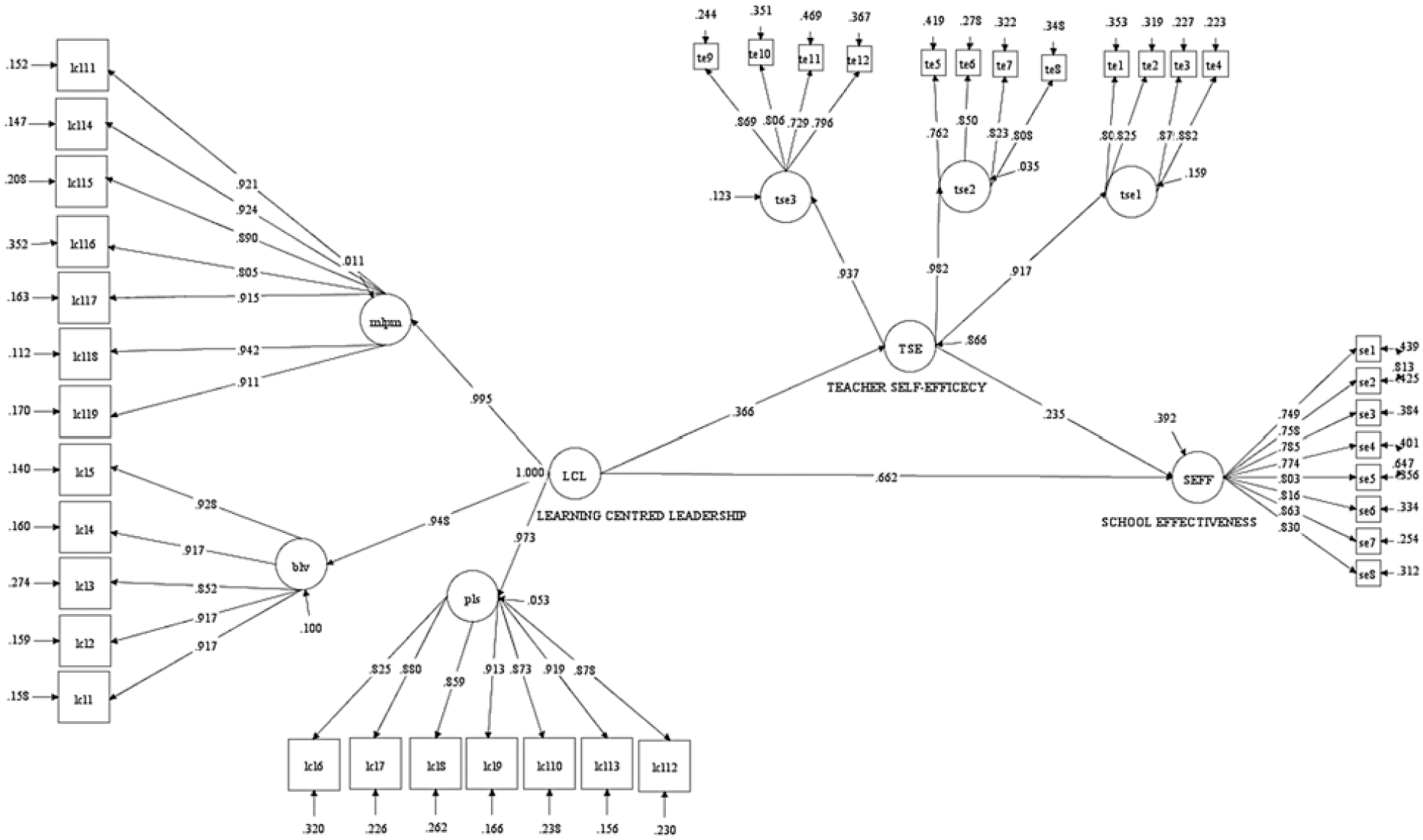
SEM diagram.
Table 2 shows that the SEM model fit indices were acceptable and comparable to those of the measurement model (χ2/df = 2.10, p < .001, RMSEA = 0.061, 90% CI [0.056, 0.065], SRMR = 0.065, CFI = 0.928, TLI = 0.923). Bootstrapping with 5,000 resamples indicated that learning-centered leadership was positively and significantly associated with teacher self-efficacy (β = .366, p < .001) and perceived school effectiveness (β = .662, p < .001). Teacher self-efficacy was also positively and significantly associated with perceived school effectiveness (β = .235, p < .001).
Bootstrapping Results for the Mediation Model of LCL, TSE, and SEFF.
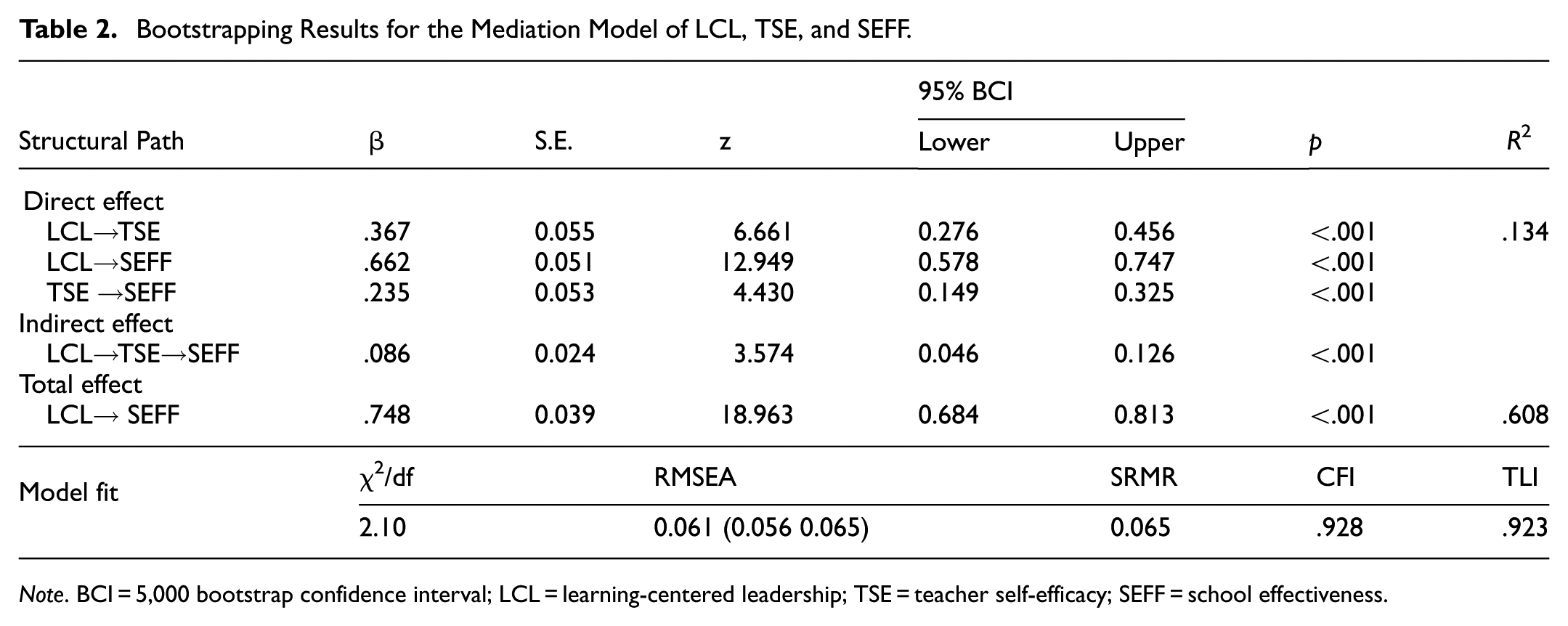
Note. BCI = 5,000 bootstrap confidence interval; LCL = learning-centered leadership; TSE = teacher self-efficacy; SEFF = school effectiveness.
The total association between LCL and perceived SEFF was positive and statistically significant (β = .748, p < .001). The results also indicated a positive indirect association between LCL and perceived SEFF through TSE (β = .086, p < .001), indicating partial mediation. Consistent with the hypotheses, learning-centered leadership was positively associated with perceived school effectiveness (β = .662, p < .001) and teacher self-efficacy (β = .367, p < .001), and teacher self-efficacy was positively associated with perceived school effectiveness (β = .235, p < .001). Thus, H1–H4 were supported, and the mediation results indicated that teacher self-efficacy partially accounted for the relationship between learning-centered leadership and perceived school effectiveness. Within the model, LCL accounted for 13.4% of the variance in TSE, and the full model explained 60.8% of the variance in perceived SEFF. Cohen’s f2 indicated a medium association for LCL → TSE (f2 = 0.155) and a large association for LCL → perceived SEFF (f2 = 1.551).
Discussion
This study makes an important contribution to leadership literature by examining the direct and indirect effects of learning-centered leadership on teachers’ perceptions of school effectiveness within the Türkiye context and the mediating role of teacher self-efficacy. The findings suggest that LCL is positively associated with perceived school effectiveness directly and indirectly via teacher self-efficacy. These results align with international literature emphasizing that effective school leadership is associated with improvements in student achievement and school performance by fostering teacher capability (Hallinger & Heck, 2010; Kılınç et al., 2022; Li et al., 2016). This study is one of the few quantitative analyses of the LCL → TSE → SEFF pathway within a centralized system. It reveals partial mediation under constrained decision-making conditions. Collaboration-oriented routines, such as observation-feedback-reflection cycles, may function as critical sense-making mechanisms that link leadership practices to teacher beliefs and educational outcomes.
The first finding of the study is that learning-centered leadership is significantly and positively associated with perceived school effectiveness. This may occur through the efficient use of material resources (Özdemir & Sezgin, 2002), the creation of appropriate learning environments (Özdemir, 2000), and the establishment of a strong school culture. Previous studies have shown that effective school principals develop teachers’ professional capacities by fostering an academic culture that promotes continuous learning (Hallinger & Lee, 2014) and by providing active guidance to teachers (Brown & Militello, 2016). The focus of principals on learning is emphasized as a critical factor in school development and the creation of effective school environments (Talebizadeh et al., 2021). School improvement efforts focus on developing teachers’ instructional practices to achieve desired learning outcomes for students (Darling-Hammond, 2010), with changes in instructional practices at the heart of this process (Kılınç et al., 2022).
These results align with Bandura’s (1997) Social Cognitive Theory, which suggests that environmental and social influences, such as modeling and support from principals, shape individuals’ beliefs in their own efficacy. This theory explains how leadership practices may translate into improved teacher motivation and school outcomes. One of the study’s key findings is that teacher self-efficacy is associated with perceived school effectiveness beyond individual teaching competencies. This suggests that teacher self-efficacy can also influence collective school behavior (Tschannen-Moran & Hoy, 2001). Teacher self-efficacy has been linked to student achievement (Bellibas & Liu, 2017) and perceived school effectiveness (Dilekçi & Limon, 2022). The results suggest that, alongside leadership factors, the behavioral and organizational contributions of teachers should also be considered when evaluating school outcomes.
A centralized and hierarchical education system, such as that prevalent in Türkiye, may hinder the spread of innovative leadership practices by limiting the decision-making flexibility of school principals (Leithwood et al., 2020). However, the positive effects observed in the study may be related to collaboration-focused strategies developed by principals within their limited scope of authority. This situation may provide policymakers with valuable comparative insights when compared to more autonomous education systems. The literature emphasizes that leadership plays an important role in strengthening teacher capacity (Bush et al., 2022). In particular, leaders’ competencies in providing structured feedback and professional mentoring, as well as in creating a collaborative school culture, may support increases in teachers’ perceptions of their own efficacy (Balyer, 2013; Thien et al., 2024). Additionally, a growing body of literature suggests that contextual variables shape this relationship (Pietsch et al., 2023; Pont et al., 2008). In the case of Türkiye, for example, cultural norms, bureaucratic processes, and the centralized curriculum structure are the main factors that determine the impact of leadership on teacher self-efficacy (Hallinger, 2018). Therefore, comparative studies encompassing different education systems can reveal the mechanisms of LCL’s impact more clearly and play an important role in assessing its transferability across contexts. These results build on previous research by showing that the positive mechanisms of learning-centered leadership, which were identified in decentralized systems, may also operate within a centralized education system, albeit differently. Thus, the study highlights the contextual limitations of leadership theories.
The results show that learning-centered leadership may be associated with higher perceived school effectiveness directly and through enhancing teachers’ self-efficacy. This may be associated with positive changes in teaching practices and the development of high-performing schools (Hidayat & Wulandari, 2020; Kılınç et al., 2022). Furthermore, school leaders may support the development of teachers’ skills and abilities by fostering a supportive school culture (Carpenter, 2015; Khourey-Bowers et al., 2005), thereby enhancing their professional development, learning capabilities, and collaborative skills. This process may contribute to an increase in teachers’ perceptions of their own efficacy and school effectiveness (Sünbül, 1996).
The results obtained highlight some strategic priorities in terms of policy and practice. Firstly, the Ministry of National Education may consider prioritizing the development of LCL skills in its in-service training programs, as well as encouraging teachers to actively participate in professional learning communities. Secondly, decision-making flexibility at the school level may be further examined within the centralized structure as a potential way to support leaders’ capacity to implement innovative practices. Thirdly, teacher self-efficacy may be monitored periodically as part of broader school evaluation processes. These steps may help strengthen the alignment between leadership practices, teacher development, and perceived school effectiveness. In conclusion, this study suggests that LCL may play a supportive role in strengthening the overall learning capacity, teaching quality, and student achievement of Turkish schools.
Limitation
The findings of this study should be interpreted bearing in mind some methodological limitations. Firstly, the research data were collected from high schools in a single city using a cross-sectional design. This restricts the generalizability of the findings. It also eliminates the possibility of examining changes in leadership practices over time. Future research could improve representativeness by collecting data from different regions and school levels. Longitudinal or mixed-methods designs could also allow for the testing of causal aspects of the relationship between leadership and school effectiveness. Secondly, the research is based solely on self-reported data obtained from teachers. This carries the risk of subjective measurements due to respondent bias and social desirability tendencies (Podsakoff et al., 2003). To increase the objectivity of the findings, future studies should combine self-reports from teachers and school administrators and include student evaluations or data from independent observations. Although procedural and statistical steps were taken to reduce common method bias, the use of a single data source remains a limitation of the study. Thirdly, the current research used a single-level analysis approach. Examining the effects of leadership practices using multilevel models that also take into account school-level variables (e.g., school culture and management structure) could yield more comprehensive results from theoretical and practical standpoints. Because teachers are nested within schools, future research using multilevel designs may provide more precise estimates of leadership effects across organizational levels. Finally, the study did not use direct data on student academic achievement and development indicators. Therefore, the effects of learning-centered leadership and teacher self-efficacy on student outcomes were interpreted indirectly. In future research, integrating student achievement scores and development reports into the model would provide a more comprehensive understanding of the effects of leadership practices on school development and student learning outcomes.
Conclusion
This study suggests that learning-centered leadership is positively associated with teachers’ perceptions of school effectiveness, both directly and indirectly through teacher self-efficacy, within Türkiye’s centralized education context. The findings highlight teacher self-efficacy as a potential mechanism linking leadership practices and perceived organizational outcomes. These results contribute to the literature by providing context-specific evidence on how established leadership pathways may operate under centralized governance conditions.
The findings also suggest that collaboration-oriented routines may support leadership processes in systems where structural decision-making authority is limited. While the cross-sectional and single-source design limits causal inference and generalizability, the results provide a useful basis for understanding leadership processes in centralized education contexts. Future research using multi-source, multilevel, or longitudinal designs may provide a more comprehensive understanding of how leadership practices relate to teacher development and school outcomes over time.
Footnotes
Acknowledgements
The author used an artificial intelligence tool (ChatGPT) solely for language editing and reference consistency checking. All outputs were reviewed and verified by the author, who takes full responsibility for the final manuscript.

Ethical Considerations
Ethical approval was obtained from the Social and Humanities Research Ethics Committee of Fırat University (Decision Date: 07 November 2024; Document No: 08.11.2024-28733; Session No: 2024/22). The study was designed to minimize any potential risks to participants, and participation was entirely voluntary. Informed consent was obtained from all participants before data collection. The potential benefits of the study for educational practice and teacher well-being were deemed to outweigh any minimal risks. All procedures adhered to COPE guidelines and the 1964 Helsinki Declaration, along with its subsequent amendments.
Funding
The authors received no financial support for the research, authorship, and/or publication of this article.
Declaration of Conflicting Interests
The authors declared no potential conflicts of interest with respect to the research, authorship, and/or publication of this article.
Data Availability Statement
The data that support the findings of this study are available from the corresponding author upon reasonable request.