






Abstract
In recent years, in-feed advertising has seen rapid development, with its market share gradually expanding. How to continuously improve the effectiveness of in-feed advertising has become a focal issue of concern for all parties. Based on the Construal Level Theory, this paper explores the impact of the matching effect between users’ dynamic browsing modes and advertising appeals on users’ advertising attitudes, and investigates the moderating role of product types and the underlying mechanism of its influence. Three behavioral experiments yield the following findings: First, there is a matching effect between dynamic browsing modes and advertising appeals; users in divergent (convergent) browsing mode prefer emotional (rational) advertising appeal. Second, the matching effect between users’ dynamic browsing modes and advertising appeals enhances perceived diagnosticity, thereby making advertising attitudes more positive. Third, product types moderate the matching effect of users’ dynamic browsing modes and advertising appeals on users’ advertising attitudes; hedonic products enhance the impact of the matching effect between divergent browsing mode and emotional appeals on users’ advertising attitudes, while utilitarian products enhance the impact of the matching effect between convergent browsing mode and rational appeals on users’ advertising attitudes.
Keywords
Introduction
In-feed advertising has become ubiquitous on digital platforms (Chen et al., 2023), seamlessly embedded into the content streams of social media and news platforms (Shao et al., 2024). Unlike traditional banner advertisements, in-feed advertising does not appear as an independent or intrusive element but instead mimics the surrounding “native” content in form and style (Dong et al., 2024). Social media platforms such as Facebook, Google, and TikTok widely adopt in-feed advertising to monetize user attention (Ma et al., 2024).
As in-feed advertising increasingly integrates into users’ daily browsing environments, researchers have noted that users’ online browsing behavior is dynamic. Dynamic browsing modes refer to the shifting cognitive states consumers adopt when navigating content, switching between convergent and divergent patterns (Xiao & Zhang, 2022). The convergent mode is goal-oriented, focused, and rational, with users searching for specific information and filtering content to meet utilitarian needs (Ko, 2020). By contrast, the divergent mode is exploratory, impulsive, and intuitive, with users browsing casually out of curiosity or a desire for diverse information (Nysveen et al., 2005). These browsing modes shape how consumers process and respond to advertising. For example, Xiao and Zhang (2022) found that advertising effectiveness improves when persuasive style matches browsing mode: convergent users are more receptive to implicit ads, while divergent users respond better to explicit ads. Goal-directed browsers tend to reject inconsistent ads as intrusive, whereas exploratory browsers more easily integrate ads with surrounding content (Shao et al., 2024). If advertising is poorly designed, consumers’ acceptance of advertising messages will be affected (Arli, 2023). This raises a critical question: how do browsing modes in in-feed advertising influence advertising attitudes? Addressing this question is essential for resolving the tension between advertising persuasion and consumer experience in in-feed environments.
Advertising appeals are an important factor influencing advertising effectiveness (Choi & Choi, 2024), and various exploratory studies have examined the classification of advertising appeals from different perspectives. The rational-emotional classification framework is the most widely applied model in advertising research and practice (Ju & Jang, 2023; H. Zhang et al., 2020). Rational appeals emphasize factual information, product attributes, and functional benefits, persuading consumers by providing specific reasons and evidence (Qiu et al., 2025). In contrast, emotional appeals aim to elicit affective responses and build connections with consumers by evoking emotions such as pleasure and excitement (H. Zhang et al., 2014).
This study focuses on the interaction between dynamic browsing modes and advertising appeals. Previous research has primarily examined the effectiveness of advertising design elements (S. Zhang et al., 2025), the consistency between advertisements and content (Fan et al., 2025), and how browsing modes influence advertising effectiveness. However, the interaction between dynamic browsing modes and advertising appeals remains underexplored. In particular, it remains unclear whether rational and emotional appeals manifest differently across browsing modes and whether they provide different persuasive effects. This issue is important, as advertising appeals represent the core component of advertising persuasion, and ultimately, the way appeals are framed determines whether consumers can be persuaded within their browsing context.
Addressing this gap, this study further incorporates the concept of perceived diagnosticity. Perceived diagnosticity is an important construct in consumer decision-making, referring to the extent to which consumers believe the information provided by advertising is useful and reliable for evaluating products or services (Kempf & Smith, 1998). When consumers perceive advertising information as highly diagnostic, they are more likely to adopt favorable evaluations and attitudes (Cheng et al., 2022). Conversely, if advertising fails to provide diagnostic value, consumers may perceive it as irrelevant, thereby reducing its persuasive effect and perceived value (Toder Alon et al., 2025). This study proposes that when consumers’ browsing modes align with the appeal style of advertising, they are more likely to perceive the information as diagnostic, leading to more favorable attitudes toward advertising. Accordingly, perceived diagnosticity is expected to mediate the relationship between browsing modes and advertising appeals. In addition, product type represents an important boundary condition. Advertising appeals may vary in effectiveness depending on product type. Prior studies have shown that product type moderates the effect of advertising appeals (K. Kim et al., 2019). Therefore, this study further examines whether product type moderates the proposed matching effect and whether such moderation extends to perceived diagnosticity.
Based on the above, this study proposes three research questions:
To address these questions, this study employs Construal Level Theory (CLT) as the theoretical framework. CLT posits that individuals construct and process information at different levels of abstraction. When psychological distance increases, individuals tend to adopt more abstract, higher-level construals, whereas when psychological distance decreases, they adopt more concrete, lower-level construals (Trope & Liberman, 2010). Research has shown that construal level matching leads to positive advertising attitudes (Libby et al., 2009). Applied to the present context, this study argues that convergent, goal-directed browsing states trigger low-level (concrete) mental representations, making consumers more receptive to detailed and factual rational appeals. In contrast, divergent, exploratory browsing states induce high-level (abstract) mental representations, making consumers more receptive to broad and affective emotional appeals. This theoretical framework provides a reasonable basis for explaining the matching effect between different browsing modes and advertising appeals.
In summary, the present study makes four primary contributions to the literature on in-feed advertising and consumer behavior. (i) Departing from prior research that largely treated advertising appeals as static features, this study extends the discussion to the dynamic context of browsing modes. Specifically, by examining the interaction between users’ browsing modes (divergent vs. convergent) and advertising appeals (emotional vs. rational), this study advances CLT from static psychological distance to dynamic user states. (ii) Building on prior studies that emphasize the role of cognitive mechanisms in persuasion, this study identifies perceived diagnosticity as a key mediating mechanism. By demonstrating how perceived diagnosticity explains the matching effect between browsing modes and advertising appeals, this study deepens the understanding of the psychological processes underlying advertising effectiveness. (iii) Beyond the mechanism of diagnosticity, this study highlights product type as an important boundary condition. By revealing that product type moderates the effectiveness of the matching between browsing modes and advertising appeals, this study expands the contextual boundaries of advertising appeal matching effects. (iv) This study provides actionable implications for marketing practice. This study shows that advertisers can optimize advertising outcomes and enhance user experience by strategically matching rational appeals with convergent browsing and emotional appeals with divergent browsing, while also considering product type as a moderating factor.
Literature Review
In-Feed Advertising
In-feed advertising, an important form of native advertising, has rapidly proliferated across various digital media and social platforms in recent years (Chen et al., 2023). Unlike traditional display ads (such as banner ads or pop-up ads), in-feed ads typically appear in a way that aligns with the platform’s content style and integrates seamlessly with the users’ natural browsing environment. This design grants them “native” characteristics and relatively low intrusiveness (Aribarg & Schwartz, 2020; Dong et al., 2024). As a result, in-feed ads can achieve exposure and interaction while maintaining the browsing experience (LaBrecque et al., 2024), making them one of the most widely adopted advertising formats in recent years.
Existing research on in-feed advertising has mainly focused on three dimensions: ad content, ad format, and ad expression. First, in terms of ad content, studies emphasize the alignment between ads and user interests or the media environment. Research has shown that the informational, entertaining, reliable, interactive, and intrusive aspects of ad design significantly influence consumers’ purchase intentions (Shao et al., 2024). In the context of social media advertising, however, the inclusion of a Call-to-Action (CTA) button may reduce click intention (S. Zhang et al., 2025). Further studies suggest that consistency between ads and user interests, as well as moderate personalization, can effectively improve click-through rates and purchase intentions (Fan et al., 2025). In addition, the match between the identity of the ad creator (brand vs. influencer) and the brand type (luxury vs. mass-market) exerts a positive effect on advertising effectiveness (Ma et al., 2024). Moreover, the semantic similarity and perceived consistency between the ad and the surrounding platform content have been shown to enhance consumers’ attitudes toward the ad, their brand evaluations, and behavioral intentions (Y. Huang & Yoon, 2022; J. Kim et al., 2017). These studies collectively highlight the importance of content alignment in shaping ad effectiveness. Second, regarding ad format, scholars focus on the specific presentation forms of ads and the psychological processing differences they trigger. Roose et al. (2019) found that the horizon position of ad images affects consumers’ level of construal, thereby enhancing ad effectiveness when matched with ad language (Roose et al., 2019). K. Kim et al. (2019) further pointed out that close-up product images trigger low-level construal, making rational appeals more effective; whereas distant product images induce high-level construal, which enhances consumer product evaluation when matched with emotional appeals. Harms et al. (2019) compared different ad formats and found that banner ads sometimes outperform native article ads in terms of ad attitude and credibility. These studies indicate that the visual form of ads not only affects consumers’ attention allocation but also influences ad evaluation through psychological mechanisms such as construal level. Third, regarding ad expression, existing research remains limited, with studies mainly focusing on the sponsorship disclosure of in-feed ads. The results show that more prominent and clearer disclosures are more likely to disrupt the integration of ads with the background content, making it easier for consumers to identify the ad and its persuasive intent, leading to negative attitudes (Sahni & Nair, 2020). However, the mechanisms of other expression forms remain underexplored, particularly the appeal type (rational vs. emotional). Although traditional advertising research has fully demonstrated the importance of ad appeals in shaping ad attitudes and purchase intentions, the effects of ad appeals and their interaction with users’ dynamic browsing modes in the in-feed advertising context have yet to be systematically studied.
Advertising Appeals
Advertising appeals refer to the content that should be emphasized in advertisements (Holbrook & Batra, 1987). Different types of appeals not only help firms interact effectively with consumers but also highlight the competitive advantages of brands. Research has found that appropriate appeal strategies can enhance consumers’ behavioral intentions. The academic discussion on advertising appeals is extensive, covering self-interested vs. altruistic appeals (Shan et al., 2023), humorous appeals and scarcity appeals (Deshpande et al., 2022), green appeals versus non-green appeals (Ku et al., 2012), warmth appeals and competence appeals (Septianto et al., 2022), as well as rational vs. emotional appeals (Liu & Lei, 2025). Among these, rational and emotional appeals are considered one of the most representative appeal classifications and appear frequently in academic research.
Rational appeals usually focus on the utilitarian benefits of products, characterized by the direct presentation of factual information with objectivity (Johar & Sirgy, 1991). Emotional appeals are related to feelings and emotions, stimulating purchase desires through emotional resonance and affective stimulation (Matthes et al., 2014). Extant studies have examined the effects of rational and emotional advertising appeals. H. Zhang et al. (2014) found that in service contexts, emotional appeals are more conducive to enhancing purchase intentions for experiential services, while rational appeals are more effective in credence services. In the field of public service advertising, rational appeals compared to emotional appeals can generate more favorable spillover effects on the image of nonprofit organizations (Yang, 2024). Regarding endorsers, the match between endorser type and appeal influences advertising effectiveness: under rational appeals, virtual endorsers are more effective than real endorsers in enhancing brand trust and advertising outcomes, whereas under emotional appeals, real endorsers show greater advantages (Liu & Lei, 2025). In terms of product type, utilitarian products induce low-level construal and thus match more strongly with rational appeals, while hedonic products lead to high-level construal and thus match more strongly with emotional appeals (K. Kim et al., 2019). However, there is still a lack of systematic research on how the match between advertising appeals (rational vs. emotional) and dynamic browsing modes in in-feed advertising influences advertising attitudes.
Construal Level Theory
Construal Level Theory (CLT) proposes that psychological distance triggers either high-level or low-level construal (Trope & Liberman, 2010). This theory has been widely applied in advertising research to examine consumers’ responses to advertisements (Adler & Sarstedt, 2021). Advertisements can manipulate temporal, spatial, and social psychological distance cues to induce different levels of mental construal among consumers, thereby influencing their evaluations and reactions to advertising (Amit et al., 2009). Numerous empirical studies have shown that when advertising appeals or presentation formats match the psychological distance or construal level of consumers, they have a positive impact on advertising persuasiveness and attitudes (Rashid Saeed et al., 2024). For example, close-up images in ads combined with rational appeals (low-level information) can enhance attitudes and intentions, while distant scene images matched with emotional appeals (high-level information) demonstrate stronger persuasiveness (K. Kim et al., 2019). Long-term and abstract frames are more suitable for audiences with high-level mindsets, whereas short-term and concrete expressions are more appropriate for contexts involving low-level mindsets (Yang, 2024). Nevertheless, existing research has mostly focused on static advertising materials or preset contextual frames, with insufficient attention paid to consumers’ dynamic behaviors. Whether the match between advertising appeals and dynamic browsing modes (divergent vs. convergent) in in-feed advertising follows the construal-level consistency effect predicted by CLT remains unclear.
Previous studies on the effectiveness of in-feed advertising, advertising appeals, and the application of CLT have accumulated substantial findings, revealing the importance of the match between advertising information and consumers’ levels of psychological processing (Fan et al., 2025; H. Zhang et al., 2014). These studies provide a solid theoretical foundation for understanding the differences in advertising effectiveness. However, some important research gaps still exist. On the one hand, most existing studies focus on static advertisements or predefined frameworks, paying little attention to consumers’ dynamic browsing states in in-feed advertising contexts. On the other hand, although CLT effectively explains differences in advertising appeals, the relationship between CLT and dynamic browsing modes has not been systematically examined. Moreover, the underlying psychological mechanisms and boundary conditions of the matching effect remain to be further explored. Therefore, this study introduces perceived diagnosticity as a mediating variable and examines the moderating role of product type to uncover the mechanism through which the congruence between dynamic browsing modes and advertising appeals influences advertising attitudes.
Research Hypotheses
Matching Effect of Users’ Dynamic Browsing Modes and Advertising Appeals
CLT distinguishes between high-level (abstract, holistic) and low-level (concrete, detailed) construal (Trope & Liberman, 2010). In the context of in-feed advertising, convergent browsing is goal-directed and analytical, focusing on specific information such as product type, function, or price, and thus reflects low-level construal. In contrast, divergent browsing is exploratory and intuitive, characterized by rapid shifts across diverse content, and thus corresponds to high-level construal (Xiao & Zhang, 2022).
Advertising appeals also differ in construal levels. Rational appeals emphasize functional attributes and factual details (low-level construal), while emotional appeals evoke feelings and abstract associations (high-level construal; K. Kim et al., 2019; Septianto & Pratiwi, 2016). According to the CLT matching principle, advertising effectiveness improves when the processing level of users aligns with the construal level of appeals. For example, distant scenarios paired with emotional appeals elicit more favorable responses (Yang, 2024).
Based on this reasoning, divergent browsing users are expected to respond more positively to emotional appeals, whereas convergent browsing users will show stronger preferences for rational appeals. Such congruence enhances processing fluency, reduces cognitive burden, and creates a “feels right” experience (A. Y. Lee et al., 2010), thereby improving advertising attitudes and effectiveness. Accordingly, this study proposes the following hypotheses:
The Mediating Effect of Perceived Diagnosticity
According to CLT, divergent browsing evokes abstract, holistic high-level construal, while convergent browsing induces concrete, detailed low-level construal (Trope & Liberman, 2010; Xiao & Zhang, 2022). Similarly, emotional appeals represent high-level construal content, whereas rational appeals represent low-level construal content (K. Kim et al., 2019). Thus, divergent browsing is expected to fit better with emotional appeals, and convergent browsing with rational appeals.
When such congruence occurs, information processing becomes more fluent. According to fluency theory, this processing fluency not only facilitates easier and smoother comprehension but also evokes a cognitive experience of “feeling right” (A. Y. Lee et al., 2010; A. Y. Lee & Labroo, 2004), thereby creating a sense of cognitive fit and enhancing consumers’ perceptions of information usefulness and reliability, namely perceived diagnosticity (Uhm et al., 2022). Prior research suggests that matched information styles increase diagnostic value, which in turn strengthens trust, reduces uncertainty, and promotes favorable attitudes and purchase intentions (Andrews, 2016; C. Huang et al., 2024; Kempf & Smith, 1998; Toder Alon et al., 2025). Compared with alternative mediators such as emotional arousal or brand attitude, perceived diagnosticity more directly reflects the instrumental value of advertising in decision-making. Accordingly, this study proposes the following hypotheses:
The Moderating Effect of Product Types
CLT suggests that low-level construal emphasizes concrete and functional features, while high-level construal emphasizes abstract and affective features (Trope & Liberman, 2010). Accordingly, utilitarian products are typically linked to rational, low-level processing, whereas hedonic products are linked to emotional, high-level processing (K. Kim et al., 2019; Roy & Ng, 2012). Prior studies show that consumers prefer advertising appeals that match product type, such as rational appeals for utilitarian products and emotional appeals for hedonic products (Drolet et al., 2007).
Since browsing modes activate different levels of construal (Xiao & Zhang, 2022), product type is expected to moderate the strength of the browsing–appeal matching effect (K. Kim et al., 2019). Specifically, hedonic products will reinforce the positive effect of matching divergent browsing with emotional appeals, while utilitarian products will reinforce the positive effect of matching convergent browsing with rational appeals. Accordingly, this study proposes the following hypotheses:
In summary, previous studies have provided important insights into the effectiveness of in-feed advertising, but a systematic explanation of the underlying mechanisms and boundary conditions is still lacking. This study proposes a theoretical framework to explain how dynamic browsing modes and advertising appeals jointly influence advertising attitudes. Specifically, this study hypothesizes a matching effect (H1), such that the interaction between dynamic browsing modes and advertising appeals produces differential effects on advertising attitudes: divergent browsing combined with emotional appeals (H1a) and convergent browsing combined with rational appeals (H1b) lead to more favorable attitudes. In addition, perceived diagnosticity is proposed to mediate this matching effect (H2). Finally, product type is expected to moderate the relationship (H3): when the product is hedonic, the positive effect of divergent browsing combined with emotional appeals is strengthened (H3a), while when the product is utilitarian, the positive effect of convergent browsing combined with rational appeals is strengthened (H3b). These hypotheses address the limitations of prior research and provide new theoretical perspectives and empirical approaches for understanding the effectiveness of in-feed advertising. The research model of this study is shown in Figure 1.
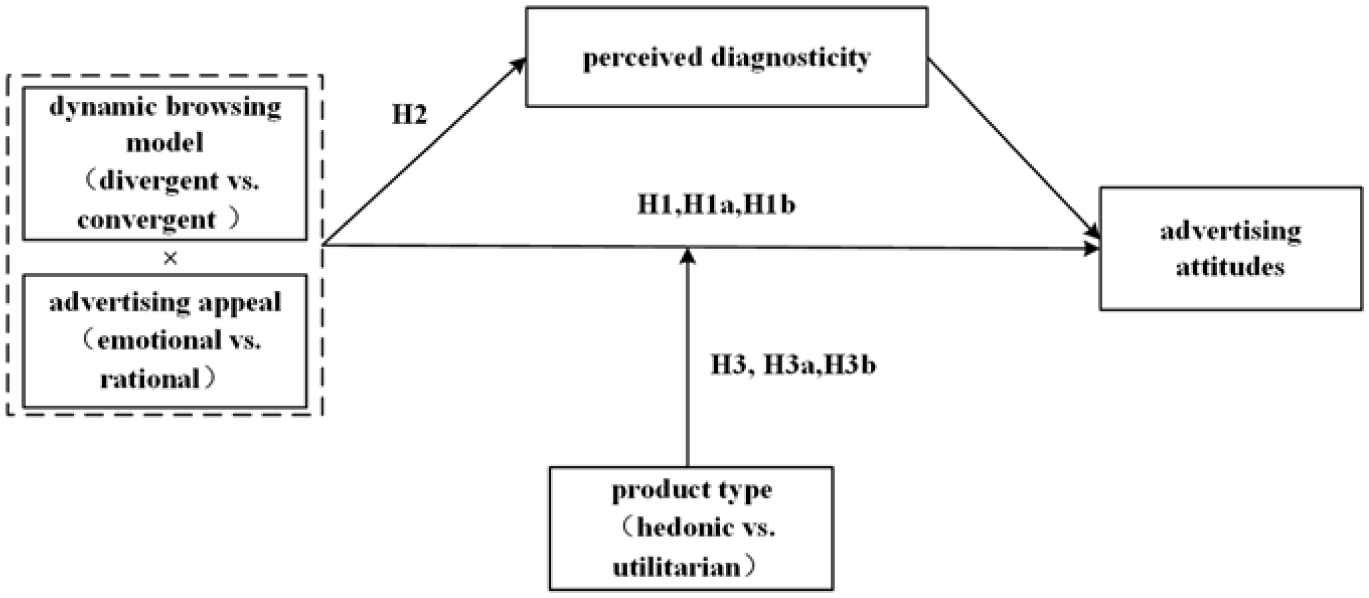
Research model.
Method
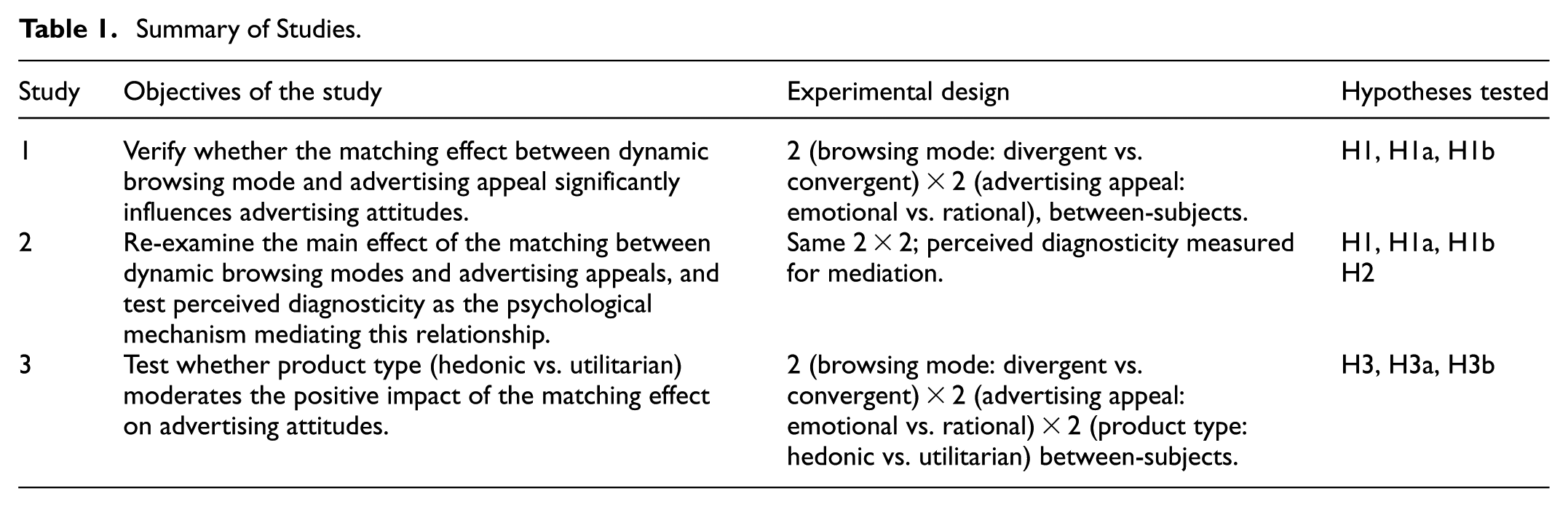
To test the research hypotheses proposed in this study, three scenario-based online experiments were conducted. The experimental materials are provided in the Appendix, and participants who completed the experiments received a monetary reward ranging from 0.5 to 1 RMB. Study 1 aimed to verify whether the matching effect between dynamic browsing modes and advertising appeals significantly influences consumers’ advertising attitudes. The experiment adopted a 2 (browsing mode: divergent vs. convergent) × 2 (advertising appeal: emotional vs. rational) between-subjects design to examine attitude differences under different matching conditions, in order to test the main effects (H1, H1a, and H1b). Building on this, Study 2 introduced perceived diagnosticity as a psychological mechanism to examine its mediating role in the relationship between the matching of dynamic browsing modes and advertising appeals, and advertising attitudes. Through situational reading and questionnaire measurements, the study analyzed whether the matching effect improves consumers’ attitudes toward advertisements by enhancing perceived diagnosticity, thus verifying H2. Finally, Study 3 incorporated product type (hedonic vs. utilitarian) into the model to explore its moderating role in the relationship between matching effects and advertising attitudes. The experiment adopted a 2 (browsing mode: divergent vs. convergent) × 2 (advertising appeal: emotional vs. rational) × 2 (product type: hedonic vs. utilitarian) factorial design to test whether product type moderates the positive impact of matching effects on advertising attitudes, thus verifying H3, H3a, and H3b. Table 1 summarizes these studies.
Summary of Studies.
Study 1
Study 1 aimed to verify whether the matching effect between dynamic browsing modes and advertising appeals significantly influences consumers’ advertising attitudes, examining attitude differences under different matching conditions (H1, H1a, and H1b). The experiment employed a 2 (browsing mode: divergent vs. convergent) × 2 (advertising appeal: emotional vs. rational) between-subjects factorial design.
Pre-Experiment
A pretest was conducted to validate the manipulations of browsing mode and advertising appeal. The first manipulation focused on the browsing modes. Referring to the study by Xiao and Zhang (2022), in the convergent browsing condition, participants were asked to imagine that they were planning a specific trip to Harbin and focus on several related pieces of information on a news platform to induce a goal-oriented, focused, and rational processing style, thereby entering the convergent mode. In the divergent browsing condition, participants were instructed to freely browse content in the travel section, with no specific goals or task restrictions, switching between various topics to induce an experiential, intuitive, and emotional processing style, thereby entering the divergent mode.
On this basis, the study also manipulated advertising appeals. In the rational appeal condition, the ad emphasized the product or service’s functions, attributes, and objective information, with the ad copy reading: “Harbin winter itinerary: 5 days and 4 nights, includes round-trip transportation, hotel, and ski tickets, with transparent pricing.” In the emotional appeal condition, the ad emphasized the user’s emotional experience and value associations (K. Kim et al., 2019), with the ad copy: “Harbin: Preserving winter’s unique romance and warmth in the glow of snow and neon.” By embedding rational and emotional appeal ads in different browsing modes, the conditions “convergent × rational,”“convergent × emotional,”“divergent × rational,” and “divergent × emotional” were created. After completing the informed consent form and providing basic background information, participants were randomly assigned to one of the four experimental conditions. Participants in the convergent browsing condition were asked to imagine preparing for a specific trip to Harbin and focus on several pieces of travel-related information in a news stream, completing the task of planning a trip itinerary. Participants in the divergent browsing condition were asked to freely browse in the travel section, with no specific goals or task restrictions, switching between various topics.
After completing the browsing task and viewing the advertisement, participants were required to complete a questionnaire. For the browsing mode, following Xiao and Zhang (2022), four items were set to measure the participants’ processing orientation during the information stream task, such as “I focused more on the overall meaning of the information during my browsing” and “I focused more on specific details or practical aspects during my browsing.” For the advertising appeals, following Liu and Lei (2025), two items were used to measure participants’ perception of the ad type, namely “This ad primarily triggered my emotions or experiences” and “This ad primarily provided specific information or factual evidence,” both measured on a 7-point Likert scale (1 = strongly disagree, 7 = strongly agree).
An a priori power analysis was conducted using G*Power. The results showed that for a statistical power of 0.80 at a 0.05 significance level and an effect size of 0.80, the required sample size was 52 (Faul et al., 2007). A total of 70 participants were randomly recruited via the Credamo platform. After excluding 10 participants who failed the attention checks, a total of 60 valid participants remained (56.7% female; Mage = 25.6). First, the manipulation of the information flow browsing mode was tested. Independent samples t-tests showed that compared to the convergent mode, participants exhibited higher levels of divergence when evaluating divergent mode ads (Mdivergent = 5.52, SDdivergent = 0.86, Mconvergent = 3.70, SDconvergent = 1.75; t = 5.10, p < .001). Compared to the divergent mode, participants exhibited higher levels of convergence when evaluating convergent mode ads (Mconvergent = 5.80, SDconvergent = 0.89, Mdivergent = 3.05, SDdivergent = 1.09; t = −10.70, p < .001). Therefore, the manipulation of the dynamic browsing modes was successful.
Next, the manipulation of advertising appeals was tested. Independent samples t-tests showed that, compared to rational appeal ads, participants exhibited a higher emotional degree when evaluating emotional appeal ads (Memotional = 5.57, SDemotional = 0.77; Mrational = 2.43, SDrational = 1.07, t = 12.98, p < .001). Compared to emotional appeal ads, participants exhibited a higher rational degree when evaluating rational appeal ads (Mrational = 5.07, SDrational = 1.08; Memotional = 2.60, SDemotional = 1.38, t = −7.71, p < .001). Therefore, the manipulation of advertising appeals was successful.
Formal Experiment
Study 1 used a 2 × 2 between-subjects experimental design, and the sample size was determined using G*Power software. The significance level was set at 0.05, statistical power was set at 0.80, and the effect size was set at 0.25. The required total sample size for the formal experiment was 179 (Faul et al., 2007). In the formal experiment phase, the experimental conditions from the pre-experiment were adopted, and all participants were randomly assigned to one of the four experimental conditions: “convergent × rational,”“convergent × emotional,”“divergent × rational,” and “divergent × emotional.” Prior to starting the formal experiment, participants were shown an informed consent form, and they were given the option to voluntarily agree to participate or opt out. For those who agreed to participate, the experiment was explained as consisting of two parts: the first part involved reading the scenario materials, and the second part involved completing a related questionnaire. Advertising attitudes were measured using the scale from Holbrook and Batra (1987), including items such as “I dislike/like this advertisement,”“I react poorly/positively to this advertisement,”“I feel negatively/positively about this advertisement,” and “This advertisement is bad/good.”
To ensure that participants in the online experiment were able to fully understand and process the scenario materials, the minimum time for each participant to stay on the material pages was controlled. Participants were required to stay on the page for at least 30 s to ensure they had sufficient time to carefully read the experimental materials. In addition, to further verify participants’ attention and avoid careless reading, two attention-check questions were added to the experiment. Participants who failed these attention checks were considered invalid samples and were excluded from the data analysis phase.
Experimental Results and Analysis
After the experiment, 220 questionnaires were collected. Following the exclusion of responses that failed the attention-check items, 196 valid questionnaires remained (55.6% female; Mage = 28.9). The Cronbach’s alpha of advertising appeals (0.932) higher than 0.7, ensuring sound reliability. A two-way (ANCOVA) was conducted with advertising attitudes as the dependent variable, dynamic browsing modes and advertising appeals as the independent variables (modes: 0 = divergent, 1 = convergent; appeals: 0 = emotional, 1 = rational), age and gender as covariates. The results showed that the main effects of dynamic browsing modes (F (1,190) = 3.102, p = 0.080,
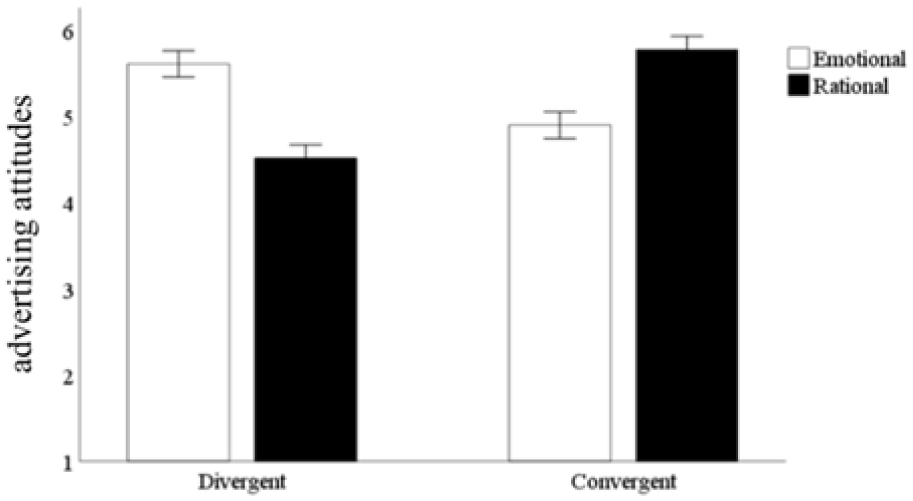
Interaction effect between dynamic browsing modes and advertising appeals on advertising attitudes.
This study conducted a moderation analysis using Hayes’ PROCESS macro (Model 1; 5,000 bootstrap samples; 95% confidence intervals). The interaction between browsing modes and advertising appeals was significant (b = 1.973, SE = 0.312, 95% CI = [1.358, 2.587]). As shown in Figure 3, the simple slope analysis further revealed that emotional appeals had a significant and positive effect on advertising attitude under the divergent browsing mode (b = −1.095, SE = 0.219, 95% CI = [−1.527, −0.662]), whereas rational appeals had a significant and positive effect on advertising attitude under the convergent browsing mode (b = 0.878, SE = 0.221, 95% CI = [0.441, 1.315]). Therefore, H1, H1a, and H1b were supported.
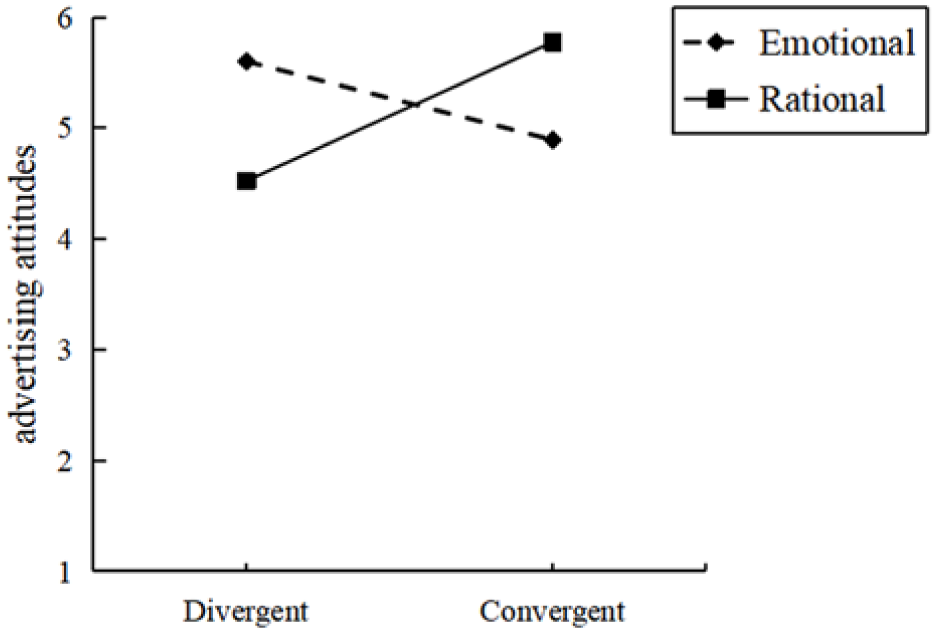
The moderating effect of advertising appeals on the relationship between browsing modes and advertising attitudes.
Study 2
Study 2 examined whether perceived diagnosticity mediates the effect of matching dynamic browsing modes with advertising appeals on advertising attitudes (H2). The experiment employed a 2 (browsing mode: divergent vs. convergent) × 2 (advertising appeal: emotional vs. rational) between-subjects factorial design.
Pre-Experiment
Consistent with Study 1, a pretest was conducted to ensure the effectiveness of the manipulations of dynamic browsing modes and advertising appeals. In the convergent browsing condition, participants were asked to imagine that they were preparing to enroll in a fitness course and to focus on multiple course-related items within the sports and health section of a news platform. In the divergent browsing condition, participants browsed freely within the same section without any specific goal or task constraints and could switch across topics. On this basis, advertising appeals were manipulated. The rational appeal copy read: “Vitality Fitness Winter Program: 5-Day Intensive Training, Professional Instructor Guidance, Transparent Pricing.” The emotional appeal copy read: “Vitality Fitness: Discover your stronger self. Make movement your life’s warm companion.” The measures for browsing mode and advertising appeals were identical to those in Study 1.
An a priori power analysis was conducted using G*Power. The results showed that for a statistical power of 0.80 at a 0.05 significance level and an effect size of 0.80, the required sample size was 52 (Faul et al., 2007). A total of 70 participants were randomly recruited via the Credamo platform. After excluding 4 who failed the attention checks, 66 valid participants remained (56.1% female; Mage = 30.8). First, the browsing mode manipulation was tested. Independent-samples t-tests showed that, relative to the divergent mode, participants evaluating the convergent mode reported higher convergent levels (Mconvergent = 5.88, SDconvergent = 0.56; Mdivergent = 3.23, SDdivergent = 1.30; t = −10.77, p < .001). Conversely, relative to the convergent mode, participants evaluating the divergent mode reported higher divergent levels (Mdivergent = 5.02, SDdivergent = 1.14; Mconvergent = 3.17, SDconvergent = 1.48; t = 5.70, p < .001). These results indicate that the browsing-mode manipulation was successful. Second, the advertising appeal manipulation was tested. Independent-samples t-tests showed that, compared with the emotional appeal ad, participants evaluating the rational appeal ad reported higher perceived rationality (Mrational = 6.26, SDrational = 0.75; Memotional = 2.59, SDemotional = 0.84, t = −18.77, p < .001). Conversely, compared with the rational appeal ad, participants evaluating the emotional appeal ad reported higher perceived emotionality (Memotional = 6.09, SDemotional = 0.69; Mrational = 2.59, SDrational = 0.78, t = 19.26, p < .001). These results indicate that the advertising-appeal manipulation was successful.
Formal Experiment
Study 2 used a 2 × 2 between-subjects experimental design, and the sample size was determined using G*Power software. The significance level was set at 0.05, statistical power was set at 0.80, and the effect size was set at 0.25. The required total sample size was 179 (Faul et al., 2007). All participants were randomly assigned to one of the four experimental conditions: “convergent × rational,”“convergent × emotional,”“divergent × rational,” and “divergent × emotional.” Prior to starting the formal experiment, participants were shown an informed consent form, and they were given the option to voluntarily agree to participate or opt out. For those who agreed to participate, the experiment was explained as consisting of two parts: the first part involved reading the scenario materials, and the second part involved completing a related questionnaire.
Consistent with Study 1, a minimum dwell time of 30 s was enforced on the materials pages. In addition, to verify participant attention and reduce careless responding, two attention-check items were included; participants who failed these checks were classified as invalid cases and excluded from the analyses.
Experimental Results and Analysis
After the experiment, 300 questionnaires were collected. Following the exclusion of responses that failed the attention checks, 263 valid questionnaires remained (52.9% female; Mage = 29.9). Measurement of advertising attitudes (α = 0.850) was identical to Study 1. Perceived diagnosticity (α = 0.845) was measured with items adapted from Meng et al. (2021), including: “This advertisement helps me clearly understand the product’s characteristics,”“This advertisement helps me effectively evaluate the product’s quality,” and “This advertisement helps me judge whether the product is worth purchasing.”
A two-way (ANCOVA) was conducted with advertising attitudes as the dependent variable, browsing mode and appeal type as the independent variables, age and gender as covariates. The results showed that the main effects of dynamic browsing modes (F (1,257) = 0.355, p = 0.552,
A two-way (ANCOVA) was conducted with perceived diagnosticity as the dependent variable, dynamic browsing modes and advertising appeals as the independent variables (modes: 0 = divergent, 1 = convergent; appeals: 0 = emotional, 1 = rational), age and gender as covariates. The results indicated a significant main effect of browsing mode (F (1,257) = 4.847, p = 0.029,
Study 3
Study 3 aims to verify that product type moderates the effect of the match between users’ dynamic browsing modes and advertising appeals on advertising attitudes (H3, H3a, and H3b). The experiment employed a 2 (browsing mode: divergent vs. convergent) × 2 (advertising appeal: emotional vs. rational) × 2 (product type: hedonic vs. utilitarian) between-subjects factorial design.
Pre-Experiment
A pretest was conducted to ensure the effectiveness of the manipulations of product type, dynamic browsing mode, and advertising appeal. Toothpaste and chocolate were selected to represent utilitarian and hedonic products, respectively. In the convergent condition, participants were instructed to focus on shopping-related information within the Health and Lifestyle section of an online news platform, thereby inducing goal-directed processing; in the divergent condition, participants were instructed to browse freely without any explicit goals or task constraints and to switch among different topics at will. Advertising appeals were then manipulated. The rational appeal slogan for toothpaste was: “Qingyan Toothpaste: A fluoride and antibacterial formula for professional oral health protection” and the emotional appeal slogan was: “Qingyan Toothpaste: From the first moment of freshness, enjoy a confident smile all day long.” The rational appeal slogan for chocolate was: “Chun Yue Chocolate: Made with select origin cocoa, transparent ingredients, and traceable quality” and the emotional appeal slogan was: “Chun Yue Chocolate: Melt-in-your-mouth richness. A sweet moment in your day, made just for you.”
The measurements of dynamic browsing modes and advertising appeals were consistent with those in Study 1. Product type was measured with reference to Drolet et al. (2007) and included four items. The first two emphasize utilitarian attributes: “Decisions to purchase this product are primarily based on logic or objective reasons” and “Decisions to purchase this product are primarily based on functional factors.” The latter two evaluate hedonic attributes: “Decisions to purchase this product are primarily based on feelings,” and “Decisions to purchase this product are primarily based on emotions.”
A total of 90 participants were randomly recruited via the Credamo platform. After excluding 2 who failed the attention checks, 88 valid participants remained (55.2% female; Mage = 30.3). First, a manipulation check was conducted for the dynamic browsing modes of the in-feed advertisement. Independent-samples t-tests showed that, compared with the divergent mode, participants exhibited a higher level of convergence when evaluating the convergent mode advertisement (Mconvergent = 5.29, SDconvergent = 1.18; Mdivergent = 4.18, SDdivergent = 0.92, t = −4.87, p < .001). Conversely, compared with the convergent mode, participants exhibited a higher level of divergence when evaluating the divergent mode advertisement (Mdivergent = 5.25, SDdivergent = 1.05; Mconvergent = 4.26, SDconvergent = 1.59; t = 3.40, p = .001). Therefore, the manipulation of dynamic browsing modes was successful. Second, a manipulation check was for advertising appeals. Independent-samples t-tests showed that, compared with the emotional appeal advertisement, participants reported a higher level of rationality when evaluating the rational-appeal advertisement (Mrational = 5.81, SDrational = 0.98; Memotional = 2.84, SD emotional = 0.86; t = −15.02, p < .001). Conversely, compared with the rational appeal advertisement, participants reported a higher level of emotionality when evaluating the emotional appeal advertisement (Memotional = 5.68, SDemotional = 0.80; Mrational = 2.74, SDrational = 1.03, t = 14.91, p < .001). Therefore, the manipulation of advertising appeals was successful. Finally, a manipulation check was conducted for product type. Independent-samples t-tests showed that, compared with the hedonic product, participants perceived higher utilitarian attributes when evaluating the utilitarian product (Mutilitarian = 5.04, SDutilitarian = 1.78; Mhedonic = 3.81, SDhedonic = 1.10, t = −6.01, p < .001). Conversely, compared with the utilitarian product, participants perceived higher hedonic attributes when evaluating the hedonic product (Mhedonic = 4.96, SDhedonic = 1.12; Mutilitarian = 3.28, SDutilitarian = 1.07, t = 7.15, p < .001). Therefore, the manipulation of product type was successful.
Formal Experiment
Study 3 used a three-factor between-subjects experimental design, and the sample size was determined using G*Power software. The results showed that for a statistical power of 0.80 at a 0.05 significance level and an effect size of 0.25, the required sample size was 237 (Faul et al., 2007). In the formal experiment, all participants were randomly assigned to one of eight experimental conditions (e.g., “convergent × rational × utilitarian,”“convergent × rational × hedonic”). Before the formal experiment began, an informed consent form was presented to all participants, who could voluntarily choose to consent to participate or withdraw from participation. Participants who agreed to take part were informed that the experiment consisted of two parts: (1) reading the scenario materials and (2) completing a questionnaire.
Consistent with study 1 and study 2, a minimum dwell time of 30 s was enforced on the materials pages. In addition, to verify participant attention and reduce careless responding, two attention-check items were included; participants who failed these checks were classified as invalid cases and excluded from the analyses.
Experimental Results and Analysis
At the end of the experiment, 350 questionnaires were collected. After excluding questionnaires that failed the attention-check items, 317 valid questionnaires remained (52.7% female; Mage = 28.8). The Cronbach’s alpha of perceived diagnosticity (0.809), advertising appeals (0.932) were higher than 0.7, ensuring sound reliability.
A moderated moderation analysis was performed using Hayes’ PROCESS macro (Model 3; 5,000 bootstrap samples; 95% confidence intervals), treating advertising attitudes as the dependent variable, browsing mode as the independent variable, advertising appeal and product type as moderators, and gender and age as covariates. The results showed that the three-way interaction among dynamic browsing modes, advertising appeals, and product type was significant (b = 0.677, SE = 0.327, p = .039, 95% CI = [0.034, 1.319]). As shown in Figure 4, the simple slope analysis indicated that in the hedonic product context, the divergent browsing mode (vs. convergent mode) enhanced the positive effect of emotional appeals on advertising attitudes (b = −0.403, SE = 0.158, p = .011, 95% CI = [−0.727, −0.104]), whereas under the rational appeal this effect was not significant (b = −0.078, p = 0.633). Conversely, in the utilitarian product context, the convergent mode significantly enhanced the positive effect of the rational appeal on advertising attitudes (b = 0.986, SE = 0.168, p = .000, 95% CI = [0.655, 1.316]), whereas under the emotional appeal this effect was not significant (b = −0.039, p = 0.813). In sum, product type played a key moderating role in the matching effect of browsing mode and advertising appeals on advertising attitudes: hedonic products are better matched with “divergent mode × emotional appeal” whereas utilitarian products are better matched with “convergent mode × rational appeal.” Hypotheses H3, H3a, and H3b were supported.
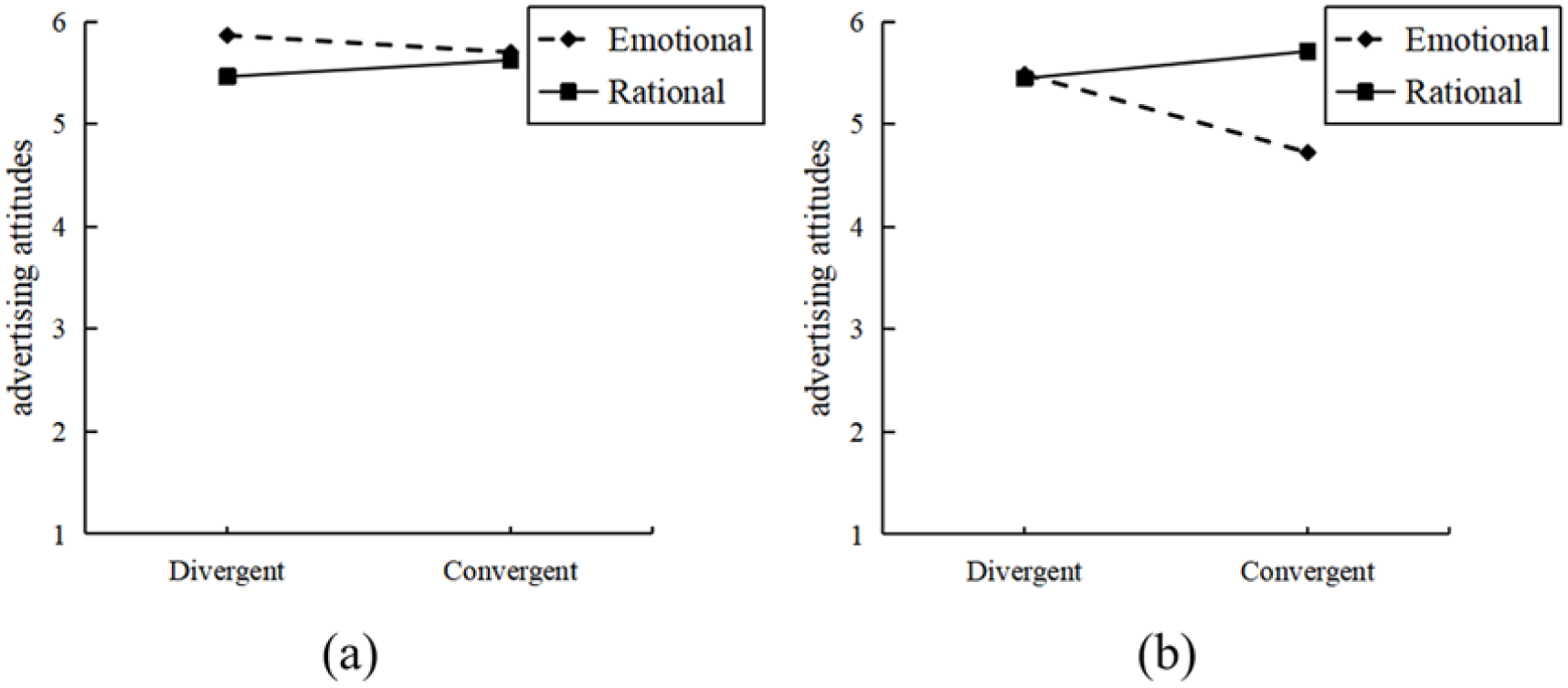
Interaction effects of browsing mode and advertising appeal on advertising attitude under (a) hedonic and (b) utilitarian product contexts.
Discussion
Three experiments in an in-feed advertising setting examine whether the effectiveness of advertising appeals depends on users’ dynamic browsing modes (convergent vs. divergent) and explore the psychological process underlying such effects. The results indicate a reliable congruence pattern: advertising attitudes become more favorable when appeal type aligns with the browsing mode. In particular, divergent browsing is more responsive to emotional appeals, whereas convergent browsing is more responsive to rational appeals in in-feed advertising, replicating and extending evidence that browsing patterns shape advertising outcomes (Xiao & Zhang, 2022). Beyond the direct fit effect, perceived diagnosticity emerges as a pivotal mechanism. When browsing mode and appeal are aligned, the advertising is judged as more informative and decision-relevant, which contributes to more positive ad attitudes, consistent with prior work positioning diagnosticity as central in consumer judgment and information evaluation (Tarafdar et al., 2024; Uhm et al., 2022). Furthermore, product type (utilitarian vs. hedonic) amplifies the congruence advantage, supporting its role as a boundary condition in persuasion and advertising effectiveness (Das et al., 2018).
These findings are compatible with a construal-level account of why different browsing modes favor different message strategies. Divergent browsing tends to promote relatively abstract mental representations, making affective and experiential cues feel more appropriate and coherent; convergent browsing tends to promote more concrete representations, increasing receptivity to attribute-based and reason-focused information. Such an interpretation aligns with CLT-based evidence that congruence between construal level and message design can enhance persuasion, especially under specific relational conditions such as weaker self-brand connections (S. Y. Lee et al., 2021), and it is also consistent with research showing that message framing matched to construal level improves attitudes and intentions in contexts like green advertising (Chang et al., 2015). Related studies further suggest that cues such as visual distance can shift perceived psychological distance and reshape the evaluation of product information (K. Kim et al., 2019). Importantly, the present pattern implies that construal activation in feed environments may not be driven solely by ad content; it can also be shaped by users’ browsing dynamics. By highlighting perceived diagnosticity as the key explanatory pathway through which congruence improves ad attitudes, the evidence situates the fit effect within a broader cognitive process of perceived information value and subsequent attitude formation, thereby extending CLT’s explanatory reach in digital advertising.
Conclusion and Implications
Theoretical Contributions
First, this study innovatively applies construal level theory to the dynamic browsing context of in-feed advertising, revealing how the match between users’ dynamic browsing modes (divergent vs. convergent) and advertising appeals (emotional vs. rational) affects advertising attitudes. The findings of the present study are consistent with prior research demonstrating that browsing modes influence advertising effectiveness (Xiao & Zhang, 2022). However, this study further advances the literature from a CLT perspective by suggesting that different browsing modes may activate either abstract or concrete mental representations, thereby creating cognitive congruence with emotional or rational appeals. This conclusion also resonates with CLT research showing that construal-level congruency enhances advertising effectiveness. For instance, S. Y. Lee et al. (2021) reported that when consumers exhibit weaker self-brand connections, high-level construal advertisements are more likely to elicit positive responses, reflecting a typical matching advantage. Similarly, Chang et al. (2015), in the context of green advertising, found that the fit between message framing and construal level significantly improves advertising attitudes and behavioral intentions. Research on visual distance further indicates that variations in image proximity can alter psychological distance and shape consumers’ evaluations of different types of product information (K. Kim et al., 2019). Therefore, the theoretical contribution of this study lies in revealing that, within in-feed advertising environments, construal-level activation is not only driven by advertising content itself but may also be triggered by consumers’ dynamic browsing behaviors. In doing so, the study extends the explanatory boundary of CLT in understanding attitude formation mechanisms in digital advertising contexts.
Second, the present study further reveals that perceived diagnosticity plays a key mediating role in the influence of the match between browsing modes and advertising appeals on advertising attitudes, thereby deepening the understanding of the internal psychological mechanism underlying the advertising matching effect. Specifically, when consumers’ browsing modes align with the appeal style of an advertisement, their subjective evaluation of the usefulness, diagnostic value, and credibility of the advertising information is significantly enhanced, which in turn facilitates the formation of more favorable advertising attitudes. This mechanism is consistent with prior research on the role of perceived diagnosticity. For example, Uhm et al. (2022), in the context of augmented reality e-commerce, demonstrated that perceived diagnosticity can reduce perceived risk and shorten psychological distance, thereby further increasing purchase intentions. Similarly, Toder Alon et al. (2025) found that different modes of media presentation significantly shape individuals’ judgments of information authenticity, with perceived diagnosticity serving as a core explanatory factor. Importantly, diagnosticity is not an objective attribute of information itself but rather a subjective assessment of informational effectiveness formed during consumers’ comparison and processing of available information. Therefore, the contribution of this study lies not only in confirming perceived diagnosticity as a mediating variable, but also in demonstrating that the appeal–browsing mode congruence effect in in-feed advertising achieves persuasive advantages by enhancing the diagnostic value of information. This study further embeds advertising matching theory into a cognitive mechanism framework of “information validity evaluation–attitude formation,” providing an important theoretical foundation for future research on digital advertising persuasion processes.
Third, the present study incorporates product type (utilitarian vs. hedonic) into the analytical framework and confirms its moderating role in the matching effect between browsing modes and advertising appeals, thereby extending the contextual boundary of the appeal–browsing congruence effect. The results indicate that for hedonic products, emotional appeals under a divergent browsing mode are more effective in eliciting favorable advertising attitudes, whereas for utilitarian products, rational appeals under a convergent browsing mode demonstrate stronger persuasive impact. This finding is consistent with prior research emphasizing the moderating influence of product attributes on appeal effectiveness. Siani et al. (2021) noted that emotional advertising is generally more suitable for hedonic products, whereas rational advertising aligns more closely with the evaluative logic of utilitarian products. Similarly, H. Zhang et al. (2014), in the context of service advertising, highlighted that the effectiveness of appeals depends heavily on the attributes of the consumption object, as different service types systematically shape consumers’ responses to emotional versus rational information. Moreover, K. Kim et al. (2019) further demonstrated that product type interacts with psychological distance cues to jointly influence consumers’ advertising processing and judgment pathways. Therefore, by introducing product type as a boundary condition, this study not only enriches the contextual explanation of the appeal-matching effect but also reveals that persuasive outcomes in in-feed advertising arise from the combined influence of consumers’ momentary browsing states, the framing of advertising appeals, and product attribute characteristics. This insight provides theoretical support for implementing more context-sensitive and dynamic advertising strategies in future digital marketing practice.
Practical Implications
First, firms and platforms should optimize in-feed advertising strategies based on users’ real-time dynamic browsing modes. Specifically, platforms can leverage real-time behavioral data such as search keyword concentration, topic-switching frequency across viewed content, page dwell time, and scrolling speed to build algorithmic models that infer whether a user is currently in a convergent or divergent browsing mode. Based on this inference, emotional appeal advertisements should be embedded within divergent-topic information streams characterized by broad content and diverse interests, whereas rational appeal advertisements should be embedded within convergent-topic streams characterized by focused goals and coherent themes. Such a matching mechanism enhances the consistency between advertising content and users’ psychological states, thereby improving perceived diagnosticity, or the extent to which users perceive the advertisement as useful and credible for decision-making, which in turn fosters more positive advertising attitudes. Technically, with the rapid advancement of big data analytics and AI-driven recommendation algorithms, platforms can monitor users’ browsing behaviors in real time and automatically deploy predesigned emotional or rational ad materials. This enables precise alignment between ad content and users’ browsing states, significantly improving ad click-through and conversion rates and generating substantial benefits for marketing practice.
Second, marketers should take product type differences into account when applying the above strategy to achieve more precise advertising delivery. The findings indicate that hedonic products are more suitable for emotional appeals, whereas utilitarian products are more compatible with rational appeals. This suggests that for hedonic products, advertisements should focus on evoking emotional resonance and encouraging imaginative engagement, particularly when users are in a divergent and open-minded state, by using vivid storytelling and affective elements to attract attention. For utilitarian products, advertisements should emphasize performance, factual information, and functional benefits, especially when users are in a convergent and analytical state, providing detailed content to meet their cognitive needs. From a managerial standpoint, this highlights the importance of context-specific creative differentiation by segmenting advertising content based on both product type and browsing context. Such precision not only strengthens the positive congruence between advertising appeals and product attributes but also helps avoid a one-size-fits-all approach, thereby improving advertising efficiency and the effective use of marketing resources.
Third, when implementing personalized advertising matching, platforms must balance personalization with user rights and ethical considerations. Firms collecting and using browsing data for ad matching should strictly comply with data privacy regulations, adopt anonymization and informed-consent mechanisms, and maintain algorithmic transparency to reduce users’ sense of surveillance. Overly intrusive personalization could trigger user resistance; thus, ad customization strategies should manage frequency and intrusiveness carefully, respecting users’ autonomy to ensure ethical defensibility.
Summary of Findings
Drawing on CLT, this study examines the matching effects between users’ dynamic browsing modes (convergent vs. divergent) and advertising appeals (rational vs. emotional) in the context of in-feed advertising, as well as the underlying psychological mechanisms. Across three experimental studies, consistency between browsing modes and advertising appeals is shown to enhance users’ advertising attitudes. Specifically, users in a divergent browsing mode respond more favorably to emotionally appealing advertisements, whereas users in a convergent browsing mode exhibit more positive attitudes toward rationally appealing advertisements. Furthermore, perceived diagnosticity is identified as a key psychological mechanism through which the matching between browsing modes and advertising appeals influences advertising attitudes. When advertising appeals align with users’ browsing modes, the advertising information is perceived as more diagnostic, which in turn leads to more favorable advertising attitudes. In addition, product type (hedonic vs. utilitarian) is demonstrated to function as an important boundary condition. Specifically, for hedonic products, advertising attitudes are more favorable when emotional appeals are aligned with a divergent browsing mode. For utilitarian products, advertising attitudes are more favorable when rational appeals are aligned with a convergent browsing mode.
Limitations and Future Directions
This study makes valuable theoretical and practical contributions; however, several limitations remain, which suggest potential avenues for future research.
First, the sample primarily consisted of users from news information platforms within a single cultural context, which may constrain the cross-cultural generalizability of the findings. Cultural differences could influence users’ preferences for emotional versus rational appeals, as well as the underlying mechanisms by which browsing modes affect advertising attitudes. Future studies should therefore consider conducting cross-cultural replications to examine how cultural factors moderate the matching effects between browsing modes and advertising appeals.
Second, the current research employed laboratory-based behavioral experiments. While such controlled settings help ensure internal validity, they may limit external validity because real-world advertising contexts are inherently more complex, with users’ decision-making processes influenced by a variety of contextual and situational factors. To address this limitation, future studies could employ field experiments in authentic advertising environments and integrate longitudinal behavioral data to investigate the long-term impacts of matching effects on advertising attitudes and consumer behavior.
Third, this study focused primarily on news information platforms. Although the findings hold practical potential, future research could extend the investigation to other types of digital platforms—such as social media, e-commerce, or short-video platforms—to test the robustness and contextual variability of dynamic browsing mode and advertising appeal matching effects across different media environments.
Finally, future research should pay greater attention to individual differences among users. Factors such as personality traits, cognitive styles, and media literacy may influence the direction and strength of the matching effects. Exploring these variables could provide deeper insights into the boundary conditions of dynamic advertising effectiveness.
Supplemental Material
sj-docx-1-sgo-10.1177_21582440261466358 – Supplemental material for From Schema to Construal: Matching Effect of Users’ Dynamic Browsing Modes and Advertising Appeals on In-Feed Advertising Attitudes
Supplemental material, sj-docx-1-sgo-10.1177_21582440261466358 for From Schema to Construal: Matching Effect of Users’ Dynamic Browsing Modes and Advertising Appeals on In-Feed Advertising Attitudes by Xuebin Qin, Shuyang Sun, Yuting Shi and Zhibin Jiang in SAGE Open
Footnotes
Acknowledgements
Not applicable.

Ethical Considerations
All studies were approved by the Shanghai Key Laboratory of Brain-Machine Intelligence for Information Behavior (BMIB), approval No. 202509260011.
Funding
The authors received no financial support for the research, authorship, and/or publication of this article.
Declaration of Conflicting Interests
The authors declared no potential conflicts of interest with respect to the research, authorship, and/or publication of this article.
Data Availability Statement
The datasets used and/or analyzed during the current study available from the corresponding author(j
Supplemental Material
Supplemental material for this article is available online.
References
Supplementary Material
Please find the following supplemental material available below.
For Open Access articles published under a Creative Commons License, all supplemental material carries the same license as the article it is associated with.
For non-Open Access articles published, all supplemental material carries a non-exclusive license, and permission requests for re-use of supplemental material or any part of supplemental material shall be sent directly to the copyright owner as specified in the copyright notice associated with the article.
