






Abstract
As the global digital economy expands, the demand for a workforce capable of navigating cross-border e-commerce (CBEC) has surged worldwide. However, existing educational frameworks often fail to effectively translate student competencies into actual workplace performance. Integrating Social Cognitive Theory with the Knowledge, Skills, Abilities, and Other characteristics (KSAO) framework, this study examines how specific competencies influence CBEC performance among Chinese vocational college students. A cross-sectional survey of 419 participants was analyzed using covariance-based structural equation modeling (CB-SEM). The results indicate that task-oriented dimensions, specifically English skills, cultural knowledge, and workplace aptitude, significantly enhance both motivation and subsequent performance. Motivation functions as a crucial mediator, transforming latent potential into active capability. Conversely, cultural sensitivity failed to demonstrate a significant impact, challenging traditional assumptions about intercultural traits. These findings reveal an instrumentality bias in digital trade contexts, where tangible, actionable competencies are more effective than abstract attitudinal traits in activating self-efficacy. This study contributes to the interdisciplinary literature by validating a Competence-Activation-Performance mechanism, suggesting that vocational educators globally should prioritize operational skills over generalized sensitivity to foster student success in the digitally mediated marketplace.
Plain Language Summary
With the rapid growth of the global digital economy, there is a high demand for workers who can manage cross-border e-commerce (selling goods internationally online). However, it is not always clear which skills vocational students need to succeed in this field. This study surveyed 419 vocational college students in China to understand the link between their skills, their motivation, and their actual performance. We looked at a mix of skills, including English proficiency, cultural knowledge, and technical operation skills. The results showed that practical, “actionable” skills—specifically English language ability and technical know-how—are the most important drivers of success. When students possess these solid skills, they feel more motivated and confident, which directly leads to better work performance. Interestingly, general “cultural sensitivity” (an open attitude toward other cultures) did not have a strong direct effect on performance in this context. These findings suggest that for students to succeed in cross-border e-commerce, having a good attitude is not enough. Schools should focus on teaching concrete, usable skills that boost students’ confidence and ability to perform tasks. This study helps educators understand how to better prepare students for the competitive digital marketplace.
Keywords
Introduction
In recent years, China has faced an increasingly complex international trade environment. The ongoing tariff tensions with the United States, including the removal of duty-free treatment for low-value goods, have placed heavy pressure on China’s cross-border e-commerce (CBEC) sector. This impact is particularly strong for small and medium-sized enterprises that rely on low-cost exports (Andrea Shalal, 2025; Kirton, 2025). Global merchandise trade declined by 1.2% in 2023, marking the first contraction since the 2009 financial crisis. Although a moderate rebound is expected, the World Trade Organization warns that geopolitical fragmentation will continue to threaten global trade stability (Reuters, 2025). In response, China is actively shifting its trade strategy toward the Global South and Belt and Road countries, expanding CBEC to diversify export markets (Zhao, 2024).
Driven by the critical strategic necessity to navigate global trade uncertainties, Chinese vocational education has heavily prioritized digital trade workforce development, integrating specialized e-commerce modules into curricula, establishing simulated training environments, and connecting student practitioners with global marketplaces (Ho & Chen, 2023). This institutional momentum has been forcefully reinforced by the comprehensive national guidelines jointly issued in April 2026 to advance the high-quality development of the e-commerce sector, which explicitly mandate “strengthening talent cultivation for the industry” alongside expanding the Silk Road e-commerce initiative (Xinhua, 2026). To avoid conceptual ambiguity for an international readership, it is essential to clarify that within this contemporary policy framework, the term “talent” does not imply innate individual exclusivity or elite brilliance. Instead, it serves as the standardized institutional nomenclature for high-skilled, occupationally competent practitioners undergoing systematic technical upskilling and workforce preparation.
However, translating these macro-level national mandates into effective classroom execution and equipping students with the multi-tiered competencies needed for CBEC remains a major pedagogical challenge. The modern digital trade arena demands a complex convergence of language proficiency, digital operational ability, and cross-cultural competence, critical domains where a significant portion of vocational students are still underprepared. Persistent institutional limitations, such as insufficient teaching resources, a severe lack of exposure to authentic intercultural communication contexts, and inherently weak English foundations, continue to hinder students’ immediate readiness for real-world, high-stakes CBEC operations (Hu, 2024; Jiang & Qu, 2024). Consequently, a distinct structural tension persists: while cultivating a proficient digital trade workforce constitutes a critical strategic imperative for resilient economic expansion, a profound operational gap remains between state-level policy aspirations and actual student capability.
Despite the growing emphasis on CBEC education, recent studies offer limited guidance for this specific context. Prior studies have predominantly focused on identifying the shortage of compound talents and measuring isolated competencies, such as general language proficiency or basic trade knowledge (Shao & Li, 2024). Crucially, while China’s strategic trade pivot toward the Global South and Southeast Asian markets has by no means diminished the primacy of English. Instead, English functions as the indispensable lingua franca between non-native speaking counterparts in these multi-lingual regions (Zhou & Zeng, 2025). Paradoxically, this non-native-to-non-native interaction amplifies communicative friction; navigating idiosyncratic syntaxes, non-standard expressions, and cultural nuances among non-native speakers requires a more robust, adaptive linguistic command than interacting with native speakers (Shao & Li, 2024; Zhao, 2024). Furthermore, because contemporary CBEC heavily relies on technology-mediated platforms like social media and live streaming, this linguistic burden is further compounded by the necessity to decode localized internet subcultures, digital slang, and platform-specific communication habits across diverse countries (Wongkhamdi et al., 2020; Zhou & Zeng, 2025). Consequently, rather than lowering the threshold, the geopolitical shift toward the Global South significantly intensifies the cognitive and linguistic burden on Chinese vocational students, rendering conventional, static language training frameworks obsolete.
However, traditional competence frameworks often overlook the unique challenges of the modern digital trade environment. Unlike traditional face-to-face interactions, CBEC relies on remote, technology-mediated platforms, such as social media and live streaming, where rapid, visually-driven, and cross-cultural communication is required (Wongkhamdi et al., 2020; Zhou & Zeng, 2025). It remains theoretically ambiguous whether the broad attitudinal traits prioritized by classical frameworks remain effective in screen-based digital contexts, or if they are superseded by tangible, operational skills (G. Liu et al., 2023). Furthermore, while recent literature identifies isolated competencies, it fails to explain the underlying cognitive mechanisms through which these static inputs are translated into dynamic workplace performance (Guo et al., 2023).
To bridge this exact theoretical gap, this study proposes an integrated framework combining the Knowledge, Skills, Abilities, and Other characteristics (KSAO) model with Social Cognitive Theory (SCT). While the KSAO model provides a structural taxonomy of competencies (Marvel et al., 2016), SCT posits that human agency, driven by motivation and self-efficacy, is the engine that activates latent capabilities (Bandura, 2001).
Rather than offering a mere incremental extension of existing models, the integration of these two theories provides a distinct theoretical advancement by establishing a boundary condition for SCT within vocational and digital contexts. Specifically, it formulates a “Competence-Activation-Performance” mechanism to test an underlying instrumentality bias. This study theorizes that in highly pragmatic, outcome-driven digital environments, not all competencies equally trigger human agency. By mapping competencies to the KSAO taxonomy, this research investigates whether only actionable, task-oriented dimensions (Knowledge, Skills, and Abilities) successfully activate the motivational pathway, rendering abstract dispositional traits (Other characteristics, such as general cultural sensitivity) inert. Articulating this relationship is theoretically crucial, as it challenges the universal applicability of traditional intercultural traits and explains precisely how specific vocational tools foster the motivational drive necessary to execute complex CBEC tasks.
Literature Review
Underlying Theory
This study integrates the KSAO model (Marvel et al., 2016) and Social Cognitive Theory (SCT; Bandura, 1997) to construct a comprehensive framework explaining how student competencies translate into cross-border e-commerce (CBEC) performance. While the KSAO model offers a structural taxonomy of the necessary competency components, SCT elucidates the procedural mechanism through which these components activate human agency and drive performance.
The KSAO model classifies occupational requirements into “Knowledge,”“Skills,”“Abilities,” and “Other characteristics” (KSAO). Widely adopted in personnel psychology and vocational education, this framework provides a systematic approach to job analysis by distinguishing between what a person knows (Knowledge), what they can do (Skills), their enduring capacity to perform (Abilities), and their dispositional traits (Other characteristics; Campion et al., 2011; Stevens & Campion, 1994). In the context of CBEC, this taxonomy ensures a holistic evaluation of talent, covering the spectrum from technical language proficiency to abstract cultural sensitivity. However, while the KSAO model identifies the inputs of performance, it does not fully explain the process by which these inputs are converted into behavioral outcomes.
Social Cognitive Theory (SCT) complements this structural view by positing that human functioning is a product of the dynamic interplay between personal factors, behavior, and the environment (Bandura, 2001). A central tenet of SCT is that possessing capabilities is necessary but insufficient for accomplished performance; individuals must also possess the self-belief and motivation to mobilize these capabilities under varied conditions (Bandura, 2001; Stajkovic & Luthans, 1998). SCT identifies self-efficacy, and the motivation it sustains, as a proximal determinant of behavior that mediates the influence of external skills and knowledge. By synthesizing these two theories, this study proposes a “Competence-Activation-Performance” logic: KSAO dimensions serve as the foundational resources (antecedents) that enhance students’ motivation (activation), which in turn drives their CBEC performance (outcome).
Cross-Border E-Commerce Performance
In the vocational context, CBEC performance is defined not merely by sales figures but by the demonstrated capacity to execute complex digital trade tasks. Unlike traditional trade, CBEC requires practitioners to navigate digital platforms, interact with diverse cultural audiences, and manage data-driven marketing simultaneously (Salazar-Kovaleff & Mauricio, 2024). Drawing on the social media marketing performance framework by (Tafesse & Wien, 2018), this study operationalizes performance as a multidimensional construct encompassing strategy development, content engagement, and customer interaction. High performance in this domain reflects a student’s ability to apply their vocational skills to solve real-world problems in a digitally mediated international marketplace.
Hypothesis Development
English skills represent the applied proficiency required for linguistic interaction, corresponding to the Skill dimension of the KSAO model. In cross-border trade, language acts as the primary vehicle for information exchange and negotiation (Jiao et al., 2020). According to SCT, the successful application of a skill serves as an enactive mastery experience, which is the most potent source of self-efficacy (Bandura & Walters, 1977). When students possess strong English proficiency, they experience greater control over communicative tasks, reducing anxiety and boosting their motivation to engage in complex interactions (G. Liu et al., 2023). Conversely, linguistic barriers often lead to withdrawal behaviors and diminished performance (Long & Lin, 2022). Therefore, English proficiency is posited to not only directly enable task execution but also indirectly enhance performance by fortifying the student’s motivational state.
Workplace aptitude refers to the enduring capacity for task execution, including problem-solving, time management, and adaptability, aligning with the “Ability” dimension of the KSAO model. In the fast-paced CBEC environment, practitioners frequently encounter unstructured problems ranging from logistics disruptions to customer disputes (Guo et al., 2023). Integrating SCT, general mental abilities and aptitudes facilitate forethought capability, the ability to anticipate consequences and plan accordingly (Bandura, 2001). Students with high workplace aptitude can better regulate their learning and work processes, fostering a sense of agency and resilience (Tseng et al., 2019). This heightened sense of competence encourages sustained effort (motivation) and directly contributes to superior operational outcomes (Ho & Chen, 2023).
Cultural knowledge encompasses the domain-specific understanding of international business customs, norms, and social practices, representing the Knowledge dimension. In intercultural interactions, knowledge serves as a cognitive map that guides behavior and reduces uncertainty (Ang et al., 2007). From an SCT perspective, cultural knowledge enhances “cognitive modeling,” allowing students to simulate interactions mentally before executing them (Bandura, 2001). This cognitive preparation reduces the perceived risk of intercultural misunderstandings, thereby increasing the willingness to initiate communication (motivation; Atteneder & Herdin, 2020). Furthermore, specific knowledge of target markets allows for more precise market positioning and customer service, directly improving performance outcomes (Fan et al., 2022; Sung & Guo, 2020).
Cultural sensitivity, defined as the dispositional orientation to notice and appreciate cultural differences, corresponds to the “Other characteristics” dimension. It involves an openness to diversity and an ability to manage emotional reactions during intercultural exchanges (Bartel-Radic & Giannelloni, 2017). Theoretically, SCT suggests that emotional and physiological states influence self-efficacy; positive affective traits like sensitivity should reduce stress reactions and foster a more welcoming interaction style (Bandura, 1997). Scholars have traditionally argued that sensitivity is a prerequisite for effective cross-cultural communication, as it enables individuals to adapt their behavior to the emotional needs of foreign counterparts (Bhawuk & Brislin, 1992; Zhang & Li, 2022). Consequently, it is hypothesized that students with higher cultural sensitivity will exhibit stronger motivation to bridge cultural gaps and achieve better interpersonal outcomes in trade contexts.
According to Social Cognitive Theory, self-efficacy and motivation are distinct yet deeply interconnected constructs (Bandura & Walters, 1977). Self-efficacy is defined as the cognitive belief in one’s capability to execute actions. It serves as a primary cognitive precursor that fuels motivation, which represents the proactive drive, willingness, and sustained effort applied to those actions (Bandura, 2001). In the context of this study, foundational competencies such as English skills, workplace aptitude, and cultural knowledge function as essential mastery experiences. As vocational students acquire these task-oriented dimensions, they develop a robust sense of self-efficacy regarding digital trade tasks. This cognitive belief subsequently generates motivation to engage in cross-cultural interactions. Recent empirical studies in vocational education support this sequential relationship, demonstrating that self-efficacy built through skill acquisition acts as a vital foundation for sustaining task motivation (Ma & Chen, 2024; Tseng et al., 2019). As operationalized in the measurement instrument developed by (Ang et al., 2007), motivation captures this resulting drive by reflecting the intrinsic interest and behavioral willingness of students to navigate diverse professional environments.
The translation of these latent competencies and motivational drives into actual outcomes is particularly critical in the CBEC sector. This environment is characterized by asynchronous communication, cultural ambiguity, and remote operations, which often present significant cognitive and emotional challenges (Wongkhamdi et al., 2020). In such demanding contexts, possessing knowledge, skills, or even self-efficacy to succeed remains insufficient if not accompanied by an active drive to persist. Highly motivated students exhibit the necessary behavioral persistence to overcome digital trade barriers and proactively engage with foreign clients. Empirical evidence from recent digital business studies confirms that high levels of motivation and entrepreneurial drive are indispensable for sustaining the effort required to optimize operational strategies and achieve tangible business success (Ho & Chen, 2023; Ye & Dong, 2021). Furthermore, continuous proactive engagement driven by motivation is recognized as a primary catalyst for superior performance in highly competitive e-commerce markets (Salazar-Kovaleff & Mauricio, 2024). Consequently, motivation functions as the proximal determinant that actualizes theoretical potential into superior workplace performance.
Methodology
Research Design
This study adopted a quantitative, cross-sectional survey design to examine the relationships between competencies, motivation, and CBEC performance among Chinese vocational college students. A self-administered questionnaire was employed to collect data on four competency factors, motivational levels, and performance outcomes. The mediating role of motivation was also tested within this framework. To analyze the proposed model and test the hypotheses, covariance-based structural equation modeling (CB-SEM) was conducted using SPSS 26 and AMOS 24 software.
Research Instrument
A structured questionnaire using a 7-point Likert scale (Altuna & Arslan, 2016) was developed by adapting items from validated instruments. English Skills were drawn from the Intercultural Business Communication Competence Scale (Jiao et al., 2020), and Workplace Aptitudes from Bartel-Radic and Giannelloni (2017) Cultural Sensitivity was measured using items from Mirzaei and Forouzandeh (2013), while Cultural Knowledge used items from the Cultural Intelligence Scale by Bücker et al. (2016) and Ang et al. (2007), CBEC Performance was assessed with items adapted from Tafesse and Wien (2018), and Motivation was measured using five items from the motivational dimension of the CQS (Ang et al., 2007). The measurement items were validated in our previous study (Song & Sahid, 2025), utilizing a mixed-methods approach that included translation protocols, expert panel content validation, and empirical psychometric testing.
Sample and Data Collection
The target population comprised vocational college students in Guangdong Province, China. Guangdong was strategically selected as the research site because it serves as the largest national economic hub for cross-border e-commerce, accounting for over one-third of China’s trade volume in this sector (Department of Commerce of Guangdong Province, 2024). To ensure diverse representation, a stratified two-stage sampling strategy was employed. In the first stage, three vocational institutions were purposefully selected based on institutional ownership, comprising one public and two private colleges. In the second stage, aligning with purposive sampling principles (Johnson & Christensen, 2024), the sampling frame targeted students enrolled in disciplines directly related to digital trade, such as Business English, E-commerce, International Trade, and Marketing. Within these targeted disciplines, a systematic random sampling approach was implemented. Students were invited to participate based on the odd or even trailing digits of their official student identification numbers.
To guarantee data reliability, systematic screening procedures were executed prior to analysis following established methodological guidelines (Hair et al., 2019). Questionnaires were deemed invalid and removed if they indicated inattentive responding. Specifically, responses with a completion time under 1 min were excluded because this duration is empirically insufficient for item comprehension. Additionally, responses exhibiting severe straight-lining behaviors, defined as selecting the identical answer option for twenty consecutive questions, were eliminated. Applying these criteria yielded a final sample of 419 valid responses, representing an effective response rate of 64.0% (Creswell & Creswell, 2017). Additionally, back-translation was employed to ensure linguistic equivalence between the original and translated versions of the questionnaire (Brislin, 1970).
Ethical Considerations
This study was formally approved by the UKM Research Ethics Committee at The National University of Malaysia (Approval No. JEP-2024-773) on October 30, 2024, adhering strictly to the Declaration of Helsinki (World Medical Association, 2013). To limit the risk of harm, the survey was completely anonymous and voluntary, with explicit assurances that withdrawal would not impact academic grades or teacher-student relationships, thereby eliminating any coercion. The potential institutional and societal benefits of optimizing vocational e-commerce talent development frameworks significantly outweighed the minimal risk confined to survey completion time. Digital informed consent was secured prior to data collection: respondents reviewed an online introductory sheet detailing the research purpose and their rights, and clicking the “Next Page” button constituted explicit, voluntary consent.
Data Analysis
This study employed a two-stage Structural Equation Modeling (SEM) approach, including Confirmatory Factor Analysis (CFA) and structural model testing, following Anderson and Gerbing (1988). Mediation was assessed using the bias-corrected bootstrap method with 5,000 resamples (Hair et al., 2019; Zainudin, 2014).
Results
Characteristics of Respondents
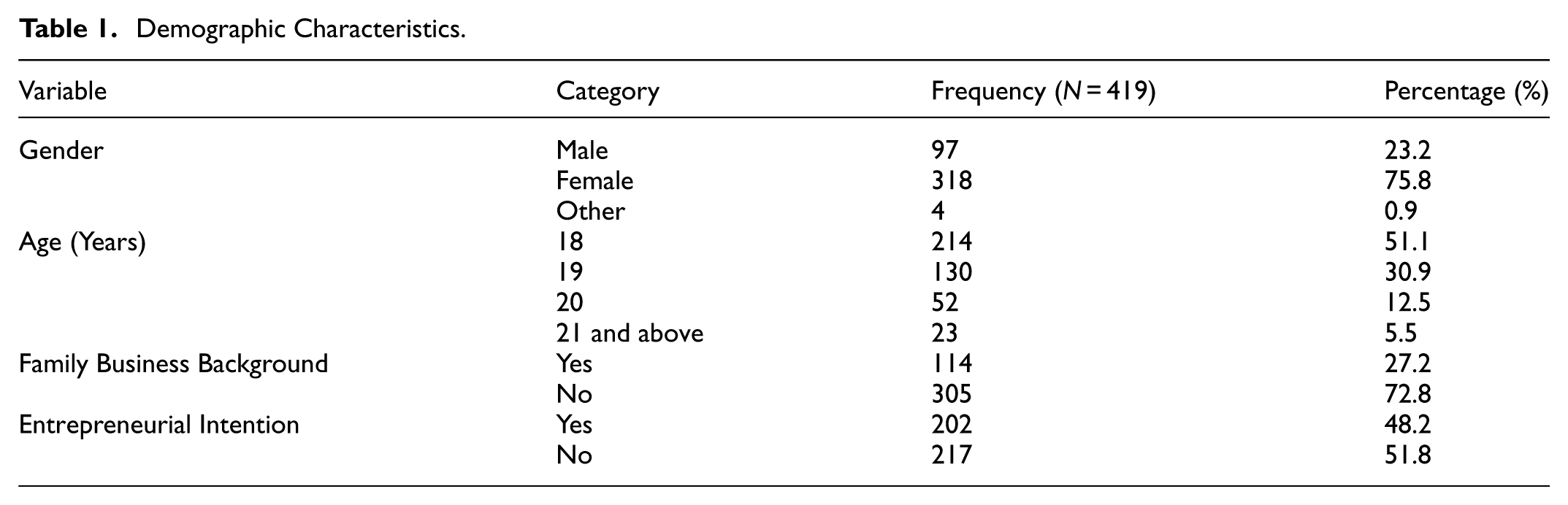
The demographic profile of the 419 participants is presented in Table 1. In terms of gender distribution, the sample is predominantly female, accounting for 75.8% (N = 318), while males constitute 23.2% (N = 97), reflecting the typical gender composition in language and business-related vocational programs. Regarding age, the respondents are relatively young; the majority are concentrated in the 18 to 19 age group, with 18-year-olds representing 51.1% (N = 214) and 19-year-olds comprising 30.9% (N = 130). Only a small fraction (5.5%) are 21 years of age or older. When examining family background, 27.2% (N = 114) of the students reported having a family business background, suggesting a potential familiarity with commercial environments. Furthermore, nearly half of the respondents (48.2%, N = 202) expressed a clear entrepreneurial intention. This high level of interest indicates that a significant portion of the sample is not only studying CBEC but also actively considering future engagement in entrepreneurial activities within the sector.
Demographic Characteristics.
Common Method Bias Test
To rigorously address the potential issue of common method bias (CMB), this study employed a dual-method approach. First, Harman’s single-factor test was conducted as a preliminary check (Podsakoff et al., 2003). Second, recognizing the limitations of Harman’s test, we further conducted a full collinearity variance inflation factor (VIF) assessment to ensure robust validation (Kock, 2015). All latent constructs were aggregated into mean scores for a multiple regression analysis. The results indicated that the VIF values for all constructs ranged from 1.067 to 1.534. Because all VIF values were strictly below the conservative threshold of 3.3, it can be concluded that the measurement model is free from pathological collinearity, confirming that CMB does not pose a serious threat to this study.
Measurement Model
The measurement model in this study comprises six latent constructs, each latent construct is measured by at least three observed items, ensuring theoretical coherence, measurability, and interpretability (Hair et al., 2019). As shown in Figure 1, model fit was evaluated using criteria recommended by Hair et al. (2019). To evaluate model fit, several established benchmarks were used: a chi-square to degrees of freedom ratio (χ2/df) below 3, RMSEA under 0.08 (preferably under 0.06), and CFI, TLI, and NFI values of at least 0.90. SRMR should also remain below 0.08.
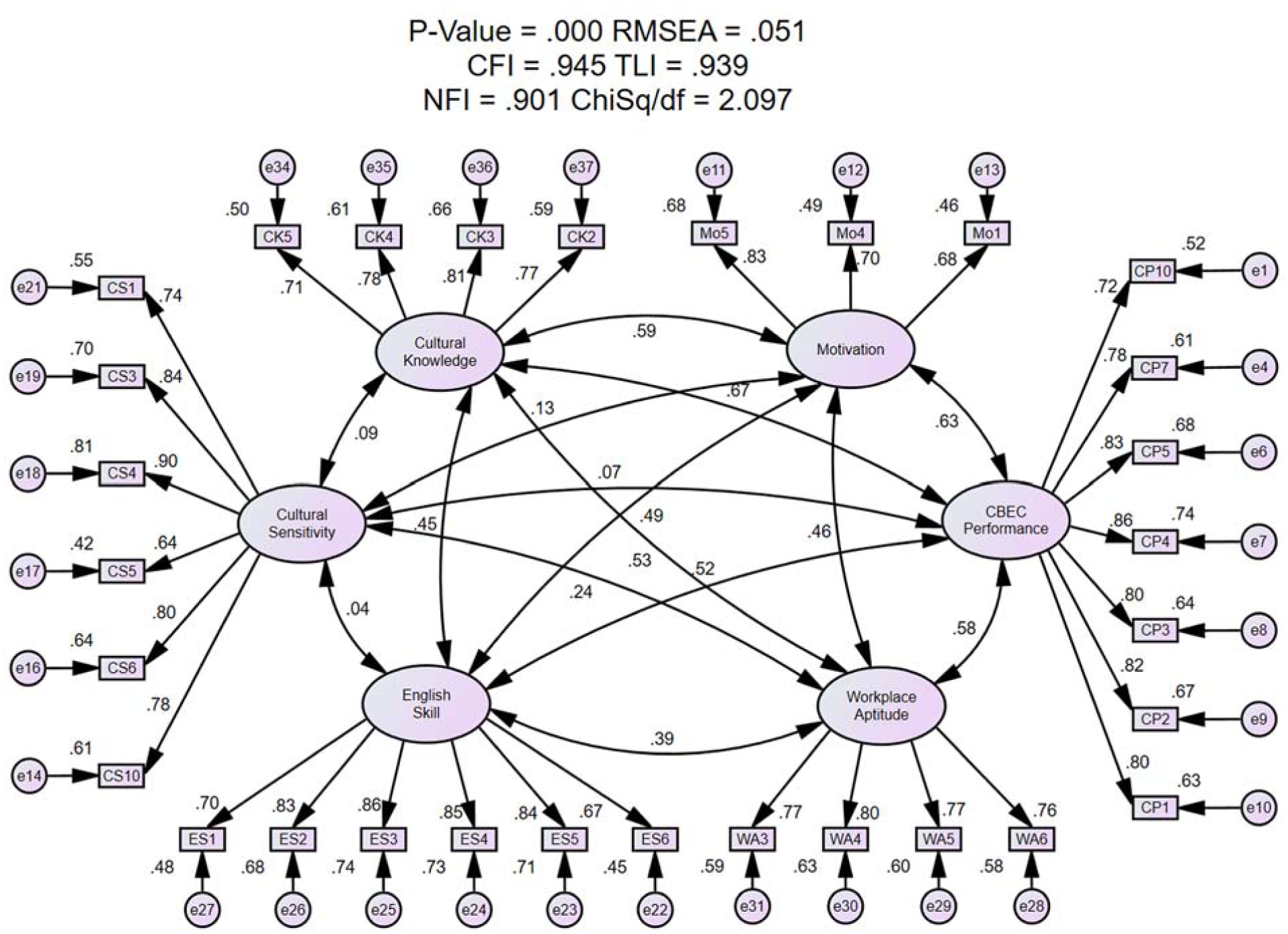
Measurement model using Pooled-CFA.
The results indicated a satisfactory fit to the data, with χ2/df = 2.097, RMSEA = 0.051, CFI = 0.945, TLI = 0.939, NFI = 0.901, and SRMR = 0.0519, all within or above recommended thresholds. Additionally, standardized factor loadings for all observed variables exceeded 0.64, with most falling between 0.70 and 0.85. These values indicate strong convergent validity and support the robustness of the measurement model.
Univariate normality was evaluated by analyzing the skewness and kurtosis critical ratios of all items. According to the criteria established by Byrne (2013), values falling within the range of ± 2 indicate acceptable normality, whereas values beyond this range suggest significant deviation from a normal distribution. As shown in Table 2, most items met the normality criteria, indicating approximately normal distributions. Several items within the Cultural Sensitivity dimension, particularly CS3, which showed a skewness critical ratio of 16.789 and a kurtosis critical ratio of 20.436, along with CS4, CS5, CS6, and CS10, exhibited substantial departures from normality, characterized by highly concentrated and positively skewed response patterns. Given these violations, based on the recommendations by Byrne (2013), a bias-corrected bootstrap method with 5,000 resamples and 95% confidence intervals was employed in subsequent path and mediation analyses to ensure robust and reliable parameter estimation.
Multivariate Normality Data.
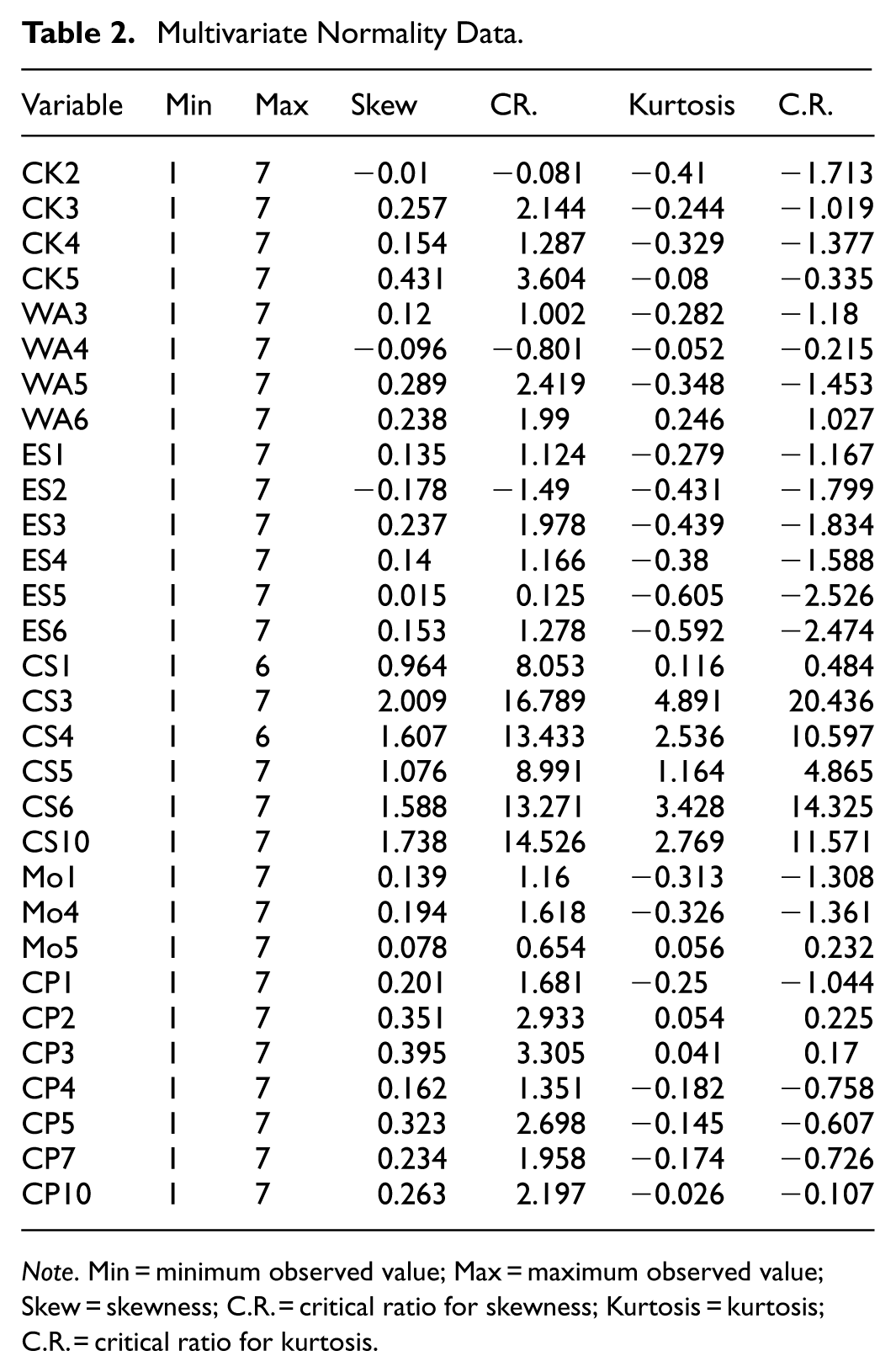
Note. Min = minimum observed value; Max = maximum observed value; Skew = skewness; C.R. = critical ratio for skewness; Kurtosis = kurtosis; C.R. = critical ratio for kurtosis.
To assess the reliability and convergent validity of the measurement model, this study calculated CR, AVE, and Cronbach’s α based on the results of confirmatory factor analysis (CFA). Following the recommendations of Fornell and Larcker (1981) and Hair et al. (2019), acceptable thresholds were defined as CR above 0.70, AVE of at least 0.50, and Cronbach’s α above .70. Standardized factor loadings were also expected to exceed 0.60.
As shown in Table 3, the results confirmed strong reliability and convergent validity across all constructs. CR values ranged from 0.783 to 0.926, AVE from 0.548 to 0.642, and Cronbach’s α from .780 to .926. Most constructs met or exceeded the recommended thresholds. Notably, the Motivation dimension, despite comprising only three items, still satisfied all criteria (CR = 0.783, AVE = 0.548, α = .780), indicating acceptable internal consistency. Standardized factor loadings ranged from 0.645 to 0.898, with the majority exceeding 0.70, supporting convergent validity. These findings confirmed the measurement model’s reliability and validity for use in subsequent structural modeling and hypothesis testing.
Construct Reliability and Validity.
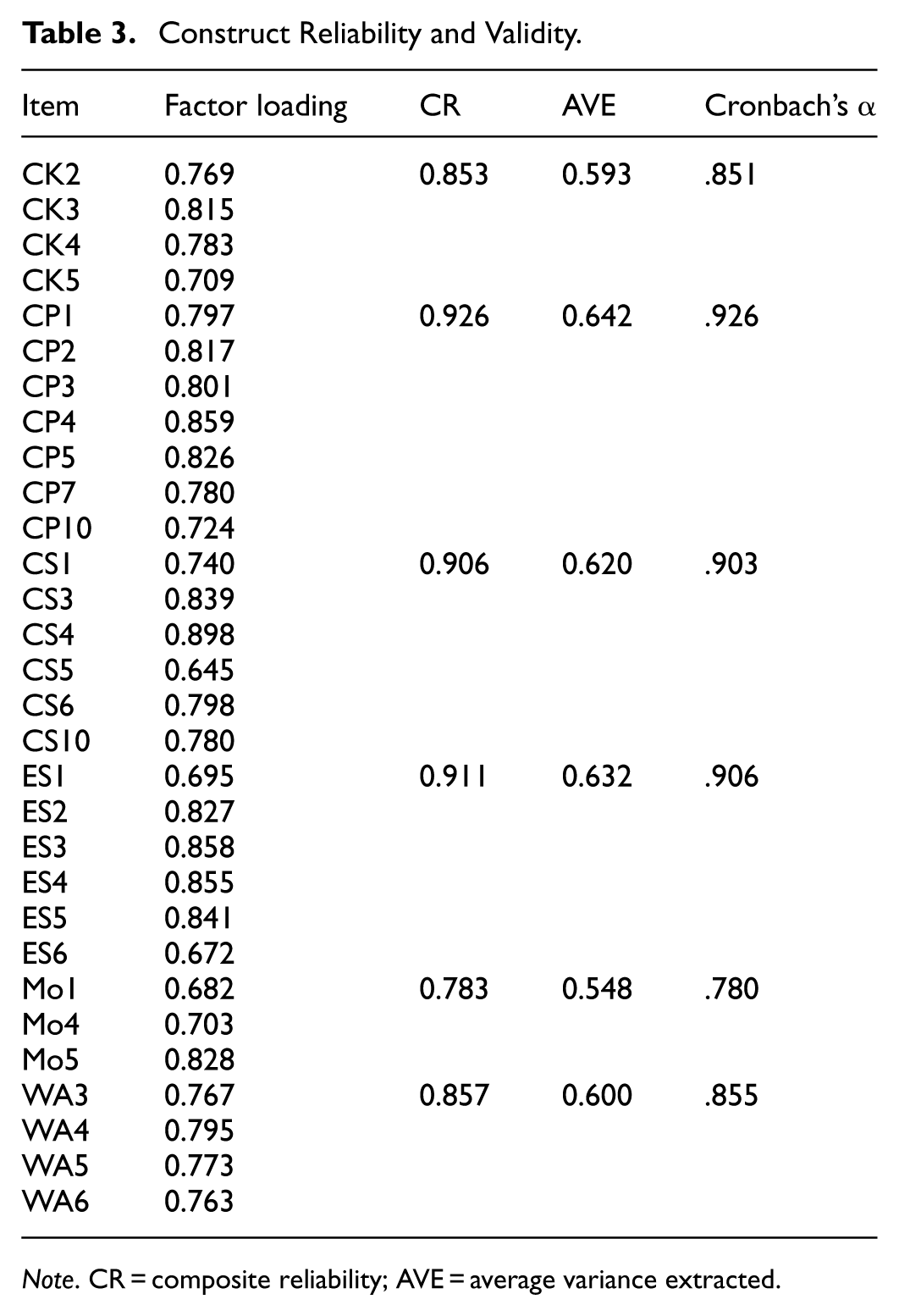
Note. CR = composite reliability; AVE = average variance extracted.
To further evaluate discriminant validity among the latent constructs, this study employed the Fornell–Larcker criterion (Fornell & Larcker., 1981). According to this method, the square root of each construct’s AVE should exceed its correlations with any other construct. Discriminant validity is confirmed if all diagonal values in the correlation matrix are greater than the corresponding off-diagonal correlation coefficients.
As shown in Table 4, the results showed that the square roots of the Average Variance Extracted (AVE) for each construct were all higher than their respective inter-construct correlations. Specifically, the square root of AVE was 0.801 for CBEC Performance, 0.787 for Cultural Sensitivity, 0.795 for English Skill, 0.770 for Cultural Knowledge, 0.775 for Workplace Aptitude, and 0.740 for Motivation. For example, the correlation between CBEC Performance and Cultural Knowledge was 0.665, which is lower than the square root of AVE for CBEC Performance (0.801). Likewise, the correlation between Motivation and Workplace Aptitude was 0.462, which is below the square roots of AVE for both constructs. These results confirm that the measurement model satisfies the criterion (Fornell & Larcker., 1981), thereby establishing discriminant validity and indicating that each construct is conceptually distinct from the others.
Discriminant Validity.
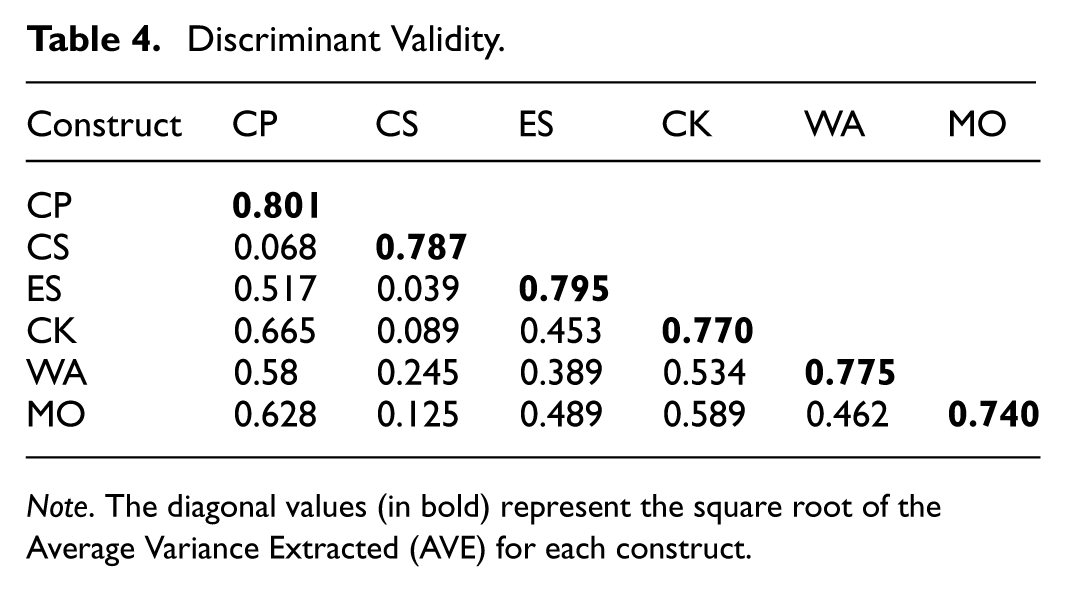
Note. The diagonal values (in bold) represent the square root of the Average Variance Extracted (AVE) for each construct.
Structural Model
Based on the validated measurement model, the structural model was subsequently constructed and assessed to determine the overall model fit and evaluate the alignment between the theoretical framework and the observed data. Following widely accepted SEM guidelines (Zainudin, 2014), the following fit indices were adopted: the chi-square to degrees of freedom ratio (χ2/df) should be below 3; RMSEA should be less than 0.08, preferably below 0.06; and the values of CFI, TLI, and NFI should all exceed 0.90.
As shown in Figure 2, the model evaluation yielded the following fit indices: χ2/df = 2.097, RMSEA = 0.051, CFI = 0.945, TLI = 0.939, and NFI = 0.901. These results indicate that the structural model demonstrates good overall fit, meeting or exceeding the recommended thresholds. Therefore, the model is deemed statistically robust and theoretically sound, providing a solid foundation for subsequent path analysis and mediation testing.
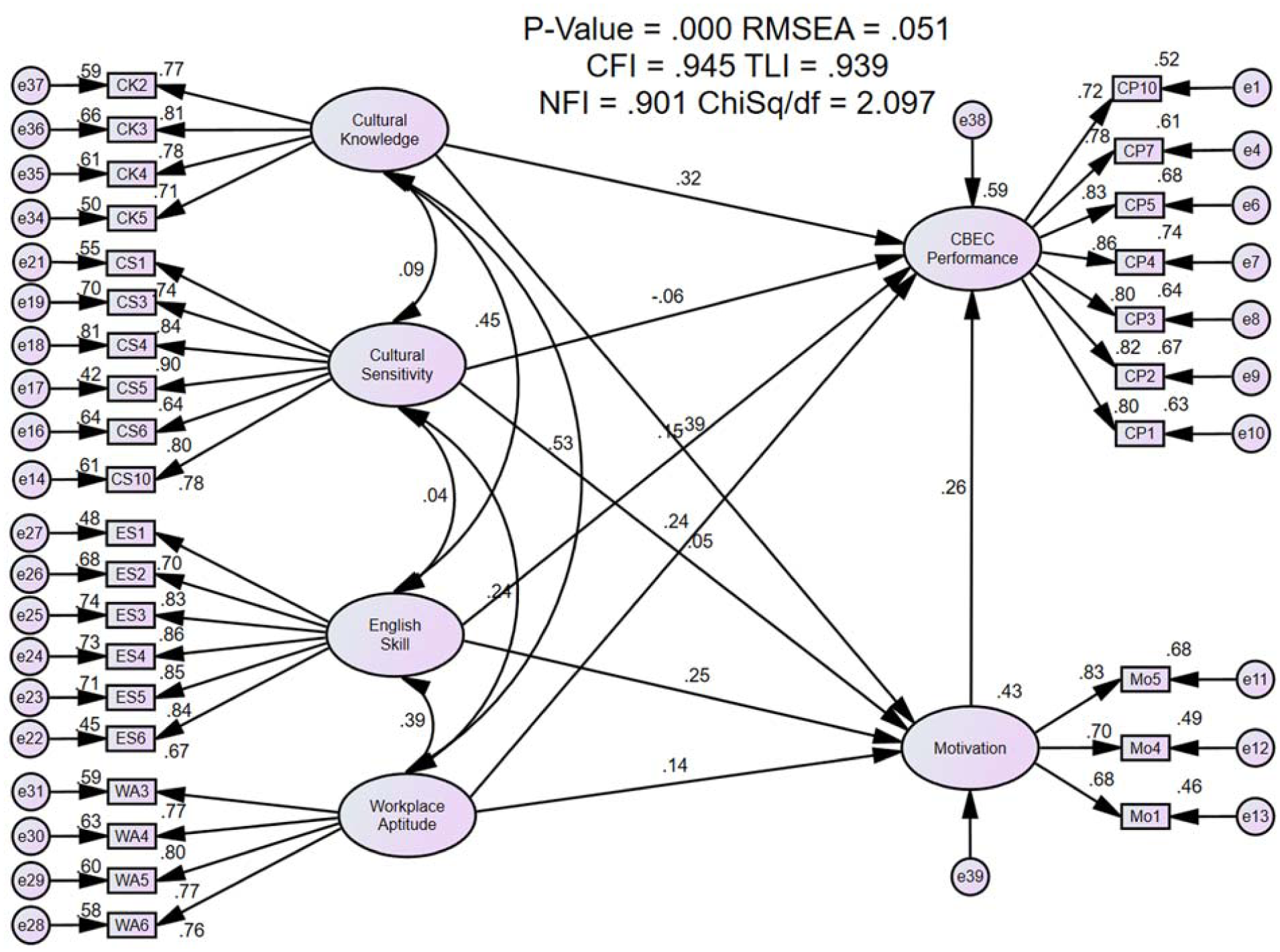
The structural equation modeling.
Hypothesis Testing
As shown in Table 5, the structural path analysis identified seven statistically significant direct relationships within the conceptual framework. Regarding the antecedents of motivation, cultural knowledge (β = .394, p < .001), English skills (β = .254, p < .001), and workplace aptitude (β = .142, p = .028) exerted significant positive effects, thereby providing robust empirical support for H8, H2, and H5, respectively. Conversely, cultural sensitivity (β = .046, p = .367) showed no significant influence on motivation; hence, H11 was not supported. Regarding the direct effects on CBEC performance, cultural knowledge (β = .317, p < .001), workplace aptitude (β = .245, p < .001), English skills (β = .153, p = .001), and motivation (β = .260, p < .001) were all confirmed as significant positive predictors, fully supporting H7, H4, H1, and H13. In contrast, cultural sensitivity (β = −058, p = .137) did not demonstrate a significant effect on performance, meaning H10 was not supported. Out of the thirteen hypotheses tested across the entire model, ten are supported. These direct pathway results provide a solid foundation for the mediation analysis presented in the next section.
Path Analysis and Hypothesis Testing.
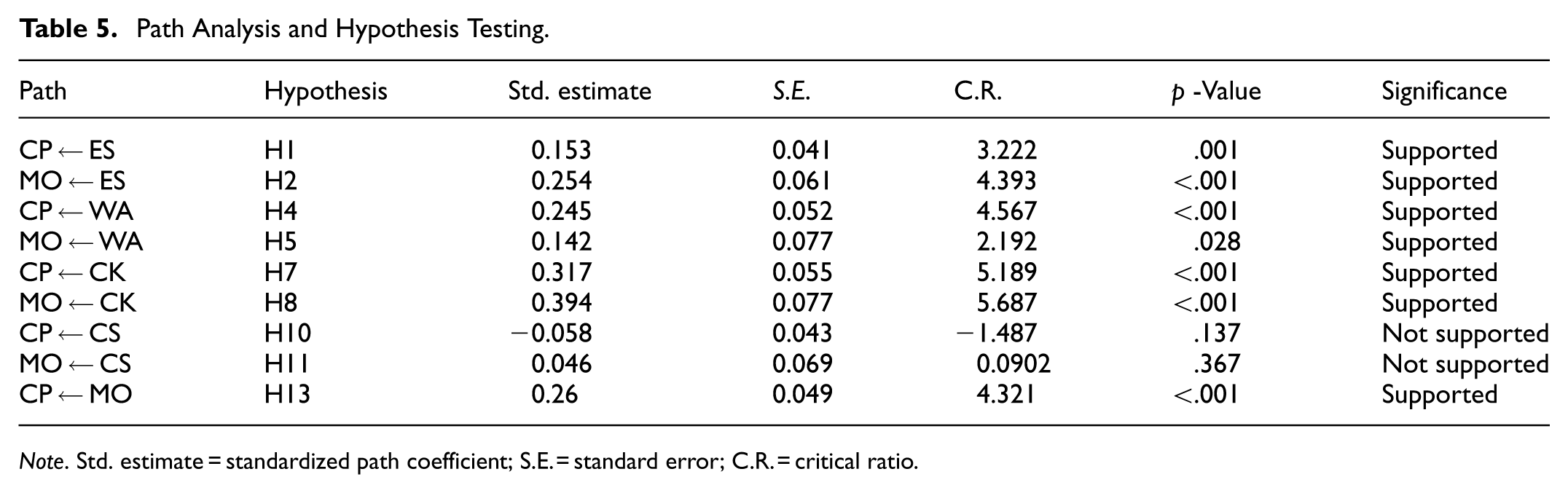
Note. Std. estimate = standardized path coefficient; S.E. = standard error; C.R. = critical ratio.
Mediation Effect Testing
To assess the mediating role of motivation between the key predictors and CBEC performance, this study applied the bootstrap method with 5,000 resamples and a 95% confidence level, using the bias-corrected technique (Byrne, 2013). As shown in Table 6, the results showed significant indirect effects for three paths. Cultural knowledge influenced CBEC performance through motivation with an indirect effect of 0.102, and the confidence interval ranged from 0.045 to 0.212. Workplace aptitude showed an indirect effect of 0.037, with a confidence interval from 0.002 to 0.099. English skill had an indirect effect of 0.066, with the interval spanning from 0.023 to 0.134. Since none of these intervals included zero, the mediation effects were confirmed as statistically significant and interpreted as partial. In contrast, the indirect effect of cultural sensitivity through motivation was 0.012, with a confidence interval from −0.020 to 0.052. The inclusion of zero indicated that this mediation effect was not significant. These findings support the mediation hypotheses for English skills (H3), workplace aptitude (H6), and cultural knowledge (H9), whereas the hypothesis for cultural sensitivity (H12) was not supported. Overall, the results highlight motivation as a critical intermediary linking these core competencies to CBEC performance.
The Mediating Testing.

Discussion
This study investigated the structural relationships between student competencies, motivation, and Cross-Border E-Commerce (CBEC) performance among Chinese vocational students to uncover the precise mechanism for bridging the competency–performance gap. The results from the Structural Equation Modeling reveal that task-oriented competencies, specifically English skills, cultural knowledge, and workplace aptitude, exhibit robust positive associations with both motivation and performance, serving as the primary infrastructure to bridge this gap. In contrast, cultural sensitivity did not demonstrate a significant relationship with either outcome, indicating that abstract dispositional traits alone leave the performance gap unbridged. These findings indicate that competencies perceived as actionable and functionally instrumental act as the primary predictors of self-efficacy and subsequent performance.
The specific Skill (S) and Ability (A) dimensions of the KSAO framework construct the direct operational infrastructure required to span this gap (Marvel et al., 2016). The significant positive impact of English skills on performance observed in this study (β = .153, p = .001) aligns with previous research by Jiao et al. (2020), who emphasized that language proficiency acts as a fundamental technical resource in cross-cultural business communication. However, our findings extend this by highlighting the mediating role of motivation, demonstrating that linguistic proficiency actively fuels the sequential bridge path (indirect effect = 0.066, p = .005). Consistent with Long and Lin (2022), who argued that language skills boost confidence, our data suggests that for vocational students, English proficiency is not merely a communication tool but a driver of self-efficacy within Social Cognitive Theory (SCT; Bandura & Walters, 1977), showing a powerful direct effect on motivation (β = .254, p < .001). Mastery of the language provides the “mastery experience” necessary to navigate the anxiety-prone digital trade environment (Jiang & Qu, 2024). Similarly, the robust influence of workplace aptitude on performance (β = .245, p < .001) and motivation (β = .142, p = .028) echoes the findings of Ho and Chen (2023) and Tseng et al. (2019), which identified self-regulation and problem-solving as critical abilities for adaptability in dynamic e-commerce settings that help systematically close the execution gap (indirect effect = 0.037, p = .042). Viewed through the interpretive context of the respondents’ strong entrepreneurial intentions, prioritizing these operational capabilities over abstract traits appears logical, as they correlate directly with the execution of business tasks.
A stark empirical divergence emerges regarding the role of cultural knowledge versus cultural sensitivity, highlighting which inputs successfully bridge the performance gap. While Zhang and Li (2022) and Hu (2024) have consistently identified positive attitudes and sensitivity as critical enablers of cross-cultural adaptation, our study found no significant link between cultural sensitivity and performance (β = −.058, p = .137) or motivation (β = .046, p = .367), meaning it fails to help bridge the competency-performance gap. This contrasts with the traditional view but aligns with the contextual argument raised by Richter et al. (2023), who noted that the effectiveness of competence constructs depends on their situational fit. The distinct nature of CBEC, relying upon remote, technology-mediated platforms, creates a digital detachment where the nuances of interpersonal sensitivity are less tangible than cognitive skills. Digital trade requires specific operational sensitivities (Wongkhamdi et al., 2020); however, our results imply that general cultural sensitivity scales may not capture the specific “digital empathy” required in screen-based interactions. Instead, cultural knowledge (Knowledge) proved to be the single most powerful tool for bridging the gap, showing the highest direct effects on motivation (β = .394, p < .001) and performance (β = .317, p < .001), while driving the primary indirect bridge path (indirect effect = 0.102, p < .001), supporting Ang et al. (2007) and Fan et al. (2022). This suggests that for vocational learners, a cognitive understanding of foreign markets serves as a more reliable roadmap for decision-making than dispositional openness, thereby reducing uncertainty and fueling the motivational engine to span the performance gap.
The selective activation of these pathways reveals that the bridging mechanism is governed by a clear instrumentality bias within the KSAO-SCT framework. The results support Ye and Dong (2021), who found that entrepreneurial intention mediates the path to business success. Our study refines this by showing that this motivational bridge pathway is selectively activated: only those competencies perceived as usable tools (Knowledge, Skills, and Aptitude) successfully triggered the motivational process required to convert potential into actual performance. This challenges the assumption in broader intercultural literature that global orientation automatically translates into engagement or successfully bridges professional performance gaps (Braskamp et al., 2014). In the pragmatic, outcome-driven context of Chinese vocational education, abstract dispositional attitudes remain inert on the bridge unless they are operationalized through specific, context-relevant tasks.
These empirical findings offer concrete practical implications for systematically engineering the talent development bridge in vocational education. First, the strong effects of English Skills, Cultural Knowledge, and Workplace Aptitude suggest that instruction should focus on competencies that are concrete, actionable, and aligned with real-world tasks, helping to enhance students’ sense of control and outcome expectancy to effectively close the performance gap (J. Liu et al., 2024). Second, the lack of impact from Cultural Sensitivity indicates that attitudinal traits must be embedded in context to be useful. Case-based and simulation tasks, such as role-playing e-commerce disputes or localizing marketing content, can make such traits more tangible and engaging for students. Third, limited access to authentic intercultural platforms can be mitigated through digital simulations and guided reflection, allowing students to rehearse and internalize communication norms to dynamically build the bridge between school and work (Bandura & Walters, 1977). Finally, since CBEC often involves multilingual interactions between non-native speakers, the confirmed roles of Cultural Knowledge and Workplace Aptitude underscore the value of teaching pragmatic communication strategies, like managing tone, clarifying intent, and adapting service approaches. These micro-skills are essential in high-context, culturally diverse trade settings to ensure students can maintain professional performance, especially under initiatives like the Belt and Road (Zhao, 2024).
The integration of the KSAO model with Social Cognitive Theory (SCT) in this study offers a distinct theoretical architecture explaining how vocational performance gaps are spanned. By mapping competencies to the KSAO taxonomy, the findings reveal a clear instrumentality bias within the social cognitive activation mechanism: only the task-oriented dimensions (Knowledge, Skills, and Aptitude) successfully activated the motivational pathway to bridge the performance gap, whereas the dispositional “Other” (Cultural Sensitivity) did not. This challenges the long-held assumption that broad attitudinal traits automatically translate into high digital performance and establishes a crucial distinction for SCT in vocational settings: competencies must be explicitly perceived by students as tangible, executable tools to effectively enhance self-efficacy and successfully cross the gap. Consequently, this research refines the application of the KSAO framework in digital trade education, positing that in outcome-driven, technology-mediated environments, abstract dispositional traits remain inert unless they are operationalized through specific, context-relevant tasks.
Conclusion
This study successfully integrated Social Cognitive Theory with the KSAO framework to construct and validate a comprehensive model of cross-border e-commerce performance among Chinese vocational college students. The empirical results demonstrate that task-oriented competencies, specifically English proficiency, cultural knowledge, and workplace aptitude, are pivotal antecedents that not only directly enhance performance but also indirectly foster it by bolstering student motivation. These findings confirm the mediating role of motivation, suggesting that actionable competencies transform into performance outcomes by activating underlying motivational mechanisms.
Interestingly, the non-significant impact of cultural sensitivity challenges prevailing assumptions, indicating that in the specific context of vocational execution, tangible skills may take precedence over abstract intercultural awareness. Theoretically, this research enriches literature by isolating the specific KSAO dimensions that matter most in an emerging economic context. Practically, the findings offer a strategic roadmap for educators: curriculum design should prioritize foundational linguistic and operational skills to build self-efficacy and motivation, rather than focusing broadly on generalized cultural sensitivity. Future research is encouraged to explore longitudinal designs to verify the causal evolution of these competencies as students transition from academic to professional environments.
Limitations and Future Research Directions
Despite the theoretical and practical contributions of this study, several limitations should be acknowledged, which open avenues for future research. First, this study employed a cross-sectional design, which captures data at a single point in time. While structural equation modeling (SEM) provides evidence of the strength and direction of relationships, it precludes the determination of strict causality among competencies, motivation, and performance. Future researchers are encouraged to adopt longitudinal designs to track the development of these competencies over time and more rigorously test causal inferences.
Second, the measurement of CBEC performance relied on self-reported data. Although common method bias was assessed and found not to be a serious concern, self-assessments may still be subject to social desirability bias or an overestimation of one’s own abilities. Future studies could benefit from incorporating objective performance metrics, such as actual sales volume, conversion rates, or supervisor ratings, to provide a more comprehensive evaluation of student performance.
Third, the sample was composed entirely of vocational college students in China, with a notable gender imbalance favoring female respondents (75.8%). While this reflects the current demographic reality of language and business programs in this context, it may limit the generalizability of the findings to other student populations or to male-dominated cohorts. Future research should aim to validate the model across more diverse samples, including university students or industry practitioners, and potential gender differences could be explored through multi-group analysis.
Finally, regarding the non-significant impact of cultural sensitivity, it is possible that the measurement scale used, originally developed for face-to-face interaction, did not fully capture the nuances of digital cultural sensitivity required in online trade. As CBEC relies heavily on mediated communication, future research could develop and validate new scales specifically tailored to measuring cultural sensitivity in digital and virtual business environments. It is important to note that while the predominantly female and entrepreneurial nature of the sample provides a valuable interpretive context, these demographic characteristics were not formally modeled as structural variables in the current analysis.
Footnotes
Acknowledgements
The authors would like to thank all the vocational college students who participated in this survey for their time and cooperation. We also appreciate the support provided by the administrators of the participating institutions during the data collection process.

Ethical Considerations
This study was formally approved by the UKM Research Ethics Committee at The National University of Malaysia (Approval No. JEP-2024-773) on October 30, 2024, adhering strictly to the Declaration of Helsinki. To limit the risk of harm, the survey was completely anonymous and voluntary, with explicit assurances that withdrawal would not impact academic grades or teacher-student relationships, thereby eliminating any coercion. The potential institutional and societal benefits of optimizing vocational e-commerce talent development frameworks significantly outweighed the minimal risk confined to survey completion time.
Consent to Participate
Digital informed consent was secured prior to data collection: participants reviewed an online introductory sheet detailing the research purpose and their rights, and clicking the “Next Page” button constituted explicit, voluntary consent.
Funding
The authors received no financial support for the research, authorship, and/or publication of this article.
Declaration of Conflicting Interests
The authors declared no potential conflicts of interest with respect to the research, authorship, and/or publication of this article.