






Abstract
A characteristic feature of English academic writing is the use of complex nominal groups, and the complexity of nominal groups is mainly achieved through nominalization and noun modification. To inform the teaching of academic English to Chinese EFL learners, this study investigated the distributions of different types of noun modifications in English academic writing. Using a corpus-based approach, this study compared head nouns, noun modifiers, and nominal group length across three groups of academic writers: published research article (RA) writers and Chinese EFL master students (CMA) and Chinese EFL doctoral students (CPhD) in linguistics. The findings are as follows: (1) RA writers employed first-person pronouns more frequently to construct authorial stance and engagement; (2) RA writers used more clausal modifiers than Chinese EFL students, which contributed to longer nominal groups; (3) RA writers demonstrated higher proficiency of English through a greater use of higher-stage noun modifiers. These findings suggest that pedagogical efforts should guide Chinese EFL students toward producing more native-like academic texts.
Plain Language Summary
This study examined how different academic writers use and modify nouns in English. We compared research article (RA) writers with Chinese postgraduate students of linguistics to better understand their differences and improve academic writing instruction. The two groups we analyzed were professional linguists who publish research articles and Chinese master’s and doctoral students in linguistics. The main findings are as follows. First, Chinese students used fewer personal pronouns such as “I” and “we” than RA writers. As a result, their writing sounded less personal and sometimes more rigid. Second, RA writers more often used full clauses to modify nouns (e.g., “the theory that the researcher proposed”). This made their noun phrases longer and their writing more detailed. Third, RA writers used a wider and more complex range of noun modifiers, which suggests a higher level of writing proficiency. Overall, the study suggests that the goal of teaching EFL academic writing should not be to promote a fixed and overly formal style. Instead, students should learn to use different structures flexibly so that they can write clear and effective academic English.
Introduction
English academic writing has been a major focus of research over the past few decades (e.g., Banks, 2008; Fang et al., 2021; Hyland & Jiang, 2017; Shao et al., 2022). This attention stems not only from its distinctive features compared to other forms of English, but also from its practical benefits: proficiency in academic English serves as a gateway to successful academic publishing and to making effective contributions across both hard and soft sciences. Analyses of academic writing suggest that its most prominent grammatical characteristics include longer sentences, heavier subordination and/or coordination, and a greater use of nominalization and clausal embedding (e.g., Brown & Yule, 1983; Chafe, 1982; Halliday, 2004).
However, the notion that academic writing is characterized by longer sentences and heavier subordination and/or coordination is subject to misunderstanding and challenge. For instance, longer sentences and clausal embedding are dominant in spoken texts, particularly in spontaneous spoken language (Halliday, 1985). Some studies (e.g., Bardovi-Harlig, 1992; Rimmer, 2006) further indicate that academic writers with higher English proficiency do not necessarily produce longer sentences or employ clausal embedding. Rather, the grammatical complexity of English academic writing is argued to reside in the use of complex nominal groups or noun phrases, which enable the packaging of compact, lexically dense and more abstract content (Fang et al., 2006; Lei et al., 2023).
Complex nominal groups are formed through two primary grammatical processes: nominalization and noun modification. Both are characteristic of English academic writing (Banks, 2005; Charles, 2003; Galve, 1998; Halliday, 1998). With the nominalization of verbal groups, participant nominal groups are correspondingly adjectivalized to function as modifiers (He, 2019). See example (1) quoted from Halliday and Matthiessen (1999, p. 343):
(1) a. They shredded the documents before they departed for the airport.
b. Their shredding of the documents preceded their departure for the airport.
The two verbal groups shredded and departed in (1a) are nominalized as shredding and departure respectively in (1b). The personal pronoun they functioning as participants of the two verbal groups in (1a) are correspondingly shifted to the possessive pronoun their functioning as modifiers of the two nominalizations in (1b). The participant nominal group the documents is shifted as a postmodifier. The circumstantial prepositional phrase for the airport is also shifted to function as a postmodifier. These shifts result in longer nominal groups and a reduction in the number of clauses, thus creating a higher lexical density overall.
English as a Foreign Language (EFL) academic writing typically differs from that of proficient English native speakers (ENS). For example, EFL academic writers tend to use fewer participle clauses (Granger, 1997) and fewer verbalizations (He & Yang, 2018) than proficient ENS academic writers. Moreover, the two groups of academic writers demonstrate different uses of first-person pronouns (Martínez, 2005). Studies (e.g., Ansarifar et al., 2018; He & Guo, 2021; Lan & Sun, 2019) also show that the use of noun modifiers may also reflect differences in the proficiency of English academic writing.
The investigation of noun modifier usage in EFL and ENS academic writing holds significant relevance for academic writing pedagogy in the Chinese EFL context. This is essential for preparing Chinese EFL learners to contribute to academia through the medium of English. The hypothesis underlying the research reported in this paper is that proficient ENS academic writers write longer and more complex noun phrases in their academic writing than Chinese EFL academic writers. Specifically, this study sought to address the following research questions:
What differences can be identified in the use of head nouns between proficient ENS academic writers and Chinese EFL writers?
What differences can be identified in the use of noun modifiers between proficient ENS academic writers and Chinese EFL writers?
This study contributes to the existing research on noun phrase complexity in three key respects. First, it extends the analysis to a systematic comparison of noun phrase patterns in Chinese EFL dissertation abstracts with those in published research article abstracts. Second, it provides a fine-grained, corpus-driven profile of the distribution of noun modifiers, revealing how different types of noun modifiers function distinctly across developmental and expert writing. Third, it offers empirical implications for Chinese EFL postgraduate academic writing pedagogy, highlighting specific syntactic features that may be targeted to support Chinese EFL learners’ genre enculturation and communicative effectiveness in international publication contexts.
The Nature of Academic Writing
The Concept of Grammatical Complexity
Research on English academic writing has predominantly focused on specific types of texts, such as research articles (e.g., Gao & He, 2023; Jalilifar et al., 2017; Wu et al., 2020), textbooks (e.g., Biber, 2006; Freddi, 2005; Jalilifar et al., 2014), and book reviews (e.g., Groom, 2005), in order to identify the distinctive features of this register. This is an important task for academic research and has practical benefits, particularly for learners of academic English (e.g., Hewings, 2001; Ouyang et al., 2022; Tao et al., 2025).
One salient feature of academic English is grammatical complexity. Simply put, grammatical complexity refers to the elaborate use of language and the varied deployment of syntactic patterning (Lu & Ai, 2015). This elaboration has often been defined in terms of longer sentences with a dense use of subordinate clauses (Hughes, 1996). However, the use of clausal subordination as a measure of grammatical complexity in English academic writing has been challenged. Research indicates that sentence structures in academic English tend to be simpler, and spontaneous conversation actually contains more subordinate clauses than academic texts (Halliday, 1985). In fact, both academic texts and conversations are complex, but their complexities manifest differently within the grammar. That is, academic texts are typically complex in noun phrases, whereas spoken texts tend to be complex in clause structure (Biber & Gray, 2010).
Halliday (1985) distinguishes between these two types of complexity by using the term “lexical density” to refer to the ratio of content words in a clause, and “grammatical intricacy” to describe the dynamic linking of clauses through coordination or subordination to form clause complexes (cf. Halliday & Matthiessen, 2014). Therefore, rather than using clausal subordination as an indicator of grammatical complexity, complex noun phrases have been identified as a more accurate measure of grammatical complexity in English academic writing (Biber et al., 2011). A study by Biber et al. (2016) on the writing of L1 English university students at different academic levels found that clausal features decreased while phrasal features increased as the students progressed academically. Many other studies (e.g., de Haan, 1989; Larsson et al., 2023; Lorenzo & Rodríguez, 2014) also recognized a greater reliance on complex noun phrases in academic writing.
The evolution of modern English academic writing is characterized by the use of complex noun phrases rather than complex clause structures (Biber & Gray, 2016). Noun phrases serve as the primary resource for increasing lexical density, enabling the relatively economical packaging of a considerable amount of information into a limited number of clauses (Halliday, 1993). Nevertheless, within the field of English for academic purposes, grammatical complexity is commonly operationalized through four key parameters: length, ratio, index, and frequency, with length being the most frequently employed measure (Norris & Ortega, 2009). What this parameter is related to is the mean length of sentence, the mean length of clause and the mean length of T-unit (a main clause along with any subordinate clauses) (Ortega, 2003). Given that academic English is distinguished by high lexical density achieved through nominalization, it is necessary to investigate the mean length of nominal groups as a measure of grammatical complexity. Doing so could provide a clearer understanding of the grammatical nature of written academic English.
Nominalization and Noun Modification
Nominalization is one of the most prominent linguistic features of present-day English academic writing (He & Zhang, 2024; McGrath & Liardét, 2023). This process entails a grammatical shift towards greater abstraction. For instance, a verbal group realizing a process can be nominalized to construe the thing within a participant nominal group, thereby allowing both pre- and post-modification. Consider the verbal group manages in the clause The council manages hazardous waste. The nominalization of verbal group manages results in The council’s hazardous waste management, which can then function as a participant in another clause, such as The council’s hazardous waste management is very effective. Here the original participant nominal group the council has now shifted to become a modifier of the nominalization head noun management, resulting in a longer and lexically denser nominal group.
Premodifiers can be realized as adjectives, participles or nouns, whereas postmodifiers can be realized as finite or non-finite relative clauses, prepositional phrases or appositive noun phrases. Nominalization and the resulting modification patterns of this kind are prevalent in English academic writing but relatively rare in spontaneous spoken English. According to Biber et al. (1999), nearly 60% of all noun phrases in academic writing contain at least one modifier, whereas in conversational English the figure drops to about 15%. Regarding the use of nominalization, He and Yang (2018) found that academic writers within the field of medical sciences use more nominalizations than those within the field of linguistics.
Given that spoken language development precedes written language, Biber et al. (2011) posited that the characteristic features of conversation are acquired earlier and are therefore easier to produce than those of academic writing, which typically require formal instruction. Building on this premise, Biber et al. (2011) hypothesized a 5-stage developmental framework of grammatical features that can be applied to the development of the linguistic competence of the L2 English learners. The framework reflects the progression from conversational competence towards academic writing competence in L2 learners. Structures that are easier and are acquired the earliest are positioned at Stage 1. Such structures are typical of conversational English. Structures that are more difficult and are acquired later are typically characteristic of academic writing and are placed at Stage 5. The framework also displays the relative complexity of noun modifiers. For example, an attributive adjective modifying a head noun (e.g., an
Methodology
Corpus
The corpus used in this study is a specialized, self-compiled collection of academic abstracts from three groups of writers. As the abstract of a typical research article serves as a concise summary which is conventionally structured around key rhetorical moves such as introducing the topic, stating the purpose, describing the method, presenting results, and drawing conclusions (Hyland, 2000), writers are compelled to achieve maximum efficiency, clarity, and economy within a limited word count (Swales & Feak, 2009). Biber and Gray (2011) observed that noun phrases significantly contribute to the compressed style characteristic of academic abstracts. Gray (2013) further noted that abstracts exhibit the densest use of phrasal features, which serve as a strong indicator of noun phrase complexity (Gray, 2013). Moreover, because abstracts consist exclusively of full sentences without non-linguistic insertions (e.g., figures or tables), they provide a reliable basis for analyzing clause constituents.
We collected 30 abstracts from linguistics theses written by Chinese master students (CMA) and 20 abstracts from linguistics dissertations authored by Chinese doctoral students (CPhD), all retrieved from the CNKI Digital Dissertations database. The selection of these two groups of English learners complements previous research that primarily focuses on English learners with lower or intermediate proficiency (e.g., Biber et al., 2020; Durrant & Brenchley, 2023). We concentrated on the discipline of linguistics because, in mainland China, nearly all masters’ theses and PhD dissertations are written in Chinese, with English-related disciplines (such as linguistics and English literature) being notable exceptions. For comparative analysis, 70 abstracts were also collected from recently published research articles (RA) in linguistics. This comparative design follows the methodological precedent established by Xie et al. (2024), who investigated diachronic changes in authorial stance in the discussion sections of Chinese master theses and published research articles. These research articles were sourced from leading international linguistics journals such as Applied Linguistics, Language, Lingua, Linguistic Inquiry, and Linguistics. All these documents are publicly accessible.
The reason for selecting these five journals is that they are widely recognized as leading international journals in the field of linguistics, representing diverse theoretical orientations and sub-disciplinary coverage. By sampling abstracts from these outlets, the study aimed to construct a reliable benchmark of proficient English academic writing produced by expert scholars. In addition, selecting multiple journals rather than relying on a single source helps ensure disciplinary representativeness and reduces the influence of journal-specific stylistic conventions. These journals provide a balanced and comprehensive representation of contemporary research writing practices in linguistics, thereby strengthening the validity of the comparative analysis.
It should be noted that while both the masters’ theses and the doctoral dissertations were produced by Chinese EFL learners, the RAs were not necessarily authored by native English speakers. To ensure the reliability of the collected data, all selected RAs were written by scholars affiliated with prestigious universities in the United States or the United Kingdom. The native English authorship was further verified by checking the names of the authors and the contextual details in the acknowledgement section to ensure that they are from English-speaking countries. These authors are regarded as proficient English academic writers based on their demonstrated advanced proficiency in English, as evidenced by their publication records in those high-impact journals of linguistics.
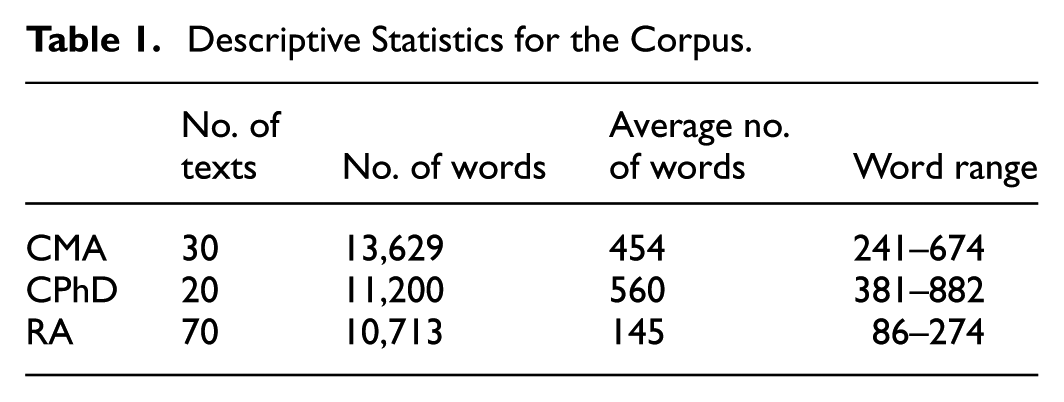
CPhD abstracts are typically longer than CMA abstracts, which in turn are generally longer than RA abstracts. To ensure comparability across the three sub-corpora, we balanced the total word count by including fewer CPhD and CMA abstracts alongside a comparatively larger number of RA abstracts. The final corpus comprises 120 texts, totaling 35,002 words. The descriptive details of the corpus are presented in Table 1.
Descriptive Statistics for the Corpus.
Data Collection
The data coding in this study is grounded in two theoretical frameworks. Specifically, the noun modifiers are classified according to the hypothesized developmental stages of complexity features proposed by Biber et al. (2011), a scheme adopted for the analysis of noun modifiers in our corpus. See Table 2.
Biber et al.’s (2011) Hypothesized Developmental Stages for Noun Modification.
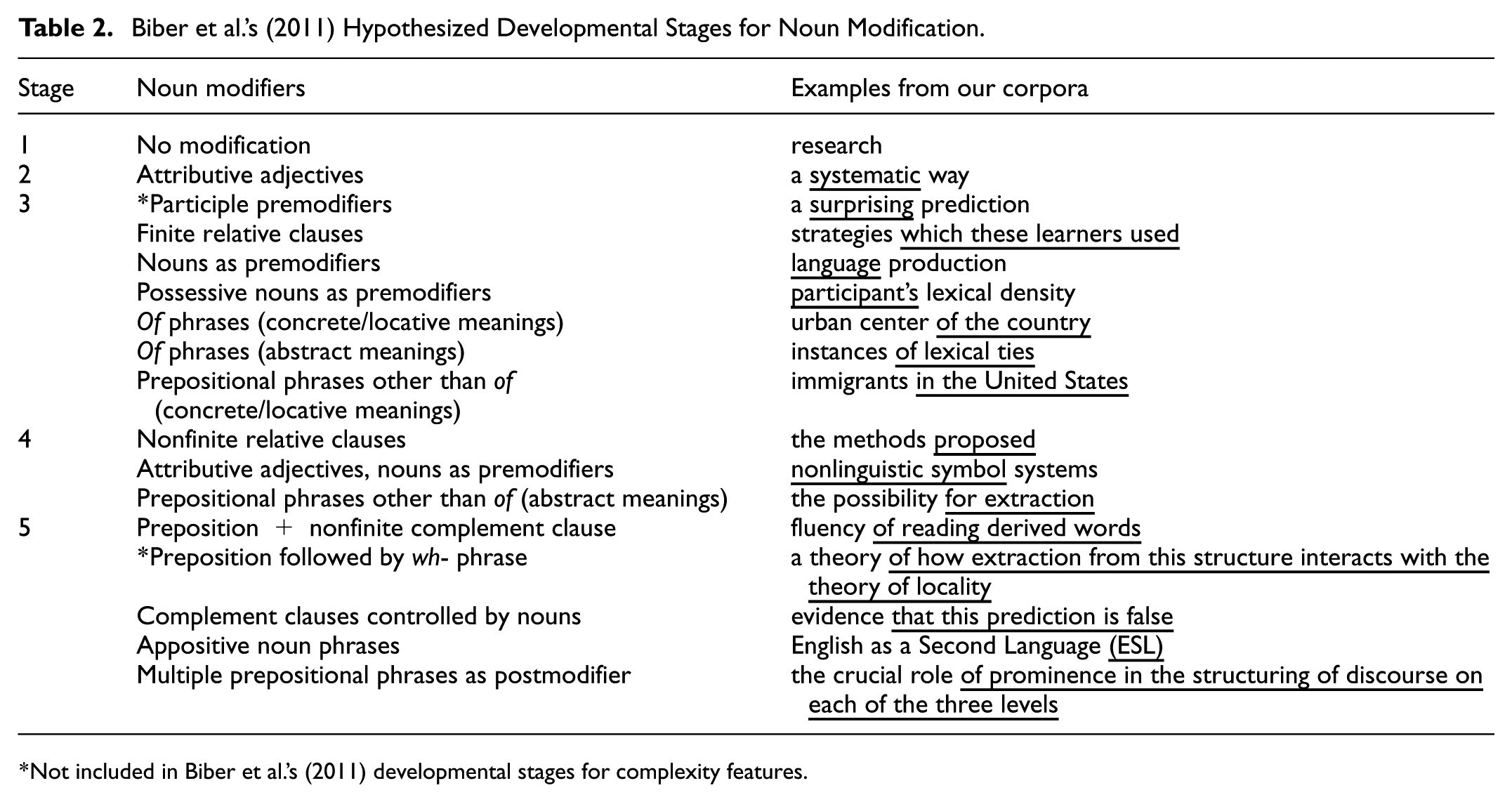
Not included in Biber et al.’s (2011) developmental stages for complexity features.
To measure the average length of nominal groups, the constituent elements within each nominal group are counted. A useful approach is illustrated by Halliday and Matthiessen’s (2014) description of nominal groups in terms of logical structure and experiential structure. The logical structure comprises a Head along with its pre- and/or post-modifiers, while the experiential structure consists of a Thing accompanied by one or more characterizing elements that precede it—Deictic, Post-Deictic, Numerative, Epithet1, Epithet2 and Classifier—and a Qualifier that follows it. The experiential structure of the nominal group those two splendid old electric trains with pantographs (Halliday & Matthiessen, 2014, p. 364) can be illustrated in Figure 1.

Experiential structure of a nominal group.
The Head of a nominal group can be realized as a common noun, a proper noun, a pronoun or a nominalization. Since noun modification can occur at multiple levels within a nominal group, different levels are used for marking the position of head nouns in a nominal group. For example, aspects in the nominal group aspects of duration and intensity and formants of intervocalic stops in unstressed syllables of male announcers in VOA News in causal speech is a level 1 head noun, duration, intensity and formants are level 2 head nouns, and speech is a level 7 head noun. This study focuses exclusively on phrasal subordination. Therefore, for the three coordinated level 2 head nouns, we only coded the head noun carrying the largest number of modifying elements, or the first head noun when they are carrying the same number of elements. The number of head nouns at different levels reflects the degree of embedding within the nominal group. The relative proportions of head nouns at different levels indicate the structural complexity of the nominal groups in a text or corpus.
The corpus was annotated manually using UAM CorpusTool 3.3. Guided by the analytical frameworks, we designed the coding scheme for the types and levels of head nouns, and that for noun modifiers and their positions within the developmental stages. It is expected that academic writers with higher English proficiency would produce a greater proportion of head nouns at higher levels and fewer head nouns at lower levels compared to those with lower English proficiency. The data collected from our corpus are presented in Tables 3 to 5:
Head Nouns Retrieved from the Corpus.

Noun Modifiers Retrieved from the Corpus.

Distribution of Functional Elements in Nominal Groups.

The length of a nominal group is defined as the number of functional elements that specify its head noun. For instance, the nominal group shown in Figure 1 has a length of six, as it comprises one Deictic, one Numerative, two Epithets, one Classifier and one Qualifier. When calculating the average length of nominal groups in a text, only level-1 head nouns were included. Because pronouns and proper nouns are seldom modified, any modifiers attached to them were excluded from the data.
Data Analysis
Pearson’s Chi-squared test was conducted in SPSS 29.0 to examine the distribution of the data across the three groups of texts and to assess whether the observed differences were statistically significant. The formulas for Pearson’s Chi-squared test are as follows:


where
However, despite the statistical significance (p < .05) of the Chi-squared test results, the association between the variables may not hold meaningful practical relevance. This highlights the importance of interpreting the results with an emphasis on effect size rather than relying solely on significance testing. The formula for effect size test is as follows:

where N is the sample size, while k is the minimal dimension (row or column). Cramer’s V ranges between 0 and 1. Values closer to 1 indicate a stronger association, while values closer to 0 reflect a weaker association. For nonparametric analysis, we used Cohen’s w test.

According to Cohen (1988), a value below 0.1 indicates a negligible or very weak association between variables, which, even if statistically significant, generally holds little practical meaning. Values between 0.1 and 0.3 suggest a weak effect, implying a modest effect. A value ranging from 0.3 to 0.5 reflects a moderate effect, denoting a clear and substantive association that warrants attention in applied contexts. Finally, a value of 0.5 or higher represents a strong effect, signaling a pronounced relationship with meaningful practical or theoretical implications.
We also compared the distributions of the frequencies of head nouns across the three groups of texts at different levels. For this purpose, we first examined the regularity of the distributions of the data and then compared the distributional patterns across the three groups of texts by performing regression analyses based on the power-function model:

where parameters a and b jointly describe the distribution pattern. The coefficient a reflects the starting point of complexity and the magnitude of change. The exponent b determines the rate of decay in complexity as the level deepens. A larger b value signifies a more limited capacity to construct or sustain deeply nested structures, resulting in a short-tailed distribution. The two parameters together quantify the balance between efficiency and capacity in the syntactic strategies of different groups of academic writers.
Distribution of Head Nouns in Noun Phrases
This section analyzes the distribution of different types of head nouns and examines the complexity of noun phrases along two parameters: average length and structural complexity.
Distribution of Head Nouns
Of the four types of head nouns, common nouns account for more than half of the total frequency, while nominalizations represent approximately half the frequency of common nouns. To facilitate comparison, all raw frequencies were converted to normalized frequencies per 10,000 words. We then compared the normalized frequencies of each type of head nouns across the three sub-corpora. See Figure 2:
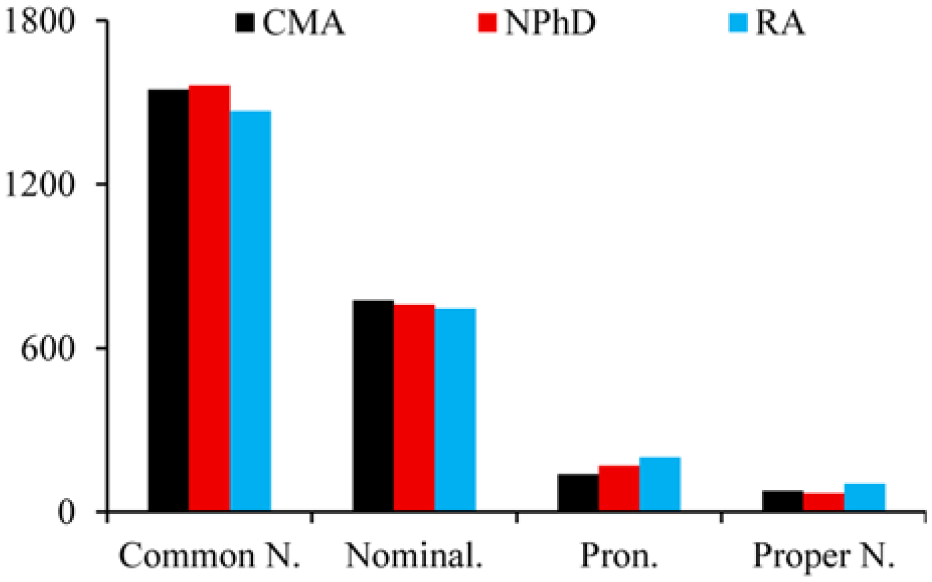
Distribution of the four types of head nouns.
Figure 2 shows that the distributions of the four types of head nouns are generally significantly different in the three sub-corpora (
In English academic writing, pronouns are generally discouraged. This is evident from the fact that their frequency in spoken conversation is approximately seven times higher than in academic writing and there are also more pronouns in other non-academic written registers than in academic writing (Biber et al., 1999). Given this, one might expect that the RA writers would use fewer pronouns than the less experienced Chinese EFL students. However, as shown in Figure 2, the RA writers actually employed fewer nominalizations but more pronouns than the Chinese EFL students.
Personal pronouns, particularly the first-person pronouns I and we, are a core linguistic resource for writers to engage with readers, construct a stance, and claim authority (Hyland, 2005). The RA writers used pronouns as head nouns significantly more frequently than both the CMA and CPhD writers. This pronounced usage demonstrates their greater proficiency in crafting a distinct authorial voice to guide arguments, establish authority, and interact with readers. The fact that the CMA group used pronouns a little more frequently than the CPhD group may suggest that the CPhD writers pursued a higher degree of formality in academic writing or they might be more inclined to avoid pronouns that could be perceived as subjective. Coupled with the finding that the CPhD group used common nouns and nominalizations the most frequently, this pattern suggests a strategic adjustment phase during academic socialization. The CPhD writers appeared to be deliberately shifting from seemingly subjective pronouns toward more objective nominalized structures, aligning their writing with perceived norms of advanced academic writing.
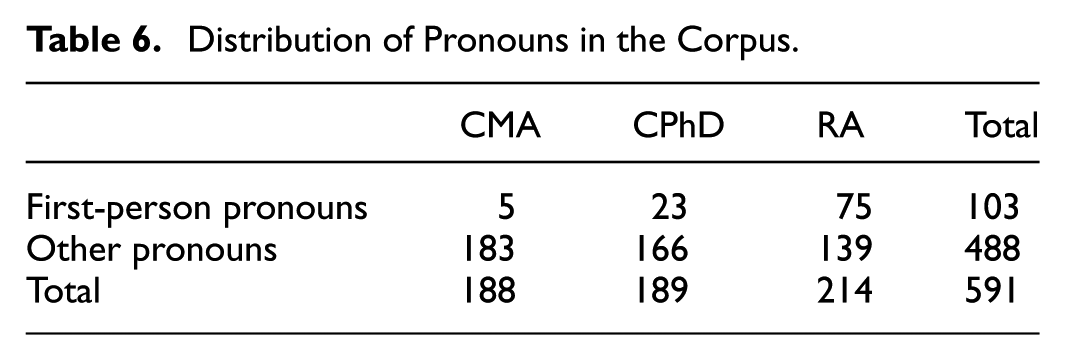
An examination of pronoun types, however, reveals an interesting trend in RA academic writing. As presented in Table 6, first-person pronouns and other pronouns show distinct distribution patterns, and their normalized frequencies are compared in Figure 3.
Distribution of Pronouns in the Corpus.
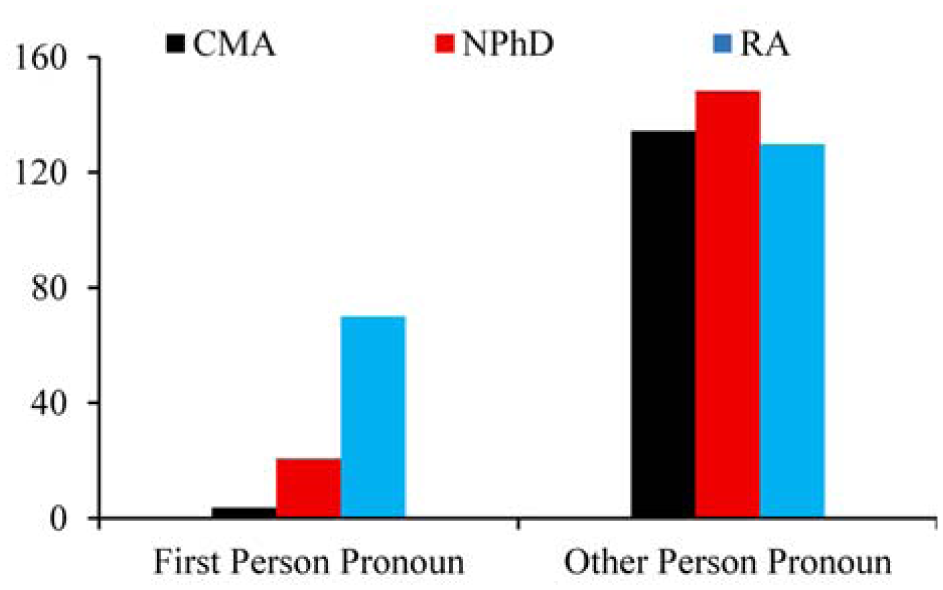
Distribution of person pronouns in the three sub-corpora.
Figure 3 shows a significant difference in the distribution of first-person pronouns across the three sub-corpora (
The frequent use of first-person pronouns (e.g., I argue, we propose) by the RA writers provides direct linguistic evidence of their efforts to construct an authorial identity, explicitly claim originality, and proactively guide readers through academic texts. The fact that the CPhD writers use first-person pronouns more frequently than the CMAs indicates that, during the process of academic socialization and with increasing experience in academic writing, the CPhDs begin to consciously increase their use of this important rhetorical resource, thereby aligning their practice more closely with that of the RA writers. This finding revised the earlier speculation that CPhDs inclined to avoid pronouns, revealing instead that they were strategically adjusting their usage patterns.
The distribution of other personal pronouns shows no significant difference across the three groups, with the RA group using them least frequently. This implies that the RA group’s preference is highly selective—only first-person pronouns are significantly increased, not all personal pronouns. This selective use underscores the precision of their rhetorical strategy. Their increased use of first-person pronouns thus serves specific functions, such as constructing a stance and engaging readers, rather than reflecting a general increase in pronoun use.
Nominal Group Complexity
The complexity of nominal groups can be reflected in their length and structure. Since the RA writers used fewer nominalizations and more personal pronouns, we could hypothesize that the RA writers would produce shorter and structurally less complex nominal groups.
We annotated 12,978 functional elements in nominal groups in the three sub-corpora, including 5,192 level 1 head nouns, finding that the average length of nominal groups is 2.53. See Table 7.
Average Length of Nominal Groups.

It can be seen from Table 7 that the mean length of nominal groups used by the RA writers is greater than those by the CMA and CPhD groups, although the Chinese EFL students use both common nouns and nominalizations more frequently than ELs. The Chi-squared test shows that the distribution of the frequencies of head nouns and functional elements in the CMA texts is not significantly different from that in the CPhD texts (
The frequency of head nouns is extremely high in all the three sub-corpora, but it decreases with the increase of levels. We, therefore, compared the distributions of the frequencies of head nouns across the three groups of texts. Based on the data shown in Table 7, we expected that the distributions of the head nouns at different levels should abide by the power function.
Table 8 and Figure 4 illustrate the distribution patterns, and the results of the non-linear regression analysis are shown in Table 9.
Data Collected for the Levels of Head Nouns.

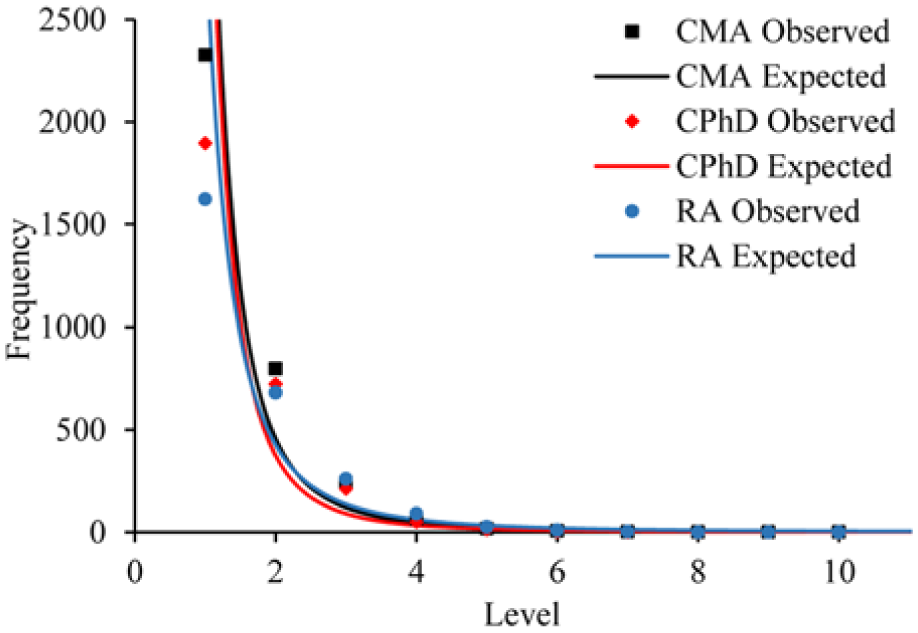
Fitting the level distributions of head nouns.
The Power Regression for the Levels of Head Nouns.
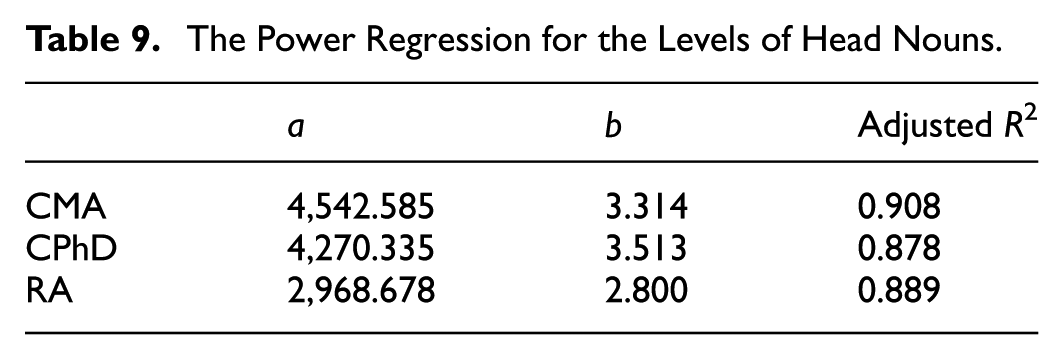
The results indicate that all the three groups of data exhibit a strong power-law decay pattern (adjusted R2 > .87), confirming that the distribution of head nouns at different levels follows a systematic quantitative pattern. However, key parameters revealed notable differences among the three groups. The highest value of parameter a in the CMA corpus indicates the highest starting point and a relatively rapid decay. The largest value of parameter b in the CPhD corpus corresponds to the most rapid decline of the curve with the increase of the levels. Both indicate the higher frequency of level 1 head nouns. The lowest a and b values in the RA corpus indicate that the frequency of level 1 head nouns is the smallest and the frequency declines the slowest with the increase of the levels, and that the RA writers maintain the ability to produce relatively higher number of complex structures at higher levels (e.g., Levels 3–6).
The CMA and CPhD groups used more level 1 head nouns than the RA group, but the s used fewer level 2 head nouns than the other two groups of writers. Head nouns at levels 3 to 6 are all used the most frequently by RA writers. This distribution trend indicates that RA writers produced more complex nominal groups than Chinese EFL students and that the CPhDs produced more complex nominal groups than the CMAs. The distributions of the data at the first four levels are significantly different in the three sub-corpora (
It can be concluded that although the RA writers used a smaller number of nominalizations and a larger number of first-person pronouns in their academic writing, their nominal groups are more complex in terms of length and structure than those produced by the CMA and CPhD groups. These differences reflect a divergence in syntactic strategies. RA writers are more adept at precisely constructing deeply embedded, complex nominal groups when rhetorically necessary to achieve high information density and logical integration, whereas Chinese EFL writers, particularly the CPhDs, may adopt a more conservative strategy characterized by steeper decay and a shorter tail, possibly to manage the structural risk. This finding offers quantitative evidence from the perspective of syntactic distribution for understanding the development of academic language proficiency and the expert balance between efficiency and capacity in academic writing.
When combined with the previous finding that the RA writers used first-person pronouns with the highest frequency, it can be argued that a hallmark of advanced academic writing lies in the ability to skillfully and effectively switch between and balance highly integrated nominal structures and clearly engaging first-person strategies, depending on specific rhetorical purposes (e.g., compressing information vs. constructing stance). This precise orchestration of syntactic-rhetorical resources may be a key factor distinguishing the RA writers from the Chinese EFL learners.
Distribution of Noun Modifiers
In this section, we delved deeper into understanding the complexity of the nominal groups used by the three groups of writers. We examined the distribution of different types of noun modifiers and explored which types contributed to the complexity of the nominal groups used by the RA writers.
Overall Distribution of Noun Modifiers
As shown in Figure 5, which presents the normalized frequencies of the seven types of noun modifiers, attributive adjectives are the most common across all the three sub-corpora, followed by prepositional phrases. Nouns acting as premodifiers rank the third, whereas the remaining four types of modifiers collectively account for only a small proportion.
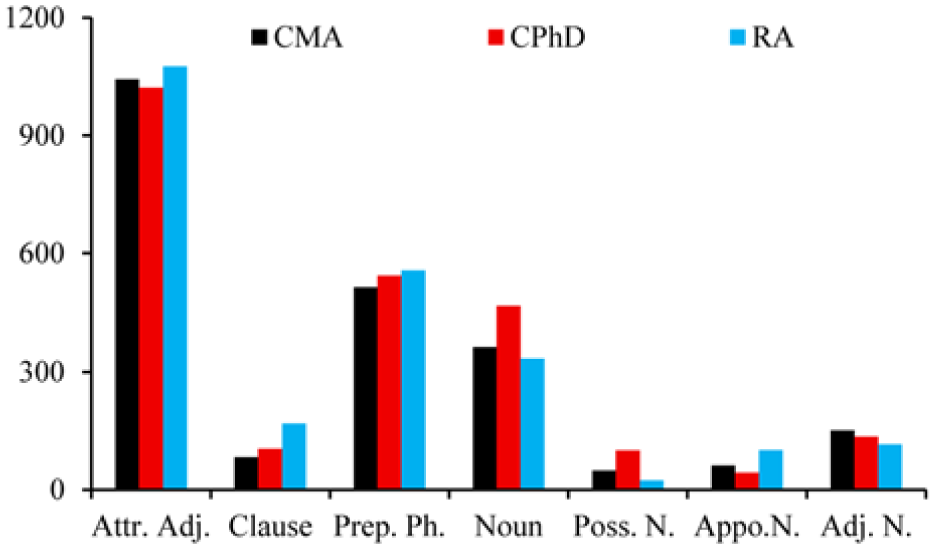
Distribution of the seven types of noun modifiers.
The analysis of noun modifiers reveals distinct patterns across groups. The distributions of attributive adjectives in the three sub-corpora are not significantly different (
The distributions of adjective plus noun premodifiers are not significantly different in the three sub-corpora (
The noun modifiers investigated in this study can be categorized as premodifiers (e.g., attributive adjectives, nouns, possessive nouns and adjectives plus nouns) and postmodifiers (e.g., clauses, prepositional phrases, appositive noun phrases). In all the three sub-corpora, premodifiers collectively occur more frequently than postmodifiers. See Figure 6.
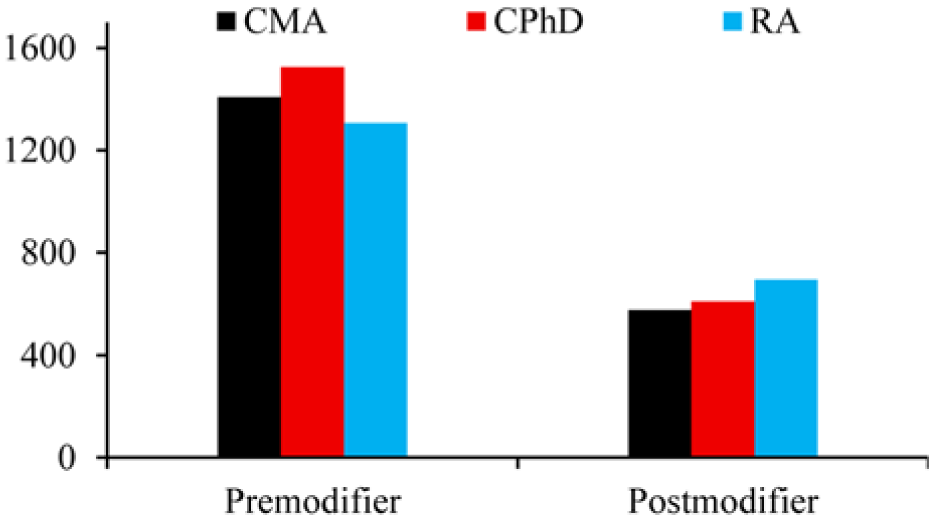
Distribution of premodifiers and postmodifiers.
The Statistical analysis reveals a distinct pattern. The frequency of premodifiers is the lowest in the RA sub-corpus (
Distribution of Noun Modifiers at Different Developmental Stages
Given that experienced academic writers typically employ more advanced modifiers, it is reasonable to hypothesize that higher-stage noun modifiers would occur the most frequently in the RA sub-corpus, followed by the CPhD sub-corpus, and then the CMA sub-corpus. Figure 7 presents the distributions of these normalized frequencies across stages for comparison with this hypothesis.
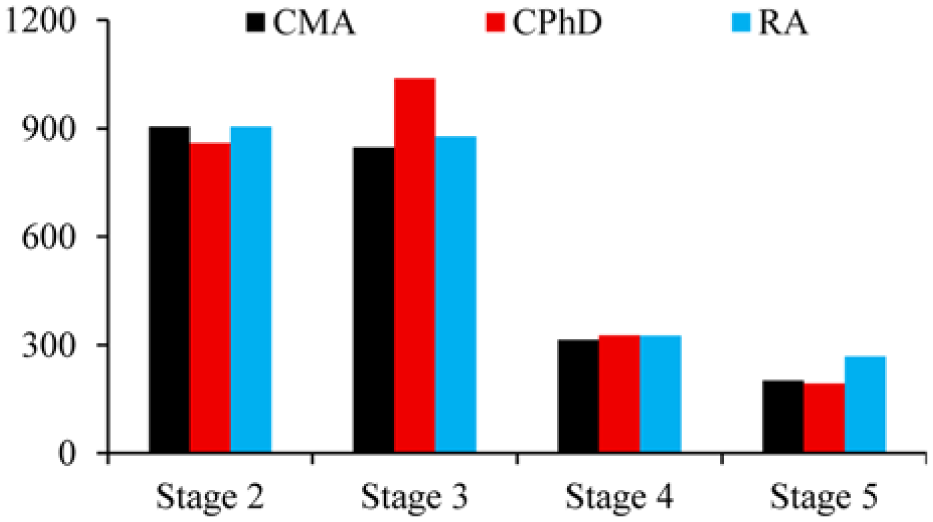
Different stage noun modifiers in the corpora.
The distributions of the normalized frequencies of noun modifiers across the four developmental stages are significantly different in the three sub-corpora (
In line with our hypothesis, higher stage modifiers are the most prevalent in the RA sub-corpus, whereas lower stage modifiers tend to occur more in the CPhD sub-corpus. This indicates that the RA writers possessed a richer and more accessible repertoire of complex structures, enabling them to deploy higher stage modifiers as needed to achieve precise logical expression and higher information integration.
Discussion
The findings of this study present a nuanced picture of academic writing proficiency. On the one hand, the RA writers used significantly fewer nominalizations and more first-person pronouns than Chinese EFL students. This pattern, rather than indicating informality, reflects the RA writers’ strategic use of conversational resources to engage readers and construct an authoritative stance. On the other hand, consistent with Biber et al.’s (2011) hypothesized developmental model, the RA writers employed a greater proportion of higher-stage noun modifiers, demonstrating their command of complex syntactic structures. This syntactic sophistication stems primarily from their predominant use of postmodifiers, which enables deeper embedding within nominal groups. In contrast, no significant difference in nominal group complexity was found between the CPhD and CMA groups, suggesting comparable proficiency levels in this domain. This section discussed these key findings.
Across all the three sub-corpora, attributive adjectives, prepositional phrases and nouns as premodifiers are the three most common types of noun modifiers, collectively accounting for over 80% of all noun modifiers. This finding is in agreement with the findings of previous studies (e.g., Ansarifar et al., 2018; Hu & He, 2023; Parkinson & Musgrave, 2014). The overall frequency of prepositional phrases is similar across groups. Within this category, of-phrases predominate, constituting over 45% of all prepositional phrases in each sub-corpus. Biber et al. (1999) attributed the prevalence of of-phrases to the wide functional range of. Semantically, most of-phrases and other simple prepositional phrases carry abstract meanings rather than concrete/locative meanings (over 90% and over 80%, respectively). This proportion exceeds the 60% reported by Biber and Gray (2010) for contemporary academic English, underscoring the strongly abstract nature of noun modification in our corpus.
The greater use of postmodifiers by the RA writers facilitates the production of longer and structurally more complex nominal groups. This structural potential arises because, unlike premodifiers which are exclusively phrasal or lexical in the Hallidayan sense (Halliday, 1961), postmodifiers in English can be either phrasal (e.g., prepositional phrases) or clausal (Biber et al., 2009). This distinction is illustrated in the following example quoted from Biber and Gray (2010, p. 9):
(5) a. the participant perspective →
the perspective that considers the participant’s point of view
b. a systems, theoretical orientation →
an orientation which is theoretical and which focuses on the analysis of systems
The data collected in this study indicate a clear preference for phrasal modifiers over clausal modifiers in English academic writing (see Table 10). To facilitate comparison, we converted the total nominalized frequency of clausal modifiers (356) to that of phrasal modifiers (6,703). See Figure 8.
Phrasal and Clausal Modifiers in the Three Sub-Corpora.
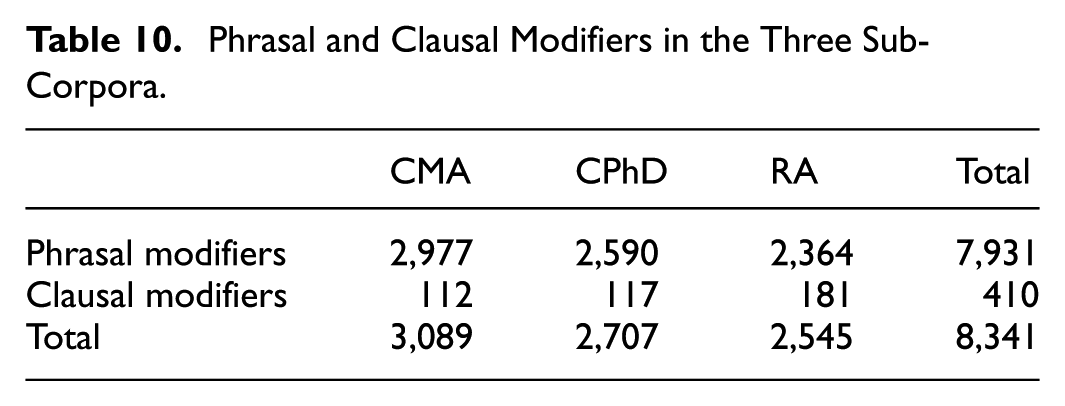
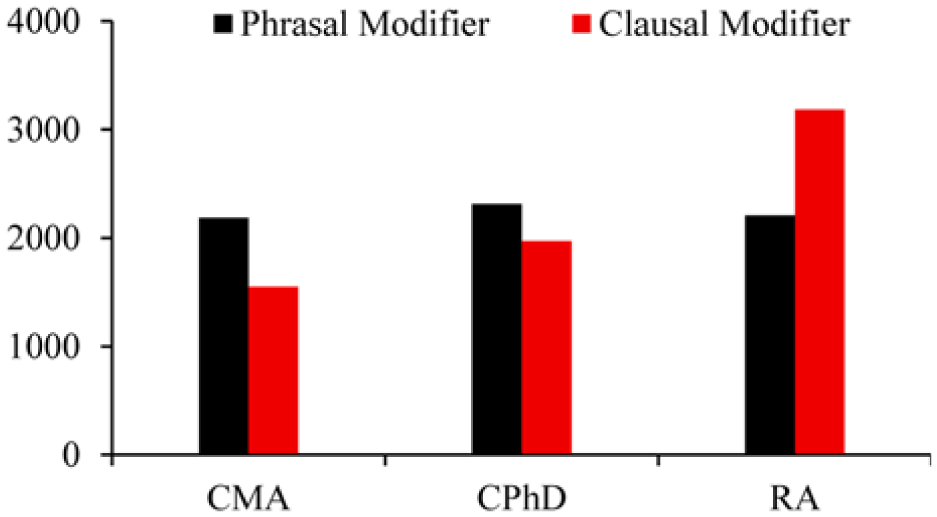
Comparing the distributions of phrasal and clausal postmodifiers (equal totality).
Phrasal modifiers are similarly distributed across the three sub-corpora (
The fundamental divergence in nominal group complexity between the RA writers and the Chinese EFL writers lies not in phrasal modifiers, but specifically in the use of clausal modifiers. Proficiency in employing clausal modifiers, particularly relative clauses, is a key syntactic hallmark of advanced academic writing. This proficiency accounts for the RA writers’ ability to construct more deeply embedded nominal groups and their overall preference for postmodification. The comparative analysis of phrasal versus clausal postmodifiers ultimately pinpoints the linguistic essence underlying the differences in syntactic strategies between the RA writers and the Chinese EFL learners.
A key finding of this study is that the RA writers used first-person pronouns more frequently than Chinese EFL students, with the CPhDs also using them more than the CMAs. This pattern diverges from the traditional emphasis in Chinese EFL pedagogy, where students are often taught to avoid first-person pronouns to uphold the objectivity characteristic of academic language (Hyland, 2006). In light of this teaching norm, the lower frequency among Chinese EFL writers is understandable. Conversely, the prevalent use of first-person pronouns by the RA writers in our corpus suggests that strategic self-mention may be interpreted not as a breach of objectivity, but as a legitimate and effective rhetorical resource in academic writing.
Academic writing is fundamentally an interactive process between writers and readers, in which self-mention serves as a key linguistic resource for constructing authorial stance (Hyland, 2005). Specifically, first-person pronouns are a crucial means of building authorial identity and claiming originality (Hyland, 2001, 2008). Research demonstrates that writers strategically employ such devices to convey evaluative attitudes (Wang & Hu, 2023; Xie, 2020; Xie et al., 2024). This strategic use exhibits disciplinary variation: it is more frequent in soft sciences to express viewpoints, whereas in hard sciences it primarily describes methods and procedures (Hyland, 2004). Furthermore, cross-linguistic and comparative studies indicate that self-mention is more prevalent in English than in Italian academic texts (Molino, 2010), and that expert international writers use it more frequently than novice writers to construct a persuasive authorial identity (Xie et al., 2024).
Previous research suggests that many written registers in English have become less formal (Adel, 2008; Foster, 2005; Leedham, 2015), including academic texts (Alipour & Nooreddinmoosa, 2018; Hyland & Jiang, 2017). For example, Hyland and Jiang (2017) found an increase in informal features in English academic writing, while Alipour and Nooreddinmoosa (2018) found that informal features are more frequent in academic texts written by proficient English writers than those written by Iranian EFL writers. This aligns with our finding that the RA writers used more first-person pronouns and fewer nominalizations than the Chinese EFL writers at the graduate and doctoral levels.
The claim that English academic writing is becoming more informal, however, has been challenged in recent years. Hyland and Jiang (2017) presented a more nuanced view, noting significant disciplinary variation—for instance, a marked increase in first-person pronouns in applied linguistics. Moreover, while first-person pronouns are common in spoken English, Biber and Gray (2010) argued that the historical trajectory of English academic writing is defined not by becoming more speech-like, but by its increasing reliance on complex noun phrases, a feature that fundamentally distinguishes it from conversation. They posited that this structural complexity is a more pervasive register-defining phenomenon than the use of informal features in English academic writing.
The findings of the present study complicate this narrative. We observed that the trend toward informal features (e.g., first-person pronouns) coincided with particular patterns in the use of complex nominal groups. Specifically, despite their higher proficiency, the RA writers produced less technical or less heavily nominalized constructions than Chinese EFL students. This suggests that advanced academic writing may involve a strategic integration of interpersonal, stance-oriented features like self-mention with a particular type of syntactic complexity, rather than a straightforward choice between informality and nominal group complexity.
We are not suggesting that academic writing is converging with spoken English. The pervasive use of complex nominal groups remains a key feature that distinguishes academic writing from conversation. However, our analysis reveals a more nuanced relationship between proficiency and formal complexity: within academic writing, the RA writers tended to use less compressed and therefore less technical nominal groups than Chinese EFL writers. Thus, whereas advanced writing proficiency among the Chinese EFL learners is often associated with increased technicality, the RA writers reveal a strategic divergence: high proficiency can also involve the deliberate choice to reduce formal complexity.
Conclusion
This study investigated the characteristics of nominal groups in English academic writing to explore their relationship with academic writing proficiency, based on a self-built corpus of three groups of linguistics texts. The findings indicate that the RA writers produced longer nominal groups than the Chinese EFL students. This supports our hypothesis that the average length of nominal groups in English academic writing is positively correlated with the writers’ academic writing proficiency. This increased length is primarily due to their more frequent use of clausal postmodifiers rather than nominalizations. While phrasal modifiers which contribute more to lexical density are fundamental to academic writing and their distribution aligns with that of nominalizations, the RA writers’ predominant use of clausal modifiers does not indicate lower proficiency. Instead, along with their higher frequency of first-person pronouns and lower frequency of nominalizations, it suggests a strategic stylistic choice that may reflect a broader trend toward a less formal style in expert academic writing.
This study yields important pedagogical implications for teaching English academic writing to Chinese EFL university students. First, instruction should aim to demystify certain traditional prescriptions, such as the prohibition of first-person pronouns and the consequent overreliance on passive voice. Encouraging appropriate authorial involvement could be presented as a contemporary dimension of effective academic writing. Accordingly, teaching should balance the need for objectivity with training in strategic self-mention, thereby enhancing the expressive power and interpersonal engagement of academic writing.
Second, students should be guided to use modifiers more strategically. Specifically, they are recommended to reduce an over-reliance on certain premodifiers (e.g., nouns, possessive nouns, and adjective-noun combinations) and to develop greater competence with postmodifiers, particularly finite and non-finite relative clauses. This shift would help foster the production of more structurally complex and linguistically precise nominal groups in academic writing, better equipping students to meet the demands of academic expression.
This study has several limitations. First, the corpus is confined to linguistics texts, which constrains the generalizability of the findings to other academic disciplines. Second, our criterion for identifying expert writers—affiliation with prestigious Anglophone universities—conflates language proficiency with institutional, editorial, and disciplinary influences, making it difficult to attribute differences solely to language proficiency. Third, the corpus size is relatively small, and the deliberate imbalance in the number of texts across sub-corpora (a design choice to balance total word count) may have potentially impacted the representativeness and statistical power of some comparisons.
Footnotes

Ethical Considerations
This article does not contain any studies with human or animal participants.
Funding
The author disclosed receipt of the following financial support for the research, authorship, and/or publication of this article: The work was supported by the Major Program of National Fund of Philosophy and Social Science of China [24&ZD250]
Declaration of Conflicting Interests
The author declared no potential conflicts of interest with respect to the research, authorship, and/or publication of this article.
Data Availability Statement
Data sharing not applicable to this article as no datasets were generated or analyzed during the current study.