






Abstract
While the number of students studying in their home countries (in situ) is usually larger than that of students studying overseas, less attention is paid to the effects of equipment on student immobilities. Drawing on Heidegger’s perspective on things as equipment, this study adds nuances to research on the mobility turn, shaped by assemblages of materialities. Interpretative conversations were conducted with 35 students at universities in Vietnam. This study analyzed the use of equipment in three modes: present-at-hand, ready-to-hand, and unready-to-hand. It then interprets how these modes of use shape students’ engagement with the world and sustain their in-situ education. The materialities students possess and mobilize for study in their home countries are transformed into social equipment that enables socially shared investment in higher education among students, parents, communities, and educational institutions. The totality of socially embodied equipment constructs “air-conditioned” universities whose materialities shape students’ decisions to study in situ and retention through entanglement with the world.
Plain Language Summary
Using Heidegger’s concept of equipment, this study investigates how students’ use of tools and resources influences their decision to attend university in their home country rather than study overseas. This study employed interpretive conversations with 35 Vietnamese students to examine the resources they rely on, such as technology, classrooms, and money. Equipment is conceptualized as socially shared, facilitating greater access to higher education. The notion of “air-conditioned” universities is created by this shared equipment, allowing students to continue their education in their home country despite the effects of the physical surroundings.
Keywords
Introduction
In 2021, 220 million students enrolled in post-secondary education in their home countries (in situ), with projections reaching 380 million by 2023 (Murthi & Bassett, 2022). Similarly, in 2023, the number of domestic students enrolled at 176 public and 66 non-public universities in Vietnam reached 612,000, out of a population of 98.8 million (The Vietnamese Government, 2023).
Extant research focuses on several aspects of in-situ education. Some studies examine students’ (dis)satisfaction with university resources and services (Dinh et al., 2021) and parents’ financial support for their children’s higher education (Freire & Giang, 2012). Students’ dynamic identities are also explored in relation to the influences of legal, educational, societal, and familial structures (Nguyen, 2025). Parental influences on their children’s decisions to pursue higher education in their home countries have been investigated in some research (e.g., Adeyanju et al., 2020). Other studies have investigated the intrinsic value of students’ in-situ studies and their resilience in confronting challenges in university learning (Durón-Ramos et al., 2020; Juntunen et al., 2022). Overall, the reasons and driving forces behind in-situ education have been thoroughly researched. However, materials used as equipment or their effects on immobility do not receive equal attention.
Materialities in education refer to relational, context-dependent configurations of things, institutional arrangements, and social relations that gain meaning through students’ interactions (Brooks & Waters, 2018; Gunter et al., 2020; Lee & Waters, 2023). The significance of materialities is disclosed through students’ engagement with materials in everyday learning. Materialities can only matter to students’ learning experiences through the purposes students embed in their use of materials. Taking this idea on board, this study argues that things or materials only make sense when students reveal their multifunctionalities through their use of them as functional equipment. Drawing on Heidegger’s (1962) theoretical framework of equipment, this paper shows that mooring can be sustained by individuals’ desires shaped by the equipment they use. In this study, the term “equipment” refers broadly to resources, tools, networks, and facilities that support students’ in-situ education. They include material objects such as books, digital devices, or campus facilities. This term also indicates non-material elements such as social relationships and institutional academic arrangements.
This study attends to students’ use of equipment in regular modes, breakdowns, and reconfigurations. It moves beyond descriptive accounts of materials and infrastructural tools to interpret how students’ lived experience of being-in-the-world is structured through their practical involvement with equipment. This study seeks answers to the following questions:
What equipment do students use and mobilize to make the decisions to study in situ and sustain their participation?
How do they use the equipment?
What does the use of equipment mean to them?
Literature Review
Materialities Shaping Students’ Decisions and Retention to Study In Situ
Overall, three major strands of research have addressed materialities. The first strand, which associates materialities with assemblages, follows Deleuze and Guattari’s rhizomatic perspective. An assemblage of materialities is defined as the dynamic configurations of human and non-human elements. They include physical objects, infrastructures, technologies, bodies, institutional arrangements, emotions, and social relations that shape people’s sense-making of their lives (Gunter et al., 2020). Lee and Waters (2023) contended that the materialities that shape international student mobility include people, non-human factors, places and proximity, facilities, and built environments. Assemblages of materialities are multidimensional and shaped by interconnected factors, such as financial constraints, visa policies, digital technologies, and students’ expectations of earning internationally recognized degrees for future employment.
Some studies in this first research strand relate materials to socio-material objects that shape how students perceive related places and constitute universities’ spaces. These materials are viewed as a combination of various materials students use to meet their academic goals (Brooks & Waters, 2018; Lee & Waters, 2023). This strand elucidates the complexity of students’ experiences and the shift from rational decision-making to relational networks. However, it tends to treat materialities as background conditions and contextual forces available to students. What if materials are unavailable, or if some break down or malfunction? This strand fails to account for the disruptions students encounter.
Another strand positions materialities as institutional and supporting infrastructures. According to Adriansen (2020), access to research and study facilities, such as libraries, research references, and laboratories, is essential in the sense-making of transnational mobilities among African scholars in Denmark. Financial resources affect student enrollment and retention at universities. Declercq and Verboven (2015) showed that reducing tuition can increase both enrolment and participation rates among students from low socioeconomic backgrounds. Furthermore, a 10% increase in parents’ income is associated with a 1.4% increase in students’ probability of attending domestic universities (Acemoglu & Pischke, 2001). Financial matters can either initiate or create friction in students’ decisions to study in their home country and their retention.
Higher education curricula, distance education delivery models, transnational education formats, semesters abroad or student exchange programs, and online courses are used as tangible materials. Students pursue online degree programs and Massive Open Online Courses (MOOCs) as part of universities’ curricula to develop lifelong learning skills. In addition, Vietnamese students can also follow 408 twinning programs at 44 universities that partner with 102 institutions from 22 countries (Nhan, 2024). All these approaches are seen as “at-home” internationalization strategies in higher education (Knight, 2015, p. 23). They initiate student mobility from countries in the Global South to the North and attract and retain students to study in their home countries in the South. However, the research corpus on materialities as institutional infrastructures positions students as actors responding to these structures as needed.
The third strand, which is still in the making, is the conceptualization of materialities as lived engagement. Several authors (e.g., Balloo et al., 2021; Brooks & Waters, 2018; Gunter et al., 2020; Lee & Waters, 2023) have argued that belonging, emotionality, and daily routines significantly shape students’ experiences. For example, Balloo et al. (2021) argued that students’ transitional experiences of study relocations are shaped by non-human materialities, such as objects they bring from home to manage their homesickness. These objects are not simply used. Working as “actors” (Balloo et al., 2021, p. 1033), they connect students to specific spaces with memories and express their sense of self. Students’ lives and learning experiences are entangled with the distribution of socio-material objects that comprise both human and non-human elements (Gunter et al., 2020). While this research strand acknowledges that materialities are felt, it seems to neglect the absence of materialities, their breakdowns, and their reconfigurations that can occur in students’ learning journeys.
While taking on board the effects of materialities on educational mobilities in these three research strands, this paper raises several issues that the current literature on higher education and education-related mobilities has not adequately addressed. First, evidence on the relationships between materialities and students’ choices to study in situ remains scarce, except for the emerging strand on assemblages and rhizomes of materialities, as mentioned previously. This gap provides an opportunity for empirical exploration in this study. Second, this paper argues that materialities themselves do not make sense and have little effect on (im)mobilities. Materials, artifacts, and other things only matter when we engage with them meaningfully in our activities. A visa, for example, is an object that always requires a verb that precedes it. It can be applying for a visa, failing to obtain a visa to Australia, or granting a visa to an international student. Third, most of the extant literature has focused on transnational education as a driver for international student mobilities and immobilities. There is still little understanding of how materials used as equipment shape students’ immobilities embedded in in-situ education.
Heideggerian Perspectives on Things as Equipment
Heidegger (1962) argued that our existence gains meaning through our interactions with others and things as being-in-the-world. This mode of being is known as our entanglement with the world. One of the modes of being-in-the-world is our use of things as equipment. In ordinary terms, “equipment” means anything used to accomplish a task. Heidegger (1962) extended this notion by arguing that equipment does not denote isolated objects, but as parts of networks that gain meaning through our immersion in the world. There are five implications for understanding things as equipment.
First, things appear as entities with identifiable properties. Heidegger (1962) referred to them as “present-at-hand” (p. 96). For example, printed textbooks with pages showing knowledge of a field of study are different from laptops with a screen and a keyboard for typing documents. However, when things are used in practical activities, they become “ready-to-hand” when we do not necessarily name the properties of these things (Heidegger, 1962, p. 96). We use things with properties suited to our activities and the purposes of our tasks (Dreyfus, 1991). A hammer is a tool for a carpenter to make wooden craftwork, and it can be a tool for a person to open a locked door. The hammer is equipment, not merely an entity (Horrigan-Kelly et al., 2016). Its function is understood through use rather than description.
Second, equipment is used in relation to other equipment. Heidegger (1962) described it as a “totality of equipment” (p. 97), where tools gain meaning through their connections to other tools. Making wooden craftwork requires a carpenter to use a hammer, nails, a tape measure, and a saw. Hammering nails into wood involves using multiple tools that serve as related devices. Using the hammer also indicates his relationship with others. By learning carpentry with a teacher or online, he uses these tools to create craftwork and sell it to customers he knows and those he doesn’t. The equipment is ready for the carpenter to complete the work. This totality of equipment involves other people and shared practices. Therefore, equipment is socially and practically embedded.
Through our immersion in the world, we already know specific ways to interact with others and follow social norms when using things as equipment. The “who” in using things as equipment includes the persons who do the activity and those who are directly and indirectly involved in the task (Dreyfus, 1991). The use of things as a totality of equipment manifests our holistic, embodied engagement with the world (Dreyfus, 1991; Horrigan-Kelly et al., 2016). Although Heidegger (1962) did not engage in a deep discussion of the body, he referred to our mode of being through our practical immersion in dealings with others and with things in the world. Accordingly, embodiment can be understood as the ways in which our interactions with the world shape our experience through the body (Dreyfus, 1991; Horrigan-Kelly et al., 2016).
Third, the use of equipment is embedded in several related contexts of significance. Heidegger’s (1962) example of a craftsman using a hammer in a workshop indicates that this person’s hammering actions are intended to serve his purpose of creating a wooden object for his customers. The hammer, used in combination with other tools, becomes the equipment he uses to produce a wooden cupboard for sale at a local market. Almost nothing is used in isolation. They are all located in the craftsman’s working space. The use of the hammer as equipment extends the workshop to a broader, interconnected world. It may include the local market, the province where the workshop is located, and the socioeconomic policies that influence the production and consumption of the products.
Fourth, the use of equipment shows interrelated purposes. For example, tuition fees enable students to meet their parents’ expectations, meet university admission requirements, complete their study programs, and earn bachelor’s degrees to secure future jobs and a financially stable life. Heidegger (1962) associated these purposes with “in-order-to” relations (p. 97). The “in-order-to’s” indicate the interconnected purposes of whom they aspire to become, which they may not always realize or are fully aware of. Things we encounter become equipment used in a referential whole, producing specific meanings for our activities.
Fifth, when equipment fails, it becomes “unready-to-hand” (Heidegger, 1962, p. 99).Our experience of using equipment as readiness-to-hand will change. A lack of readiness to handle tasks affects our emotions when we are unable to complete them. Not only do we encounter malfunctioning features in broken things, such as a broken hammer grip, but we also experience the hammer’s failure to drive a nail into a wooden piece of work and its failure to complete the task of making a wooden cupboard. To address the broken items, we seek solutions to complete the task. Public norms and routines – what other people do – can be either unsuitable or potentially helpful. We will follow other rules. In the latter case, we can replace the broken things or follow public norms that can help compensate for their deficiency in readiness-to-hand.
Overall, our use of things occurs within a specific equipmental context in which things and our use of equipment matter to our subjective interpretation of the world, becoming co-constitutive of our experience. The Heideggerian concept of equipment enables a systematic understanding of (im)mobilities shaped by our engagement with the world. It is used as an interpretive tool to help researchers read participants’ accounts of their in-situ education through their encounters with equipment in smooth use and their reorientation during moments of difficulty when it breaks down. This theoretical framework allows empirical materials to be interpreted through students’ modes of being-in-world. In this sense, physical materials do not appear with distinct attributes or as mere inventory of materials and infrastructure.
Methodology
After obtaining ethical approval for the research, the author began collecting data from September 2023 to April 2024. Several sampling factors were considered. While Merriam (2009) suggested that 12 to 15 participants may be sufficient for a qualitative study, larger samples of 10 to 50 participants are recommended to achieve saturation (Creswell & Creswell, 2018). However, phenomenological researchers often recruit 5–10 participants to explore their lived experiences (Cope, 2011). Also, interpretive phenomenological analysis (IPA) often recruits small, homogeneous samples. This study employed the Heideggerian phenomenological research tradition, which prioritizes the disclosure of shared and variant structures of experiences across various contexts and participants. Therefore, the number of participants should be large enough to capture the rich textures of the research topic but small enough to delve into participants’ interpretations and experiences of the phenomenon (Vasileiou et al., 2018). The researcher aimed to recruit 50 students for the study.
For gate permission, a request email for data collection was sent to the dean’s offices, heads of schools, student relations offices, and student admission offices at the prospective participants’ institutions. All accepted the researcher’s request. There were five public universities, one foreign university with a campus in Vietnam, two twinning programs taught at two private universities, and five private universities. The sample of this study consisted of students who followed bachelor’s degree programs instead of postgraduate students, who have less reliance on parents and may merit space in a separate study.
The researcher received 46 responses to the invitation to participate in the study. A few were participating in twinning programs with British and Malaysian universities, and three were studying at a foreign university with a campus in Vietnam. The researcher then emailed each prospective participant to confirm their consent to participate in interviews and to suggest dates and venues. Online meetings were recommended for those who lived far from the researcher’s location. However, 11 potential participants declined the invitation due to their study schedules. Using purposive sampling, the researcher balanced gender, study duration, field, university type, and location among the 35 participants.
Sufficient information from informants, as reflected in the transcripts and other sources, is defined as the saturation point at which further data yield no new insights (Merriam, 2009; Saunders et al., 2018). This study followed Guest et al.’s (2006) suggestions for determining an interpretive saturation point through the researcher’s iterative engagement with conversation transcripts, analytical memo writing, theme development, and reflexive comparisons across cases. Three conditions were established to ensure data saturation. First, successive conversations no longer generated new kinds of equipment, forms of use, and meanings of the students’ use of equipment. Second, the additional conversations did not affect the data analysis within the Heideggerian perspectives on present-at-hand, ready-to-hand, and unready-to-hand relations in equipment, the totality of equipment, and in-order-to relations. Third, successive conversations confirmed the stability of these interpretive patterns across cases that varied in institutional type, field of study, and geographic location.
As data collection and initial analysis progressed, the participants consistently articulated similar ways of encountering, mobilizing, and interpreting equipment in relation to their decisions to study in situ, particularly through ready-to-hand engagement, moments of breakdown, and subsequent reconfiguration of social and material resources. After 30 interviews, these three criteria for data saturation were met, and no qualitatively new experiential structures emerged. Five additional participants were included to enhance interpretive robustness across institutional types and disciplinary backgrounds, resulting in a final sample of 35 participants (Saunders et al., 2018; Vasileiou et al., 2018). Pseudonyms were assigned to these 35 participants and their institutions in this paper, yet the researcher could still identify them in the dataset. The participants' demographic information is presented in Table 1.
Participants’ Demographic Information.

By integrating Heideggerian perspectives on things as equipment with related literature, this study examined how the participants engaged in ordinary activities during their in-situ learning experiences. Table 2 on the next page describes the matches among the research questions, the focused aspects of the conversation questions used to ask participants, the equipment identified, and the Heideggerian theory.
Foci of the Study Inquiry.
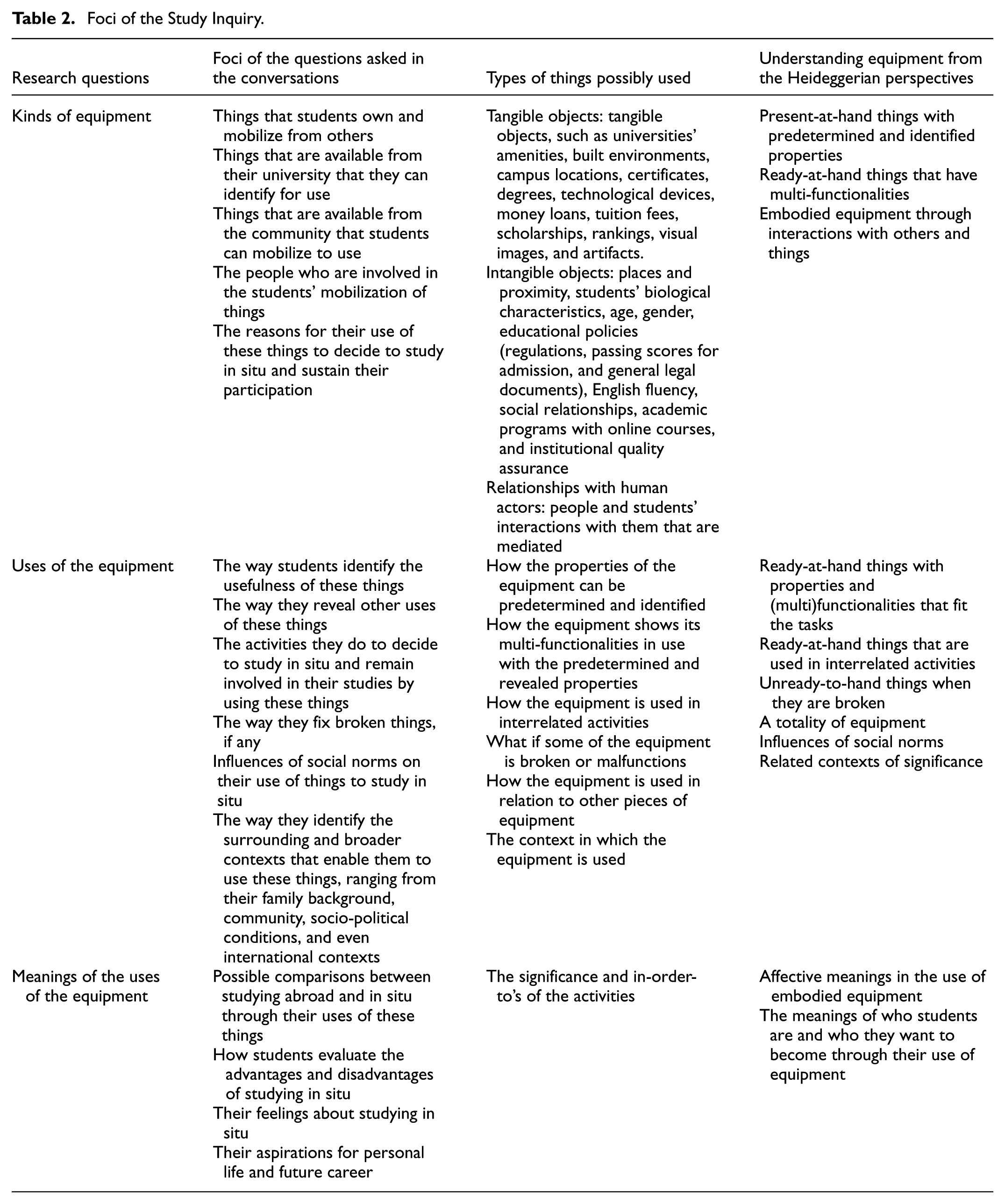
Interviewing enabled the researcher to focus on the study’s inquiries and to probe participants’ contexts and backgrounds (Azungah, 2018) and their experiences using equipment. Probing participants’ lived experience through interviews also aligns with phenomenological approaches, particularly the Heideggerian tradition (Horrigan-Kelly et al., 2016; Nguyen, 2025). The conversation question guide, written in English, served as a prompt for the researcher to elicit participants’ experiences in response to the study’s inquiries. It was designed to ensure consistency among the research questions, the literature review, and the theoretical framework (Azungah, 2018). The questions in the conversations centered on the foci listed in Table 2. Three trial conversations were conducted before the actual study. They allowed the researcher to reorder some questions and improve the linguistic clarity of the conversation question guide. The last trial conversation was included in the data analysis because it met the study’s validity and reliability criteria.
All the participants chose to speak in Vietnamese, their native language, enabling them to “say what [they] want to say freely” (Hieu, a second-year male student in Computer Science). Following the Heideggerian tradition of inquiry, which describes things as they are (Barnacle, 2001; Sandberg, 2005), the researcher focused on the flexibility and spontaneity nurtured during the conversations. The participants’ experience variations and complexities were captured, allowing for possible interrelatedness in their experiences to be identified (Barnacle, 2001). Information questions were used to encourage them to discuss various aspects of their experiences that affected their decisions and commitment to study in Vietnam. Each conversation began with the researcher’s wonder (Barnacle, 2001) about why and how the students chose to study in situ, even though similar experiences may have existed among them. This kind of wonder allowed the conversation to unfold with minimal researcher interference, preserving the flow of participants’ talk and their expressions of their experiences.
Following data collection, the analysis focused on interpreting the participants’ experiences through a Heideggerian lens. The data analysis followed a six-step interpretive process. First, the researcher engaged in familiarization with the transcripts by reading and rereading each transcript several times to note general trends and specific instances of the participants’ experiences (van Manen, 2014). The understanding of the individual cases was then collated with the researcher’s reading of all the transcripts to confirm popular trends and compare specific variations. The researcher began the data analysis by establishing an epistemological stance in understanding the empirical materials. All interview transcripts were read several times to maintain narrative integrity and experiential continuity. The interview transcripts were imported into NVivo to assist with reading and facilitate writing analytic memos. The researcher used the annotation and memo functions in NVivo to form reflections and issues in transcript segments. This initial reading immersed coding in participants’ experiences and avoided early abstraction (van Manen, 2014).
Second, an initial deductive analysis was applied through the research questions, aspects of the study’s inquiry, and Heideggerian concepts. This approach ensured that the results were not predetermined (Azungah, 2018) and enabled the researcher to develop initial codes for the dataset (Horrigan-Kelly et al., 2016). Each translation and transcript was carefully reread for a holistic understanding, variations, and emergent themes. Then, the researcher adopted an ontological stance, drawing on his experience as a former student in Vietnam and as a lecturer at a Vietnamese university, to interpret the initial understanding.
Third, inductive coding was conducted to allow patterns, meanings, and themes to emerge from the dataset itself. NVivo was used to create and label interpretive nodes. These codes revealed shifts between present-at-hand and ready-to-hand equipment in relation to the participants’ engagement with social norms and infrastructural tools (Heidegger, 1962; Horrigan-Kelly et al., 2016). The interpretive codes were intended as interpretive dimensions (van Manen, 1997) for understanding how the participants experienced and spoke about their engagements with people, institutions, and materials related to their in-situ education. The analytical focus rested on instances in which daily practices were taken for granted, and on those in which problems, breakdowns, or frictions emerged.
Fourth, the interpretive nodes and thematic groupings from the inductive analysis were developed through the researcher’s iterative engagements with the participants’ accounts and the deductive analysis. These codes were grouped into broader thematic classifications across the participants’ transcripts. The researcher used the hierarchical node structure and query functions to examine the relationships among interpretive codes and to compare convergent and divergent cases. Changes to the node structures, renaming, and reconfiguring the code were also made to document how the themes developed over time. Themes were developed through the types of equipment used, the participants’ uses, and the meanings embedded in those uses. These themes were then consolidated through reflexive comparisons between NVivo’s identifications of negative cases and variations across cases, and the researcher’s own interpretations of the transcripts based on the study’s inquiry areas.
Fifth, themes were compared across cases to identify convergences and divergences in the participants’ experiences. The participants’ excerpts that served as the key themes, sub-themes, and variations were extracted for illustrations in the paper as “informant-centric” themes that served as “facts of the research” (Van Maanen, 1979, p. 542). These illustrations were then compared with the researcher’s interpretations of the participants’ lived experiences, based on the researcher’s detailed readings of the empirical data (Van Maanen, 1979) and NVivo’s themes and excerpts. The annotations, memos, nodes, codes, theme development, thematic (re)configurations, and the researcher’s self-interpretation of the transcripts allowed for an audit trail. It enabled the researcher to trace how the participants’ accounts were interpreted, leading to interpretive codes and theorized themes.
Sixth, the findings were interpreted through the Heideggerian concepts of present-at-hand, ready-to-hand, and unready-to-hand. The combination of the researcher’s understanding of the literature on equipment, the analysis of the empirical materials, and the reflexive stances of an insider and outsider in maintaining the validity and reliability of the research created the “spiral of the interpretation” (Horrigan-Kelly et al., 2016, p. 5).
Saturation was monitored throughout this iterative interpretive process. As each transcript was analyzed, the researcher examined whether further conversations revealed any new meanings of equipment use or disrupted the existing interpretive framework. When later conversations (from the 31st to the 35th) reiterated established experiential patterns without generating new analytic insights, saturation was deemed to have been achieved. This judgment was grounded in interpretive coherence and phenomenological depth rather than frequency or sample expansion. It was consistent with Heideggerian and hermeneutic phenomenological approaches that privilege meaning over enumeration (Horrigan-Kelly et al., 2016; van Manen, 2014).
This study employed Sandberg’s (2005) conceptualizations of communicative and pragmatic validity in interpretative research. Aspects of communicative validity include the coherence and diversity of participants’ experiences and expressions. Communicative validity could be achieved through a shared understanding between the participants and the researcher, who served as both an insider and an outsider during the conversations.
The researcher in this study was a former student at a public university in Vietnam, sharing the same cultural, social, linguistic, and educational background as the participants. At the same time, he was a researcher in international higher education and student mobility. This dual positioning allowed for contextual sensitivity. The researcher was aware of how his familiarity with the research context and the participants’ backgrounds influenced the conduct and content of the conversations, the participants’ responses, and the interpretation of the data (van Manen, 2014). However, being-in-the-world (Heidegger, 1962) with the participants meant that understanding is always situated and shaped by the researcher’s prior involvement in the world. The researcher did not step out of this embeddedness. Therefore, during conversations with the participants, the researcher maintained an open stance, refrained from affirming shared experiences, and avoided premature conclusions about participants’ experiences by adopting a “wonder” (Barnacle, 2001, p. 3) attitude toward the various experiences the participants might have. In the data analysis, reflexive memos were used to highlight the researcher’s assumptions, prior knowledge of Vietnam’s higher education, interpretive tensions, and moments when his prior knowledge and experience intersected with those of the participants (Pillow, 2003).
Several steps were also taken to ensure pragmatic validity. This validity refers to the truthfulness of empirical material when participants may not report their actual experiences or remember exact details. By letting the participants freely share their thoughts and experiences, the researcher refrained from enforcing his predefined or prior knowledge on the flow of the conversations. Follow-up questions were used to clarify ambiguous statements or address perplexity to improve communicative validity. As mentioned earlier, another practical way for the researcher to ensure participants shared their true experiences was to recruit up to 35 participants (Azungah, 2018).
To enhance the reliability of the results in phenomenological research, the researcher followed Sandberg’s (2005) recommendation to produce authentic interpretations of the empirical materials and Merriam’s (2009) advice to ensure the consistency of the findings if the study were to be replicated. Multiple procedures were followed. First, the researcher asked the participants whether they wanted to read the transcripts in Vietnamese and whether they had any modifications or corrections to make. Three participants did not respond to the researcher’s email request, and the rest did not require any changes. Then, the researcher translated the transcripts from Vietnamese to English and double-checked them after completion. Finally, the translations were sent to a native English-speaking lecturer at an Australian university for proofreading and fluency checks. This proofreader voluntarily did the job and requested no honorarium.
Ethical clearance for this study was approved by the ethics associate chair of the university’s department ethics review board, where the researcher was working. This study posed minimal risks to the participants, as it focused on their educational experiences rather than on interventions, treatments, sensitive personal aspects, or clinical issues. Before approaching potential participants, the researcher sent each of them an email with a cover letter outlining the study’s purpose, data collection and analysis procedures, and measures to ensure anonymity and confidentiality. They were also sent an informed consent form that detailed their right to decline to answer any questions and to withdraw from the conversations. Their withdrawal from the study would result in their data being removed from the analysis without consequences. All participants agreed to participate in the recorded conversations by signing their names on printed forms. The conversations were conducted in Vietnamese as their mother tongue, which allowed them to feel at ease. Their choice of venues for the conversations also ensured psychological comfort and reduced power imbalances. During the data analysis and the writing of this article, pseudonyms were used to protect their identities, and all data were stored securely.
Joining this study enabled the participants to express their opinions on Vietnam’s higher education and their aspirations for future professional development. Their experiences would provide an insightful reference for domestic universities, higher education policymakers, and communities to reflect on what has been practiced effectively and what has not. The study offers practical implications for university marketing strategies, which should prioritize quality and truthfulness. It also provides references for student support services, which should focus on students’ well-being. These implications would, in turn, benefit students studying in situ.
Findings
Socially Shared Equipment
In deciding to study in Vietnam, the participants used equipment based on their prior academic achievements to support university admission. This type of equipment included their high school grade point average, university aptitude test scores, high school diplomas, and certificates from national and international contests. Two medical students said that “wearing white coats and walking along the corridor of a hospital” (Quynh, female) was their dream when they chose their field of study and university.
Most participants mobilized other forms of equipment from others. For example, they appreciated the universities’ infrastructure, which made them feel “proud if [he] studied there” (Son, male). Tangible objects provided by the universities included the “beautiful campus with air-conditioners” (Hieu, male; Hoa, female; My, female; Long, male) that could make them “check in comfortably” with photos to “post [on Facebook and Zalo] and share with friends” (My). Furthermore, universities’ main entrances prominently displayed accreditation evidence and international rankings in English. These infrastructural tools attracted some participants during their first campus visits before applying to these institutions. Linh (female) added that she “fell in love with the handsome lecturers” she had met in her first visit to the university when she was approaching the application period. Another participant added:
[Name of the university] was there, in blue color, big, standing against rain and sunlight. The university has a long history and tradition, dating back to my mother’s time. […] Whenever I looked at the picture on my phone again, I promised myself I would study there, as my mother did thirty years ago. (Men, female)
The properties of these present-at-hand objects were not manifest as they were. Quan associated Times Higher Education rankings with “brand.” Linh considered the university gate not as a means of fencing the precinct but as evidence of tradition and history. These students’ practices can be interpreted through Heidegger’s (1962) concept of ready-to-hand equipment, where resources are mobilized in combination and integrated into students’ academic activities. This equipment is defined by usability rather than physical attributes.
Universities’ promotional materials, such as backpacks, laptops, notebooks, T-shirts, partial and full scholarships, and bank loans for tuition fees, partly contributed to students’ decisions to study at universities in Vietnam. Minh (male) chose to study at a Vietnamese university because of a 20% tuition reduction (this university committed to providing a skilled workforce for the city in return for the city’s land lease for the construction of its fifth campus). Six students told the researcher that their parents were “impressed with the generous gifts” (Linh) they received. Linh was awarded a laptop after winning a lucky draw on the university’s admission day. They related these materials to institutional “care for prospective students,” which also meant “these universities [would] care for their students physically, academically, and psychologically” (Doan, male). Five other participants at private universities found the admission rates for first-generation students were “easy and accessible” (Doan). In slight contrast, six participants who had been admitted to public universities felt “extremely proud” (Thuy, female) when passing the “very competitive” admission procedures. Some felt “deserving to study at [the] prestigious university rather than being conscripted into the army or studying at a private university like other friends” (Dang, male). In this sense, institutional resources function as ready-to-hand equipment, with practicality and usability, that support these students’ ongoing in-situ studies.
While 11 students said they had “minimal impression” (Trung, male) of the libraries and buildings of their universities when they decided to apply to these institutions, their perceptions of these infrastructures changed over time. Some confessed that these materialities allowed them to “actually study at university with academic spirit” (Quang, male). The university’s facilities enabled them to feel a sense of social recognition as “someone important for society in the future” (Tri, male). Romantic relationships were also contributory to the sustainment of their studies. For example, Linh was not placed in classes taught by the “handsome lecturers.” Yet, she found her studies “rewarding” because she had friends to “spend time going out to drink milk tea” and had two boyfriends so far.
The degrees conferred at the end of their programs were perceived as futuristic equipment that could increase their retention and participation in studies. All of them wanted to complete the degrees “no matter how hard [their studies] could be” (Minh). When asked how they strove to overcome academic and financial difficulties, seven participants stated that their “dream to receive the bachelor’s degree” (Minh & Quang) motivated them to keep up with their studies. Some received allowances from their parents so that they did not “have to work hard and waste precious time” (Linh) for their studies. Parents’ frequent visits and gifts also affected their discipline and aspirations to complete their studies.
Physical objects, such as universities’ architectural designs, rankings, and symbolic displays, and others’ physical appearance, are encountered as present-at-hand entities with identifiable properties. As students orient themselves toward studying in situ and strengthen their sense of belonging, these objects become ready-to-hand equipment that supports their practical involvement in their educational immobility. The equipment students use includes both material and immaterial resources that do not belong exclusively to individual students but are accessed and mobilized through their interactions with others across educational, familial, social, and personal spheres.
Engaging with Socially Shared Equipment
The multifunctionality of social equipment was revealed through the students’ entanglement with the social milieu in which they were embedded. For example, after taking several courses and lagging in his studies, Minh took on two part-time jobs to supplement his living allowance. He also avoided his mother’s complaints about spending money on his prolonged studies. Seven participants used personal achievements, such as their aptitude test scores, extracurricular participation certificates, prizes, and high school grade point average, to gain pride and approval from the community and parents. The pride in their academic achievements was shared among these people, and they were encouraged to pursue higher education at universities in Vietnam. For example, one student said:
I won second place in the National Excellent Student Contest in chemistry. The prize gave me direct entry to [Name of the university] to study Pharmacy. My parents said that getting direct admission to a top-tier university in the Mekong Delta was undoubtedly rare in our district! (Trung, male)
Regarding the equipment they had, these students relied on relationships with people they knew well, such as parents, friends, and teachers. These people enabled them to reveal other valuable properties of their academic achievements and financial matters. The participants translated these features into ready-to-hand equipment by relating them to their aspirations and perceived rankings and prestige of the universities. The ways the participants used the social equipment encompassed feelings and emotions that emerged from the possibility of using this ready-to-hand equipment to achieve their aspirations to become who they wanted to be. These accounts show that academic achievements become meaningful only when integrated into students’ ongoing academic projects. When mobilized in conversations with parents, teachers, and peers, students’ certificates and test scores are drawn out of thematic attention. Instead, they function as ready-to-hand equipment that sustains students’ confidence and legitimacy. Their use illustrates how equipment derives its meaning relationally, within a totality that includes institutional admission practices, familial expectations, and shared understandings of educational success. External sources, social networks, and peer-shared materials are encountered for their practicality and multifunctionality, as revealed in students’ engagement with their academic world.
The participants tended to combine social, multi-functional equipment in interrelated activities across academic and social contexts. Some used their educational achievements to fulfill familial piety and seek continued support from their parents. For example, four participants chose to study the majors at the universities recommended by their high school teachers, who had studied there years ago. Following their advice enabled these participants to “show respect” to their teachers, avoid being enlisted into the army (three male students), and “create pride for [their] family” as first-generation students (Quang). They used their high school grades, certificates of participation in extracurricular campaigns organized by their high schools, and high school graduation diplomas for admission. Five other participants used poverty certifications issued by the commune people’s councils in their residential areas to obtain reduced tuition fees.
In sustaining their studies at university, Tri and Hanh said that their hard work, scholarships for excellent students, and commendations awarded to outstanding students in some semesters were the “sweet fruits” they “planted” (Hanh) and offered to their parents. Tri extracted exercises from his English and linear algebra courses to add to his tutoring portfolios. He also showed his students and their parents the photos he had taken at his university. The statue of a thinking man and the campus flowers in these photos helped him earn his students’ trust. The interweaving of educational credentials, social relationships, and institutional arrangements is experienced as a totality of multi-functional equipment in which no single object functions in isolation. Students’ educational practices are sustained through this interconnected whole as a totality. The totality of equipment is not reduced to a single material resource. It is structured through a network of their practical engagements with other equipment across social and educational domains, making their in-situ education intelligible and meaningful.
Quan, Tri, Long, Minh, and Hanh faced financial problems with tuition fees and living expenses. To confront these problems, they worked part-time as private tutors, servers at coffee shops, online game players for hire, and shop assistants. These jobs enabled them to extend relationships with other people, earn money, and “learn how to make life happy instead of being hopeless” (Long). They believed that they “[had to] learn from the outside world” (Long) as other students often did.
Overstudy loads, “difficult” final exams (Minh), and low English proficiency caused delays and problems in study progress among 11 students. Hoa complained that she had to study five subjects each semester and pass “so many assignments and progress tests,” which made her “spend [her] whole youth time” completing them. She felt “the fun” she had imagined before was turned into a “nightmare.” Some participants (e.g., Dung, Minh, & Dang) struggled to pass MOOCs due to intermittent English proficiency and laziness stemming from a lack of interest in the courses. Following friends’ suggestions, they used social networks run by “secret groups” who “[studied] for [them], and [they] just [paid] them money” (Dung) to pass their online courses. Minh used ChatGPT to help with his English writing assignments and complete the ongoing assessment, though he did not fully understand them. The internet, computer technologies, unknown social groups, and friends’ advice were used as ready-to-hand equipment to help them meet the university’s requirements.
Five participants reported that some equipment was not functioning properly. For example, some felt that the infrastructure at their universities was “old and dirty” (Dung; similarly expressed by Linh & Doan), leading them to feel that their time, effort, and money were “not well returned” (Dung). Long stated that “[he couldn’t] digest the difficult knowledge of some subjects by simply looking at the statue placed at the university entrance.” Dung thought the library did not offer sufficient references for his project writing. Quoc (male), Minh, and Linh found that the cramped, noisy dormitory was not as satisfactory as “the university [had] promised” (Quoc), causing a lack of space for self-study and privacy.
These participants adopted strategies to address these challenges, such as using alternative equipment or following rules. Dung, Linh, and Doan expressed their trust in their lecturers’ academic titles, such as doctors and associate professors, and their publications. Dung used some shadow library websites to download journal articles and book chapters for free, just like her friends usually did. As graphic design students, Long and his friends found inspiration for their artwork assignments at the many events organized at their university, which helped offset their initial dissatisfaction with the university’s amenities. Minh later moved out to live with his relatives in a suburb and rode his motorbike to the university. By following his university’s regulations on complaints and appeals, Quoc and his roommates submitted a written complaint to the student services office and were awaiting a response. Linh went to air-conditioned coffee shops and the city library for self-study and spent “sweet time” with her new boyfriend.
When institutional arrangements, such as MOOCs, assessment systems, and support mechanisms, failed to function smoothly, they became unready-to-hand. These breakdowns disrupted the participants’ absorption in their in-situ studies, prompting them to question the knowledge they had taken for granted about these institutional systems. In response to these disruptions, these students devised strategies to cope with these difficulties, such as using other resources, including social networks, digital tools, money, and others’ English proficiency. They reconfigured the entire equipment setup by mobilizing alternative social, technological, work, and financial resources to sustain their in-situ education. The moments of equipment breakdowns signaled a shift from ready-to-hand to unready-to-hand relations, where unnoticed resources were mobilized to confront academic challenges. They transformed the alternative supports into new ready-to-hand equipment. Their adaptive reconfiguration of equipment during breakdowns demonstrated their understanding of the world in relation to other people and materials, prompting improvisation rather than withdrawal.
Meaning-Making Through Socially Shared Equipment
The meaning of equipment emerged through the participants’ involvement in projects that extended beyond immediate educational tasks. These projects were conditioned and structured by “in-order-to” relations that oriented them towards future possibilities. The interrelated purposeful relations included these students’ aspirations to confirm professional identities, fulfill family duties and obligations, and gain social recognition for their families. In other words, equipment became significant because it enabled these participants to achieve their aspirations and meet their expectations for studying in situ. The use of equipment linked these students’ past achievements to their present engagements in in-situ education and to anticipated futures for their professional and social lives.
Minh, Quan, and Hong wanted to make their parents feel happy and proud with their admission to a “prestigious university” (Quan). The proximity of her home to the university campus, which was less than an hour by motorbike, encouraged Linh not to study at a university in another city. For Linh, a “smooth” ride to the campus in the same town could allow her to spend more time helping her mother sell groceries in her hometown. For her, studying at a university in Vietnam was to fulfill the cultural duty of a woman in her natal and marital families in the future.
Eight participants said that the choice to study at a university in Vietnam had to be based on “its popularity in the media” (Long), “infrastructure that [enabled] students’ learning to grow” (My, female), and “an environment that [could] make students feel like they [were] studying in a foreign university without going to study abroad” (Huong, female). Eleven participants commented that what “pulled [them] to study at these universities was the lecturers’ outstanding knowledge and the prestigious degree conferred by [the] university” (Quan), the textbooks published by “famous scientists” (Huong), and the possibility of extending social relationships with businesses during their on-the-job training programs and with friends coming from other areas (Tri). Their use of the social equipment created the necessary conditions for these participants to navigate their immobilities in their studies in Vietnam and sufficient conditions for them to sustain their efforts to complete their study programs.
Discussion
This study supports previous research on materialities by showing that students’ decisions to study in situ are shaped by interconnected material, social, and institutional resources. As an assemblage or rhizome of materialities, as argued by Balloo et al. (2021), Brooks and Waters (2018), Gunter et al. (2020), and Lee and Waters (2023), the objects that students mobilize as equipment are encountered inseparably from other things. Intangible equipment including university rankings and brands, at-home internationalization practices, financial resources, family backgrounds, test scores, and degree programs, contributes to students’ decision to study in their home countries and retention (see also Acemoglu & Pischke, 2001; Balloo et al., 2021; Declercq & Verboven, 2015; Freire & Giang, 2012; Knight, 2015; Nguyen, 2017, 2024; Watson et al., 2016). These forms of intangible equipment blur physical boundaries of the university, making it a social sphere filled with students’ negotiated interactions with others and materialities. The equipment students use to enhance their decisions to study in situ and sustain their studies shapes their educational immobilities at the confluence of their biological and psychological characteristics, cultural practices, universities’ infrastructure, and families’ economic conditions. However, beyond these existing understandings, the findings extend the current scholarship by demonstrating that educational immobility is actively sustained through students’ practical engagement with socially shared equipment. Drawing on Heidegger’s perspective on things as equipment, this study contributes six interrelated insights into how materialities shape students’ experiences of studying in situ.
The first contribution of this study is the reconceptualization of materialities as socially embodied equipment that acquires meaning through students’ practical engagement with the world rather than solely through their physical properties. The embodied assemblage of materialities affects students’ identities, social networks, and relationships with universities, as shown in previous work by Brooks and Waters (2018), Lee and Waters (2023), and Nguyen (2017, 2025). However, the theoretical framing of things as a totality of equipment offers another methodological approach to theorizing materialities as always embedded with multifunctionalities. The embedded multifunctionalities make objects socially shared and embodied equipment. Students use a single thing in combination with other things. They also mobilize materials from their possessions, friends, families, communities, and universities. The physical properties of these present-at-hand materials are revealed as ready-to-hand with additional functions when combined with other things. Social equipment use is shaped by cultural and educational norms, enabling students to find ways to deal with unexpected situations. This social equipment is embodied in students’ sense-making about who they are and what they aspire to achieve in their studies in Vietnam and in their future professional lives.
In addition, equipment operates as an interconnected totality in which material resources, social relationships, institutional arrangements, and cultural norms function together rather than independently. Universities’ facilities and landscape are not experienced as the sole factors influencing students’ decisions to study in situ and sustain their engagement. Students’ relationships with other people and non-human materialities are commonly said to influence their in-situ learning experiences (see also Ahn & Davis, 2020; Breines et al., 2019; Dinh et al., 2021; Durón-Ramos et al., 2020; Freire & Giang, 2012; Juntunen et al., 2022). Yet, the gatherings of transnational programs, textbooks, students’ emotions, parental influences, learning facilities, and so on are examined separately. Current studies do not demonstrate students’ embodied relationships with the multiple functionalities of the social equipment and other people. In contrast, this study shows that these materialities are used in relation to other materialities, families, communities, and even broader educational and socioeconomic contexts, including legal documents and government schemes for financial support in the form of bank loans.
The findings further reveal that equipment is intersubjective because its meanings and functions are continually negotiated through students’ relationships with parents, peers, lecturers, institutions, and wider communities, particularly when familiar resources become unavailable or break down. For example, some participants found that MOOCs, which had been a deciding factor in their decision to study in situ at an international academic institution, impeded their progress. They began using social networks and alternative technologies to address this challenge. The social equipment does not solely comprise properties that are revealed and used by students’ agency in a system of things and people, as pointed out in the research strands on assemblages of materialities (e.g., Adeyanju et al., 2020; Balloo et al., 2021; Breines et al., 2019; Gunter et al., 2020; Wainwright et al., 2020). Materialities, in this sense, are not merely objective entities that are always used meaningfully through students’ awareness of the properties of the things they use. Instead, their use of social equipment is negotiated with others, making materialities intersubjective.
This study also highlights that educational immobilities are sustained through the continual mobilization and reconfiguration of socially shared equipment across academic, familial, institutional, and everyday life domains. The totality of socially embodied equipment in educational immobilities is embedded in students’ engagement with others across intersected life, academic, and social domains, as well as institutional regulations on admission and support. Students’ use of this social equipment creates an infrastructure for immobilities. This finding replicates the same argument made in previous studies (e.g., Adeyanju et al., 2020; Balloo et al., 2021; Breines et al., 2019; Gunter et al., 2020; Lee & Waters, 2023; Wainwright et al., 2020). Yet, this paper extends this argument by showing that this infrastructure is relational to other people’s materials and students’ possession of resources, making it a socially resourced system. Educational immobilities require the social mobilization of resources to ensure equipment functions and meet students’ diverse aspirations. Students’ pursuit of higher education through materialities is always socially shared, creating cumulative effects on higher education marketization and internationalization practices.
As both implicitly and explicitly referred to in the existing literature (Adeyanju et al., 2020; Balloo et al., 2021; Gunter et al., 2020; Juntunen et al., 2022; Lee & Waters, 2023), materialities are used to enhance students’ negotiations between mobilities and immobilities. Instead of repeating this dichotomy, this paper adds that there are relations between materialities and educational mobilities. Equipment carries simultaneously spatial and temporal meanings, linking students’ past educational experiences, present engagements, and future aspirations while shaping their decisions to remain in their home country. This relationality is grounded in students’ aspirations to move or not to move, the effects of higher education policies, familial norms, and infrastructures that enable or impede their mobilities. Through their encounters with materials as social equipment, their aspirations are temporal. Students’ decisions to study in situ reflect their past achievements, current circumstances, and future intentions. Further, instead of viewing mobilities as the extension of space through students’ entanglement with materialities (see also Balloo et al., 2021), this article highlights that students’ immobilities and materialities are intertwined. Equipment and immobilities are found to be temporal in that one can precede the other. They are spatial in that distance matters to students’ decisions not to study abroad. Distance matters to their decision to study in situ because of the equipment they can mobilize from their own or others’ possessions.
Finally, students’ uses of materialities generate affective impacts on their learning experiences at university, as similarly pointed out in many studies (e.g., Adeyanju et al., 2020; Ahn & Davis, 2020; Breines et al., 2019; Durón-Ramos et al., 2020; Freire & Giang, 2012; Juntunen et al., 2022; Wainwright et al., 2020). Students’ use of social media intensifies (and/or diminishes) not only their sense of belonging to the university (Ahn & Davis, 2020) and connection to memories of their homes (Balloo et al., 2021) but also a range of emotions and feelings related to their relationships with relatives and social norms. Hong felt “grateful” for the money her parents “invested” in her education. Her parents’ financial resources were seen as a “spiritual debt” she was supposed to repay through her academic achievements and efforts. Minh felt “guilty” about not being able to complete his studies as planned, but he was “trying hard” to take on part-time jobs to supplement the allowance he received from his parents. The use of social equipment transforms students’ identities, relationships with others, and perceptions about their studies and universities. These transformations produce “felt” effects with students’ optimism, hope, (dis)satisfaction, pride, guilt, and filial piety.
Implications
This study enriches research on educational (im)mobilities by reconceptualizing materialities as socially shared equipment. By employing Heidegger’s (1962) concept of being-in-the-world, this study’s findings demonstrate that students’ decisions to pursue in-situ higher education are actualized through their practical interactions with equipment configured by academic, familial, social, and institutional relations. The (re)configuration of equipment engagement functions as a systematic resource that enables students to interpret their lived experience of studying at domestic universities. Students’ engagement with materials as social equipment discloses possibilities, challenges, and reconfigurations of who they want to become through their education. Therefore, this study calls for phenomenological research that attends to students’ lived experience, rather than relying on metaphorical uses of educational theories that rely solely on descriptive factors (see also van Manen, 2014).
Research on things as assemblages of materialities emphasizes the interconnected relations between human and non-human actors (Balloo et al., 2021; Brooks & Waters, 2018; Gunter et al., 2020; Kraftl et al., 2021; Lee & Waters, 2023). This study adds nuance to the understanding of materialities as contextual factors and background conditions. Materialities matter not simply because of their physical properties. They are embedded in students’ ongoing projects of making sense of who they are in relation to others. This sense-making is enacted when materials are mobilized within a totality of socially shared equipment. Students’ use of socially shared equipment enables them to pursue professional aspirations, fulfill familial obligations, secure social recognition, and reconfigure their identities. Attending to the interconnected relations of human and non-human actors in understanding materialities means delving into the sociality of equipment.
This study also demonstrates that universities shape students’ learning experiences not only through their degree programs and administrative support, but also through the provision and reconfiguration of socially shared equipment. Campus facilities, architectural designs, rankings, brands, scholarships, and symbolic artifacts contribute to diversifying and enriching students’ sense-making of their decisions and to sustaining their studies in situ. Such physical representations at universities should not be treated as isolated indicators of institutional quality, as research on institutional infrastructures has pointed out (e.g., Adriansen, 2020; Acemoglu & Pischke, 2001; Dinh et al., 2021; Freire & Giang, 2012). Market-oriented campaigns and internationalization strategies (see also Knight, 2015) are not sufficient to attract and retain students to study in their home countries. Instead, “air-conditioned universities” should provide prospective and current students with material comfort, infrastructure sufficiency, and markers of academic excellence. These “air-conditioned” infrastructures can foster students’ trust, pride, and sense of belonging in the institutions.
Calculating admission rates and retention metrics may not fully reflect a higher education institution’s actual performance, as they capture only material aspects of its quality. Higher education administrators and policymakers should explain their financial support schemes, admissions regulations, brand, accreditation achievements, and facilities to the wider community and parents. They should reshape their communication campaigns to focus on the values of their education rather than on factional figures telling success stories in the higher education market. In addition, students’ learning experiences can be disrupted by challenges and difficulties that institutions’ success stories cannot resolve. They can only be solved through students’ self-adaptive strategies, combined with institutional support as socially shared equipment. Therefore, institutional support mechanisms should extend their collaborative efforts to other agencies, such as state banks, businesses, and international partners, to broaden students’ access to shared equipment.
Conclusion
While most extant research has focused on students’ rational and emotional motivations, financial constraints, or the influence of sociocultural factors, this study expands the discourse by adopting a Heideggerian perspective on things as equipment to examine materialities as an embodied part of students’ experiences in pursuing in-situ higher education. The findings revealed how they interact with campus facilities, textbooks, legal documents, and social networks through their engagement with the world, including people they know and those they do not. These materials are embodied through students’ interactions with others and things across social domains. In this regard, higher education extends beyond the academic borders into the social and personal worlds. It is constantly reconfigured by multiple intersecting forces intensified by students’ encounters with things.
By decentering the questions of why students do not study abroad, this study challenges the conventional perpetuation of South-North international student mobility. It points to the complexities and ambiguities of student immobility through their negotiations of social interactions and the use of social equipment to realize their aspirations. It chimes with the nascent literature on students’ immobility by highlighting their agency in choosing not to study abroad. The conceptualization of materialities as social equipment suggests that higher education institutions develop infrastructural resources, rankings, brands, and supportive learning environments. They are used and consumed as social properties that enhance students’ learning experiences and motivations.
Although several procedures were implemented to enhance and ensure the transferability of this research, as mentioned in the study design section, the sample size of 35 participants may not fully represent the characteristics of the entire student population of 612,000 Vietnamese students in 2023. A larger sample size, such as up to 50 participants (Creswell & Creswell, 2018), is recommended to provide a more holistic picture of how equipment influences their educational immobilities. A sequential explanatory mixed-methods study with a larger sample can be conducted to capture both general trends and specific students’ experiences. Accordingly, a survey that is based on the literature review, the theoretical framework, and the study’s inquiry areas can be administered. The results of this survey can provide researchers with an overview of emerging trends and variables to inform revisions to the conversation question guide (Creswell & Plano Clark, 2018). Further, following up with these participants during their study programs through a longitudinal study can shed light on how their social media use changes over time. Studies focusing on the use of equipment among students who experience study failures and delay their progress can provide a richer portrayal of how equipment can be used and interpreted differently.
Another limitation arises from Heidegger’s (1962) framework, which focuses on people’s interpretations of their encounters with societal structures. This study explored the participants’ interpretive accounts of their being-in-the-world and their encounters with societal structures. The researcher could gain a critical understanding of their care, meaning, and practical engagement with the world. However, less analytical weight was placed on the structural and relational dynamics of these structures in relation to the participants’ lived experience, which could affect the co-construction of interpretation. As O’Connor (1998) and Nguyen (2025) have pointed out, the relationship between the researcher’s and participants’ self-interpretation and broader structural conditions is dialectical. Social milieus consist of other people who matter to the former. As such, alternative methodologies should address these dialectical influences and highlight potential issues of isolation and differences that participants may experience. Future studies should foreground the dialectic relationality and structural mediation alongside individual participants’ lived experience. A multi-perspective qualitative approach should be employed in future research. As recommended by Thomson and McLeod (2015), interviewing people who can influence students’ decisions to study in situ and sustain their studies, such as university administrators, lecturers, employers, parents, friends, high school teachers, and those in their communities, can provide multiple voices reflecting the students’ being-in-the-world. Such methodological approaches can complement the limitations of this study’s focus on students alone, enabling future studies to situate individual sense-making within broader social and institutional contexts.
Footnotes

Ethical Considerations
This study was approved by the Research Ethics Review Committee at the English Department, FPT University, Can Tho Campus (approval no. Staff_ChiNH6_FA24_01) on February 18, 2024. Respondents gave written consent for review and signature before starting interviews.
Author Contributions
Chi Hong Nguyen (PhD) is the Dean of the English Faculty, FPT University Can Tho Campus. His research areas include transnational mobilities of skilled migrants, international student mobilities, international education, and general issues in higher education.
Funding
The author received no financial support for the research, authorship, and/or publication of this article.
Declaration of Conflicting Interests
The author declared no potential conflicts of interest with respect to the research, authorship, and/or publication of this article.
Data Availability Statement
The data in this research can be provided upon request.