







Abstract
This case study presents the applications of OpenAI to enhance performance for Tulasi Restaurant, a newly acquired business by BLM8, Holding Pte LLC., a leading high-tech organization, in Singapore. Applying the Brand Positioning Process Model, Mr. Reddy, the CEO of the BLM8 intended to transform the traditional Indian restaurant to it new food and beverage brand with cutting edge technology. A list of Open AI applications including ChatGPT to restaurant operations, from marketing, menu creation to employee training, to enhance its competitive advantages was addressed. With potential issues and strategic alternatives, if you were Mr. Reddy, what would you do?
Case Study Learning Objectives
This case teaches students to:
Empathize the challenges faced by a company venturing into a new business beyond its expertise.
Describe the process of brand positioning.
Apply Open AI, specifically, ChatGPT, in various restaurant operations processes.
Explore effective strategies for improving branding and marketing positions.
Understand the impact of technological advancement on food and beverage industry.
Introduction
Over the years, the Food and Beverage (F&B) landscape in Singapore has experienced significant growth, with the number of F&B establishments steadily increasing from 8,486 in 2010 to 12,999 in 2019. Similarly, the overall Gross Domestic Product (GDP) has seen a rise from 3.89 to 5.78 billion Singapore dollars in 2019. Despite being heavily impacted by the COVID-19 pandemic, many businesses have managed to adapt by adjusting their business models and embracing the new normal.
Moreover, several F&B trends have emerged and are expected to persist in the ever-changing F&B scene. These trends include the demand for healthier food options, the exploration of experimental flavors, the popularity of self-service concepts, and the rise of home-based restaurants. These trends reflect the evolving preferences of consumers and present opportunities for F&B establishments to cater to their changing demands.
The F&B industry in Singapore has witnessed remarkable growth, both in terms of the number of establishments and its contribution to the GDP. Despite the challenges posed by the COVID-19 pandemic, businesses have demonstrated resilience by adapting to the new circumstances. The industry will continue to evolve, driven by consumer preferences and the emergence of new trends. F&B establishments that remain proactive and responsive to these trends will be well-positioned to thrive in the dynamic F&B landscape of Singapore.
Background
BLM8 Holding Pte Ltd.
BLM8 Holding Pte Ltd. is an Exempt Private Company Limited by shares, incorporated in Singapore on 17 December 2017. Over the past 5 years, the company has primarily engaged in holding activities with other holding companies as its principal operation. Additionally, it offers corporate finance advisory services as a secondary activity. BLM8 Holding Pte Ltd. provides a comprehensive range of services, including Mechanical, Process, Electrical & Instrumentation services, Renewable energy solutions, Power generation through waste heat recovery, Soil Stabilization, Steel stocking & trading, Rebar rolling mill & Smelting furnace operations, Calibration services for industries such as Marine, Oil & Gas, Power, Aerospace, Pharmaceutical, Landscaping, F&B, and other niche sectors. The company’s core businesses revolve around Calibration, M&E (Mechanical & Electrical), Oil & Gas, Equipment Leasing, and Material Supply. As part of its future growth strategy, BLM8 is exploring potential expansion opportunities in the agritech industry. In 2019, the company acquired a food and beverage (F&B) company, Tulasi Vegetarian Restaurant. As a technology-based company, BLM8 is aware of the current development of OpenAI and foresees enormous potential benefits with its application in F&B operations.
Food and Beverage (F&B) Entrepreneurship
Entrepreneurship is the process of embarking on a new business venture, involving risks, job creation, intensified job competition, and increased productivity and efficiency through the introduction of innovative practices or technologies. In Singapore’s competitive business landscape, efficient financial systems and human capital are vital factors for firm productivity, in addition to individuals’ entrepreneurial spirit, initiative, and effective management processes. The 8M framework encompasses the key aspects of entrepreneurial activities that impact the profitability and productivity of the F&B industry: material, methods, message, make, market, and management. Many successful entrepreneurs possess the skills and vision to effectively utilize these 8Ms to drive productive and prosperous business operations.
Findings from a qualitative survey conducted on several young entrepreneurial F&B companies in Singapore shed light on the challenges faced in the sector. Despite the initial allure and trendiness of establishing upscale cafes and bistros, often supported by venture capital funding, these businesses encounter various obstacles such as a shrinking labor pool, high operating costs, wage rates, and soaring rental expenses. The empirical study highlights a scenario of heightened creative destruction and lower productivity within the F&B sector, particularly among Small and Medium Enterprises (SMEs) that struggle to leverage economies of scale in their entrepreneurial pursuits (Toh & Thangavelu, 2017).
Vegetarian Restaurants
Little India in Singapore has undergone significant transformations, particularly in the realm of ethnic Indian cuisine. The commercialization of food in this area aims to promote multiculturalism as part of the Singapore Tourism Board’s (STB) efforts to attract international tourists. As the F&B landscape and culinary fusion evolve in cosmopolitan Singapore, restaurant businesses in Little India have had to continuously adapt. The map of Little India is shown in Figure 1.
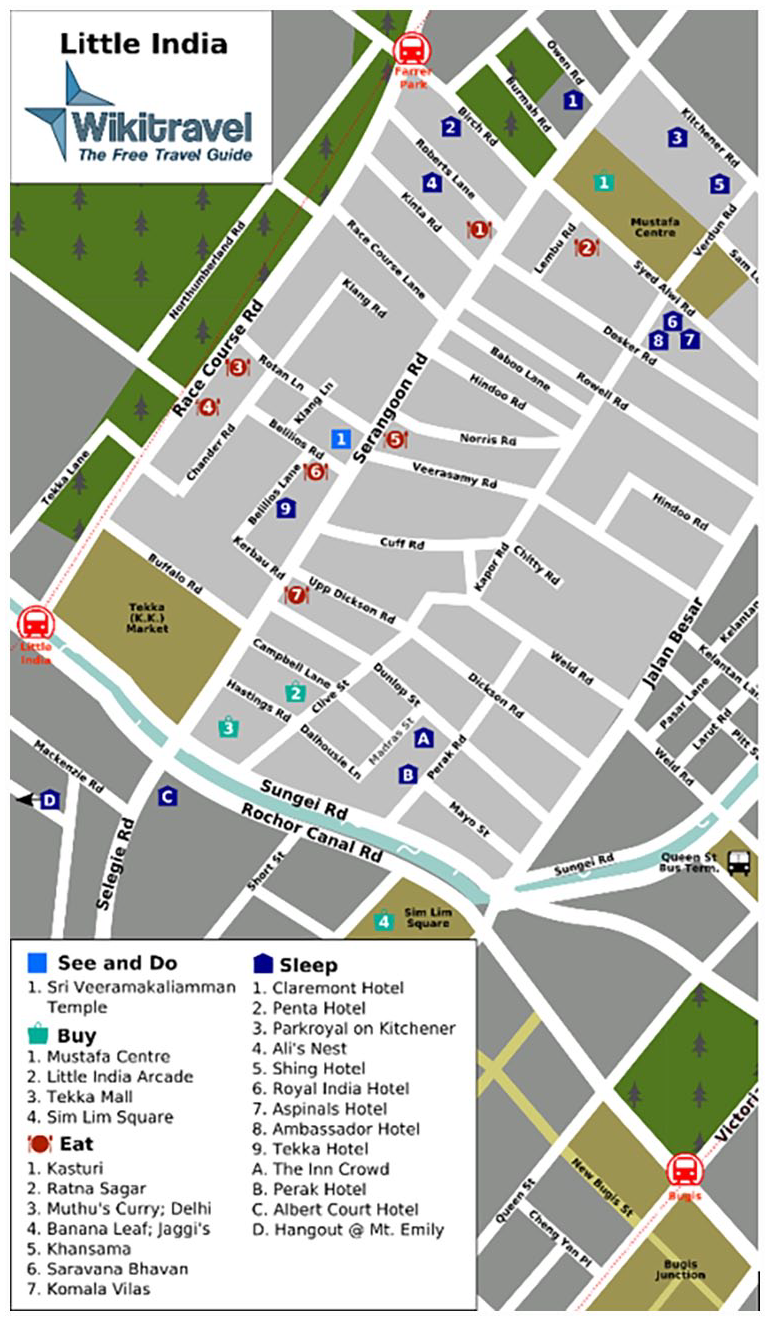
Map of little India, Singapore.
A research study conducted in Little India observed that vegetarian restaurants coexist alongside newly established fast-food outlets like Komala’s. Out of the 86 restaurants investigated, only 14 (16.3%) were purely vegetarian, all of which were operated by South Indian Hindus. Among the 19 restaurants that offered a combination of North and South Indian cuisine, 6 were vegetarian. Interestingly, these vegetarian restaurants were irregularly distributed, with a concentration in the southwest part of Little India and the core of the study area. This distribution of restaurants in Little India has created a distinct urban spatial configuration that caters to a diverse range of preferences and tastes. For instance, Serangoon Road is known for its vegetarian options, while Race Course Road offers North Indian cuisine. Notably, the number of vegetarian and Indian restaurants in Little India surpasses that of restaurants operated by other communities (Martini & Chee, 2001).
Tulasi Vegetarian Restaurant
On December 26, 2019, BLM8 took over Tulasi Vegetarian Restaurant, located in Little India. The inspiration behind this acquisition was Mr Reddy’s personal journey toward vegetarianism, driven by his concern for animal welfare and the environment. After learning about the negative environmental impact of meat consumption, Mr Reddy sought out vegetarian restaurants in Singapore and found that there were limited options, except for Tulasi. Tulasi stood out with its unique vegetarian dishes that preserved the local flavors and catered to the Singaporean palate, making it more appealing to the locals.
Recognizing the market value of Tulasi and the growing demand for meatless options and plant-based substitutes, BLM8 introduced a Western Menu into the restaurant. This expansion included popular global dishes such as Impossible Meat, ravioli, pizza, and baked pastries like Goreng Pisang (banana fritters) and brownies. By combining Asian and Western cuisines, Tulasi became one of the few Indian vegetarian restaurants offering a diverse menu.
BLM8’s vision for Tulasi is to transform it into an affordable fine-dining vegetarian restaurant, targeting a wider audience while still providing familiar local dishes. To achieve this, BLM8 renovated the restaurant’s interior, adding new lights, mirrors, and moss walls to create a greener ambiance. The colorful moss represents the multicultural aspect of Asia compared to Western countries (Figure 2). Furthermore, BLM8 plans to relocate Tulasi to a more centralized location in Singapore, such as Orchard Road, which is known for housing vegetarian/vegan restaurants on the higher price spectrum.
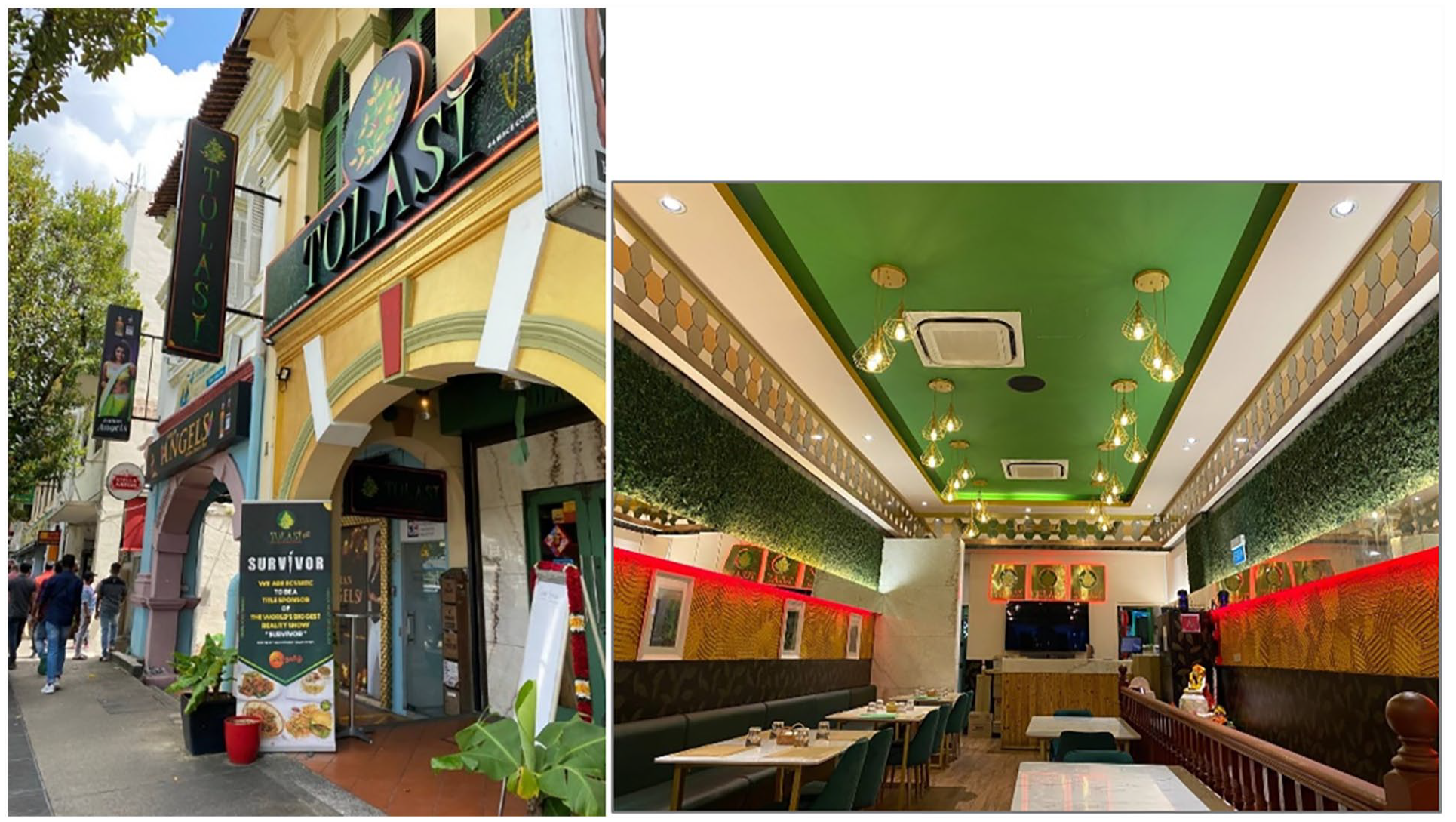
Tulasi restaurant.
In addition to it dine-in services, Tulasi also offers catering services through platforms like Caterspot. 1 Most of the catering revenue comes from traditional Indian weddings, with attendee numbers ranging from 500 to 1,000. However, the COVID-19 pandemic has put a halt to large-scale events, making catering services unsustainable based solely on restaurant-level revenue. To address this, BLM8 aims to incorporate recurring catering services, where customers can subscribe to receive regular orders automatically. Mr Reddy is currently working on providing a small-scale offering of 250 to 350 bento boxes on a daily recurring basis to generate additional revenue for Tulasi.
BLM8’s acquisition of Tulasi and subsequent plans for expansion aim to tap into the growing market for vegetarian and plant-based cuisine while providing an affordable fine-dining experience and catering services. At the same time, the expansion should leverage on the company’s strength in science and technology, as well as the advancement of OpenAI today.
OpenAI and ChatGPT
In recent years, the rapid advancement of artificial intelligence (AI) has paved the way for groundbreaking applications across various industries. One sector that has witnessed significant transformation is the F&B industry. With the advent of ChatGPT, a powerful language model developed by OpenAI, F&B businesses now have an invaluable tool at their disposal. ChatGPT offers a range of applications that can enhance customer experiences by providing personalized customer service and menu customization and recommendations, streamline ordering and delivery processes, drive innovation in menu development, and conduct market research and trend analysis within the industry. In short, the integration of OpenAI or ChatGPT into the F&B industry opens up a world of possibilities.
Unique Brand Values
BLM8 envisions the F&B industry as a platform to showcase their organization, Furthermore, conducting a social media competitive analysis and text mining is crucial for Tulasi Restaurant. This analysis involves closely monitoring and analyzing not only customer-generated content on their own social media platforms but also textual information on their competitors’ social media sites. He et al. (2013) presented a case study in the pizza industry, which applies text mining to unstructured content on Facebook and Twitter of major pizza chains like Pizza Hut, Domino’s Pizza, and Papa John’s Pizza, can serve as a reference. By leveraging social media tools to gain valuable business insights such as driving consumer traffic, increasing customer loyalty and retention, creating brand awareness, and building reputation, Tulasi can enhance its competitive advantage while effectively assessing the competitive landscape of similar businesses. This approach can apply to Tulasi’s competitors (such as Gokul—Raas Vegetarian Restaurant, Gayatri Restaurant, and Arunachala Bhavan) in Little India.
Theoretical Framework
Mr Reddy who became vegetarian in early 2010, was unable to find a vegetarian restaurant that can provide a wide range of dishes including Singaporean flavors, he acquired Tulasi Vegetarian Restaurant in 2019 with the vision to bring automation and standardization into the production of dishes, expand locally and internationally. Mr Reddy is open-minded in incorporating new technology such as automation and OpenAI in the development of his new F&B venture, Tulasi Vegetarian Restaurant.
By using unconventional ways in the restaurant operation, Mr Reddy requires to do re-branding and re-positioning of Tulasi. The theoretical framework approach in this case study is The Brand Position Process (Figure 3).

The brand positioning process.
The Brand Positioning Process
The brand positioning of Tulasi Vegetarian Restaurant requires an understanding of its existing stakeholder, BLM8 Holding. BLM8 is primarily a high-tech company operating in the engineering field, specializing in services such as Mechanical, Process, Electrical & Instrumentation, Renewable energy solutions, Power generation through waste heat recovery, Soil Stabilization, Steel stocking & trading, Rebar rolling mill & Smelting furnace operations, and Calibration services for industries including Marine, Oil & Gas, Power, Aerospace, Pharmaceutical, Landscaping, F&B, and other niche sectors. The company’s core businesses revolve around Calibration, M&E (Mechanical & Electrical), Oil & Gas, Equipment Leasing, and Material Supply.
For Mr. Reddy, venturing into the F&B industry with his background in mechanical engineering and global connections presents an opportunity to bring vegetarian food to an international audience. To understand the brand positioning, the 4Ps of the marketing mix can be utilized to assess the main marketing elements of Tulasi and analyze their suitability for the new positioning after the BLM8 acquisition.
To establish the core ideas for this new positioning, several questions need to be addressed: What is the relevance of Tulasi to customers locally and internationally? How can the brand differentiate itself from competitors? What are the core values and competencies that can establish the necessary credibility with customers? What new products and markets is the brand targeting? By determining relevance, differentiation, stretch, and credibility, the brand opportunity can be identified.
Understanding the brand opportunity allows the company to position itself and target the selected market(s), focusing its resources and following the brand platform. This includes clarifying the vision, mission, and values. The integration of Tulasi Vegetarian Restaurant into BLM8 Holding can be explored to leverage the synergies between the two entities. BLM8 Holding can utilize technologies such as OpenAI to foster the new venture into the F&B industry. This could involve implementing AI-powered solutions for various aspects of the business, such as customer engagement, operations optimization, menu development, and market analysis, to enhance efficiency and competitiveness in the F&B industry.
The incorporation of Tulasi into BLM8 Holding presents an opportunity to combine expertise in engineering and technology with the F&B industry, creating a unique and innovative approach to vegetarian food.
Brand Positioning
To remain competitive in the F&B industry and align with other prominent competitors like Casa Restaurant and Canchita Peruvian Cuisine, BLM8 is determined to enhance their marketing and advertising campaigns by promoting merchandise items for Tulasi Vegetarian Restaurant. By creating intentional and compelling brand value that extends beyond the F&B industry, BLM8 aims to attract attention from major players in the hotel and lodging industry. This can help solidify Tulasi’s brand resonance and open doors for potential partnerships and collaborations. While generating profits from merchandise sales is important, the primary focus should be on positioning the Tulasi brand effectively to gain recognition and establish connections with other prominent organizations and industry leaders.
BLM8 also has a strong vision for Tulasi Vegetarian Restaurant to practice Corporate Social Responsibility (CSR) by adopting sustainable and green practices while delivering high-quality vegetarian food. They aim to reduce the usage of plastics and instead use biodegradable materials such as crockeries and bags. Additionally, Tulasi plans to initiate various green initiatives, including fundraising during donation drives where the proceeds will contribute to environmental causes. The restaurant is well-positioned to translate these ideals into practical actions on a global scale, with the support of relevant authoritative figures and organizations. By introducing a Western menu, renovating the interior, and offering reoccurring catering services, Tulasi is in the process of transforming into a fine-dining establishment. BLM8 also envisions a potential expansion of Tulasi with a second outlet located in a central area, making it more accessible to a wider target audience and increasing brand exposure and recognition.
Dilemmas and Challenges
Challenge 1: Labor Crunch
Tulasi Vegetarian Restaurant operates with a rotating shift of a three-person team overseeing kitchen operations. Each chef specializes in a different cuisine: Western, Asian, and Indian. While the Asian and Indian chefs can cover for each other, there is no replacement available for the Western chef on their designated day off, which happens to be Mondays. As a result, the Western kitchen remains closed on Mondays.
During the COVID-19 pandemic, BLM8, like many other restaurants, encountered a shortage of manpower. With a small existing staff of less than 10 for Tulasi Vegetarian Restaurant, BLM8 had to devise effective staff remuneration strategies to ensure long-term retention. Despite experiencing a monthly revenue loss of SGD40,000 and even facing a period of financial loss, the holding group remained committed to providing staff incentives, including a minimum 3-month bonus, in order to motivate and retain their employees.
Challenge 2: Lack of Authoritative Figures to Enforce Permanent Changes
With BLM8’s strong passion and vision for Tulasi Vegetarian Restaurant to embrace green practices and contribute to environmental protection, there is a need for dedicated personnel to consistently enforce sustainable changes within Tulasi. This is essential to ensure that the brand image and food quality are not compromised while upholding the values of sustainability. To effectively achieve this, Tulasi should consider recruiting talented individuals or forming partnerships with relevant authorities, such as official government regulatory figures or bodies like the Singapore Food Agency (SFA) or Enterprise Singapore. Collaborating with these entities can provide guidance, support, and expertise in implementing and adhering to sustainable practices in the F&B industry. By working together with regulatory bodies, Tulasi can align its operations with industry standards and regulations, further enhancing its commitment to sustainability.
Challenge 3: New Competitors Entering the Market
Toward the end of the pandemic, Tulasi Vegetarian Restaurant faced increased competition with the emergence of new F&B outlets in the industry, the restaurant has limited presence in the social media and google reviews. Casa Restaurant, for example, focused on establishing an online gourmet shop offering pre-cooked dishes, brunch packages, gourmet pantry products, cocktail pre-mixes, and merchandise. On the other hand, Canchita Peruvian Cuisine aimed to expand its customer database by promoting delivery and takeaway options through its social media channels (Wong, 2021). These strategies were aimed at driving sales volume and increasing demand through price reductions. With the rapid changing of the business environment after pandemic, Tulasi needs to stay vigilant and adapt to changing consumer trends and competitor behavior in an environment characterized by volatility, uncertainty, complexity, and ambiguity (VUCA).
Strategic Alternatives
Alternative 1. Develop Strong Online Presence and Marketing Efforts
In order to leverage the digital era and reach tech-savvy Singaporeans, Tulasi Vegetarian Restaurant can benefit from investing in their online promotional and advertising efforts. They should utilize mainstream media platforms such as their brand websites and popular social media accounts like LinkedIn, Instagram, Facebook, and even consider expanding onto platforms like TikTok. Incorporating TikTok into their marketing strategies can tap into its viral algorithm and reach a highly engaged audience. On Instagram, Tulasi can expand their marketing efforts by creating Instagram highlights to categorize different types of content for easier navigation. They can also take advantage of features like reels and the upcoming “Shared Story” feature to engage users and produce dynamic content. Standardizing a theme or feed on their Instagram accounts would aid in creating a consistent visual esthetic that aligns with their brand elements (Gao, et al., 2018). In addition, ChatGPT can assist with marketing efforts by promoting special deals or events, answering customer questions about promotions or discounts, and providing recommendations to customers.
Tulasi Vegetarian Restaurant can enhance its branding by investing in its own brand website. The website can serve as a convenient platform for online consumers to access the restaurant information, such brand values, corporate social responsibility, CEO background, F&B menus with prices and ingredients, links to social media accounts, FAQ section, live chat support, and a schedule of past and upcoming events. Additionally, displaying potential partners, sponsors, and governmental statutory boards on the website would help emphasize Tulasi’s commitment to delivering quality products and services. ChatGPT can also be used to translate the content into different languages which could enhance Tulasi in attracting different segments of market, including diverse cultural domestic market, as well as the international visitors.
To create brand resonance, Tulasi can customize its F&B menus to add a personalized touch that relates to loyal customers. It can also run recipe competition to engage customers and leave a lasting impression. Sharing such content through social network sites (SNSs) would stimulate customer resonance and influence their perception of products and services, ultimately impacting their buying decisions.
For merchandise sales, Tulasi can collaborate with renowned suppliers like Blue Pheasant to deliver quality vintage-themed tableware or maritime collections that resonate with its brand. They can also offer general merchandise items such as clothing, enamel pins, watches, jewelry, and tote bags. Expanding merchandise sales overseas would help reach a wider audience, including patrons from Western countries.
By combining these online marketing strategies, Tulasi Vegetarian Restaurant can effectively promote their brands, engage customers, and differentiate themselves from competitors within the F&B industry.
Alternative 2. Collaborate With Industry Partners and Governmental Initiatives
The FoodInnovate initiative launched by Enterprise Singapore provides a valuable opportunity for Tulasi Vegetarian Restaurant to adapt to industry disruptions and collaborate with larger corporations, food science experts, and industry associations. Through FoodInnovate’s network of shared production facilities, they can co-innovate, network, and form partnerships with big industry players, which can contribute to greater brand awareness and market opportunities.
Participating in events like the Food Industry Asia Food for the Future Summit, where potential big names in the food industry such as Coca-Cola, Danone, and Unilever gather, can further extend the branding of Tulasi beyond the F&B industry. These events provide a platform to discuss industry challenges, exchange ideas, and potentially form partnerships with other sectors of the hospitality industry, such as lodging and accommodation (hotels). Seeking architectural advice from establishments like PARKROYAL COLLECTION, known for their environmental responsibility and innovative design concepts, can help Tulasi with its interior decoration layout and eco-friendly culinary offerings.
For future expansions or the opening of a second outlet, Tulasi can explore partnerships with global and renowned international brands. Tulasi could invest in partnerships with companies like Hungry Planet, known for their meat-free grounds, patties, and ready-to-eat options, which cater to a global audience and offer a diverse range of meat-free alternatives. Furthermore, by leveraging the opportunities provided by the FoodInnovate initiative and forming strategic partnerships, Tulasi Vegetarian Restaurant can enhance their brand value, expand their market reach, and stay at the forefront of innovation and sustainability in the F&B industry.
Alternative 3. Embrace Science- and Tech-Based Innovations and Partnerships
The vegetarian food scene in Singapore is indeed embracing cutting-edge science and innovation, with various high-tech plant-based meat substitutes and alternative food products becoming increasingly popular. Tulasi Vegetarian Restaurant, already adopting impossible meat, can continue to stay at the forefront of innovation by exploring new menu expansions and incorporating science-based vegetarian alternatives.
One avenue for Tulasi to explore is the adoption of plant-based “egg” products, such as those developed by Float Foods and Hoow Foods. These innovative companies have recently debuted plant-based egg alternatives that offer a similar taste and texture to traditional eggs. Collaborating with such companies can enable Tulasi to offer a wider range of plant-based options and cater to customers seeking alternative protein sources.
Another potential collaboration for Tulasi is with Plantae Bioscience, which specializes in purpose-designed vegetables with enhanced nutrients through phytonutrients. By partnering with Plantae Bioscience, Tulasi can offer unique and nutritionally enriched vegetable dishes that align with its commitment to delivering quality vegetarian food.
To support these innovations and potential collaborations, Tulasi could consider exploring partnerships and investments with venture capital firms that specialize in plant-based alternative protein businesses. VC firms like Good Startup, GROW, Temasek (Singapore), Ahimsa (India), and Capital V (Europe) focus on driving investments in plant-based alt-protein and vegan companies, prioritizing environmental sustainability, animal welfare, and public health benefits. Such partnerships can provide Tulasi with not only financial support but also access to industry expertise and networks.
The application of ChatGPT can enhance the business operations. It can assist with managing reservations and customer service by answering customer inquiries and frequently asked questions, checking availability, addressing complaints or issues, and managing reservations in real time. It can also help to create menus and recipes by analyzing customer data, identifying popular dishes, suggesting new dishes based on customer feedback, providing ingredient substitutions, nutritional information, and other relevant data. In order taking, ChatGPT can be integrated into a chatbot or virtual assistant to take orders from customers. It can provide personalized recommendations based on customer preferences, take orders quickly and accurately, and process payments securely. In delivery, on the other hand, ChatGPT can be used to track delivery times, provide real-time updates to customers, and optimize delivery routes to ensure timely and efficient delivery. ChatGPT can also be used to manage restaurant inventory by tracking stock levels, monitoring expiration dates, and generating alerts when stock levels are low. This can help restaurants avoid stockouts and reduce waste.
By embracing high-tech innovations in vegetarian food Tulasi Vegetarian Restaurant can position themselves as pioneers in their respective fields, offering unique experiences and driving the evolution of the F&B industry in Singapore. By incorporating OpenAI or ChatGPT F&B operations will be benefited from personalized customer service and menu recommendations to streamlined operations and culinary innovation.
Finally, to address the human resource issue, OpenAI’s machine learning model is trained to analyze employee data and can identify patterns and trends that could indicate when an employee is likely to leave the company. The model is designed to help employers identify potential risk factors and develop strategies to reduce employee turnover. The AI model can also analyze data such as employee performance metrics, demographics, and employee feedback to identify potential risks that could lead to employee turnover. It can also provide companies with insights into what types of rewards, benefits, and training may be most effective for keeping employees happy and engaged.
Conclusions
Based on the information provided in the case study, the main objective is to improve the branding and marketing positions of Tulasi Vegetarian Restaurant, which are newly acquired F&B outlets in Singapore under BLM8. The case study highlights various factors that influence the success of these outlets, such as their backstories, objectives, target markets, locations, merchandise sales, continuous R&D, and strategic branding.
To assist Mr. Reddy in improving the branding of BLM8’s F&B investments, several analysis tools can be utilized, including financial analysis, social media competitive analysis, text mining, and SWOT analysis. These tools can provide insights into the current situation of the restaurants, identify areas of improvement, and guide decision-making for marketing efforts.
Furthermore, the outcome of this case study can be valuable for undergraduate and postgraduate students in F&B-related programs, as it helps them understand the roles of different stakeholders and the dynamic trends in the F&B industry in Singapore. It can serve as a reference for future F&B brands looking to expand their marketing efforts.
Discussion Questions
Do you think it is wise to position Tulasi Vegetarian Restaurant with technology? Explain your reasoning.
What are the advantages of OpenAI to the F&B industry in general, and Singapore specifically?
Are there any concerns related to the application of OpenAI in the F&B industry?
What is the ethical issue related to using ChatGPT in operating an F&B business?
Recommended Readings
Ferrell, O. C., Hartline, M., & Hochstein, B. W. (2021). Marketing strategy: Cengage Learning.
Kumar, P. (2010). Marketing of hospitality and tourism services. New Delhi: Tata McGraw Hill Education.
Thompson, A. B. (2003). Brand positioning and brand creation. Brands and branding, 1, 79-95.
If you are an ICHRIE member, you can access the Teaching Notes for this case study here: https://ichrie.memberclicks.net/jhtc. If you are not an ICHRIE member, the Teaching Notes will be published in a future Sage Business Cases (SBC) annual collection: https://sk.sagepub.com/cases. For more information, please contact info@sagepub.com.
Footnotes
Acknowledgements
This case was possible based on real business experience by Mr. K Vinod Reddy, BLM8 Holding’s Group CEO and Managing Director, owner of Tulasi Restaurant; and Ms Kacie Tan, Research Assistant in the Hospitality Business Programme at Singapore Institute of Technology.
Declaration of Conflicting Interests
The author(s) declared no potential conflicts of interest with respect to the research, authorship, and/or publication of this article.
Funding
The author(s) received no financial support for the research, authorship, and/or publication of this article.

1.
Caterspot is an online food delivery and catering platform in Singapore to connect companies with local caterers and restaurants.