







Abstract
This case study explores carbon emissions through the lens of the Google Flights search engine tool, scrutinizing the calculations and procedures used to attain that data. The case study focuses on the United States and discusses both the positive influences of Google Flights toward enhancing sustainability and the criticism that the tool was initially not accurate. Additional sustainability endeavors within the airline industry, as they relate to stated emission reduction and overall climate initiative goals, are summarized. The dilemma focuses on the positive and negative aspects of the tool and how to address views about green practices versus greenwashing and other issues related to sustainability in connection with the airline industry.
Introduction
Suppose a person wants to take a flight in the near future to visit family and/or friends or go on a vacation, or on a business trip. While flying may be their best option in terms of transportation, they worry about the pollution that air travel causes. Therefore, they may use an online tool such as Google Flights to determine which flight would create the least amount of emissions. However, issues have been raised about the legitimacy and accuracy of such tools with regard to calculating the greenhouse gas emissions generated by a flight.
To explore those issues further, this case study focuses on the use of Google Flights in the United States (U.S.). Google Flights is a popular search engine tool that allows site users to compare airline flight options across a number of different major airlines, based on a variety of preferences, and book flights (Google, n.d.-a). Visitors to the website can search for specific or flexible travel dates, look for one-way or round-trip flights, and sort flights based on several factors including price, flight duration, number of stops, and ticket class (Henderson, 2023).
In 2021, Google Flights added a feature to their site that allowed visitors to view the estimated carbon emissions (often referred to as CO2 emissions in this case study) expected to be incurred during their selected flight (Pruitt-Young, 2021). The tool allows people to see how much CO2 emissions would be created per passenger on a particular flight, thereby helping a person to decide how to travel more sustainability (Google, n.d.-a). Studies published in the same year claimed that by only measuring carbon emissions, Google Flights was not accounting for approximately two thirds of aviation’s environmental impact (Jones, 2022), such that they did not include water vapor, soot, sulfur aerosols, and water contrails that are also emitted by airplanes (Ritchie, 2024). Scientists and others criticized Google Flights, accusing it of not being green and instead greenwashing air travel’s true environmental impact in the minds of consumers (Rowlatt, 2022).
Sustainability, including both concepts and practices, stakeholder theory, and the process of being green versus greenwashing provide context for this case study. In addition, the case study seeks to provide background information about the transportation industry, specifically as it relates to the airline transportation sector, and the impact it has on the environment, the economy, and people (the stakeholders). The case connects the importance of air transportation to tourism infrastructure in the United States (U.S.) and identifies the major stakeholders involved. In this case, carbon emissions are discussed through the lens of the relatively new Google Flights emissions estimation feature and the calculations and methodology used are reviewed. The case acknowledges the contributions made by Google Flights toward increasing sustainability efforts, while also addressing the greenwashing criticisms. A brief overview of additional sustainability efforts within the airline industry, as they relate to stated emission reduction and overall climate initiative goals, is also provided. Please see the information about these topics and issues in the following section.
Background
Sustainability in Tourism Transportation
This case study explores the importance of transportation to the hospitality and tourism industry, as the industry depends on all forms of travel including air travel, which has expanded the possibilities for domestic and foreign travel. With the continued interest in and need for sustainable practices, it is critical that transportation infrastructure is not only built, but managed and operated in accordance with sustainability principles. These include sustainable development, which has been defined as “development that meets the needs of the present without compromising the ability of future generations to meet their own needs” (Brundtland, 1987, p. 11). This encompasses the triple bottom line of sustainability that strives to balance environmental, economic, and socio-cultural aspects of tourism (Elkington, 1994, 1997; Slaper & Hall, 2011).
Another issue is climate change, which is a subject of growing concern regarding sustainability, as scientists agree warming can only increase by an additional 1.5ºC maximum to limit the worst consequences, which would mean cutting current emissions by 50% by 2030 (UN, n.d.-a). However, predictions are that tourism’s greenhouse gas emissions (GHG) may continue to grow in spite of the growing concerns about climate change (Gössling & Scott, 2018; Kamb et al., 2020; UNWTO, 2019). Around the globe, tourism-related transportation contributes the largest amount of tourism’s GHG, primarily via air travel (Gössling & Peeters, 2015; Lenzen et al., 2018). Yet, even with increased attention to climate change, there appears to be a lack of academic research about tourism’s impacts on and ways to mitigate tourism’s impacts on climate change (Peeters et al., 2024) even though it is estimated that 22% of all emissions come from the travel transport sector (UNWTO, 2019). As airlines continue to grow and improve their aircraft fleets, fuels, scheduling, and policies, it is critical to have sustainability principles at the forefront. Even technology companies such as Google play an increasingly important role in reaching and evaluating the success of sustainability initiatives including those to mitigate climate change, and related to reducing GHG.
Climate Change, the “E” Addition, and Going Beyond Environmental Impacts
Climate change is defined by the United Nations as “long-term shifts in temperatures and weather patterns” (UN, n.d.-a). It is now widely understood that climate change has been exacerbated by and accelerated in recent years due in large part to human activities related to the burning of fossil fuels and increases in greenhouse gas emissions (UN, n.d.-a). Carbon emissions (CO2) are often used synonymously, and errantly, as a synonym for greenhouse gas (often referred to in this case study as GHG) emissions. This is likely due to the fact that carbon emissions make up the most significant percentage of GHG as they relate to human activities (Solomon et al., 2010). That said, carbon emissions make up a significant percentage of greenhouse gas emissions and overall climate impact, but by no means all. The measurement of “CO2e” is now considered to be a much more accurate picture of an individual’s overall climate impact (Cain et al., 2019). The “e” stands for “equivalent” and for the purposes of this case study will be referred to as “CO2e.” This allows for the inclusion of additional greenhouse gases in estimate measurements including, but not limited to, methane (CH4) and nitrous oxide (NO2) (Solomon et al., 2010).
Though concerns about climate change are often viewed through an environmental lens, there are significant social and economic concerns as well. Research has drawn attention to “the economic and social challenges facing cities around the world as a result of climate change, including energy shortages, damaged infrastructure, increasing losses to industry, heat-related mortality and illness, and the scarcity of food and water” (Gasper et al., 2011, p. 150). Plus, power outages, rolling blackouts, and damage to homes and businesses pose a significant challenge to employment and corporate productivity. Furthermore, weather-related sicknesses, injuries, or deaths, in addition to food and water scarcity, negatively impact all members of society and can reduce the ability of individuals to achieve upward social mobility (Saush et al., 2022). As a result of the social, economic, and environmental concerns, climate change has become an issue of concern among many meteorologists, economists, and health professionals and practices of greenwashing have become important to address (Saush et al., 2022).
Green Practices Versus Greenwashing
Yet another issue is that of green practices versus greenwashing. Green practices are typically defined as those that enhance sustainability by reducing people’s negative impact on the environment, such as recycling and using locally produced products (González-Viralta et al., 2023). Whereas greenwashing is seen as giving the false impression that one is engaging in sustainability practices (Lindwall, 2023). Greenwashing is a term that has been defined in several ways, but a succinct definition includes the following: “misleading consumers about firm environmental performance or the environmental benefits of a product or service” (Delmas & Burbano, 2011, p. 64). This practice refers to the use of marketing and public relations efforts within a company or industry to mislead or convince the public that products or policies are environmentally friendly (Beebe, 2023). For example, a food and beverage company could mislead the public by indicating that its containers are recyclable when the reality is that they are not recycled, or claims can be made that a sporting event is carbon-neutral, when in fact, it was not; or a company could promote its clean energy activities, which are actually only a very small portion of its actual business practices (Jackman, 2023). Thus, it is not surprising that greenwashing has become an issue of concern to many stakeholders and may impact a company’s bottom line (Ioannou et al., 2022; Saush et al., 2022).
Stakeholders
This case study explores the intersection of transportation, tourism, and technology as it relates to the economy, the environment, and each affected individual and corporation. Thus, it is critical to productive decision-making and conversation that key stakeholders are identified and understood. A stakeholder is defined as “any group or individual who can affect or is affected by the achievement of the organization’s objective” (Freeman, 1984, p. 46). In this case study, there are a number of stakeholders directly related to the airline industry, including the current and future airline companies, airports, the current and future employees at each of these, consumers who take their flights, and the communities around the globe impacted by air transportation activities. Employment numbers between the airline, airport, and on-site operations have been estimated at upwards of 2.2 million jobs in the United States (U.S.) alone (IATA, 2018). As noted, additional stakeholders include current and prospective airline travelers, with the Transportation Security Administration (TSA) screening 736 million passengers in the year 2022, which is roughly 2 million passengers per day (TSA, n.d.). Though this figure includes repeat travelers and does not speak to the specific number of unique visitors, these travelers represent a significant stakeholder to be considered. Residents, especially those who live near airports, are stakeholders who may be negatively impacted by air transport on a community and/or individual level on a daily basis via loud aircraft noise (Basner et al., 2017). In fact, studies have shown that aircraft noise can negatively impact children’s learning abilities (Clark, 2015). Other stakeholders include Google Flights, and their current and future competitors, as well as the current and future airlines and travel agencies who benefit from increased bookings and website traffic originating from Google Flights.
As climate change is an ongoing environmental crisis which affects people, the environment, and the global economy, people around the world can also be included as stakeholders, regardless of their use of air transportation. It is important to understand who the key stakeholders are in this case as their buy-in and consideration is pivotal to successful decision-making and planning (Freeman, 1984). This case study focuses specifically on the following stakeholders: the current and future air transportation industry, Google Flights as an organization itself), and current and prospective air travelers; the authors acknowledge that this rather narrow focus on those stakeholders is a limitation of the case study
The Air Transportation Industry
Air transport is a substantial industry in the U.S. that contributes to the tourism economy in a number of ways, including via employment opportunities, facilitating foreign and domestic travel, and overall spending. A 2018 report from Oxford Economics estimated that the air transportation sector represented 4.2% of the gross domestic product (GDP), subsidized by air transport and foreign travelers arriving in the U.S. by air (IATA, 2018). Total spending at airlines and airports is measured at $779 billion within the U.S., including the contribution of foreign tourists; in fact, foreign tourist expenditure alone was estimated at $211 billion (IATA, 2018). Air transportation is integral to the expansion and continuation of the tourism industry and thus, it is an important topic, as it relates to sustainable development opportunities.
In addition to the economic contribution, the transportation sector in the U.S. was the most significant contributor to greenhouse gas emissions in 2021, contributing 28% of the total (US EPA, 2023). Though personal vehicle transportation makes up the largest percentage of contributions within this sector, aircraft (commercial and other) combined for 9% of the total usage in 2021 (US EPA, 2023). The transportation sector in particular has had difficulties reducing its emissions due to the reliance on petroleum and limited transportation alternatives (US EPA, 2023). Greenhouse gas emissions have accelerated the effects of climate change, resulting in rising global temperatures. Due to transportation, CO2 emissions have played a significant role in exacerbating this issue and have been the subject of much debate. There is a clear connection between CO2 emissions and the important role that airline transportation has on tourism within the U.S., and equally evident is its negative contribution to the environment.
Initiatives
Greenhouse gas emission reduction initiatives have become central to the long-term vision-planning and strategy for major companies within the airline industry. The International Civil Aviation Organization (ICAO, 2024), a United Nations agency that assists 193 nations’ cooperative, mutually beneficial efforts, initiated the Carbon Offsetting and Reduction Scheme for International Aviation (CORSIA) (Pesmajoglou, 2018). CORSIA is “the first global market-based measure for any sector and represents a cooperative approach that moves away from a “patchwork” of national or regional regulatory initiatives. It offers a harmonized way to reduce emissions from international aviation, minimizing market distortion, while respecting the special circumstances and respective capabilities of ICAO Member States” (ICAO, 2024). The CORSIA was initiated in 2016, but modified due to the decline in air travel due to the COVID-19 pandemic, and then modified again to provide for a realistic baseline for emissions (IATA, 2024b). Therefore, “in October 2022, at its 41st Assembly, ICAO set 85% of 2019 emissions as CORSIA’s baseline from 2024 until the end of the scheme in 2035: a significantly more ambitious target than originally planned, which the industry supported” (IATA, 2024b).
For example, American Airlines and Delta Airlines, two U.S. based airline companies, whose services have been used by the authors based in the southern U.S., have both implemented initiatives targeted to meet the CORSIA goals. In their sustainability goals for 2022, American Airlines included specific objectives, targeted completion dates, and updates regarding the current progress being made, and one of their stated goals is to “fly 30% of available seat miles (ASMs) with latest-generation aircraft” by the year 2025; at the end of 2022, they were already at 21.6% (American Airlines, n.d.). Delta Airlines has also begun initiatives regarding fuel sustainability, building more efficient aircraft, and reducing their reliance on single-use plastics onboard (Delta Air Lines, n.d.). These initiatives are included in their annual Environmental, Social and Governance (ESG) Report, which also provides consumers with insights into their long-term sustainability goals. This report includes a goal of reaching net zero greenhouse gas emissions by or before the year 2050, and a commitment to invest in carbon offsets of up to $1 billion through 2030 (Delta Air Lines, n.d.).
Given the emphasis placed on the importance of emissions reduction across the airline industry, there are other third-party companies that offer emission estimate services. One such company is Oncarbon, an innovative flight emissions calculator that provides emissions data to airlines, Online Travel Agencies (OTAs), and travel agents. Their calculation methodology includes factors such as: “plane models, engine models, the number of seats in the aircraft, an estimation of cargo on the flight, airport busyness factors… and any stops along the way” (Oncarbon, 2022). Oncarbon’s calculation methodology includes not only direct carbon and nitrogen oxide emissions, it also contains a variety of other emissions measured in terms of kg CO2e (Oncarbon, 2022). This company began in 2021, the same year as Google Flights launched their emissions estimate initiative (Oncarbon, 2022). Innovation often spurs other innovations and over time, incremental progress made from a variety of sources can result in substantial changes long-term (Hamel, 2006).
Google Flights
Google Flights is a search engine platform that allows travelers to compare prices and preferences for airfare across a number of airlines quickly and efficiently (Henderson, 2023). It includes flight booking data from major airlines, such as American Airlines and Delta Airlines, and incorporates domestic and international options. It can provide a fast user experience for travelers as it allows them to not only compare multiple airlines on one website, but also sort and filter for preferences such as price, number of stops, and flight time. These features can be especially effective for guests that are brand agnostic and looking for the best deal possible. Google Flights is a utilization tool specifically geared toward current and prospective airline travelers, which were defined as a key stakeholder within this case. Understanding how Google Flights is marketing to and communicating with these travelers is key to calculating the extent to which they impact decision-making, especially as it relates to purchasing decisions (Henderson, 2023).
A 2021 addition by Google Flights revolved around the inclusion of emissions data and estimates on their website (Pruitt-Young, 2021). These emissions are measured by kg CO2 calculated on a per passenger basis for each flight option (see Figure 1). In addition to these estimates, Google Flights also include “typical emissions” data for each flight, which gives travelers insight into how their selection compares to the average. As shown in Figure 1, emissions that are above average include an estimate of the extent of the increase. They also added an additional filter option related to emissions where guests can now select between: “any emissions” or “less emissions only” (Google, n.d.-a). This will filter search results, much like a price limit, to only include trip options with a reduced estimate of emissions.
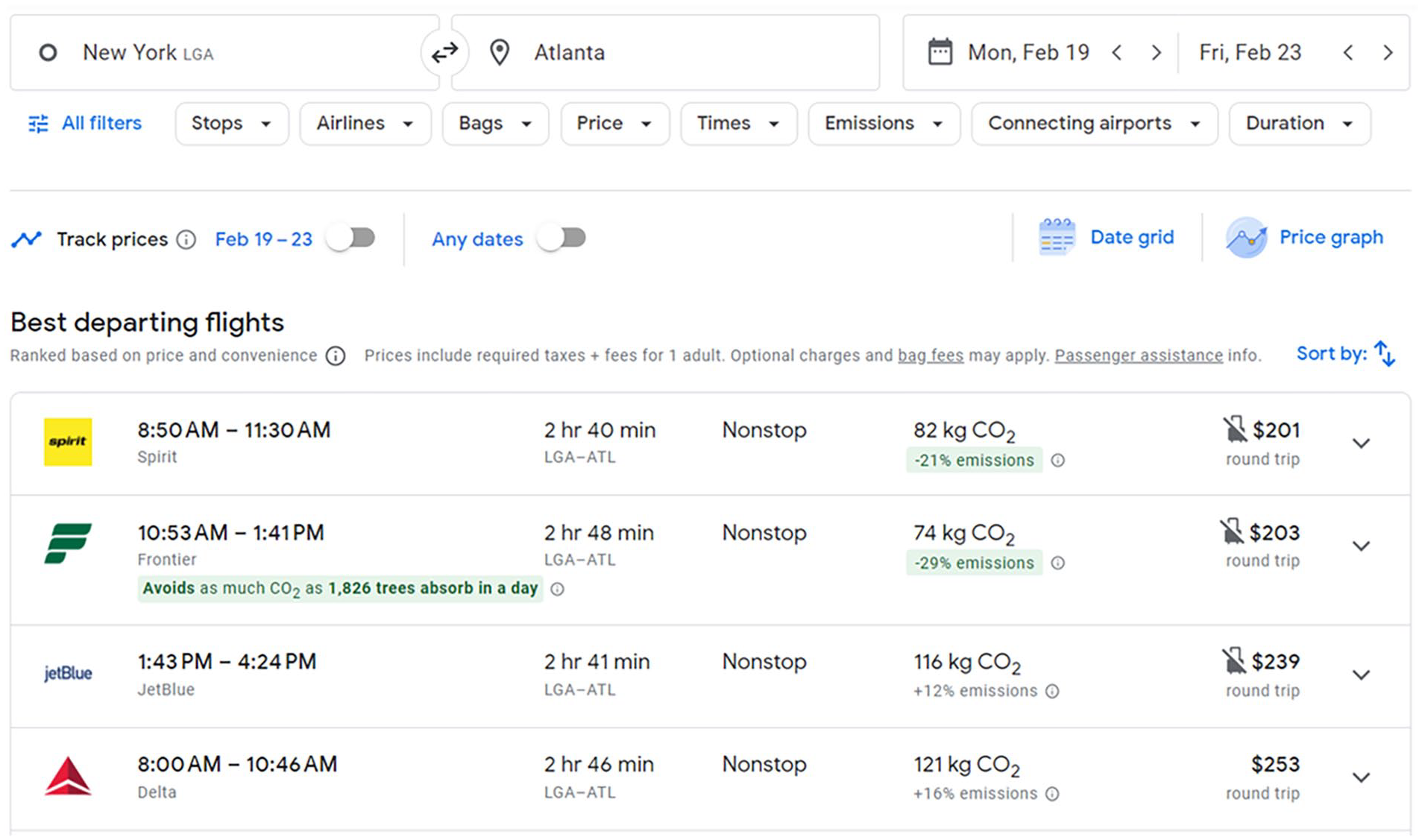
An example of a Google Flights calculation.
Google Flights is transparent regarding their emissions calculations with information icon buttons (shown in Figure 1), which can redirect site visitors to an entire section of their website dedicated to explaining the how and why behind their carbon emissions estimates. This section of their website references the European Environmental Agency (EEA) whose 2019 algorithmic model is what Google uses for their calculations (Google, n.d.-b). Google Flights also readily acknowledges that these calculations are specific to carbon emissions with the acknowledgement that this may exclude “other warming effects” (Google, n.d.-a). Critics of Google Flights have noted that only using the CO2 emissions calculations provided an inaccurate estimate of the total emissions (Jones, 2022; Rowlatt, 2022; Schaal, 2022). In 2023, Google handed over the tool to an independent advisory group to assist with matters concerning the calculations (Hawkins, 2023), and recently other platforms such as Expedia and Booking.com have allowed passengers to calculate flight emissions estimates using the same algorithm, called the Travel Impact Model (Rivero, 2024).
Current and Future Air Travel and Travelers
Environmental awareness and concern among travelers continue to grow and therefore, consumers often wish to track their carbon emissions when they travel, including when they travel by air (IATA, 2024a). Air travel creates significant CO2 emissions compared to other forms of travel. For example, the same trip per passenger by train may generate 4 kg CO2 emissions, by car it may generate 19 kg of CO2 emissions, and by air it may generate 23 kg (Google, n.d.-c). Moreover, in Europe, flight shame, often referred to as “flygskam,” has compelled airlines to react to these concerns (Chiambaretto et al., 2021). Many current and prospective air travelers book their flights online via tools such as Google Flights and may use the tool to track their carbon emissions. It has been estimated that on average, a customer can reduce the emissions caused by a flight by approximately 20% if they choose the least polluting itinerary (Rivero, 2024). Advances in aircraft technology have included a reduction in the noise levels of planes, more aerodynamic aircrafts, and the development of better fuel capabilities, but issues still remain in terms of balancing the economic, environmental, and socio-cultural aspects regarding air travel (Wittmer & Müller, 2021).
The Dilemma
Google Flights attempts to give consumers an accurate picture of their direct effect on carbon emissions, but many argue that this minimizes the additional negative environmental impacts caused by air travel. Critics have suggested that when the tool was available to users in 2021 that their estimates may have underestimated the true impact of air travel by close to 60% (Lee et al., 2020). This is due to the fact that there are a variety of additional emissions caused by air travel, in particular, that contribute to the warming of the climate, including nitrogen oxide, contrails, and soot (Google, n.d.-a). Only focusing the attention of travelers on CO2 impacts can indirectly cause individual consumers and industry professionals to minimize the true impact of their transportation choices. To create long-term behavioral changes, travelers will need to believe that emissions data are reliable and that alternatives do not have a substantial impact on their lifestyle. The ease of comparison between flights on the platform proves that a small change in arrival or departure time, as well as airline brand, can have a major impact on emissions. One of the remaining behavioral change barriers for travelers is the confidence they have in the calculation data (Palm et al., 2020).
The ambiguity and omissions related to Google Flights calculations and methodology have led many experts and critics to accuse Google Flights of greenwashing rather than engaging in a green practice. As noted above, greenwashing can include a company or organization making unsubstantiated claims, overinflating facts and figures, or even just using undefined, vague language (Beebe, 2023). This practice may be used in circumstances where a company or organization wants to gain approval from the public. For example, by reducing the estimated emission data, individuals may limit their own personal contribution to climate change and paint an unrealistic picture of the overall impact caused by the airline industry. As the definition of greenwashing includes ambiguity, it can often be difficult to discern, and this ambiguity makes it even more difficult to discipline companies applying these tactics. In some cases, regulatory action can be taken as a form of punishment, but usually the negative consequences include the following: poor brand perception, loss of consumer and investor confidence, and declines in sales (Beebe, 2023). Thus, increased scrutiny of climate-related business practices by the public could be a major force of change within the industry.
The “e” emissions from airline flights include a harmful byproduct known as a contrail, which has the appearance of a cloud trailing behind the airplane, but it is actually a formation of harmful emissions that includes nitrogen oxide, water vapor, and soot (Lee et al., 2020). The formation of contrails and the existence of these harmful gases within the atmosphere all contribute to global warming (Brander, 2012). These types of emissions are not currently included in the calculations used by Google Flights. Including both direct and indirect emissions data, the emissions calculations would improve in accuracy and paint a more holistic picture of climate impact. This is critical as “the last decade was the warmest on record” and the average surface temperature on earth is 1.1ºC warmer than it was in the late 1880s (UN, n.d.-a). Climate change impacts on human health and well-being are pervasive and persistent, including a higher frequency of extreme weather events, an increase in disease, and infrastructure damage (World Meteorological Association, 2023). Given what is at stake, it is of the upmost importance that CO2 emission data are properly calculated and widely understood. This will allow individuals and industries alike to better understand and adjust the way their behavior directly impacts climate concerns (World Meteorological Association, 2023). Yet, while the Google Flights tool may have underestimated the emissions created via air travel, at least it addressed the issue and allowed potential passengers to have at least some understanding of how their travel would contribute to emissions. However, going forward, it would be wise for all stakeholders involved to create and have access to accurate estimates. In addition, it would be helpful for consumers to be able to differentiate between green practices and greenwashing practices.
Analysis
As shown in this case study, there have been significant barriers to transparency, which included not only calculation methodology, but also extend to consumer education and understanding of emissions data. In order to combat climate change, it is important to have a foundational understanding of all contributing factors. Human activity is the leading cause of climate change; therefore, it is crucial that public education and data availability are at the forefront of climate change initiatives (U.N., n.d.-b). Furthermore, even with an educated public, it is important to understand how effective emissions estimates will be with regard to changing public behavior and purchasing decisions. Studies suggest that demand side policies and action may be less effective than those on the supply side in terms of creating meaningful, long-term change (Falk & Hagsten, 2021). Google Flights is more on the demand side of this equation as they seek to educate users on emissions data and total carbon footprint impact. Though this is impactful and necessary, it is important that industry innovations are focused on the supply side as well. Supply side innovations can include fuel-switching, increasing fuel-efficiency, improving aircraft design, and fine-tuning operating practices (US EPA, 2023). Specific examples related to the airline industry can include reducing the weight of the aircraft and improving aerodynamics in shape and design as well as reducing taxi times and engine idling at the arrival and departure gates (US EPA, 2023).
Google Flights has taken a step toward emissions transparency and public education through the addition of their emissions estimations. By encouraging guests to view and consider their emissions impact and providing insight and education into carbon emissions data, they are actively contributing to the public dialogue about climate change. A case in point is that this addition and the immediate greenwashing criticisms have increased the scrutiny of emissions calculations data and become an educational and overall improvement opportunity for the industry and Google Flights. They have certainly taken the initiative to increase carbon emissions transparency on the demand side of the airline transportation equation. Google Flights is also proving how important technology companies can be, not only in the transportation and tourism industries, but also in terms of the impacts on global climate change goals as well. Furthermore, while Google Flights provides an example, different initiatives will continue to be created and implemented, and it would be wise for all stakeholders, including those in the travel industry and consumers themselves to be able to understand the characteristics of greenwashing practices versus truly green practices that help the triple bottom line of environmental, economic, and sociocultural sustainability.
Conclusion
This case study focuses on exploring carbon emissions through the lens of the comparatively recent Google Flights online flight emissions estimation tool and examines the calculations and procedures used to acquire that data. The authors recognize that CO2 is a significant marker of climate change. However, solely focusing on it may not be adequate, such that incorporating the “e” in CO2e offers a more comprehensive view of emissions. Moreover, the original approach of Google Flights that included only CO2 emissions might be seen as “greenwashing.” In this case, there is recognition of the positive impacts of Google Flights toward enhancing sustainability, and in addition, it addresses the criticisms about greenwashing. Moreover, the case study offers a succinct synopsis of further sustainability endeavors within the airline industry as they connect to stated emission reduction and overall climate initiative goals. The dilemma concentrates on the positive and negative attributes of this tool and how to address perceptions of greenwashing and other issues connected to sustainability in relation to airline flights. Again, the focus is on discerning green practices from greenwashing so as to genuinely enhance sustainability.
Discussion Questions
What impact does the transportation industry have in connection with the development and management of sustainable tourism and hospitality? Please explain.
Briefly define and explain the current state of climate change as it relates to the rise in global temperatures and sustainability. What are a few of the contributing factors for this increase?
Why are carbon emissions so significant in terms of their contribution to overall greenhouse gas emissions?
Aside from air transportation, what are some additional human activities that result in significant carbon emissions?
What is greenwashing? Please define greenwashing and provide examples of greenwashing (in addition to those offered in the case study).
Google Flights was under no obligation to add emissions data on its search engine platform. Is the addition itself, even if just measuring carbon emissions, a step in the right direction? Or are greenwashing claims warranted? Please explain.
Could emission estimates be used in other sectors of the hospitality and tourism industry? If so, should there be an effort to standardize the calculations and methodology behind emissions estimates? Please explain.
How can Google Flights take additional steps toward encouraging individuals and corporations to take their carbon footprint into consideration when making transportation decisions?
What efforts are currently being taken by independent airline industries to address climate change? Do these seem sufficient? Please explain.
What other efforts do you think can be taken in connection with the hospitality and tourism industry to mitigate climate change and enhance sustainability?
If you are an ICHRIE member, you can access the Teaching Notes for this case study here: https://ichrie.memberclicks.net/jhtc. If you are not an ICHRIE member, the Teaching Notes will be published in a future Sage Business Cases (SBC) annual collection: https://sk.sagepub.com/cases. For more information, please contact info@sagepub.com.
Footnotes
Declaration of Conflicting Interests
The author(s) declared no potential conflicts of interest with respect to the research, authorship, and/or publication of this article.
Funding
The author(s) received no financial support for the research, authorship, and/or publication of this article.
