







Abstract
This case examines a challenge faced by outdoor-based accommodations and attractions regarding guest service technological expectations through the lens of copresence and technology dependence. Given the remote nature of these types of locations and lack of viable infrastructure, it can be difficult for guests and employees alike to work and play without technology such as Wi-Fi or cellular access. Additionally, the case shows how upper management and governmental entities in charge of national park tourism attempt to address the inclusion of technology access within a natural setting. The case discusses various solutions—such as utilizing a paid internet service at multiple lodges within the park or “disguised” cellular towers. However, determining the appropriate solution can be difficult, as management and other stakeholders need to balance technological guest satisfaction with preserving the natural space of the park and the wilderness that attract guests to the destination. As seen within the case, guests respond both positively and negatively to the lack of technological access within the park, which results in a challenging situation for park management to resolve.
Introduction
Outdoor-based tourism is a subsector of the hospitality and tourism industry that focuses on nature-based experiences and accommodations. Such experiences range from hiking in a national park to whitewater rafting, while accommodation examples include RVs, cabins, lodges, traditional camping, and “glamping” types of lodging such as treehouses and tipis (Brooker & Joppe, 2013; Saayman & Van der Merwe, 2017; Smith, 2017). Some of the challenges facing the outdoor hospitality industry include environmental destruction, climate change, over tourism, and lack of access to modern-day technologies we have come to expect (Sheva, 2023). Due to the often-remote nature of these locations, it can be difficult for a worker or a guest to gain access to Wi-Fi, cell service, streaming, or other cloud-based technology that society has become accustomed to using. In addition, adding access to this technology can be difficult due to infrastructure laws and challenges relating to accommodations on protected land, such as those in national parks. However, guests expect the comforts of a “normal” vacation when utilizing outdoor-based accommodation and attractions, particularly those comforts linked to technology; This expectation is only further compounded when technologically friendly marketing is utilized.
The following case describes a fictional location—Greenbriar National Park—and experiences of fictional guests (Simon) and employees (Julie), including challenges due to the lack of technological access. All information, settings, and characters presented in this case are fictional, and any resemblance to real locations, individuals, and organizations is purely coincidental. The case provides an example of the influence of social expectations about technology access on guest expectations within a rural location, and the subsequent impact this has on both employees and management organizations within the location.
Theoretical Perspectives: Copresence and Technological Dependence
This case is founded within the concepts of copresence and technological dependance to highlight the connection and reliance modern society has on technology. Copresence is based on core sociological theories about social construction and order (Goffman, 1966). In the contemporary context, copresence is used alongside an understanding of technology dependance to explore the connection that society has with technology access. Technology, such as social media and cell phones, are used to facilitate connection with others in society, creating a feeling of belonging and community. When one shares experiences via technology, one becomes “aware” of other environments alongside the original poster thus sharing in the experience with them (Grabher et al., 2018). In the tourism industry, copresence can be seen in the utilization of social media by tourists to share experiences with family and friends back home (Tham et al., 2020). Moreover, social media is also used as a marketing tool by tourism organizations to connect with potential visitors, generating real-time presence (Nyangwe & Buhalis, 2018).
Technology dependance, a core construct in relation to technology utilization behavior, refers to an individual’s dependence on technological devices and software, often to a detrimental degree (Brenner et al., 2021). Colloquially, technology dependence is a “modern problem,” seen in the rising use of technological devices and platforms across all aspects of life—school, work, and pleasure—and steadily increasing in frequency each year. Studies have shown that technology dependence affects brain function, including visual cognition, perception, and language (Hoehe & Thibaut, 2020). User satisfaction with technology is related to the engagement and responsiveness of the tech, something that can be difficult to achieve in wilderness spaces (Fan et al., 2017).
In conjunction with technology dependance, copresence partially attributed to the desire tourists have to maintain access to their preferred forms of technology, something that is evidenced within this case.
Objectives of the Case Study
The main outcome of this case study is for students to weigh the benefits against the costs of technology’s growing importance in society in relation to tourists’ expectations. This case will investigate outdoor-based tourism and the challenges related to technological access that visitors often encounter. Through the lens of sociological copresence and the concept of technology dependence, by the conclusion of the case discussion and analysis, students should be able to:
• Justify the level of appropriateness and distinct types of technology that guests would expect access to in outdoor-based tourism.
• Develop solutions in guest recovery scenarios in relation to technology access challenges in both lodging amenities and attraction spaces.
• Connect theoretical copresence and technology dependence perspectives to modern technological contexts.
• Formulate a comprehensive strategic framework for the integration of technology within the context of preserving historical wilderness areas.
Background
Amidst tall lodgepole pines and roaring waterfalls sits Lookout Lodge, one of the five accommodations options within Greenbriar National Park run by a property management company in conjunction with the Department of Land Management. Lookout Lodge boasts a wooden, rustic exterior with plenty of windows to observe the surrounding scenery (Figure 1).
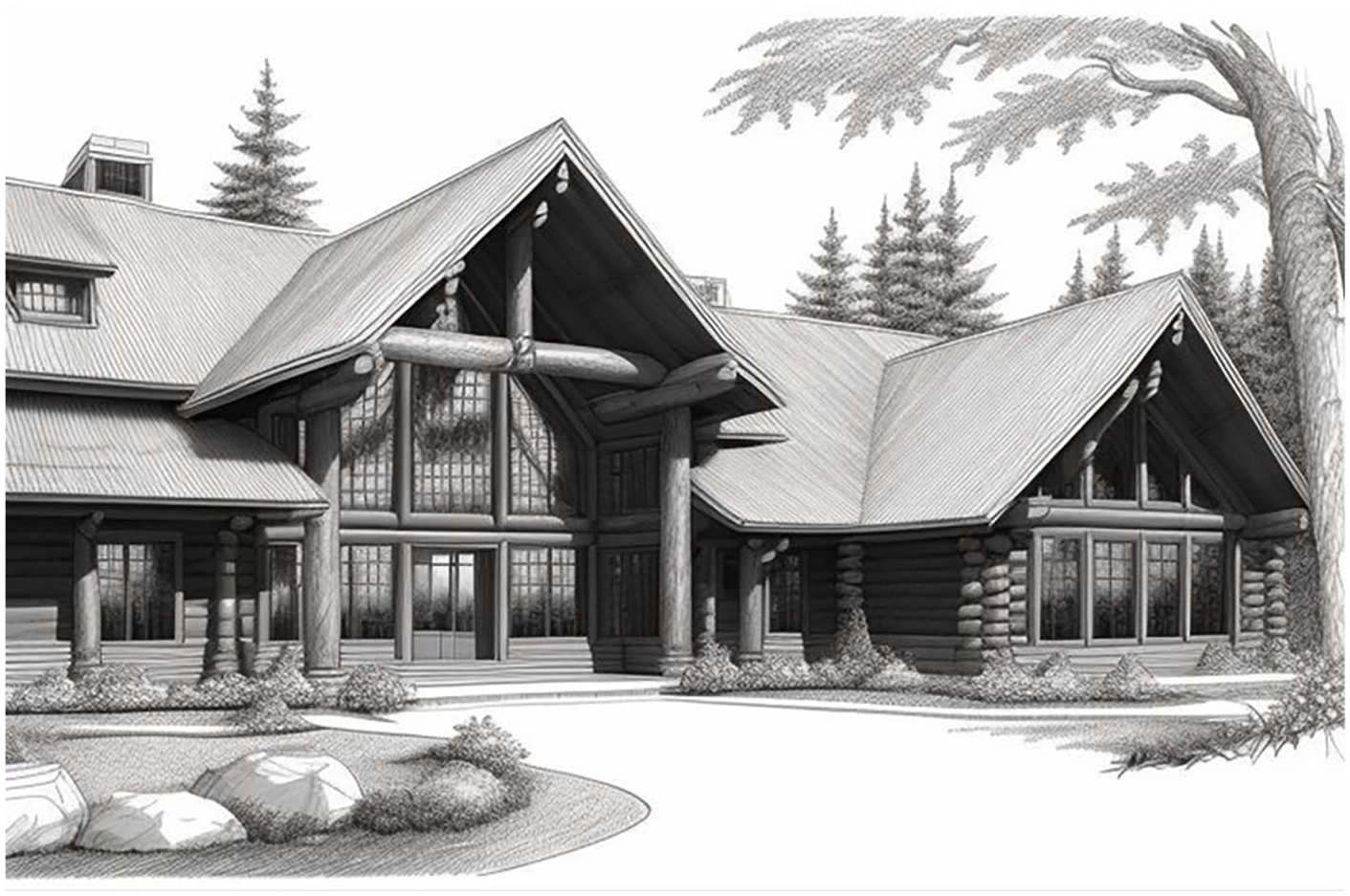
Conceptual drawing of Lookout Lodge (100% AI generated).
The interior of Lookout Lodge matches its exterior in rustic, metal, and wooden construction. Wherever possible, the designers of Lookout Lodge incorporated natural materials into the building. It is clear from the picturesque windows in each room that the design was intended to highlight the beauty, wonder, and attraction that is the surrounding wilderness. Lookout Lodge in Greenbriar National Park is famous for its historical status and exclusivity in booking, stemming from the natural features intentionally built into the hotel’s design. However, given the rural location, Lookout Lodge (and other accommodations within the park) are unable to offer commonly expected technological offerings—such as Wi-Fi access, cellular service, and television service.
An Employee’s Perspective
Julie, the Front Desk Manager at Lookout Lodge, loves her job. She has been in the position for 2 years and is quite proud of the changes she has made to the front-desk team during her tenure. For example, her new concierge and front desk associates are knowledgeable about the park and surrounding areas, are polite and helpful to guests, and are slowly becoming more proactive when facing operational challenges. Unfortunately, her team has faced some challenges, as guest complaints about technology access have increased over the years. Lately, guests have been flooding the front desk with complaints about the lack of available technology and specifically, Wi-Fi. Guest have inquired, “What do you mean I have to pay for access? I paid to stay here; you should provide Wi-Fi for free!” Other guests point out how outdated the Lodge technology is, “What is this, 1823? Why isn’t there Wi-Fi?” Some guests with young children seem to rely on TV: “My kids can only sleep when the TV is on, so can we get a TV delivered to the room?” and “What do you mean you don’t have TVs … This is an outrage!” These are all examples of comments from unhappy Lookout Lodge guests that Julie and her team must address daily.
Coincidentally, Julie understands this challenge because the employees at the Lodge are also frustrated with the lack of technological access. Julie admits that it can be confusing for guests and that when they book a stay at Lookout Lodge, they are expecting “wild luxury” that still meets the basic expectations of a hotel stay. Guests simultaneously want to see wild animals and wooden walls, but they also want access to the expected technology. This is only further complicated for the guests when they see marketing used by the park highlighting guests utilizing phones and laptops within the hotel lobby; it creates a modern setting in the marketing materials, but also confuses guests when they attempt to utilize their own technology.
When Julie first faced these guest complaints, she tried to empathize, but was soon unsuccessful. She quickly learned that the guests became more upset because she could not do anything within the scope of her job to solve a major equipment and technology infrastructure problem at the Lodge. Therefore, Julie adopted a practice of apologizing to the guests and offering compensation such as: providing a voucher covering the cost of the paid Wi-Fi at the nearby Flathead Inn; paying the guests’ dining room charges; upgrading the guests to a room with a better view; and discounting half of the guests’ overall charges on some occasions. This service recovery effort and discounting strategy was something she also trained her staff to do.
A Guest’s Perspective
While Simon finds Greenbriar National Park fascinating, at times he also thinks it is a boring place to stay. His parents wanted to take the family on one last big summer vacation, and they decided to visit a national park. While it was not Simon’s first choice, he enjoyed exploring the trails, seeing wildlife like wolves and elk, and taking photos of the waterfalls. The one major issue keeping Simon from thoroughly enjoying himself was the lack of cellphone access and Wi-Fi in the park. He understands and appreciates the natural beauty of the park; however, he still expected to have at least some type of reliable cell service. If he had reliable cellular access, he would send texts and photos to his friends, thus sharing the grandeur of the park. Instead, he has encountered unreliable reception throughout the park and slow Wi-Fi that you must pay for. Simon is ready to go home back to modern life.
Infrastructure Woes
While Greenbriar National Park is praised for its scenery and unforgettable experiences, it is also criticized by the public for one of the main reasons that all national parks in the country are criticized—a lack of technology access across the entire park. The Department of Land Management, who oversees national park upkeep and protection, has investigated improving technological access within the park multiple times through the past 50 years of its existence. However, there is never a clear answer on the best course of action. One could easily cut a path through the park’s forests to install telephone lines, cell towers, and internet lines, thus solving visitors’ demands for technological access. However, this solution completely goes against everything the Department of Land Management stands for. Cutting down trees and placing more human-made structures inside the natural park would further deteriorate the ecosystem of the park, displacing wildlife, and threatening the wilderness of the location. Overhauling a new infrastructure into a national park is not as easy as the public thinks.
There are some solutions available that both the Department of Land Management and the management company who runs the lodges in Greenbriar National Park have discussed in the past. One option is to increase the availability of the paid Wi-Fi service within the park. Currently, this service is only available at one of the smaller lodges at the south end of the park—Flathead Inn. There has been some discussion about bringing paid Wi-Fi service to Lookout Lodge, but the proposed construction project would encompass tearing down miles of forests, resulting in significant disturbance to the park’s physical environment.
Another option the Department of Land Management has put forth is the installation of disguised cell phone towers in already developed areas of the park. These “fauxliage” towers are built into artificially manufactured trees that blend in with the surrounding landscape. While these cell phone tower trees have limited capacity, they would still allow for more cellular service than previously available in the remote park areas and provide a way to stream certain television programs (Figure 2).
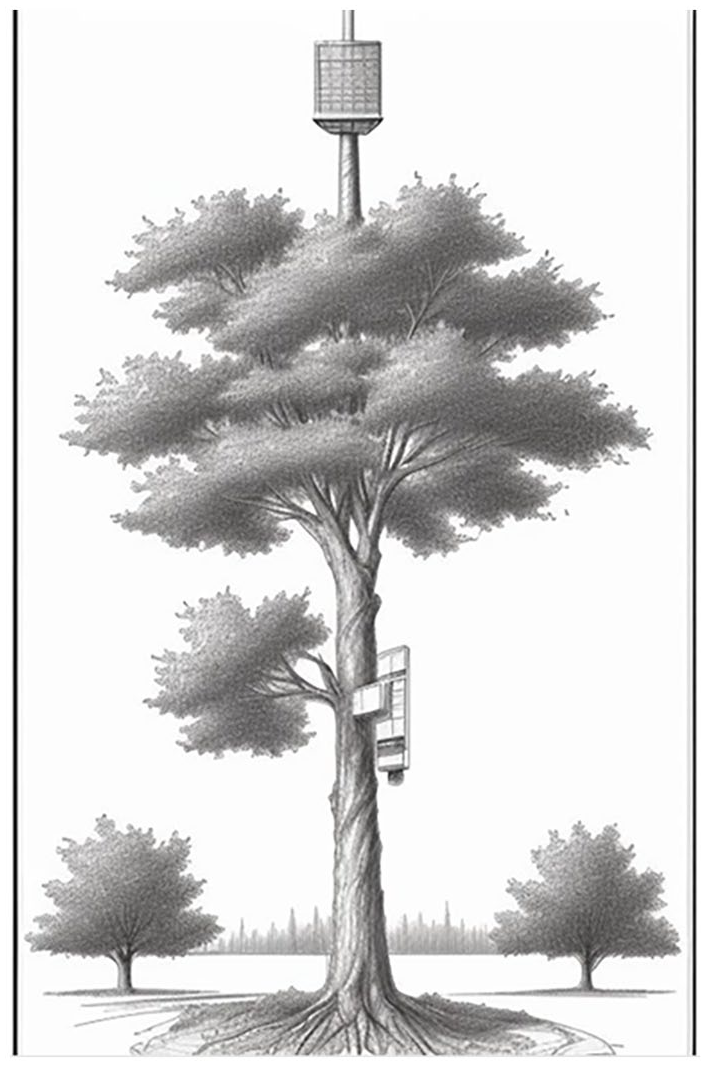
Conceptual drawing of a cellular tower disguised as a tree (100% AI generated).
Guest Satisfaction Survey
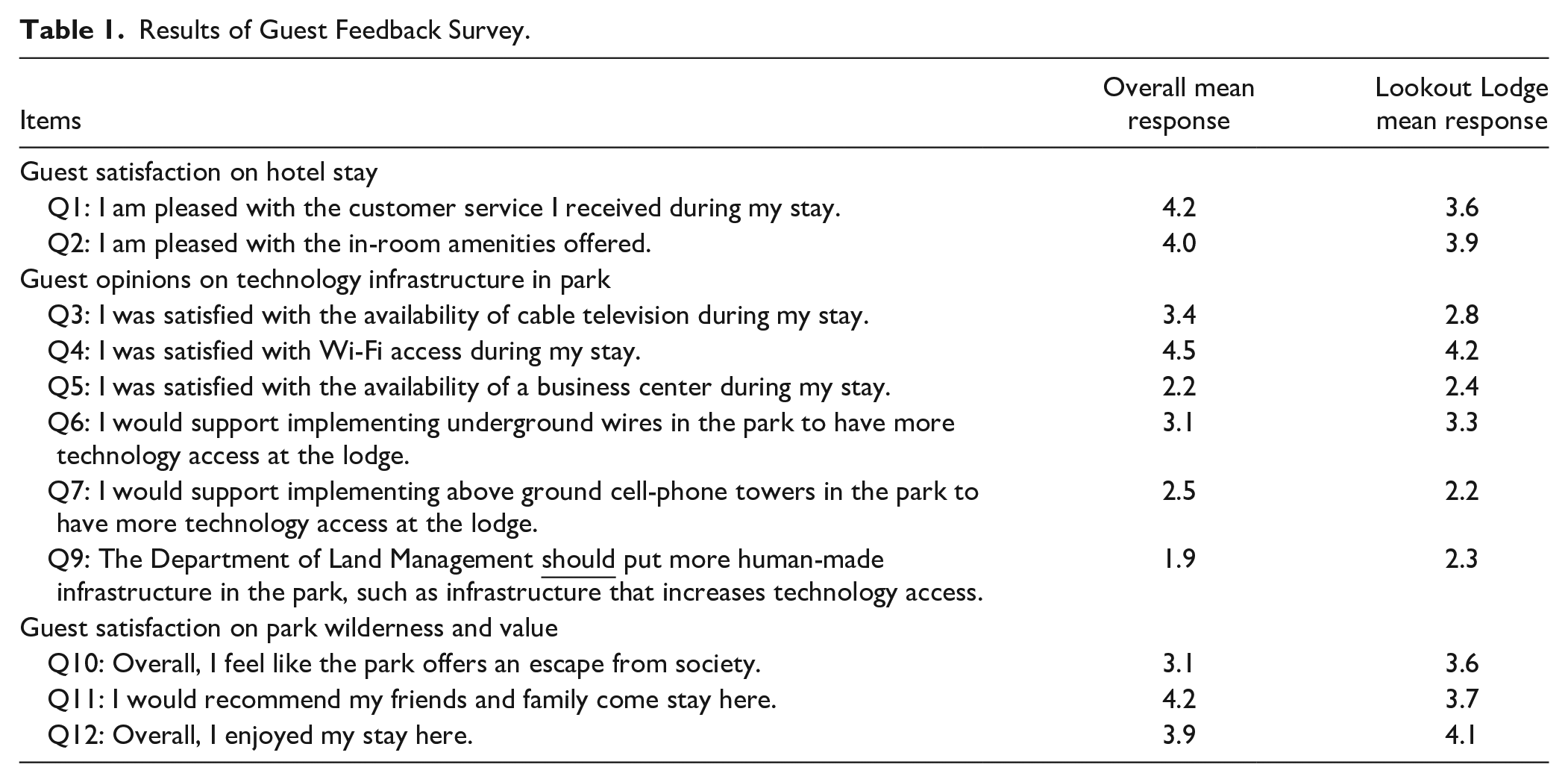
After a discussion with the Department of Land Management, the Lodge’s property management company decided to examine their guests’ satisfaction with technological access. Upon check-out, front desk employees introduced the surveys to interested guests. The survey contained 12 questions utilizing a five-point Likert scale (1 = Strongly Disagree to 5 = Strongly Agree) asking guests to rank their feelings on various aspects of their stay, with an emphasis on technological offerings. All five of their lodges in the Greenbriar National Park—including Lookout Lodge—distributed the survey for a 2-month period. The survey results for all properties combined and Lookout Lodge are below (see Table 1).
Results of Guest Feedback Survey.
Discussion
Modern society has become accustomed to near 24/7 technological access; these expectations remain the same for workers like Julia and for guests like Simon, who travel to Greenbriar National Park, a 1.5-million-acre wilderness. Given the infrastructure and environmental challenges that emerge when attempting to increase technology access in rural places, both employees and guests are challenged to work and play within a technological desert. Even though there have been discussions about ways to meet guests’ expectations regarding technology access in the park’s lodges, a question remains about the best ways to balance employee and guest expectations, technological innovations, and environmental protection of the park.
Discussion Questions
What are the shared viewpoints and disparities between employees’ and visitors’ perceptions regarding the role and impact of technology available within Greenbrier National Park?
Using the results of the survey in Table 1, what management challenges might you foresee in training the frontline employees to handle guests’ critical feedback on the apparent lack of technology access?
What types of technological access do guests expect based on demographics (generational, cultural)? How might a manager/owner prioritize solutions for building technology infrastructure based on the percentage of demographics and their target consumer?
How do copresence and technological dependence explain guests’ behavior? Based on these psycho-social frameworks, what strategic operational recommendations can be proposed to enhance the overall guest experience at the Lodge?
If you are an ICHRIE member, you can access the Teaching Notes for this case study here: https://ichrie.memberclicks.net/jhtc. If you are not an ICHRIE member, the Teaching Notes will be published in a future Sage Business Cases (SBC) annual collection: https://sk.sagepub.com/cases. For more information, please contact info@sagepub.com
Footnotes
Declaration of Conflicting Interests
The author(s) declared no potential conflicts of interest with respect to the research, authorship, and/or publication of this article.
Funding
The author(s) received no financial support for the research, authorship, and/or publication of this article.
