







Abstract
This case study focuses on the unknown risks and harm of wildlife supplementation due to misinterpreting the perceived relationship between humans and wildlife. Arizonian resident Lisa Williams is observed as a victim of these misconceptions after being killed by an Elk she attempted to feed. The cause of these misconceptions is explained through the lens of Social Exchange Theory. In addition, possible solutions to deter wildlife supplementation are introduced.
Introduction
The perceived need to occupy the same spaces as wildlife has been rising for the past decade, a compounding issue due to forced COVID-19 lockdowns (Newsome, 2020). The longing for close-up encounters with wildlife has led to tourist supplementation of the animals to draw them in. Unbeknownst to the tourist, prolonged human-wildlife feeding provokes aggressive behavior from otherwise docile wildlife. Tourists’ lack of knowledge and disregard for the risks of wildlife supplementation results in harmful animal encounters.
In the case of 63-year-old Lisa Williams, supplementation of local wildlife resulted in her tragic passing and the first recorded death by Elk in History of the state of Arizona. This case study analyzes the misinterpretation of perceived relationships in the context of human-wildlife encounters by tourists. The known motivation behind wildlife supplementation is a desire for a relationship with animals. Tourists perceive that they are partaking in mutually felt bond with wildlife, which is a dangerous misconception. Unlike humans, wildlife does not possess the ability to partake in social interaction; they are simply foraging for food. Numerous instances have been documented of wildlife displaying unnaturally aggressive behavior toward humans, injuring them to obtain food.
The case of Lisa Williams is not an isolated incident; rather, her tragedy illustrates a global epidemic in human-wildlife encounters, namely in the tourism industry. Countries worldwide are experiencing the disastrous results of tourists’ attempts to supplement wildlife as a means to engage with the animals on a seemingly more personal level. An article written for USA Today, Ahjańe Forbes, outlines a human-wildlife interaction that goes awry after a tourist was videotaped feeding a local bull on a beach in Los Cabos, Mexico. The bull, whom tourists had been warned against feeding and is native to the area, is seen knocking a woman to the ground and continuously attacking her shortly after she fed the animal (Forbes, 2024). Another example demonstrating the dangers of feeding wildlife is recorded in the Daily Mail by Jacob Thorburn. As reported by Mr. Thorburn (2021), after being fed by multiple tourists, a wild moose in Zyuratkul National Park, Russia, struck a young girl with its hind legs when she approached the animal. Thorburn (2021) concludes the article stating that the Alaska Department of Fish and Game, who frequently interact with moose, warns that the more often a moose is fed, the higher the chance it charges a human. An additional case demonstrating the adverse effects of prolonged human-wildlife supplementation, as reported by The Jakarta Post, can be observed in Nara Park, Japan. Nara Park, a 600-hectare park located in Western Japan, has a long history of encouraging the feeding of its over 1,000 deer as a tourist attraction. According to The Jakarta Post (2019), these activities often prove perilous, with the park reaching a record high of 200 injured tourists in 2018, 80% of which resulted from attempts to feed the wildlife. As is evident in these numerous accounts from varying countries across the globe, feeding wildlife as a means for an up-close interaction has become an international phenomenon that poses a great variety of risks to participating tourists.
In the tragic case of Lisa Williams, her fatal encounter with wildlife involved an elk and resulted in her death. However, in the grander scope of human-wildlife interactions, a wide variety of animals can be involved, and such exchanges range in severity. In a study compiling data from published and unpublished papers, government reports, and website estimates, Conover (2019) highlights the species, location, and fatality of human-wildlife encounters in North America as seen in Figure 1. Conover (2019) states that attacks from dangerous predators, namely alligators, cougars, polar bears, grizzly bears, black bears, and Coyotes, have been increasing in North America. Postulating that the rise in these incidents results from human-wildlife habituation and a lack of understanding surrounding the risk involved with wildlife interactions, Conover (2019) believes that the rise in attacks may stem from a social issue. On a global scale, the species of animals involved, the nature of injuries incurred, and fatalities associated with human-wildlife incidents depend on indigenous wildlife and access to and availability of local medical resources. Figure 1 demonstrates the extensiveness and far reach of human-animal incidents, outlining the dangers of inappropriate human-wildlife interactions. It underscores the need to accurately understand human-wildlife relationships, making knowledge a critical factor in preventing such incidents.
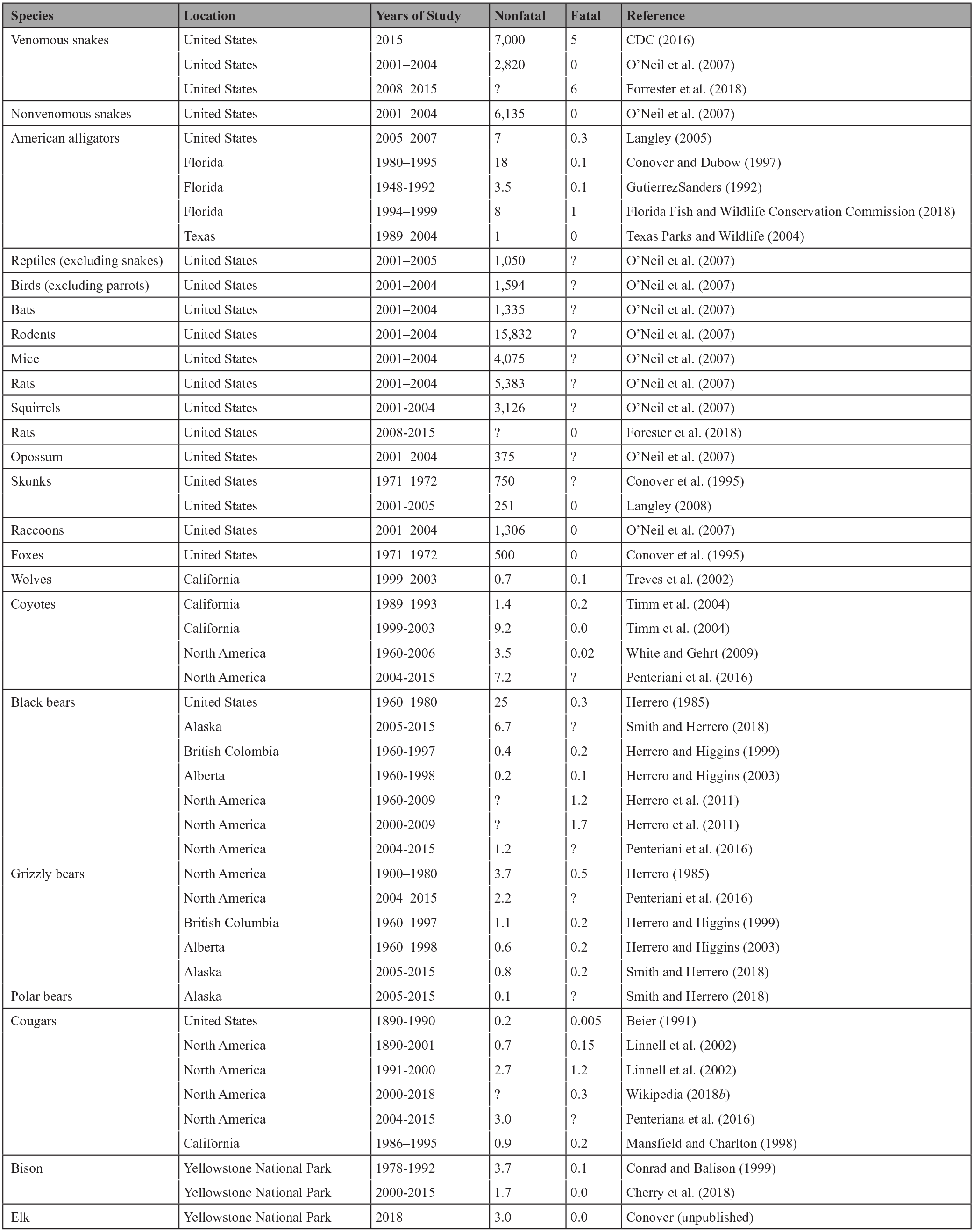
Species, location, and fatality of North American human-animal incidents developed by Conover (2019).
Lacking understanding and education on the risks involved with wildlife supplementation, tourists continue to partake in the fantasy of Social Exchange with wildlife. Researchers argue that addressing the problem of wildlife supplementation by tourists requires implementing education for those who will interact with wildlife. Increased signage, evidence of the risks involved with wildlife supplementation, and targeted social media campaigns may be actionable ways to dispel the tourists’ fantasy of wildlife-social exchange and deter future wildlife supplementation. These strategies may prove beneficial for parks and tourism managers as tangibles ways to prevent tourist-wildlife supplementation.
Background
Death of Animal Enthusiast
The Kingman Daily Miner, a local news outlet in Kingman, Arizona, featured an article authored by McDonough (2023) exploring circumstances leading to the death of resident 63-year-old Lisa Williams. It was well known in the community that Mrs. Williams possessed a desire and affinity for wildlife. Lisa habitually adopted animals in Pine Lake—the deer, Elk, birds, lizards, and bunnies. On the day of the incident, Scott Williams, Lisa’s widower, stated that Mrs. Williams was occupied constructing bird wiring for woodpeckers who frequented their estate. Before leaving, Mr. Williams noticed that Mrs. Williams had prepared a bucket of corn with the intention of feeding the local wildlife, namely deer. A rake leaned against the house as a makeshift defense if her feeding attracted aggressive animals. Lisa’s preparation to ward off unwanted animals indicated her knowledge of the risks associated with wildlife supplementation. When Mr. Williams arrived home, the bucket of corn was spilled, and he found Mrs. Williams in critical condition, presenting injuries consistent with an elk attack. As mentioned, at the hospital, Mrs. Williams succumbed to her wounds and did not survive the wildlife encounter. Scott expressed his dismay at Mrs. Williams’s tragic passing while also acknowledging the danger of feeding wildlife by stating, “Did she deserve to die? No. She was just feeding animals. But this can happen, and everybody should know this can happen” (McDonough, 2023). Regardless of the perceived relationship Mrs. Williams felt toward wildlife, Lisa subjected herself to harm in her attempt to supplement the local animals.
Elk and Arizona
Native to North America, Elk have long been a predominant wildlife species and an integral aspect of the Western American economy. Elk have become a staple in wildlife-driven tourism, prompting thousands of visitors to travel to the southwestern states due to their desire to observe these creatures (Heydlauff et al., 2006). Although Elk were originally indigenous to Arizona, in 1902, native Elk became extinct due to overhunting. In 1913, to reinstate Elk to habitats in which they previously resided, Yellowstone game managers relocated 11,366 Elk back to their natural habitats (Amundson, 2020). As a part of Arizona’s heritage, the rejuvenation of the Elk population has become a significant part of the state’s history. Elk have since repopulated and adapted to the lands and forests which used to be their homes.
In 1929, the Arizona Game and Fisheries Department (AGFD), through the Arizona Game and Fish Commission (AGFC), assumed responsibility and authority for managing the entire wildlife population in the state, including Elk. Their mission, “As responsible stewards of the public trust, we must modify our management to best serve the needs of both present and future generations, while maintaining our commitment to conserve, enhance, and restore the State’s diverse wildlife resources” (Young et al., 2000). Arizona residents feel a connection with the Elk that populate their state. As an indigenous species and fundamental component of the state’s history, past human-Elk relationships have been symbiotic and a source of enjoyment for locals. After surveying Arizonian residents, Heydlauff et al. (2006) discovered the extent to which Arizonians admired Elk. The overwhelming majority of the public (80%) recounted that they had benefited in some aspect from Elk in their state. Of those who expressed their adoration, most (64%) stated that the incurred benefits were a result of the aesthetic value associated with Elk; others (18%) derived satisfaction simply by having the knowledge that Elk existed in their environment.
Wildlife Supplementation in Tourism
The human-animal relationship is one as old as civilization. From hunting to domestication, humans and wildlife have always coexisted. In recent years, the desire for animal observation has grown tremendously. Orams (2002) discovered that due to the nature of the long-standing human-animal interdependence, many feel that connecting with wildlife is their congenital right. Wildlife-based tourism is and will continue to grow in popularity. With wildlife tourism on the rise, many have found that feeding animals wildlife supplementation is a successful avenue for up-close wildlife encounters (Orams, 2002). Wildlife supplementation has become common among tourists seeking close encounters with wildlife.
Although the risks surrounding irresponsible human-wildlife interactions are insurmountable, specific physical impairments and infectious agents present greater danger and are more prevalent in human-animal encounters. Research and data from Freer’s (2004) on North American mammalian injuries, Warwick and Steedman’s (2012) work on exotic pet injuries, envenomations, and stings, as well as a 2014 safety memo from the Occupational Health Program, have revealed the most common injuries and illnesses prevalent in human-animal interactions. These findings are complied with in Figure 2. While Figure 2 provides a more considerable oversight of the common risks associated with human-animal interactions, it should be noted that the animal involved, frequency, and severity of incidents vary case by case and largely depend on the indigenous animals in a given region. Nonetheless, the research clearly demonstrates the diversity and magnitude of the physiological and pathological hazards inherent in precarious human-animal interactions.
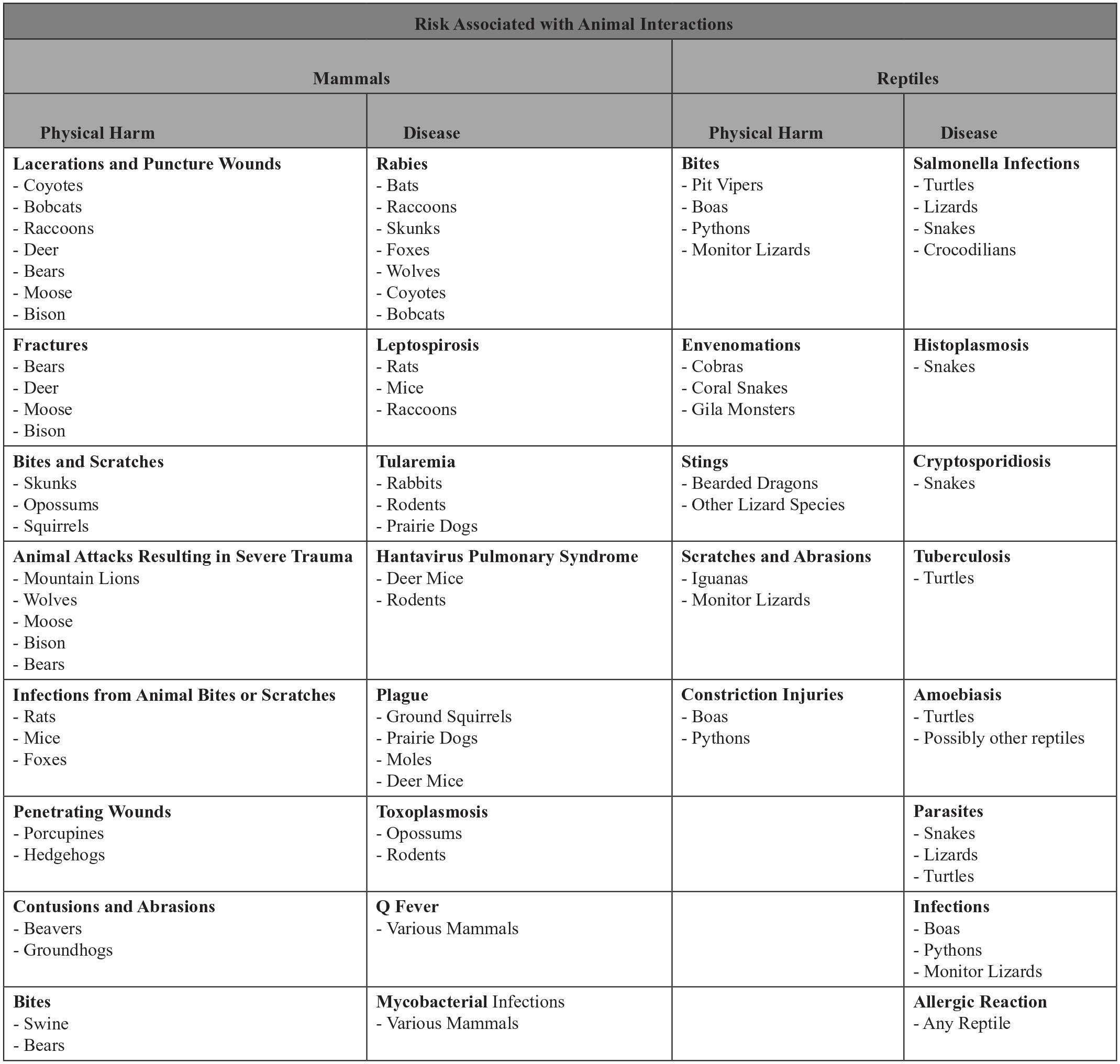
Physiological and pathological risks human-animal interactions compiled from Freer (2004), Warwick and Steedman (2012), and the Occupational Health Program (2014).
The Issue
In recent years, the human-Elk relationship has transformed from docile to dangerous. American Television Network (ABC News) reported that on October 26th, Arizona resident Lisa Williams was the first Elk-caused death recorded in the state’s history. Although Mrs. William’s is the first documented Elk-related passing, ABC news reported that, according to the AGFD, there has been a growing increase in Elk attacks in recent years (Haworth, 2023). A NBC news articled authored by Smith (2023), outlines two of these intendents; in 2021 a woman sustained severe injuries from an Elk habituated to humans in Pine, Arizona, and in 2015, two children received minor injuries as consequence of an Elk encounter. Hawkins’ (2017) account for the Las Vegas Journal Review divulged that the children harmed by the Elk in 2015 had actively participated in wildlife supplementation. This occurred in Arizona’s Hualapai Mountains. Prolonged exposure to human activity has habituated Arizona’s Elk to humans and their behavior. As a result, Elk have become increasingly bold in their exchanges with people. As revealed by these cases, habituated wildlife can even display aggression.
Since the beginning of the 21st century, placing oneself in as close of proximity to animals as possible has emerged as a viral mechanism whereby tourists feel they are communicating with nature (Orams, 2002). Constant close-up exposure to humans has habituated animals to human behavior, deteriorating their instinct to avoid situations that may pose as dangerous. In conjunction with entering an animal’s proximity, tourists also provide food for wildlife to entice a physical interaction (Orams, 2002). Supplementing wildlife compounds the already dangerous habit of tourists approaching animals to be in their vicinity. Specifically recounting the effect that these behaviors are having on deer and elk, an article for the Las Vegas Review-Journal, authored by Hawkins (2017), reports that deer and elk have begun to frequently approach people visiting Hualapai Mountain Park as they have grown accustomed to handouts from tourists. These behaviors become cyclical and compounding. As more tourists approach and feed animals, more animals become comfortable interacting with humans. In turn, once wildlife has been exposed to supplementation, they seek food from humans. This cycle increasingly promotes unhealthy and dangerous interactions between wildlife and humans.
Although there are many observable negative impacts associated with wildlife supplementation, in the context of the danger posed to humans, tourists are most significantly impacted by the behavioral shift of animals toward aggression (Newsome & Rodger, 2008). Figure 3 displays a variety of ways in which animals are affected by supplementation, namely their altered behavior and psychological changes. Newsome and Rodger (2008) note that the primary behavioral change in wildlife that has received frequent supplementation is increased aggression toward humans. They outline examples of coastal sting rays in Australia swarming divers, two dingoes who mauled a 2-year-old to death, and others to exhibit the direct effects of wildlife supplementation on animals’ behaviors. These examples make clear that wildlife supplementation increases wildlife aggression, and the risk wildlife poses to tourists.
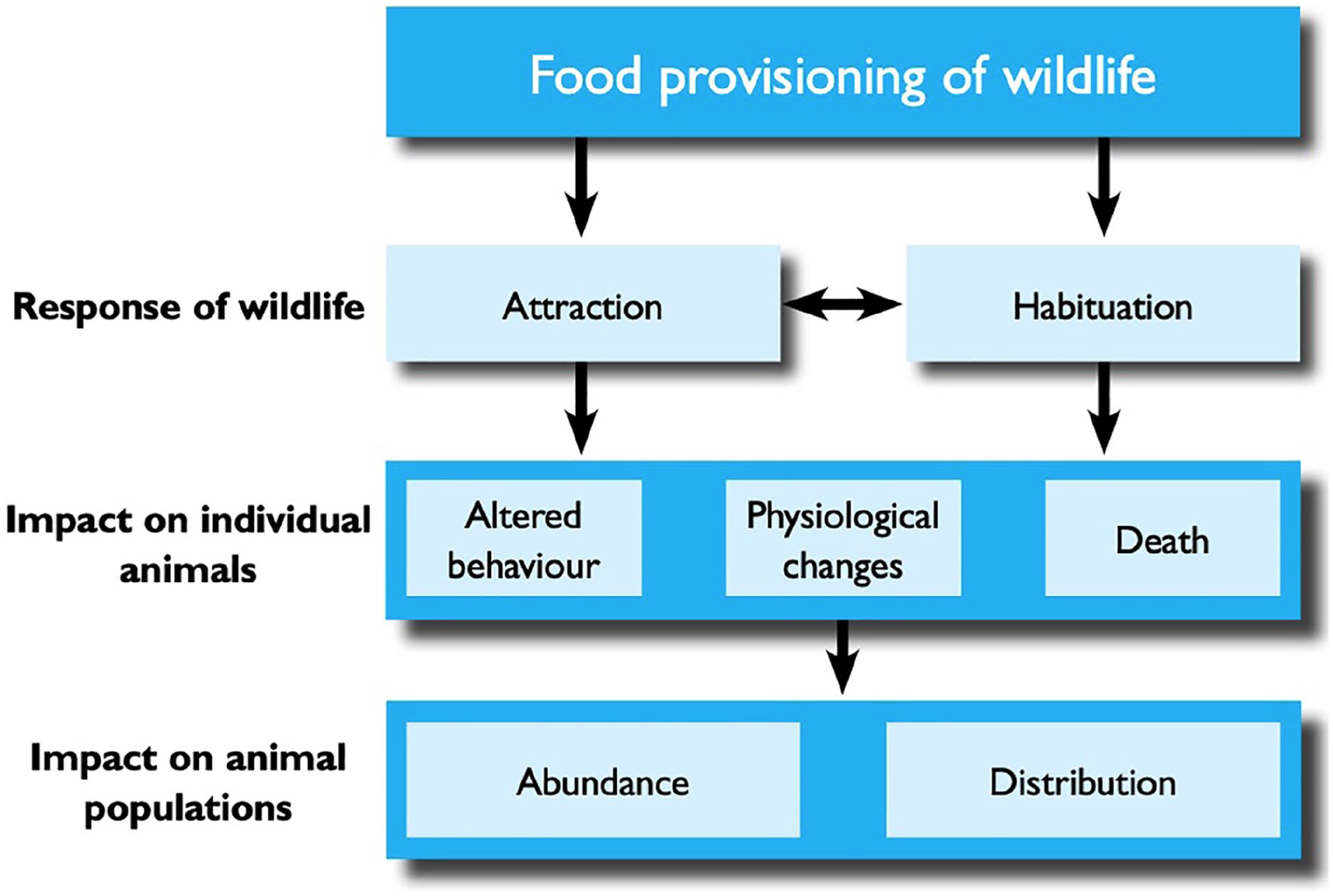
Potential and actual impacts on wildlife from food provisioning developed by Newsome and Rodger (2008, p. 261).
Dilemma
Wildlife Encounters in Tourism
Human interactions with wildlife have been a crucial experience since society’s inception. Since the beginning of the 21st century, the human desire to connect with nature has shown a stark increase. This longing to interact with animals has propelled visitors to travel with the intention of wildlife-based tourism (Orams, 2002). A survey of park visitors to ascertain individuals’ motives for travel revealed that 68% to 71% of people claimed viewing wildlife was an essential aspect of their trip (Hockett & Hall, 2007). There exists a growing demand for wildlife encounters from tourists. The perceived need to occupy the same spaces as animals is on the rise, and, as uncovered by Newsome and Rodger (2008), many consider it their right to feed wildlife (p. 265). Although this is not the view held by all those seeking to interact with nature, feeding wild animals has become an accepted enough practice that damage to wildlife and humans has already become evident.
Prolonged interaction with humans as a product of supplementation radically alters an animal’s psychology. Numerous cases have been recorded of wildlife consistently fed by tourists, displaying unnaturally violent behavior (Orams, 2002). As stated by the U.S. Department of Agriculture Animal and Plant Health Inspection Service (2023), wildlife that becomes too aggressive can result in encounters leading to serious injury, destruction of property, and, in some cases, even the loss of human life. An article published by ABC News outlines such a tragedy. Yamada (2021) tells the story of a woman visiting Yellowstone National Park who, after approaching a deer being fed by other tourists, sustained injuries after the spooked creature charged at her. As a result, Yosemite National Park’s officials released a statement reiterating the dangers associated with wildlife feeding and strongly condemning such behavior. Multiple instances of aggressive animal behavior resulting from inappropriate human interactions has been recorded by Guardian News and Media (2018). Tourist operators indicated that visitors often feed animals unsuitable food, such as carrots, corn chips, and even McDonald’s takeaway, to experience up-close interactions with wildlife (Guardian News and Media, 2018). These encounters resulted in several reported instances of kangaroos attacking visitors. One man received deep gashes to the stomach, while another’s injury necessitated 17 stitches due to significant lacerations to his face. These instances are a few examples of the physical harm befalling tourists who engage in wildlife supplementation. Despite the consequences of their actions, the perceived benefit of approximate encounters with wildlife outweighs the risks in the minds of many wildlife tourists.
Social Exchange Theory and its Misinterpretations
Social Exchange Theory is critical to understanding the motives driving the dilemma of human-wildlife supplementation. Homans (1961) defined social exchange as “the exchange of activity, tangible or intangible, and more or less rewarding or costly, between at least two persons.” In this understanding, cost is viewed as the alternative activities or opportunities foregone by an involved individual who does not participate in an exchange. In wildlife supplementation, the reward can be explained as the benefits of feeding wildlife. In contrast, the cost would involve missed opportunities for wildlife encounters and potential physical risk. Cook (2005) further elaborates on the psychology behind Social Exchange Theory, suggesting a couple of way that social exchange operates. He explains that human exchanges are framed through rewards and punishments. Behavior in an exchange that is rewarded and generates perceived positive consequences will likely be repeated. Congruently, if a similar behavior performed in the past yielded preferable outcomes, those actions are likely to be repeated in expectation of the same reward. The higher the perceived value of an action, the more likely an individual is to take part in future activities of the same nature.
In the context of wildlife supplementation, uneducated tourists misconceive their interactions with animals as a social exchange. Outlining Levi-Strauss’s Theory Exchange Hamlin (n.d.) explains that animals are incapable of social exchange and that only humans have this capacity. With this misconception of a social exchange, perceived rewards of wildlife supplementation, in the minds of tourists, outweigh the known punishments. Much of this misinterpretation of social exchange is from a skewed understanding of the distinction between the differing classifications of animals in their context. As outlined in Figure 4, these categorizations are captive, semi-captive, and wild. Each area presents examples of an animal in each given context. With the continual growth of human-animal interactions in the captive and semi-captive context, tourist perception of wildlife has shifted. Regular exposure to habituated animals has inadvertently caused humans to cultivate the fantasy of a strong familiarity with and affinity toward wildlife. Although the visitors’ perceptions may have changed, animals in the wildlife context still pose a severe threat of injury to humans (Orams, 2002). With the continuation of these patterns, tourists will continue to place themselves in harm’s way.
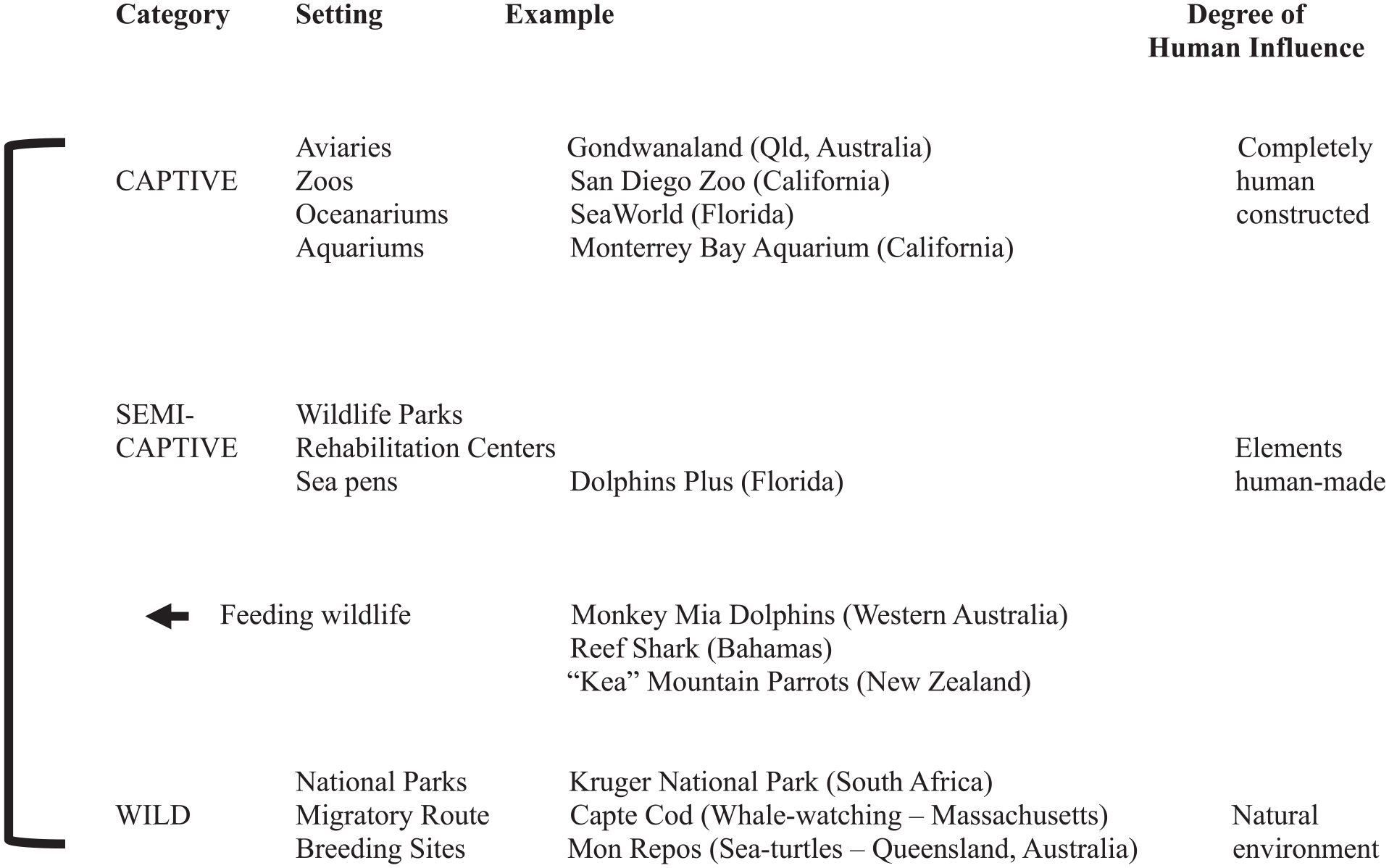
Classifications of animals in contexts developed by Orams (2002).
Semi-captive, specifically, is an animal context that has had a detrimental effect on tourists’ ability to distinguish between animal classifications leading to the misconception of a social exchange. Contexts such as zoos, wildlife parks, rehabilitation centers, and other institutions contain animals who, otherwise are considered wild. In the semi-captive context, humans can participate actively and safely in supplementing dangerous animals. A journal published by Akinyemi (2015) explored the concept of tourists feeding wildlife for pleasure. His findings were indicative that the opportunity to feed wildlife was a highly motivating factor for tourists seeking to visit the local zoo. He argues that close interactions are quantifiable and part of the human psychic/physique. The muddying of animal classifications due to the inability to distinguish between captive, semi-captive, and wild animals can be understood to be a driving factor in tourists’ perceptions of wildlife supplementation as a rewarding behavior.
Social Exchange Theory can also further help understand tourist actions in wildlife supplementation because of community behaviors. Due to tourists’ perception of a social exchange, understanding the motivations behind this theory is imperative. Social Exchange Theory outlines that observing others partake in a behavior with noticeable rewards will induce a desire in an individual to replicate that behavior. As quoted in Akinyemi’s (2015) article, Bernstein et al. (1991) states, “as individuals, humans are also predictable in that if they perceive that other people are receiving benefit from some activity, then they also want to be ‘part of the action’.” When tourists view others receiving a positive experience interacting with wildlife via supplementation, they are predisposed to seek the observed reward. This results in tourists mimicking the behavior associated with other visitors’ up-close interactions with wildlife. Behavior such as this is especially evident when, whether legally or illegally, tourists view tourism excursion guides feeding wildlife (Orams, 2002). Although the perceived social interaction is a fantasy, when tourists observe others gleaning a seemingly relational encounter between people and wildlife, they are likely to emulate this behavior.
In the case of Lisa Williams, the relationship between wildlife supplementation and the misconception of Social Exchange Theory is exemplified. Lisa’s passion for animals displayed that her mindset toward interactions with wildlife was relationship oriented. Aware of the problems (risk) associated with wildlife supplementation, as evidenced by the placement of the rake for self-defense, Mrs. Williams’s perception was that the misconceived social exchange mitigated the cost. As proposed by Social Exchange Theory, Mrs. Williams’s past experiences and understanding of animal encounters were sufficient for her to derive that this act would be beneficial and represented a relational exchange. Had Lisa more aptly recognized the dangers involved with this activity, her fantasy surrounding her social exchange with wildlife may have dissolved resulting in actions that could have prevented this incident.
Preventative Methods to Deter Tourist-wildlife Supplementation
Understanding the misinterpretation of Social Exchange Theory may be a beneficial tool to adjust the inappropriate interactions tourists conduct with wildlife, specifically habituation, through supplementation. Arizona’s AZGFD have acted in response to the recent tragedy. According to an ABC article by Haworth (2023), in Lisa Williams’s case, AZGFD has taken measures to prevent future incidents. Along with constructing new signage condoning wildlife feeding, the department sent officers door to door in the Pine Lake community to distribute door hangers educating local Arizonians about the dangers of wildlife supplementation. Additionally, in a CBS News article by Kingman (2023), the wildlife and fisheries agency stated that they will continue to monitor elk activity in the area to prevent future incidents proactively. By means of education with the purpose of dismantling the façade of the perceived human-animal relational exchange, the AZGFD seeks to reduce and eventual eliminate the act of tourist-wildlife supplementation.
Social Exchange Theory argues that if individuals correctly understand a behavior’s actual costs and benefits, they will become more likely to participate in self-advantageous activities. This suggests that tourists require a more sophisticated viewpoint to eliminate social exchange fantasies surrounding their perceived relationship wildlife, thus necessitating further education. To understand how the tourism industry should educate individuals about the malice of wildlife feeding, a suitable framework exploring unbefitting behavior must be established. Newsome and Rodger (2008), in their research surrounding the negative consequences of inappropriate supplementation of wildlife, developed the following criteria defining when it may be advantageous verses malapropos to feed wildlife as seen in Figure 5.
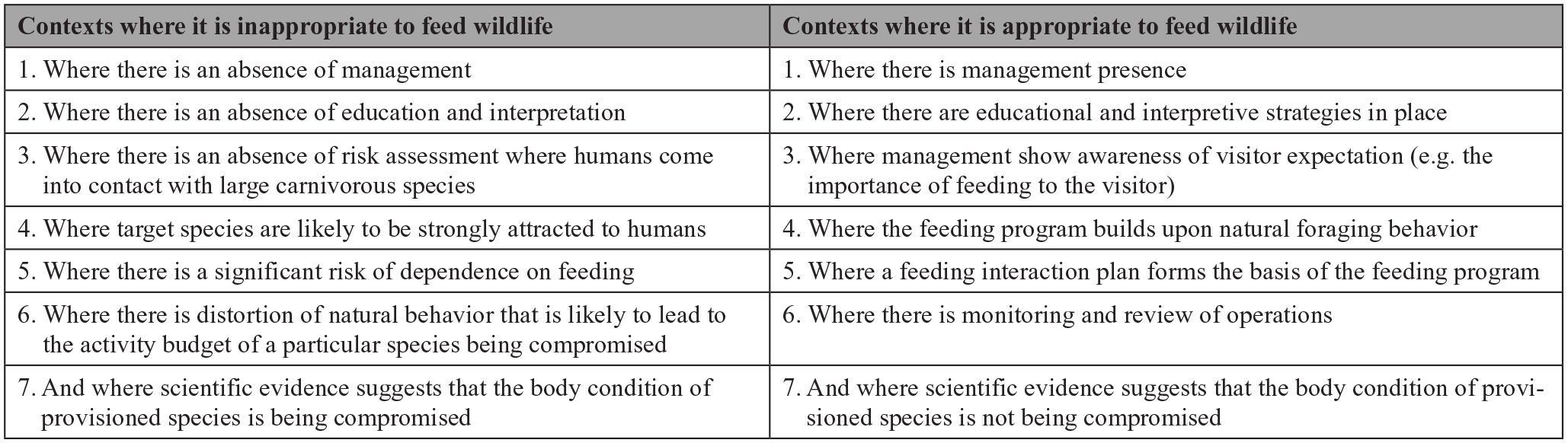
Contexts of wildlife-supplementation developed from Newsome and Rodger (2008).
Multiple studies have been conducted to establish beneficial practices to deter tourist-wildlife supplementation. Three practices that have yielded successful results are increased signage condoning wildlife feeding, increased education on the dangers of wildlife supplementation, and focused media campaigns highlighting the consequences of inappropriate interactions with wildlife.
Tasmania’s National Parks have implemented increased signage discouraging visitors from feeding wildlife as a preemptive measure. Of surveyed subjects who had seen the signs, 84.6% stated that the signs reinforced their preexisting notions concerning wildlife feeding, 3.9% reported that the signs had formed their opinions, and 11.5% said the sign did not affect their stance (Mallick & Driessen, 2003). Similar conclusions were drawn in a study of signage implementation by Griffin et al. (2023). Phoenix Park, Dublin, erected signage strategically in select locations and distributed posters and infographics to local businesses condoning wildlife feeding. Griffin et al. (2023) state that the increase in signage resulted in a significant decrease in the number of people feeding wildlife compared to previous summers. These findings argue that adding signage dictating the consequences of wildlife supplementation is an actionable method to decrease inappropriate wildlife feeding.
Tourists currently act under the assumption that the act of wildlife supplementation has more benefits than costs due to their fantasies surrounding perceived relationships with wildlife. Per their misconstrued understanding of Social Exchange Theory, tourists will continue participating in behaviors that seem rewarding. Tourist-wildlife supplementation will continue if insufficient evidence that the risks outweigh the benefits remains. Hockett and Hall (2007) conducted a study to explore what information was necessary to alter the risk-benefit analysis in tourists’ minds surrounding wildlife feeding. Their findings suggest that rather than focusing on the negative consequences associated with the animal, highlighting the danger to the tourist elicits a change in ideology amongst visitors. Specifically, calling attention to the severity of injuries resulting from inappropriate interactions with wildlife had a substantial effect. Hockett and Hall (2007) argue that videos displaying visitors who had sustained injuries from wildlife provoke shock and lead to a newfound belief in the risks of wildlife pose to humans. Before the videos, respondents suggested that they were not afraid of deer and did not consider themselves vulnerable. Additionally, Hockett and Hall (2007) propose that providing visitors with statistics displaying the previous season’s injuries because of human-wildlife supplementation proved effective in altering behavior. Consistent with the argument made by Social Exchange Theory and in conjunction with tourist misunderstanding of social exchange in the context of human-wildlife encounters, evidence suggests that when they are given thorough information about the risks involved in wildlife feeding, tourists behaviors change.
Seeking to determine the effectiveness of media campaigns and on-site education in deterring wildlife supplementation, Griffin et al. (2023) conducted a study of Phoenix Park, Dublin. Griffin et al. (2023) provided two treatments to assess the effects of on-site education. Treatment 1 included trail signs with messages, “Help protect wild animals by not feeding them. Human food is unhealthy and teaches them to become aggressive beggars. We need your help to keep wildlife wild in their native habitat.” Treatment 2 comprised a personal message delivered by uniformed park staff detailing the same message outlined and posted to signs in Treatment 1. The results were as follows: visitor groups who intentionally attracted chipmunks declined from 24% to 3% for both Treatments; notably, groups who intentionally fed chipmunks dropped from 11% to 3%; those who dropped food unintentionally decreased from 41% to 10% for Treatment 1 and 6% for Treatment 2. The findings from on-site education conducted by Griffin et al. (2023) are consistent with Social Exchange Theory in the context of wildlife supplementation and may help deconstruct disillusions tourist have surrounding human-wildlife relationships.
In a world continuing to adopt new technology as a normalcy in day-to-day life, digital media may serve as an effective education strategy in deterring tourist-wildlife supplementation. In their research, Griffin et al. (2023) observed a digital trend where tourists would take seasonal photos of themselves or their children feeding deer. This was done by obtaining photos that resembled “feeding Santa’s reindeer” to share on social media. In response to this trend, Griffin et al. (2023) released interviews from late November 2020 to early January 2021 with national and local news outlets deterring tourists from feeding deer. This was expanded by the summer “booster” campaign in June of 2021. A total of six different static ads were created with differing images and key messages. These ads were educationally focused on a statement that prohibited the winter trend of holiday pictures with deer. The ads were paid promotions on social media. Griffin et al. (2023) observed a significant reduction in tourists feeding deer after the introduction of the media campaign. The top-performing ad featured a voiceover from Phoenix Park’s head deer keeper Terry Moore.
Additionally, their data revealed that certain ads appealed to different population segments. Griffin et al. (2023) states “The ‘Young Families’ audience (i.e., those with children at primary school age) delivered much stronger engagement, with an overall CTR of 1.14%. This was much higher than the ‘Young Adults’ (i.e., 18–30 years old) demographic which saw an overall CTR of 0.61%. Facebook was a more successful platform for engaging both audiences (Young Families—4,351 clicks; Young Adults—2,491 clicks), however, on Instagram, the ‘Young Adults’ audience slightly outperformed the ‘Young Families’ audience.” This discovery suggests that media campaigns can be strategically structured to elicit higher decreases in wildlife supplementations by appealing to different segments via their preferred platforms.
Conclusion
The case of Lisa Williams’s tragic encounter highlights the dangers inherent to misunderstanding Social Exchange Theory within the context of human-wildlife encounters. Regardless of her well-intentioned behaviors, Mrs. Williams’s passion for a relationship with wildlife led to her unfortunate and preventable death. This misunderstanding of the exchange between wildlife and human relations has broader implications, as evidenced by the growing trend of tourist supplementation of wildlife to facilitate close encounters.
Through a multifaceted approach, these issues in wildlife-based tourism may be addressed. Education is paramount in dispelling the fantasies tourists have about social exchange with animals because it highlights the dangers associated with wildlife supplementation. Increased signage and targeted media campaigns have shown the potential to alter tourist behavior by emphasizing the risks associated with wildlife supplementation and determining inappropriate human-wildlife encounters.
Combining strategies exhibited by Social Exchange Theory and implementing comprehensive educational interventions, actionable change deterring tourists from participating in wildlife supplementation may be archived. These approaches can work toward a more sustainable form of wildlife-based tourism where visitors can interact and participate in nature safely and appropriately. The tragic case of Lisa Williams is a solum reminder of the importance of accurately understating the dangers associated with human-wildlife supplementation and the necessity of respecting the boundaries between humans and wildlife. Utilizing these strategies, parks and tourism managers may effectively deter and prevent tourist-wildlife supplementation.
Discussion Questions
How does Lisa Williams’s tragedy relate to current issues in the tourism industry?
In what ways does Arizona’s history coincide with Lisa’s affinity for wildlife supplementation, specifically elk?
What risk/benefits are associated with wildlife supplementation?
How does a misunderstanding of Social Exchange Theory explain tourism behavior in the context of wildlife supplementation? With this misconception in mind, how can Social Exchange Theory be used to alter tourists’ behavior?
What addition action can the AGFD take to ensure that incidents such as Lisa Williams’s do not occur in the future?
What are some of the risks and potential consequences associated with inappropriate human-wildlife interactions? What may be the causes of these incidents?
What strategies can be implemented to manage and mitigate the risks associated with human-wildlife interaction in tourism? How can tourism operators, local governments, and communities cooperate to reduce inappropriate human-wildlife interactions?
What policies and actions can wildlife-based tourist sites implement to deter wildlife supplementation?
Besides practices mentioned in this cases study what additional methods can wildlife-based tourist industries use to discourage wildlife supplementation?
If you are an ICHRIE member, you can access the Teaching Notes for this case study here: https://ichrie.memberclicks.net/jhtc. If you are not an ICHRIE member, the Teaching Notes will be published in a future Sage Business Cases (SBC) annual collection: https://sk.sagepub.com/cases. For more information, please contact
Footnotes
Declaration of Conflicting Interests
The author(s) declared no potential conflicts of interest with respect to the research, authorship, and/or publication of this article.
Funding
The author(s) received no financial support for the research, authorship, and/or publication of this article.