






Abstract
Numerous domains of our day-to-day lives have been altered as a result of the rapid developments in technology. An example is the manner in which we connect with service providers and express our gratitude through the act of tipping. This study utilizes sociotechnical systems theory in order to study the changing context of tipping culture, potential opportunities for tipping system design, and the challenges and opportunities that arise in the novel setting of human-robot service organizations. This research serves as a response to the growing implementation of contactless payment systems and robot workers in marketing and technology adoption perspectives.
Introduction
Many areas of food service operations, including meal preparation, service, and customer interactions, are starting to integrate robotic technology as an innovative advancement for the future (Blöcher & Alt, 2020). Robotics were first used in the food service sector during the 1980s to enhance efficiency and consistency in food preparation, including on food production and assembly lines (Bogue, 2009). The Two Panda Deli in California, USA, attained the distinction of being the first fast-food restaurant to use robotic waiting employees upon its establishment in 1983 (Guinness World Records, 2018). In the 21st century, restaurants began trials using robots for positions that interact with customers. One of the primary modes in which robots captivate consumers is by providing a novel experience that stimulates their interest and attracts them to restaurants. The global pandemic in 2020 also expedited the use of robots in restaurants (Zeng et al., 2020). In response to the need for contactless services and improved hygiene standards, restaurants used robots to reduce human interaction and guarantee safety.
A key component of this study is the impact of robots on tipping operations, a longstanding norm in the food service industry. Tipping is a culture in which individuals are willing to offer extra money to workers who provide services, such as waiters in restaurants, housekeepers in hotels, and taxi drivers, as a sign of appreciation for the quality of service they have received. There are a variety of elements that influence the culture of tipping, including economic status, cultural traditions, and local customs, the culture of tipping varies from country to country and area to region (Liu, 2008). Tipping is an established practice in certain countries, representing a significant source of income for millions of laborers and generating dozens of billions of dollars annually in the United States alone (Azar, 2020). There are numerous elements of our lives that have been reshaped by technology.
In the 1900s, tipping became a common practice, which had originated in Europe and was brought to the United States by the nobility (Azar, 2003). A so-called “tipping credit” was established by the United States Congress in the 1960s, which allowed employers to pay their employees less than the minimum wage if the employee collected tips, and it’s still in use in many states now (Linda, n.d.). Tipping culture has been established in many nations and regions as an approach for customers to demonstrate their appreciation for exceptional service from service providers. Over the span of the previous few years, technological advancements have had an impact on the culture of tipping.
Over the past few years the food and beverage industry began using various forms of contactless technologies. These technologies include QR code ordering systems, online ordering systems, contactless payment systems, and many others (Isha, 2021). The traditional practice of tipping is considered outdated in contemporary society due to its reliance on cash or handwritten gratuities. The pandemic and technological advancements have sped up the development of contactless operation and payment systems, revolutionizing current service and tipping practices. Equipment such as mobile wallets, touchless terminals, and QR code scanning are becoming more and more popular. A new era of convenience, efficiency, and safety is emerging as contactless technology transforms the dynamics of tipping culture in establishments such as hotels, restaurants, and ride-sharing services.
Background
Background of the Restaurant: BiTe to ROBObiTe
Even though there has been a major improvement in technology development over the past several years, the use of robotics in restaurants is still quite uncommon. This is despite the fact that there has been significantly more technological advancement. The BiTe restaurant is a human-robot establishment that is located on the Las Vegas strip. It offers barbecue style meals. There are some human employees working at this restaurant, and the rest of the employees are robots. This restaurant’s mission is to provide exceptional service to the patrons by utilizing a wide range of technical solutions.
Prior to 2020, BiTe restaurant was merely a traditional restaurant that utilized 20 human staff for all elements of service. It was well-known for its warm and attentive service as well as its delicious barbecue dishes. Customers had the option of placing their orders from a paper menu with servers, paying with cash or a with credit card, and leaving a tip for the server either via cash or on their card when they leave the restaurant. The operations of ordering food, delivering dishes, paying bills, and giving tips were all handled by human employees.
However, the outbreak of pandemic has led to a fundamental transformation in the way some culinary establishments operate. In the course of the pandemic, restaurants have been forced to adjust their practices in order to maintain social distance and adhere to hygiene regulations. As a consequence of this, restaurants have implemented a number of technological solutions in order to guarantee the safety of both their employees and their customers. Since the year 2022, BiTe has been utilizing robot servers. The payroll cost of a human employee increased from $5,000 to $6,000 per month, whereas the cost of a robot is roughly $15,000 per year (Osorio, 2023). One year of robot use incurs a cost equivalent to about 3 months for a human employee. A total of six robots have been employed by BiTe, while the number of human servers that provide service amounts to 12. In addition, Restaurant BiTe changed its name to ROBObiTe after they started using robots as part of their workforce.
The restaurant implemented a workforce of six robots in the replacement of eight human employees, each assigned with specialized job tasks that were conventionally carried out by human workers. One production robot assists the kitchen with food preparation activities by automating certain cooking and assembly procedures. One greeting robot set up at the entryway greets customers and provides key information about the menu and services. Four robots could execute various functions in the restaurant’s customer interaction areas, such as order-taking, food delivery to tables, and table payment processing, while also including cashless payment options for customer convenience. The cost for hiring a human staff member amounted to almost $5,000 per month. The replacement of eight employees resulted in annual labor costs of approximately $480,000. Comparatively, each robot costs $15,000 annually, which adds up to a total annual cost of $90,000 for six robots. As a result, the use of robots in the food service sector leads to around $390,000 in net yearly savings for the restaurant, demonstrating the enduring financial advantages.
Social media posts by the restaurant management on various platforms, such as Instagram, Facebook, and TikTok, contribute to the acquisition of an extensive number of customers. Users uploaded photos or video recordings of their experiences interacting with the robot servers, and they also shared their thoughts on modern technology and the unique experience they had. Initially, the restaurant’s official account on Instagram had 17,062 followers. Three months after the deployment of robot employees, the total number of followers reached 111,436, which significantly increased the number of customers consuming food almost two times compared to before. Figure 1 shows the example of changes in the number of followers and restaurant account.
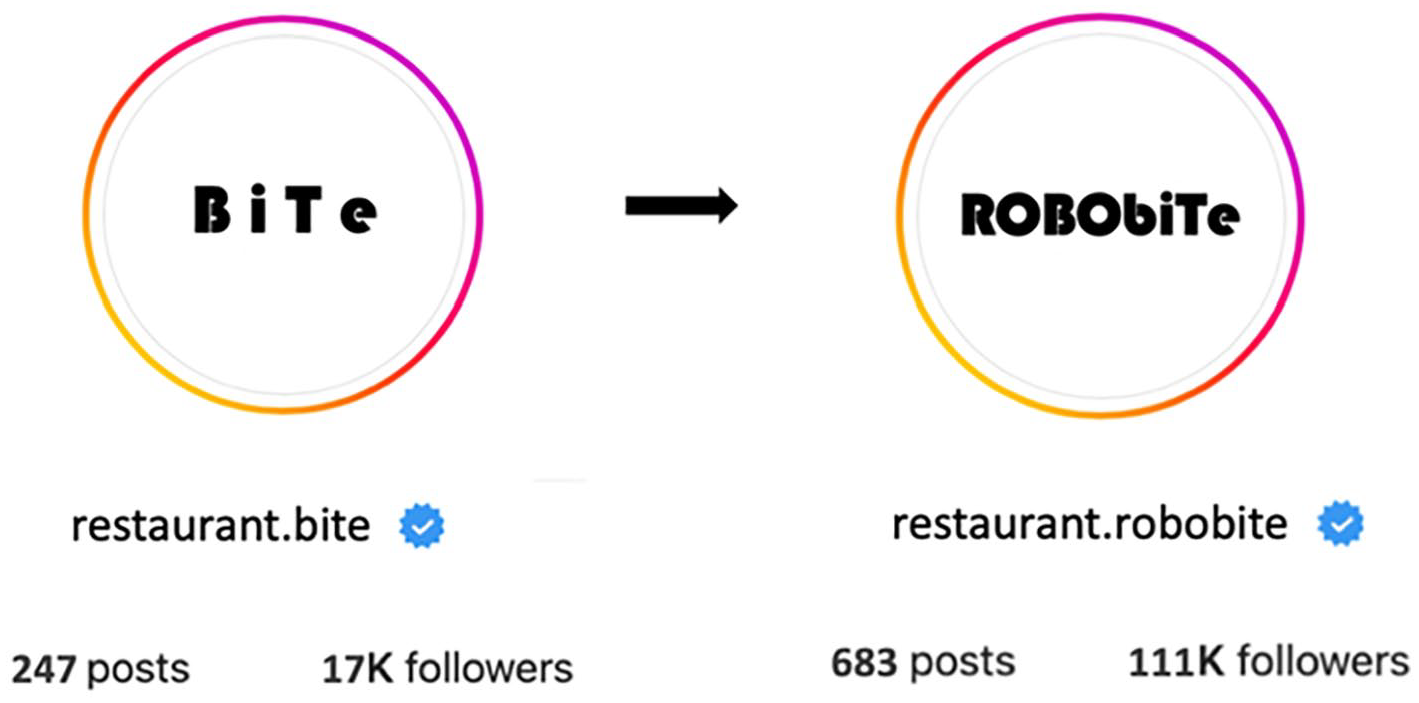
Example of changes in the restaurant account on Instagram.
Types of Consumers
Technology has altered many people’s perspectives on how the world operates; although some individuals are enthusiastic about emerging technologies, others are simply not very interested in interacting with such technologies.
There are some customers who are truly interested in having robots perform their service. It’s possible that they would find the applications of new technology fascinating and interesting, and they would be eager to try out the services that any business offers. Some of them are more likely to employ robot services since they have never had this kind of experience before and would like to experience the novelty of trying it for the first time. Additionally, for many customers, robot service may be more convenient and efficient than traditional service because it allows them to place orders and get meals through straightforward requests without the need to interact with a person with dialogue or facial expressions. As the service robots are not really talking, this service saves time and is more comfortable for those who are more introverted (Joosse et al., 2013).
Even though the recently implemented technologies are appealing to a large number of individuals, there are still some consumers who demand greater interaction with real people. Considering this, there are still customers who would rather interact with human beings because they believe that human service is more welcoming and pleasant. Additionally, they take pleasure in establishing personal connections with the service providers and engaging in communication with them. The ability of human servers to better understand the requirements and preferences of customers and to give customized advice and services is another way in which organizations can differentiate themselves from their rivals (Wind & Rangaswamy, 2001).
Meanwhile, in order to acquire an extensive and varied service experience, there are some consumers who might be interested in combining human and robot service during the dining experience. The novelty and effectiveness of robots may appeal to them, while they may also want to take advantage of the human interaction and customization that come with real-person service.
About Tipping
Prior to the appearance of the robot and contactless tipping techniques, an average tip that had been left for each human server was $150 per day. It is interesting that the average tip amount for both robot and human workers is around $250 after the robot and contactless tip methods have been utilized. This indicates that there was an average total of $3,000 in tips for 20 humans before the implementation of robot servers. After the adoption of robot servers, the average total in tips for 12 human servers and 6 robot servers is around $4,500. Customers are either tipping both robot servers and human workers, or, due to the approximately two-times increase in the number of customers, the total tips to human workers rose.
On the one hand, customers may have the impression that the level of service and efficiency provided by robot servers is comparable to that of human workers, and as a result, they may find themselves willing to tip accordingly. In spite of the fact that they have had a variety of experiences with robot servers, they are still willing to express their appreciation for the outstanding service that they have received. Due to the fact that the robots provide clients with novel and amazing experiences, some of the customers might even tip them significantly more. On the other hand, the new setting of restaurants attracted a lot more customers, and as a result, the average amount of tips increased after utilizing robots. This could be due to the fact that social media platforms and word-of-mouth promotions increased the number of people who started visiting the restaurant.
Contactless Tipping Method
It is possible that the adoption of contactless tipping devices will also result in some adjustments to the quantity of tips that servers obtain. Due to the fact that payments form a significant portion of the income of many hospitality and service staff members (Mensah et al., 2020), contactless tipping solutions have become a new need in recent years. This is due to the fact that cashless alternatives to payments have become so popular in recent years (EasyTip, 2023).
Considering that many people are shifting away from the traditional method of tipping with cash, it is essential for businesses to implement a contactless tipping solution that enables the distribution of tips in a manner that is simple and transparent. Customers have the option of using electronic tipping, which can be accomplished through the use of tipping devices, mobile phones, or QR codes, to leave a tip in situations where they do not have cash on them or when they wish to give a specific amount of money but only have a large bill and are unable to split it down (Perkowsky, 2022). For instance, if a customer intends to leave a tip of ten dollars but they only have one five-dollar bill and several fifty-dollar bills, they might only leave five dollars eventually if they are unable to break the large bills, and workers will receive fewer tips than they are supposed to receive.
The ROBObiTe restaurant has set up its contactless tipping program screen, which includes one question titled “Add a tip?” and five different options, namely, “15%, 18%, 20%, Custom, and No tip.” Typically, the settings for the five options are as follows: “15%, 18%, and 20%” listed on the first line, “Custom” listed on the second line, and the “No tip” option listed on the last line. Depending on how it is presented to customers, it could have a different design and layout. This is a possibility that should be considered: moving “20%” to the first option could encourage customers to leave higher tips than “15%,” but moving “No tip” to the first line could influence customers to leave no tips in the end. Several examples that are shown in Figure 2 below illustrate how the five options might be displayed in a different sequence.
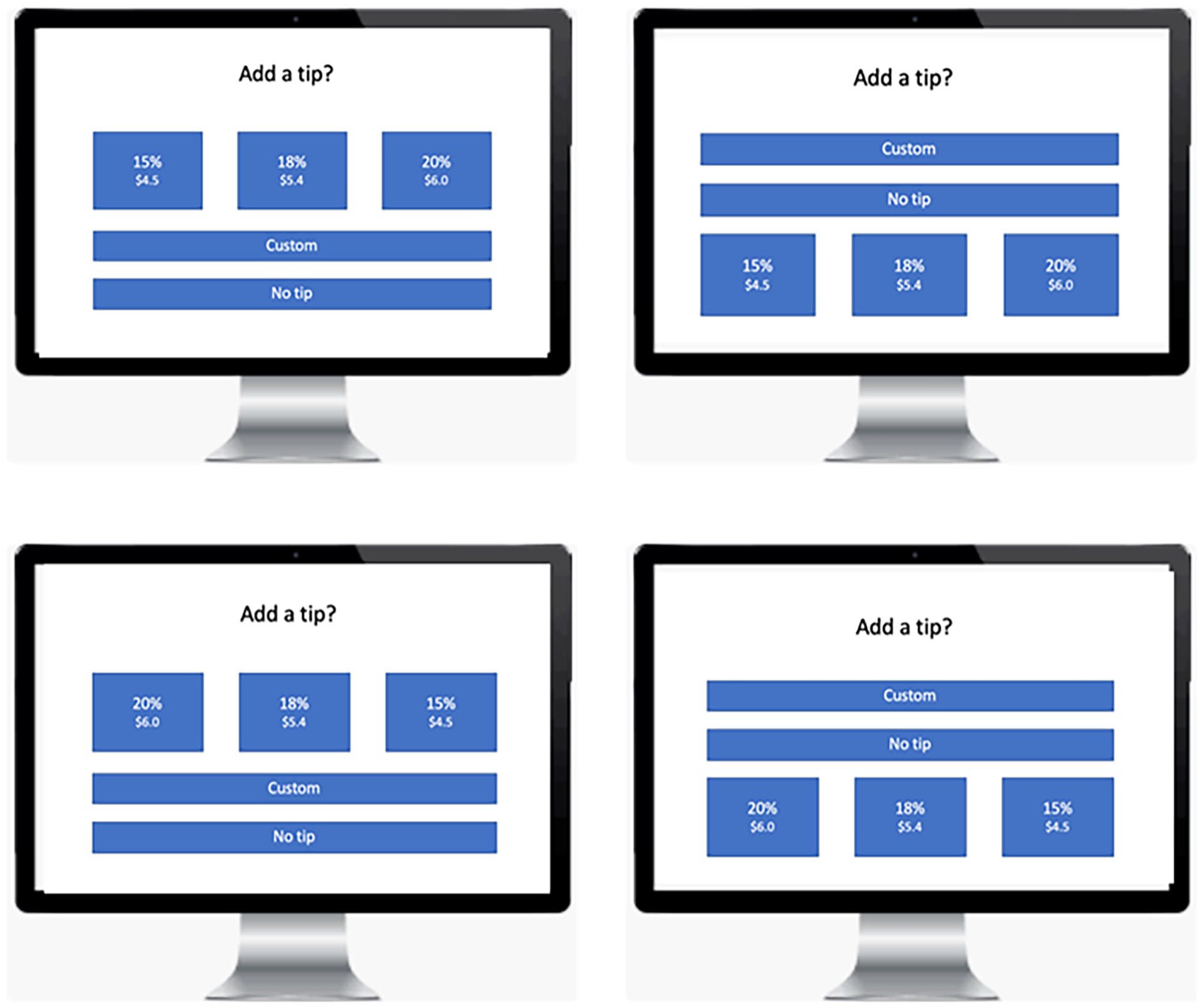
Different locations for tipping options.
One more interesting idea about the layout of the screen design that should be taken into consideration is the addition of emojis for each of the available options while tipping. It is possible that the emojis that appear next to each tipping option could have an effect on the customers’ decision to leave tips or not, as well as the number of tips that they will leave. For instance, when customers see the “cry” emoji, they might reconsider their decision. Despite the fact that they had intended to leave no tips, they can end up feeling embarrassed and decide to leave some nominal tip amount instead. The illustration in Figure 3 depicts two distinct examples of different tipping possibilities, one with emojis and the other without.
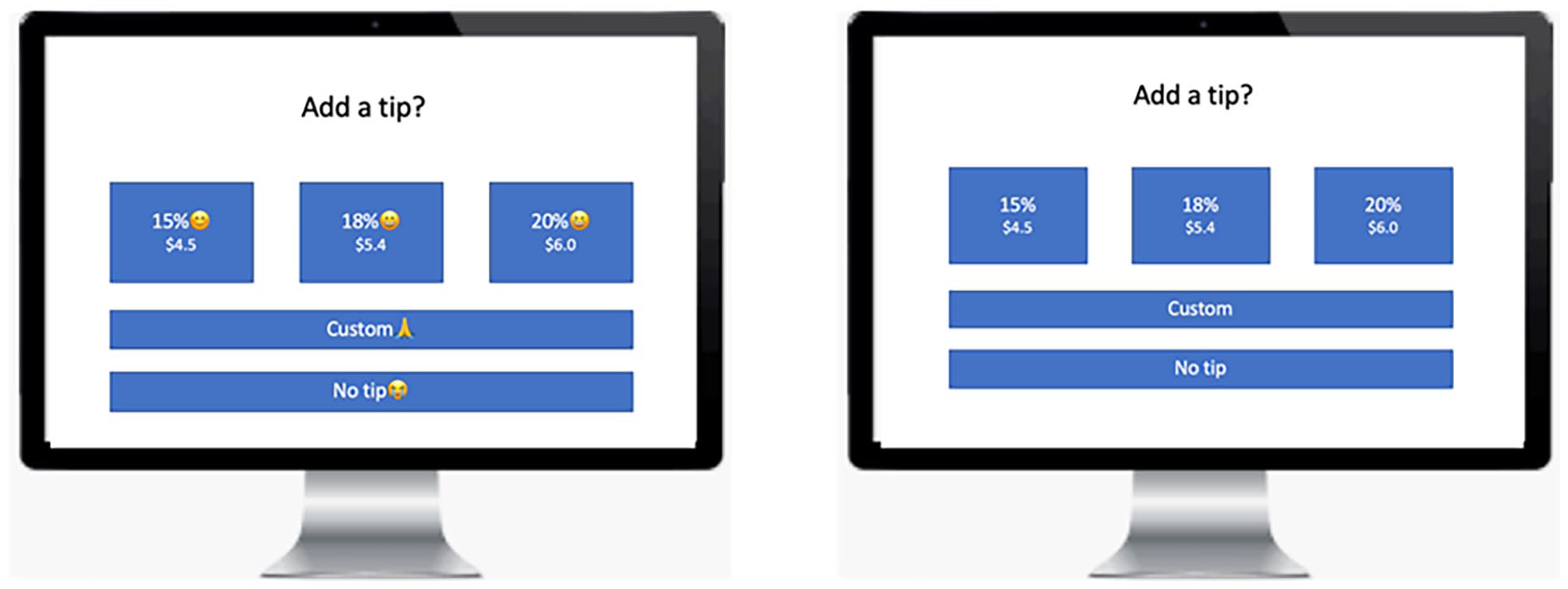
Tipping options with and without emojis.
Employee Perspectives on Emerging Technologies
It is possible for employees to have varying perspectives on contactless tip machines and robot servers, depending on their individual perspectives, the economic conditions, and their general mindset toward technology. Certain employees perceive robotic workers positively as a technique to enhance their efficiency and reduce their workload. By utilizing robot coworkers, businesses may effectively cater to a larger number of consumers, potentially leading to an increase in customer flow due to the combination of novelty and efficiency. An increased number of customers could potentially lead to a higher likelihood of receiving more tips. These individuals welcome the development of this kind of technology, as they believe it enhances their performance at work and improves their earnings.
A number of workers are dissatisfied with the implementation of robot workers and are concerned about the situation. Consequently, they have a negative perspective on these technologies because they are concerned that the implementation of technology and robots will result in them losing their jobs, lessening their relationships with customers, and increasing the risk of losing tips. As stated in Chui et al. (2016), individuals might experience feelings of anxiety and unease at the likelihood of their jobs being replaced by machines. Some employees in this scenario hold the belief that robots fail to establish an equal emotional bond and demonstrate the same level of concern that humans do. Some consumers may choose not to leave tips for machines since robots do not exert the same degree of effort.
There are also a variety of perspectives expressed by employees regarding contactless tip devices. When it involves automating the process of tip collection and avoiding embarrassing or unpleasant situations that may occur when interacting directly with customers, some staff view it as an effective and convenient solution to simplify the procedure. In most cases, the system will provide consumers with detailed tip percentages and amounts, which completely eliminates the need for customers to do calculations on tips. There are some staff who are doubtful or opposed to contactless tip machines; they think that there is a “no tip” option on the screen, which influences the decisions that customers make on whether or not to leave a tip. It is also the opinion of some of them that the contactless tipping method lowers the amount of engagement they have with customers during the process, which could lead to a reduced amount of tips.
Analysis of the Strategic Objective
Sociotechnical System Theory
During the era of World War II, Eric Trist, Ken Bamforth, and Fred Emery came up with the concept of sociotechnical systems during their work at the Tavistock Institute in London with workers in English coal mines (Wikimedia Foundation, 2024). The sociotechnical systems theory is a framework that explores the interface between technology and society and aims to understand how technology impacts and is affected by society (Eason, 2014). The objective of the theory is to establish organizations that are capable of adaptability, flexibility, responsiveness, and resilience (Walker, 2015). According to early research, job performance was less negatively impacted by the perceived complexity and difficulty of technological systems when social systems such as networks, trust, and shared vision were in existence (Lee et al., 2022).
New technologies, such as robot workers, are being incorporated into restaurants, which is not only an innovation in terms of technology but also has an impact on the social environment and the interpersonal interactions that exist within the restaurant. Both the interaction between customers and robot workers and the acceptance of technology by employees are examples of how technology and society interact with one another. The decision of a restaurant to implement new technologies, such as robot workers, is influenced not only by the feasibility and profitability of the technology but also by some other aspects, such as the evolution of social culture and the economic turndown. It is possible that the adoption of new technology will result in changes to the workflows, service designs, and overall customer experience of restaurants. Employees at restaurants may feel uneasy, and consumers may feel uncomfortable as a result of the changes.
Motivation for Adopting New Technologies
The restaurant adopts creative technology upon recognizing the upcoming hygiene need and boringness crisis, which might pose a risk of losing business. The utilization of emerging technologies is novel, appealing, and has the potential to enhance the quality and efficiency of services. Businesses must consistently enhance or refine their technology in order to adjust to shifts in market demand and surpass client expectations. This action demonstrates the business’s proficiency in implementing technological advancements and its eagerness to meet market needs, which reinforces its competitive edge.
In order to market its brand and attract customers, the company has utilized social media. Through the sharing of their innovations and the encouragement of their consumers to share their experiences, they have attracted followers and customers. In light of the fact that the digital world is constantly evolving, this underscores the significance of social platforms in terms of promoting products and services, communicating with consumers, and developing a brand image.
It is possible that the roles and duties of employees will shift as a result of the application of new technology. In order for employees to successfully adjust to the new working environment and procedures, they need to receive training in both new skills and adaptations. It is the responsibility of management to maintain open communication with staff members, to explain the significance and benefits of emerging technology, to request advice and recommendations from staff members, and to make modifications if needed. Managers ought to provide training so that they can acquire skills and master new technology to enhance the effectiveness and quality of their performance.
Problem Statement
Implementing robots alters the experiences and perceptions of employees and consumers in food service businesses. Although robotics and automation have the ability to improve labor costs, food delivery efficiency, and service speed (Berezina et al., 2019), there remain discussions over their effect on some conventional practices, especially tipping. Traditionally, tipping has served as a way to acknowledge and encourage human service providers based on their performance and quality of service. However, the integration of robots into formerly human-dominated positions prompts a debate: should consumers provide tips to a robot? It is critical to explore the potential implications of tipping practices for robotics and the overall customer experience.
Some people prefer the traditional method of leaving a tip in cash or by writing it on the receipt. The practice of tipping with cash enables employees to collect their tips instantly, without having to pay tax, and directly to the specific server, which may be more convenient for the workers, while tipping using a credit card may be simpler for customers, given that the majority of people no longer carry cash (Albring, 2023). On the other hand, some consumers find that they are more comfortable when they engage in exchanges that include physical contact, such as placing cash on the table or adding a tip amount to their credit card bill.
Additional Discussion Questions
What are the perspectives of customers regarding the use of robots in restaurants?
Do people value human service more, or are they more interested in it when a robot performs the service?
Would consumers be prepared to tip for a reward for robot servers?
Does the presence of robots working alongside human staff members have an effect on the tips that they receive?
Does the position of the tipping options on the screen have any effect on the amount of the tip that is given?
Does the desire of individuals to tip decrease when they use the contactless tipping method?
If you were to design the layout of the tipping screen, how would you design it to encourage consumers to leave more tips?
Regarding the management of the robot workers and their interactions with human employees, how do the restaurant owner and the managers handle the situation?
What is the cost to maintain or fix a robot?
If you are an ICHRIE member, you can access the Teaching Notes for this case study here: https://ichrie.memberclicks.net/jhtc. If you are not an ICHRIE member, the Teaching Notes will be published in a future Sage Business Cases (SBC) annual collection: https://sk.sagepub.com/cases. For more information, please contact
Footnotes
Declaration of Conflicting Interests
The author(s) declared no potential conflicts of interest with respect to the research, authorship, and/or publication of this article.
Funding
The author(s) received no financial support for the research, authorship, and/or publication of this article.
