







Abstract
High schools hold great potential as contexts within which educators implement evidence-based practices shown to change post-school outcomes for youth with Autism Spectrum Disorder (ASD). Unfortunately, educators feel unprepared to use transition and disability-focused evidence-based practices. Coaching, as an essential feature of effective professional development, is an important process for supporting educators in their development of competencies for use of these practices. To inform the use of coaching in complex high school settings, the model used by the Center on Secondary Education for Students With ASD to implement a comprehensive package of disability- and transition-focused interventions in 30 schools is described and coaching data analyzed to offer lessons learned for developing professional development supports for secondary school practitioners. Limitations and implications for research and practice are discussed.
High schools have been described as “larger, organizationally more complex, and politically more complicated” than other educational systems (Cannata et al., 2013, p. 8). Attending to the educational and transition needs of adolescents with Autism Spectrum Disorder (ASD) in high school settings may be a “perfect storm of complexity” (Odom et al., 2014). High schools are perceived as particularly challenging environments for youth with ASD due to inherent inconsistency (e.g., scheduling, change in support over time); the challenge of communication across educators, youth, and families; and lack of clarity of roles and responsibilities (Hedges et al., 2014). Furthermore, various stakeholders (e.g., parents of youth, special educators, general educators, administrators) perceive high schools as paying little attention to the specific intervention needs of youth with ASD and find existing efforts insufficient and ineffective to ensure positive future outcomes (Kucharczyk et al., 2015). These challenges may further negatively affect youth as they move into adulthood. Critically, youth with disabilities have not experienced marked positive change in adult outcomes despite a growing body of research focused on their transition from high school to adult life (Trainor et al., 2020). Still, high schools may be the best hope for building the organizational, academic, and social competencies necessary for a smooth transition to better outcomes (McIntyre et al., 2013). Effective coaching of school personnel in the implementation of evidence-based interventions is necessary to achieve this outcome (Odom et al., 2014).
Coaching Transition-Focused Evidence-Based Practices and Predictors
Evidence-based practices (EBPs) and predictors of positive post-school outcomes for youth with disabilities have been identified, operationalized, and continue to be investigated (Mazzotti et al., 2021; Rowe et al., 2015, 2021; Test et al., 2009). Unfortunately, school personnel do not feel prepared to put into place transition-focused EBPs (Morningstar & Benitez, 2013; Plotner et al., 2012); nor do they feel prepared to implement effective instructional interventions for students with ASD (Knight et al., 2019). Results of Morningstar and Benitez’s (2013) survey of secondary educators on their reported levels of preparation point to the importance of on-the-job training in the implementation of transition practices for school personnel supported by coaching. Furthermore, content-focused coaching for collaborative school teams that is engaging and addresses the critical issues affecting educators is key to effective professional development for personnel preparing youth for transition (Holzberg et al., 2018).
Coaching, as a situated and collaborative process to drive change, is considered a best practice for the implementation of educational interventions (Leko et al., 2015). Coaching has shown to be far more effective in changing teacher practices than traditional professional development, such as workshop training (Horner et al., 2009), and has been identified in the implementation science literature as a critical driver for sustained change (Fixsen & Paine, 2009). Coaching is a core component of the implementation process and provides novice implementers (i.e., teachers) with opportunities for “advice, encouragement, and opportunities to practice and use skills specific to the innovation” (Fixsen et al., 2009, p. 534).
School-based coaching is embedded in professional development for educators to improve student learning outcomes (Gallucci et al., 2010; Mangin & Dunsmore, 2015). Although recognized as a critical vehicle for knowledge transfer from research and in practice, coaching has been poorly defined, described, and systematized (Gallucci et al., 2010; Woulfin & Rigby, 2017). Richer descriptions of research-based coaching are especially important in complex settings to provide guidance for school personnel who plan to implement new and complex intervention packages in high school settings. Settings with inherently greater complexity, such as high schools, may require coaches to masterfully navigate needs for adaptations while maintaining fidelity of implementation (Harn et al., 2013).
Coaching in Secondary School Settings
School-based coaching has been challenged by (a) its enmeshment with evaluation, (b) weak district- and school-level infrastructure support (e.g., professional development and supervision for coaches), (c) leadership buy-in, and (d) “school-based systems to organize and support coaches’ work to ensure alignment with the school’s goals and outcomes” (Woulfin & Rigby, 2017, p. 326). Attending to these challenges is critical given the potential for coaching to change outcomes for youth. While few studies investigate the impact of coaching specific to high schools, Grissom et al. (2013) found a positive association between student achievement and direct instructional coaching by high school leaders, such as principals and other instructional coaches. Investigating how coaching works in high schools will inform efforts to support effective school-wide implementation of EBPs and complex intervention packages, including those identified as effective when applied in the transition process (Rowe et al., 2021; Test et al., 2009).
The focus of this study is on the coaching process and practices implemented as part of the Center on Secondary Education for Youth With ASD (CSESA). The CSESA utilized coaching as a vehicle for implementation of a comprehensive school-wide model within 30 intervention high schools in the United States. Investigating the application of coaching in the complex context of secondary education may shed light on ways to approach coaching to improve the experiences of high schoolers with ASD, and ultimately, enhance their post-school outcomes. Furthermore, this study extends understanding of essential features of transition-focused professional development as reviewed by Holzberg et al. (2018) by detailing the ideal and actual use of professional development in the implementation of a comprehensive, multi-intervention model. We describe the coaching model used to implement interventions attending to outcomes for youth with ASD with a focus on data-driven lessons learned that support coaching of comprehensive, multi-intervention packages in complex environments. The objectives of this analysis of the CSESA coaching process are to (a) identify the extent to which coaching was implemented with fidelity to the coaching model and (b) analyze relationships between coaching and student exposure to CSESA components. Reflections on the variability between intended and actual coaching practices are summarized and include recommendations for the preparation and continued support of research- and school-based coaches in complex high school settings.
Method
CSESA was comprised of three university research teams across the country (i.e., Wisconsin, North Carolina, California) partnering with 60 high schools across these three states to develop and evaluate the efficacy of a comprehensive model for high school students with ASD in a 3-year cluster randomized control trial (RCT). Control schools maintained “school as usual” (SAU) with data collected on programmatic quality indicators on the Autism Program Environment Rating Scale (APERS; Odom et al., 2018) and an implementation index which reflected the key features of the model, delivery of the model, and reception of the model by students (see Steinbrenner et al. [2020] for full description of the implementation index). No coaching occurred at SAU schools. The 30 intervention schools received training and coaching to implement a multi-component intervention across 2 years. Table 1 summarizes the four components (i.e., Academic, Independence and Behavior, Peer and Social, Transition and Families) and each of the 11 interventions that address specific competency areas where youth with ASD commonly require support (see https://csesa.fpg.unc.edu/materials for deeper descriptions).
Description of CSESA Components.
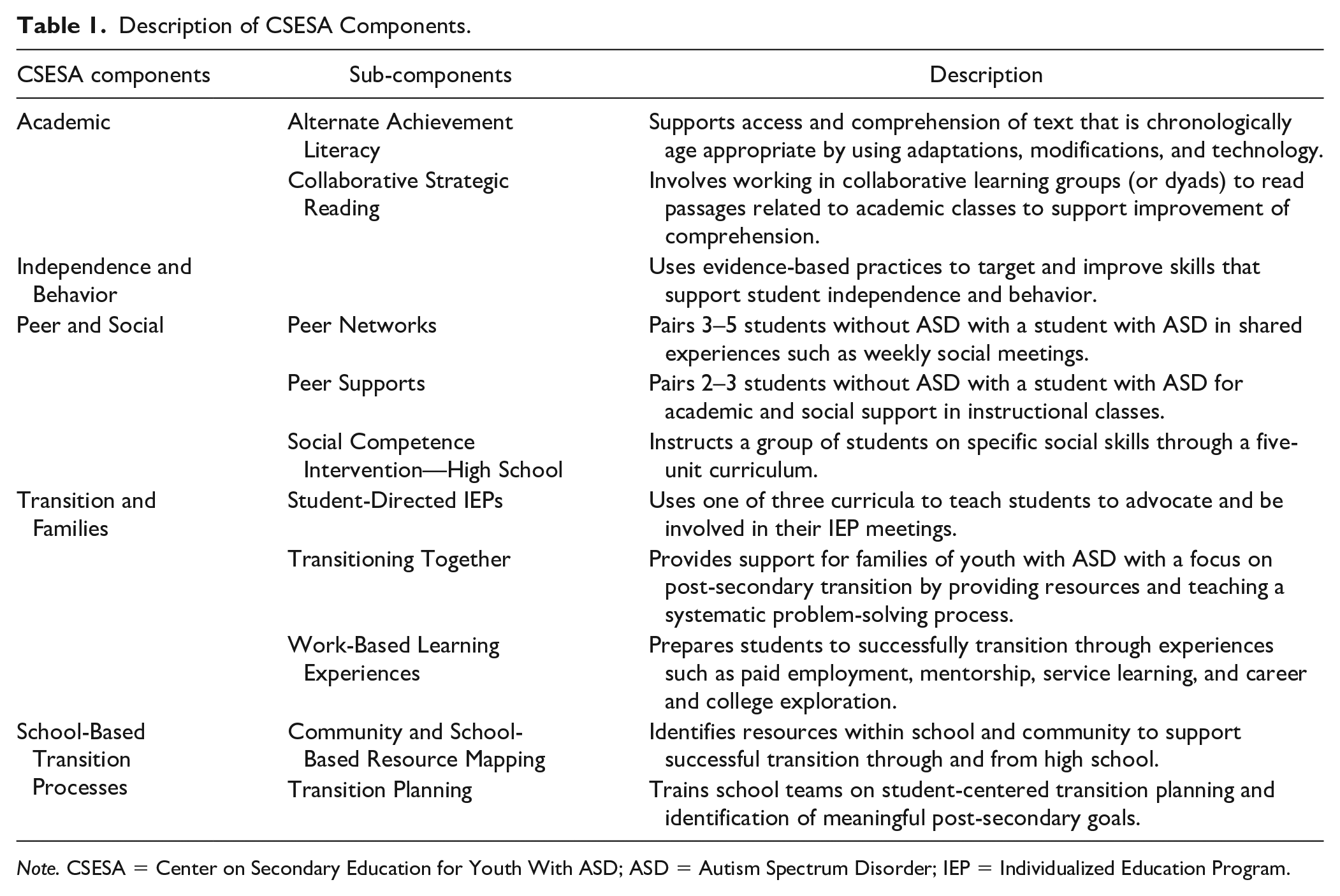
Note. CSESA = Center on Secondary Education for Youth With ASD; ASD = Autism Spectrum Disorder; IEP = Individualized Education Program.
Curriculum materials, designed by national experts across the four components and 11 interventions, were manualized for use in each intervention school. As illustrated in Table 1, the transition and families component area highlights interventions focused on specific student experiences (i.e., student-directed Individualized Education Programs [IEPs], a support group intervention for families and youth, work-based learning experiences) and system-level interventions (i.e., community and school-based resource mapping, transition planning processes). Evidence-based practices identified as effective for use with students with ASD (Wong et al., 2015) and relevant to each intervention were aligned with each component, and additional resources were developed to support the implementation of these in high school contexts (see https://csesa.fpg.unc.edu/professionals/supporting-ebps, for examples). A resource was developed for intervention schools to tie student skills and behaviors addressed by each of the CSESA components with EBPs and linked to professional development learning modules. While the Wong et al. (2015) review was used to support implementation of the CSESA model, a more recent review has been completed (Hume et al., 2021). Coaching was the key process for facilitating the implementation of CSESA interventions and EBPs embedded in these components. The CSESA coaching model was developed for the National Professional Development Center (NPDC) on ASD and is aligned with an implementation science framework (Kucharczyk et al., 2012).
Coaching School Participants
Each school team created a memorandum of understanding between school staff and the CSESA research team to establish an A-Team (Autism Team). The A-Team included staff members who interacted with students with ASD and was interdisciplinary, with the aim of creating broad buy-in, ownership, and competence with the intervention strategies. The A-Team included at least one administrator, special and general education teachers, and related service providers, such as speech and language pathologists or occupational therapists. A critical A-Team member was a lead liaison between the school and CSESA coach. Coaching could occur with the full A-Team, one-to-one, or with small groups of A-Team members implementing CSESA components and related EBPs. If other school practitioners were identified to implement a specific CSESA intervention, they were recruited by the A-Team for participation. The CSESA coaching staff worked with A-Teams to enroll eight to 12 target students across the autism spectrum who were willing to participate. The target students could include those seeking standard high school diplomas and those participating in modified diploma programs. The CSESA coaches worked directly with the A-Team and individual A-Team members to implement program components and monitor student progress.
As the CSESA project involved school-wide implementation of a comprehensive model, coaching activities were structured on multiple levels to encourage system-level change. Once partnerships began with each school, coaches provided weekly check-ins with a designated A-Team liaison. The CSESA coaches were expected to schedule an average of 6 hr of interactions with each school each week with at least 4 hr of this time spent on coaching activities with implementers. The A-Team and other school staff were oriented to the project and given initial trainings to provide the entire school with a basic understanding of ASD, introduce the CSESA coaches to the school teams, and develop a relationship to better understand the training needs and priorities for each school. Following the initial staff training, high school program quality was assessed, and a work plan was developed for each school and each participating student.
Coaching Procedures
In this section, we describe coaching procedures, including the preparation of coaches, school and student planning, coaching cycles, and measurement procedures. These coaching procedures include essential features of professional development (Holzberg et al., 2018) in that they (a) are focused on content specific to transition and disability-specific needs of students and knowledge of A-Team members; (b) emphasize active learning through coaching; (c) are driven by school, student, and A-Team needs; (d) promote collaborative learning; and (e) are used across 2 years to support implementation of components, interventions, and relevant EBPs.
Preparation of research team for coaching activities
Each university site employed a team of CSESA coaches comprised of staff with PhD and MA degrees, and post-doctoral students and doctoral candidates, with a background in special education or school psychology as well as experience with students with ASD in schools. During the intervention stage of the research study, across the three University sites, nine coaches left for various reasons (e.g., maternity leave, beginning a doctorate program, moving to faculty position), and 15 new coaches joined the project. The principal investigators from each site trained coaches on the implementation of each of the CSESA interventions and relevant EBPs. Coaches were trained during cross-university summer retreats as well as at each university when new coaches were added to the research project. All trainings were conducted using the same content and processes based on manualized CSESA coaching procedures (Kucharczyk et al., 2012) across the following areas: process of coaching, communication strategies, evaluation, and progress monitoring. Coaches were observed and evaluated in the assigned school using a rubric to check fidelity of implementation of coaching and CSESA interventions. A sample of the coaching fidelity rubric with one to two items from each of the areas of focus is provided in Figure 1.
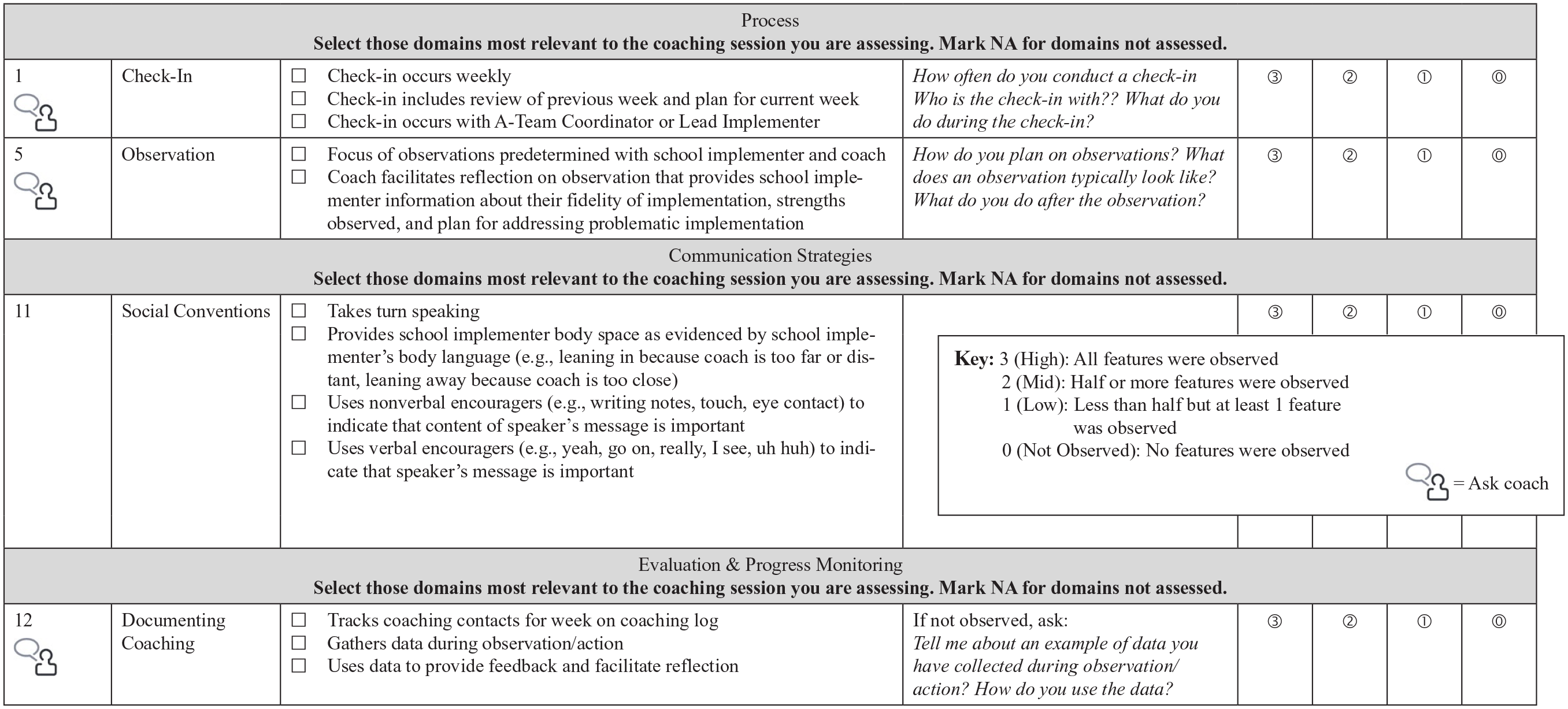
Sample coaching fidelity form.
To ensure ongoing reflection on procedures and processes, coaches at each University received group consultation during weekly research meetings, at which fidelity of implementation and dosage were discussed. In these meetings, coaches discussed the challenges they were facing in the schools and were supported through a specific collaborative, problem-solving process. An example problem-solving process during the meetings included (a) the coach discussing a specific challenge without interruption for 3 min and (b) team members providing potential next steps and strategies, followed by (c) the coach indicating which of the suggestions would be tried, and (d) the coach reporting back to the team at the next coaching consultation meeting. This problem-solving process provided coaches with support across various issues arising during implementation, including challenges with relationship building (e.g., expressed frustration from teachers); working within systems (e.g., lack of collaborative planning time available to school teams); the intervention model (e.g., confusion with components and/or EBPs); and data collection (e.g., need for support in completing assessments). Coaches also participated in monthly cross-site conference call meetings and annual in-person meetings with all three university sites, during which coaching data were reviewed, strategies discussed, and action plans developed to optimize the coaching process across sites.
School and student planning
Coaches and A-Teams used school-wide data collected through administration of the inventory assessing program quality for students with ASD (APERS; Odom et al., 2018) to identify school strengths and areas needing improvement related to their teaming and the use of effective practices for youth with ASD. These strengths and areas of improvement were reviewed to determine the order in which the four CSESA components were prioritized and implemented across the two project years. School plans also informed the training and coaching activities for each school year. Although it was expected that each school would implement all 11 interventions from the four components, schools could do so in the order that was most appropriate for their setting. Fidelity of implementation for each intervention was observed and recorded by each coach in an implementation index (Steinbrenner et al., 2020). The A-Team was encouraged to meet regularly, at least twice in a school year, with their CSESA coach to review the school plan and make changes and additions, as necessary.
Along with school-level planning, student-level planning of implementation was informed by assessments and development of priority goals aligned to the CSESA interventions. For each intervention, the A-Team, in discussion with their CSESA coach, used a student-planning document to outline professional development supports required to ensure effective implementation (e.g., training, coaching), data collection procedures, and needed resources. A majority of students (57%) were on course to receive a standard high school diploma with 25% of students participating in general education classes between 40% and 79% of their school day and 32% of students spending 80% of more of the school day in general education. Because of this, most planning for implementation of CSESA intervention curricula required collaboration between special education and general education teachers. The school team identified which members would implement the intervention and during which period in the student’s schedule. Teams then scheduled coaching times to receive training on selected interventions and planned for ongoing coaching to implement interventions with students.
Coaching cycles
Through the coaching model as designed by the NPDC on ASD, relationship and communication behaviors were employed in a cyclical, teacher-led coaching process. The CSESA coaches were expected to follow a similar cyclic process when coaching individual school implementers. The cycle consisted of pre-observation contact, observation or action, and a post-observation contact. The length of time spent in each of the components of this cycle varied based on factors such as when the intervention component was introduced, whether all training had been conducted, and the skill level of the school implementer.
Pre-observation
During pre-observation, coaches and team members negotiated the content of coaching and/or training for the week. Decisions were made about what was worked on (e.g., CSESA component, specific EBP); how this would be worked on (e.g., planning meeting, training, modeling, feedback session, observation); and whether resources or actions were needed (e.g., space to meet, communication with teacher that CSESA coach will be in classroom). Pre-observations occurred in person, by phone or text, and through email.
Observation and action
During the observation and action phase of the cycle, the CSESA coach provided support through observation, feedback, and modeling. Coaches and school team partners negotiated in the pre-observation phase whether the coach would observe and give feedback to the teacher or model a practice. In some situations, the modeling and feedback from the CSESA coach occurred side-by-side with the school team implementer, especially when the intervention was first introduced. Coaches were trained in a sequence of modeling steps which included (a) discussion of target intervention behavior, (b) school team partners’ observation of coach with specific behaviors to look for, (c) CSESA coach observation of school staff implementation, and (d) reflection and feedback. The CSESA coaches were also trained to solicit reflection by asking questions meant to help school team members to analyze their implementation of interventions and student progress (e.g., “What worked?” “What do you attribute to the change?” “Who might provide good information?”), as well as to provide specific performance feedback immediately and post-observations so team members were clear about the degree to which they were implementing interventions as intended.
Post-observation
Post-observation focused on debriefing the coaching session. These debriefs were conducted in person, shortly after the observation/action part of the coaching cycle. When necessary, debriefs were done by phone or electronically (e.g., email, Skype). Post-observation included (a) reflection on what worked and what could be improved, including a review of data taken as relevant; (b) discussion of changes to implementation as needed; (c) plan for additional professional development as needed; and (d) plan for next phase of implementation/coaching.
Check-ins
The CSESA coaches conducted check-ins at least weekly with the school’s A-Team liaison or primary implementers of each CSESA component. Each check-in consisted of (a) a review of the last week’s activities, (b) a review of the plan for the current week, (c) a discussion of any concerns or questions related to implementation, and (d) development of an action plan to address questions or concerns. Check-ins were conducted face-to-face or, if necessary, by phone or email and lasted between 20 and 30 min on average. During these check-ins, coaches and A-Team coordinators discussed progress being made, challenges that needed to be addressed, and next steps in the process.
Communication strategies
In addition to the coaching cycles, coaches were trained on their use of communication strategies. Coaches were trained on how to use (a) open-ended questions to encourage deep reflection and analysis, (b) leveling statements to resolve disagreements or conflicts, (c) nonverbal skills to communicate engagement with and attention to school partners, and (d) social conventions to support collaboration and encourage those coached. Figure 1 includes an example of how the fidelity of coaching, including the use of communication strategies, was assessed.
Measures and Analysis
Ongoing documentation of coaching was conducted using a coaching log (see Figure 2) and intervention fidelity forms (sample in Figure 1). Coaching logs were used to record the following for each contact: the date of coaching, who was coached (including how many people and what roles they had at the school), the length of the coaching contact, the type of coaching (e.g., discussion, action/modeling, observation, check-ins), and the content of the coaching (e.g., EBPs, CSESA intervention). Data on the length of time coached were grouped in 10-min ranges of time up to an hour, and then, 61 to 90 min and beyond to capture short and long spans of coaching (see Figure 2). Calculations for total minutes spent coaching were made using the highest number in the category.
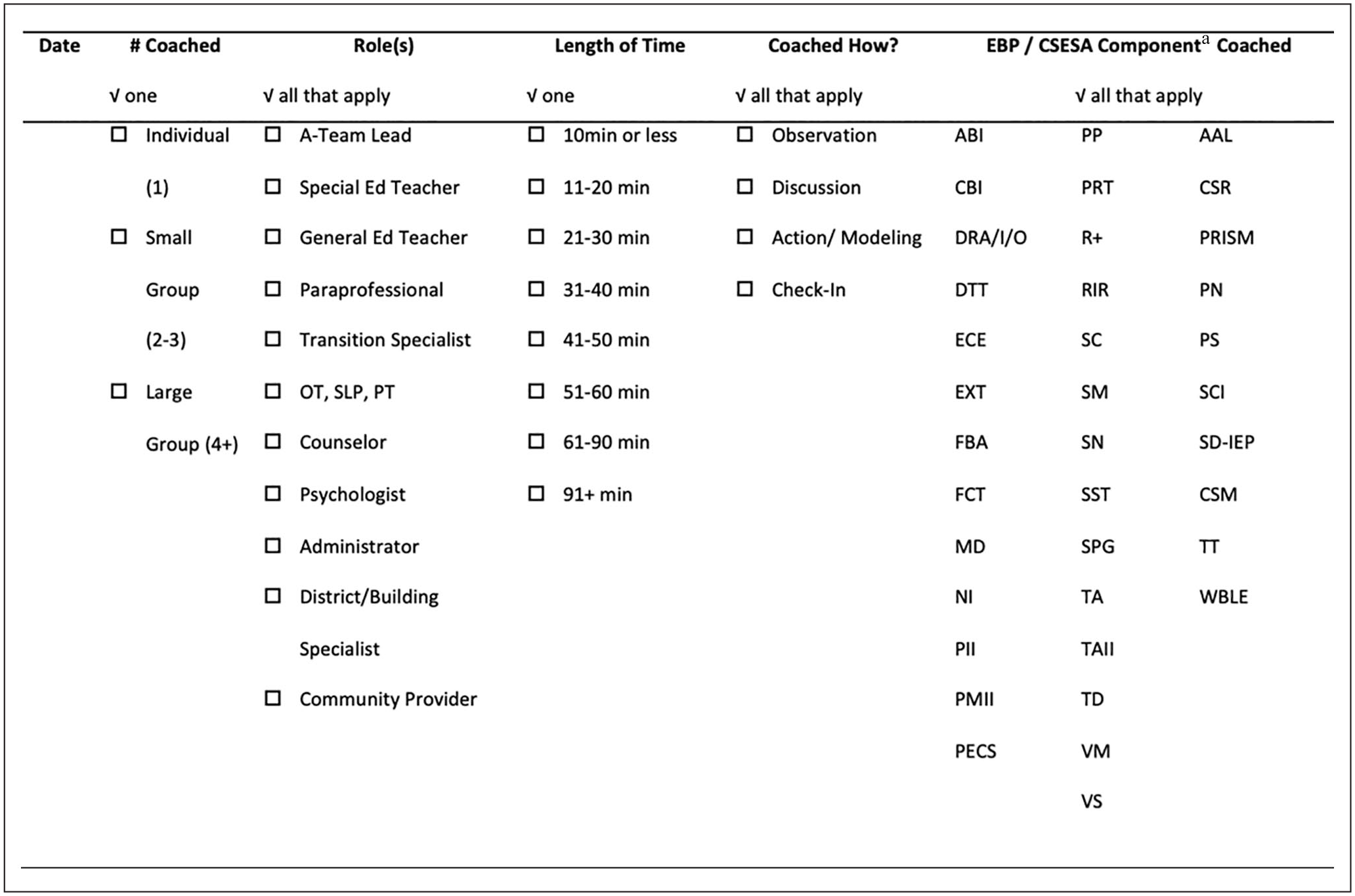
CSESA coaching log.
In addition to documenting coaching activities on the coaching log, coaches measured fidelity of implementation for each CSESA component. Coaches were required to collect a minimum of three fidelity checklists for each intervention during the initial semester-length intervention, and then, one per semester if the intervention was continuing. Coaches scored the fidelity of implementation on a CSESA designed checklist that identified the general features of effective practice (e.g., dosage, preparation and structure, general strategies such as positive reinforcement, evaluation and progress monitoring) and the essential features of the intervention (content and strategies identified by the developers). Each rubric contained between 10 and 13 program features to score. Features were scored on a scale of 0 to 3 (0 = no features observed; 3 = all features observed). A score below a 3 indicated an area to target for coaching feedback.
The fidelity of component implementation was calculated for each of the 30 intervention schools as part of the implementation index used in the study. As mentioned earlier, a full description of the implementation index, as well as data on program quality (i.e., fidelity) from across the CSESA project, has been published (Steinbrenner et al., 2020). For the purpose of understanding coaching, we examined the relationship between coaching (e.g., time spent, type of coaching), overall fidelity implementation of the CSESA model, and student component dosage for each school by calculating Pearson product–moment correlations. Student component dosage was defined as the overall student participation in CSESA components. Student component dosage was calculated from converted scaled scores (0–3) per component based on expected dosage, and scaled scores were used to calculate a student mean. Then, student mean scores were used to create a school mean.
Results
We summarize below data from the cumulative coaching logs for all 30 schools randomly assigned to the intervention condition across the three project sites. We also present data from the analysis of the implementation index profile specific to coaching.
School Personnel Coached
As described above, the school personnel who received coaching as part of the CSESA project were from various disciplines and held a breadth of roles within each school which included their participation on transition planning teams. Special educators were most frequently coached with 2,579 total coaching sessions, or 53% of the total coaching sessions including a special education teacher. This is nearly 5 times the number of coaching sessions compared with general educators (n = 524, 11%) and paraprofessionals (n = 520, 11%) who had the next highest number of sessions. These three categories accounted for 75% of the coaching sessions. Related service personnel (e.g., occupational, physical, speech therapists; n = 456, 9%), administrators (n = 148, 3%), district specialists (n = 138, 3%), transition specialists (n = 133, 3%), psychologists (n = 101, 2%), community providers (n = 96, 2%), and counselors (n = 82, 1%), in contrast, received relatively few sessions totaling only 25% of the sessions across all three project sites. The relative percentages of participation by personnel from different disciplines were similar across schools.
Coaching Format and Dosage
Although the percentages of time spent coaching in the different coaching formats varied across schools, one-to-one sessions were the most frequent format for coaching used, followed by small group and large group sessions. Nearly three quarters of the coaching sessions between the project staff and school personnel took place in a one-to-one format (n = 3,194, 72%); 22% (n = 967) of sessions took place with two to three school personnel; and only 6% (n = 248) of sessions included four or more school personnel. Most coaching took place through discussion with approximately 59% (n = 3,135) of the entries indicating this approach. Coaching feedback before, during, or following an observation took place for only 29% (n = 1,581) of the sessions, and modeling during the coaching session occurred for 12% (n = 645) of the coaching sessions. The pattern of discussion occurring most frequently, followed by observation, and then modeling, was consistent across the 30 schools.
The range of the length of time spent coaching in each school varied. The targeted coaching amount was approximately 216 hr for each school. The school receiving the least coaching received 51 total hours, or less than an average of 1 hr a week. The school with the most number of hours, or 241 total hours, averaged 4½ hr of coaching a week. The school with the most coaching hours was the only school that met the initial study aim of 4 hr per week of coaching. Six other schools averaged at least 3 hr a week, or more, of coaching.
Content of Coaching
Coaches reported the focus of each coaching session (e.g., specific CSESA intervention, related EBPs) in coaching logs. The total number of coaching entries by component for the 30 schools receiving interventions is found in Table 2. All 30 schools implemented the independence and behavior component intervention called PRISM (Promoting Responsibility, Independence, and Self-Management) with 28% (n = 1,295) of the coaching sessions focused on this component. Coaching sessions focused on social interventions accounted for 34% (n = 1,575) of the sessions. The transition component had the most separate interventions (i.e., Student-Directed IEPs, Transitioning Together, Work-Based Learning) and was the focus of 27% (n = 1,282) of coaching sessions. The academic component, which focused on reading comprehension, was the least implemented and coached for 11% (n = 508) of sessions.
Coaching Sessions by CSESA Component.
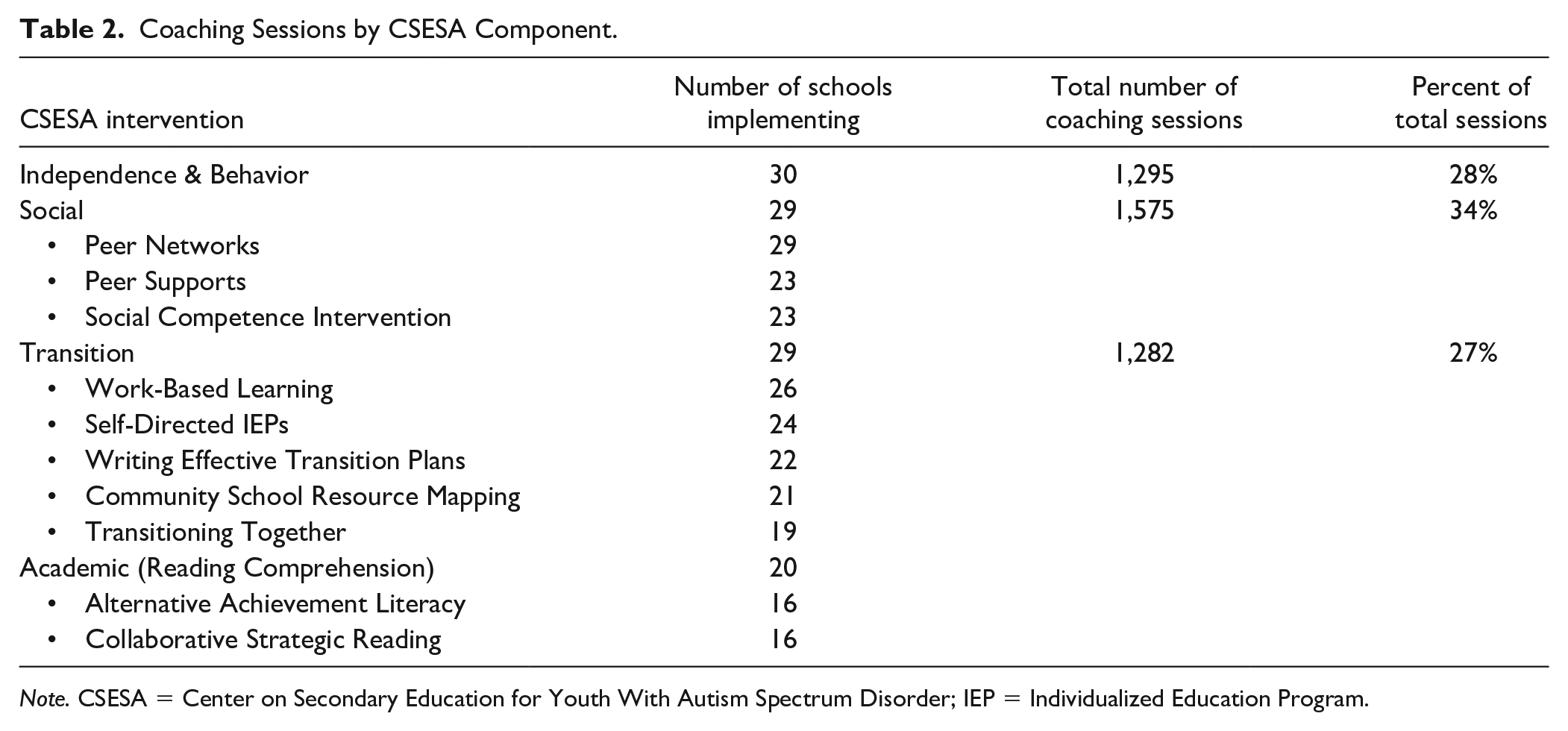
Note. CSESA = Center on Secondary Education for Youth With Autism Spectrum Disorder; IEP = Individualized Education Program.
In addition to providing instructional coaching on the 11 interventions, coaches also provided training and feedback on the use of any EBPs identified for high school students with ASD by the work of the NPDC on ASD (Wong et al., 2015). Table 3 lists the number of coaching sessions that included content on each of the listed EBPs. As mentioned earlier, a linking document can be located on the CSESA website that aligned each component with relevant EBPs. Based on need identified by the coach and team member(s), more than one EBP may have been reviewed in a session. The most frequently coached EBP, visual supports, was the focus of coaching in 859 sessions across each of the 30 schools. Prompting (n = 655), reinforcement (n = 631), and self-management (n = 531) were coached in 28 of the 30 schools, followed by peer mediation (n = 330) and task analysis (n = 260), which received this extra focus in 25 and 23 schools, respectively. About half the schools received coaching on modeling (n = 162), antecedent-based interventions (n = 162), time delay (n = 152), social narratives (n = 143), social skills (n = 128), and functional behavior assessment (n = 83). In contrast, pivotal response training was never coached nor was cognitive-behavior therapy.
EBP Coached.
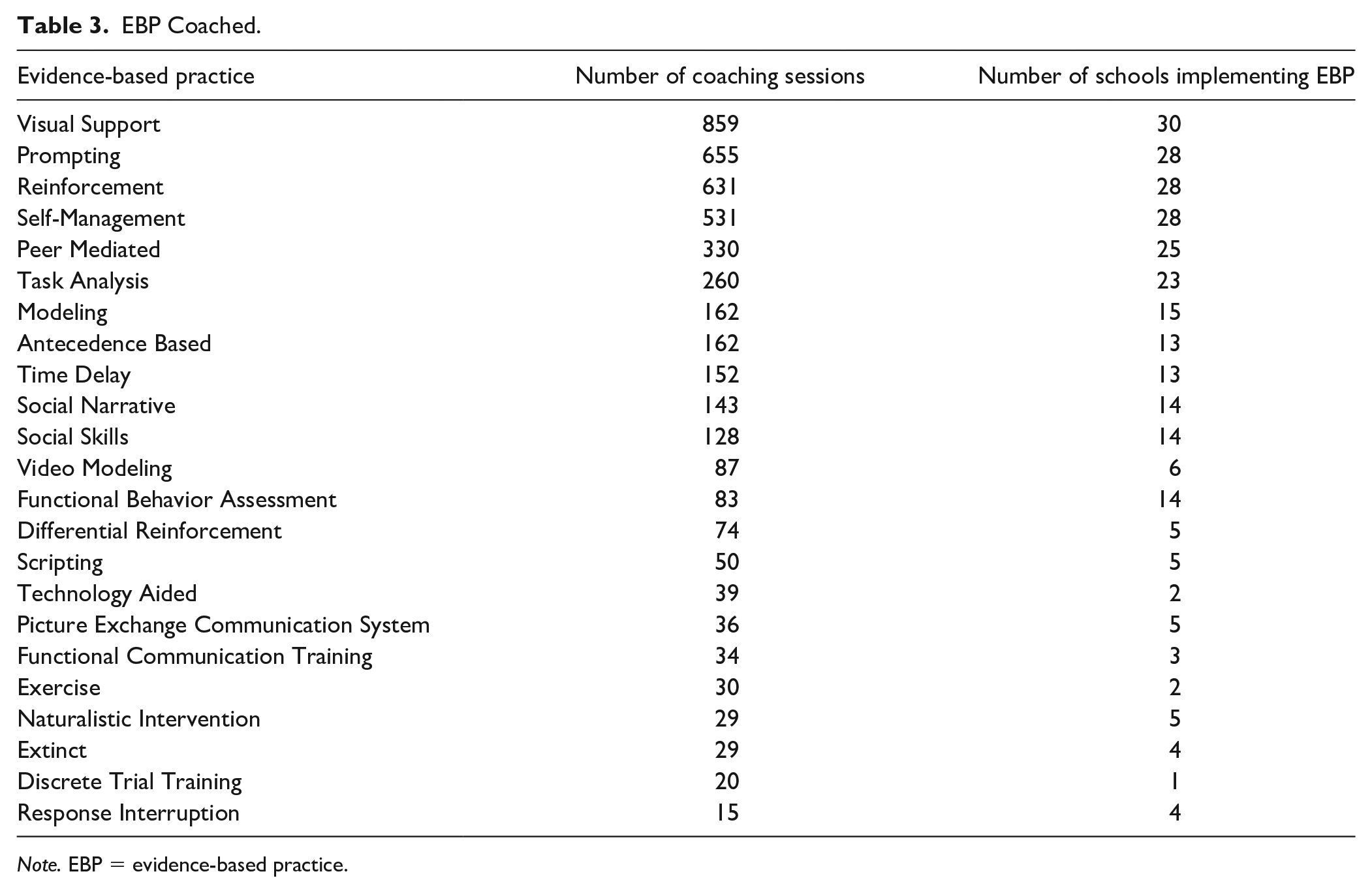
Note. EBP = evidence-based practice.
Coaching Implementation and Fidelity
Pearson product–moment correlation was used to analyze the relationship among various aspects of the CSESA model (e.g., student component dosage, overall implementation fidelity) and coaching (e.g., amount of time coached, type of coaching provided). The relationship between the fidelity of component intervention and student component dosage was not significant (r = .03, p > .05). However, the relationship between time spent coaching and student component dosage in a school was significant (r = .41, p < .05). The type of coaching (e.g., discussion, observation, action modeling) was also significantly related to the student component dosage with a stronger relationship between observation (r = .63, p < .001) and action modeling (r = .59, p < .001) with student participation in components compared with discussion (r = .39, p < .05). The types of coaching were also related to each other with a high likelihood that if observation occurred in a school, there was also action modeling (r = .72, p < .001) and discussion (r = .80, p < .001).
Discussion
The coaching data from the CSESA study provide examples of the reality of coaching as part of a study of a comprehensive package of transition and disability-specific interventions in complex high school contexts. Although the CSESA model was manualized and coaches were trained on the use of the model, the actual coaching of interventions frequently deviated from the model’s expectations for school contacts (staff from multiple disciplines including general educators), format (individual and group), content (all 11 interventions in every school), process (discussion, observation, action modeling), and dosage (4 hr per week). Despite these deviations, high schoolers with ASD had more exposure to component interventions when more active coaching was conducted in their school. Lessons learned from these differences and factors influencing these outcomes will be described with implications for use of coaches in high school settings to implement transition-focused EBPs.
It is clear from the research on effective, transition-focused, professional development that teachers need opportunities for active learning, a team-based model for participation, engagement, and planning across time, as well as content aligned with their beliefs and knowledge (Holzberg et al., 2018). Interdisciplinary A-Teams were established in each school to ensure broad participation and school-wide expansion of professional development supporting students with ASD in their education and transition planning. However, data from the coaching logs reveal that although CSESA coaches invited all participating staff to engage in coaching, more than half (53%) of all coaching sessions were held with special educators. These special educators were receiving coaching at 5 times the rate of general educators. Interestingly, 57% of all students participating in CSESA were in school programs resulting in a standard diploma, and one third of all students were learning in general education settings 80% or more of their school day. In other words, most students were educated directly by general educators, yet many of those educators were not engaging in the CSESA coaching activities.
Given concerns about the lack of knowledge high school general educators have about students with ASD (Kucharczyk et al., 2015), this finding is important. Several factors may have influenced the high percentage of coaching sessions with special educators. Despite the role youth access to general education plays in predicting positive post-school outcomes (Mazzotti et al., 2021), general education teachers continue to not receive adequate professional development on supporting the inclusion of students with disabilities (Kuntz & Carter, 2021). Thus, they may have still believed that the education of students with IEPs is primarily the domain of special education and prioritized other commitments over their involvement in CSESA. Unfortunately, special educators feel unprepared to implement EBPs related to transition services (Morningstar & Benitez, 2013; Plotner et al., 2012) and those specific to students with ASD (Knight et al., 2019). Furthermore, most CSESA coaches were themselves trained special educators and may have felt more comfortable and familiar interacting with teachers in special education. Ensuring that secondary general educators, special educators, and other professionals involved in collaborative transition planning access professional development supported by coaching on EBPs is critical.
Thus, a lesson learned is the importance of ensuring coaches have skills not only specific to the intervention but also in interdisciplinary collaboration. Such interpersonal competencies may be necessary to extend partnerships beyond those in disciplines coaches are most familiar. Importantly, allocating time for coaching requires strong partnerships with schools and administrative support (Lane, 2017). Encouraging administrators to take a systems-level approach to the implementation of CSESA in their high schools by informing and recruiting across departments may have not been sufficient. Administrator support was needed to ensure that the school team fully understood and agreed to the expectations of engagement across special education, general education, and other disciplines necessary for effective transition planning. Furthermore, partnership with school leaders is critical to establishing administrative investment in school-wide approaches through flexible scheduling, communicating commitment to the intervention, and access to personnel across disciplines. Although high schools with a culture of learning and professional behavior and learner-centered leadership are more likely to be high performing overall (Rutledge et al., 2015), not all high schools have the deliberate structures enabling such professional learning. Preparing research team coaches to partner with school leaders and extend themselves to work with those from various disciplines by building experience in inclusive settings and interpersonal skills may support whole-school implementation of EBPs through coaching.
A second lesson learned is the importance of explicit administrative support for opportunities for coaching in formats other than one-to-one. One of the complexities of high school contexts is their complicated scheduling which may be more or less student driven (Rutledge et al., 2015). In the implementation of CSESA, it was not uncommon for class schedules to differ according to the day of the week and for the general and special education programs to be operating on separate schedules with little overlap of available time for collaboration. Given complex scheduling, it is not surprising that the format most frequently used by coaches (72%) was a one-to-one session. High schools which did not have built-in structures for teaming (e.g., professional learning communities across disciplines, consistent release time) may have been especially challenged to support team- and group-based coaching. Scheduling opportunities for group coaching sessions is important as these formats can improve fidelity of implementation of the intervention and broader positive outcomes (Fettig & Artman-Meeker, 2016). Organized structures that enable meaningful conversations and interactions among adults, like those needed for group coaching, are factors that separate higher performing from lower performing high schools (Rutledge et al., 2015). Critically, group learning structures are components of effective transition-focused professional development (Holzberg et al., 2018) and necessary for effective interdisciplinary transition planning (Carter et al., 2014).
Although coaches encouraged school teams to adhere to the research model, CSESA coaches were invited most often to engage in discussion with teachers, rather than observation or modeling of interventions and practices, and did not spend the recommended 4 hr of coaching a week. Incorporating opportunities for modeling and direct performance feedback can lead to improved outcomes in pre-service or in-service professional development activities (Kretlow & Bartholomew, 2010; Sinclair et al., 2020). Findings show a positive relationship between both active coaching processes (e.g., observation, modeling) and time spent coaching on student engagement in CSESA components, and thus, exposure to EBPs. More passive modes of coaching (i.e., discussion) did not correlate with more student dosage of CSESA components. Because intervention studies adhere to a rapid timeline for implementation, it may be difficult to design an intervention process that allows for relationship building and the expectation that variable time might be necessary across professionals to implement practices and interventions as intended (Fixsen et al., 2009). Such time would allow the coach to develop the understanding of context and the trust necessary to be invited into the classroom of their cooperating professionals for observations and provide active modeling of and feedback on practitioner implementation of EBPs. A third lesson learned was that arranging time for coaches and school personnel to establish positive relationships, build trust, and demonstrate readiness might better facilitate the prioritizing of coaching sessions and comfort with active modes of coaching.
Fourth, coaches and teams may make decisions about implementation of interventions based on the level of complexity of interventions in the context of their work environment. All 30 schools implemented the independence and behavior support intervention. This intervention might have been one of the easiest interventions to coach and implement due to the fact only one student and one educator were required to design an activity or support plan to decrease problem behavior or increase independence in a targeted skill. Coaches spent the most time implementing the social component interventions. Selecting and implementing social interventions may have been easier for high school personnel to adapt to already established programs. For example, a school with an already established Peer Buddies program could easily adapt it to the CSESA peer networks or peer supports interventions.
Other interventions, such as the CSESA transition interventions were coached less and may have required a more challenging re-organization of class time. For example, the Student Involvement in the IEP intervention required instructors to use evidence-based curricula (e.g., Self-Directed IEP, Whose Future Is It Anyway?) designed to help students become more active in their IEP development. The implementation of interventions in this component in some cases required a change in student schedules, replacement of an approved curriculum, or approval by the school board to offer a new transition-focused class. The parent support intervention of the transition component, Transitioning Together, required the organization of a meeting time for parents usually before or after school hours for group meetings led by a trained facilitator and was another intervention with a comparatively lower number of coaching hours. The complexity of some interventions or the readiness of some schools may have led the prioritization of coaching on specific components or subcomponents. Preparing coaches to explicitly assess with school teams the costs and benefits of attending to some interventions over others within their contexts may ensure school teams are more effectively making decisions aligned with school and student outcomes.
Harn et al. (2013) stated that the “chaotic realities of schools and classrooms impact (teacher) ability to select, implement, and sustain EBPs with fidelity” (p. 184). The authors advocate for interventions that not only clearly identify fidelity but also allow flexibility and adaptation. Although overall fidelity of implementation of CSESA was not correlated with coaching, it may be that some school teams required less coaching support to maintain high fidelity and others required significant coaching support to reach a lower level given contextual factors as have been discussed (e.g., access to administrators, time for trust building, complexity of component and interventions; Steinbrenner et al., 2020). It is important that intervention designers informing the work of coaches communicate both these non-negotiable components and acceptable adaptations based on contextual factors. Checklists to assist in monitoring fidelity of implementation (Nelson et al., 2015), like those used by CSESA, help implementers assess their own adherence to fidelity and should document areas of adaptation. Providing tools, such as decision-making trees, may aid the training of coaches in determining appropriate paths for adaptation (e.g., sequence of intervention; priority needs of school, team, or student; form of coaching needed), as well as guide coaches in making decisions throughout implementation.
Fifth, the preparation and support of coaches must ensure not only that coaches have reached high levels of competency related to the intervention, but also to the practice and art of coaching and the context of the school system. Gallucci et al. (2010) asserted that it is a mistake to assume coaches are experts without their own needs for systematic professional development. In addition to training on interventions and coaching, CSESA coaches received ongoing systematic support through group consultation. Arranging for opportunities for group consultation provided CSESA coaches with support by facilitating reflection on decisions made, challenges to fidelity, and adaptations made in their work with schools. As with educators, coaching of coaches may improve fidelity and decision making for acceptable adaptations. Systematic coach support can also aid in successful implementation of complex models of school-wide intervention like CSESA by providing ongoing training and support to ensure coaches who are less skilled or newer to the model will receive the training and expertise from team members with more experience and expertise.
Limitations and Directions for Future Research
The implementation of CSESA in 30 high schools was led by the school principal and school personnel who volunteered to participate in the project. Participating school leaders signed a memorandum of understanding outlining the agreement to implement interventions through a interdisciplinary team. Only after agreeing to participate were schools assessed for quality indicators, including those specific to teaming. Readiness for implementation, a component of the exploration stage of implementation (Fixsen et al., 2013), was not assessed prior to the beginning of coaching with each school. Thus, it may be that some high schools were better equipped to manage the complexities required by their contexts and the project. Although the coaching logs provided data on a variety of variables related to coaching effectiveness, ongoing collection of CSESA team members’ coaching fidelity by the CSESA research team was not included in the model design beyond the initial coaching training and observations to ensure fidelity of coaching. Information about the coaching challenges addressed during CSESA team meetings by site, also, were not recorded or analyzed. These data might have provided more detailed information about the problem-solving and decision-making activities that were engaged in by coaches and the success of select strategies. Finally, this multi-year RCT required each of the sites to spend time re-training school personnel on the CSESA interventions and project processes due to attrition, as well as any coaches newly hired for the project. The re-training of coaching staff and need to develop new relationships may have affected the intervention schools’ collaborations with the CSESA project and influenced the dose of weekly coaching.
Implications for Practice
As has been demonstrated in CSESA’s coaching of high school team members, the complexities of high schools affect the coaching of interventions in such contexts. The lessons learned from a coaching model which incorporated the essential features of professional development generate recommendations for secondary school systems and transition researchers using coaching as a vehicle for effective implementation of evidence-based interventions. By attending to contextual and intervention complexities through these recommendations, coaches may more effectively attend to active coaching through observation, modeling, and feedback of interdisciplinary groups. Coaches require professional development beyond mastery of interventions (Gallucci et al., 2010). Thus, high school–based coaches should receive their own professional development on the realities of a high school context (e.g., scheduling, teaming structures), as well as opportunities to build upon current transition practices. The National Technical Assistance Center on Transition’s Predictor Implementation School/District Self-Assessment (2019; https://transitionta.org/) can serve as a starting point for coaches to understand school strengths and their own learning needs specific to transition. Coaches need development of interdisciplinary collaboration competencies necessary to build partnerships and trust with administrators and professionals across disciplines. Furthermore, coaches need systematic supports for decision making as they navigate complexities specific to schools, partners, and interventions. Such supports may take the form of decision-making trees, fidelity checklists highlighting opportunities for adaptation, and group-based consultation with other professionals.
It is clear from analysis of the CSESA coaching data that more research is needed on the most effective use of instructional coaches as part of a system of support for professional development in high schools (Gallucci et al., 2010). Similar to the work of Leko et al. (2015), collecting data on the coaching process through qualitative (e.g., interviews with coaches and partners coached, observations of coaches, notes from consultation groups) and quantitative methods (e.g., surveying teachers on their experiences of being coached) may provide critical information for theory development of coaching adaptions of implementation and of the design of future implementation models that include coaching.
Conclusion
The coaching model of CSESA meets the essential features of transition-focused professional development identified by Holzberg et al. (2018). The model (a) aligns with educator knowledge and needs, (b) provides for active learning, (c) engages A-Teams in learning and planning, (d) provides for sustained learning through coaching and feedback, and (e) is manualized itself and is based on manualized component interventions and EBPs. This study extends research in professional development by articulating the challenges of coaching of comprehensive interventions in the complex context of high schools and suggests approaches to creating structures and supports for successful coaching. Furthermore, this study underscores that coaching, focused on active modeling and feedback rather than passive observation, is linked with more student access to interventions, and thus, EBPs. Increased access to transition and disability-focused interventions based on EBPs and predictors for post-school outcomes has potential to affect the trajectories of youth with disabilities. Analysis of coaching data in comparison with the ideal of the model reveals implications for both practice and embedding of coaching in applied research in secondary school settings.
Footnotes
Acknowledgements
Thanks to the CSESA research team working across seven universities, which includes the additional CSESA Key Investigators: Kara Hume, Samuel Odom, Leann Smith Dawalt, Bonnie Kraemer, Jessica Steinbrenner, and Christopher Brum. Thank you to the many schools, staff members, youth, and their families who made this study possible. Thank you also to Dr. Brianne Tomaszewski and Dr. Sam Odom for assistance with analysis of data.
Declaration of Conflicting Interests
The author(s) declared no potential conflicts of interest with respect to the research, authorship, and/or publication of this article.
Funding
The author(s) disclosed receipt of the following financial support for the research, authorship, and/or publication of this article:T he work reported here was supported by the Institute of Education Sciences, U.S. Department of Education through Grant R324C120006 awarded to UNC-Chapel Hill. The opinions expressed represent those of the authors and do not represent views of the Institute or the U.S. Department of Education.
