







Abstract
In this study, we estimated the cost of implementing the Self-Determined Learning Model of Instruction (SDLMI), an evidence-based practice in secondary transition, at scale in 17 U.S. school districts to enhance self-determination and transition goal attainment outcomes among 340 transition-age adolescents with intellectual disability. An advantage of the SDLMI is that it can be overlaid upon any curriculum and, therefore, can minimize opportunity costs for self-determination instruction. Using the ingredients method, the current study: (a) identified and described the essential ingredients of SDLMI implementation in typical high school settings, (b) assigned and described the cost of needed ingredients, and (c) calculated a generalizable estimate of the average cost of using the SDLMI with 340 students for one school year across 17 school districts to be $40,221.26 (or $118.30 per student). We discuss how decision-makers considering using the SDLMI in their context can minimize costs while maximizing effects on transition goal attainment outcomes. Several implications of these findings for the field of transition are also described.
There is natural variance in levels of self-determination among students with disabilities, with higher levels of self-determination predicting postschool success (Mazzotti et al., 2021). Decades of accumulating research on self-determination further document that instruction in self-selected goal attainment can help students acquire higher levels of enduring self-determination (Shogren, Wehmeyer, Palmer, et al., 2015). An evidence-based practice (EBP) for promoting self-determination is the Self-Determined Learning Model of Instruction (SDLMI; Rowe et al., 2021; Shogren, Raley, et al., 2018; Wehmeyer et al., 2000), an instructional framework for supporting students to set goals, plan and take action to achieve their goals, and monitor and evaluate progress toward their goals. However, there remain ongoing challenges in implementing the SDLMI in high school settings (Shogren et al., 2021), which the recent COVID-19 pandemic disruptions have only exacerbated. Even in the face of challenges, the need for more self-determination instruction has never been greater (Rowe et al., 2021).
One of the most important considerations for schools in implementing self-determination instruction is the cost. By implementing self-determination instruction, instructional time is locked up, hence, incurring so-called “opportunity costs.” Broadly defined, opportunity costs refer to the notion that once resources are used in one manner, they cannot be repurposed in another manner. Opportunity costs can be high when educators have little instructional time to spare (e.g., teachers might fear that more time on self-determination instruction means less time on key content areas). One solution to offset concerns about these opportunity costs is the SDLMI (Shogren, Raley, et al., 2018). This approach to self-determination instruction allows a trained facilitator—in this study, a special educator—to overlay self-determination instruction onto routine instruction that they would normally cover (i.e., business-as-usual [BAU] instruction) and, hence, mitigate opportunity costs as the self-determination instruction can then enhance academic learning. In other words, when self-determination and BAU instruction largely overlap, then there is high alignment and thus, opportunity costs are low. Conversely, when self-determination and BAU instruction are disparate from one another, then there is low alignment and therefore, opportunity costs are high. The educator implementing the SDLMI can accomplish this by supporting students to acquire higher levels of self-determination by teaching students to work through self-selected goals that reinforce, rather than distract, from academic instruction. For example, a student working through the SDLMI might self-select improving their course grade by at least one letter on their next report card as their goal, which facilitates their motivation to engage in academic instruction).
The advantage of the SDLMI then is that students acquire higher levels of self-determination with only minimal opportunity costs. The framework of the SDLMI is composed of three core components that are used to measure fidelity of implementation (Shogren et al., 2021): Student Questions, Teacher Objectives, and Educational Supports (Shogren, Raley, et al., 2018). The first component is a defined set of Student Questions organized into three distinct phases designed to guide students through the process of setting and working toward goals. The second component corresponds to a set of Teacher Objectives that the facilitator uses to define what they are trying to achieve in supporting students to answer the questions. The third component is Educational Supports, which guide facilitators in selecting appropriate support resources for students based on measured needs. As an example, Student Question 4 in Phase 1 is, “What do I want to learn?” The corresponding Teacher Objective is “Enable student to state a goal and identify criteria for achieving goal,” and the associated Educational Support is goal-setting instruction. Importantly, the SDLMI can be inserted into any instructional domain (e.g., academic, transition, and personal) by facilitators trained to creatively translate the SDLMI into deliberate opportunities for students to repeatedly practice setting and working toward goals with individualized support in their routine instruction.
Researchers have established a strong evidence base for the efficacy of the SDLMI (see Hagiwara et al., 2017; Rowe et al., 2021). Wehmeyer and colleagues (2013) conducted a large-scale efficacy study comparing the SDLMI to BAU instruction, meeting design standards of What Works Clearinghouse (2020). The randomized controlled trial (RCT) took place in self-contained or resource classrooms with students with learning disabilities or intellectual disability. A latent measure of self-determination created using multiple indicators showed substantive divergence over time in latent group means. In the SDLMI group, the mean improved from 0.00 to 0.30 standard deviation units (i.e., baseline latent means were standardized) from Time 1 to Time 3 (end of 2 years of intervention), which we consider to be a sizable effect for an education intervention. No such change was detected for the BAU group. Furthermore, the same efficacy study demonstrated significant improvements for the SDLMI group on academic and transition goal attainment, measured via Goal Attainment Scaling (Shogren et al., 2012). However, despite attractive features such as a strong evidence base and low opportunity costs, there are still costs associated with implementing the SDLMI, and these costs have yet to be rigorously studied.
Recently, attention has focused on the need for more economic evaluations in education science to inform decision-makers on the cost of implementing educational programs and interventions, like the SDLMI (National Center for Special Education Research, 2020). Economic evaluation is a broad term that encompasses many methodologies, such as cost analysis, which can be used to inform the decision to adopt a given program or intervention. Economic evaluation is premised on the hypothesis that for sound judgments to be made regarding whether an intervention should be employed, it is necessary for decision-makers to have a complete picture of the costs associated with the intervention. The complete picture includes not only the cost of tangible items and materials but also “soft resources,” such as personnel time and opportunity costs, with the latter being the crux of economic evaluation and cost analysis.
Analyzing costs has been identified as one of eight Standards for Excellence in Education Research (Institute of Educational Sciences, 2020). Although there is a rich history of examining the efficacy of interventions in the area of transition (e.g., Lombardi et al., 2020; Lombardi et al., 2017; Shogren, Burke, et al., 2018; Shogren et al., 2019; Shogren, Wehmeyer, Palmer, et al., 2015), there remains a dearth of information regarding the total cost required for implementing transition interventions such as the SDLMI. The disparity between evaluations of efficacy and cost is a common problem in education research (Barrett et al., 2020; Kolbe & Feldman, 2018). The purpose of this study was to provide initial cost data on SDLMI implementation based on a secondary analysis of data collected from high school students with intellectual disability who received the SDLMI as part of a clustered RCT (C-RCT) during the 2016 to 2017 school year. This retrospective cost analysis allows for an estimate of the cost of delivery of the SDLMI in school settings. Our primary research questions were the following:
Method
Sample and Setting
Starting in 2015, our research team supported a statewide initiative in a northeastern U.S. state, asking trained special educators to implement the SDLMI for transition-age students served under the education classification of intellectual disability as part of a multi-pronged effort to enhance post-school transition outcomes. The entire project occurred over a 3-year period, although this retrospective cost analysis focuses on cost data coming from 340 transition-age students, 64 teachers, and 17 school districts collected during the 2016 to 2017 school year as part of a RCT. Of the 340 students, 205 were male (with 36 missing gender information), and the most common race/ethnicity of students was White (n = 123). The mean age was 16.52 (SD = 2.13) with the oldest and youngest observed ages being 21 and 10, respectively (see Shogren, Burke, et al., 2018). Cost estimates account for the entire cost required for implementing the SDLMI from start to finish. In this period, our research team provided 64 teachers, of which nearly 94% were female (n = 60) and were on average 42.10 (SD = 12.44) years old, with a one-and-one-half day training on the SDLMI (see Shogren, Burke, et al., 2018). During SDLMI training, teachers are trained to provide direct instruction (15 min, two times per week) in self-determined goal setting and attainment strategies, enhancing student self-direction and involvement in setting and pursuing goals for the future, and providing students with the supports needed to do so. Teachers then embed these goal-setting and attainment strategies throughout the curriculum, enabling students to identify and strive for goals related to the content they are learning. In the present context, students focused on goals for post-school employment. In addition, our research team also trained 14 of these 64 teachers to be coaches and to implement specific SDLMI coaching practices to the rest of the teachers, who were evenly assigned to coaches (Hagiwara et al., 2020). We asked coaches to observe teachers’ SDLMI implementation a minimum of three times per year during classroom visits of approximately 45 to 60 min. Coaches conducted fidelity observations using the SDLMI Fidelity Measure (Shogren, Wehmeyer, Antosh, & Naoom, 2015), and they identified strengths and areas for improvement to guide discussions with teachers during follow-up coaching sessions, typically lasting 30 min per occasion. Coaches also participated in problem-solving and professional development meetings once per month during the school year, with each meeting lasting approximately 2 hr.
Data Sources
Retrospective cost data came from the triangulation of multiple sources. Our research team relied on a range of informants with unique perspectives (i.e., members of our team talked with school administrators, coaches, teachers, and students). Drawing upon anecdotal records of interactions during the trial, our research team gathered data on the resources needed to implement the SDLMI with high fidelity in high school settings. Our research team also relied on information from the developers of the SDLMI and related artifacts (e.g., logic models of the intervention) to understand the theory of change behind SDLMI implementation. This enabled the team to better grasp how the SDLMI Core Components interconnect, and the relative importance of each component to fidelity from the perspective of the developers (Shogren et al., 2021). Members of our research team also reviewed the fidelity data and made direct observations of implementation in the field, including the trainings with research team members prior to implementation. This direct observation enabled the research team to understand what implementation in the field looks like in practice, as we realize sometimes actual practices diverge from the intent of developers. This triangulation of multiple data sources contributed to the in-depth level of knowledge of SDLMI implementation needed to collect meaningful cost data for the current study.
Evaluation Design and Analysis
Taking a societal perspective on cost, which considers all costs regardless of who pays them, we conducted a rigorous cost analysis to estimate the total cost of a yearlong SDLMI implementation in high school settings with students with intellectual disability (relative to BAU). To estimate the total cost of SDLMI implementation at the student, teacher, school, and district levels, we employed the ingredients method (Crowley et al., 2018; Levin, 1983; Levin & McEwan, 2001; Levin et al., 2018) in three steps: (a) we conceptually partitioned SDLMI implementation costs into three stages: Startup costs (e.g., training), Active Implementation costs (e.g., delivery), and Maintenance costs (e.g., coaching); (b), we identified and described ingredients related to each activity within each stage of implementation cost; and (c) we assigned each ingredient a cost in constant dollars over a school year and summed costs to calculate a total cost. To organize the cost analysis in a way that is natural to the intervention being evaluated, we used a flexible cost template (Kolbe & Feldman, 2018; Rice & Hall, 2008). It is important to note that when assigning costs, we used national prices to make the results of the cost analysis more widely interpretable across a wide range of locals. National prices were retrieved from CostOut, the CBCSE Cost Tool Kit (Hollands et al., 2015) which was developed by the Center for Benefit-Cost Studies of Education (www.cbcsecosttoolkit.org).
To provide meaningful information regarding the implementation of the SDLMI, we report the total incremental cost of the SDLMI assuming both high and low alignment between the SDLMI and BAU instruction. Furthermore, we detail total incremental cost by implementation stage (Startup, Active Implementation, Maintenance), ingredient type, and cost type. Additionally, we standardized these cost estimates to communicate the cost per student served.
Results
Since the SDLMI was implemented with 340 transition-age students from 17 school districts in school year 2016 to 2017, we retrospectively reconstructed the cost of the SDLMI relative to BAU using the ingredients method with a cost template as our guide. The calculated total incremental cost for implementing the SDLMI across the 17 school districts in the 2016 to 2017 school year depends on whether we classify the direct instruction time involved in using the SDLMI as an opportunity cost or not (relative to BAU). If we decide that the 15 min of direct instruction that the teachers using the SDLMI engaged in twice a week is not a relevant opportunity cost, because they had the freedom to overlay and align it with the instruction they would otherwise do, then, the cost of such time can be fairly canceled out between the treatment levels (i.e., teachers are engaged with students the same amount of time across conditions). If those costs can fairly cancel out, then the incremental total cost is calculated to be $40,221.26 (or $118.30 per student) relative to BAU for a yearlong SDLMI application for 340 transition-age students across 17 school districts. However, if that time devoted to direct instruction is instead treated as an extra cost over and above BAU costs, because of possible misalignments between self-determination and BAU instruction, then, the total incremental cost rises to $92,568.14 (or $272.26 per student). We report the calculation of both costs so that readers can decide which cost calculation best represents their planned use of the SDLMI, as the total costs of the SDLMI depends on how tightly the SDLMI and BAU instruction are made to align. Table 1 includes the cost template used to calculate the total incremental cost of the SDLMI assuming high alignment between self-determination and BAU instruction. Additionally, Table 2 reports the total incremental cost by implementation cost stage, ingredient type, and cost type under both high and low alignment between the SDLMI and BAU instruction.
Self-Determined Learning Model of Instruction (SDLMI) Ingredient List.
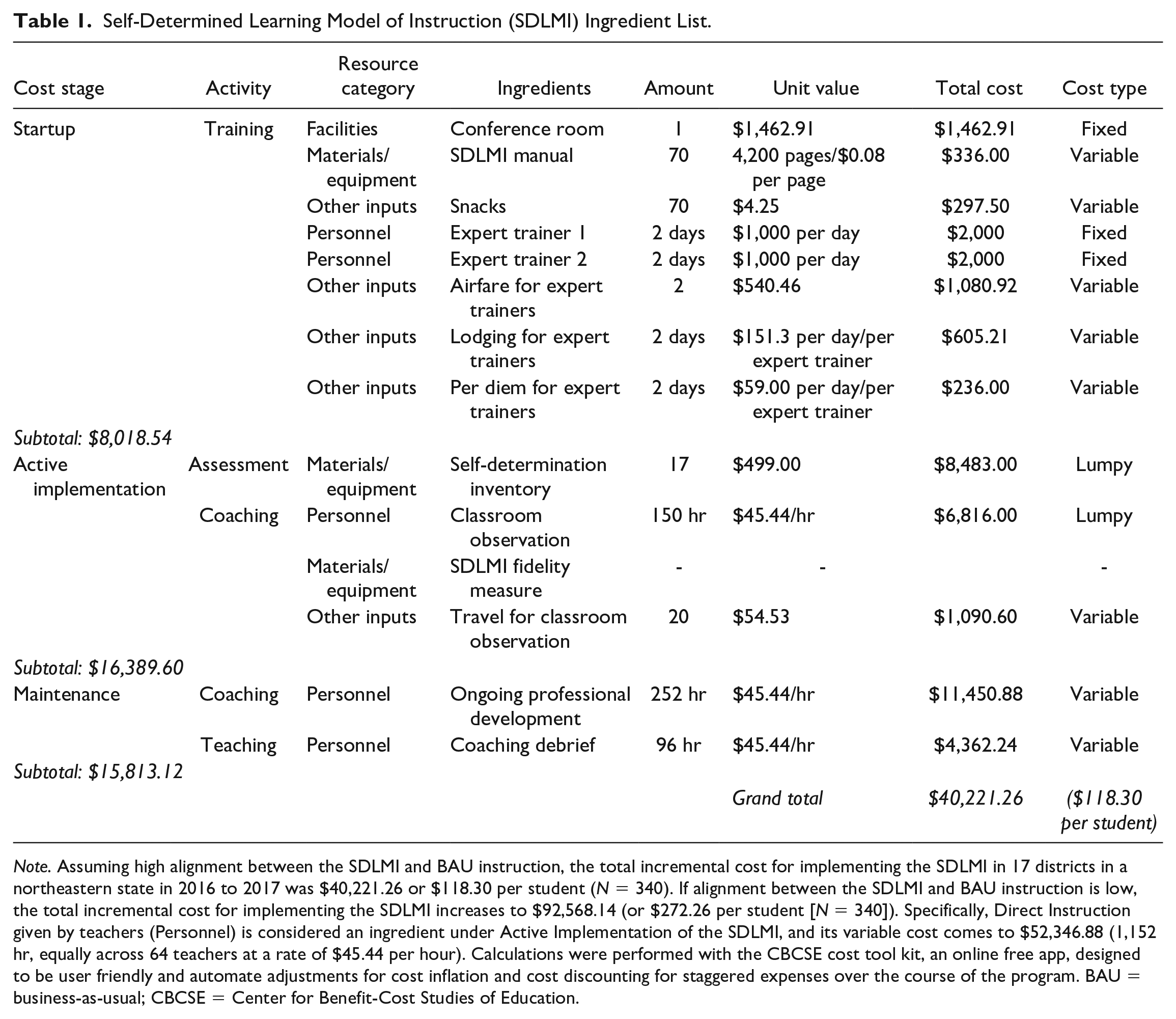
Note. Assuming high alignment between the SDLMI and BAU instruction, the total incremental cost for implementing the SDLMI in 17 districts in a northeastern state in 2016 to 2017 was $40,221.26 or $118.30 per student (N = 340). If alignment between the SDLMI and BAU instruction is low, the total incremental cost for implementing the SDLMI increases to $92,568.14 (or $272.26 per student [N = 340]). Specifically, Direct Instruction given by teachers (Personnel) is considered an ingredient under Active Implementation of the SDLMI, and its variable cost comes to $52,346.88 (1,152 hr, equally across 64 teachers at a rate of $45.44 per hour). Calculations were performed with the CBCSE cost tool kit, an online free app, designed to be user friendly and automate adjustments for cost inflation and cost discounting for staggered expenses over the course of the program. BAU = business-as-usual; CBCSE = Center for Benefit-Cost Studies of Education.
Self-Determined Learning Model of Instruction Cost Under High and Low Instructional Alignment.
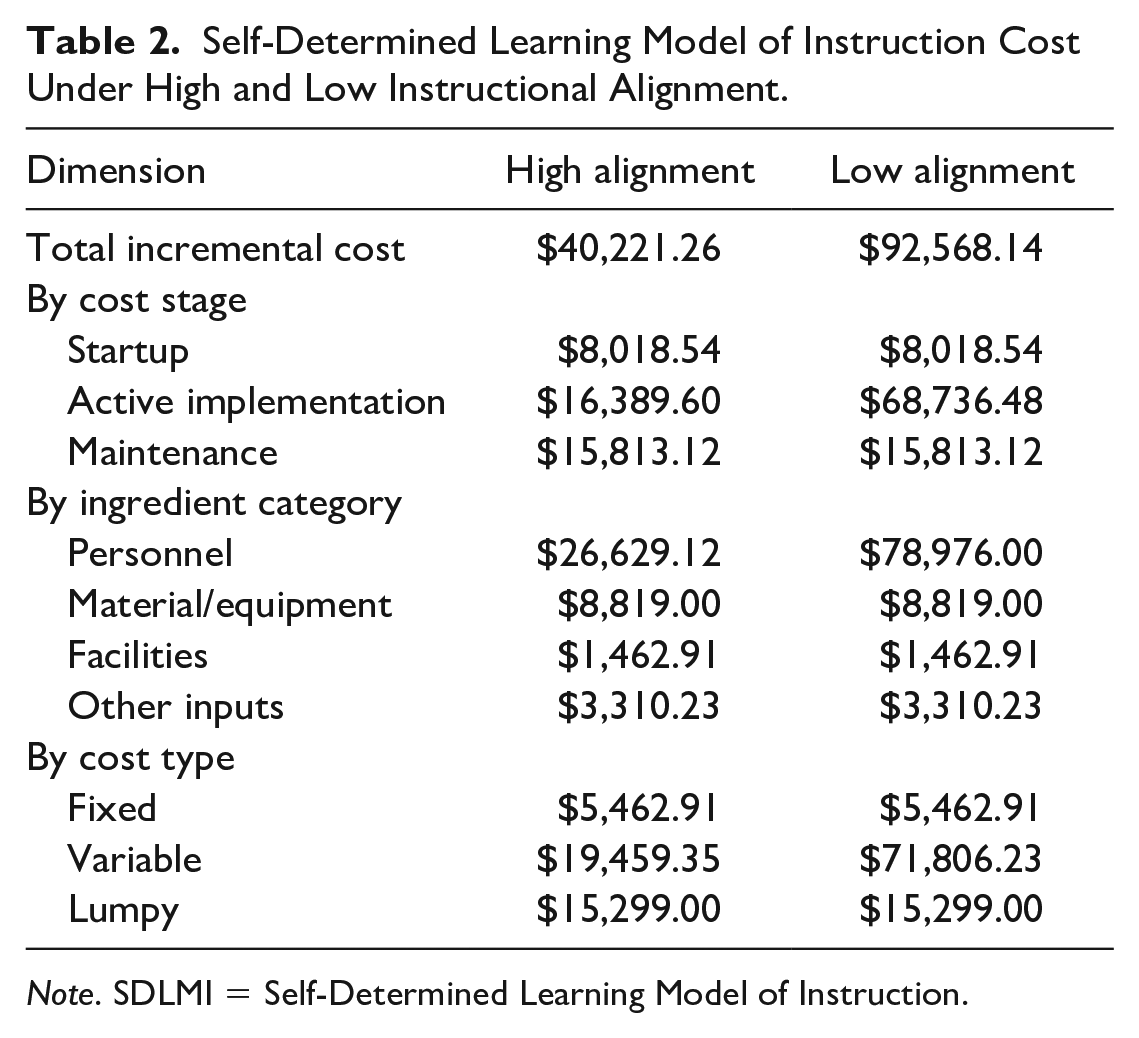
Note. SDLMI = Self-Determined Learning Model of Instruction.
By Cost Stage
The total cost of implementing the SDLMI is composed of startup, active implementation, and maintenance costs. Below we detail the notable activities within each of these program components.
Startup costs
The activities surrounding training prior to the implementation of the SDLMI encompass the facilities and materials necessary for the training to occur, the time of the expert trainers, and the costs associated with the expert trainers’ travel. In sum, startup costs associated with implementing the SDLMI come to $8,018.54 (or $23.58 per student) and remain constant regardless of the alignment between self-determination and BAU instruction.
Active implementation costs
Teachers are required to provide direct instruction on self-determination skills (e.g., goal setting, goal attainment) for 15 min, twice a week. As such, with 64 teachers implementing the SDLMI over the 36-week school year, the cost of this ingredient alone comes to $52,346.88 (or $153.96 per student) and is relevant when there is misalignment between self-determination and BAU instruction.
Additionally, coaches observed teachers implementing the SDLMI; therefore, costs are incurred for the observations themselves as well as travel to the classroom. Specifically, the time required for the 14 coaches to observe their respective teachers was 150 hr to adequately observe the implementing teachers and provide coaching feedback three times per year. The cost of this ingredient comes to $6,816.00 (or $20.05 per student) and the costs associated with traveling to the classroom came to $1,090.60 (or $3.21 per student). It is important to note that the time required for the coaches to complete the SDLMI Fidelity measure is already accounted for, as this is done while they observed implementation. Finally, to examine the impact of the SDLMI on students’ self-determination, it is necessary to evaluate student outcomes. For this purpose, student responses must be collected using the Self-Determination Inventory: Student Report (Shogren & Wehmeyer, 2017), which has a unit value of $499.00 per school district; therefore, with 17 districts participating, the total cost of assessment comes to $8,483.00 (or $24.95 per student).
All told, the cost of active implementation of the SDLMI comes to $68,736.48 (or $202.17 per student). If teacher time for direct instruction is not included, Active Implementation cost comes to $16,389.60 ($48.20 per student).
Maintenance costs
This final cost stage corresponds to activities related to ongoing professional development and encompasses activities related to the coaches and the teachers. In total, this component comes to $15,813.12 (or $46.51 per student) and is the same regardless of the degree to which self-determination and BAU instruction are aligned. The ingredients with the largest cost for this stage of implementation were the monthly professional development and problem-solving meetings that coaches attended as ongoing training above and beyond non-coaching teachers. Based on a 9-month school year with 2-hr meetings attended by 14 coaches, costs were incurred for a total of 252 hr. This comes to a total of $11,450.88 (or $33.68 per student) which makes up 72.4% of the maintenance cost for sustaining SDLMI implementation. Using the cost template, we can also assess cost by category or by type.
By Ingredient Category
We classify cumulative costs for the project as falling into the following categories: (a) personnel, (b) material/equipment, (c) facilities, or (d) other inputs. Personnel costs came to $26,629.12 (or 66.2% of the total incremental cost), or, if direct instruction is considered, personnel costs come to $78,976.00 (or 85.3% of the total incremental cost). Material/equipment and facilities costs combined were $10,281.91 and accounted for approximately 25% (or 11%, if direct instruction is included) of the total incremental costs. Other input costs came to $3,310.23 and accounted for 8.2% (or 3.6%, if direct instruction is included) of the total cost. Personnel costs account for a large proportion of the total cost, as is frequently the case. Given the high proportion of the total consisting of personnel costs, it is worth noting that a significant cost-saving feature of the SDLMI is the embedded instructional design, which cancels out teacher time by simply restructuring how instruction is delivered rather than adding new instruction time.
By Cost Type
Analyzing the types of cost offers an alternative lens to categorize costs. In this approach, costs are aggregated by type of cost and roughly fall into three categories: (a) fixed, (b) variable, and (c) lumpy.
Fixed types of costs
Fixed costs are those that are the same regardless of the number of individuals served by the program. One such fixed ingredient in this analysis is the expert trainers, who are considered personnel. Regardless of whether the SDLMI is to be implemented in a single school district or multiple school districts, as in this study, 2 days of expert training must be given to those who will implement the SDLMI. Because the nature of training is suitable for audiences of various sizes, we treated expert trainers as a fixed cost, given the condition that all trainees across the districts can converge on the same training activities with the same expert trainers. For two expert trainers giving a 2-day training, the total incremental cost was $4,000, with each expert trainer costing $1,000 per day.
Variable types of costs
Variable costs exist where there is a dependency (e.g., linear relationship) between an ingredient and the number of individuals that could benefit from the program. Variable costs come to $19,459.35 (or 48.4% of the total incremental cost) when direct instruction is not incorporated into the cost analysis; or $71,806.23 (or 77.6% of the total incremental cost) when direct instruction is accounted for. Variable costs could be utilized to determine cost to expand SDLMI implementation to additional teachers.
In 2016 to 2017, 64 teachers implemented the SDLMI. One variable ingredient for implementing the SDLMI is the paper manuals that must be printed and provided to each implementing teacher. It follows then that if an additional teacher was to implement the SDLMI, an additional manual must be printed, representing a linear relationship between the cost of manuals (falling under Materials/Equipment) and implementing teachers. The SDLMI manuals contain 60 pages each, and therefore, it would cost $307.20 at $0.08 per page to produce 64 manuals. However, for the purposes of this cost analysis, we budgeted a total of 70 SDLMI manuals to be conservative, and therefore, the total incremental cost comes to $336. This accounts for a negligible proportion of the total incremental cost at roughly 1%; however, if digital manuals were used in lieu of print copies, then this incremental cost of this ingredient could be eliminated.
Lumpy types of costs
Lumpy costs (also referred to as step function costs) reflect that once a threshold is reached, an additional unit is required. In the context of the SDLMI, coaches (classified as personnel) provide support to implementing SDLMI teachers, and in this intervention context, can only support a maximum of four teachers while following the requirements of the coaching protocols (e.g., specific number and times for visits). Specifically, in 2016 to 2017, a total of 150 hr was required of the 14 coaches to conduct all classroom observations over the entire school year totaling $6,816.00, a figure arrived at by using the same hourly rate as teachers.
In this study, when sorting ingredients based on type of cost as opposed to category for the 17 school districts: Fixed costs add up to $5,462.91 or 13.6% of the total costs; lumpy costs add up to $15,299.00 or 38% of the total costs; and variable costs add up to $19,459.35 or 48.4% of the total costs. However, if direct instruction is part of the estimated cost, variable costs rise to $71,806.23 and account for 77.6% of the total costs for implementing the SDLMI, while the proportion of fixed and lumpy costs shrink to 6% and 16.5%, respectively. Among other things, this introduces the possibility that careful planning in the design of the implementation of the SDLMI can reduce total costs, if this is a concern for schools or districts. As an example, one could optimize the deployment of coaches to ensure that all coaches are being effectively utilized to support the maximum number of teachers.
Discussion
To the best of our knowledge, this study constitutes the most rigorous cost analysis of SDLMI implementation to date. All economic evaluations, no matter how advanced and complex, ultimately depend on the accuracy of cost data and, thereby, cost analysis for their validity. Cost analysis requires assignment of hard monetary values to all resources, including soft resources such as volunteer time, that are required to implement an intervention with fidelity. These types of resource components are overlooked in an expenditure (budget) analysis, and therefore, results from this type of analysis cannot inform decision-makers about which of the competing interventions should be deployed. We conducted a cost analysis of the SDLMI based on cost data collected from a recent C-RCT. In sum, we determined that the societal cost of implementing the SDLMI relative to BAU on 340 transition-age students, 64 teachers, and 17 school districts as part of a statewide initiative to enhance transition outcomes for students with intellectual disability was $40,221.26 or $118.30 per student served (N = 340). Furthermore, we determined that the ongoing professional development, a required maintenance activity for the 14 coaches, which occurred monthly over the 9-month school year, was the costliest ingredient coming to $11,450.88 or 28% of the total cost of the SDLMI when direct instruction cancels out (i.e., high alignment between the SDLMI and BAU instruction).
A key consideration when determining the societal cost of using the SDLMI (relative to BAU) relates to whether to cancel out the 15 min of direct instruction that teachers were asked to give students twice a week as part of the SDLMI to support their students in the process of setting and working toward goals. If we predict that the SDLMI will not be overlaid and aligned with ongoing BAU instruction, then time spent on direct instruction should be included in the cost analysis. Toward this end, we conducted a sensitivity analysis and concluded that with low alignment, the total cost of using the SDLMI increases to $92,568.14 (up from $40,221.26) or $272.26 (up from $118.30) per student in this project. In this context, direct instruction time is the costliest ingredient at $52,346.88 and accounts for 56.5% of the total incremental cost. Clearly, the decision to cancel out teacher time had a profound impact on the total cost estimate. However, as previously mentioned, the decision of whether to count or cancel out this specific cost between treatment levels (SDLMI vs. BAU) depends on the extent to which the SDLMI and BAU instruction can align (i.e., tighter alignment; less opportunity cost). One feature embedded into the design of the SDLMI is that teachers can align the SDLMI and BAU to minimize opportunity cost (e.g., they can use the SDLMI to amplify BAU instructional objectives). That is, the intent of the design of the SDLMI is to give teachers a feasible option for folding self-determination instruction into regular classroom activities to minimize opportunity costs (Shogren et al., 2020). Decision-makers should select the cost estimate that they believe is most consistent with the implementation of the SDLMI in their unique context.
Another consideration that can potentially affect the total incremental cost of the SDLMI (relative to BAU) is the number of expert trainers. For example, although in this study, two expert trainers satisfied the needs of this project, in future applications, two expert trainers might be one too many or not enough (e.g., at some point only determined by the specifics of the context, the audience size will become too unwieldy for two expert trainers to handle). The point of this observation is that the cost of an expert trainer will depend on the number of expert trainers needed for the application. However, in most cases, we anticipate that one or two expert trainers will suffice, like in the present application. In addition, our two expert trainers were both members of the original development team, but, as we anticipate the number of trained coaches will grow in the field as SDLMI applications become common, future expert trainers for an application might not need to be drawn from the original development team, which is a consideration that could save costs (especially if states and school districts can draw from in-house sources).
Limitations
Evaluations that combine efficiency and effectiveness information in a single analysis will help decision-makers optimize their choice of program; however, this was beyond the scope of the current retrospective study, as we did not have the type of effect and cost data needed to perform a rigorous cost-effectiveness analysis. To perform the most informative types of cost analysis (e.g., net-benefit cost curve analysis), cost analysts need exact cost and effect data for each student in the study rather than a general or average cost and effect estimate across students in the study. Researchers should aim to gather this student-level data to increase the utility of the cost analyses conducted.
Implications for Research
Although it was not possible for us to combine cost and effect data in this study to determine if the SDLMI is cost-effective or not because of the limitation of retrospective cost analysis, we recommend researchers studying the SDLMI in the future fold a cost evaluation into an RCT so that the type of student-level cost and effect data can be collected at the same time. In addition, this RCT could investigate the relationship between instructional alignment and effect size. If alignment is high, does this have a significant impact on self-determination outcomes, relative to low alignment? To answer these questions, an RCT will enable a rigorous net-benefit regression analysis, which takes the extra step of determining whether the SDLMI is cost-effective and under what conditions and for whom. Future research should seek to include students from diverse racial/ethnic backgrounds and with a broad range of support needs, with particular attention to how personnel time and resources may vary within multi-tiered systems of support (Raley et al., 2022). As the first rigorous cost analysis of the SDLMI, this study contributes to the knowledge base and estimates the total cost of implementing the SDLMI relative to BAU. This study also serves as a basis from which future researchers can investigate possible cost-saving strategies, such as, for example, leveraging technology to decrease personnel time. Furthermore, this cost analysis may serve as a benchmark to compare other approaches to self-determination, for example in the context of a meta-analysis or research synthesis (e.g., Rowe et al., 2021).
Implications for Practice
Self-determination is an evidence-based predictor of post school outcomes for students with disabilities (Mazzotti et al., 2021), and thus, is a pivotal focus as adolescents prepare to transition from secondary to postsecondary education and/or careers. Targeted instruction and opportunities for practice can facilitate the acquisition of self-determination (Rowe et al., 2021); however, one common hindrance to implementing self-determination instruction and supports is the concern that there is not enough instructional time to cover both content and self-determination; that is, in the language of economic evaluation, it comes with high opportunity costs. Consequently, one of the most attractive features of the SDLMI is that it gives trained implementers the option of minimizing the opportunity cost of self-determination instruction by overlaying it into routine BAU instruction to the extent feasible. However, the extent to which an implementer opts to utilize this feature varies. As the present study shows, the degree to which an implementer utilizes this feature changes the overall cost of implementation—in this case, the overall cost jumps from $40,221.26 (high alignment) to $92,568.14 (low alignment). Thus, based on these study findings, we recommend decision-makers seeking to reduce the costs of self-determination instruction should utilize the option that the SDLMI affords by aligning it with BAU instruction to minimize opportunity costs. It should also be noted that alignment comes in degrees, and that in most applications, it will likely fall between the extremes of $40,221.26 (high alignment) and $92,568.14 (low alignment). In other words, the true cost will be somewhere in the middle. Although these opportunity costs might be invisible in an organizational budget, the advantage of cost analysis is that it makes these types of opportunity costs visible. Ultimately, it is important to provide educational administrators with robust cost data so that sound decisions can be made about whether to adopt the SDLMI.
Footnotes
Declaration of Conflicting Interests
The author(s) declared no potential conflicts of interest with respect to the research, authorship, and/or publication of this article.
Funding
The research reported here was supported by the Institute of Education Sciences, U.S. Department of Education, through Grant R324L160002 to University of Kansas. The opinions expressed are those of the authors and do not represent the views of the Institute or the U.S. Department of Education.
