







Abstract
Action sport participants have always been actively involved in the consumption and production of niche cultural media. However, the proliferation of new media technologies is playing an evermore important role in the ongoing progression of skills among athletes and committed recreational participants, and building a sense of community among enthusiasts and audiences across local, national, and global contexts. More than repeating previous patterns, such media technologies are contributing to new relationships between corporations, action sporting bodies, and communities. This article sets out a research agenda for understanding new media developments in action sports. In the first part of this article, I detail how new digital media are being used by corporations, athletes, and everyday participants, and in so doing, are transforming the networks and connections within and across action sport communities. In the second, I describe how new media technologies such as GoPros™, camera drones, and GPS tracking devices are changing action sport experiences and the relationship between “human” and “nonhuman” sporting bodies. As well as revealing emerging issues, this article also poses a series of critical questions and challenges to researchers interested in contributing to new understandings of the latest media technologies in action sport cultures.
Keywords
Action sport cultural industries have long been at the forefront of new media technological developments aimed at capturing the moving body in ways that are not only able to vividly capture the “thrills and spills” but also to evoke deeply affective responses among viewers (Booth, 2008; Borden, 2001; Wheaton & Beal, 2003). The emergence of new social and digital media technologies is playing an evermore important role in the ongoing progression of skills among action sports participants and building a sense of community among enthusiasts and audiences across local, national, and global contexts (Gilchrist & Wheaton, 2013; Thorpe, 2014). More than repeating previous patterns, however, such media technologies are contributing to new relationships between corporations, action sport bodies, and communities. In identifying emerging issues and new questions, this article sets out a research agenda for understanding new media developments in action sports. More than describing such developments, we need to consider what makes the usage of new media technologies in action sports unique, as well as their (perhaps unintended) implications on action sporting bodies and experiences.
With the aim of identifying new trends and developments in media technologies in action sport cultures, and particularly user practices and subcultural relations, this article consists of two parts. In the first part, I detail how new digital media are being used by corporations, athletes, and everyday participants, and in so doing, are transforming the networks and connections within and across action sport communities. Second, I describe how new media technologies such as GoPro™, camera drones, and GPS tracking devices are changing action sport experiences and the relationship between “human” and “nonhuman” sporting bodies. As well as offering an overview of emerging issues, this article also poses a series of critical questions and challenges to researchers interested in contributing to new understandings of the latest media technologies in action sport cultures. In so doing, it signals exciting opportunities for future action sport media and communications scholarship that reveals the increasingly complex relationships between new media technologies and action sporting bodies. It is important to note that while this is not an empirically focused article, it is based on a decade of ethnographic research on action sport cultures and media engagement (see, in particular, Thorpe, 2008, 2011, 2013, 2014; Thorpe & Ahmad, 2015).
The Role of Social Media in Action Sport Communities
Cultural sociologist John Tomlinson (2007) uses the term telemediatization to describe the “proliferation of communication technologies and media systems within the quotidian rhythms of social life,” a phenomenon that he believes has “altered the ‘everyday flow of experience’” (p. 94). Drawing upon Tomlinson’s (2007) work, Paul Hutchins (2011) proclaims that tele-, meaning “at a distance,” is the “pivotal prefix here,” opening the possibility of real-time “presence at a distance” as a readily available method of interaction for social actors who form and maintain meaningful relationships in and through media systems, including websites, bulletin boards, social networking services, chat rooms, and online games and spaces. (p. 241) offering instant communication across the world, new media technologies may have accelerated the dissolution of barriers of time and space, redefining notions of the global and local and offering possibilities for the development of new communities based on affinities of interest, politics or any form of cultural identity.(Osgerby, 2004, p. 193)
As various scholars have illustrated, action sport participants have always been actively involved in the consumption and production of niche and micro media (see Borden, 2001; Thorpe, 2008; Wheaton & Beal, 2003). However, the Internet and new media and communication technologies (e.g., smart phones) are playing an evermore important role in sharing information across borders and facilitating trans-local communication within and across action sport communities (Evers, 2015a, 2015b; Gilchrist & Wheaton, 2013; Kidder, 2012; Thorpe, 2014; Woermann, 2012). For example, the surfing website www.surfline.com attracts more than 1.5 million visitors from around the world each month. The European snowboarding magazine, Onboard, surveyed its readers (a total monthly audience of over 170,000) to find that 96% have access to the Internet, 93% use the Internet to catch up with snowboarding news and snow conditions, and 80% buy clothes and snowboard equipment online (“OnBoard Media,” 2012). Before illustrating how action sport participants are consuming and utilizing new digital and social technologies for their own sporting, social and political purposes, however, it is worth briefly highlighting the continuing power of corporations in representing and (re)defining action sporting performances, aesthetics, and cultural dynamics. Thus, in the following part, I offer some brief insights into how corporations are utilizing digital and social media in their efforts to create, and connect with, action sport communities and consumers, before turning to consider how action sport participants are consuming, adopting, and adapting such technologies.
Corporations, Social Media, and Action Sporting Spectacles
As with many traditional sports (see Hutchins & Rowe, 2009, 2012), action sport–related events are increasingly being designed and choreographed for online audiences. 1 The 2011 Vans Triple Crown surfing contest series, for example, set a new record for the action sports industry with more than 10.4 million online viewers during the event. 25–30% of whom watched the event online via competition applications (apps) designed specifically for iPhone, iPad, and iPod Touch (Lewis, 2011). Nearly 10% (1.1 million) of these viewers streamed the event via their iPhones. Some action sport events have specifically designed Apps for iPhone, iPad, android mobile, and android tablet. For example, the latest X Games app features instant results, news, schedules, athlete bios, and live music from the summer and winter events, and guest information (e.g., venues, parking). The app touted the “Hypemeter” as its newest feature, a “built-in game that lets you contribute to the overall excitement around X Games via tweets, Facebook posts or device interaction (shaking your phone or tapping your tablet)” (Foss, 2014, para. 1). As a result of such new technologies, the 2012 Winter X Games were the most watched yet, with an estimated 35.4 million viewers in the United States tuning into Entertainment and Sports Programming Network (ESPN), and a digital media audience that was up 147% from the previous year’s X Games (Hargrove, 2012).
Corporations have long utilized action sports events in their efforts to reach young male consumers, such that it should not be surprising that they are now embracing social media and digital technologies to further establish the connection between their products and the action sport lifestyle. A particularly noteworthy example of the use of new digital technologies for unique marketing strategies, however, is the energy drink company Red Bull. Much more than an energy drink, Red Bull is a transnational brand closely associated with youth culture and the action sports lifestyle and community. This connection has been established through the creation and organization of over 90 individually branded action sport events around the world (e.g., the Red Bull Road Rage, Red Bull Air Race World Championships, and the Red Bull X-Fighters), all of which are captured by some of the world’s best photographers and cinematographers. In 2007, the Red Bull Media House (RBMH) was founded as an umbrella for Red Bull’s massive print, television, online, and feature film production. With offices in Austria and Santa Monica (California), the RBMH employs over 135 people who are involved in the production and distribution of an extensive array of action sports events and content, including videos (e.g., the snowboarding film, The Art of Flight that cost US$2 million to create but quickly became the hottest property on iTunes), websites, web videos, documentaries, Facebook (with more than 32 million fans), and the Red Bulletin, an action sports magazine, with a global circulation of 4.8 million.
The RBMH are also experts at producing “media events”—“live broadcasts of historic occasions that engage a committed or worldwide audience, which does not merely watch the event, but celebrates it” (Dayan & Katz, 1992, cited in Giulianotti & Brownell, 2012, p. 204). One such example of a successful Red Bull “media event” was Austrian BASE jumper Felix Baumgartner’s “space dive” of 120,000 feet from a helium-filled balloon on October 14, 2012. A carefully choreographed media event, the jump was 7 years in the making, with Red Bull’s investment ultimately costing more than £9 million. Although a highly risky marketing initiative, Baumgartner’s successful jump ultimately became an incredibly valuable media asset for Red Bull. The event broke the record of the most watched live streaming event on YouTube with more than 8 million people around the world watching the live footage. It is reported that 7.6 million viewers also tuned in for Discovery Channel’s live coverage of the jump, and another 40 television stations showed the jump across 50 countries. Red Bull’s Facebook postjump photo of Baumgartner gained almost 216,000 likes, 10,000 comments, and over 29,000 shares within 40 min. Further revealing the digital significance of this event, more than 3 million tweets were sent about the jump (Clancy, 2012), and half the worldwide trending topics on Twitter were related to the “Red Bull Stratos” event. The night of the jump, Baumgartner himself tweeted “One small step for man, one giant step for energy drink marketing” (cited in McGiugan, 2012, para. 9).
An important factor in Red Bull’s dominance in the action sports industry is its policy on ownership of all media assets resulting from action sport events and athletic achievements in which it has been involved. Not only does the RBMH own media assets from such events, but also the copyright. Such ownership rights, however, raise critical questions for the rights of the athletes. While most action sport athletes, including Baumgartner, embrace the opportunities enabled by Red Bull and ultimately benefit from the publicity resulting from media events made possible from the generous sponsorship of Red Bull, they do not own the media produced from their efforts. The athletes are in a labour relationship in which they are (often freely) producing media assets for Red Bull who then proceeds to make money from both the media products and, ultimately, the sales of energy drinks which benefit from the connection with action sporting spectacles. In so doing, it might be argued that action sport athletes are experiencing new forms of alienation in the Red Bull media–event–industry complex (Brohm, 1978). It is also worth noting that not all action sport athletes survive Red Bull sponsored events. For example, in March 2009, world-renowned American extreme skier and BASE jumper Shane McConkey died in the Dolomites (Italy) while completing a highly technical skiing BASE jump for Red Bull. Red Bull owns all media of this event, including footage of McConkey plummeting to his death when the parachute did not open correctly. Thus, it is no surprise that, in contrast to the phenomenal Red Bull produced media coverage of Baumgartner’s successful jump, Red Bull’s response to this tragedy was one of relative silence. Carefully managing the postevent media coverage, the incident was largely interpreted as McConkey’s individual choice to pursue such risky activities and thus the incident was his personal responsibility rather than that of a corporation encouraging him to strive for evermore spectacular feats. While death is rare in action sports, injuries are rampant among the most elite action sport athletes, and particularly those pushing their bodies to the limits of what is considered possible, all in the name of “getting the shot” and producing the content that will ultimately be owned and monetized by Red Bull.
In sum, in contrast to many other corporations investing in sporting events and athletes, Red Bull does not merely pay to advertise in sports-related magazines, during event coverage, or through the sponsorship of mega sporting events (i.e., X Games), but rather utilizes the latest digital technologies and media platforms to produce their own events, media, and sporting celebrities. In so doing, Red Bull is blurring previously conceived divisions between media, events, corporations, and celebrity that raise important questions for sport and media scholars, particularly regarding athletes’ agency and rights in this new context of mega corporations, transnational digital and social media, and evermore extreme sporting spectacles. 2 While new technologies and social media may seem to offer action sport athletes and participants opportunities for more innovation, creativity, and even control over representations of their sporting lives, as this section highlights, we should not ignore the increasingly powerful roles of corporations in controlling flows of cultural knowledge, dialogue, and information sharing.
Action Sport Athletes Use of Social Media
Much like their peers in more traditional sports, professional surfers, skateboarders, snowboarders, BMX-riders, climbers, mountain bikers, and other action sport athletes are embracing new media to connect with fans around the world. For example, more than 40 professional skateboarders have Twitter accounts, with global skateboarding icons Tony Hawk and Ryan Sheckler having more than 4.12 million and 2.7 million followers, respectively. As other scholars have revealed, many action sport athletes are also using YouTube and other video-hosting platforms (i.e., Vimeo) to post short videos of their sporting achievements (Gilchrist & Wheaton, 2013; Ojala, 2014). In so doing, some of the more skillful and creative athletes are able to forge careers away from competition and almost solely through short films that are then shared widely by their peers across the action sport culture via an array of social media platforms (i.e., Facebook, Instagram, Twitter, Snapchat). Such social media capital can be converted into economic capital when the athlete garners the financial support of action sport companies who may opt to sponsor their digital media-based careers (Ojala, 2014). Most action sport athletes also have their own websites, Facebook pages, and Instagram accounts, some of which they manage themselves and others by their agents.
Instagram is a particularly popular platform among action sport athletes, many of whom use it to share photos and short videos of their sporting pursuits and lifestyles with their friends, family, and fans. According to one action sports journalist, the action sports industry “has thrived through Instagram”: “First there were magazines. Then there were videos. Now there is a whole new medium for you to see how much cooler someone’s life is than your own” (Andrews, n. d., para. 1). Continuing, he connects the hero culture within action sports to the immediacy and intimacy that Instagram offers action sport enthusiasts who are interested in the lifestyles and sporting pursuits of their heroes: We have always sought out heroes in these sports, as they do the seemingly impossible day in and day out—and continue to raise the bar. Now, with Instagram we do not have to wait for a video to be released or for a magazine to hit the stands—these athletes’ videos and photos are posted as easily as a tap on the phone. (Andrews, n. d., para. 2)
A select few action sportswomen also have huge social media followings, and this is particularly true for those who are able and willing to combine athletic prowess with a hyper-heterosexualized femininity. For example, American professional surfer and model Alana Blanchard has over 1.5 million Instagram followers, almost 2 million Facebook “likes,” and 180,000 Twitter followers. Blanchard is a highly competent surfer, and although no longer competing on World Surf League, she remains the highest paid female surfer, earning more than US$1.8 million in 2014 from her various sponsorships, including Rip Curl, Sony, and T-Mobile (“The Stab List,” 2014). Very aware of the economic potential of her hypersexualized blonde, tanned, toned “surfer-girl” image, Blanchard uses an array of online and social media platforms in combination with various other media representations to promote her bikini-clad physique and surfing lifestyle. Many other action sportswomen are opting to self-subjectify themselves in similar ways, and often with the support and encouragement of their transnational sponsors (i.e., Roxy, Rip Curl) who encourage the use of social media for building the athletes personal “brand” worth, but with little consideration for the impacts on women’s position in action sport cultures more broadly. In so doing, it seems many action sportswomen are internalizing the neoliberal feminist discourses of entrepreneurialism and self-branding (see Prügl, 2015; Rottenberg, 2014; Thorpe, in press). The key point here is the need to consider how the use of social media technologies may be objectifying, and in some cases enabling/encouraging the self-subjectification of, action sporting bodies in new (and old) ways.
Everyday Usage of Mobile Media
With many (though certainly not all) action sport participants coming from privileged backgrounds, iPhones and other smartphones are common accessories. The European snowboarding magazine, Onboard, found that 95% of its readers owns a mobile phone (“OnBoard Media,” 2012). Such technologies have allowed participants to keep up to date with latest news from their sporting heroes, communicate with their peers—organizing times to gather for a skate, surf, or climbing session—and access relevant information about conditions, products, and events, often while on the move. Each action sport has its own preferred iPhone apps, including games, news, forecasting, and event coverage. For example, surfers can access more than 150 apps via iTunes designed specifically for their needs. According to Surfers Village, however, “99% are rubbish” (“Best of,” n. d.). Snowboarders can also download a plethora of apps that calculate their on-snow statistics during a day of riding, and provide detailed, up-to-date information on resort facilities. With such access to mobile devices and computers, everyday action sport enthusiasts are heavy consumers of the social and virtual media of the companies, events, and athletes. According to one skateboarding journalist, we are being fed so much amazing skateboarding on a daily basis that …we are getting desensitized. Even when we come across a section we actually enjoy we don’t even bother downloading it anymore. We’ll watch it once or twice, click on another link, passively stare at the clip even if it sucks, click on another link and so on, until everything we’ve just witnessed fades into a blur of wallies, yo flips and high fives. (Top 5, March 2013, para. 1)
Action sport niche media have become very effective in utilizing new technologies to connect with their highly mobile audiences. The websites for TransWorld-Surfing, -Snowboarding, and -Wakeboarding magazines have 300,000, 440,000, and 448,000 visitors per month. As well as featuring an array of videos and print articles, and an array of interactive forums, these websites also have thousands of Instagram and Twitter followers. However, some recreational action sport participants have also been proactive in setting up their own interactive platforms that become important spaces for the sharing of information and communication across local and national fields. One of the earliest examples of an interactive digital action sport community was alt.surfing, which was established in (or around) 1990 prior to the development of the World Wide Web. Participants were mostly passionate surfers with the technological skills necessary to access and contribute to the dialogue. The site has been described as a surfing “newsgroup” with a “distributed, worldwide system with somewhat transient information” (altsurfing.org, n. d.), and it was revolutionary in its use of new technologies for transnational communication among surfers. During the early 2000s, www.snowboard.com (now defunct) became the world’s largest snowboarding website established by passionate snowboarders, hosting 550,000 registered members—313,000 from the United States, 98,000 from Canada, and 144,000 from other countries around the world. While the majority of members were males (70%) aged between 13 and 25 years old, the website also hosted specific forums for older and female participants (Media Man, n. d.) where they shared stories of their previous and recent local, national, and international journeys and adventures, reflected upon past and present lifestyle constraints and opportunities, and debated local and global cultural issues and controversies. This website also included virtual spaces representing real locations within popular snowboarding locations (e.g., famous nightclubs in Whistler, BC, Canada) where members could choose an alias and then interact with other members in this space, including live chats which were a relatively recent development. Similarly, www.theskateboardersjournal.com website encourages members to “share your skateboarding life with skateboarders from all around the world, contribute to the culture, lifestyle and sport of skateboarding.” While most of the early online action sport community platforms were not moneymaking ventures, today the majority of interactive action sport websites are riddled with a wide variety of advertising ranging from vehicles to energy drinks, with many such sites becoming subsumed by larger action sport corporations and online magazine companies.
Based on almost a decade of observations of contemporary action sport participants online and new media usage, I concur with Williams and Copes (2005) who argue: “[E]xpressing subcultural identities online is part of the identity work individuals perform in their everyday lives,” yet “identity online is not separate from the face-to-face world … rather [it] complements and supplements it” (p. 73). Certainly, for many action sport athletes and committed recreational participants, their online and off-line sporting experiences are complementing and supplementing the other, and contributing to a transnational imaginary in which many feel a sense of belonging to a larger community beyond their immediate social groupings. For example, on December 18, 2015, Kelly Slater used his various social media platforms to reveal details of a high-performance artificial wave pool developed by the Kelly Slater Wave Company. Within 7 hours, the short video of the wave pool had received over 1.5 million views on Facebook, and over 50,000 “likes” on both Facebook and Instagram. The news spread quickly across the global surfing culture with enthusiasts sharing and commenting on the news via their own social media platforms. Yet such conversations were not limited to online spaces, and the news also triggered conversations in various physical spaces in local surfing communities (i.e., in the waves, on the beach, in cafes, surf shops, and carparks), about the potential of such technologies and the impact on surfing as it is currently imagined.
Importantly, the lines between commercial and noncommercial media, and (paid, paying, and volunteer) producers and consumers, have also become increasingly blurred. Indeed, action sport participants of all ages, even very young children, are active consumers and producers—or “prosumers” (Ritzer and Jurgenson, 2010)—of new digital and social media. In so doing, they are often critical consumers of mass media products, and enjoy the social activities of responding to existing cultural products, as well as coproducing their own. Further research that examines how different groups of participants (i.e., youth, highly committed/core participants, women) are producing their own media, and the creative skills and techniques and social interactions involved in such processes, would offer valuable contributions to our understandings of the practices (and politics) of “prosumption” currently operating in action sport cultures (see Woermann, 2012). Moreover, research on audience responses to such media products would also offer important insights into how the “circuit of culture” is being (re)negotiated within action sport communities. It is typically one’s peers (in local and international contexts) who regulate each other’s practices in online environments via the comments, “like” buttons, and various other “linking” or “liking” options. In so doing, existing identities, power relations, and cultural hierarchies are largely reestablished in digital spaces.
Interesting research is emerging that examines how recreational action sport participants are using mobile technologies as part of their everyday lifestyles and communications, and the effects of such media usage on gendered identities, performances, and relationships within both local and global action sport communities. For example, in her study of recreational female surfers living in Byron Bay, Australia, Olive (2015) reveals how many young female surfers are using Instagram to offer their self-selected representations of particular lifestyles and relationships to place and people. In so doing, such representations of their surfing selves both challenge and reinforce stereotypes: Their photos emphasize women’s active and committed participation in surfing, and their positive relationships with other women surfers, while simultaneously emphasizing the bikini-clad, slim, toned, bronzed, sun-bleached “surf babe” stereotype that continues to be reinforced in both mass media and the social media self-portrayals of female action sport athletes. Evers (2015b) has also studied how male surfers use mobile phones to not only access surf forecasts and up-to-minute weather conditions but also to “facilitate the coming together of masculinity, bodies, affects, emotions, friendship, risk, waves, etc” (p. 375).
Some action sport participants also use social media, such as Facebook, Instagram, Twitter, and their own personal blogs, for broader political purposes. For example, in 2011, American World Champion longboarder Cori Schumacher used various mass and social media platforms to announce and explain her boycott of the World Women’s Longboard Championship to be held in Hainan Island in the South China Sea, stating “deep political and personal reservations with being a part of any sort of benefit to a country that actively engages in human-rights violations, specifically those in violation of women” (cited in Weisberg, 2011, para. 10). Some action sport scholars have also examined how female action sport participants are using social media for feminist-inspired strategies. In their critical analysis of the all-female “Skirtboarders” blog, for example, MacKay and Dallaire (2014), identify online niche media as an important space “where crew members attempt to reflexively start a movement and, in so doing, construct and circulate a wider collective identity” (p. 1; also see MacKay & Dallaire, 2013a, 2013b, 2014).
Of course, access to and ownership of social media technologies requires some level of expendable income. Indeed, many action sport participants are from privileged backgrounds. They have access to computers and mobile devices (e.g., smartphones, iPads) at home and in their classrooms or workplaces. However, such resources and access are not available to all. For example, after being invited to join a group of local American Mexican skateboarders in El Paso, TX, on a private skateboarding session in a “secret spot,” I asked whether anyone had an e-mail address to which I could send them copies of the photos I had taken. Despite their enthusiasm to see the photos, none of the eight young men (ranging from 10 to 22 years old) had an e-mail address. Admittedly, this surprised me at first; I had assumed local schools would be providing American youth with at least some access to computer technologies. In contrast, however, I was equally surprised to learn of the high levels of access and use of social and digital media among young male parkour participants in the war-torn region of Gaza. As I have discussed elsewhere, young men in the Middle East are creatively engaging social media (e.g., YouTube, Facebook, Twitter) to gain inspiration from the transnational parkour community, and also for opening new dialogue and establishing informal cultural exchanges with parkour enthusiasts around the world (Thorpe & Ahmad, 2015). The key point here is that access to the Internet and digital technologies is far from universal, and we should not assume clear distinctions in terms of access between the developed and developing world. In contrast to my observations among some groups of youth in parts of the United States, individuals and groups in some of the remotest and least privileged spaces in the world (e.g., Gaza) do have access to electronic communications, and in so doing, are contributing to shifts in their own and other’s understandings of space and place.
In the first part of this article, I have highlighted how social media is being used by action sport events, corporations, athletes, and recreational participants to facilitate new and existing connections with one another across space for economic, social, cultural, and political purposes. Arguably, more research is needed that considers the everyday online interactions with action sport participants from different parts of the world via different digital media platforms. In one of my latest projects, I am examining action sports in sites of war, conflict, and disaster, and in so doing, have found social media to be playing an integral role in the everyday lives of young action sport participants in the global south, and often in some very surprising ways. For example, recent conversations revealed how young male Palestinian skateboarders are using the Internet and particularly media sharing platforms such as YouTube to not only teach themselves new skateboarding manoeuvres but also to learn almost perfect English, with some even touting skateboarding jargon with an American accent. As well as being very active online and social media consumers, these young men are also producing their own “trick tips” videos in Arabic to help other Palestinian youth learn new manoeuvres, and thus establish a skateboarding community in their region. With social media playing such an integral role in the everyday lives of action sport participants, action sport researchers need to critically consider how we might ethically, rigorously, and systematically integrate digital methods into our projects to help make meaning of the cultural practices, performances, and politics that are operating within and across physical and digital geographies.
New Technologies and the Action Sport Body Assemblage
In the second part of this article, I briefly consider three recent media technologies—the GoPro, camera drones, and GPS tracking and data recording devices—that signal important new developments in the action sport body–equipment–media assemblage, and are contributing to redefining how action sport activities and events are being represented in ways that enable and constrain particular affective relations, and new (perhaps unintended) ways of experiencing action sports for both participants and audiences.
GoPro and the Everyday Mediatization of Action Sport Activities
At US$199, the GoPro “Hero”—a small, waterproof, high-definition, low-weight, digital camera—is a relatively affordable technology offering action sport participants new opportunities to produce and consume more embodied and affective media content. For those without access to a GoPro, recording on digital phones and lightweight digital cameras remain popular activities among action sport enthusiasts. Today, action sport participants of all ages and ranging from novices to the most extreme athletes are recording themselves and their peers via GoPro cameras (or other lightweight digital recording devices), with some using the content purely for their own learning and performance analysis, but many more sharing the content with their family, peers, and “friends” via various social media platforms. The key point here is that recording, editing, and publishing one’s peers “in action” is no longer an activity enjoyed solely by the most proficient and/or wealthy action sport participants, but is an integral part of the everyday experiences of many groups of committed (yet, often not highly competent) action sport enthusiasts. To paraphrase Evers (2015a), the GoPro is now a “ubiquitous technology” in action sport cultures (p. 146).
The connection between the GoPro and action sports is not by happenchance. Founded in 2002 by American surfer, Nick Woodman, GoPro has always marketed their products specifically to action sport participants, and have proceeded to offer a growing array of mounts and accessories to facilitate different viewpoints from various parts of the action sporting body-equipment assemblage. For example, GoPro offers clips to attach to action sports equipment such as the surfboard mount and mounts for BMX and mountain bikes, straps for the participant to attach the camera to their hand, wrist, arm or leg, and mounts for the front or side of a helmet. Many action sport participants also modify mounts and accessories for their own purposes, all of which are used in an attempt to capture their own (or others) moving bodies from unique angles and perspectives, and in ways that do not limit their movements. Connecting a lightweight waterproof camera to various points of the action sport body-equipment assemblage offers a wide array of representations of the action sporting body in movement in natural and built environments, including skateparks, city streets, mountain bike trails, rivers, oceans, and mountains. In so doing, they also enable the viewer of such content to be transported into the body of the participant for deeply affective and affecting audience experiences that they might never otherwise be able to access. For example, while few may be daring enough to leap from a 10,000-foot cliff face, wingsuit BASE jumpers with GoPro mounted on their helmets offer the rest of us an opportunity to see what they see as they leap—either individually or following their friends—soaring, tumbling, and buzzing past rock walls. For a brief moment, the viewer can imagine what it must “feel” like to perform such daring acts. For the jumper, such videos offer an opportunity to relive the experience, learn from their mistakes, and/or share the footage with their community, and in so doing, garner social capital for their commitment, skill, courage, humour, or humility.
For many action sport participants, wearing a GoPro is part of their regular sporting participation and thus the camera becomes an extension of the moving body. However, at the same time that it extends the body, it also modifies the experience in particular ways. Drawing upon Marshall McLuhan’s (1964/1995) point that media create “extensions of the human body and senses” (p. 239), Evers (2015a) explains how the GoPro camera “modifies” and “extends” the “surfer’s gaze,” producing “new visions …from underwater” (p. 151) and a “witnessing” by the camera of the surfer “becoming-wave” (p. 150). He concludes by arguing that the GoPro camera “can be taken to previously inaccessible places” and while it is “effective at documenting, evoking and enacting emotional and affective experiences,” it also becomes apparent that “the camera’s material technical architecture is woven through perception, techniques, choices, ideas, space, etc” (Evers, 2015a, p. 153). With GoPro cameras now an integral part of many action sport participants’ individual and collective experiences, and perhaps changing the ways such experiences are lived, remembered, shared, and narrated, this is a topic deserving much more scholarly attention. In other words, how are GoPro cameras affecting the embodied action sporting experience, influencing action sport media production and consumption, and contributing to new forms of individual and collective meaning-making within local and global action sport communities?
Camera Drones: Action Sport Media Progressions
Camera drones are increasingly being used in sporting events for surveillance as well as offering new perspectives on spectators, sporting facilities, and athletic performances. However, action sports have been leading the way in the use of such technologies. In fact, action sport athletes, videographers, and companies have been using drones to produce video content since the early 2010s. For example, in 2012, the producers of a skateboarding film, Firefly, used a camera mounted to a hexacopter for “sweeping overhead vistas” of a lone skateboarder riding the empty streets of a city at night, his board lit from beneath with a glowing blue ring, such that it effectively evokes a science fiction imaginary. The company that produced the film, Samadhi Production, also posted a video of the making of Firefly that reveals the behind-the-scenes efforts to use a drone for filming a skateboarding/art film. Today, the use of camera drones has become common practice in the filming of high-quality action sport videos and action sport-related advertising. For example, a 2015 advertisement for Lexus featuring a group of skateboarders experimenting with a Lexus designed hoverboard at a skatepark used drones to get close-up shots of the hoverboard in action from ground level as well as aerial shots of the skater trying an array of maneouvers as well as the social activities in the skatepark (Kiefaber, 2015). The advertisement also included shots of the drones buzzing around the skateboarders, further reinforcing the intended connection between Lexus and technological innovation. Further revealing the growing popularity of the use of drones among action sport enthusiasts, the 2015 “Rise of the Drones Film Festival” proclaimed to “cater to those who like to live life on the edge,” and featured videos submitted by surfers, motocross riders, snowboarders, wingsuit flyers, climbers, and mountain bikers, from around the world. According to one technologies journalist, “the high-flying exploits of camera drones and extreme sportspeople seem to dovetail ever so nicely” (Lavers, 2015, para. 4).
Here I argue that this connection between technological innovation and extreme sporting pursuits requires further critical consideration. What is it about action sports that seem to “dovetail ever so nicely” with new media technologies such as the GoPro and camera drones? Is it the intimate connection between action sporting bodies and varied natural and built (and often very beautiful) environments, and/or the creative ways in which action sport participants interpret (even dance) with their terrain? Is it the partly choreographed, partly spontaneous, movement of individual (or groups of) action sporting bodies through environments (rather than within the “lines” and rules of more traditional sports) that is particularly interesting to watch from above? It is also necessary to ask, what do camera drones offer to action sport participants and audiences interested in watching these sports that other camera angles do not? Arguably, the bird’s-eye view offered by the camera-drone highlights the scale of the geographies being used by action sport athletes and, in so doing, puts the participant into a different perspective. Examples of this include a small surfing body within a larger ocean of moving swell lines (rather than a zoomed lens framing the surfer on the face of the wave), or a snowboarder soaring like a bird off a cliff, dwarfed by the colossal size of the mountainscape. Does the view from above evoke an out-of-body experience as so often represented in films when an individual dies and rises above a body, looking down on the scene from above, or is it simply the view from above that we so rarely see through our own eyes that makes it so interesting? Action sport and media scholars would do well to pose such questions to those using such technologies, as well as those who are consuming their media products. Moreover, as suggested above, in considering what makes the connection between action sports and drone technologies so evocative, it is also interesting to consider how the flows and rhythms of action sporting bodies in natural and built environments may differ from traditional sports, thus offering different visual representations and affective opportunities for consuming sport in a myriad of forms.
More recently, action sports events have been among the first to integrate camera drones into their live coverage, and in so doing, have pioneered new space in sport media technologies. In September 2014, the U.S. Federal Aviation Administration (FAA) began working with movie and television groups to grant approval for operating drones in national airspace. In January 2015, ESPN became the first U.S. network to use camera-equipped drones during a live sporting event at the Winter X Games in Aspen Colorado. According to Vice President of ESPN and ABC Sports Remote Production Operations, Chris Calcinari, “The goal for this particular event is to follow snowboarders and snowmobiles as they race on a course that includes bumps, turns and jumps. We will experiment following behind, overhead and in front of the competitors” (cited in Alvarez, 2015, para. 2). Continuing, he explained: Drones allow us to freely move a camera around and above a subject, at varying heights and varying speeds. This untethered flexibility will give our production teams the ability to provide angles that have not been seen previously. (Calcinari, cited in Alvarez, 2015, para. 5)
In using such technologies, ESPN had to adhere to strict safety rules imposed by the FAA that impacted the overall organization of the event. They had to provide thorough documentation to prove that the drones would be flying in a “closed-set” environment, one that limited access to the fly zone to only members of the production crew, and to provide evidence that the drone operators had the necessary pilot qualifications (Dormehl, 2015). According to Chris Schuster, a drone pilot for Vortex Aerial, the company that produced the footage for ESPN over the X Games weekend, “We worked on the whole thing for two and a half months,” including clearance from the airport, cordoning off a large area of the mountain, practicing with the technologies, course modification, and education of event staff and athletes: We were out there for a whole calendar week, doing practice runs, making minor changes to the course to make it more exciting. It was a huge coordinated effort, and the athletes were very, very receptive to the idea of this type of footage. (para. 12)
Since May 2015, the World Surf League (WSL) has also used drone footage in its live broadcasts in Australia, Brazil, Portugal, France, Fiji and French Polynesia, and South Africa. According to Rob Hammer, vice president of post productions at the WSL, “It’s a game-changer. From an overhead view, places like Tahiti or Fiji, no one’s ever gotten those shots for a live broadcast” (cited in McFarland, 2015, para. 3). In so doing, however, they experienced an array of challenges across different locations. For example, a lack of recreational airspace regulation in Rio de Janeiro meant that hobbyists were able to fly their drones over the event, such that there were “at least three or four drones in the air going over the water at the same time. It’s pretty nutty, there could be a collision at any point” (Hammer, cited in McFarland, 2015, para. 8). In contrast, strict air use regulations in the United States meant that the U.S. Open of Surfing in Huntington Beach, CA, was the only event on the tour that could not include drones in live broadcast coverage. Another important consideration for event organizers and the media team is the short battery life of the camera drones. Thus, the league takes three to four DJI Inspire drones to each competition, rotating them throughout the event: “You’re only going to get a drone up for half a heat, then bring up another one” reveals Hammer (cited in McFarland, 2015, para. 5).
Action sporting mega-events such as the X Games and WSL are always looking for new ways to represent the athletes and events and continue to investigate new technologies that will excite and inspire their national and international audiences. For example, the WSL is currently exploring the potential of submersible camera drones: “You go down to the reef level and pan across the reefs where people are surfing above you …It’s an interesting part of the sport you can’t explore because you can’t see it” explained Hammer (cited in McFarland, 2015, para. 12). Of course, issues of safety need to be carefully considered alongside this continual drive for media innovation. This was evidenced on December 22, 2015, when a camera drone crashed during a downhill skiing competition in Italy, only narrowly missing a potentially fatal collision with the skier. As a result, the International Ski Federation banned camera drones from future World Cup races. The use of drone technologies during live sporting events continues to develop with each sport working through safety and technical issues specific to their activity and environment, as well as the rules and regulations of different countries.
Whereas drone camera angles offer a unique perspective on the action sport athlete in the natural or built sporting environment, they rarely show the face of athlete. In so doing, the athlete becomes a body largely devoid of affective expressions (i.e., stoke, fear, joy). While such angles may enable the viewer to momentarily transport themselves into the body of a faceless athlete, the observable expressions on the faces of athletes are an important part of what makes these sports so interesting to watch, and thus coverage from drone cameras tend to be interspersed into live broadcasts with various other angles that better capture the affective experiences of the athlete. Arguably, future research would do well to consider how camera drones enable and constrain particular affective displays and responses from athletes and audiences of action sports.
The Emergence of the “Throw and Shoot” Camera
Another particularly noteworthy media innovation that sits at the intersection of GPS and drone technologies is the Lily, the “world’s first throw-and-shoot camera” (Lily, 2015). In my efforts to offer a simple description, a GPS tracker is worn by the participant that allows the Lily camera drone to follow the wearer and to respond to changes in elevation (i.e., when the wearer is going over jumps or down hills or waterfalls). Initially conceived by two University of California Berkeley students in September 2013, and with major private investors coming onboard in 2014, the company is due to release the product to the market in August 2016. While some are sceptical that the company will realize their original promises, Lily continues to strive towards its mission “to release human creativity by inventing tools that allow for effortless expression” (“Our Story,” 2015). In contrast to camera drones that require a somewhat skilled human to fly the drone above or near an athlete as he or she travels over particular terrain, the Lily drone is launched in the air by the wearer of the GPS tracking device and then proceeds with their activity while the camera flies nearby recording the individual in action based on their preprogrammed specifications, only returning to the wearer when a button is pushed. According to the company marketing materials, the Lily drone will be capable of flying between 2 and 50 feet off the ground, able to take cinematic tracking shots, perform slow zooms, make a slow circle around the subject, or simply hover over a set area for up to 20 minutes (Byrne, 2015).
The initial promotional video that went viral instantly upon its release in May 2015 makes explicit the connection between the Lily and action sports. The advert commences with a snowboarder throwing the drone in the air and then riding through a terrain park before the camera lands precisely back into the hand of the rider at the end of the run, followed by a female kayaker putting the tracking device in a waterproof case on her wrist and then throwing the camera into the water before it rises into the air and proceeds to follow her and a partner through a set of rapids (Figures 1 and 2). Of course, various other companies have joined the race to develop similar follow-drone camera technologies, some of which are Kickstarter projects (i.e., Airdog, Hexo+) whereas others are being developed by more established camera companies such as GoPro. While such technologies have yet to enter the recreational sports market, the Lily has been receiving preorder sales (US$819 including shipping) since May 2015. The company is not releasing preorder numbers, but many action sport enthusiasts are using social media to discuss the potential and possible limitations of the Lily (i.e., overcrowding of flying cameras in busy recreational areas such as ski resorts), with most expressing their excitement as to the potential of the product for experimenting with new angles on, and representations of, their sporting performances. Once again, the introduction of such technologies offers important possibilities for future research on the human/nonhuman action sport body–technology–media assemblage.

A snowboarder launches a Lily camera drone. Image used with permission of Lily.
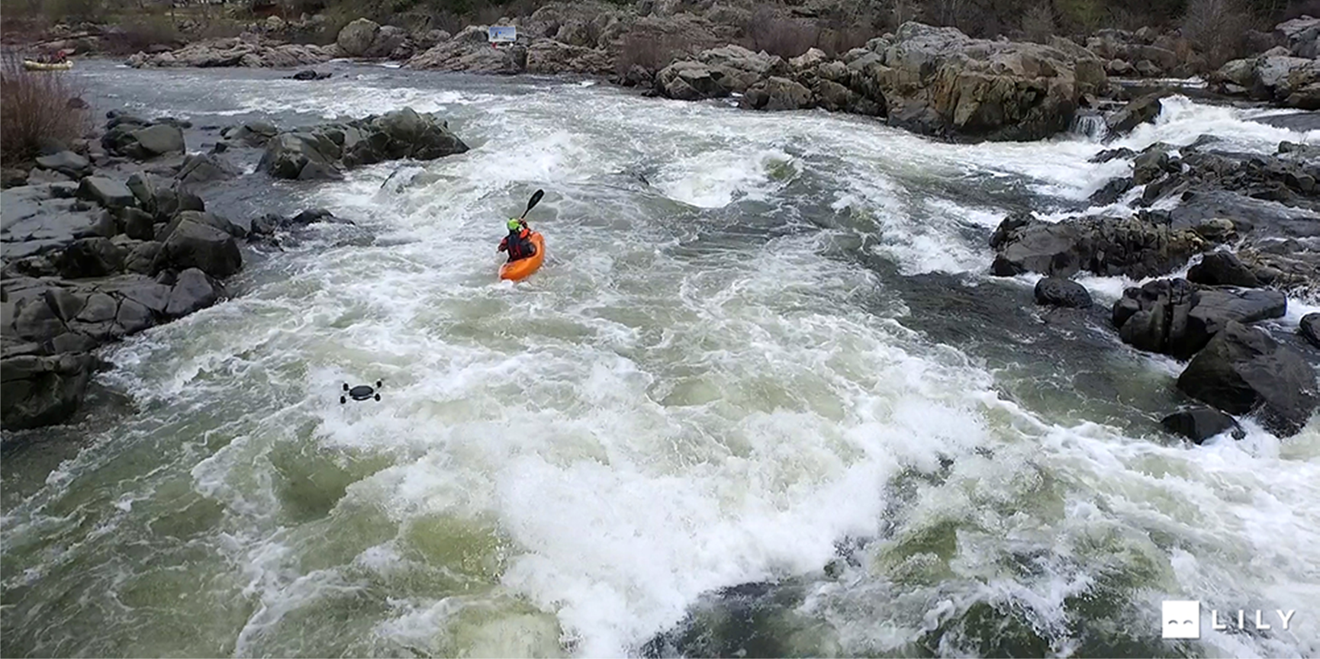
The Lily camera drone following a kayaker down a rapid. Image used with permission of Lily.
GPS Tracking Devices and the Digitizing of the Action Sporting Body
A growing number of scholars are critically examining how new digital devices are changing the ways we can “know” our bodies. A leading figure in this field, Deborah Lupton (in press) is examining “the ways in which human bodies interact with and are configured by digital technologies and how these technologies generate new knowledges and practices about bodies” (n.p.; also see Lupton, 2015, 2016a, 2016b). According to Lupton (in press), the growing popularity of medical, health, and exercise “apps” are generating detailed data on the “geolocation, movements, appearance, behaviours and functions of bodies and the uses to which these data are put as part of the digital data knowledge economy” (n.p.). In so doing, the “cyborg body has transformed into the digital body, whose data outputs possess commercial, managerial and research as well as personal value and status to a range of actors and agencies beyond the individual” (n.p.). Arguably, there is much potential in digital sociology for action sport scholars interested in studying how the growth of digital devices and wearable apps are contributing to new forms of “digitized embodiment” in action sport cultures.
Indeed, GPS tracking devices have been steadily gaining popularity among action sport athletes and participants over the past 5 years. Here I offer a recent example to illustrate such trends. In 2015, Rip Curl released “the world’s first GPS surf watch.” For US$400, the watch allows surfers to “Track your surf, register your top speed and distance and rack up your wave count in each session.” According to the company website, data from the watch can be synchronized with the Rip Curl Search App or website to “re-live your surf with location maps, image sharing and graphic charts which showcase your session.” The notion of individually and collectively “re-living” ones surf session is an interesting suggestion, as the data produced encourages the participant to focus on the quantitative dimensions of their experiences (Figures 3). In so doing, it is worth considering how such technologies might be promoting more calculating approaches that may (positively or negatively) motivate a surfer and their interactions in the ocean, and how analyzing such data may influence how/what one remembers (or forgets) of their surfing experience. The individual and collective digital mapping of surfing bodies over time and across locations may also contribute to new understandings of surfing mobilities and geographies.
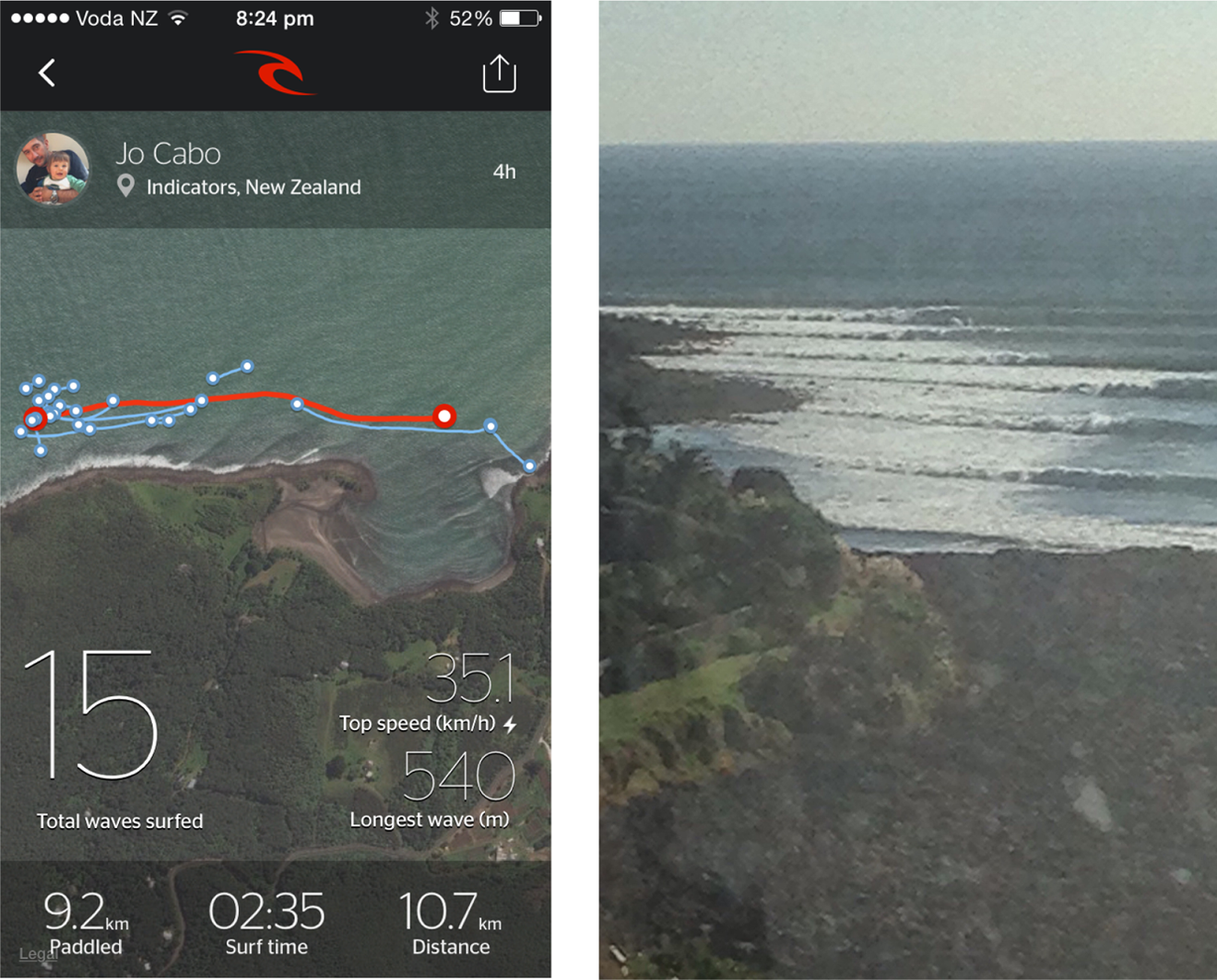
(left) Data produced from a Rip Curl Search GPS Watch next to an iPhone image of the swell on the same day (Figure 3, right), both of which were subsequently shared on this surfer’s various social media platforms. How do such digital and media representations influence how surfers approach, interact with, remember, and narrate surfing? Images used with permission.
Much like many other exercise-related apps, surfers are also able to synchronize their watches with their friends such that the data can be used to compare and contrast performances. As such, I suggest there is potential for research that builds upon Evers’s (2015b) recent work on mobile phones and performances of masculinity among male surfers, to consider how such GPS tracking devices are not only digitizing the surfing body and changing the ways individual surfers “calculate” and “showcase” their performances, but also facilitating particular affective interactions and relationships between surfers. Arguably, studying the continuing proliferation and usage of such devices in action sports could benefit from theories of digital sociology and “networked affect” that may help us to see “how individual, collective, discursive and networked bodies both human and machine …are modified by one another” (Paasonen, Hills, & Petit, 2015, p. 3). Moreover, the recent surge of literature on self-tracking devices (Lipton, 2016a) also prompts us to consider how the introduction and use of such new media technologies that quantify recreational and competitive action sporting practices might be enabling and/or alienating (some) action bodies from the physical, affective, sensual, and social aspects of their experiences and performances.
Towards a Research Agenda: New Media Technologies and Action Sports
In sum, action sport cultures have been an important space where new media technologies have been, and continue to be, developed, marketed, and consumed in similar and different ways to more traditional sports. In this article, I have provided a broad sketch of some of the many different ways social and digital media technologies are transforming the action sports experience for athletes, recreational participants, and audiences alike. As well as identifying emerging issues, I have also highlighted key questions deserving of further consideration, particularly surrounding the usage of new media technologies in the everyday lives of action sport participants, the role of such technologies in subcultural relations, and how such technologies may be influencing action sport participants’ affective relations with the environment, their own bodies, and their peers and broader communities. Scholarship in the emerging and related fields of digital sociology, digital and social media studies, cyber cultural studies, and digital ethnography, as well as research in sport and new media studies, will offer much inspiration as we continue to ask and attempt to answer such questions, and consider what (if anything) makes the relationship between action sports and social and mobile media unique. While I expect those working in action sport studies will be the most likely to take up these challenges, I also hope those researching sports media in more traditional sporting contexts may also pay attention to recent developments in the action sport–media–industry complex, and consider how the media techniques and technologies being adopted and developed by action sport corporations, athletes, and participants may be informing or challenging what we know about sport media and communication in the 21st century.
While the focus of this article has been on new media developments and their use by action sport participants, another important consideration for this research agenda is to consider how we might bring such technologies into our research design and methods. Indeed, there are potentially valuable opportunities for action sport researchers who may consider utilizing such media as part of their methods. For example, Olive (2013) has discussed the potential of blogging as a research method for her understanding of, and contributions to, women’s surfing; in my own work, I have used an iPhone as part of my ethnographic methods at action sport mega-events (Thorpe, 2014); in his work on men’s surfing, Evers (2015a) has explored the potential of a GoPro as another embodied method for understanding men’s surfing bodies in relation to one another and the ocean; and a group of surf scientists in New Zealand are currently using the Rip Curl GPS watch to record local surfers’ interactions with changing coastal geographies, using such data in conjunction with other methods to better understand and protect surf breaks (see “eCoast Wins,” 2015). Finally, with new media technologies and social media playing such an integral role in the everyday participation cultures of action sports, I conclude by calling for more rigorous discussions about how these digital environments are being incorporated into our research. In other words, what are the ontological, epistemological, and axiological assumptions underpinning action sport research that is increasingly taking place in digital spaces? As part of this research agenda, I believe we need to be more rigorously and systematically addressing the ethical, reflexive, and logistical challenges for critical scholars studying action sport cultures within and across physical and digital spaces.
Footnotes
Acknowledgement
The Author is grateful to the Editor, Professor Lawrence Wenner, and the three reviewers for their very helpful advice on an earlier version of this paper. Also, thanks to Lily Camera and Jose Borrero for generously sharing their images.
Declaration of Conflicting Interests
The author(s) declared no potential conflicts of interest with respect to the research, authorship, and/or publication of this article.
Funding
The author(s) received no financial support for the research, authorship, and/or publication of this article.