







Abstract
Previous research indicates that athletes report receiving disparate levels of confirmation, which is consequential given the psychological, emotional, and cognitive benefits of being confirmed. This article explains head coaches’ use of confirmation, which is comprised of accepting and challenging communication, as a function of athletes’ roles and leader–member exchange (LMX). Data obtained from 197 high school athletes—representing 17 sports and from 16 states—substantiated that starters receive more recognition and acknowledgement of their efforts and accomplishments (i.e., acceptance) but are not more likely to receive communication that seeks the refinement of their potential (i.e., challenge). LMX with head coaches, however, accounted for much larger portions of variance in reports of receiving confirmation, with in-group relationships being predictive of greater amounts of confirmation. These results indicate that confirmation is received as a function of the roles of athletes and their interpersonal relationships with coaches. Such findings provide mechanisms to explain disparate experiences of confirmation and connect two theoretical bodies of literature in a manner that intersects the organizational and interpersonal processes of coaching.
Athletic coaches are tasked with the physical, psychological, social, and cognitive development of all of their athletes (Camiré, Forneris, Trudel, & Bernard, 2011; Vella, Oades, & Crowe, 2011). One behavior that helps coaches achieve this development is coach confirmation, which comprises communication that makes athletes “feel endorsed, recognized, and acknowledged as valuable, significant individuals” (Cranmer & Brann, 2015, p. 195). Recent research has demonstrated that confirmation is accomplished via accepting and challenging athletes (Cranmer, Brann, & Weber, 2017) and contributes to their satisfaction with coaches and sporting experiences, motivation to participate in sports, and cognitive learning (Cranmer, Brann, & Weber, 2018; Cranmer & Mazer, 2018). Although demonstrations of the effectiveness of coach confirmation are encouraging, these findings are subverted by reports that coaches use disparate levels of confirmation among their teams. For instance, interviews with collegiate student athletes reveal that coaches are believed to unequally use confirmation based upon the characteristics of athletes or their relationships with them (Cranmer & Brann, 2015). This pattern would indicate that some athletes are more readily obtaining the psychological and developmental benefits of being confirmed than others.
There is an absence of a theoretical framework that would explain the disparate use of coach confirmation. This void is of consequence, as sport is an educational context that socializes participants into developing desirable psychological, emotional, and cognitive states (Coakley, 1993). As such, identifying underserved subpopulations of athletes and, more specifically, what influences the provision of confirmation is a valuable pedagogical tool that can be utilized to refocus coaches’ efforts (i.e., directly or indirectly) to foster more productive environments. Early theorizing suggested that confirmation may vary in quality and quantity based on the relationship between communicators and context (Laing, 1961). Within sport literature, researchers have advanced several explanations of why athlete–coach relationships vary, including an athlete’s ability to contribute to the performance of a team and the reciprocal nature of a specific athlete–coach relationship (Cranmer & Myers, 2015). The underlying mechanism for why these features may determine who receives confirmation (and who does not) is that coaches have limited resources and cannot necessarily meet the developmental, communicative, and psychological needs of all of their athletes within a practice or season (Cranmer & Myers, 2015). Given that confirming athletes requires the expenditure of a variety of social resources (e.g., time, attention, and cognitive efforts), it is likely that coaches strategically confirm select athletes with particular roles or with whom they have close relationships. One framework that would explain coaches’ strategic investment of their resources is leader–member exchange theory (LMX; Dansereau, Graen, & Haga, 1975), which asserts that individuals form dyadic and differentiated relationships with superiors and that these relationships determine their subsequent interactions and organizational experiences. The purpose of this study, therefore, is to examine athletes’ reports of receiving coach confirmation as a function of their role within a team and their LMX with their head coach. To accomplish the purpose of this article, two theoretical frameworks must first be expanded upon (a) confirmation theory and (b) LMX theory.
Review of Literature
Confirmation Theory
Confirmation originated as a theological and philosophical concept that encompasses interactions denoting recognition, endorsement, and acknowledgement of individuals (Buber, 1957, 1965). Buber asserted that confirmation is the most meaningful and important type of interaction that individuals can have throughout their lives; for it is through these interactions, that recipients understand how others view them and manage their sense of self. Communication scholars have expounded upon Buber’s work by forwarding a theoretical framework that explains the benefits of receiving confirmation (Dailey, 2010). This theory recognizes that although feeling confirmed is a psychological state (Sieburg, 1975), confirmation is achieved through a collection of verbal and nonverbal messages that create a relational climate, which benefits recipients (Sieburg, 1985). In other words, confirmation is achieved via a host of communicative acts (e.g., a meaningful touch, a reassuring look, or verbal statements) that are shared within specific relationships and leave communicators feeling recognized, endorsed, and acknowledged.
Although confirmation may occur in a variety of contexts and relationships (e.g., romantic, child–parent, and student–instructor relationships), athletic coaching merits investigation as a unique context for five reasons. First, coaches are tasked with the social, physical, and cognitive development of athletes (Camiré et al., 2011), and confirmation is a psychosocial resource that assists recipients in the development of a sense of self, connection to others, and skill development (Dailey, 2009, 2010). Second, confirmation is a behavior that meets the aims of prosocial coaching movements and offers an alternative to established and aggressive forms of athlete–coach interaction (Cranmer, Brann, & Anzur, 2016). Third, confirmation is one of the few coaching behaviors that focuses on athletes’ affective and psychological sense of self (Cranmer & Brann, 2015), which is an underrecognized aspect of effective coaching (Vella et al., 2011). Fourth, millions of youth and adolescents compete in athletics every year, and confirmation is especially beneficial for human development during these periods of life (Munz & Wilson, 2014; Steinberg & Morris, 2001). Fifth, the physical and competitive nature of sport fosters a hyper-task-oriented environment that prioritizes the refinement of performance and ability, which may alter how confirmation functions and is processed (Cranmer et al., 2018). Together, these realities indicate that confirmation is likely an effective coaching behavior that meets the aims of practitioners and scholars alike and can serve millions of developing athletes.
The central tenet of confirmation theory is that dualistic functions of acceptance and challenge comprise confirmation (Dailey, 2010). Cranmer, Brann, and Weber (2017) independently replicated this central tenet within the athlete-coach relationship. Acceptance touches upon validating individuals in their current form and is accomplished through the communication of warmth, affection, admiration, or attentiveness (Dailey, Crook, Glowacki, Prenger, & Winslow, 2016). Coaches confirm athletes in their current state by recognizing and praising past or current efforts, performances, and accomplishments (Cranmer et al., 2017). Acceptance functions to reaffirm an athlete’s self-concept by acknowledging his or her successes, as was well as creating a social environment that mitigates face threats that arise in highly structured and competitive environments (Dailey, Romo, & Thompson, 2011; Wilson, Hall, Gettings, & Pastor, 2015). Challenge recognizes what one can become (i.e., their potential), as it encourages the development of athletes through pointing out their mistakes or calling for the implementation of corrections or new techniques. Coaches confirm athletes in this manner through confrontation or competition to test and refine their abilities in a stimulating manner. Cranmer, Brann, and Weber (2018) argued that acceptance and challenge work together to establish effective developmental environments, as acceptance without challenge is unlikely to inspire the internal need for development, and challenge without acceptance may promote negative emotional states.
Confirmation theory argues that the presence of both acceptance and challenge is beneficial for a host of attitudinal, affective, and behavioral outcomes (Dailey et al., 2016). To date, empirical evidence has demonstrated the effectiveness of coach confirmation, as coaches’ use of acceptance is associated with higher affective evaluations of communication with coaches and sporting experiences among collegiate student-athletes (Cranmer & Mazer, 2018). Moreover, coaches’ use of challenge is associated with not only affective evaluations but also motivation, competitiveness, and cognitive learning for former high school and collegiate student-athletes (Cranmer et al., 2017, 2018; Cranmer & Mazer, 2018). Taken together, this evidence suggests that while acceptance and challenge are important in shaping emotions and attitudes towards coaches, challenge alone determines psychological orientation toward competition and the retention of sporting information.
Confirmation theory serves as an adequate framework to explain the effectiveness of this particular set of behaviors. However, the theory has not addressed mechanisms by which confirmation may vary across individuals within particular groups. Further, previous applications of confirmation theory have focused exclusively on dyads without recognizing the social collectives in which they are embedded (Dailey et al., 2016). Coach confirmation research has demonstrated that athletes’ reports of confirmation can vary (Cranmer et al., 2017, 2018) and that athletes believe that coaches do not confirm all of their athletes equally (Cranmer & Brann, 2015). Understanding the mechanisms that underlie patterns of prosocial coaching behaviors has pedagogical value for coaches and scholars. Communication researchers have forwarded that athlete–coach interactions may differ as a function of athletes’ roles on their team and relationships with coaches (Case, 1998; Cranmer & Myers, 2015). These features are at the heart of LMX theory.
LMX Theory
LMX originated as an organizational management theory that sought to explain employees’ organizational experiences as a function of differing qualities in superior–subordinate relationships (Dansereau et al., 1975). Coach communication scholars have adopted the framework because sport teams are by definition organizations, and the athlete–coach relationship closely parallels the superior–subordinate relationship (Case, 1998; Cranmer & Myers, 2015; Kassing & Matthews, 2017). Further, LMX offers sport communication scholars an alternative understanding of coach leadership, which has traditionally been examined via coaches’ communication with intact teams (e.g., multidimensional model of leadership; Chelladurai & Saleh, 1980). In contrast, LMX recognizes that athletes form dyadic relationships with coaches and that these relationships differ based on the quality of resources exchanged within those dyads. Put differently, each athlete forms an individualized and personal relationship with his or her coach, and athlete–coach relationships vary in quality from teammate to teammate. The resources—such as attention, respect, support, information, influence, and affect—exchanged between subordinates (athletes) and superiors (coaches) determine the quality of these relationships (Gerstner & Day, 1997; Graen & Uhl-Bien, 1995). Confirmation may also be considered a resource that can be exchanged, given that it serves valued ends within group contexts and is considered a psychosocial resource that assists in human development (Munz & Wilson, 2014).
The type and extent of resources that are exchanged determines whether an LMX relationship can be categorized as in-group, middle-group, or out-group. In-group relationships come to be defined by reciprocal and frequent exchanges of resources, subordinates’ successful individualization of roles, and greater superior investments toward the subordinate’s career development. Out-group relationships, however, are characterized by the absence of these features, more distrust, conflict, and direct use of superiors’ authority (Fairhurst, 1993; Fairhurst & Chandler, 1989). In-group relationships with coaches are beneficial for athletes, as they provide increased opportunities to express their concerns or perspectives, foster greater affect for sporting experiences, facilitate more cohesive relationships with teammates, and provide knowledge about a team’s goals and values (Cranmer, 2018; Cranmer & Buckner, 2017; Cranmer & Myers, 2015). Given the benefits of in-group relationships, coaching scholars and practitioners are called upon to understand how the quality of LMX relationships may shape athletes’ subsequent sporting experiences and interactions (Case, 1998; Cranmer, 2016).
LMX quality is believed to differ because coaches have finite resources (e.g., time, attention, affection) and must strategically distribute those resources in an uneven fashion to maximize their team’s effectiveness (Cranmer & Myers, 2015). Sport is a highly task-oriented environment in which the public almost exclusively judges coaches based upon their ability to win games—even though coaching effectiveness extends well beyond mere wins and losses (Vella et al., 2011). As a result, Case (1998) suggested that coaches spend the majority of their time and attention instructing athletes who are or will be contributing on the field, which can be understood via starting status. Subsequent research has corroborated that starters form higher quality LMX relationships with coaches (Cranmer, 2016; Cranmer & Buckner, 2017; Cranmer & Myers, 2015). However, Cranmer (2016) demonstrated that starting status only accounts for as little as 9% of athletes’ LMX with coaches and argued that LMX is based upon numerous other relational factors. For instance, homophily (e.g., shared language and values) is crucial in the formation of in-group relationships (Fairhust, 1993) and may be relevant for confirmation (i.e., athletes believe playing a similar position to coaches increases confirmation; Cranmer & Brann, 2015). Put differently, while starting status is important, LMX relationships extend beyond a mere label and often are dependent on relational dynamics between coaches and athletes. Collectively, LMX theory and the abundance of coaching literature indicate that starters and in-group members are more often the target of effective coaching behaviors. As such, the following hypotheses are forwarded:
Method
Sample
Participants were 197 high school athletes (103 men and 94 women) from schools spanning 16 states (i.e., CT, FL, GA, IL, KY, MA, MD, MI, NJ, NY, OK, PA, SC, TN, TX, and VA). These participants ranged in age from 13 to 19 years old (M = 16.57, SD = 1.36) were racially homogenous (87.8% Caucasian) and mostly upper classmen (i.e., 47.2% seniors, 25.5% juniors, 13.2% sophomores, 13.7% freshmen, and 0.4% unreported). The participants competed in 17 sports, were members of teams that won the majority of their games or meets (M = 66.51%, SD = 24.93%) and were primarily varsity starters (83.8%). See Table 1 for a full reporting of participants’ demographics.
Participants’ Demographics.
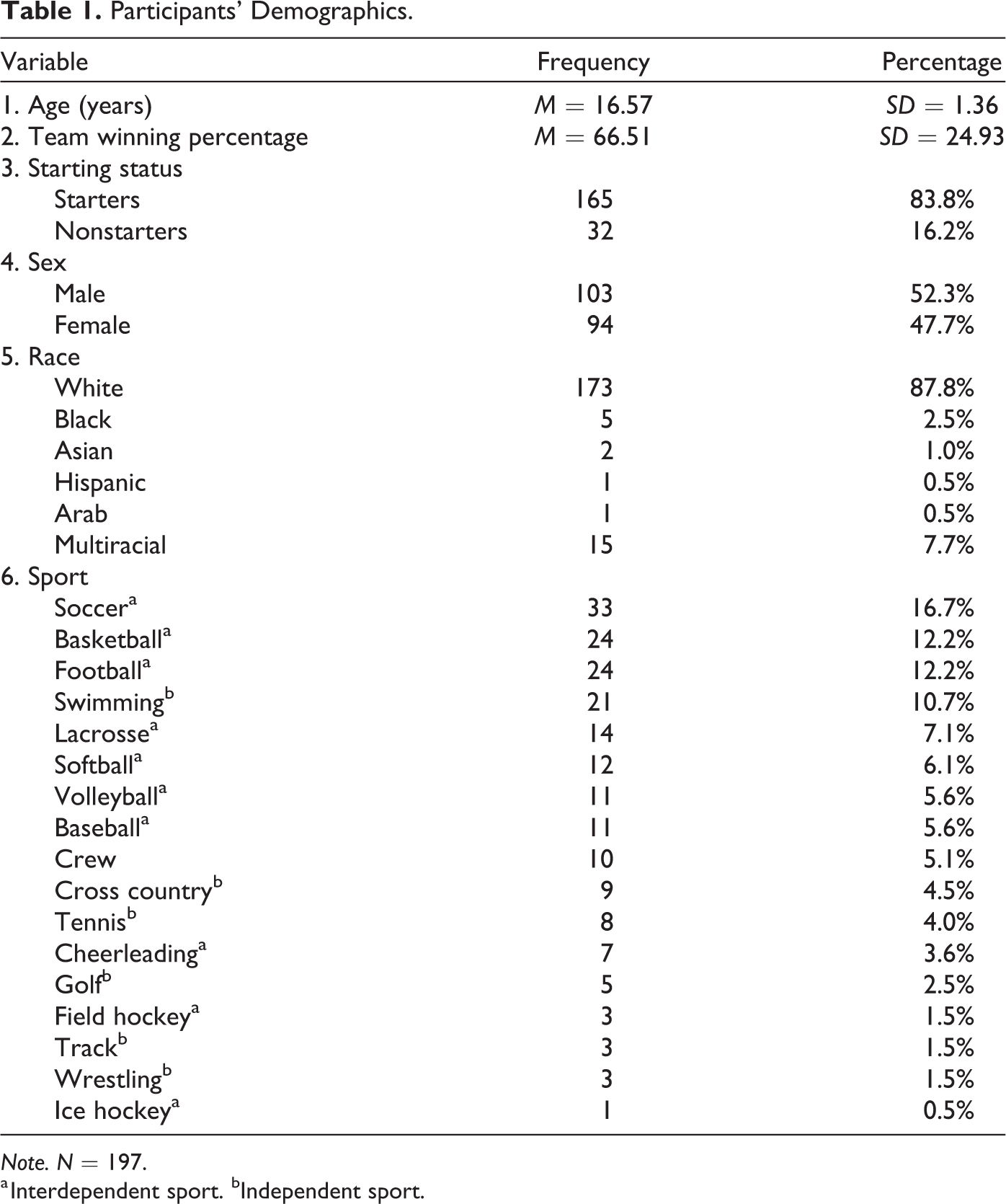
Note. N = 197.
a Interdependent sport. bIndependent sport.
Procedures
After an institutional review board (IRB) granted approval, participants were solicited with an IRB-approved advertisement. This advertisement was delivered to participants via three sampling techniques: (a) networking sampling, (b) snowball sampling, and (c) purposive sampling. For network sampling, students in freshman-level public speaking classes at a Southeastern university were invited to refer high school athletes from their social networks (e.g., family members, friends, and acquaintances) to take a survey. For snowball sampling, at the end of the survey, participants were provided with an opportunity to refer or share the survey with teammates. For purposive sampling, researchers contacted high school athletes (directly and indirectly [i.e., via coaches and athletic directors]) to participate in this study.
All participants were provided with the same advertisement, which sought individuals to complete an online survey about athlete–coach communication and outlined the requirements for participation. The inclusion criteria required participants to (a) be high school students and (b) play on a school-sponsored sports team. Participation was incentivized with the opportunity to enter a drawing to win one of the two US$50 gift cards to Walmart (i.e., winners were chosen using a random sequence generator at the completion of the study). This advertisement included two URLs to an online survey that was posted on qualtrics.com . The first URL was for athletes younger than 18 years old. This version of the survey required parental consent and child assent before granting access to the rest of the survey. The second URL was for athletes 18 years old or older and required participant consent before granting access to the survey. Other than the method of obtaining consent (and assent for minors), both versions of the survey were identical in regard to the questions and measures to which participants responded. To ensure that each participant fit the inclusion criteria, two filter questions were used as follows: Are you a currently an enrolled high school student? and Are you a member of an officially recognized school athletic team? Individuals who did not meet these criteria were thanked for their interest but denied access to the survey. After confirming that they met the inclusion criteria, participants were instructed to complete the remainder of the survey in reference to the head coach of a single sport team on which they were a current member. In total, 233 participants opened the link to the online survey and 197 completed the survey (84.55% completion rate).
Measures
The survey consisted of measures assessing athletes’ perceptions of their head coaches’ use of confirmation, their LMX with their head coach, and their demographic information. Coach confirmation was operationalized with the Coach Confirmation Instrument (Cranmer et al., 2017). This 15-item measure assesses participants’ perceptions of coaches’ use of challenge (e.g., “My coach expresses that he or she believes I can improve”) and acceptance (e.g., “My coach tells me when I am performing up to his or her expectations”). Responses were recorded on a 5-point Likert-type scale that ranged from never true (1) to always true (5). Previous Cronbach’s α reliability coefficients for the factors of this scale ranged from .88 to .92 for acceptance and from .93 to .95 for challenge (Cranmer et al., 2017, 2018). In this study, an internal reliability of .86 was obtained for acceptance (M = 3.97, SD = .87) and .91 for challenge (M = 4.28, SD = .70).
Athletes’ LMX with their coaches was operationalized with the Leader-Member Exchange-7 (Graen, Novak, & Sommerkamp, 1982), which was adapted to the sport context (Cranmer & Myers, 2015). This 7-item measure assesses athletes’ perceptions of the quality of their relationships with their head coaches (e.g., “I would characterize my working relationship with my coach as effective”). Responses were recorded on a 5-point Likert-type scale that ranged from strongly disagree (1) to strongly agree (5). Previous Cronbach’s α reliability coefficients for the adapted version of this scale have ranged from .86 to .90 for this adapted measure (Cranmer, 2016; Cranmer & Buckner, 2017; Cranmer & Myers, 2015). In this study, an internal reliability of .88 was obtained for LMX (M = 4.67, SD = .90).
Questions about athletes’ demographic features (e.g., age, sex, race, and grade level) were also obtained. Likewise, sporting demographics were collected, including the sport athletes played (collapsed into independent and interdependent sports), their teams’ winning percentage (0–100%), and starting status (nonstarters and starters).
Data Analysis
To answer Hypothesis 1, two independent samples t tests (i.e., one for acceptance and one for challenge) were conducted to determine whether starters reported receiving more confirmation than nonstarters. The second hypothesis was analyzed via two hierarchical regression analyses. In each of these analyses, the type of sport they played (i.e., interdependent sport = 1, independent sport = 0), the percentage of games, meets, or competitions that their teams won (i.e., 0–100%), and starting status (nonstarters [i.e., 0] and starters [i.e., 1]) were entered as the first block of variables. The sport demographic variables were entered in the first block, as an athlete’s role and their type of sport are suggested to influence athlete experience and communication (Cranmer, 2016; Cranmer & Goodboy, 2015; Cranmer & Myers, 2015). By first accounting for the variance explained by contextual factors of sport, it is possible to identify the unique contribution of relational quality on receiving confirmation. Next, athletes’ LMX with their head coaches were entered into the second block. For each hierarchical regression, athletes’ reception of acceptance and challenge served as a criterion variable, respectively. Prior to examining the results of each hierarchical regression, the data met relevant assumptions, including the establishment of no perfect multicollinearity (tolerance = .93–.97, Variance Inflation Factor = 1.03–108), independence of residuals (Durbin–Watson = 1.89–1.95), and homoscedasticity.
Results
Prior to testing the hypotheses, analyses were conducted to ensure that the variables of interest did not vary as a function of athletes’ demographic profiles. Results revealed that that reports of confirmation and LMX did not differ as a function of athletes’ sex, race, or grade. 1
The first hypothesis forwarded that starting athletes would report receiving greater degrees of confirmation from their coaches than nonstarters. Two independent samples t tests were conducted to compare athletes’ reports of receiving acceptance and challenge from their head coaches. There was an observed significant difference in the reception of acceptance, with starters receiving more acceptance (M = 4.01, SD = .84) than nonstarters (M = 3.55, SD = .87); t(195) = 3.05, p < .01, Cohen’s d = .58. However, there was no observed difference in the reception of challenge; t(37.82) = 2.01, p = .052. Hypothesis 1 was partially supported.
The second hypothesis forwarded that athletes’ LMX relationships with head coaches would positively predict the degrees of confirmation they receive. This hypothesis was examined via two hierarchical regressions. Results of the first regression indicated a significant Block 1, F(3, 190) = 3.88, p < .01, R 2 = .06, with athlete starting status predicting athletes’ reception of acceptance (β = .19, p < .01). The addition of LMX (β = .60, p < .001) within Block 2 significantly added to the model, ΔF(4, 189) = 115.50, p < .001, ΔR 2 = .36. The second hierarchical regression failed to yield a significant Block 1, F(3, 190) = 1.95, p = .12, R 2 = .03. The addition of LMX (β = .76, p < .001) within Block 2 significantly added to the model, ΔF(4, 189) = 262.26, p < .001, ΔR 2 = .56). Hypothesis 2 was supported. See Table 2 for a full reporting of all regression statistics.
Regression Statistics.
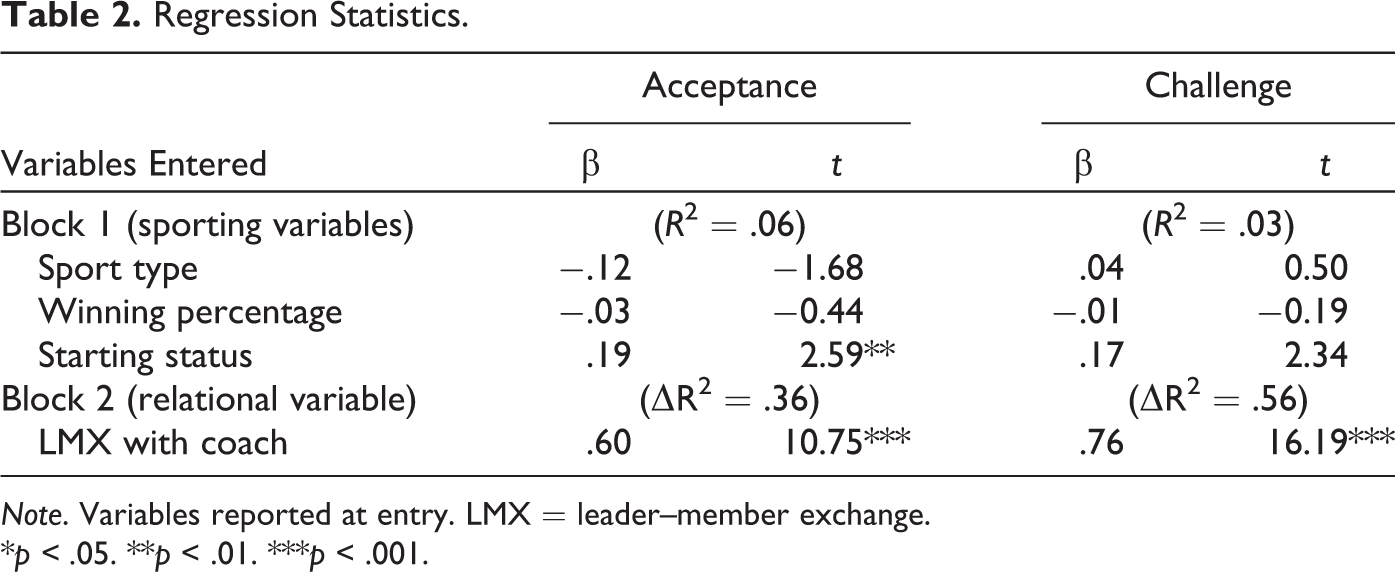
Note. Variables reported at entry. LMX = leader–member exchange.
*p < .05. **p < .01. ***p < .001.
Discussion
This study sought to understand the importance of athletes’ roles and LMX relationships with head coaches in an effort to explain their reports of coach confirmation. This purpose is important, as confirmation confers validation to an individual’s current and/or future worth, and builds identity and understanding of oneself—outcomes of effective coaching (Vella et al., 2011). Thus, if coaches are to maximize their contribution to the psychosocial development of their teams, it is important to determine whom is being confirmed under their coaching. The results of this study indicate that effective coaching behaviors are not equally experienced across subpopulations of athletes and is a product of both athletes’ roles within their teams and their interpersonal relationships with their coaches.
Athletes’ Roles
Despite the hypothesized importance of athletes’ roles, only the provision of acceptance significantly differed as a function of starting status. The difference in reports of acceptance indicates that starters receive slightly more praise and acknowledgement of their efforts and performances than their teammates (i.e., role accounted for 6% of reports of acceptance). These results provide further evidence that starting athletes experience more prosocial interactions with coaches (Cranmer & Goodboy, 2015; Kassing & Anderson, 2014; Turman, 2006). This finding also provides some support for the assertions of LMX because it demonstrates that coaches invest their attention and time in building up those best positioned to contribute to their teams’ performances. Furthermore, the significance of starting status demonstrates that structural features within social groups may partially explain the distribution of confirming behaviors—a missing element of confirmation theory. There are two potential explanations for why starters would be recognized and praised more than their teammates. First, the label of starter denotes comparative athletic advantage over nonstarters. In other words, starters are commonly perceived to be more athletic than their peers and as a consequence receive more time on the court or field. Hence, starters should be expected to receive praise and recognition more by coaches because of their advantage in both ability and opportunity to perform well during competition. Second, acceptance helps mitigate potential face threats within highly competitive or task-oriented environments. Within high school athletics, the outcome of winning is salient and visible to not only sports teams but also their publics. Put differently, the successes and failures of high school athletes are often known by their peers and communities via public announcements within school or local communities (e.g., newspapers). Given the importance placed on winning, losing may be face threatening for young athletes, especially for those athletes who actively participated in the unsuccessful performance. Coaches, therefore, may attempt to ensure that the efforts of these athletes are recognized. Turman (2005) noted a pattern of athlete–coach interaction, which he termed regret reduction, whereby coaches attempt to recognize and praise athletes’ efforts after unsuccessful performances. Research further argued that mitigating face threats after poor performances is an important component of helping adolescent athletes stay motivated and involved in sport and is necessary for countering the win-at-all-cost mentality that pervades modern youth and adolescent athletics (Sagar & Jowett, 2012; Turman, 2005, 2007).
Although acceptance differed across starting status, athletes reported receiving similar amounts of challenge regardless of whether they were starters. Similar reports of challenge reveal that high school coaches emphasize improvement with all athletes, regardless of their current role on a team. Although this finding contradicts the assertions of LMX theory, it is likely due to the nature of high school athletics and sport at large. High rates of turnover in adolescent sports are ensured by the structure of the education system in which sport is played (i.e., students usually matriculate to the next higher grade annually) and restrictions on eligibility, which are often determined by age requirements. For instance, although minor variations between states may exist, it is common for high school athletes to be restricted to only 4 years of eligibility. Their eligibility can also be restricted by their ages, as students who are 19 years old or older can be barred from participation. These features ensure that the membership of a high school sports team is continuously changing each year. Also, the physical nature of sports results in injuries, which means that starters will occasionally miss competitions, meets, or games. It is a coach’s job to ensure that nonstarters are as prepared as possible to contribute and perform when these situations arise, which explains their nondiscriminant use of challenge. Together, the evolving nature of high school sports teams and the need for depth means that coaches’ abilities to develop and keep athletes who are not primary contributors involved is crucial to the long-term success of their teams. In this manner, coaches may still be prioritizing the functioning of their teams by strategically challenging both starting and nonstarting athletes (i.e., in line with the spirit that underlies the assertions of LMX). This notion is encouraging, given that challenge appears to be the most beneficial aspect of confirmation for athletes’ motivation, satisfaction, and learning (Cranmer et al., 2018; Cranmer & Mazer, 2018).
LMX
Results of this study also demonstrate the importance of athlete–coach relationships. Specifically, athletes’ LMX with head coaches accounted for large amounts of variance in their reception of confirmation—36% of acceptance and 56% of challenge—after controlling for contextual factors including starting status. As such, this study indicates that confirmation is mostly provided based upon the relational nature between coaches and athletes. Features such as reciprocal trust, respect, and admiration—which come to define LMX (Fairhurst & Chandler, 1989)—arguably create climates that facilitate confirmation. Such findings are consistent with the benefits associated with elite coaches’ proper balancing of professional and personal relationships with athletes (Becker, 2009)—these two aspects of the athlete–coach relationship appear to be closely entwined. These findings further reiterate the importance of intimacy in the communication of validation, recognition, and endorsement of another (Laing, 1961), and the benefits that accompany forming high-quality exchanges with coaches (Gerstner & Day, 1997; Graen & Uhl-Bien, 1995). The connection of LMX to confirmation is important as it demonstrates that athletes have disparate experiences that are attributable to their organizational relationships and assist in their personal development during participation. Sport socialization scholars have traditionally investigated the value of sport based upon perceived universal outcomes associated with participation (Coakley, 1993). Communication scholars have challenged this understanding and argued that the benefits athletes experience are a product of the manner in which sport is organized and of the quality of their interactions during participation (Cranmer, 2017; Meân, 2013). This study provides empirical support for the communicative perspective that outcomes of sporting experience (or at least the reception of communication associated with psychosocial resources) are based on the quality and types of human interaction during participation.
Implications
Results of this study have theoretical implications for coach communication research and the frameworks of confirmation theory and LMX. In regard to confirmation theory, this article forwards explanatory mechanisms that aim to elucidate why confirmation may vary among members of groups. To date, confirmation theory has mostly focused on the nature and benefits of confirmation within dyads (e.g., romantic relationships). Even when confirmation is considered within group contexts (e.g., familial units), disparities that might exist within the group are not considered or explained. For the utility of confirmation theory to be furthered, it is imperative to expand the framework to recognize why confirmation occurs and may vary. The results of this study suggest that the hierarchical positioning of individuals within a group and their relationships with superiors are potential determinants of received confirmation.
With regard to LMX, the results of this study challenge the salience given to starting status within previous research and theorizing. Case (1998) introduced LMX to coach communication literature and forwarded that the central mechanism for determining athlete–coach relationships are the roles that athletes serve on their teams. Yet, Cranmer (2016) demonstrated that only a small portion of LMX can be understood as a product of the starting status of an athlete. This study furthered our understanding of LMX within the athlete–coach relationship by demonstrating that the social resources exchanged are mostly dependent upon the aspects of LMX that cannot be understood via starting status. This could mean that a more nuanced understanding of what contributes to athlete–coach LMX is needed within literature, including the recognition of alternative roles (e.g., captain status) and novel relational elements (e.g., personality and homophily). Further, the integration of confirmation as an exchangeable resource extends the scope of LMX to recognize the interpersonal and nonsporting benefits of these relationships including the potential development of healthy identities.
The heuristic value of this article is that it bridges two distinct perspectives of coach communication research (i.e., organizational and interpersonal perspectives). The organizational perspective seeks to understand the organizational processes through which teams come to function and coaches manage their athletes (Kassing & Matthews, 2017). Within this article, these processes are encompassed within the formation of the superior–subordinate relationships and the distribution of communicative resources as a function of athletes’ roles. The interpersonal perspective, however, focuses on the relational and communicative needs of sporting stakeholders that extend beyond performance (e.g., emotions, satisfaction; Turman, 2008, 2017). In the current article, the reception of confirmation addresses athletes’ interpersonal needs and relates to their emotional well-being. Our results indicate that athletes’ organizational relationships and roles are associated with their communicative interactions that have psychological and social benefits. Although the notion that membership in task-oriented groups can lead to interpersonal fulfillment dates back to human relations approaches to organizations, this study provides empirical evidence that athletes experience these outcomes as well. The integration of different frameworks—similar to Turman’s (2003) blending of organizational and instructional perspectives—is integral to the development of a more holistic understanding of athletic coaching.
The current results also have pedagogical value for coaches who may use intrapersonal and interpersonal knowledge to monitor their interactions with others as well as critically reflect upon their own distribution of resources. In particular, these findings indicate that coaches recognize and praise the efforts of starters more than their teammates and confirm athletes to whom they feel closest. The disparate exchanges of acceptance are concerning given that nonstarters experience face threats too. For example, most high school athletic teams are embedded within larger social and educational systems, and participation on these teams confers social status. However, being labeled a secondary contributor to these teams may detract from said status. Thus, acceptance might be an important means of keeping nonstarters motivated and engaged with athletics. Cranmer and Brann (2015) noted that nonstarters also desire to feel connected with their teams and prefer acceptance that recognizes their contributions to a team’s efforts. As such, coaches should attempt to incorporate this type of communication into their evaluations of athletes during scheduled feedback sessions and build it into team cultures through the use of coaching philosophies and organizational narratives. For example, the utilization of inclusive language (e.g., “we,” “our,” and “team effort”) could be implemented after successful performances. Additionally, verbalizing recognition of specific acts in combination of praise (e.g., “Great job, Susan. Good dig!”; Cranmer & Brann, 2015, p. 200) can be beneficial.
Limitations and Future Directions
The contribution of any article should be considered with full recognition of its limitations. The first limitation that needs to be recognized is that the use of nonprobability sampling decreases generalizability. The current study utilized network and snowball sampling, which means that participants were directly or indirectly connected to the social networks of students and researchers at a particular university. As such, they are more likely to share characteristics and experiences not held by the general population of high school athletes. Perhaps this is an explanation for the overrepresentation of Caucasian participants. Nonetheless, nonprobability sampling is the most efficient means of identifying and recruiting participants with specific characteristics and produced a sample that spanned 16 states and 17 sports. A second limitation is that the items featured within the questionnaire were not randomized. Although a lack of randomization is common within athlete–coach research, it increases the potential for priming participants’ responses to subsequent measures (McFarland, 1981). Future research can correct for these threats by either using multiple randomized versions of questionnaires or ordering survey measures from broad, general constructs to more specific constructs. A third limitation is that despite the use of filter questions, self-report research relies on the truthfulness of participants. Within this research, the potential exists for participants to be deceptive. A fourth limitation is the scope of this article was limited to an athlete’s relationship with a single source of confirmation (i.e., their head coach). This specificity was needed as a parameter to link LMX with head coaches to psychosocial resources received from that relational partner. It is also justified based upon previous assertions regarding the importance of LMX with head coaches (Cranmer & Myers, 2015). Given recent evidence that assistant coaches and teammates are important sources of organizational understanding and athletes’ voice (Cranmer, 2018; Cranmer & Buckner, 2017), it might be beneficial to consider other relational exchanges within future research.
Future confirmation research needs to continue to provide explanatory mechanisms for why some athletes are confirmed and others are not. Confirmation fulfills an important basic human need of validation and is a means through which human development occurs. Thus, understanding why coaches confirm particular athletes is imperative to understand how to maximize effective coaching by drawing attention to underserved subpopulations of athletes. This study forwards athletes’ roles and their relationships with head coaches as an explanation of confirmation. However, there are other potential variables that should be considered, including coaches’ dispositions toward particular communication styles, general team climates, and other social or cultural factors that may influence how coaches and athletes relate. Further, given the continued demonstration of LMX as an important determinant of athlete–coach interaction, researchers should seek to understand the formation of these relationships. Longitudinal approaches with intact teams will likely yield the most insight into the formation of LMX.
Conclusion
Over the past two decades, scholars and practitioners have made extensive efforts to encourage more effective athletic coaching within youth and adolescent sports. Sporting movements such as The Positive Coaching Alliance and the Bill of Rights for Youth Athletes have sought to provide youth and high school coaches with pedagogical resources that assist in the athletic and social development of athletes. Social scientists, especially coach communication scholars, have contributed to this effort by identifying and understanding the benefits of particular sets of behaviors or messages (e.g., Becker, 2009; Cranmer, 2016; Cranmer & Goodboy, 2015; Cranmer & Sollitto, 2015; Kassing & Infante, 1999; Rocca, Martin, & Toale, 1998; Turman, 2001, 2003, 2008; Turman & Schrodt, 2004). If effective coaching is to be optimized, it is crucial that scholars begin to recognize that the nature of athlete–coach relationships differ within teams, and the consequences of these relational differences are profound for determining the experiences and benefits that athletes take from sport. The disparity in receiving confirmation is significant because it is a psychological resource that aids in the development of beneficial attitudes, self-perceptions, and skills. Given the goals of effective coaching and the purpose of sport as a context of socialization, the notion that participants have disparate experiences receiving developmental resources is of great consequence for the benefits of sporting experience and how athletic coaching currently functions. Acknowledging and addressing this reality is an important first step toward attempting to foster positive athlete–coach interactions for all sporting participants. In short, this research sets the stage for developing more effective coaching practices by explaining the individualized experiences of athletes, thereby promoting the knowledge needed to optimize the attitudinal, behavioral, emotional, and psychological development associated with participation in organized sport.
Footnotes
Declaration of Conflicting Interests
The author(s) declared no potential conflicts of interest with respect to the research, authorship, and/or publication of this article.
Funding
The author(s) disclosed receipt of the following financial support for the research, authorship, and/or publication of this article: The Robert H. Brooks Sports Science Institute paid for the incentive cards given to participants.