






Abstract
Two Australian football clubs—St Kilda and the Sydney Swans—played the first Pride Game in Australian professional sport in 2016 to support and include the lesbian, gay, bisexual, transgender, intersex, and queer (LGBTIQ) community at and through a major sporting event. This study examines the framing of this game in the print and online media and in public responses via comments on media coverage and comments on Facebook posts. The framing of both the media coverage and the public response was predominantly supportive, with the theme of the “inclusion,” of gay Australian Football League players and the broader LGBTIQ community, prominent. However, there was a significant difference in the frames used in media coverage compared to the public response to this coverage. There was a relatively high proportion of unsupportive comments (e.g., a “stick to football” theme), including pernicious homophobia, present, particularly in the public response, compared to other recent related research. Overall, the findings suggest that, while there was strong support for the Pride Game, homophobia in sport remains, and the media, particularly social media, can be a platform for its expression. This study also highlights the value in analysing multiple platforms in media framing research.
International rugby league player Ian Roberts was the first Australian professional player of any football code to come out as gay—in New Weekly magazine in 1995. This made Australian media headlines, not all of which were positive, and Roberts received homophobic abuse from the public while playing. Newspaper columnist and former Australian rugby union player Peter FitzSimons (1995, p. 44) at the time noted “the next sportsperson to come out will make fewer headlines, the next after that fewer still, and fewer still again until…I’m bored already.” However, 20+ years later, the Australian media’s response to other male professional footballers coming out remains untested—Roberts is still the only one.
Internationally, media coverage of male professional athletes’ coming out has slowly transitioned from reinforcing the hegemonic masculinity historically found in sport to more accepting models of inclusive masculinity. Coming out announcements from professional and college athletes in the United States, such as NBA player Jason Collins, and European soccer players have generated a more positive media discourse (Cashmore & Cleland, 2012; Cassidy, 2017; Cleland, 2015; Kian et al., 2015; Schallhorn & Hempel, 2017). Research also demonstrates a decreasing cultural homophobia in online spaces (e.g., social media and Internet message boards) over time (Billings et al., 2015; Cleland, 2015; Kian, 2015; Luisi et al., 2016) and more accepting discourse in specific cases including examples from English soccer (Cleland, 2015). This suggests that media remains a forum for contested debate about homosexuality and homophobia and that it is important to engage with multiple media platforms when seeking to understand the types and range of representation and discussion that occur.
While the number of openly gay athletes in professional sport is still low, particularly in men’s sport, some sporting organisations have engaged with the lesbian, gay, bisexual, transgender, intersex, and queer (LGBTIQ) community by supporting Pride initiatives. Many sporting organisations, including Swedish professional ice hockey teams and U.S. minor league baseball and soccer teams, have incorporated the rainbow—a symbol of LGBTIQ pride and diversity—into their uniforms for Pride-themed games (Lukas, 2015). The North American National Hockey League has embraced the Pride theme, with Pride nights at games since 2015 and “Hockey is for Everyone” since 2017 (Zeigler, 2017).
In a global context, Australia provides an interesting case study. There are several openly gay male former Olympians, out officials and referees at the elite professional level, multiple out female athletes across many sports, and prominent gay community-level Australian football players, but no openly gay male professional team sport athletes. In addition, Australia has the second highest rate of “closeted” grassroots sports participants (Sadler, 2015), and many gay, lesbian, and heterosexual athletes have witnessed or experienced homophobia in sport (Denison & Kitchen, 2015). In Australian society more broadly, same-sex marriage was only introduced after the public voted in favour of it in 2017—but the accompanying campaigning damaged the mental health of members of the LGBTIQ community due to the negative sentiment present (Metherell, 2019).
The Australian government’s national sport administration body (the Australian Sports Commission, now Sport Australia) introduced the Pride in Sport Index in 2016, the first instrument for benchmarking inclusion of LGBTIQ people within sport and sporting organisations (Australian Sports Commission, 2017). In addition, several Australian professional sports teams have actively supported the LGBTIQ community (Bossi, 2017; Ciccarelli, 2016). While Australian and international initiatives demonstrate support for the LGBTIQ community, little research has explored media coverage of, or public response to, these campaigns.
In an age of increasingly fragmented and diverse media, this study aimed to explore the media coverage of sexual orientation and identity in Australian sport through the media and public responses to the first Pride Game in Australian professional men’s sport. Using agenda-setting (McCombs, 2005) and framing theory (Entman, 1993), we examine the relationship between media coverage of this Pride Game and the public response to it. In so doing, we explore whether or not the trends identified in other national contexts are evident in an Australian case, including whether differences exist between mainstream media and social media framing. This article reviews the literature and describes the relevant theoretical frameworks and masculinity theory, before moving on to the method, results, and discussion sections.
Literature Review
Most research exploring mainstream legacy media coverage of homosexuality in sport focus on professional male athletes’ disclosures that they are gay. Early work shows the initial response to gay professional athletes was mixed. One of the first cases explored was that of U.S. National Basketball Association (NBA) player John Amaechi, who came out postretirement in 2007. Hardin et al.’s (2009) analysis of U.S. newspaper opinion columns found that, while the writing appeared progressive, it often reproduced concepts of hegemonic masculinity. Kian and Anderson’s (2009) analysis of the media around Amaechi’s disclosure found supportive and inclusive coverage, alongside reinforcement of locker-room hegemonic masculinity.
In contrast, when Jason Collins disclosed he was gay in 2013, the media adopted frames more favourable to inclusive masculinity. The most common message in newspaper coverage of Collins’s coming out was one of a “landmark” event (Kian et al., 2015), with an overwhelming framing of sport as accepting and inclusive of homosexual athletes. A study comparing the media framing of coverage of Collins to that of Michael Sam, a yet to be drafted U.S. college American football player, who came out in 2014, suggested that the nuanced coverage meant that sports journalism could perhaps no longer be considered the “toy department” of the newsroom (Cassidy, 2017).
Explorations of gay athletes’ coming out in Europe also indicate changes in media framing over time. Cleland (2014) compared coverage of Swedish soccer player Anton Hysén’s coming out in 2011 with that of Justin Fashanu in 1990 and noted that “a significant number of articles stress the need for key stakeholders in football [soccer] (players, fans, clubs, agents, the authorities, and the media) to accept gay players” (p. 1269). Media coverage of German soccer player Thomas Hitzlsperger’s coming out in 2015 was also overwhelmingly supportive (Schallhorn & Hempel, 2017).
However, not all sports media narratives have moved to reject hegemonic masculinity completely. Luisi et al. (2016) analysed U.S. newspaper coverage of the coming out of both Collins and Sam and concluded that while NBA media coverage demonstrated elements of inclusive masculinity, National Football League (NFL) media sources were more likely to illustrate traditional hegemonic masculinity structures. For example, anonymous NFL coaches were quoted saying that homosexuals would “chemically imbalance an NFL locker room” (Luisi et al., 2016, p. 15).
Alternative media framing of LGBTIQ athletes
As in traditional media discourses, there is evidence of less blatantly homophobic online content over time. Kian et al. (2011) analysed 7,000 posts across 618 U.S. college American football message boards and found examples of homophobic language, leading them to argue that while “mainstream sport media is increasingly policed for homophobia and sexism,…the anonymity of the internet permits hegemonic masculinity to flourish in specific locations, without contestation” (p. 680). More recent research on fan responses in the United Kingdom (UK) indicates changes in online discourse. Cleland (2015) identified inclusive masculinity on English Football (soccer) Association message boards, while Cleland et al. (2018) found just 2% of the 5,000 posts on UK soccer fan online message boards and comments from The Guardian newspaper about Thomas Hitzlsperger’s coming out, contained pernicious homophobic content.
The limited research exploring traditional and online media coverage of homosexuality in sport suggests a multiplatform analysis is useful. For example, an analysis of liberal U.S. website MSNBC.com revealed that while this media outlet overwhelmingly framed coverage of Collins and Sam as positive for sport and U.S. society, readers’ comments underneath those stories attempted to uphold traditional hegemonic masculinity (Kian, 2015). Similarly, Billings et al. (2015) found a difference between platforms after analysing newspaper articles and tweets following coverage of Collins’ disclosure. Although coverage was generally positive, traditional media framed the story as a “watershed” moment for sport, while Twitter contributors framed it more in terms of civil rights (Billings et al., 2015).
Most previous analysis of sport media has focused on coverage of athletes who disclosed their sexual orientation. Some research has explored how organisations include the LGBTIQ community and tackle homophobic abuse from a policy perspective (Bury, 2015). However, there is limited research on how the media frames sporting organisations’ support for social change initiatives. Our study addresses this gap by investigating the frames present in the media coverage of, and public response to, the first Australian Football League (AFL) Pride Game.
Agenda-setting and framing
Agenda-setting and framing are common theories applied in media research. Agenda-setting theory proposes that increased media focus on an issue raises the salience of that issue, relative to others, for media consumers. Fundamentally, agenda-setting theory posits that the media can influence what viewers or readers think about, but it cannot directly influence what the public thinks (McCombs, 2005, 2013).
Framing theory, in conjunction with agenda-setting theory, helps explain how discourse frames the content already filtered through an agenda-setting process. A frame can be used “to select some aspects of a perceived reality and make them more salient in a communicating text” (Entman, 1993, p. 52). Framing is useful within media research to “organise the world both for journalists who report it and,…for us who rely on their reports” (Gitlin, 1980, p. 7). Essentially, the media select and emphasise specific components of an issue or event and ignore or give a lower profile to other components (Entman, 1993). This can influence how the public receives and accepts information on the issue with frames both shaping public perception and facilitating how less informed groups navigate their understanding of a story (Scheufele, 1999).
Hegemonic and inclusive masculinity
Masculinity is the set of social practices and cultural representations associated with being a man. However, according to Connell (2005) rather than there being one performance of masculinity that all men conform to, there are multiple performances of masculinity, across multiple sites. Different men display different versions of masculinity, and masculinity in any individual can be transient and influenced by context (Connell, 2005).
Hegemonic masculinity has been described as “the configuration of gender practice which embodies the currently accepted answer to the problem of the legitimacy of patriarchy which guarantees (or is taken to guarantee) the dominant position of men and the subordination of women” (Connell, 2005, p. 77). Traditionally, sport media and professional sport have reinforced notions of hegemonic masculinity (Whannel, 2002), and organised competitive sports and the media that cover them in Western cultures have been highly homophobic (Anderson, 2011b). Early research indicated that sports fields were inherently homophobic to uphold the masculine ideal (Pronger, 1990). Messner (1992, p. 34) wrote, “the extent of homophobia in the sports world is staggering. Boys [in sports] learn early that to be gay, to be suspected of being gay, or even to be unable to prove one’s heterosexual status is not acceptable.” Anderson (2002) described team sports as an arena in which “hegemonic masculinity is reproduced and defined, as an athlete represents the ideal of what it means to be a man, a definition that contrasts to what it means to be feminine and/or gay” (p. 860). More recent research suggests these attitudes are changing, with an associated decrease in homophobia in sport (Anderson, 2011a; Bush et al., 2012), including in Australia (Murray & White, 2017).
A useful theory in this new era of declining homophobia (Cleland, 2018) is Anderson’s (2009) inclusive masculinity concept. This proposes that multiple masculinities can coexist with equal cultural appeal across different sports settings where boys and men rejected homophobia, compulsory heterosexism, and sexism. Rather than rigidly conforming to hegemonic masculinity, the concept of multiple masculinities has resulted in more fluid, varied, and reconfigured performances of masculinity. In line with the move towards ideals of inclusive masculinity within sport in Western cultures, the research on media coverage of LGBTIQ athletes discussed above highlights a shift from upholding ideals of hegemonic masculinity to supporting notions of inclusive masculinity. In this context, this study asks the following questions:
Method
Context
The Pride Game aimed to support and include the LGBTIQ community at and through a major sporting event and to raise awareness about the issues faced by people identifying as LGBTIQ. The 2016 Pride Game was a St Kilda Football Club (St Kilda) home game played against the Sydney Swans Football Club (Sydney) in the AFL, Australia’s leading professional sports league. The AFL, an 18-team national league, generated AUD$500 million in revenue in 2015 (Bowen, 2016). The AUD$2.5 billion paid to the AFLs in 2015 was the highest price recorded in Australian history for sports broadcasting rights (Stensholt & Mason, 2015). Globally, the AFL has the fourth highest average crowd attendance per game (Australian Associated Press, 2015). It therefore generates significant national media attention across numerous platforms.
For the first AFL Pride Game (the focus of this article), players from both teams wore rainbow-adorned uniforms, while LGBTIQ support services and networks set up stalls at the game, and Melbourne’s LGBTIQ radio station broadcast the game live, in addition to usual radio and television network coverage. An integrated monthlong campaign used St Kilda’s internal club and external sources to promote the match as a space for inclusiveness and belonging within sport. This included creating content with a message of inclusion (e.g., videos with LGBTIQ fans, staff members, and other stakeholders), which was disseminated through St Kilda’s website and social media channels.
St Kilda previously supported Pride events including encouraging club staff to walk in Melbourne’s annual Pride March, and becoming an official stakeholder in a community (nonprofessional) Pride Cup game held by the Yarra Glen (Australian) Football Club annually since 2014 (Wade, 2016). Two years before the AFL Pride Game, Jason Ball, a Yarra Glen player, became the first Australian football player at any level to come out. In the absence of any openly gay current or former professional AFL players, Ball became a community icon for gay men playing Australian football. The AFL created an educational video on sexual orientation, featuring Ball, to show to newly drafted AFL players, and Ball was a prominent AFL Pride Game ambassador, working closely with St Kilda to educate players and staff.
The Pride Game was held in August 2016 at Docklands Stadium (capacity 53,359 for AFL games) in Melbourne (capital city of the state of Victoria; Australia’s second largest city; population of over 4 million people). Over 33,000 people attended the match, slightly higher than the average AFL match attendance (31,805) across the season (Connolly, 2016).
The Sample
To explore the media coverage and the public response to the first AFL Pride Game, traditional media articles, online articles, comments, and social media posts were collected. The sample included Melbourne’s two major print newspapers (the Herald Sun and The Age), online articles from other Australian media, and comments in response to Pride Game–related Facebook posts (see below for more details of specific sites). These outlets were selected to facilitate analysis across a range of media forms, enabling engagement with emerging debates in the literature around the importance of incorporating multiple media platforms in media content research.
The Herald Sun (and Sunday Herald Sun), a News Corp Australia tabloid newspaper, has a daily readership of more than 825,000. The Age, at the time a Fairfax Media (now Nine Entertainment Co.) broadsheet newspaper (though technically now published in the compact Berliner format), has a daily readership of 477,000 on Monday–Friday, 645,000 on Saturday, and 508,000 on Sunday (The Sunday Age; Morgan, 2016). A copy of every edition of both newspapers was collected between July 20 (the official Pride Game launch date) and August 20, 2016 (a week after the Pride Game). All identified Pride Game–related articles and letters to the editor were included in the sample. These two newspapers were selected because they are the two mainstream newspapers most focused on Australian football in Melbourne, the location of the Pride Game. They also enabled the study to engage with news coverage from the two major newspaper organisations in Australia, News Corp Australia, and Fairfax Media (now Nine Entertainment Co.).
A Google News Alert was established with the terms St Kilda, AFL, and Pride Game to collect online news articles daily between July 20 and August 20, 2016. All identified Pride Game–related articles on news websites were collected. The final sample included articles from mainstream media (e.g., FoxSports.com.au, the Australian Broadcasting Commission, and Special Broadcasting Service) and queer media (e.g., samesame.com.au, the Star Observer, and Gay News Network). All identified public comments in response to these online articles were also collected.
Pride Game–related public comments from posts on three public Facebook pages—the St Kilda (www.facebook.com/stkfc/), the AFL (www.facebook.com/afl), and La Trobe University (www.facebook.com/latrobe)—were collected between July 20 and August 20, 2016. Facebook, the most used social network in Australia, has a unique audience reach of over 15 million per month, reaching 71% of all Internet users in February 2016 (Tucker, 2016). Although other research has used Twitter as a data source to analyse discourse on LGBTIQ media narratives (Billings et al., 2015), we used Facebook in this study as its unlimited characters allow for more detailed responses/comments and in-depth analysis from contributors and because it has a wider audience reach in Australia than Twitter. This social media content and the data collected from the Google News Alert expanded the geographic reach of the study beyond the Melbourne heartland of the two newspapers, the Herald Sun and The Age. While those newspapers are Melbourne-based, the other data had no such geographic boundary.
Data Analysis
All identified items were imported into NVivo for Mac qualitative data analysis software. A two-step coding process was followed (Saldaña, 2013). A deductive, qualitative content analysis (Hsieh & Shannon, 2005) was adopted to coding to generate multiple and layered elements of analysis. An initial layer of coding was applied to categorize items as either supportive or unsupportive of the Pride Game, based on initial close reading. Key factors considered in this close reading included the specific words used in the item and the tone of the language used in the item. Further descriptive coding was then conducted, informed by Cleland et al.’s (2018) use of McCormack’s (2011) four-stage model, which categorises homosexually themed language as “homophobic language” (pernicious intent and a negative social effect in trying to degrade or marginalise a person or behaviour through an association with homosexuality), “fag discourse” (a wide range of intent but less negative social effect), “gay discourse” (no intent either way but privileges heterosexuality), and “pro-gay language” (a positive social effect and more inclusive towards sexuality; McCormack, 2011, pp. 673–675). This coding schema and two-step process allowed both a quantitative analysis of the number and proportion of items identified in each theme and an exploration of nuance in the data. For example, it enabled us to identify and quantify items relevant to more specific themes within the broad categories of “supportive” and “unsupportive,” such as inclusion and stick to football. These are discussed in more detail in the analysis and discussion that follows. Two coders collaborated to code a sample in this first and second step, working through a random selection of articles and posts, and coming to agreement on particular themes. One coder then conducted the rest of the coding using a guidebook developed in the initial stage.
In addition to coding the comments made in response to Pride Game–related Facebook posts, comments that achieved “top comment” status—the comment with the most “likes” from users—underneath each Pride Game–related Facebook post were recorded and coded.
Results
A total of 1,980 items were gathered, including 11 print newspaper articles, 30 online articles, 32 letters to the editor, 211 comments associated with the media articles, and 1,696 comments on 33 Facebook posts.
Media Coverage: Inclusion
The key frame identified in 38 of the 41 print and online media articles was a supportive frame of inclusion, across two identifiable groups—potential gay AFL players and the broader LGBTIQ community. The fact that no AFL player had ever come out as gay was mentioned in most media articles, with a strong theme of urging gay players to come out. There was also a wider inclusion frame around the LGBTIQ community in the media coverage, suggesting that it was important for Australian football and the AFL to promote a message of inclusion, and then translate that message into action, through initiatives such as the Pride Game. The AFL chief executive Gillon McLachlan was quoted as saying: People are born how they’re born, that’s just a fact, and there are some in the community who still might not accept that. If we can play a role with St Kilda and Sydney in calling out that fact and that everyone should be able to be who they want to be. If we can do that through a football game and have the conversation then let’s have it. (SBS, 2016)
One story that linked both aspects of the inclusion frame was that of Nicky Winmar, an indigenous former St Kilda player famous for standing against racial discrimination in the AFL in 1990, and his son Tynan Winmar. Immediately prior to the Pride Game, the media focused on Tynan, who came out as gay, his struggle in sport, and his father’s support for him. Consequently, these items were framed as inclusion, both for LGBTIQ members of the community and gay AFL players.
However, some media coverage coded as inclusion could be interpreted differently. For example, after the Pride Game launch, The Age published an article titled “Gay footy players urged to come out in force,” in which former player and activist Russell Greene was quoted as saying “we’re doing everything proactively that we can possibly do, but until four or five boys get together and say, ‘yeah, we are gay’, that culture still remains.” Overall, while the article supported the Pride Game as a way for the AFL to be more inclusive of gay players, it also emphasised that change depends on players coming out, alongside clubs or the code driving cultural change to accept all community members. In other words, while supporting a more inclusive masculinity, these articles also proposed a complex process of change, requiring action from the league, other organisations, and individual players. These articles also recognized that social change is an ongoing process requiring time that will not happen immediately. What was not always considered in such calls for action by individual players, however, was the potential costs to the players if they were not supported appropriately by the league and by supporters on coming out.
While the overwhelmingly majority of media coverage in this study was positive, three media articles had an unsupportive frame, encapsulated by the phrase stick to football, which potentially reinforced notions of hegemonic masculinity. Although the content of these articles was not categorised as homophobic language, there was a theme that sport should only be a space for sport. For example, the Daily Mail (an online tabloid Australian news site) reported that talk-back radio host Tom Elliott said “I don’t want to be lectured, I don’t want a political message. I don’t care if it’s about indigenous culture or gay players or multiculturalism or women’s issues or whatever.” This framed the Pride Game as a “political message,” suggesting it was inappropriate to use sport to champion social change. The stick to football frame was also present in a blog post from The Daily Telegraph columnist Tim Blair, who wrote “the AFL also wants to shape community attitudes on subjects that have absolutely nothing at all to do with sport.” This frame was reinforced in a Herald Sun cartoon depicting a banner with “Average White Male Round” (Figure 1). It should be noted that these unsupportive media stories all appeared in more conservative (and tabloid in an Australian context) media outlets and were individual views, not “news” stories. Such responses can be considered as attempts to reassert the existing dominant position of, in this case, heterosexual white males and forms of hegemonic masculinity. However, these responses downplay or ignore altogether the historical and existing power relations that have enabled some groups to be dominant at the expense of other groups.
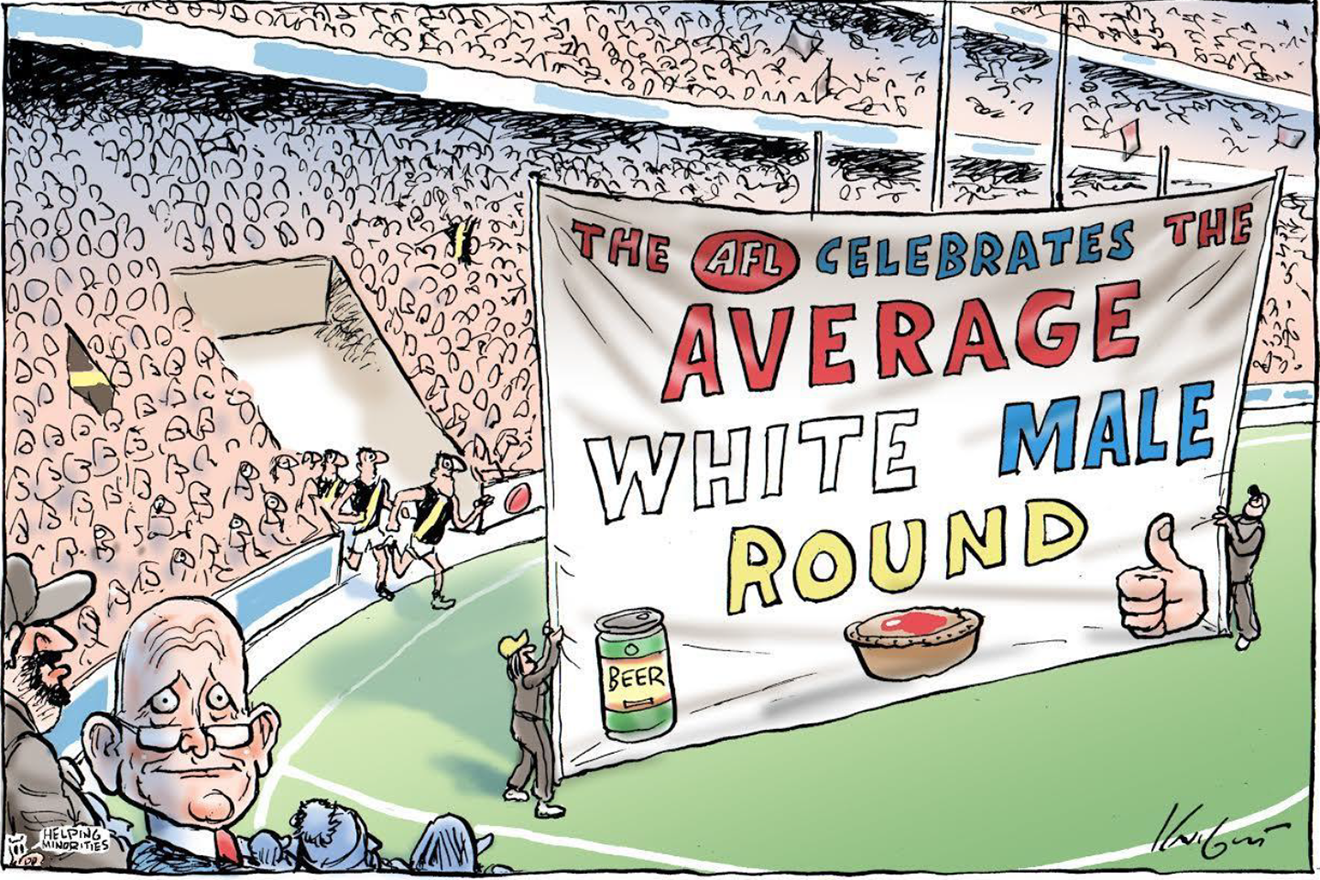
Cartoon in the Herald Sun August 16, 2016. Source: Reproduced with permission from Mark Knight.
The three media articles that framed the Pride Game using the unsupportive stick to football frame were greatly outnumbered by the coverage applying the supportive inclusion frame. Nonetheless, they demonstrate that a small component of the media coverage potentially reinforced elements of hegemonic masculinity by suggesting that the AFL should not be a vehicle or forum to promote social change. It is also important to note that these messages appeared in high-circulation outlets, thereby reaching large numbers of people.
Public Response: Inclusion and “Stick to Football”
The public response to the Pride Game, as it emerged through media, was established by analysing 1,939 items made up of 32 letters to the editor; 211 comments under nine media articles; and 1,696 comments on the 33 Facebook posts by St Kilda (n = 24), the AFL (n = 5), and La Trobe University (n = 4). Of these, 389 comments under online media articles and on Facebook posts were not specifically related to the Pride Game (e.g., “go Saints, keep those finals hopes alive”) and were considered irrelevant to the research. A total of 884 public response items were coded under the inclusion frame (Table 1). In contrast to the media items, most public response items framed the Pride Game in terms of the inclusion of, and support for, the LGBTIQ community rather than gay AFL players. Responses ranged from short Facebook messages such as “Great initiative, well done AFL” (www.facebook.com/afl, August 14) to longer letters to the editor in The Age (August 13), such as:
Public Response: Coding by Source (n, %).
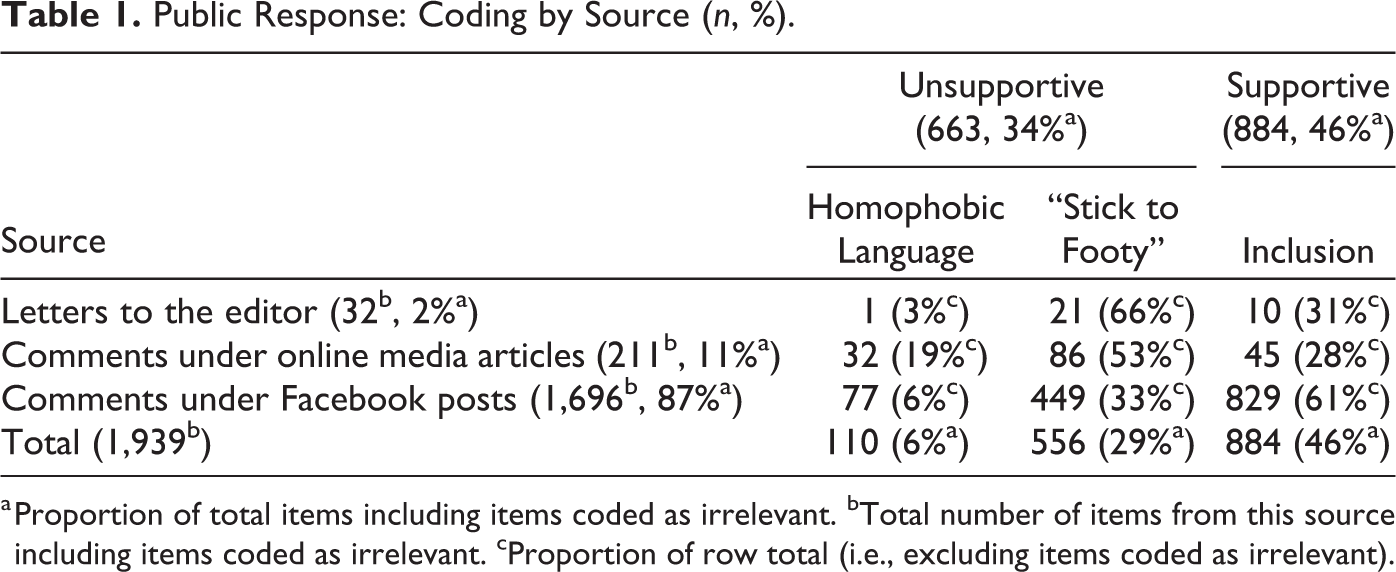
a Proportion of total items including items coded as irrelevant. bTotal number of items from this source including items coded as irrelevant. cProportion of row total (i.e., excluding items coded as irrelevant).
No doubt the AFL will cop stick from the usual suspects for sponsoring the inaugural Pride game (Sport, 12/8). However, as a gay man who has enjoyed watching footy over a lifetime, I congratulate all those involved—not least the St Kilda and Sydney Swans clubs—in taking brave first steps in making footy a welcoming place for gay people, both on and off the field. Gary Jaynes, Ivanhoe.
There was evidence that both the LGBTIQ community and the mainstream community welcomed the game. The message of community inclusion was particularly prevalent in comments responding to St Kilda official Facebook page posts evident in the following quotes: As a straight man, I’ll be wearing my beanie [hat] and scarf with pride this Saturday night. I’m proud to be a member of a club with the guts to stand up for equality. To stand up for those who get picked on and made to feel less for just being themselves. Onya Sainters! (www.facebook.com/stkc, August 11) Thanks for putting me in this! It was such a huge night for me, I loved getting all dressed up and feeling 100% open about who I was at the game I love most. I cannot accurately express in words how important a night this was for me, and I know I am nowhere near alone. Be proud always! (www.facebook.com/stkc, August 15)
Public Response: Coding of Comments in Response to Facebook Posts (n, %).
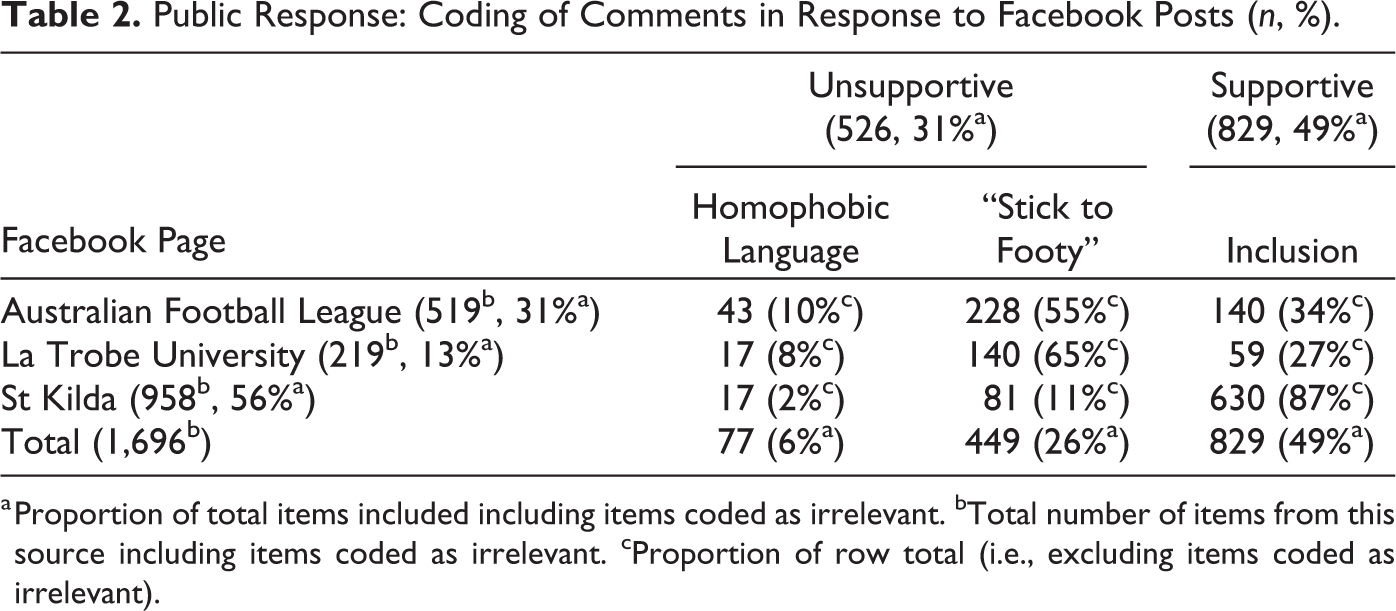
a Proportion of total items included including items coded as irrelevant. bTotal number of items from this source including items coded as irrelevant. cProportion of row total (i.e., excluding items coded as irrelevant).
Many of the public response items framed as inclusion directly challenged the homophobic views of others. For example, some comments with the most “likes” on the AFL’s Facebook page were responses to negative comments from others. Can’t all you homophobic twats just sit down and let some people be happy? The AFL representing pride has no impact on the actual game whatsoever, and only serves to make people feel more included. Grow up. (www.facebook.com/afl, July 25) Over 500 positive reactions to this post and only four angry faces. Compassion is winning. (www.facebook.com/stkc, July 20)
The majority of the unsupportive public responses were framed as stick to football (n = 556, 84% of all unsupportive responses and 29% of all public responses). Responses framed like this emphasised that the Pride Game was a way for the AFL and clubs to demonstrate “political correctness” and that Australian football should not be subject to “political agendas.” As an example, the comment that received the most “likes” (n = 1,224) across all of the Facebook comments included in this study was in response to an AFL Facebook page post—“FFS [For F…Sake] could the AFL just concentrate on sport for once and not shoving random agendas down our throats? I watch sport to get away from all this crap.”
Many of the responses framed as stick to football included qualifiers such as “I’m not homophobic, but…” or “I don’t care what goes on behind closed doors, but…” For example, a response to a Herald Sun story noted “Just play some bloody footy!!!!! I don’t care if you are gay, straight, black, white, green or purple, I just want to go to footy and see my team take some marks and kick some goals and maybe win, is that too much to ask!!!!” This is indicative of McCormack’s (2011) “fag discourse” which, while not necessarily intended as negative or to stigmatise homosexuality, has a negative social effect with an underlying message that sport should continue to privilege heterosexuality. It also carries an underlying assumption that sport can exist and operate independently of the broader societal context within which it is embedded. This is in direct contrast to the more inclusive contributions, which in many instances articulated a close connection between sport and society.
One hundred and seven public response items were coded as “homophobic language” and could be described as having “pernicious intent” (McCormack, 2011). Seventy-seven (6%) Facebook comments and one letter to the editor (3%) were coded as “homophobic language” compared to 32 (19%) comments underneath online articles. Most homophobic language comments under online media articles were in response to Herald Sun articles. This forum allows comment using a pseudonym, which may explain the higher prevalence of this type of comment in this setting. The comments coded as homophobic language included multiple comments suggesting the game was unsuitable for children, calling the Gay and Lesbian Mardi Gras “a freak show,” and noting, “if I was an AFL player and there were gays in my team I would not want to be in the same change rooms let alone have showers with them…no thanks!” Outright homophobic comments comprised only 6% of the public responses included in this study. Although the intent of the comments and articles in the stick to footy category is difficult to decipher, it is important to note that it represented 29% of all responses.
Discussion
While varied and nuanced, the dominant narrative across both media and public responses to the Pride Game was positive and supportive both of people who identified as LGTBIQ and of St Kilda’s and the AFL’s broader initiative supporting social change. In this regard, there was a clear trend in the media coverage to representations and discussions promoting forms of inclusive masculinity, mirroring findings from other recent research. However, compared to recent European research (Cleland et al., 2018), this study also found a higher proportion of unsupportive, homophobic content with potential pernicious intent, among the public responses. Although it was the least common in this study, the proportion of the public responses coded as homophobic language (6%) is higher than the 2% reported by others (Cleland et al., 2018).
It should be noted that, as in Cleland’s (2018) research in Europe on fan messages, there were significant examples in this study of posts pushing back against homophobic views when they were present in Facebook posts or in article comments. These findings suggest that social media and other forms of online media provide a forum in which direct interactions and debates around masculinity, and how it should be understood and practiced, can occur between supporters in ways not previously possible. Therefore, these platforms offer an opportunity to address the criticism that agenda-setting and framing theories underestimate audience agency. At the same time, it is important not to overstate this. While enabling a range of voices and perspectives to be presented is one thing, it is another matter as to whether those different voices are listened to and are influential.
The fact that nearly one third of public responses in our sample, while not explicitly homophobic, were framed as stick to football with a potential negative social impact possibly reinforces traditional ideas of heteronormativity and articulates a perspective that sport and society can and should exist separately. This reflects the findings of a recent analysis of social media responses to a U.S. Soccer online post that identified that posts resisting the intertwinement of politics and sport were a significant portion of the sample (Cavalier & Newhold, 2018). In much of the public response to the Pride Game in this study, respondents sought to distance themselves from the directly pernicious intent of homophobic language by using qualifiers such as “I’m not homophobic, but…” which still potentially stigmatises the LGBTIQ community while seeking to normalize hegemonic masculinity as the “natural” state. Ultimately, while seeking to separate out sport and politics, such responses actually highlight the intersection. These findings also speak to recent work that examines sport organisations’ policy and fan responses to it. For example, Magrath (2018) found, via in-depth qualitative interviews, that while fans supported anti-homophobia policy in principle, they invoked homophobic chants in practice when supporting their team, highlighting the difficulties in enforcing governing body policies around inclusion (Magrath and Stott, 2019).
The findings of this study are of additional significance because recent international research suggests that media coverage and online discussion spaces have transitioned from homophobic language and models of hegemonic masculinity towards a more inclusive masculinity (Billings et al., 2015; Cassidy, 2017; Cleland et al., 2018; Kian et al., 2015). The relatively high proportion of unsupportive public responses found in this study may reflect the context of Australian football as a sport, with the AFL more closely resembling professional sport codes, such as the NFL, without high-profile gay athletes. For example, Luisi et al. (2016) found that the NFL media were more likely to reinforce notions of hegemonic masculinity than NBA media. As with the NFL, and unlike the NBA when Luisi et al. conducted their study, no active or retired AFL player has identified as gay, and this may have contributed to the notions of hegemonic masculinity present. This might also explain why the media coverage of the Pride Game focused on the lack of openly gay AFL players. It may also be explained by the broader context in Australia, where at the time of the Pride Game, same-sex marriage was not yet legal, only being legalized in 2017 amidst strong resistance from some sections of the Australian community.
An important finding of this study was a clear difference between the frames used in the mainstream media coverage and those used in the public response. Although both highlighted inclusive supportive messages, the public response also framed the issue unsupportively as stick to football. The comments in response to the St Kilda Facebook posts were the exception, as they were overwhelmingly supportive and focused on inclusion. This may reflect the previous advocacy work by the club on this issue.
This study highlights the value in analysing multiple platforms in media framing research, given the different frames identified across different platforms. The letters to the editor and public comments in response to online articles had a higher proportion of unsupportive comments, perhaps because the websites allowed comments to be made anonymously, a similar finding to Kian’s (2015) research that examined media coverage and comments to MSNBC’s coverage of Jason Collins and Michael Sam. In contrast, the comments in response to Facebook posts, particularly to St Kilda Facebook posts, were overwhelmingly supportive and focused on inclusion.
Overall, the most important finding from this study is the difference between the framing of the media items and the public response items. Much of the media coverage was framed around the lack of an openly gay AFL player, while also promoting inclusion of the LGBTIQ community. Conversely, the public response, while also mostly supportive of the inclusion of the LGBTIQ community, used the unsupportive stick to football frame much more frequently than the media. The St Kilda Facebook page was the only platform where the media framing and the public response were closely aligned. As social media continues to become more important in mass media framing and agenda-setting, the value of comparing media frames across different platforms, and even in different spaces within those platforms, is evident. This research confirms findings in international contexts that indicate the importance of studying multiple platforms in sport media research (Billings et al., 2015; Kian, 2015). In this regard, this current research also indicates that media, broadly defined, can be a site for contested representations and perspectives. The findings show that different perspectives were presented and that supporters were taking advantage of the interactive possibilities of online media to engage directly with each other. Interestingly, given the focus and methods approach of this study, the negative and noninclusive comments were developed and presented in response to the largely positive and inclusive representations of the mainstream media. This tends to reinforce one of the central insights of agenda-setting, namely that while the media can frame what people are thinking about, it cannot control how people think about issues. The emergence of social media in this context is important as it provides an immediate forum through which people can present their viewpoints, which was not available to the same extent prior to the emergence of the Internet and social media. In this case, even where there is a predominant approach proposing a model of inclusive masculinity, the fact that some voices argue for maintaining or reinforcing a hegemonic masculinity suggests that players who are considering coming out will potentially face intense personal criticism from at least some supporters and commentators, despite a more generally supportive environment emerging.
This study has a number of limitations which should be acknowledged. The relationship between this study’s findings and those of previous studies of media coverage of athletes disclosing their homosexuality should be treated with caution. Based on the positive response to the Tynan Winmar story uncovered in this study, media coverage of, and public response to, an individual AFL player disclosing they are gay may be generally more supportive than was evident in this study, as it was primarily focused on the response to a Pride Game, rather than a story of an individual coming out.
Perhaps the most significant limitation is our collection and use of Facebook data. Facebook comments can be affected by Facebook’s news feed being individually tailored, with each user’s previous engagement influencing what they see. Data collection of Facebook content is also problematic for researchers as some comments on public posts may not be publically accessible (Olmstead & Barthel, 2015; Oremus, 2016). It is also unclear whether or how administrators of the Facebook pages included in this study moderated or removed comments and in particular whether St Kilda removed more negative comments. It is also possible that comments in response to Facebook posts, particularly responses to St Kilda posts, were positively biased. This same caution should be applied to the letters to the editor because, based on a content analysis, it is not possible to know how many letters in total were sent to the newspapers. It is also unclear how or why letters were selected for inclusion in the letters section. Despite these limitations, the findings of the content analysis are important, as they provide insights into material that was ultimately part of the public discussion.
Conclusion
While much of the previous research in this field has explored media reactions to athletes coming out, this study offers a novel insight into media coverage of, and public response to, a Pride Game in professional sport. Much of the existing research has focused on basketball, American football, and soccer in the United States, UK, and Europe (Billings et al., 2015; Cassidy, 2017; Cleland, 2015; Cleland et al., 2018; Kian et al., 2015; Schallhorn & Hempel, 2017). By comparison, this study offers insight into how the media and public frame LGBTIQ issues in a different sport (Australian football) and cultural context (Australia). It also offers insight into media and public framing of a related but different issue, the first Pride Game in Australian professional sport. Applying agenda-setting theory (McCombs, 2013), this study suggests that while the media put the Pride Game on the public agenda, it did not wholly influence how the public framed their reaction. Nevertheless, the analysis provides evidence that the media, broadly defined, is a space where debates around masculinity in sport are occurring and that even in the social media context, some people are putting forward arguments based on inclusive masculinity. The findings also echo previous research that indicates multiple frames of analysis are useful in the new media environment (Billings et al., 2015; Kian, 2015). In particular, given the current fragmented media context, analyzing one form of media alone risks providing a partial understanding of the phenomenon under analysis. As such, this study suggests a need to extend the arguments of agenda-setting to recognize that there may be multiple voices competing to set the agenda. In addition, social media is enabling more voices to contribute to these debates in public than was previously the case.
The findings of the study also suggest opportunities for further investigation, including analysis of a broader range of media. The starting point for this study was Melbourne-based news media, given the context of the specific game under analysis. This could be broadened in future research to consider whether similar perspectives emerge in locations beyond Melbourne (particularly in more regional or remote communities). A second potential area for further investigation would be to interview people participating in these discussions. While challenging in terms of accessing the participants, this could provide insights into the motivations behind their contributions. Overall, this study offers a theoretically and empirically important case study in a growing literature around the representation of LGBTIQ issues in sport in the media while also providing a foundation for further research.
Footnotes
Declaration of Conflicting Interests
The author(s) declared no potential conflicts of interest with respect to the research, authorship, and/or publication of this article.
Funding
The author(s) disclosed receipt of the following financial support for the research, authorship, and/or publication of this article: This work was supported by funding from the Victorian Health Promotion Foundation.
