







Abstract
Women are more visible than ever in sports media. Yet, extant research has shown that females have endured an array of issues exclusive to their gender. Consistent research updates on gender in sports media is necessary in order to discover whether an increase in numbers has changed the assessment of women in sports media. This study’s objective was to understand how audiences now perceive women in television sports media, specifically as sports reporters covering the NFL. This quantitative experiment employed two current, veteran sports reporters (one female and one male) and pre-tested for the purpose of this study. It is the first known study that utilized professional television sports reporters. Each reporter recorded the same two “stand-ups” with identical backdrops. Survey participants randomly watched a video either of the male or female giving a fact or an opinion report and were then asked questions to measure their perception of the sports reporter’s knowledge and credibility. Intriguingly, this study did not replicate results from prior research, and therefore could contribute to literature on women in sports media moving forward.
Keywords
Over the past several decades there has been a worldwide increase of women journalists on sports news broadcasts (Etling et al., 2011; Schoch & Ohi, 2011; Strong & Hannis, 2007). Today’s youth have grown up accustomed to seeing and hearing female journalists’ voices in sports discourse. While equality, in terms of the numbers of women in the field, might be moving in the right direction, prior research has shown that viewers do not think of male and female sports journalists in the same way, finding male sports journalists more credible (i.e., Mitrook & Dorr, 2001; Etling & Young, 2005, 2007; Davis & Krawczyk, 2010; Etling et al., 2011; Schmidt, 2015), and often trivializing or sexualizing women associated with sports (Bruce, 2016; Crolley & Teso, 2007). Has this attitude changed? Are television audiences now perceiving female sports reporters to be as credible and knowledgeable as their male counterparts? Are women gaining any ground in being respected in this profession? The purpose of this study is to produce contemporary research on how audiences in the United States are currently perceiving gender differences of sports journalists through the lenses of both social identity theory and the concept of stereotyping.
This between-subjects experiment uniquely utilizes equivalent professional television sports journalists in order to better ascertain the audience’s evaluation of the credibility and knowledge of both male and female sports reporters. While prior research comparing people’s perceptions of male and female sports broadcasters measured both credibility and knowledge, none utilized video and professional journalists in the stimulus materials. Therefore, this research can be a notable contributor to extant research.
Masculinity and Sports Media
Research continually and consistently demonstrates that the sphere of sports broadcasting has largely been for men, about men and by men (e.g., Bryson, 1987; Messner, 1992, 2000; Pringle, 2005; Schmidt, 2018). Sports journalism, both in print and in broadcast outlets, “celebrates the male values of competition, toughness, endurance and physical prowess and, above all, the male body, for the appreciation of the male viewer” (Dyer, 1987, p. 8). Most media messages regarding sports are characteristically masculine and are specifically created to encourage socialized gender norms (Merrill et al., 2015). Male hegemony is “constructed and reconstructed” through the institution of sport (Bryson, 1987, p. 349). Essentially, prior research illustrates that, for decades, while women made advancements in other facets of journalism, the sports departments at newspapers, television and online all operated with teams of male journalists producing content for male audiences (Merrill et al., 2015). The feminist theory of the male gaze depicts women as being perceived as sexual objects for the gratification of male viewers, producing a sexual inequality, with women seen as passive images and men as active viewers (Coykendall, 2000; Mulvey, 1999). Mulvey (1999) unpacks Sigmund Freud’s classification of scopophilia as voyeurism that dehumanizes women into merely being regarded as to whether they are visually appealing objects or not, and men subjecting them to a “controlling and curious gaze” (p. 270). And while Mulvey is orientating her considerations in the context of cinematic performance, comparable deduction could be formed for the “small screen” of television.
Sport is a “microcosm of gender values in American culture,” as males are often perceived at the forefront and females in the periphery (Creedon, 1994, p. 4). As athletes, women have largely maintained a subordinate position to men in every aspect of sports: compensation, media coverage and respectability (e.g., Birrell & Cole, 1994; Duncan & Hasbrook, 1988; Eastman & Billings, 2000; Crolley & Teso, 2007). In recent years women have made remarkable advances in the world of sports, including the hiring of the first full-time female coaches in the National Basketball Association and National Football League, as well as full-time female referees in both of these leagues. Yet, Schmidt (2018) found that men and women’s sports coverage remains “significantly disproportional” (p. 63) and suggested that women are still a “token” group in sports media positions (p. 66). Messner and Sabo (1990) demonstrated that at the heart of sports is a power dynamic that puts men in charge and provides them with far more opportunities. While an argument could still be made that a male-athlete-dominated sports world is simply the result of supply and demand and is what the audience wants, the same argument does not hold for sports journalism (Etling & Young, 2005).
Sports Media and Gender Research
While no evidence exists suggesting women perform worse than men as sports journalists, past studies have shown they have been subject to far more discrimination and sexism than in any other area of journalism (Etling & Young, 2007; Schmidt, 2015; Schmidt, 2018). In spite of increased numbers of female sportscasters, positions essentially continue to be male dominated (Schmidt, 2015), “likely because sport is perceived as a specialization in which practitioners must excel in ‘credibility’ and ‘knowledge’,” and these are characteristics often not applied to female sports journalists (Allen, 2003, p. 160). In several developed countries, the number of female sports print journalists remain at low levels. In the United States, the growth of women in sports journalism has stagnated (Sherman, 2015). Over a 30-year period, only 10.4% of U.S. newspaper articles were penned by women (Schmidt, 2015). Research in Australia indicated that women account for between 8% (North, 2012) and 11% (Strong & Hannis, 2007) of sports journalism. And in the United Kingdom, just 3% of sports journalists are women (Greenslade, 2011).
Several studies have analyzed discrimination, stereotypes and obstacles faced by female sports reporters (Hyre et al., 2017; Schmidt, 2015). Women have confronted imbalanced cynicism of their credibility and knowledge (Chambers et al., 2004) as well as pressure to conform (Kanter, 2003; Riordan et al., 2005). Mastro et al. (2012) conducted an experiment utilizing photographs of reporter images including black and white women and men to examine the perception gender and race played when considering the sports reporters' expertise, character and likeability. The researchers deducted that white male reporters were “rated more favorably in terms of expertise and character” (p. 468), as well as likeability, when the sport was typically a white, male sport (i.e., hockey). Meanwhile, white female reporters “were regarded to be more valuable than that of her peers” (p. 469) when contributing to coverage of white, female dominated sports, such as women’s gymnastics. Similarly, their data supported gender-based expectations based on whether the reporters were speaking about male versus female sports and “partially corroborated” race-based” predictions (p. 469). Beyond empirical, quantifiable literature, much rich cultural work also illustrates the divide between male and female sportscasters; Harrison (2019), for example, contended this significant inequality in terms of audience perceptions often revolves around notions of attraction. He argues that for women to get ahead in sports media, they must dress provocatively, but while ultimately this negatively affects their credibility with the audience, they do it because “it is more likely that many women see no other reasonable alternatives” (p. 152). This contention aligns with Sheffer and Schultz (2007), who also maintained that attractiveness affected women’s viability in sports journalism, but could also hinder the audience’s perception of them.
Previously, Toro (2005) examined the credibility of male and female sportscasters by showing photographs of various Caucasian and African-American men and women to college students to discover whom they felt were more credible sportscasters. Female participants judged female sportscasters more severely than the male participants. Knowledge and attractiveness of the sportscasters were also examined. The male sportscasters perceived as the least knowledgeable and least attractive were considered more credible than the most knowledgeable and attractive female sportscasters. Toro deduced that “a sex stereotype does exist in public perceptions of male and female sportscasters” (Toro, 2005, p. 26).
Davis and Krawczyk (2010) showed participants video footage of three non-professional college-age females who possessed varying degrees of attractiveness in order to examine the “various factors of credibility that modern sports media viewers desire in female sportscasters” (p. 2). Each of the three women read the same excerpt from a sports news script referring to football. The research showed that the more attractive the sportscaster, the higher they were rated in knowledge and credibility. Also, looking to measure credibility and knowledge, Etling et al. (2011) tested the influence of a sports journalist’s vocal pitch; participants listened to an audio-recorded sportscast comprising numerous sports stories given by either a man or woman. Results showed that female listeners rated male sportscasters more authoritative than female sportscasters. Etling and Young (2007) also used audio recordings of male and female sportscasters in an earlier study and found “sexism to be strongly associated with negative attitudes toward female sportscasters” (pp. 121–122).
Mitrook and Dorr (2001) utilized photographs of sportscasters and sports scripts in their study. They concluded that male sportscasters were perceived as more credible than women sportscasters. Prior research, a whole body of work, illustrates that people stereotype female sports journalists as less credible and knowledgeable. While sports journalism is becoming more opinion-based (McCarthy, 2014), scholars have found that people rate fact-based journalism as more credible than opinion-based journalism (i.e., Fletcher & Park, 2017; Kiousis, 2001), and potentially even more so in sports journalism (Wölke & Powell, 2018). A clear majority of sports is consumed through television, and prior research does not examine if people apply these stereotypes to broadcast sports journalists. Etling et al. (2011) wrote, “Acceptance of female sportscasters may be greater in television” (p. 11). All of these studies illustrate that women have faced an uphill struggle to be respected equal to their male counterparts, and continue to do so.
Focus of Research
This study purposefully chose to focus on the reporting of NFL news. In sports where women can easily participate, such as basketball, tennis, and baseball/softball, it is reasonable for women to automatically have increased credibility; the contrast is less automatic when compared to a hyper-masculine sport like professional football, with limited opportunities for women. In this preliminary experiment, researchers tested audiences’ perception of both male and female sports reporters’ credibility and knowledge when reporting on the National Football League. Participants viewed broadcast-like stories from either a professional male or female sports reporter presenting objective news or an opinion-based analysis. This study specifically focuses on whether people rate female sportscasters as less credible and knowledgeable than male sportscasters when reporting on a hyper-masculine sport such as professional football, both in terms of fact-based and opinion-based reporting.
Social Identity Theory
Fundamentally, social identity theory argues that people define themselves through social category (Hogg et al., 1995). Specifically, people fall into many social categories defined by characteristics such as gender, sports team allegiance, hobbies, nationality or political ideology. Membership in such groups helps form the basis of an individual’s identity (Linville & Fischer, 1993). The theory essentially posits two distinct ideas: people want to be part of a group with similarly minded others, and this helps shape a person’s identity (Turner, 1982). At their core, people want to be viewed positively by both themselves and others (Tajfel, 1982). The way a person sees themself is often a combination of the positive attributes they perceive are attached to membership in a variety of social groups or an amalgamation of both “the value and emotional significance attached to” those memberships (Tajfel, 1982, p. 63). People use membership within groups as a manner to view themselves and other members of said group more positively than non-members (Tajfel & Turner, 1979). As such, a key component of social identity theory concerns the concept of in-group and out-group biases (Tajfel & Turner, 1979). People hold a heightened awareness, true or untrue, of the differences between members of their social group and non-members; those members are considered the in-group and the non-members the out-group (Gardikiotis, 2008). While in-groups can be formed based on any common interest or characteristic, members of the in-group tend to see themselves as part of a heterogeneous group filled with unique members, but view the out-group as homogenous (Brewer, 1979). This is what leads to stereotyping. In order to enhance their positive representations and reinforce their group membership, in-groups stereotype out-groups, thus distancing themselves, and reproaching out-groups.
Social identity theory provided the foundation for prior research examining the intersection of stereotyping and sports journalism (e.g., Ferrucci & Perry, 2015; Ferrucci, 2016; Ferrucci & Tandoc, 2017, 2018; Ferrucci, Tandoc, Painter, et al., 2016; Ferrucci, Tandoc, Hong, et al., 2016; Mercurio & Filak, 2010; Rainville & McCormick, 1977). In fact, when testing stereotype application in general, social identity provides one of the most fundamental theoretical frameworks, one that also delivers some of the most useful data and information (Stryker & Burke, 2000). However, in the previously mentioned studies, researchers examined the effects of sports journalists who were consistently describing athletes in stereotypical modes based on race or gender. This current study experimentally assesses how common gender stereotypes affect how people rate male and female broadcast sports journalists in terms of credibility and knowledge. The study also tests whether the gender of a participant affects these variables. According to prior research, gender is one of the social categories, or in-groups, with which members feel the most strongly connected (e.g., Rudman & Goodwin, 2004; Schmader, 2002).
Stereotyping
The process or act of stereotyping is not as facile as simply applying a stereotype or not. In fact, stereotyping is not simply a yes-or-no proposition at all. After much empirical research, Devine (1989) found stereotyping to be a two-part process, one stage automatic and one controlled. Stereotypes themselves are often media-propagated characteristics, meaning that while some stereotypes might form organically, it’s only when various forms of media consistently disseminate them that they take hold in culture (Brown Givens & Monahan, 2005). Therefore, Devine (1989) determined that the first stage of the stereotyping process is called “activation,” and it is an automatic cognitive response. When someone encounters another person from an out-group, all the known stereotypes about that out-group will be activated in the person’s mind (Dovidio et al., 1997). Devine (1989) calls this stage activation because the automatic process “activates” the stereotype in a person’s mind.
The second stage of the stereotyping process is called application (Devine, 1989). The person controls this stage, unlike the first, by making a conscious choice whether to apply that stereotype (Dijksterhuis & Van Knippenberg, 1996). Researchers who study the first stage often examine whether specific stereotypes exist, but studies concerning the second stage question the effects of already established stereotypes; more specifically, researchers studying the application stage of stereotyping often want to understand if the media dissemination of stereotypes are affecting how an audience views groups (Dovidio et al., 1997).
There are numerous other studies of stereotype application from various fields which examine very different stereotypes, utilizing the model first published by Devine (1989; e.g., Ames, 2004; Ferrucci et al., 2013; Kundra & Sinclair, 1999; Kunda & Spencer, 2003; Leshner, 2006). This present study will focus on this second stage of the stereotyping process. It will examine whether participants apply common stereotypes toward female sports journalists working in broadcast journalism.
Credibility
While asking participants a series of questions is one way to test stereotype application, a secondary measure involves the concept of credibility (Leshner, 2006). For example, while a researcher can ask a participant to rate a person’s intelligence and see if the participant applies that stereotype, another way is for the participant to rate a message’s credibility (Leshner, 2006). If the media presents a message that is not consistent with a stereotype, and the participant rates the message as not credible, that is, therefore, a secondary way of testing stereotype application. Research illustrates that people view information fitting their belief system as more credible than information that deviates from their belief system (Meyer, 1988). In political communication, for example, research illustrates that when presented with information fitting their ideology, people view it as significantly more credible than the opposite; and when presented with factual information that does not fit into their worldview, people will rate it as less credible (e.g., Tajfel, 1982; Tsfati & Cappella, 2003). These studies illustrate the connection between social identity theory and stereotyping: When information seemingly aligns with the views set forth by a person’s in-group, they will view it more credibly, and the opposite occurs with information aligning with an out-group (Tajfel & Turner, 1979).
For this particular study, participants will see a “story” from broadcast sports journalists. One group will see a story from a female broadcaster. The other group will see the same exact story delivered by a male broadcaster. The participants will be asked to rate the journalists in both credibility and knowledge, and this is the primary measurement for stereotype application. As a secondary measure, the study will ask participants to rate, using a Likert scale, the credibility of the messages delivered by the broadcasters. Researchers measure media credibility as a function of three distinct dimensions (e.g., Hu & Sundar, 2009; Kiousis, 2001). Medium credibility measures how credible the medium’s message is; message credibility examines the credibility of the information relayed; and source credibility looks at the credibility of the person delivering the information. This present study is interested in source credibility and uses the scale developed by Hu & Sundar (2009) to test it.
Knowledge
Credibility is one way to secondarily test stereotype application; however, measuring knowledge is another way to measure source credibility. Prior research found that, in a variety of instances, people link knowledge and credibility, believing the two to be intrinsically connected (e.g., Ashley et al., 2013; Eastin, 2001). Therefore, if measuring source credibility allows researchers to secondarily test the stereotype application of intelligence, then measuring knowledge does the same with source credibility (Flanagin & Metzger, 2000). Researchers test knowledge in two main ways: through source knowledge and knowledge transfer (Jacobson & Goering, 2006). Essentially, when conducting an experiment, researchers looking to measure knowledge ask participants to rate the source of information’s level of knowledge or test whether information provided raised a participant’s level of knowledge. This present study examines the former measure of knowledge.
Hypotheses
Based on what previous studies have found, this study tests the following hypotheses:
Method
Sampling
To answer these questions, this study employed an experiment using a between-subjects design where participants (N = 491) were randomly assigned to either a male-fact (n = 126), male-opinion (n = 123), female-fact (n = 125) or female-opinion (n = 117) condition. The participants were recruited through Amazon’s Mechanical Turk Service, which social scientists have been using more and more for participant recruitment and data collection (Buhrmester et al., 2011; Pittman & Sheehan, 2016). All participants were required to be United States residents and at least 18-years-old. They received a small monetary incentive for their participation, a near average participation rate on Mechanical Turk (Pittman & Sheehan, 2016).
Mechanical Turk skews slightly more male in terms of respondents (Huff & Tingley, 2015) while the main alternative in mass communication research often involves using student samples, which are overwhelmingly female (Bui, 2014). The questionnaire received 491 completed responses, of which 67% were from male respondents. The average age was 33.08 years old (SD = 10.26). Mechanical Turk participants also tend to be better educated than the average American (Pittman & Sheehan, 2016) and therefore lend themselves better to stereotype studies as education typically lessens stereotype application (i.e., Aberson & Haag, 2007). Consequently, to test whether participants apply gender-based stereotypes to sports journalists, sampling a more-educated group would hopefully allow us to better determine whether stereotypes are still prevalent, as this group should apply stereotypes less often than the average American.
Procedure
Researchers randomly assigned participants into one of four conditions based on the month they were born. Once they were assigned, they read a standard consent form and instructions about how to complete the experiment. During the experiment, each participant viewed one roughly 35-second video. They were then asked to rate the sports journalist in the video in both knowledge and credibility. Participants were also asked questions about their sports media habits, their sports fandom and demographic questions. The experiment concluded with a debriefing.
Manipulation
Participants viewed one of four videos, depending on the condition: a professional male journalist delivering a fact-based story, a professional male journalist delivering an opinion-based story, a professional female journalist delivering a fact-based story, or a professional female journalist delivering an opinion-based story. The scripts for the two fact-based and opinion-based stories were exactly the same. Both stories were pretested for how much they were rated as fact or opinion. Factual videos were rated more fact-based (M = 8.87, SD = 5.61) than the opinion videos (M = 7.14, SD = 4.62), t (487) = 3.71, p < .001.
Each of the stories were about generic National Football League rule changes. For the purposes of this study, each professional television sports reporter was asked to videorecord two “stand-ups,” approximately 35-second videos pertaining to new rule changes in the NFL. All videos showed both of the reporters in front of identical backdrops and in front of an NFL sports team's facility. The reporters were both Caucasian and middle-aged. They were asked to dress similarly in business casual attire and read from the same script that was provided to them by the researchers. The first stand-up was based on the facts of the rule changes and the second stand-up was an opinion of the rule changes.
Researchers gathered photos of professional sports journalists and pretested them for attractiveness, credibility and knowledge. Fundamentally, because this experiment is focused on credibility and knowledge (and attractiveness impacts those), it was essential that the sportscasters utilized in the stimulus materials rated virtually the same on those variables. So, we pretested for those characteristics. One of the researchers on this study is a former sports journalist, so we pretested several journalists that she knew from her past. Two professional television sports journalists were chosen based on the pretest results. Both journalists work in the same local television market in the southwest and are not nationally known. In the pretest, these two journalists were not rated as highly attractive, instead were both rated as barely above average.
Once the two journalists were chosen, both were provided with the pretested scripts and asked to make two videos, one fact-based and one opinion-based. The videos were the same length. The sports reporters shared similar age and experience in sports broadcasting. In essence, participants in the fact-based conditions saw almost identical videos in terms of look, script and length, with the only difference being either a professional male journalist or a professional female journalist, both of roughly the same age, years of experience in the field, and attractiveness, as considered by the researchers. Television reporters are generally considered attractive, but for the purposes of this study, the reporters were chosen because of their other similarities. Attractiveness was intentionally controlled for in this study as to avoid any confounding factors when testing gender.
Dependent Variables
Credibility
This variable was measured using five items which the participants rated in a 5-point Likert-type scale. They were asked to rate their level of agreement with each of the following descriptions about the journalist in the video they saw: trustworthy, accurate, unfair (reversed), tells the whole story or is biased (reversed). The scale was reliable, Cronbach’s α = .76.
Perceived knowledge
The participants were also asked to rate how knowledgeable they thought the journalist in the video was. This was measured using five statements rated in a 5-point Likert-type scale: “I like this sports journalist,” “I think this sports journalist knows what they’re talking about,” “I think this sports journalist is knowledgeable about sports,” “I think this sports journalist is providing quality information,” “This journalist knows enough about sports to be qualified for their job.” The scale was reliable, Cronbach’s α = .83.
Predictor variables
To investigate the effects of the two manipulated variables, the journalist’s gender (male vs. female) and the type of report (objective vs. opinionated), as well as the effect of the participants’ gender, the study also controlled for the following other variables (see Table 1).
Descriptives.
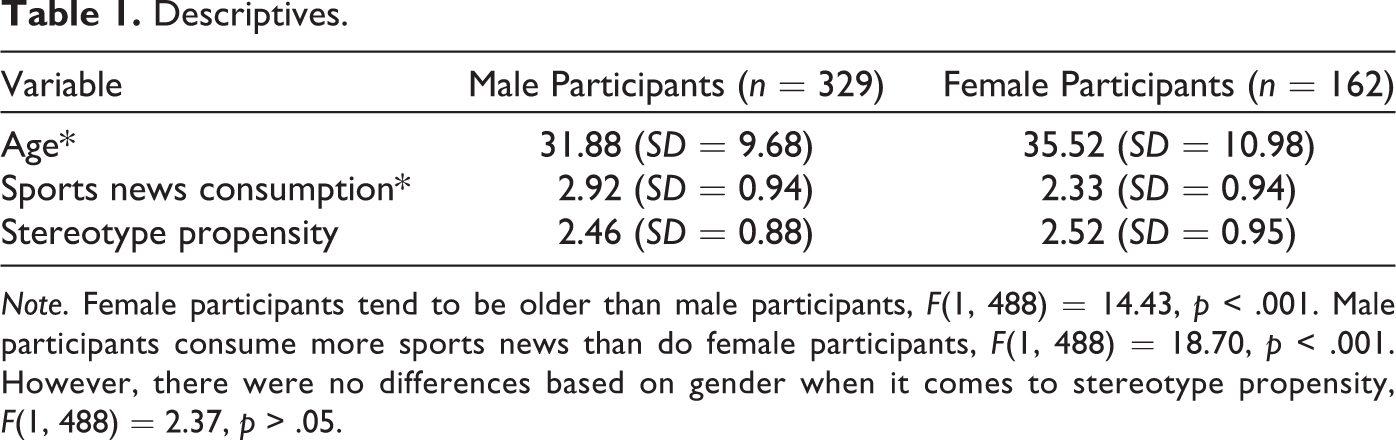
Note. Female participants tend to be older than male participants, F(1, 488) = 14.43, p < .001. Male participants consume more sports news than do female participants, F(1, 488) = 18.70, p < .001. However, there were no differences based on gender when it comes to stereotype propensity, F(1, 488) = 2.37, p > .05.
Journalist’s attractiveness
Three items were used to measure perceived attractiveness of the journalist. The participants rated in a 5-point Likert scale how much they agreed that the journalist in the video was attractive, classy, and ugly (reverse coded). The scale was reliable, Cronbach’s α = .83.
Sports media use
The respondents were also asked to rate on a 5-point scale how often they watch sports news on television news programs, read sports sections in newspapers, read about sports online, listen to sports radio, read sports magazines, and watch cable sports networks (e.g., ESPN, Fox Sports). The scale was reliable, Cronbach’s α = .89.
Propensity to stereotype
Finally, the respondents also reported their level of propensity to stereotype. The participants rated their agreement using a 5-point Likert-type scale with each of the following statements adopted from Shrivastava and Gregory (2009): “I can tell a great deal about a person by knowing that person’s age,” “I can tell a great deal about a person by knowing that person’s gender,” “A person’s race can indicate a lot about that person.” The scale is likewise reliable, Cronbach’s α = .88.
Results
To test all of this study’s hypotheses, a multivariate analysis of covariance was conducted, predicting credibility and perceived knowledge, with journalist’s gender, participants' gender and type of video as fixed factors, and participants’ age, sports media use, propensity to stereotype, and perceived attractiveness of the journalist as covariates. Perceived attractiveness was a noteworthy covariate for both credibility, F(1, 478) = 30.44, p < .001, partial eta squared = .06, and knowledge, F(1, 478) = 48.60, p < .001, partial eta squared = .09. Stereotype propensity was also a significant covariate, but only for credibility, F(1, 478) = 7.71, p < .001, partial eta squared = .02. Sports media use was a significant covariate, but only for perceived knowledge, F(1, 478) = 9.11, p < .001, partial eta squared = .02. Age, however, was not a meaningful predictor.
Discussion and Conclusion
The purpose of this study was to generate current data to pinpoint audiences’ perception of gender differences of professional television broadcast sports journalists through the discernment of social identity theory and stereotyping theories. On the surface, this study found that only one of five hypotheses were supported. Counterintuitively, though, this suggests that the experiment could have found something unexpected and perhaps suggestive of a possible shift to more progressive perceptions of female sports reporters, something not seen in prior research.
Numerous prior studies found a distinct gender bias in sports media (Davis & Krawczyk, 2010; Etling & Young, 2007; Etling et al., 2011; i.e., Mitrook & Dorr, 2001; Toro, 2005). We could argue our results demonstrate that sports audiences may conceivably be beginning to accept women in their roles as sports journalists. We were encouraged to discover that two of the hypotheses generated from previous research were not supported. The analysis showed no significant difference between the participants’ perception of the credibility and knowledge of the female sports journalist and their perception of the male sports journalist. There was also no interaction effect between the journalists’ gender and type of reporting (objective versus opinion-based) when considering credibility and knowledge. Likewise, the participants’ gender was not a significant predictor of either the female or male sport journalist's credibility and knowledge. The only hypothesis supported concerned the journalists’ credibility and knowledge on fact versus opinion-based reporting, regardless of gender. Both the male and female sports journalists were deemed more knowledgeable and credible when reporting on facts versus opinions. The notion that most of the null hypotheses are supported in the data, thus not replicating the findings from the aforementioned studies, is promising.
Our second hypothesis found that participants rated journalists delivering fact-based stories as both more credible and knowledgeable. In an era featuring more opinion-based sports journalism than ever before (Ferrucci, 2016; McCarthy, 2014), this finding could potentially illustrate something concerning sports media: people could be getting frustrated with so many opinions intersecting sports journalism. Networks such as ESPN and Fox Sports populate their schedules with shows focusing extensively on providing outrageous opinions despite, oftentimes, a lack of fact or evidence to back them up. The opinion-based stimuli featured a reporter giving a very measured take on a subject matter of very little import. Yet, participants still rated the journalist as less credible and knowledgeable. This shows, potentially, people might be getting tired of this type of journalism and wish for reporters to only deliver facts.
Interestingly, our study’s findings do not reproduce most of prior literature concerning the intersection of sports journalism and gender (Davis & Krawczyk, 2010; Etling & Young, 2007; Etling et al., 2011; i.e., Mitrook & Dorr, 2001; Toro, 2005). Regardless of the gender of the participant, we found no significant difference in terms of perceptions of knowledge or credibility between male and female sports broadcasters. In a previous study, Etling et al. (2011) argued that future research should examine whether people rated female television sportscasters as less credible and knowledgeable than their male counterparts. This study did this and found no disparity. Televised sports have long featured female journalists, and women writers and columnists are now common in sports departments of newspapers (Whiteside & Hardin, 2013) . Our study shows that people might be more accepting of female sportscasters for this reason. Also, our sample features a more educated group of participants compared to the general population; this could have led to less stereotype application.
More importantly, this finding came from an overwhelmingly male sample. This finding alone is central to an argument that the gap between the credibility of male and female sports journalists is conceivably beginning to close. However, this also suggests that future research should attempt the same type of study with a more female-focused group of participants. It is important to keep these findings in perspective. As an experiment, this work cannot be generalized. Also, our stimuli videos in the opinion condition did not present a controversial opinion; the videos did provide an opinion, of course, but if the opinions were perhaps more controversial – say, Skip Bayless-like – this could have affected our outcome. Specifically, the audience might be more receptive to over-the-top commentary from a male and not a female. With our majority male participant group, it is absolutely possible an uncontroversial stimuli material did not trigger an in-group/out-group response, which would have resulted in participants being less likely to apply stereotypes. Also, while our findings may illustrate a growing acceptance of female sportscasters from the audience, it does not mean that working in the industry as a woman is any easier, as noted by Harrison (2019). Women still face an uphill battle regarding the pressure to be appear attractive for example, in a way that men do not.
This study sought to discover if perceptions of gender bias, involving credibility and knowledge, from sports audiences remain or if they are changing, bearing in mind the substantial increase of women working in sports media. It also tested the participants’ age, gender, propensity to stereotype and sports media use. We did find, however, that certain characteristics, just not gender, do affect credibility and knowledge ratings. First, as found by Davis & Krawczyk (2010) and others, the covariate perceived attractiveness was significant for both credibility and knowledge. This means that the more attractive the participant found the sportscaster to be, the more credible and knowledgeable they considered them. Sports journalism is often criticized for employing only attractive, especially female, sportscasters (Hyre et al., 2017; Davis & Krawczyk, 2010); this could be the reason for this finding. People are used to attractive journalists on TV and when they do not see that, they immediately find the person less credible and knowledgeable. This study also found that propensity to stereotype was a predictor only with credibility. Therefore, this could mean that a more representative sample, not from Mechanical Turk, might still be stereotype-based on some characteristic such as gender or race. Finally, sports media use was a predictor of perceived knowledge. Fundamentally, this makes perfect sense; the more people knew about the subject matter, presumably, the more knowledgeable they found journalists reporting on the subject matter.
Women’s role in sports media is continuously evolving. Women are hosting national sports broadcasts, serving as national game broadcast analysts and occupying sports media roles in a majority of the television markets in the United States. By building upon the earlier, aforementioned studies, the findings from this study may help to move forward the conversation about women’s acceptance in sports media.
Limitations and Direction for Future Research
This is a preliminary study which featured a reliable and intuitive research model that built upon the limitations and recommendations of extant research. One limitation of this study is the use of single message stimuli. Using single messages in a between-message design, as we have done, muddles the treatment and message. Slater (1991) argued that single-message designs are a mainstay in mass communication research, especially in cases where the stimuli necessitates precision. The research also focused on one sport, professional football, rather than on multiple sports, where women could be seen as more credible and knowledgeable, such as when reporting on gymnastics, ice skating or tennis. Additionally, by pinpointing the stimuli, using only simple fact and opinion-based messages, it is difficult to generalize the findings. An additional limitation is the shortage of female participants.
Future research could utilize more controversial statements to examine if the journalists would be more harshly judged. Exploring various levels of attractiveness in the female reporters could also be examined in a future study. Another study could incorporate multiple message stimuli to investigate whether our findings can be replicated. Furthermore, a future study could measure audiences’ reactions to a female reporter covering a women’s sport in order to examine the gender congruity and its relationship to trust and credibility. The results could be juxtaposed with the findings in this research in order to comprehend where identity biases intersect. This initial study chose to utilize an NFL focus to purposefully place the female reporters in an out-group in order to examine the contemporary effects of their social identity placement. However, again, because male participants would be more likely to stereotype female sportscasters, this limitation could also be looked at as a positive when considering our findings. One could argue that our sample approximates the general audience for sports journalism more than a sample featuring 50% female participants would. Another future study could entail a large-scale survey which would provide more generalizable findings concerning the same fundamental questions; while other studies feature internal validity, a survey would provide more external validity.
Footnotes
Declaration of Conflicting Interests
The author(s) declared no potential conflicts of interest with respect to the research, authorship, and/or publication of this article.
Funding
The author(s) received no financial support for the research, authorship, and/or publication of this article.
