






Abstract
The Olympic Games are the largest mediated sporting mega-event, and broadcasters are instrumental in ensuring their exposure and financial viability. In the digital era, the Olympics navigate technological and societal changes that contest the values of sport, carry political and economic implications, and shape the relationship between the organizers and nation states. These interdependencies vary by global regions. This study examines the mediatization of sport as manifested in digital Olympic content published on Facebook during the Tokyo Olympics by public service media (PSM) in Croatia and Slovenia—two countries inconsistently assigned to either Central and Eastern Europe or Southeast Europe. These PSM face a host of challenges, including rising media rights costs, digitalization, and political interference, while continuing to broadcast the Olympics. On their Facebook pages, contest-related updates were the primary type of content, general news and especially human interest content was rare, critical posts were virtually non-existent, and “home” athletes were politicized conspicuously. Mediatization in this region seems delayed, facilitates event-focused and decontextualized sport content, and appears central in promoting patriotic narratives. On social media, broadcasters perpetuate problematic practices characteristic of sport media and only partially fulfill the roles traditionally ascribed to PSM.
A Public Service? Mediatization of the Olympic Games in Croatia and Slovenia
The Olympic Games are a global spectacle par excellence and the greatest regularly staged show and, thus, media production on television (Billings, 2008). Media coverage of the Olympic Games adheres to remarkably consistent patterns across the globe, yet also varies depending on context. National media outlets consistently cheer for their “home” athletes, but the differences in critical commentary of the Games and the level of nationalism may vary depending on the country, the nation’s relationship with the host country, and whether the commentary is on a public or commercial media outlet (Hayashi et al., 2016). As digital media continue to evolve, broadcasters are challenged to develop new contents and formats to remain popular. Sport’s ubiquity and enduring popularity lends itself especially well to new forms of presentation in any region and at all levels of competition. Most recently, media producers worldwide exhibited great resourcefulness in bringing new or previously unknown contents and formats to sports-starved audiences on all continents during the coronavirus pandemic (Ličen, 2021).
The context of the Olympic Games offers a unique opportunity to examine the relationship between the global mediatization of sport while remaining attentive to how particular political, social, and cultural conditions structure the process within the boundaries of nation states. A chorus of increasingly loud dissenting voices protest the International Olympic Committee’s lack of financial transparency, problematic hosting model, alternating political interference, and questionable event legacy (e.g., Boykoff, 2020). The digital mediatization of the Olympics entails not just a proliferation of platforms, but also an investment in technological, spatial, and institutional changes that contest the values of sport, carry political and economic implications for the Games, and shape the relationship between the International Olympic Committee and the nation states (Hutchins & Mikosza, 2010).
Despite a plethora of research on Olympic media, few recent studies have focused on the context of former Yugoslavia (Ličen & Billings, 2013). This study offers insight into the intersection of mediatization, sport, and national identification as reflected in the way public service media (PSM) reported from the Olympic Games in Tokyo in 2021. In particular, we examine how PSM’s digital platforms extended national agendas in Croatia and Slovenia. The analysis identifies dominant news types, the multimedia elements they employed, examines dramatized stories that prompted audience engagement, and interprets some institutional practices. The mediatization of sport raises crucial questions about the remit of PSM in the region.
Literature Review
Mediatization and the Olympics
Mediatization refers to the relationship between the transformation of media and transformations in society (Hepp, 2020). The concept was introduced to explain the growing importance of digital media and their ever-increasing influence on individuals, economy, democracy, culture, and society (Krotz, 2014). Its conceptual cornerstone is the concept of media logic (Altheide & Snow, 1979), which describes the changes in the institutional order—news, politics, religion, and indeed sport—that are prompted by media and result in the people involved in these institutions to soon expect heightened action and visual emphasis—for example, fans at sports venues (Altheide, 2013). Media have since become ubiquitous and saturate all aspects of individual and social life, causing them to become intertwined with digital media structures in what Hepp describes as “deep mediatization” (Hepp, 2020, p. 5). In addition to having become a dominant communicative practice, digital media in deep mediatization generate data that feed back into the mediatization cycle and further influence our construction of our social world. Within sport, mediatization is influencing all levels of competition ranging from the largest international tournaments to recreation and even e-sport (Frandsen, 2020).
Still, mediatization seems particularly relevant to the Olympic Games. The value of the event for media corporations is reflected in the sums commercial, and even public broadcasters are willing to pay to secure media rights: the International Olympic Committee earned US$2.87 billion (€2.55 billion) in broadcast revenue for the 16 days of the 2016 Summer Olympics in Rio de Janeiro (International Olympic Committee, 2020). Since about 2008, these rights have included digital media, and in 2014, the amount of digital coverage exceeded that of traditional broadcasts for the first time, with hundreds of outlets carrying 60,000 hours of digital broadcast coverage (International Olympic Committee, 2020).
While the International Olympic Committee established the Olympic Broadcasting Services (OBS) company in 2001 to serve as the host broadcaster for all Olympic Games and ensure production quality and consistency (“Company overview,” n.d.), national broadcasters remain the fundamental link between the games and national audiences. The narratives they convey perpetuate the event’s cultural significance and visibility and are, thus, central to the mediatization of the Olympics (Billings, 2008). For Tokyo 2020, OBS produced more than 9000 hours of content. While national broadcasters only televise a fragment of the total pool, many offer additional content through online streaming (International Olympic Committee, 2021b). Additionally, social media and digital platforms more generally are becoming an increasingly prominent supplemental source of Olympic information and consumption (Billings et al., 2019).
Mediatization can be operationalized by examining the specific transformations that occur in the rules, values, or practices of an institution and its dynamics. For example, when examining political organizations, Donges and Jarren (2014) describe mediatization as a process that starts with a perception of the increased importance of media and communication, continues with changes in the organization’s structure (e.g., increasing the resources allocated to communication), and ultimately manifests in changed communicative behavior and practices. Since media drive mediatization, one way of operationalizing the concept when examining media organizations is by examining further changes that occur in response to mediatized institutions—in our case, the Olympic Games as produced by Olympic Broadcasting Service. In other words, how do media organizations themselves (re)organize, and what do they publish in response to content produced by mediatized (sport) organizations?
Public Service Media and Olympic Broadcasting in Croatia and Slovenia
Traditionally, the mission of public service broadcasters has been to inform, educate, and entertain. The global standard in this field—both as an ideal and as an actual institution—has been the British Broadcasting Corporation (BBC) (Raboy, 1997). Public service broadcasting was “one of the most important cultural institutions in Europe in the second half of the twentieth century,” central in “creating, maintaining and communicating important values in society,” and contributing to national cultures by providing “common sets of references” (Połońska & Beckett, 2019, p. 6). However, trust in public service media and their perceived legitimacy have declined, especially in Central and Eastern Europe (Dobek-Ostrowska, 2019). Reasons for this decline include economic and cultural globalization, media digitalization, and political interventions (Marko, 2019; Połońska & Beckett, 2019). Additionally, media “increasingly act as independent agents that simultaneously pursue and follow their own institutional and organizational goals, orientations, and values” (Frandsen, 2020, p. 8). The emergence of digital networks, technologies, and devices prompted the renaming of public service broadcasters to public service media (PSM), as well as their conceptual shift from being a universal service to “providing the means for universal services because, in a world of fragmented audiences, it is necessary to go beyond radio and television to reach all audiences everywhere” (Llorens, 2019, p. 45). This shift coincides with the transformations of media, society, and technology that is characteristic of mediatization (Hepp, 2020; Krotz, 2014).
Croatia and Slovenia are two former Yugoslav democracies that are inconsistently and sometimes interchangeably assigned to the Western Balkans (Herrero et al., 2021; Marko, 2019), Central and Eastern Europe (Dobek-Ostrowska, 2019), and Southeast Europe (Peruško et al., 2021) geopolitical regions. Both countries are members of the European Union and their public broadcasters—Hrvatska Radiotelevizija (HRT) in Croatia and Radiotelevizija Slovenija (RTVSLO) in Slovenia—follow similar missions to inform, educate and entertain, as codified in the laws regulating their work (Zakon o Hrvatskoj Radioteleviziji, 2010; Zakon o Radioteleviziji Slovenija, 2005). These PSM have also played a dominant role in shaping society, media practices, and sport consumption customs, since journalists in Yugoslavia were deemed “socio-political workers consciously adhering to the ideas of Marxism-Leninism” (Košir, 2003, p. 80), and the first commercial television channels did not appear here until 1991. PSM in Croatia and Slovenia have been instrumental in developing sport broadcasting and media production in the region, as the first dedicated sport cable channels were not introduced until the early 2000s (Ličen, 2009). With regard to sport, RTVSLO is today legally bound to “ensure quality information about every major…sporting…events” and “encourage sport” (Zakon o Radioteleviziji Slovenija, 2005, art. 4). HRT also has a duty to “inform the public about…sporting…events…and ensure an open and free discussion of all questions in the public interest” (Zakon o Hrvatskoj Radioteleviziji, 2010, art. 9) and to broadcast sporting events when Croatian national teams or athletes compete in them.
Many major sporting events—including the Olympic Games—continue to be aired by PSM, although their primacy in securing broadcast rights has declined significantly on account of the growth of commercial broadcasters (Milosavljević, 2021; Smith, 2017). The European Broadcasting Union has retained rights to select international tournaments. Some events deemed “of national or non-national (…) major importance for society, such as the Olympic Games, the football World Cup and the European football championship” are required to be widely accessible and aired on free-to-air channels by the European Union's Audiovisual Media Services Directive (2010, art. 49). At the moment, this provision is likely vital to ensure broad spectator access to the Olympic Games in Europe; however, it explicitly mentions television, but not digital media coverage. U.S.-owned commercial media conglomerate Discovery purchased exclusive rights to reproduce the Olympic Games in Europe across all platforms for the four Olympic Games in the 2018–2024 period (Abboud, 2015). Discovery retained some rights to air on its subsidiary Eurosport, a pan-European television sport network, and sublicensed other rights to free-to-air PSM, especially in the countries (including Croatia and Slovenia) where it does not operate free-to-air channels (Abboud, 2015).
Fueled by the rapid evolution of technology, the massive growth of commercial digital media platforms has exacerbated the challenges already experienced by PSM (Llorens, 2019). Already less nimble due to its duty to provide contents that are unprofitable but culturally important (e.g., art music, and children’s programming), many broadcasters in the Western Balkans and Central and Eastern Europe face political pressure and interference, challenges to the legitimacy of license fees, and other financial pressures that influence agendas and threaten editorial independence (Castro Herrero et al., 2021; Marko, 2019; Milosavljević, 2021; Šimunjak, 2016). These tensions further affect public broadcasters’ ability to offer content designed for entertainment purposes (including sport) that drives advertising income: advertising revenue for HRT and RTVSLO declined by more than 40% between 2006 and 2020 (Državni ured za reviziju, 2010; Hrvatska Radiotelevizija, 2020; RTV Slovenija, 2006, 2020).
Studies on the mediation—and mediatization—of the Olympics in Slovenia and Croatia, two countries still in a somewhat turbulent transition from socialism to democracy and free-market capitalism (Peruško et al., 2021), remain comparatively scarce. In Slovenia, a study of broadcaster commentary of the 2008 Olympic Games showed that evaluative commentary comprised 44% of the announcer dialogue. Discourse about the broadcaster’s “home” athletes was more nuanced and included comments about gender and nationality that many would deem offensive (Ličen & Billings, 2013). A later study showed that national identification and protectiveness were both predictors of fan involvement with the Olympic Games, which in turn increased their televisual and digital consumption of the Olympics (Brown et al., 2017). A recent study showed that the Slovenian Olympic Committee successfully used social media to lobby and enact crisis communication during the COVID-19 pandemic (Ličen, 2020). People and sport organizations are, thus, incorporating social media into their routine sport consumption and communication efforts.
Research focused specifically on Croatian Olympic broadcasting is non-existent, but Bartoluci (2013) studied mass media discourse about sport in Croatia throughout the 1990s and 2000s. She found that sport has been central to the formation of a Croatian national identity: media coverage in the 1990s (including during the Croatian War of Independence of 1991–1995) emphasized the pursuit of athletic, as well as political and nation-building goals through sport by publishing content characterized by both ethnic and civic nationalism (Smith, 1991). Albeit relatively rare, overtly nationalistic media dialogue was deemed acceptable by managing editors. Ethnic nationalism was especially noticeable when athletes or teams from Croatia played opponents from Serbia. Media discourse in the 2000s continued to present sport as an extension of politics and as central to the formulation of a Croatian nation, but expressions of ethnic nationalism declined considerably (Bartoluci, 2013).
Both countries in this study are home to national minorities from the other. Some media personalities and portions of the general population have shown a positive disposition toward athletes from neighboring nations even decades after Yugoslavia broke up (Ličen, 2015). Yet, the discourse becomes more complex and rivalries intensify, when teams from neighboring countries play each other and when athletes switch affiliation (Bartoluci & Doupona, 2020).
The Tokyo Olympics in Croatian and Slovenian Broadcast Media
As noted earlier, exclusive broadcast and digital rights of the Tokyo Olympics in Europe were sold to Discovery, who then sublicensed some rights to free-to-air PSM members of the European Broadcasting Union. In Croatia, Hrvatska radiotelevizija (HRT) televised Olympic content on HRT 2, which is the channel primarily used for sport and entertainment programming but is not dedicated solely to sport. Ahead of the Games, HRT announced they would air around 240 hours of live competition beginning around 2 or 3 a.m. each day, with reruns and highlights in the afternoons and evenings. HRT 2 also aired a daily prime-time recap show “mostly dedicated to the performances of our athletes, but of course to other events, as well” (HRT Komunikacije, 2021, para. 6). On radio, HRT devoted “practically its entire Second Program [station] to the Olympic Games” (HRT Komunikacije, 2021, para. 10). The on-site television crew comprised 39 people, and the radio crew included eight; in addition to live broadcasts, they produced news segments and updates for TV and radio news shows (HRT Komunikacije, 2021).
RTV Slovenija—which, like HRT, is one of the successors of the Yugoslav public service broadcaster JRT (Jugoslovenska radiotelevizija)
Both broadcasters’ production plans were thus similar in size and scope. Both also scaled down their crews in Tokyo compared to their original plans due to COVID-19 and the local organizer’s restrictions on the movement of all participants to the Games. These restrictions made it more difficult for reporters to prepare non-sport-related “human interest” stories about the host city and country (Mateja Mir, personal communication, December 16, 2021). Aggravating the usual challenges associated with broadcasting a mega-event with a small production and on-air crew was Tokyo’s unfavorable time zone as Japan Standard Time is 7 hours ahead of Central European Summer Time. These factors provide context for interpreting the mediatization process broadly and the content and multimedia elements on social media platforms more specifically.
As noted earlier, PSM in former socialist countries have been especially influential in shaping sport media production and consumption patterns among national audiences due to their long monopoly. Their standing eroded after the broadcast media market in these countries was liberalized. Around the same time, PSM started expanding to digital media in an effort to reach audiences everywhere (Marko, 2019; Peruško et al., 2021). However, no study to date has examined how the Olympic Games are covered on social media in this region. This study assesses how PSM in Croatia and Slovenia are situated in the interrelated transformations of media, society, and sport in Croatia and Slovenia by examining the coverage of the Tokyo Olympic Games on their sport-specific Facebook pages as the most popular social media outlets controlled by these media corporations. Specifically, we examined what content is published, how it is presented, and how it fulfills the roles traditionally ascribed to public service media.
Methodology
Cross-National Comparative Media Research
This analysis is inspired by comparative analyses of media systems in Central and Eastern Europe (CEE). When compared to other CEE countries, Croatia and Slovenia are similar (and clustered with the Czech Republic and Poland) in terms of media advancing political goals (political parallelism), strength of PSM, and state intervention in public broadcasting, media subsidies, and ownership regulation (Castro Herrero et al., 2017). Also, when compared to other countries in Southeastern Europe (e.g., Serbia, Bosnia and Herzegovina, North Macedonia, and Montenegro), Croatia and Slovenia share a “favorable historical development path” alongside “support for media pluralism and digital infrastructure” (Peruško et al., 2021, p. 240)
The Western Balkans are themselves unique within CEE because of the “deep ethnic cleavages within and between the countries in the region” and the significant influence of international actors in transforming local PSM in ways that “frequently pushed for solutions without much concern for local inputs or broader contextual constraints” (Castro Herrero et al., 2021, p. 6). Croatia and Slovenia also rank “medium” in terms of politicization of media among 21 CEE states (Dobek-Ostrowska, 2019, p. 264).
To date, several studies have compared televisual (Ličen & Doupona Topič, 2008) and newspaper (Bartoluci & Doupona, 2020) coverage of the same athletic events in Croatian and Slovenian media. These studies were grounded in the shared histories, cultural similarities, and institutional analogies in the two nations. Our study on social media builds upon this tradition.
Data Collection
Selected societal and media usage characteristics in Croatia and Slovenia.
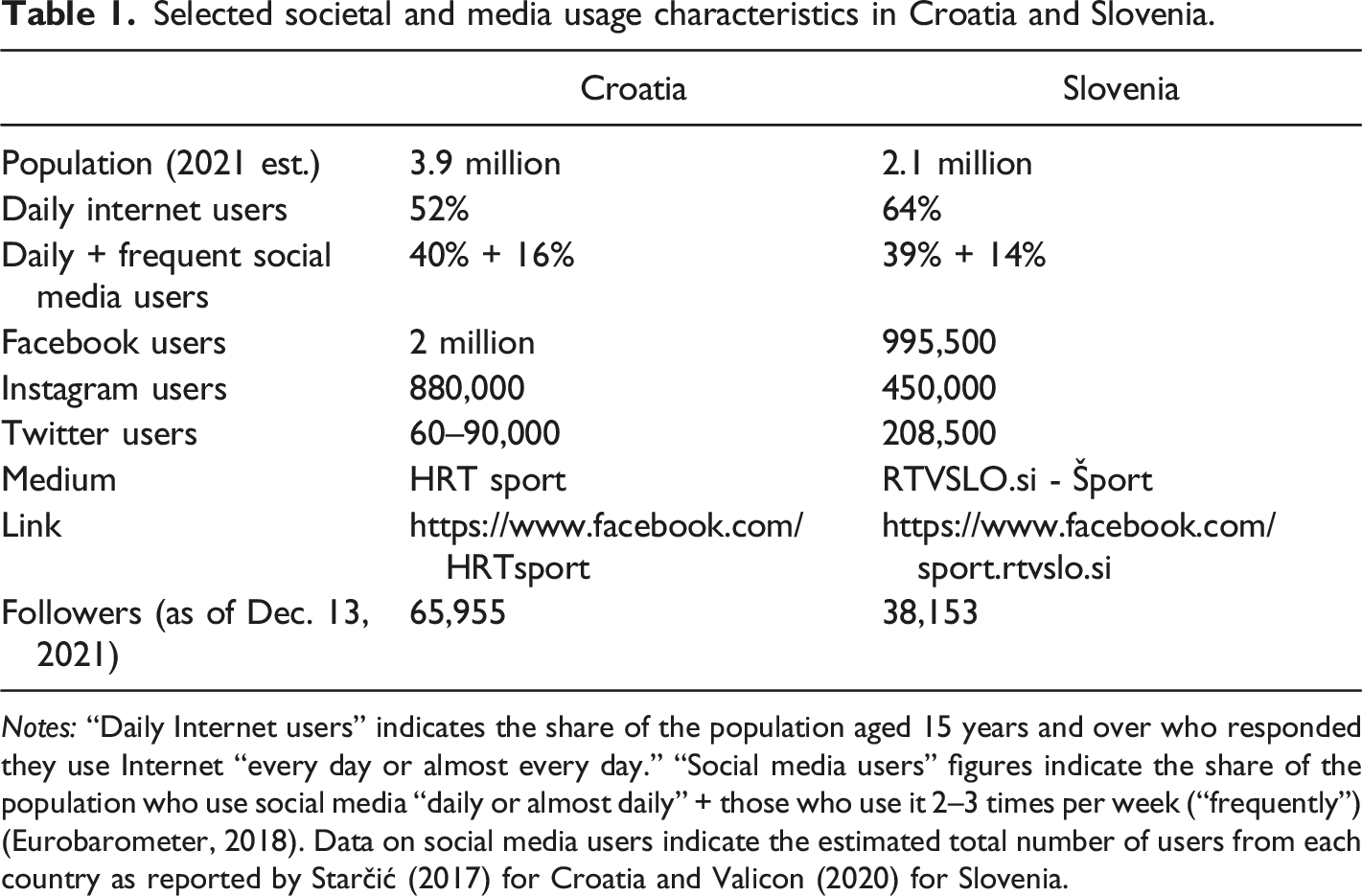
Notes: “Daily Internet users” indicates the share of the population aged 15 years and over who responded they use Internet “every day or almost every day.” “Social media users” figures indicate the share of the population who use social media “daily or almost daily” + those who use it 2–3 times per week (“frequently”) (Eurobarometer, 2018). Data on social media users indicate the estimated total number of users from each country as reported by Starčić (2017) for Croatia and Valicon (2020) for Slovenia.
Data were collected during the 17 days of the Olympic Games between July 23–August 8, 2021. This is consistent with other studies on Olympic media that captured data on the days between the opening and closing ceremonies (e.g., Billings, 2008). Discarded were posts not related to the Olympics (e.g., items on domestic competitions or international soccer). This selection yielded 572 posts: 275 for HRT Sport and 297 for RTVSLO.si - Šport.
Two researchers wrote brief research entries for each post that included the name of the athlete or team in focus, the event and stage of competition, the main news content (the journalistic “what”), and any multimedia elements included in the post. Based on these descriptions, we categorized each post with regard to the “primary content” of the stories using the typology originally developed for the International Sports Press Survey (Schultz-Jorgensen, 2005; Horky & Nieland, 2013). Two pilot studies were conducted prior to data collection in which two researchers independently analyzed a full day of posts on both platforms. At this stage, we conducted a deductive analysis based on the typologies in the literature. Given the specific context (i.e., social media, Olympic coverage, and structure of PSM), we were also attentive to news types that emerged inductively from the data.
Initial results were too fragmented due to the breadth of the classification, which includes 20 categories, so the typology was narrowed down to four categories: “sporting contests and previews” (encompassing results/match reports, competition previews, as well as broadcast previews since these were often referenced in competition previews); “general news” (e.g., generic information about the Olympic Games, opening and closing ceremonies, news about the COVID-19 pandemic); “human interest” (e.g., stories about athletes overcoming obstacles, insight into different cultures, stories connected to the Games but unrelated to athletic competitions); and “sport and politics.” One researcher coded all data to ensure consistent coding. A second researcher reviewed the data and organized (recoded) them into the typology presented in this analysis. All researchers (authors) collaboratively analyzed and interpreted data. For multimedia elements, we identified general usage and editorial patterns rather than quantifying each element per post, as typically used in media research (see Rojas-Torrijos & Ramon, 2021). This approach allowed us to be attentive to both content and context of the news story, and observe patterns regarding how multimedia elements complement content and specific news types
Findings based on the Facebook posts are presented as qualitative data. They are not intended to provide a systematic descriptive analysis of content or discourse as often employed in social media research in communication and sport (Hardin, 2014). Rather, we use the output (i.e., content) as an entry point to gain insight into the mediatization process of the Olympics in the region. All three authors share (to varying degrees) an “insider” status in terms of the national, regional, cultural, linguistic, and professional contexts analyzed here, which informed the analysis. Our primary concerns are the theoretical implications of how multimedia features and content reflect the interconnectedness of sport, politics, and the remit of PSM in this geographic and societal context.
Findings
Sporting Contests and Previews
Content pertaining to the competitive aspect of the Olympic Games comprised the vast majority of posts on both Facebook pages: 86% on Croatia’s HRT Sport and 93% on Slovenia’s RTVSLO.si - Šport, combining for approximately 90% of all content. Included in this category are competition previews, results, and score updates (both during and after competition), match recaps, quotes, and interviews with athletes and/or coaches about the competition, and medal ceremonies, especially those featuring athletes from the medium’s “own” country. Both posted competition news largely as short-text teasers with links to articles published on their websites. Presentation modes also included photos or clips also used on radio or television channels, and short features or interviews with medal winners recorded at airports or at receptions in their hometowns. RTVSLO.si - Šport also published graphics and transcripts of clips from their studio show (Kaja Jakopič, personal communication, January 31, 2022).
The heavy emphasis on competitive news and updates reflects the traditional priorities of sport journalism and broadcasting that have earned them the moniker of being the “toy department of the news media” (Rowe, 2007, p. 385) due to their focus on descriptive reporting. Videos and links generate content and data that feed back into the mediatization cycle. Both broadcasters tried to integrate electronic media content with social media, especially to hype performances by their country’s athletes. Such multimedia cross-promotion of Olympic content might be an attempt by PSM to capitalize on a prestigious (but increasingly uncertain) media property and alleviate the “increased competition and fragmentation of audiences” that is part of the digitalization process (Broughton Micova, 2021, p. 235). It is also likely prompted by limited staffing: RTV Slovenija’s crew in Tokyo included only one journalist tasked specifically with publishing content on its MMC web portal (Služba za komuniciranje RTV Slovenija, 2021), while eight other journalists (some on split appointments) and a single social media editor who oversaw all social media publishing operated remotely (Kaja Jakopič, personal communication, January 31, 2022). Both broadcasters simply lack resources to invest into the development of new and original formats.
General News
General news posts conveyed announcements about, for example, the opening and closing ceremonies. The Facebook pages followed their nation’s athletes closely during both. RTVSLO.si - Šport published six items pertaining to the opening ceremony, including one about flagbearer Bojan Tokić that included the following soundbite: Our apartment building may be one of the most recognizable. We share it with the Serbs. Đoković is here, Dončić is here...We are on the 15th floor, the Serbs are on the fourth and fifth floor. In between are some exotic national teams, but Balkan music resounds from above and below. I think other national teams also sing these Balkan hits (RTVSLO.si - Šport, 2021).
While not necessarily a prime example of mediatization, this quote is worth unpacking for the national complexity it entails. Slovenia’s male flagbearer Bojan Tokić was born in Bosnia and moved to Slovenia in 1992, early in the Bosnian War of 1992–1995, aged 11. He continued representing Bosnia-Herzegovina internationally until 1995, but later relinquished Bosnian citizenship sometime after obtaining a Slovenian passport (Plestenjak, 2017). Tennis player Novak Đoković is indeed a Serbian national, while basketball star Luka Dončić is a third-generation Serb born in Slovenia. Tokić’s unprompted reference to “exotic national teams” (cf. Ličen & Billings, 2013) and the ethnic and national mish-mash of the individuals he mentioned as being united by the same culture made for a curious soundbite on an outlet that spent an Olympic fortnight hyping the nation whose flag Tokić bore.
HRT sport stood out with content that could be categorized as “public service.” For example, it published a link to a news story about the heat in Tokyo affecting athletes, and specifically tennis players, who were scheduled to play in the middle of the day despite the extreme heat and humidity. (Croatia fielded six tennis players.) Tokyo’s summer climate was known to be likely to pose risks for athletes and spectators, especially at outdoor events—the 1964 Olympic Games were held in October—but the International Olympic Committee had stipulated that the 2020 Olympics should be held between July 15 and August 31 to accommodate global broadcaster needs and ensure their prime-time viewer leadership (Foster, 2018).
Even though the Games occurred during a global pandemic, Facebook content rarely addressed the issue directly. Rather, references happened as contextual factors in other articles, posts, or interviews. For example, Slovenian medal-winning judoka Tina Trstenjak and her coach discussed in an interview how the pandemic affected their preparations for the Olympics, while Croatian water polo athlete Paolo Obradović said playing a fifth-place game “in a Covid situation” is pointless. More generally, the subject was mostly avoided and only mentioned when an athlete or coach from another country tested positive for COVID-19. Notably, missing were informational posts or articles about the state of the pandemic in Tokyo. The absence of pandemic-related updates vis-à-vis the dominance of competition updates confirms that coverage of mega-events (and coverage of sport more generally) often lacks critical, contextual reporting (Horky & Nieland, 2013).
Human Interest
The “human interest” category was designed to capture the ancillary stories very often produced during the Olympic Games and other mega-events (Billings et al., 2018). Their presence on PSM Facebook pages, however, was limited. HRT provided cultural and educational content related to Japan. Posts included links and content about kabuki theater, the Tokyo Bay, the Hama-rikyū Gardens, and the Edo-Tokyo Museum. RTVSLO.si - Šport published human interest content about gymnast Simone Biles’ mental health issues. Coverage about these topics was objectively impeded by coronavirus countermeasures, as a Croatian reporter mentioned in a feature that the organizers held a lottery each day to determine which media organizations can travel and visit select locations outside the “Olympic bubble” (see also International Olympic Committee, 2021a). The pandemic severely disrupted the work of journalists and broadcasters, likely driving them to rely even more than usual on competition-related news. When present, these posts received minimal engagement (only a handful of “shares”) compared to the hundreds or even thousands of reactions to medal wins. HRT’s pursuit of these stories confirms its dedication to the values of information and education traditionally attributed to PSM (Marko, 2021) even as mediatization in sport continues to grow.
Sport and Politics
PSM in this study published virtually no Facebook content about the political implications of the Games. However, some posts about individual athletes became politicized in a way that reflects the relationship between nationalism, sport, and mediatization. In addition to the common politicization of athletes’ success as reflecting that of the nation (Billig, 1995), at least two cases sparked contentious debates about regional political history and prompted additional media content (posts, articles, studio and discussions) about these very cases. Exemplars of the amplification of nationalistic drama in each country are the cases of Matea Jelić in Croatia and the national basketball team in Slovenia.
After winning a gold medal in taekwondo on July 26, Matea Jelić stated she was proud to be Croat and wanted to celebrate the accomplishment on Victory Day as it is a special day for her. Jelić (born 1997) is originally from Knin, a city in Croatia that was captured by Serbian forces in October 1990 and was reclaimed by Croatian forces during Operation Storm (Operacija Oluja) 1 in the Croatian War of Independence on August 5, 1995. The date is now marked as Victory and Homeland Thanksgiving Day and the Day of Croatian Defenders, a national holiday, and Jelić’s stated wish to celebrate the gold medal then inspired a host of chauvinistic comments on social media. Serbian media interpreted her comment as a provocation and an expression of national intolerance, while Croatian media described it as patriotic and an expression of national pride. Comments on both sides were infused with ethnic nationalism (Smith, 1991) and reminiscent of media dialogue in the 1990s, when sporting accomplishments were celebrated primarily as a victory for the nation and political battles were often fought on athletic fields (Bartoluci, 2013). Reactions to Jelić’s comments prompted additional posts by HRT Sport, which in turn resulted in further thousands of reactions by followers.
Slovenia’s men’s basketball team played unexpectedly well; its indisputable star was NBA standout Luka Dončić, and several Slovenian personalities made comments on social media that could be interpreted as disparaging to other team members (e.g., “On this team, even [Luka] Rupnik and [Žiga] Dimec play well,” posted by a former state secretary in the Ministry of Education and Sport; T. O, 2021). An online article published on RTV Slovenija’s MMC website combined some such comments with the sarcastic social media responses by some players (T. O., 2021). This article, and RTV Slovenija’s link to it on Facebook, garnered hundreds of responses, many of which called for national unity and pride during the team’s successful run. Moreover, the venue (social media) where these exchanges between public figures—a state secretary and a prominent newspaper editor on one side, Olympic national team members on the other—occurred indicate an evolution in public discourse. In the past, both politicians and journalists dialogued with athletes either in formal settings (official receptions, interviews) or privately. This may be the first prominent case in Slovenian sport of celebrity exchanges on social media eliciting significant public response.
More generally, a common characteristic of HRT and RTVSLO’s Facebook coverage was the celebration of the performances of domestic athletes. HRT Sport used capital letters to celebrate two tennis pairs from Croatia, facing each other in the men’s doubles final, while RTVSLO.si - Šport framed medals won by cyclists Primož Roglič and Tadej Pogačar as accomplishments for the nation. Posts about medals of the home nation athletes had by far the highest engagement numbers, reaching thousands of “likes.” To generate engagement among followers, RTVSLO.si - Šport asked trivia questions such as, “Who won the first Olympic medal for Slovenia since the country’s independence” and “When did Slovenia win the European Championships in basketball?” 2
The celebration of perceived national triumphs and reliance on them to cater to media audiences is not a new phenomenon in this region (Bartoluci & Doupona, 2020; Ličen & Billings, 2013). Rather, it seems to be a mediatization-inspired extension of patriotic/nationalistic media dialogue to public service digital media. On these occasions, it proved successful, as the posts about Jelić and trivia questions about the first medal and basketball victory attracted hundreds or even thousands of likes and comments.
Discussion and Conclusion
This comparative analysis of PSM’s usage of sport-specific Facebook pages during the Olympics supports the notion that the mediatization of sport takes on specific characteristics even within similarly structured media systems. We observe three distinct characteristics of mediatization in Slovenia and Croatia: (1) Mediatization of sport is delayed, as PSM did not stream additional content beyond what was televised and produced minimal new formats that fit digital media; (2) mediatization facilitates event-focused and largely decontextualized sport content; and (3) the proliferation of pro-national media, as PSM continue to emphasize “home” athletes and promote a patriotic narrative. With regard to the roles traditionally ascribed to public media (Raboy, 1997), both corporations used Facebook to provide some form of entertainment and (incomplete) information, but minimal education. The heavy focus on the “home” nation that is characteristic of traditional media (Billig, 1995) extends to social media but hardly ensures “an open and free discussion” of sports questions in the public interest (Zakon o Hrvatskoj Radioteleviziji, 2010, art. 9). Rather, in the era of digitization, PSM offered a narrative that aligned with the existing conservative political climate in both countries (Bartoluci, 2013; Milosavljević & Poler, 2017).
The mediatization of sport in this region is situated within broader political and economic transitions that have shaped the structure of media systems. Thus, digital platforms are not merely an additional site of content, but serve as indicators of innovation and/or struggle in relation to complex social processes within the region. These differences can be attributed to a complex set of factors including historical processes, varying staffing, resources, professional and creative potential, political and economic structures, and scope of the digital platforms of each respective PSM organization (Castro Herrero et al., 2021; Peruško et al., 2021). An HRT reporter stated that their web and multimedia desk was independent in their editorial decisions but significantly limited in their content creation by the (limited) rights that had been purchased, as digital rights were sold separately (Marija Žužak, personal communication, February 25, 2022). Still, it is unclear how effectively HRT and RTV Slovenija could use additional streaming content (or how adequately staffed and creative they are to capitalize on the opportunity) even if they were able to secure a broader rights package. MMC RTV Slovenija’s technical staff worked overtime to produce video clips for publication on social and digital media (Kaja Jakopič, personal communication, January 31, 2022), suggesting personnel were stretched to their limit.
An example of mediatization “delayed” is the adoption by both desks of content formats that are typical for the medium. These included short text with multimedia (photo or video) content, links to articles on their websites, and graphics used across social media. Neither desk developed new formats that would capitalize on the specifics of the platform (e.g., Facebook-only shows like BBC News’s Cut Through the Noise) and, thus, substantially change professional practices in response to evolving media and society. A contributing factor to this may be the absence of an institutional relationship with Meta Platforms, Inc., as the technology conglomerate that owns the platform. In the past, Facebook was able to assist with technical issues (e.g., combining accounts) but did not engage in programmatic networking and collaboration (Kaja Jakopič, personal communication, January 31, 2022). RTV Slovenija’s Acting Editor of New Media Kaja Jakopič attributes this to Slovenia’s small size, which makes it unappealing for collaborative initiatives (personal communication, January 31, 2022). Given the similar context, the same is probably true for Croatia.
This analysis provides preliminary insight into the mediatization of the Olympics in the region. Missing from it is an in-depth analysis of how users engaged with the content. We noticed occasional peaks in engagement (especially in connection with national athletic triumphs), but limited content co-creation (cf. Hepp, 2020). A broader methodological approach might yield more detailed information on whether followers’ engagement fed back into broadcasters’ content and account for PSM’s multi-platform strategies in the contemporary networked media environment (Donders, 2019). Future studies should examine other countries in the Western Balkans and CEE to identify regional patterns: the media and sport systems in the region are heterogeneous and warrant additional comparative analyses (Castro Herrero et al., 2017; Peruško et al., 2021). Another aspect worth examining in much greater depth is how PSM promote national identification through sport content on social media. Finally, to ensure an adequate cross-national comparison, we only examined the dedicated sport-specific Facebook pages of each PSM, but not the Facebook pages of their sub-entities (e.g., radio Val 202’s). Those outlets may have produced other types of content and formats that were not captured in this study.
The findings presented in this manuscript shed some light on the function of public service media—and their digital platforms—in the region. PSM in the Western Balkans and CEE face challenges including politicization and the influence of political ideologies, commercial pressures, lack of journalistic professionalism, and low audience ratings (Castro Herrero et al., 2021; Milosavljević & Poler, 2017; Połonska & Beckett, 2019). These manifest in coverage of sport, as well: RTVSLO.si - Šport’s cover photo during the 2022 Winter Olympics in Beijing included the hashtag, #ThisTooIsPSM (orig. #tuditojejavniRTV).
When trying to answer Castro (Herrero et al., 2021) question on “which is the right way forward” for public service broadcasters (p. 19), scholarly analyses should take into consideration how the mediatization of sport perpetuates problems. Changes in media happen in eruptive moments or waves (Frandsen, 2020), and political and economic circumstances are precisely the factors that enable and accelerate the mediatization of sport. This study suggests PSM in Croatia and Slovenia are currently only partially fulfilling their mission and potential. In a more optimistic outlook, we might ask: Is it possible to envision a situation in which sport coverage can drive broader structural changes to public service media? Sport attracts audiences which, in turn, attract revenue (see Milosavljević, 2021). It can also provide information and education, in addition to entertainment (see Billings, 2008; Ličen & Billings, 2013). To fully accomplish its mission, PSM in Croatia and Slovenia would need more resources, a greater intake of new ideas—and probably less interference.
Footnotes
Declaration of Conflicting Interests
The author(s) declared no potential conflicts of interest with respect to the research, authorship, and/or publication of this article.
Funding
The author(s) received no financial support for the research, authorship, and/or publication of this article.
