







Abstract
In this study, we seek to understand how Turkish female athletes who are active on Instagram experience cyber violence, the cultural context of that violence, and the ways in which athletes negotiate and struggle with violence via a critical feminist approach. We analyze data obtained via individual, in-depth interviews with 15 athletes using the thematic analysis method. The findings show that active use of Instagram brings with it experiences of cyber sexual harassment and online and offline stalking. Turkey’s neo-conservative, religious, and patriarchal gender regime does not allow the interviewees to post freely on Instagram. Findings also reveal the presence of digital emotional labor, which is an important part of the athletic labor of femininity, in the struggle of participants to use Instagram as their own safe and free space. Consequently, although the participants have a fear of being exposed to violence in the real world due to their cyber violence experiences, or even fear death from time to time due to their Instagram posts, they nevertheless strive to use this space freely and break the control over their bodies.
Introduction
In the world and in Turkey, female athletes are increasingly present on social media platforms with every passing day. Unlike traditional media, female athletes can oppose traditional representations by means of social media platforms, claim control of their own representations, advertise and promote themselves, improve their brand images, present different aspects of their lives, and use these platforms as opportunities for self-love, self-disclosure, and self-empowerment (Bruce, 2016; Geurin, 2017; Geurin-Eagleman & Burch, 2016; Toffoletti et al., 2021a, 2021b, 2022, Toffoletti & Thorpe, 2018a, 2018b). On the other hand, it is widely recognized that social media provides space for the unregulated physical and sexual abuse of female athletes in a way that traditional sports media does not (Litchfield et al., 2016).
Western voices have previously described how female athletes make use of social media (Geurin, 2017; Thorpe et al., 2017; Toffoletti & Thorpe, 2018a; 2018b; Toffoletti, Thorpe, et al., 2021; Osborne et al., 2021). These studies revealed the opportunities and risks that social media presents for female athletes. However, in Turkey, research addressing representations of women via social media is both limited and new (Kavasoğlu & Koca, 2022). We need further studies to understand the opportunities and challenges of using social media for female athletes from Turkey and room for their voices must also be made. Turkey is a country with different cultural, political, and social foundations in comparison to Western contexts. At the same time, although Turkey is a Muslim country, it is a secular state with a privileged position compared to other Muslim countries in terms of women’s rights. The fact that religious patriarchal codes are more prevalent in Turkey, compared to Western cultures, while women in Turkey have more modern and free lives, compared to other Muslim countries, makes Turkey a special field of study. It is very important to understand female athletes’ experiences of using social media within their specific social and cultural contexts. Therefore, the present study focuses on social media usage motivations and experiences of cyber violence among female athlete university students in Adana (Sungur, 2011), a city in Turkey known for its patriarchal masculinity. As we try to understand the cyber violence experiences of athletes in the context of gendered relations of power in Turkey, we benefit from a critical feminist approach.
Normalization of Violence in Turkey
In this research, we refer to Foucault’s conceptual framework to understand the control over women’s bodies and sexuality and the cultural and political norms for disciplining women in Turkey. In addition, we use the term “normalization of violence,” as suggested by Kandiyoti (2016) in a Foucauldian sense, to question the de facto existence of the major gap between laws aiming to protect women’s rights and the actual practices in Turkey. As is well known, many of Foucault’s (1977, 1978, 1980) theoretical concepts have served to advance our insights into disciplinary power and the cultural production of normalized bodies (and subjectivities) in the modern era. His concepts provide opportunities for understanding the docile female bodies (and subjects) that are regulated, controlled, and ultimately normalized by disciplinary power (1977, 1978, 1980).
According to Foucault (1980), power relations are multitudinous, are exercised in specific contexts, and circulate within society. Furthermore, power relations are a process that operates through bodies: “power relations have an immediate hold upon [the body]; they invest it, mark it, train it, torture it, force it to carry out tasks, to perform ceremonies, to emit signs” (Foucault, 1977, p. 25). Kandiyoti (2016) uses the term “normalization” in the Foucauldian sense to refer to social processes that transform ideas and actions into taken-for-granted “natural” realities. An investigation of how these processes play out in the case of gender-based violence may highlight useful points of entry for a broader exploration of the suspension of the rule of law and operations of impunity more generally.
Kandiyoti (2016) emphasizes the “normalization of violence” in recent political discourses and practices in Turkey in relation to neo-conservative gender discourses and policies. The threefold increase in femicides in the last 10 years in Turkey confirms the urgency of this analysis. According to 2021 data of the “We Will Stop Femicide Platform,” 280 women were killed by men in Turkey and 217 women were found “suspiciously dead.” In the 280 confirmed murders, 33 of the victims had previously filed a complaint with the police or the prosecutor’s office or had a protection order.
Feminist studies, conducted with a Foucauldian approach in Turkey, have revealed that women’s bodies and sexuality are regulated and controlled by various neo-conservative, religious, and patriarchal discourses and practices including honor, morality, shame, and sin. These studies emphasize the political transformation experienced in the last decades when talking about the social position of women (Coşar & Yeğenoğlu, 2011; Güneş & Ezikoğlu, 2022). In this transformation, the transition from Western and modern Turkish images of women to the traditional conservative view of women is evident, and discourses on gender (in)equality and misogyny have also increased (Güneş & Ezikoğlu, 2022). The neoliberal, religious-conservative sociopolitical climate intensifying in Turkey in this new period has led to the consecration of women’s roles as wives and mothers and to a significant increase in practices of regulation and control over their bodies and sexuality (Acar & Altunok, 2013; Cindoglu & Unal, 2017; Güneş-Ayata & Doğangün, 2017).
According to Atuk (2020), high rates of gender-based violence and sexist political rhetoric are other central features of contemporary Turkey. She argues that the politics of “woman making” are central to “the politics of woman killing.” In connection with this, Muftuler Bac and Muftuler (2021) report that increasing numbers of women in Turkey are being murdered by their relatives, spouses, or significant others. Perpetrators plead provocation for their crimes, claiming that their actions were responses to the women’s initial acts, which they deemed to violate societal norms. Pleading provocation facilitates more lenient sentences. It is argued that legal rulings on femicide reflect societal norms and traditional expectations of women’s roles in Turkish society via the provocation defense. Consequently, the legal system becomes complicit in femicide through provocation; and provocation could be seen as the system’s concession to patriarchy (Muftuler-Bac & Muftuler, 2021).
We maintain that the sociopolitical transformation occurring in Turkey in recent years has deepened women’s experiences of violence in all public and online spaces. According to the results of an electronic survey sent to 18,000 women via Facebook, within the scope of a Turkish study titled “Another Form of Gender-Based Violence: Cyber Violence”, approximately 6 out of 10 women stated that they were exposed to cyber violence. The most common examples of cyber violence against women were unwanted messages, the sending of sexually explicit messages, and the following of profiles. Seven out of 10 women participating in the study stated that they did not feel safe while using the internet (Temur Şimşekcan, 2018). Both international and national data indicate that young people are most affected by digital violence (Şener & Abınık, 2021, p. 4; PEW, 2021), and data show that women are exposed to more digital violence than men, especially in terms of online harassment (EIGE, 2017; UN, 2015; UN Women, 2020; Şener & Abınık, 2021).
Offline and online violence are the results of gender relations of power. Therefore, cyber violence disproportionately affects and targets girls, women, and individuals with non-heteronormative sexualities (Backe et al., 2018). For this reason, it is necessary to pay more attention to the gender-based dimensions of cyber violence. Moreover, online violence is an extension of offline violence; it overlaps with offline violence and can occur simultaneously (Backe et al., 2018). That is why the “experience of not feeling at home in the world” for women (Ahmed, 2018, p. 28) has been compounded with the experience of not feeling at home or safe in the online world. In this context, in the present study, we focus on the cyber violence experiences of 15 female Turkish athletes who are active on Instagram. We aim to understand the reasons for their experiences of not feeling at home on Instagram in the context of gender-based power relations in Turkey.
Female Athletes, Social Media, and Cyber Violence
Studies analyzing the social media usage of female athletes showed that these platforms provide many benefits for athletes, such as the ability to interact with their fans, promote themselves and their sports as they wish, or pursue sponsorship opportunities. On the other hand, these studies also revealed that social media platforms may be disempowering and oppressive, make female athletes feel vulnerable, and foster their maltreatment (Geurin, 2016; 2017; Kavanagh et al., 2016; Kavanagh et al., 2019; Litchfield et al., 2016; Toffoletti, Thorpe, et al., 2021).
Since gender-based power relations are complex, it is important to understand the experiences of cyber violence specific to the gender regime of sportswomen and ways to combat it. For example, while Western sportswomen are exposed to forms of cyber violence such as racism, sexism, homophobia, misogyny, sexual harassment, physical threats, and sexual propositions (Kavanagh et al., 2019; Litchfield et al., 2018; Osborne et al., 2021), sportswomen in Muslim countries may struggle more often with religious patriarchal norms (Kavasoğlu & Koca, 2022).
Rahikainen and Toffoletti (2021) applied the theoretical framework of the “athletic labor of femininity” to explore sportswomen’s decision-making processes in producing social media content by interviewing 27 sponsored female climbers and 5 industry professionals. They also followed the public Instagram accounts of over 250 sponsored female climbers, and took screenshots relevant to various topics of gendered practices between 2016 and 2020. They explored the forms of digital labor that these women used to manage their viability online while attempting to keep themselves safe and avoid negativity and criticism. They also discussed the experiences of these female climbers in attempting to avoid online arguments with the concept of “noncontroversial demeanor”, emphasizing that this is an important type of digital emotional labor. Their findings complemented and built upon the framework of the “athletic labor of femininity” to argue that digital labor involves more than just aesthetic labor to craft an image of sporting femininity with market appeal (Rahikainen & Toffoletti, 2021). The present study further builds upon such previous research in exploring the digital labor forms of female athletes in their efforts to be visible on Instagram despite cyber violence and neo-conservative, religious, and patriarchal pressures.
This study is the first to analyze the cyber violence experiences of female athletes in Turkey, and we aim to answer the following questions: What are the gender-based cyber violence experiences of young female athletes from Turkey? How do religious-conservative and patriarchal norms in Turkey control and regulate their visibility on Instagram? How do they deal with and negotiate threats of violence online and offline?
Methods
This study draws on in-depth interviews conducted with 15 female athletes who were students in Çukurova University’s Faculty of Sports Sciences, in Adana, Turkey, to understand their experiences of cyber violence, the Turkish context of that violence, and the tensions experienced by female athletes while representing their athletic bodies on Instagram. We applied a critical feminist perspective (Birrell, 2000) in this research to unpack cyber violence and its relationships with gender, privilege, and power in Turkey.
None of the authors were insiders in the context of this study, but all authors are former athletes and actively use Instagram as part of their daily lives (the first author also uses it within the context of academic research). The first author conducts research on female athletes and social media, policies toward the female athlete body, and experiences of women and LGBTI + individuals in sports using feminist methodology. The second author studies topics such as entrepreneurship and women’s entrepreneurship in sports from marketing and management perspectives. The third author examines issues including child abuse in sports, female athletes, and gender-based violence from the perspective of sports management. As cisgender, middle-aged, and middle-class Turkish women, all three authors recognize their visible and privileged positions in sports, exercise, and digital culture (Toffoletti, Olive, et al., 2021). Being aware of that, our research is nourished by a feminist perspective that enables us to highlight the lived experiences and perspectives of young sportswomen with different ethnic and cultural backgrounds and active exercise lives, and to listen to their distinct voices (Toffoletti, Olive, et al., 2021).
Information of The Participants.
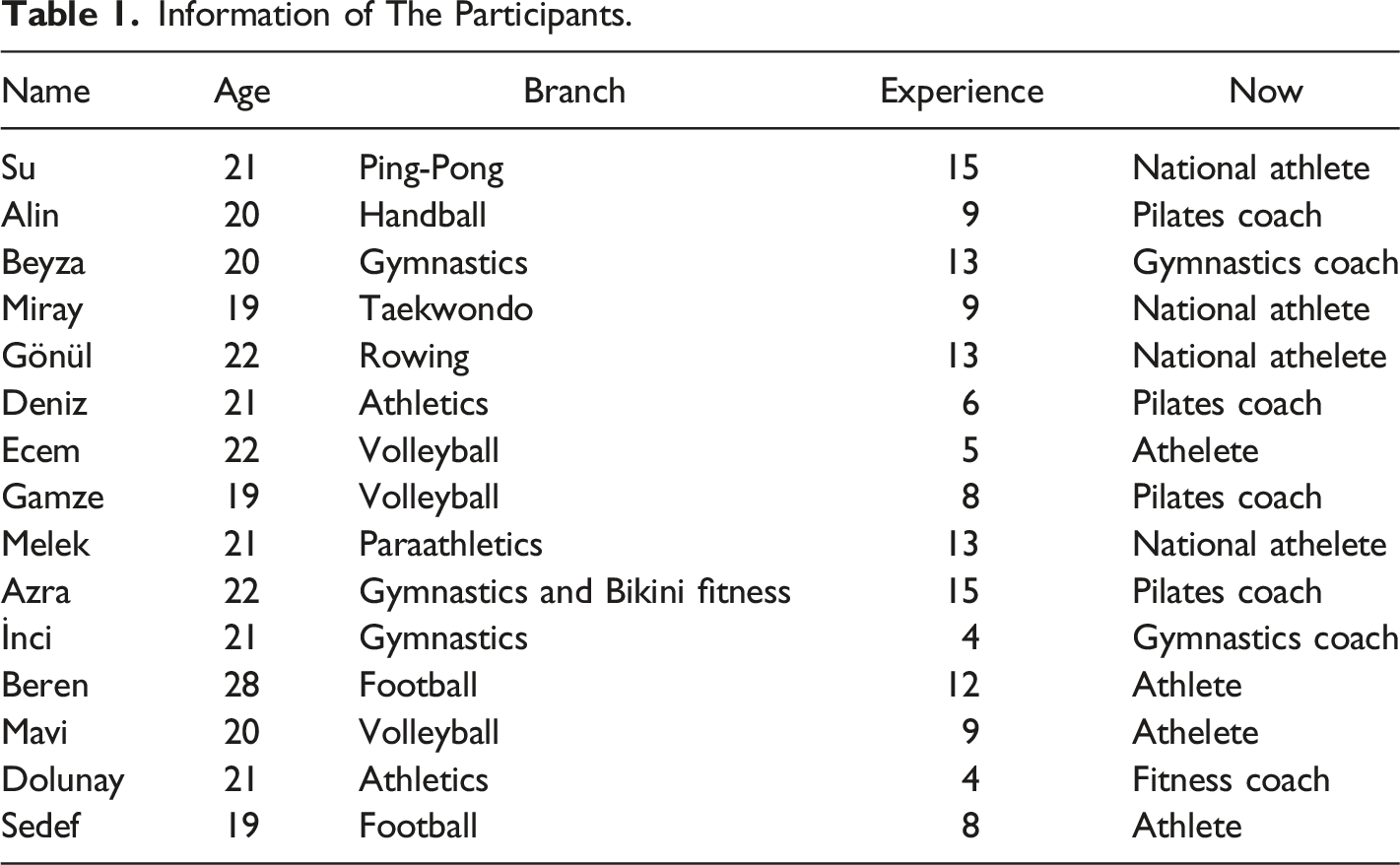
At the time of the interviews, all of the participants were students at Çukurova University in the Faculty of Sports Sciences, and they were all active on Instagram. All of them had competitive athletic backgrounds; some were continuing their careers as athletes at the university level, while others aimed to become academic experts in the fields of sports and exercise. More specifically, the following women participated in this study: Su was a table tennis player at the national level, and her participation in sports was ongoing at the time of our research. She had won medals in national and international competitions and also competed with the university’s team. Miray was a national taekwondo athlete who had won championships in Turkey and internationally. She was still participating in competitions at the time of the interviews. Didem was a national rowing athlete, a champion in both Turkey and the Balkans, with the goal of earning medals in the upcoming European and world championships. She was also pursuing a spot in the 2024 Olympics. Ecem and Mavi were volleyball players from the university’s team. Gamze was a former volleyball player who worked as a Pilates instructor when we spoke. Melek was a national para-athlete still engaged in sports events. She was a champion athlete who broke the Turkish record in her field and ranked third in the world. Azra was a national bikini fitness athlete. While continuing to pursue sports herself, she also worked as a fitness trainer. Sedef played football (soccer) in the Turkish Football Sports League and was also a team athlete at the university. Dolunay and Deniz were former athletes who participated in national competitions and were both working as fitness trainers at the time of our interviews. Beyza and İnci were interested in gymnastics as a recreational activity and were both coaching children’s gymnastics lessons. İnci also took dance lessons and participated in social dance nights with the aim of improving her skills and participating in more dance competitions. Alin was a former competitive handball player who became a Pilates and yoga instructor. Beren was an athlete who had previously played football in the Turkish Women’s Super League and was a tennis coach at the time of the interviews. Generally speaking, the participants were mostly athletes interested in competitive sports, with some continuing in those fields and some leaving those fields to pursue other goals. All of the participants who were not actively pursuing sports careers at the time of this research were working as part-time coaches in branches of sports including children’s gymnastics, Pilates, yoga, fitness, and tennis. They also often reported a desire to become experts in the sports and exercise industry after graduation. Those who were actively engaged in sports themselves and those who worked as part-time coaches were posting on social media to convey their physical abilities and performances. In this study, we focus on the cyber violence experiences of these young women who were active on Instagram at the time of our interviews. Differences among the sports pursued by these women as they represented themselves on Instagram were not considered. The common experience across all branches of sports was exposure to cyber violence and so we sought to explore which types of cyber violence these athletes were exposed to and how they dealt with it in the context of actively presenting their athletic activities on Instagram.
Adana was chosen as the study area because it is the city in which the authors responsible for conducting the interviews reside (first and second authors) and because it is widely known for its culture of patriarchal masculinity (Sungur, 2011). We chose to work with students in the Faculty of Sports Sciences as this faculty has very active female students who regularly go to gyms as both athletes and coaches on top of their academic work. As a result, they are present on social media with multiple identities as athletes, coaches, and students.
We began all interviews with questions about the purposes and motivations for social media usage. We then asked questions about messages and comments that bothered them, the reasons, and their feelings and reactions to them. We also asked questions to understand their views on the causes of those cyber violence experiences, such as the gender regime, religious patriarchal norms, or traditions. Finally, we asked about their strategies for dealing with cyber violence. During the interviews, with the participants’ permission, we looked at some of their Instagram posts with them, using the social media scroll-back method (Robards & Lincoln, 2017; Toffoletti, Olive, et al., 2021). While doing so, we talked about the meaning of their poses and clothing choices in some posts, what they particularly paid attention to in those posts, and the messages and comments in reply to the posts that inspired them or made them feel bad. These interviews allowed us to obtain rich and interactive data and more deeply understand the cyber violence experiences of the participants. All interviews were recorded and transcribed, and participants were assigned pseudonyms.
All three authors separately organized the data manually into different numbers of categories (7, 9, and 10, respectively) including the topics of routines, motivations, empowerment, opportunities, supportive fan interactions, body control, religious patriarchal and conservative violence, types of cyber violence, knowledge and awareness of cyber violence, tensions, strategies of struggle, resistance, and submission. Religious, patriarchal and conservative violence, and cyber sexual harassment emerged consistently across the categories. The same consistent repetition was related to categories of participants’ responses to their experiences of cyber violence. The analysis of the data included repetitive readings that allowed us to identify themes within categories, create categories, and conduct a more detailed analysis that yielded the main themes (Braun & Clarke, 2006).
Findings and Discussion
Cyber Harassment and Online and Offline Stalking
According to the findings for this theme, the active representation of athletic bodies on Instagram is accompanied by cyber sexual harassment and persistent following. All of the participants stated that Instagram posts about athletic performance lead to harassment, including expressions of sexual desire from male followers. They also stated that they were subjected to persistent following for years, from time to time, from fake accounts. This persistent following was not always limited to Instagram and could move into the “real world.” They emphasized that persistent stalking, which started with cyber harassment and extended into the real world, created periods of psychological trauma, paranoia, and fear in their lives.
The participants believed that as their visibility on social media platforms increased due to high numbers of followers, the use of public accounts, posting almost every day, and/or frequently posting about sports and exercise, they became more exposed to cyber violence: I wore shorts and a cropped sports top when I entered the race, and I shared it as a story before the race. A boy said Wow, some mothers do ‘ave ‘em. You’re a slick chick. Let’s screw. Your ass is so beautiful, wow, I wanna hit it, I wanna sleep with you, you’re so cute, won’t you come to me? These are all guys. Someone wrote something, I’m so sorry, I don’t know how else to say it, but it was I want to fuck you (Melek). … I shared a splits pose. Someone wrote I want to tie you to a tree and fuck you. I was shocked when I read this. You can’t help being scared when you get comments like this. You think about who said this and wonder what kind of people there are around you (Alin).
All of the participants believed that all young women, like themselves, have experienced cyber violence. Beyza made sense of her own experiences by saying “I guess there’s no girl who doesn’t experience this.” They explained that they are now “used to” the sexually violent messages they receive via Instagram. The following statement from Dolunay helps us understand how the participants had normalized this violence: They say we can hold your hips and do some things with you, I want to lick that, I’ll masturbate good with you… they [make references to] oral sex, there are guys who send pictures of their genitals… They ask Which gym are you in while you’re doing this, I’ll stand behind you and I’ll do it for you… While walking outside on the street, we encounter similar statements, so I think we normalize it a little more when we also see it on Instagram (Dolunay).
The above quotation allows us to see what Kandiyoti (2016) conceptualized as the normalization of violence at work in daily political discourses and practices in Turkey. It is reflected here in the participants’ interpretations of the online violence that they experienced.
Our findings on this theme overlap with previous research revealing harassment and cyber sexual violence against female athletes (Demir & Ayhan, 2022; Geurin, 2017; Kavanagh et al., 2019; Litchfield et al., 2018; Osborne et al., 2021; Toffoletti, Thorpe, et al., 2021). However, the fact that the online violence and harassment experiences of our participants extended to offline realms, with the participants fearing the possibility of experiencing violence in the real world, sets our findings apart. Almost all participants emphasized that they felt uneasy on the street or in the gym from time to time, and they feared that online harassment could penetrate into their offline lives. This fear can be understood more clearly in light of the analysis conducted by Atuk (2020) on the concept of the speaking state. The speaking state authorizes the institutional practices that allow femicide and grants institutional legitimacy to acts of violence when they are framed as reactions to women’s improper gender performances (p. 288). Atuk (2020) emphasizes that hundreds of women are killed every year in Turkey, these murders can happen even when women are under legal protection, and legal verdicts may be in favor of men on the grounds that women have violated gender norms. We interpret this as a way of punishing women, and more specifically those who are not disciplined and do not conform to the gender regime regarding neo-conservative, religious, patriarchal, and traditional norms.
Litchfield et al. (2016) show how social media provides space for the unsupervised physical and sexual abuse of female athletes in a way that traditional sports media does not, helping us to further understand the experiences of the participants of the present study. All participants had experiences of harassment and persistent stalking from social media expanding into the public sphere. For example, Mavi said that she received a message via Instagram that “terrified” her two or 3 years ago: someone took a photo of her house and sent it to her in a direct message, asking her “where have you been for the last days, why can’t I see you, I wish you would stop by that corner.” Mavi described the fear and trauma she experienced after that event in the following words: After that, I would call someone every time I went home. After 8 pm, either a friend or my father would take me to my home. If they couldn’t, I wouldn’t be returning home after that time. I mean, I never got on a bus or anything after 8 pm… Even though it was my own street, I would call someone and ask if they could talk to me on the phone until I got home, or I used to tell my mother to watch from the balcony, I used to tell her when I had entered the street. This was traumatic for me (Mavi).
A common pattern in the stories of our participants involved male followers who followed them on social media for years and disturbed them in public spaces, as well. Most participants said that they were bothered for long periods of time by people who saw them on Instagram and wanted to meet, date, or talk in person. The participants experienced serious uneasiness and psychological problems when followers revealed in Instagram messages that they knew the training days, times, and places of their victims: Even though I never answered him, I was terrified when he told me I will find you. At that time, I was training 4 days a week, and getting off the bus at 8 pm and walking home. It took me 3 minutes to walk home, but even then, I was getting nervous. Even walking on the street during the day, I was nervous. After a while, my parents would pick me up from the bus stop (Beren).
Among our participants, Dolunay had experienced the most insistent online and offline stalking and threats. She stated that she was harassed both online and offline by a male student from her faculty of study and she experienced physical violence. After that incident, she filed a criminal complaint. She emphasized that this is how she learned that cyber violence is a legal crime. She also explained that she had to change universities and move to a different city after that incident.
Our findings show that online stalking and the threat of violence extending from online to offline realms affected the sports routines of the participants. Dolunay mentioned that she had changed the route she took to go from training sessions to home and preferred a longer but seemingly safer route. Beren and Su, on the other hand, thought that these threats were reflected in their training performances from time to time: While I was in training, I was looking at the bleachers to see if he had come, I was paranoid. Sometimes this affected my performance in training, because I always had this fear in my mind (Beren). I’m scared that this will turn into violence in the real world. When I return home alone after training in the evening, I’m afraid and I always try to go with someone. That’s why I don’t want training that ends late. I want to go jogging in the morning, but when winter comes, it’s not bright out in the early hours, so I don’t go jogging. I want to jog at [a particular running park] in Adana, but it doesn’t feel safe to go alone in the morning or evening and I don’t go. These things can sometimes be reflected in my performance because when I feel anxious I can’t fully focus on training (Su).
The establishment of safe sports environments in Turkey will increase the participation of girls and women in sports and other physical activities. The results of previous studies conducted from gender-based and feminist perspectives in this country reveal that some women are not allowed to participate in physical activities because their families forbid it due to concerns about their personal safety (Koca et al., 2009). Therefore, safe streets, safe neighborhood environments, and safe sports facilities will play important roles in increasing the opportunities for girls and women to participate in physical activities and sports in Turkey (Koca, 2014; Öztürk & Koca, 2014). Within this particular theme of the present study, it can be seen that the relationship between digital and public threats of violence affected the participants’ activities and performances as athletes.
Our participants emphasized that they were careful about not tagging their locations in their posts because of the experiences and fears described above. Toffoletti, Thorpe, et al. (2021) stated that the participants in their study similarly avoided sharing pictures on Instagram that could reveal their specific locations or regions with the aim of protecting their safety. The participants of the present study also turned off the location information for their posts because they did not feel safe in public spaces in Turkey. As Kern (2021) emphasized in her book titled Feminist City, our participants were also afraid and felt the threat of violence while experiencing the city. In the context of Turkish society and sports, we can highlight the following as important and effective factors for the young female athletes we interviewed: In Turkey, women’s experiences of living safely and freely in cities is being increasingly restricted day by day, and women’s experiences of harassment, violence, and murder in private and public spaces (and the damaging influences of living among them) are also increasing (Acar & Altunok, 2013; Atuk, 2020; Kandiyoti, 2016; Tandogan & Ilhan, 2016). This is a major concern for athletes and for their families as well, and it raises the risk of women finding themselves unable to participate in sports and exercise. Moreover, online and offline harassment and threats are a significant risk for girls and women as they attempt to safely participate in all areas of physical activity and sports in Turkey (Kasfad, 2021), a country far from achieving gender equality in sports.
Neo-Conservative, Religious, and Patriarchal Cyber Violence
The findings of this study show that young female athletes are exposed to a unique form of cyber violence fueled by the dominant gender regime in Turkey. Within the scope of this study, we describe this specific form of violence as neo-conservative, religious, and patriarchal cyber violence. Although all of our interviewees wanted to use Instagram as a free space of their own, they felt that they were oppressed and restricted in Turkey due to the neo-conservative, religious, and patriarchal control of women seen in this country. For example, İnci, who stated that she had earned considerable sums of money by broadcasting on a social media platform for a while, subsequently closed her account after fake accounts were opened on Instagram using her photos and describing her as a sexually promiscuous woman. İnci emphasized that her main fear in that situation was that her family, and especially her father, would learn about those accusations. At the same time, she had a serious fear of death: At that time, I closed my account, I was so scared. I told myself that if somebody sees it, your whole life will end, İnci. If my family sees it, they would kill me for sure. I mean, imagine that I’m really naked – it wasn’t clear that it was a photoshop job-. My father would kill me. My father didn’t know that I was broadcasting, anyway. If my father knew that I was broadcasting, he would immediately kill me. My father thinks such things are done to [sexually] satisfy people. He thinks you’re enticing them and they’re giving money to you. He’s extremely closed-minded. I’m not even allowed to wear leggings. I can’t wear these tight leggings at home when my father is there (İnci).
One of the most fundamental and deep-rooted problems faced by women in the sports ecosystems of Muslim societies is related to dress codes, be they formal or informal, where control of the body and sexuality can be easily implemented (Benn et al., 2010; Koca & Hacısoftaoğlu, 2011). We argue that no female athletes in Turkey are free of this type of violence. All of them are exposed to it in different ways within the context of their own subjectivity (Kasfad, 2018a; 2018b). We can understand this better by considering the experiences of two participants who practiced sports with different dress codes. Azra is a bikini fitness athlete and Miray is a taekwondo athlete who wears a headscarf: I’m a bikini fitness athlete. In Turkish society, a woman wearing a bikini and standing on the podium is perceived as an exhibition, not as a sport… For example, my mother called me many times and said your aunt made blah blah comments about your profile picture, you’re putting me in a difficult situation, remove that photo. My aunt called my mother and said to her your daughter is trying to show off her body, your daughter has lost her way, she has said lots of stuff like this… When someone in the family tells my mother such things about me, it puts my mother under psychological pressure, and even if she doesn’t interfere with me, she tells me remove it, don’t share such things, just so that she won’t hear anything else from them (Azra). Our federation photographer took a picture of me [at a national tournament] … It was a beautiful photo, but my butt was really prominent… Actually, I looked really beautiful in that photo, but the fact that the lines of my butt were so clear spoiled everything, so I didn’t share it… I’m careful not to share my body on Instagram (Miray).
Our participants were caught between their desire to promote their physical abilities and control of their athletic bodies. The following statement from Gönül, a national-level rowing athlete, highlights the tension that she experienced while displaying her athletic performance on Instagram: I want to share about sports, both to promote my own achievements and to find sponsors. But we usually have to wear comfortable things, like short leggings and a tank top or something… When we shared [such outfits] on social media, we didn’t get very good reactions and comments in general, so we stopped sharing… I don’t feel good when something is written about my physique, because I don’t want my family to see it and I have too many relatives following my account. I don’t think my relatives are very forward-thinking, anyway. I immediately delete such comments (Gönül).
Traces of control of the female body and sexuality are clearly seen in the Instagram usage practices of our participants. In Turkey, this control is primarily exerted on the basis of concepts such as morality and honor. These codes control women’s bodies, sexuality, visibility, and voices in the public sphere and they are used to punish undisciplined bodies (Göle, 1997; Parla, 2001). Furthermore, legal processes, social and cultural norms, traditions, and values regarding femicide in Turkey provide legitimacy to the religious and patriarchal control of female bodies as a whole (Atuk, 2020; Muftuler-Bac & Muftuler, 2021; Parla, 2001). The cyber-religious patriarchal and conservative violence, that our participants were subjected to, put pressure on them and weakened their self-expression by causing them to censor themselves: I don’t actively use my personal account, because… I actually want to use it, because I love to use Instagram actively. But society’s, people’s perceptions affect this… In our country, a woman who makes herself look attractive and shares comfortably, as they say, on social media, who shares posts of herself wearing a sports bra and leggings or while doing squats, is called a slut, a tart, a loose girl… That’s why I pay attention to my posts (Su).
Our findings also show that the perpetrators of the neo-conservative, religious, and patriarchal violence to which our participants were subjected spanned a very wide range. The perceptions of family, relatives, partners, friends, trainers, and society were all included within that range: I closed my Instagram account because of receiving too many sexual messages, and my boyfriend is also very jealous. And he wants me to post pictures of the two of us on Instagram so that I don’t get messages like that, I guess… But my mom wants me not to post too much with my boyfriend. My aunt complained to my mother about my sister, that she was going on vacation with a man, with her boyfriend. My mother is rightfully pressing us so that the people around us will stop (Beyza). [My boyfriend] was totally against me, he didn’t want me to wear such things and he didn’t want me to post [anything pretty or attractive, while wearing shorts, leggings, miniskirts, or bikinis] on Instagram… He didn’t even want me to join the school [volleyball] team, because I’m wearing short leggings and because we would be going to tournaments with the men’s team. I couldn’t accept Instagram follow requests from any male friends… He wouldn’t let me share, he would make me delete posts immediately. I would share photos where no [lines of my body] would be obvious, but he would tell me delete that immediately, your bra strap is visible, you’re going to delete that right now. I would delete them just to shut him up… (Ecem).
Miray stated that her trainer had checked all her correspondence on social media for a while. She emphasized that she was young at that time, and she said that she subsequently blocked her trainer from some of her posts. We can understand how far Miray’s trainer’s domination on social media extended from the following statement: I couldn’t share my photos with my boyfriend because I was afraid of my trainer. I couldn’t even like his photo on social media. It made me feel so bad… For example, if one of my male athlete friend’s hand was on my shoulder in a photograph, I wasn’t sharing it, or else I was blocking my trainer [laughs] (Miray).
The findings related to this theme suggest the presence of online male policing forcing the participants to censor their Instagram posts. They emphasized that other women around them also wanted this censorship, such as their mothers, other female relatives, and friends. Alin, a part-time Pilates and yoga instructor, said that she received warnings from both her boyfriend and female followers that she should not share particular poses in her Instagram posts: I get very interesting feedback from women like this creates a desire in a man, your very striking hips and your lines are very clear in this photo, I get comments like God knows what men think (Alin).
These findings suggest that online male policing is supported by both women and men. With the concept of patriarchal bargaining, Kandiyoti (1988) tries to understand how women in patriarchal societies such as Turkey cope with patriarchy and what strategies of adaptation and resistance they develop. According to her, women not only internalize the norms, but also, whether consciously or unconsciously, engage in patriarchal bargaining to make room for themselves in male-dominated systems and to acquire a share of the power there. These strategies reproduce the patriarchal system. Thus, we can interpret these calls for online policing as a patriarchal bargain made by the women who wanted our participants to censor themselves. However, some participants emphasized that their mothers encouraged their Instagram posts. For example, Deniz explained that she did not want to use Instagram actively due to the negative comments she received on her fitness training posts, but her mother said no matter what people think, you should continue in your own way. Gamze’s mother was also a woman who did not support online male policing: I made a post from my volleyball match, a male relative sent this photo of me to my mother and told her tell your daughter to remove that photo. My mother replied that what my daughter shares isn’t your concern (Gamze).
Findings related to this theme show that nearly all of the participants were surrounded by neo-conservative, religious, and patriarchal cyber violence. This violence could even affect their sports routines and sometimes their performances. For these participants, the fact that a physically active body was visible on Instagram caused various tensions.
Tensions Between Self-Control and The Struggle for Freedom
Toffoletti and Thorpe (2018a) view the digital emotional labor of female athletes as an important aspect of the athletic labor of femininity. Rahikainen and Toffoletti (2021), on the other hand, emphasize the importance of digital emotional labor in the efforts of female mountaineers to remain visible online in their study, in which they expand the concept of the athletic labor of femininity. The present study foregrounds sportswomen’s experiences of digital labor. Within this theme, we define the efforts of young female athletes from Turkey to use Instagram as a safe and free space of their own as digital emotional labor and we argue that this athletic labor of femininity is unique to Turkey.
The findings related to this theme reveal that the participants experienced tensions between resistance and submission in their Instagram posts. They practiced obedience to protect themselves from cyber sexual harassment and neo-conservative, religious, and patriarchal cyber violence. One of the major risks of this practice was the withdrawal of participants from Instagram. This reflects the disempowering aspects of being visible on Instagram for our participants. On the other hand, the fact that they believed that they should share freely as a way of coping with the control over their bodies and sexuality and the violence they were exposed to reflects an important possibility of resistance.
The participants applied a wide variety of strategies, such as opening new accounts, hiding their profiles, reducing the number of followers from thousands to hundreds, blocking and reporting people, blocking certain people from stories and posts, posting less, closing posts to comments, paying attention to body parts and dress codes while sharing posts, using accounts that their families did not follow, using two different accounts, and sharing photos with boyfriends or using symbols of marriage on Instagram even if they were not married: …I shared a photo every three or four days, not every day. I hid my stories from people I didn’t know, I wasn’t in a close relationship because I was hesitant about the photos I didn’t hide, I was sharing them with the fear that someone would write to me… I always kept my account private, reduced the number of followers… Actually, I tried not to allow them (Mavi). I made my work account private. Very strange people send follow requests, send messages, persistently try to meet. When I share a story, there are always flames, comments, like saying I’m here, I keep getting notifications… Because of all these things, I hid my profile (Alin).
Toffoletti, Thorpe, et al. (2021) analyzed how security is experienced and directed by women on Instagram. The participants of that study strategically and effectively benefited from Instagram’s opportunities to navigate the risks of making exercise activities public. For example, using Instagram options such as multiple accounts, blocking people, and restricting access allowed them to share content without compromising their sense of security. The participants of the present study also used such Instagram options effectively.
Our participants drew connections among online violence, the fact that they do not feel safe in certain areas, and their reasons for accepting the necessity of self-censorship. These reasons included violence, harassment, femicide, and the lack of deterrence of criminal sanctions for violence against women in public spaces in Turkey. It gave me a lot of fear because of the increasing incidence of harassment in our country. I think about it sometimes when my mom tells me not to wear leggings and I take care not to draw attention to my hips on Instagram. That’s how society is, and I remind myself that I have to live with it and protect myself. Now I’m alert even when walking down the road during the day, because my Instagram profile is public and I share where I am and what I’m doing at any moment, so I was afraid that someone might see me and come after me. I want to freely share my exercise videos and photos on my Instagram page, I used to share freely, but now I don’t (Su). First of all, the state should have strong support for women. When people abuse a woman on social media or in normal life, they should be afraid and shouldn’t dare to do that, thinking that it can happen to them, this doesn’t exist in our country (Alin).
Participants worried that cyber violence would extend into their daily lives and harm them. Moreover, they believed that if they complained upon being exposed to serious cyber violence, it would not gain them quick or satisfactory results. Although violence against women and femicide have increased in recent years, verdicts remain in favor of the men (Atuk, 2020; Muftuler-Bac & Muftuler, 2021). Our findings show that our participants could not use Instagram freely and restricted themselves in order to ensure their own safety. Generally speaking, fear, worries about safety, and restrictions in online realms are the most obvious consequences of cyber violence (Kavanagh et al., 2019; Osborne et al., 2021; Toffoletti, Thorpe, et al., 2021; UN Women, 2020). However, it is the right of all women to feel safe and free while using Instagram and other online platforms.
A promising finding of this study is that some participants emphasized that despite all pressures and obstacles, they decided how to share on Instagram and that decision belonged to no one but themselves. Demonstrating this, in spite of cyber violence and the religious and patriarchal norms that feed it in Turkey, some participants emphasized that they were still sharing posts with the clothes they wanted to wear, such as leggings or shorts and sports bras. They saw Instagram as their own space and stated that they shared posts freely.
Sharing an Instagram post of oneself wearing tight or revealing athletic clothing is different for Western and Turkish women. While Western female athletes can do so with promotional and self-empowering purposes, in the case of female athletes from Muslim countries, it is an action of activism. Turkish female athletes put themselves in real danger while fighting against religious and patriarchal norms and speaking for women’s freedom with their photos. This finding should be understood as evidence of an important practice of awareness and resistance in a country like Turkey where women are not completely free and equal. If I tell people about the bad comments and messages I get from Instagram, what people say to me is if you are uncomfortable, then stop sharing. But I don’t have to change myself because of these messages. There are many of these people, the majority, but their truth is something that isn’t true. If I restricted myself so that they wouldn’t say such things, the number of these people would increase. Even if you wore a sheet, they would still find something to say. This is how this society is. It’s not about wearing leggings – their spirit is bad (Azra).
Bruce and Hardin (2014) suggest that social media has the feminist potential to challenge dominant representational regimes for female athletes. In the present study, it was seen that some participants were growing stronger while fighting the pressure and violence related to their use of Instagram, and they used this platform as a tool in the fight for gender equality. …Despite the pressures, I continue to share, I don’t withdraw myself… In the beginning, there were too many people from whom I hid my stories or I blocked them because of their comments. I used to be very nervous and blocked people, but now I don’t feel the need to block people, I say, let anyone think what he wants (Deniz). I posted a photo on Instagram where my abs are evident, and I show my stomach clearly. One of the comments I got was: this pose is given by men, I think it’s very offensive, you should delete it. A woman wrote this. I think this is an example of gender inequality, as well. This is because very few women do this work. Therefore, I ignored this comment and I shared more photos showing my body, performance, and muscles. Because my aim is to show that women can do this, too, and that women have power in such a place (Azra).
Despite the quotations above, we must keep in mind that it is not possible for our participants to challenge gender stereotypes in Turkey with only their Instagram posts. As discussed above, Instagram visibility leaves them vulnerable to cyber harassment. For this reason, it is essential to create policies for keeping sports and athletes safe, taking into account the risk factors specific to Turkey. 1
We know that for Western female athletes, social media plays an important role in athlete activism and provides opportunities to combat social injustice (Cooky & Antunovic, 2020), while for female athletes from Muslim settings, it provides opportunities to reframe their lives, challenge stereotypes, and play potentially empowering roles (Ahmad & Thorpe, 2020). The findings of our research show that some of the young female athletes we interviewed had an awareness of using social media for resistance. They were also aware that the patriarchal norms of Turkish society are an obstacle for them in representing themselves more powerfully on social media. First of all, the mentality that we call patriarchy should definitely change. For this to happen, we need to be stronger, we have to do it out of spite, we need to be comfortable… Because as long as we run away, it will never get better. That’s why we need to be more resilient and more determined. We need to share every photo, video, every move we want comfortably (Beren).
Our participants were experiencing tensions as other people connected to their sports and their social circles tried to control how they would represent a female athlete’s body on Instagram. They protected themselves from online and related offline harassment and threats, and they complied with certain codes of honor and chastity to avoid experiencing pressure and violence from fathers, brothers, coaches, mothers, other relatives, or anyone else around them. Existing on Instagram while tackling and negotiating all of this was digital emotional labor for our participants.
Conclusion
This research contributes to studies of sportswomen’s social media usage by providing insight into female athletes from Turkey who struggle with cyber violence, cyber harassment, stalking, and religious and patriarchal cyber violence while using Instagram as their own free space.
In our interviews with female students of a sports science faculty who were pursuing competitive involvement in sports or aimed to become experts in the sports and exercise sector, we drew attention to the tensions experienced by female athletes as a result of cyber harassment and neo-conservative, religious patriarchal violence while they shared their athletic performances on Instagram. We emphasize that due to the “normalization of violence” (Kandiyoti, 2016) in daily life and the political climate in Turkey, experiences of online violence extended to offline areas for our participants. We determined the effects of their experiences of not feeling comfortable in public spaces or on Instagram in Turkey (Ahmed, 2018), their fears of being exposed to harassment and violence, and feelings of unease in their sports routines and performances from time to time. Thus, we have extended the previous research in this area.
The female athletes we interviewed were making serious digital emotional labor in continuing their use of Instagram, especially in terms of fighting neo-conservative, religious, and patriarchal norms in Turkey (Rahikainen & Toffoletti, 2021). Online control by men and other women can lead to self-censorship and withdrawal from Instagram as young women feel forced to regulate their Instagram posts. Despite these experiences of cyber violence, fear, and anxiety, some participants stated that they saw that their experiences were related to the secondary position of women in Turkey and that they still chose to present their athletic performances on Instagram as they wished.
The fact that our interviewees experienced cyber violence, with this violence extending into real life and creating fear and uneasiness, is important as it puts them at risk of withdrawing from both Instagram and sports. For this reason, we recommend that sports managers take responsibility in ensuring that girls and women in Turkey can safely participate in all areas of sports and use social media platforms without being exposed to violence and harassment, and we encourage them to implement zero-tolerance policies against online and offline violence.
Future studies may open the door to new research areas where we will hear non-Western female athletes’ voices on social media platforms and understand their tensions and struggles, taking into account the different representations of non-Western female athletes in sports with different athletic roles and different ages, beliefs, and sexualities.
Footnotes
Acknowledgments
We are grateful to the female athletes who shared their stories with us in this research, for their solidarity and courage. We would like to thank the reviewers for their meticulous work and valuable comments, who made the study reach this point. We are grateful to Dr. Kim Toffoletti and Dr. Cheryl Cooky for encouraging us throughout this process.
Declaration of Conflicting Interests
The author(s) declared no potential conflicts of interest with respect to the research, authorship, and/or publication of this article.
Funding
The author(s) received no financial support for the research, authorship, and/or publication of this article.
