







Abstract
Content analysis was used to examine NBC’s primetime broadcast commentary from the 2020 Tokyo Summer Olympic Games (62 hours) and the 2022 Beijing Winter Olympic Games (61.5 hours) to ascertain differences in how male and female athletes were described. Using an expanded taxonomy to analyze the descriptor word(s) assigned to each athlete, NBC’s commentary diverged based on athlete sex in a number of categories in both Games, though differences were not consistent between the two Games, with one notable exception. A number of firsts were found with respect to significant differences in descriptors in the Tokyo Games, while significant differences found in the Beijing commentary repeated previous findings. Commentary during the Tokyo Games appeared to present females as athletes first, as compared to men, focusing on their commitment, intelligence, and athletic backgrounds. Men were significantly more likely to have their attractiveness discussed, a result in opposition to previous studies. The attractiveness finding from Tokyo was also replicated for men during the Beijing Games. Overall, Tokyo commentary presented significant differences in 10 different categories, while the Beijing commentary presented significant differences in 5 different categories. The divergences are examined within their given Olympiad and also analyzed in a longitudinal context.
The 2020 Tokyo Summer and 2022 Beijing Winter Olympics presented a series of unique challenges for both the organizers and the athletes. The 2020 Tokyo Games were delayed by one year due to the COVID-19 global pandemic. Summer and winter athletes across the globe faced hurdles with respect to training, qualifying, and ultimately competing in their disciplines. In both the delayed 2020 Games and the 2022 Games, athletes faced significant challenges upon arrival to the host country in the form of COVID-19 safety protocols, testing measures, quarantine rules, and limited in-person spectators. During the Tokyo Games, Matt Ludwig, a 2020 alternate for Team USA in the pole vault, received a phone call late on a Wednesday night informing him that Sam Kendricks had tested positive for COVID-19, and that he needed to be a plane to Japan the next morning so he could replace Kendricks. Ludwig flew across the world and was competing about 48 hours after he received the phone call (Schad, 2021). American bobsledder Elana Meyers Taylor tested positive for COVID-19 upon her arrival in Beijing. Instead of serving as the Team USA flag bearer during the opening ceremonies, she found herself in isolation, training in the limited space of her hotel room (Levinsohn, 2022).
Despite these unprecedented challenges, NBCUniversal’s production of both Games remained strong in terms of the amount of coverage delivered across their broadcast, cable, and digital streaming. The Tokyo primetime broadcasts averaged 15.6 million viewers per night across multiple platforms (NBC Sports, 2021) and delivered 11 of 100 most watched programs of 2021 (Karp, 2022). Primetime telecasts for Beijing 2022 averaged 11.4 million viewers per night across broadcast, cable, and streaming (NBCSports, 2022). Yet, the overall primetime viewership for both Tokyo and Beijing was down significantly from previous Olympiads, with Beijing and Tokyo, respectively, being the least and second least watched Olympics since Nielsen started its implementation of the People Meter in 1988 (Lewis, 2022). The primetime telecasts of the Beijing Games accounted for only 1 of the Top 100 most viewed broadcasts of 2022 (Crupi, 2023). The Tokyo and Beijing numbers, however, remain impressive when considered in the current video marketplace where the proliferation of streaming and video-on-demand has disrupted traditional viewing patterns. During the Tokyo and Beijing Games, NBC was the most watched network in primetime every night, often doubling or tripling the combined viewership of ABC, CBS, FOX, and The CW. Outside of NBC’s Sunday Night Football, no regularly scheduled primetime series topped the viewership for the Tokyo and Beijing Games (NBC Sports, 2021; NBC Sports, 2022; Porter, 2022).
Sport remains one of the few television products that consistently delivers large primetime audiences, even in the face of declining viewing numbers (see Crupi, 2023; Karp, 2022). In this arena, Olympic broadcasts stand as a unique product in that they both feature female athletes and regularly reach large audiences nightly over a period of more than two-weeks. Past research on the coverage of athletes by sex is plentiful (e.g., Coche & Tuggle, 2023; Cooky et al., 2021) and consistently finds male and female athletes receive differential treatment on television, be it the amount of coverage (e.g., Billings, 2008), the number of mentions (e.g., Billings & Angelini, 2019), or the nature of the broadcast commentary (e.g., Smith & MacArthur, 2020). Building on previous research (see Billings et al., 2018; Eastman & Billings, 1999), Angelini and Arth (2023) examined the amount of clock time devoted to men’s and women’s sports and the number of mentions male and female athletes received during the Tokyo and Beijing Games. Similarly, this current study builds upon previous analyses (see Billings et al., 2018; Eastman & Billings, 1999; Smith & MacArthur, 2020) by examining NBC’s commentary during the Tokyo and Beijing Games to determine if there are differences in primetime announcer dialogue about male and female athletes and putting the results into longitudinal context.
Related Literature
Framing theory (Goffman, 1974) has often been used by researchers (e.g., Boykoff & Carrington, 2020; Smith & MacArthur, 2023) to examine mediated sports content. Gitlin (1980) observed “Media frames are persistent patterns of cognition, interpretation, and presentation, of selection, emphasis, and exclusion by which symbol handlers organize discourse, whether verbal or visual” (p. 7). Through what is selected and emphasized, individuals come to understand those frames as more important; conversely, the exclusion of certain individuals or narratives lends to the notion that those elements are unimportant. Frames “organize the world for both journalists who report and, to some important degree, for us who rely on their reports” (Gitlin, 1980, p. 7). By providing a mental schema (a mental structure), frames allow for information to be rapidly processed (Goffman, 1974), in part because the frames generally refer “to something resident in the surrounding culture” (see Tewksbury & Scheufele, 2020, p. 57).
Entman (1993) posited that, “To frame is to select some aspects of a perceived reality and make them more salient in a communicating text …” (p. 52). Whether consciously or not, media producers promote certain interpretations because messages are constructed in a manner that often focuses on selected connections within the text, be they verbal, auditory or visual (Entman et al. (2009). As part of the framing process, members of the media “choose images and words that have the power to influence how audiences interpret and evaluate issues and policies,” (Tewksbury & Scheufele, 2020, p. 51). As Podlas (2009) stated, a frame “guides the way we think or provides the lens through which we examine a given issue” (p. 266). Thus, how information is presented may shape reactions and the audience may use a frame as a reference and begin to view the world in a similar manner. This can become more pronounced through repetition as a sustained frame may have more power in shaping a media consumer’s viewpoint (Sieff, 2003).
Previous Olympic Broadcasts
Studies of American Olympic broadcasts have used different methods to examine media framing of male and female athletes. A series of studies examined the amount of airtime men’s and women’s sports received during the primetime Olympic broadcasts from 1994 – 2022. These studies determined women’s sports received the majority of clock-time in the 2012, 2016, 2018, 2020 and 2022 Games, while men’s sports had the majority of clock-time in the rest (see Angelini & Arth, 2023; Billings & Angelini, 2019; Billings et al., 2018; Eastman & Billings, 1999). Another set of studies researching the 1996–2020 Summer Games found women’s sports received more airtime in the 2012, 2016 and 2020 Games (Coche & Tuggle, 2023). Airtime studies of U.S. broadcasts have also been expanded beyond primetime. Coverage, with women’s sports receiving more coverage outside of primetime in 2020 (Arth et al., 2022) and men’s sports receiving more coverage outside of primetime in 2022 (Art et al., 2023). Researchers have also assessed what types men’s and women’s Olympic sports are more likely to be shown (Coche & Tuggle, 2023), how often network announcers mention male and female Olympic athletes by name (Angelini & Arth, 2023; Billings & Angelini, 2019; Billings et al., 2018; Eastman & Billings, 1999; MacArthur & Smith, 2021), and whether male or female sources (e.g., athletes, coaches) were interviewed more often (Coche & Tuggle, 2023).
A number of media studies have focused on the specific language directed toward male and female athletes, both inside and outside the Olympics Games. Previous examinations have found significant differences in how male and female athletes have been described (e.g., Fink, 2015). Language has often employed a ‘female first, athlete second’ narrative surrounding female athletes, with more emphasis on their femininity and heterosexuality (Kane et al., 2013), even when they are dominant on the playing field (Bissell & Smith, 2013).
Daddario’s (1998) qualitative examination four American Olympic broadcasts during the early-’90s (Albertville, 1992, Barcelona 1992, Lilliehammer, 1994, and Atlanta 1996) found commentary about female athletes that, while not always consistent with each Olympiad, at times reinforced stereotypical feminine narratives. Differences in language ascribed to athletes based on their sex have also been located in Olympic broadcasts outside of the U.S., including Canada (MacArthur et al., 2017a), Australia (Scott et al., 2022), and China (Xu et al., 2019).
An examination of NBC’s broadcasts of the 1992 Summer Barcelona Games found equivocation with respect to female athletic performances, and that women were often subject to sex-marking and received different commentaries about their strengths and weaknesses than their male counterparts (Higgs & Weiller, 1994). In a follow-up analysis, Higgs et al. (2003) argued NBC’s 1996 Atlanta coverage contained “notable improvements” (p. 52), but that, depending on the sport, women were still subject to instances of sex marking, ambivalent commentary, and differences in how their strength/weakness was described as compared to men.
Beginning with a study of the 1994, 1996 and 1998 Olympics, Eastman and Billings (1999) introduced a taxonomy for dividing primetime television announcer dialogue into a series of success/failure and personality/physicality categories to determine if announcer dialogues deviated at a statistically significant level based on athlete sex. This taxonomy, which has been updated on multiple occasions, most recently by Billings et al. (2008), has been applied to every U.S. based primetime broadcast from 1994–2018 (see Angelini et al., 2013, 2018; Billings, Angelini, MacArthur, Bissell, Smith, et al., 2014; Smith & MacArthur, 2020). This taxonomy has similarly been used to examine golf (Billings, 2003), football (Billings, 2004), and figure skating (MacArthur, Angelini, Billings, & Smith, 2017). These studies reveal that announcer dialogue about Olympians has diverged at a statistically significant level, based on athlete sex, in at least two categories in every single Olympiad studied. These differences, however, have not been consistent over time. For example, men were more likely to receive success-based comments relative to courage at the 1996 and 2004 Games, while women were more likely to receive these comments at the 2006, 2010 and 2016 Games. Further, no single difference has appeared in a majority of the Games studied. The most common deviation trending towards men saw them more likely to receive success-based comments related to experience in 5 of the 13 Games studied, while the most common deviation trending towards women saw them being more likely to receive comments related to attractiveness in 4 of the 13 Olympiads examined.
Based on the results of previous research on the discourse surrounding Olympic athletes (Billings et al., 2018; Eastman & Billings, 1999; Smith & MacArthur, 2020), the following hypotheses are proposed for both the Tokyo 2020 Games and for Beijing 2022 Olympic Games:
NBC announcers will be more likely to emphasize the success/failure (commentary about athletic performance) of male athletes.
NBC announcers will be more likely to emphasize the personality/physicality attributes of female athletes.
Consistent with past research findings (e.g., Billings et al., 2018; MacArthur & Smith, 2021) where significant differences have generally been found in less than one third of the success/failure and personality/physicality categories in a single Olympiad, the following hypotheses are proposed:
NBC announcer depictions of male and female athletic success will be taxonomically different in less than one-third (1/3) of the categories examined.
NBC announcer depictions of male and female athletic failure will be taxonomically different in less than one-third (1/3) of the categories examined.
NBC announcer depictions of male and female athletic personality and physicality will be taxonomically different in less than one-third (1/3) of the categories examined.
Method
A content analysis, consistent with past methodologies used in the analysis of primetime Olympic coverage (e.g., Angelini et al., 2017; Billings, Angelini, MacArthur, Bissell, & Smith, 2014; Smith & MacArthur, 2020) was employed to examine the language used to describe male and female athletes during the 2020 Summer Olympic Games in Tokyo, Japan, and the 2022 Winter Olympic Games in Beijing, China. Using NBC’s scheduled primetime coverage for both events, 62 hours were analyzed over 17 nights for Tokyo and 61.5 hours over 18 nights were analyzed for Beijing 2022. The NBC broadcast network East Coast feed was used for this analysis and network overruns beyond 11:00 p.m. up to the local news break were incorporated into this examination. Only commentary spoken by NBC employees was evaluated as editors and producers have the potential to script and supervise this dialogue (Eastman et al., 1996). These network employees included host commentators (e.g., Mike Tirico), on-site reporters (e.g., Andrea Joyce, Lewis Johnson, Steve Porino), correspondents (e.g., Mary Carillo, Elizabeth Biesel, Steve Kornacki, Lindsey Vonn), color commentators (e.g., Paul Burmeister, Leigh Diffey, Chris Marlowe) and play-by-play announcers (e.g., Dan Hicks, Terry Ganon, Ted Robinson, Kate Scott) for both individual and team sports.
The unit of analysis for this study was the descriptor (defined as any adjective, adjectival phrase, adverb, or adverbial phrase) used by a network-employed individual. All comments were coded for (a) the athlete’s sport (b) the sex 1 of the athlete (male or female), (c) the ethnicity of the athlete (Asian, Black, Hispanic, Middle Eastern, White, or other), (d) the nationality of the athlete (American or non-American), and (e) the specific word-for-word descriptive phrase. Descriptors were classified using the success/failure and personality/physicality attributions listed in the Eastman and Billings (1999) taxonomy, as most recently expanded by Billings et al. (2008). Success and failure attributions have been operationalized as sportscaster commentary attributable directly to the athletic performance (as opposed to comments on personality or physicality that may or may not impact performance but are described in an ancillary manner).
The Eastman and Billings (1999) taxonomy, as modified by Billings et al. (2008) includes the following categories: (a) concentration [i.e. “in a zone,” “game face on,”], (b) strength-based athletic skill [i.e., “super powerful,” “legs exploding off the block,”], (c) talent/ability based athletic skills [i.e. “nice play,” “good form in the air,”], (d) composure [i.e., “looks relaxed,” “confident look,”], (e) commitment [i.e., “trains more than anyone in the field,” “found a way (to train),”], (f) courage [i.e., “guts and determination to the max,” “fearless,”], (g) experience [i.e. “third Olympics,” “veteran athlete”], (h) intelligence [i.e. “good at race management,” “saw an opportunity,”], (i) athletic consonance [i.e., “just wasn’t there,” “gets a huge break,”], (j) outgoing/extroverted [i.e., “most demonstrative,” “always fired up,’]; (k) modest/introverted [i.e., “chill guy,” “unassuming,”]; (l) emotional [i.e., “big smile on face,” “first emotions shown,”]; (m) attractiveness [i.e., “has scars on the top of his head,” “dominating in small trunks,”]; (n) size/parts of body [i.e. “4′8” giant,” “bulky guy,”]; (o) background [i.e., “always dreamed to play for Ireland,”] and (p) other/neutral. Categories (a) through (i) are related to athletic performance and are subdivided as either success or failure comments. Categories (j) through (p) are considered personality/physicality comments.
The researchers then expanded taxonomy in two ways. First, prior analyses using the taxonomy have often generated a high number of “other/neutral” comments, leading Smith and MacArthur (2023) to suggest some refinement of the other/neutral category might be in order. Current results/standings-based comments [i.e., “Won gold”], which were originally part of the “other/neutral” category, were separated into their own category to determine if there were differences in dialogues surrounding specific ranked performance. A comment classified into the current results/standings only related to the specific Olympiad examined, not results/standings from prior Olympiads. Second, a large number of background comments have also appeared in previous studies. For this analysis, comments in the background category were separated into two categories: a) background - athletic [i.e., “had a hard season,” “a couple of stints in the NBA,”], and b) background non-athletic [i.e., “allergic to the cold,” “cancer survivor,”] to determine if athletic and/or non-athletic comments in this area of dialogue were different by athlete sex. In all, 18 classification categories were implemented for the analysis, whereas 16 classification categories were previously used under the refinements made by Billings et al. (2008).
Using Cohen’s (1960) agreement formula along with Scott’s (1955) formula for establishing intercoder reliability, a second researcher coded 20% of the database and calculations were determined for the following variables: (a) the sex of the athlete [K = 1.00], (b) the sex of the announcer [K = 1.00], (c) the word-for-word descriptor or descriptive phrase [K = .86.], and (d) the name of the sport being discussed [K = 1.00]. Overall intercoder agreement using Cohen’s kappa exceeded 90%.
To determine if significant differences existed, a chi-square analysis was employed using the percentage of overall macro category comments as expected frequencies. For example, since 43.35% of all success and failure comments were about male athletes on the Tokyo broadcast, it was expected that roughly the same proportion (43.35%) of comments about experience, consonance, athletic ability, and so on should be established as expected frequencies for male athletes on the Tokyo broadcast. Through use of proportional frequency, more meaningful findings can be ascertained than using a standard .50 as the expected frequency for each category (see Eastman & Billings, 1999).
Results - Tokyo 2020 Summer Olympics
Success/Failure and Personality/Physicality Descriptors for Male and Female Athletes on NBC’s 2020 (1) Tokyo Summer Olympic Primetime Broadcast.
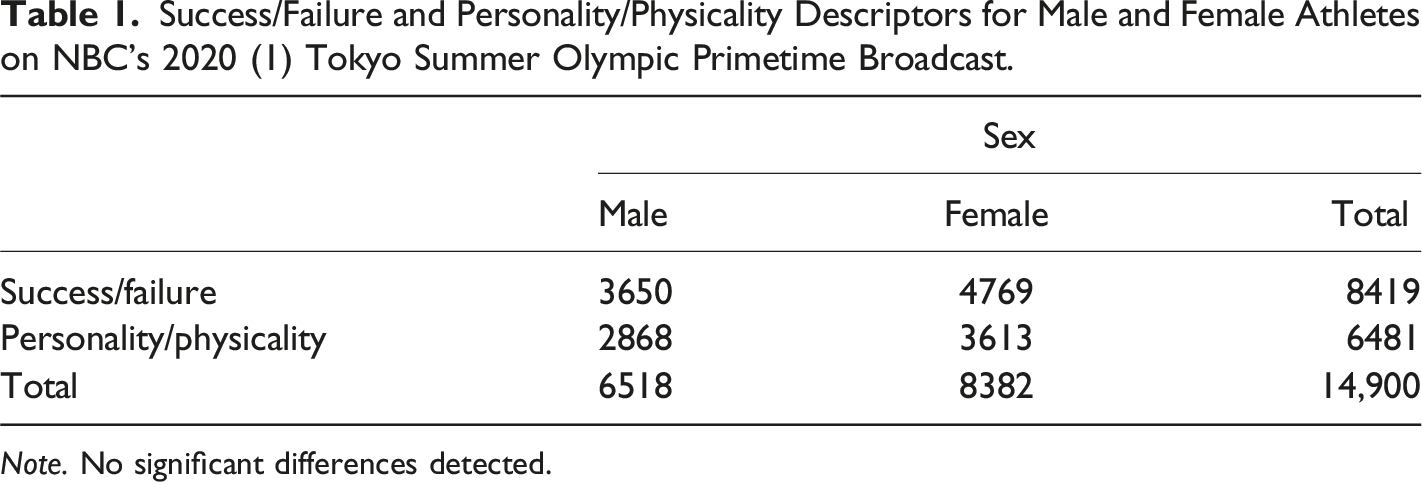
Note. No significant differences detected.
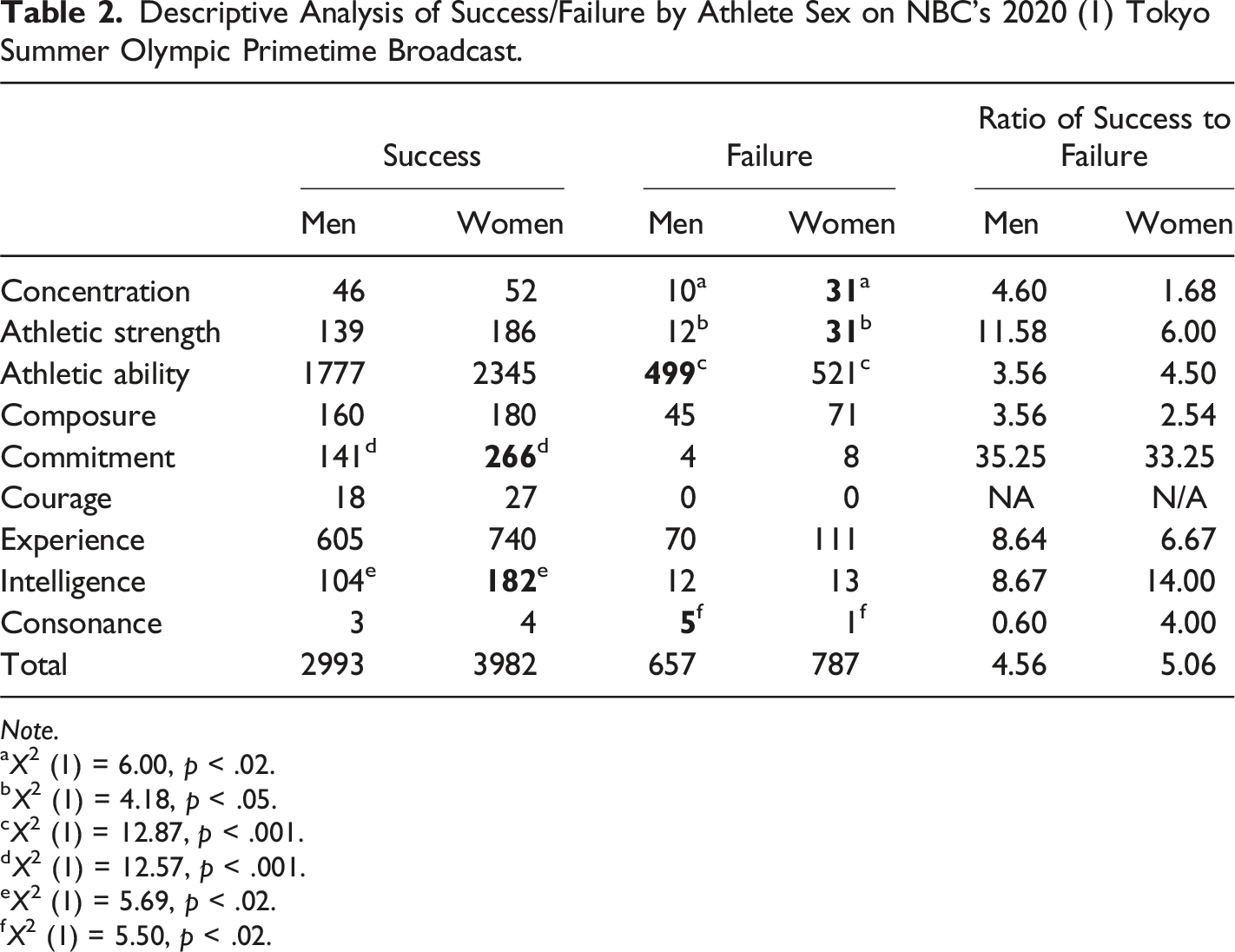
Descriptive Analysis of Success/Failure by Athlete Sex on NBC’s 2020 (1) Tokyo Summer Olympic Primetime Broadcast.
Note.
aX2 (1) = 6.00, p < .02.
bX2 (1) = 4.18, p < .05.
cX2 (1) = 12.87, p < .001.
dX2 (1) = 12.57, p < .001.
eX2 (1) = 5.69, p < .02.
fX2 (1) = 5.50, p < .02.
Hypothesis 4 predicted depictions of athletic failure would be taxonomically different in less than one-third (1/3) of the categories examined. Referring to Table 2, four significant findings appeared with women being more likely to receive failure comments related to (c) concentration and (d) athletic strength, while men were more likely to receive failure comments related to (e) athletic ability and (f) consonance. H4 is not supported as significant differences appeared in more than one-third (44%) of the nine categories for failure.
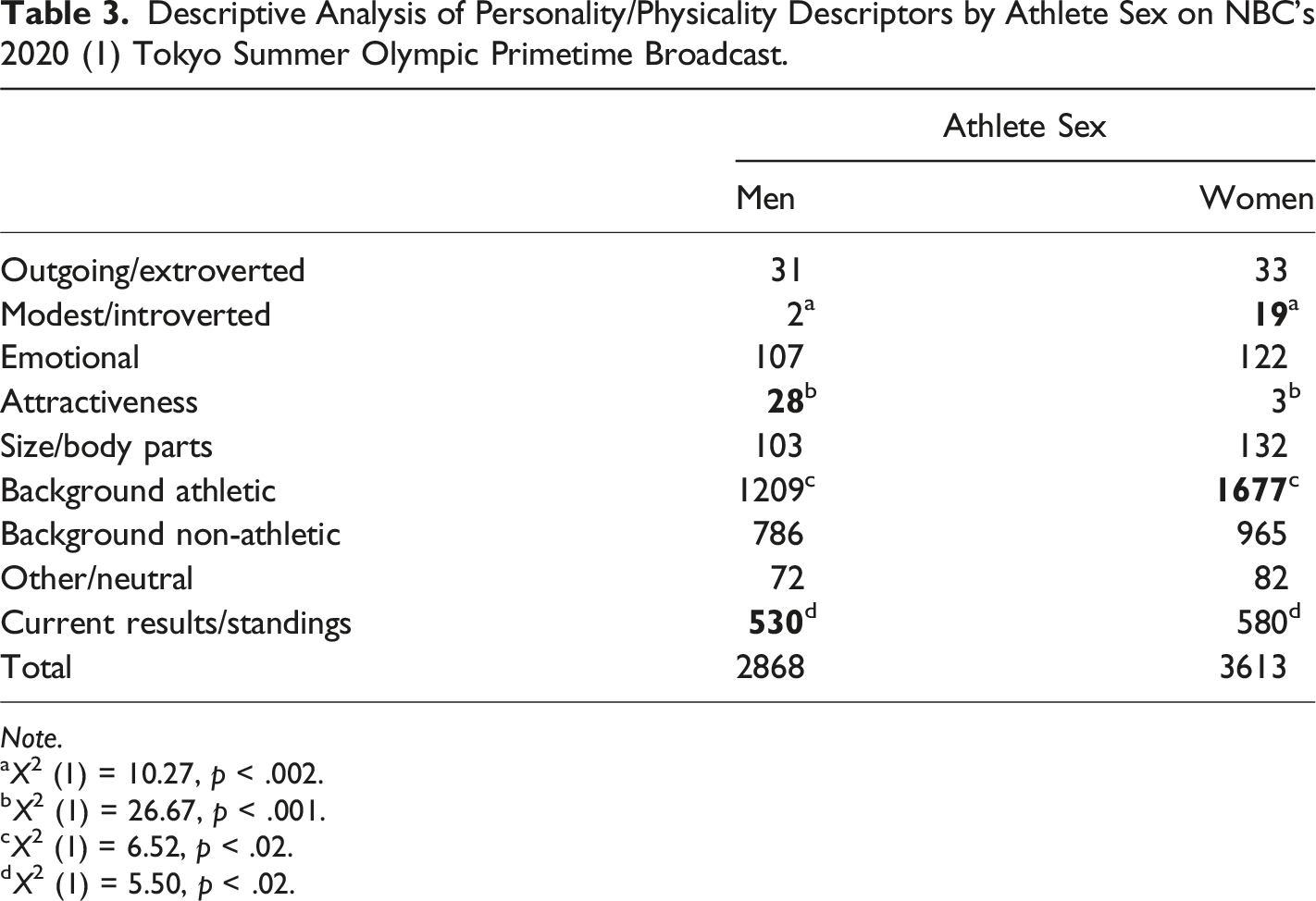
Descriptive Analysis of Personality/Physicality Descriptors by Athlete Sex on NBC’s 2020 (1) Tokyo Summer Olympic Primetime Broadcast.
Note.
aX2 (1) = 10.27, p < .002.
bX2 (1) = 26.67, p < .001.
cX2 (1) = 6.52, p < .02.
dX2 (1) = 5.50, p < .02.
Results - Beijing 2022 Winter Olympics
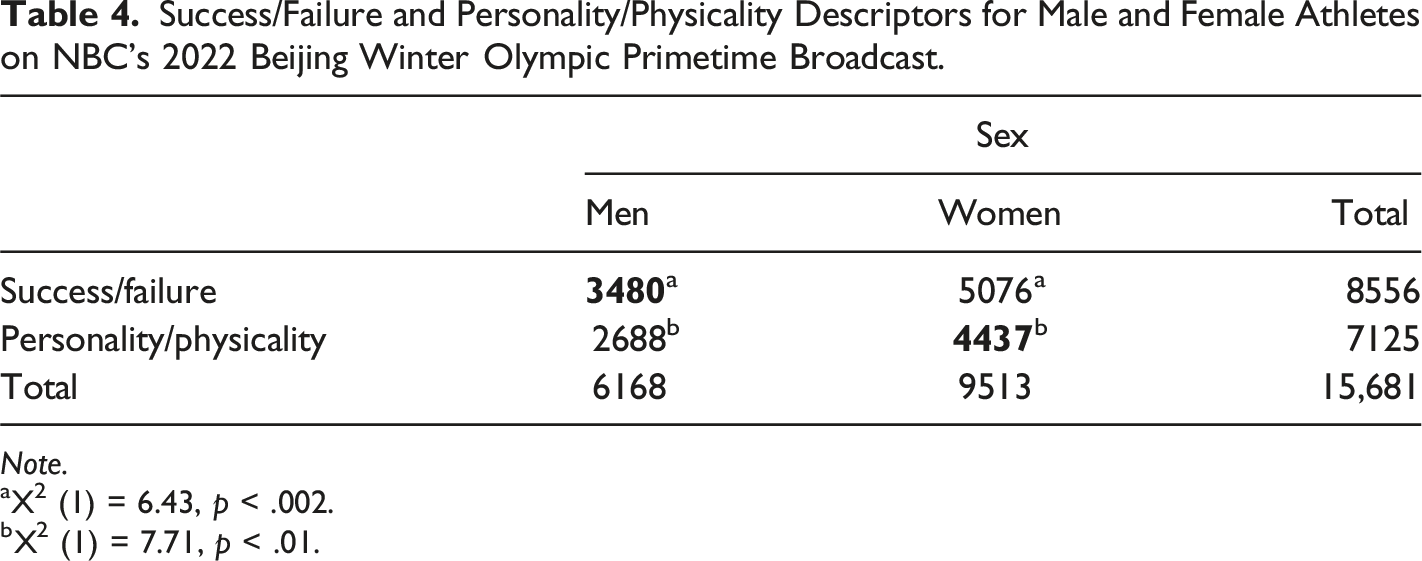
Success/Failure and Personality/Physicality Descriptors for Male and Female Athletes on NBC’s 2022 Beijing Winter Olympic Primetime Broadcast.
Note.
aX2 (1) = 6.43, p < .002.
bX2 (1) = 7.71, p < .01.
Descriptive Analysis of Success/Failure by Athlete Sex on NBC’s 2022 Beijing Winter Olympic Primetime Broadcast.
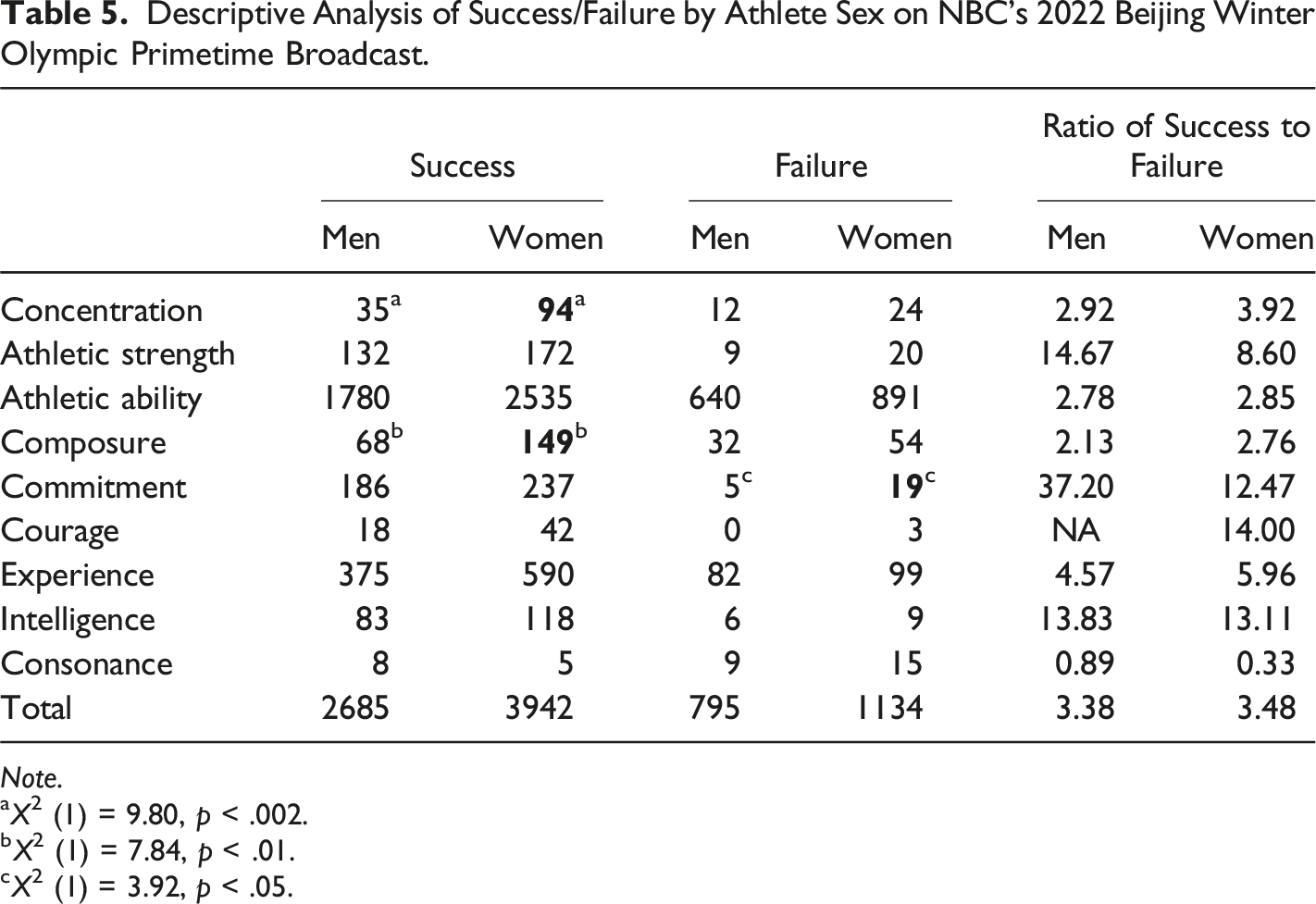
Note.
aX2 (1) = 9.80, p < .002.
bX2 (1) = 7.84, p < .01.
cX2 (1) = 3.92, p < .05.
Hypothesis 4 predicted depictions of athletic failure would be taxonomically different in less than one-third (1/3) of the failure categories examined. Referring to Table 5, one significant difference (11%) was found as women were more likely to receive failure comments related to (c) commitment. Hypothesis 4 is supported.
Descriptive Analysis of Personality/Physicality Descriptors by Athlete Sex on NBC’s 2022 Beijing Winter Olympic Primetime Broadcast.
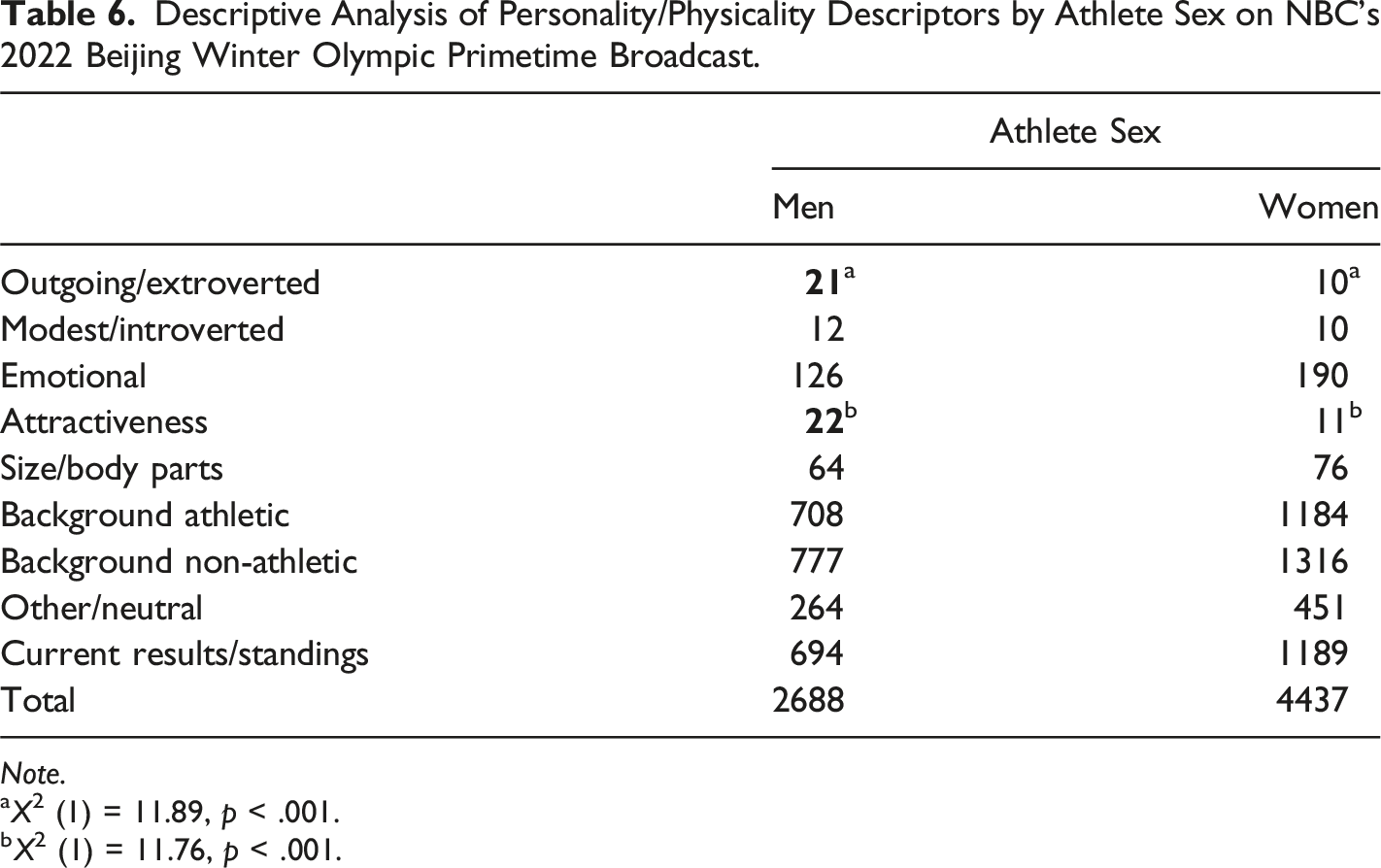
Note.
aX2 (1) = 11.89, p < .001.
bX2 (1) = 11.76, p < .001.
Discussion
NBC’s primetime commentary diverged based on athlete sex in a number of ways during the Tokyo and Beijing Olympics, though, with one exception, these differences were not consistent between the two Games. At the macro level, neither male or female athletes were more likely to receive success/failure comments or personality/physicality comments during the Tokyo Games. This changed with the Beijing Games as men were more likely to receive success/failure comments while women were more likely to receive personality/physicality comments, replicating findings from the 2018 PyeongChang Winter Games (see Smith & MacArthur, 2020). At the same time, the Tokyo commentary contained significant differences in 10 categories versus 5 categories for the Beijing commentary, suggesting the Tokyo commentary was more separated within the success/failure and personality/physicality divisions, but did not diverge at the more holistic level.
The tilting of women’s commentary toward personality/physicality comments in the Beijing Games may have been influenced in part by Eileen Gu, a U.S. born freeskier competing for China whose story generated coverage prior to the Beijing Games (e.g., Branch, 2022). Gu, who won two gold medals and one silver, was the fourth most mentioned athlete of the Beijing Games (Angelini & Arth, 2023) and a featured subject throughout the telecast. She garnered 486 total descriptor phrases throughout her competitions; of those 486, 52% of them fell into the personality/physicality descriptors. When Gu was mentioned, the NBC commentary often included the fact that she was American born, currently resided in San Francisco with an American mother and Chinese father, decided to represent China athletically in 2019, and currently attends college in the United States. The broadcasters seemed to go to great lengths to “claim” Gu as an American athlete, even though she was competing for China. Other commentary focused on the fact that she took yearly trips to China as a child, that she made the decision to represent China because she wanted to give young athletes in China a role model, and that she was an academic star at Stanford University. Gu also received commentary in other personality/physicality areas.
At the categorical level, only one finding in this study was replicated across the Tokyo and Beijing Games: Men were more likely to receive comments about their attractiveness (e.g., dual summer/winter athlete Pita Taufatofua (taekwondo and cross-country skiing) ‘getting attention when he walks into a room,’ and freestyle skier Walter Walberg looking ‘very fit’). This not only runs counter to previous findings as women were more likely to receive attractiveness comments in 4 of the previous Games studied (1994, 1996, 1998 & 2012) compared to zero for men, but also clashes with the long-standing notion that sports announcers are more likely to comment on women’s appearance (Bruce, 2016; Cooky et al., 2021). Whether this change emerged because network announcers specifically avoided commenting on female athlete appearances – women only received this attribution 3 times in Tokyo and 11 times in Beijing – or developed because of some other factor that is uncertain, but this result warrants future monitoring.
The remainder of the Tokyo commentary contains several firsts, while also replicating some previous results. Women were more likely to receive success comments related to commitment (e.g., skier Makayla Skinner being ‘the epitome of perseverance,’ and swimmer Ariarne Titmus ‘trained relentlessly’) and intelligence (e.g., beach volleyball’s April Ross making a ‘smart play,’ or swimmer Katie Ledecky making a ‘good move’ by hugging a lane line). Both findings are firsts as men were more likely to receive success-based comments related to commitment in 2000 and intelligence in 2006, 2008, and 2016.
Regarding failure, women were more likely to have failure comments related to concentration (e.g., gymnast Simone Biles making a ‘mental error,’ or the beach volleyball team of Kelly Claes and Sarah Sponcil not being ‘focused’), the first time this has occurred, with men previously more likely to receive this attribution in 2000. While not the sole female athlete to receive remarks in this area, the commentary surrounding Simone Biles and her well-documented struggles during the Tokyo Games contributed to this finding. Meanwhile, men were more likely to have their failure attributed to a lack of consonance (e.g., triathlete Alex Yee ‘not having it within him’), the first time a failure finding has been found for men or women in this category since it was introduced in 2004. It is worthwhile to note that while the total number of comments about consonance are low, this category has historically had a low comment count in past examinations.
Another first occurred in personality/physicality commentary, as women were more likely to be described as modest/introverted (e.g., Katie Ledecky ‘always humble,’ and ‘unassuming’), which was something previously only found for men in 2004. Observationally, Katie Ledecky seemed to receive the greatest number of comments in this category; of the 21 comments coded into this category, Ledecky received 15, or 71% of the comments. Ledekcy was the 2nd most mentioned athlete and the most-mentioned female during the Tokyo Games (Angelini & Arth, 2023), likely due to the discourse surrounding her incredible success throughout her career. Ledecky’s athletic accolades tended to be accompanied by comments about her being humble, modest, and unassuming in the face of being the greatest female swimmer of all time (Goodman, 2024).
Two repeated findings involved women being more likely to have their failure discussed in the context of a lack of strength (e.g., swimmer Penny Oleksiak ‘not having staying power to come back’ or track and field’s Shelly-Ann Fraser-Pryce ‘not getting the drive’), repeating a result from 2006. Men were more likely to have their failure attributed to a lack of ability (e.g., gymnast Sam Mikulak looking ‘clunky’ during a routine or swimmer Chase Kalisz being ‘a little long coming into the wall’), repeating a result from PyeongChang, but which would not appear in Beijing.
The expansion of the taxonomy resulted in two new findings for the Tokyo Games. In the previous background category, which contained both athletic and non-athletic commentary, women were more likely to receive these attributions in 2008, while men were more likely to receive them in 2014. With the category divided into athletic background and non-athletic background, women were more likely to receive comments about their athletic background (e.g., swimmer Kate Douglass being ‘instrumental’ in helping the University of Virginia win an NCAA championship, or gymnast Jordan Chiles moving to Texas to ‘train with Simone [Biles]’), while there were no significant differences in the non-athletic background category. Second, men were more likely to receive comments in the newly created current results/standings category, (e.g., sprinter Noah Lyles ‘set an Olympic record,’ or swimmer Caleb Dressel ‘wins another gold’), where previously those comments were categorized as other/neutral. The combined results provide an intriguing storyline as athletic background comments give more context to an Olympian’s performance, while the current results/standings are more focused on the immediate here and now. This may suggest that, at least during the Tokyo Games, announcers placed more emphasis on telling the athletic story behind female athletes and put more priority on the immediate impact of male athlete performances.
The overarching narrative during the Tokyo primetime broadcast suggests an evenhandedness at a macro level and seems to go against the grain of established commentary about female athletes. This was notably present in both the lack of comments about female appearance and that women were more likely to receive comments on their intelligence, commitment, and athletic backgrounds. While women were also more likely to receive failure comments related to lacking strength, which might play into a stereotype, this is counterbalanced by men being more likely to receive failure comments due to a lack of athletic ability. Female Olympians were more likely to receive failure comments due to a lack of concentration, which might play into the concept of women being unfocused, but the context of the comments, particularly as they related to Biles who received the bulk of this dialogue, doesn’t support that interpretation.
When taken as a whole, the Tokyo findings counter a significant amount of past research (e.g., Bruce, 2017; Cooky & Antunovic, 2018; Kian et al., 2013) that suggests women are presented as females first, athletes second, with the focus often given to their looks and sexuality. By framing female athletes, as compared to male athletes, in terms of their athletic background, commitment to the sport, and intelligence - where comments typically center around strategy and making good decisions - rather than in terms of their emotions, looks, and relationships, a picture emerges from Tokyo of a female athlete being just that - an athlete. Taken in the context of framing theory, by selecting and emphasizing traits that focus on female athleticism, as compared to male athletes; while not overemphasizing well-established stereotypical narratives, a larger story emerges in the Tokyo commentary that is centered on female athleticism.
The results from the Beijing Games, while not as robust as Tokyo, create a different narrative. In the area of success, women were more likely to have their success credited to concentration (e.g., Eileen Gu ‘visualizing’ or beach volleyball’s Alix Wilkinson having a ‘charging mentality’), and composure (e.g., figure skater Karen Chen ‘doesn’t rush her program,’ or snowboarding’s Jamie Anderson being ‘perfectly composed’). The concentration finding repeats a result from 2014. Though no one individual seemed to be responsible for most of these comments, two women did seem to garner more comments than others: Eileen Gu, and discussions around the amount of visualization work she does, and Mikalea Shiffrin ‘working out the demons’ after failing to complete her first two events. Similarly, the composure result repeats a finding from 2014, though men were more likely to receive this composure attribution in 1998 and 2006. While one individual athlete did not garner more comments over other athletes, much of the discussion seemed to center around female figure skaters in general.
In the area of failure, women were more likely to receive failure comments related to lacking commitment (e.g., skier Olivia Asselin opting to drop out of her race and get a ‘DNS’ [did not start], or skier Jasmine Flury ‘not going full gas’), which repeats the results from 2010. Men, however, were more likely to receive this attribution in 2006. In the Beijing Games, the comments for failure were spread across several female athletes, with no one specific individual appearing to make a notable difference.
The Beijing commentary diverged in the personality/physicality categories in two ways. As previously noted, men were more likely to receive comments about attractiveness, replicating the Tokyo result. Men were also more likely to receive comments related to being outgoing/extroverted (e.g., ice dancer Nikita Katsalapov ‘brings moxy’ or figure skater Jason Brown being a ‘charismatic kid’), repeating a finding from 2010. Regarding the new categories developed for this study, no significant differences were located in athletic background, non-athletic background, or current results/standings.
If Tokyo painted a picture that displayed female athleticism, a clear image from the Beijing commentary is a bit more allusive. For example, Men were more likely than women to be described in terms of their attractiveness, but women were more likely to receive comments about personality/physicality as a whole and men were more likely to be described as outgoing/extroverted. Women were more likely to receive success-based comments related to concentration and composure, both suggesting athletic discipline, but then were more likely to receive failure comments related to commitment, which connotes a lack of discipline. What emerges from Beijing is fewer categorical differences in commentary and the differences that do emerge do not necessarily reinforce each other.
When the Tokyo and Beijing Games are considered collectively, the power of sports media frames should be considered a) within the context of individual broadcasts, b) their appearance (or lack thereof) in multiple broadcasts over time, and c) whether they break away from previously established frames. The Tokyo Games saw the emergence of seven new differences in terms of how men and women were framed as compared to each other, though two of the categories where significant differences were located did not exist as unique classifications prior to this study. The significant differences in ten categories during the Tokyo presentation is the most on record, with the previous high being six. Beijing, meanwhile, was not an outlier. Every frame that appeared repeated a finding from at least one prior Olympiad, though only one repeated a Tokyo finding. The number of significant differences in the Beijing Games is in line with previous Winter Games since the taxonomy’s expansion with the Torino Games, though higher than the three significant differences located in the 2018 PyeongChang broadcast, the latter being lowest number of findings on record since the aforementioned taxonomical expansion.
In their analysis of NBC’s primetime broadcast of the 2010 Vancouver Winter Games, Angelini et al. (2012) noted that differences in announcer dialogue based on athlete sex were, generally, inconsistent from Olympiad to Olympiad and that, such differences in commentary – while important – absent a consistent pattern, should be considered, “differences rather than stereotypes” (p. 274). Six Olympiads later, the most consistent trend appears to be that each primetime Olympic broadcast tells its own unique story about male and female athletes, occasionally repeating differences from previous Games and sometimes introducing new ones. The result is a narrative about men and women that may be as varied as the Olympics and their host cities.
When viewed through the lens of framing theory, specifically that the repetition of frames can reinforce ideas and conceptions, the lack of a pattern across multiple Olympiads does not mean a frame lacks power within the context of specific 17- or 18-night mega event where its repetition (e.g., success comments about women’s composure in Beijing) is a component of the presentation. The appearance of a frame that suggests differences between men and women within any given Olympic broadcast tells the audience there are substantive variances in how the athletes competed and/or the athletes themselves. These differences are not automatically negative, but nonetheless contribute to larger narrative patterns about male and female athletes. If such a frame is repeated across Olympiads, it may gain more salience, particularly if it parrots other established media sport narratives.
Breakaway frames (e.g., men being more likely to receive comments about attractiveness) may also play a role in how viewers understand the Olympic Games and its athletes as compared to other events. Even if a breakaway frame does not repeat across multiple Games, its presence in one Olympiad still offers the opportunity for the audience to reimagine male and female athletes during a megasport media spectacle – a spectacle that is without a counterpart in terms of not only showcasing men’s and women’s sports on the same broadcast, but also showing them competing in the same event. If a narrative appearing within an Olympic broadcast runs contrary to previously established portrayals of male and female athletes, that narrative contributes to the larger sports discourse and has the potential to shape both how an audience understands the athletes within this unique event and how they view athletes as a whole.
Conclusion
It reads like the beginning of a bad joke: “What do 60% of the gold medals from Tokyo have in common?” (Planos, 2021), but the answer is not a laughing matter. American women won 60% of Team USA’s gold medals (and 58% of the total medals) during the Tokyo 2020 Games, and 68% of Team USA medals during the 2022 Beijing Games (Ceron & Bhasin, 2022). This study continued a longitudinal trajectory examining broadcaster dialogue surrounding the male and female athletes at the Tokyo 2020 and Beijing 2022 Olympic Games. As women’s participation in the Olympic Games continues to rise, the Games remains as the largest showcase of women’s sports. As women have begun to dominate the medal table for the United States, NBC broadcaster dialogue about female athletes may continue to change. Future examinations, however, are still needed to determine what differences in commentary surrounding male and female athletes exist when a network presents this international mega-sporting that provides the unique opportunity to examine male and female narratives.
Footnotes
Declaration of Conflicting Interests
The author(s) declared no potential conflicts of interest with respect to the research, authorship, and/or publication of this article.
Funding
The author(s) received no financial support for the research, authorship, and/or publication of this article.
