







Abstract
The role of female journalists in local television news is a tenuous space. Having women occupy jobs in traditionally hegemonically male roles enriches perspective and content. Simultaneously, the work environment can be challenging—often hostile—which leads to negative work experiences for female practitioners. The instability has led to an outflow of women opting out of the television news industry. The purpose of this study was to investigate why female local sports journalists were leaving the business. Researchers conducted 27 semi-structured interviews with local sports television journalists who left their jobs in the last four years (since 2020). The findings of this study rendered two main themes and one smaller secondary theme that offered a perspective on several variables behind these decisions and important distinctions between those factors facing women and men. Many of the variables influencing practitioners to leave were similar. For instance, almost every respondent offered low salary and bad schedules as reasons for getting out. However, findings showed that women made less money and did not serve in newsroom leadership roles, which meant they had even worse schedules. The conclusion of this study is that newsroom leaders need to address the stronger headwinds facing female journalists and need to be more strategic about fostering healthier work environments for women in the newsroom.
On April 18, 2024, former WTAE-Pittsburgh sports reporter/anchor Emily Giangreco posted on X (formerly Twitter), “THAT’S A WRAP! After nearly 9 years in the TV industry, I’m officially calling it quits. Thanks to everyone who tuned in from Louisiana to Texas to PA. I appreciate all the support” (Giangreco@EmilyGiangreco., 2024). It was the last line of her post, however, that was particularly noteworthy of her announcement: “Here’s to hoping this is a safe space for strong women one day (heart emoji).” Giangreco, in a later interview with TribLive, said she was “not at liberty to discuss leaving WTAE right now” and she could not “really get into detail, and I don’t want to” about her departure (Owen, 2024, para 2). Similar stories, like that of sports reporter Jeanna Trotman departing WXYZ-Detroit (Williams, 2024) and sports reporter/anchor Lexi Swatt leaving WNYT-Albany (Gustafson Barlette, 2023), are occurring with more frequency. The reasons Trotman and Swatt left were also not specifically detailed, but both articles alluded to multiple variables that included family and other personal reasons.
Analysis from the annual Radio Television Digital News Association (RTDNA)/Newhouse School at Syracuse University news director survey found that there are approximately 28,000 jobs in local television news in 2023, a near high-water mark previously set in 2021 (Papper & Henderson, 2024a). The RTDNA/Newhouse survey found that salaries rose by 7.5% in 2023 (4.4% adjusted for inflation; Papper & Henderson, 2024b). Results also showed that 2023 set a record for the average amount of news content produced by local news organizations (Papper & Henderson, 2024c), and nearly 80% of news directors said they were implementing innovative digital efforts into their content production (Papper & Henderson, 2024d). These datapoints indicate a healthy local news landscape that is in some ways growing—or at least sustaining.
But embedded in these results are increasing headwinds that are indicating the industry is facing significant challenges. For instance, in the same article that stated employment was up 1% in 2023, Papper and Henderson (2024a) also noted nearly 70% of news directors said staff burnout was prevalent in their newsrooms, a reality Reinardy (2013) observed more than a decade ago. Relatedly, while the number of hours and minutes reached record highs in 2023, the number of news-producing stations fell beneath 700 (n = 694) for the first time since the survey was founded (Papper & Henderson, 2024c). And, while salaries increased in 2023, 78% of news directors stated they had difficulty hiring qualified staff, leading to more than 2000 unfilled positions (Papper & Henderson, 2024b). The byproduct is an environment that is trying to do more with statistically less and it is creating added dissatisfaction, which is leading to turnover.
That is not to say that local television is an outlier from other industries in the United States. According to the U.S. Bureau of Labor Statistics (2024), the median employment tenure for women in the United States in any industry is 3.6 years. But that number is steadily decreasing and is demonstrably lower for younger workers than it is for workers ages 55 to 64 (9.6 years; U.S. Bureau of Labor Statistics, 2024). Giangreco noted she worked in television for nearly nine years at three different stations (Giangreco@EmilyGiangreco., 2024). Trotman entered the industry in 2014 and also worked at three different stations during her 10-year career (Williams, 2024). According to her LinkedIn, Swatt worked in television for four years, but only in sports for one year at WNYT. On average, these three examples all stayed at stations under the national average, which is both typical of contract cycles (usually two years) and the realities of increasing turnover in the industry (Hull, 2024). These descriptive statistics, however, do not tell the story of why practitioners are leaving. The purpose of this study is to examine why female sports journalists are exiting local television newsrooms across the United States.
Literature Review
The gender disparity among sports journalists in local newsrooms has stagnated for decades. According to the Women’s Media Center, in their first “Status of Women in U.S. Media” report, data from 2008 stated women occupied 7.8 percent of sports anchor and 18.7 percent of sports reporter jobs in the country (Women’s Media, 2012). The most recent report in 2021 totaled the percentage of women covering sports beyond just broadcast—including print, digital, wires, and broadcast—found an abysmal 15% of sports journalists were women (Women’s Media, 2021). That has been reaffirmed by The Institute for Diversity and Ethics in Sport’s (TIDES) “Racial and Gender Report Card,” which has given the Associated Press Sports Editors (APSE) an “F” each year it has published a report (2008, 2011, 2012, 2014, 2018, 2021; Lapchick et al., 2021). Yet, this comes at a time where local news broadcasts have set record highs for broadcast minutes per day, increased revenue dollars due to election cycles, and have sustained more than 700 TV stations across the country (Papper & Henderson, 2023).
While the percentage of female sports journalists coming into the industry remains low, recent studies have also highlighted that many female sports journalists are leaving the industry at disproportionate rates compared to their male counterparts (Hardin & Whiteside, 2020; Schoch & Fabien, 2021). These trends have troubling impacts on newsrooms and newsroom diversity, specifically on the subsequent bearing those diverse perspectives have on content. Sherwood et al. (2016) noted that the dearth of female sports journalists contributes to the relegation of women’s sports, audience expectations and assumptions, and systemic hurdles that exist exclusively for women. The differences between experiences for men and women, as well as the byproduct that emanates from local news coverage, have led to near hostile work environments for aspiring female sports journalists.
Perception and Credibility
Two of the most observable distinctions between men and women in this field are perception and credibility barriers. Hardin and Shain (2006) outlined the obstacle of perception as a matter of inherent gender inequity and the ideological shortcoming of accepting the ‘employing women will equate to empowering women’ mantra. Ferguson (1990), referred to the latter as the “feminist fallacy.” Gender inequity is largely informed by the hegemonic realities that have perpetuated the sports media landscape since the discipline emerged. Take, for instance, the all-too-common “unwritten rule” that women should not date athletes or coaches or run the risk of delegitimizing their ability to objectively tell stories (Everbach, 2018). Or consider Pedersen et al.’s (2009) finding that more than half of the respondents of their study—female sport print journalists—reported experiencing at least one incident of sexual harassment at work within one year of starting their media job. In some cases, gender inequities are as simple as a gaze. For instance, Cummins et al. (2018) found that viewers spent more time looking at female reporters’ bodies than their faces, while the inverse was true of their male counterparts. The implication, of course, is female journalists are subjected to “passive objectification” simply based on their gender.
This objectification, of course, is part and parcel with credibility. In the aforementioned references, women must meet the expectations of an audience member physically while also being subjected to a reception that requires more of them from an output perspective as well (Cummins et al., 2018). Boczek et al. (2023) noted a litany of variables that accompany the physical constraints on credibility. Namely, they cite marginalization stemming from the lack of female journalists overall, the infrequency of women’s sports being covered, and the eventual reality that female journalists are more than likely to cover a sporting event of the opposite gender. Mudrick and Lin (2017) examined the “impact of attractiveness and role congruence on source credibility and reader loyalty” (p. 79) between male and female journalists. Their findings revealed that male journalists were viewed as better fits regardless of gendered sport, while female reporters were better suited for congruently gendered sport—in their case volleyball.
Lack of Mentorship and Support Networks
The absence of mentorship and support networks tailored to women sports journalists exacerbates feelings of isolation and impedes professional development (Cahn, 2017). As has been studied in congruent facets of sport like coaching (Banwell et al., 2021) and administration (Picariello et al., 2023; Smith et al., 2016), mentorship is often thought of as an important tenet of increasing social capital and—perhaps more importantly—the cultural capital necessary to increase workplace satisfaction. Banwell et al. (2021) found that engaging in mentorship increased satisfaction and engagement at the individual, interpersonal, organizational, and sociocultural levels. The amalgamation of bolstering each component of a hegemonic work environment is the holistic charge for a marginalized group trying to reach legitimacy. The departure of potential mentors and larger support networks makes realizing the feeling of encouragement in the workplace much more challenging (Mirabito et al., 2022).
The Association for Women in Sports Media (AWSM) has been a forum for women to address these imbalances, find necessary support, and address the inequalities of the work landscape. The organization offers membership to women in sports media, holds an annual conference, presents awards, creates networking opportunities, and oversees 17 student chapters placed in colleges and universities across the country (Association for Women in Sports, 2024). As valuable a resource AWSM is for women, though, it stands alone in many regards in this space (Hardin & Whiteside, 2020). Many of the scholars cited in this article have deep rooted ties to AWSM and bolster its value. But, as Staurowsky and DiManno (2002) noted, much of the burden falls on prospective female practitioners to form strategic alliances with potential mentors early in pre-professional settings. AWSM certainly facilitates some of those relationships, but finding appropriate mentorship opportunities is time-consuming and limited—especially if the population of potential mentors is shrinking.
Burnout, Mental Health, and COVID-19
Burnout, conceptually, is a framework long entrenched in job satisfaction scholarship dating back to the 1970s (Schaufeli, 2017). The World Health Organization (WHO) defined burnout as a “syndrome conceptualized as resulting from chronic workplace stress that has not been successfully managed” (World Health Organization, 2019, para. 4). The Maslach Burnout Inventory (MBI; Maslach et al., 1997) was groundbreaking work in this field, which is still used to quantify the effects of burnout in work settings. In fact, Reinardy (2008; 2012) employed the MBI researching both newspaper sports editors and local tv sportscasters—two of several studies that mirror the intentions of this work. Mental health is an even more mature concept with roots dating back to the 19th century (Bertolote, 2008). The WHO also defined mental health as: A condition, subject to fluctuations due to biological and social factors, which enables the individual to achieve a satisfactory synthesis of his (or her) own potentially conflicting, instinctive drives; to form and maintain harmonious relations with others; and to participate in constructive changes in his social and physical environment. (World Health Organization, 1951)
There is not a tremendous amount of literature on the effects of burnout and mental health among sports journalists. Often, the scope of the discourse is focused on how those issues are covered by said journalists (Billings, 2024), rather than how they cope with dealing with the impacts of the conditions. However, MacDonald et al.’s (2016) extensive literature review of the topic found that the young, female journalists with less experience are the population most at risk for burnout and mental health issues. Similarly, Reinardy (2009) found that female sports print journalists did experience higher burnout rates than their male counterparts, which subsequently made them more likely to leave their positions.
Factors like balancing career demands with personal and family responsibilities poses a significant challenge for women in sports journalism (Bruce & Boyle, 2019). Structural barriers, such as limited opportunities for promotion and leadership roles, hinder women’s career advancement in sports journalism, too (Bruce & Tuggle, 2021). Combined with the many pressurized demands of broadcast journalism that apply to all practitioners, mental health and burnout have become principal variables in job satisfaction—and often departures from the industry (Hull et al., 2022). Hull (2024) added COVID-19 as a driving aspect in at least speeding up journalists’ career changes. The pandemic, for most of the population, elevated instances of anxiety and depression. The immediate impacts of removing journalists from newsrooms and demanding extra work hours (Mulcahey, 2020) to the long-standing feelings of reprioritization of life goals and self-worth (Jones, 2021) have reshaped the landscape in newsrooms—and with the journalists—across the country (Hull, 2024).
Contextualization
There were 694 news-producing, affiliated television stations in the United States in 2024 (Papper & Henderson, 2024c). Those newsrooms are led by news directors who are charged with staffing, content oversight, resourcing, and other macro-level decision making. Sports departments—if a station has a dedicated department—can vary in size and staffing. Typically, the sports director oversees the department, again if it exists, making key decisions regarding content, scheduling, logistics, and staff mentorship (Chuday, 2008). Depending on the station, additional roles such as weekend sports anchor, sports reporter, producer, or photographer may also be present in various combinations (Hull, 2024). However, many of these positions are being reduced or eliminated entirely, increasing the workload for the remaining journalists responsible for content production (Mirabito et al., 2022). In some situations, stations may have hybrid journalists who will cover both news and sports. Other stations will simply send general assignment reporters to cover a sports story with no official title associated with sports. Springer (2021) argued that this transformation, combined with the growing significance of social issues in sports, should force newsrooms to reconsider how they integrate sports coverage rather than isolating it.
Theoretical Framework: Gender Sidelining Theory
This study is informed by using gender sidelining theory, a concept derived from critical feminist theories like muted group and co-cultural. Fink (2018), who coined the name “gender sidelining,” posited that the theory would offer context to the phenomenon that “women across a wide range of employment settings may find themselves sidelined, upstaged, or otherwise marginalized [by men] in ways not reached by traditional antidiscrimination laws” (p. 60). More simply, “slights, snubs, and disadvantages that women experience” are leading some to disengage from or completely leave their careers (Fink, 2022, p. 498). The caveat is that while these workplace challenges reduce job satisfaction for women, they often remain legally permissible. The persistence of microaggressions contributes to a sense of diminished worth and an increased desire to leave the profession (Fink, 2018)
Culver (2018) expanded on Fink’s gender sidelining theory by introducing the concept of “self-” sidelining theory. The principles of self-sidelining do not contradict or eliminate gender sidelining but assert that women often experience self-induced obstacles like lack of confidence or imposter phenomenon, alongside overt biases. “Self-sidelining results in women downplaying their achievements and opportunities allowing external gendered forces to consciously or unconsciously prevent achievement and advancement” (Abrams & Durbin, 2020, p. 252). Imposter phenomenon is defined as an “inability of some high achieving-women and men to internalize success, due to the distorted assumption that they are phonies in their respective field despite objective evidence to the contrary” (Culver, 2018, p. 175). The interplay between self-imposed barriers like imposter phenomenon and overt gender-based marginalization creates a challenging work environment.
The public-facing dynamic of broadcast journalism, especially with the added demands of maintaining a presence on social media (Mirabito, 2020), is deeply intertwined with gender sidelining theory for several reasons. First, Fink (2018) and Culver (2018) highlight impostor phenomenon as a backdrop to feelings of doubt in the workplace. While securing a television reporting or anchoring job may symbolize career success, the reality is that this sense of achievement is often fleeting or never fully realized due to the ongoing sociological burdens associated with the profession. Second, legal protections for women against workplace microaggressions are limited. While Titles VII and IX offer some safeguards, there are significant gaps in legal standards. For example, Sobieraj (2017), whose research is grounded in muted group theory, examined the incivility that is rampant in social media spaces—an issue courts largely protect under First Amendment arguments. Third, while precise data on the number of female sports journalists in local markets is difficult to obtain, the Women’s Media, 2021 estimated that women make up only about 15% of the workforce. Furthermore, although representation in sports journalism has slowly improved, coverage continues to focus predominantly on men’s sports, with male sources cited more frequently than women (Hardin & Whiteside, 2020). The male-dominated nature of sports media influences workplace culture and audience expectations, further shaping the challenges women face in the industry (Sherwood et al., 2016).
The following research questions were posed to ascertain the current landscape facing women in the local sports journalism field and examine why they are leaving the industry:
Method
This exploratory research intended to capture the experiences of female practitioners in the United States in the local sports television journalism space, why those journalists decided to leave the industry, and to juxtapose the variables impacting female journalists with those of their male counterparts. Therefore, both female and male participants were recruited to contribute to this research. Participants for this study were required to have worked at a local television news station as a full-time employee in the station’s sports department and left the station after 2020. This timeframe was chosen because of recency to their departure and incorporating the COVID-19 pandemic as a potential variable. Participants were identified through various methods, including station announcements (either on air or in a web story), another local outlet’s news story, social media (LinkedIn or Facebook) post, word-of-mouth, or—in three instances—snowball sampling. The latter entailed participants referring former colleagues who made similar professional decisions to leave the industry. It should also be noted here that Emily Giangreco, Jeanna Trotman, and Lexi Swatt, each of whom was referenced in the introduction, were not interviewed for this study. They were only used in this article as a framework for why this research is important due to the lack of clarity behind their departures.
Researchers recruited male and female journalists from across the country to participate in this study. Since this specific study focused on the experiences of women, purposeful sampling was used to increase the number of female participants. Women’s Media (2021) reported that women accounted for approximately 15% of the mobile and social sports media content that was viewed in 2020. The benchmark was to eclipse that number by more than double. Forty percent (n = 11) of the participants were women in this study, which achieved that participation goal. Twenty-seven former journalists participated, 16 men and 11 women.
Participants.

Note. Nielsen DMA is taken from the 2023 report.
Data Collection
Semi-structured interviews with former journalists were conducted over the phone or through Zoom and recorded for transcription purposes. Scholars have argued that using the telephone (Cachia & Millward, 2011) and Zoom (Archibald et al., 2019) as mediums to conduct semi-structured interviews are increasingly useful methods due to the accessibility of more diverse participant pools. In both familiarity with the technology and improved likelihood that interviewees from around the country would be willing to participate, this form of communication was essential in forming a more robust sample (Cachia & Millward, 2011). Additionally, Adeoye-Olatunde and Olenik (2021) noted that semi-structured interviews were increasingly valuable in qualitative research due to preciseness of the interview framework that was structural, combined with allowing autonomy to the interviewer to add depth in pertinent lines of questioning. In this case, each of the interviewers were previously practitioners in local television, which allowed for a greater contextual understanding and an easier pathway to establishing rapport.
Two non-affiliated, former television journalists who met the criteria for participation in this study but were not part of the sample were asked to review the intended list of questions. The questions included four demographic, 10 short-answer, and between nine and 11 open-ended questions. The questions were modified based on the reviewers’ suggestions. Once the interviews were completed, a researcher transcribed the conversation onto a Microsoft Word file with any distinguishing information describing the participants’ identity kept confidential.
Data Analysis
Braun and Clarke (2019) seminally blending theory and inductive analysis in what they deem “reflexive thematic analysis” (p. 594) was foundational to this research. Stalwarts in championing and legitimizing thematic analysis (TA), Braun and Clarke mandated more rigorous transparency in employing this methodology. van Antwerpen et al. (2022), who used Braun and Clarke’s six-step approach to thematic analysis in their research analyzing journalists’ work behavior during COVID-19, provided the analytical scaffolding for this study. Phase one, familiarization, consisted of a team of researchers transcribing, reading, and reviewing each interview verbatim with initial reactions and notes included. The presence of multiple researchers allowed for exhaustive analysis of the data. Phase two, initial coding, in a pattern consistent with Cottingham et al.’s (2015) employment of inductive analysis through the constant comparative method, rendered patterns that were related to previous knowledge and specific questions in the interview subsets. Phase three, organizing, began the collaborative process of sorting initial codes into thematic clusters. Phase four, internal homogeneity and external heterogeneity, required thorough examination due to the nature of the subject and samples. The bifurcation of female and male participants with an aim to analyze common and disparate factors both inter- and intra-group necessitated processes to ensure accuracy. Thus, researchers engaged in member checking to safeguard as described by Shin and Miller (2002), who stated “member checking involves researchers’ confirming their interpretations with participants in terms of whether themes and information are accurate” (p. 128). Every participant was sent a draft of the findings section below and asked to give feedback on both content and if there were concerns about breaching confidentiality. None of the participants listed any changes.
Phase five, naming, offered the opportunity for researchers to collaboratively come up with the most appropriate monikers for each theme based on the induced process. Although there was not any feedback from participants during member checking, the researchers were able to reaffirm that the designated names were the most suitable for the findings. Phase six, finalizing manuscript, involved copy edits and another review of the material. Two prominent themes emerged, which the research team named “newsroom leadership concerns” and “family focus.” One secondary theme also emerged, which was titled “passed over for jobs.” The secondary theme emerged because not every journalist admitted to experiencing direct engagement with the circumstance but, when the situations did arise for journalists, there were notable and consistent similarities.
Findings
Short Answer Responses.
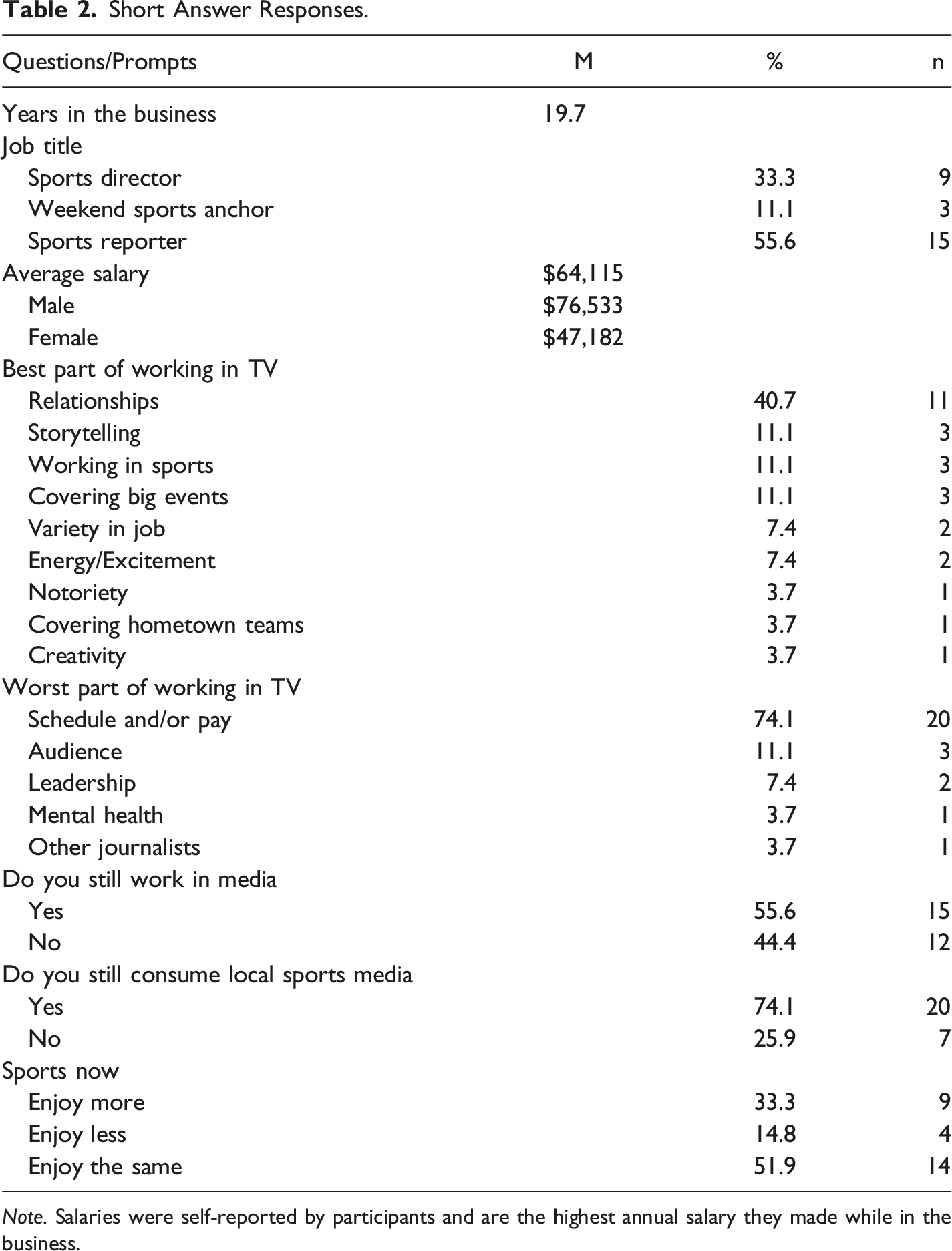
Note. Salaries were self-reported by participants and are the highest annual salary they made while in the business.
Newsroom Leadership Concerns
This theme is defined as journalists feeling their managers misused or neglected their responsibilities and failed to foster productive work environments. It should be noted that there was consideration given to titling this theme “lack of newsroom leadership” but researchers noted that respondents did not necessarily feel there was lack of leadership, but there were persistent concerns over leadership approaches. Additionally, the implication of leadership was viewed more fluidly than simply the news director, with implications reaching several levels of vertical leadership. For example, general managers and owners, who often act as reports for news directors, and executive producers and sports directors, who report to news directors, were included in the scope of leadership.
The Female Experience
Expectations of female journalists working in sports had stereotypical realities that many of the respondents took as being perpetuated by newsroom leaders. For example, Linda, who worked in a top-100 market, noted, “I just got criticized a lot by my news director for wearing dangly earrings or wearing my hair a certain way.” She observed that her male colleagues did not receive that same criticism, and added, “it just got to a point where I got tired of being criticized and being told I wasn’t really good enough.” Harper sensed that some of the expectations of female journalists were grounded in “old school” ideology. She said, “I think management is having a really hard time understanding that the new generation that we’re kind of growing is much more independent.”
None of the 11 women interviewed were sports directors in their last jobs in television—although Alisha and Jaime were sports directors at previous stations. Conversely, nine of the 16 male respondents held the leadership role of sports director. When the COVID-19 pandemic created scenarios where sports reporters were asked to shift to news reporting, it was often the subordinate journalists in the sports department who were asked (or told) to make the switch. For instance, Jaime said, “I did have to do news stories during COVID. I think it’s why you’re seeing so many people leave TV or sports in general. It’s just taken a big shift.” Maureen added, “[During COVID], my boss would call me on my days off and say, ‘I need you to write my scripts’ and I'm like, ‘I’m off.’ He said, ‘but I need help because I don't understand this.’ There were no boundaries.” Angela said of the switch to news, frankly, “news sucks.”
In several situations, it was in those spaces where female journalists experienced instances where their bosses seemed to disregard their safety. Lydia described an instance where she had to cover a story where she felt her news director did not have her wellbeing in mind. She was sent alone to a rural part of the state where cell phone service was inconsistent. The interview subject she was meeting was being accused of murdering his fiancé and she felt unsafe. After returning to the newsroom, she confronted her news director, saying, “‘Next time you send me somewhere, you need to ask if you’d send your 21-year-old daughter there, and if the answer is ‘no,’ don’t ever [expletive] send me to something like that again!’” She summarized her feelings toward management as “they don’t hesitate to send you into these really dangerous situations.”
The Contrast
Understandably, leadership is going to vary from job to job in any profession. But Kristin, a former weekend sports anchor, said of local news, “In newsrooms, you get a lot of different leadership, and it can be micromanaging, or it can be the opposite. I never found that station that really was a good, inspiring leadership place. I think it’s hard to find those.” Two factors that seemed to be unique to local television news, at least to female participants in this study, were newsroom leaders’ assessments of physical appearances and a cavalier attitude toward safety. All 11 women noted they had some experience with management offering commentary—often perceived as negative—on their appearance, while none of the male participants mentioned it once. That was consistent with Linda’s previous statement that she never heard a man receive the same criticism.
Safety, a condition of work that was rightfully considered to be under the purview of leadership, was a little more amorphous in how it differed between genders. Lydia’s previously mentioned experience covering a possible murderer was the most egregious example of malpractice that was discussed. However, there were a range of circumstances where reporters felt safety was fleeting simply because their job responsibilities were shifting. Multimedia journalists (MMJs) are required to tell stories as a “one-person band,” more simply by themselves. Sport events, which account for the majority of field work for these sports reporters, often take place in well-lit, heavily attended, public spaces. The shift to news meant that reporters were now required to go to more compromising news sites, by themselves, with little-to-no feeling of security. Lola’s reaction to this was, “I would say that I disliked the bosses.” Most of the male participants did not switch to news, especially those who occupied the sports director role. And none of the male participants who transitioned to telling news stories mentioned safety. They did, however, express frustration that they were no longer covering sports.
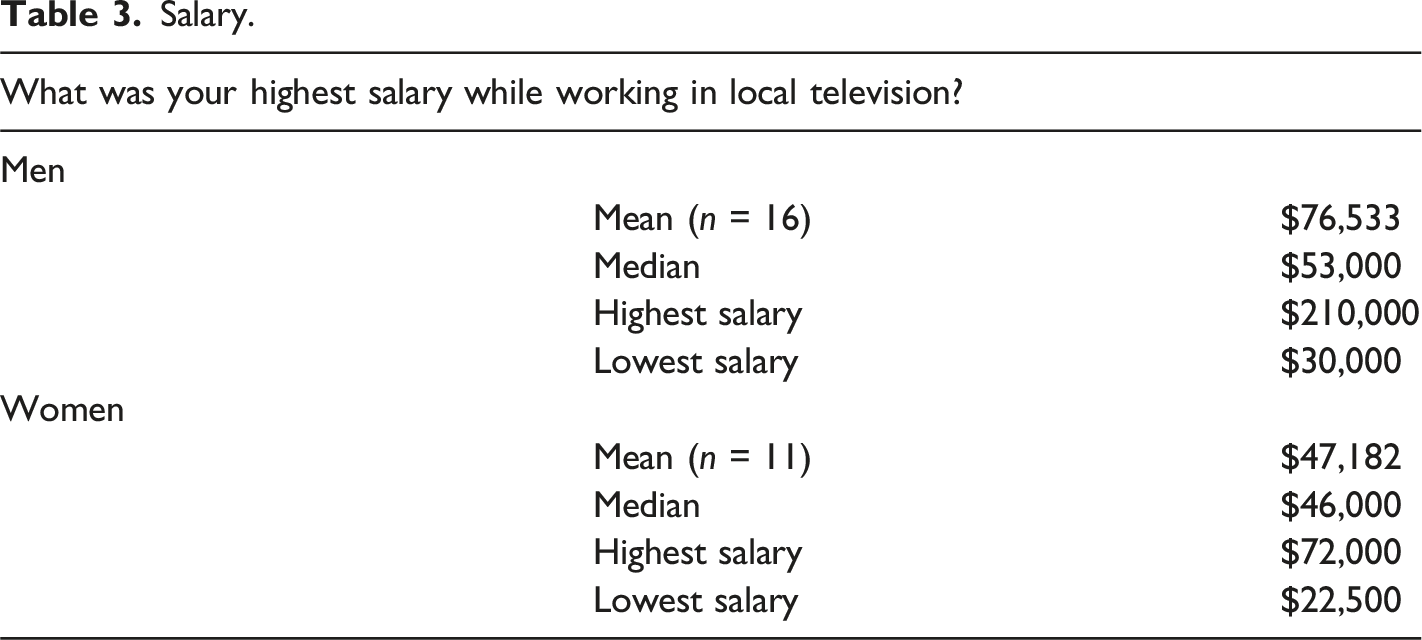
Salary.
Family Focus
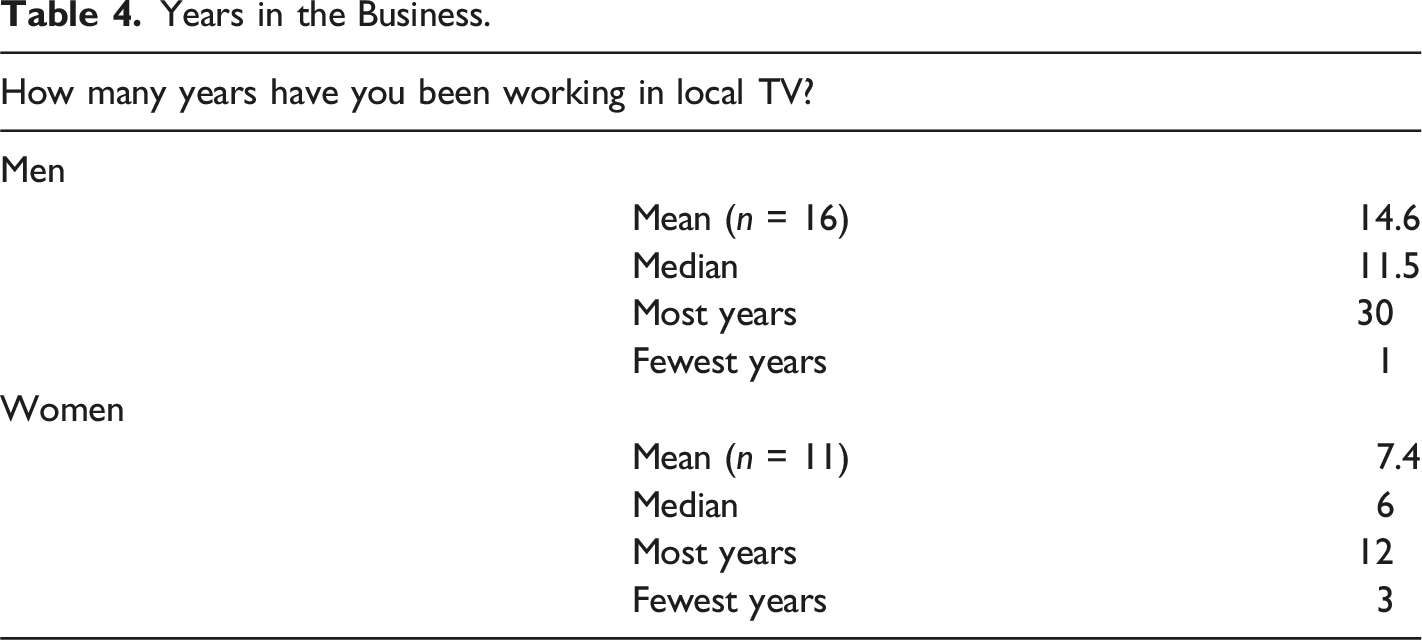
Years in the Business.
The Female Experience
Contracts in local television news usually run in two-year cycles. Female journalists, on average, completed three contract cycles before leaving the business, as opposed to their male counterparts who were nearly double in industry years. The timeframe of early-30s, and thinking proactively of family planning, did coincide with responses from the participants. For example, Jaime said: Let’s be honest, I’m gonna (sic) be in my mid-30s, we want to start a family, this [working in TV] is just not something I want to do…I knew that I was getting older and more mature and going to start a family and it was just like the perfect opportunity to leave TV.
Tina, similarly, said, “I didn’t think I was going to get married. My friends didn’t think I was going to get married. They thought I was just going to flow and be single for the rest of my life.” She did get married shortly after leaving television and plans to start a family.
Linda realized of her relationship with her then boyfriend, now husband, “He lived in Colorado, and we had been together for nine years. And I was like, you know what, this job isn’t worth it. And I’m going to move out to Colorado and start a new life with my boyfriend.” Kristin echoed that, saying, “I was getting married, and I saw where I wanted to take my life, which was starting a family eventually doing those sorts of things. I just didn't see how that balance was going to work in my life.” Andrea, who was a sports reporter for three years, described how the stress of her job impacted her family planning. “I left the station just after COVID really ramped up. I was also finally pregnant after a year and a half of trying. I greatly blame stress and stress-related weight loss on why it took so long.”
It was not always getting married specifically or having children that caused female journalists to leave the industry. As Lydia mentioned, “I just was realizing, oh my gosh, I'm actually going to get to spend holidays with my family. I spent an entire decade, my entire twenties, not doing any of that.” Lola, comparably, said, “If you're moving up through different markets, you’re always the new kid. Then you are working Thanksgiving, Christmas, whatever, the main holidays. You want to be home with your family.” She added, “I think I spent two Christmases with my family in 10 years.”
The Contrast
Both female and male participants mentioned family in their interviews. Family was often used as an outcome of having more discretionary time, like what Lydia and Lola said in the previous subsection. Notice, however, each of the previoius responses incorporated a proactive lens that situated the women respondents as forward-facing decision makers. Jaime, Tina, Linda, Andrea, and others implied the thought entered their minds when it came time to decide to leave the industry, they developed a plan, and executed the plan. None of the 11 participants had children before leaving news. Seven of them have since had children. Certainly, in many ways women inherently have more autonomy over the process of family planning simply because they are responsible for carrying the children. However, not one of the male participants noted they decided to leave their job because they wanted to start a family or even be closer in proximity to a significant other.
That is not to say that men did not consider their families in their responses. George offered an example of this. He captured the often reflective—rather than the proactive—perspective men took in these considerations: The sacrifices that the job requires you to make are worth it and exciting when you're 24. And the more you do it, and the more Christmases you miss, and the more birthdays you miss. And not only that, more importantly, the more casual time that you don’t even think about with your friends and family that you miss, that really starts to weigh you down. And you really realize how much you are missing being away.
It is noteworthy that he understood the missed engagement with his family because of his job, but any change he made were rear facing in contrast to his female counterparts. That was representative of the male response.
Passed Over for Jobs
Being passed over for jobs was a secondary theme, meaning not all female participants experienced this condition, but noticeably more female participants experienced this than male participants. This secondary theme is defined as journalists feeling they were being passed over or not considered for jobs they wanted. There was no obvious disparity in meaning or impact between men or women, it was principally frequency of it occurring that was different. Several women mentioned being frustrated, or even pushed to leaving, because they wanted a job they felt they were suitable candidates for and were not selected. It was noteworthy that they did not share whether there was specific feedback as to why they were not selected but it was clear that not being selected was a tipping point for exiting their job.
Lydia was one of the women who experienced being passed over for a job she wanted. She shared the following anecdote:
The turning point was after the fifth full-time reporter job that had been posted since I was there, and both myself and another reporter—who’s fantastic—both got passed up for it again. Five full-time positions while we’re working our asses off proving ourselves day in and day out, they’re taking these outside hires from, I don’t even know where. So, after number five, I said I’m out.”
Lydia was in a top-20 market, which was inherently more competitive than other markets, but was able to find a job outside of television within days of making this decision.
Alisha had an almost identical experience at her top-50 market station. Her sports director left the station, and she submitted her application for the position. She described it as, “Our sports director left and instead of me getting promoted to that position, someone else was brought in to fill that position.” Like Lydia, the person who was hired was a man. She added, “So that was disheartening after, you know, having been there for years and put in my time, I thought that it should have gone to me, but it didn’t.” Interestingly, none of the respondents explicitly stated they were upset that a male counterpart was hired, but they were brought to a decision of leaving—at least in part—because they were not selected.
George was the only male participants that detailed his experience with this secondary theme. One noteworthy difference for George was he applied for a job at a station he previously worked at as an intern, unlike his female counterparts who were currently employees at the stations they eventually were passed over by. He did note that he knew several people who still worked there and was a viable candidate. But, he said, “I submit my email, I submit my application. I email the people I know there. I never hear back for an interview.” That was discouraging for him, of course, but because he was not directly affiliated with the station, it was more a variable in becoming discouraged with the industry holistically, not ultimately resigning from the job he currently held.
Discussion
The consolidation of variables motivating female journalists to leave television news offered further context to Fink’s (2018) description of gender sidelining and Culver’s (2018) self-sidelining theories. The enumeration of themes that emerged, in many ways, oversimplified the complexities of the life-changing decisions journalists made in departing the industry. The feedback provided about leadership concerns, focusing on family, being passed over for jobs, and others, were all contributory factors in also supporting Culver’s (2018) interpretation of “self” in sidelining theory. In both Fink (2018) and Culver (2018), there were acknowledgments that the factors pushing actors out of their roles were within the scope of American antidiscrimination legislation. There were no explicit illegal actions taken by newsroom managers or violations of hiring laws like Title VII or Title IX—at least stated by the participants. There were, however, noticeable differences between women’s and men’s experiences that, especially in the hegemonic environment of sports journalism (Everbach, 2018), support Fink’s delineation of gender.
Metaphoric headwinds that are defined—and often bolstered—by systemic shortcomings were at the root of female journalists quitting their jobs, essentially seeming to wear them down over time. Hardin and Shain (2006) described the greater lengths women had to go in sports journalism to be perceived as credible as journalists. The subtext behind Emily Giangreco’s final statement, “Here’s to hoping this is a safe space for strong women one day” (Giangreco@EmilyGiangreco., 2024) demonstrates the complexities to the job and that equity is still not realized. The female respondents in this study often noted that not only did they face those same challenges with viewers, but they also had them with their newsroom leaders. Simultaneously, discretionary facets of life, like starting a family or spending time with friends, became a catalyst for dissatisfaction in the job. Female participants were acutely aware of their trajectory toward starting a family and having the opportunity to realize personal milestones that were not often afforded women in sports journalism (Bruce & Tuggle, 2021). It spoke volumes to the researchers that none of the participants had children during their television careers, but a majority had started families since leaving the business. Pair those realities with an evolving work environment where job responsibilities and safety precautions routinely shifted, and consistently being passed over for jobs they desired, and the participants of this study demonstrated that they thought their only recourse was to leave.
Those professional constraints previously noted of female journalists were originally analyzed independently of any comparison to the male experience. The contrast between men and women allowed for further contextualization that illuminated both overt and nuanced distinctions between groups. This study found that men held more leadership positions (Billings, 2018), earned higher salaries (Hardin & Whiteside, 2020), and had longer tenures in the business (Whiteside & Hardin, 2017) just like the work that came before this. Similarly, women disclosed they were self-preserving of their desire to have families (Bruce & Tuggle, 2021), more objectified (Cummins et al., 2018), and lacked mentorship and support (Picariello et al., 2023; Smith et al., 2016). But the intricacies within those differences are perhaps more telling. For example, female respondents were clearly more proactive about family planning than men, taking a more forward-facing posture while men were more reactionary. Additionally, female journalists voiced concern of their personal safety, where men seemed to primarily object to leadership decisions that took the focus away from sport.
The findings of this study demonstrated that men and women do not share the same outcomes in salaries or upward mobility, either. Women’s pay, as previously mentioned, is lower and, because they hold subordinate positions in the newsroom, their schedules are often more grueling. Add the litany of other variables that contribute to job dissatisfaction among female journalists and the work environment is ripe for gender sidelining (Fink, 2018). It is also observable that, while men have worthwhile complaints, women have a more difficult existence in this profession. While none of the journalists explicitly stated that burnout (Reinardy, 2009; 2013) was the reason they left, the implications certainly imply that it played a role.
There is no question that having diverse journalists, in this case female sports journalists, enriches the content viewers consume (Hardin & Whiteside, 2020; Sherwood et al., 2016). As Springer (2021) noted, the moment to engage in social discourse is profoundly present for sports journalists. The institution of sport is positioned to continue to migrate away from the ‘Toy Department’ moniker (Springer, 2021) and this moment will necessitate diverse voices. Feminist scholars like Marie Hardin, Erin Whiteside—both cited multiple times in this article—among many others have long stated diverse perspectives in news will only enhance storytelling of marginalized groups. The gravity of losing capable, female journalists, who are often exposed to similar sidelining experiences is a loss for audiences.
The researchers would like to offer three suggestions to help thwart the recruiting and retention issues surrounding female sports journalists in local television. First, newsroom leadership should engage in more active feedback loops. This would allow journalists to see their value in the newsroom by being more involved with two-way communication while simultaneously improving their craft with constructive feedback. Second, co-opted conversations about burnout, safety, and growth should be mainstays in the newsroom. The findings showed that morale was negatively impacted when journalists felt overwhelmed with work, unsafe on the job, or they were trapped at a station. Third, advocating for greater engagement with mentorship and support networks is essential. There are rarely multiple female journalists in a station’s sports department, much less an entire market. Newsroom leaders can demonstrate their commitment to improving work environments by showing their desire to be involved with the mission of AWSM and other professional development opportunities.
Conclusion
There is no silver bullet solution to the problem of losing female sports journalists. The obvious short-term solution is pay them more money. While the authors of this study believe that paying journalists more money should be a priority and, according to Papper and Henderson (2024b) that is happening slowly, it likely provides diminishing returns long-term. Offering more paid time off, conversely, may have more enduring effects on employees. But it is extremely difficult to predict how significant that change would be. The theoretical and practical applications of this study appear to be more rooted in wider shifts in culture. Sports journalists, both female and male, want to feel valued and not only their time but their content contributions. Therefore, researchers offered potential solutions at the end of the last section in order to bolster an inclusive work environment.
The more obvious challenge in this complex dynamic is that local television newsrooms are strapped for resources as the market continues to thin (Hull, 2024; Papper & Henderson, 2024a). Future research in this area should include perspectives from newsroom leaders—news directors, executive producers, assignment editors, etc.—and how those managers and these journalists can find symbiosis. The researchers in this study firmly believe that sports have an important role in the local news ecology. And there is substantial evidence that viewer interest in sport, both national and local, is not waning. Perhaps, strategic rethinking of the role of sports in a newscast could serve the industry—and its practitioners—well.
Footnotes
Declaration of Conflicting Interests
The author(s) declared no potential conflicts of interest with respect to the research, authorship, and/or publication of this article.
Funding
The author(s) received no financial support for the research, authorship, and/or publication of this article.
