







Abstract
Secondary school adolescents attending vocational tracks engage considerably more often in substance use and sexual activity compared to those attending academic tracks. Prior studies have sought explanations for these differences in higher levels of social-emotional problems among vocational students. This study presents a novel approach. Inspired by ethnographic and cultural studies, it examines the role of conceptions and expectations of adulthood in the association between educational track and adolescent substance use and sexual activity. Self-report data were collected among 1,568 Dutch adolescents by means of a web-based questionnaire. First, in a preliminary qualitative analysis, conceptions of adulthood were explored among vocational and academic students. Next, a mediation analysis was employed. Results of the qualitative analysis revealed that vocational and academic students had different conceptions of adulthood, with vocational students perceiving substance use and sexual activity more often as typical adult behaviors. The results of the quantitative analysis confirmed this finding and added that vocational students expect social role transitions earlier in life than academic students. Both factors mediated the association between educational track and adolescent substance use and sexual activity. Implications of the findings and future directions for research are discussed.
Keywords
Numerous studies conducted in different cultural contexts have provided evidence that students in vocational tracks engage substantially more often in substance use and sexual activity compared to students in academic tracks (Friestad & Klepp, 2006; Geckova, Van Dijk, Groothoff, & Post, 2002; Hagquist, Sundh, & Eriksson, 2007; Richter & Leppin, 2007; Vereecken, Maes, & De Bacquer, 2004). While the association between educational track and adolescent substance use and sexual activity is well established, far less is understood regarding its underlying mechanisms. Recent evidence (De Looze et al., 2012) suggests that vocational students experience the transition to adulthood earlier in life than academic students and that this may explain their higher levels of engagement in adult-like behaviors such as substance use and sexual activity. The present study elaborates on this suggestion. It explored to what extent adolescent conceptions and expectations of adulthood mediate the association between educational track and adolescent substance use and sexual activity.
Diversity in Pathways to Adulthood
Adolescence is a developmental period characterized by the transition from childhood to adulthood. As adolescents grow older, they increasingly assume adult roles and responsibilities in society. Pathways to adulthood however differ across individuals, as they are shaped by personal and societal factors (Shanahan, 2000). Recent evidence (De Looze et al., 2012) suggests that educational track may be one of these factors. According to this study, vocational students may experience the transition to adulthood earlier in life than academic students. The earlier transition to adulthood for vocational students may be caused by the fact that they generally complete their education at an earlier age than academic students. As a result, vocational students also experience social role transitions, such as entering the labor market (Berzin & De Marco, 2010; Gillis, 1981; Raymore, Barber, & Eccles, 2001; Scherger, 2009), getting married, and having a first child (Beets, Dourleijn, Liefbroer, & Henkens, 2001), at an earlier age. Scholars have traditionally considered these social role transitions as markers for adulthood (Arnett, 1997, 2001; Buchmann & Kriesi, 2011; Hogan & Astone, 1986; Shanahan, 2000). The earlier transition to adulthood for vocational students is likely to influence their conceptions and expectations of adulthood. These factors, in turn, may explain their higher engagement in adult-like behaviors such as substance use and sexual activity.
Conceptions of Adulthood
In the past few decades, young people’s conceptions of adulthood have become a burgeoning area of research. Traditionally, individuals were considered adults when they had experienced certain social role transitions (completing school, leaving home, beginning a career, getting married and having children; Hogan & Astone, 1986). More recently, due to a delay in the ages at which young people experience these transitions, the process of becoming an adult has become less ordered and more diversified (Settersten, Furstenberg, & Rumbaut, 2005). As a result, young people have increasingly used subjective, individualistic criteria for adulthood, such as accepting responsibility and making independent decisions (Arnett, 2001; Donoghue & Stein, 2007; Nelson & Barry, 2005; Westberg, 2004).
According to Donoghue and Stein (2007), demographic variation in young people’s conceptions of adulthood is exists as young people define adulthood in ways that are consistent with their own experiences. They tend to attach value to those markers for adulthood they think they have already mastered or will master in the near future, so that they can strengthen their own status as a mature, adult individual. In line with this reasoning, vocational students, who expect to experience social role transitions earlier in life, may be more likely to perceive these social role transitions as markers of adulthood. In contrast, academic students, who tend to delay these social role transitions, may reject these standards of adulthood in favor of more subjective and individualistic benchmarks which they may believe they have mastered, such as being responsible or independent.
Another potential difference in vocational and academic students' conception of adulthood is the extent to which they associate (the transition to) adulthood with overt, adult-like behaviors, such as substance use and sexual activity. While both qualitative and quantitative studies have revealed that many adolescents perceive substance use and sexual activity as typical adult behaviors (Arnett, 2001; Kloep, Hendry, Ingebrigtsen, Glendinning, & Espnes, 2001; Moffitt, 1993; Treacy et al., 2007), only few studies have touched upon the idea that this perception may differ across adolescents attending different educational tracks. One of the first scholars who touched upon this topic was Willis (1977). In his classic ethnographic study, he described how working-class boys in Britain were more likely to perceive smoking and drinking as typically adult behaviors and were consequently more likely to engage in them, compared to their peers from a higher social class. This finding may be explained by the fact that the working-class boys faced an earlier transition to adulthood and were therefore more oriented toward obtaining an (overt) adult status among peers. In addition, it may reflect the fact that lower-class boys had relatively few other resources to attain status among peers. While higher-class boys for example were more likely to use educational achievement as a resource to acquire peer status, working-class boys often had lower educational achievements and instead used their engagement in adult-like behaviors to attain status. A similar mechanism may apply to vocational and academic students. As vocational students are likely to make the transition to adulthood at an earlier age and have lower educational achievements than academic students, they may be more likely to engage in adult-like behaviors and to use these behaviors to acquire status among peers.
In sum, it can be hypothesized that conceptions of adulthood differ among adolescents attending vocational and academic tracks. Vocational students can be expected to attach more value to social role transitions as markers of adulthood, while academic students are more likely to attach value to individualistic or subjective norms as markers of adulthood. Further, it can be hypothesized that vocational students are more likely to perceive substance use and sexual activity as typical adult behaviors, and that this perception mediates the association between educational track and adolescent substance use and sexual activity.
Expectations of Adulthood
Besides adolescent conceptions of adulthood, adolescent expectations of adulthood may also explain why vocational students engage more often in substance use and sexual activity compared to academic students. Although previous studies have convincingly demonstrated that vocational students experience social role transitions, and therewith the transition to adulthood, at an earlier age than academic students (Beets et al., 2001; Berzin & De Marco, 2010; Gillis, 1981; Raymore et al., 2009), it is not known whether vocational and academic students, at high school age, are already aware of the differences in future pathways.
If they are, then theories of human behavior scaffolded by a life history framework (Roff, 1992; Stearns, 1993) predict that vocational students are more likely to adopt a fun morality, go out, and engage in behaviors such as substance use and sexual intercourse, because the expectation of earlier social role transitions - or a higher pace of life in general - makes them believe that there are fewer opportunities for personal advancement in the future, and this in turn causes them to become more present-time oriented and to prioritize short-term gains. In contrast, if academic students expect to make social role transitions at a relatively old age, they can be expected to be less likely to adopt a fun morality and engage in these behaviors, because they will have more confidence in the future and are more likely to prepare themselves to obtain long-term goals at the expense of short-term gains. Recent empirical studies confirmed that adolescents growing up in settings with fewer opportunities were more likely to engage in fun, but sometimes risky behaviors such as substance use and sexual intercourse than adolescents growing up in settings with more opportunities (Borowsky, Ireland, & Resnick, 2009; Chisholm, 1993; Harris, Duncan, & Boisjoly, 2002; Kruger, Reisch, & Zimmerman, 2008; McDade et al., 2011; Stearns,1992). To date, however, no study has specifically applied these theories to explain differences in substance use and sexual activity between adolescents attending different educational tracks.
Research Questions and Hypotheses
This study aimed to explain why vocational students in the Netherlands engage more in substance use and sexual activity compared to academic students. We tested whether conceptions and expectations of adulthood mediated the association between educational track and adolescent substance use and sexual activity. First, we explored conceptions of adulthood among adolescents attending vocational and academic tracks in a qualitative, preliminary analysis. Second, we conducted a mediation analysis based on quantitative data. We expected that vocational students were more likely to mention social role transitions as markers of adulthood, while academic students were more likely to mention individualistic and subjective norms as markers of adulthood. Further, we expected that vocational students were more likely to perceive substance use and sexual activity as typical adult behaviors, and that this (partly) explained their higher levels of engagement in these behaviors (mediation effect 1). Finally, we hypothesized that vocational students expected to experience social role transitions earlier in life than academic students, and that this also explained their higher levels of engagement in substance use and sexual activity (mediation effect 2).
Method
The sample was comprised of a subgroup of adolescents who participated in the 2009 Dutch Health Behavior in School-aged Children (HBSC) survey. The HBSC study is a World Health Organization collaborative cross-national study on the health, health-related behaviors, and the social context of young people’s health. For detailed information on the data collection procedure, we refer to the study protocol (Griebler et al., 2010; Roberts et al., 2007, 2009).
In October and November 2009, data were collected in a nationally representative sample of students in the first through fourth grade of secondary education in the Netherlands (see Van Dorsselaer et al., 2010). Data were collected via an anonymous self-report questionnaire at secondary schools. After filling in the questionnaire, all students were invited to participate in a longitudinal study. Thirty-seven percent of the students (N = 2,131) agreed to participate and provided a valid e-mail address and phone number. In November 2010, these students were approached by e-mail to fill in an online questionnaire. At that time, they were aged 13 to 17 years old. If youth did not fill in the questionnaire, they were repeatedly reminded by e-mail and phone. Also, they were offered the option to answer the questions over the phone. Respondents were instructed to fill in the online questionnaire or respond to the questions over the phone only when there were no other people present in the room.
In total, 1,568 students (74% of the youth that were approached) filled in the questionnaire; 64% of them participated via Internet and 36% participated via a phone interview; 44% of the sample were boys, the mean age was 14.6 (SD = 1.2), and 45% attended a vocational track. Compared to the nationally representative sample from 2009, the adolescents in the 2010 sample were more often female, χ2(1) = 23.11, p < .001, younger of age, t = 9.00, p < .001, and more often attended academic tracks, χ2(1) = 79.63, p < .001.
Measures
Adolescent Substance Use and Sexual Activity
Adolescent risk behaviors were measured by means of a latent construct based on the four indicators, which had a very good model fit: χ2(2) = .44, p = .80, comparative fit index (CFI) = 1.00, Tucker–Lewis Index (TLI) = 1.00, root mean square error of approximation (RMSEA) = .00. The four indicators were:
Daily tobacco smoking. With respect to tobacco smoking, adolescents were asked, “How often do you smoke at present?” The original answer categories (never, less than weekly, weekly but not daily, daily) were recoded into “no daily smoking” and “daily smoking.” The focus on daily smoking was based on the fact that daily smoking is a crucial aspect of nicotine dependence (Jarvis, 2004), which increases adolescents’ likelihood of smoking in the future and developing smoking-related health problems leading to premature deaths (Hublet et al., 2006).
Binge drinking in the previous month. With respect to alcohol use, adolescents were asked, “How often have you, in the previous month, drunk five or more alcoholic drinks on one occasion (for example at a party or a night out)?” Original answer categories (ranging from never to nine times or more) were recoded into never and at least once. Regular binge drinking is considered an indicator of excessive alcohol use (as per Lammers et al., 2011).
Cannabis use in the previous month. Lifetime cannabis use was measured by the item “How often, in your entire life, have you smoked cannabis?” The original answer categories (ranging from never to 40 times or more) were recoded into never and at least once. Cannabis use is rare among adolescents aged 13–17 (e.g., Currie et al., 2012; Hibell et al., 2011); if adolescents at this age already have experience with cannabis use, this is generally interpreted as a risk behavior.
Sexual intercourse. In 2009, students were asked whether they had ever had sexual intercourse. Answer categories were either “yes” or “no”. In 2010, students were asked whether they have had sexual intercourse in the year previous to our study. Based on these two variables, the variable “sexual intercourse” (defined as ever having had sexual intercourse) was created.
The Perception of Substance Use and Sexual Activity as Adult Behaviors
Respondents were specifically asked about the extent to which they perceived substance use and sexual intercourse as adult behaviors by means of the question: “To what extent do you associate the following behaviors with adulthood: (a) smoking tobacco; (b) drinking alcohol; (c) using cannabis/soft drugs; and (d) having sexual intercourse.” Answer categories (5) ranged from “absolutely not” to “absolutely, yes.” A latent construct was created based on these four indicators. Items b and d were correlated. The latent factor had a good fit: χ2(1) = .90, p = .34, CFI = 1.00, TLI = 1.00, RMSEA = .00.
Transition Expectations
Adolescents’ expectations of when they will make the transition to adulthood was measured as a latent factor, which was based on six (open-ended) items: At what age do you expect to be when you (a) have a full-time job; (b) are financially independent; (c) have a steady romantic relationship; (d) are able to take care financially for your own family; (e) get married or live together with a partner; (f) have a first child?. Because of their interrelatedness, Items c, e, and f were correlated. The latent factor had a good fit: χ2(6) = 48.39, p = .00, CFI = .99, TLI = .92, RMSEA = .07.
As some adolescents are already involved in a romantic relationship, we tested whether this influenced their answer to Item c. The results of a linear regression revealed that current relationship status did not affect expectations about the timing of having a steady romantic relationship (p = .695).
Educational Track
Educational track is a proxy for adolescent socioeconomic status as it is a strong predictor of adolescents’ future socioeconomic status (Research Centre for Education and Labour Market, 2009). In the Netherlands, four types of secondary school exist, ranging from prevocational training to higher academic education. Although adolescents’ enrolment in a specific educational track is influenced by factors such as parents’ socioeconomic status (Herweijer, 2010) and access to social capital (Eriksson, Dahlgren, Janlert, Weinehall, & Emmelin, 2010), adolescents are placed in a specific educational track primarily based on their achievement at primary school (expressed both in the results of a battery of tests that are used nationwide in most schools and in the advice of the teacher). As many secondary schools are specialized in teaching either vocational or academic education, the two vocational tracks were combined and the two academic tracks were combined for the purpose of the present analyses.
Analytical Strategy
First, a preliminary analysis was conducted to explore adolescent conceptions of adulthood. The main goal of this analysis was to examine to what extent adolescents mention adult-like behaviors such as substance use and sexual activity when they respond to the open question “Please indicate three things you typically associate with adulthood.” As previous studies (Arnett, 2001; Nelson & Barry, 2005; Westberg, 2004) paid only limited attention to this specific association (e.g., although sexual activity is a distinct category in Arnett’s (2001) measure of conceptions of adulthood, substance use is not included in this measure), we conducted this qualitative analysis. We classified adolescent answers using standard qualitative methods (a full description of the procedure is available from the first author) and presented the results by gender, age, and educational track.
Next, we present the descriptive statistics of our quantitative data on adolescent substance use and sexual activity, adolescent expectations of the timing of social role transitions, and the extent to which adolescents perceived substance use and sexual activity as adult behaviors. Statistics were presented separately for gender, age, and educational track. Differences between subgroups were calculated by means of chi-square tests and analyses of variance in statistical package for the social sciences.
Finally, we performed a number of regression analyses by means of structural equation modeling in Mplus version 6.11 (Muthén & Muthén, 1998–2010). First, we tested the direct association between educational track and adolescent substance use and sexual activity. Second, a mediation model was tested, investigating whether adolescent transition intentions and conceptions of substance use and sexual intercourse as adult behaviors mediated the relationship between educational track and adolescent substance use and sexual activity. Mediation was tested by means of the Delta method (Bollen, 1989; MacKinnon, 2008), which is the default way of mediation testing in Mplus. This method calculates the significance and relevance of indirect (mediation) paths. A mediation effect was concluded to be present when the direct path from educational track to substance use and sexual activity became insignificant after the addition of the mediators to the model.
All analyses were corrected for cluster effects of pupils within the same school (primary sampling unit) using the “cluster is” option in Mplus. Also, they were controlled for gender (boy vs. girl), age (ranging from 13 to 17), and the way respondents participated in the study (i.e., by filling in the Internet questionnaire or by answering the questions over the phone). The range from missing values per variable ranged from 0% to 12.1% (How old do you think you will be when you will have a steady relationship?). In the analyses, missing values were dealt with using the full information maximum likelihood estimator.
Results
Preliminary Analyses
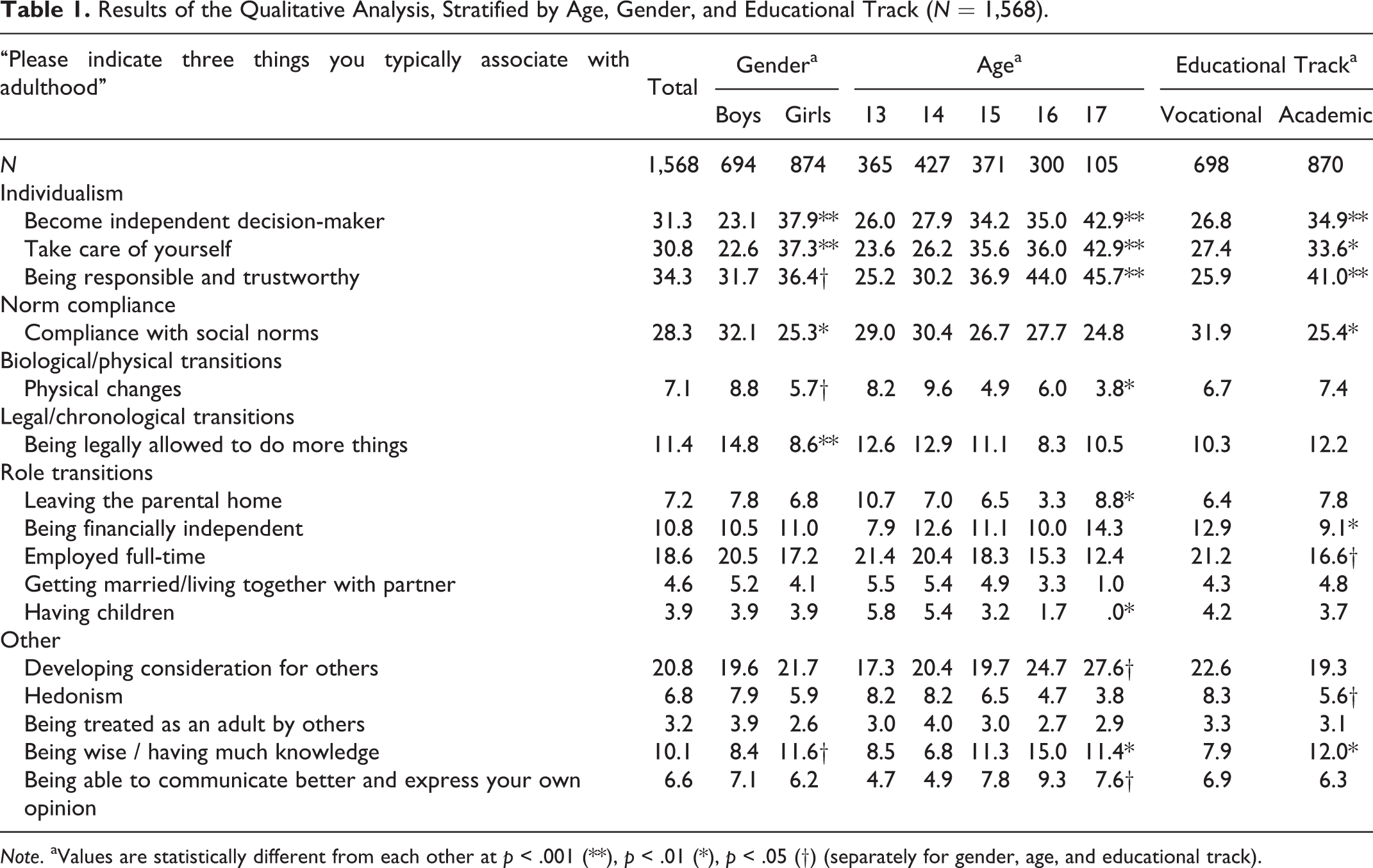
Table 1 summarizes the results of our qualitative analysis, that is, the answers adolescents gave to the open question “Please indicate three things you typically associate with adulthood.” In all, 6.1% of the respondents did not answer this question. This was more often the case among vocational (7.9%) compared to academic (4.6%) students (p = .005). Nine codes were mentioned by less than 3% and were therefore not included in the table. They were having a stable self-concept (2.8%), being capable of running own household (2.8%), finishing education (2.3%), having a long-term orientation (2.5%), being socially and/or politically involved (2.1%), being able to control one’s own emotions (.8%), negative associations (i.e., boring, stress; .8%), having authority (.7%), and having an active/busy life (.7%).
Results of the Qualitative Analysis, Stratified by Age, Gender, and Educational Track (N = 1,568).
Note. aValues are statistically different from each other at p < .001 (**), p < .01 (*), p < .05 (†) (separately for gender, age, and educational track).
The most prevalent answers (>28%) adolescents gave to our open-ended question were individualistic criteria (i.e., becoming an independent decision maker; taking care of yourself; being responsible and trustworthy) and norm compliance (e.g., stick to the rules, be a role model for young people, have good manners). The next most prevalent codes included being employed full-time and developing consideration for others (e.g., having respect toward other people, being helpful, taking care of other people). Substance use and sexual activity, sometimes mentioned in the context of going out at night, were mentioned by 7% of the respondents. This category was labeled as hedonism. Vocational students were more likely to mention hedonism as a marker for adulthood than academic students. Further, academic students were more likely to mention individualistic norms and wisdom as markers for adulthood, while vocational students more often mentioned norm compliance, full-time employment, and financial independence.
Descriptive Statistics
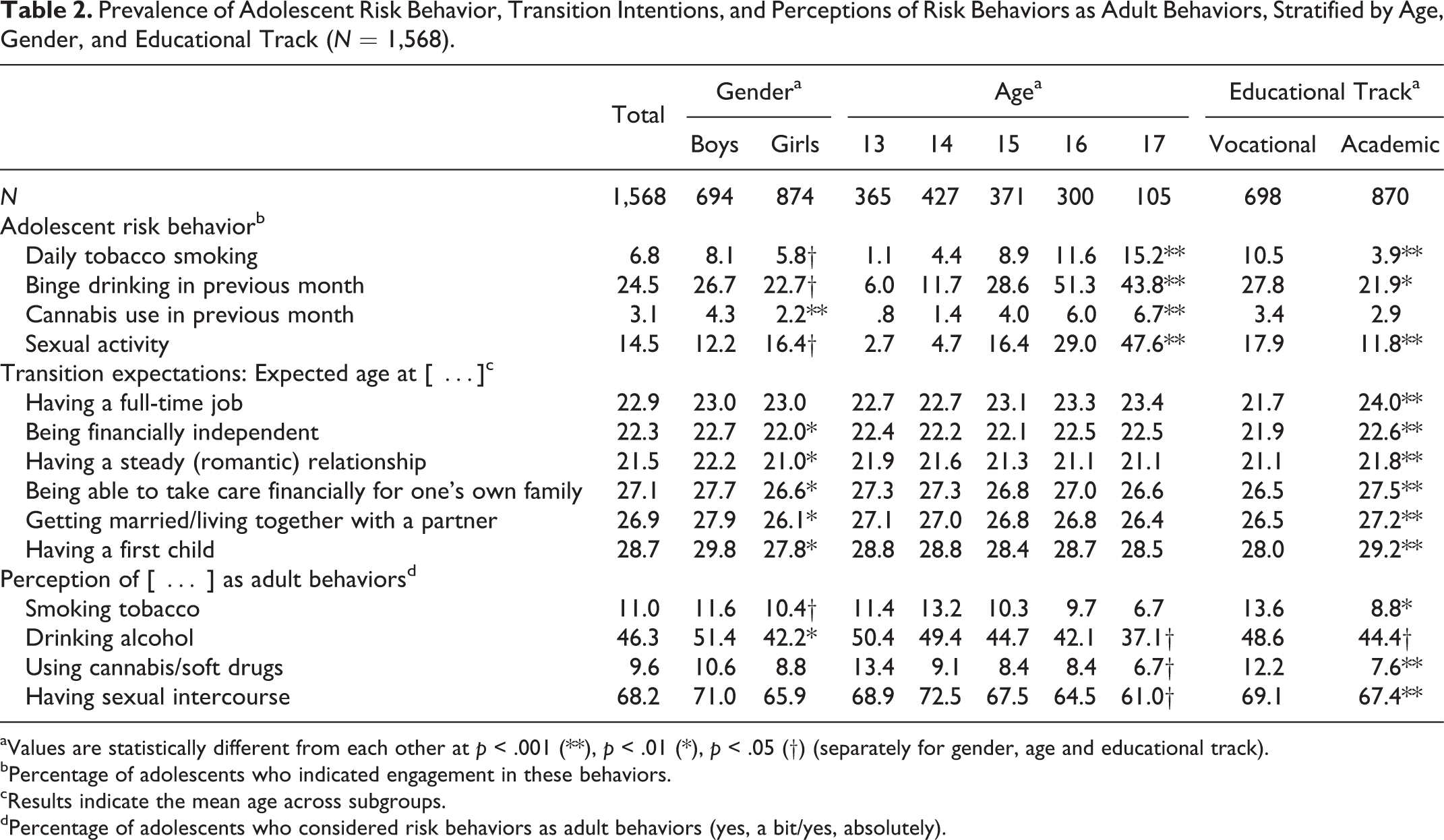
The prevalence rates of daily smoking, recent binge drinking, recent cannabis use, and sexual activity among the adolescents in our sample are presented in Table 2. The prevalence of all four behaviors increased with age. Boys more often indicated using or having used substances compared to girls, while girls more often had experience with sexual intercourse. Finally, vocational students engaged significantly more often in smoking tobacco, binge drinking, and sexual intercourse. There was no significant educational difference with respect to lifetime cannabis use, although the prevalence was slightly higher among vocational students.
Prevalence of Adolescent Risk Behavior, Transition Intentions, and Perceptions of Risk Behaviors as Adult Behaviors, Stratified by Age, Gender, and Educational Track (N = 1,568).
aValues are statistically different from each other at p < .001 (**), p < .01 (*), p < .05 (†) (separately for gender, age and educational track).
bPercentage of adolescents who indicated engagement in these behaviors.
cResults indicate the mean age across subgroups.
dPercentage of adolescents who considered risk behaviors as adult behaviors (yes, a bit/yes, absolutely).
Table 2 also presents the mean age at which adolescents expected to experience social role transitions. Girls generally expected to experience major life transitions about one or two years earlier than boys. There were no significant differences across age groups, but there were clear group differences with respect to educational track. Vocational students expected all major life transitions earlier compared to academic students. There was especially a large difference in their expectations of when they would have their first full-time job (21.7 years old vs. 24.0 years old).
Finally, Table 2 presents the percentage of adolescents who indicated to perceive substance use and sexual activity as adult behaviors. Adolescents especially perceived sexual intercourse (68%) and drinking alcohol (46%) as adult behaviors. Although boys were more likely to perceive all four behaviors as adult behaviors, compared to girls, this gender difference was only significant with respect to drinking alcohol and smoking. Moreover, younger adolescents perceived all behaviors more often as adult behaviors compared to older adolescents, with the exception of smoking tobacco. Finally, and most importantly, vocational students perceived all behaviors more often as adult behaviors compared to academic students.
The Mediation Model
Before testing the hypothesized mediation effects, the direct association between educational track and adolescent substance use and sexual activity (controlled for age, gender, and the way respondents participated in the study) was tested. This model, χ2(22) = 91.64, p = .00, CFI = .91, TLI = .87, RMSEA = .05) showed a direct, negative association between educational track and adolescent substance use and sexual activity (β = .13, p < .001).
Next, the mediation model (see Figure 1) was tested. This model fitted the data well: χ2(115) = 366.21, p = .00, CFI = .92, TLI = .90, RMSEA = .04. The results confirm that vocational students expected to experience major life transitions earlier in life and that they more often perceived substance use and sexual intercourse as adult behaviors compared to academic students. Further, both factors were found to predict adolescent engagement in substance use and sexual activity. Tests of indirect effects showed that both transition intentions (β = −.04, p < .001) and the perception of substance use and sexual intercourse as adult behaviors (β = −.02, p < .01) mediated the association between educational track and adolescent substance use and sexual activity. The direct association between educational track and adolescent substance use and sexual activity disappeared (p = .08) in this model. In total, our model explained 43% of the variance in adolescent substance use and sexual activity.
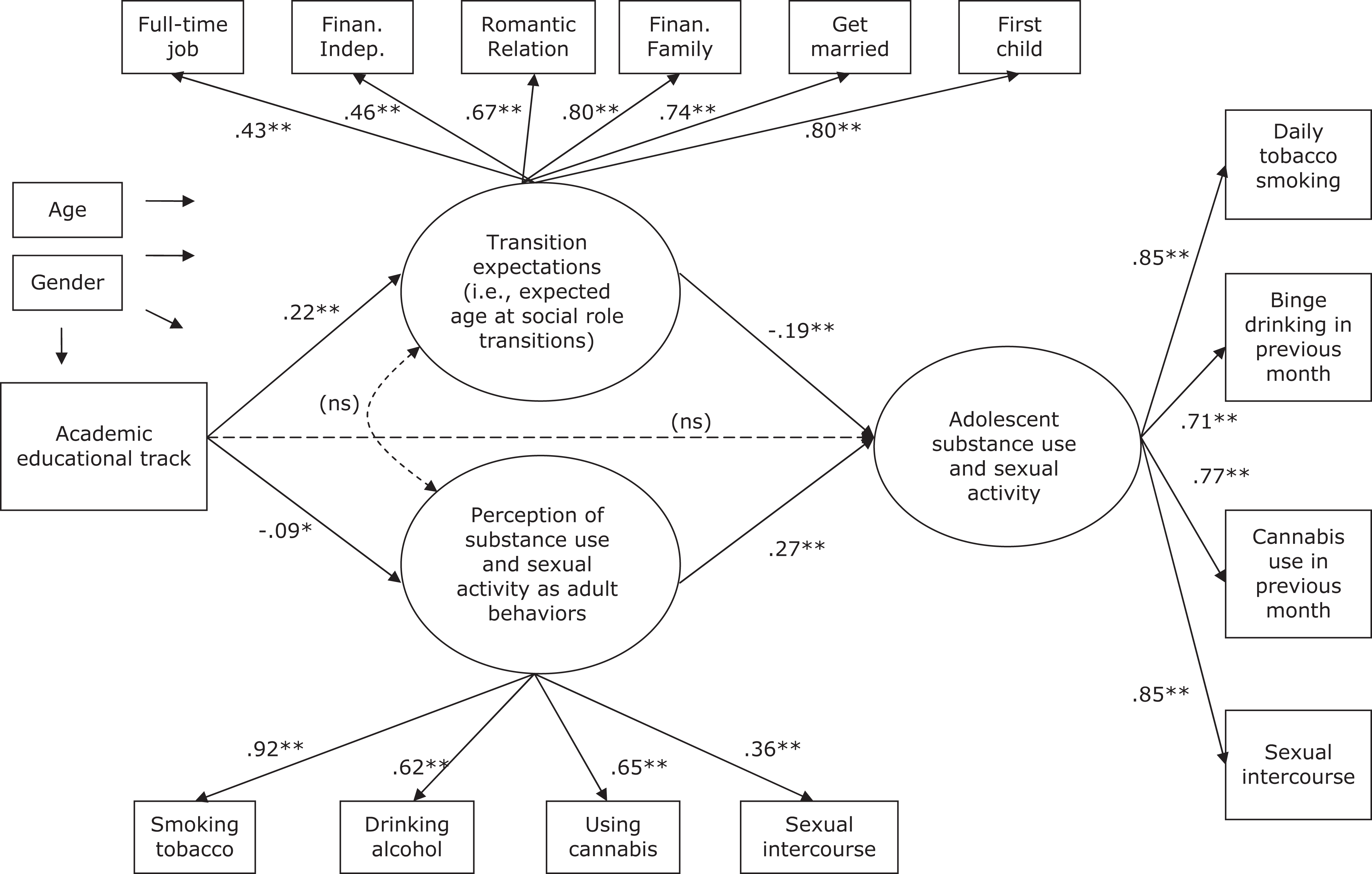
Mediation model. Model fit statistics: χ2(115) = 366.21, p = .00, comparative fit index (CFI) = .92, Tucker–Lewis Index (TLI) = .90, root mean square error of approximation (RMSEA) = .04. Note. **p < .001; *p < .01.
Discussion
The aim of this study was to investigate whether adolescent conceptions and expectations of adulthood mediated the association between educational track and adolescent substance use and sexual activity. The preliminary, qualitative analyses showed that vocational and academic students had different conceptions of adulthood. Vocational students were not only more likely to mention social role transitions as markers of adulthood, but they also perceived substance use and sexual activity more often as adult behaviors, compared to academic students. Our quantitative analysis confirmed the latter finding. Further, it showed that vocational students expected social role transitions, such as getting married and having children, earlier in life compared to academic students. Both the perception of substance use and sexual activity as adult behaviors and expectations of the timing of social role transitions were positively related to adolescent substance use and sexual activity. Consequently, both factors mediated the association between educational track and adolescent substance use and sexual activity.
The categories resulting from our qualitative analysis were largely consistent with those of Arnett’s (2001) quantitative measure of conceptions of adulthood. However, our findings added that a small but relevant proportion of adolescents associated adulthood with overt, adult-like behaviors such as substance use and sexual intercourse. Vocational students were more likely to report this than academic students. This difference may be explained by the fact that vocational students have fewer educational resources to acquire status among peers and are more oriented toward overt adult-like behaviors to obtain status. Vocational students’ belief that substance use and sexual activity are mature behaviors may be confirmed by the fact that they more often have older peers in their direct surroundings (i.e., at school) who go out at night, use substances, and are sexually active, compared to academic students (Van Dorsselaer et al., 2010). This perception may consequently trigger younger adolescents’ engagement in these behaviors as older, popular peers function as a role model for them (Moffitt, 1993, 2006).
Our finding that vocational students were more likely to mention traditional markers of adulthood, while academic students were more likely to mention individualistic markers, can be explained by Donoghue and Stein’s (2007) notion that adolescents tend to attach value to those markers of adulthood that they think they have already mastered, or will master in the near future, so that they strengthen their own status as a mature individual. Further, the qualitative analyses also showed that vocational students more often mentioned norm compliance as a marker for adulthood, compared to academic students. Potentially, this finding may reflect the fact that vocational students are being prepared for jobs in which the boundaries for creativity and initiative-taking are relatively small. In contrast, academic students are more likely to get an executive job which demands innovative thinking and personal initiative-taking to a higher extent. Consequently, vocational students may perceive that compliance with social norms results in stability and safety, while academic students may learn that one has to be creative and original, and should sometimes question or go against accepted norms, to become a successful adult.
Our finding that vocational students expected to experience social role transitions earlier in life than academic students is consistent with the historical fact that vocational students have a shorter youth and experience social role transitions earlier in life than academic students (Beets et al., 2001; Berzin & De Marco, 2010; Gillis, 1981; Raymore et al., 2001; Scherger, 2009). Our findings revealed that vocational students, from age 13 onward, already have different expectations about the timing of social role transitions, compared to their peers in academic tracks. The differences were generally about 1 year, except for “having a full-time job,” which vocational students expected 2.3 years earlier than academic students. Based on the actual age that vocational and academic students experience social role transitions (e.g., Beets et al., 2001), the differences in transition expectations were hypothesized to be larger. The relatively small group differences in our data may be attributable to the fact that it is hard for adolescents to estimate their age at future transitions or events they are not (yet) consciously thinking about in their current everyday life.
Transition expectations mediated the association between educational track and adolescent substance use and sexual activity. This can be explained by theories of human behavior scaffolded by a life history framework (Roff, 1992; Stearns, 1992). According to these theories, individuals who expect a higher pace of life (in this instance, vocational students) are more likely to prioritize short-term goals, including fun and direct satisfaction, while individuals expecting a slower pace of life (in this instance, academic students) are more likely to prioritize the attainment of long-term goals (McDade et al., 2011). Our findings may thus reflect the fact that vocational students are more likely to be present-time oriented and adopt a fun morality, while academic students are more focused on attaining long-term goals.
Study Strengths and Limitations
The present study is one of the first studies trying to explain the association between educational track and adolescent substance use and sexual activity by looking at factors reflecting adolescents’ unique social context and development. Whereas previous studies were limited to either describing this association without explaining it or explaining it by pointing at elevated social emotional problems among vocational students (Schrijvers & Schuit, 2010), the present study was able to explain educational differences in substance use and sexual activity by pointing at factors related to adolescents’ normative development, thereby using a life course perspective. This was an important gap in the literature.
Our findings must however be interpreted with knowledge of some limitations. First, our data are based on self-report. We chose this method as it outweighed the limitations associated with alternative methodologies for simultaneously collecting large amounts of data. By stressing the anonymity of the study, including the fact that neither parents nor teachers would find out about respondents’ individual answers, a bias due to self-reporting was limited (Brener, Billy, & Grady, 2003).
A second limitation is that our data are cross-sectional, which impedes us from making any causal inferences. Mediation models assume a specific temporal sequence and presume that there are no unaccounted confounders and that the model is correctly specified (MacKinnon, 2008; Muthén, in press). Although our model specification has a strong theoretical basis, future research may examine whether our findings can be replicated in a longitudinal design. This type of study may provide more insight in the potential causal nature of the paths that were identified in the present study.
Third, although the large dataset was an advantage for our quantitative analyses, it was a limitation with respect to our qualitative analyses. Due to the large sample, it was not possible to ask follow-up questions or further interview the respondents of the study in order to get more insight into their conceptions of adulthood.
A final limitation of this study was that our sample is not fully representative of Dutch youth aged 13–17. Adolescents in our 2010 sample were higher educated, more often female, and engaged less often in substance use and sexual activity compared to the nationally representative sample from 2009. When interpreting our findings, it is thus important to note that our results are conservative in estimates of adolescent substance use and sexual activity.
Implications
The current study lends support to the importance of examining adolescents’ expectations and conceptions of adulthood with respect to their engagement in adult-like behaviors such as substance use and sexual activity. Not only do vocational students expect social role transitions at an earlier age and are they more likely to perceive substance use and sexual activity as adult behavior compared to academic students, these two factors also explain the higher rates in substance use and sexual activity in vocational students. These findings suggest that research in the field of adolescent risk behavior may benefit from a life course perspective. Also, they suggest that adolescent engagement in substance use and sexual behaviors may be interpreted as normative behavior that occurs in the context of young people’s transition to adulthood.
This study’s findings may have implications for emerging adulthood theory. According to this theory, emerging adulthood is a phase of the life span between adolescence and full-fledged adulthood (Arnett, 2000, 2007). It has generally been applied to individuals in their 20s in developed countries who are becoming more independent and explore various life possibilities. Having left the dependency of childhood, and having not yet entered the enduring responsibilities that are normative in adulthood, emerging adults often explore a variety of possible life directions in love, work, and worldviews (Arnett, 2000). Our findings suggest that the earlier transition to adulthood for vocational students may lead them to experience the developmental stage of emerging adulthood at an earlier age. Future mixed-method research may investigate the relation between vocational track, emerging adulthood theory, and adolescent engagement in substance use and sexual activity in more detail.
Footnotes
Acknowledgment
We are indebted to all study participants. We would like to thank Cynthia Claasen, Eva van Eekelen, Joline de Bles, Renée Scheepers, and Esther Horrevorts for their help and dedication with respect to the collection of our data and the coding of our open-ended question.
Declaration of Conflicting Interests
The authors declared no potential conflicts of interest with respect to the research, authorship, and/or publication of this article.
Funding
This study has been made possible by a grant from The Netherlands Institute for Social Research (SCP).