







Abstract
Successfully managing and navigating romantic relationships is a key developmental task of emerging adulthood. While researchers increasingly use statistical analyses to accommodate the interdependent nature of romantic relationship data, there are very few applications and primers for comprehensively investigating moderation effects, especially in the structural equation modeling framework. The current article illustrates the application and extension of a dyadic analytical technique, the actor–partner interdependence model, to the study of romantic relationships in emerging adulthood, with a particular emphasis on testing different types of moderators (between-dyads, within-dyads, and mixed) and specifying latent variable interactions. We draw on concrete examples of various moderation hypotheses by examining the association between internalizing problems and threatening behaviors in dating couples. Finally, we conclude the article with suggestions for future directions.
The development of romantic relationships during emerging adulthood (18–29 years old) is a watershed in the growth toward social maturity (Arnett, 2000). During this period, emerging adults gradually accumulate the experiences, competencies, and capacity for forming stable and mature romantic relationships. Not surprisingly, there is substantial research on emerging adults’ dating relationships. However, despite dating relationships being inherently dyadic, research on emerging adults’ romantic relationships using a dyadic approach (studying two members at the same time) is only at its beginning stage. While issues about interdependence—and their implications for statistical analyses (inflated Type I or Type II errors, Acock, van Dulmen, Allen, & Piercy, 2005; Kashy, Campbell, & Harris, 2006)—have been acknowledged for decades (e.g., Kenny, 1996), close relationship scholars still do not consistently model these effects (Claxton, DeLuca, & van Dulmen, 2015). Thus, contemporary scholars have contended that research on close relationships should move beyond individual-level analysis and focus on the issues of interdependence between two partners in a relationship (Cook & Kenny, 2005; Kenny, 1996; Kenny, Kashy, & Cook, 2006).
In this article, we present a specific way of handling dyadic data, the actor–partner interdependence model (APIM; Kashy & Kenny, 2000; Kenny, 1996), for examining issues of interdependence in emerging adults’ dating relationships. First, we present the traditional (and simplest) approach to specifying the APIM. Second, we present special versions of the APIM (moderated APIM) for examining dyadic hypotheses that involve moderation hypotheses. To exemplify both conceptual and statistical procedures of these APIM extensions, we draw on a dyadic data set of emerging adult heterosexual couples for concrete examples that pertain to these models. 1 Specifically, we present an APIM that examines the dyadic associations between internalizing behavioral problems (indicated by anxious/depression, withdrawn, somatic complaints) and threatening behaviors as a conflict resolution strategy (manifest variable) in dating relationships (see Figure 1). Finally, we discuss the unique features and importance of a moderated APIM.
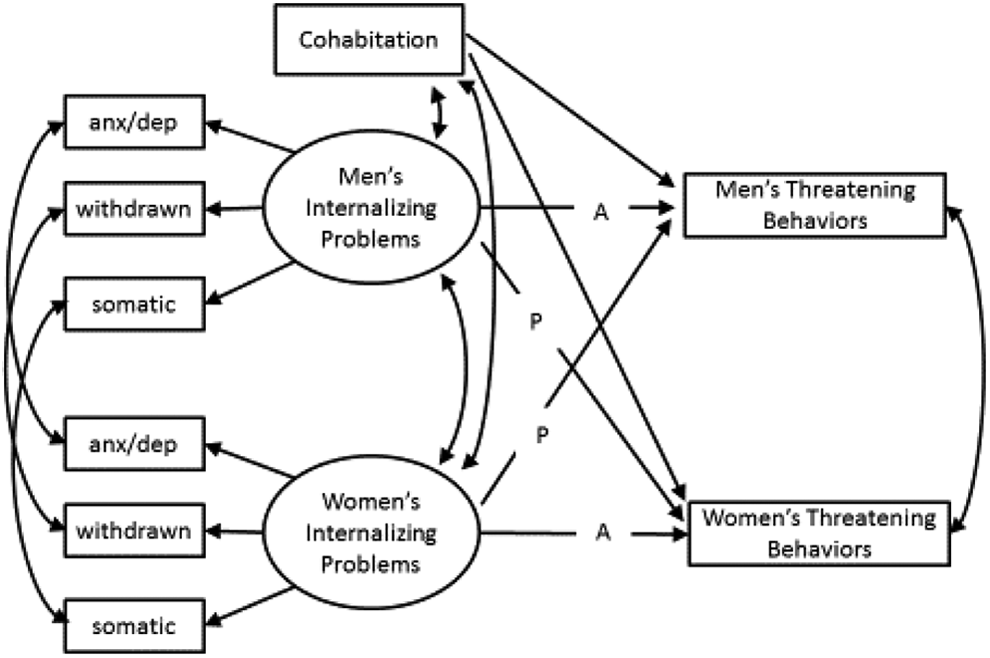
Basic actor–partner interdependence model illustrating internalizing problems predicting threatening behaviors in heterosexual couples. A = actor effect and P = partner effect. Double-headed arrows represent covariances for predictor and residual variables.
Although moderation hypotheses are common in psychological research (Aiken & West, 1991; Baron & Kenny, 1986), the inclusion of moderation hypotheses in APIM is relatively uncommon in the relationships literature. Ironically, the conceptual importance of moderation hypotheses in dyadic relationships have long been outlined by theorists (Kenny & Cook, 1999; Wickham & Knee, 2012). One possible explanation is that there are only a handful of articles that detail the examples of moderation hypotheses within the APIM framework (e.g., Campbell & Kashy, 2002; Garcia, Kenny, & Ledermann, 2015; Wickham & Knee, 2012). Furthermore, most existing works utilize a multilevel modeling (MLM) approach to examine moderation in APIM (Campbell & Kashy, 2002). Surprisingly, very few attempts have been devoted to demonstrate the application of structural equation modeling (SEM), especially its capability of specifying latent variables and latent interactions, for examining a moderated APIM. In this article, we hope to provide general guidelines for specifying a moderated APIM that involves latent variables, based on the recent development of latent moderated structural equations (LMS; Klein & Moosbrugger, 2000; Marsh, Wen, & Hau, 2006; Maslowsky, Jager, & Hemken, 2014). Furthermore, Mplus syntax (Muthén & Muthén, 2011) for specifying a moderated APIM will be provided in the Appendix. The focus of this article is conceptual and pedagogical, and the computational details of the APIMs will be limited.
APIM
The APIM (Kenny, 1996) is one of the most commonly used techniques in examining interpersonal dynamics in dyadic relationships. The APIM is unique in that it addresses interdependence in dyadic relationships. Figure 1 presents an example of the APIM examining the link between two dating partners’ predictor (X) and outcome (Y) variables. Two parameters are central to the APIM, actor effects and partner effects, which are denoted as “A” and “P” paths in Figure 1, respectively. Actor effects estimate the association between each individual’s predictor and his or her own outcome variable. In contrast, partner effects estimate the association between each individual’s predictor and his or her partner’s outcome variable. The estimation of partner effects explicitly addresses the conceptual interdependence in dyadic relationships (Kenny & Cook, 1999; Wickham & Knee, 2012). The APIM also accounts for the degree of similarity or correlations between two partners’ predictor variables and outcome variables (as double-headed arrows in Figure 1). The correlation between two partners’ predictor variables ensures that the actor effects are statistically independent from the partner effects and vice versa. The correlation between the two partners’ outcome variables accounts for the interdependence in the residuals.
For the purpose of illustration, we present an APIM on the association between latent internalizing behavioral problems (indicated by anxious/depression, withdrawn, somatic complaints) and threatening behaviors as a conflict resolution strategy (manifest variable) in dating relationships (see Figure 1). The association between internalizing behavior problems (IBPs) and physical abuse perpetration has been well documented in the empirical literature (e.g., Capaldi, Knoble, Shortt, & Kim, 2012; Stith, Smith, Penn, Ward, & Tritt, 2004). Based on previous literature (Capaldi et al., 2012; Stith et al., 2004), we hypothesize that individuals’ higher tendency to engage in threatening behaviors is predicted by both their own IBPs (actor effect) and their partner’s internalizing problems (partner effect). In all our statistical analyses the two partners’ report of IBPs and threatening behaviors covary to account for the nonindependence in the data.
Extending APIM to Moderation Hypotheses
Interpersonal dynamics among dating couples are often more complex than the direct actor and partner effects estimated in the basic APIM (Kenny & Cook, 1999). We argue that an APIM that integrates moderating and mediating hypotheses portrays a more holistic picture of the interpersonal dynamics that occur in emerging adult dating relationships. Whereas APIM of mediation has been described by others (e.g., Ledermann, Macho, & Kenny, 2011), this article focuses on APIM analyses that involve moderating variables. Furthermore, the current article also presents ways of handling latent variable interactions in APIM. Essentially, APIM of moderation allows researchers to investigate whether the direction and/or strength of the actor and partner effects vary depending on a moderator. To understand how moderators operate in the context of APIM, it is important to clarify that there are three different types of variables in dyadic analyses: within-dyads, between-dyads, and mixed variables (Kashy & Kenny, 2000; Kenny et al., 2006; Garcia et al., 2015). To illustrate how researchers can incorporate these different types of moderators in the APIM, we revisit the example on internalizing problems and threatening behaviors among emerging adult dating couples.
Within-dyads moderator
Within-dyads moderators are variables that vary across two partners but the average of the two members’ scores is the same from dyad to dyad (e.g., gender in heterosexual dyads, mentor–mentee dyads). As an example of a within-dyads moderator, gender in heterosexual dating relationships may moderate the direction and strength of the actor and partner effects. Researchers have been interested in the issues related to gender when investigating social relationships (West, Popp, & Kenny, 2008). Likely due to complexities involved in modeling gender as a moderator in dyadic models, it is more common for studies to examine mean differences between males versus females (e.g., using a dependent t-test) than to examine dyadic dynamics that include gender as a moderator. However, within the APIM framework, researchers can specifically include gender as a moderator. For example, it is possible to test whether the association between IBPs and threatening behaviors is stronger for females than males (moderated actor effect) based on previous findings indicating gender differences (Capaldi et al., 2012). Alternatively, researchers can examine whether the influence of a partner’s internalizing problems on individuals’ threatening behaviors is stronger for males than females (moderated partner effect) based on past research (Kim & Capaldi, 2004; Kim, Laurent, Capaldi, & Feingold, 2008).
Between-dyads moderator
Between-dyads moderators are variables that differ across dyads in which both members of the same dyad have the same scores (e.g., relationship duration, heterosexual versus homosexual couples). Combining a between-dyads moderator and the APIM, researchers may examine whether the couple-level characteristics affect the direction and strength of the actor and partner effects. As an example of between-dyads moderator, we use cohabitation as a moderator in the association between internalizing problems and threatening behaviors. First, suppose that cohabitation is a risk factor for abusive relationships during late adolescence and young adulthood (Brown & Bulanda, 2008), it is possible that the link between individuals’ internalizing problems and threatening behaviors is more salient for couples who live together than those who do not. In other words, cohabitation status as a between-dyads moderator may alter the actor effect of internalizing problems on threatening behaviors. Second, suppose that cohabitating couples are more interdependent than noncohabitating couples, and levels of interdependence between two partners are reflected as the partner effects in APIM (Kenny & Cook, 1999; Wickham & Knee, 2012). Thus, the influence of one’s partner (partner effects) may become more salient for cohabitating couples than noncohabitating couples. Together, cohabitation status may function as a between-dyads moderator between internalizing problems and threatening behaviors at both the actor and partner levels.
Mixed moderator
Mixed moderators are variables that vary across individuals and across dyads. Consider trait extroversion as an example of a mixed variable. Two partners’ extroversion scores are expected to be different (i.e., within a couple the individuals’ levels of extroversion differ), and the average (or sum) scores across two partners will vary from dyad to dyad (i.e., the scores also differ across couples). Very often, researchers are interested in the joint effect of actor’s and partner’s mixed variables, examining the crossing between two partners’ characteristics in explaining outcomes that are beyond the characteristic of each partner (Chow, Buhrmester, & Tan, 2014; Wickham & Knee, 2012).
One way of examining APIM that involves a mixed moderator is to form an interaction term by multiplying the actor and partner scores on internalizing problems (Kenny & Cook, 1999). This approach is most often referred to as the actor–partner interaction in which actor effect is moderated by the partner effect or vice versa. For instance, dyadic coping researchers argue that relationship functioning depends on whether coping behaviors of two partners are complementary (Revenson, 1994). Complementary coping styles are optimal when the negative effects of one partner’s maladaptive style (e.g., avoidance) on adjustment to stress are buffered by another partner’s adaptive style (e.g., low in avoidance or high in problem-focused coping). In order to examine this hypothesis, one estimates the effect of the product term of two partners’ coping scores on relationship outcomes, while controlling the actor and partner effects.
For the current study, we hypothesize that individuals with high levels of IBPs will be more likely to engage in threatening behaviors (actor effect) according to previous research (Capaldi et al., 2012; Stith et al., 2004). The developmental system perspective (e.g., Capaldi, Shortt, & Kim, 2005) suggests that behaviors occurring within dating relationships are an interactive process and that the relationships between partner characteristics are essential for understanding aggression within a relationship. Thus, it is likely that when individuals are paired with another partner who is also high in internalizing problems, their threatening behaviors tendency will be further escalated (partner-moderated actor effect). Alternatively, individuals tend to display higher threatening behaviors when their partner is high in internalizing problems (partner effect). It is possible, however, such an association would be buffered by individuals who themselves have low levels of internalizing problems (actor-moderated partner effect). Together, we argue that the actor–partner interaction approach fits well to the current study’s hypotheses.
Summary
In this article, we provide general guidelines for the analysis of the APIM that involves moderation hypotheses. One novel contribution of this article is to demonstrate the specification of the APIM with latent variable interactions, within the framework of LMS (Klein & Moosbrugger, 2000; Marsh et al., 2006; Maslowsky et al., 2014). Whereas there are multiple approaches for estimating latent variable interactions (Kelava et al., 2011), the LMS method is attractive for several reasons: (1) it permits the inclusion of latent variables to account for measurement errors, (2) the flexibility of including latent–latent variable interactions as well as latent–manifest variable interactions, (3) interaction terms are formed without computations of product terms among factor indicators (see Kenny & Judd, 1984), and (4) it can be directly specified in the Mplus program (Muthén & Muthén, 2011). The mathematical underpinning of latent interaction terms in LMS is beyond the scope of this article; readers may refer to Klein and Moosbrugger’s (2000) for more specific information. Readers may also consult Maslowsky, Jager, and Hemken’s (2014) for a user-friendly reference on LMS. Despite the complex computational procedure, the interaction terms can be easily interpreted by graphing and analyzing the simple slopes as in regular regression models (Aiken & West, 1991). Furthermore, the methods presented here apply to moderators that are measured as between-dyads, within-dyads, and mixed variables. Steps in specifying a moderated APIM will be detailed in the Results section.
Method
Participants and Procedure
Participants included 336 couples across three samples collected over several years (Spring 2007–Spring 2013). This sample was composed of undergraduate psychology students at a large Midwestern state university, recruited from a psychology subject pool, and their romantic partners. In order to be eligible for participation, couples were required to be in a romantic relationship, have no children, and be unmarried. Same-sex couples were excluded from the analysis (as same-sex dyads are indistinguishable). As part of a larger protocol, participants completed a number of self-report measures, including demographics and information on IBPs and dating aggression. The sample was primarily Caucasian/White (86%), with an average age of 20.07 (SD = 1.76) years old.
Measures
IBPs
IBPs were measured using the Adult Self-Report (Achenbach & Rescorla, 2003) for Ages 18–59. The IBP Broadband Scale consists of three narrowband subscales based on 39 items: anxious/depressed (n = 18, e.g., “I feel that no one loves me”), withdrawn (n = 9, e.g., “I have trouble making or keeping friends”), and somatic complaints (n = 12, e.g., “I feel dizzy or light-headed”). Items were assessed on a 3-point Likert-type scale (0 = not true, 1 = somewhat true or sometimes true, and 2 = very often or very true). These subscales demonstrated adequate internal consistency (αs ranged from .84 to .91).
Threatening behaviors
The Conflict in Adolescent Dating Relationships Inventory (Wolfe et al., 2001) assesses dating aggression perpetration with an individual’s current partner over the past year. Self-reported threatening behaviors perpetration was derived from the 4-item threatening behavior subscale (e.g., “I deliberately tried to frighten him or her”). All items were rated on a 4-point Likert-type scale, from 1 (never) to 4 (often). The composite scales demonstrated somewhat low internal consistency for threatening behaviors perpetration (females’ α = .54, males’ α = .47), although a similar level of internal consistency was reported in Wolfe et al.’s research. Previous work suggests that even these levels of reliability do not seriously attenuate the validity of the measures (Schmitt, 1996).
Results
Basic APIM
Analysis plan: Basic APIM
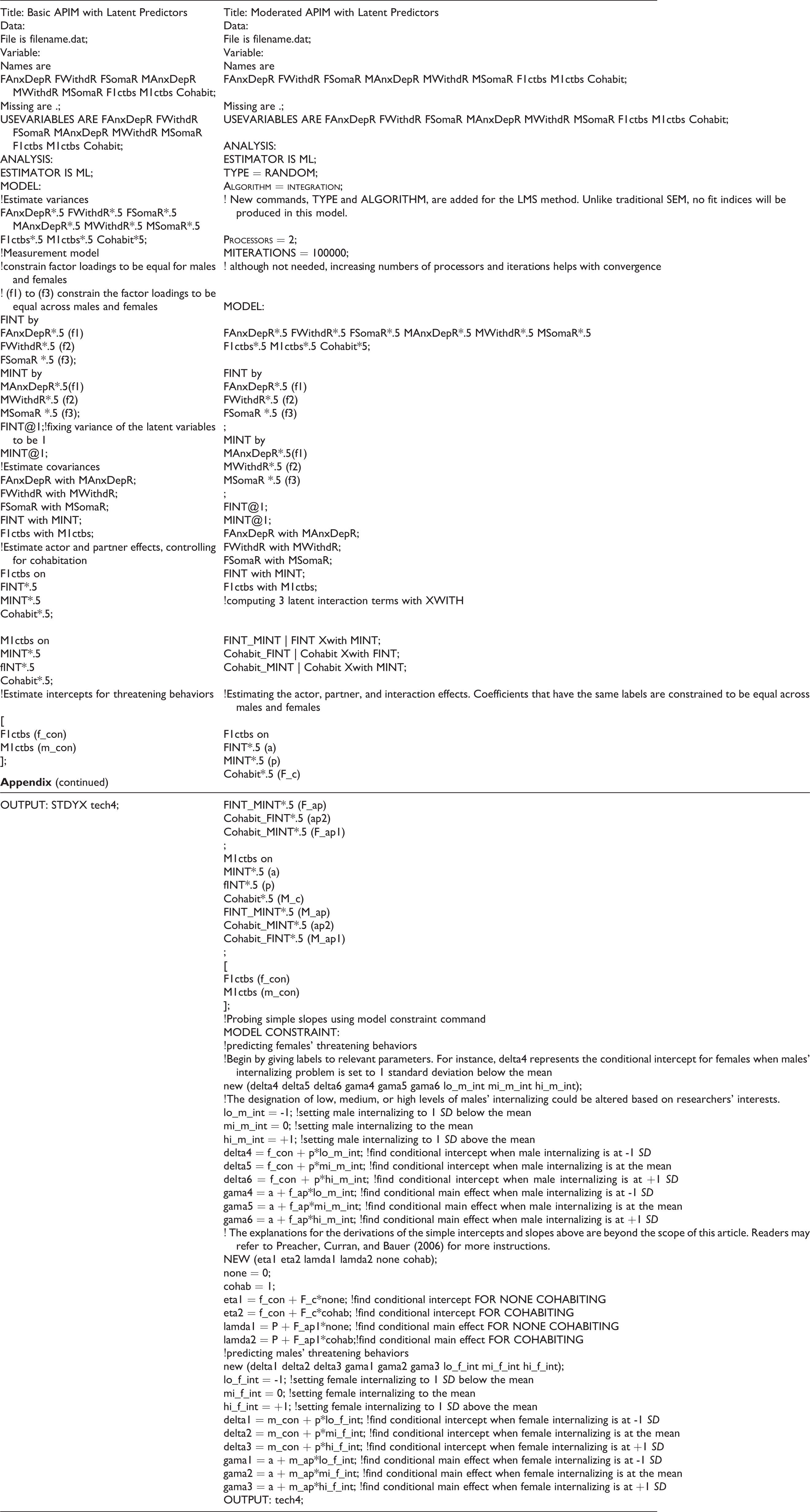
The specification of the APIM with moderations involves two major steps (Maslowsky et al., 2014). The first step is to estimate the basic APIM without the latent interaction terms (Model 0). As depicted in Figure 1, this model includes two latent exogenous variables (internalizing problems), one manifest covariate (cohabitation status), and two manifest endogenous variables (threatening behaviors). The latent internalizing problems are indicated by the anxious/depressed, withdrawn, and somatic complaints subscales. Instead of scaling the latent variables to one of the indicators, the latent variables are standardized by constraining the variances to be 1. To establish factorial invariance, factor loadings of males and females are constrained to be equivalent. 2 Residuals of the same indicators are allowed to covary across males and females. Also, internalizing problems and threatening behaviors (residuals) are allowed to covary across males and females. These covariances address the issue of statistical interdependence in dyadic data. Finally, actor and partner effects of internalizing problems on threatening behaviors are estimated, controlling for cohabitation status. This basic APIM provides conventional fit indices (e.g., χ2, comparative fit index [CFI], Tucker–Lewis index [TLI], root mean squared error of approximation [RMSEA]) which serve as the basis for subsequent model comparisons (Maslowsky et al., 2014). Mplus syntax for the basic APIM is provided in Appendix (left panel).
Results: Basic APIM
The basic APIM (Model 0) did fit the data well, χ2(20) = 44.93, CFI = .96, TLI = .93, RMSEA = .06. Unstandardized path coefficients, along with standard errors (SEs), are presented in Table 1. Females with higher internalizing problems were more likely to engage in threatening behaviors (actor effect). Similarly, males with higher internalizing problems were more likely to engage in threatening behaviors (actor effect). Females’ tendency to engage in threatening behaviors was not significantly related to their male partner’s levels of internalizing problems. Similarly, males’ tendency to engage in threatening behaviors was not significantly related to their female partner’s levels of internalizing problems.
APIM of Internalizing Problems and Threatening Behaviors in Dating Couples.
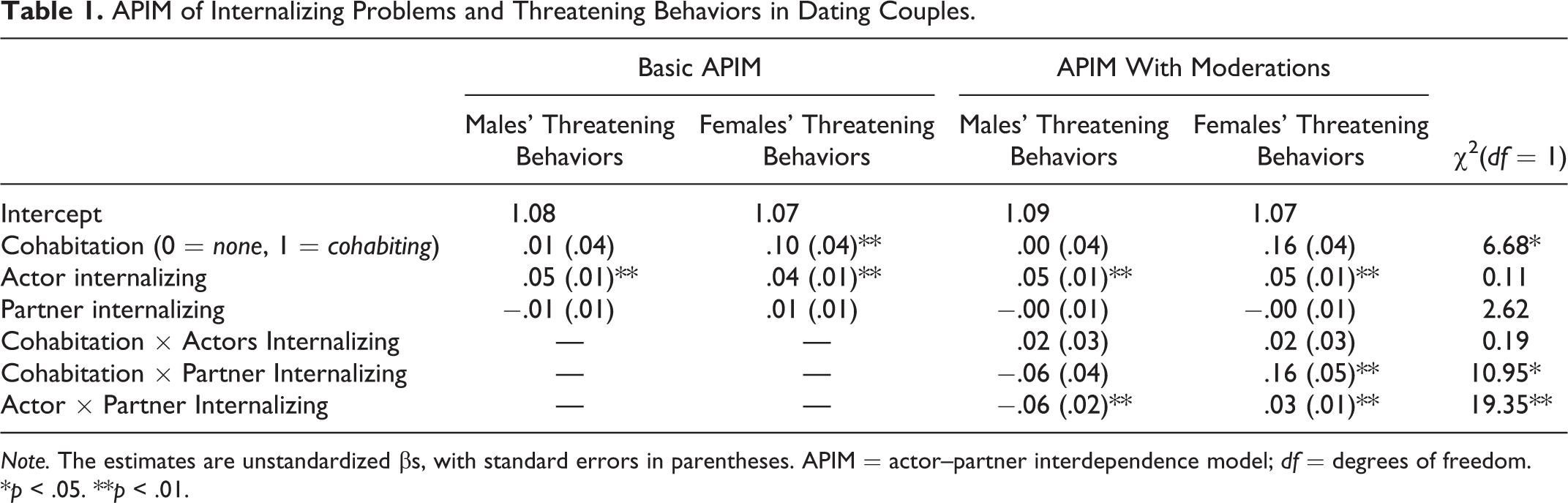
Note. The estimates are unstandardized βs, with standard errors in parentheses. APIM = actor–partner interdependence model; df = degrees of freedom.
*p < .05. **p < .01.
Moderated APIM
Analysis plan: Moderated APIM
The second step of specifying a moderated APIM is to consider the within-dyads (i.e., gender), between-dyads (i.e., cohabitation status), and mixed (i.e., internalizing problems) variables as moderators (Model 1; see Figure 2). Specifically, we will first specify a model in which three latent interaction terms are included: (1) Cohabitation Status × Male’s Internalizing Problems, (2) Cohabitation Status × Females’ Internalizing Problems, (3) Males’ × Females’ Internalizing Problems. Because SEM estimates two separate regression equations for males and females simultaneously, instead of forming interaction terms between gender and internalizing problems (as in the MLM framework), we will then examine the moderating roles of gender by testing the equality in the path coefficients using a series of χ2 tests. With gender equality (or inequality) in the path coefficients established, significant interaction effects will be interpreted by graphing and probing the simple slopes (Aiken & West, 1991). Mplus syntax for the moderated APIM is provided in Appendix (right panel). 3
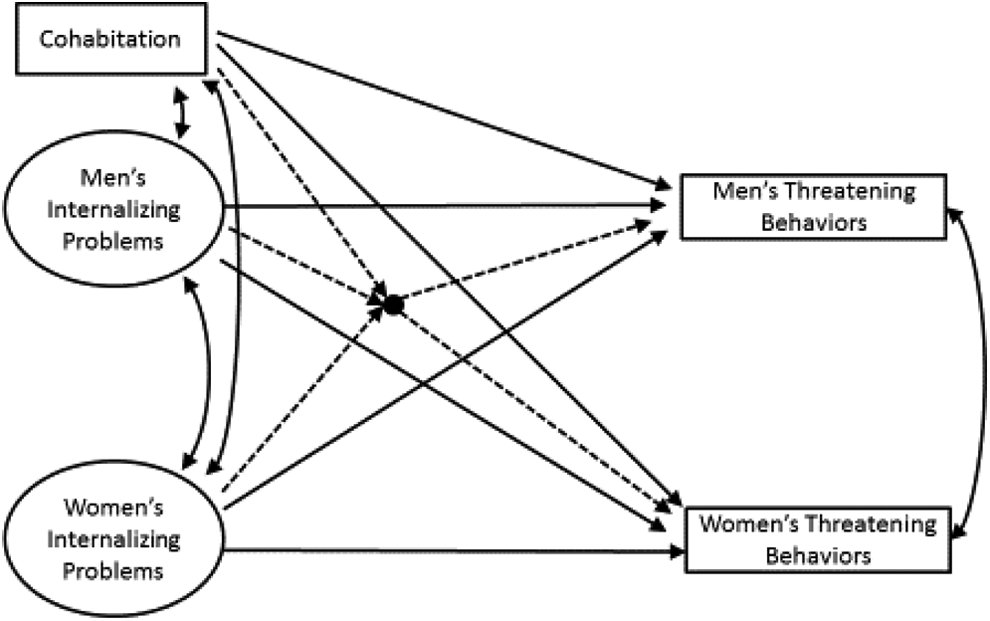
Extension of the basic actor–partner interdependence model to include latent interaction terms. To simplify the representation, latent interaction terms are represented by the dark circle toward which the formative predictors are pointing (dashed line). This representation is consistent with Mplus’ representation of the latent moderated structural equations approach (Muthén & Muthén, 2011). In this model, three latent terms are included (1) Cohabitation Status × Male’s Internalizing Problems, (2) Cohabitation Status × Females’ Internalizing Problems, and (3) Males’ × Females’ Internalizing Problems. Factor loadings for the latent variables are not shown.
Comparing basic and moderated APIMs fit
Because the moderated APIM was specified within the LMS framework (Klein & Moosbrugger, 2000), conventional SEM fit indices (e.g., CFI, TLI, and RMSEA) are not available. It is possible, however, to compare the relative fit of the basic APIM (with no interaction terms) and the model in which interaction terms were included (Model 1) using a log-likelihood ratio test or χ2 test. A statistically significant change in χ2 will indicate that without the interaction terms, the basic APIM has a worse fit compared to the moderated APIM, and, therefore, should be rejected. The χ2 statistic can be calculated using the following equation:

The log-likelihood values for the models are provided by Mplus denoted as “H0 Value”. Degrees of freedom (df) of the χ2 distribution is equal to the number of interaction effects being estimated. In this case, there were a total of three latent interaction terms and six interaction effects (three for each partner), resulting in a df of 6. For the current study, results showed that the difference between Model 0 and Model 1 was significant, χ2(6) = 220.90, p < .01. In other words, the basic APIM had a worse fit compared to the moderated APIM and, therefore, the latent interaction terms should be retained in the model.
Results: Gender as within-dyads moderator
We were interested in whether gender (within-dyads moderator) moderated the actor and partner effects of internalizing problems on threatening behaviors as well as other interaction effects. We examined the moderation hypothesis by testing the equality of each main and interaction effect across males and females using a series of χ2 test with df of 1. Specifically, χ2 tests statistics were computed based on the difference between log-likelihood values for Model 1 and a sequence of other models in which parameters were constrained to be equal across gender.
Constraining the actor effects to be equivalent across males and females did not lead to a significant reduction in model fit, χ2(df = 1) = 2.62, p = .11. Then, we constrained the partner effects to be equivalent across males and females, and this model did not lead to a significant reduction in model fit, χ2(df = 1) = .11, p = .74. Thus, we constrained the actor and partner effects to be equivalent across males and females. Constraining the effects of cohabitation status to be equivalent across males and females led to a significant reduction in model fit, χ2(df = 1) = 6.68, p < .01. Thus, these parameters were allowed to vary across males and females. As shown in Table 1, results indicated that, for both males and females, higher internalizing problems were related to greater tendency to perpetrate threatening behaviors (b = .05, SE = .01, p < .01). In contrast, for both males and females, internalizing problems were not significantly related to their partner’s tendency to perpetrate threatening behaviors (b = −.00, SE = .01, p = .79). 4 Results showed that, for males, cohabitation status was not significantly related to exhibition of threatening behaviors (b = .00, SE = .04, p = .94). In contrast, cohabitation was related to exhibition of more threatening behaviors among females (b = .16, SE = .04, p < .01).
A similar approach was used to examine gender differences in the interaction effects. Results showed that constraining the interaction effects between cohabitation status and actor-internalizing problems across males and females did not lead to a significant reduction in model fit, χ2(df = 1) = .19, p = .66. Results showed that constraining the interaction effects between cohabitation status and partner-internalizing problems across males and females led to a significant reduction in model fit, χ2(df = 1) = 10.95, p < .01. Finally, constraining the actor–partner interaction effects across males and females led to a significant reduction in model fit, χ2(df = 1) = 19.35, p < .01. Unstandardized coefficients (along with SEs) are presented in Table 1, with appropriate equality constrains imposed across males and females.
Results: Cohabitation status as between-dyads moderator
As shown in Table 1, results showed that, for both males and females, cohabitation status did not significantly moderate the actor effects of internalizing problems on threatening behaviors. 5 The interaction effects between cohabitation status and actor-internalizing problems were not significant for both males and females (b = .02, SE = .003, p = .59). These findings showed that more internalizing problems were associated with higher tendency to exhibit threatening behaviors, regardless of the couples’ cohabitation status. The interaction effect between cohabitation status and partner-internalizing problems was significant for females (b = .16, SE = .05, p < .01) but not for males (b = −.06, SE = .04, p = .14). Simple slopes for females are presented in Figure 3. Inspection of the simple slopes showed that the link between males’ internalizing problems and females’ threatening behaviors was stronger for couples who cohabited (b = .16, SE = .05, p < .01) compared to couples who did not cohabitate (b = −.00, SE = .01, p = .79).
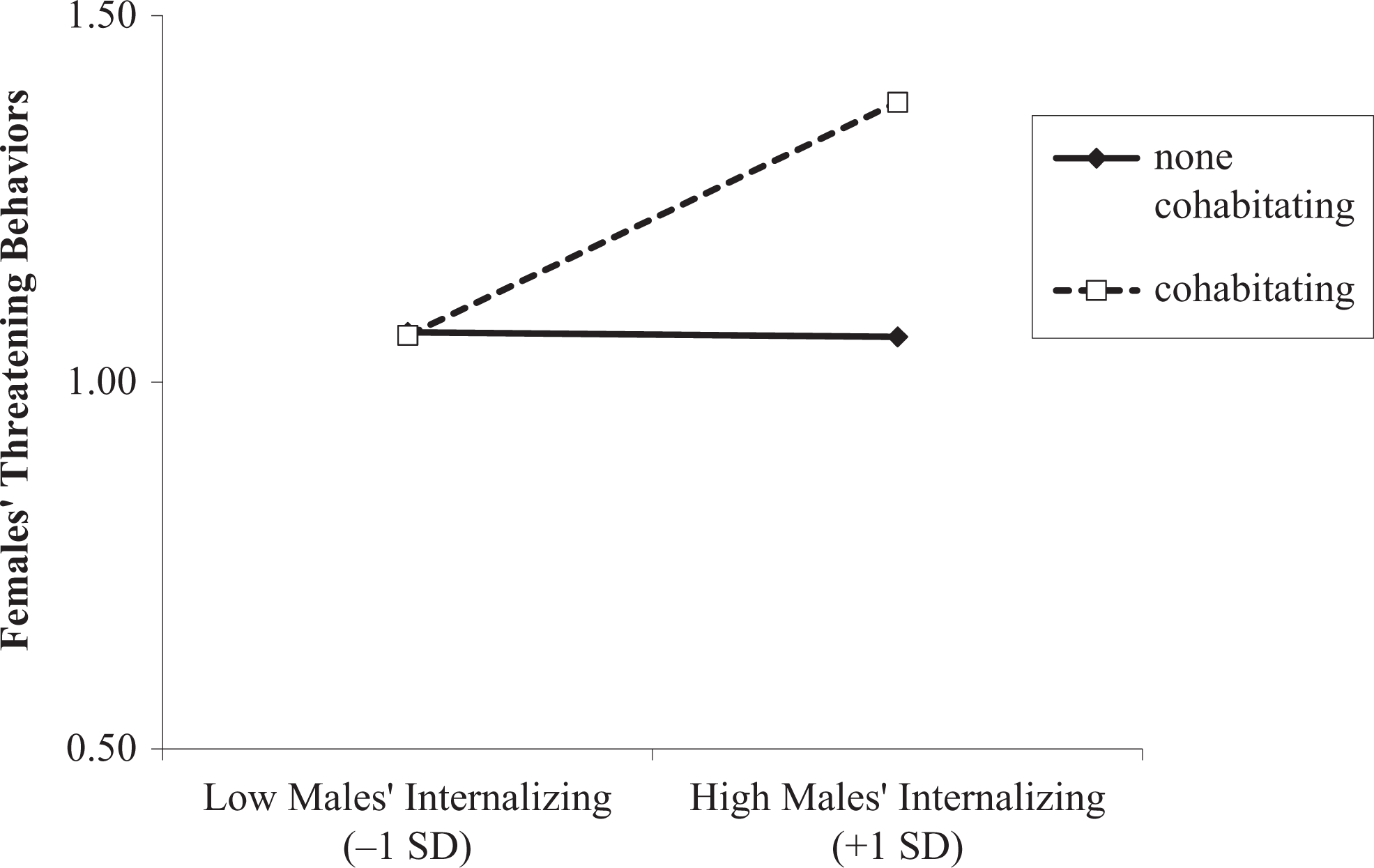
Moderating role of cohabitation in the association between males’ internalizing problems and females’ threatening behaviors. High versus low levels of males’ internalizing problems were defined by 1 SD above and below the grand mean, respectively (Aiken & West, 1991).
Results: Internalizing problems as mixed moderator
Finally, we examined whether the combination of two partners’ internalizing problems (mixed-dyads moderator) predicted threatening behaviors beyond each partner’s characteristics testing the actor–partner interaction term. As shown in Table 1, although the actor–partner interaction effects for males and females were both significant, the directions were opposite. Specifically, results showed that actor–partner interaction was predictive of females’ threatening behaviors (b = .03, SE = .01, p < .05). Simple slopes for this interaction effect are presented in Figure 4. Inspection of the simple slopes showed that the effect of females’ internalizing problems on their involvement in threatening behaviors was nonsignificant when their partner was lower in internalizing problems (b = .02, SE = .02, p = .26). In contrast, the effect of females’ internalizing problems on their involvement in threatening behaviors was stronger when their partner was higher in internalizing problems (b = .08, SE = .02, p < .01).
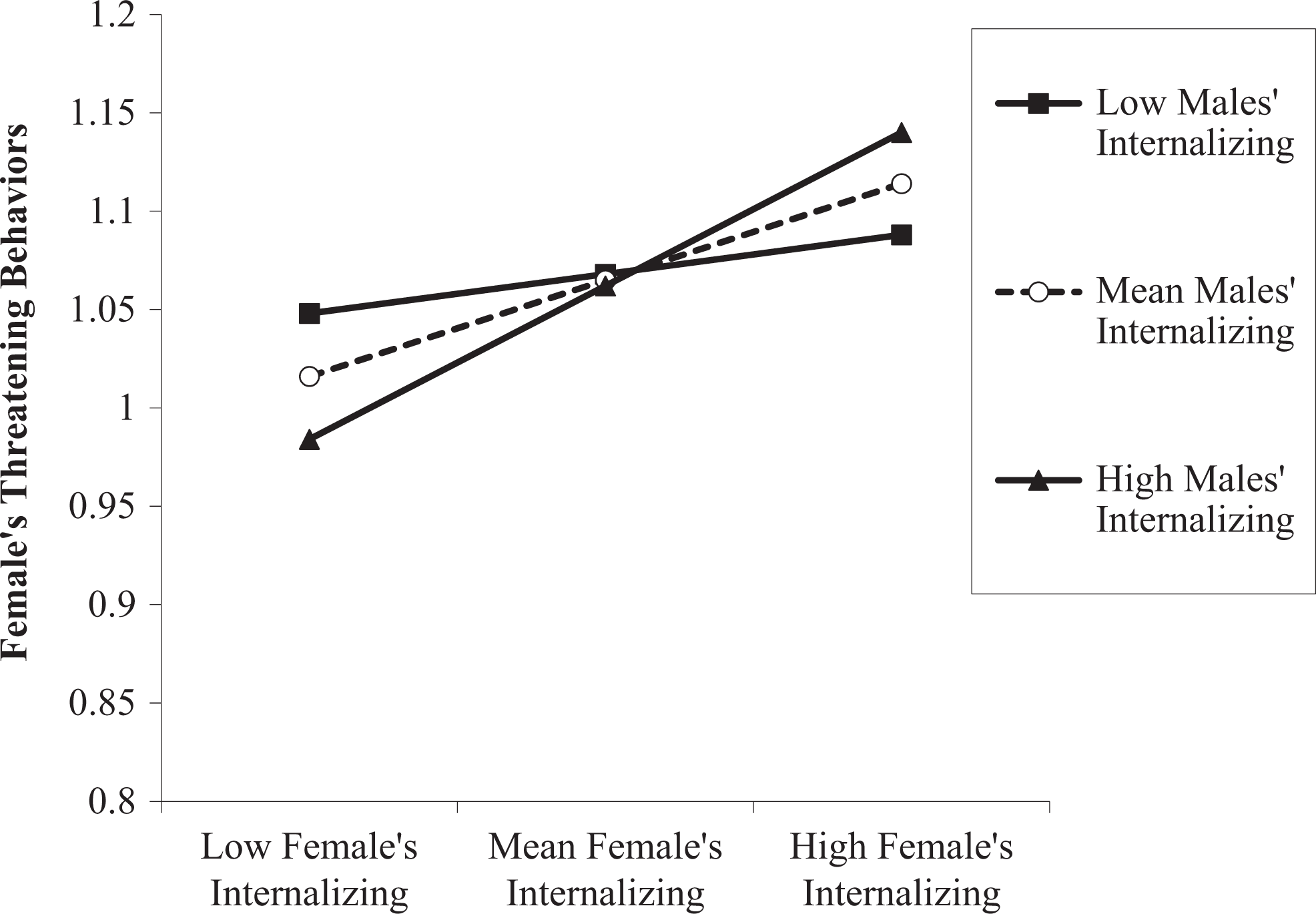
Moderating role of males’ internalizing problems in the actor association between females’ internalizing problems and threatening behaviors. High versus low levels of internalizing problems were defined by 1 SD above and below the grand mean, respectively.
Finally, results showed that the actor–partner interaction was also predictive of males’ threatening behaviors (b = −.06, SE = .02, p < .01). Simple slopes for this interaction effect are presented in Figure 5. Inspection of the simple slopes showed that the effect of males’ internalizing problems on their involvement in threatening behaviors was nonsignificant when their partner was higher in internalizing problems (b = −.01, SE = .02, p = .52). In contrast, the effect of males’ internalizing problems on their involvement in threatening behaviors was stronger when their partner was lower in internalizing problems (b = .11, SE = .02, p < .01).
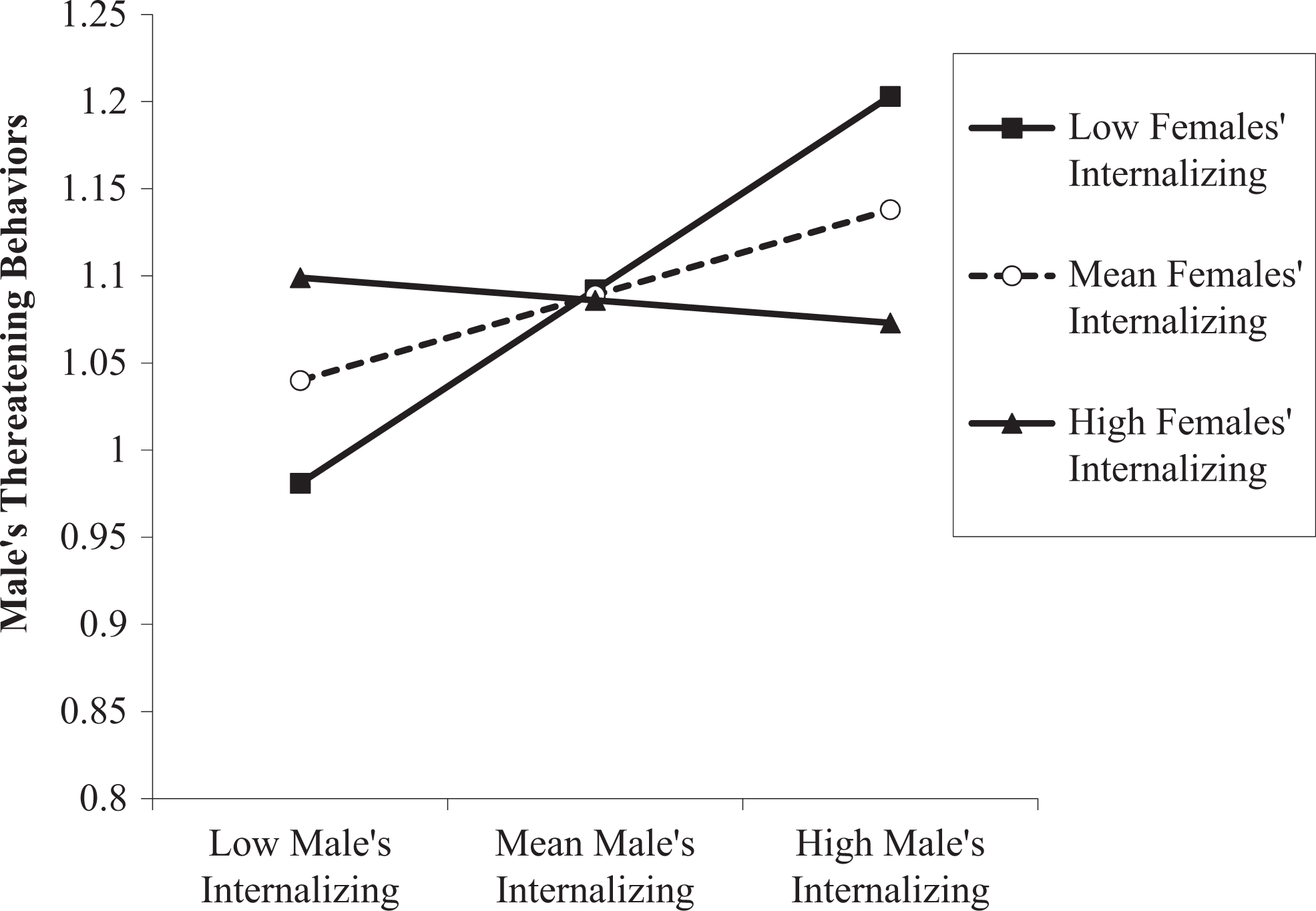
Moderating role of females’ internalizing problems in the actor association between males’ internalizing problems and threatening behaviors. High versus low levels of internalizing problems were defined by 1 SD above and below the grand mean, respectively.
Discussion
The main purpose of this article was to illustrate the application of the moderated APIM to research on dating relationships during emerging adulthood. Although there are existing works that describe the moderated APIM (Campbell & Kashy, 2002; Garcia et al., 2015; Wickham & Knee, 2012), we presented how different types of moderators (between-dyads, within-dyads, and mixed) could be modeled as latent interactions with recent advancement in the LMS approach (Klein & Moosbrugger, 2000). To achieve this, we drew on concrete examples of various moderation hypotheses by examining the association between internalizing problems and threatening behaviors in dating couples. Because the advantages of APIM over an “individualistic approach” have been described in other articles (e.g., Cook & Snyder, 2005), our discussion will focus on the advantages of the moderation models over the traditional APIM.
Importance of Within-Dyads Moderator
Inclusion of a within-dyads moderator in the basic APIM allows researchers to examine whether the distinguishable roles of two partners (e.g., males versus females) alter the intrapersonal (actor) and interpersonal (partner) processes in a relationship. For instance, in a study on couples coping with multiple sclerosis, actor and partner links between mindfulness and relationship satisfaction are different for patients versus their spouses (Pakenham & Samios, 2013). In the current study, we were interested in whether the link between internalizing problems and threatening behaviors was different for males and females. As mentioned earlier, although issues related to gender in dating relationships are often the focus of many existing studies, it is more common for studies to examine mean differences between males versus females (e.g., using a dependent t-test) in the dependent variables. When there are no significant gender differences detected, researchers often ignore the potential moderating role of gender between the predictor and outcome variables. Indeed, it is possible to find no significant gender differences in the mean structure but significant differences in the variance/covariance structure in APIM (Ackerman, Donnellan, & Kashy, 2011). Contrary to some previous findings (e.g., Capaldi & Crosby, 1997; Kim & Capaldi, 2004), we did not find evidence that gender moderates the association between internalizing problems and threatening behaviors. It is important to note, however, that many of the previous studies did not formally test gender differences (i.e., analyses were run separately for males and females). Additionally, previous studies have generally focused on at-risk samples (e.g., Capaldi & Crosby, 1997; Kim & Capaldi, 2004).
Whereas we demonstrated the statistical equivalence of the actor and partner effects across gender, it is not correct to assume that the actor and partner effects are always equivalent across males and females. Consistent with previous research (e.g., Ackerman et al., 2011; Kenny et al., 2006), we recommend that researchers examine whether the “distinguishable roles” that two partners play (e.g., gender in heterosexual relationship) have an impact on the actor and partner effects for two major reasons. Conceptually, as demonstrated in this study, meaningful research questions can be raised and answered through examining the distinguishability in the actor and partner effects across gender (see West et al., 2008). Statistically, if no significant gender differences are found in the actor and partner effects, these parameters can be constrained to be equal in the context of SEM, leading to a more parsimonious model. Furthermore, constraining the actor and partner effects to be equal across gender often leads to smaller SEs, which lead to greater power for detecting the parameters’ statistical significance. These ideas are not limited to heterosexual dating relationships; we suggest that the consideration of within-dyads moderators in APIM should be extended to other distinguishable dyads including mother–child, mentor–mentee, and older–younger sibling relationships.
Importance of Between-Dyads Moderator
Inclusion of a between-dyads moderator in the basic APIM allows researchers to examine whether various “types” of couples experience different intrapersonal (actor) and interpersonal (partner) processes in their relationships. For instance, researchers might be interested in whether the actor and partner links between age and relationship stability is different for heterosexual versus gay/lesbian couples (West et al., 2008). In the current study, we were interested in whether cohabitation status moderated the actor and partner effects of internalizing problems on threatening behaviors. We found that for cohabitating couples, compared to noncohabitating couples, females were more likely to display threatening behaviors, regardless of their internalizing problems levels. Interestingly, we also found that gender significantly moderated the interaction effect of cohabitation status and males’ internalizing problems on females’ threatening behaviors (see Figure 3). Specifically, results showed that cohabitation became a risk factor for females’ threatening behaviors when males were higher in internalizing problems. The association between females’ threatening behaviors and males’ internalizing problems, however, was not significant for couples who did not cohabitate. We also did not find support for the link between males’ threatening behaviors and females’ internalizing problems for either cohabitating or noncohabitating couples. While previous empirical findings suggest that cohabitation status may be a risk factor for abusive behaviors (Brown & Bulanda, 2008), these findings suggest the role of cohabitation may be more complex and interact with both gender and internalizing problems, highlighting the complex and multifaceted nature of risk factors for interpersonal violence and abuse (Capaldi et al., 2012).
Whereas researchers routinely examine the direct effects of various between-dyads variables (e.g., relationship duration, marital status, sexual orientations), less attention has been devoted to the moderating roles of couple-level characteristics. Consider a study on fat talk, a dyadic construct that captures how often people engage in discussion of body-related issues, especially between emerging adult female friends (Tan & Chow, 2014). This study examined whether engagement in fat talk (between-dyads variable) would moderate the association between weight status (body mass index [BMI]) and depression at the actor and partner levels. This study found that for friend dyads who engaged in more fat talk, individuals’ BMI was not related to their own depression (actor effect). In contrast, for friend dyads who engaged in less fat talk, higher individuals’ BMI was related to their own higher depression. Interestingly, for friend dyads who engaged in more fat talk, higher individuals’ BMI was associated with their friends’ higher depression (partner effect). In contrast, for friend dyads who engaged in less fat talk, individuals’ BMI was not associated with their friends’ depression. These complex interpersonal dynamics could not be detected without considering the moderating role of a between-dyads variable.
Importance of Mixed Moderators
Relationships researchers and lay people have long been fascinated by the idea of “matching” of two close partners’ characteristics (e. g, personality), and how such dyadic combinations may contribute to long-term relationship functioning. Indeed, interdependence theory has offered systematic descriptions of how relationship outcomes are dependent on the combined behavioral decisions of two partners (Kelley & Thibaut, 1978). Although there is increased attention to issues related to joint contribution of two partners’ characteristics (e.g., Chow et al., 2014; LeJeune, Zimet, Azzouz, Fortenberry, & Aalsma, 2013; Pakenham & Samios, 2013), most existing APIM research has still been limited by investigating the main actor and partner effects. The combined effect of two partners could be examined by interacting mixed variables contributed by two partners. We argue that APIM research that only investigates the main actor and partner effects would fail to detect crucial dyadic dynamics that need to become the focal point of relationships research. In this article, we illustrated—within the framework of APIM—how hypotheses regarding the way that two partners combined characteristics predict outcome variables above and beyond each partner’s own characteristics can be examined through the addition of an actor–partner interaction in the model (Campbell & Kashy, 2002).
In the current study, we were interested in how internalizing problems of two partners combined might contribute to threatening behaviors above and beyond the effect of each member’s own internalizing problems. With a latent interaction between two partners’ internalizing problems, we demonstrated that the effect of females’ internalizing problems on their involvement in threatening behaviors was nonsignificant when their partner was lower in internalizing problems (see Figure 4). In contrast, the effect of females’ internalizing problems on their own threatening behaviors was stronger when their partner was higher in internalizing problems. Together, results showed that females displayed highest levels of threatening behaviors when both partners experienced higher psychological maladjustment. Surprisingly, we found that more internalizing problems were related to the display of more threatening behaviors for males, especially when their partner was lower in internalizing problems (see Figure 5). These results extend previous findings in the literature (e.g., Capaldi et al., 2012) by showing that the association between internalizing problems and threatening behaviors is not only a function of one’s own level of internalizing problems but also a function of one’s partner’s level of internalizing problems.
Although the current study utilized the same construct (i.e., internalizing problems), reported by both partners to form an interaction term, it is possible for researchers to consider a different construct of partner (e.g., attachment security) as moderator. For instance, in a study of couples’ coping and relationship quality, researchers found that maladaptive coping (e.g., being dismissive/avoidant) was associated with lower relationship quality, but having a partner who coped with stress more adaptively buffered and reduced the negative impact of maladaptive coping (Chow et al., 2014). Depending on researchers’ interests, other forms of mixed variables interactions, including actor–actor interaction and partner–partner interaction, could be flexibly built in the APIM.
Issues in Moderated APIM and Future Directions
Researchers have long noted the difficulty of detecting moderation in general linear model due to low power in typical moderation tests (McClelland & Judd, 1993). There are increased attentions to the issue of power in basic APIM (Kenny et al., 2006); online calculators (i.e., PowAPIM.R) and R-build in (i.e., DyadR) are now available for less complex models (see http://davidakenny.net/DyadR/DyadR.htm). To our knowledge, very few existing sources provide guidance for power analysis in moderated APIM, especially when the interaction terms are specified as latent variables (Klein & Moosbrugger, 2000). Because a latent variables APIM corrects for measurement error, it may increase a study’s power and produce less biased estimates (Little, Bovaird, & Widaman, 2006). Thus, the adoption of a moderated APIM with latent interactions appears to be a fruitful direction for relationships research.
The current study utilized an actor–partner interaction (product term) approach to capture how various two partners’ levels of internalizing problems combined may predict their threatening behaviors. Alternatively, if the questions are related to similarity (vs difference) in two partners’ characteristics in predicting their outcomes, researchers may adopt an absolute difference score approach (Kenny & Cook, 1999). Specifically, a similarity index can be computed based on the absolute difference between two partners’ scores on the predictors (i.e., a between-dyads variable). For instance, dyadic coping researchers suggest that relationship functioning depends on whether coping behaviors of two partners are similar (Revenson, 1994). Similarity in couples’ coping styles may reflect coordination and mutual reinforcement in a relationship that can lead to better relationship outcomes. In order to examine this hypothesis, one estimates the effect of the absolute difference of two partners’ coping scores on relationship outcomes, while controlling the actor and partner effects. Some researchers, however, have raised concerns about the low reliability of difference scores due to measurement errors (for a discussion, see Edwards, 2001). In order to remedy this issue, a latent difference score approach has been developed (McArdle, 2009). Although the latent difference score model has been developed to model longitudinal change, we argue that it is equally valid for modelling differences between two partners’ characteristics. Consider the current study’s example of internalizing problems and threatening behaviors. A latent difference score model would include two latent exogenous variables (provided by both partners) and one latent difference score term to model the difference. In turn, the latent difference score, along with the two latent exogenous variables, could be used to predict threatening behaviors.
The current article focuses on moderation hypotheses, but other processes that involve mediation should be considered in future research (Ledermann et al., 2011). Furthermore, it is possible to combine moderation and mediation in the same model (i.e., mediated moderation and moderated mediation). Consider a mediated-moderation APIM in which researchers may examine whether dating partners’ relationship satisfaction after 1 year could be predicted by the interaction of two partners’ internalizing problems, and how such an interaction effect is mediated by their threatening behaviors. Consider a moderated-mediation model in which researchers may examine whether couples’ internalizing problems and relationship satisfaction are mediated by threatening behaviors and additionally examine cohabitation status as a moderator in the mediation process. For instance, it is possible that the mediation process of internalizing problems and relationship satisfaction through threatening behaviors is more salient for couples who cohabitate compared to those do not cohabitate.
To our knowledge, most emerging adult research that utilizes a dyadic design and the APIM as an analytical tool has focused on romantic relationships. The importance of friends, parents, and siblings in emerging adults’ development, however, should not be neglected. Although the current article focuses on romantic couples, the moderated APIM could be applied to programs of research from emerging adult scholars who are interested in other dyadic relationships. For example, researchers could examine how college roomates’ academic aspiration may mutually influence each other’s academic performance (e.g., grades) through the examination of actor and partner effects. Furthermore, with the moderated APIM, researchers could examine whether the combination of two roommates’ academic aspiration would be more indicative of their academic performance, beyond the effects of either one member’s academic aspiration. Additionally, researchers focused on parent–child relationships could examine for example whether emerging adults’ depressive symptoms were related to their own and their parents’ perceptions of relationship quality, and whether the combination of two members’ depressive symptoms would be more indicative of their relationship discord, beyond the effects of either one member’s depressive symptoms.
Summary
For several decades, theories informing the study of close relationships during emerging adulthood have highlighted the complex and dynamic interplay of close relationships and their implications for individual adaptation (and vice versa). Tremendous developments in statistical methodology and software now provide relationship scholars with flexible tools to more accurately (a) test key theoretical assumptions and (b) investigate human behavior in the context of dyadic functioning. This article illustrates the possibilities of investigating different types of moderators within the APIM framework and highlights how this can inform our understanding of risk factors for threatening behaviors in dating relationships. We hope this article encourages emerging adulthood scholars to continue to carefully evaluate the choice of analytic technique for testing theoretical assumptions and hypotheses. Considering the most recent developments in quantitative methodology is essential as we move the field forward.
Footnotes
Appendix
| Title: Basic APIM with Latent Predictors Data: File is filename.dat; Variable: Names are FAnxDepR FWithdR FSomaR MAnxDepR MWithdR MSomaR F1ctbs M1ctbs Cohabit; Missing are .; USEVARIABLES ARE FAnxDepR FWithdR FSomaR MAnxDepR MWithdR MSomaR F1ctbs M1ctbs Cohabit; ANALYSIS: ESTIMATOR IS ML; MODEL: !Estimate variances FAnxDepR*.5 FWithdR*.5 FSomaR*.5 MAnxDepR*.5 MWithdR*.5 MSomaR*.5 F1ctbs*.5 M1ctbs*.5 Cohabit*5; !Measurement model !constrain factor loadings to be equal for males and females ! (f1) to (f3) constrain the factor loadings to be equal across males and females FINT by FAnxDepR*.5 (f1) FWithdR*.5 (f2) FSomaR *.5 (f3); MINT by MAnxDepR*.5(f1) MWithdR*.5 (f2) MSomaR *.5 (f3); FINT@1;!fixing variance of the latent variables to be 1 MINT@1; !Estimate covariances FAnxDepR with MAnxDepR; FWithdR with MWithdR; FSomaR with MSomaR; FINT with MINT; F1ctbs with M1ctbs; !Estimate actor and partner effects, controlling for cohabitation F1ctbs on FINT*.5 MINT*.5 Cohabit*.5; M1ctbs on MINT*.5 fINT*.5 Cohabit*.5; !Estimate intercepts for threatening behaviors [ F1ctbs (f_con) M1ctbs (m_con) ]; OUTPUT: STDYX tech4; |
Title: Moderated APIM with Latent Predictors Data: File is filename.dat; Variable: Names are FAnxDepR FWithdR FSomaR MAnxDepR MWithdR MSomaR F1ctbs M1ctbs Cohabit; Missing are .; USEVARIABLES ARE FAnxDepR FWithdR FSomaR MAnxDepR MWithdR MSomaR F1ctbs M1ctbs Cohabit; ANALYSIS: ESTIMATOR IS ML; TYPE = RANDOM; Algorithm = integration; ! New commands, TYPE and ALGORITHM, are added for the LMS method. Unlike traditional SEM, no fit indices will be produced in this model. MITERATIONS = 100000; ! although not needed, increasing numbers of processors and iterations helps with convergence MODEL: FAnxDepR*.5 FWithdR*.5 FSomaR*.5 MAnxDepR*.5 MWithdR*.5 MSomaR*.5 F1ctbs*.5 M1ctbs*.5 Cohabit*5; FINT by FAnxDepR*.5 (f1) FWithdR*.5 (f2) FSomaR *.5 (f3) ; MINT by MAnxDepR*.5(f1) MWithdR*.5 (f2) MSomaR *.5 (f3) ; FINT@1; MINT@1; FAnxDepR with MAnxDepR; FWithdR with MWithdR; FSomaR with MSomaR; FINT with MINT; F1ctbs with M1ctbs; !computing 3 latent interaction terms with XWITH FINT_MINT | FINT Xwith MINT; Cohabit_FINT | Cohabit Xwith FINT; Cohabit_MINT | Cohabit Xwith MINT; !Estimating the actor, partner, and interaction effects. Coefficients that have the same labels are constrained to be equal across males and females F1ctbs on FINT*.5 (a) MINT*.5 (p) Cohabit*.5 (F_c) FINT_MINT*.5 (F_ap) Cohabit_FINT*.5 (ap2) Cohabit_MINT*.5 (F_ap1) ; M1ctbs on MINT*.5 (a) fINT*.5 (p) Cohabit*.5 (M_c) FINT_MINT*.5 (M_ap) Cohabit_MINT*.5 (ap2) Cohabit_FINT*.5 (M_ap1) ; [ F1ctbs (f_con) M1ctbs (m_con) ]; !Probing simple slopes using model constraint command MODEL CONSTRAINT: !predicting females’ threatening behaviors !Begin by giving labels to relevant parameters. For instance, delta4 represents the conditional intercept for females when males’ internalizing problem is set to 1 standard deviation below the mean new (delta4 delta5 delta6 gama4 gama5 gama6 lo_m_int mi_m_int hi_m_int); !The designation of low, medium, or high levels of males’ internalizing could be altered based on researchers’ interests. lo_m_int = -1; !setting male internalizing to 1 SD below the mean mi_m_int = 0; !setting male internalizing to the mean hi_m_int = +1; !setting male internalizing to 1 SD above the mean delta4 = f_con + p*lo_m_int; !find conditional intercept when male internalizing is at -1 SD delta5 = f_con + p*mi_m_int; !find conditional intercept when male internalizing is at the mean delta6 = f_con + p*hi_m_int; !find conditional intercept when male internalizing is at +1 SD gama4 = a + f_ap*lo_m_int; !find conditional main effect when male internalizing is at -1 SD gama5 = a + f_ap*mi_m_int; !find conditional main effect when male internalizing is at the mean gama6 = a + f_ap*hi_m_int; !find conditional main effect when male internalizing is at +1 SD ! The explanations for the derivations of the simple intercepts and slopes above are beyond the scope of this article. Readers may refer to Preacher, Curran, and Bauer (2006) for more instructions. NEW (eta1 eta2 lamda1 lamda2 none cohab); none = 0; cohab = 1; eta1 = f_con + F_c*none; !find conditional intercept FOR NONE COHABITING eta2 = f_con + F_c*cohab; !find conditional intercept FOR COHABITING lamda1 = P + F_ap1*none; !find conditional main effect FOR NONE COHABITING lamda2 = P + F_ap1*cohab;!find conditional main effect FOR COHABITING !predicting males’ threatening behaviors new (delta1 delta2 delta3 gama1 gama2 gama3 lo_f_int mi_f_int hi_f_int); lo_f_int = -1; !setting female internalizing to 1 SD below the mean mi_f_int = 0; !setting female internalizing to the mean hi_f_int = +1; !setting female internalizing to 1 SD above the mean delta1 = m_con + p*lo_f_int; !find conditional intercept when female internalizing is at -1 SD delta2 = m_con + p*mi_f_int; !find conditional intercept when female internalizing is at the mean delta3 = m_con + p*hi_f_int; !find conditional intercept when female internalizing is at +1 SD gama1 = a + m_ap*lo_f_int; !find conditional main effect when female internalizing is at -1 SD gama2 = a + m_ap*mi_f_int; !find conditional main effect when female internalizing is at the mean gama3 = a + m_ap*hi_f_int; !find conditional main effect when female internalizing is at +1 SD OUTPUT: tech4; |
Authors’ Contribution
Chong Man Chow contributed to conception, analysis, and interpretation; drafted and critically revised the manuscript; gave final approval; and agrees to be accountable for all aspects of work ensuring integrity and accuracy. Shannon Claxton contributed to conception, design, and interpretation; drafted and critically revised the manuscript; gave final approval; and agrees to be accountable for all aspects of work ensuring integrity and accuracy. Manfred van Dulmen contributed to conception, design, analysis, and interpretation; drafted and critically revised the manuscript; gave final approval; and agrees to be accountable for all aspects of work ensuring integrity and accuracy
Declaration of Conflicting Interests
The authors declared no potential conflicts of interest with respect to the research, authorship, and/or publication of this article.
Funding
The authors received no financial support for the research, authorship, and/or publication of this article.