







Abstract
Individuals can find a purpose or direction for life prior to reaching adulthood, with parental figures often functioning as scaffolds. However, research is lacking with respect to understanding whether purposeful emerging adults have more positive relationships with their parents. The current studies provide initial insights into this possibility using two university samples (N = 553). Study 1 demonstrated that emerging adults who report a higher sense of purpose tend to have more positive attachments to parental figures. Study 2 found that emerging adults with a higher sense of purpose also reported fewer difficulties with the separation–individuation process, which in turn partially explained why purposeful emerging adults report a greater sense of personal mastery. Results are discussed with respect to setting a foundation for future research.
Emerging adulthood is a developmental period often characterized by fluctuations in life roles and responsibilities (Arnett, 2000). One prominent change is that the frequency of parent–child contact often declines due to life transitions, forcing one to navigate the process of individuation while adaptively separating from parents. This separation–individuation process has been implicated with respect to perceived competence, adjustment, and well-being during the emerging adult years (for a review, see Koepke & Denissen, 2012). Given these transitions and separations, research is needed to identify factors related to adaptive parent–child relations during emerging adulthood, as individuation difficulties appear linked to psychological symptomatology and poorer college adjustment (e.g., Stey, Hill, & Lapsley, 2014).
One potential factor is having a sense of purpose in life, defined as having broad self-organizing life aims that direct one’s daily and long-term activities (McKnight & Kashdan, 2009). Purposeful engagement should correlate with more adaptive parent–child relations and individuation for at least three reasons. First, parents may scaffold their child’s purpose development; research shows that adolescents feel more purposeful on days when they interact with their parents (Kiang, 2012). Second, purposeful engagement may entail moving “beyond the self” (Damon, Menon, & Bronk, 2003), insofar that progressing toward life aims often incorporates and influences close affiliates such as parents. Third, qualitative (e.g., Bronk, 2014) and quantitative research (e.g., Hill & Burrow, 2012) has demonstrated an intimate connection between purpose and identity development, such that scales to measure sense of purpose tailored for emerging adulthood have been couched within the identity literature (Hill, Edmonds, Peterson, Luyckx, & Andrews, 2015). As such, purposeful individuals should have more adaptive relationships with their parents, and fare better with respect to the individuation process.
The current studies investigated the associations between sense of purpose and parent–child relations in two university samples. We focused on undergraduate students, as attending university is one of the more common reasons in emerging adulthood for individuals to leave their parents (Arnett, 2000). Study 1 examined whether sense of purpose related to greater attachment avoidance or anxiety with parental figures, two of the more prominent dimensions investigated by attachment researchers (e.g., Fraley, Heffernan, Vicary, & Brumbaugh, 2011). Study 2 examined whether sense of purpose predicted fewer separation–individuation difficulties, and in turn, a greater sense of personal mastery and control during emerging adulthood. Both studies controlled for participants’ Big Five trait profiles, in accordance with research suggesting the importance of distinguishing the effects of sense of purpose from other variables related to the self, such as identity and personality (e.g., Hill et al., 2015; Hill & Burrow, 2012; Sumner, Burrow, & Hill, 2015).
Study 1
Method
Participants and Measures
Two hundred ninety-seven emerging adult undergraduates at a public Canadian university completed an online survey for $5 CAD or course credit (m age = 19.6 years, range = 17–30; 75% female; 62% identified as White; 14% Asian; 9% Middle Eastern; 8% African; 1% Hispanic or Latin American; 6% Other). Participants tended to be in their first (44%) or second (39%) year of university. The survey asked participants about their purpose development, personality traits, well-being, and activities (see Hill, Sumner, & Burrow, 2014). For both studies, participants were allowed to skip questions, thus sample sizes slightly differed by analysis. Measures of interest are described below.
Sense of purpose
Sense of purpose was assessed using the 6-item Life Engagement Test (Scheier et al., 2006). Participants rated their agreement with items such as “To me, the things I do are all worthwhile” from 1 (strongly disagree) to 5 (strongly agree; α = .86).
Personality
Participants completed the Big Five Inventory (John & Srivastava, 1999) by rating their agreement to 44 items from 1 (disagree strongly) to 5 (agree strongly). This inventory assesses extroversion (“is talkative,” 8 items, α = .87), agreeableness (“is helpful and unselfish with others,” 9 items, α = .80), conscientiousness (“does a thorough job,” 9 items, α = .81), neuroticism (“is depressed, blue,” 8 items, α = .82), and openness to experience (“has an active imagination,” 10 items, α = .76).
Attachment anxiety and avoidance
Parental attachment was assessed using the Experiences in Close Relationships—Relationship Structures Questionnaire (Fraley et al., 2011). Participants rated their agreement from 1 (strongly disagree) to 7 (strongly agree) with respect to items such as “I usually discuss my problems and concerns with this person,” for both a father or father-like figure and a mother or mother-like figure. Six items for each figure are reflective of avoidance in the attachment bond, and three are indicators of attachment anxiety. Participants were told to skip items if they did not have the given attachment figure; therefore, sample sizes differ slightly (mother n = 291, avoidance α = .92, anxiety α = .92; father n = 286, avoidance α = .91, anxiety α = .89).
Study 2
Method
Participants and Measures
Two hundred fifty-six emerging adult undergraduates from the same university completed an online survey for course credit (m age = 20.0 years, range = 17–28 years; 85% female; 67% identified as White, 11% Asian, 7% African, 5% Middle Eastern, 2% Hispanic or Latin American, 9% Other). Participants tended to be in their first (36%) or second (34%) year at university. The survey asked participants about their purpose development, identity development, personality, and well-being. Measures of interest are described below, and sense of purpose was assessed using the same measure (α = .84).
Personality
Personality was assessed using a 25-item adjective measure derived from Goldberg (1992). Participants rated how personally descriptive each item was from 1 (false) to 5 (very true). Reliability was strong for all Big Five traits: extroversion (“talkative,” α = .81), agreeableness (“kind,” α = .70), conscientiousness (“tidy,” α = .59), neuroticism (“anxious,” α = .63), and openness (“original, creative,” α = .68).
Dysfunctional separation–individuation
Participants completed the brief form Dysfunctional Individuation Scale (Stey et al., 2014) by rating their agreement to 10 items from 1 (strongly disagree) to 7 (strongly agree). A sample item is “I need other people around me to not feel empty” (α = .84).
Mastery
Participants reported on their sense of personal mastery and control by rating their agreement to 7 items from the Self-Mastery Scale (Pearlin & Schooler, 1978), on a scale from 1 (strongly disagree) to 4 (strongly agree). A sample item is “What happens to me in the future depends on me” (α = .80).
Results
To start, we examined the correlations between sense of purpose and the parent–child relationships outcomes of interest across the studies. In Study 1, with respect to mother attachment, sense of purpose scores correlated with less attachment anxiety, r(291) = −.35, p < .05, and avoidance, r(290) = −.27, p < .05. For father attachment, again purpose scores were related to less anxiety, r(286) = −.31, p < .05, and avoidance, r(286) = −.30, p < .05. Next, we examined whether these associations held when controlling for age, gender, and the Big Five personality traits using multiple regression analyses. As shown in Table 1, all relationships between sense of purpose and attachment outcomes held when controls were entered into the model. In Study 2, results suggested that sense of purpose scores were negatively related to dysfunctional individuation, r(252) = −.49, p < .001. As shown in Table 2, this association again held when control variables were included.
Results for Multiple Regressions Predicting Parent–Child Attachment Outcomes in Study 1.
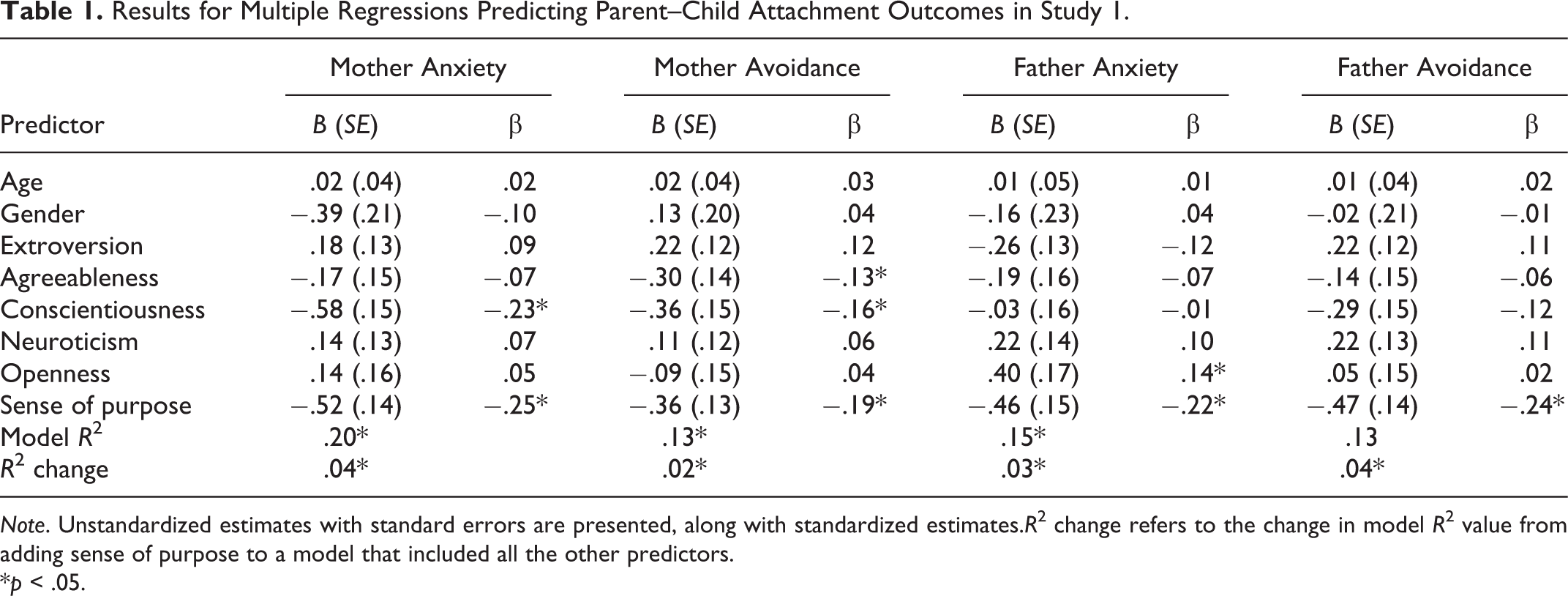
Note. Unstandardized estimates with standard errors are presented, along with standardized estimates.R 2 change refers to the change in model R 2 value from adding sense of purpose to a model that included all the other predictors.
*p < .05.
Results for Multiple Regression Predicting Dysfunctional Individuation in Study 2.
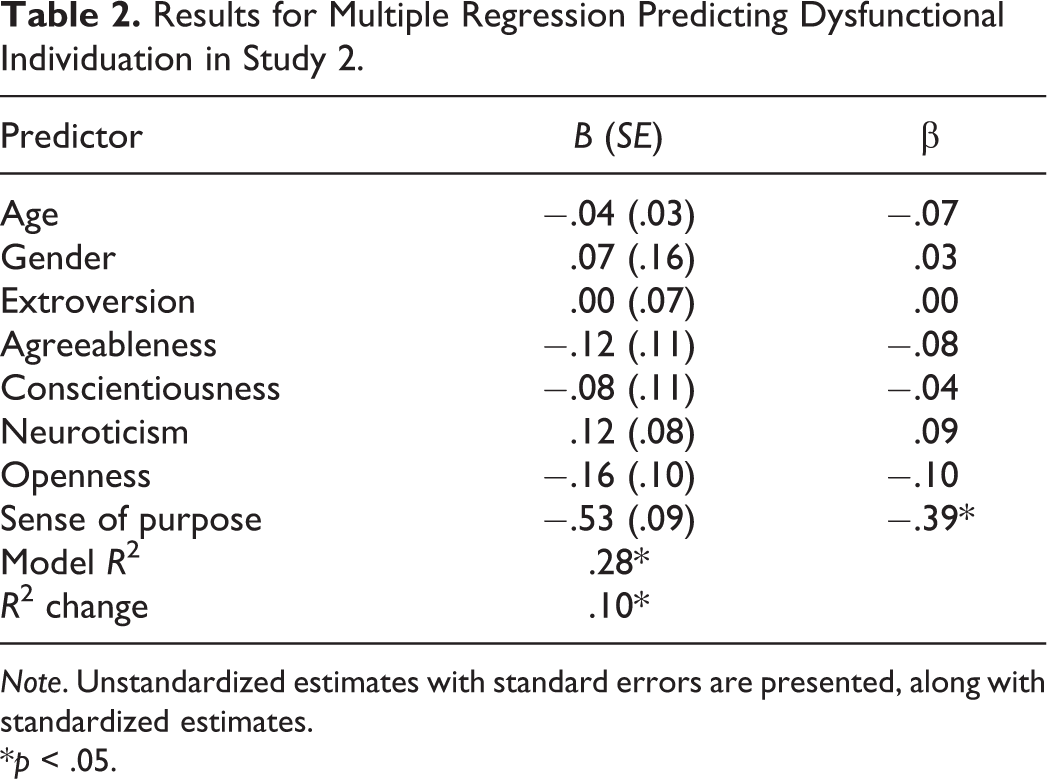
Note. Unstandardized estimates with standard errors are presented, along with standardized estimates.
*p < .05.
Finally, using Study 2 data, we examined whether dysfunctional individuation mediated the relation between sense of purpose and mastery beliefs. In line with expectations, sense of purpose correlated with greater mastery beliefs, r(255) = .56, p < .001. Mediation then was tested using a bootstrapping approach with 5,000 samples, controlling for age and gender effects. In this analysis, purpose retained a significant direct effect on mastery beliefs, B = .30 (SE = .04), t = 7.49, p < .05, though the indirect effect through dysfunctional individuation also reached significance, B = .11, (SE = .03), 95% confidence interval: [.06, .17]).
Discussion
The current studies provided evidence for linkages between sense of purpose and parent–child relationships during emerging adulthood, a transitory period often characterized by reduced parental surveillance and proximity (Arnett, 2000). First, emerging adults who scored higher on sense of purpose also reported more adaptive parental attachments as well as fewer separation–individuation difficulties. Second, these findings hold even when controlling for the Big Five personality traits. Third, it appears that one route by which sense of purpose promotes mastery beliefs during emerging adulthood is through avoiding separation–individuation difficulties. Accordingly, it appears that having a sense of purpose could assist emerging adults with the process of defining themselves while still maintaining adaptive relationships with their parental figures.
However, the current studies are limited in ways that should direct future research. First, the link between sense of purpose and parent–child relationships is likely bidirectional, which should be examined in future longitudinal work. Second, participants were undergraduates from a single school, and predominantly female, and thus future research should address the generalizability of the current findings; in particular, research should examine whether these findings hold for emerging adults not currently attending university. Third, research should examine participants’ purpose content (e.g., prosocial, financial, etc.), along with their sense of purpose. These caveats aside, the current studies provide a foundation for future research by formally linking sense of purpose to more adaptive parent–child relationships. As such, these studies suggest the potential for purpose-based interventions to promote parent–child relations during emerging adulthood and that parents may remain important figures in the purpose development process.
Footnotes
Authors' Contribution
Patrick L. Hill contributed to conception, design, and acquisition; drafted the manuscript; gave final approval; and agrees to be accountable for all aspects of the work in ensuring that questions relating to the accuracy or integrity of any part of the work are appropriately investigated and resolved. Anthony L. Burrow contributed to acquisition, critically revised the manuscript, gave final approval, and agrees to be accountable for all aspects of work ensuring integrity and accuracy. Rachel Sumner contributed to conception, design, and acquisition; critically revised the manuscript; gave final approval; and agrees to be accountable for all aspects of work ensuring integrity and accuracy.
Declaration of Conflicting Interests
The authors declared no potential conflicts of interest with respect to the research, authorship, and/or publication of this article.
Funding
The authors disclosed receipt of the following financial support for the research, authorship, and/or publication of this article: The preparation of this article and data collection was supported through funding from the Social Sciences and Humanities Research Council of Canada (Grant #430-2013-000029). This material is based upon work supported by the National Science Foundation Graduate Research Fellowship under Grant No. DGE-0707428.