







Abstract
The last two decades have seen a rapid acceleration of research on personality development focusing on the periods of late adolescence and young adulthood. The findings paint a picture of surprising quiescence in adolescence followed by a period of tremendous growth and change in personality traits in young adulthood. The patterns and potential reasons for these changes are discussed in the context of the Neo-Socioanalytic model of personality and the theory of emerging adulthood. The potential for convergence and collaboration between the fields of personality development and emerging adulthood is discussed.
Keywords
Introduction
Personality psychology, and especially the field of personality development, has made tremendous strides in the last two decades. Numerous longitudinal studies from many different countries have reported results on patterns of continuity and change over the entire life course, albeit with a central focus on young and middle adulthood. The critical mass of data has created an edifice summarized in several meta-analyses that have supported reliable, cumulative findings and sparked new theories about the way personality works across the life course (Roberts & DelVecchio, 2000; Roberts, Walton, & Viechtbauer, 2006). The picture that has emerged from these studies is eminently modest and reasonable, pointing to a picture of personality development in which there is remarkable continuity, but still room for change, even in old age.
Possibly because of the reasonableness of the findings, the ideas drawn from this work have yet to overtake more traditional perspectives on personality psychology often held by those outside of the field. In fact, it is common for people not steeped in the current research on personality development to hold one of the two stereotyped positions on personality psychology. The first, which we described as the “essentialist” model of personality (Roberts & Caspi, 2001) assumes that personality, especially in the form of personality traits, is essentially fixed. This perspective drives researchers to use personality trait measures as one-time predictors of outcomes, as they are assumed to not develop over time. The second, we described as the contextualist model of personality which argues that because people are not absolutely stable in their behavior from situation to situation, then personality traits either do not exist or simply do not matter much if they do. This perspective is reflected in research that emphasizes studying constructs that are presumed to be changeable, such as self-efficacy or other social cognitive variables, and ignoring personality traits.
Given the pervasiveness of the stereotypes held about personality psychology and the fact that the Society for the Study on Emerging Adulthood has focused on issues other than personality psychology, we felt it would be good to first review some of the new theory and research regarding personality psychology and personality development before examining areas of commonality and potential collaboration. To that end, we provide a brief overview of our working model of personality called the Neo-Socioanalytic Model of Personality (Roberts & Nickel, in press; Roberts, Wood, & Caspi, 2008) that helps to organize and potentially clarify how personality psychology and the study of emerging adulthood overlap and differ. We then focus our attention on recent developments in the area of personality development in young adulthood where we see the most potential for a fruitful interface between personality psychology and studies in the field of emerging adulthood.
The Neo-Socioanalytic Model
The Neo-Socioanalytic model consists of four primary, and essentially distinct, domains of personality: traits, values and motives, abilities, and narratives (for more in-depth descriptions, see Roberts, 2006; Roberts & Wood, 2006; Roberts et al., 2008). Figure 1 depicts these four domains in the model, along with the units of analysis, the modes of assessment, and the primary contexts thought to play a role in personality development. Traits, the first domain, are defined as the relatively enduring, automatic patterns of thoughts, feelings, and behaviors that people exhibit in similar situations across time (Roberts, 2009). Values and motives, the second domain, reflect what people find desirable—that is, what people want to do or would like to have in their lives. The third domain consists of abilities and identifies what people are capable of doing. Abilities are classically viewed through the lens of cognitive abilities but could also include abilities in other areas, such as emotional and physical (Lubinski, 2000). The fourth and final domain focuses on the stories and narratives people use to understand themselves, their environments, and the history of their lives (McAdams, 1993).
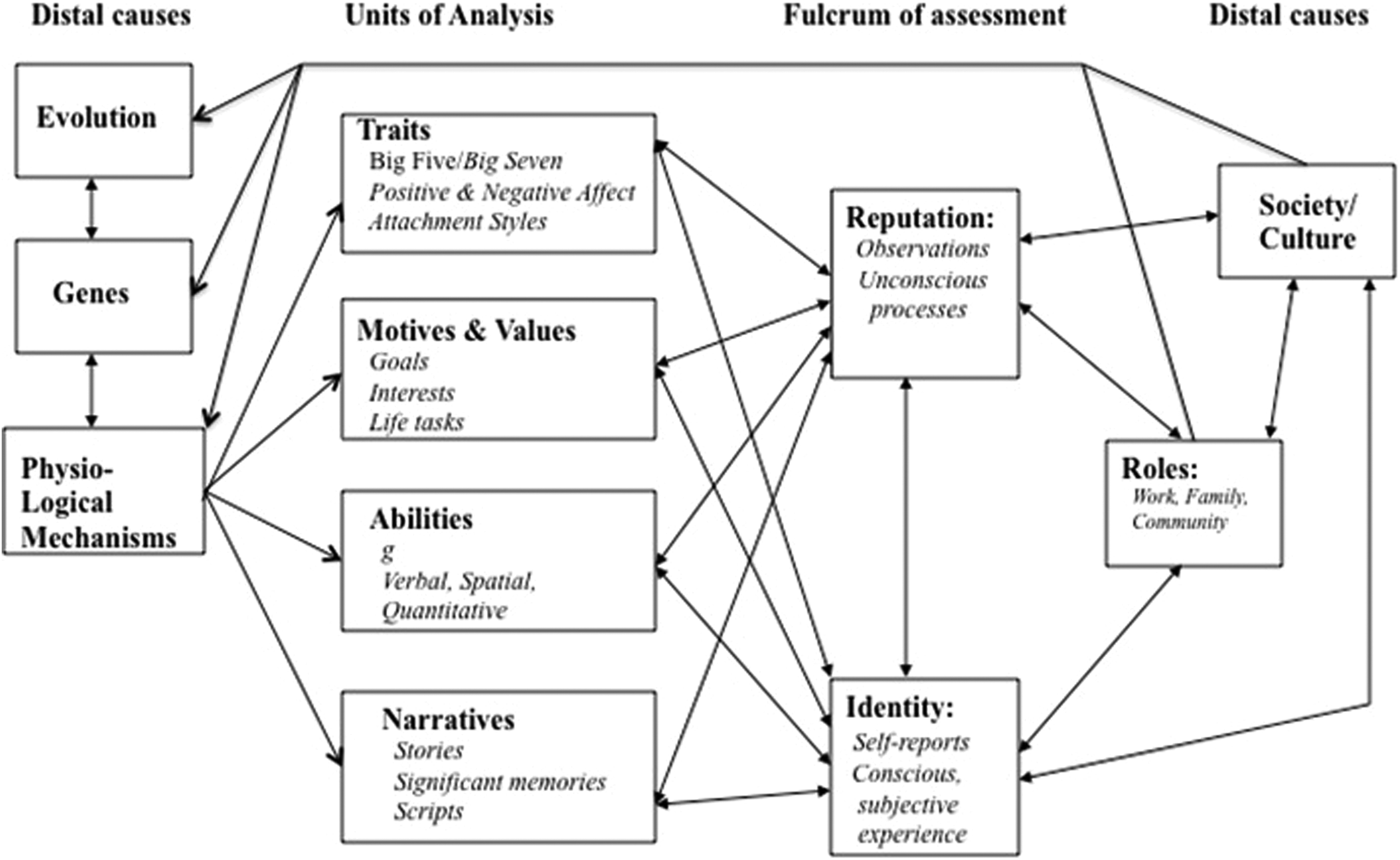
The Neo-Socioanalytic model of personality.
The domains of personality are both manifested by and organized around two entities, reflecting both the psychological and the methodological: (1) identity, assessed through self-reports and (2) reputation, assessed through observer reports. Self-reports and observer reports represent two privileged, yet flawed, ways of accessing information about people—what they say about themselves and what others say about them, respectively. Personality inventories represent typical self-report methods, whereas observer methods can include observer ratings of behavior, projective tests, implicit measures, and even physiological tests.
Self-report and observer methods correspond to global psychological constructs of identity and reputation that have meaning above and beyond the methods themselves. Identity reflects the sum total of opinions cognitively available to a person across the four units of analysis described above. Traits, the first domain of these cognitions, are the content of identity—whether people consider themselves shy or creative, for example. Identity also pertains to the meta-perceptions of one’s self. Specifically, people can see themselves as both “outgoing” and a “carpenter” (content) and feel more or less confident and invested (meta-perception) in those self-perceptions.
Reputation is others’ perspectives of a person’s traits, motives, abilities, and narratives. Consistent with the concept of the “looking glass self,” reputation can affect identity; that is, people will come to see themselves differently depending on how others define them (Cooley, 1902/1964; Erving, 1959; Goffman, 1959; Shrauger & Schoeneman, 1979). But others’ perspectives of a person do not always impact their identity, as underlying dispositions can affect reputation directly without being mediated through identity. This reflects the fact that people are not always aware of their own behavior and that others may see patterns in their behavior that they do not. We also propose that people actively shape their own reputation, seen in Figure 1 with an arrow pointing from identity to reputation. For example, in an effort to maintain a positive reputation, people do not share all of their self-perceptions with others and actively attempt to persuade them of their desirable qualities (Goffman, 1959).
When considering the environment, we prefer social roles as the unit of analysis for several reasons. First, like the Big Five personality traits, social roles are a collection of environments and are therefore at a similar level of abstraction as personality traits. Second, we know a lot about social roles because they have been the focus of much research, especially in other social sciences, such as sociology. Social roles tend to fall in two broad domains that correspond closely to two primary motives: (1) status and (2) belongingness (Roberts, 2007). Roles associated with status include work and social position roles, such as CEO, supervisor, or Parent Teacher Association president. Roles associated with belongingness include friendship, family, and community roles, such as father, mother, or friend. Although work is often associated with status hierarchies, both status and belongingness roles can be found in the workplace. Clearly, the person who aspires for and achieves the CEO position has acquired a high-status role. But many friendships are made and fostered through work and serve to provide meaning and support in a situation where status is salient.
The Neo-Socioanalytic framework was developed not only to help organize and understand the domains of personality but also to better understand personality development. To that end, we have developed a set of principles or assumptions underlying the relation between the framework and personality development (Roberts & Nickel, in press; Roberts et al., 2008). Several of these principles are key to understanding not only personality development but also the interface between personality development and systems like those found within the literature on emerging adulthood. For example, dimensions of emerging adulthood such as identity exploration are prone to change with age, as are personality traits like conscientiousness, thus development in emerging adulthood is likely to intersect with personality development, especially during young adult years. The key basic assumption is that the personality system is plastic throughout the life course. Described as the plasticity principle, this idea indicates that personality traits and other personality dimensions can and do change at any point in the life course (e.g., Jackson, Hill, Payne, Roberts, & Stine-Morrow, 2012). This idea is fundamental to both the thesis of this article that young adulthood is the crucible of development and the idea of emerging adulthood. Both of these positions highlight the fact that human development is not finished in early childhood like many systems assume.
Personality Development in Young Adulthood
If one follows the developmental literature, it would appear that young adulthood is not an important time in the life course to study or understand personality development. In contrast, the field of developmental psychology appears to be obsessed with cognitive development in early childhood (Siegler, 2016), socioemotional development in late childhood, and of late, adolescent development with an increasing focus on biological indicators (e.g., Dahl, 2004). In particular, how the adolescent brain develops has received increasing attention with the idea that the functional and structural development during this time is key for phenotypic development, especially for maturity-related phenotypes like self-control (Shulman, Harden, Chein, & Sternberg, 2014).
Given the high level of attention now aimed at adolescence, one would assume that the transition from childhood to adolescence and the period of adolescence would show consistent developmental trends in both behaviors and brain function and morphology. However, this does not seem to be the case (Göllner et al., 2016). Phenotypically, adolescence appears to be a confluence of contradictions. Teenagers increase in features of sensation seeking while also becoming more self-controlled (Harden & Tucker-Drob, 2011). Similarly, the structural and functional developmental patterns are uncertain. While it appears that adolescence is a period in which greater white matter connections are built, the remaining functional and structural changes are less clear (Crone & Dahl, 2012).
Interestingly, the developmental research on personality in childhood and adolescence mirrors the murky picture for brain changes. A closer look at existing longitudinal studies in terms of Big Five personality traits shows substantial heterogeneity of personality trait change during the transition from childhood to adolescence (Branje, Van Lieshout, & Gerris, 2007; De Fruyt et al., 2006; Klimstra, Hale, Raaijmakers, Branje, & Meeus, 2009; McCrae et al., 2002; Pullmann, Raudsepp, & Allik, 2006; Soto, John, Gosling, & Potter, 2008; Van den Akker, Deković, Asscher, & Prinzie, 2014). To date, there is no clear pattern of cross-study consistency. For instance, two of the referred studies showed increases for the trait of extroversion (Klimstra et al., 2009; Pullmann et al., 2006), three studies showed decreases (Branje et al., 2007; Soto et al., 2008; Van den Akker et al., 2014), and two studies showed no mean-level changes (De Fruyt et al., 2006; McCrae et al., 2002). The same is true for other traits such as conscientiousness, agreeableness, openness, and neuroticism. Of course, most of these studies emerge from Western countries. Different patterns may emerge if cultures that vary on how they structure the life course are studied (e.g., Bleidorn et al., 2013).
A recent study provides an excellent example of the quixotic nature of adolescence (Göllner et al., 2016). Self-reported changes in the Big Five were surprisingly nonexistent. Despite the evidence for the tension and anxieties that are pervasive in adolescence, for example, boys and girls did not report getting more neurotic with age. For that matter, they showed no marked change on the remaining Big Five dimensions with the exception of a slight drop in openness to experience. While the parent ratings are similarly unchanging on three of the five traits, they did show conspicuous declines rather than gains on agreeableness and neuroticism. If anything, parents are seeing their children become prototypical teenagers in the stereotypical sense, such that they are becoming less nice to be around and more confident in their disagreeableness.
In stark contrast to adolescence, personality change in young adulthood is dramatic and quite positive (Roberts, Walton, & Viechtbauer, 2006). Figure 2 shows the aggregate amount of change by age period discerned from the 2006 meta-analysis. While there is substantial change in the aggregate in adolescence, this amount of change is doubled in the subsequent decades (see Figure 2). For example, our meta-analysis of the mean-level changes in personality traits over time (Roberts et al., 2006) found that most people become more agreeable, conscientious, and emotionally stable in young adulthood. In particular, increases in emotional stability occurred from adolescence to middle age. Conscientiousness appears to begin a systematic increase in young adulthood and then shows increases even into old age. Changes in agreeableness were less clear but tended to show small increases across adulthood. Interestingly, the meta-analysis also showed robust increases in a facet of extroversion, described as social dominance. Social dominance reflects higher levels of assertiveness, self-confidence, and dominance and showed marked increases in young adulthood.
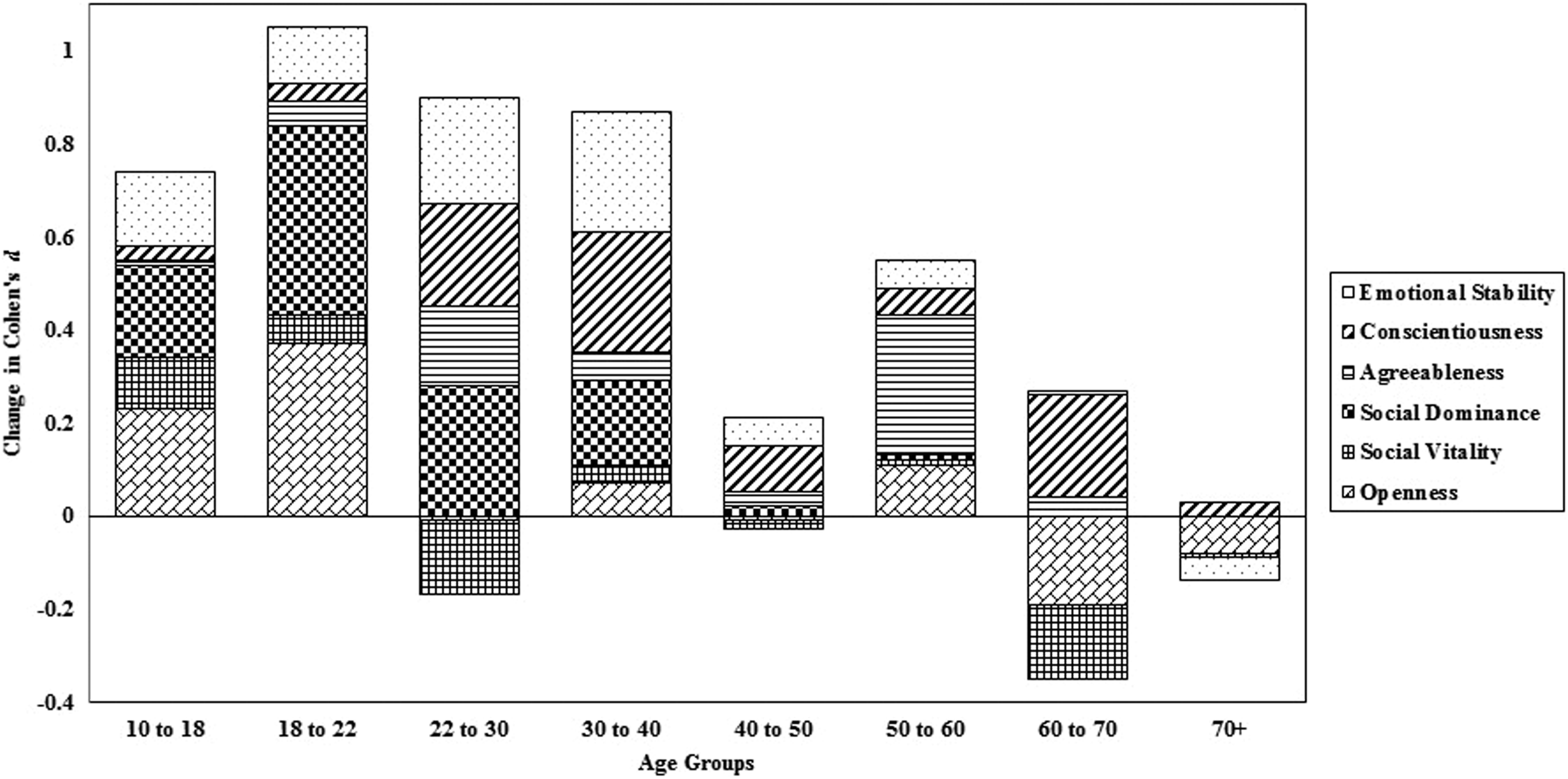
Aggregate change in Big Five personality traits on d-score metric across the life course. Order from top to bottom for age-group 18–22 is emotional stability, conscientiousness, agreeableness, and social dominance.
Both cross-sectional and longitudinal research since 2006 have shown support for the argument that people generally increase in agreeableness, conscientiousness, and emotional stability after they emerge from adolescence. Numerous cross-sectional aging studies have now shown, across cohorts, that older people are more agreeable, conscientious, and emotionally stable (e.g., Donnellan & Lucas, 2008). The longitudinal evidence in support of this pattern is especially impressive because it encompasses data from multiple, independent research teams, and multiple longitudinal studies from a variety of countries. For example, a longitudinal study of Iowans found increases in measures of constraint, a form of conscientiousness and marked decreases in measures of neuroticism in the transition to young adulthood (Donnellan, Conger, & Burzette, 2007). Remarkably similar findings have been reported for longitudinal studies from Minnesota (Johnson, Hicks, McGue, & Iacono, 2007) to many different countries in Europe (Josefsson et al., 2013; Lüdtke, Roberts, Trautwein, & Nagy, 2011; Vecchione, Alessandri, Barbaranelli, & Caprara, 2012).
The fact that young adulthood is the crucible of personality trait development is worth considering in more detail, as it fundamentally challenges most perspectives on personality development. Within academic discourse, the shear amount of attention paid to development in childhood belies the obvious assumption that most development occurs early in the life course. In many departments of psychology, it is difficult to find researchers who extend their view of development into adolescence, no less beyond into young adulthood. Of course, the most widespread implicit model of personality is that it does not change at all. No theory or folk concept of personality marks young adulthood as the primary time of development and subsequently little attention has been paid to it. The fact that personality changes so much in young adulthood invites the question of why, which we turn to next.
The Social Investment Principle: One Potential Reason for Changes in Personality in Young Adulthood
The social investment principle is an attempt to explain why people tend to increase on traits like conscientiousness and emotional stability in young adulthood. Specifically, it posits that personality trait change in young adulthood occurs because of investments in conventional social roles, which bring with them experiences and expectations for being nurturing, responsible, and emotionally stable (Roberts, Wood, & Smith, 2005). In other words, the personalities of young adults change as they commit to adult social roles (Lodi-Smith & Roberts, 2007). This seems to be a normative process, because across most societies, people commit themselves to the adult roles found in the social structures of family, work, and community (Helson, Kwan, John, & Jones, 2002).
The expectations that come with various roles are thought to be the key mechanism via which personality change occurs as a result, the transition to adulthood (Roberts & Wood, 2006). Therefore, people anticipate changes in behavior that will be needed as they enter new roles, such as taking their first career-related job or becoming a parent for the first time (Roberts & Wood, 2006). Moreover, others will promote and reward these changes because they share the expectations with the role participant. Finally, new roles come with explicit experiences, rewards, and punishments that lead to changes in thoughts, feelings, and behaviors, which translate into personality change over time.
Indeed, longitudinal data support these ideas by having shown that changes in social investments correlate with changes in personality traits. For example, Lehnart, Neyer, and Eccles (2010) found that young adults who became increasingly socially invested in romantic relationships over time experienced increases in emotional stability. Furthermore, a 2-year longitudinal study of students from Finland showed that initiating a career or job for the first time was linked to increases in conscientiousness (Leikas & Salmela-Aro, 2015). In a study of age differences in personality traits across 62 countries, people who adopted adult roles earlier showed an accelerated form of personality development consistent with the social investment principle (Bleidorn et al., 2013). For example, in countries such as Pakistan, where people enter into adult roles at an earlier age, than a country such as Belgium, there is a faster decrease in the age differences typically found on a trait such as neuroticism.
Conversely, a number of studies have shown that participating in activities that are seemingly antisocial is associated with trends in personality change that actually contradict the normative changes found for the majority of the population (Roberts & Bogg, 2004). These findings are critical for the viability of the social investment principle, as it relies in part on the inference that social experience, rather than genetics, is the driving force for personality trait change. If the results had only shown that normative experiences (e.g., starting a new job) were associated with positive change (e.g., increases in conscientiousness), then it would be possible that a third variable, like genetic factors, was the hidden cause of personality development. However, the finding that people can buck the general trends in personality change in young adulthood bolsters the inference that social experience is a causal force. Supporting this idea, there is now a set of longitudinal studies showing that “de-investment” is associated with a lack of increases and sometimes decreases in traits like neuroticism and conscientiousness. For example, participating in counterproductive work behaviors, such as stealing, arriving at work drunk, or fighting with one’s coworkers and supervisors, was associated with decreases in emotional stability over time (Roberts, Walton, Bogg, & Caspi, 2006). Similarly, continuing to abuse alcohol in young adulthood is associated with a lack of change in conscientiousness-related traits such as impulsiveness, which typically decreases during this age period (Littlefield, Sher, & Steinley, 2010).
However, two findings from recent research pose a challenge to the social investment principle. First, one study showed that longitudinal changes in psychological investment in work were associated with predicted changes in personality traits, but not only in young adulthood (Hudson, Roberts, & Lodi-Smith, 2012). Although this is only one study, and though it partially supports the social investment principle, the findings are relevant to the age specificity of the principle. There may be nothing special about social investment in young adulthood, and relevant experiences may lead to personality trait changes at any age. If so, it would be incumbent to show that the preponderance of factors associated with the social investment principle occur in young adulthood, which has not been shown.
The second finding that poses a problem for the social investment principle is the lack of personality change associated with becoming a parent (van Scheppingen et al., 2016). Unlike other normative transitions, becoming a parent is not associated with the requisite increases in agreeableness, conscientiousness, or emotional stability that are the basis of the social investment principle. In fact, if anything, becoming a parent is associated with no change or slightly negative changes in personality traits (e.g., Galdiolo & Roskam, 2014). Thus, for one of the critical demographic transitions in young adulthood, the data do not support the main argument of the social investment idea.
While the preponderance of findings to date supports the social investment principle, the two studies described above warrant further consideration of the basic assumptions underlying the social investment principle and possibly the possibility of alternative theories. In fact, contemplating the possible alternative explanations provides a strong link to the field of emerging adulthood.
A Facultative Calibration Model of Personality Development in Young Adulthood
The social investment principle follows conceptually from typical sociological ideas of socialization, which tend to focus on concrete experiences that demand or facilitate change. The relatively simplistic assumption being that people would have to experience actual environments and concomitant experiences brought about because of environmental changes to subsequently change their personality. At its root, this idea is a recapitulation of behavioristic ideas of classical conditioning and reinforcement learning (Caspi & Roberts, 1999).
While not an unreasonable assumption, it undersells human complexity and the fact that humans wield, create, and are governed by symbols as much as reality. The potential role of ideas and symbols driving personality change has already entered the empirical domain of personality development. Several studies have shown, for example, that people change in the ways described above, not through direct experience but simply through adopting new goals for their lives that represent the future realities that are expected to come with the acquisition of roles tied to the social investment principle (Bleidorn et al., 2010; Roberts, O’Donnell, & Robins, 2004). This empirical pattern offers one possible explanation for the lack of effect of acquiring the parent role on personality change. The relevant change may happen well in advance of becoming a parent; people who want to be parents may plan far in advance to have children and do the appropriate work on their identity well before embarking on that enterprise. This identity work, such as envisioning what it means to be a parent and changing one’s behavior to match that future self, may be the cause of personality change rather than the actual experience of parenting. This possibility points to the need for future studies that not only track people well before they enter their adult roles but also track the changes they engage in that pertain to their future identities rather than the current selves.
There is a second, broader possibility that integrates both the potential role of hypothetical identities and the contingent nature of actual experiences. Specifically, it has been suggested that development is intrinsically contingent rather than simply genetic or environmental (Roberts & Jackson, 2008). That is to say, one’s particular developmental pathway is a synergistic combination of selected attributes that are calibrated to more basic features of reproductive fitness (Tooby & Cosmides, 1990). For example, it has been argued that the development of extroversion is calibrated to physical stature, such that people who are stronger and more attractive develop into more assertive and extroverted people because of the confidence that comes with the physical features to which extroversion is calibrated (Lukaszewski & Roney, 2011). Appropriately, individuals who are more physically attractive and stronger (in men) are also higher in extroversion.
Inspired by this logic, one could make a similar argument for the development of personality in young adulthood. Rather than thinking that the changes found in young adulthood are only contingent on the actual demands found in concrete experiences, one could hypothesize that personality development calibrated to the perception of functioning well as a newly emerging adult (EA). That is to say, one would change in the direction of higher conscientiousness, emotional stability, and agreeableness to the extent that he or she felt they were competently handling and making the transition to adulthood. This differs from the initial views on facultative calibration, which focused mostly on physical features and instead argues that the psychological features of competently handling the perceived transition to adulthood would be the construct to which personality development was calibrated.
The advantage of this new perspective is that it frees up the assumptions from a simplistic behavioral model intrinsic to the original social investment principle to encompass the fact that people can and do change in these positive directions with only the idea of becoming an adult. This would also help to both identify more important mechanisms of change and why becoming a parent was not associated with the requisite changes in personality expected from the social investment principle. In particular, the focal variables driving personality change would be the perceptions of competence and confidence in handling the transition to adulthood, which would come about well in advance of ever acquiring the actual roles of adulthood. Therefore, college students might show increases in conscientiousness, emotional stability, and agreeableness because they assume that successfully handling the challenges of higher education are functionally preparing them for the actual role of adulthood.
One advantage of thinking that perceptions of how one is handling the transition to adulthood as the facultative calibration mechanism for personality development is that it provides an obvious interface with the study of emerging adulthood. We turn next to this possibility.
The Interface of Neo-Socioanalytic and Emerging Adulthood Perspectives on Development
The theory of emerging adulthood has developed roughly over the same timeline as the recent trends in research on personality development. The focus on emerging adulthood arose to describe the developmental transition between adolescence and young adulthood. Specifically, the field of emerging adulthood focuses on development between the ages of 18 and 29 (Arnett, 2000, 2005, 2006; Côté, 2006). Two features of the theory of emerging adulthood make it especially interesting as a point of contact for the study of personality development. First, it has identified a recent demographic trend in which individuals are delaying traditional adult roles (e.g., marriage, buying a home, “settling down,” having children) and are now engaging in more identity exploration (Arnett, 2001; Côté, 2006; Goldscheider & Goldscheider, 1999; Mulder, 2009). This corresponds concretely to the mechanisms and processes that are assumed to underlie key features of the Neo-Socioanalytic model, such as the social investment principle. Second, and in relation to the emerging perspective that is manifest in the alternative, facultative calibration idea of personality development in young adulthood, the hallmark of emerging adulthood is a focus on the psychological dimensions related to perceiving oneself as an adult or not.
Specifically, Arnett (2000) developed the dimensions of emerging adulthood claiming emerging adulthood is an age of identity exploration which individuals experiment with various life paths and focus on their individual needs; an age of negativity/instability, indicating EAs are mobile and have numerous transitions in work, school, housing, and relationships (e.g., significant other); an age of being more self-focused where young adults move away from the authority of parents and start to focus on their own needs thus creating an age of less other focus; an age of feeling in-between, such that young adults feel in-between adolescence and adulthood; age of experimentation/possibilities where EAs feel optimistic about the future (Arnett, 2000, 2006; Reifman, Arnett, & Colwell, 2007). Presumably, if young adults successfully negotiate this period of development, they should show a particular pattern of change in these dimensions. Competently making the transition from adolescent to adult would entail ending one’s exploration and experimentation, feeling less in-between, becoming more other focused, and as a result experiencing less negativity and instability.
An obvious question linking the field of personality development and the dimensions of emerging adulthood is whether those dimensions not only change during young adulthood but also account for some of the changes in personality traits during that time? Rather than conjecturing about this possibility, we decided to gather some data on the topic. We surveyed 823 participants drawn from Mechanical Turk who were between the ages of 18 and 29. We asked them to complete measures of personality traits, in particular the 36QB6, which measures the “Big Six” personality trait dimensions: extroversion, agreeableness, conscientiousness, emotional stability, intellect, and honesty/humility (Thalmayer & Saucier, 2014). We also administered the Identification of the Dimensions of Emerging Adulthood (IDEA), which assessed the major dimensions of emerging adulthood.
Table 1 shows the correlations between age and the two measures. As can be seen, many of the dimensions of emerging adulthood are correlated with age. People tended to be higher on being other focused but lower on all other dimensions, like identity exploration, experimentation, and feeling in-between. Similarly, one sees age-related correlations with personality traits, such as older participants being higher on conscientiousness. Interestingly, if one uses the dimensions of emerging adulthood as controls, one sees a marked reduction in the correlation between age and personality traits. This finding is consistent with the idea that identity-related thoughts about becoming an adult may help to explain the development of personality traits in young adulthood. While the study was only self-report and cross-sectional, it does highlight the possibility of merging developmental perspectives on personality development with the field and ideas of emerging adulthood.
Correlations Between Age and the Big Six and IDEA Scales.
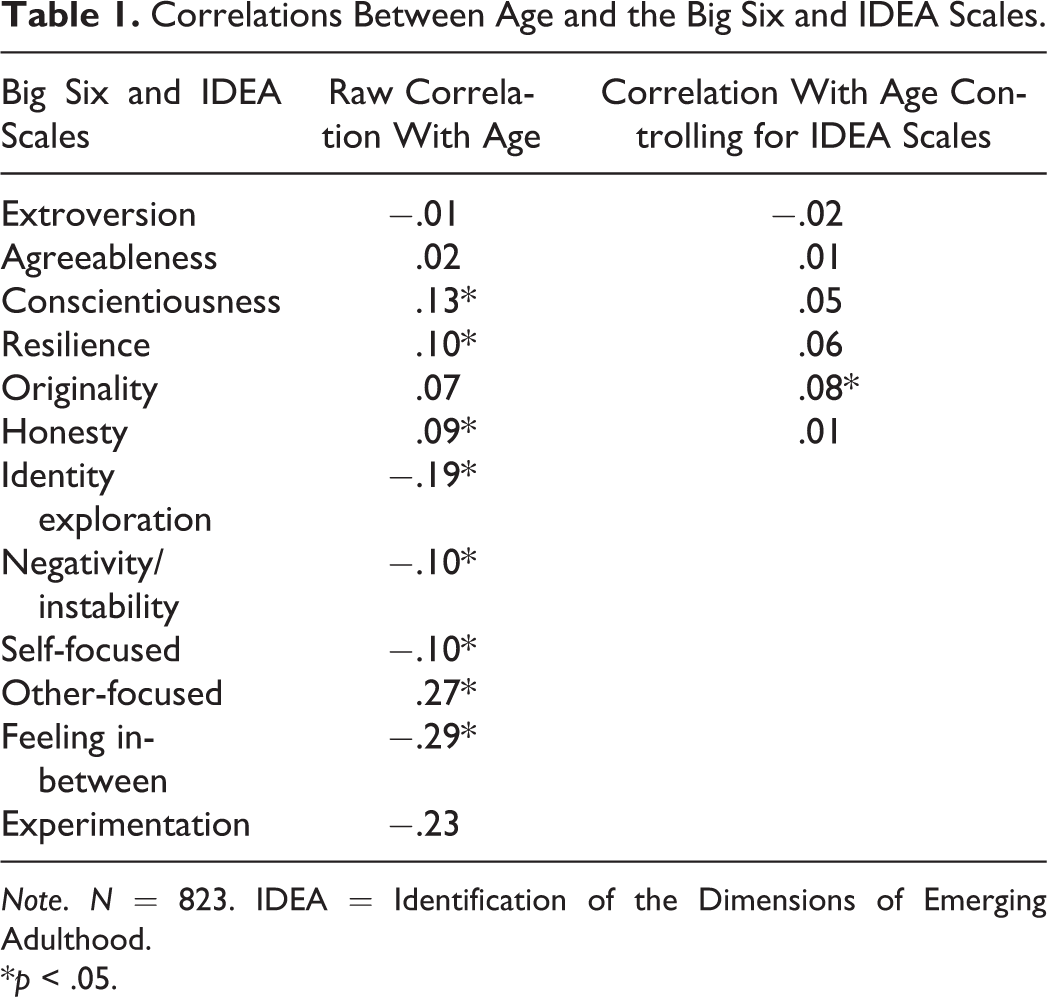
Note. N = 823. IDEA = Identification of the Dimensions of Emerging Adulthood.
*p < .05.
Conclusion
Historically, development is an idea disproportionately associated with childhood and only marginally with adolescence. The hallmark of the field of emerging adulthood is that development continues well past adolescence. Consistent with the essential premise of emerging adulthood, the modern view of personality and personality development, in particular, is that personality traits are developmental phenomenon. Moreover, the key period of the life course for personality trait development is young adulthood, which corresponds perfectly to the view of the field of emerging adulthood. In this confluence, we see much potential.
Building on the ideas alluded to in our small empirical example, we see linking ideas in emerging adulthood to the processes of personality development in young adulthood to be an obvious future direction for research. Longitudinal studies that investigate the codevelopment of identity-related dimensions found in the IDEA and the changes found in personality traits may help to solve riddles such as why becoming a parent does not lead to positive personality change. Similarly, examining both the idea of emerging adulthood and personality development in cultures where the life course is accelerated or delayed would provide fertile data for both perspectives. We see much in common and much potential in the interface between these two fields.
Footnotes
Author Contribution
Brent W. Roberts contributed to conception and design, drafted the manuscript, gave final approval, and agrees to be accountable for all aspects of work ensuring integrity and accuracy. Jordan P. Davis contributed to conception, drafted the manuscript, critically revised the manuscript, and agrees to be accountable for all aspects of work ensuring integrity and accuracy.
Declaration of Conflicting Interests
The authors declared no potential conflicts of interest with respect to the research, authorship, and/or publication of this article.
Funding
The authors received no financial support for the research, authorship, and/or publication of this article.